Blog

  • Surfing New Zealand’s North With Rapu Adventures

    Surfing New Zealand’s North With Rapu Adventures

    There is a feeling you get when you surf. It’s a mixture of many feelings – the spray of salt water in your face, the thrill of zooming across an open wave, the sight of a curving ocean spreading in front of you, the sound of your heart pumping faster and faster against your rib cage, the feeling of knowing you can tumble to your demise at any moment, the head rush jolting through you when a wave finally picks you up, and maybe most thrilling of all, the adrenaline rush from all the ocean’s boundless beneath your feet, making you forget about everything else in the world for those precious few seconds.

    This feeling, is known as the stoke.

    This week is about chasing the stoke. I’m in Ahipara, a little gem hidden in New Zealand’s north, on a five day surf tour with the boys from Rapu Adventures. And I’m ready. Ready to wake up before sunrise. Ready to paddle until my arms fall off. Ready for the stoke.

    On the first morning we are at the beach by 6:30. It’s empty. Tide is low.

    I jump out of the van and stare at the ocean. It looks small. But I know better. It’s an illusion. When you get out there, it’s bigger than you ever imagined.

    This is not my first surf camp in New Zealand, nor my first time in Ahipara. I’ve surfed with Rapu quite a few times – I caught my first wave with them back in 2015.  And every day we hit the ocean together I learn something new.

    Still, I’m not a very good surfer. But if I catch one awesome wave this week, I’ll be happy. Just one. But to catch that one awesome wave, you have to chase it. I stare at the ocean, wondering where I should be chasing it today. Maybe over there? Or there? Just one metre too far to the left or the right, and your wave is going to leave you behind. Hmm. Tell me, wave. Where are you going to be today?

    Brett, the coach, sees me staring at the water and comes over. Brett is the head honcho – he runs this whole shit. He’s a scientific surfer. Everything in his camps is calculated. Which beach, what time, which board, down to the exact spot in the ocean he wants me to paddle to – he figures it all out, creates the gameplan, and then comes and divulges it all.


    A post shared by Bren (@brenontheroad) on

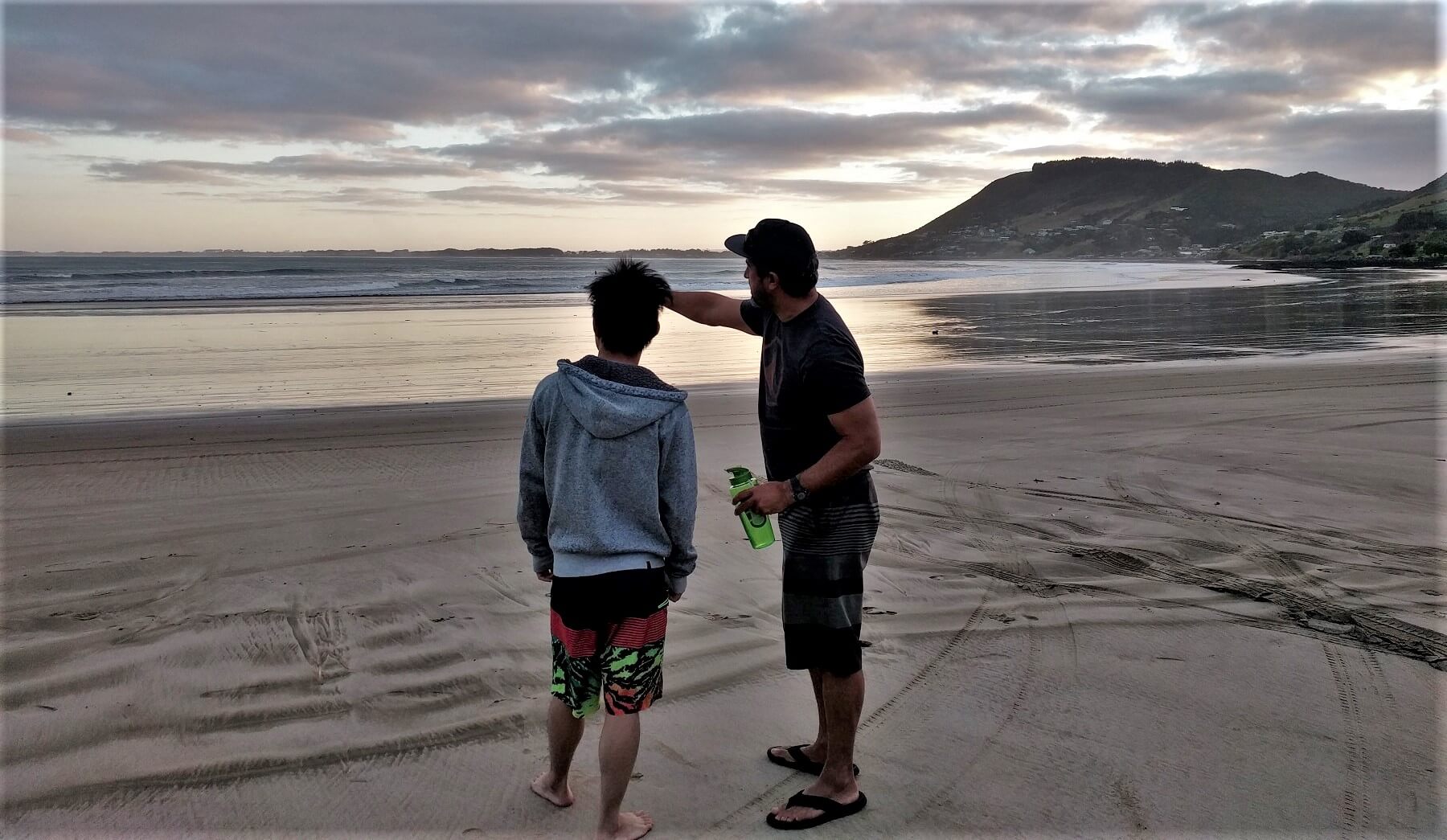
    “If you look closely, you can see the ocean drifting to the right. That’s called a longshore drift. That means we need to start way out over there – and then we’ll end up way out over here.” 

    His arm drifts slowly from the left to the right as he says it.

    We suit up and walk out, over the rocks. I walk as if on egg shells, my feet still soft, accountant’s feet, you could say. The others bounce along it, as if running on sand. I guess I have a few years to go before I earn my surfer’s feet.

    When we get to the paddle out spot, Brett turns and waves me over.

    “Okay look, that’s where you want to go.”

    He points into the water, about thirty metres out.

    “To get there, wait for a lull, and then just paddle full speed, right there. There’s a drift, remember. So paddle with it, 45 degrees.”

    Easy. I wait for the lull – the calm period between the swells. When it comes, I go. Paddle, paddle, paddle. After a few minutes, my arms start to burn. I look at the spot I need to get to. Still not there. I paddle harder. One wave nearly bowls me over. I turtle roll under it, and keep going. Jelly arms. Still not there. After about ten minutes, I sit up on my board. I can’t paddle any more. I look around and scream a few swear words. I’m nowhere near the spot. In fact, I’m halfway down the beach already. Miles and miles away. How the hell did I get here?

    Then I proceed to get pummelled by the ocean. I miss a bunch of waves. Get smashed by even more. I catch a grand total of…zero.

    After two hours of abuse I pick my board up and walk up to the van, breathless. Brett, and Ben – the other coach, are already up there, loading up the trailer.

    “How’d you go?” Brett asks as we drive back to the house.

    “Just got demolished the whole time.”

    I laugh, but secretly, I’m disappointed in myself.

    “That’s cool! That’s what it’s about half the time.”

    We get back to the house and have some breakfast. Everyone chooses a different fuel for the day – cereal, toast, fruit, coffee, juice. I stick with green tea and a few scrambled eggs.

    “Pack a lot of water guys, we’re at the beach for the whole day today,” Brett says.

    At around 10 o clock we get back to the beach and set up a gazebo on the grass above the sand. The surf is cranking. It feels like everybody in Ahipara is here today. I rummage through the snack box and then go lounge in the gazebo with the others. For the first hour we eat muesli bars and watch everyone else in the surf; pointing, laughing, lots of oohs, ahhs.

    Eventually Ben takes off for a surf. Then Laurissa, a Canadian girl, takes off too. We watch her for a little while. Brett pulls out his camera and takes a few photos. It’s her first time surfing, but she’s pretty resilient. Wipes out, gets back on. Wipes out, gets back on. Trooper.

    Finally, I decide to suit up. I slip the wetsuit on and grab my board. Brett always gives me this board. The magic carpet, he calls it. Apparently it really flies if you surf it right. I am yet to experience this magical ride.

    I paddle out to where Ben is waiting for me. We bob up and down on our boards, waiting for the sets to come in. I’m like his little poodle in the water. When Ben paddles left, I paddle left. When he paddles further out, I paddle further out. When he sits, I sit. Then when we’re lined up and a wave is standing up behind us, he nods at me and whispers go, go, go.

    That’s what he’s doing right now. Go, go, go. I turn around and paddle furiously. I look behind me. It’s right there, towering above me. Everything Brett has ever taught me runs through my head in a matter of seconds. Four power paddles! Lean on the inside rail! Look down the wave! Chest up! Board flat! Feet out of the water!

    In every wave, there’s a split second where you either make it or your don’t. If you were a little too slow, a little too fast, too much angle, not enough angle, leaning too left, leaning too right, the wave leaves you behind. Or swallows you up and dunks you. Either way, you missed it. On this wave, I don’t know what I did wrong. Probably everything. The wave flips me over and slams me underwater before rumbling on without me.

    When I come up, I pull my board towards me and climb back on. Next time, I tell myself. I look back and Ben is already up on a wave, zooming along. He swooshes right past me as I paddle back out. It looks like he’s out walking his dog on a Sunday morning. How does he make it look so easy?

    That night we all help put together a big feast for dinner. Brett cooks the steaks on the barbecue outside while Laurissa roasts some potatoes and makes up a big bowl of salad. Ben sets the table. Myself and the other Swiss dude on camp with us, I forget his name, we stand around and watch them. Teamwork.

    I love dinner at Rapu camps. We always eat good, and we’re always hungry. We sit around the table feasting and in between wave stories the others tell us about life in Canada and Switzerland. And then of course Brett always has a funny story or two to share. After that, I do the dishes with Switzerland, we study some photos with the coaches, and it’s off to bed to recharge. Tomorrow, another early morning surf awaits.


    A post shared by Bren (@brenontheroad) on

    Day 3. I am trying really hard to see what Brett sees. He looks out over the ocean and it’s as if he sees numbers, patterns, a secret code. He explains it to me, the swell, the drift, the period, the break, the peel, and I can see parts of it, but I can never see it as a whole picture. I always wonder, what exactly does he see that I don’t?

    This morning’s surf is better than the day before. I get up on a few waves, small ones, before we head in for breakfast. The second session is pretty much a repeat of the day before. I do something wrong. Brett tells me what I did wrong. I go out and do it right, but then I do something else wrong. Brett tells me what else I did wrong. I go out and…yeah, you get the picture. Eventually the sun starts to set. Home time.

    That night we all crowd around the laptop and look at more snaps from the day. Brett goes through a few with Laurissa and Mister Switzerland. Then it’s my turn. It goes something like this:

    “Alright Brendan’s up. Here we go, he looks good.”

    “Brendan mate, where are you supposed to look when you’re paddling in?”

    “Down the wave.”

    “Where are you looking?”

    “At my board.”

    “Why are you looking at your board bro! [giggles]. You can’t ride into the wave if you don’t look at where you’re going.”

    “Look at what’s happening here. This happens to you on almost every wave eh. This wave is going to flip you right over. I’ve told you how to stop yourself flipping over like that eh, how do you do it?”

    “Lean on the inside rail.”

    “Are you leaning on the inside rail here?”

    “Nah.”

    “Yeah. So you’re gonna get smoked eh.”

    “Boom. Got smoked. That’s happening to you a lot. You picked a good wave too, if you were leaning on the rail you would’ve been in that wave easy mate! Alright next one.”

    “Alright I can already tell you’re going to get smoked here. What’s wrong with this wave?”

    “Too late.”

    “Yeah mate. Way too late eh. Let’s take a look at what happens.”

    “So it’s just gonna swallow you. But also look at your feet! Get your feet outta the water mate – that’s a real bad habit of yours. It’s like two anchors you’re dragging along. That’s why you struggle to get speed sometimes.”

    “Where are you looking? Why are you looking at your board! Look down the wave bro!”

    “And boom. So just timing on that one. But still you can see all the things you need to work on in that wave too eh. You’re almost there! Just a few things to fix and you’ll be there.”

    And that’s pretty much how it goes for the next hour. At least for my waves. Switzerland got some good ones. Laurissa too. And Ben. But I’m amped for tomorrow now. I can’t wait to lean on the inside rail and get my feet outta the water and look down the wave.


    We wake up to a flat ocean the next morning.

    “The swell might pick up in the afternoon. Until then, there’s no surf.”

    We decide to head out to nearby Mangonui for the morning and bust out the fishing rods. Hopefully we’ll catch a few fresh ones for dinner.


    A post shared by Bren (@brenontheroad) on

    After about an hour we’ve caught 3 pieces of seaweed and an octopus which Ben somehow managed to let go, to the heckling of the small crowd watching. We leave the wharf empty handed. Well, not quite. Brett’s Maori genes give him a sixth sense for shellfish and he stops by the side of the road on the way out.

    “Look down there bro, oysters.”

    At first I just see rocks, but I look closely and I see them. Oysters. I lick my lips. We both climb down the rocks in the rain and grab a dozen. Fresh oysters right out of the ocean. Does it get any better than that?

    On the way back to the house Ben suggests we stop by the nearby waterfall to do some cliff jumping. The surf is still flat, why not? We take a little detour through a few rural backroads until we reach a mini waterfall nestled in a cliff face. The jump is eight, maybe ten metres high.

    We all slip into our wetsuits and peek over the edge. Laurissa immediately shakes her head. No way. I’m on the fence, but secretly I know I have to do it. After all the shit I’ve written about facing your fears, there’s no way I can’t jump.

    Ben goes first. My heart thumps as we watch him. He breaks into a sprint and launches himself off the edge, arms flailing. 7/10. +1 for style.

    I peek over the edge. It’s high. My guts are fluttering. I’m usually not afraid of heights, but usually you’re just looking over the edge. It’s a little different when you’re leaping off. But then I get to that point, where all my nerves are bundled into a little ball, ready to be thrown off the cliff with me. I run. Jump. Whoosh. Holy crap this is high.

    And splash.

    We spend the next hour chilling by the waterfall, jumping off some of the smaller cliffs into the river below. But soon it’s time to get moving. Swell is coming in. Time to surf.

    That night, after dinner, I catch Laurissa sitting out on the deck gazing at the view. Our house is up on a peak, we can see 90 Mile Beach stretching out into the horizon as far as our eyes will let us. The sunset is an orange blue. No cars. Other than the crash of the ocean, it’s silent. I stand behind her and take it in for a moment. Beautiful. But for me, this is home. I’ve seen this many times before. I leave her there to have her moment, and go to eat something. I check some emails. I take a shower. Read 50 pages. When I walk past the deck two hours later she’s still there, staring into nothing. At first I’m surprised. And then I’m jealous. Sometimes I wish I wasn’t from New Zealand. I wish I was from somewhere else, so I could see New Zealand through their eyes. I wish I could fly to New Zealand from halfway across the world and discover this strange country in the middle of the Pacific. I’m sure it would be the most beautiful place in the world.


    A post shared by Bren (@brenontheroad) on

    We wake up early again on our final day. The surf is booming.

    “Just stay next to me,” Ben tells me as we walk out.

    “You just need more waves. A hundred more waves and you’re going to have it down. I’ll get you into as many waves as possible.”

    I paddle out behind Ben. He paddles faster than me. A lot faster. He has long arms, like Spiderman.

    We get out to the spot I was supposed to get to on the first day. It’s easier to get here when you have someone to follow.

    Ben and I get into position and sit up on our boards. Almost instantly he looks at me. Go, go, go.

    I’m not actually fully awake yet. But I am now. I spin around and paddle. Too slow. That’s alright. That was a warm up.

    We spend the next two or three hours surfing Shipwreck Bay’s famous left-hand break. My perfect ride is so close. I can smell it. But every time something is just a tiny bit off. I’m too fast, I’m too slow, something. But it’s motivating. I keep thinking that if I paddle out one more time, I’m going to get it. But then we get the dreaded “one more” signal from Brett. One more wave. Last chance.

    Then I see it. I don’t even need Ben to tell me this wave is good. I already know. Go, go, go. I turn around and paddle. In my mind I know, this is the one.

    I paddle furiously. Everything I’ve got. As I paddle, I can hear Brett’s voice in my head. Look down the wave! I’m looking. I’m looking down the wave and I don’t even think about looking anywhere else. If you offered me a million dollars, if a thousand beautiful women were dancing naked on the beach, I still wouldn’t dare stop looking down the wave. The wave picks me up and I see myself shooting down the wave face. Wow. That’s what it looks like. Then I hear Brett again. Lean on the inside rail. I lean, just in time, just as the wave tries to flip me over. Brett was right. It really works. Then with every bit of strength left in my arms, I pop myself to my feet. Boom. I’m on it. This is it. This is my awesome ride. This what I’ve been waiting for all week. Zoom. But I only feel it for a second. Maybe less. The wave closes out on me and I drift away in the whitewash.

    Damn.

    We ride into shore and drag ourselves up to the van. Ben and Brett strap the boards on the roof while I stand there, gazing out. Who knows when I’ll be back here. Maybe next week. Maybe next year. I say goodbye, and then pile into the van with the rest of them, ready for the long drive back to the big city.

    I spend most of the trip silent, chilling in the back. Five days surfing in Ahipara feels like a month. I’m tired, hurting. But I feel energised. Refreshed. Happy. Maybe this is the stoke. Maybe it’s not about catching that one awesome wave. Maybe it’s just about smelling the ocean every morning, eating sunshine for breakfast, laughing, hearing the waves crash from your doorstep every single minute of the day. Maybe it’s about the escape. Maybe it’s about the challenge. Maybe it’s about chasing something, giving everything you’ve got, and not even catching it, yet still wishing you could go out and do it all over again.

    Because really, that’s exactly what we always do.

    To the ocean,

    Bren

    Want to take a surf camp in New Zealand??

    I did my surf camp in New Zealand with Rapu Adventures. Rapu is a local New Zealand business run by a few awesome coaches in Auckland. They’re very particular about finding the best conditions each day, and know all the best surf beaches around Auckland (and will take you there!). I’ve been on many tours with them, and my surfing has improved by a huge amount. I’ll definitely go on many more.

    If you’re interested in learning to surf, Rapu is now offering Bren On The Road readers an exclusive reader discount on all surf tours! One and two day tours are available, which are great for surf lessons in and around Auckland, as well as longer 5 and 7 day tours. Simply use the code BREN10 at checkout or mention “Brendan’s discount” during your phone booking, and you’ll receive a cool 10% discount! If you’re thinking about learning to surf or going on a surf camp in New Zealand I’d definitely recommend checking them out – they’re one of the few schools accredited by both Surfing NZ and Water Safety NZ, and easily one of the best schools in the country. I’ve got no doubt you’ll have an awesome time.

    To book a Rapu surf camp in New Zealand, simply head to their website.

    See you on the water,

    Bren

    Note: This post was not sponsored and I paid for my surf camp in full. The discount partnership has been arranged after being a happy customer of Rapu for several years now. I cannot recommend them highly enough and I’m sure you’ll have an awesome time. In the spirit of disclosure, I do receive a referral fee for anyone who uses the code above. If you have any questions, please feel free to contact me.

  • Couchsurfing 101: Everything You Need To Know

    Couchsurfing 101: Everything You Need To Know

    Update: Due to new developments at Couchsurfing, I no longer recommend using the site. You can read full details here.

    I spent about a week in Norway recently. On my first night, I stayed in a small cabin in the town of Neiden. I don’t actually know if you could call it a town. It probably only had eleven people living there.

    We arrived in the late afternoon, stashed some beers in the fridge, ate some crab with the neighbour, and then headed over to the sauna for the night. After sweating out twelve gallons of sins and demons, I stumbled back to the cabin and passed out on one of the couches.

    The cabin was actually pretty flash – in the summer months it was rented out to tourists who come to catch fish and king crab from the nearby fiords. About a thousand bucks a night. But in the winter it was mostly empty. That’s how I ended up there. The owner needed a chef for his nearby hotel, so he hired some Finnish guy for the job, and put him up in the empty cabin for the winter.

    That Finnish guy just happened to be my Couchsurfing host.

    Sleeping at the wheel

    People often ask me how I always manage to have such “authentic” experiences while I’m travelling. I think what they mean by this is, how do I manage to get connected to locals so quickly and easily? While there are many ways, Couchsurfing is up there with the best of them. When you get involved in Couchsurfing, experiences like the one I’ve described above are not rare. You’ll find yourself staying in all sorts of interesting places, with interesting people, and having experiences you would never hope to find in a hostel or hotel. But to get the most of the community, you need to understand how it works.

    What is Couchsurfing?


    A post shared by Bren (@brenontheroad) on


    Couchsurfing is a travel community. The concept goes like this:

    When travellers go overseas they need places to stay. And there are many locals who have spare beds, floors and couches. Couchsurfing matches these two together.

    “Hosts” will list their available spaces on the site. Travellers will then search through them and request to “surf” with hosts they think they’ll get along with. Alternatively, travellers can publish their travel plans, and hosts can offer to accommodate them.

    No money ever changes hands. The exchange is done in the spirit of travellers helping other travellers. Some of you might find it odd that anyone would do this. Why would you offer a bed for free? Why go to so much trouble to accommodate someone and get nothing in return? Why not list it on Airbnb and make some money instead?

    It’s pretty simple. Travellers know travellers. And we know how important it is to help each other out. Plus you get to meet some pretty cool people along the way.


    How to find a Couchsurfing host


    A post shared by Bren (@brenontheroad) on


    Quite a few people struggle to find a Couchsurfing host, and usually it’s because they misunderstand how the community works. This leads to most people trying to get hosted once or twice, not hearing back, and giving up on Couchsurfing altogether.

    To avoid this happening to you, try and follow my guidelines below. This will give you the best chance of finding a host, and help you get the most out of the community on your travels.

    1. Complete your profile!

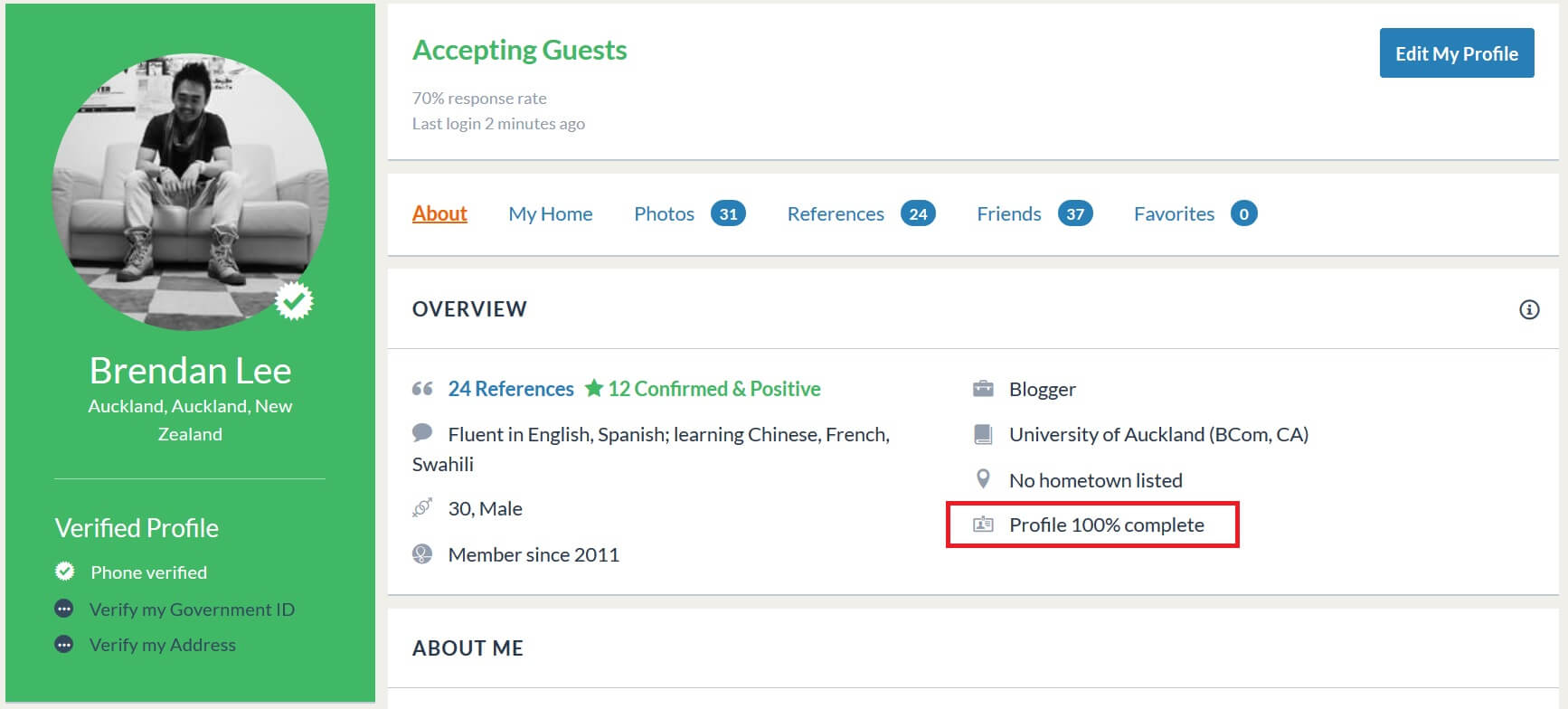
    This is super important. Most people only spend about five minutes on their profile and think that will work. Try to remember – you’re asking to be invited into somebody’s home. And it’s also quite competitive – there are far more surfers than hosts active at any one time.

    Your profile is the only thing hosts have to get an idea of who you are. It’s what they’re going to use to judge whether you’re fun to hang out with, whether you’re a serial linen thief, whether you’re going to start cooking up heroin in their bathroom. If you want to get hosted, spend time crafting your profile to show the best sides of yourself. Here are a few tips:

    1. Fill out all the sections fully. In the “About me” section actually write a few paragraphs about who you are and what you’re about. What are your hobbies? What do you do in your free time? These are things that hosts will look at to see if you have anything in common. In the “Amazing things I’ve done” section, put something interesting. It doesn’t have to be mind-blowing, maybe something as simple as graduating from high school was amazing for you. This isn’t a douchey job interview where you need to impress everyone. If you can’t think of anything, write something sarcastic. Something funny. In the “Music and Movies section”, write something! Things like this matter. If you’re a Tupac fan, the chance of me hosting you goes up 1,000%.
    2. Add lots of photos. Not two or three. More like nine or ten. And make them clear – so your face can actually be seen and we can be sure that you’re a real person. Sometimes people send me couch requests and they only have two photos – one of a sunset that was probably stolen off Google, and then another of them 10,000km in the distance where I can almost make out the colour of their jacket but not really. Needless to say those people are never getting hosted.
    3. Try and get some references. While the best references are from hosting and surfing, there is also a third reference group from “friends”. If you connect your Facebook to your Couchsurfing account, you’ll probably see you already have friends on the platform. Ask them if they would take a few minutes to write you a reference – this can be quite helpful to get you started.

    2. Look for hosts

    When looking at Couchsurfing hosts, it’s important that you find a host that is trustworthy. While hosts are concerned about their own safety, you should take the necessary precautions for yourself too.

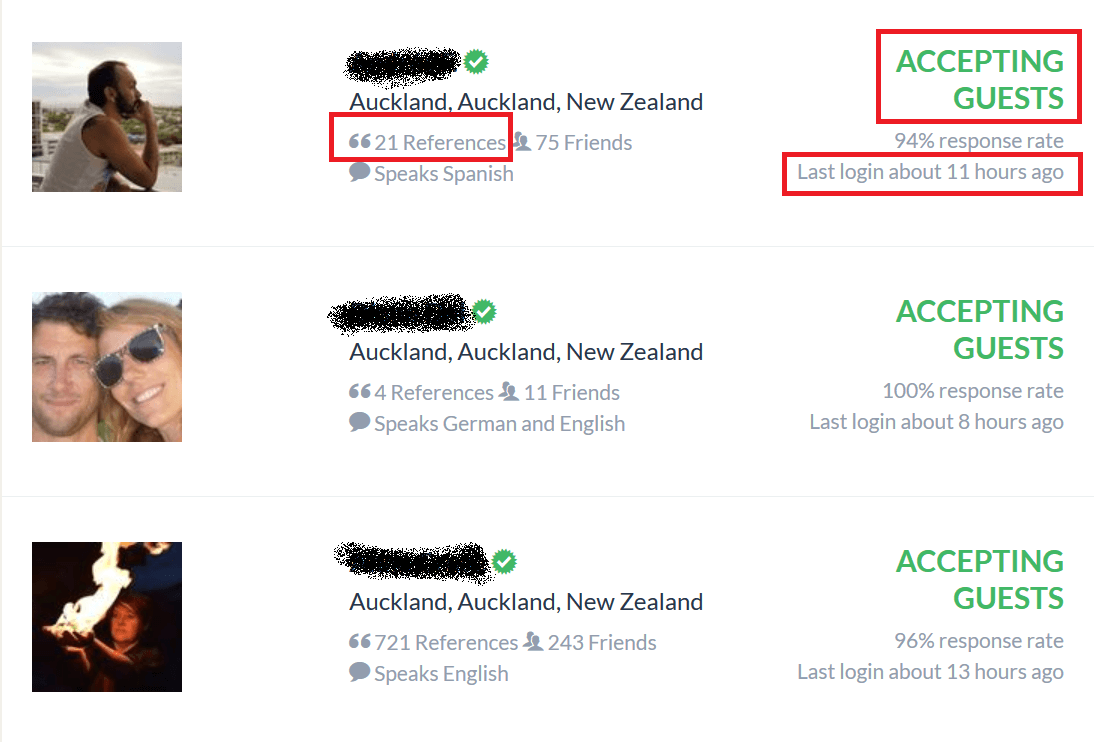
    The search function in Couchsurfing is pretty straightforward. Once you’ve searched for hosts in your destination, you’ll get a list of profiles like this:

    You’re looking for a few things here. First, look for people who are accepting guests. They’ll all be listed first in the results anyway. Next, look for references. If they’ve been well-referenced, you can be pretty sure they’re good people. And finally, look if they’re active. Couchsurfing will show you when their last login was, so if it was within the last couple of weeks there’s a good chance they’re still active on the site.

    Obviously the next step is to click into these profiles and take a closer look at their references and photos, and if you think they’re someone you’d enjoy hanging out with. Once you’ve found a few hosts that are suitable (I’d recommend choosing around ten), you can start sending your requests.

    3. Send (good) Couch requests

    It’s important to take time when writing your requests. I actually don’t mind receiving copy/paste requests if the person is an experienced Couchsurfer and I can see they’ve given a lot to the community. Even I send them sometimes if I’m really pressed for time. However, if you are a new Couchsurfer, with zero references, you shouldn’t be copy pasting your requests. It comes off as lazy, and even a little arrogant, that you would expect people to welcome you into their homes without even taking the time to write a short request to them. At least take the time to write to hosts personally to show that you’re making an effort.

    What does this mean?

    Read the host’s profile. See what their house rules are. Find out their interests, think about whether they’re someone you’ll get along with, check if they have any requests of their own (for example, some will ask you to not make requests for weekends or particular dates, some will only allow females etc). Then write a request to them personally where you introduce yourself and then give a few reasons why it might be a good idea for them to host you. If they love Italian food and you have a secret gnocchi recipe, you could offer to cook it for them for dinner. Things like that.

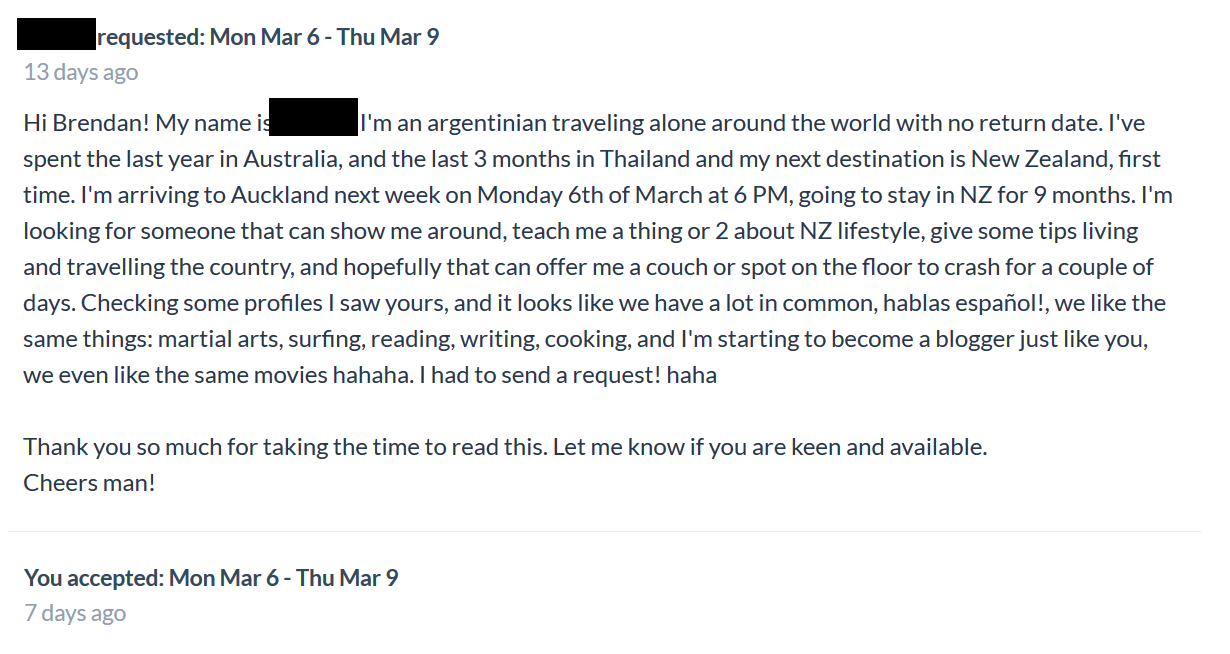
    Here is an example of a good Couchrequest that I would accept, even if your reference count was low:

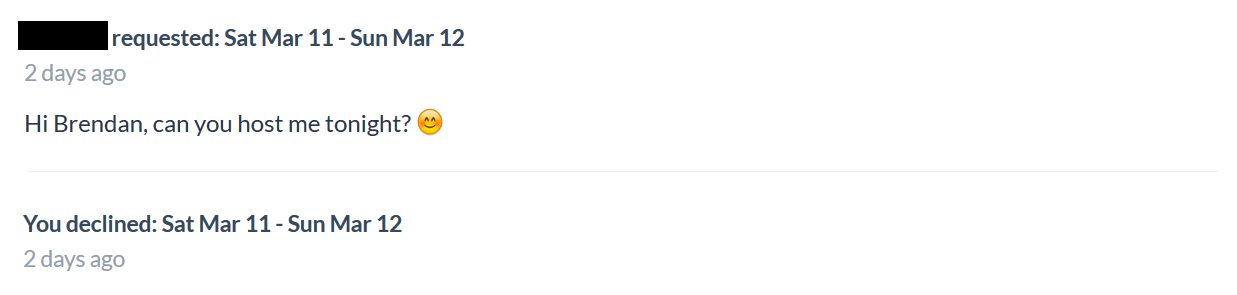
    Here is an example of a bad Couchrequest that I don’t even bother looking at, even if your reference count is high:

    4. Post a Public Trip

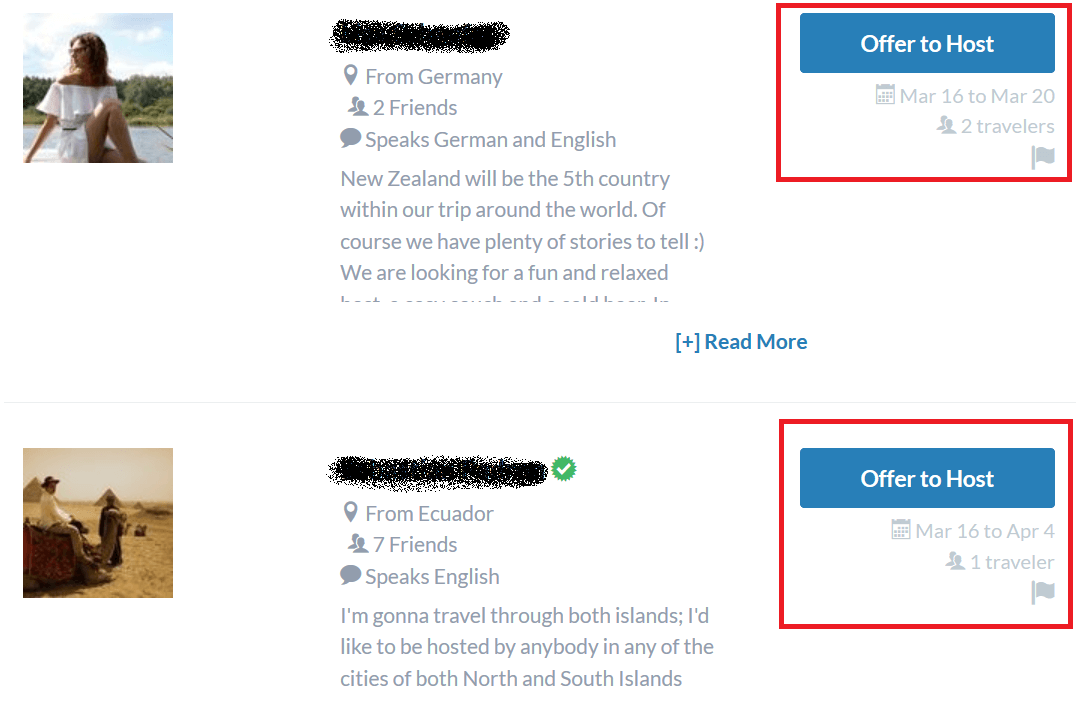
    Another way you can find hosts is by posting your travel plans. Your trip will get listed on the “public trips” list and people might offer to host you. It looks like this:

    I always thought this option was a little odd and never really use it. It’s also where most of the Couchsurfing horror stories come from (and it’s not just a problem for girls). Often it’s harmless funny stuff, but one of my guests recently told me a story that ended with him out on the street in the middle of the night after his host was left a little, errm, heartbroken. Of course this doesn’t mean you can’t find a host through this function, but I prefer to keep my trips private and choose my hosts.

    4. Arrange your stay!


    A post shared by Bren (@brenontheroad) on


    As I said earlier, you should send out multiple requests. At least five, but I find that closer to ten is better. In some places you’ll send just one or two and get accepted (woo Norway) and in some cities you might send twenty five and not even get a response (looking at you Stockholm). So just send as many as you have time for to give yourself the best chance of finding someone.

    If someone does accept you, simply get their details and make arrangements for your arrival.

    5. Follow the rules


    A post shared by Bren (@brenontheroad) on


    There are a few “unwritten” rules when you Couchsurf.

    1. Surfers are expected to give back. Despite Couchsurfing being constantly described as a “free accommodation” website, this is not what it is. Surfers might not pay anything in monetary terms, but they are certainly expected to offer back in other ways. One of the most popular ways is paying for food and cooking for your host, helping with the housework, and maybe even teaching your host something cool that you’re good at. The idea is to make life easier for them while you’re around, not harder.
    2. Be an engaged guest (and host). It’s as much about cultural exchange as it is about finding a place to sleep. It’s expected that hosts will make an effort to show surfers around, and that surfers will be engaging guests and not just put their headphones on and hide in their rooms. If that’s what you want to do that’s cool – just stay in a hostel.
    3. It’s not a dating site. Even though there are quite a few stories of Couchsurfing couples and marriages and babies. But just keep in mind that’s not what the site is designed for.
    4. If you surf, you host. It’s not cool to be surfing hundreds of times, and never hosting anyone in return. When you’re back in your home country, try to host a few people to give back to the community.
    5. Respect your host. If you had arranged to stay for 3 nights, stay for 3 nights. Don’t loiter and put them in the uncomfortable position of kicking you out. Clean up after yourself. Keep your area of the house tidy (I’m bad at this). Don’t treat it like a hotel. Don’t treat it like your own house. Treat it like the home of a very important person who is doing you a very big favour.

    6. Leave a reference!

    References are in many ways the currency of Couchsurfing. They’re the stripes that let people know you’re active and giving to the community. If a host has taken you into their home and been good to you, leave them a good reference (and if they’ve been a schmuck you should leave a bad one). Much of the site relies on the reference system to function (after all, we’re all strangers), so it’s important to do your bit to keep the community safe.


    Meetups and events

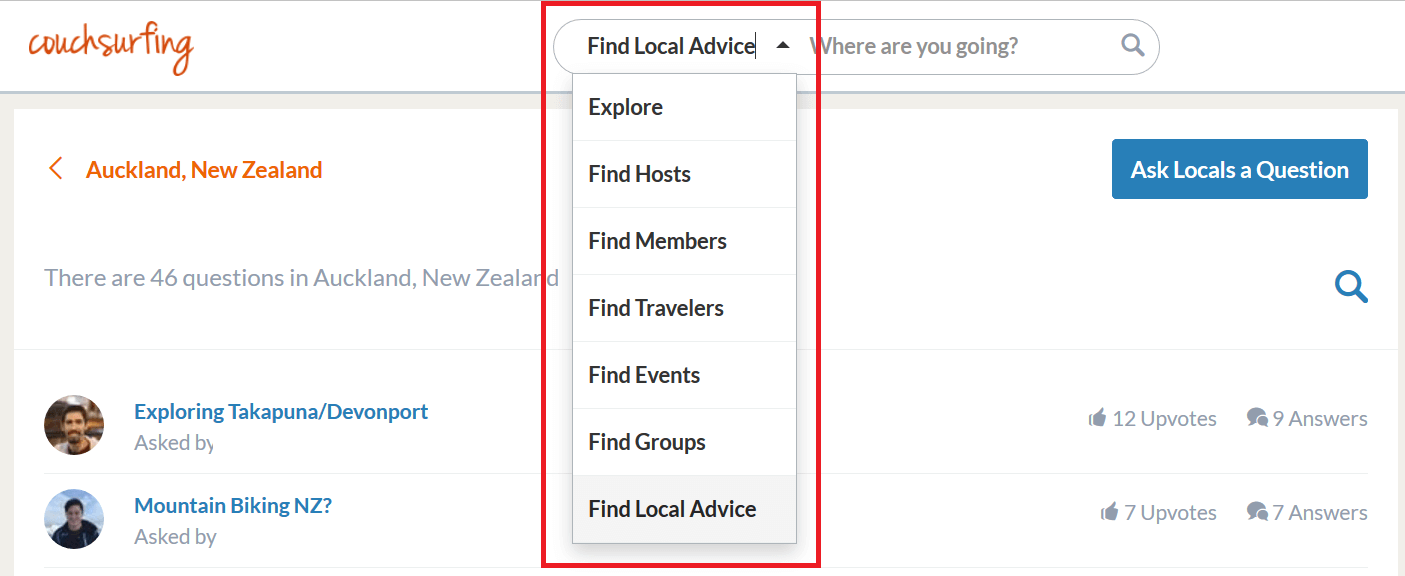
    Another (and probably more popular) aspect of Couchsurfing are their events, meetups and forums. As it has gone more mainstream Couchsurfing has almost become like a social network, where other travellers can connect and share travel plans and knowledge. This is useful for meeting up with other travellers in the city you’re visiting, finding hitch-hiking partners, finding someone to fill an extra spot on a group tour or road trip, or even just for asking for travel advice and ideas. If I’m in a city where I know nobody and have nothing to do I’ll usually check the events list that night for something interesting to do. Even if you don’t surf or host, you can still get involved in the community this way.

    Is it safe?

    The million dollar question.

    In my opinion, it’s actually safer than hotels and hostels. If you stay with a well referenced Couchsurfing host, you’re staying in the private home of someone that has been vetted and vouched for by a community of other travellers. And because the connection is personal, they will generally be more concerned about your well-being than any hotel receptionist. Many times I’ve gotten lost and I’ve had my host on the phone giving me personal directions, or even coming out to pick me up. When’s the last time a hotel did that for you? (without charging you a million dollars and three human souls).

    Your belongings will be a lot safer too. In a Couchsurfer’s home you’re staying with one stranger. In a hostel or hotel you’re with hundreds of strangers. Things get stolen out of hotel rooms all the time. Much rarer in the home of an experienced Couchsurfer.

    And probably the biggest reason that the community is so safe is because of who we are. We’re travellers. And you probably need to be a traveller at heart to understand why this community works. I don’t think I know a single friend from home who would ever try this. It’s bizarre to them. But it makes perfect sense to me, and the thousands of other active members. Couchsurfing takes a lot of time and energy to be involved in and there is no money to be made here. The members are involved for the love of the people and the community and nothing else. That’s the easiest kind of stranger to trust.

    In the end Couchsurfing requires the same common sense that the rest of travel requires. Of course there are incidents, but no more common than incidents in any other aspect of travel. Do your homework, use your instincts, trust good and kind people, and everything should be fine.


    Get started

    Just head over to the website and sign up for a free account. You’ll then need to set up your profile, and start making arrangements to host or surf. You can also attend the events and join trips to get involved. How much you get (or don’t get) out of the community is totally up to you.

    See you there.

    Bren

    P.S. If you’re new to Couchsurfing and there is something you’re unsure about – like whether a host looks trustworthy or what the protocol might be in some weird situation, feel free to contact me (or another experienced Couchsurfer) and I’ll try to help you out. This is a friendly community and we’re all here to look after each other!


    What is Couchsurfing? Get free accommodation, travel advice, events and travel buddies with backpacking's coolest community. Bren tells you everything you need to know.
  • 29 Ways To Travel Europe On A Budget

    29 Ways To Travel Europe On A Budget

    If you’re looking to start a backpacking career, there probably is no better place than Europe. It’s safe(ish), there’s a common currency, it is super easy to get around, most people speak English, there are so many countries, it’s packed with history and famous sights and the backpacking culture is booming.

    Only one problem – money.

    Europe is expensive. But if you are smart, and you look in the right places, it’s possible to do it on the cheap. When I shared my numbers with you last year, many of you were surprised at how little it cost me. Truthfully I could have done it a lot cheaper (shoulda coulda schmoulda) if I’d had a little more discipline. Europe is one of the most travellable (is that a word?) regions in the world and there’s no reason you should miss out as a budget traveller. If you want to see the historic continent, follow my tips below and money should never be an obstacle.
    1. Sleep free with Couchsurfing


    A post shared by Bren (@brenontheroad) on


    I’ve said it so many times already but I need to stress how beneficial it is to be active in Couchsurfing. If you’re interested in budget travel this is your secret weapon. Not only does it allow you to save thousands and thousands of dollars, it also gives you access to a community of budget travellers just like yourself who will know all the best ways and places to save money. Go to the events, find travel buddies, meet local people who can educate you about the city. It’s a no brainer.

    I Couchsurfed for over 50 nights on my last trip to Europe and many of the people I met were really influential in how my trip turned out. How do you get to stay in a luxury cabin in the Norweigian wilderness for free or get invited to parties on Finnish islands? Couchsurfing.

    How does it work? It’s like a cross between Facebook and Airbnb. Travellers create profiles and other travellers offer to host them whenever they’re in their home country. Couches and beds are always offered free of charge and no money ever changes hands. It is simply a community of travellers helping out travellers.

    If you’re new to Couchsurfing, check out my beginner’s guide Couchsurfing 101: Everything You Need To Know.

    2. Try hitch-hiking


    A post shared by Bren (@brenontheroad) on


    Hitch-hiking is pretty common in Europe and can add quite an interesting twist to your travels. Bonus: It’s free. Some places will be harder to hitch than others, but in most countries you can at least give it a try! There is a pretty comprehensive section on hitching in my guide Triple Your Travel, but here are a few tips to get you started:

    • Try to avoid hitching at night
    • Always have a back up plan (in case you don’t get a ride, it rains etc)
    • If you sense something is off, don’t get in the car!
    • If you’re a newbie try to hitch in pairs (Couchsurfing is a good place to find hitching buddies).
    • Check the hitching situation and choose a good pick-up spot (Hitchwiki is an awesome resource for this).

    If you’re interested, the recap of my hitch through the Baltics will give you a decent look of what a typical hitch hike looks like.

    3. Sign up for Bla Bla Car

    Bla bla car is a ride-sharing website where you can book a seat in someone’s car for a small price. For example, if somebody is driving from Paris to Madrid, they can list their spare seats on Bla bla car and earn a little gas money, while giving others a cheaper way to get between places. I know many Europeans who rely on this regularly to get around the continent.

    The price depends on the driver, but it’s always reasonable. You can click here to sign up for a free account!

    4. Eat from supermarkets


    A post shared by Bren (@brenontheroad) on


    Some people might consider it normal to spend upwards of 30 euros per day on food, but even in places like Norway and Switzerland, you can feed yourself comfortably for 5 euros if you shop at the supermarket. And that doesn’t mean you’ll need to survive on chewing gum and black tea. If you buy a loaf of bread, the cheaper vegetables and cheaper fruits, maybe some yogurt – that will get you through the day pretty comfortably and won’t bankrupt you. I did this in Zurich and for about 6 euros got more food than I could eat in a day. If possible try and shop at the budget supermarkets like Lidl and Aldi – there are also quite a few Chinese/Turkish fruit and vege shops around which will be even cheaper.

    5. Shop at the local markets


    A post shared by Bren (@brenontheroad) on


    Sunday markets and farmer’s markets are legendary budget travel allies. Even in the notoriously expensive Nordic countries you can get fruit and vegetables for 2-3 euros per kg. The cool thing about Europe is it’s actually really common to find fruit and vege sellers on the street, and they’re usually just in local plazas and shopping areas, rather than off in some random farm outside the city. In Finland, which is definitely not a cheap country, I packed up a huge bag of vegetables at one market stall and it only ran me about 4 euros. That’s almost lower than Asia prices.

    6. Dumpster dive


    A post shared by Bren (@brenontheroad) on


    If you’re up for it, try a dumpster dive. I know it sounds gnarly but I did it a couple of times in Norway and it’s actually pretty awesome. Countries like Norway and Denmark have insane food standards and the amount of food getting thrown out every day is crazy. In Copenhagen the lady at my hostel went through the fridges every morning (there were about 10 small fridges – it was a big hostel) and by law she had to throw out any food that guests hadn’t labelled. I watched her literally fill up 2 garbage bags of good and fresh food each morning and throw it out. I’m talking yogurt, chocolate, salami, bread, biscuits, fruit, cheese, vegetables – all of it probably bought in the last few days. The dumpsters behind that hostel would have been dumpster diver heaven.

    7. Share food costs


    A post shared by Bren (@brenontheroad) on


    If you have a bunch of friends at your hostel, cook a dinner together. For 10-15 euros you can get a crapload of food and cook up a pretty big feast and split between 3 or 4 people makes it super cheap as well. I do this quite often and it’s a good way to save money and make a few new friends.

    8. Get the leftovers

    Head to shops that pre-package food (eg. sushi, sandwiches) just before closing and see if they have any specials. Sometimes they’ll just give you the food for free. Fruit and vegetable markets are also good for this.

    Too Good To Go is an app designed for this and allows restaurants to offer their leftover food for super low prices. I used it a couple of times in Denmark and thought it was pretty good. Click here to check it out.

    9. Use buses!


    A post shared by Bren (@brenontheroad) on


    In a lot of countries travelling by bus was my first preference. It was just as comfortable as trains, and cheaper, and often they run overnight so you save a night on accommodation too. You also have no trouble booking them last minute, even just half an hour before they leave.

    I was recommended Flix Bus by quite a few travellers and used them exclusively. In fact I was just chilling in the hostel lounge when an Aussie girl suggested them to me, I downloaded their app right there and booked a ticket for that night on the spot. It was done within five minutes! Super easy. Their buses also have wifi, are comfortable and always ran on time. If you’re lucky you might catch some of their 5 euro special tickets which go on sale pretty often. You can visit their site and download their app here.

    Megabus is also a good cheap option if you’re travelling in/out of the UK. I’ve never ridden with them but they are owned by Flix (or the other way around, not sure) and I assume the service is similar. If you book early you can get 1 pound tickets between cities – not bad!

    10. Get a Eurail Pass (maybe)


    A post shared by Bren (@brenontheroad) on


    A lot of people like to use the Eurail pass but I find it to be quite expensive. I found using Flix bus or Bla Bla Car was usually a lot cheaper and easier to figure out too. Plus it’s more suited to travelling last minute (by last minute I mean travelling without fixed plans, and booking just a few days or a week before). The only downside is the travel time is longer, but if the bus is overnight that doesn’t worry me anyway.

    The thing with the Eurail passes is you need to have a large chunk of your trip planned out to determine whether it’s going to be worth the money. They’re not cheap (around 300+ euro for a 5 trip pass), and even then you still need to pay on top of that for some trains. If you tend to plan as you go, which I would recommend for a longer trip around Europe, it would be much easier to just take the cheapest bus/train/car/flight whenever you’re ready to move. The Eurail pass also has a lot of other rules and conditions. They’re not particularly complicated but it can be annoying to be constantly researching and reading what you’re allowed to do in each country. Put it this way – I’ve never heard anyone with a Eurail pass say “The Eurail pass is so amazing and so easy to understand I love it.”

    My advice is to only buy one if you’re 100% certain you’re going to save money with it. That will require you to do quite a bit of forward planning and reading about how the passes work, but if you end up saving a few hundred euros it will probably be worth it. You can check out the different passes here.

    11. Fly Budget Airines

    Flying around Europe is not expensive and you can find a lot of cheap flights to all corners of the continent. The kicker is you’re going to get charged pretty hefty baggage fees on most budget airlines (usually more than the cost of your ticket), so if you’ve got check-in luggage with you it becomes less cheap. It can still work out very affordable though, and you can usually get from the east to the west or the north to the south for less than 100 euro. If you’re going really long distances (say, Spain to Finland) I’d definitely recommend flying – you won’t save too much travelling big distances like that overland.

    There are a ton of budget airlines operating in Europe now so fares are always competitive. Ryanair, Wizzair, Norwegian, vueling and Easyjet are just a few of the options available. Shop around! You can use my cheap flying guide to learn how to find the best tickets.

    12. Check all your options!

    Between the buses, trains, ferries and planes, it can be hard to stay on top of all the transportation options. One site I’ve found super helpful is Omio, which summarises all the trains, buses and flights between two destinations, and you can book your tickets through them too. It’s built specifically for Europe making it the ideal tool for your Eurotrip. Sites like this will save you a lot of time checking all the different bus and train websites to compare prices, especially in a place like Europe where there are so many options. I’d recommend keeping an app like this on your phone during your trip through the continent.

    13. Shop at second hand stores


    A post shared by Bren (@brenontheroad) on


    These are super popular around Europe and you will find a ton of good stuff in them. After going to Europe without a jacket (duh) I found myself slowing losing parts of my body to frostbite once the winter hit. After spending an afternoon in the H&Ms and Uniqlos looking at crappy 40 euro jackets I came across a Red Cross store and bought a cool puff jacket for about 10 bucks (yeah, the one in the photo up there). Not to mention this was in the stupidly expensive Copenhagen. If you’re backpacking it’s likely your clothes are going to get abused anyway so this is the perfect way to stay geared up on the cheap.

    14. Stay flexible

    There are many last minute deals when travelling around Europe so it helps to stay flexible. If you want to get the $7 Ryanair flights and the $5 bus tickets, you need to be able to travel at odd and unexpected times. Don’t overplan your trip – keep things as open as possible to take advantage of these deals. It’s also important to keep checking – ticket prices change daily.

    15. Travel off-season (or don’t)


    A post shared by Bren (@brenontheroad) on


    This is mixed advice because off-season will give you cheaper buses, trains, hostels (basically cheaper everything) but it is also going to be FREAKING COLD. I only lasted until November until I had to skip to Asia because my nose was going to fall off.

    I also was in Europe during the summer peak season, and other than some hostels being booked out I didn’t experience any problems. My transport was probably more expensive but as I hitch hiked and Couchsurfed I managed to keep most of my costs down.

    One other thing to keep in mind is that a lot of Europeans are on holiday during summer, so it can mean a lot of things are closed, especially in Spain and France.

    If you don’t mind the winter, travelling during off season (October to April) will definitely save you money, but Europe is still great during the summer and you can still do it on a budget without too many problems.

    16. Don’t overtip

    Contrary to what many think, tipping is not compulsory in Europe. If you are happy with the service you can round up the bill or leave an extra 5% if you want to, but it’s definitely not like America where you need to leave 15%+ every time to avoid getting thrown through a window. I actually remember tipping my cocktail waiter just over 10% in Zurich and his eyes popped out of his head. “You must be American” he says to me. He was actually just an awesome waiter.
    It’s also pretty standard to have 10%-15% service charges included in your prices at cafes and restaurants (check the menu), so don’t feel bad for just leaving a couple of coins, or nothing at all.

    17. Check out the tourists passes


    A post shared by Bren (@brenontheroad) on


    These might be a good investment for you if you’re the kind of person that visits a lot of tourist attractions. A tourist pass is basically a multi-purpose ticket that allows you free entry into most of the city’s major attractions, and usually allows you free use of public transport too. Some of them even let you queue jump at the big attractions. After waiting in line for the Eiffel Tower for what felt like three lunar cycles, I started to realise why tourist passes might be a good idea, even if they don’t save you money.

    I’ve looked at the tourist pass in almost every capital city I’ve been to and I’ve never bought one, because the numbers never worked out for me. You usually need to be visiting 2-3 museums, galleries, sights per day for them to be worth it, and I normally visit 1 or 2 in a week. If you’re super into sightseeing though it might be worth it. Check them out. Here are a few examples:

    London Pass | Paris Pass | Berlin Pass

    18. Walk!


    A post shared by Bren (@brenontheroad) on


    A lot of Europe’s major cities are walkable. Stockholm, Zurich, Lisbon, Paris, Copenhagen are all good examples. If it’s less than half an hour from point to point I generally try to walk, especially in the cities in northern and western Europe where public transport is quite expensive.


    Some capitals like Berlin are really spread out and you’ll probably need help to get around, but in the cities where you can save a few dollars by walking you should try to do so. It’s also a really good way to get a feel for the city’s energy, poke your head around corners you’ll never see on the subway, and will help keep you in shape too.

    If places are not walkable, there’s still no need to use taxis. Stick to public transport – it’s great in most major European cities. Uber also operates in most countries in Europe, which is usually a lot cheaper than a taxi, and even if Uber isn’t operational there’s probably an Uber-like app to help you get around.

    19. Rent a bike (maybe)

    Some people recommend renting bikes in the bigger cities. I’m not sure why this is, because usually this costs around 10-12 euros per day and for that amount (or sometimes cheaper) you can usually get a subway day pass. If you hunt around you might get a bike for 8 euros but even then it won’t be much cheaper than a 24 hour pass on public transport. Add on the time and energy you spend actually riding and looking after the damn thing and it doesn’t seem like a very good deal.

    If, however, you just really enjoy riding bikes, or there are some places hidden in hard-to-reach pockets of the city that you’re planning on visiting, then it might be worthwhile. From a saving money perspective though I never found it to be a good choice.

    The one time I did rent a bike was in Copenhagen, when a Couchsurfer recommended this pretty cool rent-a-bike system – basically you register your credit card with them and then just take the bikes from the many stands around the city. The bikes all had iPads on them where you could just type in your destination and it would show you the way – it also had maps to all the destinations. I used it to ride from my hostel to Christiania and it was pretty rad. However, it wasn’t that cheap – around 3 euros an hour. A lot of countries have similar systems though as the continent becomes green conscious, so finding a bike should never be difficult.

    20. Buy sim cards


    A post shared by Bren (@brenontheroad) on


    There’s no need to roam in Europe. You can buy cheap prepaid sim cards in most countries and internet data is generally inexpensive. Even in Finland it was only 1 euro per day for unlimited internet, and in Sweden I got by on just using the free wifi around the place. Eastern Europe has some of the fastest wifi in the world. You shouldn’t have any trouble staying connected for cheap.

    21. Stay entertained for free


    A post shared by Bren (@brenontheroad) on


    If you don’t have the budget to be visiting expensive sights, know that there are countless free things to do in Europe that are just as cool. Usually Google or Facebook are good resources for simply searching “Free things to do in X” and you’ll be have more than enough to keep you busy every night of the week. Art exhibitions, open mic nights, free concerts, markets and festivals are all interesting things you can check out that won’t cost you anything. One of my favourite things in all of Europe was the Mauerpark karaoke at the outdoor auditorium in Berlin, which is hilarious and is free every Sunday in summer (the photo up there is a dude singing a love song to his wife on her birthday. Aww).

    If you look in the right places you’ll find expensive sightseeing is a choice, not a necessity, to see an authentic side of Europe.

    22. Workaway

    If you haven’t heard of Workaway, it’s a work-exchange programme where you offer a few hours of work each day for free room and board. It’s a good resource for backpackers trying to save a bit of money or lay low for a while to recover. It’s also a really good opportunity to learn some new skills, as many hosts will be willing to teach you the skills you need to help them with their projects (it might be building a fence, training dogs, cooking etc).

    Workaway is hugely popular in Europe and you will find hundreds if not thousands of opportunities in every country on the continent. I actually had a Workaway account during my last Eurotrip although I was a little too fussy and didn’t manage to get placed. Lots of really cool opportunities though.

    23. Buy travel insurance


    A post shared by Bren (@brenontheroad) on


    Make sure you buy travel insurance! As a budget traveller it’s doubly important to have coverage, as so many different things can go wrong when you travel indie style. Injuries, accidents, stolen bags etc are very common. In my Berlin hostel we had a situation where a (very expensive) laptop and a camera were stolen out of the lockers on the same night. I also had a pretty close call in Norway where I busted my ankle pretty badly out in the wilderness, and one inch to the left or right could have meant I was getting stretchered out of there. Travel insurance only costs a couple of dollars a day so be smart and get it.

    I buy my travel insurance with World Nomads, who offer really affordable coverage for Europe. You can read my guide on buying travel insurance for a more detailed breakdown on how it works and why you need it.

    Disclaimer: World Nomads provides travel insurance for travelers in over 100 countries. As an affiliate, we receive a fee when you get a quote from World Nomads using this link. We do not represent World Nomads. This is information only and not a recommendation to buy travel insurance.

    24. Hostels please


    A post shared by Bren (@brenontheroad) on


    Hostelling is unparalleled in Europe and you will find tons of trendy hostels in the major cities. As hostels have modernised I’ve also noticed more families renting out rooms now and it’s not uncommon to have kids running around the hostel lounges, along with err, more “senior” tour groups and older travellers. But of course this all comes with a bump in price. In some of the bigger hostels it won’t be uncommon to be paying up to 30 or 40 euros for a dorm bed, especially on the weekends. I always like to try and support the smaller hostels, which are usually cheaper and more homely too. And you’ll still find a lot of hip and trendy places to stay in the lower price range. That photo up there is from the lounge in my Lisbon hostel – that’s nicer than my own house.

    You can use Hostelworld to sort through all the options and find a place that suits.

    25. Airbnb is cheaper than hotels

    Airbnb has made a few waves. In some of the bigger cities, it’s almost impossible to find long-lease apartments – many landlords have decided to put their places on Airbnb instead as they tend to earn quite a bit more money that way. Of course this is bad news for locals but it means travellers have more accommodation options than ever before. In most parts of Europe you’ll probably be able to rent private rooms on Airbnb for half the price of a hotel and also entire apartments if that’s what you’re after. I’ve used Airbnb all over the world and it’s always been great. Between Couchsurfing, hostels, and Airbnb, you should never have trouble finding affordable places to sleep.

    If you haven’t used Airbnb before, you can get $25 off your first Airbnb stay using my link.

    26. Be smart with your currency

    Depending on the length of your trip you could end up paying a small fortune in bank fees if you’re not prepared. If you’re American the solution is easy – just get a Charles Schwab card – it has no ATM fees anywhere in the world. For the rest of us, it’s a little more complicated.

    I like to just take the maximum withdrawal from an ATM (usually a thousand euros), and just live off that for as long as possible. Usually one withdrawal will last me a whole month, so taking the fee hit isn’t too painful. However, my plan was obliterated in Sweden when my cash was refused (not a typo). I had real Swedish kroners in my hand and they wouldn’t accept it – they wanted a credit card. In light of these bizarre events I now think it might be a good idea to get a travel debit card for longer trips in Europe (ask your bank).

    Also if you’re dealing with cash, try and exchange your currency with other travellers where possible. People are arriving and leaving from hostels every day so it’s usually not hard to find someone going to where you’ve just come from. There are no fees and you both can receive the fair rate. You might not always have the right change, but I’ll always choose to lose a few kroners or euros to a fellow traveller rather than a smelly bank.

    27. Free museum days


    History lessons at the Uprising Museum in #Warsaw. Free on Sundays.

    A post shared by Bren (@brenontheroad) on


    If you’re visiting in winter (and summer for some cities) there are free museum days in most major cities. Usually it’s the first Sunday of the month, but some cities have it on Tuesdays or whatever other day they’ve chosen. Just visit the tourist information centre, Google it, or ask at your hostel reception. They will know. This will save you quite a lot of money as some of those big-time museums aren’t cheap to get into.

    28. Free walking tours

    Most cities have free walking tours every day. These are run on a donation basis so it’s nice to give a few euros at the end, but if you want to be that guy who walks off without giving anything nobody will arrest you. You’ll just get bad karma and everyone will give you Monopoly money on your wedding day.

    I’ve done free walking tours in Sofia, Plovdiv, Tallinn, Warsaw, maybe a few other places that I don’t remember. If I’m being honest I don’t actually enjoy them much but they are a pretty good way to learn a few interesting things about the city. They usually focus heavily on the history of the city so if that interests you definitely check it out. Google’s your friend.

    29. Spend your money in the east and south


    A post shared by Bren (@brenontheroad) on

    The south and the east of Europe is much cheaper than the west and the north. You will save a lot of money if you spend the bulk of your time in places like Portugal, Spain, Poland, Greece and Bulgaria, rather than Sweden, Norway, Finland, Denmark and Switzerland (here’s a great list of Europe’s more underrated countries you could visit). In the more expensive countries, try and Couchsurf and eat cheap at the supermarkets, in the cheaper countries you can maybe splash out on a private room and eat in a few restaurants. Be conscious of the difference in prices in each country and adjust your travel style to suit. This means buying clothes and supplies and doing most of your tours and activities in the cheaper countries, while spending less time and money in the more expensive ones. This is just basic good travel planning and will save you thousands of dollars if you do it right.


    That’s it! If you follow the tips above you should be able to comfortably travel through Europe on 35-45 euros per day, probably as low as 25 euros in some of the cheaper countries. Use all your options, be smart with your money, choose your destinations wisely and you’ll be able to enjoy every corner of the historic continent without going broke.

    Good luck and travel safe,

    Bren

    P.S. Got tips to add? Leave them in the comments!

    Heading to Europe? Don't miss this post. Lots of really amazing budget travel tips for keeping your costs down during your trip.

    Disclosure: This post contains affiliate links. Every link represents a product or service I have tried or used myself, and I recommend them honestly. Omio compensated me for a mention in this article. I have used their service and recommend it honestly. For further clarification, please check out my Disclosure Policy.

  • How To Take A Mini Retirement In Bangkok

    How To Take A Mini Retirement In Bangkok

    A few months ago I returned to Auckland from a five week stint in Bangkok. I decided to head to my beloved Thai capital after a few months in the European winter, which was driving me nuts. I finally understand why Southeast Asia is full of Europeans in December and why they’re all so happy.

    Anyways. Whenever I tell people “I was in wherever for two months” they always ask me, “But…what do you do there?”

    And then lots of other questions, like where do I live, and who do I eat lunch with, and all that other stuff.

    These mini stints in different cities are akin to Mini Retirements – a concept I’ve written about before. I discussed most of the common questions in that guide, but I guess if you’re new to the road it can be hard to visualise how it all comes together. So let me show how it all worked in Bangkok.

    Settling in

    I’ve been to Bangkok four or five times now, so it’s not new to me. I generally know which areas I want to live in, where to go once I land at the airport, places I like to eat and so on. So things were smooth and I was settled in a week or so.

    I stayed at the Cazz hostel for the first few days, which is reasonably far down the Sukhumvit line (Sukhumvit is kind of a snazzier central area of Bangkok, lots of malls and hotels and stuff). Since I was quite far down Sukhumvit, there weren’t too many tourists, maybe a few expats, it was pretty chilled out. It was 250 baht per night (about 7 bucks), so there wasn’t a rush to find an apartment or anything, I could’ve stayed there as long as I needed to without worrying about cash.

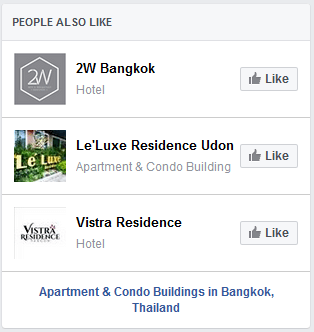
    After a couple of days of chilling I started to send messages around looking for condos. Facebook was a pretty good resource for this. If you “Like” any apartment condo page you’ll get suggested other ones in the sidebar like this:

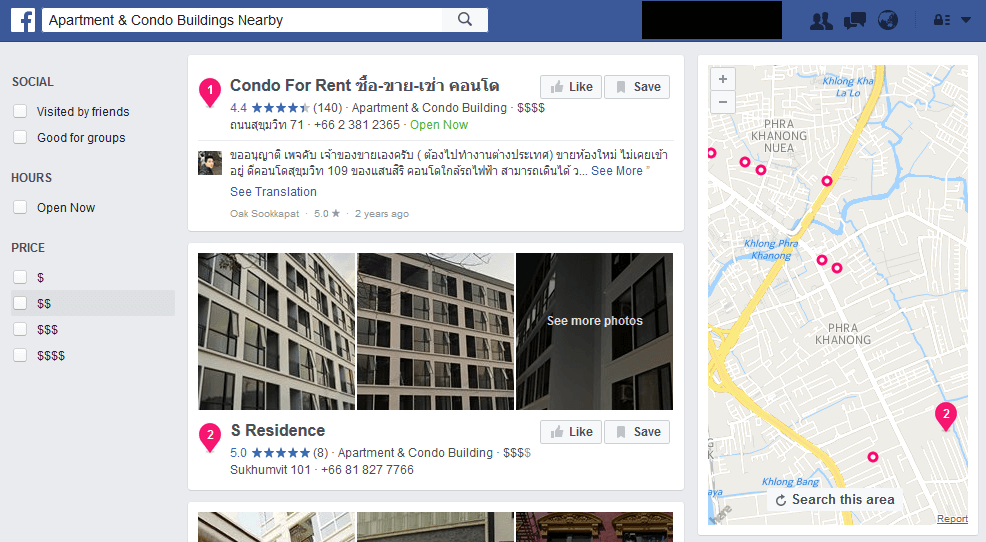
    Or you can just search for Apartments in Bangkok and you’ll get a listing and a full map search too:

    There’s a whole bunch of ways you can find apartments overseas, by using Google, Airbnb, tweet some people, ask the people at your hostel and others. I talk about this process at length in my guide Triple Your Travel.

    Haven’t used Airbnb yet? You can get $25 free credit using this link.

    After messaging with a dozen or so different condos I finally found one I liked. I viewed it in the morning and moved in the next day. When I think about it now, I actually made contact, arranged the viewing and stayed in touch with my landlord my whole time in Bangkok just using Facebook chat. So it was all really easy.

    I stayed in the Thong Lor area, which is kind of a uppity expat area, and my condo was 16,000 baht for a month ($440). That’s actually pretty expensive for Bangkok. Because I was on a one-month rate, it had quite a bump to it. If I had signed a 3-6 month lease, it would’ve been closer to 10,000 baht ($275) per month.  It was pretty basic, had a little kitchen with a small stove, microwave, fridge, hot water and wifi (no oven or dishwasher). It also had cable TV and a tiny gym, if that matters to you.


    A photo posted by Bren (@brenontheroad) on

    Another cool thing about Bangkok is it’s all really straightforward, I just showed up with a big roll of cash (16,000 baht rent, 16,000 baht deposit) and gave it to her and she gave me the keys. It was particularly funny for me because half my hostel mates in Berlin a week earlier were all looking for apartments, and the landlords were all requesting interviews and police records and stuff. Some of them had been looking for months and were interviewing with three different landlords a day. It was literally taking over their lives. I didn’t dare tell them I’d found myself a pad within seven days of landing in Thailand.

    Day to day


    A post shared by Bren (@brenontheroad) on


    Once I’d found a place to stay it was time to get back to life. The typical day for me looked like this:

    11:00 Wake up

    11:30 Cook breakfast

    12:00 Do some yoga, stretching, work out

    1:00 Sit around, listen to music, procrastinate

    2:00 Go eat some noodles (60 baht/$1.70). Read a little. Procrastinate.

    3:00 Go to a coffee shop (usually Domus Bakery & Cafe) and work. Usually I’ll get a matcha (65 baht/$1.80) and sometimes I’ll eat dinner there too if I’m hungry (95 baht/$2.60).

    7:00 Domus closes. Go to Dala Thonglor and get a massage (249 baht/$7). No website to show you, but it’s on Sukhumvit Soi 55 somewhere.

    8:30 Go to Soi 38 street food, eat dinner (150-ish baht/$4).

    9:30 Go home, work or read. Sleep whenever.

    And that was pretty much life in Bangkok for a month.

    Other stuff

    Sometimes I would go to the Couchsurfing meeting on Wednesdays, I met some other expats there and hung out with them quite a lot. They also knew about some other expat parties which we went to on the weekends. But quite often I would also eat alone or just walk around alone.

    I spent a few nights down at Q23 Academy which is a martial arts gym in Nana. I didn’t really get to spend any significant time there but if I were staying in town longer I would’ve joined and been a regular there.


    A photo posted by Bren (@brenontheroad) on

    When the UFC was on I’d head down to The Sportsman to watch the fights.


    A photo posted by Bren (@brenontheroad) on

    Because I was on a tourist visa I had to extend it beyond the given 30 days, it was pretty straightforward – I followed this guide by my buddy James at Nomadic Notes.

    Grocery shopping is really easy and there are supermarkets everywhere. For things like fruit I would just buy it on the roadside, for things like milk and eggs I would get it from 7 Eleven, and anything western I would need I would buy from the Villa Market not far from my place. Unless you were buying something crazy like Angus beef, nothing was expensive.

    To get around I either walked or used the Skytrain. The Skytrain costs around 15-45THB (45 cents to $1.50) one way. I also used Uber quite often at night, as Bangkok taxi drivers can be a pain to deal with sometimes.

    Haven’t tried Uber yet? Get your first ride free with this link.

    For my cellphone, I just headed to an AIS store and got set up for the month with a sim card. Took around ten minutes and was really easy. From memory it cost around 400 THB ($11).

    That’s pretty much all the housekeeping I can think of – if I’ve missed anything let me know in the comments!

    What else can you do during a Mini Retirement in Bangkok?

    Not all of you have blogs and freelance careers to work on during the day, and without something to do you’re going to get pretty bored pretty quick. Mini Retirements are all about challenges. Challenge yourself to try something new, to discover a new side of yourself, to push your comfort zones. But most importantly make sure you pursue something you enjoy. Here are a few ideas:

    Study Thai

    Why not learn another language? Thai is quite a unique language and not that difficult (not that I speak it well at all). Not to mention the schools will be super affordable compared to something like French or Italian. If you did an intensive course for a few months you’d be speaking and writing pretty well. I don’t have any schools to recommend, but I’m sure you’ll find one rather easily once you’re on the ground.

    Learn Muay Thai/Thai Boxing

    There are countless Muay Thai gyms in Thailand and they’re usually quite affordable – maybe 3,000-4,000THB per month ($85-$115) and you can train every day. I’ve done a one month intensive camp before in the Philippines and it was one of the best experiences of my life – got in shape, learned tons, met lots of cool people, got punched in the face, punched other people in the face, but most of all it took me out of my comfort zone and pushed my limits. I’ve also had a few readers head to the same gym to do the same thing and they all loved it. Martial arts is a great way to not only physically test yourself but also mentally and spiritually.

    Learn To Dive

    Spend a few weeks diving, get your certificate and then get a douchey GoPro and post lots of cool Instagram photos and make all your friends jealous. You can actually make a small career out of diving if you love it enough, and a lot of travellers choose Thailand as the place to get their stripes. Maybe you’ll leave Thailand a newly minted waterman? Of course you’ll need to head out of Bangkok for this.

    Volunteer

    Volunteering is always a good way to get involved in the local culture and give something back to your adopted country. You could work with vulnerable people or communities, teach, work in animal care or conservation. My volunteering experience in Tanzania was life-changing and I’d recommend it to anyone.

    If this does interest you, it’s important to understand all the angles of volunteering overseas. I was quite unaware of the ethical side of volunteering when I first did it and it was quite a reality check when I had conversations with people more familiar with the subject. Shannon from A Little Adrift is active in this community and has a great website called Grassroots Volunteering – committed to providing ethical volunteering opportunities. Check it out.

    Teach

    Add a new qualification to your name with a TEFL certificate, and then get some experience teaching English to young (or old) Thais. You can get a TEFL certificate on your own and then look for your own placement, or you can have it all organised through an agency like STA Travel. Adding a few new career options to your life is never a bad thing!

    Start an online business

    If you don’t have a business to work on, start one! Bangkok would be the ideal place to start a freelancing business or a blog. You could spend half your time reading books and learning the trade, the other half building your new empire. All you need is a laptop. There are also a lot of co-working spaces in Bangkok where you could network with other expats and creatives – 63 Bangkok is my favourite.

    If you’re interested in starting a blog but don’t know where to start, I have an in-depth guide to getting started here.

    If you’re interested in learning how to monetise a blog, I have another in-depth guide to doing that here.

    If you’re interested in starting a freelance career but don’t know where to start, I also have an in-depth guide to getting started here.

    If you want to learn how to build websites that produce income, I have an in-depth guide for that too.

    And f you’d like to become a Thai supermodel but don’t know where to start, I have a guide for that too right here…

    Just kidding.

    Something else?

    These are all just ideas off the top of my head. You can spend your Mini Retirement doing whatever you want. Start a t-shirt company, become a yoga teacher, take cooking classes, learn how to do Thai massage (aka torture), record your first album, learn to dance. Your only limit is your imagination.

    Go anywhere

    While this post details my own experience in Bangkok, you can transfer the ideas and the concept to anywhere in the world. If Bangkok isn’t your kind of place, go to another city in Thailand, or go to Greece or Italy or Argentina. The same ideas apply.

    For information on the practical side of things, check out my post How To Take Your First Mini Retirement. It discusses things like what to do with your career, how to finance your Mini Retirement, more ideas on things to do, and a more detailed explanation of the concept itself. If you’ve got questions, that post should answer them.

    Safe travels,

    Bren


    Ready for your first mini retirement? Bangkok is the perfect place. Check out how to quickly and easily settle in to Thailand's amazing capital.
  • Inside Christiania: The Free City Unlike Anywhere Else In The World

    Inside Christiania: The Free City Unlike Anywhere Else In The World

    When I arrived in Copenhagen, I didn’t really have any plans. I was maybe going to meet an old friend, eat a hot dog, possibly find a hot Danish wife and start a family of badminton players. But one thing I knew for sure was I would be spending a day in Christiania.

    Christiania, also known as Freetown Christiania or more colloquially The Free City Of Christiania, is a self-governing neighbourhood in the centre of Copenhagen.

    It consists mostly of an old military facility and housing, which was abandoned and closed some time after World War 2. People from the surrounding neighbourhoods eventually broke in and claimed the area for themselves.

    The residents of Christiana, who now number around 800, finally declared their ‘independence’ as a free city back in 1971.

    Today, Christiania feels as much like a tourist attraction as it does a city. Flocks of people visit it daily, and some (like me) are in Copenhagen for Christiania alone.

    I entered Christiana around midday. I was pretty excited just walking through the entrance – it’s like a walled city, sitting in a central Copenhagen neighbourhood. I entered through one of the side entrances, and the first thing I saw was the skate park. There were a couple of younger guys doing renovations, fixing up some ramps and shovelling dirt. I gave them a friendly nod as I walked past, trying to look as hip as possible.


    A post shared by Bren (@brenontheroad) on

    After taking a few photos, I noticed a little door by the side of the ramps. It was pretty inconspicuous, everybody seemed to be walking straight past it. There weren’t any ‘no entrance’ signs or anything. I wandered in.

    Inside was an enormous skate bowl, in pristine condition. Old skateboards were lined across the ceiling. It was huge, and empty. I don’t think many people know it’s there.


    A post shared by Bren (@brenontheroad) on

    I ogled the place for about five minutes, and was just about to walk out when I noticed some dude sitting up in the corner; a young black guy, chilling out by himself. He’d been up there the whole time.

    I climbed up the stairs towards him and gave him a friendly hello. He was rolling up an enormous spliff.

    “Hey, what’s up,” I said, climbing up the ramp.

    He offered his hand, and gave me a little “what’s up” nod with his chin.

    “Where are you from?” I asked, shaking his hand.

    “Kenya.”

    I greeted him again with a few words in Swahili.

    He stared at me, and laughed, like he’d seen a ghost.

    I laughed with him and he shook my hand again, and he greeted me with a few words of his own.

    “So you live here?” I asked him.

    “Yeah I live around here somewhere,” he said, waving his hand behind him. “Do you smoke?”

    I shrugged.

    “Yeah, sometimes.”

    He held up a perfectly rolled spliff, fat like a cigar.

    “Let’s kill this one then?”

    I wanted to say no, but of course, I had to oblige (for professional reasons, you know?)

    “Yeah, sure.”

    “Okay, but we have to go outside,” he said, ushering me out onto the balcony. “There is rules here, you see?”

    He pointed to the wall.

    “Why is that?” I asked.

    Almost on cue, a few kids wandered in the entrance, followed by their parents.

    He gave me a look and smiled.

    “That is why.”

    I followed him onto the balcony. He lit up and passed it to me, and started telling me a little bit about the place.

    “Sometimes here in the bowl at night, we have like fifty people sleeping. Everyone is chilling, smoking. Then they fall asleep here. It’s crazy.”

    After ten minutes and around three hundred questions, he offered to show me around. We climbed down from the bowl and back out onto the street, and he started telling me about all the different bars, streets, houses, the places he liked to eat.

    Eventually, we made it to the infamous Green Light District.


    A post shared by Bren (@brenontheroad) on

    As we walked in there was a small row of artisan stands, selling bracelets, pipes, lighters and different arts and crafts. One guy was wearing a crazy cool hoodie, and I asked if I could snap a photo of him and his stall.

    “Of course.”


    A post shared by Bren (@brenontheroad) on

    Behind that, we wandered into a small market, with little shops selling more pipes and bongs, clothing, bags and hats. It all felt very hippie and world peace. If I had more Danish kroners on me, I would’ve bought a few things. Unfortunately, after buying breakfast I was already broke. Copenhagen does that to you.


    A post shared by Bren (@brenontheroad) on

    Then a little further down, he warned me to put my camera away.

    “This is Pusher Street. Don’t take photos here.”

    Pusher Street is the main street in the Christiania Green Light District, where cannabis (mostly hashish) has been sold openly for many years. Until recently, there were cannabis stalls lining the street, until police came in and shut everything down. Now it’s much more hush hush; it’s not out on display, but if you look reasonably “fun” you’ll get offered some pretty quickly.

    I popped my head into a small bar. I don’t remember much about what it looked like, other than it being red (both the walls, and the eyes of the clientele). It was full, with both smoke and people, and the smell of err, happiness, was thick in the air. I told myself I should come back later for a drink (and maybe some Christiania hash).

    I followed Ben off the end of Pusher Street. Then he stopped suddenly, and turned to look behind us.

    “Oh man, what the hell are they doing here…”

    I turned around. Everything had suddenly become still, quiet. A pair of police officers, in full uniform, were leisurely strolling through. Everybody stared. Nobody said anything.

    I looked around the crowd. I could see people’s eye rolls in the silence, all stand-offish, mumbling comments to the people beside them, shaking their heads.

    “They create problems,” Ben said, shaking his head. “They’re not supposed to be here.”

    The tenseness grew, as they loitered for what seemed like forever. But eventually they made their way out of sight, and everything went back to normal again.

    Ben laughed.

    “Fuck the police.”

    I laughed with him.

    “Coming straight from the underground?”

    He smiled and took another drag, and handed the smoke back to me.

    “A policeman was shot there just recently. That’s why they’re always here now.”

    As you might expect, the culture here is very anti authority and hippie-esque, deeply rooted in things like meditation, yoga, skating, ‘peace and love’, recreational marijuana, and is a sanctuary for free thinkers and those disenchanted with modern society.

    Christiana residents think of themselves as a collective, rather than individuals. They are against any private ownership, bosses or any form of authority, particularly government. There are no weapons allowed in the free town, no private cars, no violence, no gang colours, no hard drugs. Decisions for the city are made by no one individual, but as a compromise by its residents. The people and the community are seen as equal and one.

    However, a society that can function without the government is frowned upon by, well, the government. The State is constantly pressuring Christiania into normalisation. Slowly, they are winning. The concept of Christiania has already been declared “illegal” by the government, the residents are now required to pay income tax to the State, and the government is slowly pushing for privately owned residences. Cameras have also been installed by police in the Green Light District. Slowly, Christiania is changing.

    Ben and I continue walking off the end of Pusher Street, up to a place called Nemoland.


    A post shared by Bren (@brenontheroad) on

    Nemoland is a little community area with seating, bars, food stalls. It was full of people, presumably many of them tourists, sitting around chatting with plastic cups of beer. At the front was a big stage, where Ben explained they sometimes had shows and performances.

    We wandered through, and then up to a small rise behind it. There was a park area there, where people sat in the sun, chilled out, drank and smoked. There was a certain energy in the crowd up there that made me want to stay. Peaceful, relaxed, welcoming. In fact, one of the rules of Christiania as “No running”. Running usually means police are coming, so anybody running within the freetown causes unnecessary alarm. Plus there are no bosses in Christiania. There’s no such thing as being “late for work”. Why would anyone need to run?

    A little past Nemoland we wandered onto another street that was a lot less crowded. There were a few shops and cafes, and people sat under the Christiana flag mingling and talking, simply enjoying the day.


    A post shared by Bren (@brenontheroad) on

    I was told the yellow dots on the flag represent the three dotted i’s in Christiania, but according to Wikipedia it actually stands for the 3 o’s in love, love, love, which is one of Christiania’s slogans. Apparently the red and yellow was chosen because there was a lot of red and yellow paint left behind by the military when the first group of settlers moved in.

    A little further down we came across a shop selling these bikes.

    “You seen these? These are the bikes of Christiania,” Ben tells me. “You ride around, put your stuff in the front, or sometimes your friends will sit in there.”

    Because cars aren’t allowed in Christiania, this is how people cart stuff around.

    On the other side of Christiania is where people actually live. It’s very charming and there are a lot of nice houses out here, and most of them look well kept and decorated with love.

    As we walk through, I see kids toys and bicycles and can hear children laughing inside. I wonder what it’s like to live here, to grow up here. Where do you go to school? What do you do for fun? Are there special Christiania holidays and traditions? So many questions.

    After about an hour we got back to where we started. I shake Ben’s hand again and thank him for the hospitality. In true Christiania style, he takes nothing but a handshake and a smile and walks back towards the bowl. I spend the next hour wandering around, peeking in doors, browsing all the trinkets in the stalls.

    By the end of the day, I’m exhausted, satisfied and inspired. And sad, too. Because I leave knowing in our current world, a place like Christiania will never flourish. There will always be powers that are threatened by it, that will work to tear it down, that cannot allow a free-spirited place like this to exist. And slowly but surely, piece by piece, the Danish government is wrestling back control of this unique neighbourhood. My guess is in twenty years, there will be nothing here but a shopping mall, some high rise apartments and a little government owned Museum Of Christiania in the corner (with an entrance fee, of course).

    I hope I am wrong.

    Other than that, there’s nothing really left for me to say other than – what an interesting place.

    Before I go, a few more random snaps:

    Enjoying the world’s street art is one of my favourite things in the world, but Christiania might be one of my favourites ever. Street art is on every corner. Some are murals of past counter-culture legends, like:

    And others are just paintings of cool stuff, like dragons and naked fairies.

    Back at the bowl, you’ll find more rules.

    And ramps…

    Christiania is vocal about its beliefs on safe and healthy marijuana use:

    And just as vocal about the harmfulness of hard, addictive drugs:

    A few survival tips:

    And a clothing store of sorts…

    Here’s a typical Christiania coffee shop.

    And that’s it. Welcome to Christiania.

    Heading to Copenhagen? It ain’t cheap, but fellow blogger Lena has a great guide on free things to do while you’re there. Check it out!


    Photos of the famous Christiania - the free city of hippies and free thinkers in central Copenhagen. Unlike anywhere else in the world!
  • The (Very) Practical Guide To Making Money With A Blog

    The (Very) Practical Guide To Making Money With A Blog

    Woooooaah!

    What’s up people.

    Today we’re going to talk about money. And blogging.

    There are a few reasons I’ve finally decided to write this post. The first is, you’ve all been asking me about making money with a blog since forever ago. The second is, there is a lot (a lot!) of crap getting sold around the net right now teaching people how to make money online, and the last thing I want is for you guys to buy one of these courses for only $2,997 promising to make you a millionaire.

    For those of you looking to get into blogging, I’ve already written a super in-depth guide about setting up your own blog and getting it to a point where you can start to monetise, so check that out if you haven’t already. This post is the other half of the puzzle.

    Making money with a blog is actually really simple. You sell something, somebody pays you for it. That’s how McDonald’s makes money, it’s how Justin Timberlake makes money, it’s how blogs make money.

    A better question would be, How do you find something to sell? Where do you find people to buy it? How do you know if they will actually pay for it? Hopefully, I can answer them all for you today.


    Making Money With A Blog: From start to finish

    The above diagram shows a typical cycle that a blog “customer” goes through. It starts with a stranger, let’s call him Mario, and he’s poking around the internet. He finds you somewhere, maybe on Google or Facebook. When he visits your blog or your Instagram page or your Youtube channel, you’ve turned Mario from a stranger to a visitor.

    When somebody visits your site, your goal is to turn them into a repeat visitor. You want them to keep coming back again and again. To do this, you usually need to form a connection of some sort – you get them to Like your page on Facebook, follow you on Twitter. But the most effective form of connection is email. When a visitor gives you their email and subscribes to your blog, you now have a direct form of contact with this visitor. Marketers would call this converting visitors into leads. I prefer to call them subscribers.

    Once you have some subscribers, you can contact them about anything you want. You can send them an email telling them your dog is sick, or you can send them a funny video, you could write them poems every day if you really want to. But you can also send an email to sell something. Ding ding ding. If anyone does end up buying, you’ve successfully converted your subscriber into a customer.

    You had something to sell. Somebody bought it. You made money.

    Of course it is possible for customers to skip steps in the process – for example, someone might visit your blog from Google and buy your product straight away. That happens too. But most connections loosely follow the process above (there are also income streams that run on a tangent to this process, such as advertising and partnerships – we’ll talk about them later).

    Let’s take a look at the process in more detail.


    1. Creating content

    The first thing you need to do is create some content for your blog. Normally this would be a blog post, but it could also be a Youtube video, a webinar, or maybe it’s just a video on your social media page. The idea of the content is to give people something valuable, show them something interesting – basically get their attention. Some people are not so subtle with their content, and they’ll just make a video about how they live in a mansion and drive a Ferrari – you’ve probably seen those a lot. But you can literally make any kind of content you want – funny videos, stories, photography, vlogs, songs, it doesn’t matter. The key is that people love it.

    Try and think about the first piece of content that brought you to my blog. Maybe it was a travel guide, or a story, or maybe it was this post you’re reading right now. Why did you click on it? Why are you still reading it? That’s basically what you need to create for yourself. Something that people want to read/watch/hear/see. Ideally it will be something you’re passionate and knowledgeable about also.

    Again, the overall goal here is to create something that people will love. What do people love? Things that make them happy, things that make them laugh, things that help them, things that educate them, things that inspire them, things that solve their problems. So create something that will do one of those things.


    2. Getting Visitors

    Now that you’ve made something amazing, the next step is getting some eyes on it. How do you do this?

    There are many ways. You could share it on your social media accounts, like Pinterest, Twitter and Instagram (one of the main ways I bring traffic to the blog is through my Facebook page). You can post on places like reddit and other forums. You can make Youtube videos that redirect to your blog. You could optimise your content so people will find you on Google or other search engines.

    If you don’t have any traction on any of these platforms, you can simply pay for advertising on Facebook or Google.

    Truthfully, if your content is actually awesome it will often promote itself. You’ll just need to give it a little nudge, and people will start sharing on their Twitter and BongoChat and whatever other social network is hot right now. But of course it always helps to promote it as hard as you can.

    Again, ask yourself how you found this post. Did you find it on Google, Facebook, did a friend send it to you? That should give you some clues as to how to get visitors to your own content.


    3. Converting visitors into subscribers

    When you get a visitor to your page, they’re usually looking for something. For example, I get quite a few people searching for information about cheap flights, or travelling alone. They arrive from Google, they read about how to get a cheap flight, and then they leave. I never see them again.

    I don’t have a problem with that, and you shouldn’t either. That’s why the blog post is there – for people to read. But ideally I’d like that person to return to my site again sometime in the future, and maybe he or she will become a customer.

    Therefore, perhaps the most important step in this process is converting your visitors into subscribers.

    The way to do this is to collect their information. If you can collect their email address, it means you can contact them again in the future, telling them about new blog posts, old content they might be interested in, and even products that you’re selling.

    The trouble is, very few people are going to just give you their email address. We live in a “what’s in it for me?” world. People rarely give something for nothing, however, people absolutely love getting something for nothing. Therefore, to get more subscribers, try offering them something for free.

    If you scroll down to the very bottom of this post, or visit my Subscribe page, you’re going to see a box that asks for an email address.

    This box is known as an “opt-in box”. It gives your reader the opportunity to subscribe to your blog. You can see that my subscribers receive a free 75 page ebook about how I started my life of travel. In marketing speak, they call this a “lead magnet”.

    Now you can’t just offer anything for free. If your lead magnet sucks, nobody will subscribe. And even if they do subscribe, they will look at your sucky lead magnet and then hate you for wasting their time. That person is never going to become a customer. They’re never going to visit your blog again. If you’re offering a lead magnet, it needs to be above excellent. You need to offer something that will actually help people, something of massive value. There are no shortcuts here. You need to give.

    Again, the goal is create something people will love.


    4. Making the sale

    Now that you have subscribers, you are in a position to offer something for people to buy. You simply email your subscribers and tell them about it. But what can you sell?

    The first option is to sell your own product. It could be an information product, like an ebook, it could be a physical product, like a bag of coffee, or it could be a service, such as consulting or advice. You create the product or service, then you sell it. Pretty simple. My premium ebook Triple Your Travel is an example of my own product.

    What if you don’t have a product? You could sell somebody else’s product and earn a commission. This is known as selling as an affiliate. When you become an affiliate of a product, the creator of that product will give you a unique link. If someone uses your unique link to make a purchase, you will earn a commission. If you look around my website, you’ll find many examples of affiliate products – my blog post What’s In My Backpack? is a good example. In that post many of the products listed are from Amazon. Because I am a member of the Amazon affiliate program, I earn a small commission (about 4%) on any products that people buy through the links in that post.

    Another example is my Triple Your Travel guide, which is also sold by affiliates. Whenever another blogger promotes the book and makes a sale through their link, I pay them a commission.


    This is how most online businesses make money

    This process is not exclusive to blogging. Most people making money online loosely follow this same process. Go scroll through your Facebook feed right now. Do you see any sponsored posts? You’ll probably see one within the first ten seconds. That’s people advertising for visitors. But it’s not just any content. I’m willing to bet my pinky that it’s offering you a lead magnet – a free report/guide/training/ebook/donkey. In exchange for the lead magnet, they’ll be asking for an email address. That’s them collecting leads. Once you enter your email address, they’ll probably send you an email with something for sale within the next few days. If you thought their free product was good and helpful, there’s a chance you’ll buy their premium product. That’s them turning leads into customers. It’s exactly the same process.


    5. The Fifth Element: B2B

    Blogs make money in a lot of ways. Although the four steps above shows the primary process, there is also a fifth component; B2B, or business-to-business. This represents things like advertising, partnering with brands, sponsorships, and selling professional services. Although rare, some blogs do not sell any products or services to readers, and make all their income through B2B relationships. However, these income streams are all still dependent on the four step process above.

    If you want companies to buy ad space from you, you will need awesome content, whether it’s a Youtube series, a podcast, blog posts, photography, or anything else, because you still need to attract visitors, and you’re still going to build a subscribers’ list and social media followings to keep visitors coming back to your site. No company will be paying to advertise on a site with no readers.

    If you want to get sponsorships or collaborations, you need amazing content that people love so that you can bring visitors to your site and build an audience that a company will want exposure to. No company will sponsor a blogger with no following.

    If you want to sell professional services, such as writing or photography, it still begins with your content. Companies will not be hiring you to write content or take photos for their websites if the writing and photos on your own site are not amazing.

    Again, it’s the same process; leveraging an audience by creating something that people will love.

    Here is a list of different B2B possibilities:

    • Display advertising
    • Email advertising
    • Brand sponsorships
    • Brand ambassadorships
    • Sponsored posts
    • Instagram marketing
    • Offer services (writing, design, video)
    • Press trips

    Where most bloggers fail

    Bloggers struggle at most steps of the process, myself included (especially myself included!) but I find it’s having the wrong mindset that holds most of them back, because it forces them to ask the wrong questions.

    When people ask me for blogging advice, the first question they ask is always (yes, always) how to make money.

    How can I earn at least $5,000 per month? How can I sell more books? I need at least $2,000 to support my travels. How can I do that?

    My answer is always the same. It’s the wrong question. The real question is, How can you create something amazing? How can you write a blog post about X that is more helpful than every other blog post about X on the entire internet? How can you create something that makes people go wow? How can you create something that makes people smile? How can you create something that solves people’s problems? How can you create something that helps people live a better life?

    If you can answer those questions, the rest of the process falls into place. You won’t need to ask people to subscribe – they’ll already be hunting for your subscribe box. You won’t need to ask people to share your content, they’ll do it anyway. And as you’ve seen above, those things will eventually lead to you making money in the end anyway.

    It’s the same issue that feeds into every part of the process. How can I collect more leads? Some bloggers will read somewhere that the trick is to create a lead magnet, and they’ll rush some guide or e-book together and slap it on their site. Of course, the crap lead magnet doesn’t get them anywhere, because the question isn’t “How can I get more leads?” The question is “What is a problem I can help my subscribers solve? What questions do they need answered? What is something that will help them today?”

    My free ebook So You Wanna Be A Traveller? took three months to write, edit, design and publish, and I update it every year. That’s a product that people value. It’s a lead magnet that sticks. I’ve even had readers insist on paying for it even though it was free. Others emailed me asking for other books of mine they could buy.

    Notice how in this situation I didn’t even have to try and sell anything. People were literally asking if they could buy something. Like I said, the goal is to create something that people love. The rest will fall into place.

    Notice the mindset change that is necessary. Blogging is not like an office job where you show up, punch a time card, collect a check and go home. You need to actually care about your customer, or in this case, your reader. You need to be invested. You need to genuinely want to improve their lives. You need to offer massive value for free – 99% of the people who visit your blog will never buy anything, never pay you for anything, never say thank you, and you need to be okay with that. You need to take joy in helping people for the sake of helping people. Can you do that? Be very frank in that assessment. If you’re only willing to help people when they pay you, blogging is not for you. It is estimated that 96% of blogs on the internet are abandoned, and this is why. The money can never come first. It is always reader first, blogger second.

    As a homework exercise, go and subscribe to twenty or thirty blogs and see how they interact with their audiences. I’ve subscribed to maybe a hundred over the years, mostly for research purposes, and some bloggers send out offers every month, some every week! And unsurprisingly those are blogs I never care to read. In fact, I don’t even remember their names. The blogs I actually enjoy and follow all have one thing in common – they give, give, give, give, give.


    Use these resources to get started

    It can be hard to find a (free) resource that teaches you this entire process. However, now that you know the process, it is much easier to find resources that teach a single part of it. For example, if you have trouble finding visitors you can find several good blog posts about that particular topic. If you have trouble creating a product, there will be many good blog posts about that topic also, and so on. Here are a few things to get you started:

    • If you’re new to blogging, I have a free step-by-step guide to setting up your own blog. It covers everything from getting a brand new blog online to earning your first dollar. You can click here to go there now.
    • If you are ready to set up your blog, I highly recommend hosting with Dreamhost. They are one of the most affordable hosts out there, and unlike most big hosts, their support is great! I haven’t had a blog-related mental breakdown since (and I was having them often). You can get your blog up and running today by clicking here.
    • To create email sign up forms like the ones I have on my blog, I recommend using Thrive Leads. It’s one of my favourite plugins and makes creating sign up forms super easy. It also has A/B testing, integration with all the email providers and lots of other good stuff. Super powerful – it’s worth every penny. Click here to check it out.
    • The email service I use is called Mailerlite. It is so affordable and has all the necessary features for building an effective list.
    • For a summary of all the other tools and resources I use on my blog, you can check out my Blogging Resources centre.
    • To get started with affiliate marketing and finding an offer to promote, it helps to join an affiliate network. The four I currently use are Flex Offers, CJ, Share-a-sale, and Affiliate Window.


    And finally, if you have any questions about these resources, or the blog post, you’re welcome to email me or leave them in the comments below. I’ll answer them the best I can!

    Bren


    Check out this super helpful guide to making money with a blog. Breaks down all the steps, honest and practical. Perfect for beginners!

    Note: Some of the links in this article are affiliate links. All items recommended above are resources I use here on my own blog and are honest recommendations. No items are sponsored and I pay for all my resources in full. For further clarification you can read my Disclosure Policy here.

  • There’s Something About Finland…

    There’s Something About Finland…

    So, there’s this place.

    It’s called Finland.

    You’ve probably never been there. Maybe you don’t even know where it is. But it’s kinda special. Let me tell you about it.

    You know that odd kid in school? Never really talked to anyone, kept to himself, probably had a nose piercing and a tattoo on his leg. And he was always just there in the corner, minding his own business, listening to some strange music, and no one ever really got to know him because you just never knew what he was about. Then one day you got matched up with him on a school project and you were like, oh crap. Not that guy. But after spending a couple of days together you got to know him better, and after a week you were like, dude this guy is so interesting and smart and does so much cool stuff! Everybody would love him if they just got know him better!

    That’s Finland.

    Let me elaborate…

    The People

    Photo: photodeus@Flickr

    Finnish people are very…odd. But not creepy odd. Interesting odd. Good odd. There’s this rumour out there, that because Finland’s population used to be so small and spread out, they haven’t quite finished evolving into city living yet. So as you walk around Helsinki, you’ll see people with their heads down, expressionless, just kind of pretending nobody else is there. They don’t talk to each other, they don’t smile too much. It’s like the first day of school, lots of nervous energy, just on a bigger scale (as in, an entire country). It’s as if they don’t know how to start a conversation. Even when it’s not really a stranger; it might be a neighbour or classmate or some other familiar face. They won’t say hi. They’ll just ghost right past them. Strange, right? But it’s doubly strange, because…

    They’re actually really nice

    Super nice. If you stop a Finnish person on the street and ask them a question, they’ll really go out of their way to help you. Well, not right away. First they’ll freeze in shock, a little voice in their head going Oh my goodness, why is somebody talking to me… They might even get a little cold sweat going on the back of their neck. But once they realise you’re just a silly tourist, the shock will subside, and they’re going to be really nice. They’ll stand up straight, like a real estate agent, smile, answer all your questions. It’ll probably feel like you’re talking to customer service.

    Which brings me to their next cultural quirk. With everyone being so turtled, and nobody talking to each other, how do they, you know, make friends and stuff?

    They drink

    And they can seriously drink. If you spend a weekend in Finland, you’ll know exactly what I mean. I don’t think I’ve ever been to a country where people have been so sober during the week and so rocked on the weekend. And after spending a bit of time in Finland I started to understand why.

    I was at a friend’s university initiation, and it was this super elaborate weekend trip where everyone went to an island to play games and get drunk and get to know each other. It wasn’t a fraternity or club or anything. Just a regular faculty of students. And I was telling one of the girls how cool it was, that they put so much effort into planning something like that. I told her we never saw that in New Zealand. She laughed at me. She said they weren’t doing it for fun. They did it because they needed it. Finnish people are so odd at socialising, without this event none of them would ever meet each other. They’d just go to class and go home.

    Now you might think, isn’t this kind of unhealthy? A whole country that depends on beer and vodka to make friends and talk to each other? But here’s the interesting thing. In somewhere like New York, people also drink a lot, but they drink all the time. In New Zealand it’s the same – people aren’t only weekend drinking, they’re boozing with lunch and dinner on a Wednesday. In Finland, it’s isolated. They’re all straight ahead during the week, nobody talks to each other, they go to work, go home, go to sleep. Everything’s nice and sober. Then Friday rolls around. Bang. Suddenly they’re all best friends, inhaling vodka by the bucket. It’s like they’re living double lives.

    And they’re alcohol smugglers, too


    A photo posted by Bren (@brenontheroad) on

    This was another funny thing they did. They do alcohol runs. See all that beer on that table up there ^? It’s Estonian beer. Because booze isn’t cheap in Finland, and as you’ve seen, it’s kind of essential to their survival. So even if they live up in Lapland, they’ll drive all the way to Helsinki, get on the ferry to Estonia, and buy a car load of booze. And not just five boxes to stash in the trunk. They’ll literally pack the car full. Full. Under the seat, backseat, three boxes on their lap, and they’ll smuggle it all back across the gulf to Finland. Back in the day, they were probably hunting reindeer all summer and stashing it for the winter. Today they’ve got the same hunter-gatherer instincts, only now it’s with Estonian beer.

    They have a partying uniform

    Photo: ESN

    All the university students in Finland have this uniform – it’s a pair of overalls. But it’s not a uniform for class, it’s a uniform for partying. Girls don’t even need to think about what they’re going to wear out at night. They just go home and put on their party pyjamas. And it’s not a “some do, some don’t” kind of thing. Everyone wears them. So every night that I went out in Finland (yes, every night) there were all these kids running around in these overalls. And I was like, what the hell is up with everyone in pyjamas out here? And they all have their own colours too – like the law students wear red, and the business students wear yellow, the politics students wear blue (I’m sure I got all those colours wrong but whatever).

    Then they have to decorate them too. I went to a party one night and the girl at the door gave me this patch, like I was in the boy scouts. So I figured every time you go to a party you get these patches, and you stick them on your overalls. The more patches you have, the cooler you are. So as you walk around at night, you can pretty much tell a kid’s future just by looking at his partying pyjamas. If he’s in medicine colours, pretty sober, no patches, you could guess he’s really smart and studies way more than he parties. So he’s probably going to invent some famous vaccine, or at least save a few lives one day. On the other hand you might see another kid in art history colours and he’s got patches up to his face, so you know he’ll probably end up an alcoholic school teacher or something. It’s all real serious too, they’ve got special rules for wearing and washing them and what patch goes where.

    In my second life, I’m definitely studying in Finland.

    It’s beautiful


    A photo posted by Bren (@brenontheroad) on

    It’s not unusual for sparsely populated countries to be rich in natural beauty, but Finland ranks up there with the best. Not only are their cities clean and well built, but the country is covered in wild lakes and forests, where you can pick blueberries and lingonberries in abundance, sometimes they’re just sitting there on the side of the road. You’ve got reindeers running wild, which is amazing (until they run in front of your car) and there are countless untouched places to fish and forage and camp. In fact, a lot of travellers come up here to get the Bear Grylls out of their system and live off the grid for a while. The wilderness of Finland’s many national parks is the perfect place.

    I used to think New Zealand was wild, but Finland is double wild. If you want a romantic date with Mother Nature, this is definitely the place. The Northern Lights come out up here too!

    They invented Nokia (And Angry Birds)

    Remember all those afternoons you spent playing Snake II under your desk at school? You can thank the Finns for that. They’re proud of it too. Ask a Finn, “Tell me something interesting about Finland” and there’s a 90% chance they’ll say, “Do you know we invented Nokia?” But that’s if they’re over 30. If they’re under 30, they’ll say “Do you know we invented Angry Birds?”

    They’re sauna junkies

    Photo: miikas@Flickr

    Finns don’t just like the sauna. They love it. A lot of people I met use the sauna every day. And since they use it every day, they don’t go down to the gym or the pools, they have them in their houses! There were actually cities I visited where a sauna was standard issue in the apartments there, just like a toilet or a shower. But it’s more than just a pastime, it’s actually an integral part of day-to-day life.

    Had a long day at work? Jump in the sauna. Quality time with the family on Sunday? Round up the kids, get in the sauna. Haven’t seen your mates in a while? Beers in the sauna. Hungover? Sauna. Getting ready to hit the clubs? Sauna. Morning? Sauna. Evening? Sauna.

    There’s more. You don’t wear clothes in the sauna. Mum, Dad, brothers and sisters, they all get naked and go sit together in the sauna. Five guys with a box of booze? Snuggle up, get drunk, wave your junk around in the sauna. Family reunion? Stories in the sauna. Business meeting? Naked negotiation and handshakes in the sauna. Can you imagine how that Microsoft-Nokia deal went down? “Hey Bill, jump on in here, nice and toasty. C’mon…take those silly boxer shorts off.”

    It’s wildly bizarre for a country so socially introverted, but it seems almost sacred here. So if you’re heading to Finland, you can leave the bathing suit at home. Here the sauna is 100% au naturale.

    They’ve got a cool language

    I have no idea what this says, but it sounds cool.

    Have you heard Finnish people speak? It sounds like they’re singing to you. And despite spending some time in the country I still can’t understand a bit of it. It’s too out there. But often I’d sit there just listening to people talk for entire evenings, admiring how it sounded. It’s wild. Except for hello, for that they just say Hei.

    They drink a lot of milk

    We were sitting down to eat breakfast, and my buddy pulled out two cartons of milk from the fridge. I asked him why be brought out two, and he said “I’m not sure how much I’m going to drink.”

    This guy was ready to put down a litre of milk before lunchtime. They drink a crapload of coffee too.

    They have this cool dish rack invention

    Finnish genius.

    Because I Couchsurfed a lot in Finland, I got to see inside a lot of different Finnish homes, and they all had this special dish rack. It starts with the cupboard above the sink. The shelves are all made of drip-through rails, and you just wash your dishes and put them away, all soaking wet. They just drip dry over the sink. During my trip I kept commenting on how cool it was, and my Finnish friends kept laughing, not understanding what I was talking about. To them it was just a normal dish rack.

    I later discovered it’s actually called a “dish draining closet” and was a unique Finnish invention from the 1940’s. It was subsequently coined ‘one of the most important Finnish inventions of the millennium’ (along with Nokia and Angry Birds, obviously). I wonder what the Finns think when they see the stone age “I’ll wash, you dry” thing we do in every other country. And our dish racks! It must be like watching the Flinstones.

    They eat well


    A photo posted by Bren (@brenontheroad) on

    The first thing that tipped me off to their unique food was their bread. They eat these funny hard, flat, rye bread sandwiches, usually in the morning. I think they’re called ruispalat, something like that. And one of my hosts was like, “Oh man, you’re going to love this bread, it’s so soft. It’s sooooo soft.”

    So he gives me the bread and I actually think he’s joking, because it’s the complete opposite of soft. It’s hard, like a piece of cardboard. But then he goes, “Nice, right?”, and he’s munching away on it. And I go, “Yeaaah man. So soft.”

    But as it turned out, with some cheese and tomato inside it was actually pretty good. So for a good few days, I was just living off ruispalat and tomatoes in the backseat of my rental car, like a true Finn.

    Then when I got to Lapland I found out about the reindeer, which is somewhat of a delicacy over there. My host and I tried our hand at cooking up the poronkäristys, a traditional reindeer stew. That stuff is seriously hearty. I used to wonder how they braved the cold winters up there, but if your family is poronkäristys-powered I think you’ll be just fine.


    A photo posted by Bren (@brenontheroad) on

    Over the remainder of my trip I discovered the Finns ate quite the collection of interesting stuff. Some of them are awesomely awesome, like the perunarieska potato bread, and the little egg pies known as karjalanpiirakka (I told you it was a cool language). But then of course some of them suck too, like the salmiakki. Try it though, you might like it. Tastes like old vomit.

    Smile, Finland!

    But here’s the sad thing about Finland: They don’t like themselves. Why don’t they like themselves? I have no idea.

    I noticed this quite quickly during my visit.

    Oh, Finland is so boring. Yeah, we have a good quality of life, but we’re so boring. Oh look, I know that girl. I’m not going to say hi to her. That’s what Finns do. See that? We don’t say hi to each other. Wow you’ve been in Finland for a whole month? Who the hell would come to Finland for a month!? What have you been doing?

    I remember asking a friend what medals Finland might win at the Olympics, and she laughed.

    “Finland doesn’t win at anything, ever.”

    At first, I thought they were just being humble (and the Finns did only end up with one medal that Olympics – maybe she was just being honest). But as this went on during my trip I started to see it more and more. The Finns always spoke poorly of themselves, and their country. I always tried to dig a little deeper and see what the deal was. It wasn’t poverty, or corruption, or money. Their neighbourhoods were safe, kids got good schooling. I couldn’t find it. What was going on? Where was all the negative energy coming from?

    I have no idea. You’ll have to ask them. In the meantime, I’ll just blame their crazy winter.

    But I’ll leave any Finns reading with this:

    As a Kiwi who spent almost two months roaming around your cold ass country, surviving on ruispalat and long drinks, and as someone who has visited many countries, yours truly became one of my all time favourites (and it’s way cooler than Sweden). So next time you’re kicking back in your sauna staring at all your naked friends, sipping on Estonian beer and playing Angry Birds while your dishes drip dry in your fancy dish draining closet, just remember to smile. Your country is pretty darn cool.

    Bren

    Heading to Finland and…

    Looking for tours and activities at an affordable price? I use GetYourGuide! Always great deals and local perks.

    For travel insurance, I always use World Nomads – get protected for just a few dollars a day!

    Somewhere to stay? Booking.com gives you the biggest selection and the best rates.


    Photo: edweerdt@Flickr

    World Nomads provides travel insurance for travelers in over 100 countries. As an affiliate, we receive a fee when you get a quote from World Nomads using this link. We do not represent World Nomads. This is information only and not a recommendation to buy travel insurance.

  • How To Find Cheap Accommodation

    How To Find Cheap Accommodation

    These days every traveller, no matter how inexperienced, has the ability to find their own accommodation. Travel agents, at least in this regard, are completely obselete. It doesn’t matter if you’re booking six months in advance, the day before your flight, or simply showing up unannounced – you can find everything you need with a few clicks of a mouse.

    When I book flights I almost always take the cheapest option, however accommodation is a little different. Cheap accommodation is great, but you need to make sure you’re getting the right accommodation for you. Some people will need something close to the airport. Some people will need lightning fast wifi. Some people need a gym.

    How do you get exactly what you’re looking for, at the best possible price? In this guide we’ll talk about my favourite resources and how to best use them when looking for a new bed.


    Agoda

    This is my first choice.

    Agoda is a hotel aggregator site which also include hostels and guesthouses, and is my favourite booking site. It has a huge selection of places worldwide and in my experience you’ll often get cheaper prices than anywhere else.

    Another cool thing about Agoda is you can pay for your whole stay through the website, so no money needs to change hands at the actual property – you can just check in and head straight to your room. I love this because you can pay via credit card in your own currency – this saves you a lot on credit card fees and also means I can keep my cash for other things (as I don’t always have a lot!)

    Agoda tips

    • When planning your trip check the site every day. The prices change often, and last minute deals pop up all the time. I’ve had up to 20-30% off just by waiting until the day before my stay to book. If you miss out, don’t worry – there’s plenty of other hotels to choose from.
    • When you book through Agoda, make sure you sign up for an account. Agoda will give you loyalty points for every night’s stay. It’s not the best program (it will cost you around $625 in bookings before you get $25 in rewards) but it doesn’t hurt to rack the points up if you’re making bookings anyway.

    You can visit Agoda and start searching for your next stay by clicking here.


    Booking.com

    Booking.com is my backup choice. In the rare event that I can’t find what I’m looking for on Agoda, I’ll take a look at Booking.com and see if I missed anything. With Booking.com you usually pay no deposit, and instead you clear your entire bill at the accommodation. A good site to keep as backup in your bookmarks.


    Couchsurfing

    Don’t want to pay for accommodation? Couchsurfing is your friend. Couchsurfing is a community of travellers, who either identify as surfers, hosts or both.

    A host is someone who offers travellers a couch to sleep on for free, and a surfer is someone who sleeps on a couch for free. It’s a very simple process – you log onto Couchsurfing, look at a bunch of hosts and then message the ones you think you’ll get along with. They’ll either accept or deny your request – if they accept, you show up to their house once you land and sleep on their couch for a few days. It’s also assumed that they’ll show you around the city and make sure you have a pleasant stay.

    Once you leave, you will write a public reference for the host on their profile, which can be either positive or negative. This will allow future surfers to see if the host is reputable or not before deciding to stay with them.

    Remember, there’s no money involved; it’s based on a goodwill system of travellers helping out other travellers.

    Couchsurfing tips

    • Try and stay with well-referenced hosts. This is especially so if you’re travelling solo and doubly so if you’re female. It’s not hard to find hosts that have 10+ positive references in almost every major city, so there’s no reason to stay with someone who doesn’t look 100% safe. There’s no need to be paranoid, just exercise basic common sense. Couchsurfing is a very safe and close community, but of course there are always gaps.
    • While you’re allowed to stay for free (Couchsurfing rules explicitly say hosts are not allowed to charge surfers), common Couchsurfing etiquette is that the surfer gives back in some way. “Free accommodation” isn’t really a good description. “Hospitality exchange” is a better one, and the exchange part goes both ways. There are many ways for surfers to contribute their part of their exchange; one of the most popular is cooking a meal, ideally something from your home country. You can also leave a souvenir, help around the house with something etc. It’s up to you.
    • If you’re unsure about a host, look at the references on their profile and then send a message to their past guests. I’ve had quite a few people message me asking about hosts I’ve stayed with and if I had a pleasant stay or not. This is a really easy way to do a “background check” on your host and give you some peace of mind. Some people have been known to set up fake references for themselves, although I things like this are rare.

    You can set up a free Couchsurfing profile by clicking here


    TripAdvisor

    Small hotels, guesthouses, and family run B&B’s simply cannot afford to be on Agoda or any of those big websites. Where you will find them is on TripAdvisor. This is perfect, because they’ll have reviews from past guests and you’ll be able to sort through them by review score to find the best one. I’ve found it to be a great resource for lesser travelled countries, especially in Africa. Another good resource to find such accommodation is on Wikitravel.

    TripAdvisor tips

    • Accuracy of reviews is far lower on TripAdvisor than it is on Agoda or Booking.com. Many owners of these guesthouses ask their friends, family and preferred guests to write reviews for them, meaning 5 star reviews are easy to come by. By contrast on Agoda, only guests that have actually paid for a night at the hotel can write a review for it, meaning reviews are mostly honest and accurate.
    • Negotiate! Small accommodations on TripAdvisor will normally point you to their website, where they will have rack rates that are inflated somewhat. Send them emails and bargain them down, and drop subtle hints that you’re looking at other guesthouses in the area. You’ll often be emailing directly with the owner, rather than a hotel receptionist who couldn’t care less about whether you stay or not, so your chances of getting a discount are good.

    Apartments

    When staying somewhere longer term (2 weeks+) I like to look for an apartment.

    AirBnB is the industry favourite right now. This is a sharing economy website where local people list their rooms/apartments for rent. This makes it possible to rent regular apartments for just a few days in a foreign city, which is really convenient and a lot more comfortable/interesting than a hotel. Prices are decent and this can be a great option for cities where hotels are known to be expensive (e.g. Hong Kong, Tokyo). You can also try Wimdu, Roomorama and Flipkey.

    For a more in-depth breakdown of Airbnb tips, check out my article here.

    If you’re new to Airbnb, you can also get $25 of free credit using this link.


    Other tips for finding the right accommodation:

    Location is everything

    Depending on where you’re going, transport has the ability to really dent your wallet. For example, in my hometown of Auckland, even public transport will cost you between $3-$5 to get into town and a taxi will cost you around $10 just for a 5 minute ride. At those prices, staying in the wrong part of town can really end up hurting your wallet.

    Before you book your accommodation, decide what you’re likely to do in the city. Are you going for the nightlife? Stay close to the bars and clubs. Beach? Stay within walking distance. Just overnighting? Stay near the airport.

    Almost every website above has a map function. Use it!

    Never pay the rack rate

    If you are going to stay in a hotel, don’t pay the rack rate. The rack rate is always inflated. I don’t know why they do this but they just do. The websites above will be cheaper than rack rates most of the time. There’s been several times where I’ve wanted to extend my stay and reception will only allow me to do it for the rack rate. I’ve literally stood at reception and booked extra nights on Agoda, and then waited for it to come through their system so she can add it to my room. Sounds silly but it happens.

    Negotiate rates for longer stays

    If you’re staying more than a week you should have a good chance of negotiating a better rate. This has worked best for me with little hotels and guesthouses, but I’ve heard of people having success with this at big hotel chains too. With smaller places, it helps if you have the money on you and/or offer to pay in advance. When you flash a big stack of cash it can be hard for the owner to turn it down.

    Be nice!

    There have been many times when I’ve been upgraded for no reason at all. Whenever I check-in, especially if it’s quiet, I always make a huge effort to be as chatty as possible with the person at reception. Smile, and be friendly, say nice things about the country and ask funny questions. If they have a name-tag, greet them by their first name. And then don’t be surprised if they hand you your keys and say “Enjoy your stay Sir, I’ve upgraded you to Deluxe!”

    Why does this happen? I’m not quite sure. I’ve noticed it often happens when I check in very late, presumably because at this time they know what their occupancy is for the night and what rooms they can give away for free. Also, I notice it happens when reception isn’t busy, probably because the hotel is half empty and they have a lot of spare rooms.

    Lesson here?

    Book the less popular hotels and new hotels, as they’re usually not as busy as the popular chains. But really, just be nice. The people at reception have the power to give free upgrades, so if they like you you’ll probably get one.

    Check the hostel or hotel’s direct website

    One last tip. Before you book, make sure you check the website of the actual hostel/hotel. To do this, simply Google the hotel’s name and their direct website should come up. Sometimes (but rarely) the price will be cheaper if you book direct.


    Making your booking

    Here’s a quick example of the process you might go through when booking your hotel. As an example, we’ll use a hotel I’ve actually stayed at before – Skyy Hotel in Bangkok. These guys actually gave me a free upgrade when I stayed with them, so I’m going to give them this free plug on my blog 🙂

    Let’s go for two nights on April 1-3. The process is pretty simple, just search on each of the booking sites and see who is the cheapest.

    Price on Agoda:

    Notice the small print that I’ve circled in red. Make sure you check that it in fact includes all taxes and service charges.

    Price on Hotels.com:

    Price on Booking.com:

    Price on Skyy Hotel’s website:

    One final check I would do is contact the hotel directly. Simply send them an email along the lines of “Hi, I’m coming to Bangkok soon and came across your hotel on Agoda/TripAdvisor etc. Your hotel looks perfect but I noticed your rates are a bit higher than others in the area. Is that the best rate you have available or can you offer something a little better? Thanks!”

    Depending on the place you can get quite favourable responses doing this.

    So our available prices are:

    Agoda: 3,168 THB
    Hotels.com: 3,419 THB
    Booking.com: 3,360 THB
    Hotel’s website: 3,360 THB

    So the decision here is pretty easy: book with Agoda (unless they offer you a cheaper rate via email). You’ll get the cheapest price and also the Agoda reward points to put towards a free room later on.

    Also note you can continue to check as many hotel booking sites as you wish, but I generally stick with the ones listed above.


    There it is. Hopefully this guide should be everything you need for finding accommodation on your next trip. If you’re looking for something a little more unconventional, you can also check out my post 16 Ways To Travel The World For Free. There are a lot of accommodation options available, many of them free, that will suit the more adventurous traveller.

    Happy travels!


  • Reader Survey Results: Who’s Reading Bren On The Road?

    Reader Survey Results: Who’s Reading Bren On The Road?

    The results are in!

    I’ve just completed my 2017 reader survey, which I created as a chance to get to know you all better and see what you were looking for here on Bren On The Road. Over 250 of you took the time to write in and tell me your thoughts (thank you so much!) and it gave me a lot of interesting reading for a few days.

    I decided it would be nice to share some of the insights with you – as with most things like this, I’m sure some of you are curious.

    First, some stats:

    Who is reading? Let’s break down the respondents:

    The majority of you are female:

    Of you crazy people, most are in their twenties, and thirties, but there are readers in all age groups:

    And this is where you’re all from:

    I also had responses from Brunei, Colombia, Denmark, Hungary, Indonesia, Ireland, Italy, Jamaica, Japan, Kenya, Lithuania, Nigeria, Pakistan, Portugal, Serbia, Slovakia, Slovenia, Sweden, Taiwan, Tanzania, Wales and Hong Kong. Shout out to all of you!

    Onto the questions. I won’t be sharing every single question in the survey, but these are the more interesting ones:

    Question 1: If you had a time machine, and you could either go 100 years into the future or 100 years into the past, which would you choose?

    That was unrelated to the blog, just a fun question to get things started. The result was interesting on its own, but I decided to spend a little time (actually ended up being like 4 hours) nerding out and digging a bit deeper. Here’s what I came up with:

    Males were much more likely to go to the future. Females also favoured the future, but at a much more even split. I had actually expected the opposite: Wouldn’t women want to fast forward to when they ruled the world, and men go back to before skinny jeans? I was wrong:

    Age groups were interesting. People in their fifties were the only age group that preferred the past (I guess fifty year olds are fed up with skinny jeans too). Every other age group wanted to go to the future. People in their thirties were most favoured to the future at 67%:

    Looking at it by region was more interesting. People in India weren’t interested in the future. 83% of them wanted to go to the past. I’m assuming there is something amazing about 1917 India that I’m unaware of. Conversely, Europeans weren’t too interested in the past. 71% of them wanted to go to the future (I get it). Filipinos were next, at 63%. Australia, New Zealand, Canada and USA were all a pretty even split:

    Anyway, enough of the nerd stuff. Here are the “real” questions.


    Why did you start following Bren On The Road?

    A few of you wrote comments with some other reasons, but most of them could be slotted into one of the four categories. It was interesting seeing that 43% of you wanted to read stories, even though my story posts definitely get the least traffic. And only 10% wanted making money posts, and those ones generally get the most traffic. I presume this is because the making money posts rank in search engines and get Google traffic, and the stories don’t. So don’t worry, I’ll keep writing both. 30% of you were after budget travel tips, which is great, I’ll definitely continue writing those!


    How did you find Bren On The Road?

    The Google and social media referrals are in line with my traffic stats, but I didn’t expect my features to be bringing so many readers over. I’ll try and do more of them. Also, a shout-out to the 4% who met me in real life – I actually couldn’t figure out who any of you were while reading your answers, unless you gave me an obvious hint somewhere in the comments.


    How long have you been reading Bren On The Road?

    Majority of you have been reading at least a year, which was super cool to see. I never wanted to be a “Google blog” where people just find you, get what they need, and leave. I wanted to give people a message and a journey to follow. So thanks to everyone that’s joined me for this wild ride. Big welcome to those of you who have just started reading too! I guess we haven’t met yet, I’m Brendan, I like noodles, procrastinating, making smoothies. Nice to meet you. To the readers that have been with me from Day 1: I love you all (and I won’t forget you when I get to Bloggywood).


    What is the main thing stopping you from travelling more in your life right now?

    Not too many surprises here. Money is a problem for most, which is why I write a lot about affordability and budget travel here. 18% of you already have the travel lives you want, which is awesome. 18% of you can’t travel because of work, which is a harder problem to solve. I’ve talked a bit about finding mobile jobs and incomes, but money isn’t always the primary factor in those decisions. Family is a more complicated aspect too. Those are mostly personal decisions that I can’t help you decide on, but I have written about my own decisions which hopefully gives some perspective.


    How do you usually travel?

    Two things stood out here. 40% of you usually travel alone: That’s awesome. I didn’t expect so many of you to be solo travellers, and I also didn’t expect so many families. But it was cool to see there’s such a diverse mix, especially because the people you share your journey with determines so much of what type of trip you have.


    Think about your travels over the last 2-3 years. What was the longest trip you took?

    I was surprised 1-2 weeks was the longest trip for many people, I expected it to be longer. That’s important for me to know because travel of 1-2 weeks is vastly different from longer trips, especially from a budgetary perspective.

    Around 20% of you have taken a trip of 3 months or more, which motivated me. I encourage long term travel a lot, as I think it’s hugely beneficial to every aspect of life (except maybe the bank account). Rock on. 15% took a trip lasting six months or more, which is really challenging in a lot of ways, and 99% of people will never do that in their lifetime. Freakin awesome. Be proud of that.


    Imagine you made a full time income online allowing you travel as much as you want. How much of the year would you spend travelling?

    80% of you would travel for at least three months per year. 25% of you would travel indefinitely (you crazy people).

    But most telling was that 98% of you would travel at least one month per year if you could, but (according to the previous question) only 37% of you had taken a trip lasting longer than a month. We need to close that gap!


    Why haven’t you quit your job to travel, or pursue some other dream?

    First of all, triple fist bump to the 13% of you in your dream job, and to the other 13% currently chasing your dream job (or dream whatever). I didn’t expect those numbers to be that high. Respect.

    The other answers were diverse. In fact, over 100 people selected “Other” and wrote their own reason, but I managed to fit them all into the categories above (after creating a couple of new ones). The “Fear of something” answers usually consisted of either loneliness, running out of money, or missing family. Again, money was the main problem; around 45% of you cited lack of money/savings or unpaid debt as the obstacle stopping you from starting something new.


    What new content do you want to see on Bren On The Road?

    If these results look confusing it’s because readers were allowed to tick 3 options, so the percentages are inflated.

    Half of you ticked “personal stories and narratives” which, again, is interesting as those are easily the least trafficked posts on the site, but I know regular readers really enjoy them (I also enjoy writing them, even though they take a stupid long time).

    Almost half of you wanted more tips about making money online. There is a lot for me to write about this subject, but I’ve resisted writing too much about that topic as (1) That’s not really what the blog is about and (2) There is already a crapload of stuff out there. I do already have a couple of posts about blogging, freelancing and making money while travelling, and also building niche sites, but you obviously want more.

    Lastly, travel tips. 42% of you wanted them. I feel like I’ve covered pretty much all aspects of the game, or at least the main ones, with my various posts of travel tips and within my premium guide Triple Your Travel. Of course there is still more to write, especially destination specific stuff, so I’ll keep pumping those out.

    The rest had a pretty even spread, so I’ll keep those subjects simmering and write whenever something topical comes to mind.


    What do you like about Bren On The Road? Why are you a reader?

    This was an open ended question so I can’t post all the answers, plus there were around 200 responses to read through, but these five things definitely came up more than anything else:

    1. You read the blog because it inspires you to travel or pursue something in life.
    2. You like the quality and style of the writing.
    3. You like that my budget tips are full of detail and are practical.
    4. Many of you used words like authentic, honest, down to earth, relatable. Quite a few of you said it was like reading the blog of a good friend.
    5. Many of you mentioned the “real experiences” I write about, and not just listicles or tourist attractions that you find on most blogs.

    These were all huge compliments for me (especially number four) and describes what I’ve envisioned for this blog over the last couple of years. Thank you. Sheds a tear.

    Other things that came up quite often:

    • You like that it offers a male perspective as most travel bloggers are female.
    • You like that it offers a New Zealand perspective.
    • A handful of you said you followed me because it was “super rare” to see an Asian male in travel blogging, which I thought was funny (and true too I guess).
    • You like that it is non-commercial and there are no ads.
    • You like that I talk about the negatives of travelling.
    • Many of you love the email newsletter!

    What do you dislike about Bren On The Road? What annoys you? What could I do better?

    There are two things that were by far the most common in this section:

    • Post more often.
    • Post more photos.

    A few other things that came up:

    • Many of you want videos.
    • A handful of you didn’t like the artwork on the site.
    • Some of you said the site navigation could be improved, as it was hard to find things sometimes.
    • Some of you followed me for my “making money” posts and have been disappointed I haven’t written more of them.
    • A couple of people said I tend to come off as arrogant or egocentric.

    In regards to posting more, I do actually write every day and have several hundred posts sitting in my drafts that are either just rambles, half finished, or I just don’t think they’re worth posting. I try to keep the quality of the posts as high as possible and therefore only publish stuff I think is 100% worth publishing, and it takes me a long time to edit a post to get to that point (at least a week). But this year I did resolve to write even more and publish more. I published 27 posts last year, which is only once every two weeks (that’s not much).

    As for photos, I don’t consider myself much of a photographer, and during my trip to Europe I did try and keep an active Instagram for most of the time. Improving my photography was a goal of mine this year, so just know that I’m working on it!

    As for the navigation on the blog, that was actually one of the weaknesses in my site that came up in a blogging course I’m currently doing. I’ve revamped it a little on both the menu up top, the Start Here page and the blog homepage. I’m tweaking a lot of things around the site as we speak, so keep an eye out.


    Is there a particular blog post of mine that really helped or inspired you? Which one was it?

    These were the top 10 (in order):

    How I made $4,000 in my first month on Elance

    The Real Reason I Quit My Job To Travel The World

    How To Find a Super Cheap Flight To Anywhere

    Big Trouble In Little Krakow

    Why Travelling Alone Will Change You Forever

    Why You Need To Go To Bulgaria

    To Where The Northern Lights Go

    It Started At A Salsa Club In Quito

    Dreams, Love, Fear & Pride: A Letter To Everyone In Their Twenties

    When Broken Glass Floats: A Chilling Look Into Cambodia’s Tragic Past

    The reasons you gave varied, from being hugely practical to inspiring you to travel more to just being relatable to your own life and giving you comfort/motivation/perspective. Quite a few stories came up here, I suppose because they tend to be more memorable than the tips/guides, but overall a good mix.


    I believe all things in our life influence each other. So IF you’re willing to share, what is the one thing you are struggling with most in your life right now? It can be related to absolutely anything.

    I actually expected most of you to skip this one, but it was the most answered (by far) out of all the open ended questions.

    In the spirit of sharing, here are the things that came up most often (in order):

    1. Money, by a million country miles, was the most common answer. Either not earning enough, too much debt, struggling with saving, buying stupid things. Probably every third answer was money related.
    2. Work-related problems was next. Either working too hard, hating “that bitch” that sits next to you at work, not loving your job – things along those lines.
    3. Third most common was purpose. Many of you felt like you were floating through life, not really doing anything meaningful, wasting your life doing pointless things. A lot of you expressed you were looking for something to believe in and dedicate your life to.
    4. The fourth was problems relating to depression, feeling inadequate, lacking self confidence to chase your dreams, fear of failure, or lacking motivation.
      Equally common was problems with relationships. Many of you were unhappy in relationships, or dealing with a serious problem in a marriage, dealing with divorce, or conversely, dealing with loneliness.
    5. The last categories with frequent answers were health and family. Either dealing with a condition of your own or of a loved one. Also family problems in general, such as caring for elderly parents, struggling with parenting, and some of you were dealing with recent deaths of loved ones.

    Also, for those of you that took the time to respond, please don’t let this seem like I’m just slotting you into boxes; I did my best to read all of your answers as individual answers and was actually really honoured that many of you shared such personal things with me. This was easily the most helpful question of the whole survey and I’ll be printing your answers out and reading through them regularly to see what I can do to really help you push forward in your lives. I might even frame them and carry them around the world with me (okay I’m kidding).


    The things I’ll be changing

    This was a lot of data, and I’m still sorting through it, but here are the concrete things I’ll be looking to change in light of your responses.

    • Creating a posting schedule and sticking to it. I don’t post as regularly as most blogs, but I definitely know I can post more. I’ll aim for 50 posts this year.
    • Taking better photos. I actually have quite a good camera, so I just need to learn to use it, which I will do.
    • Writing more posts about money. I’ve resisted writing about this topic because I never wanted this to become a money-oriented blog, but just seeing the huge amount of people who struggle with this aspect of their life was quite revelatory. Because of my finance background I’m very read and familiar with this topic too, so there’s actually a lot for me to write about. Expect more content around this subject this year.
    • Writing more about non-travel topics and my own journey with purpose/motivation/fear – I felt like I had already written everything I could say about a lot of these things, but there is always more. As was clear in the responses many people struggle with purpose and motivation, as do I every single day. It’s not an easy topic to write about but I will aim to share more thoughts around this.
    • Writing more features/guest posts for other sites.

    Thank you SO MUCH (high five, high five, woop) for everyone who took the time to answer the survey, I was really flattered to receive so many responses, and as you can see they’ve given me a lot of reading and things to think about. I like to think this blog is as much about you as it is about me, so your answers have given me the perfect resource to take things forward. I’ll make sure 2017 is the best year yet.

    Lastly, if you didn’t get a chance to answer the survey but would like to, you’re still welcome to leave any contribution in the comments below, I’ll make sure it gets added to the mix.

    See you all in “the future” (ha ha)

    Bren

  • Everything You Need To Know About Buying Travel Insurance

    Everything You Need To Know About Buying Travel Insurance

    Note: I have a specialised guide on travel insurance for New Zealand travellers. If you’re a Kiwi, click here.

    Travel insurance: It’s like the washing dishes of travel. Nobody wants to think about it, but sooner or later you just gotta get it done.

    Today I’m going to break this topic down for you so you’ll know exactly what kind of coverage you should have and why you need it. There are many different policies and providers, but if you know what you’re looking for travel insurance is actually really simple. By the end of this post, you shouldn’t need to spend more than ten or fifteen minutes sorting out insurance for your next trip (yes, it is that easy).

    What is travel insurance?

    It’s exactly what it sounds like – protection for your trip. Just like you get car insurance for your car, and house insurance for your house, you can get travel insurance for your travels. Whether it’s theft, injury, natural disasters, or any other crazy travel damper, travel insurance will have you covered for any physical or financial loss.

    Why do you need it? An example…

    Lots of things go wrong when you travel. And even if things don’t actually go wrong, things always have the potential to go wrong. Here’s an example:

    Let’s imagine you’re in the Philippines and you decide to go sand boarding. It looks like so much fun. Once your tour group gets to the dunes, your guide says, “Whatever you do, don’t put your hands out!”

    Yeah okay, sure, I won’t put my hands out.

    You run up the dune and look down at this enormous sand mountain you’re about to conquer. Ready. You lie on the board, take a deep breath and…go. Ohhhh yeah. This is cool. Then you start picking up speed. Whooshhhhhh. And then even faster. You’re zooming! And now you’re freaking out. Please don’t get any faster. But the laws of physics can’t hear you. You’re flying now. Seriously, you can feel the centrifugal force in your brain. This is too fast, you’re going to die, you need to slow down. Without thinking, you put your hand out. CRACKKK. Your wrist jars in the sand and you somersault into the air. That was your wrist breaking. OH MY GOD WHY AM I IN SO MUCH PAIN. You land hard. Another crack. That was your shoulder. I’M GOING TO DIE. You’re lying in the sand crying, your arm flopping around like a noodle.

    You’re taken into surgery to repair your wrist and your shoulder. The surgery was successful, but they’re going to hold you for three days. Your hospital bill is $12,000.

    If you have travel insurance, you’ll simply call your insurance company after the accident. A good insurance provider will not only pay for everything, but also make sure you’re in a reputable hospital getting the right treatment, that the changes to any travel plans are sorted and so on. You’ll pay a small deductible, maybe $100. They’ll pick up the tab for the other $11,900, plus all the subsequent changes to your flights/accommodation that are needed. If you require medical evacuation to a different city or country, they’ll take care of that too.

    How travel insurance has helped me

    You might be surprised to hear, that story above is actually a true story (one of many!) I’ve heard on the road. I’ve just dramatised it a little bit (okay I dramatised it a lot). But here are a few instances where travel insurance has worked for me, too:

    • While I was living in China, I used to buy these bananas on the way home from class. And every night after eating them, I’d feel like something was blocking my throat. After a few weeks, I decided I had better see someone. I went to an international clinic, one of the best in Shanghai, and saw the throat specialist there. She was a German lady with a whole bunch of fancy letters after her name. She stuck a thin tube up my nose, with a camera on the end, and then fed it through my nasal passage and down into my throat (yes, it was uncomfortable). The camera was linked to the monitors in the room, so as she wiggled the tube around I could actually see inside my throat on the big screen TV in front of me. And then she said, “As you can see, there is absolutely nothing in your throat, it’s not infected or inflamed, it looks perfectly fine!” From memory, this elaborate treatment cost around $600, and my insurance company picked up the tab.
    • I had just landed in Kenya, and was about to start my three month journey through East Africa. Two days after I landed, I received a message from my brother on Facebook. My grandmother had just passed. I was thirty hours away from home, but of course there was no way I was going to miss my grandma’s funeral, which was in just a few days. The last minute flight home was around $1,100. Travel insurance agreed to pick up the bill.

    Insurance works.

    What things should you look for in your coverage?

    When choosing a policy it is essential that you understand the terms. Here’s what you need to look for. I’ll divide this into three groups: (1) Absolutely Essential, (2) Important, and (3) Everything else.

    Absolutely essential:

    • Accident and sickness medical: This includes hospital and specialist care, dental care, surgery, post injury care, ambulances, and medical evacuation. I would look for coverage of at least $100,000 (a simple surgery in many countries can cost up to $20,000).Travellers from some countries (such as Australia and New Zealand) will be able to find coverage of up to a million dollars. While you’ll probably never need this it’s nice to have!
    • Emergency medical: This relates to times where you’re stuck on a mountain or in the jungle, or in a country that doesn’t have appropriate medical facilities to treat you. It should include emergency evacuation by plane or helicopter. As you might guess, this is expensive.I’d recommend coverage of at least $300,000-$400,000. It should also cover transport of your remains home in the event of your death (this is important – it will be very expensive for your family to fund this). Again, in some countries it’ll be standard to get up to a million dollars of coverage – maybe a little overkill but nice to have.
    • Personal liability: This covers situations where you’ve caused damage to people or property and are at risk of being sued. This will cover your legal fees and any compensation you’re required to pay. Look for cover of at least $500,000.

    Other important things:

    These things are not life-or-death, but will still be important to have.

    • Trip cancellation: If your trip is cancelled for any reason (you break your leg, there’s a hurricane, your passport got stolen), you’ll get reimbursed for all the expenses you’ve already paid. That includes flights, accommodation, tour fees etc. At least $5,000 coverage is ideal.
    • Trip interruption and changes: If you have a serious injury on the road and you’re in hospital for a week, you might still want to continue your travels but things would’ve changed. You would have missed flights, missed tour dates, you might have been evacuated to a different country. With this coverage your insurance company will cover the costs of all these changes. Look for coverage north of $2,000.
    • Baggage and personal effects: If you lose your GoPro, your iPad, your passport, even your sexy new hiking boots, travel insurance should cover the cost of replacement. How much they’re willing to cover depends on your policy, and usually you’ll need to declare and pay extra for coverage on more expensive items, like a fancy camera or expensive camping gear. Look for standard coverage of at least $2,000.

    Depending on the type of trip you’ve planned, it could also be important to seek special coverage, like a specific sport or activity you plan on doing (some companies won’t cover certain activities).

    Everything else

    Most companies will offer coverage for a few other things, like your rental car deductible, missed concert or event tickets etc, but the ones listed above are the essentials. Make sure the coverage is rock solid on each of them. The other stuff will be mostly a bonus.

    Is there anything insurance won’t cover?

    Some people think because they have travel insurance that everything under the sun is covered. It’s not.

    For example, if you hire a motorcycle but you don’t actually have a motorcycle license, you probably won’t be covered if you have an accident. This is kind of obvious (would your car insurance at home cover you if you didn’t have a driver’s license?) but some people seem to get caught out by things like this.

    If you missed your flight or train because you were hungover, they probably won’t be covering that either.

    I could write out fifty scenarios like this, but much of this comes down to common sense. But this is also why it’s important to read the policy. If you can’t find the answer to your question in the policy, call or email your insurance provider before you buy.

    Why you should buy travel insurance before anything else!

    This is super important. Often people book their flights, accommodation, pay for all their tours and then just before they leave start thinking about travel insurance.

    This is risky and I highly recommend doing things the other way around.

    Here’s why:

    Travel insurance only covers you for things you’ve committed to after you’ve bought your policy. If you book a two week vacation today and then a cyclone destroys your resort, you can’t suddenly buy a travel insurance policy tomorrow and get everything back. You will not be covered. This is like crashing your car and then trying to buy car insurance for it the next day while it’s already lying wrecked at the bottom of a cliff. It doesn’t work that way. You need to have a policy in place before the incident happens.

    That’s why I always recommend buying insurance first, before anything else. That way, you can start booking things like flights and hotels knowing that it’s all covered in case anything happens. If you’re about to book part of your travels and don’t yet have insurance, STOP. Be smart and get insured first.

    Where can you get good travel insurance?

    If you need to buy travel insurance, my first bit of advice is to check if you’re already covered.

    This is most common with people that have a credit card.

    Usually if you have a gold or platinum card, it will include travel insurance, you just need to let your bank know about your trip. Make sure you read the policy carefully.

    Many will only offer coverage for 30-60 days, meaning it’s not suitable for long term travellers, and many credit card insurance policies are quite limited in coverage as well.

    It is also possible that you are covered under a business policy or a family policy. Check with anyone in your immediately family if their insurance policies include travel (even if they’re business or credit card policies) and if it extends to family members (this is common).

    If you’re still not covered, you’ll need to buy a policy. There are many providers out there.

    Who do I use?

    The company I currently use for travel insurance is SafetyWing

    SafetyWing is a travel medical insurance which I’ve been using for a few years now. I love them because they allow you to subscribe to a monthly plan which is perfect for a long-term traveller like me, rather than buying year-long policies or continually needing to buy new policies everywhere I go.

    However, they also offer policies to cover specific dates, so they’re perfectly suited for your standard short-term trip or vacation too.

    Things I love about them:

    • They’re affordable – Their policies are not expensive. Their Nomad Insurance Essential Plan gets you full health cover for around $2 per day. You can upgrade to full travel cover for around $6 per day. And $0 deductible!
    • Their coverage limits are high – This will depend on where you’re from, but you should be able to get coverage at the upper limits of what I recommended above (standard $250k medical cover, but upgradeable to $1.5m).
    • Extensive coverage – Their plans cover you in over 180 countries.
    • You can buy a policy in the middle of your trip – This is one of their best features. Most providers require you to buy before your trip starts, but with SafetyWing you can get insured mid-trip. My trips are rarely planned and it’s not uncommon for me to be travelling several months longer than I expected. If I’m taking a long trip I can get the monthly pay-as-you-go, for shorter trips I can buy last minute or mid-trip. It’s awesome.
    • Getting coverage is easy – You are literally done in five minutes. There’s no long form to fill out. I put in my age and destinations, check the policy hasn’t changed since last time, and boom. Five minutes. It’s that fast.

    You can get a free quote instantly on their website, or using the widget below.

    Please make sure you read the policy and don’t just check the price. It’s important to know exactly what you’re covered for.

    Still got questions? Leave them in the comments below!

    SafetyWing provides travel insurance for travelers in over 100 countries. As an affiliate, we receive a fee when you purchase a policy. We do not represent SafetyWing. This is information only and not a recommendation to buy travel insurance. For further clarification, you can read my Disclosure Policy.