Blog

  • The Best Places to Stay in Krabi: A Beginner’s Guide

    The Best Places to Stay in Krabi: A Beginner’s Guide

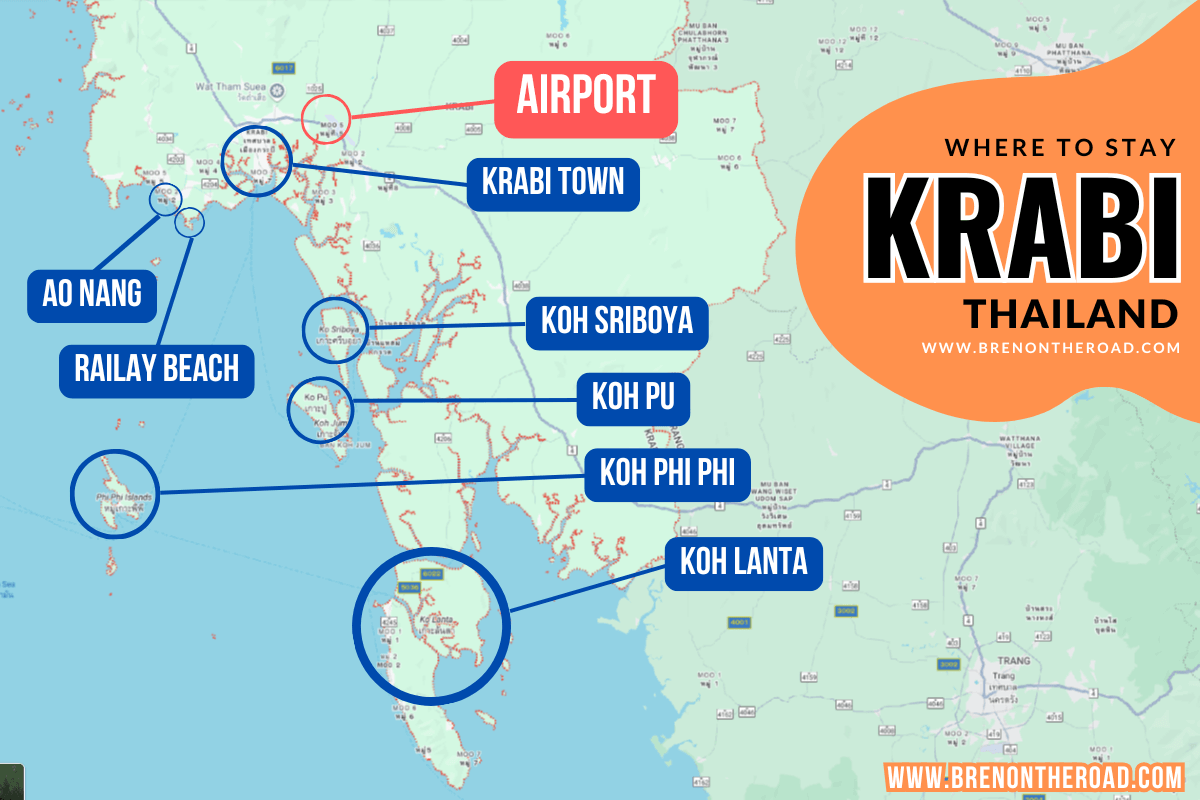
    Krabi is a wonderful area in Southern Thailand, not far from Bangkok, and with speedy links to some spectacular beaches for the island-hoppers among you.

    I’ll be running through the best places to stay in Krabi, whether you’re after a friendly hostel, dinky B&B or a luxe hotel.

    This is a great destination for every traveller, as there are areas to suit all personalities and travel styles; from the hustle and bustle of Krabi Town to the deserted beaches on nearby islands, this part of Thailand has something for all.

    Krabi is technically a province, home to a collection of stunning beaches, teeny islands and mangrove forests. It’s a very easy area to get around making it super tourist-friendly.

    If you hop on a bus (expect what is essentially an open-air cart attached to a car!) you can enjoy the breezy ride to nearby Railay Beach.

    For something quieter, Ao Nang is a lovely little place to head for a day or two, especially if you’re on a solo adventure.

    Krabi is also just a short boat trip away from several nearby islands too, so makes a great base for those on longer trips – there’s nothing like an island-hopping weekend to polish off the week!

    Krabi Town 
    krabi beach hotels

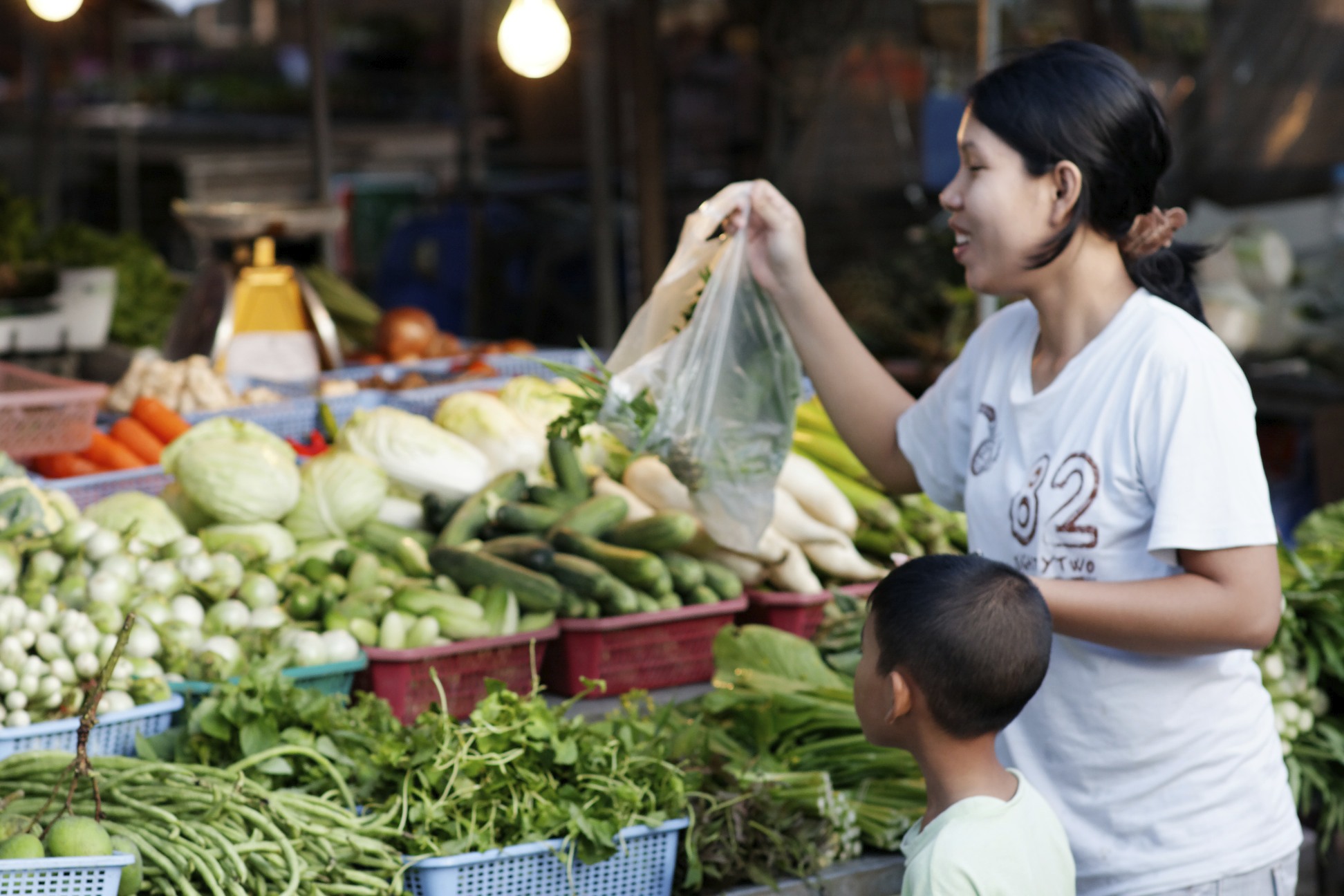
    Krabi Town is packed with cool food markets, quirky stalls and one of the best night markets around.

    If you’re a foodie, get yourself down to the centre and feast on all the Thai goodies you can handle!

    The town centre is nicely compact, so you won’t find yourself having to walk too far to the 7-Eleven, the glorious array of restaurants and even the karaoke bars.

    The town is very laid back – you’re likely to see lots of other tourists wandering around, but it’s a calmer vibe down this part of Thailand.

    Unlike some of the busier areas like Bangkok and Phuket, there’s no haggling or hustling in the streets.

    Locals tend to be very friendly without the usual flurry of salesmen with bags of bracelets and sarongs!

    This makes Krabi town the perfect spot to enjoy some downtime and stock up on the essentials before heading off to a nearby island for some R&R.

    While you’re in Krabi town, head to the night market by the river. It’s home to rows of stalls, each boasting steaming pans of goodness of classic Thai eats. Meet other travellers here and bond over Chang beer or a fruit shake.

    If you’d rather visit a restaurant, make it Coconuts – this cafe and bar offers amazing Thai cuisine, as well as European delights. It’s well-priced and very friendly.

    May & Mark‘s is another fantastic find, right in the centre of Krabi Town. This is a popular choice among tourists, thanks to its comfy seats, aircon and free wifi. The fact that their brunch menu is mouth-wateringly good is a positive, too!

    Where To Stay In Krabi Town

    For the Backpacker

    Chanchalay Hip Hostel is one of the best places to stay in Krabi for a budding backpacker, thanks to its cheap rooms and friendly vibes. Those travelling alone will have no trouble finding new buddies here. You can choose what size room you’d like, or just book yourself a budget private room. Free wifi is available to all guests, as are comfy beds and clean bathrooms. This hostel is in a great location for those wanting to unwind in the city area – it’s not too noisy but still within walking distance of the most popular attractions. Highly recommended for those wanting a pleasant place while still trying to save a few dollars. Best rates here!

    For the Budget Traveller

    Dee Andaman Hotel proves that you can enjoy a slice of luxury without splashing out too much.

    You’ll fall in love with the pool here, especially during the hot, sticky days. You can even grab a massage during your stay, or just make the most of relaxing in the sun in the stunning garden area. Rooms are cheap, with various options available, all of which include WiFi. Despite housing a  large number of rooms, Dee Andaman offers a quiet break from it all. Ideal for budget traveller couples or those who aren’t too keen on the hostel life. Best rates here.

    For the High Roller

    Family Tree Hotel might just take the top spot on the best places to stay in Krabi.

    Choose from a private balcony, garden view or huge ‘Deluxe Suite’ and get settled into a life of luxury. The rooms are all spacious and airy, with quirky additions in their common areas, such as hanging plants, stylish graffiti and light features.

    The great thing about Thailand is you can experience luxury without going bankrupt, and the Family Tree is no exception. This hotel is perfect for anyone who wants to enjoy the finer things in life while still embracing Krabi’s traditions and energy.

    Get the best rates here.


    Ao Nang

    where to stay in Krabi

    Quirky little Ao Nang is a must-see place when visiting Krabi. Yep, it’s touristy and, yep, it doesn’t initially seem like a Thai paradise, but just give it time.

    This hub of activity will quickly grow on you, with fun bars and restaurants dotted around.

    The beach might be studded with tourists but don’t let that put you off, the waters here are great for a dip and you’re bound to make new friends while sipping on a Chang (or a coconut!)

    While you’re in Ao Nang, why not get adventurous with a day of rock climbing?

    Choose from a half or full-day of climbing over the cliffs of Railay. There are different sessions depending on your abilities, with the options of climbing and belaying. This is a great way to take in the incredible views of Krabi while trying something new – or an amazing new place to build on your existing experience. Just remember to take plenty of water and sunscreen as it gets very hot! This is popular and one of the must-do’s if you’re down this part of the country.

    Ao Nang is also a great place to hop on a cruise. Some companies take you on a sightseeing trip, complete with snorkelling masks, stand-up paddleboards and kayaks. What better way to explore?

    Where To Stay In Ao Nang Beach

    For the Backpacker

    Look no further than Balcony Party Hostel. Three little words we all love to hear when backpacking.

    This hostel is a total gem, set in the perfect location for a night on the town. The dorms are all really well priced and come with a plug socket and light by every bed. There’s a free BBQ-hour every day, so those travelling alone will have plenty of opportunities to meet other people. The balcony itself is, of course, the ideal spot to enjoy views of the Krabi ocean. Has an age limit (18-40).

    Best rates here.

    For the Budget Traveller

    One of the best places to stay in Krabi, Ao Nang Cliff View Resort is home to spacious rooms, a luxurious pool and peaceful surroundings. In the daytime, Ao Nang is full of boozy tourists and it can be hard to see the town for the friendly, traditional Thai gem it is. The classic Thai buildings at this resort will help you immerse yourself in the ways of Thailand, so embrace it all at one of the best Krabi beach hotels. There’s a fantastic restaurant on-site if you don’t fancy leaving the resort (and I wouldn’t blame you for that!) You’ll be living in the jungle during your stay here, so make the most of the peace and quiet while topping up your tan.

    Best rates here.

    For the High Roller

    Centara Grand Beach Resort & Villas is undoubtedly one of the best places to stay in Krabi.

    Choose from an ocean-facing room and take in the views or enjoy some privacy in the luscious gardens. Whichever room you pick, you’re guaranteed an incredible stay here. This is one of the best resorts in Krabi, thanks to its stunning surroundings and total calm. The best bit? The resort is located in its own private bay, giving you access to the best beach in Krabi! You’ll also be free to make the most of the resort’s facilities, be it their spa, fitness centre or hot tub. Luxury.

    Best rates here.


    Railay Beach

    where to stay in Krabi

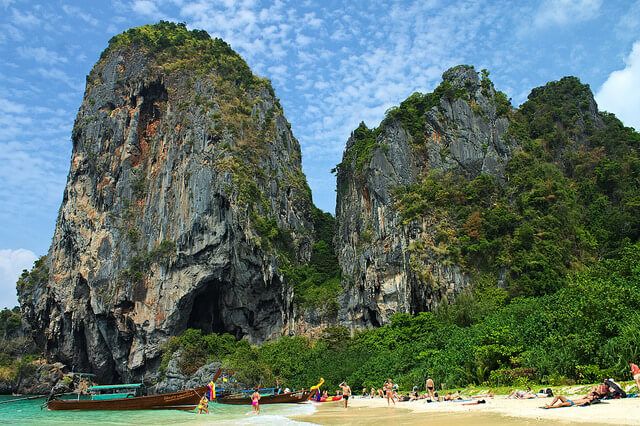
    Crystal clear waters, cragged limestone peaks shooting up from the azure waves and a hub of marine life. Railay Beach is the water lover’s dream come true.

    Move a little further away from the main drop-off point and bag a spot of white sand to relax on. You can take a boat here from Ao Nang for the day, or stay a couple of nights in some of the best resorts in Krabi.

    There aren’t backpacker options on this island, sadly – this place is pristine and many tourists are willing to pay a lot of money to spend time here.

    While you’re at this little paradise hub, head up to the viewpoint! This cliff-top area offers stunning views of the little island, as well as further out back towards Ao Nang and Krabi Town. It’s not the easiest walk to do in flip flops, unfortunately, so watch your step and power on up.

    While on the island, why not rent a stand-up paddleboard or kayak? There are lots of little stalls along the beach where you can rent a watersports kit.

    Those feeling brave should take a trip to the lagoon. While notoriously tricky to reach, Railay Lagoon is well worth the climb if you’re feeling bold. This trail isn’t suitable for young children, due to slippery slopes and shaky bamboo ladders.

    If you feel like giving it a go, you’ll be rewarded with scenes out of a utopic movie – expect lush greenery, murky emerald waters and craggy rocks. You can take a dip here or simply admire the Jurrasic Park-style scenery…

    Where To Stay In Railay Beach Krabi

    For the Budget Traveller

    Avatar Railay Resort offers up class and luxury without the huge price tag. Choose from a room or villa, with the option of a pool-side bedroom! The rooms themselves are relatively basic, with WiFI available and TVs in some of them (check when booking!). But the real treasure here are the outdoor areas. Enjoy rainforest surroundings, a huge pool and peace and quiet. This island might be bustling with day-trippers, but early mornings and evenings when the boats have left are the best times to wander around. This has to be one of the absolute best Krabi beach hotels out there, so book a few nights and be prepared for a pampering.

    Best rates here.

    For the High Roller

    Railay Village Resort is Thai luxury at its best.

    This stunning resort is home to a range of rooms, from those with a private jacuzzi to those with direct access to the huge pool area. Rent a whole villa, if you feel like it!

    This resort is mainly aimed at those on romantic getaways, so you can look forward to impeccable customer service, breathtaking surroundings and beauty at every turn.

    If you can handle the heat, hop in the steam room and make the most of the resort’s amazing facilities.

    Best rates here.


    General Tips for Krabi

    Book your accommodation before you go! Krabi is very popular with travellers and tourists, so can get busy during high season (Oct – Mar).

    Check online for the best deals and book in advance.

    Of all the booking sites, I’ve always found Booking.com gives you the best rates throughout Thailand (of course feel free to shop around).

    While part of the thrill of travelling can be turning up with nothing booked and only a bag on your back, in Krabi it certainly pays to plan ahead.

    Another thing – keep small change on you. Krabi is full of quirky little market stalls, so it’s a good idea to keep small change on you – nobody wants to be paying for a mango with a wad of cash.

    Lots of little trinkets will probably catch your eye during the day so it’s nice to be prepared.

    Keep small notes on you for viewpoints, too, as there are often people with donation or collection buckets on the trails.

    Lastly, be open-minded. Parts of Krabi can feel very Westernised at first sight, and it’s easy to be a bit put off.

    Give yourself time to settle in and fall into the Thai way of life – there’s a lot more authenticity to Krabi than the flat whites, 7-Elevens and late-night bars suggest.

    Search a little deeper and don’t be afraid to get stuck in.

    Other than that, be safe and enjoy. Krabi is a magical place 😉
    Photo Credits: 1, 2, 3, 4, 5, 6, Featured Image

  • How To Find A Super Cheap Flight

    How To Find A Super Cheap Flight

    Depending on where you live, flights can be a real suck on your travel budget. Thousands, sometimes tens of thousands of dollars. How do you find a cheap flight? It’s the bane of every budget traveller.

    Over the last few years I’ve learned a few tricks, and flights are no longer the draining expense they were when I first started travelling. It can be a bit of a process, but if you’re vigilant in your flight search there is usually a way to get where you want without smashing the budget.

    Below is the general process I use whenever I’m looking to head somewhere new. It can be pretty involved so try and stay with me, but I’m confident you’ll be able to save a bit of money using the tools and tips below.

    Step 1: Start with a flight search engine

    This is your starting point. There are a lot of them out there, but for this example I’m going to be using Skyscanner.

    (Others that I’m particularly fond of are Flight Network, Hipmunk and Google Flights).

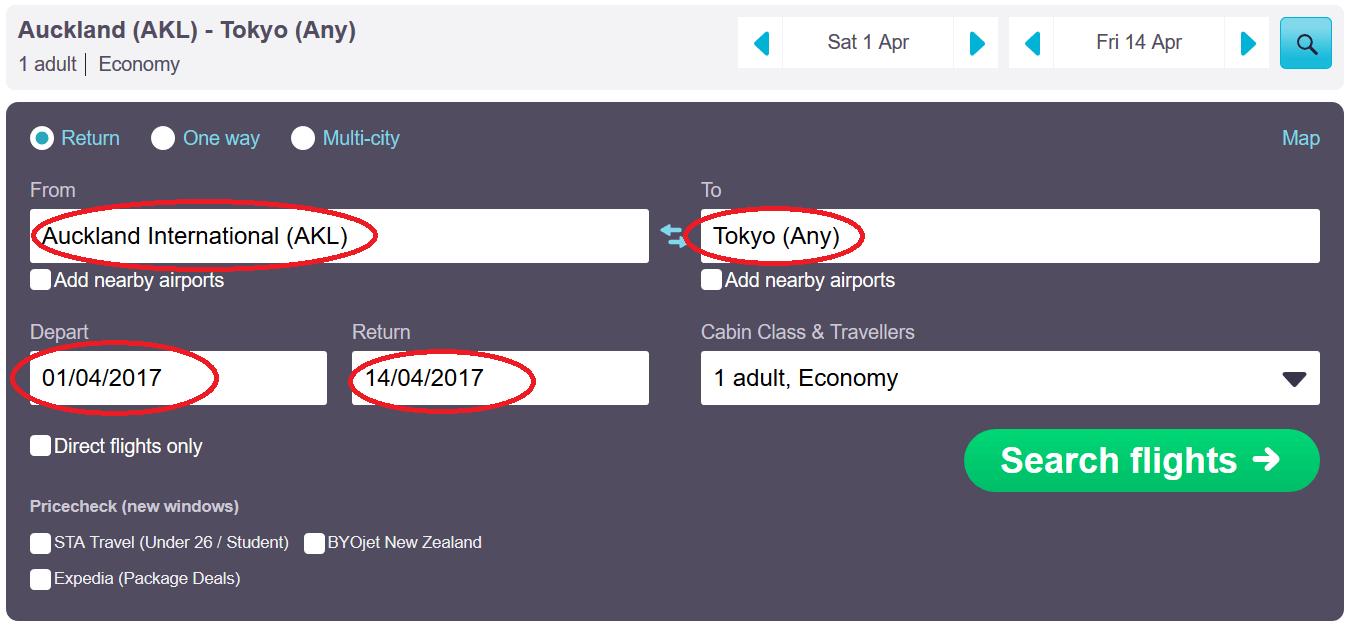
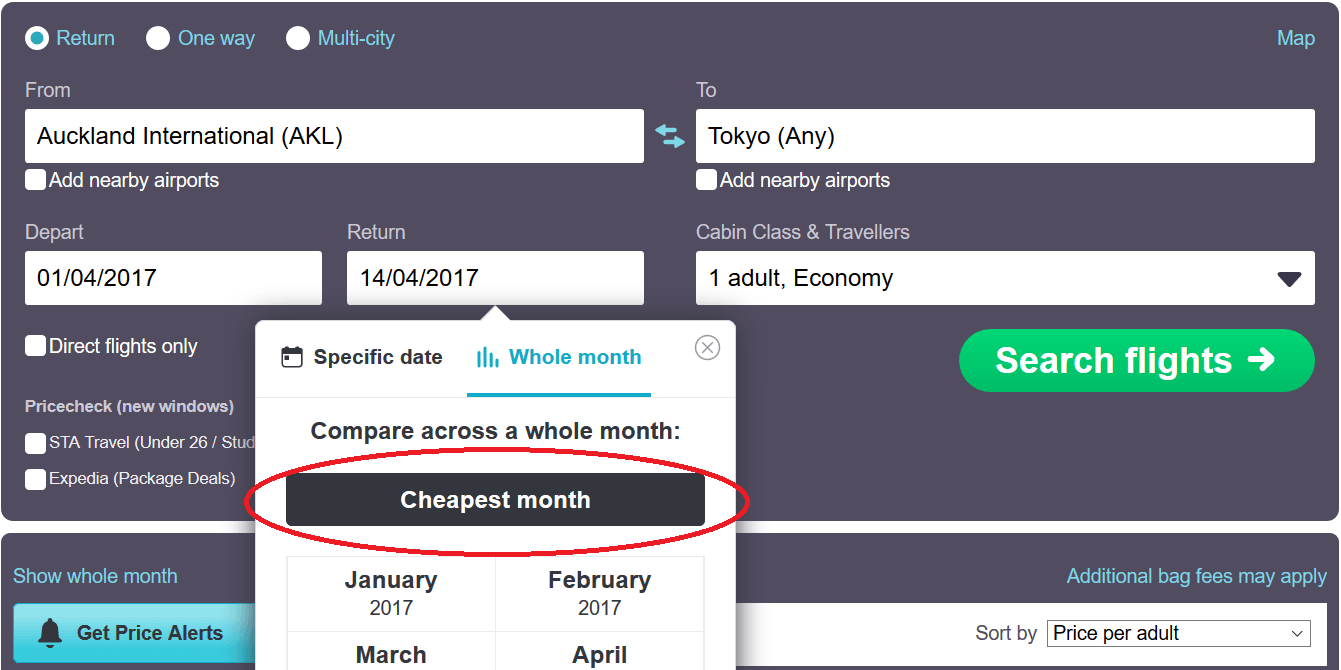
    As I’m based in New Zealand I’ll use Auckland as our starting point. For our example, let’s say we’re heading to Tokyo for two weeks – 1 April to 14 April.

    Searching for something like this is pretty simple. Just head to Skyscanner, plug in your dates and destination, click search. It will search (almost) all airlines for you and give you the best available price. Your form should look like this:

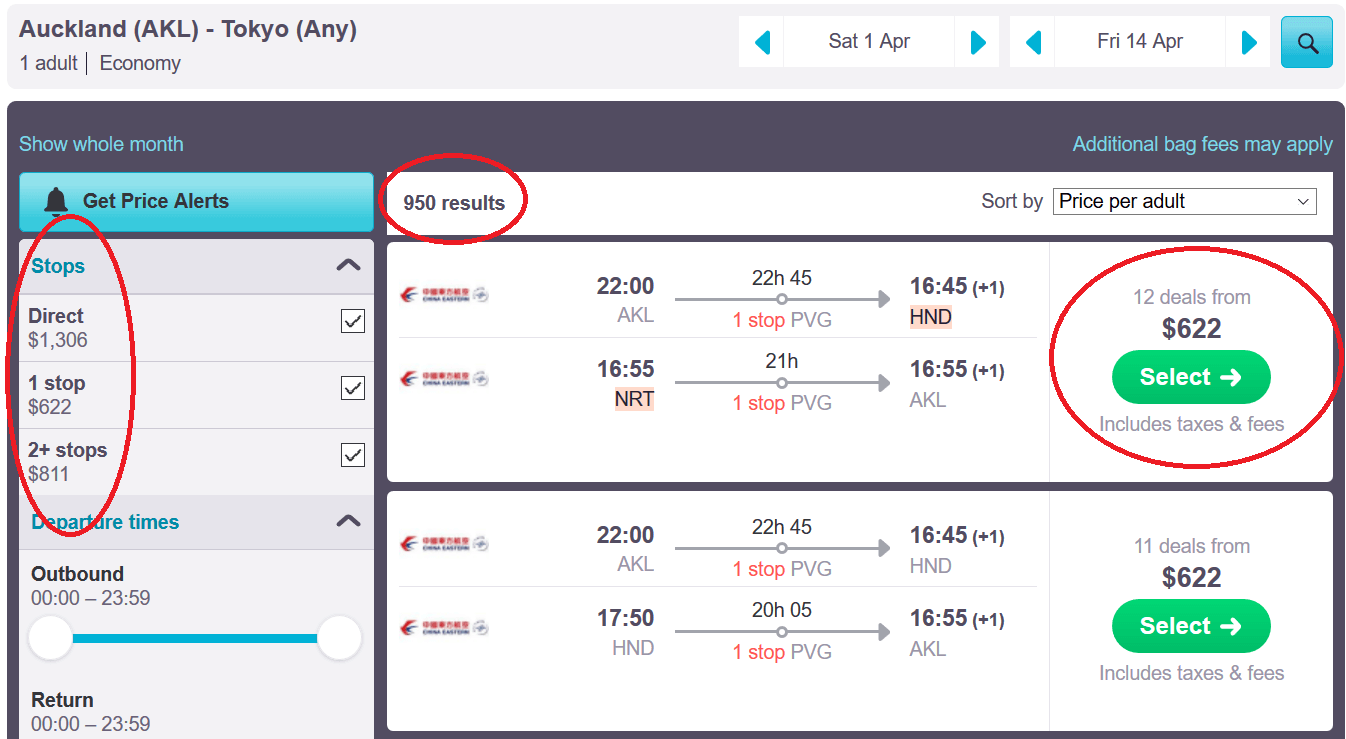
    Here are the results:

    We’re given 950 options, the best one being $622 with China Eastern. That’s not bad, but let’s see if we can get that price down a bit.

    Be flexible with your dates

    The best way to save money on a flight is to be flexible. If you only have two specific weeks during the year you can travel there’s not too much you can do, but if you’re without a strict schedule, you can save a lot.

    Let’s search for another flight to Tokyo, assuming we don’t care when we go. All we want is the cheapest flight.

    To do this, leave your search criteria exactly the same but in the date section choose “cheapest month”. It should look like this:

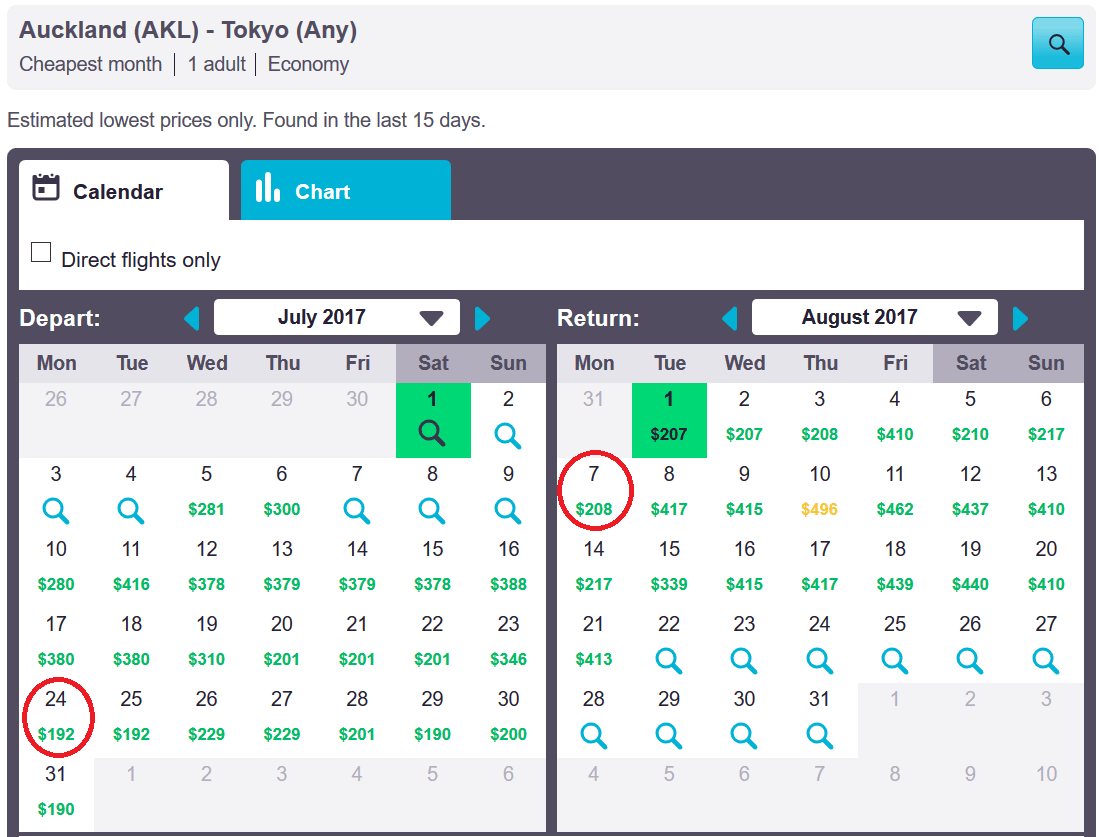
    Skyscanner will then search every month and give you the cheapest possible flight for the year. In the results we’ll see it’s in July.

    To get the cheapest two week trip, you would probably choose the flights I’ve circled in red – the outgoing flight on July 24th for $192, and the return on August 7th for $208 for a total of $400.

    If you remember, our earlier April dates were going to cost $622. In less than a minute, we’ve pinpointed the cheapest possible flight of the year, and saved $222, or 37%. Not bad.

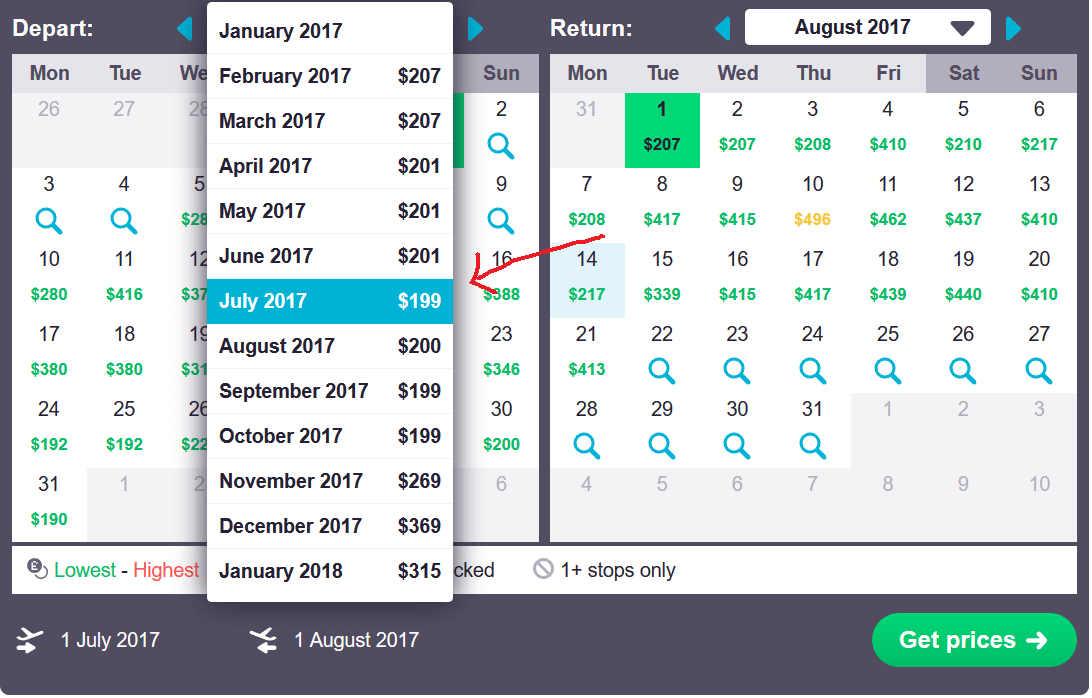
    If July or August isn’t a good time for you, just click the months’ dropdown box and you’ll get an indication of prices for each month:

    This gives us a few more options. Even though July was given to us as the cheapest month, you can see that September and October look equally cheap. However once you click around those dates you’ll find the return leg is probably more expensive, which is why Skyscanner gave us July instead (Skyscanner is kinda smart). Nonetheless you can click through those other months and see if there are other options for you.

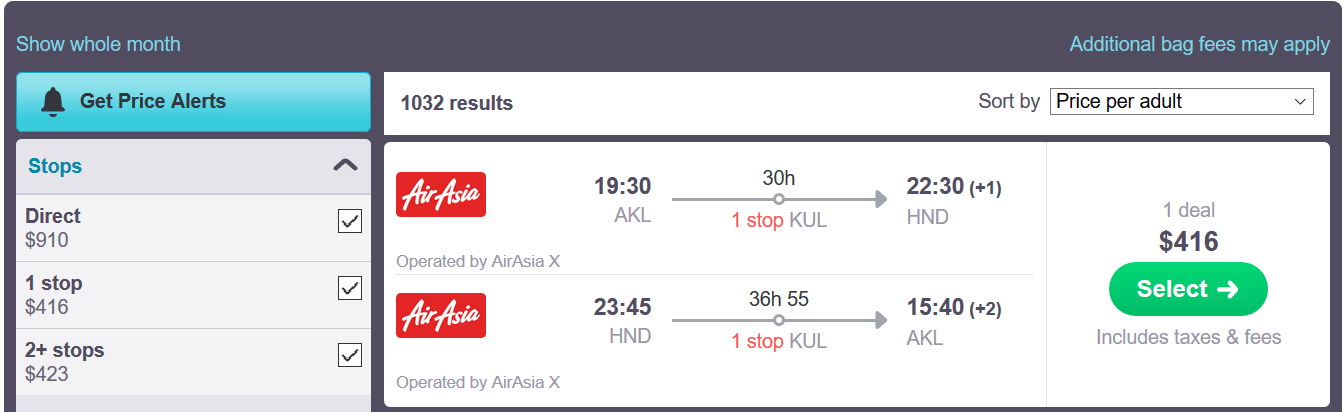
    Now if we actually select those flights for $400 and click “Get Prices” we’ll get taken to the actual flight itinerary. In this case the flight turns out to be on Air Asia, for $416:

    You might be thinking, why is it now $416 and not $400? This is actually really common on these sites – there are even times when the opposite happens and the itinerary comes out cheaper – maybe $390 or something. Flight prices are always changing (literally every minute) so I presume this is why this happens.

    Now if you’re ready to book the flight you can just click the green button and book. But maybe we can do even better?

    If you look at the above itinerary, you’ll see it’s an indirect flight, meaning the flight has a layover. In this case, the flight goes through KUL (Kuala Lumpur). One option we have now is to book those legs separately – we’ll book Auckland to Kuala Lumpur, and then we’ll book another flight from Kuala Lumpur to Tokyo.

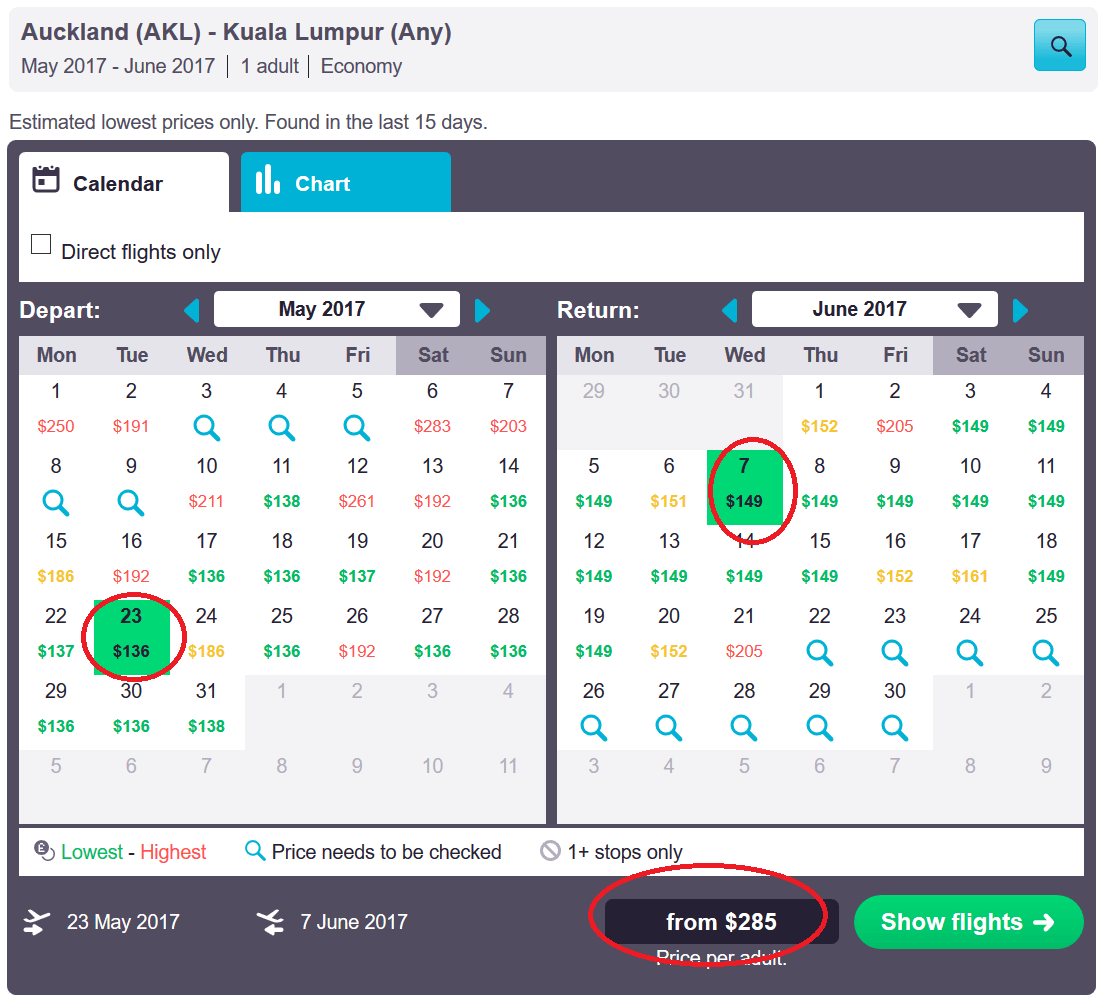
    Using exactly the same technique from before I’ve found the cheapest flight from Auckland to Kuala Lumpur, which is in May/June for $285.

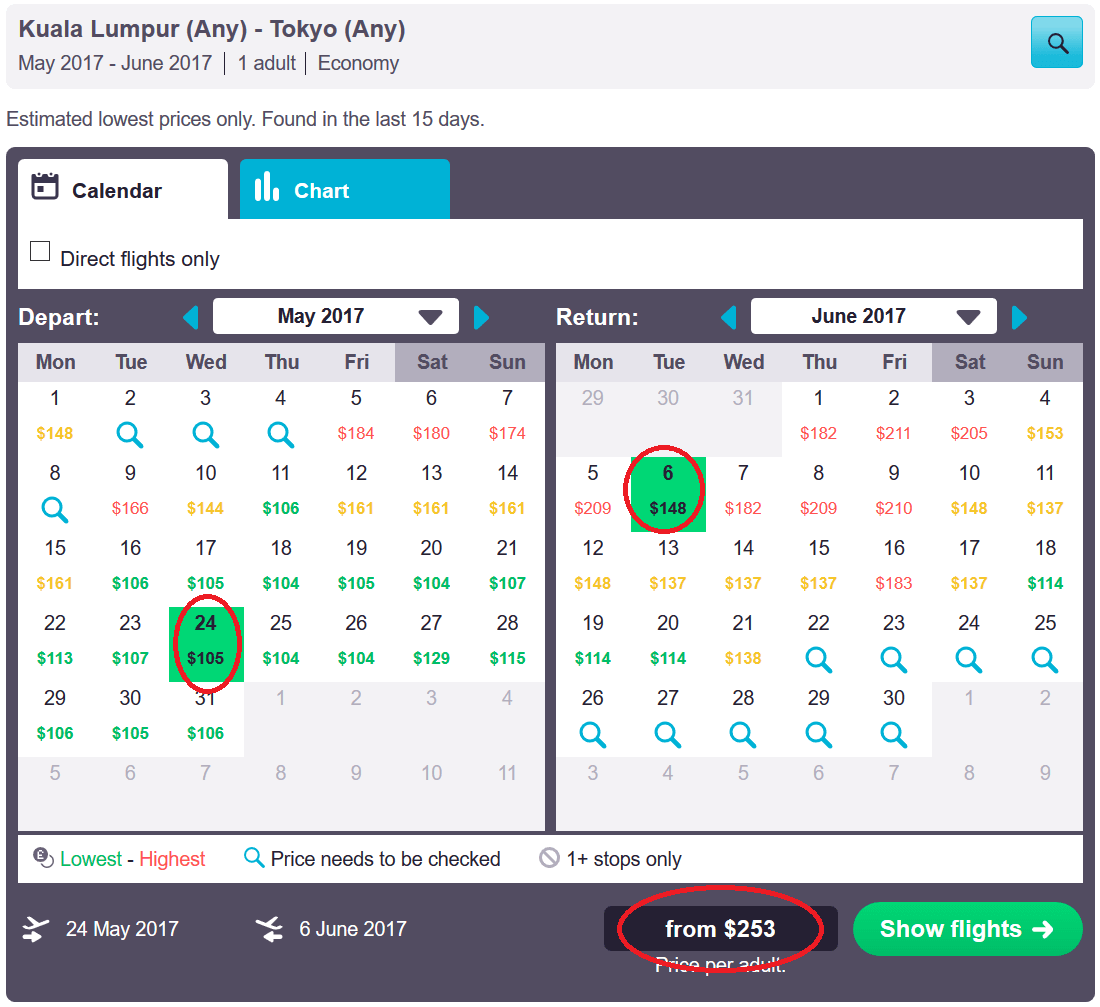
    That’s pretty good, but we still need to get from Kuala Lumpur to Tokyo. If we can do it for less than $115, we’ll beat our $400 itinerary from before. Obviously we can’t just search any dates – we know the exact dates we’re going to be in and out of Kuala Lumpur (23 May – 7 June) so we have to work with those. Here’s what we get:

    Aaaand we’ve struck out. $285 + $253 gives us $538, way more expensive than the $400 we found before. BUT, this technique does work really often, especially on longer routes. I actually spent a while trying to find an example for you that worked but I lucked out (to be honest I only spent about five minutes and then I gave up, but it does work!)

    That’s the general process for finding the cheapest flight to a specific destination. Be flexible with the dates, try and book your legs separately, experiment with different layover cities. That should already give you a lot to work with. But again, can we do better?

    3. Be flexible with your destination (and get a ridiculously cheap flight)

    We’ve just seen how much you can save if you’re flexible with dates, but what if you’re flexible with your destination too?

    If you’re like me, maybe you don’t care where you’re going. You just want to go somewhere new. So unless you’ve fallen in love with a girl on a Tokyo dating website, or have an infatuation with guys dressed in cosplay, maybe you could pass on Tokyo and try somewhere else. If that’s the case, here’s what I do pretty much every time I travel.

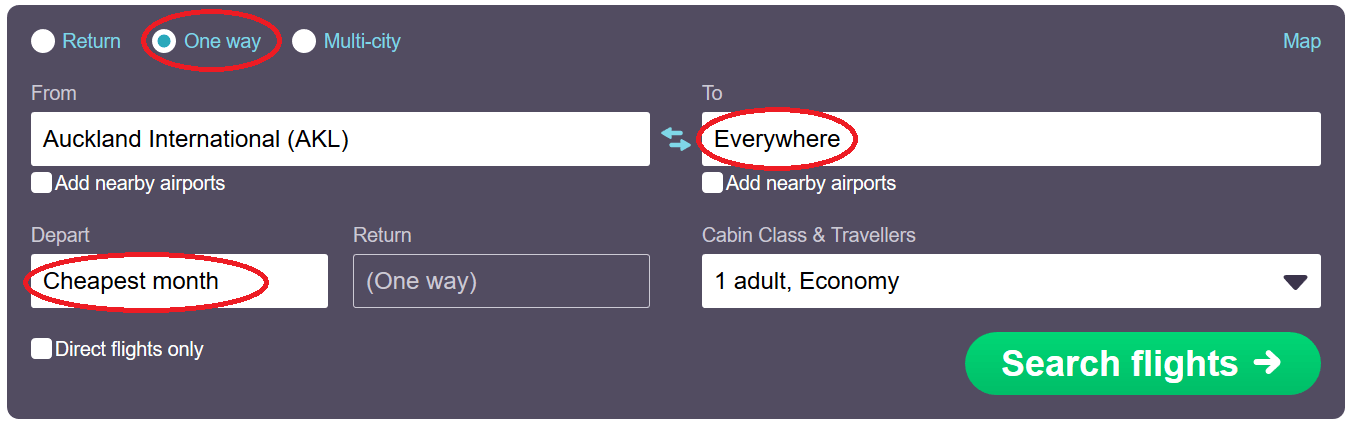
    Go back to Skyscanner and put in your origin. We’ll stick with Auckland for now. Set the search to “One way”. Then, select the “cheapest month” option like we did before. Then leave the destination field blank. It will self populate with “Everywhere”. Your form should look like this:

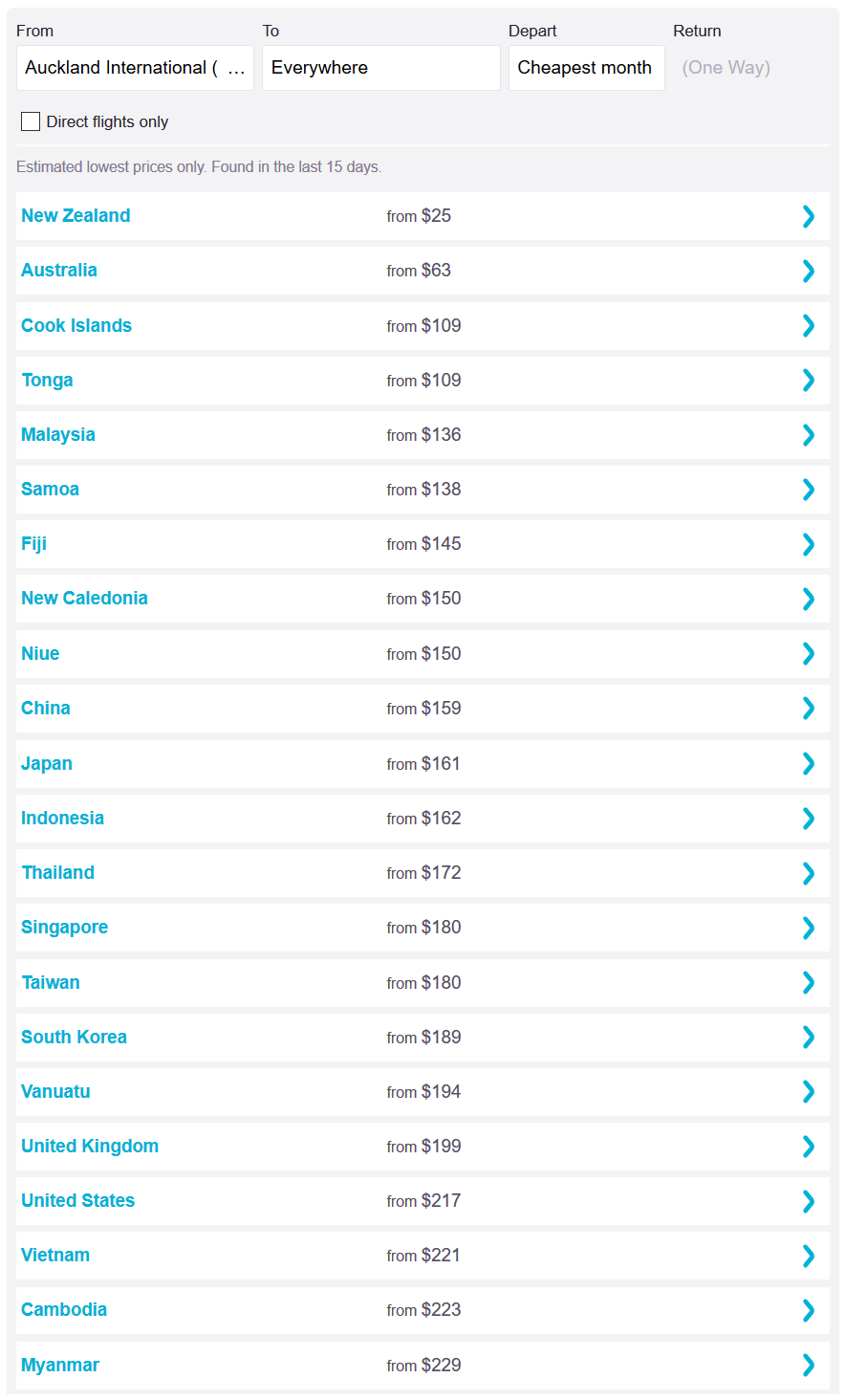
    Hitting search will give you the cheapest flights from Auckland to everywhere in the world for the entire year. Check out how many places you can go to for under $200 USD:

    Pretty cool. Note that there is some time lag for these results to update. For example, I clicked into that $199 to UK option and it had already disappeared, so it was probably a flight special or mistake fare that’s been finished. But those were all real results at some point in time, and they’re usually pretty up to date.

    (As a side note, if for some reason you’re not loving Skyscanner, you can perform this same search technique using Kayak’s “Explore” tool and Google Flight’s “Discover Destinations”)

    Now all these cheap flights are super exciting, but still we need to ask. Can we do better?

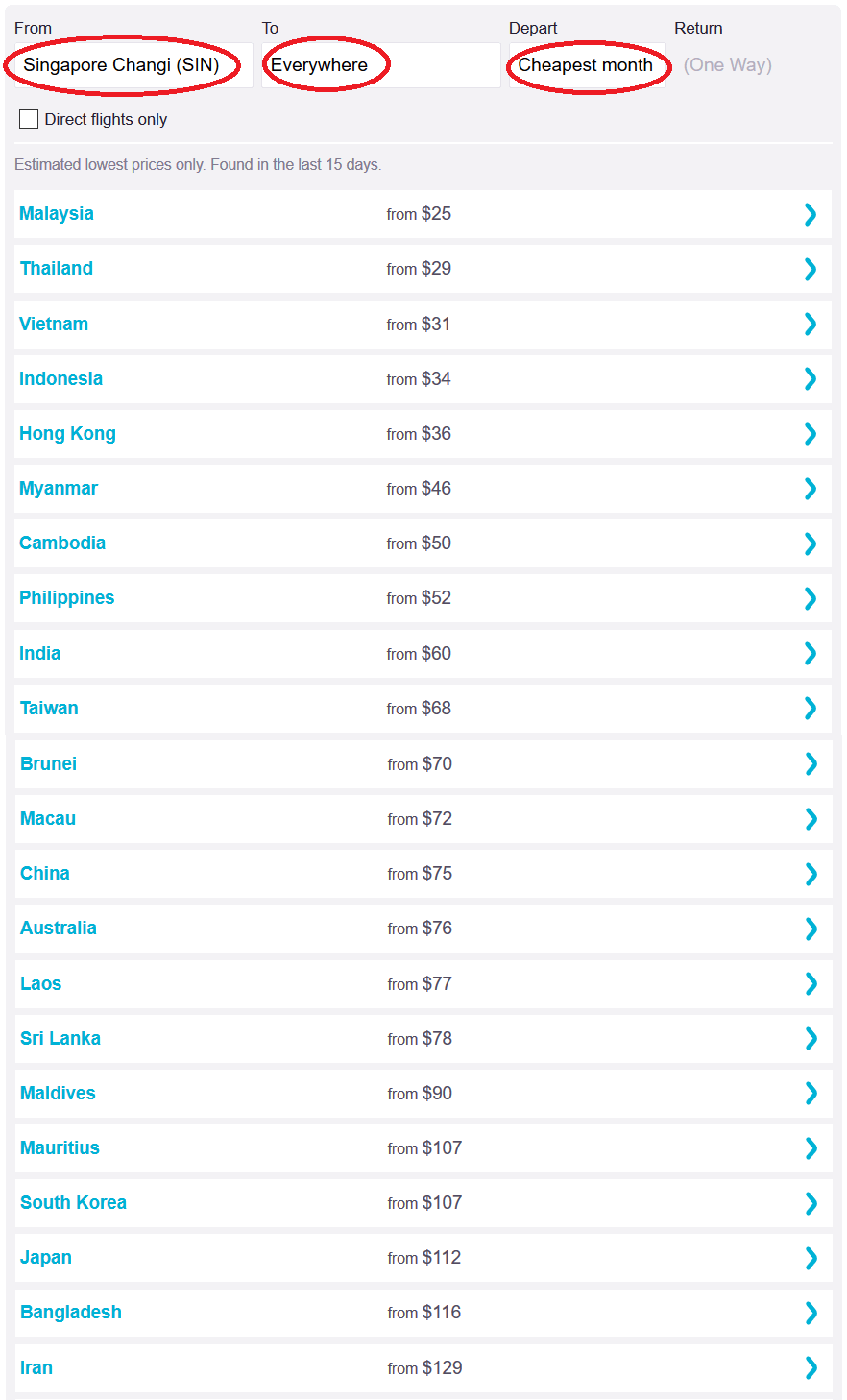
    Let’s do the search again, but this time we’re going to use a nearby international hub as our departure point. For example, the closest hub to Auckland would be either Sydney or Singapore. The Skyscanner search we just did (Auckland to everywhere) says we can get to Aussie for $63 and to Singapore for $180. Singapore is a really good hub (possibly the best in the world) so we’ll use that one.

    Here’s the same “everywhere search” using Singapore as the point of departure:

    The obvious gameplan here would be, buy the $180 ticket to Singapore and then launch your travels from there. Thailand for $29? Vietnam for $31? It’s up to you.

    What if you’re not flexible with dates or destination?

    This means you basically have no bargaining power at all, but there are still one or two tricks you could use that might save you some money. The tips below are some generic flying tips, and you can apply them to all your flight searches, even (especially) the shotgun searches we did above.

    Try using different hubs

    We touched on this already but I’ll mention it again. If your dates are fixed, and your destination is fixed, you can still try and change the hub you fly through.

    In our example we were flying from Auckland to Tokyo. This gives you plenty of options; Tokyo is close to many hubs such as Bangkok, Singapore, Hong Kong, Kuala Lumpur and Manila. Auckland is close to Australia. That leaves you with a lot of search possibilities. As an example, you might be better off flying from Auckland to Singapore and then taking a budget airline such as Tiger Air to Tokyo. You could also get a Jetstar or Virgin flight from Auckland to Australia and try flying from there. In our example the Kuala Lumpur option didn’t quite work out, but there’s a good chance others will if you have the time to search through them.

    I actually remember doing this a few years ago when, instead of taking the Emirates flight from Auckland to Nairobi (through Australia and Dubai), I caught a budget airline from Auckland to Singapore instead, and then flew from Singapore to Nairobi with an Indian airline. It was a simple route, but Skyscanner’s default searches didn’t put it together. I had to do it myself.

    A very handy tool for finding flights on budget airlines into and out of hubs is Whichbudget. It aggregates all the budget airlines and has a lot of smaller airlines the bigger sites like Skyscanner don’t pick up.

    Go directly to the airline’s website

    I’ve actually never found a flight to be cheaper on the airline’s website than it was on Skyscanner. For some reason the search engines are always cheaper (I still haven’t figured out a reason for this).

    I have, however, found flights on the airline’s website that didn’t exist on Skyscanner. This has actually saved my ass a few times – it was particularly common in Africa.

    There’s a lesson here. Skyscanner (and every other aggregator site) will never show every single flight available. That means you need to search a little bit deeper once you’ve done your initial research, which means searching both flight search engines and the airlines’ official websites.

    Again, to make sure you haven’t missed any of the lesser known airlines, do a quick search on Whichbudget too.

    Land in a smaller city

    This works because larger airports are more expensive for planes to land at, and these extra fees get added to your ticket.

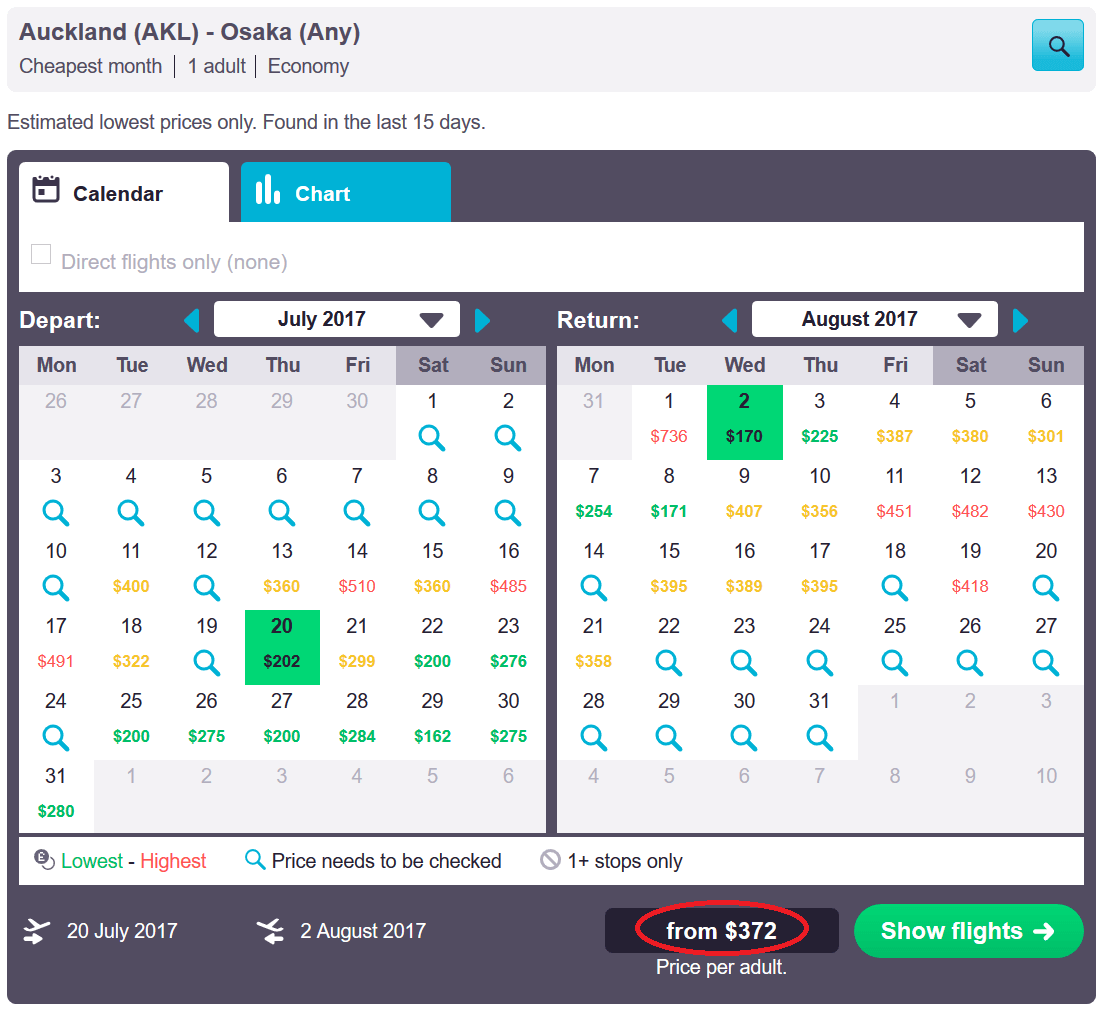
    For example, instead of flying into Tokyo you could try fly into one of Japan’s smaller cities. The first one that comes to mind is Osaka, and a quick search shows it is in fact cheaper. If you remember, the cheapest return flight to Tokyo was $400. The cheapest return flight to Osaka is $372:

    Obviously this gives rise to the problem of getting from Osaka to Tokyo after you land (it’s about a 4 hour bus ride, I think), but if you wouldn’t mind visiting Osaka anyway, why not? In this case the flight is only marginally cheaper, so it might not be worth your while, but sometimes it can work out several hundred dollars cheaper. Common examples are landing in Newark instead of New York City, Beauvais instead of Paris, or Clark instead of Manila. There are countless examples like this.

    Fly budget airlines

    If you want to travel long term, you really just need to get used to this. I’ve known people that pay up to $500 more for their airfare just to avoid a budget airline. Of course, that’s fine, but it also means you have no right to complain about flights being expensive.

    One couple I met spent $3,000 on their airfares to Thailand because they didn’t want to fly Air Asia, which could’ve got them there for $1,600. That’s $1,400 in change! A couple could live in Thailand on that for 2 months.

    At the end of the day, just think about how much better a major airline really is. You get a TV, a plate of airplane food, a couple of free Cokes. That’s it. How much is that worth? I’d say about 50 bucks. Get used to flying budget airlines, and spend the hundreds of dollars you’ll save on something a little more rewarding once you land.

    Fly at the right time

    They say the best day to fly is Wednesday, and the best time to fly is the last flight out at night (or very early morning). This is not set in stone but from my experience this is good advice. When flying around Asia, the 2am flight is sometimes less than half the price of the 9am flight.

    Also, be clever about which time of the year you fly. Christmas and other holidays are traditionally bad times to fly; but you can also use the heavy season to your advantage.

    Example: In 2011 New Zealand hosted the Rugby World Cup, and during that time airfares coming into the country skyrocketed. Also, no one wanted to leave the country during that time, so flights going out of the country hit rock bottom. During that time I flew to Buenos Aires for $1,100 return (at the time the fares were usually $2,000+). It was just a product of good timing, and the leftover change went a long way in South America.

    Book at the right time

    If you book too early, you get grouped with the high payers (think people who are flying somewhere for a wedding or a conference). These people reserve their seat early because they need to make sure they fly on that date, and therefore they lock their flights in early and pay a premium. If you book too late, you also get grouped with the high payers (think people attending a funeral or some other emergency).

    How do you avoid that? The unwritten rule is to book in the golden window: 5-8 weeks in advance. That should give you the best chance of getting the best price. Of course nothing is guaranteed, but that’s a good guideline.

    Search incognito

    If you’re doing a lot of searching, do it incognito. To do this, simply click “Open Incognito Tab” in your browser. This means your browser won’t hold any cookies and keep data on where/when you’ve been searching for flights. If there’s a route you’ve been searching a lot, it’s possible the search engine will catch on and bump prices in your searches. Whether or not this is actually true is disputed. Some travellers swear by it, some think it’s nonsense. What do I think? I have no idea. But I do it, simply because it doesn’t cost anything, and it does kinda make sense.

    Watch out for specials!

    I take advantage of specials often. Jetstar often runs flight specials from Auckland that are almost 50% less than normal fare. Air New Zealand is running really good specials constantly. In The Philippines, Cebu Pacific sometimes has $0 flights! Air Asia does all sorts of gimmicky stuff like that too.

    My favourite special is Jetstar’s Auckland to Singapore, which usually pops up around March or June. It’s an awesome bargain, because once you get to Singapore you can fly almost anywhere in Asia for less than $100. Not to mention most airlines charge between $700 – $1,000 for that Auckland – Singapore route. It’s pretty easy to stay informed for deals like this – just sign up for the email newsletter of all the major airlines in your city/country and let the specials come to you.

    Get Price Alerts

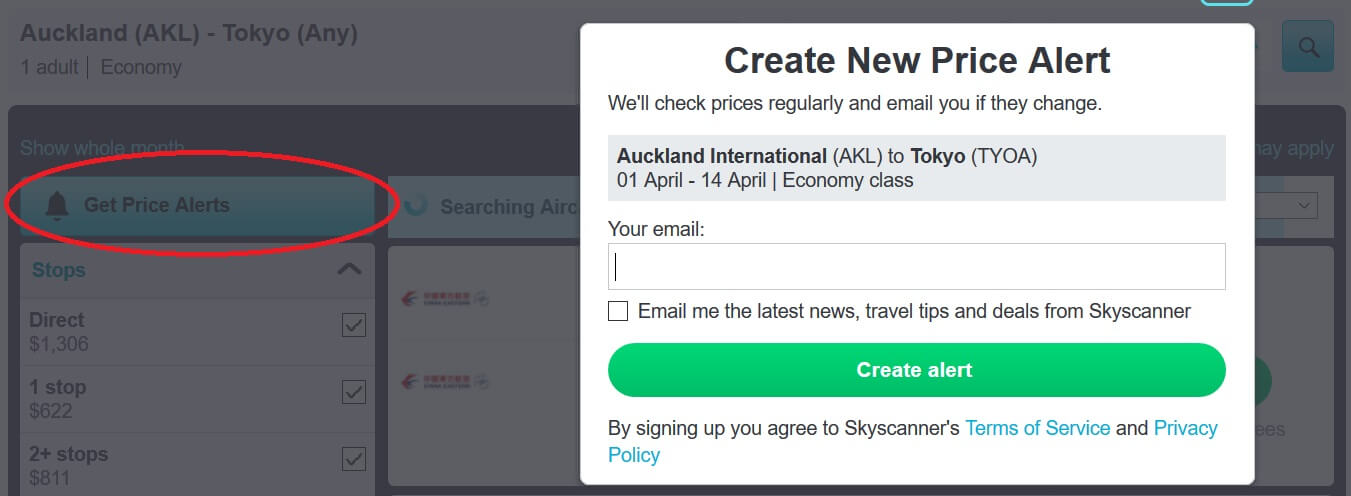
    Airfares change all the time. If you’re searching for a specific flight, like we were in our Auckland – Tokyo example, it can be worthwhile to sign up for price alerts. Depending on the alerts you sign up for, you’ll get emails whenever the price is about to drop (or about to rise a lot). Most search engines will have an option to receive alerts, on Skyscanner it looks like this:

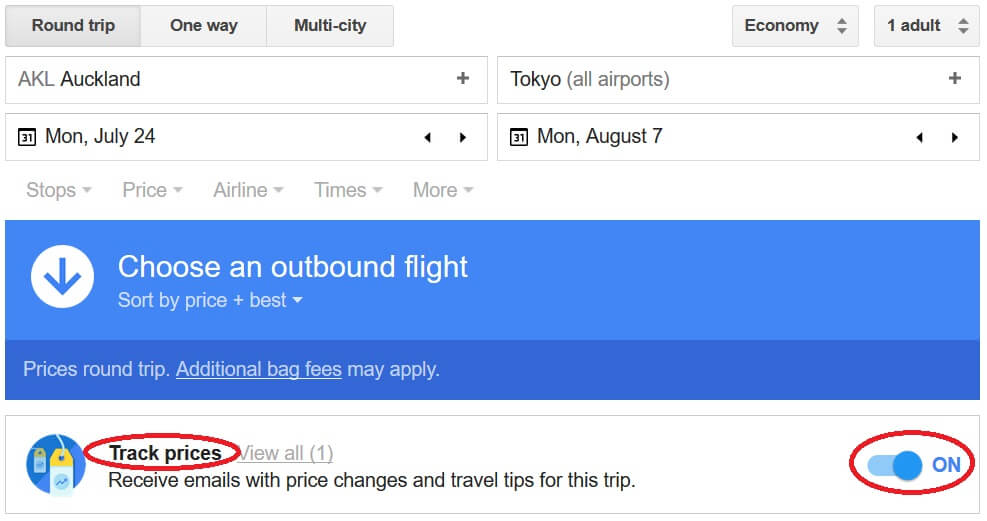
    I would also suggest signing up for a second set of alerts from a different service, as every search engine has gaps, as we discussed earlier. Google Flights is a good option, just toggle price alerts on as follows:

    Flight deals

    Lastly, sign up to some flight deals websites. These sites congregate deals from all over the world and bring them to you in one place. Lots of mistake fares (for example, an airline mistakenly puts a fare in the system for $200 instead of $2,000) and limited time specials too. These sites are updated daily, and they do have some pretty amazing deals.

    Some I can recommend are Airfare Watchdog, The Flight Deal, and my personal favourite, Secret Flying.

    If you love a bargain I highly recommend checking them out. They are a very good resource.


    And that’s about all I’ve got. It seems everyone has their own little tricks to hunting down cheap flights online, so if you have any, please share them in the comments section! Flights are almost always the the biggest drain on a backpacker’s budget, so if you can get them under control that’s half the battle won. As we’ve seen above, you don’t need to spend thousands and thousands of dollars on flights to see the world. Know where and how to look, and you should be laughing all the way onto the plane.

    Good luck and travel safe!


  • A Tammisaari Story

    A Tammisaari Story

    I didn’t even remember what this kid looked like. I mean, I could’ve picked him out of a police line-up, probably. But I didn’t have a clear image of him in my head. He had that funky haircut with the ponytail on top though – I remembered that much.

    I got off the train and headed for the exit. It was a tiny little platform, mostly empty. Only a couple of others had gotten off with me. I lugged my bag up the long, dark flight of stairs, and heard a voice come from the top.

    “What’s up, man?”

    I could only see a shadow, the sun blindingly behind it, but I knew it was him.

    “Hey. What’s up.”

    Kasper and I had met about ten days earlier, in Estonia. I’d walked into an empty Mexican cafe, and he was sitting there alone by the window. I got thrown an Estonian menu by the barman, and as I walked past, looking puzzled, he said hi and offered to translate it for me. I knew right away he was a backpacker. What other creature sits alone in a restaurant and says hi to a complete stranger? Only we do that. It’s like our secret handshake.

    I ended up sitting and eating with him that night, and we talked a bit about our travels and shared a few beers before going our separate ways.

    “If you’re ever in Finland, hit me up. You can visit my town, I’ll show you around the south.”

    Ten days on, I was in Finland, and I hit him up. He invited me to his town, to show me around the south.

    I threw my bag into the trunk. He was driving a white BMW. I would’ve picked him more for a nineties hatchback, boom stereo, hot box in the backseat kind of guy. But you never quite know on the road – it’s a time of stripped identity for many. Oftentimes, the version you meet is completely different to the one they are back home.

    It was a short drive from the train station to his hometown. Tammisaari, they called it. A small Swedish-Finnish town, by the southern archipelago, population 15,000.

    My head was on a swivel as we drove through. Empty streets, lined with small shops, polished and neat, unmarked roads and large wooden houses with big backyards. I loved it. I’d always been enamoured by small towns – so many stories and characters and small town secrets hiding behind every park bench, every schoolyard. All I wanted to do was knock on some old person’s door and ask about all the different legends and scandals and hometown heroes, like when the town jock breaks up with the town sweetheart, and then a new kid arrives in town and gets in the mix and there’s a big standoff at the soccer game on Friday. Then they end up becoming best friends and the girl ends up marrying the town nerd. I could listen to such tales for days.

    We pulled up to Kasper’s house and his mother greeted me at the door. She appeared very homely and sweet, smiling a country smile, apron on, obviously cooking something. I felt like an old family friend, being welcomed home for the holidays.

    Kasper showed me to my room. I grinned a huge grin inside. The bed was huge. A bazillion pillows, fresh towels, three layers of sheets. After months of bunk beds and couches, I’d never been so excited to sleep.

    And then came the tour of the rest of the house. I’d guessed from the BMW his family probably had a bit of money, but the place was a damn palace. Three huge flat screens, massive garden, apple trees, Michelin kitchen, dining table fit for royalty. When we first met, I’d never pictured him as a rich kid. His temperament didn’t show it, nor his clothes, nor his attitude, nor his outlook on life. He just seemed like a regular humble dude. Like most Finnish people, I guess.

    Once we’d settled in, I changed into some shorts and flip flops and we walked down to the beach. They lived only a few hundred metres from the water, and there was a nice pocket of sand where we lay out and chilled in the sun. It was a little strange being there alone with him. I didn’t know the guy well at all, we’d only talked for an hour or so that night in Estonia. I got more familiar with his story; where he was heading in his life, his newly bloomed travel career. As he was only starting university, I felt like I was playing elder brother, in a way.

    “Anyway, tonight my friends and I are going to play volleyball, if you want to go.”

    “Volleyball?”

    “Yeah we started doing that every Sunnnnday. We needed to fiiiind something to dooo around here, you know.”

    His words had that Nordic drawl, where they hold certain syllables just a little longer than usual.

    But I dunno, my friends are kinda scared.”

    “Scared?”

    “Yeah, of you.”

    I looked at him, semi laughing.

    “Me!? What did I do?”

    “Maybe because you’re from New Zealand. I dunno, Finnish people are scared of new things. New people. New anything.”

    When we got back to the house, Kasper’s mother had cooked up a huge pot of lasagne, with a garden salad, fresh bread and homemade juice. She didn’t even serve it in the house; they had some stand-alone dining cottage thing out in the garden, decked out with a fridge and dishwasher and everything. I don’t even think there’s a name for it. A garden house, let’s say. It would’ve been lavish on any day, but after months on the road, I felt like a Finnish prince dining in a private cottage in the middle of my castle orchid.

    We rolled up to the volleyball pit just before sunset. It was nestled in the corner of their old school courtyard, a lone sandpit, not far from the roadside. A couple of his friends, Ville and Ida, were already there, knocking the ball around. Ida smiled a bubbly smile and shook my hand. She had long, dark blonde hair, blue eyes, and full, rosy cheeks, which gave her a certain small town charm. Ville was a little more reserved, but gave me a friendly nod and introduced himself. He was of the famed Nordic gene pool – blue eyes, blonde hair, a sharp nose and jawline, and I suppose the famed Finnish temperament too; passive and poker faced. But even though Kasper had made it sound like they were going to scatter and hide behind trees when I arrived, they introduced themselves with smiles and handshakes like ordinary human beings. I felt stupid for expecting anything different.

    Car by car, his friends showed up, and I sat back and watched them come together with familiar smiles. It was like a small town eighties movie. The girls arrived in groups, and sat on the bench gossiping, snuggled up, sipping on bottles of Coca Cola. The boys stood around, brooding, joking, kicking the ball at each other.

    Andreas was the first to chat to me, halfway through one of the games. He was tall, with glasses, a thick combover. He had a gentle, well mannered way about him, and although he appeared the quiet type, he made small talk with me whenever there was a break in the game, like when someone ran off to fetch the ball from the trees or across the carpark. He was chatty, curious. I guessed he was probably the smart kid, who smoked all these other guys when exam time rolled around.

    Volleyball carried on well into darkness. Some games, some chit chat, some goofing around. For them it was just another Sunday, but for me, it was an interesting first peek into their life, their friendship, into this little town I didn’t even know existed a week earlier. I had seen my first glimmer of the real Tammisaari.

    We got home around 11 and I headed straight for the shower. It was pitch black in his enormous bathroom. I found the light switch and stared at it for a moment. It wasn’t a light switch. It was some Star Trek shit with a quartet of neon buttons, sitting on a touch pad. I tapped each of them, in different combinations, even clapped in front of them, like in the movies.

    “Yo Kasper, how the fuck do you turn on the lights in here.”

    He came over, laughing, and pressed the top right button at some funny angle. The lights blinked on. The bathroom was long and tiled black, a sauna on one side, a double rain shower big enough to sleep three on the other. I looked up at the shower head, laughing. It was the size of a dinner plate. I stripped down and stepped in, excitedly, fiddling with the tap – a little colder, a little warmer, until I got it just right. And then I stood there, in bliss, grinning as it rained down on me, washing away every ounce of road weariness from all the months before.

    The next day Kasper and I were on a mission. While at the beach the day before he’d mentioned that a big “crab party” was going down in a few days. Of course the obvious question for me was, “What the hell is a crab party?”

    Crab Party [krab pahr-tee]
    Noun

    1. An occassion where people gather and eat crabs, sing Swedish songs and consume large amounts of alcohol. Usually celebrated at the end of the short Swedish summer, before the long and harsh winter arrives. Dangerous. Avoid if possible.

    Fun. But I’d be long gone by the time that shindig rolled around. So I just thought out loud:

    “Why don’t we have our own? You and me.”

    Kasper hesitated for a moment, furrowing, and then nodded with approval.

    “Yeah, that’s a good idea. We’ll go buy some crabs tomorrow.”

    Only things had changed since yesterday. A few casual invitations thrown around at volleyball, some text messages, and now his whole crew had decided they were up for a crab party with the guy from New Zealand. We had some shopping to do.

    By the time we got home that afternoon we had crab plates, crab hats, crab tablecloth, crab decorations, and of course, the crabs themselves (which, lost in translation, were actually small crayfish). I’m sure if they were selling crab ice cream we would’ve bought that too. We unloaded it all into his garden cottage, ready to kick things off, but it was only early afternoon; we still had several hours to kill before party time. Wondering what to do, Kasper texted Ville, who offered to take us out on his boat for a few hours, to visit his family’s island.

    Say what?

    A little history lesson for you: In Finland you have Finnish Finns, and you have Finnish Swedes. And the Finnish Swedes are the minority for sure. And they don’t really speak Finnish, they speak Swedish, and I guess they just kinda hung around after the Swedes left Finland back in the day. So you’ve got all these Swedish speaking people living in Finland, and they’re all kind of loaded for some reason. So I ask Kasper one day while we’re walking around, “Yo Kasper, straight up, everyone in this town looks loaded as hell. Where did all this money come from?”

    And he just shrugs, and says “I don’t know.”

    But he guesses it’s all generational, passed down from some rich great grandfathers or something. So not only do they have nice cars and houses down this side of the archipelago, they own islands too. It’s normal; you own a bike, you own a toaster, you own an island. And I guess they own them because their grandfather’s grandfather’s grandfather owned them. But I have no idea how all that started.

    Anyway.

    We jumped in the BMW and went to pick up Andreas. He was chatty when he jumped in the car, like the day before. We’d only talked for maybe ten minutes that day, but we greeted each other like old friends.

    “What’s up homie,” I said as he jumped in, giving him a little fist bump.

    Ville was already there when we got to the docks. We parked beside him. By now, I’d started to figure these guys out somewhat. Kasper was the free spirit of the group. The thinker, the idealist. He was the guy who would read the book and be inspired, who would dream beyond the town. Andreas; he was more of a follow the script, study hard, put a smoke alarm in every room kind of guy. You wouldn’t see him put life on pause to go volunteer in Guatemala for a year. He was more the ‘become a hotshot engineer and start your own firm’ type. And you just knew he’d end up with a mega hot wife too, since those sensible dudes always seem to. And then Ville was like the poster boy of the group. Blue eyed blondie, crisp clothes, classic good looks. If they filmed a McDonald’s commercial in Tammisaari, Ville would’ve been the guy holding up the Big Mac at the end looking all dapper and Hollywood cheese. And he’d probably be your regular douchebag if he was from the big city. But as a Tammisaari kid he was cool, and level headed, like the rest of them.

    The four of us jumped in the speedboat. Ville threw the gas down and just legged it. We zoomed through the inlet, past endless clusters of little islands with little cottages on them. I wondered how the hell this guy knew where he was going. Everything looked the same to me. But after twenty minutes we pulled up to a little jetty in the middle of nowhere, and the three of them tied the boat up, as if they’d done it a hundred times before.

    We jumped out onto the grass, one by one. As we started walking, Ville just turned to me and threw it out there;

    “So, uhh, welcome to my island.”

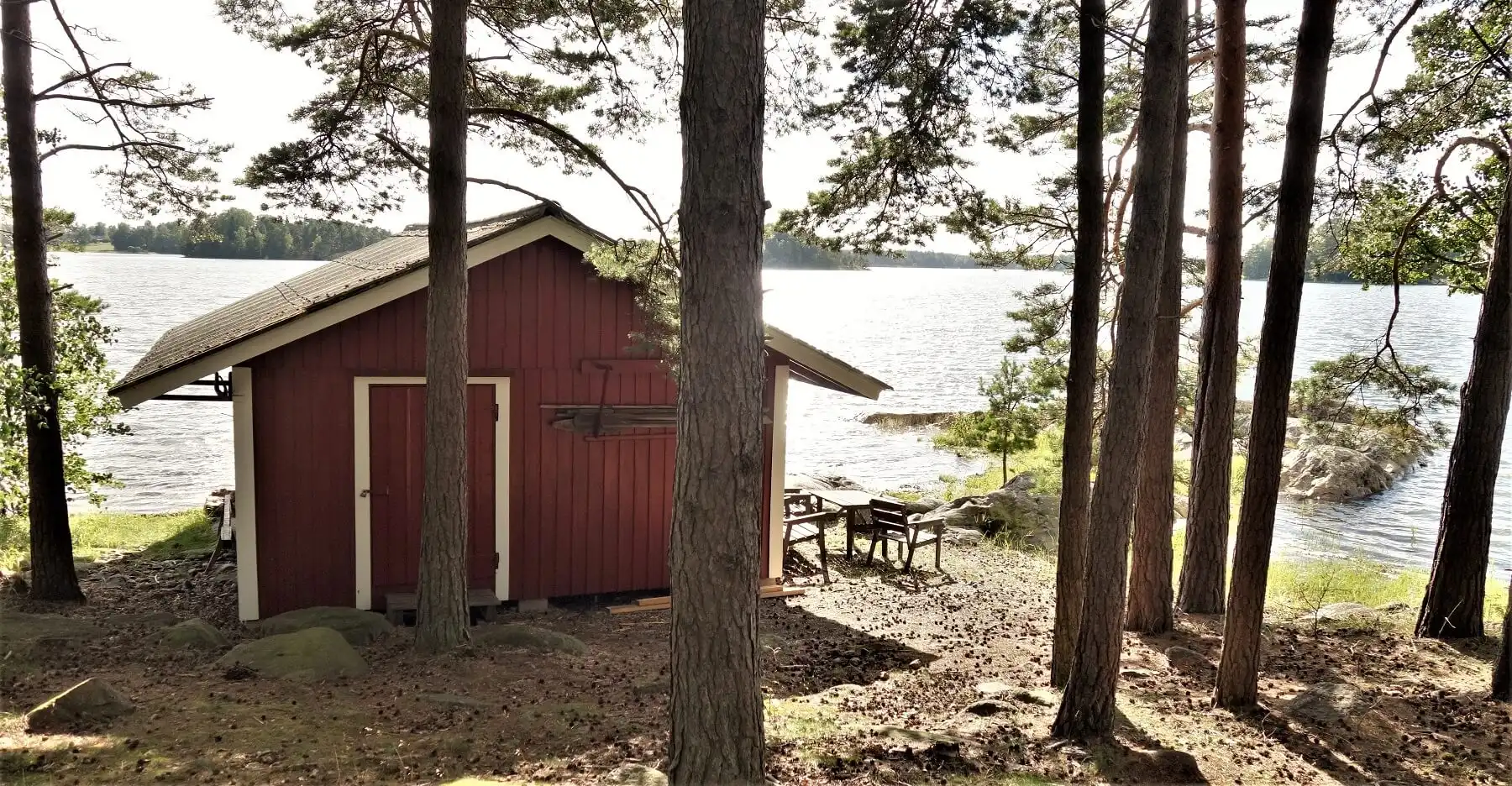
    It wasn’t a small island; the size of a pair of football fields, at least. There were a couple of holiday cottages on it, and a boat shed, but most of it was covered in tall, straight trees and fallen logs, grass growing wild, terrain uneven. As we wandered around, they started unleashing the legends of the place.

    “Hey Kasper, remember when you passed out in that toilet over there and nobody knew where you were, hahahahaha. Remember when the boat broke and we paddled for like two hours, hahahahaha.”

    I could see it in their eyes, their smiles, the memories. It was those coming of age experiences, the kind that bonded people together forever. In New Zealand we had the gullies, the big Pohutakawa trees. In Tammisaari, they had the islands.

    “Man, I used to hate coming out here,” Ville started, gazing over the water. He was more talkative today, more out of his shell.

    “My parents would force me to stay out here in the summer holidays, and all my friends were having fun in the city. It was the worst…”

    His voice trailed off, as he seemed to recollect some old memories. The other two kicked around in the dirt behind us, nodding, as if they’d heard all this before.

    “But now I come out here, relax, drink a few beers. I love it here now.”

    When we finally got back to Kasper’s place the little garden house had been turned into Crab Disneyland. There were crab banners stretched across the ceiling and crab hats with crab bibs and crab songs printed out for us to sing.

    His friends arrived, one by one, two by two, until there were eight or nine of us crammed around the table. Kasper’s ex girlfriend showed up, and I giggled at the it’s-cool-but-it’s-not-that-cool friendly thing they had going on. I sat beside Ville, and Dennis. Dennis was this lanky 9 foot tall rascal who was all about the good times. If you needed your party to pop off, you invited Dennis. If you opened a beer and took one sip, Dennis threw another one in front of you with a “Hey, your beer’s almost finished, here’s another one.” And he himself could throw back beer like mineral water. I guess every group needed a Dennis.

    With my drinks sorted, Ville started teaching me how to eat the crayfish. They were piled in front of us, raw and still shelled. He threw a couple on his plate, and showed me how to crack them open and surgically pull all the meat out. I felt like a child earning wings – busting my own shells at my first crab party – like getting taught to use chopsticks for the first time. Once I fumbled through the first couple, I started tearing through them, piling shells up on my plate. And then I looked at the girls. They were doing some fancy thing where they put mayonnaise salad on toast and piled little crayfish bits on top, eating it all neat and civilised. It just looked like way too much effort. I stuck with the Chinese caveman style I knew so well.

    Then the vodka came out. It was Dennis who fetched it, of course. It was Koskenkorva; a big deal, apparently. No other vodka was worthy to be crab party vodka.

    Now when you drink with the Swedes, you have to drink a shot every time someone yells skål. So Dennis, being a Dennis, starts pouring shots for the table, and is skål’ing me every five minutes. Then the songs come out. You eat your crabs, sing a song, skål. That’s how you crab party. So the girls egg me on to sing, because they’ve got all the words printed out on these crab party sheets, but of course I don’t know the melody. Ville and Dennis to the rescue. They put together some quality Finnish beatboxing, and I blow up their Swedish crab songs like an MC Jin freestyle. And we skål all night until I can skål no more.

    I woke up early the next morning, unsure of what time, or how, I had gotten to bed. Only vague memories of Swedish songs and falling off a skateboard. Kasper would later tell me I had an early night. Those crazy kids had knocked me out before midnight. But there was no time for hangovers. I was due to leave Tammisaari in a few short hours.

    Kasper and I spent the morning cleaning up the dining cottage. We opened the door and laughed at the aroma. It smelled like a dying toilet, filled with beer and crab shells. We hustled, making quick work of it, and then I cooked us a couple of omelettes in his five star kitchen. The pepper grinder alone made me feel like a professional chef. It was battery powered, you didn’t even twist it. Just hold the button down and off it went. Nrrrrrrrrrr.

    As we lounged in his kitchen afterward, we decided there was just one thing left to do before I took off; the most Finnish thing ever.

    Sauna.

    The sauna was tucked in the corner of their downstairs bathroom. It was the traditional wood burning kind, and large, you could have fit five or six people in there easily. I watched Kasper stoke a little fire in the furnace and then throw on a bunch of firewood. After an hour it was ready.

    “We usually go in naked,” he said. “But I think…we should wear swim shorts.”

    We both changed and climbed in. It was nice and roasty, like sitting by the fireplace. Then he threw a cup of water on the stones. The steam hit my face and I collapsed forward in pain, clutching my ears. It was like being doused with a flame thrower. I grimaced hard, then looked at Kasper, who laughed, and then I grimaced again. What the hell kind of kinky ass Finnish tradition is this? Then the steam found my airways, and every breath I took cut short, as if all the oxygen had melted away too. I cupped my mouth with my hands, trying to breathe through my fingers, sip, sip, sip, seconds away from jumping out and rescuing what was left of my face. But then the heat dissipated suddenly, and I started to feel good, fresh. I sat up and breathed a little life back into me. Mmmmm. I understood now. No pain no gain. It was like the Finnish version of a Thai massage.

    “So you always come in here naked? Even with like, Ville and Dennis and stuff?”

    “Yeah.”

    He threw another cup on the stones. Psshhhh….

    I was ready for it this time, and zenned through it, breathing in sips until I could talk again.

    “Really? Like totally naked? Even with your Mum and Dad?”

    “Yeah.”

    “Like not even a towel?”

    “It’s just normal here. We grow up doing it.”

    Hmm. Weird. Although I guessed it wasn’t that weird. It’s just…bodies. Right?

    Either way, it didn’t feel real anymore. I was too proud, too purist, to enjoy it like this.

    “Alright. I need to get naked then. I feel like a fraud.”

    Kasper laughed. I pulled my shorts off and dumped them beside me. He did the same. And then we just sat there, talking about bullshit, naked, faces melting, sweating out all the sins from the night before.

    Kasper offered to drive me to Turku – my next stop – later that afternoon. Dennis, Ville and Ida decided to come along for the drive. I spent most of the way in silence, window gazing, making sense of the pieces of Tammisaari I was taking with me. Between thoughts I listened to them bicker with each other, laugh, tell each other stories, like brothers and sisters. I found myself admiring, even jealous, of their friendship. It was real, genuine, lifelong. And suddenly I realised, the lesson I was taking wasn’t in Tammisaari. It was here, sitting in the seats beside me. It wasn’t the crabs or the islands that had left me enchanted with their small town. It was their bond, and kinship, so effortless and apparent. Once childhood friends, they now sat together in this car, decades later as adults, still going through life together, still coming home each summer to walk the same streets they had as children. I thought about all my closest childhood friends, now all distant strangers, out there living a life I knew nothing about. It was different here. Tammisaari didn’t have the sporty schools where all the jocks went, and the preppy schools where all the geeks went, where everyone drifted apart, withdrawing into their own groups of similar tunes and waves. Here you all went through life together because you didn’t have anyone, or anywhere else. It didn’t matter that they were all different; Dennis, the joker, Ville, the posterboy, Andreas, the bookworm, Kasper the dreamer. They all fit together now, like a jigsaw puzzle. And as much as they took digs at their boring town – the boring town where everyone knew your business and there was nothing to do – it was the town that bonded them. One would guess, as different as they were, that they all had different hobbies, goals, loves and dreams, and anywhere else, in any big city, life would have pulled them apart. But Tammisaari held them together.

    I said goodbye to my new friends that afternoon in Turku’s central plaza, with handshakes and smiles, no different to the times I’d farewelled the hundreds of characters before them. But they didn’t know, as they drove away in the white BMW, that their story, and their town, as plain as it would seem, had inspired me, to cherish the important things we often take for granted: your roots, old friendship, family, the unique bond you share with the place you call home. The road leaves you many lessons, in many unexpected ways and places, but when I’d been welcomed into Tammisaari just 48 hours earlier, I’d never expected to take so much from their unassuming town in Finland’s unassuming south.

    I can only hope, I left something behind as well.

    To the place, and people, we call home,

    Bren

  • The Books I Read In 2016

    The Books I Read In 2016

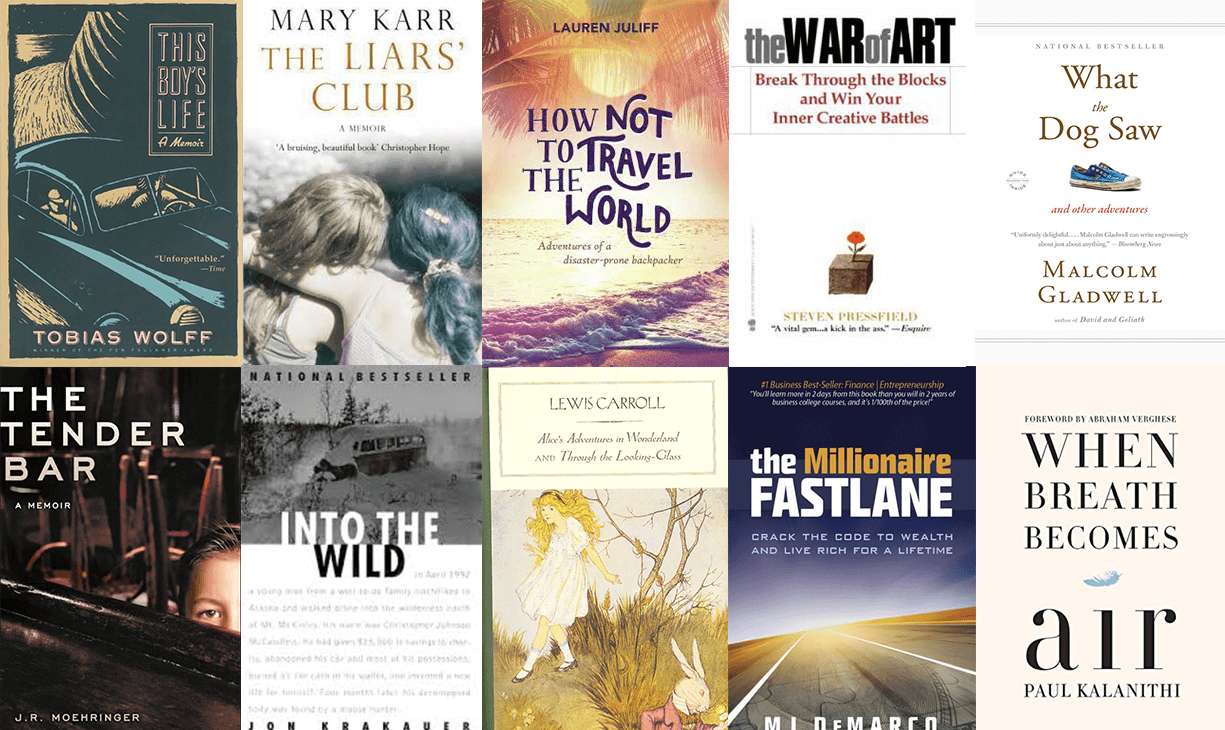
    Books! This has been a big part of my life the last couple of years, especially because I suck at reading and used to take so much pride in never reading the book in school and still passing the exam. But this is no longer school, this is life, and reading is starting to feel kind of important now.

    I have decided, however, that I’m not going to be intimidated by all these supernerds around me reading like 100 books a year and taking over the world. I’m eager to read more, but now I’m only competing with myself and my only goal is that I read more than I did the previous year. In 2015 I read 11 books, in 2016 I read 12.5! So I’m pretty much a genius now.

    If you’re interested, here’s what I was reading this year:

    What The Dog Saw | Malcolm Gladwell

    “They were there looking for people who had the talent to think outside the box. It never occurred to them that, if everyone had to think outside the box, maybe it was the box that needed fixing.”

    Malcolm Gladwell is one of my favourite authors and storytellers, and I generally have to be in a certain headspace to read his books as they’re so thought-provoking and involved. What The Dog Saw is a collection of short essays where he investigates questions such as “Why are there hundreds of mustards but ketchup has never changed?” or “Why do Japanese women have breast cancer rates six times lower than American women?” By looking at these questions from unique angles, or perhaps, just closer than anyone else has, he tends to uncover ideas about us and the world that you don’t see on the surface. It is definitely not his best book, not for me anyway, but if you enjoy innovative, Freakonomics-esque ways of looking at the world, you will love this one.

    Click here to check out What The Dog Saw on Amazon


    The War Of Art | Steven Pressfield

    “The artist cannot look to others to validate his efforts or his calling. If you don’t believe me, ask Van Gogh, who produced masterpiece after masterpiece and never found a buyer in his whole life.”

    What does it mean to be an artist? How, and why, do we create art? Why is it so difficult? And how do we overcome it? Steven Pressfield writes of the debilitating difficulty of simply sitting down to write, or paint, or compose, and how the evils of procrastiation and “Resistance” prevent us from creating great things and reaching our potential. It is war, he tells us. A war against ourselves. A war that any creative will understand intimately. And then he arms us with the mindset to win this war. If you are a creator in any discipline – painting, drawing, writing, singing – it may become one of your bibles. One of the most important books I’ve ever read.

    Click here to check out The War Of Art on Amazon


    This Boy’s Life | Tobias Wolff

    “I was subject to fits of feeling myself unworthy, somehow deeply at fault. It didn’t take much to bring this sensation to life, along with the certainty that everybody but my mother saw through me and did not like what they saw. There was no reason for me to have this feeling. I thought I’d left it back in Florida, together with my fear of fighting and my shyness with girls, but here it was, come to meet me.”

    My Kindle continued to recommend this book to me at every turn, so I gave it a go. You may remember the film adaptation, many years ago, which starred Leo DiCaprio as the author. It’s a memoir of a boy growing up with a darling mother and a wack stepfather. It’s set in small town America, between various places, and is mostly about a young boy getting up to mischief while trying to survive boyhood.

    I read it back in January/February some time and honestly don’t remember much else from it, other than I read it quite quickly and enjoyed it. Not a fiery endorsement I know, but it’s really well written and if you enjoy memoirs you’ll probably like it. A classic, supposedly.

    Click here to check out This Boy’s Life on Amazon


    The Liar’s Club | Mary Karr

    “Now, Miss Karr, this looks like a bullet hole.”

    Lecia didn’t miss a beat, saying, “Mother, isn’t that where you shot at daddy?”

    And Mother squinted up, slid her glasses down her patrician-looking nose and said, very blasé, “No that’s where I shot at Larry.” She wheeled to point at another wall, adding “Over there’s where I shot at your daddy.”

    This was tipped as the memoir to rule all memoirs, winning prize after prize, so being a sucker for true stories of course I had to read it.

    It’s a very candid story of a looney father, a mother who can’t stop getting married, sexual assault, family secrets, child abuse, guns, booze, and all sorts of other crazy shit set in small town Texas. I found it a little underwhelming. Mary Karr can write, no doubt, but she has a neurotic way of writing things that kind of loses me at times. But nonetheless a fascinating story, and not a bad pick if you’re a fan of memoir. Kind of dark, but funny. I feel like the ladies out there will vibe with it a lot more than I did.

    Click here to check out The Liar’s Club on Amazon


    How Not To Travel The World | Lauren Juliff

    “I’d read over and over about how one of the most important things a solo female traveller could do is listen to their instincts. How could I, though, when mine always told me I was going to die? Intuition was a thing for me to ignore. If I paid attention to it, I’d never leave the house.”

    This is a memoir by my friend Lauren who blogs over at Never Ending Footsteps (I interviewed her a while ago here). It is a classic backpacking tale, through Europe and Southeast Asia, and Lauren talks openly about overcoming her anxiety through travel, finding love on the road with a Kiwi rascal, and dealing with all the shit that the road throws at her along the way. It started slow for me, but once the story picked up I zoomed through the book in a couple of days. Ultimately it’s about finding the courage to follow your dreams, and a real, honest look into the backpacking culture and what a single female traveller can expect when they go to the road.

    On a semi-related note, I have spoken before about how there is too much “10 things to do” and not nearly enough storytelling in travel blogging today; most bloggers can’t even knock out 1,500 words of personal narrative, let alone a whole book. So to get this real, honest story from Lauren was super refreshing. Did us all proud with this one.

    Click here to check out How Not To Travel The World on Amazon


    Alice’s Adventures In Wonderland | Lewis Carroll

    ‘Would you tell me, please, which way I ought to go from here?’
    ‘That depends a good deal on where you want to get to,’ said the Cat.
    ‘I don’t much care where -‘ said Alice.
    ‘Then it doesn’t matter which way you go,’ said the Cat.
    ‘- so long as I get SOMEWHERE,’ Alice added as an explanation.
    ‘Oh, you’re sure to do that,’ said the Cat, ‘if you only walk long enough.’

    I have been meaning to read this one for a while. It was as great as I expected it to be. Of course the book needs no introduction but if you’re looking the wackiest, weirdest, most cryptic and imaginative story ever, open this one up.  Everyone seems to have a favourite chapter – mine was Chapter 7: The Mad Tea Party.

    Click here to read more about Alice’s Adventures In Wonderland


    Think And Grow Rich | Napoleon Hill

    “Charles Dickens began by pasting labels on blacking pots. The tragedy of his first love penetrated the depths of his soul, and converted him into one of the world’s truly great authors. That tragedy produced, first, David Copperfield, then a succession of other works that made this a richer and better world for all who read his books. Disappointment over love affairs, generally has the effect of driving men to drink, and women to ruin; and this, because most people never learn the art of transmuting their strongest emotions into dreams of a constructive nature.”

    The premise of the book is this: Napoleon Hill spent decades studying the most successful people in history. The book was written in 1937, so his subjects were people like Henry Ford and Thomas Edison. His goal was to find out what the true drivers of success were. He found that it started in the mind. Everything that exists in the world started in the form of a thought. Someone thought it, then they did it. Not the other way around. So if you control your thoughts, you control your world. Hence the title, “Think and Grow Rich”. The other big theme is of energy. Where does our energy come from? And how do we use it? How do we harness it? Very interesting.

    The content is heavy. I feel like you will need to read it three or four times before you can really understand it as a whole, but more importantly you need to be ready for it. If you’re looking for something in the motivational/self-help space, this isn’t a book I would start with. Had I read this when I was 21 I don’t think I would have got past the first 50 pages. But if you consider yourself open-minded and ready to create something meaningful for the world, it might be for you.

    Note: Since the book is so old it’s been revised a few times and it is hard to find the original, uncut version. The one I’ve linked to is the one I bought which was supposedly the original but I still don’t really know. Try hunt for the paperback original if you want to be super sure.

    Click here for Think & Grow Rich on Amazon


    Influence | Rob Cialdini

    “A well-known principle of human behavior says that when we ask someone to do us a favor we will be more successful if we provide a reason. People simply like to have reasons for what they do. Langer demonstrated this unsurprising fact by asking a small favor of people waiting in line to use a library copying machine: ‘Excuse me, I have five pages. May I use the Xerox machine because I’m in a rush?’ The effectiveness of this request-plus-reason was nearly total: Ninety-four percent of those asked let her skip ahead of them in line.

    Compare this success rate to the results when she made the request only: ‘Excuse me, I have five pages. May I use the Xerox machine?’ Under those circumstances, only 60 percent of those asked complied.

    At first glance, it appears that the crucial difference between the two requests was the additional information provided by the words “because I’m in a rush.” But a third type of request tried by Langer showed that this was not the case. It seems that it was not the whole series of words, but the first one, “because,” that made the difference. Instead of including a real reason for compliance, Langer’s third type of request used the word “because” and then, adding nothing new, merely restated the obvious: Excuse me, I have five pages. May I use the Xerox machine because I have to make some copies? The result was that once again nearly all (93 percent) agreed, even though no real reason, no new information, was added to justify their compliance.”

    Funnily enough, while I was reading this book I experienced this exact scenario. I owed a guy 67 euros, and he asked, “Can we just make it 70, because it’s just easier if we round it up?” If he had asked, “Can we just make it 70?” I would’ve said no straight away, but with a (stupid) reason, I was a split second from just saying yes without even thinking. Then I remembered this chapter from the book and caught myself just in time. Interesting.

    In this book Rob Cialdini breaks down persuasion into a science, giving real-life examples of when you get persuaded to buy or do things, and why it works on you. For example, when a used car salesman offers you a very low price, what is he actually doing? How does he end up convincing you to pay the higher price in the end anyway? How did a group of monks multiply the donations received simply by giving people cheap flowers on the street? These are all examples you or others will experience in their own lives, and this book explains how and why they work.

    The second part of each chapter explains how to recognise these techniques being used on you, and how to resist or even flip the script on the “influencer”. It’s all very interesting. Perfect if you’re in the business of selling, or if you’re one of those hopeless people who can never resist buying stuff.

    Click here to check out Influence on Amazon


    Into The Wild | Jon Krakauer

    “So many people live within unhappy circumstances and yet will not take the initiative to change their situation because they are conditioned to a life of security, conformity, and conservatism, all of which may appear to give one peace of mind, but in reality nothing is more dangerous to the adventurous spirit within a man than a secure future. The very basic core of a man’s living spirit is his passion for adventure. The joy of life comes from our encounters with new experiences, and hence there is no greater joy than to have an endlessly changing horizon, for each day to have a new and different sun.”

    I watched this movie for the first time six years ago, just after my quitting my job. I thought it was just kind of “cool”. This year I watched it again, after six years on the road, and I felt and lived and breathed every minute of it.

    The story of Chris McCandless is a polarising one. A boy, wickedly smart, accepted into Harvard, suddenly drops off the grid one day. He donates his $20,000 savings (or thereabouts, I don’t remember) to Oxfam, burns all the cash in his pocket, adopts a new name, ditches his car by the side of the road, and walks out into the wilderness. His two year journey takes him up and down America, into Mexico, and later up to Alaska, where he planned to live off the land for an entire summer. He was found dead, of sickness and starvation, in the Alaskan wilderness in 1992. He was 24.

    After his death, McCandless became somewhat of a hero amongst backpackers, nomads, hippies and other counterculture movements. After watching the movie again this year, I became semi-obsessed with the story and had to know everything about it. I whizzed through the book in about two days. What I found most interesting, and satisfying also, was how so many didn’t understand him and thought he was stupid. He was vilified in popular media after his death. Why would you not take a map? Why would you abandon such a nice life? Why didn’t he take a phone? Idiot! When it comes to life on the road you either get it or you don’t. To most it will probably just be an interesting story at best, but if you’re a traveller at heart I’m sure you will fall in love with it.

    P.S. The movie is as good as the book.

    Click here to read more about Into The Wild


    The Millionaire Fastlane | MJ DeMarco

    “In a few short years, JK Rowling, author and owner of the Harry Potter brand, went from being a 32 year old divorced English teacher to a media mogul worth over $400 million. The single mom has sold over 30 million copies of her books in 35 different languages. I guess she didn’t hear the excuse, “I’m a single mom and I don’t have time.” Ms. Rowling recalls the happiest point of her life – not the acquisition of millions, but the point at which she could write full time. Similarly, Dan Brown has sold over 80 million copies of the DaVinci Code in 51 languages. Let me be perfectly clear: If you sell 80 million of ANYTHING, you will be a very rich human being.”

    Back when I was a teenager and obsessed with being rich I read quite a few books like this. The premise was always the same – create businesses, not jobs, create passive income, not active income, invest money, don’t spend money, and work really, really hard. So the first half of Millionaire Fastlane was like revision for me, and I actually skimmed most of it. I also studied and worked in finance, so most of the concepts around money and investment were already known to me.

    The second half of the book is where he talks about the “Fastlane”; a process that supposedly anybody can use to become a millionaire within 5 years. Again the concepts are nothing new but he does manage to explain them in an easy-to-follow process that a layman can understand. He talks a lot about mindset and lifestyle changes, such as becoming a saver not a spender, a producer not a consumer, and building scaleable businesses through the “Law of Effection”, which states to earn millions of dollars you need to affect millions of people. A coffee shop or a bar does not have the potential to affect millions of people, therefore they are “Slowlane” businesses. To be in the Fastlane you would want to own the business supplying the coffee or beer, which will give you the potential to supply hundreds of other similar businesses as well. He also talks a lot about the potential of the internet, which essentially has given everybody in the world the potential to affect millions and join the Fastlane.

    If you can handle his “I’m so much smarter than everyone” tone, it’s a pretty good read.

    Click here to read more about The Millionaire Fastlane


    When Breath Becomes Air | Paul Kalanithi

    “Will having a newborn distract from the time we have together?” she asked. “Don’t you think saying goodbye to your child will make your death more painful?”

    “Wouldn’t it be great if it did?” I said.

    Lucy and I both felt that life wasn’t about avoiding suffering. Years ago, it had occurred to me that Darwin and Nietzsche agreed on one thing: the defining characteristic of the organism is striving. Describing life otherwise was like painting a tiger without stripes. After so many years of living with death, I’d come to understand that the easiest death wasn’t necessarily the best. We talked it over. Our families gave their blessing. We decided to have a child. We would carry on living, instead of dying.”

    When Paul Kalanithi, a standout neurosurgeon from Stanford, is diagnosed with lung cancer, his world is turned upside down. After years as the doctor, who wrangled patients from the grip of death daily, he was now the patient, fighting the same fight himself. Paul eventually lost his battle with cancer, but not before becoming a father, making peace with his fate, and penning this poetic and heart wrenching memoir in the months before he died. He had dreamed of becoming writer after his surgical career, therefore in a way, this book was not only about his story, but also fulfilling a final milestone before passing to the other side.

    The book will mean many different things to different people. There are so many life lessons tangled within each chapter, but ultimately it’s a reminder that we must all face death at some point, and therefore death is not the real challenge. The real challenge is, can we face it with integrity and acceptance? Can we meet death without bitterness and defeat? Can we die with gratitude for a life well lived, no matter how long or short we are given? It’s a difficult yet beautiful story, one we should all read.

    Click here for When Breath Becomes Air on Amazon


    The Tender Bar | J.R. Moehringer

    “People just don’t understand how many men it takes to build one good man. Next time you’re in Manhattan and you see one of those mighty skyscrapers going up, pay attention to how many men are engaged in the enterprise. It takes just as many men to build a sturdy man, son, as it does to build a tower.”

    Saving the best ’til last.

    At the end of Andre Agassi’s book Open, he talked about reading a memoir, falling love with it, and later asking the author to help write his own autobiography. The memoir he was talking about was this one, The Tender Bar by J.R. Moehringer. I added the book to my wishlist and didn’t read it until a few months later. But it didn’t take long before I fell in love with it too.

    This is a painfully beautiful story, beautifully written, beautifully honest, with beautiful characters you will come to adore. It is not a crazy story at all, in fact, it’s probably quite an ordinary American story, but the author paints such a vivid picture of his life that you can’t help but feel a part it, like it’s happening before your eyes. He takes you through his childhood growing up with an absentee father, his dream of going to Yale, his love for his trying mother, his rocky adolescence, his first love, and everything else that sent him into manhood. The backdrop of all this, though, is the local bar where his uncle tended each night, and where the characters he met on the stools as a toddler eventually became his father figures who guided him from boy to man. It is an impossibly charming story and easily an all time fave of mine.

    Click here to check out The Tender Bar on Amazon


    What about you? What did you read this year? What were your favourites? Let me know in the comments!

  • The Best Places to Stay in Langkawi (for Every Budget)

    The Best Places to Stay in Langkawi (for Every Budget)

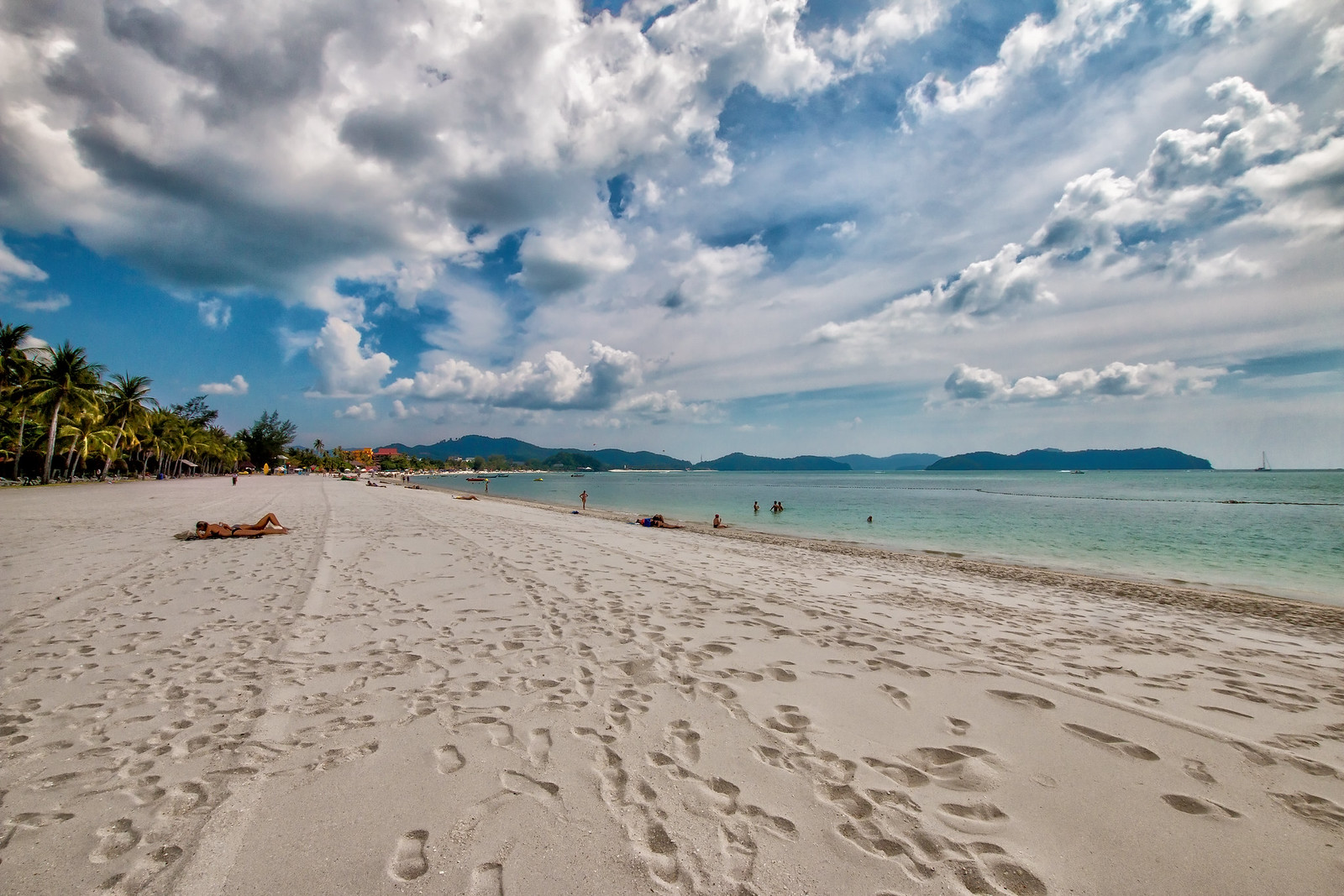
    Langkawi is a great little island nestled in Malaysia, home to busy beaches, a lively nightlife culture and some of the friendliest locals around.

    I’ll be running through the best place to stay in Langkawi for all budgets, and some fun things to add to your to-do list as well, whether you fancy being in the hustle and bustle or out in the sticks.

    cheap hotels in Langkawi

    The island itself is very easy to get around, with cheap moped and car hire, as well as Grab and taxis available.

    The two main beaches are within walking distance of each other (with plenty of air-conditioned shops and bars to stop off at on the way!) and most hotels and hostels here are just minutes away from the sand.

    The island does offer quite a few different “types” of areas, from luxurious honeymooning spots to strips of bars and clubs where younger travellers will enjoy to party into the night, so it’s important you choose the right spot.

    Don’t worry – some would consider me a Langkawi expert by now, and I’ll walk you through everything you need to know!

    Where To Stay In Langkawi

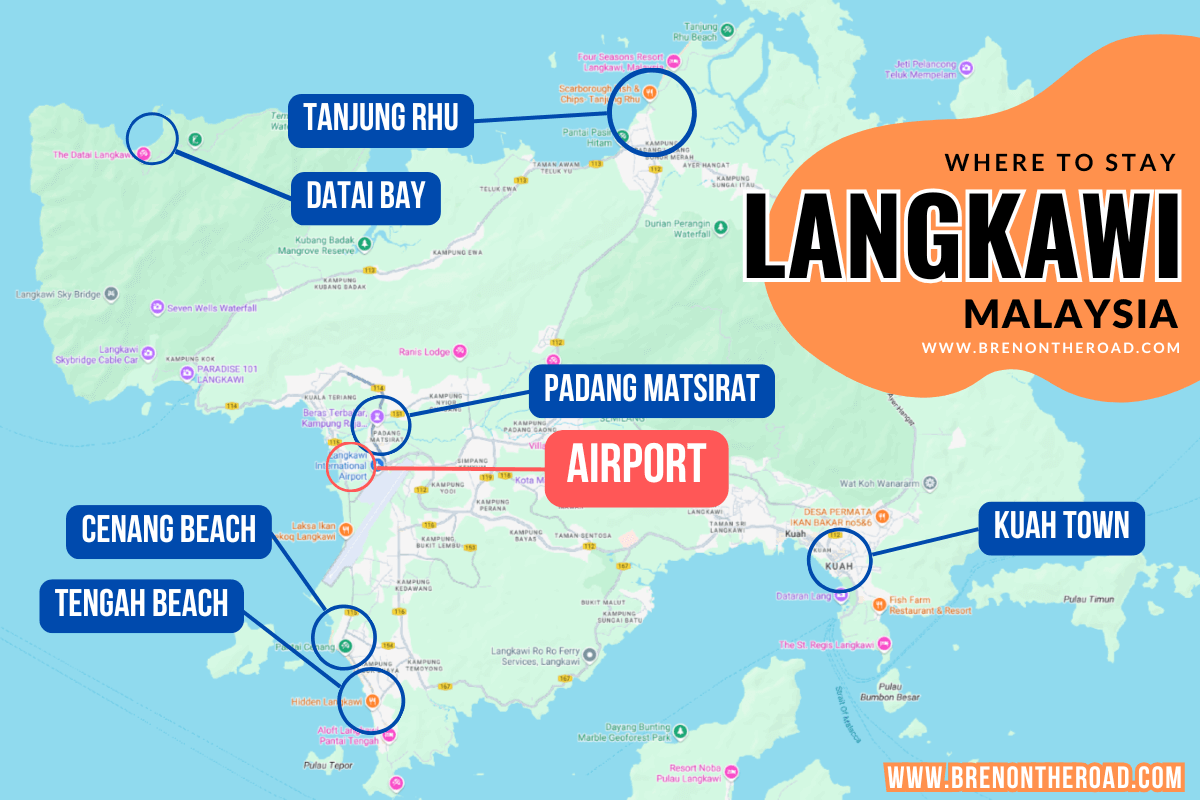
    As you can see, the island is quite scattered in terms of places to stay.

    While the most popular areas are near the airport and easy to get to, they are by no means your only options.

    In the guide below I’ll break down each of the different areas so you can choose the best place for you!


    Cenang Beach

    Best place to stay in Langkawi

    Cenang Beach is the main touristy area of Langkawi, just a short ride away from the airport and packed with restaurants, beach bars and places to stay.

    The main street is parallel to the beach and is home to various convenience stores, such as 7-Eleven, as well as little boutiques and market stalls.

    There are accommodation options for every budget here, from beach huts to hostels to fancy hotels.

    Where to Stay In Cenang?

    For the Backpacker

    Stay at The Cottage. They offer cheap dorm rooms, as well as well-priced privates and houses. The WiFi is speedy, you’re a five-minute walk to the beach and there’s a shared kitchen and barbecue area. The rooms are all kept nice and clean and there’s a really friendly buzz to this place. This is the best place to stay in Langkawi if you’re travelling alone and want to meet like-minded backpackers. Best rates here.

    For the Budget Traveller

    Stay at Langkawi Village Budget Rooms. This no-frills place is a 3 minute walk to the beach, and the rooms are simple but have everything you need – fridge, kettle, desk and air con. Might run you $35 per night. Best rates here.

    For the High Roller

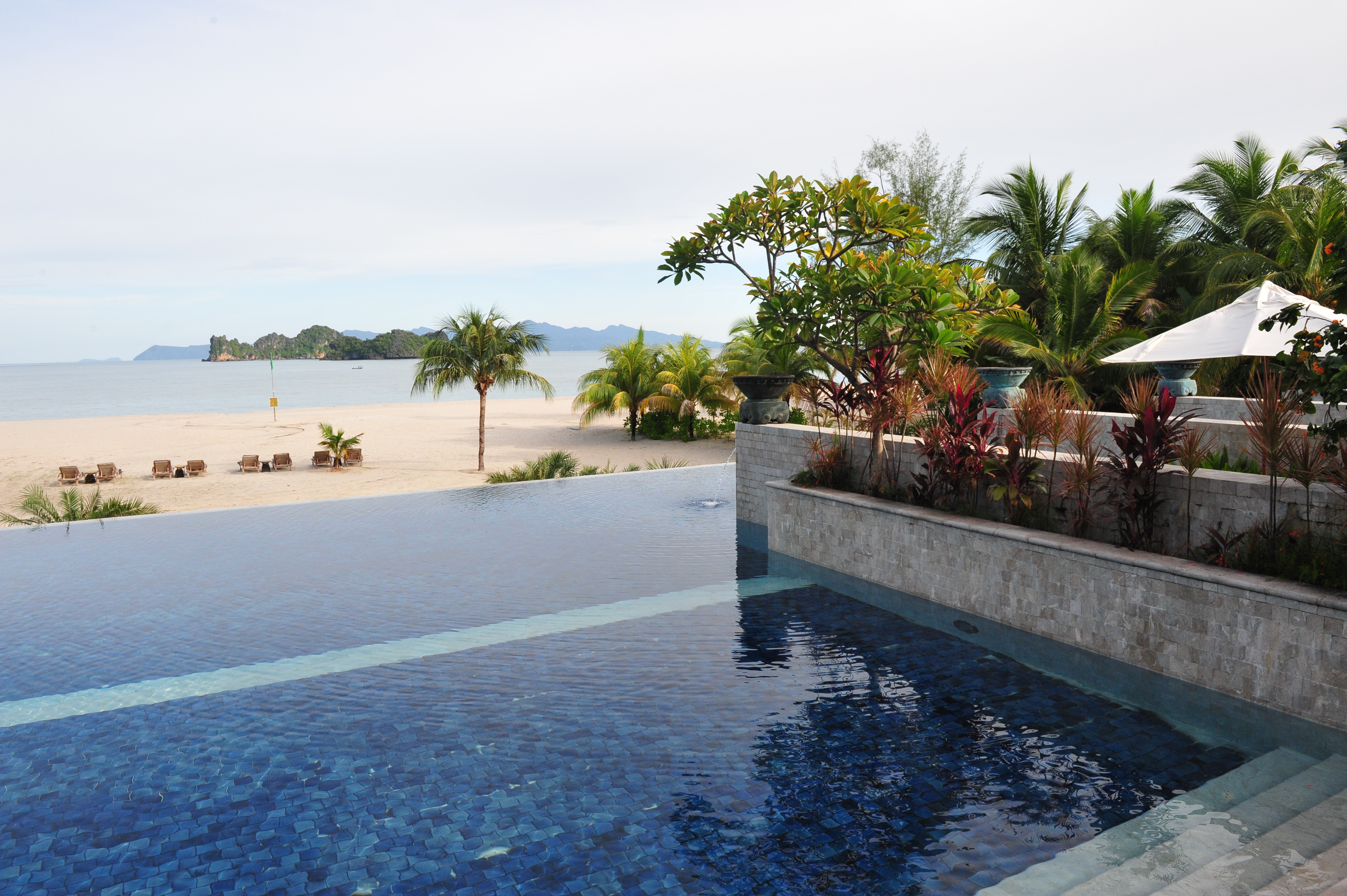
    Stay at Pelangi Resort and Spa! Well-known on the island for offering total luxury, and having the best strip of beach right in front of it! You can choose from lake, beach or garden views from your private chalet, all within walking distance from the beach. The pool areas here are unbeatable, decked out with sun-loungers, fancy bars and great live bands. If you’re craving some quiet time, enjoy the stretch of white sand in front of the hotel. For those after something more lively, a two-minute walk will have you on Cenang’s main strip of bars, restaurants and shops. If you don’t mind a little splurge on luxury and happiness, there’s no better place than this. Best rates here!


    Pantai Tengah

    Where to stay in Langkawi

    This is another section of the island that is popular with tourists, but much quieter than busy Cenang.

    It’s around a twenty-minute walk from Cenang and its amenities, so you’re not totally isolated! 

    If you’re wondering where to stay in Langkawi which offers a mix of nightlife and chilled vibes, look no further, this is the region for you!

    Tengah is home to its own array of quirky shops, cafes and restaurants, my favourite being the 24-hr Indian heaven called Tomato.

    This little end of the island is also home to most of the late-night bars and clubs. For a wild night out, head to Marrakesh, Sunba, BamBooBa or The Woods.

    However, honeymooners and families shouldn’t be put off – this end of the island has its tranquil side too and there are many spots perfect for couples looking for alone time.

    In fact, some of the best resorts on the island can be found here.

    Where to stay in Pantai Tengah?

    For the Backpacker

    Bed Attitude Hostel is the best choice in the area. It’s a little to the north, closer to Cenang, but still within spitting distance of Tengah. It’s a modern hostel and facilities are well kept. Best rates here.

    For the Budget Traveller

    La Pari-Pari is the spot for those looking for comfort on a budget. Situated in the quieter part of Pantai Tengah, around ten minutes away from the nearest beach, as well as a big outdoor pool available for all guests. The on-site restaurant is one of the best on the island, too! The hotel is nestled in the backdrop of the forest, so is peaceful and calm. Cenang centre is about a twenty-minute walk, plus there are some fantastic cafes and bars nearby. This is undoubtedly the best place to stay in Langkawi if you’re after some peaceful alone time by the beach. Best rates here.

    For the High Roller

    Ambong Pool Villas are fit for royalty. No luxury is spared here – private lap pools, staff that cater to your every whim, breakfast delivered right to your door. Private drivers are available until midnight to take you anywhere you want to go. Not to mention, you’ll be right in the middle of a private rainforest, waking up to sounds of monkeys and seabreeze right outside your window. There’s no need to leave your villa and you probably won’t ever want to. Comes with a price tag, but if you’re after an unforgettable honeymoon or anniversary, there is no better place on the island than this. Best rates here!


    Datai Bay

    Best place to stay in Langkawi

    Undoubtedly the gem of Langkawi, Datai Beach area is packed with pricey hotels and luxury bars and restaurants.

    Not the place for a backpacker or budget traveller, as the hotels are expensive and marketed almost solely towards couples and honeymooners with fat wallets.

    However, if that’s what you’re looking for, Datai offers a glimpse of the glitzy Langkawi – glorious beaches, great hospitality and total luxury.

    If you’re bringing a special someone to Langkawi, head straight to Datai Beach, you won’t be disappointed.

    Where to stay in Datai Bay?

    The Datai is pure luxury. This hotel offers the best of everything, from rainforest backdrops to stunning views across the Andaman Sea, making it the best place to stay in Langkawi. Make the most of the in-house spa and enjoy world-class treatments in the most beautiful setting. The resort hosts a world-class golf course, too. If that’s not enough, you can also take advantage of the on-site gym, yoga studio and huge pool. There’s even a stretch of private beach for guests to enjoy. The restaurant is fantastic and set away from the resort in the rainforest. Doesn’t get much better than this. Best rates here.


    Tanjung Rhu

    Where to stay in Langkawi

    This is another area of the island that is saturated with great (read: pricey!) hotels and stunning beaches.

    Tanjung Rhu is very secluded, so there isn’t much to do here except wake up late, lounge on the beach, lounge in the resort, eat, and go back to sleep.

    If that’s what you want, Tanjung Rhu offers one of the best beaches on the island, and is home to a very small number (but excellent) little bars and restaurants, too.

    If you fancy a break from it all, while enjoying crystal waters, this is the place for you.

    Where to stay in Tanjung Rhu?

    For the Budget Traveller

    Sunset Bay Cottage is as quaint as it sounds, with quirky little rooms and a lovely, natural vibe to it. Expect seashells and brightly-coloured throws as you step into this little haven. The rooms are all kitted out with WiFi and some have plasma TVs (make sure you check when booking!). You’ll be a short distance from the beach, restaurants and other attractions on the island. This is the best place to stay in Langkawi if you’re after a taste of luxury on a budget. Best rates here.

    For the High Roller

    The Four Seasons Resort is arguably the best place to stay in Langkawi, thanks to its array of luxury offerings. Enjoy the stunning private beach as well as the unbelievable views from the hotel rooms. You can book a room or private villa, all of which have access to the various on-site pools. While staying here, you can also make the most of the rock-climbing facilities, archery area and abseiling facilities. If you’re after something more relaxing, head down to their spa and unwind. There are 4 restaurants nestled in the hotel, so you’ll have plenty of options to choose from. Best rates here!


    Kuah Town

    Kuah Town is an interesting area of Langkawi that is normally just a stop-over for tourists to the island.

    While it has its charms (cheap restaurants and shopping malls), I’d suggest staying here for a night or two before exploring the rest of the island.

    Make the most of Kuah while you’re there, however, and get your fill of delicious local food – the best restaurants are those by the side of the road.

    The main mall here is cheap and offers a mix of international and local brands, as well as eateries.

    You may find it hard to meet other travellers outside your accommodation, so it’s not the best place for solo travellers. Still a cool little place to check out though!

    Where to stay in Kuah Town?

    For the Backpacker

    Motodorm Hostel is a great choice for backpackers after a cheap place to stay. It’s funky, clean, well-located and has free bikes for you to use. It’s one of the few hostels in the area, so most backpackers will be congregating here. Best rates here.

    For the Budget Traveller

    If you’re after something mid-range, head to Ramada Langkawi Marina. It’s located just outside the main centre of Kuah Town so is nice and quiet in the evenings. A short ride will take you into Kuah Town and you’ll be around 30 minutes from the airport. The Club offers clean, light rooms at low prices – the views are the main attraction, however! The Yacht Club is sat overlooking the harbour, so make sure you grab a drink, or dinner, and take it all in. As always, speedy WiFi is available and the staff are always on-hand to help. Easy on the bank account, too. Best rates here.

    For the High Roller

    For a little luxury in Kuah, look no further than Adya Hotel. This is the best of the best in Kuah, thanks to its fancy rooms, huge pool and stunning views across the ocean. In-house spa, fitness centre and a hearty room-service menu makes it a legit upper end offering on this side of the island. Well located near Kuah Town, Kuah jetty and Langkawi’s main attractions too. If you’re after peace and luxury in Kuah Town, this is your spot. Best rates here!


    Padang Matsirat

    Another area of Langkawi that is slightly out of the main tourist route, Matsirat is worth a stay for a night or two.

    While there might not be much going on, it can be the perfect place to relax and unwind.

    There aren’t many hostels here, as the main backpacker scenes are along the Cenang and Tengah beaches.

    Therefore I’d suggest steering clear if you’re travelling alone, mainly because you won’t meet many other people here (unless that’s what you want, of course).

    For couples or families, Matsirat can be a nice break from the island’s flocks of tourists.

    Accommodation out this way isn’t too varied, most are in the mid range in terms of price and flash. 

    Where to stay in Padang Matsirat?

    The Smith House is a probably the top choice around here. All the comforts of a mid range hotel, you can look forward to a huge pool, WiFi and room-service, alongside roomy, clean suites. The hotel is around 15km away from the main areas of the island, so you’ll need to rent a car or moped (or grab an Uber) to get out to the main strips of restaurants and bars. The beaches are a ride away, too, but you’ll have a beautiful pool in relaxing surroundings if you’re desperate for a dip. Great no-frills place that has everything you should need. Best rates here.


    Enjoy Langkawi!

    B

    Photo Credits: 1, 2, 3, 4, 5, 6, Featured Image 

  • 2016 In Review: A Productive Summer, Turning 30 & Discovering Europe

    2016 In Review: A Productive Summer, Turning 30 & Discovering Europe

    2016 is in the bag.

    How was it?

    As has been tradition each year (2014 and 2015 here), I’ll be publishing my personal summary of the year gone by. Where did I succeed? Where did I fail? What was good? Bad?

    My own reflections are below for you to read if you wish, but more important are your own insights. I encourage you to take an introspective look at your year, and journal your thoughts to refer back to in 12 months time. Writing this has been very helpful, as has been reading my reviews from previous years. I think very few us take enough time to reflect. Even if we only do it once a year, that’s something.


    Blogging

    A photo posted by Bren (@brenontheroad) on

    It was a mixed year for the blog.

    Statistics wise, traffic is down. In fact, it’s gone down every year since I went live. I presume this is due to the type of content I like to write nowadays. In my first year, I wrote a lot of free travel guides, how-to posts and SEO focused writing. Today I prefer to focus on stories and narratives which don’t bring in any search or viral traffic, but satisfy my longer-time readers and also allow me to share deeper travel experiences, which is what I really love to write about.

    Despite traffic being down, readership continues to grow. My newsletter now goes out to more than 3,000 readers each month and has been one of my most active vehicles for getting to know many of you personally. It also allows me to update you all on my whereabouts, the books I’m reading, interesting things I’ve been doing, deals and giveaways, and updates from the blog. My blog posting can be up and down sometimes, but I always make sure the newsletter gets sent! Not subscribed? You can do so here.

    I also started being active on Instagram this year, and built a little following there. It’s been the perfect tool for sharing little stories that aren’t big enough for their own blog post, and has been useful for keeping everyone updated on where I am in the world. I’m not much of a photographer, but it’s been a nice outlet for a little creativity when I’m too busy to get on the laptop.

    Money-wise, the income was up a lot. Mostly due to the release of my ebook Triple Your Travel, having it included in this year’s Paradise Pack, and higher affiliate incomes. Still a long (loooong) way from replacing my accountant salary, but we’ll get there. Along with the rise in income comes a rise in expenses. It now costs me over a thousand bucks a year just to keep this thing online. Not quite what I expected when I signed up for my $50 per year hosting package back in 2013. But I guess that’s blogger life.

    It was also bit of a battle of morals this year. Offers for free trips and advertising opportunities started flowing in. In my first year I committed myself to being ad-free. No sponsored posts, no ads, no free trips. I hated the idea of my readers being flashed with banners and getting sold random shit from around the web. I also hated the idea of writing blog posts about some goofy museum or tour for the sake of a free trip. More importantly, how can I honestly voice affordable travel for everyone when my trips are being paid for by some corporation? I can’t. I stay committed to keeping the blog ad-free, my blog posts are all non sponsored and written by me, and I pay for all my own trips.

    Writing

    I have been trying to write this damn memoir. I wrote about 50,000 words earlier in the year, then I stopped, because I thought it was shitty, and recently I started all over again. I don’t really have much else to tell you about that, other than “I’m working on it.”

    As for the blogging itself, the year started well and it’s ending well, but I slacked off during my long Eurotrip, struggling to publish more than once or twice a month. I still wrote some important pieces this year – It’s Not About The Money, Why You Still Haven’t Found Your Passion, and Solving The Quarter Life Crisis appearing to be some of the more resonant with you.

    As for personal narratives, I published one of my favourite pieces, It Started At A Salsa Club In Quito back in February, almost 18 months after I was actually in Quito. That experience was particularly special to me and it was difficult to really illustrate that in a blog post. I guess that’s why it took so long to write. I managed to knock out some other stories too; Under Stars In The Sahara, Big Trouble In Little Kraków, and To Where The Northern Lights Go.
    I’ve got a handful more from the year drafted, I’ll get them out next year!

    A New Look

    I completed my first blog redesign this year! The original design was ugly and limiting, and I’d been planning on redesigning for a while. The whole process was quite long, my perfectionist nature with these things didn’t help either, but I was happy with how it all turned out. You can read more about the whole process and see some before and after screenshots in my post, A New Bren On The Road.


    Finances

    I spent approximately $8,000 this year on 7 months of travel, which included five months backpacking through Europe and five weeks laying low in Bangkok. I was prepared for this to be a bit more, especially in Europe, so I was happy with how the travel budget worked out.

    As for income, the blog continues to bring in some cash (and takes out a lot too), mostly through ebook sales and affiliate sales, and my stock with my freelance clients continues to rise. Old investments I made in my accounting days still drip feed dollars into my account during select months of the year. I’m not going to be a millionaire anytime soon, but with my efforts to live minimalistically (that’s not a real word) things are fine. And for those of you wondering – no, I can’t survive off this blog alone…yet.

    I’m currently working on a few things I hope to launch in 2017, keep an eye out!


    Education

    Awesome jiu jitsu class last night at Auckland MMA. Repost @aucklandmmagym.

    A photo posted by Bren (@brenontheroad) on

    I was staying with my parents in Auckland for the first five months of the year. I used that downtime to focus on some new/refreshed interests:

    -I spent 4-5 evenings a week down at Auckland MMA, training in various martial arts, as a follow on from my little jaunt at Legacy Gym in the Philippines in 2013. It was an awesome place to train and I look forward to getting back there this summer.

    -I joined a dance school and was there twice a week refreshing my salsa skills from Ecuador. My teachers and partners always tell me I dance very well, but I’m still not confident enough to rock up into dance clubs and start shredding the floor with someone. It’s a mental thing – I will work on it.

    -I spent one day a week in the ocean surfing, and also just sitting out there bobbing on my board thinking about my life (because I’m a weak paddler and get tired quick). Every couple of weeks I also went surfing with my old surfing coach from my Ahipara story, who really helped me get better at a lot of things.

    -I started meditating seriously with Headspace, although I feel like it didn’t do much for me. I don’t think I’ll continue this in 2017.

    -I tried to learn the guitar with Yousician and I got to about Level 8, but after trying and failing so many times over the years I think the guitar just isn’t my instrument. My instinct is music shouldn’t feel like a chore. A very musical friend I met this year told me “You don’t choose the instrument, the instrument chooses you” and advised me to try something different, like the piano. So I will do that this year.

    -I added morning yoga to my schedule and still do it every few days – the body feels good when I can keep at it.

    -I tried to carry on my French study from Montpellier using Duolingo and watching some French movies, but honestly I was kinda half-arsing and I’m quite sure my French is the worst it has ever been.

    Overall it was a productive summer in New Zealand, and I was actually sad to leave for once. Still, the road called, and I was forced to change things up.

    With no gym or dance school to keep me busy I started reading a lot, and totalled 13 books this year. I’m pretty sure that’s a new record, and a big achievement for me (I’m a slow ass reader). You can check out my reading list in The Books I Read in 2016.

    I also threw down some cash and signed up for two blogging courses, finally. As someone who is three years into this game now, I feel like it’s time to learn from some of the vets. I’m only halfway through them, but my opinion so far is mixed. I am hoping these communities will help me increase the blog’s reach beyond it’s current ceiling, we will see how that goes in 2017.

    As always, education remains a big part of my life, and I’m super passionate about being a lifelong learner and never limiting yourself. Read, read, read, discover new things, try them, learn, learn, learn. It’s what keeps life exciting, and your horizons constantly growing.


    Friends & Family

    A photo posted by Bren (@brenontheroad) on


    I actually saw my family a lot this year. Along with the five months I spent with my parents during the summer, I also travelled with them for a month at the start of my trip. A far cry from my entire years on the road back when my travel career began.

    I also found I was a lot more choosey (aka snobby) with the people I hung out with on the road this year. There weren’t many nights out boozing with dorm mates or frequenting the Couchsurfing meets, like I used to do a few years ago. But it also meant I made much closer friends on the road this year – people who were walking similar paths to me, or people who I really enjoyed the company of. And it meant I had more time for myself to read, write, think, and take care of myself.

    I was also blessed to once again spend Christmas with my parents, brothers, uncles, auntie, cousins and grandfather, and now I look forward to another New Zealand summer with my family and friends before I figure out what’s next.

    A lot of travellers leave their old lives in the rear view mirror, including their families. I’m always conscious of never letting that happen.


    Health

    A photo posted by Bren (@brenontheroad) on


    I turned 30 this year.

    I was actually walking the Camino with my Mum at the time, who turned 60 in the same month. To mark the occasion I wrote the post Dreams, Love, Fear & Pride: A Letter To Everyone In Their Twenties And Beyond.

    Thankfully, I am in good health. Other than a niggling shoulder injury my body feels great, I am fit and healthy, I can sit through 30 hour plane rides without any problems, I can walk the entire day around new cities and suffer nothing but the usual tired feet. This despite smashing my body in the gym, the ocean, and on the road. But this has only been achieved through a lot of hours reading about how to maintain a healthy body, and even more hours doing mobility and maintenance work each morning through yoga, stretching, and subjecting my muscles to all sorts of unpleasant treatments with massage balls, foam rollers and unlovable exercises.

    The second half of the equation is my diet, which is strict on the road and slightly obsessive when I’m stationary. A lot of greens, juices, supplements, power shakes and home-cooked food, healthy snacking and so on.

    I shared a few of the things in my “stay healthy stack” in my recent post What’s In My Backpack?

    At my age you learn pretty quickly that without a body of gold you can’t surf, box, dance, or do any of that other cool shit. So I encourage you to learn to treat your body like gold before anything else, sooner rather than later.

    Things I will be working on in 2017 are fixing some imbalances, injury proofing myself, and working on my flexibility. One of my goals is to do the splits (it’s coming along slowwwly). Who knows if that’s even possible at my age. We’ll see. I’ll be doing some dietary experiments too.


     Travel

    A photo posted by Bren (@brenontheroad) on

    2016 was about getting back to my backpacking roots. It was a huge year.

    I set foot in 15 different countries, mostly in Europe. As a usual Slow Traveller, that’s far more than I’ve ever done before.

    The year started in Spain. My Mum asked me to walk the Camino with her, so we headed up there in early May to knock that one off her bucket list. I look back on it and I’m glad I experienced it, but at the time I found it pretty insufferable. Not my thing. I spent most of the time listening to podcasts, and detailed all the interesting things I learned in my post 116 Things I Learned On The Camino De Santiago.

    A photo posted by Bren (@brenontheroad) on

    After that we whizzed through Portugal. One of the struggles with travelling with others is you tend to miss out on things. Had I been alone, I think I would’ve stayed in Portugal for at least a month. There was a lot to see, and a coast filled with amazing surf that I didn’t get to check out. Had a nice energy. Unfortunately we only had five days. I met up with bloggers Dave from Too Many Adapters and Lauren from Never Ending Footsteps who are both living in Lisbon right now, and they are loving it. I would love to go back some day.

    After that we spent a couple of weeks discovering Morocco. Morocco was a nice surprise for me – a different side of Africa, my favourite continent, and I warmed to it more than I expected to. I wrote some thoughts on the country in my post A Glimpse At Morocco.

    A photo posted by Bren (@brenontheroad) on

    After that I headed back to Spain to start my solo journey. I hit up Málaga, the site of my very first solo trip back in 2011. It was nostalgic for sure, but southern Spain in June is so damn hot I just sat in the hostel most of the time and sweated. It was too hot to even read. I mostly ate and slept, but I also made some cool friends at my hostel that I hung out with each night. During my time there, I realised how much I’ve grown since that first trip.

    The funny Schengen rules for Kiwis then forced me to head east quickly. I caught a flight to Kraków, Poland, where I stayed for five weeks and caught up on some work, while also frequenting the famous Kraków nightlife. I liked Kraków but for a place that gets raved about so much I consider it a little overrated. I ran into some trouble there too, but luckily got out okay. I share the ordeal in my story Big Trouble In Little Kraków.

    A photo posted by Bren (@brenontheroad) on

    From Kraków I decided it might be fun to hitch hike the Baltics, so I hitched over 1,300km from Kraków, to Warsaw, to Bialystok, to Kaunas, to Riga, to Pärnu, to Tallinn. Seven cities through four countries, and didn’t spend a dime. It was a new experience for me, with many interesting characters. I found it inspiring that people would take time out of their day to help a complete stranger. In the end I realised that we fear each other more than we should, and trust each other less than we should. It was a very valuable experience. The whole story is shared in The Hitch Hiking Diaries: From Kraków To Tallinn.

    A photo posted by Bren (@brenontheroad) on

    During my hitch, I made a stop in Pärnu for four nights to attend the Weekend Baltic Festival, my first music festival. I’ve decided they aren’t quite my thing, but I met so many amazing people there and was amazed how free and spirited everybody was. I am sure I’ll be seeing some of these friends again down the line. The lesson: Always say yes to new experiences.

    A photo posted by Bren (@brenontheroad) on

    As I continued through Estonia and Finland, a handful of my festival friends offered me couches to sleep on. It was kindness like this that allowed me to travel Europe for so long on so little. Hopefully I get to return the favour someday.

    A photo posted by Bren (@brenontheroad) on

    After a couple of nights in Helsinki, I spent two nights in the charming small town of Tammisaari, where I got a peek into small town life in Finland. You learn so much from small towns. I share the story in my post, A Tammisaari Story.

    A photo posted by Bren (@brenontheroad) on

    After that I headed to Turku, one of Finland’s student cities, and ended up renting a room from my Couchsurfing host. I stayed there for four weeks and caught up on some work. Made some great friends here too who were super welcoming. Finland is an incredible place.

    A photo posted by Bren (@brenontheroad) on

    From there I headed into Finnish Lapland and hired a car for my hunt for the Northern Lights. This little road trip was an unexpected highlight of the year and took me through the north of Finland and Norway on what turned out to be a week of soul searching. I was reminded of why I live this life. I share the story in my post, To Where The Northern Lights Go.

    A photo posted by Bren (@brenontheroad) on

    From Norway, I headed back to the Finnish coast to catch the ferry to Sweden. I spent four nights in Uppsala, and two nights in Stockholm. I visited some viking sites, ate meatballs, visited the Nobel museum, checked out an open mic, and caught up with some old friends. Overall Sweden was nice, but a tad underwhelming for a place I’d expected so much from.

    A photo posted by Bren (@brenontheroad) on

    From there I caught the train to Copenhagen. I’ve wanted to visit Copenhagen since forever, but only ended up spending two nights there. I caught up with an old friend, and hired a bike for an afternoon to explore ‘the world’s most bikeable city’. Again, it was nice but a little underwhelming. If it weren’t so prohibitively expensive, I might have felt differently. Still, I’ve got love for the city. The semi autonomous Christiania was definitely the highlight.

    A photo posted by Bren (@brenontheroad) on

    Berlin was next. I caught the overnight bus down and ended up spending about three weeks at the U Inn Berlin hostel. It was like a little family in there, and the perfect place to unwind after weeks of being on the move. The friends I met there reminded me of why I love the travel community – people who don’t need money and nice things to be happy. As for Berlin itself, it’s hipster heaven, with a very odd, quirky culture. I loved that it was so affordable for a capital, and always had something to do. But it seems like nobody that lives there is actually German. It’s like a poor version of New York city. Not for everyone, but grew on me.

    A photo posted by Bren (@brenontheroad) on

    My final stop in Europe was Switzerland. I met up with an old friend I met last year (Lara from Melancholic in Montpellier), who invited me to stay with her family in Unterageri for a weekend, and later showed me around her new home in Aarau and some of her favourite places in Zurich. Switzerland in a word: Picturesque.

    A photo posted by Bren (@brenontheroad) on

    By this time the European winter was setting in and I was ready for warmer climates. What better place to unwind than Thailand. I jumped on a flight to Bangkok, one of my favourite cities in the world, and rented a condo to lay low for a month. It was a month of noodles, writing and massages. I’ve written before about my love for Bangkok, and with the month I spent there the love grew just a little bit more.

    A photo posted by Bren (@brenontheroad) on

    Finally, I headed to Sydney to spend Xmas with my family, and now am back in New Zealand for the summer.

    A huge year of travel, exhausting, challenging, but of course I loved every bit of it. Finland and Poland stand out as the places that I grew very fond of, Norway and Berlin were nice surprises too. But everywhere I visited left me something to smile about it.

    For the first time on the road, however, I started to feel a little…bored. This year I realised I’m no longer the starry eyed do-everything love-everything backpacker anymore. I’ll always have love for the culture and the community – it has contributed so much to who I am today, but the traveller’s curse, if you could call it that, is that every trip needs to outdo the last. After five years on the road, much of Europe just felt a little ordinary. Bopping from hostel to hostel, city to city, it was too easy and familiar, like a job you’ve been at for too long. I think any further trips to Europe will need to be Slow Travel or Mini Retirement style, and future backpacking trips will likely need to be something a little more out there, perhaps one of Africa’s coasts, the Middle East, Siberia, something like that. Who knows. For now, I’m content to sit still and build my multi million empire (of Vietnamese dong) until the right adventure presents itself. I have a few ideas – surfing West Africa, the Caribbean, the ‘stans in Central Asia. We’ll see.


    Plans for 2017

    I have a lot of things I want to work on, so I’ll be in Auckland for the summer and most of autumn probably. I’ll be on the laptop during the day, back at the fight gym in the evenings. When the surf is good I’ll be in the water. I also plan to do another 28 Days Of Discipline soon to set 2017 off right.

    As for travel, I am 90% confirmed to return to Tanzania mid year to attend to some commitments, and as the flight over there is so long I usually stick around to enjoy some extended time in my adopted country. But some family commitments beckon too. So that is up in the air for now. Other than that, no real plans.

    One thing I do know is it won’t be another big backpacking year like 2016. I have a lot of things, both health and work wise, that I want to work on and they simply cannot be done while being so nomadic. So it will be very slow travelling next year, if at all. If time permits, I will spend some time getting to know my hometown – Auckland – and sharing it with you.


    Thank you!!

    I can’t believe you guys are still here. It’s funny to think this rickety blog has connected so many of us. Like an illegitimate love child, what started as an afterthought back in 2014 has now grown into it’s own little monster taking over my life. To everyone that supported the blog this year by reading my posts, sharing on Facebook and Twitter, leaving a comment, subscribing, donating, and especially those of you who supported the Triple Your Travel release, muchas gracias. I can’t thank you enough. You guys are the best readers in the world! (Actually you’re probably not, but you’re still awesome).

    Hopefully I’ll see you back here in 2017. Until then, enjoy the holidays and stay safe.

    Peece and luv,

    Bren


    How was your 2016? What were your successes, failures? What are you aiming for in 2017? Let me know in the comments below.

  • Big Trouble In Little Kraków

    Big Trouble In Little Kraków

    I didn’t feel like going home.

    I’d just had dinner with some friends in the main square and they’d all clocked out early; it was only 11pm. With a belly full of beer, I decided to hit the bars for a couple more, lone cowboy style.

    After a twenty minute walk I was in the bar-heavy Kazimierz district, one of Kraków’s tourist favourites. I headed straight for Pies Piekny, one of my regular spots. They always had good tunes playing in there.

    My first mission was to visit the toilet.

    Someone was in there, so I leaned against the wall and waited. An old dude, maybe sixty, walked past me.

    “Do you know where the toilet is?”

    I pointed at the door in front of me. I guess if you were a first-timer, you’d walk right past it. It was unmarked, in a weird spot. He looked it over quickly, then came and waited beside me. He was shortish and stocky, and dressed casually, in a tee and sneakers, looking like a typical bar dweller.

    “Where are you from?” he asked.

    His name was Finn, from Scotland. We got chatting, while whoever was in the toilet was doing drugs or taking a shit, or something else that took a lot longer than what a normal human being should take in the bathroom. After a minute of small talk, the toilet hogger finally emerged.

    I did my business and headed to the bar. A lady sat there alone, maybe mid thirties, blonde, sipping on something girly.

    “Is someone sitting here?”

    She smiled and shook her head.

    “No, no, you can sit.”

    Her name was Monica, from Poland.

    “What brings you to drink alone at a bar on a Tuesday?”

    She laughed.

    “It’s my day off tomorrow.”

    As I ordered my first drink, Finn emerged from the bathroom and sat on the other side of her. I gave him a nod, and continued my conversation.

    We’d been talking maybe fifteen minutes when Finn decided to interject. I forget what we were talking about exactly. He offered to buy a round of drinks. I wasn’t going to say no.

    “Gin and tonic for me brother.”

    The three of us sat there talking for the next two hours. I told Finn more about myself, my travels, my blog, which he wrote down on his phone. He was a journalist himself, so despite our age difference, we had parallels to talk about. I offered to buy the next round.

    The night drifted on to about 2 a.m, and many rounds later we’d somehow ended up on the dance floor. It was empty, so the three of us just bopped around like idiots. I showed off my salsa moves to some rock music with Monica, while Finn continued pounding drinks. But soon enough it was time to go.

    We exited the bar. Monica started talking to some guys standing outside the bar next door, while Finn stood by, enjoying the night air.

    I crossed the road to sit on a flight of steps while trying to call an Uber on my phone. As always, none were available. I put my phone away and slouched against the wall for a moment, waiting to try again in a few minutes. From there, I had a front row seat to the events that would follow.

    Monica enters the bar with the guys. I cannot tell if she knows them or has just met them. But she sits at a table inside and happily accepts a drink. Finn is standing outside, playing with his phone. I check for another Uber.

    Then some guy in an orange sweatshirt appears. He approaches Finn and starts grabbing half-heartedly at his pockets. I watch from a distance. He seems harmless enough, no different to the regular drunk encountered outside bars in early morning hours. But a lot of things are being said between them. I keep an eye on things.

    Five minutes pass.

    Then a flurry. The orange sweatshirter grabs more fiercely this time. Finn pushes him and walks away, towards me. Orange Sweatshirt Guy follows and grabs at him again. Finn throws a short backhand and connects on his chin.

    “Get lost!” he says sternly, pointing a finger in his face. The guy stares back at him, shouting something in Polish.

    “Kazimierz Kazimierz hurgh arrrh blur argh. Kazimierz arrgh blaah!!”

    Finn comes up to me, slightly flustered.

    “I’m going home. See you later.”

    We shake hands and he hurries on his way, shuffling off down the street.

    Orange Sweatshirt turns and says something to me in Polish. I shrug my shoulders, shake my head and tap my ear as if to say “I don’t understand”, and go back to checking my phone.

    Then some shouting from the bar. I look up and a can of pepper spray is mid flight. Orange Sweatshirt catches it and runs towards Finn.

    Shit.

    Adrenaline pumps. My heart starts to beat loud. Boom, boom. My eyes flicker left and right. I see everything in front of me. Four guys standing at the door of the bar, watching. I presume they’re his gang buddies. They look calm, like they’ve seen this a hundred times. Orange Sweatshirt is about twenty steps from Finn. Finn is still oblivious. No one else is around, save for a couple of parked taxis.

    I stand up and shout something. I don’t remember what. Probably just something like “Hey hey hey!!!”

    Finally Finn hears the footsteps and turns around. He takes a spray to the face. He stumbles forward. Orange Sweatshirt talks some shit, taunting. He sprays again.

    I look at the door of the bar. Still four guys watching, calmly, drinks in hand. I look at Finn. He takes a punch to the side of the head.

    I wince, hard.

    I have to protect him. This is what all those hours in the gym are for, right? To end fights. To protect ourselves and our friends.

    No. Don’t kid yourself. You’re a rookie. Find the cops.

    He takes a kick to the face. I recognise the technique. Kickboxer.

    I grimace. Five versus one. There is no way this ends well for me.

    Finn takes another kick, to the shins. He welps in pain.

    Fuck it. Go time.

    I run over, hands up. He sees me and turns, and sprays at my face. I slip it and feel it hit my neck and the back of my head. The smell is suffocating. I back up. He follows me. He sprays at me again but it doesn’t reach, although my breath catches some of it. It’s strong. I look the guy in the eyes. He’s drunk. I want to engage. I can engage. I glance at the bar. No, I can’t. There’s too many. He breaks into a sprint right for me, the can of mace out in front of him. I do a little shuffle, and sidestep him easily. He stares at me, surprised.

    I walk backwards, down the street. He’s following me, slowly, arm outstretched. I’m surprised too, that I am not afraid. My head is clear. I hold eye contact, shaking my head at him. He continues to follow. This is good. I hope Finn has picked himself up by now, and run his ass out of there.

    After half a block, Orange Sweatshirt finally turns around and runs back. I watch him, wait for him to turn the corner and then follow.

    Gotta find Finn.

    I get back to the same intersection where Finn had been smacked around. I peek around the corner. I can see the bar. They’re all sitting inside. I look around. Finn is nowhere.

    I spend the next hour walking around Kazimierz trying to find him. Secretly I also want to find Orange Sweatshirt by himself somewhere. I’m angry. But I find neither. I sit in the main square for a while. My neck is burning and hurts to touch. I try to think. I don’t have his phone number, his Facebook, his hotel, nothing. I just know his name – Finn, from Scotland.

    The sun starts to come up. I go home.

    The next morning I wake up at lunchtime. I have an email. It’s Finn.

    At first I think, how? And then I remember. He wrote down my blog on his phone.

    “Brendan, are you okay? I have been quite badly injured. The guy sprayed me and attacked me while I was defenseless. I could not see or hear anything. Nobody would help, not the taxi drivers or the police and not even the bar where we’d spent the last four hours. Please let me know how you are.”

    My heart sinks.

    “Finn, I was there, I saw the whole thing. I’m fine. The boys in the bar were his mates. They threw him the mace and he chased after you. I’m sorry I couldn’t protect you. They were just too many. What happened to you after? I looked for you everywhere.”

    We exchanged emails for the next half hour as I relayed the whole story to him. He’d been picked up by some family and had already left town, readying himself to return to Scotland. With him he’d take some cracked teeth, a broken jaw, bruising on his legs. But he was still breathing. He was going to be okay.

    I spent the rest of the day lying on the couch, feeling shitty, shadow boxing in front of the mirror, trying to convince myself I did the right thing. I ran over all the ‘what ifs’ in my head. Some of them ended with Finn and I standing over five groaning bodies. And many more ended with us both breathing out of tubes in the hospital. But it doesn’t pay to torture ourselves with such games.

    The moral we’re left with is, as beautiful as it is in Kraków – and the world – you have to be careful out there. Big trouble is always somewhere.

    Stay sharp and travel safe,

    Bren


    krakowpin
  • What’s In My Backpack?

    What’s In My Backpack?

    So you want some packing tips.

    Don’t really have many good ones, to be honest. But I can tell you what I like to carry.

    My backpack has all the usual stuff in it – underpants, toothbrush, pet giraffe – but I also carry a few things that might not be so obvious.

    Continue Reading

  • Tiny Ramblings From Around The World (Part II)

    Tiny Ramblings From Around The World (Part II)

    Missed the first one? Check out the original Tiny Ramblings here.

    In Bangkok there are massage salons with “balls massages” on the menu. Just down the road from one of the fanciest malls in the world. It’s up there on the window for everyone to see. Balls massage. And you got ladyboy hookers and businessmen eating noodles at the same street food stand at 4 o’clock in the morning. Rats the size of cats hiding in the garbage bags. Two blocks down you got a street stall where you can buy boner pills. Some 60 year old white boy walking down the street with 3 gogo girls on his arm. His wife five steps behind. And people think Vegas is crazy. You think Vegas is sin city? Bangkok eats Vegas for breakfast.

    Switzerland is so nice. You walk around that country and you’re just like, how is this place so nice? I was with a friend in Zurich, and she goes, “So yeah, this is one of the not so nice areas.” And the streets are spotless, no graffiti or trash or anything, there’s a BMW parked on the side of the road, Audi’s are driving past. That’s what a rough neighbourhood in Switzerland looks like. So now I know why there are no good boxers or rappers from Switzerland.

    There’s this really funny dynamic when you hitch hike. Because as the hitcher, you’re thinking “Shit I hope someone crazy doesn’t pick me up.” And the driver is also thinking, “Shit I hope I’m not picking up someone crazy.” So a car stops, and you’re afraid the driver might be crazy, the driver’s afraid you might be crazy, and you both tentatively introduce yourselves hoping the other one isn’t crazy.

    Finland is such a self-hating country. They have nothing nice to say about themselves. You ask a Finn what Finland is like, they’re going to say, “Oh it sucks, no one smiles, it’s always cold, it’s so boring, everyone is so rude and ignores each other.” So I went to Finland expecting some screwed up place, and it turns out to be one of the nicest places ever. People are nice, girls are pretty, food is good, everyone is welcoming and happy to see you, it’s super polite and pleasant. I would even live there. And then you kinda figure out the Finns are just real humble people. That’s why they talk like that. But I hope deep down they know they come from a really awesome country.

    Germany needs some problems. If you walk on the wrong side of the sidewalk in Germany, people will literally stop and have a meltdown in front of you. Don’t believe me? Try it. I’ve seen people get punched for walking on the wrong side of the sidewalk in Germany. Now think about what that means. For you to have a meltdown, someone needs to really, really fuck up your life. Like some guy goes bankrupt, loses his job, his wife leaves him, okay fine, he has a meltdown. But in Germany you just walk on the left instead of the right of the footpath and they’ll have a meltdown. Screaming, pulling their hair out. You think I’m joking. I’m not joking. And they got enormous sidewalks there too, like five metres wide. But that’s a meltdown-level problem for a German. That’s literally the biggest problem in their life, having to walk around someone on their enormous sidewalk. So I feel like they need some real problems there. Someone needs to go to Germany and just slash tires or cut the power or something so they can have some real problems.

    The French are too funny. If you’re at a table with some French people, they’ll just speak French with each other. And they know it’s rude. They’ll even say to you, “Sorry, that was rude, we shouldn’t be speaking French.” And then two minutes later they start speaking French again. And then they’ll apologise again, and then start speaking French again. Honestly I don’t even consider it rude anymore when French people do it. I just consider it a bad habit that they can’t break, like Chinese people talking really loud in restaurants or Italians flirting with the reception lady.

    I find it weird how we speak English everywhere. In every country in the world, without exception, people either speak English, or are trying really hard to speak English. So England kinda still rules the world. They invade the whole world, take all this shit over, kill everyone, and then they give it all back. They’re like, okay, you can all be independent now, we’re sorry. So it’s like, cool, now we’re all free. But we still all speak English every day. I’m Chinese, from New Zealand. So I should speak Chinese and Maori. But I speak English. Why do I speak English? I’m not from England. Queen Elizabeth is on our money. Why is she on our money? We’ve got some Maori queen down in Rotorua or something but I’ve never heard of her, because she isn’t on our money. So to me it still feels like England owns everything. But you also gotta admit, every country colonised by England is usually quite a nice place to live – safe, civil, nice roads and stuff. So I don’t know if I’m supposed to love them or hate them.

    Is it just me or are the Aussie travellers getting tamer? Because the Americans have this reputation for being geographically retarded, like they think China is by Antarctica and South Africa is a separate continent. So nowadays it’s not uncommon to meet an American traveller who just knows everything, like the capital city of Yemen and its population and what its flag looks like. Because they’re so aware of the stereotype that they do everything they can to be a geographical genius and prove everyone wrong. So now it seems Aussies are doing the same thing. Like you’ll all go for a beer and you ask the Aussie guy in the hostel, yo, wanna come for a beer? And he’s like nah I might stay in and read. And everyone’s like, what the hell? Since when did you Aussies read anything on holiday other than the cocktail menu.

    They drink hot, mint tea in Morocco. It makes no sense. You’re living in this hot ass country, the Sahara desert is two blocks down the street, and you’re sitting there wrapped up from head to toe drinking hot tea in the middle of the afternoon. Shouldn’t your national drink be like, iced tea, or if mint is really your thing, maybe a virgin mojito or something. At least in other hot ass places like Spain they drink little cups of cold beer in the afternoon. But in Morocco you come in from the street dripping in sweat about to pass out from Vitamin D overload and the first thing they offer you is a cup of hot tea. Figure that one out.

    Lithuania is an interesting one. Tiny little country. All nice and developed and everything. Peaceful. Maybe the most beautiful women in the world. But nobody living there. Refugees don’t even wanna go there. Most well-to-do Lithuanians have skipped the country. They’re all in London or something. And to me it just feels like a little New Zealand. Because all the smart New Zealanders are overseas as well, because of all the bullshit in New Zealand. So I walk around Lithuania and I’m just thinking, what is it? Tell me what it is! What is the bullshit here that everyone’s fleeing? I can sense it, I know it’s there, because we have the same thing in New Zealand. But I have no idea what it is.

    You wanna know the truth about people? Look at their food. It tells you everything. Like the Chinese – they throw all this shit into the wok, turn the heat up to max, and just throw it around like a cyclone. And they chuck it on a plate and they don’t care what it looks like. Fast, efficient, to the point. That’s Chinese people. Then take the Japanese. It’s all about appearances. They give you this real simple dish, like rice and fish. But it looks bland, so they put a piece of pumpkin there for some orange, and some ginger for some pink, some green beans. Just to make it look nice. And it comes out all tidy and delicate and polite looking. Like Japanese people. Then you got the French. When they eat steak, it’s not just steak. They make this fancy sauce and give it a fancy name, pile the potatoes up like they’re playing Jenga, make a tic tac toe grid with the asparagus. All served on a square plate that probably cost more than your shoes. It’s all very dressed up and pretentious. Like French people.

    When you meet Korean people on the road, they’re so insular. Like you can actually go up and say hi to them and they’ll still ignore you and turn you away. And at first I thought it was just because they hate me, but then you meet a few Koreans who speak English and they’re like the nicest people ever. So I still don’t really know. Either they’re just really shy, or they’re too polite to speak English badly, or they just don’t like you. One of the three.

    I want to know where the “bad Asian driver” stereotype came from. Because Asian people are seriously the best drivers in the world. Go spend five minutes watching the traffic in any big Asian city. Saigon, Shanghai, Delhi, Bangkok, whatever. Doesn’t matter. You gonna see people whizzing in every different direction weaving between motorbikes and buses and food carts, no one gives a shit about the traffic lights, people speeding their faces off. And not a single accident. And they’re all calm too. All that madness and they’re all as calm as monks, no stress, and none of them crash. Now take your average Susan or Philip from America and throw them in there. Give them a set of car keys in Guangzhou and send them to the grocery store. Bet you a thousand bucks they crash within five minutes.

    I’ll be honest, I don’t know if I’m too worried about this global warming thing. Sometimes you’re up in Europe somewhere, and you can’t even go outside because your afraid your toes are gonna freeze off. They’re living in single digit temperatures 11 months of the year. And people are saying some places will get too hot to live. Well guess what. A shitload of places will finally be warm enough to live. Like the north of Canada. Ain’t nobody living up there right now. Why? Too freaking cold. But once this global warming shit starts happening it’s going to be real nice up there. Everybody going to be moving from Hawaii to the north of Canada. It’ll be like the next California. Kugluktuk could be the new Beverly Hills. Would that be so bad?

    There are places in Sweden that don’t accept cash. It’s freaking weird. I got on the bus, and I give the driver some kroners and he’s like nah, no cash. And I’m like what? What do you mean? I can’t pay for stuff with money in this country? So luckily I had a Mastercard, and I’m standing there while the bus driver fires up his credit card machine. And I’m just bewildered. Then the next day I go to the market and I order some fish tacos, and just as the guy is wrapping em up I suddenly think shit! I only have cash! So I ask the guy, “Uhh, can I pay with cash?” And he looks at me like I’m brain damaged or something and is like, “Uhh yeah, of course.” And I just think, well this guy obviously doesn’t catch the bus to work.

    I’m finding evolution hard to understand. Because I want to know why we all look so different, and the Wikipedia answer is “evolution.” So we all start on this big piece of land, and it separated into different continents. And Africans stayed dark because it’s really sunny there, and white people are white because there’s no sun up in Europe so eventually they all turned white. I guess down south it was somewhere in between, so the South Americans are all olive, and the New Zealand and Aussie natives are all Nutella colour or whatever. But let’s say you take 1,000 people from Ghana, and you put them on a deserted island up by Scotland somewhere. How long is it going to take that group to evolve from black people into white people? Are they really just going to start growing blonde hair and running slower because there’s no sun up there? I can’t see it happening. Maybe in like a million years, maybe. But we haven’t been around that long have we? Then again, Michael Jackson evolved in like eleven years, so maybe I’m wrong.

    Every single German person I’ve met travelling has been cool. And I’ve met a lot. Probably over a hundred. And I never understood how they got their reputation. All the Europeans always screw up their face when you mention German people. I’m like, what you got against the Germans? They’re so cool. And then I went to Germany and I was like, ohhh okay. Got it.

    I’m noticing a culture change in the world. Back when I was a kid, everybody wanted to be rich. If you were a kid from a rich family and you had a nice car and all that, you were cool. Everybody wanted to be your friend. Nowadays, people are changing. It’s not cool to be rich anymore. You meet some rich kid from a celebrity neighbourhood, and you meet some cool guy from the ghetto who paints pictures and plays the guitar, guess who everybody wants to be friends with? Not the rich kid. When did people stop wanting to be rich? Was it Lorde? Did Lorde do it? Because kids are actually starting to get over the rich thing. You wanna know what that means? It means if you want this generation to work for you, don’t offer them a big salary. Offer them an average salary, and let them wear sneakers to work and give them eight weeks to travel and free yoga lessons and lunches from Whole Foods on the house. You don’t need to pay them much. Just give them a parking space for their Vesper, let them vape at their desk. That kind of thing. You’ll have more applicants than you know what to do with.

    In China, love is practical. You get two sets of parents and they’ll kinda sit down and play checkers and drink tea and say, you want your son to marry my daughter? Show me his résumé. And if he has at least an A- average and isn’t too ugly they’ll set it up, make the kids get married, have some babies, and learn to love each other. It’s like marriage comes first, worry about love later. And they do usually end up loving each other. But in America, you just send your daughter out into the world and tell her to find someone to love on her own. And of course she’s looking for some Sleepless in Seattle shit which never happens, because life ain’t a movie, so she gets depressed and spends her twenties posting Instagram photos about true love and happiness and being lonely. And because life is impossible to figure out before 40 anyway she usually picks some idiot and gets divorced twice before she finally gets it right. So maybe the American way feels right but the China way gets results. So which is better?

    One of the most fascinating things about travel is eating bread. Every single country makes bread, and they all make it differently. So after eating like 100 different breads you start to ask yourself, how the hell did all these places come up with totally different ways to cook flour and water? But they did, somehow. India, Turkey, France, Italy, Spain, they all make it so differently. Every country. It’s like basketball. Every player shoots a jumpshot the same way – they pull up, jump, release. But it’s unique. If you blot out the faces, most people will still be able to say, that’s a Kobe jumpshot, that’s an MJ one, that’s Steph. Same with bread. Same ingredients, but different every time. If you’re bored while you’re travelling, just go start eating bread. It’s fascinating.

    I have a love hate relationship with the airport. There’s all these people standing around pretending to have important jobs. You go through security and the guy tells you off for not taking a receipt out of your pocket. It’s like, oh really, you’ve seen a receipt bomb before? Is my receipt going to set off your stupid X-ray machine over there? Dickhead. But then it’s also the realest place in the world. The realest tears in the world are cried in the airport. The realest hugs and kisses and joys and heartbreaks are in airports. You see a couple kiss at their wedding, it’s the lamest shit ever. I mean, what the hell was that? That’s how you kiss the love of your life? I kiss my biceps with more passion than that. You wanna know if love is real, you wanna see if people really love each other, watch them kiss at the airport. Then you’ll know. I’ve seen more Romeo and Juliet scenes at the airport than the rest of the places in the world combined. So I hate the airport, but I love it too.

    People ask me about Copenhagen, and I kinda shrug my shoulders. Because Copenhagen is seriously beautiful. Everything is colourful and stylish and every third person you see looks like a Calvin Klein model. But you’re going to go bankrupt just standing around on the street there. So it’s hard for me to love a city like that. If you’re going to charge me that much to live in your city, I’m telling you, it better be the best freaking city I’ve ever seen. With those prices there should be matcha latte coming out of your drinking fountains.

    I’ve noticed this funny thing in New Zealand. When white people go on holiday, it’s no big deal. Honestly, you see some girl show up at the airport, maybe her Dad just waves her goodbye from the car and she goes and checks in like she’s going to the movies or something. Even if she’s going overseas for a year, she’s moving to London, it’s like whatever, have a safe trip. But you get someone from Samoa or Tonga, some Polynesian kid, maybe even a Filipino, you can be sure the entire family is going to be there to say goodbye. I’m not just talking about Mum and Dad and little brother. I’m talking Grandma, Grandpa, all the cousins, Auntie Moana, Sione from church, your best friend Rangi from high school. They’re all there in one big group taking up half the departure hall. And they don’t just show up in their pyjamas. They’re wearing number ones like they’re going to a sacred ceremony or something. And they’re there until the last second, to say goodbye with hugs and kisses, every single one of them, watching as you go through the gate to bid you good luck on your journey, singing songs, tears rolling down their cheeks. You can see how much family means in those cultures. It’s really beautiful.

    You know I heard a rumour, that the reason all the blonde girls are up in Scandinavia is because them Vikings used to really love blondes. So back in the day the Vikings just went around Europe and raided everyone’s village and took all the blondes home. So you walk around Denmark and Sweden and stuff, and you see some tall blonde girl and you’re like ooh shit, don’t mess with her, she’s a Viking. Maybe her grandfather even has dreadlocks and an axe collection at home. But what about the boys? They all got combovers and skinny jeans up there now. They don’t look so Viking. But before you mess with one of those guys just remember, he might have Viking blood. And a bunch of Viking cousins too. They’re just all disguised as hipsters now.

    Malaysia is awesome. You know why it’s so awesome? Because you don’t need to fill out that stupid form at the airport. You just give them your passport, they put it in that little scanner machine thing, and then you go in. No form. And you know what? Malaysia is still there. It’s fine. Hasn’t blown up or anything. So all you other countries that still make me fill out that stupid form at the airport, can you please call Malaysia and ask them how they do it? Because I know you don’t even read those forms, I see you, you just throw them all in this box and then probably send it straight to recycling. So you’re wasting everyone’s time and you’re also killing millions of trees. Seriously, don’t be too proud. Just pick up the phone and call Malaysia. It’ll take you like five minutes.

    I’m gonna be real. India annoys me. Its the hustle. They are going to squeeze absolutely every last penny out of you. You give some guy a tip and he’s just going to look at you like you’re a frikkin gypsy. Even if you give him like five bucks, he’ll stand there shaking his head like you gave him a couple of Tic Tacs or something. And then you actually feel bad. You’re like, shit, was I supposed to give him more? If you make a deal with someone, no matter how set in stone it is, they somehow change it. You can even confirm it like seven or eight times. “200, right?” And he’ll be like, “Yes 200.” And you’re like “Really, just 200, yeah?” And he’ll go “Yes yes yes just 200.” And he’ll do that funny shake of his head and you’re like cool, 200. And then it comes time to pay and now somehow the price is 400. And he tells you this huge story and it kind of even makes sense, and you’re like shit, am I really gonna give this guy 400 now? So I’m always a little on edge in India. But then you eat their food and you’re like, you know what, I don’t care. Take all my damn rupees. When your food is this delicious you can do whatever you want.

    If you go to Germany, you’re gonna find really good Chinese food. Sometimes it’s even better than the stuff in China. And Vietnamese food too. You’re going to find noodle soups and fried rice and roast duck and it’s gonna be the real shit. And then just down the street in France, you’re going to find the worst Chinese food in history. I don’t even know how a Chinese person can stand behind the counter and sell that. They’re gonna charge you 8 euros and then serve you some Uncle Ben’s rice with salami or something and call it a Chinese fried rice. Go order a riz cantonais in France, I dare you. I’m pretty sure you won’t eat it. You’re gonna feed it to your dog or fertilise your garden with it. So how is it that Germany and France are right beside each other and one of them is cooking Hong Kong level food and the other is serving rice porridge from a can? Those two need to get friendly and sort that out.


    Missed the first one? Check out the original Tiny Ramblings here.

    ramblings
  • How Much Does It Cost To Travel Europe For 5 Months? My 2016 Figures

    How Much Does It Cost To Travel Europe For 5 Months? My 2016 Figures

    How much does it really cost to travel Europe?

    This year I went to find out.

    After a short jaunt with my family, I took off to backpack the continent solo for five months.

    11 countries, 23 cities, 40 beds and 10,101km later, it’s finally over.

    Truthfully, I was a little nervous doing my numbers. I’m a budget traveller at heart, so was just being my thrifty, miserly self for the most part, but there were times when frequent visits to the ATM starting getting me a little anxious.

    Thankfully, it wasn’t so bad. After doing my accounts things turned out more or less how I expected.

    Here are the numbers:


    Accommodation€1,659
      
    Transport€873
      
    Other stuff (booze, food, getting around, all that shiz)€3,896
      
    Travel Insurance€165
      
    Total (156 days)
    €6,593

    Just over €42 per day.

    Below I’ll be breaking this spending down as much as possible, so you can see where money goes on the road. This isn’t intended to be a guide on how you should or shouldn’t travel, or how much you should or should not spend. It’s only intended as a closer look into the budget travel lifestyle, and hopefully will help you plan and budget your own trips in the future.

    Let’s see how it all broke down.


    Accommodation

    Beds in Europe aren’t always cheap – in northern Europe the cheapest hostel bed will run you at least €30 during summer. That’s already most of your daily budget gone, so I had to be smarter about my accommodation.

    I Couchsurfed a lot this year, which is quite an involved process and can be exhausting and time-consuming, but it’s definitely worth it for the money you save and the people you meet.

    If you are new to Couchsurfing, I have a very thorough guide on how to get started here.

    I also stayed with friends whenever I could. This is less taxing than Couchsurfing, because obviously you know the person already. You can just send a casual text and ask, rather than writing up a whole blurb about yourself and sending it to a ton of Couchsurfing hosts. And if any of you are thinking “Well I don’t have any friends in Europe”, 90% of the friends I stayed with were people I met during the trip! So make sure you stay in touch with people – your travel buddy network will come in handy.

    In total I stayed with friends or Couchsurfed for 51 nights – at a guess that saved me at least €1,000 to €1,500.

    The rest of the nights were stayed in hostels, which are all listed below, or Airbnb when it was affordable enough.

    Here’s how the accommodation costs broke down:


    Málaga, Spain 
    Casa Babylon (6 nights)€81
      
    Kraków, Poland 
    Couchsurfed (8 nights)Free
    Airbnb (28 nights)€495
      
    Warsaw, Poland 
    Couchsurfed (2 nights)Free
    Lwowska 11 Hostel (3 nights)€33
      
    Białystok, Poland 
    Couchsurfed (3 nights)Free
      
    Kaunas, Lithuania 
    Airbnb (3 nights)€93
      
    Riga, Latvia 
    Seagull’s Garrett Hostel (1 night)€9
      
    Pärnu, Estonia 
    Festival camping (1 night)Free
    Strangers In The Night (4 nights)€88
      
    Tallinn, Estonia 
    Stayed with a friend (3 nights)Free
      
    Helsinki, Finland 
    Stayed with a friend (3 nights)Free
      
    Tammisaari, Finland 
    Stayed with a friend (2 nights)Free
      
    Turku, Finland 
    Couchsurfed (9 nights)Free
    Rented a friend’s room (21 nights)€252
      
    Rovaniemi, Finland 
    Couchsurfed (3 nights)Free
      
    Ivalo, Finland 
    Couchsurfed (1 night)Free
      
    Neiden, Norway 
    Couchsurfed (1 night)Free
      
    Honnigsvag, Norway 
    Slept in the car (2 nights)Free
      
    Alta, Norway 
    Couchsurfed (3 nights)Free
      
    Uppsala, Sweden 
    Stayed with friends (4 nights)Free
      
    Stockholm, Sweden 
    Generator Hostel (2 nights)€37
      
    Copenhagen, Denmark 
    Urban House (3 nights)€68
      
    Berlin, Germany 
    Industriepalaast (3 nights)€51
    U Inn Berlin (18 nights)€320
    Stayed with a friend (3 nights)Free
    Pegasus Hostel (2 nights)€22
      
    Unterägeri, Switzerland 
    Stayed with a friend (3 nights)Free
      
    Aarau, Switzerland 
    Stayed with a friend (4 nights)Free
      
    Zurich, Switzerland 
    Residence Serviced House (2 nights)€110
      
    Total€1,659

    Transport

    Transport is bit of a killer in Europe.

    Flights can be cheap, but they usually charge a small fortune if you have check-in luggage, which I did. So I did almost everything overland.

    Of course I always took the cheapest bus or ferry, no matter what time they went, and the fares fluctuate quite a bit. It helps to be flexible – sometimes the Monday morning bus can be double the price of the Wednesday overnight. I was a fan of Flixbus, which was super easy to book with online and always cheaper than the train.

    I hitch-hiked through the Baltics which helped keep costs down and I wanted to hitch-hike more through Scandinavia, but the cold weather and rain set in so I decided against it.

    I got a little lazy and started catching trains instead of buses in Finland, just because they were so much faster, so that added maybe €40 or €50 to the total.

    Care hire was probably the biggest cost, but that was really the only way to explore northern Norway. That mini road trip was one of the highlights anyway, so no regrets there. Quite surprisingly, I found the cheapest rates to hire my car were through Expedia.

    Here’s how the transport costs broke down:


    Málaga to Kraków 
    Flew Ryanair€140
      
    Kraków – Warsaw – Białystok  
    Hitch-hiked Free
      
    Białystok – Kaunas
    Hitch-hiked Free
      
    Kaunas – Riga
    Hitch-hikedFree
      
    Riga – Pärnu – Tallinn
    Hitch-hikedFree
      
    Tallinn to Helsinki 
    Linda Line Ferry€29
      
    Helsinki to Tammisaari 
    VR Train€10
      
    Tammisaari to Turku 
    Ride from a friendFree
      
    Turku to Rovaniemi (return) 
    VR sleeper train€130
      
    Rovaniemi – Norway – Rovaniemi 
    Hired a car€193
    Petrol€161
      
    Turku to Stockholm 
    Viking Line (actually €25 but I missed my first one)€50
      
    Stockholm to Uppsala (return) 
    Local train€18
      
    Stockholm to Copenhagen 
    SJ Train€29
      
    Copenhagen to Berlin 
    Flixbus€19
      
    Berlin to Zurich 
    Flixbus€39
      
    Zurich – Unterägeri – Aarau 
    Swiss trains€55
      
    Total€873

    Note: Not included here are my flights in and out of Europe. I wanted to only include costs that would be constant across all travellers, and flights in and out will be different for everyone. If you’re curious though, my flight from New Zealand to Spain was €790, and my flight out to Bangkok was €295.


    Other spending

    This is just everyday spending on kebabs, cocktails, haircuts, subway tickets, shampoo and so on. It excludes accommodation.

    Here’s the breakdown:


    Spain (6 days)€100
    Poland (44 days)€895
    Lithuania (3 days)€30
    Latvia (1 day)€10
    Estonia (8 days)€350
    Finland (42 days)€1,598
    Norway (6 days)€35
    Sweden (6 days)€80
    Denmark (3 days)€50
    Germany (27 days)€429
    Switzerland (10 days)€319
      
    Total€3,896

    I didn’t really keep tabs on my everyday spending – usually I just take the maximum withdrawal from the ATM and use that cash for everything until it runs out. I have all my bank records so my total spending figure above is definitely correct, but the breakdown between countries is a close estimate. I’m pretty frugal and don’t buy many things anyway, so I can make a good estimate of how this figure broke down:

    65% (~€2,532) on Food

    15% (~€584) on Booze (Mostly in Finland, those guys drink a lot)

    5% (~€195) on Clothes (2 pairs of shoes, jacket, jeans, sweatpants, beanie)

    5% (~€195) on Activities (Festival ticket, entrance fees etc)

    5% (~€195) on Public Transport/Uber (I’m sure it’s less than 5% but let’s keep this simple)

    5% (~€195) on Other stuff (Haircuts, phone credit, toothpaste, that kind of stuff)


    A few notes on how these figures shaped up:

    Food

    To keep food costs down I cooked a lot – almost every day in Finland, Germany and Poland. If you’re savvy you can eat pretty well for around €5-€8 per day. When I was on the road without a kitchen, I would normally eat fruit, vegetables, bread and yoghurt from the budget supermarkets or the vege market. When I had a kitchen it was chicken and vegetables. It’s usually not expensive, but in places like Copenhagen or Zurich you might still spend €15 per day on basic supermarket food. Eating out will be double that. I was only eating out two or three meals per week at most. But to be honest, by the last couple of months I didn’t really care anymore and just ate whatever I wanted.

    Booze

    I don’t really drink to get drunk, but booze was a problem. I did quite a lot of going out in Poland and Finland because, well, Poles and Finns like to drink. In Poland booze is cheap so it wasn’t a problem. In Finland booze is definitely not cheap, so it was a problem. So that’s definitely something to keep tabs on next time.

    Public transport

    If you’re not careful you could easily blow this figure out another €100-€200. Public transport isn’t cheap up in Europe’s north. To keep public transport costs down I tried to walk as much as possible, especially in Sweden, Finland and Denmark. I must have spent at least fifty hours walking those cities. In Poland it was a different story, I caught the tram every day but it was barely a dollar, so no worries there. And I have to be honest, I didn’t always pay for the subway during my 3 weeks in Berlin (sorry Berlin).

    Uber

    I used Uber a lot in Poland. It’s incredible. Nice cars and drivers, and the rides were rarely more than €3! I don’t know how these guys are making any money, sometimes I felt bad for not tipping. But that was the price. Saved my ass in a couple of other countries too.

    Activities

    I didn’t do many tourist activities. I did a few walking tours, which only require a small donation, and I visited two museums – the Uprising Museum in Warsaw, and the Nobel Museum in Stockholm. Can’t say I particularly enjoyed either one. All the other activities I did were free (open mics, exhibitions, street art, that kind of thing). I do give to buskers quite often, so you can throw some of my budget to that.

    Cellphone

    I didn’t use roaming. I bought local sim cards in Poland, Lithuania, Estonia and Finland, and even in Finland it was only about €1 a day for unlimited everything, so no worries there. Everywhere else I just relied on free wifi, which is pretty widespread in Europe.

    Places of note

    Germany and Poland seem to be the outliers – I spent a lot of time in both places and didn’t spend much. In Germany it was so damn cold I just stayed in the hostel and worked, and any tourist stuff I did was always free. There was also a “free food” cupboard at the hostel full of stuff that other people had left behind, and there was a great vege shop down the road that got you a whole bag of produce for €3 or €4. So I didn’t spend much on food either. As for Poland, everything was just cheap in general so no tricks needed there.

    The Estonia numbers might look odd, as I spent a lot there and it’s not an expensive country. I was there to attend a 3 day festival and, well, things got a little silly. So that’s why those numbers are high.

    Finland was definitely where I blew the budget. I knew I’d spent a lot there, but I didn’t expect it to be that high. As I said, I went out a lot there and it’s just an expensive country in general. Still glad I spent the time there though, awesome place.

    Lastly, I kind of went off the rails in Switzerland. €319 over 9 nights (excluding accommodation) was a little reckless, but the Swiss make quality cocktails and I was just letting loose for my last moments in Europe. I was catching up with a few friends there and just wanted to enjoy myself.


    Travel Insurance

    Yes, I always travel with insurance. I was partially covered by a family policy for the first few months. For the remaining months I purchased a basic policy from World Nomads, which cost €165. These guys are great because you can buy your cover whenever you want, even if you’re already in the middle of your trip. I’ve been using them happily for a few years now.

    For more information on travel insurance and why you need it, you can check out my post Travel Insurance 101: Everything You Need To Know About Getting Covered.


    Summary

    The numbers again:

    Accommodation€1,659
    Transport€873
    Other stuff€3,896
    Travel Insurance€165
      
    Total€6,593

    €42 per day over 156 days. From a budget travel perspective, I think I did okay. I’d give myself a B+.

    Unsurprisingly, I got the “Are you rich?” question a lot when I told people how long my trip was. Budget travel is still a myth to most people (except for you awesome readers, of course!)

    As you can see, this isn’t an enormous amount of money for a five month trip. Take your Macbook, your iPhone, a couple pairs of shoes and your sunglasses and you’re probably halfway there. To be honest, it wasn’t difficult to travel within this budget – it was pretty comfortable most of the time. I was always well fed, usually well slept, and felt healthy the entire trip.

    For context, I think you could do this trip for €5,000 without getting too uncomfortable, although if you’re new to the road it would be quite the challenge (doable though). On the other end of the scale, €9,000 should hold you down very comfortably.

    Of course there is always room for improvement, so here’s a few things I could’ve done to knock this figure down:

    • Choose different countries. I spent a combined 65 days in Finland, Sweden, Norway, Denmark and Switzerland – some of the most expensive countries in the world. Replace those with places like Italy, Portugal, Greece and Spain and you’ll shave at least €1,000-€2,000 off that total pretty effortlessly. There are lots of guides online to help you pick the right itinerary to choose your budget – this one’s good!
    • Less booze, especially in the Nordics. It eats through your wallet pretty quick.
    • Couchsurf more. By the last month of my trip I was just too tired to be finding Couchsurfing hosts. I just paid the €10-€15 for a hostel and did it easy. If you were really strapped for funds though, it’s not too difficult to find hosts in major European cities.
    • Hitch-hike. I really wanted to hitch more, but as the summer closed out it was a little difficult to predict the weather. I also felt like I was running out of time a little, and didn’t want to waste any more days standing by the roadside. Europe really is a great place for hitch-hiking though.
    • Try a Workaway. I actually purchased a Workaway subscription this year and sent out twenty or thirty requests, but never got accepted to any of them. In saying that, I was being very fussy (I only wanted a place where I could surf or learn to ride a horse). If you’re open to all kinds of projects, I’m sure you would get placed very easily. This would give you a few months of free food and accommodation, knocking your cost per day down significantly.
    • Lastly, the obvious answer. Travel somewhere else! Europe is easily the most expensive continent. €42 a day is frugal living in Europe, but I would need to try very hard to spend that much in Southeast Asia, or even Latin America. If you can survive on €42 per day in Northern Europe, you can do it pretty much anywhere.

    That’s it! I hope this was a helpful post for planning your next trip. If you have questions, leave them in the comments below.

    Travel safe!

    Bren


    11 countries, 23 cities, 5 months, $7,000. I break down every expense from my 2016 Eurotrip. Enjoy!

    World Nomads provides travel insurance for travelers in over 100 countries. As an affiliate, we receive a fee when you get a quote from World Nomads using this link. We do not represent World Nomads. This is information only and not a recommendation to buy travel insurance.