Category: Destinations

  • Redesigning Bren On The Road (a rebuild from scratch)

    Redesigning Bren On The Road (a rebuild from scratch)

    Welcome to Bren On The Road 3.0!

    You might notice things look a little different around here. This is the second redesign I’ve done since launch, and the first in 4 years. It’s a big change from how things started!

    When I first started this site in 2013 I knew nothing about websites. I knew nothing about how they worked or how to build them.

    All I knew is I wanted a blog, and in my mind I knew exactly what I wanted it to look like. So I drew some sketches, took photos of it on my phone and then paid a designer in India $150 on Upwork to make my blogging dream come true.

    Over a month of back and forth over email we built this little blog and I thought it was the coolest thing in the whole world. But I still didn’t really know how it worked or how to use it.

    Then like a miracle a few of my first blog posts went viral like my Singapore Airport post and my Philippines food post and within a couple of months my blog was everywhere and my server was crashing every day under traffic most bloggers only dream of. The learning curve for blogging is already steep but suddenly mine was vertical and I found myself sprinting at full speed trying to learn blogger life as quickly as possible!

    A couple years of blogging experience I finally did my first redesign. I used the same designer, but this time I had a much better idea of what a blog was supposed to do and what made them good and bad. Instead of just scribbling designs on paper I created a meticulous graphic in Canva of what I wanted right down to every single px on the margins and every single font size and border. I paid a few hundred dollars more than the previous time and we created a beautiful design that I still really love.

    But it’s been four years since we did that, and the internet has changed a lot since then. The site has been getting slower, and more clunky as I keep adding random things on and taking things off. Plus I’m not sure how clean my designer’s code was under the hood, but I noticed a lot of things poking out of place over the years.

    One thing that also spurred this redesign is Google has made site speed an important factor in their search results, and my site is much slower than the competition these days. All those broken pieces floating around make the site a bit like an old car.

    I also felt it was time to evolve this site again into something fresh. My life has changed a lot since 2016, and just like life, I feel like the blog should be ever-changing too.

    About a week ago, I finally set out to create Bren On The Road 3.0. The difference this time was I didn’t have a designer – I purchased a few design tools and rebuilt the site on my own from scratch. This meant I had to invest many more hours but also meant I had complete control over the entire build; something I’ve never had before. That’s not really a good thing for a perfectionist and it’s been a long week, but I’ve loved the whole process, and will be excited to do it again in a few years.

    Let me give you a tour and show you what’s changed.

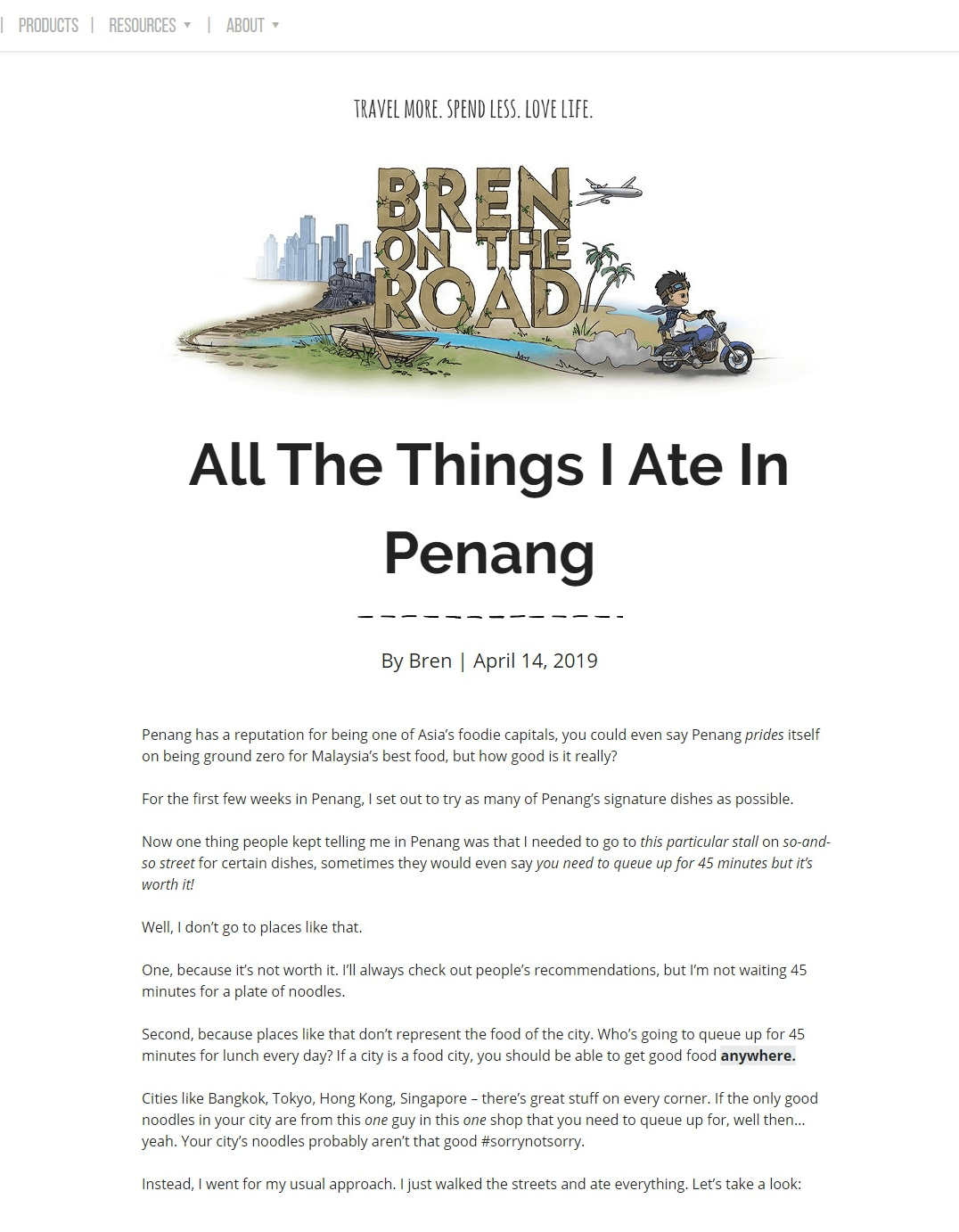
    Blog homepage

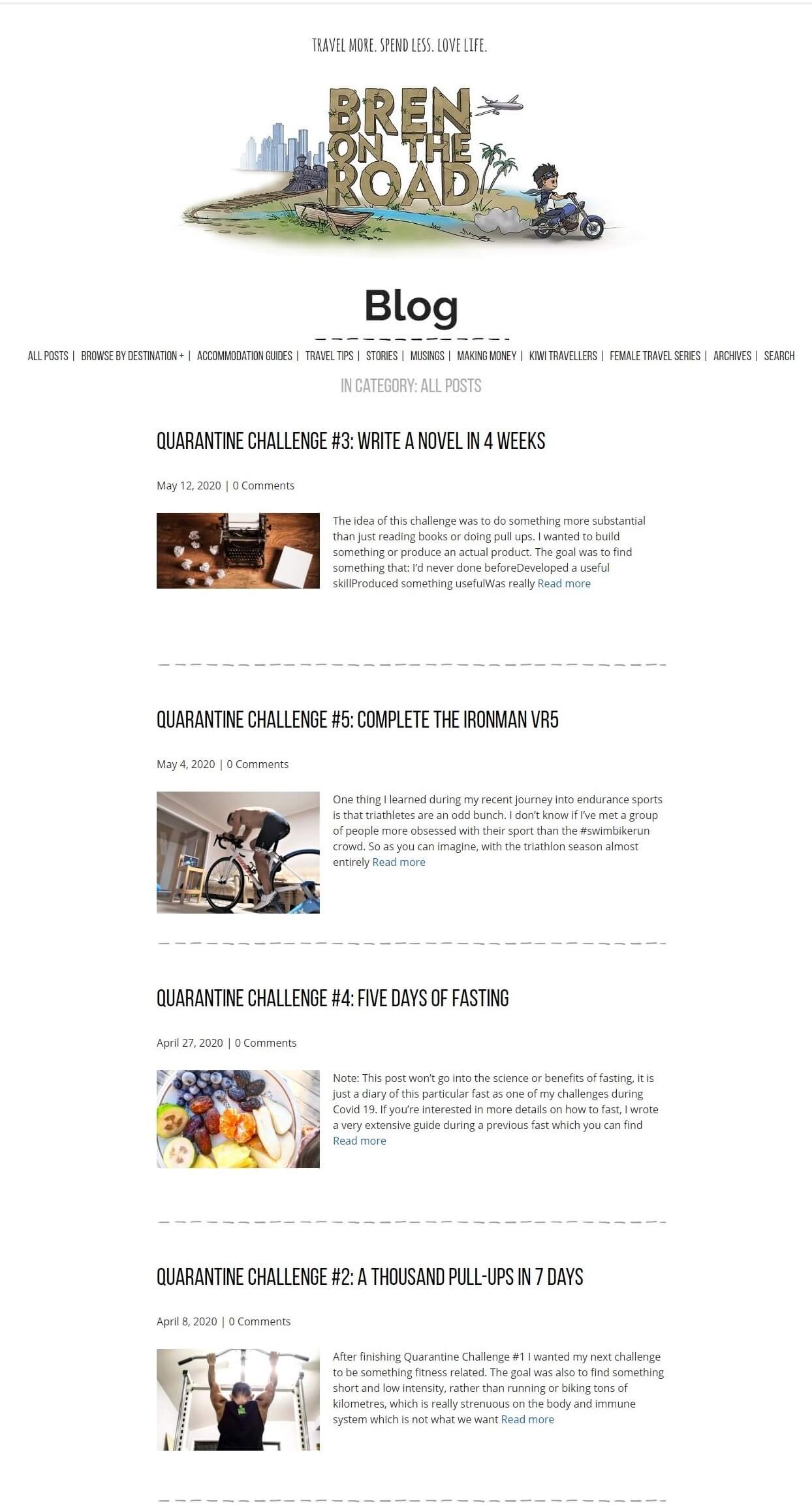
    Before

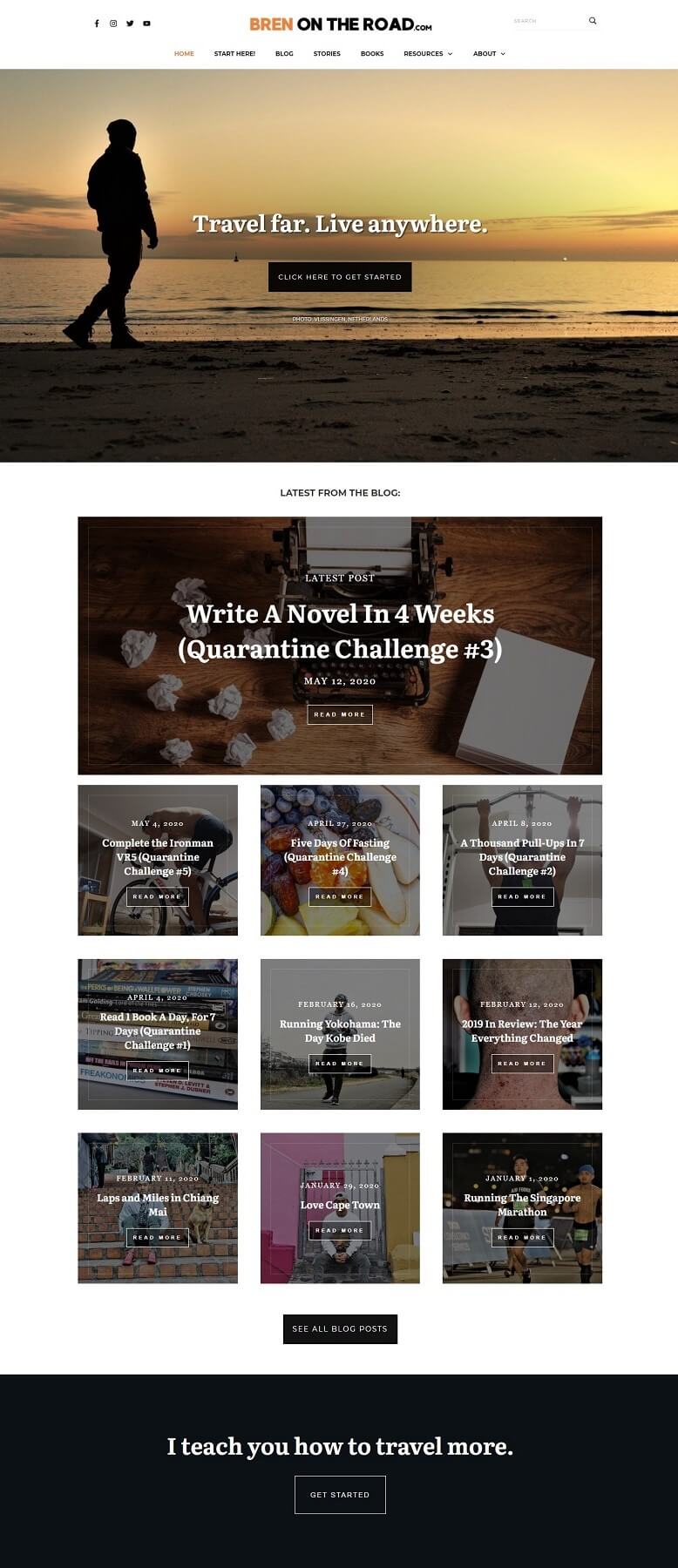
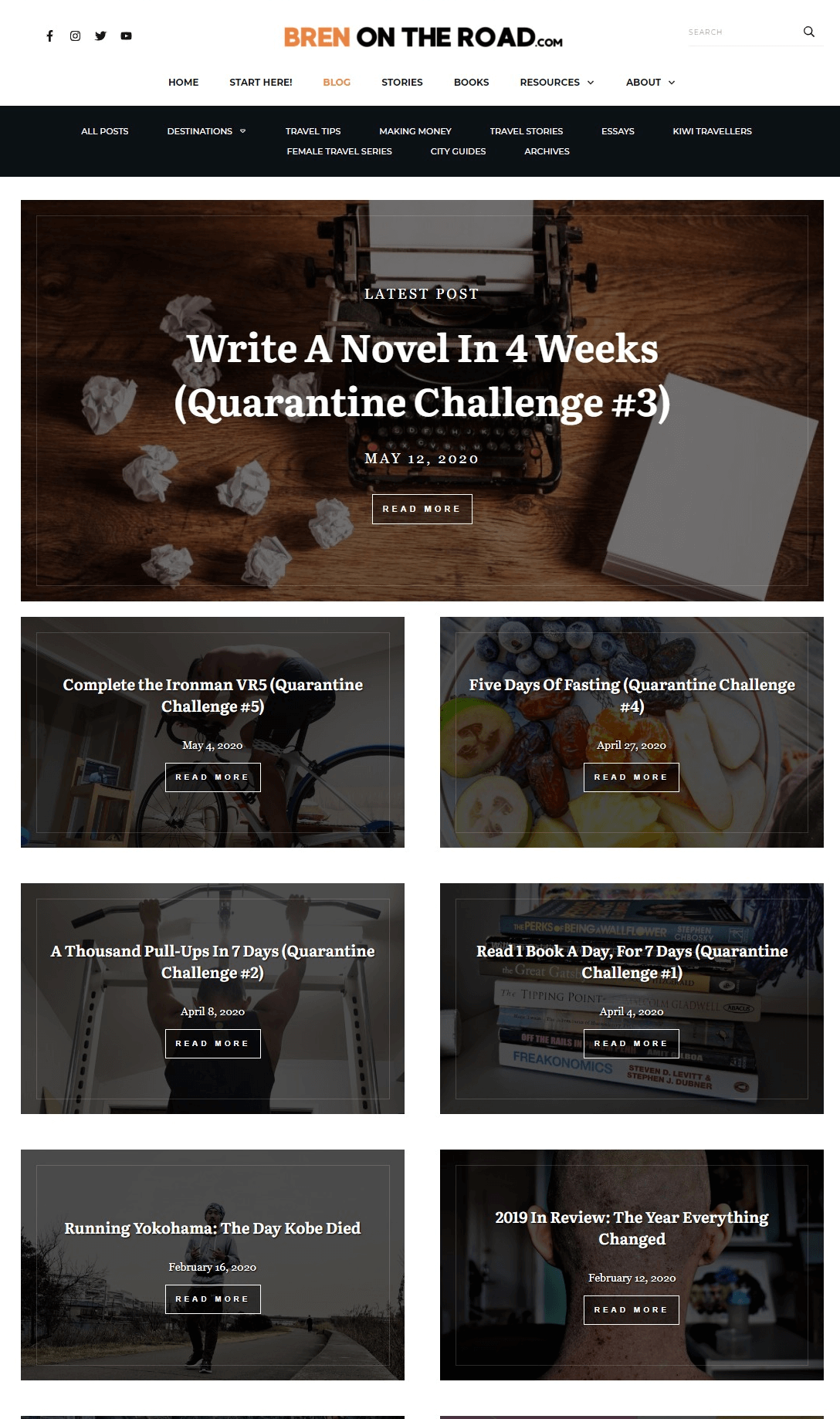
    After

    One of the main issues with my old home page was having too many options on the page. There were links and buttons to around nine different sections of the blog. Really you only want one (or maybe two) choices for a new visitor to have to choose from.

    Also it was wordy – as you scroll down the page there’s just more and more text which isn’t very exciting for a new visitor.

    Actually when I look at it now, that home page should have ended under that first row of cartoons/artworks. That would have been pretty much perfect! I wasn’t ruthless enough at the time and wanted to include everything.

    Another thing is I tend to over-calibrate a lot. Since I felt like there were too many photos on the 1.0 version, I decided to have zero photos on the 2.0 version. I guess this is part of my personality where I tend to sway between extremes.

    First thing you might notice is my cartoon logo has gone. That was a hard decision because I love that logo and I’m sure a lot of readers recognise the site from that logo. 

    The reason it had to go was because I couldn’t redesign freely with it and I kept drifting back towards the old design. For example, I tried to keep remnants of my old “flavour” with the new logo such as:

    or something like:

    But that stopped me from using a clean slate and doing anything fresh, and I was kind of stuck between two worlds. I decided to ditch the old cartoon brand and build from scratch and see what I came up with.

    The new logo is simpler and easier to read and maybe not quite as funky but I think it suits me and the site better especially now that I’m not 25 anymore. I still have a feeling I’ll bring this old design back when it feels retro, maybe when I’m in my fifties 😉

    Simplifying the home page

    There are three distinct parts of the page as you scroll down – the first part is for new readers, the second part takes you to the blog, and the footer is a subscribe box.

    There’s also as little writing on the page as possible – I wanted to be more visual this time so unless you’re reading the text on a button, it should be photos dominating most of the page.

    The Blog

    The old blog page was fine on the surface, but was patched together with different plugins and had issues with images and so on (you probably wouldn’t have noticed, but it did slow the site down).

    I also wanted to improve the number of posts that were displayed at one time so readers didn’t have to scroll and scroll and scroll to get anywhere. Also again, too much writing on the page.

    The goal here was more photos, less writing, and faster. Now there can be around 12 posts on the screen at once, rather than the five or six you could have before. Also it just looks and moves nicer.

    Before

    After

    Blog posts

    Interestingly this is probably the most important design decision you make, because 80% of the time spent on your blog is spent reading blog posts.

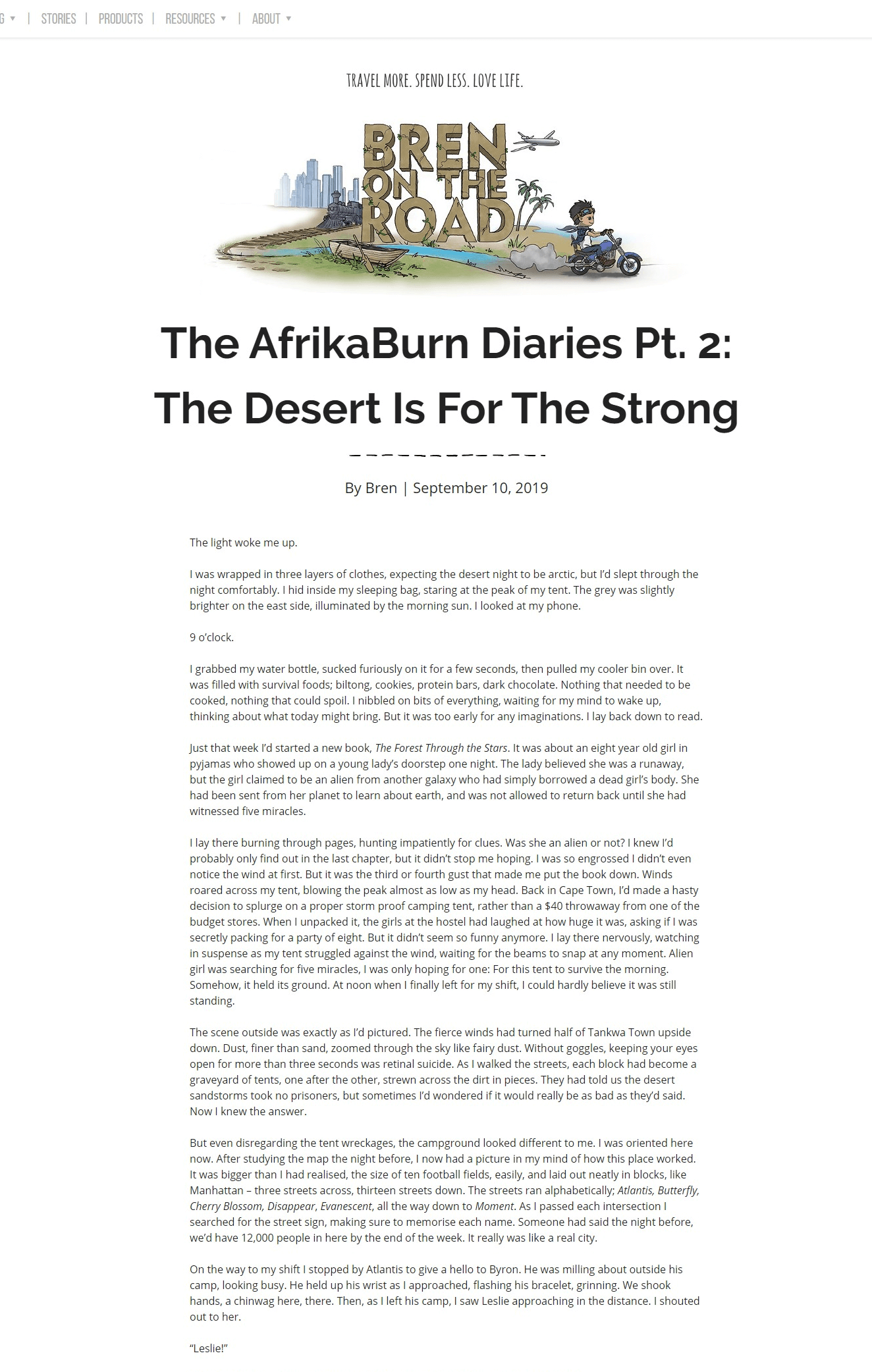
    In the previous version, I wanted people to focus on the words and the stories and not bog them down with visuals. The end result was white space everywhere.

    I loved the idea of white space so much I removed the sidebar completely, which is supposedly the most important area of your site (for promoting the rest of your content).

    All I had on the page was the story and nothing else. I’m still glad I did that as I think it definitely made me a better writer.

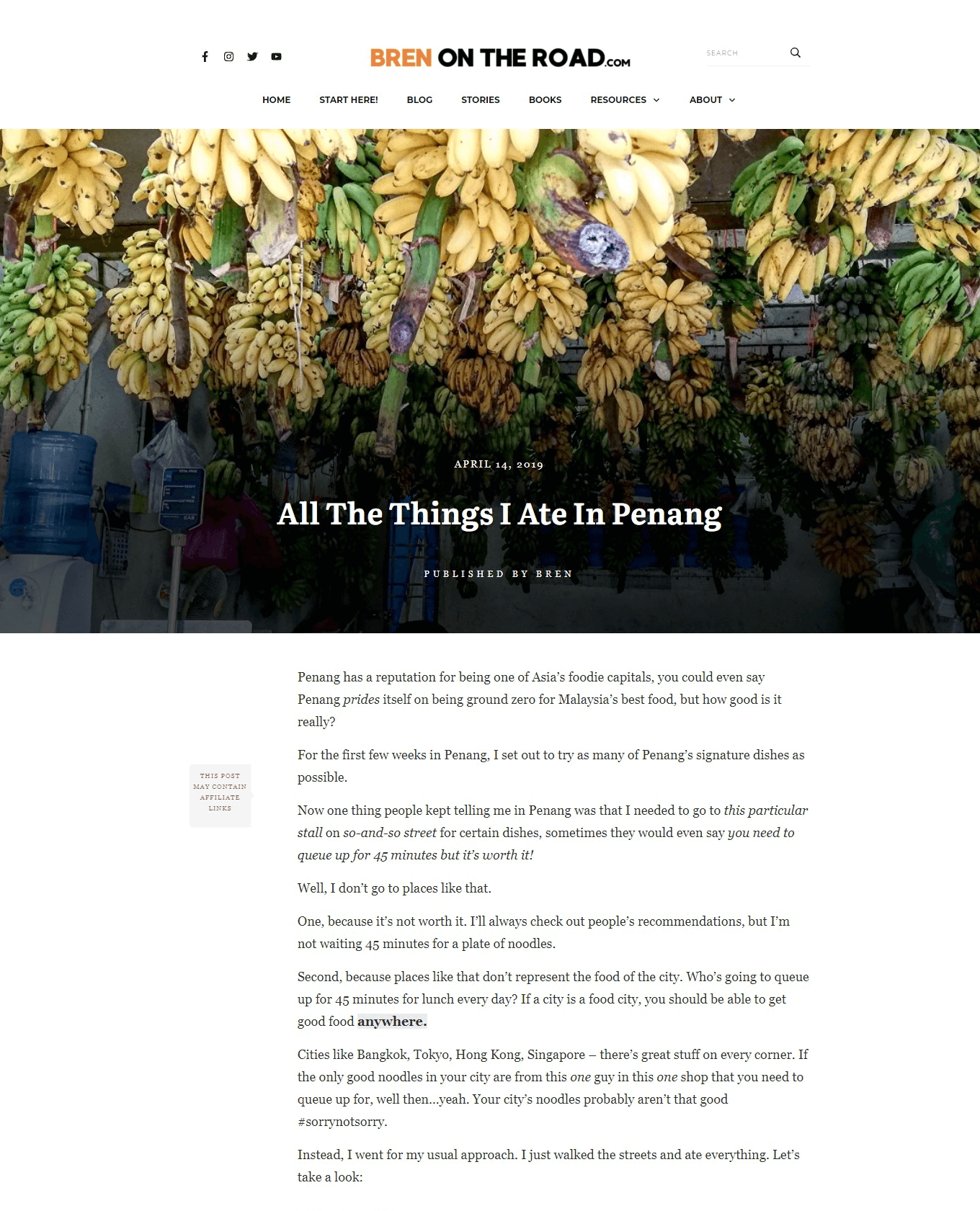
    Before

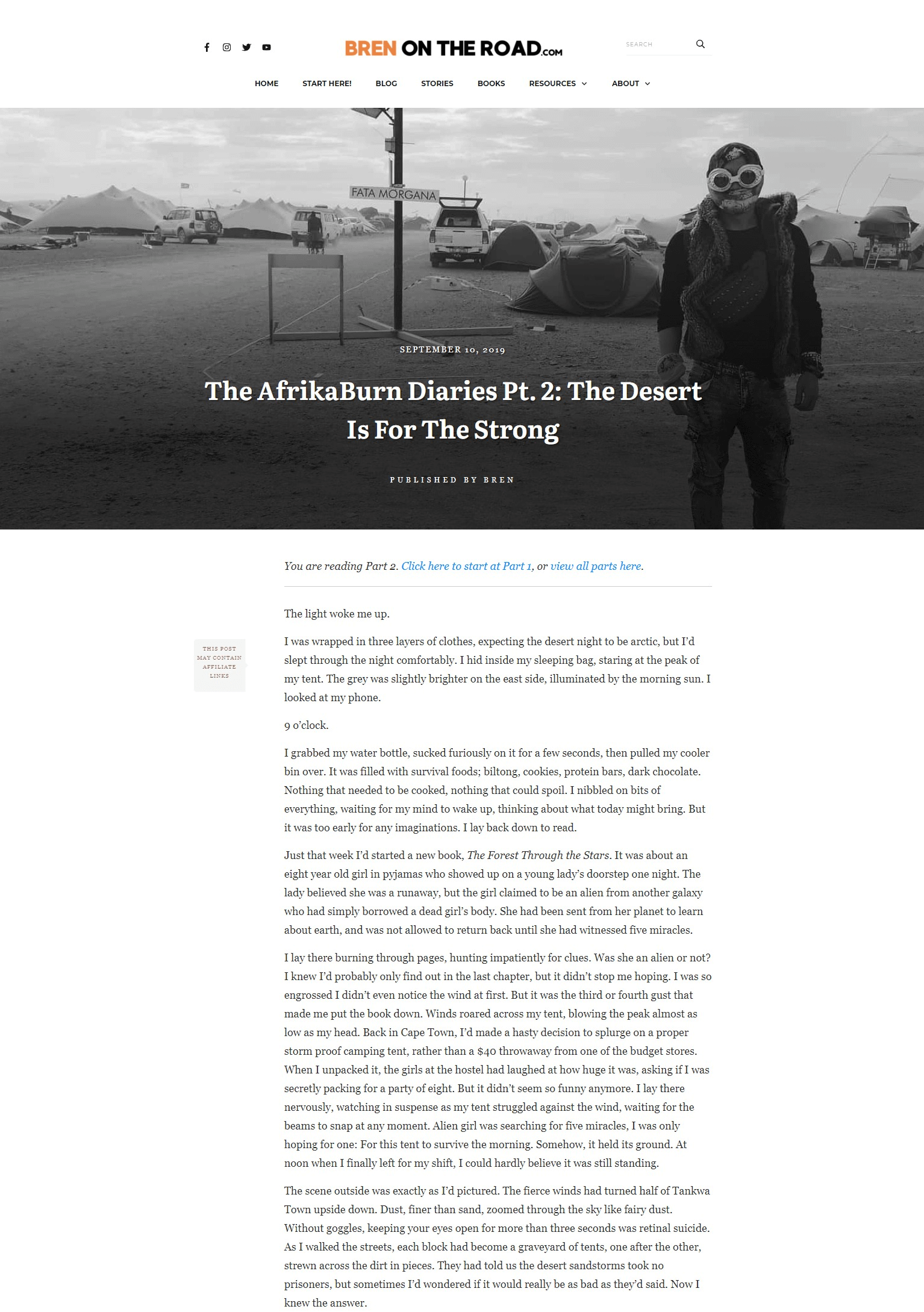
    After

    To be honest I haven’t changed much here. 

    The sidebar is still gone and there are only words on the page, but the featured image at the top is back. Whilst beforehand I thought photos might distract from the story, now I think the right photo adds a lot to the story and primes the reader.

    Before

    After

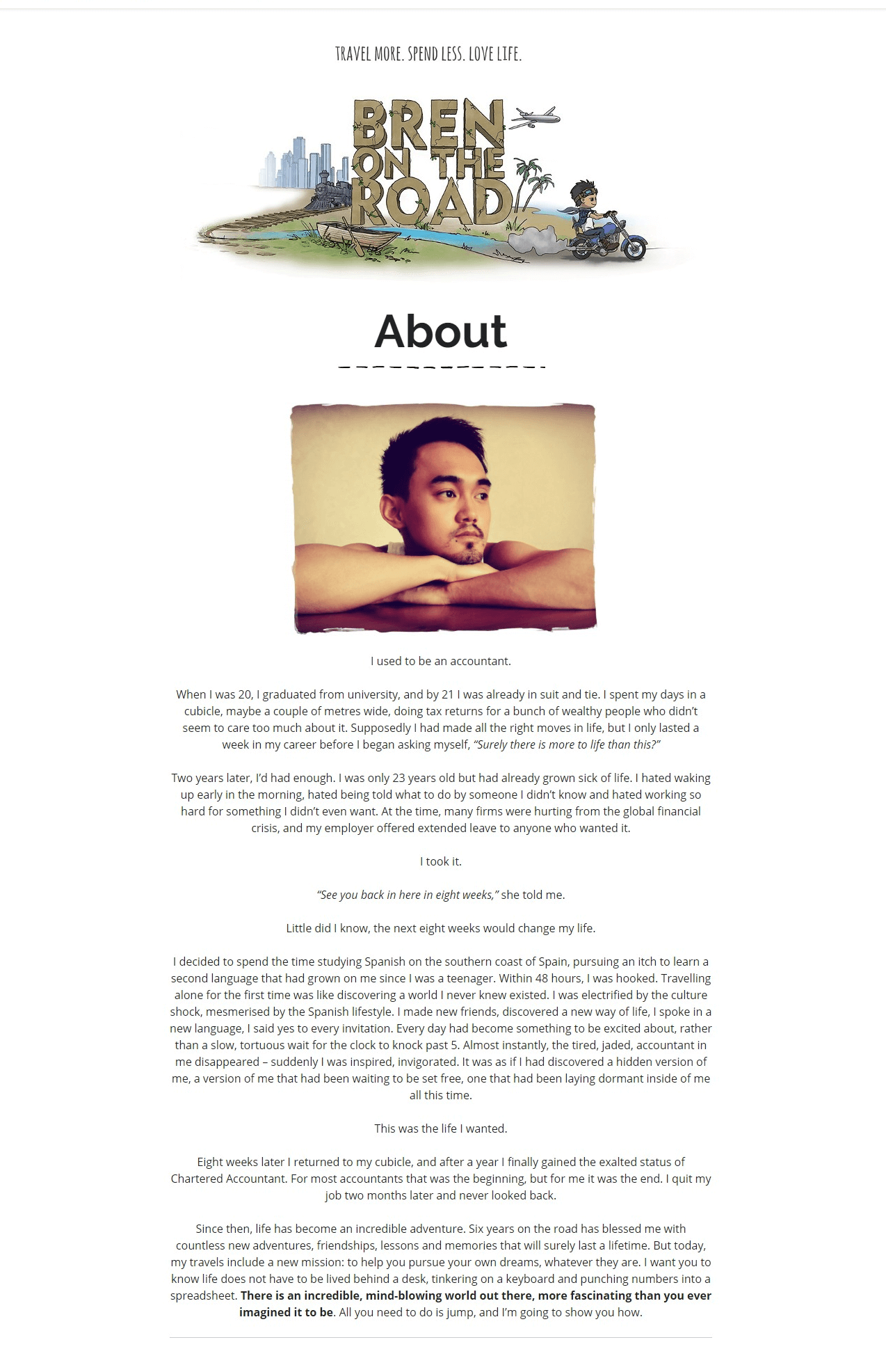
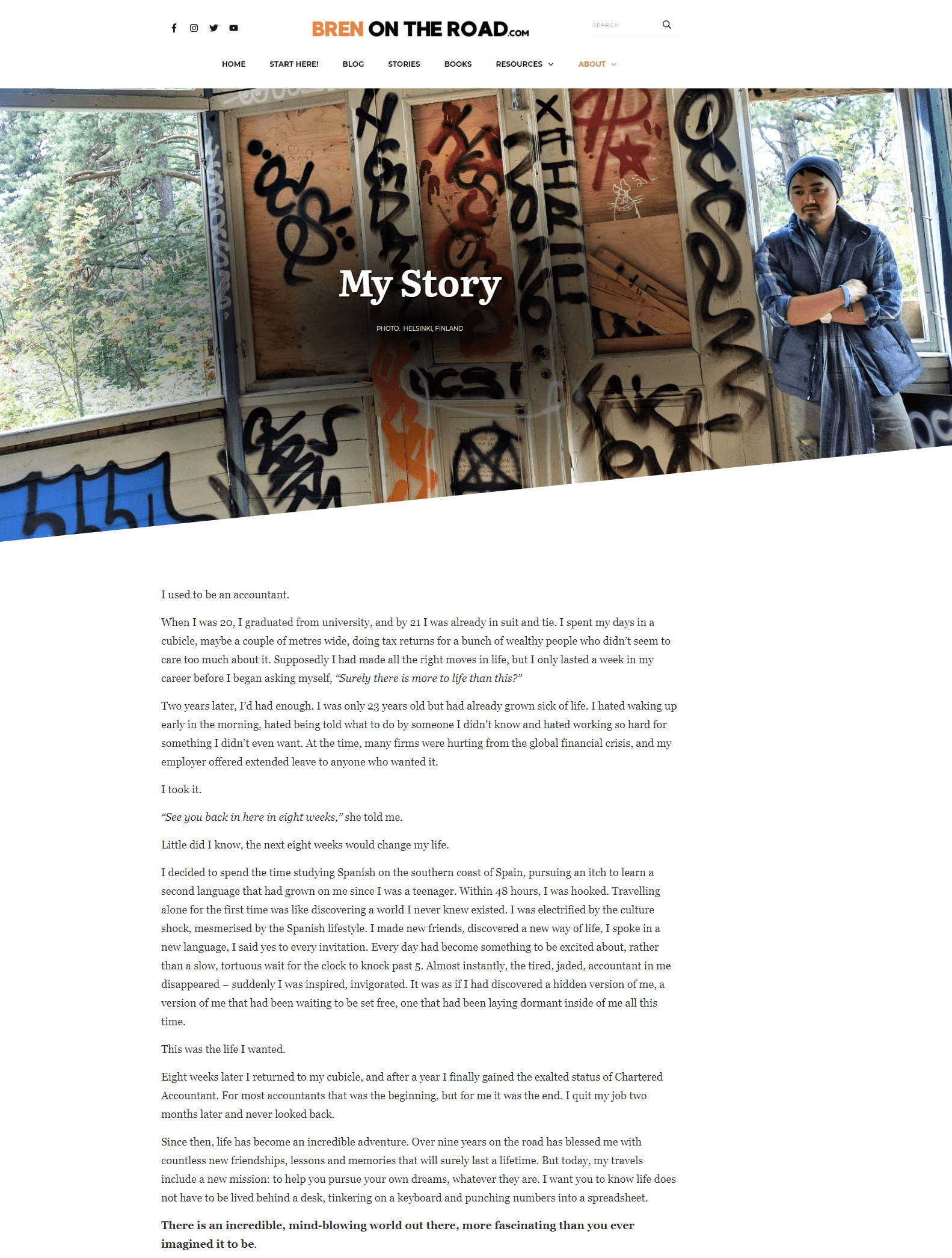
    Blog pages

    Blog pages are a lesser visited part of the site but still important – they include your Contact page, About page, Resources page and other standalone info readers might need.

    They looked a bit bland before so I spruced them up with some travel photos. Also I realised I need to audit my site more often – I had pages with info that was way out of date which has been sitting there for years.

    Before

    After

    What “good blogs” look like in 2020

    One of the challenges with owning a blog is the internet is ever-changing. Good blog designs from five years ago no longer work and need to be revamped to keep up.

    One of the main things today is mobile compatibility. Even I have noticed this change, as I rarely did any reading on my phone five years ago, and today I read almost everything on my phone while lying down.

    The other thing much more relevant today is speed. Google generally removes slow sites from its search results, so site owners need to keep their sites clean and fast with good web hosts to make sure they don’t get lost in the internet.

    These days most people find me via Google, and I also find I’m very unforgiving to slow sites (if a site takes longer than a few seconds to load, I usually click Back and choose a different one), so this makes it doubly important.

    Therefore one of the main motivations for the redesign was not to change the way the blog looks but the way it functions.

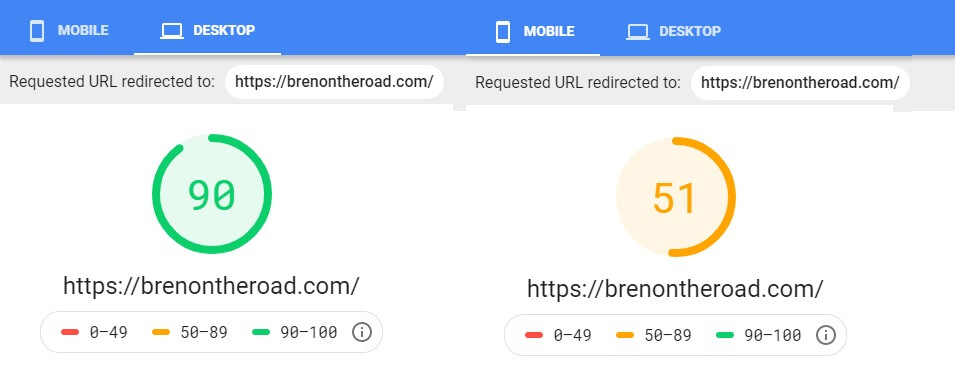
    Thankfully the new design is an improvement so far, the mobile version is great in most respects, and the site is getting much faster scores on speed tests.

    On Google Pagespeed, the old design was scoring around 45 for desktop and 10-15 for mobile! It’s much improved now:

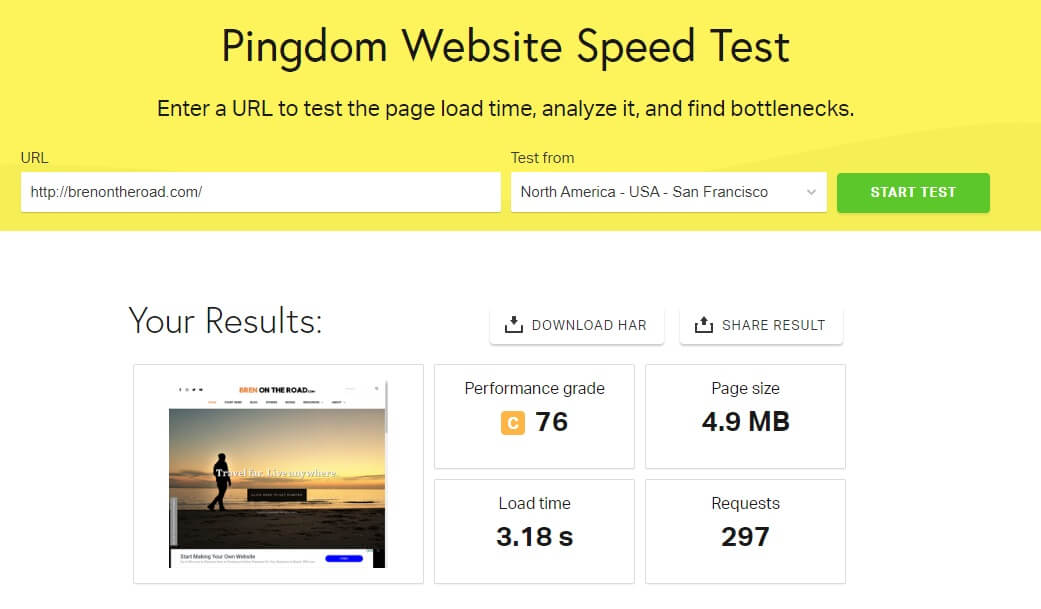
    I was also getting scores in the mid 60s and load times of around 5-6 seconds on Pingdom, which has also improved:

    Still not nearly perfect (I mean a performance grade C? My parents would die).

    So I’ll need to put aside ten or twenty hours somewhere to work on all the suggested fixes (just another behind-the-scenes blogger headache that sucks up all our time :D)

    Overall though it’s moved everything in the right direction!

    The Tools I used

    If you’re reading this and thinking “this looks complicated” then you’ll be happy to learn this entire redesign didn’t require a single line of code, or a computer science degree, or even any experience in web design.

    In fact it was even easier than using Powerpoint (which I hate), so if you’ve ever made a Powerpoint presentation in your life that didn’t look like dog shit, you can definitely make a nice-looking site just like this one.

    During the redesign I used two different tools:

    The first is WordPress, which is a blogging platform and is free. It’s also the most popular blogging platform, and to be honest I’ve never met a blogger who used anything else. I have a very thorough and simple guide on setting up a WordPress site here.

    The second tool I used is a web design tool called Thrive Theme Builder. It’s a WordPress plugin for designing your theme, and it’s amazing!

    This is a drag-and-drop tool designed for people like you and me who want to design their own blogs but don’t want to go insane while doing it. I’d actually never heard of Thrive Theme Builder until last week, but I’ve used other Thrive products on my blog in the past and they were excellent. The entire redesign shown above was done with Thrive Theme Builder and nothing else!

    In the past the bootstrapper blogger strategy was to find cheap designers for $200 or $300 in China or India or Eastern Europe to design a site for you, but this is a far better option and now my recommendation to everyone. You will get full control over your design, you learn how to design beautiful sites (which technically makes you a freelance web designer and you now have a new side hustle) and the best part of all – it’s cheaper! Thrive Theme Builder – big thumbs up from me.

    If you would like a look inside Thrive Theme Builder, I’ve recorded a video of me working on the redesign behind the scenes where I rebuild this entire site from scratch in around 45 minutes. You can check it out on my Youtube below:

    How to get Thrive Theme Builder?

    A single license for Thrive Theme Builder is $97 for lifetime use.

    You can get a full demo and read everything about it by clicking here.

    What’s next for Bren On The Road?

    While going through and reformatting my old posts, I was reminded of what a long journey this has been. I also got to see how my blog has matured over the years and had flashbacks of the specific experiences that spurred specific articles. Never once did I expect I’d become a blogger or a writer of any sort and it’s pretty wild to see this has become my career after just falling into it randomly seven years ago.

    Most of all I was reminded of all the great readers who have supported and encouraged me to keep building this site and how many great people it has brought into my life.

    I just want to give a huge thank you to all of you for still being here after seven years! Who knew blogging could change so much. Hope you’ll still be here at the next redesign, and still reading these posts seven years in the future.

    Stay safe everyone and be well!

    B

  • The Ultimate Guide To New Zealand Slang

    The Ultimate Guide To New Zealand Slang

    It happens to me everywhere I go. I’ll be having a conversation with some mates at the hostel and, forgetting I’m not in New Zealand, I’ll say something like…

    “Yeah nah bro, I reckon that’s all good, cheap as for a mean as feed like that!”

    And they’ll all stare at me in silence, as if I’m an alien speaking to them in Na’vi. And then one of them will go, “Sorry, what?”

    Meanwhile the Aussie guys next to me are pissing themselves laughing.

    I’ve since learned to go easy on the New Zealand slang while travelling, especially when I’m around non Kiwi folk, but this isn’t as easy as it sounds. It’s actually quite a struggle, and I still remember bunking with an Aussie in Colombia and both of us laughing at how nice it was to finally be able to speak normally with someone.

    So, next time a Kiwi is in your dorm, prep yourself with this guide. In fact, bust out some of the New Zealand slang below and they’ll think you’re the coolest person alive. More importantly, if you plan on coming to New Zealand you’d do well to learn as many of these NZ slang words and phrases as possible.

    Learning Kiwi slang isn’t easy, so we’ll start with 20 common words. Once you’ve learned them all, move on to the next section where I’ll teach you the good stuff. You guys are going to be speaking fluent Kiwi in no time!

    Lesson 1: Some popular New Zealand slang words to start:

    Kiwi – Can refer to either a New Zealander, or the country’s national bird. For the fruit, we say kiwifruit.

    Jandals – Flip flops. e.g. Havaianas

    Dairy – A convenience store, corner store, or mini supermarket.

    Chilly bin – A cooler bin, used for keeping drinks cold.

    The wops – Really far away, the middle of nowhere. e.g. she lives far away, out in the wops.

    Macca’s – McDonald’s

    Togs – Swimsuit

    Bonnet & boot – Hood & trunk (of a car)

    Scull – To drink a usually alcoholic drink in one go without stopping.

    Buggered – Very tired

    Fizzy drink – Soda

    Mince – Ground beef

    Hot chips – French fries

    Kai – Maori word for food

    Chocka Block – Crowded/busy

    Pissed – Drunk

    Cuppa – A hot drink, usually short for “cup of coffee” or “cup of tea”

    Jumper – A jersey or sweatshirt

    Angus – Someone with an anger problem

    Hungus – Someone who eats too much

    Easy enough? Cool. Now try wrap your head around these ones:

    Lesson 2: Advanced Kiwi Slang Words & Phrases (for those who wanna get serious!)

    Bro

    When I’m with my friends I use this in almost every sentence. We use it in place of ‘man’ or ‘mate’ or ‘dude’. It’s not reserved for good friends, you can say it to anyone, like the mailman or a taxi driver. They’ll probably say it back to you.

    Example:
    Jack: Hey bro how’s it going?
    John: I’m all good bro! Did you see Shortland Street last night bro? It was crazy bro!


    All good

    This basically means ‘everything’s fine’ or ‘no problem’, and we also use it in place of ‘you’re welcome’ when someone says thank you.

    Example:
    Jack: I thought my car was going to break down but it was all good, thanks for waiting.
    John: All good bro.


    Sweet as

    Means ‘no problem’, or sometimes can just mean a simple “OK”. Used similarly to ‘all good’.

    Example:
    Jack: Yo, we’re all going to Jen’s house to watch Gossip Girl and eat Toffee Pops. Gotta go gym first but I’ll pick you up at 7?
    John: Sweet as (translation: OK).


    Faaaa

    This could be considered a shortened version of “far out” (or the F word, I’m actually not sure) which can be used to express both excitement and disappointment. The amount of excitement or disappointment you wish to express will depend on how long you hold the ‘faa’.

    Example:
    If you scratch a lotto ticket and win $2 you might go “Faaa, only $2”, but if you scratched it and won $20,000 you’d probably go “Faaaaaaaaaaaaaaaaaaaaaaaaaaaaaaaaaaaa $20,000!”


    As

    We commonly use the word “as” as an amplifier to the preceding adjective. For example, “cheap as” would translate to “really cheap”.

    Example:
    John: Bro, check out my new polka dot undies. Got them in Howick for 20 bucks.
    Jack: Bro, that’s expensive as! (translation: that’s really f*cking expensive).


    Hardout

    This is one of those Kiwi slang words with many meanings:

    1. To amplify an adjective.

    Example:
    It’s hardout cold today! (translation: It is extremely cold today)

    2. To express agreement to something very enthusiastically.

    Example:
    Jack: Bro, this restaurant is awesome as, we should come here every week.
    John: Hardout! (translation: yes, we should!)

    3. To describe something as awesome or amazing.

    Example:
    John: How was the movie?
    Jack: It was hardout, bro! (translation: It was awesome, bro).

    4. To describe someone as extremely talented/hardworking/successful.

    Example:
    John: Did you know Ben got 100% in every exam?
    Jack: Man, that guy is a hardout! (translation: that guy works really hard).


    Not even

    Loosely translates to “No way” or “That’s not true”, but can be used in various different contexts.

    Example:
    Jack: Bro, I forgot my wallet. You’ll lend me 20 bucks though eh?
    John: Not even! (translation: No, I wont.)


    Ow

    This can be combined with “Not even” and is used somewhat like an exclamation mark. It’s used quite sparingly, but if you manage to pull off the “Not even” + “Ow” combo as a foreigner, you will probably be made an honorary Kiwi.

    Example:
    Jack: Bro, how did you pass that exam, you must have cheated hardout!
    John: Not even ow! (translation: Get the f**k outa here)


    Shot

    This has multiple meanings, so many that it would be pointless to explain them all here. In fact I’m not even sure I could explain them, as there is an acquired comfort in using this word and understanding all it’s uses. Nonetheless, I encourage foreigners to try as often as possible. Three of the most common meanings are:

    1. To express thanks.

    Example:
    Hey bro, can you pass me that jug of water please? Shot. (translation: Thanks)

    2. To express joy, similar to how you might use “Yuss!!”

    Example:
    John: Bro, Jen got us free VIP tickets for Miley Cyrus tonight!
    Jack: Oh shot! (translation: That’s awesome!)

    3. To express encouragement, or to say ‘good job’ or ‘well done’.

    Example:
    John: Hey bro, I finally passed my bikini waxing certification last night. Starting my new job tomorrow!
    Jack: Shot bro! (translation: Well done!)


    A feed

    A meal.

    Example:
    Jack: I’m hungry bro.
    John: Alright, let’s go for a feed. Macca’s?


    Reckon

    In many ways it is a synonym for the word “think”, for example instead of saying “I think so” you could say “I reckon”. However it has other meanings:

    1. Used to express one’s opinion. For example, instead of saying “Do you think?” you would say “Do you reckon?”

    Example:
    John: Do you reckon if I buy Jen a box of Pineapple Lumps and then ask her on a date she will say yes?
    Jack: Yeah, I reckon! (translation: yes, I think she will).

    2. Used to agree enthusiastically to something.

    Example:
    John: I can’t believe Tom cheated on Jill for the 279th time!
    Jack: I reckon! What a dick. (translation: I know! What a dick).


    Mean

    An adjective to describe something as really amazing or awesome.

    Example:
    Jack: Did you see that girl in the purple dress last night?
    John: Yeah bro that girl was the meanest! (translation: that girl was extremely hot/amazing).

    Example:
    Jack: Did you like that Olsen twins movie we saw last week?
    John: Yeah, it was pretty mean (translation: Yeah, it was quite good).


    Heaps

    Means ‘a lot’ or ‘very’.

    Example:
    Jack: Man, I always see that girl there.
    John: Yeah, I’ve seen her heaps too. She goes there heaps bro. (translation: Yeah, I’ve seen her a lot too. She goes there all the time).


    Piece of piss

    To describe something that’s very easy, similar to “piece of cake”.

    Example:
    Jack: Hey, I’m about to take my driving test. Is it hard?
    John: Nah, piece of piss bro (translation: No, it’s very easy).


    Taking the piss

    An expression which means ‘to make fun of’ or to ‘mock’, or to not be taking something seriously. Not to be confused with “taking a piss”, which means to urinate.

    Example:
    Jack: I was gonna go out drinking with you guys tonight, but Jen got mad at me so I’m staying home.
    John: What the f**k? Are you taking the piss? (translation: Are you being serious?)


    On the piss

    Getting drunk.

    Example:
    Jack: Man have you seen Melissa’s Instagram lately?
    John: Bro she’s always on the piss eh????
    (translation: she’s always out drinking, right?)


    Yeah nah bro

    Yeah nah is a tricky one to translate accurately. It basically means “No”, but it’s like a more polite version of no.

    Example:
    Jack: Hey man you wanna stay for dinner?
    John: Yeaaaah nah bro, I gotta get home and study
    (translation: I’d like to [not really], but I can’t, gotta get home and study).

    However, it can also be translated as simply “Ummm”, or perhaps as “Ummm yeah, but no”. Such as when you’re talking about a sensitive topic, or just need time to think.

    Example:
    Jack: Hey bro, I saw you and Jess go home together last night!
    John: Yeah nah bro……how did your night go? (translation: Well, no, we didn’t, how did your night go?)

    There’s no exact translation, so try to observe the different ways Kiwis use it before you start trying to use it yourself!


    To the days

    This is pinned to the end of a word or phrase, and means ‘extremely’ or ‘very’.

    Example:
    Jack: Did you see Tim got drunk again last night?
    John: Bro, that guy’s an alcoholic to the days! (translation: That guy’s seriously an alcoholic).


    Honest to who?

    Loosely translates to “Really?” Often the response will be “Honest to G”, which I presume means Honest to God.

    Example:
    Jack: Bro, I won like $5,000 at the pokies last night.
    John: Honest to who?
    Jack: Honest to G O D!


    Gizza

    Short for “Give us a”, which actually means “Give me a”.

    Example:
    Jack: Faaa, check this out, Jen posted a photo of herself on Instagram in a bikini.
    John: Honest to who? Gizza look! (translation: Really? Give me a look!)


    Shout

    This is the Kiwi form of the verb ‘to treat’, such as treating someone to a meal or a drink.

    Example:
    Jack: Bro, I can’t come out tonight, I spent all my money on a pedicure.
    John: It’s all good bro, Tim is shouting drinks tonight.
    Jack: Shot!


    What a sad guy

    This is said when someone does something super uncool.

    Example:
    Jack: Bro, when Tim was drunk as last night I put $500 of booze on his credit card.
    John: What a sad guy!
    (translation: what a crappy thing to do)


    Aye/Eh

    Probably impossible to explain, but I will try. It has many different uses so you will need to listen carefully to the pitch, tone and context in which it’s used to decipher the meaning in each particular situation. Also note that the word is pronounced like the letter “A”, not the letter I.

    1. Used on the end of a statement to solicit agreement from the other party. Similar meaning to “don’t you think?” or “isn’t it?”

    Example:
    Jack: It’s pretty hot today eh? (translation: It’s pretty hot today, isn’t it?)
    John: Yeah bro, hardout. (translation: Yes, very).

    2. Used to express disbelief and/or surprise. You would use a similar pitch and tone to when you say “Really??”.

    Example:
    Jack: Tim broke his leg at rugby last night and now he’s in the hospital.
    John: Eh? (translation: Really!?)

    3. Used to express confusion when you’re unsure of why something is happening or when things are not appearing as they should. When used in this context the “Aye” will typically be longer and more drawn out, usually in a slightly higher pitched voice.

    Example:
    Jack: Bro Mr Tupai said you have to go to his office after school because your exam was so crap.
    John: Eeeeeeh? (translation: What the hell!?)

    4. Used as a filler word, with no real meaning at all.

    Example:
    Jack: How was Jen’s cupcake party?
    John: It was cool eh, I really enjoyed it.


    Cuz

    While technically short for “cousin” this is mostly used as a term of friendship, but can also be used as just a casual way to address someone. Sometimes the longer form “cuzzy” is used.

    Example:
    Staff: “Sir, here’s your Big Mac combo, no pickle extra fries.”

    Jack: “Oh, cheers cuz.” (translation: Thanks man)


    Chur

    Generally used in place of “cheers” or “thank you”, but in certain situations can also mean “OK/cool” or “No problem”. I’ve also heard people use it simply as a way to greet each other.

    Example:
    Jack: Saw you were running low bro so got you another beer.
    John: Chur bro! (translation: Thanks man).


    Can’t be bothered

    Used when someone is too lazy or just simply doesn’t feel like doing something. Another variation of this is “can’t be stuffed”, which has the same meaning and is used in the same way.

    Example:
    Jack: Bro, your arms are looking kinda small you should come to the gym with us.

    John: Nah, I can’t be bothered bro. (translation: No, I’m too lazy).


    Choice

    Simply means “good” or “cool” and is used similarly to “sweet as”.

    Example:
    John: Bro, Jen went to buy our movie tickets and the guy gave all of us free popcorn.
    Jack: Oh choice! (translation: Oh that’s awesome).


    Suss

    This word can have two different meanings depending on the context:

    1. To take care of a task that needs to be done or to sort something out.

    Example:
    John: You were supposed to get our rugby tickets sorted, suss it out bro! (translation: take care of it)
    Jack: Sussed it out this morning bro! (translation: I sorted it out this morning)

    2. To describe something as suspicious/suspect.

    Example:
    John: Bro, it’s all good, this guy said he’ll give us a ride into town.
    Jack: Are you sure you wanna go with him? He looks kinda suss bro. (translation: he looks a bit suspicious/not right).


    Mint

    Loosely translates to “cool”, or “awesome”. Has quite a broad meaning and can be used to describe most things that you think are cool.

    Example:
    John: “Bro, check out my new iPhone cover, it’s got Kim Kardashian on the back.”
    Jack: “Gizza look. Oh bro, that is mint.” (translation: Give me a look. Oh man, that is awesome.)


    Gap it

    Can simply mean “to leave” or can also mean to “run away”.

    Example:
    John: Bro I saw this guy trying to break into my car.

    Jack: Did you catch him?
    John: Nah, he gapped it. (translation: no, he ran away)


    Stink!

    Stink can be used on its own to express unhappiness with something, or can also be used as an adjective to describe something/someone as really lame.

    Really good word to pair with “Faaa”.

    Example:
    Jack: Did you see the Easter Show got cancelled?
    John: Faaa stink as!
    (Translation: Oh no that sucks!)

    Example:
    Jack: I was supposed to go for get milkshakes with Tim, but he cancelled on me last minute.
    John: What a stink dude!
    (translation: What a bad person).


    Skux

    Really cool/attractive/stylish/awesome.

    Example:
    Jack: Bro I heard you got like 3 girlfriends now wassup?
    John: Nah, not even, I’m not a skux dude like you eh!
    (translation: no way, I’m not as cool as you!)


    Chocka

    Chocka means something is very full or busy. If something is extremely busy, you can use the full term “Chocka Block”.

    Example:
    Jack: Yo, I heard the supermarket was pretty chocka today? (translation: I heard the supermarket was quite busy today?)
    John: Bro, chocka block! (Man, it was super busy!)


    Kia Kaha

    Kia kaha translates to “Be strong” in Maori. It is a phrase Kiwis say to each other during hard times, periods of grieving, or when sharing support to each other. For example during natural disasters, tragic events, or the All Blacks losing in a World Cup final. You will see Kiwis saying to each other, kia kaha.

    Example:
    We are all grieving today during this difficult time. Kia kaha, New Zealand (stay strong, New Zealand).


    Straight up

    This can be used as both a question and a response. As a question, it loosely means “Are you serious?” As a response it means, “Yes, I’m serious.”

    It can also be used as a way to answer something with an enthusastic yes.

    Example:
    Jack: Dude I can bench 200kg now!
    John: Straight up? (translation: Really?)
    Jack: Straight up. (Yes, really).

    Example:
    Jack: If you were given the chance, would you date Barbara Streisand?
    John: Straight up! (translation: Definitely!)


    C*nt

    The reason I’ve included this word is because while it might be vulgar in some countries, it is not in contemporary New Zealand. In fact, it is often used a term of endearment between friends, and probably on the same level as “douchebag” or maybe “dickhead” when using it as an insult.

    If you hear this in the streets in New Zealand, do not be alarmed! It is quite normal and nothing to worry about 🙂

    Example:
    Jack: Hey man do you know Sara’s new boyfriend Joey?
    John: Yeah, he’s a good cunt actually (translation: yeah, he’s actually a nice guy).


    Wanna hiding?

    Generally if you hear this phrase between friends it’s okay, but if it’s said to you by a stranger, you’ve done something wrong. You might hear this at the bar once or twice on a heavy weekend. It’s what Kiwis say when they want to punch you in the face.

    Example:
    Jack: *pours water down John’s shirt*
    John: What the f***! You wanna hiding?! (translation: You want me to smash your face in!!?)


    Palangi

    This is actually a Samoan word which means foreigner, but you’ll hear it in New Zealand quite often. It’s normally used as a friendly term to describe white people/caucasians.

    Example:
    Jack: Hey, what do you think of that new guy Shane on our rugby team?
    John: I’ll be honest, he runs pretty fast for a palangi!


    Bring a plate

    This is one of those New Zealand sayings that’s often misunderstood. When Kiwis invite you to dinner and ask you to bring a plate, it’s not because they don’t have enough kitchenware. It means they want you to bring a dish, like a lasagne or a cheesecake. It’s basically our way of saying it’s a pot luck dinner.

    I had to include this one, because it would break my heart if you were one of those foreigners who hilariously turned up to a dinner party with just an empty plate! (happens often).

    Example:
    John: Hey, dinner party at my house on Friday, you free?
    Anita: Yes! I’m coming.
    John: Alright, don’t forget to bring a plate!
    Anita: Oh, you don’t have enough plates?
    John: No I mean BRING SOME FOOD omg! 😀


    Nek Minnit

    This phrase was born from a viral Youtube video, which literally means “next minute” or “suddenly”.

    Example:
    John: What happened to that girl at the bar last night? I thought you guys were getting along?
    Jack: Bro, everything was good, then we took a shot, nek minnit she was drunk as! (translation: suddenly she was extremely drunk).


    Gummon!

    This phrase was born from a clip on a TV police show that quickly went viral. It’s used as a slang way to say “C’mon!” when someone gives an excuse or says something soft.

    Make sure you emphasise the G at the start!

    Example:
    John: Bro what happened to you last night? You said you were coming to town with us!
    Jack: Sorry bro I stubbed my toe and it was too sore to walk.

    John: Aww gummon!!


    WANT TO ADD YOUR OWN? The official Kiwi Slang Dictionary has been launched, with all the above words, and more! Add your own definitions, submit words not in the list, vote for your favourites! Check it out here.

    Well, that pretty much covers it! Hopefully now if we ever cross paths on the road you’ll find it a little easier for us to understand each other.

    Oh, and a special thanks to all the Canadians, Americans and Europeans I’ve met who didn’t understand a word I was saying. You were the inspiration for this post.

    Been to New Zealand? What other New Zealand slang phrases did you hear that you didn’t understand? If you’re a Kiwi, what did I miss? Let me know in the comments below!

    Heading to New Zealand? Follow these tips:

    • For affordable accommodation in New Zealand, I highly recommend using Airbnb. This will allow you to get both private rooms and fully furnished apartments at rates far less than hotels and some hostels, especially in the bigger cities. You can get $25 of free Airbnb credit using this link.
    • I highly recommend purchasing travel insurance, particularly if you plan on partaking in the outdoors or road tripping up and down the country. For a beginner’s guide to travel insurance, why you need it, and how to get it, check out my post Travel Insurance 101: Everything You Need To Know.
    • If it’s your first time visiting New Zealand, my buddy Will at The Broke Backpacker has an epic New Zealand travel guide on his blog. Check it out, it should have all the information you’re going to need to see our fine country on a healthy budget!

    Just the funniest writeup on New Zealand slang you'll ever see. Check it out, bro.
  • Running Yokohama: The Day Kobe Died

    Running Yokohama: The Day Kobe Died

    It’s been almost three weeks since Kobe died.

    I still think about him every day. It’s starting to feel real, but still doesn’t feel right and probably never will.

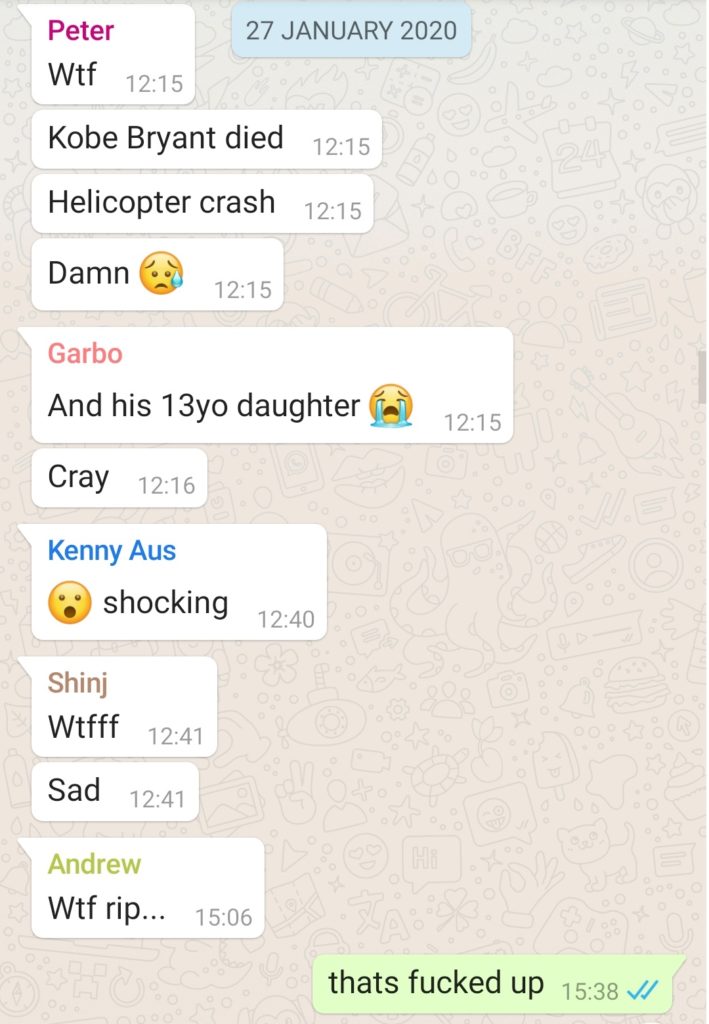
    When I first heard the news I had just woken up and was checking my phone with crusts still in my eyes. I was in Yokohama, Japan, lying in my hotel bed. A couple of days earlier I’d attended my friend’s wedding, and was enjoying a few days of free time before my flight home.

    I saw the messages and quickly sat up.

    I’ve been having this weird thing happen this past few months, where my dreams are extra vivid. So vivid that I wake up and sometimes I have to make sure I’m awake. And often I drift back into sleep and wake up again, so it takes me a second to confirm which is the dream and which one is real life.

    So as I read through the messages my first thought was, oh okay I must not be properly awake yet. Because Kobe Bryant doesn’t just die. But then I put my feet on the floor, and I Googled it, and I touched my face, and I realised it might be real.

    There are some events, like the September 11 attacks, or the day Princess Diana died, that people will say “I still remember exactly what I was doing when I heard the news.” But I’ve never had a moment like that, until then.

    I’d actually had a lot of plans that day. But life stopped, and I spent the next few hours in bed, scrolling through Instagram and reading all the tributes, watching old Kobe videos people were posting and seeing the news unfold. I haven’t felt sadness like that in a while. Perhaps you wouldn’t even call it sadness. More like, being smashed back to reality.

    Back in 2013, Paul Walker died in a car accident. That screwed me up for a while. I was no longer an accountant then, I had just finished going back to university in China, I was 26, not earning any money and didn’t really know what to do with my life. I had considered going back to finance and had looked at jobs in London and China and New York. I was travelling in the meantime, and I remember telling everyone, “This Paul Walker thing has got me all messed up, man.” Because to me that was the perfect life – rich, talented, famous, handsome, probably swimming in women and fast cars and famous friends. I just didn’t see how someone like him could have a single problem in his life at all. And then overnight he was gone.

    That was when I realised, if life didn’t give a fuck about Paul Walker, it’s definitely not gonna give a fuck about me.

    A few months after that, I decided to start my career as a writer and blogger. I knew travel was my true love, and I should try to pursue it, and even if I failed who really gives a shit because Paul Walker just died in a car explosion and that could also be me in two years or two months or two days. And I never forgot that feeling of realising life was so short and fleeting and could literally be gone in an instant. So not only did Paul leave me with Fast And The Furious – that masterpiece I can never stop watching whenever it comes on – he also inspired that little period of reflection that changed my life.

    I grew up watching Kobe play, but to be honest I never really became a fan of his until he retired. I hated him, actually. I hated him because he was so good.

    When I was younger, I played a lot of NBA on Playstation. My team was the Orlando Magic. It started with a love affair with Anfernee Hardaway when I was a kid, and I still played often by the time I started working as an accountant in my twenties. By then I was running my team around Dwight Howard and Jameer Nelson, mastering the big man/little man offense.

    During those 9-5 accounting years, I noticed an interesting thing happens with men and sports. We spend every day sitting in this box, wearing these dorky clothes and we loathe it so much that we cling on to any little bit of excitement we can find. And often we find it in a sports team. Them winning or losing literally means nothing to us, doesn’t affect our lives one bit, but we attach our happiness to it, sometimes our entire existence, if our team wins, we feel good, our team loses, we mope through the office for the rest of the day. We need those teams, it’s the only way we get to be a part of something great from our cubicle, and eventually being their fan becomes a part of who you are. Even if we have a shit day, we can say, well at least my team won today. And it makes us a feel a little bit alive inside. For me that team became the Orlando Magic.

    During those years, Dwight Howard was a big star so all the Magic games got played live on ESPN. Tip off time in America worked out to lunch time in New Zealand, so any time the Magic played I spent my lunch hour in the office lunch room watching the game with the other boys in the office.

    Then after lunch I’d follow the rest of the game online, and we’d trash talk each other via email until it finished around 3pm.

    “Dude your boy better sink these free throws.”

    “He’ll nail em with his eyes closed.”

    Refresh refresh refresh.

    “Choke!”

    Refresh refresh.

    “Choke again!”

    “Motherf%!$@^@!! Wanna go for afternoon tea?”

    We didn’t get much work done on those days, but like I said, you couldn’t look away. It became a part of you. Even if your entire day was a borefest, at least you had your sports team.

    In my second year as an accountant, 2009, the Orlando Magic made the NBA Finals. They were up against Kobe Bryant’s LA Lakers. All the boys in the office were like, bro that’s your team! And when Jameer Nelson choked on a game winning layup in Game 2, all the boys were like, bro that’s your team! Then when Kobe Bryant dominated us and closed it in 5 games, the boys were like, bro that’s your team! Man, I hated Kobe Bryant. That was my team.

    But when Kobe retired I remember reading his letter Dear Basketball, and I became a fan then. Not that I ever truly hated him, I loved watching him play against any other team, I had so many memories of him; his epic three pointer in the Olympic Final against Spain, the 81 point game, the broken finger game. One afternoon I was watching a Lakers game at my desk, my workmate standing beside me. Kobe was his guy, and I said “Kobe’s injured that’s why he’s only shooting jumpers,” then two seconds later he drove to the rim and dunked it so hard my friend burst out laughing and smacked me.

    It was cold in Yokohama the morning Kobe died. Around 10 degrees. I lay in bed, digesting the news, thinking about the 10km run I was supposed to do.

    But that morning, it was Paul Walker all over again. Too hard to believe – he was all the same things as Paul; rich, handsome, famous, talented, healthy, loved, an icon. The hours of work and sacrifice you take to build a life that great, and the world just decided, whoosh, to take it all away. Most people would be distraught if you just took away their Instagram page. So how can you take away Kobe Bryant’s life?!

    My first thought was; tough day, and freezing outside, maybe I could take a day off. But that didn’t last long. I came across a video of Carmelo Anthony saying he was going to play in his basketball match that evening, because that’s what Kobe would’ve wanted.

    I thought, if Kobe was my friend, he wouldn’t want me taking any day off either. He would want me to run.

    I jumped out of bed, and decided not only would I run, I would make it a special run too. My plan that day had been to try all the different fast food joints in Japan and write a blog post about it, so I decided to merge the two together and do a run/feast all in one.

    I planned a running route along the Tsurumi River, starting just a few blocks from my hotel, which included little detours to stop at all the most famous Japanese fast food restaurants.

    My first stop would be Sukiya, followed by Matsuya, followed by Mos Burger, followed by Ikinari Steak, followed by the Yoshinoya right by my hotel. Run to each one, have a meal, then run to the next, for a total of 5 meals and 25km. What could go wrong?

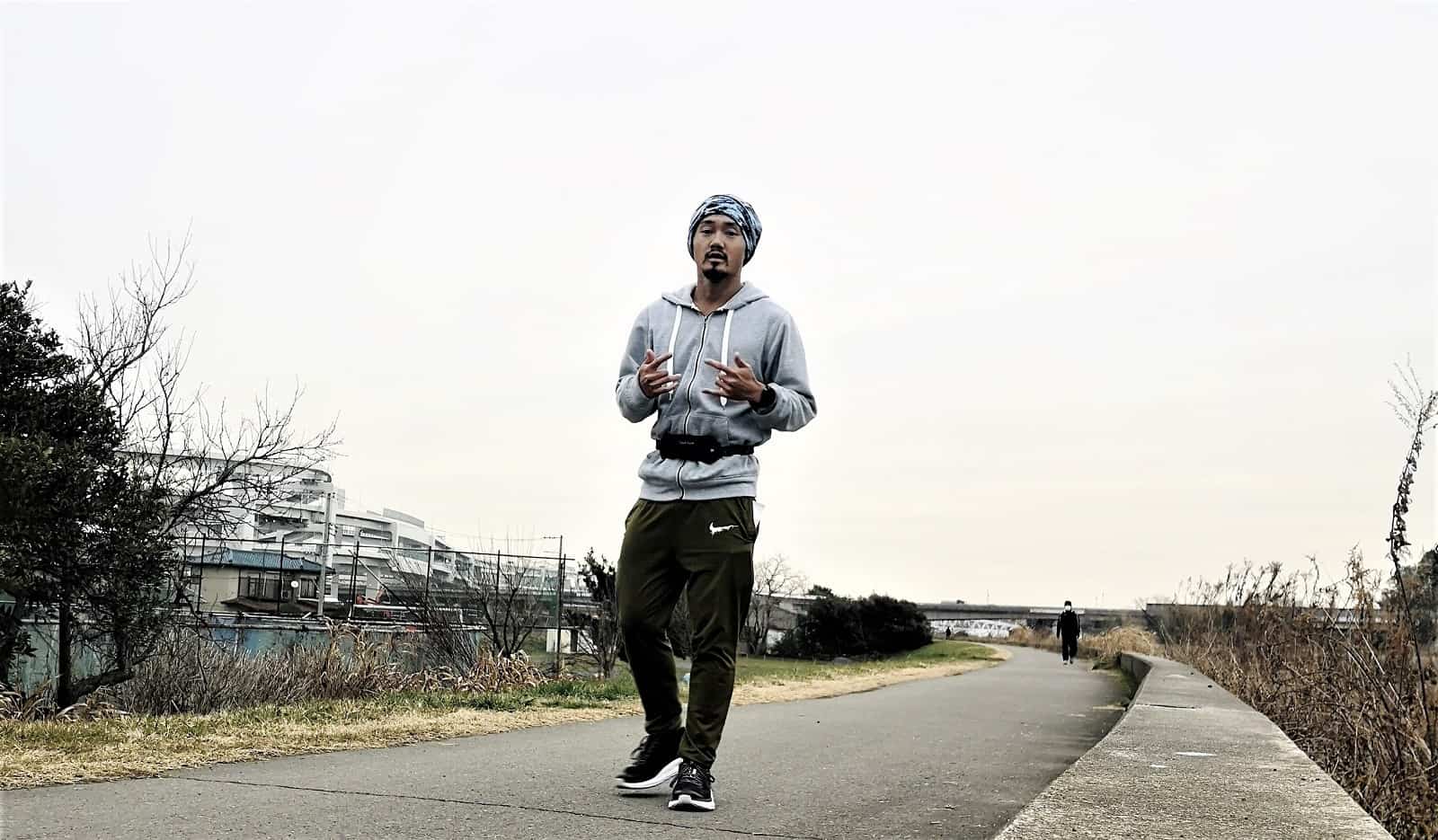
    It was around 3pm when I finally got my ass out the door. The Tsurumi River is long and winds through Yokohama, with running paths on both sides. I wrapped up in sweats, a facemask, a hoodie and a beanie, and took off right from the hotel lobby. The wind blasted me in the face as soon as I stepped out the door.

    On any other day, I would’ve turned around and went right back up the elevator.

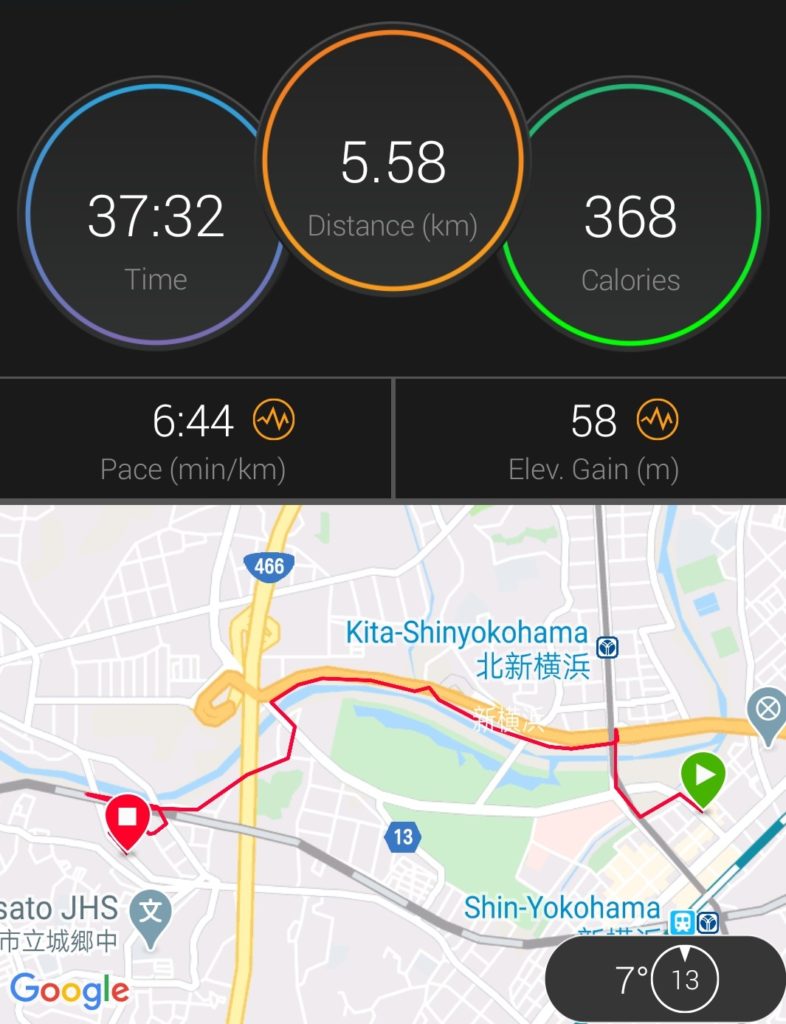
    My first stop, Sukiya, was around 5km away, straight down the river.

    It was actually a nice run, once I got out of the city and onto the riverfront. Yokohama’s winter is cold, the kind of cold that doesn’t set too deep in your bones, but definitely bites your fingertips. But my body warmed up quickly and I had the river to myself. The paths were empty, maybe only one other runner out there.

    I had an old video of Kobe jogging in my mind, and I even found myself trying to run like him, the way his shoulders shrugged with each step and the sharp bounce of his elbows.

    As I started getting further from the city the paths got narrower and more obscure, and I got a little lost, wandering around odd paths and intersections.

    Eventually I came to some train tracks which led me into a very classic looking Japanese neighbourhood.

    The streets were quiet, car-free, with lots of vegetable gardens and residential alleys. I got a few funny looks too. Maybe I looked funny. Or maybe I had Kobe’s Mamba spirit within me and people couldn’t help but be drawn to it!

    Nah I probably just looked funny.

    Through a few backstreets, I finally made it back to a main road and saw the Sukiya in the distance.

    I slowed to a walk and smiled with relief. A solid forty minute job.

    The Sukiya was a typical suburban fast food joint, on a quiet road with hardly any customers and just one old lady managing the till.

    It reminded me of the little Wendy’s by my house in New Zealand, which is always empty and you wonder how it makes any money.

    I hadn’t eaten anything all day so once I got inside I was ready to feast on the entire menu, but had to control myself; I still had 20km to run and four more meals to eat. Though I knocked down the free cup of tea in a millisecond, and then another one after that.

    Eventually I decided on the tuna bowl, and ordered the small size just to be safe.

    I wolfed it down in seconds and then after one more cup of tea, headed back out on the road.

    Verdict on Sukiya: Super fast service, tuna was fresh, huge menu. I like it.

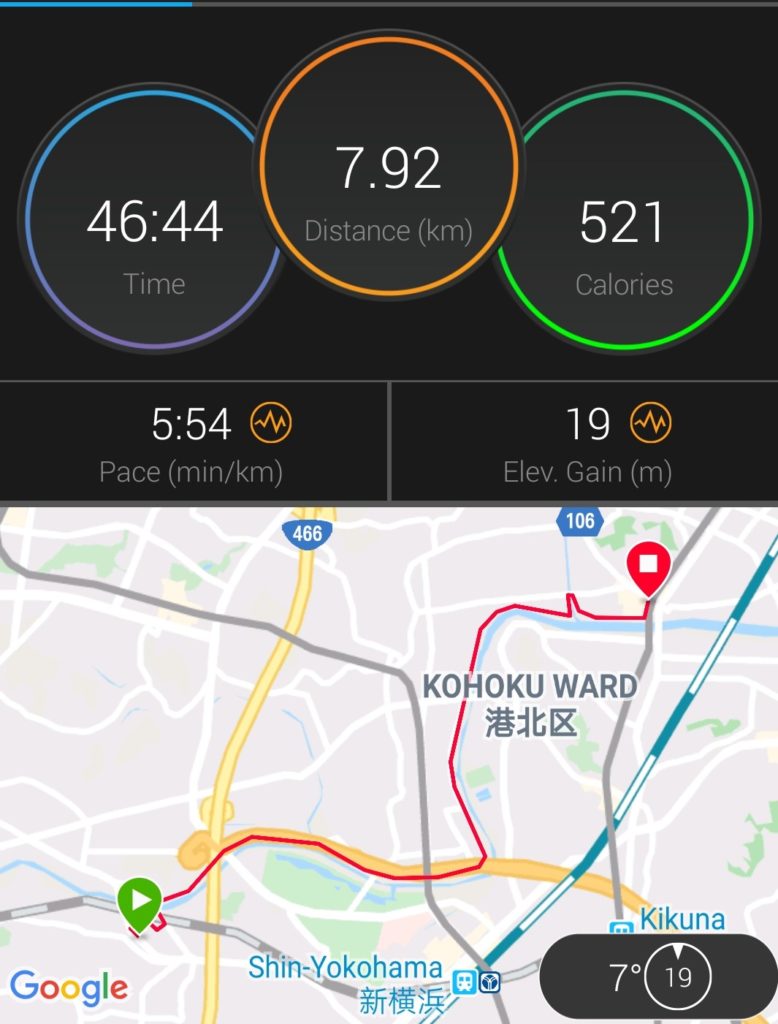
    The next stop was Matsuya, about 7.5km away.

    I backtracked through the residential streets and back onto the river. By now it was starting to get dark (didn’t plan for that) and quite a bit colder, although this run literally followed the river the entire way so was much easier to get through.

    During the last fifteen minutes the rain started to come down and this was brutal on my fingers. I took my beanie off and wrapped one of my hands in it, the other I tucked inside my hoodie.

    Forty five minutes later I made it there, just short of 8km.

    Turned out this Matsuya was in a mini commercial grid of streets I didn’t even know was there. It looked like a mini Tokyo.

    The Matsuya was a little busier, maybe half the seats taken, and was set up like a little ramen bar.

    I picked up a Pocari Sweat at the vending machine and then decided to go for the pork and green onion bowl.

    To be honest I wasn’t too hungry, the tuna still fresh in my stomach from an hour earlier. Plus with all that running, things hadn’t digested so well.

    Verdict on Matsuya: Smaller menu than Sukiya so not as much selection and feels cheaper too. Food pretty good, but wouldn’t be my first choice.

    When I got back up to the riverfront, the rain suddenly started coming down with force. It was completely dark now, and getting colder by the hour.

    I looked at the Mos Burger on my map 4km away, which would also mean another 4km back to the Ikinari Steak just around the corner from where I was, plus another 5km home to Yoshinoya. My stomach already wasn’t feeling great, and I knew on a sunny day I might be able to pull it off but here in the rainy 8 degree cold, it was going to be a really long night.

    I stared down the river into the darkness, looked at the lights way in the distance. As I felt the rain patter against my face I winced and shook my head.

    The verdict was in: Abort mission.

    (honestly, this still annoys me to this day ??? I should’ve kept going!).

    The run home was hardly the leisurely jog I’d wished it was. It was a long 5km, fingertips frozen, though the rain eased up to a drizzle and I could see the big tower of my hotel in the distance which made it feel less far away.

    By the time I made it back there, my stomach was a washing machine and I further aborted mission on the Yoshinoya and went straight to the showers.

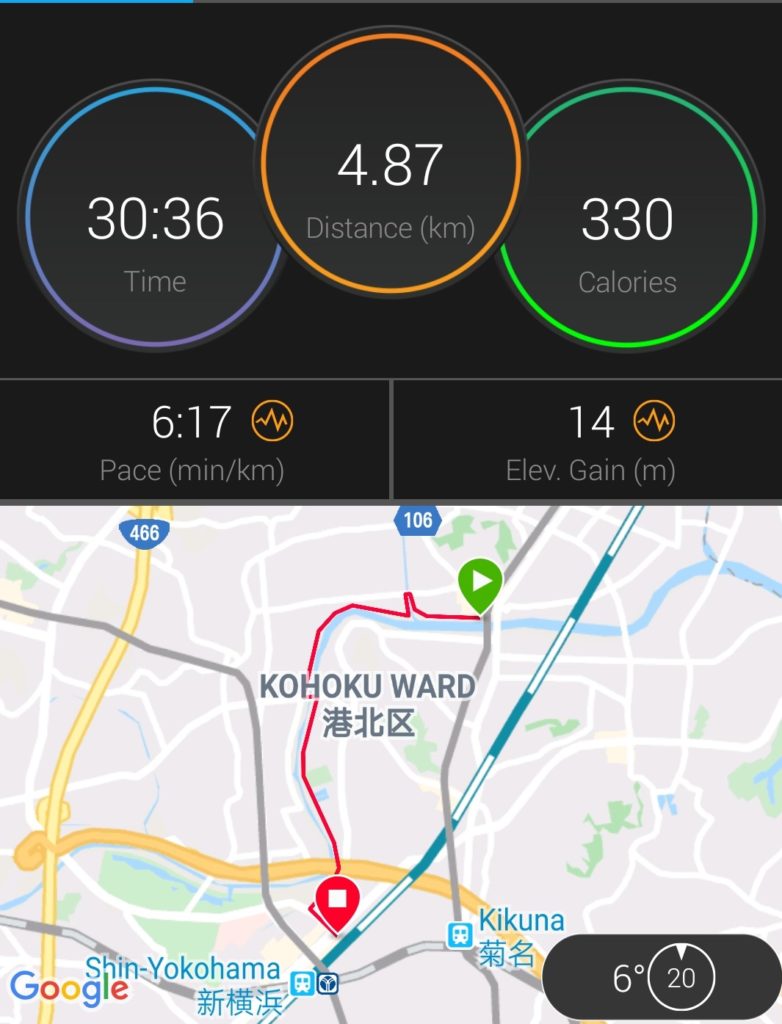
    The final scorecard: 18.37 km and two fast food restaurants.

    Not quite the 25km and five restaurants Kobe had inspired me to try, but it was an adventure all the same.

    Plus I now have unfinished business in Yokohama. If I’m ever back, I’ll be lacing up again, and you know I’m gonna win the rematch!

    So what’s the moral of this story?

    Let’s just say, this life could be long, it could be short, we don’t know. So while we’re here we need to get off our asses, challenge ourselves, live life to the max every single day. And maybe it won’t work out, but it doesn’t matter. 18km is still better than zero km, and two fast food meals is better than none.

    So next time you think about doing something and you tell yourself tomorrow, instead tell yourself Kobe Bryant, tell yourself Paul Walker, and then get off your FAT ASS and do it today.

    Doesn’t matter if you fail.

    As long as we’re out there and we’re living, we owe our heroes that much.

    ALL THE LOVE IN THE WORLD,

    B

  • Laps and Miles in Chiang Mai

    Laps and Miles in Chiang Mai

    Chiang Mai is a place talked about often in my circles. Fellow bloggers and readers just assume I’ve been there, being the hotspot for anyone who works on a laptop. But somehow I’ve managed to miss Chiang Mai for an entire decade of globetrotting.

    In December I finally had some free time in Asia and got the chance to visit. It wasn’t my typical trip to Thailand, but as you’ll see below Thailand is always fun no matter what you do 🙂

    Arriving in Chiang Mai

    Due to a little mix up, everything for Chiang Mai was literally booked last minute (more like last second). I had just finished the Singapore Marathon and had about a month free to spend in Asia before Christmas. Singapore is always nice, but a little expensive to hang around for that long.

    One night after dinner with some friends, I got home around midnight and thought I still had one more night in town. But when I got back to the apartment I found out I was supposed to check out the next day! I knew I was leaving Singapore but hadn’t decided where yet, so suddenly in panic mode, I went on a flight search, picked Chiang Mai, booked a cheap Airbnb and then went to pack all my stuff and get to bed. The flight was early morning, so I didn’t get a lot of sleep either; I was up at 5am and straight to the airport. It’s been a while since I’ve had to travel on the spot like that – but it was fun as I remember 🙂

    Flight was short, and I landed at Chiang Mai airport in the early afternoon. Luckily all my blogger friends have been to Chiang Mai and have guides on it, so I had gotten well acquainted with the city before I landed.

    I’d booked my Airbnb in the popular Nimman area. A taxi might be around ~150-200 baht, but the public bus from the airport was only 20 baht and right outside the terminal. It’s not really advertised a lot but it’s easy to find. The bus map didn’t have much English, but a friendly Thai guy helped me out. It took me right into Nimman. I hadn’t noticed when I’d booked, but my Airbnb was also right beside the huge Maya Mall which would end up becoming like a second home for me.

    I forgot to take a photo, but my Airbnb was a one bedroom with kitchen, gym and pool, and ran about ~$33 per night. That might sound cheap but it’s actually pricey for Chiang Mai (you’d pay ~half that on a monthly stay). Not that I had any time to go browsing apartments. As it turned out, the landlord was great and her place ended up being the perfect spot; Chiang Mai would eventually become home ground for my next training camp, and this apartment was right in the centre of everything I needed.

    Back to training

    Life was kind of boring in Chiang Mai to begin with. As my whole life for the previous 6 months had been about recovering from my skin catastrophe, I didn’t have any new projects to work on, I hadn’t been travelling so didn’t have a whole lot to write on the blog. To be honest I just wasn’t in a working mood in general.

    I still had to exercise daily as part of my treatment, and get daily sunshine, so I scoped out gyms and running routes when I arrived. However, it’s hard to train every day when there’s nothing to train for. Just feels like you’re running around in circles for no reason. I needed a race.

    The new race on my radar after Singapore had been the Ironman. Even though I’d never done a triathlon, and didn’t have a bike, and hadn’t swam in years, it was something I had become drawn to. I loved the story of it, a bunch of athletes trying to create “the hardest race in the world”. I had been watching Ironman videos on Youtube, sometimes I would spend the whole day watching races and observing all the little tricks the athletes were doing, like the special way they changed their shoes before the bike ride, and how they fought with each other during the swims. Between races I watched interviews and training videos of different triathletes and became a little fanboy of Lucy Charles and Nick Bare and a few others.

    I Googled some training plans, and they all looked kind of ridiculous. But I thought – I don’t need to sign up for the actual race right now. An Ironman is special, let’s just start by seeing if I can handle the training. So that Monday I started on Week 1.

    The First Week

    I had no idea at first, but Chiang Mai turned out to be a great city to train in. There is an old ASEAN Games stadium there, with a full athletics track and Olympic swimming pool (and lots of other cool stuff I didn’t need). They’re all open to the public, but nobody uses them. Most can only dream of having an Olympic training ground all to themselves, but that’s what I had almost every day.

    The first day of training was a swim:

    Since I didn’t have swimming goggles, I went to Maya Mall that morning to buy a pair.

    Despite being a huge five storey mall, there’s only one sports store in Maya Mall, and they didn’t sell swimming goggles. I asked the guy if another shop sold them, and he said no. Knowing he must be wrong, I went to the information desk and the girl there also said no. Five storeys of shops in this brand new mall and not one of them sells swimming goggles?!?? It’s not possible!

    So I walked around the mall, every floor, for about an hour, searching for swimming goggles. Well, guess what. Maya Mall has a bazillion shops and sells everything that’s ever been invented in human history, except for swimming goggles!

    Exhausted and bewildered, I walked down the road to the old mall in Nimman – Central Kad Suan Kaew – which looked like it had been built in 1995. My hopes weren’t really high, but after five minutes I found a sports store, and guess what. It had half a wall of swimming goggles.

    Thailand is odd sometimes.

    I bought the cheapest pair and, now reinvigorated for training, called a Grab to the stadium. It’s about a ten minute drive and cost ~100 baht each way (if you want to go, the official name is 700 Years Stadium).

    Entry to the pool was 60 baht for a foreigner, and worth every cent. I ended up going often, and most days it was empty. Other days there were one or two others but even then, I had at least six lanes to myself:

    I’ve forgotten how tiring swimming is. One 50m sprint and I was heaving like someone had been holding me underwater and punching me in the ribs. The training plan asked for 40 laps that day, and I was in that pool for hours, labouring through each set. They were supposed to be a mix of fast sets and moderate sets, but mine were more like slow sets and very slow sets and stopping-to-rest-in-the-middle sets. I also learned quickly why those swimming goggles were so cheap; they were useless and may as well have been made of cardboard. I had one eye full of water the entire time.

    The whole swim wasn’t even a little bit fun or pretty, but I finished.

    Afterwards I sat in the stands and watched this kinda fat guy effortlessly swimming what felt like 100 laps non-stop, he was there when I started and he still hadn’t stopped by the time I got up to leave. That was a big reality check…I was still a million miles from competing in an Ironman.

    In the basement of the Maya Mall is a supermarket that I’m guessing all the rich locals and expats shop at. They had things like Australian ribeye and Norwegian salmon and organic duck eggs; since my training diet is usually high on animal fats and proteins it was perfect, although not that cheap. Still, you can’t skimp on food when you’re pumping through that many hours of exercise. For the first time I wasn’t eating daily street food in Thailand – which is usually the reason I come here in the first place – and was cooking all my meals instead.

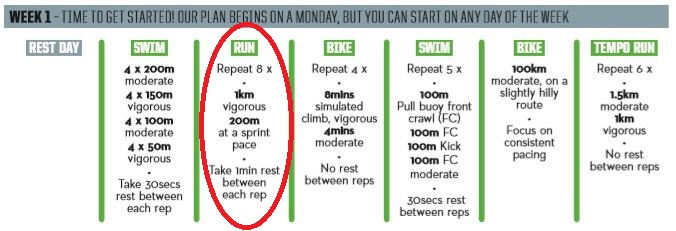
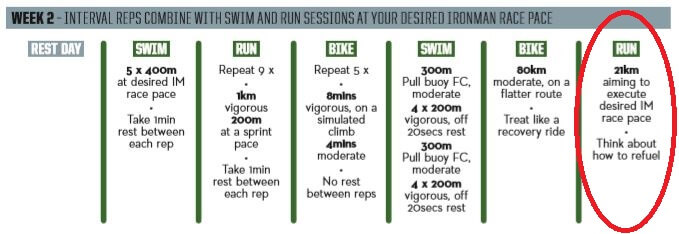
    The next day was a run, repeats of 1km fast-ish and 200m sprinting:

    The running track was perfect for a workout like this so once again, I headed out to the stadium and once again, had it all to myself. It was the first time I’d ever run repeats, even though I see them talked about all the time in running groups and blogs. It was also the first time I’d ever trained on a real running track so that was cool.

    It was a pretty tough session but I was still (almost) in marathon shape from Singapore so this day finished much more comfortably than the swim the day before.

    Finding a way to do the bike workouts was a little more challenging.

    Since I didn’t have a bike, I had to find a gym with a decent spin machine. There are a few gyms around Nimman, but luckily I didn’t have to spend too long scouting – the first one I visited was perfect. Gold Hillside Gym was 100 baht for a day pass, was just across the road from Maya and had everything I needed (they also do 1,100 baht monthly memberships if you’re staying long term).

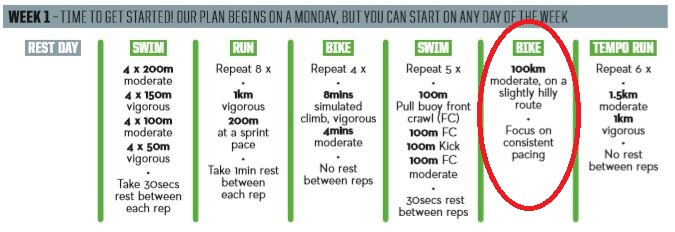
    The big training day for the week was a 100km ride:

    I do about 25km/hr on an exercise bike, so that worked out to ~4 hours on a spin machine.

    Four hours sounded a bit silly so I decided to aim for three hours and see how it went. Got to the gym, booted up a 3 hour podcast and started pedalling. I left the gym that day with two badly chafed thighs and a bruised ass cheek and pretty sore balls. But I made it!

    Rest day!

    Sunday was rest day, and I have never loved a rest day so much in my life.

    I went to a sports bar to watch the UFC in the morning, then wandered around town, stopped at a second hand bookstore, picked up a few classics, then hopped through a handful of Thai cafes and restaurants, reading and snacking on Thai food until sundown. Afterwards I walked through the Sunday market, sat at a bar and listened to some live music, went for a massage and went home to sleep. PERFECT DAY.

    This became my routine over the next two weeks – wake up and stretch, spend the day at the stadium or gym, go to Maya and buy dinner, then cook a feast and relax at home.

    If I had the energy I’d walk downstairs and get a massage before I went to sleep, and maybe cheat with a street food bowl of noodles on the way home.

    I can’t say I loved training that much, didn’t hate it either, but I always found myself really looking forward to rest day!

    A tour of Chiang Mai

    Mimi was local friend of mine I met with for dinner the week I arrived.

    After catching up over a grill feast, we jumped on her scooter and she gave me a little night tour of Chiang Mai.

    First we stopped by the Tha Pae Gate, which is probably the most famous landmark in Chiang Mai. If you look at the map of Chiang Mai, the Old Town is encircled by a large square wall and moat, which opens at the Tha Pae Gate. It’s a centrepoint for tourists with lots of foreigner friendly bars/restaurants, street stalls, western joints like Starbucks/Burger King etc. It’s a fun place to just wander around, take some pictures and people watch.

    After that she drove me down Loi Kroh Road, a famous nightlife and red light district, and some of the surrounding streets. She referred to it as the “street for man”, meaning a street full of girlie bars. It felt quiet that night but touristy/party streets in Thailand, like Khao San Road, Bangla Street, Soi Cowboy and so on – all have a very similar look/vibe, so I figured this one wouldn’t be much different when it came alive.

    Then she took me to the Night Bazaar, a big maze of streets all selling the usual Chang Beer singlets and elephant souvenirs. “Tourist all love elephants” she told me as we walked the alleys. And we talked for a long time about why they love elephants, but never really came up with an answer.

    Finally we headed for the Ploen Ruedee Night Market, which is a super classy spot; a mix of western and Thai foods, live music, some crafts stalls, and really just a fun place to chill and enjoy a relaxed night out.

    Thank god for that night, because without it I probably wouldn’t have seen much of Chiang Mai at all!

    Maya Mall

    The problem with living beside a mall, is you just go to the mall for everything. I visited the supermarket on the bottom floor every day for my groceries. After training I would head to the restaurant floor to get a carrot and beet juice. There’s a little street food section on one of the top floors, and I visited there on cheat days to get my bowls of noodles.

    I also got my old phone screen fixed there on the electronics floor. Side note: In New Zealand I got quoted $100 USD for that screen, later in Singapore I got quoted $95 in a mall and $80 in Chinatown. In Maya Mall they did it for $55. If I’d gone to an older mall they’d probably have done it even cheaper. They say Chiang Mai is cheap, it’s true 😉

    Still, while it might not feel like much of a “Thai” experience to live right by the mall and go there for everything, it was the perfect spot for convenience and comfort’s sake. If I returned to Chiang Mai, I’d probably stay in exactly the same area.

    Chiang Mai Half Marathon

    On my final week in Chiang Mai, the big workout on the schedule was a 21km run.

    I did a quick race search and found out the Chiang Mai Marathon was that Sunday! I’d never run a half marathon (officially) so it was perfect.

    Unfortunately, entries for the race had sold out weeks ago. My heart dropped as I’d gotten excited about finishing the year with one more race, but I knew there must be at least one person who wouldn’t make the start line. People drop out all the time due to injury, schedule clashes or sometimes they just didn’t train and don’t bother showing up. I joined a few Chiang Mai running groups on Facebook, and one guy helped me find a whole bunch of people selling their race numbers on another page.

    The guy I ended up buying my entry from turned out to be an awesome guy, and when I asked how to pay him, told me to donate the entry fee to charity. I was inspired and started a fundraiser for readers to pay it forward and see if we could multiply his kindness. We ended up raising over $2,000 for my friend’s charity, Stand Tall International. It all made it an extra cool race to finish the year with.

    The event was officially the MUANG THAI Chiang Mai Marathon. The entry fee for the half marathon was only $25 USD, so I wasn’t expecting much but everything was surprisingly excellent.

    The gun was at 4am which wasn’t ideal for me, but it turned out be a bonus weather-wise as Chiang Mai nights are so cool. The start line was at the Tha Pae Gate. Everyone showed up in the beautifully designed race singlet (I still wear it all the time!) and we started right on time.

    The race logistics went like clockwork. The course wasn’t crowded at all, except for maybe the first 2km. Aid stations were flawless and served water and Gatorade. Every km was clearly marked with nice big signs. It’s also a perfectly flat course so was a joy to run – just put your head down and work!

    The red carpet finish was packed with photographers and we were welcomed home with Thai dancers on both sides. As soon as I crossed the tape I got my medal and official time slip, then was ushered into the finishers area.

    The finishers area was the best surprise of all.

    It was packed with food and drink tents, Gatorade, water, watermelon, bananas, omelettes on rice, green bean soup, McDonald’s burgers, fish soup, congee, some other stuff I’m probably forgetting, plus a post race massage tent for all the runners.

    When I was ready to leave, they had a free shuttle back to the Tha Pae Gate. It was a long and slow drive, but when we got there we had another surprise. They had even more food tents there set up for the 10k finishers! So I sat there eating even more omelette rices before getting a Grab home.

    Really good event, if you’re a runner, I highly recommend it!

    My final day

    Race day was actually my final full day in Chiang Mai, I was due to fly home the following afternoon.

    The race had started at 4am, so by 6am we were done. That’s a pretty rad feeling, to see the sun rising and know you’ve just run a half marathon while everyone else hasn’t even woken up yet.

    When I finally got back to the apartment, I hobbled up to the gate with my race number still on and my medal around my neck. The security guard smiled and congratulated me as if I’d just won the entire race, I don’t think he knew it was just a finishers medal. But I still pretended I was a champion 🙂

    After resting my legs for the rest of the morning, I headed to One Nimman for lunch. One Nimman is an upscale-ish mall/eatery just across the road from Maya, it’s mostly Thai street food but the fancy version.

    My appetite was small after feasting at the finishers zone, so I just had a few skewers and dumplings. Pretty good although nothing life-changing. I’ll give it a B+, maybe an A- on a very hungry day 🙂

    That night I met up with Mimi one last time for dinner. Somehow we ended up back at One Nimman, which turns into a bigger food market at night. It also extends to the block across the street, just opposite the Maya Mall. I’m not sure if they’re part of the same market, but they’re right next to each other and the whole area is super busy. Lots of interesting stuff in there, so definitely check it out if you’re in town.

    Afterwards as she was driving me home on her scooter, she asked me what I’d been doing for the last couple of weeks. I told her I’d just been training at the stadium every day. “You haven’t even visited anywhere?” She said if I wanted, she could pick me up early the next morning and take me to one of the famous temples in Chiang Mai before my flight. I said I needed to go to the gym in the morning, and she snapped at me. “You can miss the gym for just one day!!!!” she yelled, banging her hand on the handlebars.

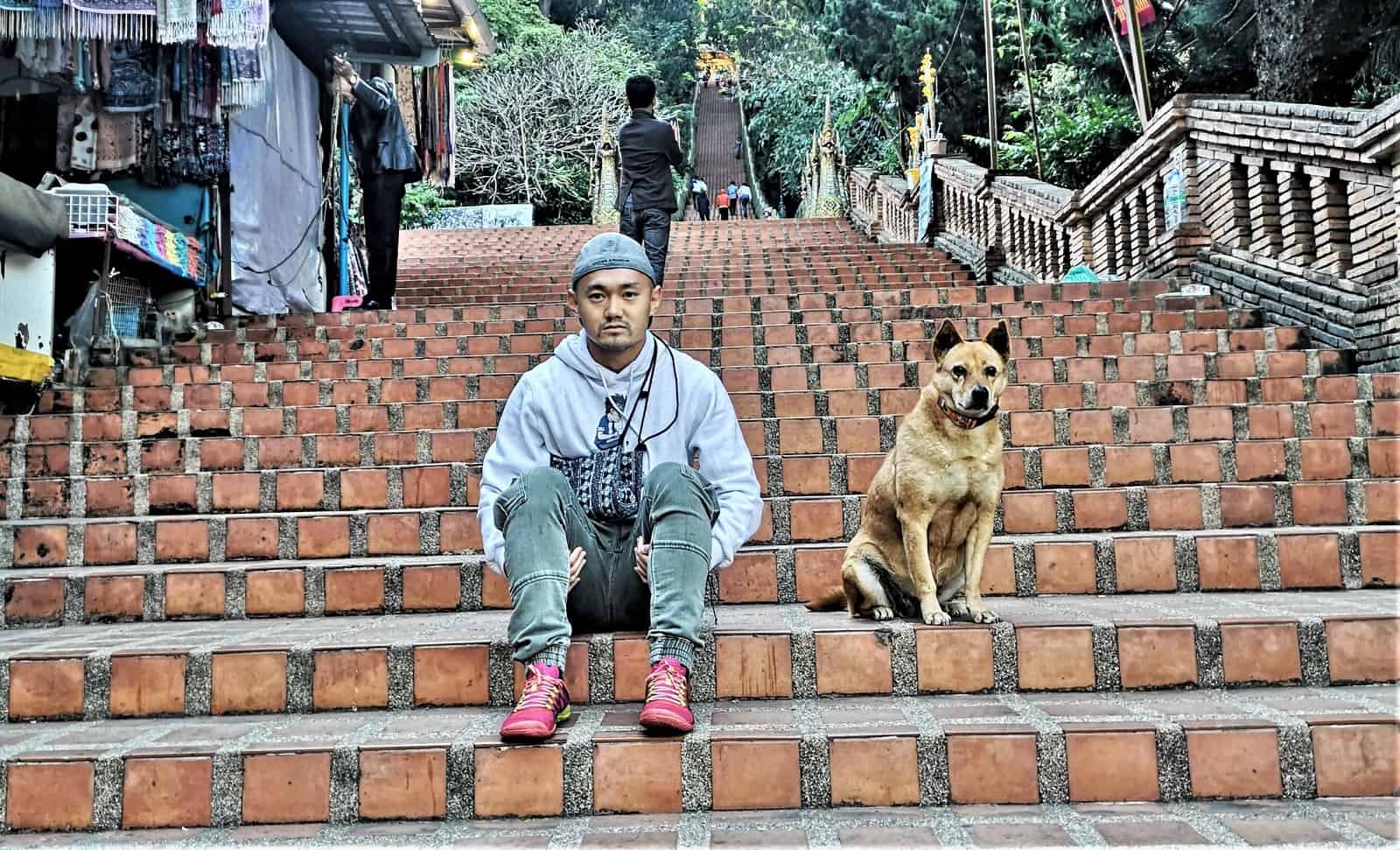
    She picked me up at 7 the next morning. We drove up the huge winding hill to Wat Phra That Doi Suthep, a temple built on one of the mountains around Chiang Mai. It was a good half hour to drive up there on a scooter. When we arrived I winced looking at the huge flight of stairs up to the temple – I still had marathon legs from the day before – but luckily the climb only looked intimidating. The stairs were shallow and most people got up pretty easily.

    After the temple, I had a quick plate of noodles with Mimi in town before I left to have lunch with my friend James from Nomadic Notes. He’d landed in Chiang Mai just the day before, so luckily we crossed paths, even if only for 24 hours.

    I haven’t seen James for several years, we first met in Bangkok maybe five years ago. Bloggers spend so much time talking to each other through a screen, it’s always great when we get the chance to meet in person.

    James’ recommendation for Chiang Mai was SP Chicken in the Old Town – solid spot for a roasted chicken and some sticky rice!

    On the training schedule that day was a one hour bike ride, which I’d planned to get it in early morning before meeting James, but Mimi had convinced me to miss it for our temple visit. But when James and I finished up I still had a little over an hour before I had to leave for the airport.

    I raced to the gym and knocked out my bike session, then ran back to the apartment and made my flight. Every training session matters, but every missed training session matters even more. Sitting on the plane for the next ten hours, I was able to relax and feel proud of myself for getting that work in. And even eat a little junk food 🙂

    Verdict on Chiang Mai

    During my first week in town I was thinking, “This place is still not cooler than Bangkok.” But Chiang Mai grew on me slowly, especially the cleaner air, and the better traffic. Luckily Grabs are cheap, because public transport is sparse or non-existent. Plus the weather is much better. Bangkok is suffocatingly hot always, but Chiang Mai in December was actually cold at night, and I couldn’t go out without jeans and a hoodie. I also never used the air conditioner in my apartment once.

    I didn’t see that much of Chiang Mai to give any expert recommendations on the place, but from what I saw it’s a pretty cool city. Will likely be back some time!

    B

  • Love Cape Town

    Love Cape Town

    At first glance, The Zebra Crossing was just your regular hostel. Fifty beds, small lounge, small kitchen, little courtyard for the smokers. But like all good hostels, it was operated with love. And like all hostels operated with love, it became home.

    It was Doniel who checked me in. The cheeriest of smiles, caramel skin, short shoulder length hair, a pair of warm eyes behind black rimmed glasses. As she showed me the bathrooms, she reminded me Cape Town was in a drought, and not to shower longer than two minutes. Then she showed me the kitchen, and reminded me to wash the dishes with the tap off, and use as little water as possible. And I knew she loved working in hospitality. I knew that, because when she showed me to my room she said, “I really love working in hospitality!”

    That’s how I met Doniel.

    My room had eight beds but was empty, except for one other guest, presumably female, who looked like she’d been there a while. She had those Arabian looking blankets hung around her bunk like curtains, and all her clothes folded neatly on the bed above. It’s an oddity to find someone who actually unpacks in a hostel dorm. When you see it you already know; that person is either very strange, or a first time traveller, or is living here.

    That night I learned the owner of that bed was a black South African woman, tall, skinny, an artist, maybe in her forties, very upbeat, chatty, vibrant, and I was right, she was living here in the hostel, and working here too, and had been for some time. Out in the courtyard late that evening, I sat on one end of the couch, wrestling with the wifi, and she sat on the other, puffing on a cigarette. And in between wifi signals and puffs of smoke, we started talking. An hour, and then two, and maybe three.

    That’s how I met Stephanie.

    A few mornings later, I was, as usual, on my laptop in the lounge. I’d been in Cape Town three or four days now, and spent the mornings sitting against the back wall, at the large wooden dining table, with full view of the room, and anyone in the room with a full view of me. When Doniel arrived for work that day she walked through the lounge to reception, and we exchanged good mornings. Then just after her followed a young woman, strikingly pretty, with pale skin and a sharp nose, dark straight hair that fell to her shoulders. And I wasn’t sure if I should also say good morning to her, so I just smiled, and she smiled, and then she was gone.

    A few minutes later, she was back. And Doniel was teaching her how to fold the big stack of sheets sitting on the couch, and how to make the beds.

    “Are you working, Brendan?” Doniel finally asked, in between folds.

    I nodded, and she smiled, saying, “Whenever people need to work, that’s always the spot they sit in.” Which led to a conversation about what I do, and all the questions that always follow.

    “That’s so interesting. I’d love to learn something like that, I have so much time these days.”

    “I can sit down with you some time, and show you a few things, if you want.”

    “I would love that.”

    And she turned to the pretty girl and said, like a big sister, “See! You should talk to people more often. You never know what you might learn.”

    Not long after that, Doniel left to attend to something else. And the pretty girl suddenly became chatty, asking me all sorts of things.

    “So what’s your name, by the way?”

    “Erin.”

    “Ellen?”

    “No Erin, with an R.”

    So we chatted for the morning, while she folded sheets, and wandered in and out of the rooms, making up beds for the guests who were to arrive that day.

    That’s how I met Erin.

    It was later that same day a gentleman came into the lounge to lay on the couches. I was still on my laptop, sitting in the same spot, against the back wall, at the big wooden dining table. I’d seen him wandering in and out of the hostel in the previous days, but we’d never crossed paths in a way that required me to introduce myself. But now here he was, sitting right in front of me.

    “I’m a driver,” he told me. “I drive people around for the same rates as Uber, so if you ever need to go somewhere, call me.” At first I had no intention of calling him, since using Uber was already so easy, but as we talked I learned more about him, and he explained “I tried to apply for Uber, but they rejected me because my car is too old, only people with new cars can apply. So I started my own thing with the hostels and I find my own customers. Because we need to hustle, right? We can’t let this capitalistic world keep us down.”

    And I thought to myself, this is a man with his mind right, and the right kind of energy to be around. And I decided right then I would surely call him for a ride any time I got the chance.

    That’s how I met Craig.

    It was probably after a week, at the incessant pleading of Doniel, that I finally got off my laptop. I hadn’t been further than the supermarket down the road, and Doniel convinced me to at least do the free walking tour.

    As I was sitting on the couches tying my laces and getting ready to leave, Craig went rushing out the front door, and yelled out “Sharp!” as he ran through the lounge. Then he popped his head back in and said, “You learned that yet, B?”

    “Learned what?”

    “In South Africa, when we say bye, we say sharp sharp! It means like, everything’s cool.

    So I repeated after him, “Sharp sharp” and the cleaning ladies on the couch opposite me cackled with laughter, before Craig also joined in with a giggle.

    “You got it,” he laughed. “Alright, I’ll see you guys later. Sharp.

    Cape Town is an odd kind of city; it feels big, and modern, but is built in patches of nice and not-so-nice. As I walked down to the centre I found myself on streets with cafes and juice bars thinking, “What a nice street”, but would continue onto the street right next to it and think, “Maybe I shouldn’t be here.” Luckily it didn’t take long to get to the centre, where I quickly found the cafe with the big umbrella, the words “Free Walking Tour” plastered across it, and the walking tour manager standing under it with her walking tour clipboard.

    “Is it your first time doing a tour with us?”

    She was maybe 5’1 or 5’2, plump, buxom, big round cheeks and small eyes, a little afro dyed blonde with the cheekiest smile on the street.

    “Okay just sign up here,” she said, handing me the clipboard, “And we’ll be starting in about ten minutes.”

    I overheard her say something in another language while I scribbled my name on the sheet.

    “What language is that?”

    “Xhosa.”

    “It’s cool.”

    “Yeah it is!” she laughed.

    “And your haircut is cool. Like Chris Brown’s, but cooler.”

    And she put the clipboard down and hooted with laughter.

    That’s how I met Florina.

    I did the Apartheid Tour that afternoon; we walked past the court where various Mandela trials took place, the site of apartheid founder Verwoerd’s assassination, the now demolished counter-culture hotspot of District 6. It was my first look at downtown Cape Town, and again, something struck me about its streets I couldn’t quite put my finger on; a fine city, well built, just a little neglected perhaps, like a really nice apartment that hadn’t been cleaned in a while. You’d walk past a street with a really nice hotel, and the whole street was colourful and polished, with fancy coffee shops and park benches and big tall trees, and then you’d turn the corner and it was back to the colour of old concrete.

    When we got back to the cafe, Florina was still standing there with her clipboard. It was as if she were a permanent fixture on that street, like a lamp post or a statue, always in the same spot, under the same umbrella, with the same smile on her face. It was now nearing 4pm, and she told me the Bo Kaap tour was just about to start. I thought, “How proud Doniel will be, that I did not one, but two walking tours today,” and signed up for that tour as well.

    The Bo Kaap is the Muslim quarter of Cape Town, where the Indonesian and Malaysian slaves were housed 300 years ago, the streets still lined today with the world famous colourful buildings, the old mosques, and an endless stream of tourists selfying their lives away. That tour took us right until sundown, and when the day was over and I was back at the dining room table, nursing tired legs and flicking through my photos, I thought, “Doniel was right. What a great idea that was, to finally go out into the city today.”

    The next day I was in the city again, this time to finally start my shopping for AfrikaBurn. This was why I had come to Cape Town; to attend this week-long cultural gathering in the nearby Karoo desert. I still had a few weeks to prepare, but also had an entire shopping list of supplies I hadn’t touched yet. Doniel suggested I head to the Grand Parade, where the second hand market came alive twice a week. We had walked by there during the tour the day before; it was the site of Mandela’s famous speech the day he was released from 27 years in prison.

    I got there and wandered through the square and surrounding streets, surveying the street stalls and prices, the jewellery, jackets, bags, all things I needed in abundance. I didn’t buy anything that day, but the following day I returned, a greater idea of what I was dealing with. One thing I needed was gifts, to give to the many people I would meet in the desert, so just off the Grand Parade I stopped by an old jewellery stand that had given me the cheapest prices the day before.

    I asked again, “How much for these?” and he said “Twenty rand” like he had the previous day. They were bracelets with lettered beads, that spelled out names, hometowns, quotes.

    So I asked, “Can I give you my own words to write?” and he said “Of course, I can make anything.”

    So I said “If I buy twenty, how much?” and he thought about it for a second, and said, “Fifteen rand.”

    And I nodded and said, “What about if I buy fifty. Will you do them for ten?”

    And he looked at me again to make sure I was serious, and then said, “Okay” and told me to come back in four days.

    That’s how I met Adam.

    The next day I was tent shopping in the city, and Adam’s shop wasn’t far from where I was, so I went to see him again. He had already threaded a few bracelets and showed them to me, and as I was about to show him a mistake I overheard him speaking to his friend. It was Swahili, so I asked, “Are you from Kenya?” and he said “No,” with a smile. “We are from Tanzania”. Immediately my heart lit up, Tanzania being a second home of mine, and at once I could suddenly see it in his face and hear it in his accent, and I wondered why I hadn’t noticed it before. So I introduced myself, as an adopted child of Moshi, and an Mbongo, and a Chaaga, and him and his friend laughed, as it must always be a novelty to see someone with my face speak their language.

    And from that point Adam and I were friends, and I would stop by in the afternoons almost every day, he would invite me to sit with him at the back of his stall, teach me how to thread bracelets, ask me about Moshi, and it seemed there were Tanzanians all around this street; they would stop by and say, “Hey, you’re the boy from Moshi?” and I would laugh and say “Ndio!” And they would giggle and say to their friends, “Aisee mchina anaongea Kiswahili” (Man this Chinese guy speaks Swahili!).

    The following week, I finally ventured further out from the centre. There was a local suburb called Wynberg in the city’s south, with a couple of second hand stores I wanted to visit. I hoped they would have the extravagant coats and hats and boots I wanted for AfrikaBurn, the kind the city’s shops weren’t extravagant enough to sell. I went into reception that morning to ask Doniel if there was a bus, and how to catch it, in fact I’d already started shouting my sentence, “Hey, Doniel” before I even walked in the door. But to my surprise it wasn’t Doniel sitting behind the desk, it was Erin.

    She looked up startled, then smiling, stopping my voice in its tracks.

    “Oh. Good morning,” I said.

    “Hey. You’re still here?”

    She had a thick South African accent, the rolling of her R’s extra clean and extra sharp.

    “Well, obviously.”

    “I thought you’d left.”

    And distracted by a pretty face, I ended up sitting there talking to Erin all morning. And I learned she was barely out of school, and didn’t actually have a job at the hostel, but was related to Doniel through a marriage, to a cousin, or something similar, and she had a daughter, and a boyfriend, or fiancé, I don’t quite remember. But what I noticed most was how she had seemed so painfully shy the first time I met her, and now, she literally talked non-stop, with great energy and gusto. And by the end of that morning I had become seemingly good friends with Erin.

    “So can you tell me how to get to Wynberg?” I asked finally.

    “Where?”

    “Wynberg.”

    “I’ve never heard of it, where is it?”

    “Uhh. In Cape Town.”

    “Yeah but….say it again?”

    “Wynberg.”

    She screwed her face up, and started typing something into Google.

    “Erin you can’t be a hostel receptionist if you don’t know where Wynberg is. What if a guest, who’s not as nice as me, asks how to get to Wynberg and you can’t help them. That will be such a bad Tripadvisor review.”

    I leaned over the desk as she pulled up the map, and I took the mouse from her, scrolled east, and then down, until it was bang in the middle of the screen.

    “There.”

    “That’s W-I-N-E-berg!!!!” she screamed. It was loud enough that I pulled away, thinking she might attack me, or at least continue screaming for a few more sentences.

    “But it’s spelt Winberg,” I laughed.

    “Oh my god it’s Wineberg you can’t even read.”

    “Winberg Wineberg. Same thing.”

    And so we sat there arguing about how to say Wynberg for another half hour, before I finally left to the centre to catch the bus.

    Getting around Cape Town isn’t difficult, but can get confusing for a newcomer. There’s a rapid transit system, but it’s confined to the central suburbs so most people use buses. But they use minibuses or vans as their buses, and they call these buses “taxis”. Which means they can’t call actual taxis “taxis”, so they call them “cabs”.

    On the walk down to the city, I passed by the walking tour cafe, and of course Florina was standing there, with her clipboard, under the big walking tour umbrella.

    “Hey Chris Brown.”

    She laughed her big hearty laugh and hugged me.

    “I’m heading to Wynberg,”

    I pronounced it correctly this time, feeling like a proud local.

    “Why the hell are you going to…Wynberg?”

    “To go clothes shopping.”

    “In Wynberg?”

    “Yeah there’s a second hand shop there.”

    She looked at me skeptically, and then finally nodded and said, “Okay, it’s easy, just go to Grand Parade and get a taxi.”

    “But it’ll be way too expensive,”

    “It’s only 20 rand for a taxi,” she frowned.

    But after looking at me again for a split second she figured out what was happening and said, “No baby, not a cab, a taxi.”

    It was only a flashback of a vague memory from Uganda, where I remembered having a similar confusing conversation – as in Uganda they also called their buses taxis – which made me click and I said, “Oh! A taxi is like a bus, right?”

    And Florina laughed and said, “Yes, exactly.”

    Adam’s shop was also on the way to the bus stop, so I stopped there quickly to say hello. He showed me more of my bracelets, which looked good, and as I left I said, “I’m off to catch a taxi to Wynberg” and he nodded, like there was nothing odd about that sentence. So as I left I said “Sharp!” and again he grunted like that was a perfectly normal thing for me to say. And I thought to myself, “Yes, I’m finally sounding like a real Capetonian.”

    That bus/taxi ride was like a mini tour of outer Cape Town; the streets outside the city were much rougher, much emptier, more run down, a little less welcoming on every front. A far cry from the boutique malls and cafes of upper Kloof Street where the hostel was, and what had become home. Wynberg turned out to be rather busy, and didn’t feel dangerous, though didn’t feel completely safe either. Although nobody really looked at me too funny, and I figured it was all in my mind, that I would be just fine, and I was just fine.

    When I got back to the hostel that afternoon with my bag full of steampunk clothes – furs, plaid shirts, vests, boots – Doniel, Stephanie and Erin wasted no time diving into my costume planning. I had merely gone to ask Erin for a pair of scissors, but then Doniel came in and started looking through everything, and then Stephanie joined in, and suddenly all three of them were onto those clothes like it was crack, and they couldn’t stop, and there was now nothing more important to them than dressing me up and making me look fabulous.

    “No, no, you can’t sex that one up. This one, put this one on.”

    “Yeah that one.”

    “You can definitely sex that one up.”

    “Maybe cut the sleeves off.”

    “And wear this around your wrists.”

    Snip snip snip.

    “Open the chest a bit.”

    Snip.

    “Oh yeah, that’s hot.”

    “HOT.”

    “So hot.”

    “Now I want to go to Afrikaburn too!”

    “What if you put that one on top?”

    “And then the vest.”

    “I don’t think he needs the vest.”

    “Okay there. Like that.”

    “Gotta show his arms, definitely.”

    “Of course.”

    “There we go.”

    “I love it.”

    “Hot.”

    And I thought to myself, “This is what it must be like to have sisters. Wouldn’t it have been nice, to have a sister or three.”

    From then on I found myself walking into central Cape Town almost every day. It was a fifteen minute walk from the hostel, and now that it was familiar it always felt safe, the police on each block making it feel doubly so. However, I always made sure to avoid the infamous Long Street, tourists conjugated there, and locals knew it, always roaming that street to ask people for spare change or food. The walk downtown always took me along the same route, where I would stop and have a hot chocolate with Florina, and then stop and chat for an hour with Adam, say hi to some of the other shopkeepers in the market I’d befriended – the sock lady from Cameroon with whom I practiced my French, Banks from Nigeria who sold me my jeans, the Kenyan guy on the far end of Grand Parade – then I’d do some costume hunting through a few stores before finally heading to the supermarket to buy dinner and head back home.

    One night, after cooking dinner, I went to sit in the lounge with a tea and a bag of rusks. The rusk is a South African snack, like a hard, dry, slow baked cookie. It was something I did almost every night, and this night Craig was in the lounge too, chilling with his iPad on the couch. At the time around ten exchange students from America were also staying in the hostel, and one of them was sitting on the opposite couch, chatting with him. It was dark, as we never turned the lights on in the lounge for some reason, and I couldn’t see her well, but she was tall-ish, and slender, and dark skinned, and pretty, with a young face, and sat abnormally upright, and had large bountiful hair tied in a bun atop her head. As we introduced ourselves she asked, “What are those?” and I told her they were rusks, and she should try one. She hesitated for a long time, maybe five, ten minutes, then she came over to look at the bag, but didn’t take one, and then went to sit back down. How odd, I thought to myself.

    That’s how I met Zawadi.

    The next night, while I was cooking dinner in the kitchen, I got to know Zawadi a lot better. It was somewhat serendipitous as I had found myself thinking about her that day. I was cooking steaks and avocado, and while I stood in the kitchen eating she came in and stood with me. It turned out she wasn’t so American after all, but Kenyan Ethiopian, which gave us much to talk about, and after finishing half my plate I realised I was being rude and asked if she wanted some. She smiled and she nodded, so I cut her a piece of steak and handed her my fork, and she ate it happily.

    “More?”

    “Mmm.”

    “Steak?”

    “And parachchi.

    So I cut her another piece of steak, this time with avocado, and I should’ve known as a Kenyan she would love avocado, I handed her my fork, and again she ate it happily. And we talked a lot that night, and I felt my mood lift whenever she entered the room, and sadden when she left. And I found myself thinking that night, “There’s something quite special about that Zawadi.”

    The following day I asked Craig to take me into Observatory. Observatory was an up and coming bohemian neighbourhood in Cape Town, a short drive out of the city centre. The main street was filled with chic bars with semi overpriced cocktails, cafes that served vegan burritos and turmeric lattes, op shops with funny names, but the wider area was filled with lower priced flats and apartments, so a lot of people seemed to live in Observatory too. I was heading over there for none of those things, though. My mission that day was to get a haircut, and Observatory was home to the only Korean hairdresser in town.

    Craig was already at the hostel waiting for me when I woke up. That was the thing about Craig – he took his job seriously. Never forgot an appointment, never showed up late. The other great thing about having Craig as a driver; every ride was a tour of Cape Town.

    “See that hospital, the world’s first heart transplant was done there, right here in Africa.”

    “That restaurant there, they do a huge ostrich burger for 100 rand, with fries and everything!”

    “Look up there, our three mountains, you hiked any of them yet? Lion’s Head, that’s the best one.”

    Craig was a gentle soul. Forty-ish, probably, and skinny, with cleanly cropped hair and a boyish smile. He wore glasses with large lenses, and was always dressed casual – sneakers, chinos – but always clean and crisp. But the most notable thing about him was his zen – always peaceful, always smiling, always polite – he let off such a zenful energy it made you feel zen as well.

    As we pulled up to a traffic light, he took half a chocolate bar sitting under his dashboard and held it out the window.

    “Hey, come, have some sweet,” he shouted.

    A young woman begging on the footpath jumped to her feet and ran over to take it.

    “It’s funny you know, we eat chocolate all the time, but for them it’s like such a special thing.”

    Craig was what old South Africans would describe as “coloured”; someone of mixed white and black ancestries. During the apartheid era, every person had to carry a ‘passbook’, which said which group you belonged to – coloured, white or black – and that determined whether you could enter the white areas of town, whether you could vote, and so on.

    “What about me, would I be coloured too?”

    “For you man, I think they had a separate one, like Chinese or Asian or something. But they would have treated you like a coloured.”

    “But you know what,” he continued. “Sometimes when they ask that question now on forms and stuff, I just scribble out all those boxes and write over the top in big letters, SOUTH AFRICAN.”

    That night, I had plans with Stephanie. A platonic affair, at least I’d guessed so at the time. I had been sitting in the lounge one morning, probably eating rusks and doing nothing, and Stephanie had come in looking for me.

    “Do you want to go to this with me?” she asked.

    She showed me a poster on her phone. It was for a singer named Ernestine, performing at an arts weekend that Friday.

    “She’s a friend of mine. Something South African for you to see. I think you’ll love it.”

    “Sure,” I said.

    But it was Craig that would tell me several weeks later, as he dropped me off at the airport, “You know, Stephanie had her eye on you…talked about you a lot, said she thought you would be the sweetest catch.”

    Some weeks earlier, I had been down in the city chatting with Florina and her clipboard; she was with a friend that day, and the two of us ended up going for sushi while we waited for Florina to finish work. But we ended up staying there drinking tea and eating sushi rolls until after dark, so I had to call Craig to drop her home. The next day Craig said to me when I woke up, “Got your lady friend home safe” and Erin overheard, then tried to give Craig a little grilling.

    “Craig is a proper taxi driver, and taxi drivers always keep secrets,” I said, and we both laughed, and Erin rolled her eyes and gave up. So I didn’t miss the irony, that on my final day there was Craig, the secret keeper, bending the code and divulging a little secret to me before I boarded a plane to leave.

    Of course Craig knew it was all harmless, Stephanie nor I could hardly have cared, and I was glad Stephanie asked me out that night, because it was the kind of night I loved but would never find on my own. Craig dropped us off at the theatre around six. Stephanie was a perfect lady, bought the first drink, was a delight to talk with, and she was right about the music; Ernestine performed a lengthy set with a full band, with many stories, a joy to experience. I was starting to learn this about Cape Town – it was a city rich with experiences, and a true melting pot, it had everything you needed or wanted. It was all just a little hidden. You needed a little help to find it.

    As my departure date to AfrikaBurn approached my packing list still had many things unticked. One afternoon while in the city shopping, again, I swung by the walking tour cafe to visit Florina and her clipboard.

    “Just…nobody has what I’m looking for,” I told her, exhausted.

    “Well what are you looking for?”

    “I need a bag, but like…a cool bag. And a scarf, but a cool scarf. And just, lots of cool stuff.

    She nodded and checked the time.

    “Plus everything gets wrecked in the desert, so needs to be cheap. But still cool. You know?”

    “C’mon, I’ll take you somewhere,” she said, putting down her clipboard.

    “Aren’t you working?”

    “There’s still two hours before the next tour starts. C’mon.”

    We walked downtown, past the Grand Parade and into a busy street I’d never been to before. Into a big mall, then up a pair of escalators that led to what looked like an abandoned second floor. As we strolled through a maze of empty shops – and they looked like they’d been empty a while – we came to an overpass with a few people selling jewellery and trinkets laid out on sheets on the ground. The vibe suddenly went from neutral to uneasy, I could tell we were crossing some kind of invisible territorial line, but I followed Florina across, and talked to her casually, acting like this was nothing new, like I’d been here a hundred times. But I felt so out of place there, had I been alone I would’ve turned around and walked straight back from where I’d came.

    Across the overpass, we turned a corner to what looked like an empty rooftop. It seemed like an abandoned building, but I could hear activity in the distance, and after turning behind a few walls we came to a concrete market. It was weathered but tidy, like rows of little boat sheds or storage units, all turned into market stalls and shops. And though there were many of them, seven or eight rows, maybe even ten, reasonably busy with foot traffic and chatter and laughter, they all sold mostly the same things – sunglasses, bags, denim clothes, jewellery. And hair shops. Lots and lots of hair shops.

    “This is Top Deck,” Florina said as we walked the first alley.

    “Yeah I know, I come here all the time.”

    She laughed heartily and pushed me.

    As we walked the stalls, every other person looked up and stared at me for a moment, not in a hostile way, just curiously, then looked at Florina, then went back to what they were doing.

    “Don’t ever come here without me, okay?”

    “Why?”

    “Just don’t. Well, you can if you want, but don’t cry to me when…”

    She looked at me and made a face, and then smiled.

    “You know.”

    I had been told several times that although apartheid had been abolished in South Africa for years, even though things were relatively peaceful, there were still ‘white’ areas, where black people never went, and ‘black’ areas, where white people never went. It had sounded like something problematic, something they were struggling to solve, but as I watched a group of ladies getting their hair braided, and laughing and gossiping in Xhosa, I thought, “Maybe that’s not a bad thing, or even a problem. People are different, maybe it’s good, to have our own spaces sometimes.”

    We wandered every single alley, and Florina was right, Top Deck was the spot I’d been looking for. In an hour I had the exact scarf I wanted, the exact bag I wanted, the exact sunglasses I wanted, and it had all cost less than a Kloof Street lunch. Plus, she had been exaggerating about it being a shady place, surely. We’d chatted with everyone, and everyone had been lovely.

    That evening back at the hostel, I was on the picnic benches outside the kitchen. I was eating my usual steak and avocado dinner, tinkering on my laptop between bites. It was now late April, and the nights were starting to become cool in Cape Town; though with a few layers on it was pleasant enough to spend the evenings sitting outside. Zawadi joined me and stole some of my steak again, then sat across from me and worked on her paper. In fact, all of the exchange students were working on papers furiously that night, apparently with a big deadline looming the following day.

    “Do you always travel with your laptop and your tablet?” I asked her.

    “Actually, I won this,” she said, waving her iPad.

    “How?”

    “A slam poetry contest.”

    “You do slam poetry?”

    She nodded.

    “I wanna see. Is it on video?”

    She hesitated for a moment, then grabbed her phone and pulled up an obscure video on Youtube. I didn’t recognise her at first, in that outfit, that different hairstyle, but I smiled when I saw her walk out onto the stage. She was modest in real life, gentle, harmless, but as I watched her performance unfold I knew I’d only seen a single side of her; she was fierce in front of the microphone, her words were bold, and intelligent, she drew applause from the crowd, again and again. And again I found myself thinking, “She’s really quite special, this Zawadi.”

    That night, Zawadi texted me after we’d all gone to bed. She had told me earlier in the night she hadn’t seen much of Cape Town, and I’d told her I was heading to the market to see Adam the next day and she could join me. And to my delight she said yes, she would quite like to, and messaged me to say I should let her know before I leave.

    I was awake earlier than usual the next morning. It was only a few days until I left for the desert, and I still had much to do.

    “I’m leaving soon are you awake!”

    Silence. Unfortunately, I had things to do and didn’t have a morning to waste. I headed down to see Adam without her.

    Every time I visited Adam, I learned something new about him. One day, he had a little kid, maybe six or seven, sitting in his seat. He was in school uniform, and making himself a bracelet with Adam’s tools. A while later the mother came and took him away, and they waved at each other like old friends.

    I asked, “Who’s that?” And he said, “Every day that boy was always standing around here waiting for his Mom after school, so I let him wait in here to be safe.”

    Another day, he had to go buy some glue to finish a piece, and he asked me to watch his stall for him. “What if a customer comes?” I asked, and he said, “Just tell them a price.” And I sat there for almost thirty minutes by myself, looking like a Chinese guy with an African jewellery store in one of the busiest streets in Cape Town, secretly loving it, and laughing at how trusting he was, leaving literally his entire livelihood with someone he barely knew.

    On this particular day he was showing me some photos on his phone, and he scrolled past a photo of a flashy music studio. I asked him about it.

    “You should know, me, I am a really good rapper!” he proclaimed. “And I will have a studio like that one day.”

    Immediately he scrolled through his phone to some of his songs, and proudly handed them to me to listen to. It was while I was bobbing my head to his tunes that Zawadi finally texted me.

    “Noo I slept too long. Come backkk.”

    “Hah. Just walk down and meet me.”

    An hour later I walked up to Long Street to meet her, and spent the rest of the day showing Zawadi the Cape Town I had come to love over the previous weeks. I took her down to Grand Parade, introduced her to Adam and a few other stall owners, took her past the walking tour cafe – unfortunately Florina wasn’t there – but we went on to visit the clothes shops I’d frequented on my costume shopping, then to the Bo Kaap, where I recreated for her the walking tour I’d been on several weeks before. On that tour they’d recommended a little cooking school/cafe, so we went and tried their bobotie together – a traditional South African casserole – before walking around trying to find the perfect photo spot amongst the colourful buildings. We had been talking about ice cream all afternoon, so on the way home we went hunting for a scoop. The sun was setting then, the streets a little busier, and as we turned up onto Long Street we walked by a group of people drumming furiously out on the sidewalk.

    Further up we found what might be the poshest ice cream parlour I’ve ever seen, and as we sat outside poking at our tubs, she suddenly pulled out her phone, pressed record and placed it on the table.

    “Shhh,” she gestured to me, holding her finger over her lips. I held her gaze, wondering what she was doing, and when she finally put her phone away I raised my eyebrows at her, waiting for an explanation.

    “The people talking, and the drums in the background, and the music,” she smiled. “I just wanted to remember it.”

    The next day I left for AfrikaBurn. Zawadi was also scheduled to leave two days later, for Johannesburg. I wouldn’t see her again. My bus left at midnight, so Craig picked me up around 11:30 and helped me load my gear into the car.

    “Can you just give me a minute?” I asked, before we left.

    I went back into the hostel, but the lounge was empty. The kitchen was empty. The courtyard was empty. I couldn’t find her.

    “You’re not here,” I messaged her. “I’ve gotta leave now. You’re a lovely soul, I’m glad I met you.” I poked my head in the front door one last time, looked around, perked my ears, before pulling it shut and running down to the car.

    When we got to the bus stop in Greenpoint, I gave Craig a hug goodbye, told him I’ll see him in seven days. We had talked about AfrikaBurn a lot during our car rides.

    “Just have the most amazing time, man.”

    I dragged all my stuff to the only free spot left on the sidewalk, next to a girl with an enormous suitcase sitting on her own.

    “Mind if I chill with you?” I asked.

    “Yeah of course,” she said, as she moved a few of her bags and then huddled herself back in her jacket.

    “I’m Brendan.”

    “Leslie.”

    And as we sat there on the sidewalk shivering with hundreds of other strangers, waiting to be bussed into the desert, my phone beeped.

    “Did you leave already?”

    “Yeah. I’m at the bus now.”

    “Sorry! I didn’t see this til now.”

    “Don’t worry. See you in the next life maybe.”

    “Yeah,” she replied. “Or this life.”

    I reached up and grabbed the necklace she’d given me a few days earlier, twirled the pendant between my fingers.

    “We can hope.”

    It was several weeks later, back at the Zebra Crossing, when I came across Stephanie cooking dinner in the kitchen. I had been back from AfrikaBurn for some days now, decompressing and readjusting to life back in the city. The hostel was emptier now, and it happened quite often that Stephanie and I ended up cooking at the same time, and talking way into the night.

    “So did you fall in love, at AfrikaBurn?” she asked.

    “No. Well…I don’t think so.”

    That was Stephanie’s style, straight into the good stuff.

    “Oh, why not! Love is the best!”

    “Is it really? Some people might say, love is the worst,” I laughed.

    “No no, it’s the best. Love is the best. Do you know the story of the Cape?”

    I shook my head.

    “There used to be nothing here. Nothing! And then some people started introducing different plants, and working the land. But still there was nothing, but they kept coming, and planting, and they literally built the Cape from empty desert into this. It started from nothing, and look at it today, it has more plants than anywhere, and it’s more beautiful than anywhere. Because a few people loved it enough to do that.”

    “That’s love,” she continued, a glow in her eyes. “Cape Town is love.”


    Rusks and tea at the dining room table:

    Adam making bracelets:

    At Ernestine’s concert with Stephanie:

    Roaming the Bo Kaap with Zawadi:

    The poshest ice cream parlour we ever saw:

    If you’re backpacking through Cape Town, I can highly recommend The Zebra Crossing hostel. It’s a lovely spot 🙂

    I also highly recommend Craig as a driver, no matter where you are staying. His business is called Beyond Expectations and you can reach him here. Tell him Brendan sent you. He is a great person to know in Cape Town, I promise!

    Adam’s shop is on the corner of Grand Parade, not in the parade itself but on the street, city side. Go buy some necklaces from him, he has better prices than anyone.

    Florina is still the walking tour manager at the time of writing. Tell her I said hi if you meet her!

    Hope you also love Cape Town. I’m sure you will 🙂

  • Running The Singapore Marathon

    Running The Singapore Marathon

    When deciding to do the Singapore Marathon there was a big question mark over it for a few weeks. I had just finished my first marathon at Auckland, but something told me I still had more to give. With all I’d learned at that race, plus a few more weeks of training, I was confident I’d be able to improve my time.

    After a week of rest I decided to sign up. The biggest lesson from my first marathon was, if you never try, you’ll never know. And my months-long battle with TSW had taught me how important it was to do things while you have the chance. Life can change overnight.

    What’s it like running Singapore Marathon?

    Singapore was very different from my first marathon at Auckland.

    It’s much bigger. 50,000 runners, around 15,000 for the full marathon. By comparison, Auckland had less than 2,000. Secondly, the weather played a big part. Singapore Marathon 2019 was also an evening race rather than a morning race. All these things combined for a very different and challenging experience. I’ll break this all down below, I’m sure you’ll see what I mean!

    Signing up for the race

    Singpapore Marathon is one of the biggest marathons in the world. The sign up is done through the Singapore Marathon website.

    The registration will cost you anywhere from $90 SGD to $155 SGD, depending on whether you’re a local or foreigner, and how early you sign up.

    It’s also worth hunting around for discount codes on various runner websites, as the marathon does give out quite a few. As an Auckland marathon finisher I received a discount code, but unfortunately it had expired by the time I signed up.

    During the registration you will be asked your shirt size for both a running singlet to wear on the day and a finishers t-shirt that you receive at the finish line. They’re both pretty good items that will last a while, so make sure you get the size right!

    You can also pre-order the photo package during registration. It will be more expensive to get it after the race, however, there weren’t actually that many photographers on the Singapore course. There’s a good chance they may only get 1 or 2 photos of you, especially since there are so many runners, and they may not be high quality since the race is at night. It’s bit of a gamble to pre-order them without knowing what you’ll get. You also get one free photo anyway with your entry.

    Training

    My biggest concern had nothing to do with weather or travel or anything external. I was mostly concerned with my body. I only had six weeks between the Auckland Marathon and the Singapore Marathon.

    In Running To The Edge, the author talked about how professional marathoners can only compete twice a year because the toll on their body is so high. This caused me to be more cautious with my training and to actually tone down my training from the first marathon since I hadn’t had a chance to fully recover. Plus I hoped all the endurance I’d built up for Auckland would at least carry over.

    I planned out my six weeks like this:

    Week 1: Rest

    Weeks 2 and 3: Mileage 25 km/week, gym twice a week

    Weeks 4 and 5: Mileage 45 km/week, gym once a week

    Week 6: A few short runs, race on Saturday.

    As it turned out I was quite under-trained for the race, maybe an extra 10 fast kms per week would have helped a lot. But much advice also said it was better to be under-trained than over-trained. It’s hard to hit the perfect spot, especially for someone like me who has no running background and no coach. I’m kind of just guessing and figuring it out as I go along!

    Diet

    I was on the keto diet for all my Auckland training and was even 100% keto during the race. I also did all my workouts fasted except for maybe some ketones/electrolytes in my water. I actually felt great during all my Auckland training on this diet (I describe my keto diet in detail in my Auckland marathon post).

    When training for Singapore I stuck with keto for most meals, but I changed this up a bit and started incorporating post-run carbs into my training. This meant I was eating ~100g of carbs after my workouts, mostly to try and beef up my glycogen stores. Some keto athletes also said post-workout glycogen helped a lot with muscle repair, so I decided to try it and see.

    While it was nice to be able to eat carbs, I didn’t feel as strong. Normally after working out I would eat salmon, avocado, fish, lamb, eggs etc, and would wake up feeling brand new the following morning. Now I was replacing that with sweet potato, rice and fruit, then eating my proteins later at night and was feeling kind of flat. I felt this during the race too, which I’ll go into later.

    So for me, pure keto is still a winner.

    Athlete Check In

    I actually love the Athlete Check-ins. This is where you go to pick up your racing bib, shirt and goodie bag a few days before the race. There’s a runners expo on as well and it’s just cool to have something like this to get you pumped up for the event.

    The Singapore Athlete Check-In was at the Marina Bay Convention Centre. It’s easy enough to reach by MRT (Bayfront Station). It’s run over three days so you have plenty of time to go and check in.

    They have all the usual things, like merchandise for sale, lots of running gear, info on other marathons and Singapore Marathon branded stuff. I actually ended up buying a running belt and some gels for the race. Anything you need for the run, you’ll find it there.

    Race Day

    Singapore Marathon 2019 was the first year they started the race at night. The official start time was 6pm. I had actually anticipated this being a good thing, as I hate waking up early in the morning.

    The opposite turned out to be true and I’d say now I actually prefer to race in the morning. There’s a few reasons. First, when you wake up on race day you’re usually pumped and ready to go. You’ve left the schedule for the whole day empty and all you want to do is get on with the race. But with an evening race you wake up at 8am and have to wait until 6pm to race, that’s ten hours you’re just sitting around waiting to get started. Not only do you lose a lot of energy in that time, you also need to be mindful of everything you eat and do – you can’t eat anything too heavy, you need to stay off your feet and so on. By the time you line up at 6pm you can actually feel quite drained and all your adrenaline from the morning is gone.

    This is somewhat how I was feeling when I got to the race venue. Being there got me a little pumped up, but nowhere near to what it feels like to be out starting a marathon at 5 or 6 in the morning.

    The second reason I’d prefer a morning race is because the evening is super hot! At 3 or 4 in the morning, the air would have cooled a lot from the previous day, but at 6pm the air is still almost at peak temperature, even though the sun has gone down. The heat was actually one of the big killers for most people.

    Singapore Marathon is a huge event so everything was much more controlled. Every checked bag went through security screening and every starting pen was heavily staffed and controlled at the entry point. I actually wanted to be in starting pen C (4 hours to 4:15 hours) but since I registered late the fastest pen I could get a place in was pen E (4:45 to 5 hours). I thought I might be able to sneak into C anyway, but there was no chance.

    Another interesting thing was the half marathoners and the full marathoners started at the same time. I found this to be odd – surely 15,000 marathoners will make the course crowded enough, you really want to add in 15,000 half marathoners too? The pens felt very tight and everyone was already sweating before we even started, not just from the heat but from the crowd. Nights can be cool in Singapore sometimes, but on race night we weren’t so lucky. It was around 30-31 degrees when we got to the start line.

    Because of the rolling start, the elites got the gun at 6:05 pm and my pen got the gun just before 6:30. We were off!

    Kilometres 1-8

    I had a goal to run 4:15 in this race. That meant my pace had to be around 6 minutes/km. Because I started in a slower pen than I had wanted, everyone was running around 7-7.5 minutes/km. That was actually fine as I had planned to start out slow anyway. However after the first aid station at 2km, I wanted to get on pace and I couldn’t. It was far too crowded to pass people or even weave through. The initial streets were narrow so everyone was just boxed in the crowd. I had no choice but to run 7 minute kms for the first 6-8 kms.

    The aid stations were also sucking time. At Auckland, the aid stations literally had 200-300 cups at each table pre-poured, stacked four or five high and ready to go. Volunteers held them out for you and you could just run past and grab them without even stopping.

    The aid stations at Singapore were nowhere near as organised – they had queues probably 5 or 10 deep, and the cups weren’t pre-poured (or they couldn’t pre-pour fast enough). If you wanted water, you had to stop and wait in line, wait for them to pour your cups and then get running again. They were super understaffed. At one station there was only one girl at the table I stopped at. When I got there she was fetching bottles of water from the boxes in the back, then she rushed over to us and dumped them on the table, opened one and started pouring furiously. There were about 7 or 8 of us holding cups out impatiently wanting to get moving again. My best guess is they had a lot of volunteers who didn’t show up for the day. Running an aid station table is at least a 3-4 person job, she was doing it alone! It was going to be a long night, I felt so sorry for her.

    Since I was already running each km 1 to 1.5 minutes slower than I needed, and also losing probably 30 seconds at each aid station, any hope of finishing in 4:15 vanished by the 8km mark. I was already about 10 minutes behind pace and it would’ve required a miracle to catch up. I basically told myself to not worry about the time, just run my best, and have fun.

    Kilometres 9-15

    By now I was already soaked in sweat and the humidity wasn’t letting up. A few guys had already taken their shirts off, so I took mine off also and tied it around my head. This actually made a huge difference, I now had wind against my body to cool me down, and felt lighter too, and any water I poured on me actually hit my skin instead of just making my shirt stick to me even more.

    This part of the race was pretty uneventful and just felt like a normal training run. The course was still crowded so trying to put on any speed would have still required some weaving through people, but nowhere near as bad as the first few kilometres.

    Kilometres 16-21

    This is where things started turning sour. I’d been dealing with some foot niggles all week, but it didn’t feel like anything serious. Then around the 15-16km mark sharp pains started in my foot. At first I thought it was just normal running pain. When you set out to run 42 km, it’s usually a given that your feet (and everything else) is going to get messed up at some point. If you zone in on the task the pain usually just goes away.

    Unfortunately this time it didn’t “just go away”. Things got worse quickly and by 18 km my foot was in serious pain and buckling under weight. At this point I was convinced I had broken something, possibly a stress fracture or at the very least had a really f*cked up foot.

    I actually remember saying out loud to myself “You’re in trouble”. 24km left, and no way out except to run every 24 of them on my own two feet. A horrible feeling came over me that I probably wouldn’t be finishing. On one good foot I knew I could beast-mode through 5km and maybe even 10km, but I knew 24 km was impossible even on my best day. My heart sunk as I thought about needing to pull out of the race.

    It’s easy to talk a lot of shit before the race about how you’re a beast, how you’ll never give up, but when you’re staring it in the face like this, it’s not always the same words running through your head. Sometimes you’re forced to admit you’re not really as tough as you said you were.

    What started going through my mind at that point was a Youtube running video I listen to during training. Near the end is a part that goes, pain is temporary, but quitting is forever. This starts playing through my head and I tell myself, no way you can stop here. If it turns out you can’t do it then you can’t do it, but the only way you’re going to stop before the finish line is if the ambulance comes and carry you off the course. As long as you can still take one more step, giving up now is quitting! I put my head down and went to work.

    At this point, the goal was just to get to half way. In my mind, I saw that as the huge psychological victory I needed to win. After that I could chip away at the second half, and maybe we’ll make a miracle happen.

    Because I couldn’t put much weight on my left foot, I had a new style of running, waddling a bit like a penguin and using my arms to push me through the air. It wasn’t pretty but it worked. Also motivating me was the fact that I was passing a lot of people! By this stage the heat was taking its toll, and half the course was already walking.

    Eventually I saw the signs up ahead that split the course – half marathoners turn off to the left, full marathoners carry on down the right. I watched the half marathoners leave the course and a few minutes later, I hit the 21km marker. Half way! Time to turn on beast-mode and hope for some magic.

    Kilometres 22 – 30

    The name of the game here was mini goals. Every 2km there was an aid station, so I told myself to get to the aid station at 22km, then walk through it as you drink.

    As I hit the aid station, it was pleasantly empty. With the half marathoners gone, the course was now far less crowded, there was no more waiting for water or trying to push through the crowd. I downed two cups of 100 Plus and sucked down an energy gel I had in my race belt. I told myself to get all the sugar I could get.

    I walked through the aid station, gave my feet a rest, then slowly got running again. I used this strategy for all the aid stations up to 30km; run 2km, walk through the aid station. To be honest that whole stretch of the race is a total blur, I don’t really remember it. When I got to 28km, it felt like a miracle. I told myself if you make it to 30km, you can walk to 31.

    I made it to 30.

    Kilometres 31 – 36

    Hitting the 30’s was a huge psychological win, but as I walked to 31km, things started to get a little depressing on the course. The mood was super glum and most people were walking by then. The heat was really f*cking people up in a bad way. It felt like nobody wanted to be there, including me.

    I also noticed all the medical tents were full. There was a tent every ~2km, and it was always busy, at least 10-20 people at each one. I saw a few people on stretchers who looked semi-conscious, most likely heatstroke. And there was always a crowd of people spraying stuff on their legs. I’m not sure what it was, but it smelled like tiger balm and stung my eyes every time I ran past.

    At this stage we’d been running for around 3.5-4 hours.

    Running through the various parks, lots of people were sitting on the park benches. Some had taken off their shoes. I’m not sure if they were just resting and planned on continuing, or if they’d given up. One guy was laying against a railing, half conscious. He looked like he needed help. Then I saw the medic running towards him about 25m down the street.

    A few kilometres on, a woman collapsed just a few metres away from me. She was probably the fourth or fifth collapsed person I’d seen in the last couple of kms. Luckily, the guy behind was close enough to catch her. He sat her up on the sidewalk. I continued running, and a few minutes later saw the medic running with the wheelchair and some ice. I pointed behind me and said, “She’s 30 seconds that way.” He nodded and kept on running.

    Not long after that, a guy ten metres ahead of me suddenly turned off onto the grass and dropped to his knees. A bunch of us turned to see him vomiting loudly in the bushes. I didn’t sound pretty.

    The last incident in this “death period” of the race was along a bridge towards the final loop of the race, around 36km. As I crossed, I saw a medic kneeling over a guy passed out against the railings. It was one of the pacers. As I ran past the medic was yelling into his radio, “I need some ice on the bridge please, right now, ice on the bridge.”

    It was dismal. Nobody wanted to be out there anymore. I was thinking, I’m never doing this again. Just get me to the finish line.

    Kilometres 37-42

    Hitting the 37km mark was a huge victory. It was now 5km to the finish line. How many times have I run 5km in training? Sometimes I’d do that just for a warm up. There was no way I was going to be broken by 5km now, I was certain I’d be finishing this race.

    But just as things started looking up, I got to a hill just before 38km. It wasn’t a small hill. It was a monster! When I think back on it, the hill was probably somewhere between 100m to 200m, but it felt like 2 kilometres at the time.

    Some people say it’s best to walk up hills, because if you run up you use a lot of energy and don’t even move much faster than walking. But for me the hill is a more mental challenge. I like to run it as fast as I can and get it done as soon as possible.

    I did my best to sprint up the hill, probably wasn’t moving very fast, but at least it felt fast. After conquering it I got to the 38km marker. 4km left.

    Then somewhere around 39km, a bit of magic happened. While running into one of the final parks a guy suddenly stopped and hunched over, resting his hands on his knees. Just out of instinct, I gave him a tap on the shoulder and said “No no don’t stop we’re nearly there!”

    Suddenly his head shot up and he started running beside me.

    When we hit the 40km aid station, I stopped and slug two cups of water. As I finished I saw him a few metres away, waiting for me. He motioned me with his head to get moving. He had fire in his eyes and I could tell he was ready to smash these next 2 km with a sledgehammer.

    I nodded and we took off.

    By this stage, 90% of the course was walking. We weaved through the crowd, my splits say we were only running around 7:30/km but we were passing so many people it felt like we were flying. In Running To The Edge, he talks about how running as a group is always more powerful than running alone. Now I started to see what he meant. When someone is pacing you it’s far too hard to give up. When you’re alone, it’s far too easy.

    I was even running normally now. At least, it felt normal. My foot had gone numb a long time ago, I couldn’t even feel it. We pushed and we pushed, but it felt like forever waiting for the 41km marker. At one point I was convinced the marker didn’t exist, that it had gotten blown down by the wind or something. There was no way hadn’t run at least a kilometre yet! But eventually I saw the 41km sign in the distance. 1km left.

    There were a few spectators as we got to the final stretch into the F1 building. They cheered and it gave us a little boost to not give up. My foot buckled a little and I grunted, but he shouted “Cmon!” and we kept on moving. It wasn’t long before we hit 42km.

    “200 metres left,” I said between puffs as we passed the sign. “Let’s do it,” he said back.

    We followed the course through a little U-turn, then in the distance we could finally see the blue carpet and the finish line. It’s an indescribable feeling to see a marathon finish line. It’s an image you’ve been imagining not only for the entire race, but for all the months of training and hours of pounding pavement leading up to race day. When you see it in front of you, it’s a type of joy that could never be explained, it can only be experienced.

    Obviously the first half of the course was empty by now, so all the photographers had gathered here at the finish line. There was nobody in front of us, just me and this guy, running side by side. All we could see was photographers click-click-clicking, it’s flash after flash, it felt like we were running for first and second at the Olympics. We picked our legs up and crossed the finish line side by side.

    After taking a moment to catch our breath, we finally gave each other a hug and a fist bump. A few others finished just after us and we all enjoyed the moment with high fives and smiles and good jobs and well dones. All I can remember thinking is, what a motherfu*cker of a race. And how happy I was it was over.

    Post race

    To be honest, post-race at the Singapore marathon is kind of ridiculous. After you collect your medal, you’re then forced to walk around a kilometre to the finisher’s village. It’s literally the last thing you want to do after running 5 hours in the Singapore heat, but for some reason the organisers designed it this way.

    To make things worse, to collect your finishers tee shirt they make you walk through one of those winding snake airport type queues, and not a short one either. I can vividly remember everyone’s sour faces as hundreds of us hobbled through this line for five minutes to collect our t-shirts.

    One nice touch after the race is you do get a lot of freebies; a packet of Lays, a can of 100 Plus, a cold towel, a banana, a bottle of water, and a can of (zero-alcohol) Heineken.

    The Finisher’s Area was also kind of disappointing. There were a few stalls, but nothing really happening, no food or drink for sale (or not much), it just felt a bit like an empty parking lot with lots of kids waiting to be picked up from school or something. Normally post-marathons should be quite celebratory, but at Singapore it was a bit dull.

    By now it was also just after midnight. As the MRT was closed, getting home was a nightmare. Around 15,000 marathoners ran that night, so for about 1.5 hours we couldn’t get a cab or a Grab anywhere. I ended up wandering around with my parents trying to find a cab until we finally got home at 3am. Definitely not what you want to be doing after running 42 kilometres!

    Final Thoughts on SCSM

    For me, the event was just okay. Lots of the logistical planning was disappointing. In the lead-up they had talked it up as being a world class race but so many simple things they got wrong. For example; running out of energy gels at the aid stations, being understaffed at the aid stations, on-course entertainment consisted mostly of empty stages (didn’t bother me at all, but I did notice it), poor design of the post-race area. They all seem like pretty simple things (like, how do you run out of energy gels?) so I was surprised at many of them.

    It also didn’t work out starting the half marathon and full marathon at the same time. Apparently this is the first time they did this, and it made the course super crowded at the start, we felt like sheep being herded in the paddock. Most races start the half-marathoners around an hour later, which doesn’t matter since the half marathon finishes about 2-3 hours earlier than the marathon anyway. Maybe there was a reason they did it that way, but it seemed odd to me and made the race a lot less enjoyable for both groups I’m sure.

    As for the course itself, it’s not too hilly but still super challenging because of the weather. The humidity increases the difficulty by more levels than you’d expect. Racing at night is also quite special, even though it’s much hotter (at least at the start).

    Overall, it was a good one to add to my running résumé, and I learned a lot. Probably not a course you’ll PR on, but if you’re up for a challenge, it’s a good one for the collection.

    Good luck!

    Heading to Singapore Marathon and…

    Looking for tours and activities at an affordable price? I use GetYourGuide! Always great deals and local perks.

    For travel insurance, I always use World Nomads – get protected for just a few dollars a day!

    Somewhere to stay? Booking.com gives you the biggest selection and the best rates.

    Also be sure to check out my Singapore travel guide here!

  • Running The Auckland Marathon

    Running The Auckland Marathon

    It was late August when I signed up for the race. Nine weeks out.

    Part of me didn’t really believe I could do it.

    But, part of me did.

    That was the only part that mattered.

    There’s a long backstory to why I signed up for this race. I was battling a skin condition called Topical Steroid Withdrawal (TSW). It had destroyed me physically and mentally. I could write a book about the experience, but I’ll leave out the long version for now (you can read more here).

    Because what I learned on race day is everyone has a unique reason for getting to the start line. The marathon isn’t a race for most, it’s a battle against yourself, trying to conquer your own limits and destroy your demons. The thing we all have in common is, we are in a fight.

    On the back of one guy’s shirt, it said “Sudden cardiac arrest in May, but I’m still here.” Another guy’s shirt said something like “My wife said I needed to get in shape.”

    To some it might seem like madness to wake up at 4 a.m and run 42 km with a bunch of strangers, but thousands of people had accepted the challenge. Marathons are particularly special, mythical even; a chance to undertake the impossible journey that Pheidippides ran from Marathon to Athens. You go out there and run the impossible race, and by doing so you take your life back. Because once you finish a marathon, you can do anything.

    What’s it like running Auckland Marathon?

    The marathon experience is quite special, something I didn’t expect or even think much about when I signed up. People come from all over the world to run. It’s a a life changing event for many.

    Below I’d like to take you through the experience, from signing up to everything that happens on race day. If you want to run your first marathon and Auckland is on your radar, I’ll include everything you need to know. And if you have no plans of ever running a marathon, hopefully this gives you an insight to what it’s like, or better yet it might inspire you to try 🙂
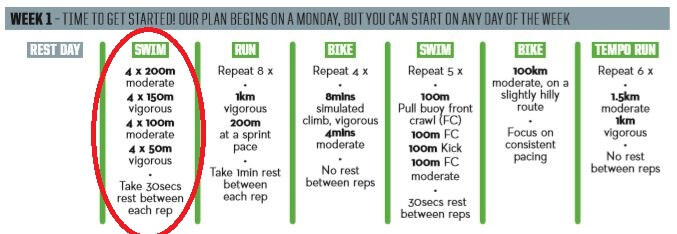
    Signing up for the race

    Auckland Marathon is owned by Ironman and administered through Active.com, but you start your registration directly on the Auckland Marathon website.

    It will cost you around $130-$190 to enter, depending on how early you sign up.

    You will also need to pay an Active.com handling fee of 8%, so in total the registration fee will cost you between $140-$205 NZD.

    This fee gets you entry into the race with an official race number and timing bib, a gear bag, medical support on the course, water, Powerade and Coke at aid stations, an Auckland Marathon hat, and a finisher’s medal (if you finish).

    The other thing you might want to buy is your race-day transport. You don’t want to be worrying about things like parking and being late on race morning, so I’d recommend using the transport provided by the event. You can either catch the ferry from Auckland CBD, which will take you directly to the start line, or there are also buses you can take from other areas on the North Shore. The tickets cost around $10-$20.

    There’s a whole bunch of other stuff you can buy during registration like photos, clothing etc. but none of it is essential. If you’re thinking about buying the photos, you can wait until after the race and you’ll get to actually see them before you buy, but it is a bit cheaper to buy them beforehand.

    Training

    For some idea of my background, I’m new to running, I started running 4 months before the race, and started training for the marathon 9 weeks before. I would’ve liked more time, but I made the decision to register late so that was all I was left with.

    Most people would have considered me fit and healthy before I started, but I quickly found out that didn’t matter much. Running fitness is a different beast!

    I remember my first run in June was 2.14 km and I felt like I was going to pass out. If you had told me then I would be running a marathon in October I would have said “Impossible!” or at the very least, “highly highly highly highly unikely”. But the other thing about running fitness is it tends to improve quite quickly; a handful of short runs and you’ll already notice a big difference. So don’t be discouraged if your first runs feel like death!

    As a new runner the first thing I had to do was put together a training plan. All the training plans I Googled you had to pay for, and the free ones were vague. I did find a few helpful-ish articles and used those and mostly guesswork to put a plan together.

    Basically you’re going to need to run a lot (duh), but there are many different kinds of runs; slow runs, fast runs, long runs, short runs, tempo runs, threshold runs, repeats.

    To be honest all that stuff just complicated everything so I just focused on one thing: Mileage.

    This meant I ended up doing only three types of workouts:

    1. Short runs
    2. Long runs
    3. Weights

    My only goal was to finish the race. As long as I met my mileage goal every week I figured I was getting fitter and would finish.

    A typical week would be three short runs (between 6-10 km) and then a long run on Sunday (20+ km). I didn’t worry about how fast I ran or when I ran or how I ran, I just focused on finishing the mileage. Once or twice a week, I would go to the gym after a short run and do some weights (mostly hitting legs, and some circuit stuff).

    “Good” runners typically get their mileage up to 80+ km per week or more, but I knew in 9 weeks I’d never get that far. The goal was to get up to 50 km per week, but I never actually made it there either. Dealing with TSW and also a few sore muscles meant the most I ever ended up logging in a week was 41 km, and the longest run I did was 28 km. Not the ideal build-up to race day, but it was the best I could do with the time I had.

    Diet

    Obviously you need large amounts of fuel to train for and finish a marathon, so nutrition is a big part of the training plan. I know everyone has a different view on what a healthy diet looks like, and to be honest I think you could finish a marathon on any reasonable diet, whether it’s Whole 30, paleo, vegan, carnivore or whatever else. But I will tell you what I did and why I did it.

    I decided to train on the keto diet, which is a low/zero carb diet. I’d have been open to any diet, but I went with keto because it’s familiar and fit best with the TSW treatment I was going through.

    The broad macronutrient breakdown on keto is 75% fats, 20% protein, 5% carbs.

    This is the opposite of almost every recommended diet for marathoners, which recommends ~60% carbs and almost no fats. However I did find many people who had run marathons on keto and that was all I needed to know.

    What’s the idea behind keto?

    Carbs are the default energy source for most people. What happens is you eat carbohydrates, your body turns them into glycogen. The body then sends this glycogen to your muscles to use as energy.

    However if you stop eating carbs, your body has to use something else. It turns to the next energy source which is fats. Your body takes fats (either body fat or dietary fat) and turns it into something called ketones, which gets sent into your bloodstream for energy.

    The reason people choose the fats/ketones route over the carbs/glycogen route is because of capacity. Glycogen delivers energy faster, but your muscles can only store around 2,000-3,000 calories of glycogen at any time. When you run out, your body shuts down and you’ll get light headed and find it difficult to stand or walk (also known as “bonking”) until you eat more carbs. 2,000 calories will only last you around 1.5 hours of a marathon, so if you’re running on glycogen, you will need to eat during the marathon if you want to finish. This is why most people hammer energy gels during marathons, which are packed with sugar (carbs).

    When it comes to fats, your capacity is much higher. Most people already have at least 30,000 calories of stored body fats, which is enough to fuel several marathons without eating anything. However, if you’ve been eating carbs your whole life your body’s ability to create ketones will be weak, since it’s never had to do it before. It takes time for your body to build the ability to generate large amounts of ketones, or to become “keto adapted”. Usually around 6-8 weeks of no carbs, and your ketone-producing ability will continue to improve over time after that.

    If I were an experienced runner and could finish the marathon in ~3 hours, I would have relied on a more glycogen-based diet, but as a newbie with only 9 weeks to train I figured I could be out there for 5 hours or even more. So the bigger gas tank on keto made more sense to me. I’m also a regular faster so I knew my body was already keto-adapted to some extent.

    So what does a keto diet look like? Lots of fish, steak, chicken, cheese, eggs, butter, and low glycemic vegetables. This was good because it also kept my food prep very simple. For all my training, I also worked out fasted, relying only on body fats to fuel my runs. This made my meal prep even simpler as I only ate one (big) meal a day.

    I did learn quite a few interesting things about this diet during my prep, and for any future marathons I would tweak this strategy a bit, but overall it worked as I’d hoped.

    Athlete check-in

    Two days before the marathon there is the check-in, where you go to pick up your race number and your race pack. It was held at The Cloud in the CBD, and there’s a big runners expo there too with all kinds of merch and gear for sale.

    It’s pretty cool to go to these things as a first time runner. You see all the other competitors and what a big event it is. Everyone is on a buzz because you’ve been training for months and now finally the race is here.

    If you’re running at Auckland, one thing I’d recommend is depositing special drinks. The great thing about Auckland marathon is it lets all competitors deposit special drinks, not just the professionals. This means you can prepare your own drinks and deposit them at check-in with your name and the aid station you want it to be sent to, and the staff will make sure that drink is waiting for you out on the course.

    Because I was running on keto I couldn’t drink the sugary drinks they provided, so I mixed up my own drinks with electrolytes, ketones and MCT oil and had them deposited at every aid station. This was a big mental confidence booster for me, because I knew I would have lots of keto-friendly fuel, and would be able to race with the same drinks I’d been using all throughout my training.

    Race morning

    I woke up around 3:30 am on race morning. I had all my kit prepared the night before. During the race I’d be carrying a race belt with my knee guard, a little box of electrolyte pills, some “fat bomb” sachets, and my phone with headphones in case I needed inspiration (I ended up not using the phone, the fat bombs or the knee guard at all, but I did finish all the electrolytes!)

    I arrived at the start line early. This gave me a lot of time to stretch and do some massage ball work, more for peace of mind than anything. In the back of my head I still wasn’t sure if I’d be able to finish this thing. My knee was a little soft and I knew I’d have to be gentle on it. I was just doing my best to focus and get positive.

    As my parents were with me I didn’t need to deposit any gear, but if you’re alone there is a bag check where you can deposit your jackets etc and they’ll transport it to the finish line for you.

    The start line is divided up into zones based on pace, so if you think you’ll run around 3 hours, you go to the 3 hour pace zone, if you think you’ll run 4:30 you go to that zone and so on. It’s a rolling start, and there’s an electronic timer on your racing bib so your official time doesn’t start until you actually cross the start line.

    I started at the back of the 4:45 zone. I figured I could run between 4:30 and 5 hours, but I’m a slow starter and didn’t want to get caught in a whole bunch of people passing me. I decided it was better to start at the back and pass lots of people rather than get overtaken all the time and be reminded of how slow you are.

    There was a lot of buzz on the start line. Thousands of people, all this work and it had all led to this moment. This means lots of nerves, lots of emotion. But as soon as the gun went all that faded away and I got to work.

    Kilometres 1-10

    I felt unusually strong for the first 10km. Normally my body takes a while to loosen up, but on race day I was comfortable from the beginning. Possibly because I started at a slower pace than usual.

    It was still dark at this point, about 30 minutes before sunrise. As a summer chaser it was a little cold for me. Of course I was too caught up in the moment to worry about that. It only took a couple of slow kilometres before I was warmed up and running smoothly.

    The course at Auckland is top-heavy, meaning the difficult parts are in the first half. Most of the early part consists of small hills. In fact the course basically starts on a hill (an easy one). Hills are the bane of a marathoner because not all kilometres are equal. After running for hours, 1 km on a hill can be ten times harder than 1 km on a flat. So getting the hills out of the way early actually turned out to be a good thing.

    The first aid station was at 4 km. This was where I realised how awesome it is to have special drinks. The special drinks table is actually about 20 metres before the actual aid station. So how it happens is everyone is running towards the aid station, but before we get there, there’s a big sign that says “Special Drinks” with a table. And on the table I see my bottle waiting, with the blue and yellow ribbons I tied on it so I could find it easily. There’s only 2 other bottles there. I run by like it’s my own personal refreshment booth, don’t even need to stop, I grab my bottle and start sucking on it as I run right through the aid station. Everyone else is slowing down or stopping in the crowd to get water or Powerade, and I just breeze right past them.

    The second huge advantage was I had a bottle, and everyone else was drinking from cups. It’s almost impossible to run while drinking from a cup without slowing down (I learned this when I grabbed some water a few aid stations down), but it’s easy from a bottle. So I was able to continue running while drinking without breaking my rhythm at all, and everyone else had stopped to walk/drink.

    My pro tip: If you’re running at Auckland, definitely deposit special drinks!

    The first ten kilometres was my strongest part of the race as expected. I also ended up passing a lot of people like I’d planned, including the 4:45 pacer. At least mentally, that set me up nicely for the next leg.

    Kilometres 11-20

    This is the area where you finish the last few roads on the North Shore and then head over the bridge to Victoria Park.

    I still felt strong during this area. However, the bridge was a lot steeper than I expected. Quite a few people struggled on the uphill. It’s a lot steeper than you might guess while driving over it. I grinded out the uphill quite well, but ended up finding the downhill difficult too. It felt uncomfortable running it slowly. I told myself it’s a waste of energy to hold back on a downhill, so I let my legs loose and went down at speed.

    This probably used a lot of energy anyway and hammered my legs, but it did mean I got over the bridge quickly. I also passed the 4:30 pacer group on the way.

    Once you get over the bridge, there’s a few winding roads you run through and some mini hills, but eventually you get out towards Victoria Park. This is the halfway point, so you see the half marathoners going off to the finish. For you though, it’s only halfway!

    I actually remember feeling pumped at this point as I still had spring in my legs, and told myself I was more than ready to fight through the second half. This is what we came to do!

    Kilometres 21-28

    The second part of the course is all flat. It’s also all straight – along the waterfront to St Heliers and then straight back. This makes it ideal for putting your game face on and getting to work.

    My goal was to stay in front of the 4:30 pacer and maybe even push for 4:15 in the later kms. But my legs started to weaken around Kilometre 25, and eventually the 4:30 pacer group caught up to me. I stayed with the group for about 2km, but my legs just couldn’t do it and I had to let them go. That was disappointing, but I didn’t have time or energy to dwell on it. I just told myself to make sure I stay ahead of the 4:45 pacer, and kept on going.

    Along the waterfront there are markers every kilometre. They seemed to come rather quickly at the start, but by Kilometre 25 it felt like decades between them. Around Kilometre 28, the hurt started to set in deeper than I’d ever experienced in training. It was the kind of pain where I would have said to myself “Enough for today” because I would’ve guessed an injury wasn’t far away. For the first time I was doubting whether I’d actually finish without walking. I hadn’t even gotten to Kilometre 30 yet, and that’s supposed to be when the “real” hard part starts.

    Kilometres 29-36

    The worst part of the race x100. My legs were toasted. I told myself whatever you do, don’t walk. But although I may have looked like I was running, I was probably moving at walking pace anyway.

    Interestingly it was only my legs though. My cardio was fine, I wasn’t breathing heavy, and had a ton of energy (those trusty body fats). I could’ve gone straight to the gym and smashed an arm workout. But my legs just weren’t conditioned to run this long. They were being tortured.

    This is also the point I started seeing a lot of people bonking, a few people walking with limps, and pairs of people just walking and talking like they’d given up on trying to run anymore.

    Around Kilometre 31 was where the peak pain period started and even though I didn’t stop I felt like I wasn’t moving at all. Looking ahead was just endless waterfront, and the disadvantage of being an Aucklander was, I knew exactly where I was. Even in a car Victoria Park was miles away! It would have been better if I’d had no idea. Plus my mind was playing tricks on me. “Does that sign say Kilometre 32? I thought I already passed Kilometre 32! FML.”

    Finally I did stop to walk through an aid station at 33km and finished my drink slowly. A little pep talk, and I managed to force myself to get running again.

    Then after managing to “run” to the 36km aid station, I stopped to go toilet and it was hard for me to get moving again. Six more kilometres shouldn’t feel like a lot, but it might as well have been 100 more at that point, the finish line felt so far away. This is where you start zoning out, calling on Jesus to come down and save you. I gave myself a chest bump and told myself just get to the next aid station, drink more ketones and maybe your legs will come to life.

    Kilometres 37-42

    I was running super slowly (my splits say I ran 8’41” for Kilometre 37) but running a few kilometres slowly was probably what I needed. My legs found a little spring and as each kilometre marker went down it was a mental boost that got me moving a little faster each time. I ran Kilometre 38 in 7’47”, and Kilometre 39 in 7’26”.

    When I left the 40 km aid station, my legs came back to life. Now I could visualise the finish line being only 2 km away. There was a police officer there that told me to finish strong and I said to myself…YEAH! Time to finish strong.

    The crowds started growing after this point and suddenly the course was lined with people smiling and cheering. The marathon course is pretty lonely at times, especially in those later kms. You’re out there chugging along, the finish line is still so far and you realise nobody can run these kms except for you; the only way you’re getting out of here is through another hour of pain on these smashed up legs. So to suddenly get all that energy from spectators in the last two kms, it was like a pure shot of adrenaline. If you’re ever on the sidelines of a marathon, or any running race, definitely cheer and clap people on. It might not seem like much but after four hours of running that boost is everything.

    Because your name is on your race bib, people were even saying “C’mon Bren you’re looking strong!” and that would pump me up for at least another 200 metres. I’d say “F*ck yeah, I am looking strong!” and beast mode became activated. Another lady shouted, “Don’t give up, and remember to smile!” and that really reminded me that it was such a blessing to be out here running this race, that I wasn’t even supposed to be here. I thought back to where I’d come from, all the darkest nights I’d been through and how I’d survived far worse pain than this. I needed to be reminded that this race wasn’t just for me but for everyone who’d been through what I’d been through.

    The only thing I regret from the race is I wish I could’ve gone back and thanked all those people who cheered for me. They have no idea how much impact they had with just 4 or 5 words.

    The last kilometre was all engines GO and I started to power through it. By now there was no doubt in my mind I was going to finish, so there was no reason to hold anything back anymore. Even if my ankles broke I could crawl to the finish line. I lifted my legs up and tried to get the best time I could. Looking at my race splits, the last kilometre was actually one of my fastest (6’03”).

    As I came through the business park before Victoria Park, there were crowds of people sitting along the route in the sun, enjoying the race. I couldn’t see the finish line yet but I knew it was just around the corner. A lot of them were cheering, saying “Finish strong!” and “Almost there!” and this is where I started to get a bit emotional and was holding back tears. I actually still think about this moment a lot and I cry every time. A marathon means something different to every person, but it’s always about conquering yourself and achieving the impossible. It’s such a long and hard journey to get there and after months of training and hours of running one step after the other, you can finally smell the finish and all these strangers are clapping and screaming for you, it’s a feeling that can’t be explained.

    When I turned the corner to the finish line, the first thing I saw was the lines of people crowded on the ASB barricades, banging on the sides and screaming. I had visualised this moment so many times during training, so to suddenly experience it was a little overwhelming and I wasn’t able to hold back tears anymore. Nine weeks ago I could barely walk up the stairs, nobody would’ve believed I would ever finish this race. The feeling of crossing the finish line will be impossible to forget. No matter how many marathons I run in my life, even if it’s the Olympics, even if I win the gold medal, even if it’s a world record that lasts forever, this marathon at Auckland will always be the one that means the most.

    Post race

    After the race you walk through the finisher’s tunnel and you get your medal, a banana and a Powerade.

    There are a few places for you to pose for finisher’s photos, and all of Victoria Park is turned into the post-race festival/village with food and merch for sale to enjoy with your family and friends. You can also join the crowd and support the other runners who are just finishing, which includes half and quarter marathoners and the Fun Run.

    However most people tend to just chill out on the grass and relax, which is exactly what you should do. You’ve just become a marathoner!

    Thinking of running Auckland?

    One thing that I noted during the whole build up and after the race was what a great job they do with this event. It’s one of the best organised events I’ve been to. Everything goes like clockwork and everything is made as stress-free as possible for the runners so they can focus on what might be the hardest thing they ever do in their life. It’s also small enough so that your experience isn’t dampened by long lines, crowding, traffic and all that other crap that often ruins large events. If you’re thinking of running a marathon, especially if it’s your first, Auckland is a big thumbs up from me.

    Can I do it?

    Lots of people say, “I could never do a marathon”, but running the marathon is the greatest equaliser of all sports. You don’t need a coach, a gym membership, natural born talent, good genes, height, big muscles, expensive gear, good teammates or anything else to become a marathoner. All you need is a pair of shoes and two working legs (and there were people with no legs and no shoes at Auckland 2019, so technically you don’t even need those!)

    Finishing a marathon only requires two things:

    1. Working hard
    2. Not giving up

    That’s also what makes it scary, but if you can commit to that, you can cross the finish line. Plus, you get bragging rights for life 😉

    See you there!

  • A Day In Honiara

    A Day In Honiara

    I’m skipping the hotel breakfast. I already know what it’s going to be.

    Eggs, bacon, fruit, sausages. And fish of course.

    Not that there’s anything wrong with that. Sounds delightful actually.

    It’s just, we’ve only got one day in Honiara, and I’d prefer to start the day with something…different.

    It’s around 8:30. I head out of the hotel, wave good morning to the ladies at reception.

    The bellman outside gives me a friendly nod.

    “Good morning sir.”

    “Morning, my friend. The market is that way, right?”

    I point in the distance.

    “Yes sir.”

    Luckily, the sun’s not too high in the sky yet. It’s barely gotten off the sidelines, yet the air is already hot. And not just normal hot.

    Island hot.

    Honiara is typical for an island capital. It looks like an island capital, with dusty buildings and crooked palm trees along the streets. It moves like an island capital (slowly). Most of it all, it smells like an island capital. Like humidity and sea salt and brown grass and wet sand. It’s one of those smells your nose doesn’t forget. If you know, you know.

    The first store I pass is a supermarket. Of course, I have to go in.

    Earlier in the week I’d asked our guide Fiona, “What are some of the traditional dishes here?”

    She hesitated, but didn’t really have an answer. So I pointed to the airport workers in front of us.

    “Like what will those guys eat for lunch today?”

    She didn’t even have to think about it.

    “Tuna.”

    “Like fresh tuna?”

    “No from the can.”

    “Just tuna?”

    “And maybe bread.”

    I looked at her oddly for a moment.

    “You guys live on islands surrounded by fresh seafood and your favourite food is canned tuna?”

    She laughed and shrugged her shoulders.

    “It’s easy.”

    And that’s exactly what I see as soon as I walk in. Rows and rows of Solomon Island tuna.

    I have to buy a can. If this is the national dish, I’m trying it.

    There’s not a lot of people around today. It’s Saturday.

    Shops are open, but empty, buses are running, though empty(ish). One block, two blocks, three blocks. Police station, a few supermarkets, people lining up at the ATM. Everything is rather uneventful.

    That is, until I get to the market.

    The entrance is so crowded, I can barely get in. To my right, lines of all types of vegetables, laid out on tarpaulin mats. On my left, watermelons.

    Rows and rows of watermelons.

    As I walk down eyeing them all, the young boys scream out to me, seeing me salivating from my eyes.

    “Sir, melon, here!!”

    “No here, melon here! Sir!”

    “This one this one!”

    Selling watermelons is competitive business.

    The vegetable ladies are less enthusiastic. Most of them are too busy gossiping to even look up at me.

    The market’s huge, and the produce is all beautiful.

    Casavas, pumpkins, taros, eggplants, pawpaws, cucumbers. And bananas.

    Lots and lots of bananas.

    I keep walking, and find more interesting stuff. That’s the great thing about tropical markets. They never end.

    Huge pineapples. Oysters, clams. Coconuts.

    It’s a tropical food paradise.

    Anyway, I don’t have a kitchen, and I’m only here for a day. So I’m not shopping. I’m looking for the cooked stuff.

    When I find the rows of cooked food I realise I’ll need to strategise a little. There’s SO MUCH to try.

    Now, do I be a good blogger and try all the funky stuff, or just eat the stuff I like?

    Easy answer. The stuff I like!

    The first lady is selling sausages. The kind you eat at birthday parties when you’re a kid. Haven’t had one of those in forever. I’ll take one.

    The next lady has “golden rice” and “vegetable pies”.

    “What’s inside that?”

    “Fried rice.”

    “And what about that?”

    “Vegetables.”

    Okay. I’ll take both.

    Next we’ve got chicken, fish, more chicken. Comes with rice, bananas, some type of pancake. Should I get one? I’ll think about it.

    But beside them are some boiled (or steamed?) bananas I’ve never seen before. Yeah, I’ll take one, please.

    On the opposite side, a group of girls are selling packed meals. It’s chicken, rice and vegetables. If I was living in Honiara, I’d probably eat that for lunch every other day. But surely I can find something more interesting.

    Then I come to a smiley grandma, buckets of home cooked food in front of her. I already know this is a winner. Even though there are signs, I ask her what’s in each one. She lifts each lid and lets me peek inside. They all look great.

    I’m feeling a little flush. I’ll get the most expensive one.

    I wasn’t expecting a big serving, but she grabs a takeaway container and packs in enough beef and rice for breakfast, lunch, dinner, and maybe even a few scoops leftover for tomorrow.

    I look at my collection of plastic bags. I think I’ve got enough food for the day. Probably the week.

    I make my way to the exit. But I can’t escape. More things catch my eye.

    Bananas. Not just any bananas. Green bananas, yellow bananas, orange bananas, red bananas. Question: Are you really going to walk past bright red bananas and not buy them?

    I only want one, but they sell them in bunches, and bunches here aren’t small, they’re bunches of fifteen.

    I guess I’ll take fifteen.

    I finally head out of the market, past the gossiping vege ladies, past the watermelon boys. Just as I’m about to exit, a grandma walks past me carrying a box of something delicious-looking.

    “Excuse madam, what are those?”

    She turns, looks at me startled. Who is this strange oriental man inquiring about my food?

    “Those. What are they?”

    “Casava rolls.”

    Question: Are you really going to walk past homemade casava rolls (never heard of them) and not buy one?

    “Can I have one please?”

    I smile. She smiles. Puts the box on the ground. Takes a plastic bag. Scoops one up and pops it inside. Hands it to me.

    I hand her some cash.

    “Keep the change.”

    We’re staying at the Heritage Park Hotel, just on the edge of the town centre. I’m dripping in sweat when I finally make it back.

    Luckily it’s not just any old hotel, it’s a resort that breeds smiles and oohs and ahhs. My room is air conditioned, there’s a Peanut Slab on the pillow, two cold waters waiting for me in the mini bar. I’ve got a nice balcony too, there’s a pool downstairs. Two actually.

    But I’m just thinking about breakfast.

    I start with the golden rice. It’s literally fried rice that’s been wrapped in batter and deep fried. Even though I feel like it’s giving me heart disease it’s a solid 7/10.

    The vegetable pie is next. It’s lots of pie and not many vegetables. 4/10.

    The casava roll is slightly bland but the texture is very unusual and satisfying. Be amazing with ice cream. 6/10. Maybe 6.5.

    Then it’s time for grandma’s beef stew. The box is so full it spills out on the table when I open it. I only plan to eat half, but it’s so darn good I destroy that thing like it’s trying to run away. Paired with the boiled bananas I picked up, it’s one of the best things I’ve eaten all trip.

    10/10.

    I lounge on my balcony, my stomach swollen from too much food. I’ve still got red bananas, and a can of tuna. Tomorrow’s breakfast, I say.

    A few hours later, once the girls have woken up and done a morning wander, I go to meet them at Breakwater Cafe, just around the corner. Sun is at full mast now, the town is baking. I find the girls there halfway through their brunch. It’s a cosy place, lots of goodies on the menu.

    I’m still full from my little market adventure earlier. But, question: Are you really going to walk past such a delicious menu and not try something?

    “I’ll have the coconut smoothie please.”

    “Anything else?”

    I shake my head, then take a quick look in the cabinet.

    “Well, maybe a piece of that strawberry slice.”

    While picking at our food, the four of us chat about what to do with our day. It’s a free day for us, our last day in the country, our only day in Honiara. They’ve already been to the National Museum, which “didn’t take long”, in their words. I’ve done my market haul. To be honest, we’re just kind of exhausted from a week of whizzing around so many islands.

    We make a little pit stop at the crafts market next door but after that, it’s back to the hotel. The girls head for a day of sunbathing at the pool. I head to my room and fall into a food coma.

    That’s our day in Honiara.

    That night the four of us have dinner in the hotel restaurant. We’ve been spoiled with good meals this trip, but it doesn’t stop here. The Heritage Park menu is top notch. I go with one of the traditional dishes – fish cooked in banana leaf.

    Afterwards we sit and talk about the only thing travellers know how to talk about: Where we’re going next. Freya’s going back to Aussie before taking off on another big trip. Sam’s heading off to tour Europe. Sarah’s going to Bali. We swap stories and tips, like telling Sarah how to finesse the taxi system in Bali, and giving Sam advice on surviving Europe’s hostels. And then we talk about dessert. It feels like I spend an hour deciding between the apple pie and the cherry tart. I even consult the girls several times.

    “Seriously, apple pie or cherry tart?”

    I get the apple pie.

    Should’ve got the cherry tart.

    The following morning we get picked up for the airport. As it’s on the opposite end of town, so we get to enjoy one last drive through Honiara’s centre. Our driver’s name is Andrew. Young guy. Hip. Groovy hairstyle.

    “Are we going to pass Chinatown?” I ask him.

    “Yeah, it’s just coming up here.”

    He points up ahead, to the right.

    “I was going to walk there yesterday,” I say. “But it was too far. Is there anything interesting there?”

    “Not really.”

    “But there’s a lot of Chinese here? I noticed people don’t really look at me too funny.”

    “Yeah, lots. For example this hotel here.”

    He points out the window next to me.

    “It was started by this Chinese man. He had lots of kids with different Solomon women. And now all those kids run the hotel together.”

    “This one right here?”

    “Yeah.”

    We both look at it, and then he laughs, and then I laugh, and then we both look at the hotel again. And keep on laughing.

    We pull into the airport and unload our bags. I still have about eight red bananas left. Even after giving two to Sarah, I barely got through half of them. I hand them to Andrew.

    “A gift for you,” I say, grinning.

    We say goodbye, shake hands, give each other a bro hug. Probably be a while before we see each other again.

    Or so we thought.

    A few hours later, we’re back at the airport entrance. Andrew comes to pick us up. Our eyes are tired, faces glum.

    “Flight overbooked.”

    We were the first ones off. No more flights today. Back to the hotel.

    As we load our bags back in the van, I crack a smile.

    “Well. At least I’ll get to try the cherry tart.”

    They all laugh. “And the tiramisu!”

    That night, I find out what I’d known in my heart all along: The cherry tart was so much better than the apple pie.

    Maybe one more night in Honiara isn’t so bad.

    The following afternoon, Andrew picks us up again, ready for round two.

    “What you been doing today?” I ask him.

    “Just in my house, watching movies.”

    “Did you eat the bananas?”

    “Yeah,” he grins.

    “Did you know,” he goes on, “we have an island here that has one hundred different types of bananas! One hundred!”

    “Really? What’s it called?”

    “Makira.”

    “Makira…”

    “Yeah Makira. They even have a banana festival. A festival just for eating bananas!”

    Now that sounds like a party worth going to.

    It’s a Sunday today. The roads are empty. I figure everyone in Honiara is at home, watching movies and eating bananas, like Andrew.

    Then we pass the local soccer pitch.

    I was wrong. The field is packed on all four sides. Nobody is watching movies. Everyone in Honiara is here, watching soccer.

    Another few minutes along, we pass by a few fruit stalls. I remember I still have some spare change jingling in my pocket.

    “Andrew can we stop here. I got some coins to burn.”

    He nods and pulls over.

    “Who wants coconuts?!”

    We pool our spare change, hand it to the lady out the window. She pulls half a dozen coconuts off her stall, drills a hole in each one, drops a straw in, hands them to us one by one.

    One last coconut for the road.

    As we pull into the airport, we all say bye to Andrew, again. We unload our bags from the van, again. Check in, again. Go through customs. Then as we head through security, the guy slaps my bag gently as it comes through the belt.

    “Yours?” he asks.

    I nod.

    “You got tuna?”

    I laugh and pull out the tiny can of tuna I’d forgotten about. What a nice surprise. I’ll have it on the plane.

    He looks at it for a minute, then puts it on the desk behind him.

    “I can’t take tuna?” I ask.

    He shakes his head.

    Fiona was right, they really do love their tuna. Won’t even let it out of the country.

    It’s not long before we’re buckled in, and the flight takes off. We all look at each other and grin, nervously, and then with relief. We’re really leaving. But as we watch the islands pass beneath us in the window, something tells us, we’ll be back.

    Or at least I will be. I’ve got a banana festival to go to.

    Until then, Solomon Islands.

    B


    The cost of my trip was covered by Tourism Solomons. Opinions are always my own. For more information, see my Disclosure Policy.

  • A Day In Gizo

    A Day In Gizo

    Life is good at Fatboys.

    It took us a little while to get out here, in our little boat, zooming across the ocean. But wow, it was worth the trip. This charming resort on an island of its own, surrounded by calm and crystal waters.

    When heading to Fatboys the first question is, why call a place Fatboys? I had a few theories. But it’s answered on the wall as soon as you step off the boat:

    “Fatboys comes from the character Joe in Charles Dickens’ “The Pickwick Papers”. The fatboy’s life revolves around eating, sleeping, and making every attempt to avoid work. Whilst at Fatboys, guests can become “Joe the Fatboy”.

    When we’d arrived yesterday, just as we were docking, some of the boys from the resort were unloading their catch from a fishing trip.

    “Just around here,” they answered, when we asked where they’d been.

    The Spanish mackerel they pulled onto the deck was the size of my leg.

    We ate it a few hours later for lunch.

    Right now, we’re eating the rest of it for breakfast.

    It’s not so bad, becoming Joe the Fatboy.

    We’ve got a fun day planned. A little island hopping, some snorkelling, another lunch on a beach somewhere. But first, we finish breakfast slowly. I have a second cup of tea. Then we head back to the rooms to chill for a bit. There’s no rush. There never is, around here.

    The four of us are staying in a lovable two piece cottage, right on the water. There’s a little balcony, attached to another little balcony, attached to the sand, attached to the ocean. The water’s shallow, barely reaches your knees. Water is clear as glass. Calm. Rooms are simple, soothing. No television. Just good food and the ocean.

    Exactly what I’ve needed.

    As soon as breakfast settles it’s back to the boat. We all climb in, head back out onto the water.

    Fatboys is located in Gizo, in the Western Province of the Solomons, a collection of islands, great for snorkelling, diving, lots of boutique resorts. As we whiz through the waves I realise how funny it is that since we landed here, we go almost everywhere by boat. Hardly any driving, walking, biking, training, flying. It’s pretty much boat, everywhere.

    It’s almost normal to us now. Getting in a car would be kind of weird.

    We spend the morning hopping through a few different islands before reaching our snorkelling spot.

    The girls gear up, jump in, spend an hour exploring the water. For me, the water is off limits again. I hang about on the sand for a few hours. That’s fine. Perfect, actually. There are few things I love more than sitting in the sand on a quiet beach.

    Lea is with us today. Lea is one of the staff from Fatboys, always chipper and wearing a cheeky smile.

    Her and Fiona, our guide, disappear for a moment into the island, then come back.

    “There’s a guy living over there,” Fiona tells me, pointing down the beach, where she’s just come from.

    “Like a village?” I ask.

    “No just a guy.”

    She grabs a Coke from the cooler bin. Lea takes one too. She offers me one. I shake my head.

    “Just one guy?”

    “Yeah, and his kid. It’s his job, to look after the island.”

    “Wow.”

    Must be lonely, I think. Or maybe, paradise. I know a few people who’d fantasise about swapping jobs with him, probably every day.

    When the girls have had enough of the water, it’s time to head to a new island for lunch. We pile back into the boat and zoom out.

    The ocean has a slight attitude today, rocking our boat more than usual. Every few seconds we get a healthy spray across our faces, island after island whizzing past us. I sit with Fiona, up the front.

    “How many islands do you have here?” I ask her.

    “Almost 1,000.”

    “Is there an official number?”

    “992.”

    Nine hundred and ninety two islands. We’ve been to about eleven.

    Nine hundred and eighty one to go.

    “And why are they called The Solomons? Solomon was an explorer, like Cook?”

    “No,” she laughs. “There was another explorer that came here, a Spanish guy. I forgot his name. But when he got here he guessed this was where King Solomon hid his gold. So that’s how he named it.”

    “And did he find the gold?”

    “Nobody knows.”

    We both have a chuckle.

    After a longish boat ride we finally pull into shore. Kennedy Island, they call this one.

    There’s a story to this island too, and it’s not about a king named Kennedy or his hidden gold. In 1943, a man by the name of John Kennedy, who would later become US president, had his ship smashed by the Japanese navy during World War 2. Two of his crew died, but Kennedy and the rest managed to swim here and survive long enough to find rescue (and get an island named after them). No doubt a few Solomon coconuts would have kept them going. Maybe the odd Spanish mackerel too.

    Lunch for us, though it doesn’t need to be, is slightly more lavish than that. When we arrive, a crew is there cooking us an island feast certainly fit for a president or two; grilled crayfish, boiled yams and cassava, fried rice, sweet potatoes, fresh fish, stewed pumpkin and greens, and of course some fine Solomon Islands tropical fruit. SO YUM. I want to be a Fatboy forever.

    After that, it’s back to the resort. We spend the rest of the afternoon recharging in the cottage. Then, just before dinner, we’re into the boat one last time. Where to now? Heading out for a “wine down”, they tell us.

    The “wine down” is a Fatboys treat, for guests to end the day with a sunset and a glass of vino on your own private island. We get taken fifteen minutes out to a tiny island, maybe the size of a tennis court or two. Ocean is warm, calm, sand is soft like flour. Although we’ve almost stopped noticing all that. We’re getting used to these perfect islands.

    We haul the beach chairs off the boat, the cooler bin full of wine and sodas, ready to watch the sunset. The girls open the wine and polish it quickly. We all snap photos. Then, I go sit with Lea in the sand. Open a beer, pour myself two sips, give her the rest.

    “What’s it like, working at Fatboys?”

    “Fun,” she says. “I get to do lots of different jobs.”

    “Like coming out here with us,” I say, tapping the beer can.

    “Yeah,” she laughs.

    “So what do you guys do out here, for fun?”

    “Play snooker. Chew betel nut.”

    “Chew what?”

    “Betel nut.”

    I look at her, make a face.

    “You chew it. Makes you high. You haven’t seen it?”

    I shake my head.

    “You want to try it?”

    “Sure.”

    “I’ll ask the boys for you. Tonight.”

    That night after dinner, Lea tells the guy behind the bar he’s chewing betel nut with me tonight. I pull up a stool, introduce myself. He’s soft spoken, with a boyish face, curly brown hair.

    He fetches the goods from under the bar; half a betel nut, plus a sprig of ‘fruit leaf’, and a bag of coral powder.

    “This first,” he says, rolling half a betel nut between his fingers. He pops it in his mouth and starts chewing. Then he dips the sprig in the lime powder, takes a bite.

    “And now you just chew. And spit.”

    He grins. His teeth are going red already.

    I copy him. Start chewing. It tastes terrible.

    “And where do I spit?”

    “There,” he says, pointing behind me. “In the sea.”

    We both walk out to the jetty and spit into the ocean.

    “You see how it’s red?”

    We stand out there for a while, chewing, making our teeth red. In between spits, we chat. Get to know each other. He has a girlfriend. Not married yet. Chews betel nut every day. Not very good at snooker.

    “You feel anything?” he asks.

    “Not really. What am I supposed to feel?”

    He points to his head.

    “A bit high. Happy.”

    I shrug, shake my head.

    “Maybe you need to chew more.”

    I shake my head again, spit what I have left into the sea. There are lots of delicious things to chew on in the Solomon Islands. Betel nut isn’t one of them. We go back and sit at the bar. I order a ginger ale and a bowl of fruit.

    This is more like it.

    The next morning we’re in for something a little different. We’re heading to the market in Gizo town. It’s a short boat ride. When we arrive, the place is brimming with action. Waterfront lined with boats, bumper to bumper.

    “They’re waiting for passengers,” Fiona tells us, pointing to all the young drivers milling about. “Ladies come here in the morning for the market, then head back to their islands.”

    Just so happens, today is the grand re-opening of the market, in a brand new building. Everybody’s in Gizo town to check it out, people are giving speeches, the streets are blocked off with crowds. Markets are one of my favourite things to wander, always full of delicious treasures. I can’t wait.

    As we duck past the crowds and file inside, the tables are lined with beautiful island produce. There’s no shortage of treats to try.

    The first thing that catches my eye is a round yellow fruit, looks like a big passionfruit.

    “What is that?” I ask the friendly man.

    “Poutera”.

    “A what?”

    He laughs.

    “Poutera.”

    “Is there an English name?”

    He shakes his head.

    I turn to Fiona standing next to me.

    “What’s it taste like?”

    “I’ve never heard of it,” she says.

    The man cuts one open, neatly carves off a slice and hands it to me on the knife. I slurp it down.

    “So good,” I grin, reaching out for another.

    “You want to get one?” Fiona asks.

    “How about three,” I smile.

    With my bag of poutera in hand, we continue wandering the aisles. Cakes, donuts, fruits, soups. I could wander these stalls and eat all day long. But, time is short. We’ve got to get back to Fatboys, pack. We’ve got lunch waiting, and then a flight to catch.

    With the time we have, I try a coconut cake, a pumpkin roti, grab some bananas for later.

    Wishing I could stay all day, I make a mental note – next time you head to a Solomons market, go early, with an empty stomach.

    Not all is lost. Lunch back at Fatboys is my favourite tropical fruit smoothie, followed by seafood noodles (amazing). If you ever make it to Fatboys, you certainly won’t be disappointed with the kitchen. It lives up to its name. Food at Fatboys is always a winner.

    Of course, before we head to the room to pack, I remember I have poutera for dessert. I ask Lea for a knife at the bar and start cutting them up.

    “You know what these are?” I ask her.

    “Poutera.”

    I look at Fiona and laugh. “Lea knows!”

    I cut her a slice. Nobody else wants any. I take care of them myself. They go down like candy.

    It’s sad saying bye to Fatboys. For delicious food, beautiful views, a place to put your feet up and recharge, you couldn’t ask for a better place. A few more days would have been perfect. Piling into the boat, all our bags in tow, we wave bye to the crew one last time.

    It’s not every day you get dropped at the airport by boat, but today is one of them. After a short ride we pull up to a stone jetty, on a small island, feels like the middle of nowhere. That’s because it kind of is.

    We haul our bags off, walk along the jetty. It feels like nothing is here. But we turn the corner and find the cutest, smallest, strangest airport we’ve ever seen. We all look at each other and laugh, wander out onto the airstrip, snap a few photos.

    “The Japanese built this,” Fiona tells us. “The Japanese left a lot of stuff here actually, that we still use today.”

    Eventually the plane arrives – a tiny little thing.

    The crew consists of two; the pilot, and the co-pilot. They jump out, refuel the plane, then wave us on.

    As we take off, we stare out the windows, watch the islands of Gizo slowly disappear below us. What a magical place. But, there are other corners of this country to explore. For now we head to the capital. Next stop – Honiara.

    A stay at Fatboys can be booked easily through Booking.com. For all info on transport, flights and things to do in Gizo, see the Tourism Solomons website.

    The cost of my trip was covered by Tourism Solomons. Opinions are always my own. For more information, see my Disclosure Policy.

  • A Day In Munda

    A Day In Munda

    It’s our first full day in The Solomons. We’re in Munda, having breakfast at the Agnes Gateway Hotel, just around the corner from our guesthouse. Sarah is having eggs, Samantha is having sausages. I’m the only one having fish. Because apparently, that’s the thing to do here. Heavy breakfasts, like fish and rice and potatoes. I love it. It feels like a very island thing to do.

    “So after this head back to the rooms, and a taxi will pick you up for the museum,” Fiona says.

    Fiona is our guide for the week. She’s a young, smiley woman, soft spoken, with a slow walk and a kind face.

    “After that I’ll meet you guys back here, we’ll head out to the islands.”

    Breakfast done, we head back to the rooms to get ready. We’re staying at Qua Roviana, a two storey guesthouse just around the corner from the docks. It’s a small but charming place, obviously built with love. The four of us head straight to the lounge and wrestle with the wifi.

    An old lady walks in.

    “Good morning!” she says in her grandmotherly voice. She’s a friendly soul we met the evening before, grew up around here some 50 years ago.

    “It’s a lovely day, do you have something fun planned?”

    “Yeah we’re off to the museum. Then we’re going snorkelling at the islands.”

    “Oh fantastic. Which island?”

    We all look at each other.

    “I think it starts with H,” Sarah says.

    “H…” she lady trails off. “Must be…Hopei?”

    We all shrug.

    “Probably!”

    An hour later the taxi picks us up for the museum. The driver is a young guy with a funky haircut. His name is Junior. We all jump in and say hello.

    “So the museum right?”

    “Yep. I forgot the name though,” I say. “How many museums are there in Munda?”

    “Just one.”

    “Well then that’s the one we’re going to!”

    The drive out isn’t long, but it’s bumpy. It’s a dirt road, with small shacks and houses every few minutes, potholes, puddles. Junior maneuvres around them slowly, telling us a few bits about Munda.

    Fifteen minutes later we pull up a sand driveway to someone’s house.

    “We’re here.”

    Waiting to greet us is a stocky man with a childish grin. He’s wearing a camo tee shirt and shorts, his shabby hair hidden under an old baseball cap. His name is Barney.

    Barney greets us enthusiastically and welcomes us into an open air garage, two long wooden tables down the middle.

    “So this is my collection. I haven’t put labels on anything, I prefer if you want to know about something, you ask me.”

    I look up and down the room. The two tables are covered with what looks like scraps – old bottles, scrap metal, bottle tops. But looking a little closer, they’re actually parts of guns, medicine bottles, dog tags. I’d been wondering where the entrance to the museum was, but that’s when I realised – this room is the museum.

    During World War 2, the Solomon Islands found itself more involved than it probably wanted. The Japanese and Americans fought over the isles, likely wanting them for resources and strategic bases. Even today there are still buildings and airstrips built by the Japanese. Obviously as history was happening, the Islands were left with their fair share of mementos – army equipment, bullets, guns, blown up airplanes – left buried in the Islands’ sands. For fifty years, anyway. After that, Barney came along to dig it all up. It seems he’s spent most of his adult life beep beep beeping with his metal detector, uncovering every bit of wartime memorabilia he can find. And it seems he’s barely getting started.

    He pulls out a box from under the table. It’s filled with old bullets, keys, bits and pieces.

    “This is my special box. I keep all the really interesting stuff I find in here.”

    He takes out a big keyring of dogtags. There’s at least 200 on there.

    “You can see where they were all from – mostly US soldiers. The first dog tag I ever found was a man named Peter Joseph. So I named my museum after him.”

    “Do you still have it?”

    “Of course! It’s right here.”

    We all snap a photo.

    While the girls continue looking through the box, I wander around the tables.

    “Where do you find all this stuff?” I ask him.

    “Just anywhere down there, at the old sites,” he says, pointing in the distance. “Sometimes kids find stuff and they come running down here asking, Barney will you buy this off me? So I give them five dollars, ten dollars, depending on what it is.”

    At first glance the whole room looks messy, but on closer inspection, you can see everything has been laid out meticulously in distinct collections. Coke bottles sorted by colour, rifle barrels sorted by length. Each time I stop and take a photo of something, Barney starts telling me about it.

    “These ones are all Japanese helmets,” he tells me as I examine a bullet hole.

    “How do you know?”

    “Mushroom,” he says, moulding the shape with his hands. “The Japanese wore mushrooms.”

    As I stop at the guns, he rattles off all the different models, who they were used by. Same with the knives, and the clothing.

    “And what’s this, an engine?”

    It’s a huge clunk of metal, sitting tucked away in the corner of the room.

    “Yep jet engine,” he says, rattling off more fancy names. “All the Japanese planes were given female nicknames by the Americans, like…Betty Bomber, Grace, Louise, Norma. Zeke.”

    I look at him stare at the engine like it’s an old childhood toy. He smiles childishly, obviously fascinated by it all.

    On the table behind us are bottles.

    “Tell me about these.”

    “Oh, they’re all different types of bottles. Soldiers used them for liquor, medicine, drugs. See?” He holds one up so I can read the print. “Oh! And look at this.”

    He pulls out a small box from under the table.

    “Morphine. Still sealed.”

    “What’s the coolest thing you ever found, do you think?”

    He walks back over to his little box of treasures.

    “I don’t know, but when I found this, I thought it was really amazing.”

    He rummages through his box and pulls out a lock and key. It’s inscribed with United States Marine Corps.

    “It still works.” He turns the key back and forth a couple of times before going back to his little box.

    “Oh! And this.”

    He twirls a little bolt in front of me.

    “What is it?”

    “A stamp. Japanese one. Rare”

    “What’s the most recent thing you found?”

    He smiles.

    “Well actually, I found this just the other day.”

    He holds up his hand, like a newly engaged damsel showing off her diamond ring. Then he pulls the silver off his finger and sets it on the table.

    “It’s from a US soldier,” he tells us proudly. “Just look at the design.”

    When you first meet Barney, you kind of half listen. But after a while, he tells you something interesting. Then a few more things. After long enough, you begin to see how passionate he is about everything in this little room. So you start asking questions. You discover how well read and knowledgeable he is. And genuine. Half an hour goes past, and he’s suddenly wildly interesting. Maybe the most interesting guy you’ve met all year.

    I ask him if there’s a good book I could read about the Solomons and the war.

    “Munda Trail is good. Midnight in the Pacific. Here, take a look.”

    He points behind me. I turn around and see a stack of books on the table. Munda Trail. Midnight in the Pacific. Among others. We talk history for a while, a few stories about the Japanese, and that’s when I realise, this is really all this guy does. Looks for artefacts. Reads history books. He’s one of those guys that found something to obsess over, and now he obsesses over it. Not everyone discovers their true love. Barney is one of the lucky ones.

    “So you still go out looking for stuff today?”

    “Oh my gosh, all the time. I’ll go out tomorrow.”

    He points to a metal detector hanging on the wall.

    “I just…I have to. It’s in my blood, you know?”

    He laughs, like it’s ridiculous, but it’s not. It’s pretty darn cool. In fact, I regret that we’re leaving town tomorrow. If we weren’t, I’d ask if I could join him.

    As much fun as Barney is, we can’t stay any longer. The islands await. We snap a photo with the man, share handshakes and pile back into the cab.

    If you’re ever in Munda, do make an hour or two to go visit Barney’s Museum (official name is The Peter Joseph Wartime Memorial Museum). Even if you’re not a war history enthusiast, it’s great to meet Barney and support someone who loves what he does and does what he loves. Entry is 50 Solomon dollars (about $6 USD).

    “So what are you doing after this?” Junior asks as he pulls out of the driveway.

    “We’re going to the islands for snorkelling.”

    “Which one?”

    We’re all silent again.

    “It’s the one that starts with H.”

    “Hopei,” he says. “Is Billy taking you?”

    “I have no idea. Who’s Billy?”

    “He’s the boat driver. I’m sure you’ll be going with him.”

    “Is he cool?”

    “Yeah! He’s a cool guy.”

    “Okay if he’s taking us, I’ll tell him you said he’s a cool guy.”

    We all have a chuckle.

    When we get to the docks Fiona is there waiting for us. She sets the girls up at the dive shop with snorkels and fins. For me, I’ve been dealing with skin issues, so swimming is off limits. I’ll be sitting on the beach, enjoying some sunshine, taking photos.

    At the dock, our driver shepherds us all onto the boat. Junior was right. His name is Billy. He reverses the boat out, then powers us out into the open sea. The water here is a sparkling turquoise, littered with islands. Gorgeous, times one hundred.

    It’s around a twenty minute ride to Hopei. As we pull up on the sand, a staff of four or five is already there, cooking our lunch. Two large fish are resting over hot stones, sizzling away. I go over and chat with them, ask them questions.

    “The traditional way to cook fish,” they tell me.

    Under the shade, a spread of fruits and refreshments have been laid out for us. Two of my favourite things in the world – bananas and coconuts.

    The first coconut goes down like a milkshake.

    “Can I have another one?” I ask Fiona.

    “You can have as many as you like!”

    She shouldn’t have said that. I grab another. Again it goes down in seconds.

    The girls have gone into the water. The water is crystal, the kind where you can walk out to your knees and still see your toes in high definition. Fiona and I sit on the shore, snap a few photos.

    With the girls occupied, Fiona asks if I want to take a walk around the island.

    Sure, I say.

    We call Billy over. I grab another coconut, and the three of us start walking inland.

    Hopei isn’t a small island. It’s not huge either. Just good for a day. Billy walks us over to the opposite end, passing under fruit trees, forest. We walk by a cabin where guests can stay the night, nestled in the green. Imagine sitting out here with a group of friends, I think to myself. Eating grilled fish, sipping on coconuts, listening to Bob Marley. What a dream.

    On the walk back, we stop at another beach, hidden by some trees.

    “This is where the sun sets,” Billy tells me. “The water is shallow – you can walk, all the way out there, watch the sunset.”

    He points out to a water line, way out, at least thirty or forty metres. The water is clear as glass. We relax for a while under the trees, talking, sipping my coconut.

    “Oh by the way. Do you know a guy called Junior?”

    “Yeah.”

    “He says you’re a really cool guy.”

    He laughs and shakes his head.

    Lunch is ready when we return to the group. The girls are just getting out of the water, ready to eat. I salivate as I watch them lay out the food. Watermelon salad, casava and sweet potatoes, yams stewed in coconut milk, and of course, the pair of marvelous grilled fish. All Solomon Islands favourites, all cooked delightfully.

    We don’t use plates, but banana leaves. I stack my banana leaf healthily with everything. It goes down too fast.

    “Eat more,” Fiona says.

    She shouldn’t have said that.

    I have seconds. Thirds. Wash it all down with fresh coconut. Heaven must look like lunchtime on Hopei.

    With my pile of empty coconuts stacking up, I ask Fiona if they have a machete to cut them open. The flesh is inside, waiting for me. It would be criminal to leave it to waste.

    “Just use this,” she says, grabbing a carving knife on the table. She digs it into the shell, prys it open.

    “Do you have a spoon?”

    She takes the knife and slices a little wedge off the coconut shell. “This is how we do it,” she smiles, handing it to me. It’s like a little ice cream scoop.

    I scrape out a spoonful flesh and suck it off the edge of the shell. My tastebuds sing. I’ve eaten a lot of coconuts in my travels. No lie, these are the best in the world. The best.

    The girls lounge around the beach a while, letting lunch digest, while I continue to nibble on tropical goodies at the table. But soon the afternoon rain sets in. After gobbling down six coconuts and every banana on the table, it’s time to head back.

    As we pull out into the sea once again, we say goodbye to Hopei – the island starting with H – and thank it for the memories.

    All inclusive day trips to Hopei (and many other islands), diving, snorkelling, sunset cruises, and various other activities around Munda can be arranged at the Agnes Gateway Hotel. Just show up and ask – it’s centrally located and very easy to find!

    That night we get together for a short sunset cruise before dinner.

    The weather is nippy, the girls look half-hearted. Then Fiona brings the wine out, and suddenly the girls can’t wait. Sunset cruise? Yes please!

    We climb back in the boat, zoom out into the ocean once more, around twenty minutes out, then sit there afloat as we watch the sun set behind some islands in a purple sky. The girls polish off the wine while I polish off the snack platter. It’s a nice way to wind down the evening. Then it’s back to the Agnes Gateway Hotel for dinner.

    On the menu tonight? Crab. Not just any crab. An enormous crab.

    The seafood in the Solomon Islands is legendary. Right out of the sea, onto your plate. Every night of the week.

    With full bellies and well tanned faces, we head back to Qua Roviana for the night. Tomorrow, we set sail west, for new islands and new adventures. Our time in Munda has come to an end, but our adventures in the Solomon Islands are only just beginning.

    B


    The cost of my trip was covered by Tourism Solomons. Opinions are always my own. For more information, see my Disclosure Policy.