Category: Destinations

  • Training, Racing and Eating In Hanoi

    Training, Racing and Eating In Hanoi

    After playing two tournaments in small-town Vietnam, the plan for Hanoi was to eat a lot of food, explore the city and find a good coach to train with.

    I found a great Airbnb right by the French Quarter, a short walk from Hoàn Kiem Lake.

    One thing I wasn’t prepared for was the weather. Hanoi was in the middle of rainy season and almost every day I was there it rained. Often I wanted to go out walking at night but alas, it was pouring down much of the time.

    First thing on the list in Hanoi was to find a badminton hall and a coach to work with, which took a bit of hunting but I managed to find something within a few days.

    I started training at Duc Thao club with Coach Tuan who was awesome and became a good friend during the month I was there.

    So the routine in Hanoi was training at 10 am, gym at 12 pm, eat as much food as possible and then get as much work done in the evenings. It didn’t leave much time for exploring, but I still managed to get a few things in!

    One odd thing about gyms in Hanoi – they’re really expensive. If you’re a foreigner, you might pay something like 300K VND (about $11 USD) for a day pass.

    That might not sound crazy, but in Hanoi where everything else is so cheap, it can feel crazy.

    Of course there are some small gyms around that will be much cheaper, but for a quality gym that’s what I found most places charging.

    After training the goal is to slam as many calories as possible and luckily in Hanoi – that’s easy!

    Unfortunately I was boring and Grab’d almost all of my meals as my schedule was always so tight (not great blogging material, I know) but I can report that Grab food is good and cheap and most days it was raining and not very fun exploring weather anyway.

    In the evenings I used to take a walk around the nearby lake, Lake Hoàn Kiem.

    It’s a small lake in a fancy area (there were Prada and Rolex type stores on the same block) and it’s busy every night. People doing things like tai chi, dancing, people-watching, eating snacks, running, or just doing what people do around lakes.

    Also right on the north bank is the start of the Old Quarter, a matrix of streets where you can buy tons of knock-off goods. Lululemon, Nike, Timberland are all really popular brands to pick up there, I bought a few Nike sweats and they were great. Some people online claim they’re genuine, but as someone who lived in China I can tell you with 99% certainty everything sold there are fake knock-offs. The quality however can be comparable, so if you don’t care, you can pick yourself up a pair of Nikes for $20 and probably can’t tell the difference.

    Unfortunately I never took any photos, but the whole lake area beautiful (though often crowded) little lake to stroll around with lots of little coffee shops and places to grab a drink or bite.

    My landlord was a Vietnamese woman maybe in her 40s that was very into fitness.

    When she saw my badminton gear she started asking a lot of questions, about how she used to play but now she’s gotten into running.

    I told her I also run casually and she mentioned the Hanoi Marathon was on in a couple of weeks.

    I checked the website and thought maybe I could run the half, but unfortunately, sold out! Same issue I had back in Chiang Mai a few years back.

    She said – don’t worry! I will get you an entry!

    A few days later she called and said he’s secured me a bib number for the race.

    I guess it was time to start marathon training!

    Now every day after training, instead of doing badminton work I was on the treadmill, trying to ready my legs for 21 km.

    It had been a long time since I run that distance, a few years at least. I didn’t have time to put a proper training circuit together, so I figured I’ll just get as comfortable as possible running 10km, then we’ll just figure out how to get it done on the day.

    When I went to pick up my race number, I was quietly confident that I’d get through the race. I didn’t have many kilometres in the bank, but I knew I could count on experiene to get me through. I definitely wouldn’t be setting any PBs, but a finish? Sure!

    There’s a big running culture in Vietnam – I don’t know why I found it surprising, but I did. In fact, I’ve learned in almost every country the running scene is bigger than you’d expect. Running truly is the global sport.

    When race day arrived, I got to the start point nice and early. It was drizzling, which wasn’t much fun, but they had free pho for everyone which was a good way to slam some electrolytes down before the gun.

    I didn’t have much of a race plan. Start slow, just pump out the first 5 km and get the legs warm, cruise onto 10km and from there, just pace myself and have fun. I knew the last 5km were probably going to be tough for me, so the goal was to keep some gas in the tank for the final quarter and not push too hard for a time.

    One thing I didn’t realise until the race was well underway – what a beautiful way to see Hanoi! I’d been stuck at the badminton hall or my apartment for most of the month, now I was running the streets at 5am watching the sun rising over the lake. Running through alleys where people were just setting up their noodle stalls for the day, or people still drinking from the night before. I’m not often awake at that hour, so it was a treat to do some sightseeing while pumping out kilometres in the early morning hours.

    The race was easier than I imagined. The last 5km was a slog, but nothing too painful and nowhere near as bad as some of the absolute soul-crushing finishes I’ve had in the past. I cruised over the finish line and relaxed in the finishers zone with lots of free noodles and ice cream. An amazing way to end my month in Hanoi.

    I’d love to return some time when the weather is less rainy and I’ve got a freer schedule, I’m sure there are many wonderful nooks and crannies in this city to explore!

  • My First Trip To Vietnam

    My First Trip To Vietnam

    It’s taken me a long time to get to Vietnam.

    Since it’s an all-time favourite on the backpacker trail, most assume I’ve ticked this one off already.

    Somehow it’s escaped me all these years.

    I finally got the chance to visit, as Vietnam hosted two international tournaments – the perfect excuse for me to make the trip once and for all.

    The two tournaments were in small cities – Ninh Binh and Bac Giang, one week after the other.

    I’d never heard of these places, which made it even more exciting.

    I landed in Hanoi Airport and was picked up by the tournament staff. Everything supposedly was arranged for me and I wasn’t to worry about anything, but it turned out I did need to worry about quite a few things.

    First, my driver didn’t show. After buying a sim card and calling whatever numbers I had, someone finally showed an hour late.

    I assumed that would be the end of it and I’d be driven all the way to the Ninh Binh hotel, but instead I got dropped at some bus stop in the middle of who-knows-where. My driver didn’t speak any English, just unloaded my bags, said something to somebody and waved goodbye.

    So here I am with all my badminton gear standing around in some random street, but the guy is gesturing me to just chill and wait (he didn’t speak any English either, I’d learn this is the norm in Vietnam).

    Finally a shuttle arrives and he loads all my stuff and tells me to get on. Then the driver asks me for 400K dong (about $15).

    I try to tell him – my trip is already paid for by my host, but he doesn’t give two shits. He’s not moving until I pay my fare. I try to get hold of the host, again she’s nowhere to be found, so I just pay the man and we get moving (luckily I had withdrawn some cash at the airport, otherwise I would have been screwed!).

    So we’re driving for a couple of hours, it’s middle of the night now I get dropped off again in the middle of nowhere, again. The driver unloads all my stuff, again, and points me to another car. The driver speaks no English, again.

    But he drives me though this city and it reminds me of rural China – it’s so dystopian and concrete-jungle vibes, no spark, no flavour. I ping myself on GPS and we are indeed in Ninh Binh. That’s a good start.

    After a few minutes we pull up at The Reed Hotel. It’s a huge, flashy hotel, way on the outskirts of the city. There’s nothing around it. No houses, no restaurants, just empty space. I see some tournament staff in the lobby and they show me to my room. I’ve made it!

    First thing on the agenda – food. The hotel restaurant is closed. There are no restaurants around. I put my exploring shoes on and go wandering. It’s about 11 p.m. I walk for fifteen minutes before I find civilization, but civilization is closed. I walk and walk, four blocks, five blocks, everything closed. That’ weird. Then I see one place with lights on.

    As I get closer, I see it’s a classic night food spot. It’s busy. Smells amazing. I wander in like your regular tourist idiot and they point me to a table. A young boy, maybe 18, comes to take my order.

    “Do you speak English?”

    He winces.

    “It’s okay,” I say, laughing. I pull out my phone and type in in Google Translate “I want the beef pho”

    He squints as he reads it.

    “Ahh, phở bò!”

    He nods, smiling.

    The food barely takes 30 seconds. He comes right back with a steaming bowl of pho, the broth is so fatty and silky, it’s full of beef, the noodles are perfect. It’s the best damn pho I ever had in my life.

    I end up eating at this place almost every night for the whole week. The pho barely costs a dollar and it’s the only place open at night. But every night, in the spirit of discovery, I’ll walk the streets trying to find somewhere else to eat, literally nothing is open, and I’ll end up back here. So, I try as many things on their menu as I can.

    For lunch, it’s a different story. There’s lots of food around.

    I try my first banh mi, and eat many bowls of pho.

    I’m supposed to be in tournament mode, so pho is perfect – lots of carbs, lots of protein. And I try to eat as much as possible, because who knows if I’ll find dinner.

    One night, I make it a mission to go out early.

    I start walking at 4 p.m., and make it out to the river, where there’s a huge market with temples and street food and ice cream.

    The food is mostly seafood, barbecued shrimp, squid, stuff like that.

    Lots of locals, not a lot of tourists. I might have been the only one.

    I wasn’t hungry yet, so I didn’t eat, but it’s a beautiful place to walk.

    On our last day in Ninh Binh, the local government arranges a trip for us athletes. We are going to see Hang Mua, which is a famous cave and mountain area.

    There are some kids volunteering with the tournament, they’re the ones who arrange our laundry and answer all our questions like, “where’s the nearest pharmacy” and stuff like that. They’re also our tour guides for this trip.

    It’s pretty funny because they don’t know anything about it. I’m walking with one of them, his name’s Ngoc. He’s 16 or 17, somewhere around there. He always gets excited when he sees me because he likes practicing his English.

    As we’re walking, I ask him what this place is, and he doesn’t have a clue. “I’m also not from this city,” he says. “I guess there are some rice fields.”

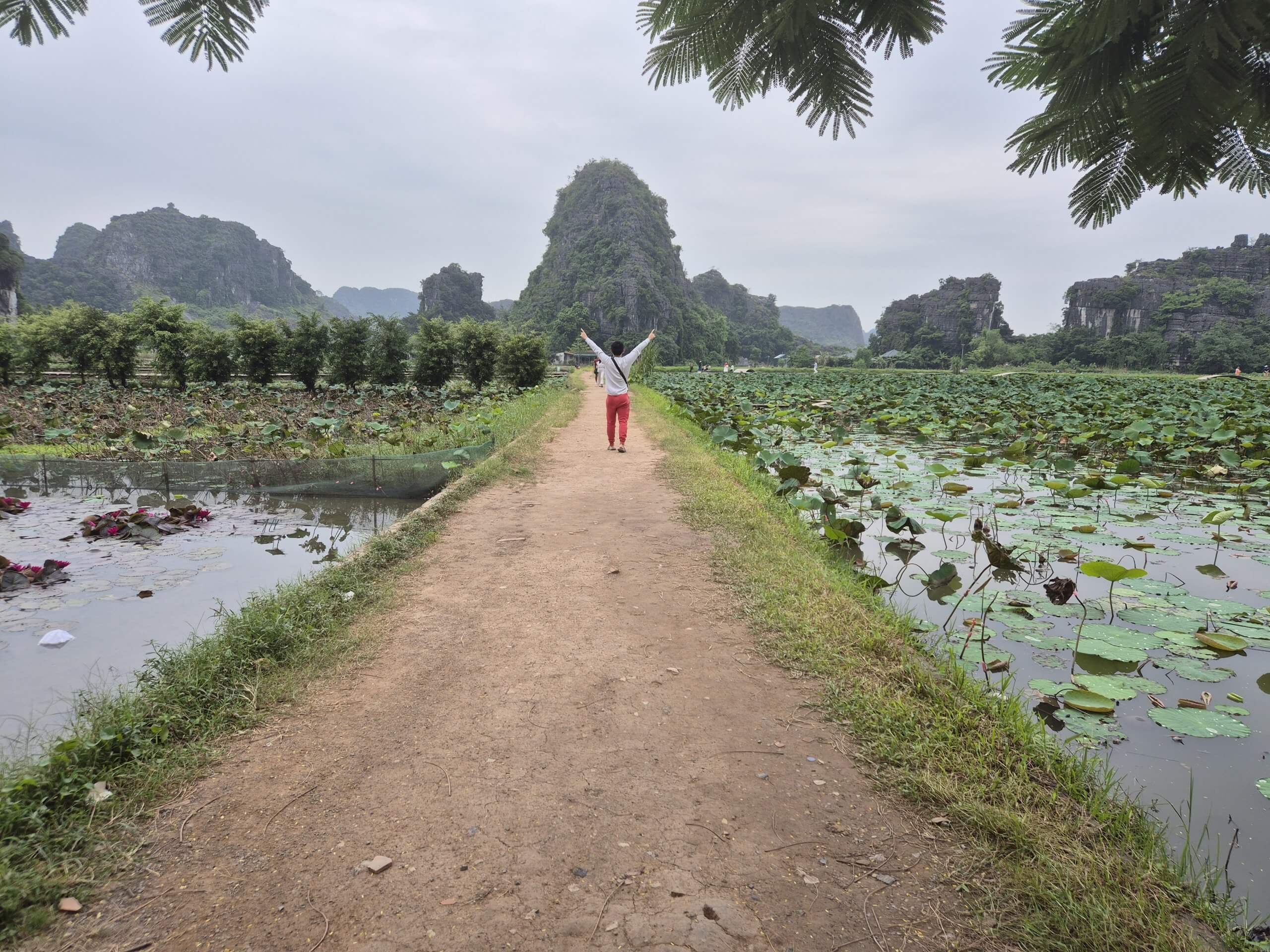
    So we just walk around, talk, guess what we’re supposed to be looking at, take some photos, until we get to the big mountain.

    It’s a lot of stairs. Probably around 500. Maybe even 1,000. Half the people don’t want to climb. But Ngoc and I are gonna climb. The others follow behind.

    The sun is just coming out and we work up a sweat pretty easily. We’re all supposed to be elite athletes, but these stairs are killing us. We rest at each landing, then climb again. Takes a good 20 or 30 minutes.

    We get to the top eventually and there’s a stone dragon up there. Everybody seems to be waiting in line to climb onto it. A few people, mostly older people, take one look at it and shake their head. But most of the young people are up for it. It’s not that easy to climb, and doesn’t look that safe, but since we’re here we climb it anyway. Isn’t that what being a tourist is? Doing stupid shit that makes no sense but it’s what everyone else is doing?

    So me and Ngoc are laughing as we climb onto this stone dragon, it’s not safe at all and I’m sure at least one or two people have died falling off and tumbling down the cliffs beside us. But we climb it all the way to the end, take a photo, then very slowly climb our way back down so more tourist idiots can have their turn at risking their lives.

    The next day, the bus takes us to Bac Giang for the next tournament.

    My memory of Ninh Binh is mostly walking around every single night starving, looking for somewhere to eat. It’s one of my weird habits, I like eating dinner really late, like midnight. I remember on the first night opening up Grab Food, and even on there, not a single meal was available at 11, hotel restaurant closed at 10. That’s what caused me to go wandering, like I did every night after that.

    Kind of ironic for a country where every traveller raves about the food, and most nights I was not even able to find a 7-Eleven to buy a sandwich.

    I’m wondering if Bac Giang will be different.

    We arrive at the hotel and it’s right in the middle of town. Hopefully I’ll be well fed here!

    But the first night, it’s the same weirdness. I go walking for food around 10 p.m. Everything is closed. I finally find a convenience store that closes at midnight, and my dinner for the night is three cans of tuna, a loaf of bread, jackfruit chips and 3 protein Milos.

    The next day I notice it again. After games, I go wandering for lunch at 2 p.m. and everything is closed! What’s going on? Never have I found a country where it’s been so hard to spend my money. Do Vietnamese people just hate money or something?

    I finally ask one of the volunteers at the hotel. Her name is Pop, she can’t be older than 15. I guess only the young people speak English in Vietnam. She tells me, in Vietnam the restaurants just open a couple of hours for lunch, then they close. Then they open at night for a couple of hours for dinner, then they close. So you have to go at those exact hours to eat – between 12 and 2 in the afternoon, and somewhere around 6-9 at night.

    This is one of the weirdest things I’ve seen in all my travels. Even in the poorest parts of Africa, restaurants are open at 3 p.m. Middle of the day – seems like a pretty normal time to be open?

    So Bac Giang ends up being round two of Ninh Binh. Often I wake up from a nap, or finish working, or get home from the stadium around 9. I venture out for food and literally walk around the entire city looking for a restaurant, and can’t find one. There’s about three nights I slam cans of tuna for dinner. It’s hilarious.

    One night, I make it my mission to go looking for dinner at 6 p.m. Even though I’m not hungry at all, I find a nice Japanese restaurant and don’t take my chances walking around any longer. Everything might suddenly close if I do. I enjoy my first real dinner in Vietnam, and it’s Japanese. Shabu shabu pot, dumplings, Coke. It’s amazing.

    I realise the way to finally eat well in Vietnam is force myself to have a normal eating schedule and dine at 6 p.m.

    The next day I make my way to a local steak restaurant, I get there at 8:30 and the guy says, sorry they’re closed. What! Okay what time do you close tomorrow? Same time, he says. I tell him I’ll come early. I get there at 7 the next day. I order way too much food (who knows if I’ll find dinner tomorrow) and spend an hour trying to finish it all.

    The steak is just okay, but I devoured it (even forgot to take a photo), it’s definitely the most calories I’ve had since arriving in the country.

    One night, the volunteers ask how I like Vietnam. I tell them I’m always hungry. They laugh and give me some local snacks. The North Korea team is also at the tournament, and brought some North Korean snacks for the volunteers, which they share with me. One is a dark chocolate with an insane amount of calories. Not bad.

    The rest of my time in Bac Giang is spent doing nothing much, because to be honest, there isn’t much to do.

    I go for a run every day, 7km, 8km, exploring the city’s streets, taking a different route each time.

    At night, I go to the stadium to watch the rest of the tournament (I lost in the first round, again).

    It’s a sleepy city, with a huge town square, a few main streets and then mostly concrete avenues with coffee shops. Like Ninh Binh, very China-esque.

    As the tournaments close, it’s time to head back to Hanoi.

    Now in Hanoi, things are different.

    People love making money here, at least way more than Ninh Binh and Bac Giang.

    You go walking at 10 p.m. and everything is open (even though it’s raining every night).

    You open up Grab Food and there are unlimited choices.

    I’ve lost about 4kg in Bac Giang and Ninh Binh.

    I spend the first week gluttonously replacing calories from two weeks of malnourishment.

    It’s amazing. The rumours are true – in the big city, Vietnam is great for food!

    And then … starts my three weeks in Hanoi. Read about that next!

  • What’s Nigeria Like?

    What’s Nigeria Like?

    The final spot on my West Africa tour after Ghana and Cameroon was the fan favourite Nigeria!

    Despite hearing a lot about Nigeria over the years I wasn’t sure what to expect. It’s supposed to have one of the biggest and fastest growing economies in Africa, but also one of the most complained about countries by tourists. So I guess I was finally going to see for myself.

    The first thing that made an impression was the cost of a visa. Just for a basic one week visit my visa cost was … $311! It’s literally the most expensive visa I’ve ever gotten in almost 70+ countries.

    So … the bar was set pretty high. With a visa costing about the price of a gram of gold, Nigeria better be the best damn country I’ve ever visited in my life!

    My Airbnb was in Victoria Island, which is a place outside of the city centre, where many hotels are and tourists tend to stay. It was a decent drive from the airport, but getting an Uber was not an issue.

    The first thing I did after my long trip (believe it or not, getting from Cameroon to Nigeria was quite a mission, even though they’re right next to each other) was settle in to my new home and order some food! Wasn’t quite time to try my first Nigerian meal, so I just went for a good old Middle Eastern feast.

    Then it was time to do the standard perimeter check. My host assured me it was safe to walk at night, so I went for an evening stroll. There was a small family owned supermarket down the road, which had a decent selection of stuff, and the street was packed with restaurants. It was also packed with locals just loitering around, either standing around a motorbike or a street stand just talking and laughing. All were friendly, and some said hi. I didn’t get many odd stares, so I guessed foreigners were pretty common around the area.

    The next day I took my first drive through Lagos. I was in town for the Lagos International badminton tournament, luckily I have some Nigerian friends who were able to arrange some training courts for us. This required us to drive across town from Victoria Island to Ikeja, a very busy local area.

    The Uber driver was chatty and he told us a lot about Lagos, from the politics to the public transport to the religions. My first impression of seeing Lagos in the daytime – messy. Once outside Victoria Island, traffic was horrible, roads aren’t the best, streets have no real order to them and most buildings are quite run down. Compared to somewhere like Abidjan, which itself is nowhere near perfect, it’s a noticeable difference which surprised me. I expected the opposite for some reason.

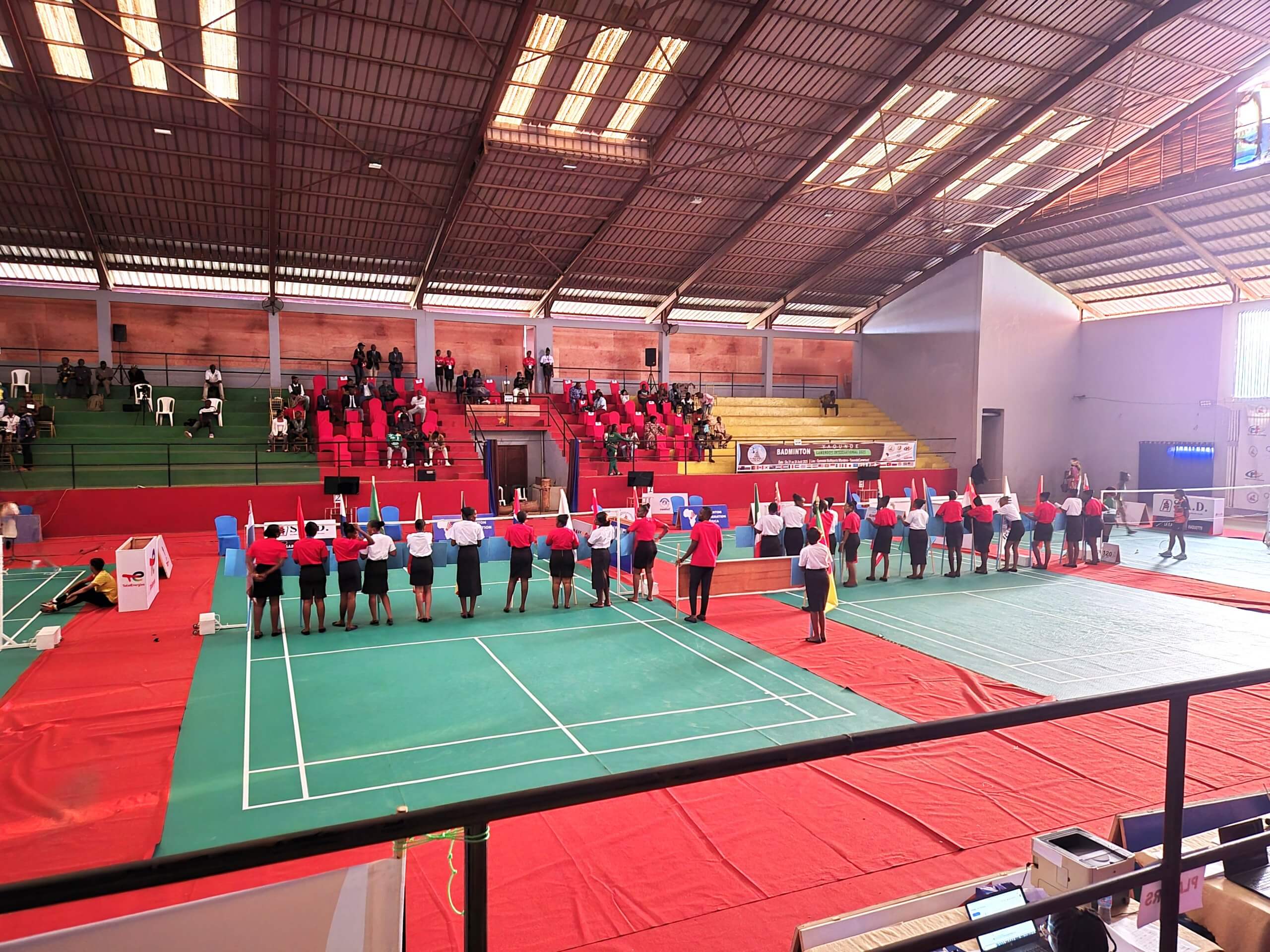
    The tournament started the following day at Teslim Balogun Stadium. It’s a big complex in the middle of the city, and the stadium was definitely an upgrade from Cameroon, which was borderline comical. I was knocked out in the first round, which is never fun, but it also meant I now had four days to explore Lagos! After spending $300+ on a visa, I needed to make the most of it!

    First thing we did was head try the boba place near my apartment. I’ve noticed boba has been becoming more popular in Africa, in Nairobi there are boba spots literally everywhere, but they’re hit and miss. Many don’t actually understand the boba culture, nor do they even understand how to make the pearls properly. Part of a good boba is getting those pearls to jussssssst the right amount of chewy and sweet. Outside of Asia they don’t really get this right in a lot of places.

    We headed to Frosty Pops on Victoria Island, to our surprise it was actually amazing. I watched them make the boba from scratch and they did everything right, and it hit the spot! Wide range of flavours too. If you’re ever hanging on Victoria Island and need a place for a boba and lunch, definitely check it out.

    The next day we had the whole morning free, so we went to check out the beach. Lagos is on the coast so there are a lot of beaches to see, but my local friend took us to Sol Beach – a private beach being developed into a lifestyle area with restaurants and bars etc.

    It cost us about $6 each to get in, which we happily paid. The beach was empty, so we spent some time just laying out on the sand and relaxing, then two friends of mine went down the beach to ride a horse, and got fully scammed. They told them one ride down the beach is N15,000, so they agreed, then they charged them N30,000 because going there and coming back was actually equal to two rides. Nigeria has a reputation for blatant scamming, I guess stuff like this is the reason. But the audacity of this scam just kinda made it funny, we all laughed about it.

    Then lunch rolled around – it was our chance to try the famous Nigerian suya along with some classic fried chicken.

    Naturally we took our food to the tables to eat, then a staff member came and told us we needed to pay an extra fee of N15,000 to use the tables. Excuse me? We all laughed thinking it was a joke, but they were serious. Are we supposed to eat on the floor? So we confusingly took our food back to the beach and sat on some of the chairs there and ate.

    Then the staff member came back and said if we want to use the chairs on the beach we also need to pay an extra fee N30,000 to use the chairs. At this point we were just completely bemused. We had almost finished our food so we just told them we’re going to leave now. We didn’t really see any other option unless we wanted to keep getting charged for everything, maybe next they’ll be telling us we’re breathing in the wrong place and need to pay an extra N50,000 for the oxygen.

    So … Sol Beach? Not my favourite beach in the world, that’s for sure. As for the suya – it’s delicious! Definitely something to try when you’re in town. And it’s also a classic street food, so you should find it everywhere.

    On my final day in Lagos I got the chance to meet up with Chris, an old travel buddy. We met in Thailand way back during out backpacker days and as he’s married to a Nigerian now, Lagos is home. He’s also the face behind the famous Authentic Travelling Instagram page.

    I met him and his lovely wife at Ikeja Mall, which is one of the big malls in Lagos. Chris is a foodie all the way so he took me to eat some classic Nigerian food, I don’t remember exactly what this is but I think it was swallow and egusi.

    Honestly I wasn’t the biggest fan, mostly because I’m not big on spicy food and this thing was spicy! But everyone else at the table was loving it, so I’m guessing it’s good for most people. Give it a try!

    Unfortunately I didn’t have more time to spend in Lagos with Chris or I’m sure he would have had a ton of interesting places to show me, but was a blessing to see him anyway ten years after we first met. That’s the spirit of the traveller’s life anyhow – you can pick it up with old friends right where you left off, no matter how long or how far.

    When it finally came time for me to leave, my friend came to see me off at the airport. He was carrying one of my bags, but when the security guard asked him where he’s travelling, he said he was just escorting me inside. She stopped him for a moment and told him there’s a fee for non-travellers. But he said he didn’t have any cash, then she looked at me and said it’s okay he can pass this time.

    Even after a week, I had kind of gotten used to this. Everywhere you go there is just always someone trying to shave a dollar from you, and if I lived here I think it would drive me insane. Of course this happens everywhere on the continent, and I’ve spent years living in East Africa so it’s not new to me. But in Lagos it was just another level. I can understand why it feels like people are just on edge all the time – because you need to be!

    So final impressions of Nigeria? Well, I only had a week in Lagos, and I was lucky I was amongst local friends who had the time to show me around different places. I can imagine as a solo traveller here, you’d really need to have your guard up, but overall I had a great time. Had a lot of interesting things to eat, caught up with old friends, and got to experience Lagos first hand. I’d always wanted to see this part of West Africa, and I’m glad I finally did.

    One last funny story to finish. About two weeks after I left, I got a phone call on Whatsapp. It was a Nigerian number. I had no idea who it was, but I guessed it was one of my friends calling me on a different number.

    “Hello sir do you remember me? I delivered your food to you on Victoria Island.”

    “In Nigeria?”

    “Yes.”

    “Okay?”

    “Sir my wife is giving birth right now and I really need some help to pay the hospital bill, please sir can you help me?”

    I didn’t even know what to say. I guess even after you leave Nigeria, it’s always still with you somehow!

  • Cameroon’s Capital Is Rough!

    Cameroon’s Capital Is Rough!

    After Ghana, the next stop on my West Africa tour was Cameroon.

    I had high hopes for Cameroon, as I really enjoyed Cote d’Ivoire when I visited some years ago, and as part of francophone Africa I was expecting them to be somewhat similar.

    Well…I was wrong.

    The first drama happened as soon as I landed in Yaoundé, the capital – myself and some other athletes who were also on my flight lost our bags. This was NOT ideal as we had to compete in 48 hours. Luckily only one of my bags got lost, so I still had my rackets and my shoes, but all my clothes were in my other suitcase.

    In the end we were sent away with a form and told they’ll call us when the bags arrive.

    Getting a taxi to the apartment was simple enough, I had to do it the old school haggling way, but I got a nice enough driver who spoke a bit of English.

    The funniest part was when we drove through a police check and he slowed down until the cop came to the side of the car, then zoomed off.

    “I am the chairman!” he said, laughing.

    I later learned that drivers do this all the time – they know the cop is just going to make up some nonsense and ask for money, so they just don’t bother stopping. They know nothing will happen because the police don’t have any police cars to chase them. Pretty funny.

    My apartment for the week turned out to be comfortable, however the area it was in totally disappointed. I had chosen to stay in Bastos, supposedly the nice expat area in Yaoundé, but on my first walkabout the following morning, I discovered there was literally nothing around me.

    One restaurant down the road was the only place to eat within walking distance, there were three restaurants on Google Maps nearby, but when I went looking for them, all were all non-existent.

    Nobody seemed to stare at me too much, meaning foreigners aren’t uncommon in the area, but I was surprised that there were just zero stores or restaurants around.

    To make things worse, there is no Uber or food delivery! In Ghana I had been using Uber and Uber Eats daily, but here things were going to be a lot more interesting. It was like going back to my early backpacking days in 2010 – no phone, no internet – just real-life exploring.

    Since there was nothing in the streets around me, I walked a little futher, and still didn’t find much other than a Chinese supermarket. It wasn’t even a normal store, it was like a house that had been converted into a supermarket, behind a normal residential gate and everything. The only reason I knew it was there was because I saw it on Google Maps. I knocked on the gate, and a local man came out who spoke no English. But I said “supermarket?” in French and he nodded and pointed me in. That already was odd, but once inside, I realised there was also a Chinese restaurant in there.

    I walked in and the owner seemed shocked to see me, but I used my broken Chinese to ask if he’s serving food right now, and he said yes. So it turned out my first meal in Yaoundé was a big plate of Chinese dumplings.

    After returning back home, I went down the road to look for a taxi, and after five minutes I realised – this isn’t going to work. I can’t be walking down here searching for taxis every day when I have a tournament to play.

    I texted my landlord and asked if she knew of a taxi that would be willing to be my driver for the week. I’ll pay him $10 or $20 per day and he can just drive me everywhere. She said she knew the perfect person and sent me a number.

    That’s how I met Richard.

    Richard picked me up the next day and became my one friend in Yaoundé. First stop – take me to the mall to get some groceries.

    The mall he took me to was called Playce Yaoundé, a small but modern shopping mall with mostly clothes shops and a big Carrefour supermarket.

    Since my kitchen wasn’t great, I stocked up on canned goods and survived on tuna, corn and chickpea salads with healthy spoonfuls of olive oil, three times a day, plus a disgusting amount of mandarins and apples for dessert.

    Then later that afternoon, it was time to head to the stadium to practice.

    Richard didn’t actually know where the badminton stadium was, so we had a little adventure hunting for it while we chatted and got to know each other. The big bonus was he spoke great English, unlike most people in Yaoundé, where the dominant language is French.

    One thing you notice while driving around Yaoundé, and forgive me for not taking any photos but it just never crossed my mind, is how poorly designed the city is. The way the roads are laid out and where they’ve built things around the hills, where the shops have been placed and so on, it just makes no sense. So often Richard would be trying to manoeuvre down a road and I was thinking “He’s going to try driving down there?” Sometimes I would laugh, and he’d laugh back, knowing exactly what I was thinking.

    “Welcome to Cameroon!” he would say.

    The following afternoon my bags still hadn’t arrived, so I needed to improvise. I was scheduled to compete the next day, and BWF rules require you to wear a playing kit with your name on the back.

    I told Richard the mission, and off to the mall we went.

    Finding sports gear in there turned out to be harder than I thought. I bought some fake Nike shorts from Carrefour, and then after browsing every store, had to settle with some black cotton tees.

    I explained to Richard I needed someone to print my name on the back, and he knew exactly where to go.

    When we got to the place, there was no indication it was a printing place, or that a business even existed there at all. Just one building in a big row of buildings. It didn’t even have a front door. I followed him down the side alley, up some stairs into a small room, and there I found a bunch of printing machines humming away.

    Richard translated into French what I wanted, and they said they could have it done in a couple of hours. Perfect!

    After dropping me at the stadium, he called me a few hours later saying the printers called and he’s on his way to pick up the shirt. Price – about $4. Seriously I don’t know how I would have survived Yaoundé without him.

    Turns out it was all for nothing though.

    That night, I get a phone call from another athlete. It’s almost midnight.

    “Our bags have arrived!”

    Last time my bags got lost on the way to Thailand, the airline delivered them to my hotel for free. Not the case in Cameroon.

    I call Richard.

    “Are you working now?”

    “I’m always working!”

    “Can you take us to the airport?”

    He picks me up, then we go pick up two other athletes from their hotels. It’s about a one hour drive out to the airport. We drive through the Yaoundé nightlife, streets full of Cameroonians drinking the hours away.

    “What would happen if I walk down this street right now?” I ask Richard.

    “Everything would be stolen from you in five minutes,” he laughs.

    “But what if I’m walking with you?”

    “Ahh with me! Nothing can happen if you’re with me.”

    We all laugh.

    We get to the airport and head to the luggage desk. They point us to a huge stack of bags in the corner, but none of our bags are there. Please tell me we didn’t come all this way with no bags.

    Then a guy calls us over. We follow him into a room in the back. Once he opens the door, we see our bags right there in front of us.

    “Phew!” we all sigh with relief.

    “So you’re happy?” the man says loudly.

    “Yes very happy thank you.”

    “I also want to be happy,” he says, staring at us.

    The other two guys freeze. It’s their first time in Africa.

    “Ah we don’t have anything, man.”

    “You have something…”

    “We really didn’t come with anything,” I say, pulling out my pockets.

    “Okay just go,” he says, waving us out.

    As we’re walking back to Richard’s car, they say to me, “That guy wanted money, right?”

    I nod.

    “Oh man!”

    Yeah, it used to shock me too, mate.

    The next day, after I’d finished my games, I went walking around the stadium to try and find something to eat. If I’m in Cameroon, I need to try some Cameroonian food, right? So I went searching. The main street by the stadium looked busy enough to have some food options, but also didn’t look like the safest street in the world. I left my bag in the stadium so nobody could rob me, and went wandering. Ten minutes in and I’d found a few small shops selling things like burgers and chips, samosas, but as for a local food joint that didn’t look like it would nuke my stomach … nothing.

    This seemed to characterise a lot of my week in Cameroon – wanting to see and try things, but not finding much to see and try.

    I called Richard to come pick me up. When we arrived home, I reached into the front pocket of my bag to pay him. It was empty. I grunted with a puzzled look on my face. Richard’s face quickly changed to the same look. He knows that’s where I keep my cash, because I pull it from there to pay him each day.

    “My money’s gone.”

    I searched all the other pockets in my bag, then just quietly laughed to myself. Someone robbed me. Obviously while I was outside the stadium hunting for food.

    “Sorry man I’ll need to pay you tomorrow.”

    “No problem, no problem.”

    The rest of my days in Cameroon were just sitting in the stadium, sitting in traffic with Richard, and eating tuna and corn salads in my apartment.

    By the time I left, myself and some other athletes were chatting and we all agreed, Cameroon is pretty rough. Many people seem to be on edge all the time, there’s a palpable tension in the air. And after you’ve spent a week there, you sorta understand why. Things are just not easy, even the most basic things like finding somewhere to eat lunch.

    I’ll be honest – once I hopped on the plane, I was happy to be leaving. Next stop – Nigeria!

  • A Very Normal Week In Accra, Ghana

    A Very Normal Week In Accra, Ghana

    Getting to Ghana was actually much more difficult than it should be.

    I was heading there for a badminton tournament and needed a tourist visa, which on its own sounds like no big deal.

    I was in Dubai at the time, so I called the Ghana embassy and asked for an appointment. When I told them I’m on a New Zealand passport, they said it needs to be done at the embassy in New Zealand.

    “So you’re saying I have to fly 17 hours to New Zealand, get the visa and fly 17 hours back?”

    “Yes.”

    “Can I send my passport to New Zealand and have them send it back?”

    “No.”

    “I have to be there in person?”

    “Yes.”

    “For a one week tourist visa?”

    “Yes.”

    Sounded kinda silly for 2026. So what did I do? I do what every man does when he doesn’t know what to do.

    I called Mama!

    I told her to call the embassy in New Zealand, explain that I’m a travelling athlete and if it was possible for me to DHL the passport to her, get the visa, and then she can DHL back to me.

    The good folks at the Ghana Embassy in New Zealand said that would be fine, but to guarantee it in a week I needed to get the express visa for a few hundred dollars extra. But after spending a few hundred on DHL fees, what’s a few hundred more?

    After a couple of weeks, I had my passport back in Dubai with my shiny new Ghana visa.

    First impressions after touching down?

    Ghana drivers are crazy! I’ve travelled much of Africa, and road rules aren’t really followed anywhere, but in Accra they literally drive as if they’re playing Need For Speed. On the way from the airport to my Airbnb, I figured I just got a wild driver, but it turned out all my Uber drivers the entire week were like that.

    My apartment was in the Osu area, and at least according to ChatGPT, it was supposed to be one of the upmarket areas where the expats stay.

    Note: If you’re heading to Accra, I stayed at this apartment which was perfect for my needs, but the area was so-so.

    Next time I go to Accra I will likely stay somewhere around Accra Mall which I think is much better for a short stay, somewhere like this apartment.

    There are also many other affordable options all over Accra on Booking if you have a different area in mind.

    On the morning I arrived, I put on my walking shoes and went for my first scouting mission of the neighbourhood. Sorry to report that I was quite underwhelmed with this “nice expat area”, it was rougher than I expected. However, it did feel safe to walk and nobody gave me any strange stares, so I guess foreigners are a common sight around there, even though I felt like I was the only one at the time.

    I walked about an hour and the place I decided on for my first meal was going to be at a smoothie spot called Nourish Labs. They have a mixture of tuna, salad and apple that they called “pocholala” and the waitress convinced me it was delicious so I tried it…and it was!

    Then it was time to check out the beach. The reason I had picked this particular Airbnb was because it was just a few minutes walk from the ocean, at least that’s what Google Maps told me. Just turn left, walk straight and you’ll be at Osu Beach in no time!

    Reality turned out to be a little different – as I walked the three or four blocks towards the water, things started getting rougher and rougher until I found myself in an area I really didn’t feel like I was supposed to be in. Nothing new in Africa – that happens in almost every country I’ve been to, but the road Google Maps was telling me to get to the beach looked to be some kind of private/village/alley type of road?

    I decided, probably I shouldn’t go wandering down there on my first day in Ghana so decided to go back home and ask my security guard a few questions before coming back.

    The next day I headed for the badminton stadium. I was here for the Ghana International which was hosted at Borteyman Stadium – an impressive complex built for the African Games in 2024.

    It feels like it’s in the middle of nowhere because there seems to be nothing else around it, and a lot of Uber drivers seemed to not where it was exactly. But inside the facilities were good and better than most tournaments I’ve played in Africa. This is where I spent most of my week!

    Funny story from the following morning. I woke up and wanted some fruit so went looking for mangoes. There’s a small street stall just on the corner of my apartment, so I went looking at her small table of fruit and only found oranges, papayas, watermelons, avocados, but no mangoes. I asked if she had mangoes.

    “Oh that’s my sister’s stall, let me call her.”

    Then she screams at the top of her lungs for her sister to come out, and keeps screaming eight or nine times for at least a few minutes until her sister finally appears.

    “Do you have mangoes?” I ask.

    “Mangoes are here!” she says, and under the papayas there are indeed a couple of mangoes.

    I grab one.

    “How much?”

    “Eighty” she says in her friendly big mama voice.

    Now, eighty Ghanaian cedi is equal to about $7, but since it’s my second day in Ghana (and first day shopping) I don’t actually know this and haven’t bothered to check. I have a pocket full of 100 cedi bills, and I don’t always carry my phone when I go walking, so I can’t check. So the price is eighty, no problem.

    So I take the mango, then I ask, “How much are the oranges?”

    “Oranges are four.”

    So I take five oranges and I say to her, “So five oranges are 20, and the mango is 80, so that should be 100, right?” and I hand her a 100 cedi bill.

    And she looks at me with a bemused face, and then looks at the money, and looks at me again, even more bemused, and finally says, “Okay!” and gives me a huge smile, and I walk off thinking, that was weird, did I calculate wrong or something? Why was she so confused?

    It’s not until that night when I go to order some groceries online, and I see the price of oranges are indeed around 5 cedi, but the price of mangoes are about 10 cedi.

    And I realise, when I asked the price of mangoes, she wasn’t saying “eighty” she was saying “eight”. Just with the Ghanaian accent, the T on the end is hard so it sounded like eighty. So there I was giving her eighty cedi when she only asked for eight cedi, and of course she accepted it with glee once she figured out what was happening, and I’m here laughing in my apartment that I ripped myself off, but also happy that an extra $7 probably made someone’s day.

    During the days I was competing, I tried to not be too adventurous with food, so I was mostly ordering Chinese and Korean, or cooking my own. Surprisingly the Korean food there was really good. I think I ordered from the same place three times at least.

    Next thing I had to do was try some Ghanaian food! On my free day I went looking for a popular cafe not far from my apartment, apparently some of the best local food in the area.

    When I arrived looking like the typical lost tourist a waitress pointed me to a table and told me the menu.

    I told her to just bring me the most popular thing because it’s my first time eating Ghanaian food. She said she’ll bring me okra lamb and banku – I said fine!

    The banku is a type of pounded cassava, and the okra and lamb is like a traditional stew. I told her I didn’t want anything spicy, but she said in Ghana that’s not possible.

    I didn’t expect it to be that spicy, I think I needed two bottles of water to finish it and a twenty serviettes to wipe away my sweat, but I finished it. Pretty good!

    On my final day, I decided I couldn’t leave Accra without seeing the beach – it’s the whole reason I tried to stay near the beach after all. I grabbed an Uber and took a ride down to one of the resorts near Labidi Beach to have dinner.

    This time I tried more Ghanaian food – lentils with yam fries and fried bananas.

    This was too oily for me and stopped being enjoyable after the first five bites or so, would be good as a daytime snack though.

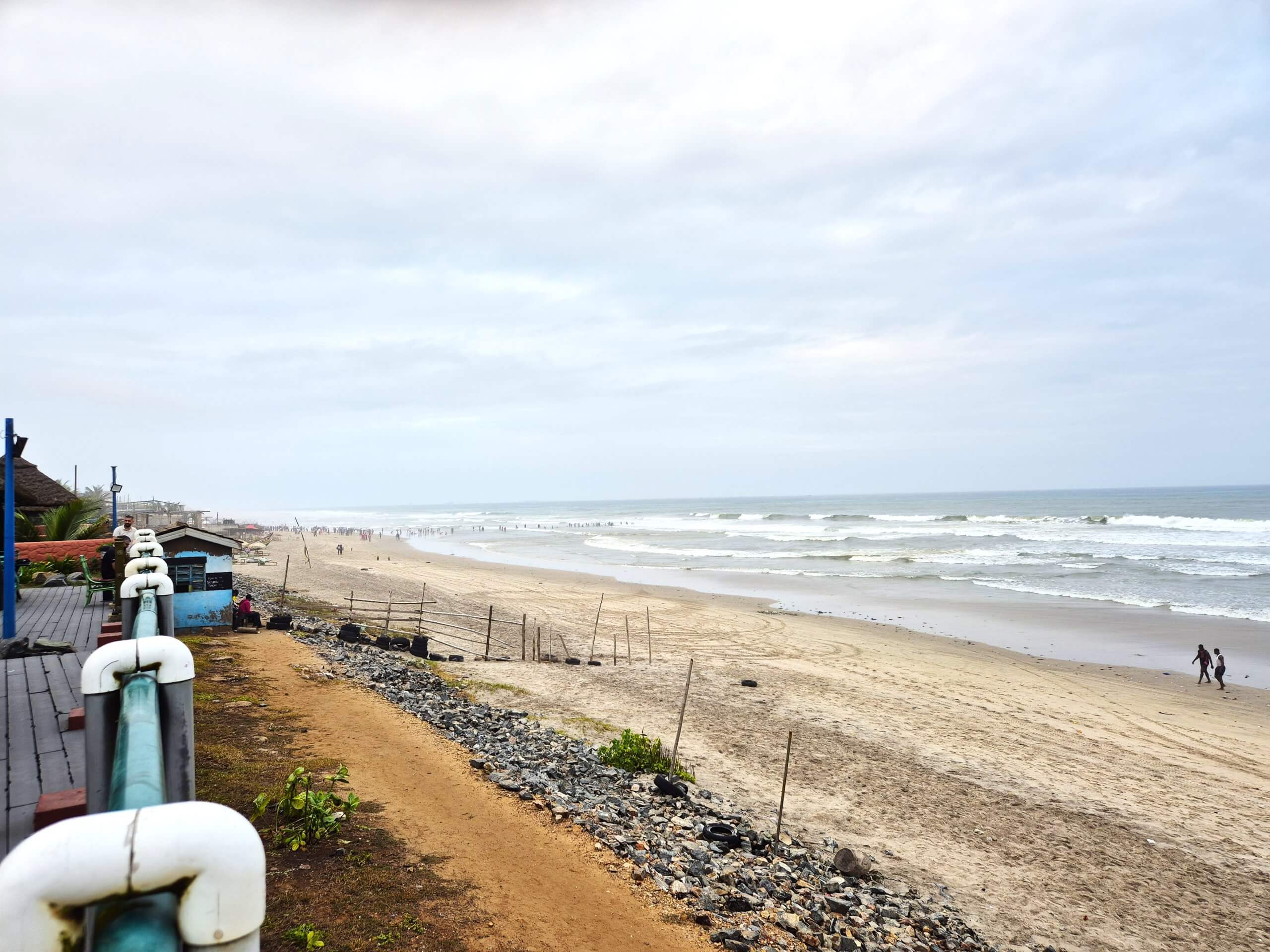
    As for the beach – well, it wasn’t much to look at to be honest, certainly not somewhere I would want to swim. But having some food on a warm night overlooking the ocean – a great way to end my trip to Accra nonetheless.

    Final thoughts on Accra?

    I had expected Ghana to be much more developed than it was – I’m not sure why but there’s a perception that the west of Africa is much more modern than the east. In my experience this hasn’t been so true. It was also much sleepier and less busy than I expected.

    My longest conversations about the country were with the Uber drivers during my 40 minute drive to the stadium each day, and we talked about all the usual things – politics, work, women, travel. My impression was it’s slow, but also stable and reasonably safe by Africa standards. Definitely much more pleasant than somewhere like Cameroon, though I think their neighbour Cote d’Ivoire was a step ahead in most things.

    Should you visit? Absolutely! It seems like the type of place where the longer you stay, the more you’ll find and fall in love with the place. Bonus if you like spicy food!

  • What Are The Best Beaches On Rarotonga? A Local’s Guide

    What Are The Best Beaches On Rarotonga? A Local’s Guide

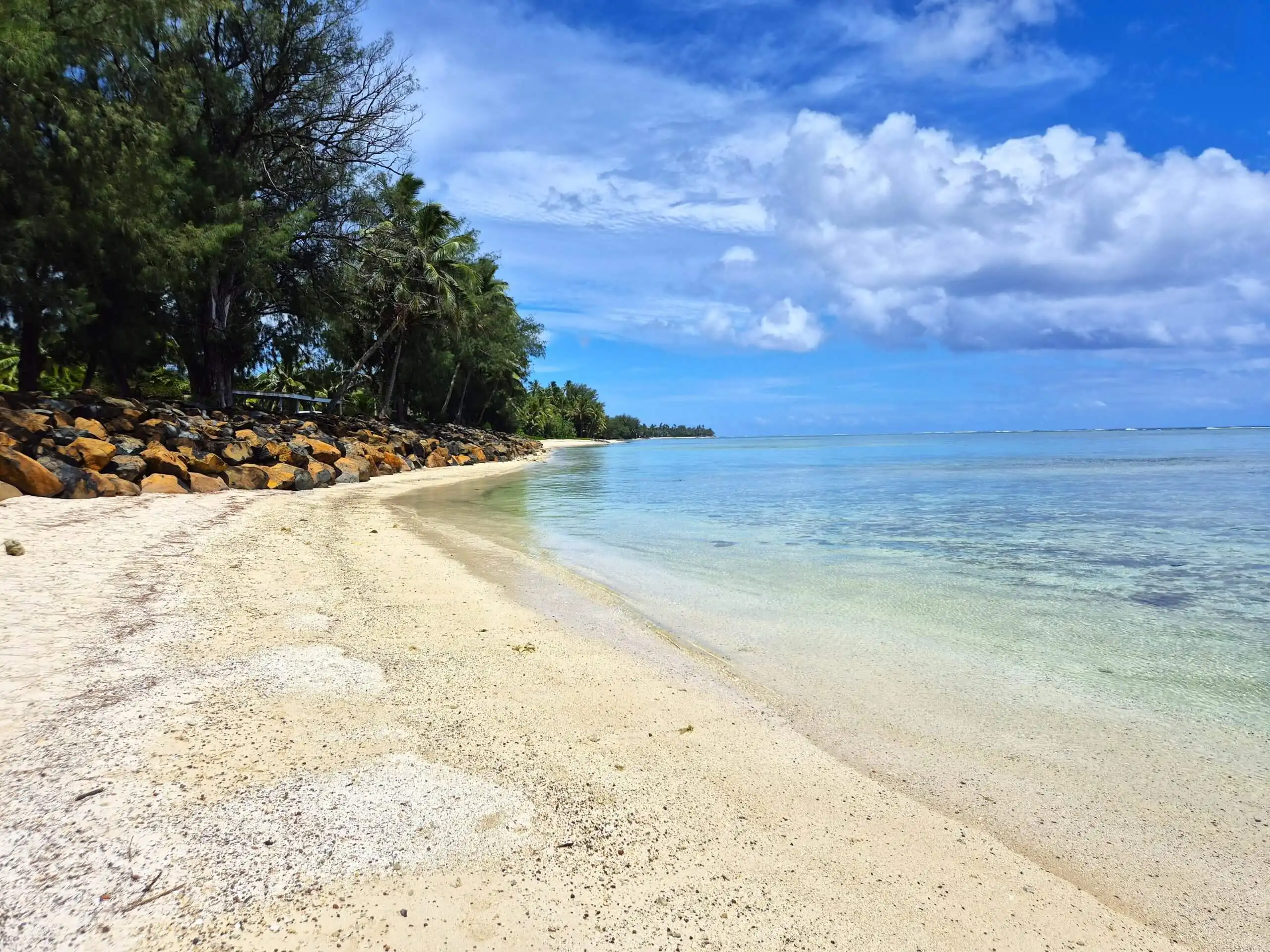
    If you’re coming to Rarotonga, it’s likely you’ll be spending a lot of time at the beach.

    I’ve been all over the world and the Cook Islands has the best beaches I’ve ever seen. Period!

    • The water is crystal clear.
    • The water is WARM.
    • The sand is soft and golden.
    • There are all kinds of fish, starfish, crabs, corals, turtles to enjoy – you don’t even need to take a boat out somewhere, they’re just metres from the shore.
    • The beach is always close! No matter where you stay on the island, you will be no more than a five minute drive from the beach, and probably much closer.
    • Best part – the beaches are empty! Even during busy season, you will have no trouble finding a quiet beach with just a handful of people, or even nobody!

    While you might find a beach somewhere in the world with softer sand or warmer water or whatever else, you will be hard pressed to find a beach that has all of the above.

    While Rarotonga is small, there are definitely good beaches and better beaches and the best beaches, so in this guide I’m going to break down for you all the top beaches in Rarotonga and which ones you might enjoy the most.

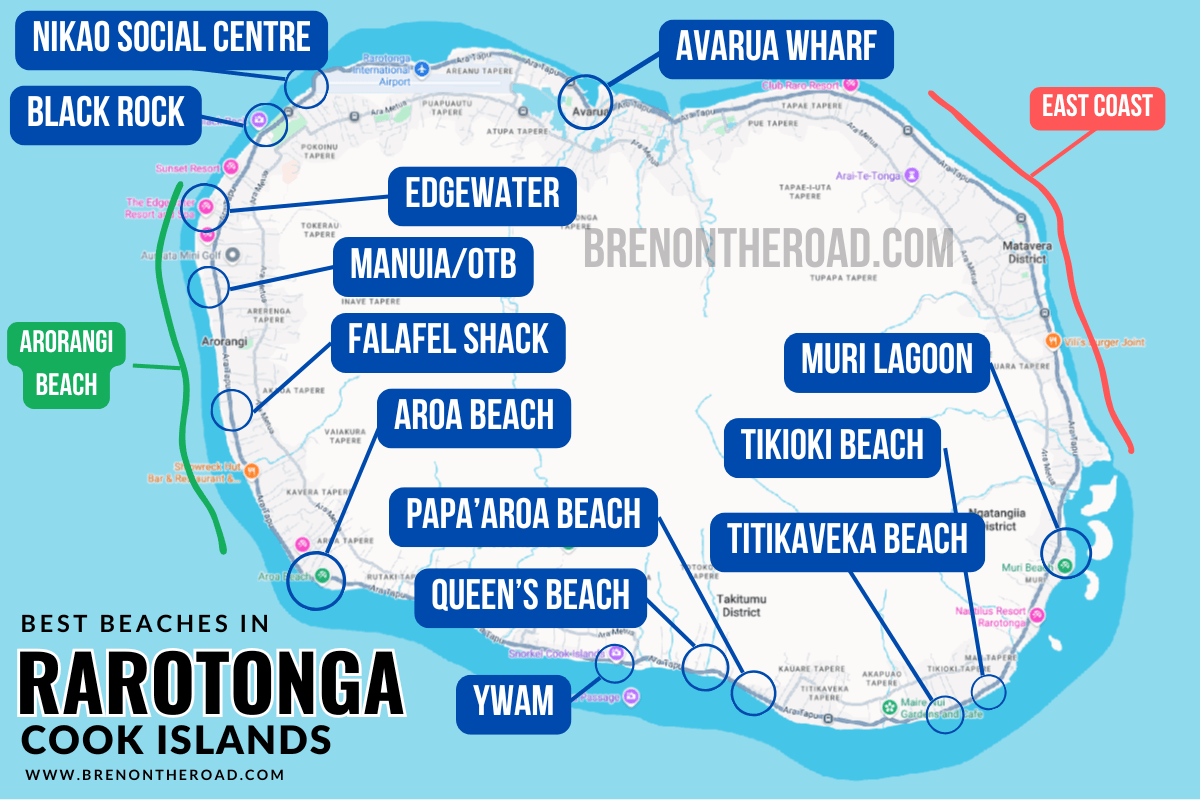
    Map Of Rarotonga Beaches

    As you go through the guide, refer to this map to locate the beaches I’m talking about.

    Rarotonga is not a big island (you can drive around it in less than an hour) but knowing exactly which spot on the island you’re driving towards will be very helpful to you as you hunt down these spots.

    Arorangi Beach

    Arorangi is located on the western side of the island, and that entire stretch can be considered Arorangi Beach.

    The water is calm on this side (usually), as there is a reef about 300 metres out that locks the water in like a swimming pool. Not quite as calm as the south side of the island, but still great for relaxing and snorkelling.

    Arorangi Beach stretches for about 5 kilometres, and you can find some truly beautiful spots for a quiet day in the sand. Let me break down some of them for you.

    Edgewater

    Edgewater is a popular resort in Rarotonga, as they’re well-known for doing packages with Air NZ. The beach outside Edgewater is a decent spot for snorkelling, but far from the best on the island.

    If you’re staying at Edgewater though, it’s a good spot to enjoy since it’s right on your doorstep, the water is usually clean and not too choppy.

    Manuia Resort and OTB (On The Beach) Restaurant

    This is a bit further south from Edgewater, and the beach here is slightly better because the water is often calmer and the sand is a bit less shelly. The water is crystal clear! OTB also has a fantastic restaurant that opens out onto the sand. Even if you’re not staying at the hotel, you’re welcome to come in and have a drink, and the beach is not private, meaning you can just walk down from any public entry point (it’s about a fifteen minute walk along the beach from Edgewater).

    Great spot to spend a day and some lunch or dinner at OTB.

    In my opinion this is also the best spot on the island to enjoy the sunset. Truly breathtaking!

    You can get here by simply walking along the beach until you see the OTB pool and restaurant opening out onto the sand, or if you’re coming for lunch, just enter through the road at Manuia Resort.

    Raro Backpackers/Falafel Shack

    Another kilometre down you have Falafel Shack. This is an unassuming tent on the grassy bank just behind the sand that sells Mediterranean food and wraps and just good fast meals that are perfect for a beach day.

    They’re well known on the island and you should see the little “Falafel Shack” sign on the road as you’re driving through Arorangi.

    The beach here is gorgeous and again, clear like a swimming pool. If you want a chilled out spot to enjoy some beach bumming with delicious, affordable food on hand, this is the perfect spot.

    If you walk just a few minutes north, you’ll come to Raro Backpackers which is also a great spot for swimming. You’ll know it from the swing hanging outside the bungalows.

    Aroa Beach

    As you head south from Arorangi, just before you reach the Rarotongan Hotel, you’ll find a spot that many consider the best beach on Rarotonga for snorkelling (not me – my favourite is shared further below!)

    Some people just call it “The Rarotongan Beach” as it leads into the Rarotongan Resort on one end, but its proper name is Aroa Beach.

    The reason people rate is so highly is because the water is deep, glassy, and there are lots of fish and other marine life around. In other parts of Arorangi Beach you can be dodging rocks and coral because the water is quite shallow, but here you won’t have that issue and it’s a couple metres deep in most places.

    When I lived on Rarotonga there was a swim club that set up lane ropes here like a swimming pool, and we’d do training laps with the triathletes and swimmers, because it really is like one big pool in the ocean. And the water is spotless!

    To get here, keep driving south towards the Rarotongan until you come to this parking bay, just opposite the Kaena Restaurant.

    Beautiful spot – definitely check it out.

    YWAM

    This is the “swim with the turtles” spot.

    When I lived on Raro I came here alone, which was okay because people thought I was a local and I’m also a competitive swimmer. However – if you’re a tourist, do not come swimming here alone.

    The currents here are very strong (it’s true – I can attest) and several people have even died here in the past. It’s one of the few places on the island that has swimming warning signs up that warn you not to swim without a guide or lifeguard.

    As a result the government requires you to only swim here with a qualified guide, of which there are several. If you do come alone, you may get asked to leave, and there are private property signs all over the place.

    The turtles are quite incredible though, so if you’d like to swim with them, definitely sign up for a tour and take your GoPro!

    Just look for YWAM on the map, you’ll see all the turtle tour and private property signs right beside it.

    Queen’s Beach

    I don’t know the real name of this beach, my friends call it Queen’s Beach because it’s opposite the residence of the Queen’s Representative.

    Everyone knows it though, because you drive past it often and it’s marked with the blue logs along the footpath.

    Beautiful beach to the see the sunset, and the sand and water itself is also stunning, the only issue is it’s quite small, and there aren’t many trees for shade.

    Great place to take a swim though – I swim there often as the water is often calm and very clear!

    To get here, just look for the Residence of the Representative Of The Queen on Google Maps and look out for the blue logs as you drive by. If you’re walking on Papa’aroa Beach, you’ll naturally cross past here too.

    Papa’Aroa Beach

    For which Raro beaches have truly taken my breath away, Papa’Aroa at sunset is top of the list.

    On a clear day, the water is so unbelievably clear, the sand so soft and white, and the sunset reinforces your belief that God must be real because how else is something so beautiful even possible?

    I used to live near here and taking a morning and evening walk on this beach each day was always the highlight of my day. Definitely one of the best beaches on the Cook Islands for strolling!

    Depending on the season, the water can be a bit rougher and the sand can get a bit rocky/shelly, but it’s still a gorgeous beach to walk.

    The downside is there isn’t much else around, so bring your own drinks and snacks.

    To get to Papa’aroa Beach, just look for Papa’aroa College on Google Maps, the parking bay for the beach is right opposite. It’s also marked as “Tu Meke Beach” on Google Maps.

    Titikaveka Beach

    Personally I think this beach is overrated, people think it’s top tier but I never found it that impressive.

    A good place to enjoy Titikaveka Beach is Charlies Restaurant which overlooks the water, the food there is excellent so you can go for a well deserved feed after an afternoon of swimming.

    Part of the reason the beach isn’t that great is because many expensive resorts are around here and their beach access is private.

    However, you can still get there by entering at a place like Charlie’s and walking down (none of the beach itself is private, only the access roads).

    The beach is quite long so feel free to go walkabouts and explore – it stretches a good distance on either side.

    Tikioki Beach

    Tikioki Beach has a special place in my heart – I lived in Tikioki on my first stay in Raro and did my swim training here. It’s a beautiful, secluded spot where the water is deep and azure blue, I used to feel like I was swimming in my own personal fish tank.

    The water can be 50/50 – it’s choppy on some days and pure glass on others, so you just need to work with the weather. But when you get a good day, this is definitely the best snorkelling spot on the island if you ask me!

    To get to Tikioki Beach, the best place to access is to look for Fruits of Rarotonga (it’s a small cafe) which you should find on Google Maps. A small parking bay is just opposite which is for Tikioki Beach. You can also look for Chantal’s Concierge which is right beside Fruits Of Rarotonga. Chantal’s rent out snorkelling gear and give you a place to leave your car keys/belongings.

    This is not a well known spot, so keep it hush, and enjoy it!

    Muri Lagoon

    The Muri Lagoon is probably the most famous beach spot on Rarotonga, maybe on par with Aroa Beach, and one of the top beaches in the Cook Islands. Many of the top resorts are located on this beach or close by. It’s not a surprise – the lagoon is beautiful and straight out of a postcard.

    There are a couple of small islands people like to swim or paddle to on a SUP or kayak, and also boat tours run throughout the day.

    The best way to get to the Muri Lagoon is to look for the road that heads to Muri Beach Club Hotel.

    Turn down and drive past the netball courts, when you get to the Muri Beach Club, don’t turn in, just keep driving, and you’ll come to the public parking lot, just outside the sports club.

    This might be the best place on the island to enjoy a true day at the beach – boat rides, kayaks, snorkelling, lots of white sand to sunbathe and enjoy a picnic of your own. You can also try the food at Muri Beach Club, who will be happy to serve you. It’s excellent!

    East Coast

    The East Coast of the island is not great for beaching – the water is usually more choppy and rocky along this coastline and not many spots are frequented by beachgoers.

    You can still explore the coast on this side but the other areas in this list are much better for enjoying a day of sand and sun.

    Nikao Social Centre

    Nikao Social Centre is a local favourite, and near Christmas time it’s a tradition for families to set up tents along here and literally live on this beach for a few weeks.

    It’s a long flat beach with beautiful calm and warm waters, and most days there are food trucks in the Nikao Market just behind the sand selling things like fish and chips, ice cream, pizza and so on.

    On a clear day, you can expect a lot of locals coming to spend the day here, setting up umbrellas on the sand and enjoying a family day with picnics, swimming sand and fun!

    To get to Nikao Social Centre, just keep driving along the main road and look for the volleyball courts – you should see the Nikao Social Centre sign just opposite.

    Black Rock

    Leaving the best ’til last, we have Black Rock.

    Just a few minutes down the road from Nikao Social Centre, Black Rock is exactly what the name suggests – it’s a big black rock sitting the ocean, and around the rock is a favourite swimming spot for locals.

    You’ll park atop a low cliff, and then climb down the rocks (it’s not that steep, don’t worry) to get to the water.

    What makes Black Rock so great?

    Firstly, this is the cleanest ocean on Raro. First, because it’s not close to any hotels, so there is no dumping or runoff here.

    Secondly, the way this part of the ocean is set up, it’s like a lagoon but the water gets flushed on both sides. So there are large amounts of fresh water being washed in and out every day. Everywhere on Raro has clear water, but Black Rock is exceptional.

    Finally, the water is glassy and it really is like a big swimming pool.

    The downside of Black Rock is there’s no restaurant or hotel or food trucks up on the sand like there are on most other popular beaches on Raro, but if you’re looking for beautiful clear water to swim in, there’s no better spot than here.

    Black Rock isn’t hard to find – if you head towards it on the map, you’ll come to this parking bay. Park there and you’ll see the rock at the bottom of the rock cliff.

    Heading To Rarotonga?

    Looking for tours and activities at an affordable price? I use GetYourGuide! Always great deals and local perks.

    For travel insurance, I always use World Nomads – get protected for just a few dollars a day!

    Somewhere to stay? Booking.com gives you the biggest selection and the best rates.

    You might also want to check out my Rarotonga Accommodation Guide for help on where to stay!

  • A Visit To The Gold Souk In Dubai

    A Visit To The Gold Souk In Dubai

    If you’re in Dubai, a visit to the Gold Souk is a staple on the list of things to see.

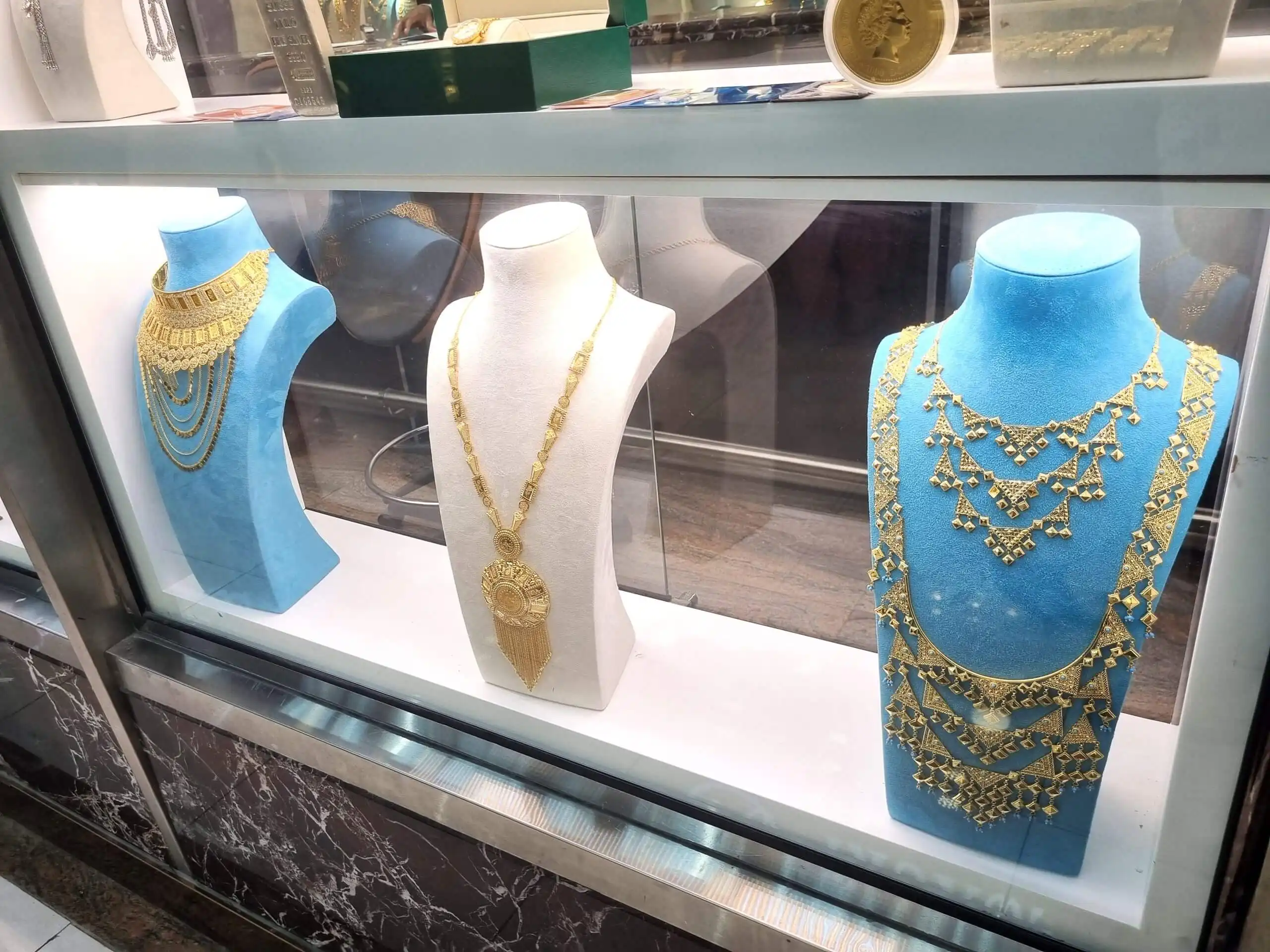
    Well known as one of the safest and cheapest places in the world to buy gold, people from all over the world flock here to buy gold jewellery, gold coins, gold bars, gold decorations, and pretty much anything made of gold you can imagine.

    I spent a day at the gold souk on my last visit to Dubai and wandered as many stores as my legs would allow, and then bought myself a little something to take home as well.

    Let me take you through everything you need to know, so whether you’re going on a gold shopping spree or just taking in the golden sights, you won’t be left cluelessly wandering the alleys wondering what’s going on!

    How To Get To The Gold Souk

    The Gold Souk is located in Deira.

    It’s an area of Dubai that’s known for cheap shopping and restaurants, situated near the airport. You can easily get their by car, taxi, or using the public metro (take the Green Line to the Al Ras or Gold Souq metro stations. It’s a short five minute walk from either one).

    However you decide to get there, you want to be heading towards the “Dubai Gold Souk” on Google Maps.

    There are many entrances to the souk (technically souks – plural) which won’t be hard to find once you get into the general area.

    All should be signposted and so just keep your eyes open and follow the map!

    What Can You Buy At The Gold Souk?

    For luxury lovers, the gold souq is a little Disneyland.

    There are so many things you’d never imagine could be made of gold, from shoes to homewares to full sets of clothing.

    Of course, most places still focus on the standard jewellery items like necklaces, rings etc.

    In the main souq, you’ll find the higher priced stuff, which includes everything from basic jewellery to royal style decorations and adornments.

    What most people don’t know is while there is an “official” gold souk, the entire area is a gold trading area, so there are other malls and souks in the surrounding blocks that are also great places to shop for gold.

    The main souk will have the most reputable brands, and the biggest crowds too.

    So, once you’ve exhausted the gold souk and still want more, keep exploring! There are many gold traders in the area worth checking out.

    How To Buy Gold At The Gold Souq?

    Almost all the shops in the Gold Souk follow the same system.

    First, you have the price of gold. This is standard and you should be able to see it published on screens around the souq.

    You can see there are four different prices here, which relate to the different purities of gold.

    • 24 carat gold is the purest, but also the softest, so it’s generally not recommended for everyday jewellery.
    • 22 carat gold is the next purest. This means it’s mixed with a small amount of other alloys like copper or nickel to make it harder and less malleable.
    • 21 carat and 18 carat golds are mixed with higher amounts of alloys to make them even tougher, but obviously this brings purity down even more.

    Whatever type of gold you want to buy comes down to your own intentions and preferences.

    If you want gold as an investment you might prefer 24k gold, but for a ring or bracelet that might get knocked around a bit, 21k or 18k might be more suitable.

    The next step is to determine the weight of whatever you’re buying, because that will determine the price!

    Every item for sale will be based on weight, and this weight is usually printed on the item label.

    For example, here’s a gold chain I ended up buying which you can see has a weight of 4.42 grams:

    You can also see on the tag this is 22k gold. At the time the rate was 286 AED ($78 USD) per gram.

    This means for the gold only, the cost would be 4.42 grams x 286 AED per gram = 1,264 AED.

    The next component of the price is the maker’s fee.

    A maker fee is exactly what the name suggests – it’s the markup the jeweller adds for time and labour to actually make the item into a bracelet or necklace or whatever you’re buying.

    For this particular jeweller, the maker fee was 9.9%, which came out to 125 AED.

    The final part of the price is your VAT, which in Dubai is 5% (you can get this refunded at the airport when you leave).

    This gives a final price of 1264 + 125 + 70 VAT = 1,458 AED or $397 USD.

    All the prices are negotiable, but in reality 4g is a pretty small item and these shops are used to dealing in hundreds or even thousands of grams. So for a maker fee of 125 AED ($30 USD) don’t expect to shave off too much!

    For example on this item I got him to bring his maker fee down from 125 to 100, which wasn’t too hard. He probably would have gone for 75 if I’d really pushed him for it.

    This is the general process for building most things in the Gold Souk, unless you’re buying an exceptional amount of gold or a very intricate piece which might garner you some special treatment.

    Zero Maker Fees?

    Yes! You can find places with zero makers fees, meaning you’ll only pay for the price of gold and VAT.

    These places get their gold at wholesale discounts and make very basic jewellery, so their business is all about big volume.

    Why didn’t I buy something with zero maker fees?

    Well, after spending several hours looking at zero-maker-fee jewellery, you can tell the design and craftsmanship is lower quality.

    After I got the quote for the chain I showed above, I actually went and looked at maybe a hundred chains with zero-maker fees in many different shops, and none of them were as nice. To me it was worth paying $30 extra to get a better-made item, so I ended up going back and buying that one, even though that hadn’t been my plan.

    I think most people feel this way, because the zero-maker shops aren’t really that common – there are a few but maker fees are the norm definitely.

    However, if price is the biggest factor then the zero fee spots are definitely what you want. It’s the cheapest gold you’ll find here. The Gold Center is a good place to start for zero-maker stores, just a few minutes walk from the main Gold Souk entrance. You’ll find some of the best Dubai gold souk deals around here.

    Is the gold real?

    The only way to know if your gold is real is to have it independently tested.

    There are places to do that around the Gold Souk, but even better would be to have it tested at a jeweller or lab back home.

    However, there’s a reason the Dubai Gold Souk is one of the most popular places in the world to buy gold.

    Not only are the prices among the lowest, but the reliability is also world-renowned.

    The Dubai gold trade is extremely heavily regulated by the UAE government, as places like the Gold Souk are important to their economy and reputation. Agents regularly spot check stores at random, testing some of their stock at labs to make sure it’s genuine gold. Anyone selling fake gold is harshly punished. Obviously all fake gold selling is illegal, and police take complaints seriously.

    A friend of mine who’s a well-known businessman in Dubai for over a decade explained to me – it’s not worth trying to sell fake gold in the Gold Souk, as if you’re caught the punishment is so severe that you’d be stupid to even attempt it. On the black market might be a different story, but for official stores in the souq it’s nearly unheard of. There’s a reason it’s one of the busiest gold markets in the world.

    However! That doesn’t mean you can’t get scammed or end up with fake gold. But with a bit of common sense, you should be able to shop confidently. Here’s how to ensure you don’t get scammed at the gold souk:

    • Only buy from official storefronts! Don’t let touts convince you to go wandering down back alleys to hidden or “secret’ stores, no matter how good their prices sound or how good their jewellery looks.
    • Don’t use middlemen! There may be individuals who offer to show you the “best” spots. Kindly decline and insist you want to shop alone.
    • The magnet test – if you want to be double careful, you can ask for a magnet, or carry one with you. Real gold is not magnetic, but many other alloys are, so if it attracts to the magnet, it’s fake (not foolproof, but useful). Genuine store owners will have no problem doing this test for you. Remember – make sure you do it before you take the item out of the store.
    • After you agree to buy an item, don’t let it out of your sight while they package it. Insist they package it in front of you so it’s not switched.
    • Always make them weigh it in front of you before you pay. Don’t trust the weight on the price tag.

    And most importantly – have fun!

    Shopping at the gold souk is a unique experience. Even if your budget is low or you can’t afford to buy anything, just enjoy yourself. You can have just as much fun watching people shop and haggle and seeing the odd and wonderful things they buy. This is Dubai!

    Heading to Dubai?

    Looking for tours and activities at an affordable price? I use GetYourGuide! Always great deals and local perks.

    For travel insurance, I always use World Nomads – get protected for just a few dollars a day!

    Somewhere to stay? Booking.com gives you the biggest selection and the best rates.

    You might also want to check out my Where To Stay In Dubai Guide. It will break down all the major areas of Dubai to help you pick the perfect spot for your trip!

  • How I Spent A Week In Riyadh, Saudi Arabia

    How I Spent A Week In Riyadh, Saudi Arabia

    I have just left the mighty Kingdom Of Saudi Arabia after a short one week trip.

    It’s one country I never expected to visit, but after my stay in Dubai, the stars aligned and I was able to pop over and finally see the Arabian kingdom with my own eyes.

    Here’s a quick recap of my trip, and some tips for you if you ever decide to go.

    Saudi has been making a push to boost their tourism industry lately, so you might find yourself booking a trip sooner than you thought!

    Day 1:

    This was a recovery day, as I’d had a hectic final few days in Dubai and was in need of some serious downtime.

    I did nothing at all except sleep and order food on Careem.

    I did, however, manage to get myself out of bed and take a walk for dinner.

    The nearest block of restaurants was 40 minutes away, but to my pleasant surprise, it wasn’t too hot to walk after dark.

    I stopped by at the Royal Mall on the way, which sounds fancy, but was underwhelming and just store after store selling the same traditional clothes, and a lone waffle shop in the centre.

    My destination for dinner was the famous Mama Noura – a popular chain in Riyadh selling typical Saudi dishes, of which their shawarma is supposed to be one of the best in town.

    I had the beef grill with lemon juice. A pleasant surprise in Riyadh was the abundance of fresh fruit juices – it’s in every restaurant! And of course the region is famous for pomegranates, so I ended up having pomegranate juice for breakfast, lunch and dinner on most days.

    I also had to try the shawarma, so after my stomach had settled I went for a second round – this time juice and shawarma – just so I could report back to all you fine readers how good it is.

    How good is it?

    Well – it’s really just chicken, salad and mayonnaise so… I’ll say 7/10. Cheap though! (about $2 USD).

    Overall I can see why Mama Noura is so popular – food is fresh and the place is clean and cheap. Would definitely go back!

    Day 2:

    I started my day by going for a run through the Riyadh backstreets.

    I got a few funny looks from people, I think because I looked crazy running in the beating hot sun.

    Being too lazy for any sightseeing afterwards, I relaxed at the hotel until dinner time where I decided to head to the famous Al Romansiah.

    This chain is supposedly one of the best local places to eat a “kabsa” – a popular Saudi rice dish.

    The thing was enormous and it’s ridiculous one person is supposed to eat that much rice, but if you’re looking for value for money, it’s a winner.

    I only managed to eat half, the rest I took home and it was enough for two days of breakfast!

    After sitting for an hour to digest one million kilos of rice, I paid a visit to the Riyadh Gallery Mall. It’s one of the most popular malls in Riyadh so seemed like the perfect place to grab tea and dessert.

    After wandering the whole thing, I found myself disappointed at how normal it was. I expected malls in Saudi to be extravagant, but it was like any mall you’d find back in New Zealand (not even close to the grand malls of Asia or Mall of Dubai).

    Day 3:

    Time to finally see some sights!

    I headed first to the Masmak Fort, which unfortunately was under renovation at the time.

    Luckily, right next to the Masmak Fort are a few other sights.

    Deera Square or Chopchop Square as it’s sometimes called by tourists, is famous for being the site of live executions, where beheadings take place (yes, even recently). I guess it’s a sensitive place because there are no signs or information boards to share the history of it, so you’re left to Google and learn about it for yourself.

    Right beside that is the big mosque, I didn’t go inside because I was afraid I might do something I’m not supposed to, but I’ve heard tourists are allowed in at certain times.

    A spent an hour sitting outside watching the sunset over the flag, the weather was good and it’s a great place to people-watch.

    An Iranian woman approached me while I was sitting there and asked if I spoke English. She needed a hotspot to call an Uber, so we sat there chatting while she waited. Since she wasn’t wearing a hijab and had long hair, she started drawing a lot of (not good) attention from the many men walking by. Many were staring as they walked past so I asked her about it. She laughed it off and said “they’re not used to seeing a lady’s hair”.

    This was interesting because in other parts of Riyadh (like in the malls) you can see women without hijabs and it seems quite normal. So obviously the strictness of the dress-code must differ depending on the area. I’m guessing it’s because we were outside the mosque that it was drawing attention.

    Once the sun had set, I made my way over to the popular Riyadh Boulevard on the other side of town.

    This is a development area in Riyadh with a theme park and a large entertainment/shopping street.

    I didn’t visit the theme park but I walked through the shopping area and found it a bit strange. It’s very well-built and maintained but it’s a flashy outdoor mall in the middle of nowhere and just felt odd walking through it. It’s complete with a food court, restaurants, cinema and some other entertainment things like VR and games and so on – reminded me a bit of Japan. Hard to describe but in any case, you should definitely visit if you’re in Riyadh! Interesting place.

    Finally, it was over to Tahliah Street to have some dinner and relax.

    Tahliah Street is a very popular and developed eating/shopping street in central Riyadh. One thing that took me by surprise is how popular American fast food is here. They have Arbys, Popeyes, Chuck E Cheese, Burger King, IHOP, Five Guys, Shake Shack – almost every American chain no matter how popular or obscure, they seem to have it! We don’t even have most of those in New Zealand.

    I decided to eat at one of the bougie traditional restaurant called Awani.

    The menu has endless interesting choices, but I went for the Maajoua Halabiyeh – a “kebab pie” or let’s just call it a huge stuffed meatball, and the Shish Barak – Saudi beef dumplings in a yogurt sauce.

    Both were great! If I’m ever in Saudi again, I’d love to try the rest of the menu. Recommended!

    Day 4:

    On the skirts of Riyadh are the Tuwaik Mountains.

    There’s a spot where the mountain range falls off, a famous viewing point for enjoying the sunset/sunrise.

    I booked a sunset tour, which turned out to be quite popular. We had 20 people in my group from all over the world. After a quick roll-call/coffee, we split up into small groups and were put into 4WD’s to head out into the mountains.

    It’s a one-hour drive, and you should arrive an hour before sunset giving you time to wander around and take photos.

    The view is quite spectacular and once the cliffs fall off it extends forever beyond the eyes can see.

    After spending an hour taking photos and hiking to the different viewing points, you’ll choose a spot to watch the sunset.

    Obviously, it’s turned into a business so you’ll be sharing it with a few hundred other tourists, however, doesn’t make the sunset any less beautiful!

    Once the sun is down, you’ll be served “dinner under the stars”.

    While we were walking back for dinner, I asked the guy I’d been walking around with to guess what dinner would be. He said “chicken and rice,” and we both laughed because that’s all they seem to eat in Saudi Arabia.

    We arrived at the camp and dinner turned out to be … surprise! Chicken and rice. But we also had a pasta soup and some vegetables, and a cup of Pepsi – our lucky day!

    Definitely a worthwhile day trip to see something different in Riyadh and meet a few other travellers. I sat with a helicopter engineer from Peru who was working in a small city in Saudi, and a Brazilian traveller who had just visited Afghanistan, so we all had lots of interesting stories to share. The best part of travelling, isn’t it?

    I booked this tour through GetYourGuide which cost about $100!

    Day 5:

    This was my final day in Saudi, so the plan was to wake up early and have a big traditional Saudi breakfast at the popular Shawarma House.

    I failed miserably and didn’t get to the restaurant until 1 p.m. Luckily they were still serving breakfast, so I ordered the biggest one and as soon as it hit my table I knew I had zero chance of finishing it.

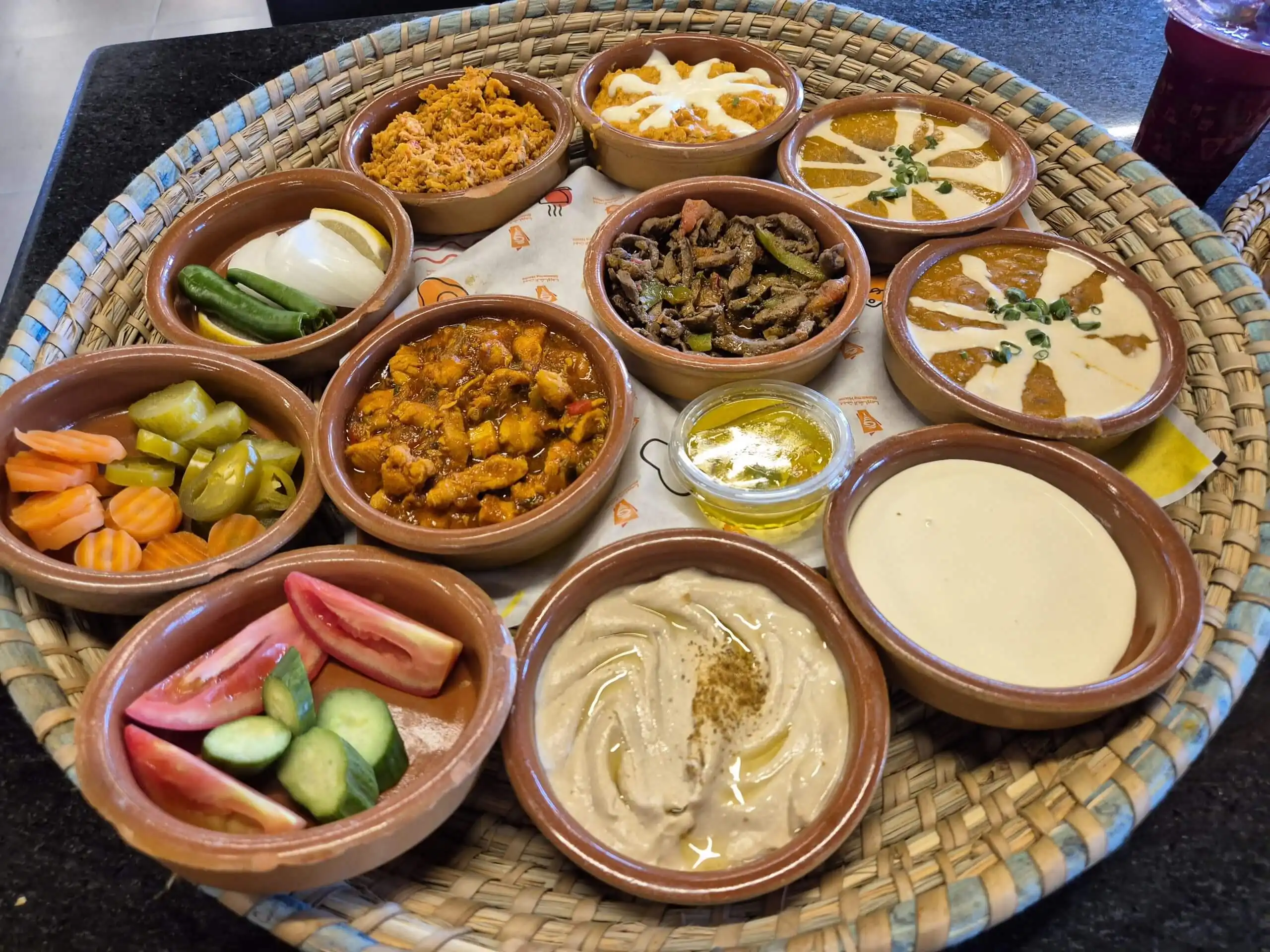
    It had chicken, beef, beans, lentils, salads, and two huge sheets of bread, easily enough for four people!

    It also gave me a chance to try the famous Saudi dish fool (beans) which I’d been looking for everywhere.

    What’s it like? Well .,..it tastes like beans (helpful I know).

    After a nap to survive the digestion of that monstrous breakfast, I was in an Uber heading out to Al-Awwal Park Stadium.

    If that name doesn’t ring a bell, it’s the home of the Al Nassr Football Club, the current home of the one and only Cristiano Ronaldo.

    I don’t even watch football and know almost nothing about it, but something told me it would be a crime to leave Saudi without watching them play, especially since their stadium was just a short drive from my hotel.

    Tickets were very reasonable (about $40) for great seats – centrefield and only 4 or 5 rows from the field.

    Untitled design - 1

    Unfortunately they lost, but I had fun. I think it was my first ever live pro football match!

    How To Get A Visa For Saudi Arabia

    The first challenge in getting to Saudi Arabia is securing a visa … or so I thought.

    It turned out to be the easiest and fastest visa I’ve ever gotten in my life.

    Saudi has been making a big tourism push to diversify its economy, so it appears they’ve tried to make the visa process as easy as possible. I’m pleased to report their efforts have been a success.

    It’s an e-visa and done all online. First, head to the official visa website here. Make sure you’re from one of the eligible countries – most Western countries qualify.

    Fill out the details like any other visa form and make the payment. As I write this, the cost is 395 Saudi riyals ( ~$100 USD).

    As soon as I submitted my payment, I was approved and received my visa in my email almost instantly – I’m talking less than a minute! I didn’t even need a return ticket (they didn’t check at the airport either).

    If you want to learn more about the visa process, the visitsaudi website has a lot of good info (on the visa and Saudi in general).

    Arriving In Saudi And Getting Around

    In case you’re not aware, Saudi Arabia is a rich country, so its facilities are generally good.

    The airport is nothing spectacular, but it’s a modern and well-functioning airport similar to what you’ll see in Dubai or Qatar.

    Going through customs, the officer kindly explained how my visa worked and that I could return any time within the next year as long as my total days stayed don’t exceed 90 days. She also spoke excellent English! I’d later learn this is quite rare in Saudi.

    Once you’re out of the airport, you’re going to need transport. You can get taxis, but I find it much easier to use Uber or Careem (the Middle East Uber). There is a specific pick-up point at the airport for rideshare app users, so it was easy.

    Riyadh is a scattered city (definitely NOT walkable). The drive from the airport to my hotel was long and there seemed to be a lot of road and not much city. It seemed very disjointed, like a big developed area, then nothing, then another big developed area, then nothing.

    Also it seemed quite common to have a random pizza shop or burger place just sitting in the middle of nowhere. Normally things like that are built beside apartment complexes or in shopping areas, but often you would see shops just sitting alone with nothing significant around them for several blocks. Very strange.

    In short – you will need taxis to get around, and most don’t accept cash, so Careem is your best bet.

    Where To Stay In Riyadh

    I stayed near the Kingdom Centre, which is a famous landmark in Riyadh, but I wouldn’t recommend it.

    There is nothing around there, and not many eating options either!

    I ended up having to Uber around during meal times to find something.

    After spending a week in the city, I would recommend staying on or near Tahliah Street.

    It’s a street full of shops and restaurants, very safe and upper scale, and pleasant to walk.

    I would recommend the Narcissus Hotel. It’s flashy, but that’s what Saudi is known for, perfectly located too. You’ll get the best rates here.

    For something a bit cheaper, you could try something like Al Muhaidb Al Diwan.

    For anything on a smaller budget than that, you’ll probably need to try a different area.

    Booking.com will have plenty of cheaper places around Riyadh to choose from!

    Sim Card In Saudi

    You’re also going to want a sim. Since I was only there for a week I decided to try one of these e-sim services for the first time. There are a billion to choose from these days, but I went with Airalo and it was excellent!

    I got 3GB for around $15 and it was more than enough to last my trip. Everything was managed through the app and seamless.

    Of course for longer stays, local sims are preferable, but 1-2 week stays this was so convenient and useful. Will definitely use them more going forward. Highly recommended.

    Enjoy Saudi!!

  • Wonderful Nights Atop Mt Sinai

    Wonderful Nights Atop Mt Sinai

    Rawan has the most incredible eyes.

    At first they’re green. You get a second look, they’re yellow.

    When she’s finally looking at you and you’re gazing back into them, they’re hazel.

    Then the sun hits her face, the light fills them from a distance and you realise – they’re gold.

    It’s been a long night.

    It’s 11 a.m., I still haven’t slept.

    We’ve hiked a mountain, watched the sunrise, stood where Moses stood, driven out to the wilderness and back, now I’m finally back in my bed, ready to sleep.

    And what I remember most from it all are – Rawan’s golden eyes.

    13 hours earlier…

    “The guy said 10:30.”

    “No no no, ten sharp!” he screams at me through the phone.

    “Okay I’m coming!”

    It’s 9:55.

    I grab my stuff and scramble out the door. The meeting point is at the supermarket, just two or three minutes away. There are no streetlights in the alleys running off the beach, but it’s a full moon. I can see.

    In the distance I see the van arriving.

    Is that the guy?

    He sees me power walking and nods at me.

    That’s the guy.

    “St Catherine’s?”

    I nod. “Do we have a couple of minutes? I need to buy some things.”

    “Of course, take your time.”

    Take my time? You were rushing me out the door five minutes ago.

    I buy a bottle of water, a can of Sprite, and six bars of chocolate. Then I jump in the van, out of breath, and wait.

    10:05.

    10:10.

    10:15.

    What happened to ten sharp?

    Finally at 10:20, another couple shows up. We do the hello-introduction thingie. Brazilian. Friendly.

    We head off. Two blocks down the road we stop to pick up another guy. Also Brazilian. Naturally, he and the couple start chatting. I don’t speak Portuguese, but I can guess what they’re saying. Oh wow you’re from Brazil too, what are you doing in Egypt, oh you’re from Sao Paulo cool, me too.

    After ten minutes we stop. The driver is yammering away on the phone. He’s speaking Arabic, but again I can guess what he’s saying. This hotel beside the pizza place, right? Yes, we’re here, where are you?!

    After fifteen minutes, three young ladies jump inside. The rest of us are semi-sleeping, but these three are loud. They ask if they can put on their music. Driver says sure. They blast it. And talk. And laugh. A million decibels. I’m guessing they took a power nap to prepare for the night ahead. Now they’re wired.

    We pick up one last guy, from Israel, then start the drive to the mountain.

    We are climbing Mt Sinai tonight.

    Mt Sinai is famous for a few things. First, at the foot is St Catherine’s Monastery. It’s the longest active monastery in the world. The summit has an Orthodox church built in 1934, and a mosque still used by Muslims today. And finally, according to both the Bible and Quran, it’s where Moses received the Ten Commandments from the Tablets of Stone, a zillion years ago.

    We arrive around 1:30 a.m. I am barely awake. We get off the bus. Now I’m barely awake and freezing cold. We get taken into a small shop selling hot drinks and snacks. Now I’m barely awake, freezing cold and hungry.

    As we sit and wait, we finally get a chance to chat with one another. The Brazilian guy is Daniel. He’s studying in Lebanon on exchange, now he’s in Egypt, fleeing the war. The Brazilian couple is on a trip around the world. They’ve just been to China. They find out I’m from New Zealand, and excitedly tell me they’re going there next. Cool. The Israeli guy is talking to the Egyptian girls in Arabic. I ask him, how do you know Arabic? He says, because I’m Arabic (he’s Palestinian). Oh. Stupid question. The Egyptian girls are a classic travelling trio, on a one week getaway. In backpacker speak, we call them Charlie’s Angels.

    Charlies Angels
    Noun

    1. A group of three female friends travelling together, who move everywhere as a group of three and never separate. Usually young and rowdy. Avoid if possible.

    We head to the starting checkpoint. There are passport checks, security checks, ticket checks.

    We stand in line and wait.

    The guide keeps saying, “Yella, yella, yella.”

    One of the Egyptian girls is next to me.

    I ask her, “What’s yella?”

    She looks at me. “What’s yellow?”

    No, “yella.”

    “Oh! It’s like, let’s go.”

    Ahh.

    Once they confirm that we all bought tickets, have visas, and none of us are fugitives, we get moving.

    It’s 2 a.m.. The air is crisp. The path is rocky and difficult to walk freely, there are no lights, but the full moon shines and guides the way.

    I walk with the Brazilian guy. Beirut is an awesome city, he tells me. I tell him I almost visited Lebanon, after meeting a Lebanese surfer in the Ivory Coast, who said the surf in Lebanon was great.

    “You’re Brazilian, you surf?”

    “Yeah!”

    “So how’s the surf in Lebanon?”

    He shakes his head, confused.

    “It’s shitty.”

    We both laugh.

    The hike is supposed to be six kilometres, with a final climb of 720 steps to the top. The idea is to be at the peak for sunrise.

    I calculate that by starting at 1 a.m., we will reach the peak around 4 a.m..

    I ask the guide – “What time is sunrise?”

    “6:50.”

    Either I’m awful at math, or we’re going to have three hours of standing around staring at our shoes.

    The path up the mountain is well-trodden. It winds like a never-ending “S”, there are men with camels every ten minutes, waiting for people to get too tired to climb any further.

    I don’t know our guide’s name. But as the rest of the group tires, I find myself at the front, walking with him. He’s chatty. He tells me in high season, he climbs this mountain every day. In low season, it can be as seldom as once a month.

    As he falls back to check on the rest of them, he tells me to go ahead.

    “When you get to the coffee shop, stop and wait for us,” he says.

    “Oh, there’s a Starbucks up here?” I ask.

    He looks at me confused and shakes his head.

    “No.”

    Just a joke, bro.

    I get to the coffee shop. It’s a little hole-in-the-mountain selling Coke, chocolate, and potato chips.

    There are also small benches for us to sit on. I plonk myself down and wait for the others.

    The Brazilian couple are right behind me. The lone Brazilian is next. Then the Israeli. Then the Charlies Angels. I can hear the three of them laughing and hooting long before they arrive.

    As we get ready to start moving again, the Israeli guy cracks. He points at the camel and says, “Might need one of those.”

    Two minutes later, he rides past us on camelback, grinning.

    As this group of camels walk by, one passes two inches from my face. I stare, realising what wondrous creatures they are. They’re enormous. You think they’d be just like horses, but they’re bigger and clunkier, yet somehow still graceful. Secondly, their thighs are ridiculous. Massive slabs of pure muscle. “Wow,” I whisper to myself as they clobber past.

    As we hike to the next stop, I’ve now figured out how this hike goes.

    There is a coffee shop, or “Starbucks” every kilometre or so. The hike is six kilometres, so there’s going to be five or six Starbucks’, and we simply hike from Starbucks to Starbucks taking a rest at each one.

    This gives people a chance to catch their breath, buy a chocolate bar, the group regroups for a head count, then we head on to the next.

    By the time we reach the third Starbucks, I’m falling asleep.

    It’s freezing cold, and five hours past my bedtime.

    As I set there dozing on one of the benches, the Charlies Angels come and sit beside me.

    “Hi!”

    “Hi.”

    Whenever you meet a group of Charlies Angels you rarely learn their names. You just know them as the blonde one, the tall one, the curly-haired one etc.

    This group, I piece them together as the quiet one, the loud one, the mysterious one.

    “So…you guys are from Cairo?”

    The loud one nods. And then shakes her head.

    She tells me she’s from some other city, which I don’t remember. And the other two are Cairenes (someone from Cairo).

    “You have too much energy,” I joke with them.

    “We slept already!” they scream, laughing.

    As we sit there chatting, waiting for the guide to move us along, freezing our toes off, I lie down on the bench and close my eyes. Sometimes during moments like these, I smile at what a faraway place I’ve found myself in. I’m in Egypt. On the Red Sea Coast. Climbing Mt Sinai. Lying under the stars in the middle of the night. Isn’t that wild?

    Another hour passes. Another kilometre. Another Starbucks.

    Finally, we reach the last one.

    The guide tells us we’re at the end. Just wait here until almost-sunrise, and we’ll climb the 720 stairs to the peak.

    At this particular Starbucks, they have blankets to hire for a few dollars which is a godsend. The air is biting with a fierce cold that sends frost deep into your bones. I am freezing. I wrap myself in one and sit with the Charlies Angels. They are all wearing the same baggy jeans.

    “Is this the fashion in Egypt or something?”

    “Yeah!”

    They laugh as I tell them it was the fashion in New Zealand about twenty years ago.

    The loud one pulls out a pizza box. I stare at her confused.

    “You guys brought pizza?”

    “It was our dinner…”

    She opens it up to show five or six slices.

    “Oh my goodness can I have one?”

    “Of course!”

    I grab a slice and savour it. “I’ve been craving pizza for the last five hours!”

    As we sit there shivering in the cold, eating the final pizza scraps, I start wondering where everyone’s gone. There’s nobody around but us. I go look around the Starbucks and notice everyone cramped into a small room, napping. I follow them inside. It’s warm. There are benches to lie on. I find myself a spot and tuck under my blanket. It feels so good I fall asleep immediately.

    “Let’s go!”

    How long have I been asleep? I don’t know. The Charlies Angels are shaking my blanket and rushing me outside. Time to climb to the peak.

    It’s still dark, but sunrise is in an hour. We get the group together, the Brazilians are fast asleep and slow to get up, but eventually we hit the stairs and start ascending.

    The stairs are not really stairs in many places – just rocks conveniently placed, and it’s hard to climb in the dark. We go slowly, taking frequent breaks.

    By halfway, the Charlies Angels are exhausted, heaving oxygen. I see why – it’s tough. We do another twenty stairs and stop again. And again. It’s warming me up, so I love it. They hate it.

    We reach the top. It’s like a small castle. We see the little room where Moses was. We see the cathedral. The small mosque. But mostly, we just want to rest. We go sit against the wall, wrap ourselves in our blankets, and wait for sunrise.

    Like most sunrises, it comes slowly, and we don’t even realise it’s happening until it’s already in the middle of happening.

    As everything comes to light we take photos, hundreds of photos, climbing up on the mountains, on the walls, any shot we can find.

    Once we’ve exhausted every photo angle and possibility, we sit and talk. I finally learn the Charlies Angels names. The loud one is Shahd. The quiet one is Mariam. The mysterious one is Rawan.

    Finally, once the sun is well and truly up, it’s time to descend.

    We climb down the 720 stairs, say goodbye to the last Starbucks guy, give him back his blankets, and head on our way.

    I walk with Rawan. In the sunlight, her eyes mesmerize me. They are yellow, but also brown, and also green. All together – golden. And they glimmer, like gold, every time her face turns and glances against the sun.

    It’s about a two hour trek back to civilisation. I walk with Rawan. We talk about TV shows, and travelling, and work, and food.

    She lights up a cigarette.

    “Isn’t that haram?”

    She rolls her eyes.

    The sun on the Egyptian coast is tough. It starts to beat down. Our walk turns into a dawdle. I don’t mind. She tells me her favourite food is Koshari. Her dream country to visit is Greece. She doesn’t want to go back to Cairo.

    As we arrive back at base, we thank our guide for walking with us all night, tip him, and tumble back onto the bus. We fall asleep immediately.

    Moments later I’m woken by the noise of Dahab, the heat on my face through the window. It’s almost lunchtime. I haven’t slept in over 24 hours. We’re pulling up to the girls’ hotel.

    Everyone says their goodbyes.

    Rawan smiles at me with warm, tired eyes.

    I smile back.

    “Bye.”

    “Bye.”

    I’m the last one on the bus.

    As we arrive at my stop, I thank and tip the driver.

    I’m sleepy, but calm, and grateful.

    Walking back to my guesthouse, I take off my shoes and wander barefoot, along the sand road.

    Once I arrive, I sit for a while outside, looking over the Red Sea.

    What a beautiful sight, and what a beautiful night, atop Mt Sinai.

    For my Mt Sinai climb, I booked my tour through GetYourGuide. It was great! Highly recommended.
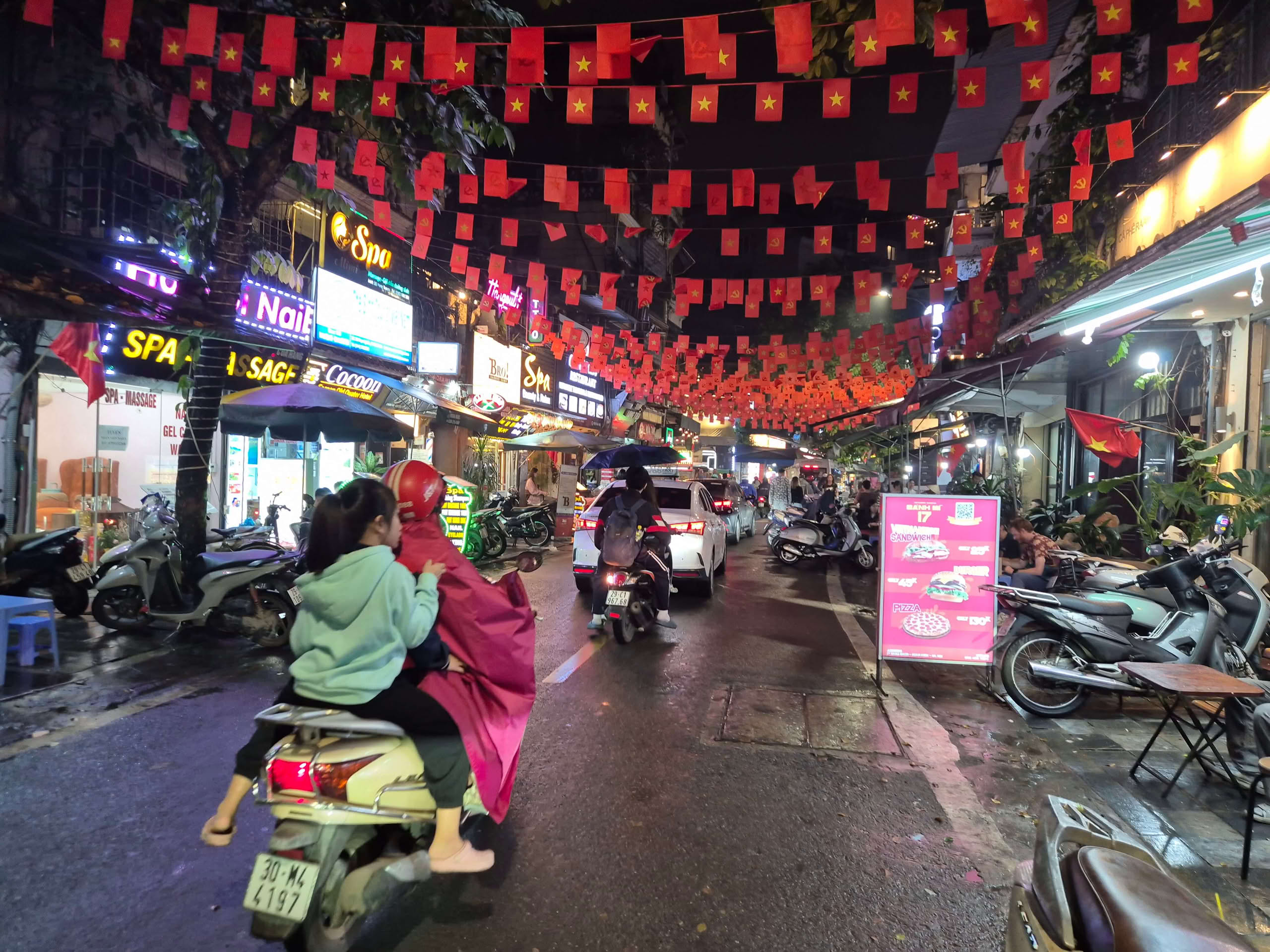
  • How To Spend A Week In Dahab

    How To Spend A Week In Dahab

    During my trip to Egypt, I learned about a small town on the Red Sea coast named Dahab.

    Apparently the “hipster meeting point” for North Africa, filled with digital nomads, backpackers, yogis, divers, and foreign expats.

    As you know, that’s totally my kind of scene so I planned a one-week trip to the coast to check it out.

    Getting To Dahab

    Getting there is reasonably easy.

    Since the Egyptian Red Sea is a popular dive mecca, you can fly directly into the coast from Europe and other places.

    The airport you will land at is Sharm El Sheikh.

    If you’re coming from within Egypt, most likely Cairo or Alexandria, you can fly domestically into Sharm El Sheikh.

    From there, you book a taxi to wherever you need to go along the coast (you could even stay in Sharm for a night or two to check it out, it’s a nice place!)

    I arranged my taxi through my accommodation, which came to a total of $40. That may not be the cheapest you can find, but it’s about what you’ll pay for a private airport pickup. You could land without plans and just negotiate with the airport taxis, but getting much cheaper than $30 will be a hard ask.

    From there – everything is easy! The road is great and you’ll be in Dahab in an hour or so.

    Where To Stay In Dahab

    Most people stay on the main boulevard, which is exactly what the name implies.

    There’s a long wooden boulevard filled with restaurants and bars and shops and it stretches for a good twenty or thirty minutes walking. You’ll find many affordable accommodations around here, and this is where most people stay.

    I stayed a bit further away (about 15 minutes walk) which I think was a good choice. You have a part of the ocean to yourself, things are not so busy or noisy, but everything is close.

    Personally I think this is the best place to stay in Dahab, but be mindful that you’ll need to do a bit of walking to get your groceries and food etc. I stayed at the Skyrock Garden which was perfect!

    There are a lot of great places to stay along that stretch of beach, great deals can be found here.

    Getting Around Dahab

    Hiring bicycles is popular, but honestly, there’s no problem just having a slow holiday and walking around.

    I spent several hours walking every day and it was not too hot nor tiring.

    I enjoy walking, so if you hate it, you might want a bike or to get the number of a taxi, but otherwise Dahab is reasonably small and everything you need on a daily basis is nearby.

    What To Do In Dahab

    There’s a lot of interesting things you can do from Dahab as your launchpad.

    It’s right at the border of Jordan, Israel, Saudi Arabia and Egypt, so naturally the area is home to a lot of history.

    I did the St Catherines Monastery Tour which takes you up Mt Sinai, it’s very affordable (maybe $50) and well worth the overnight climb. You can read my recap of that here!

    I also did a day trip to the Blue Hole to do some swim training.

    It’s a popular dive spot which is very deep and the water is very blue.

    It’s a busy place and there will be many other divers and snorkellers there, but still it’s huge enough that you won’t feel like you’re in a mosh pit.

    It’s only a 15 minute drive from Dahab so very easy and you’ll only pay around $20 or $30 or so for a guide to take you there and bring you back, with a lunch included.

    Since I went alone it got boring after swimming through the hole two or three times, but this would be a really fun day out with a group of friends.

    There are countless other tours you can do around Dahab, along with day trips to Cairo for the pyramids, Luxor to see the old emperor city, and even day trips into Israel and Jordan.

    I had planned to do the Petra tour which takes you into Jordan for an afternoon, however it only goes one day per week, which I missed. The Jerusalem tour was also on my list, but they weren’t running due to the war with Palestine at the time.

    I booked all my trips on GetYourGuide! Highly recommended.

    Other than that, I mostly spent my time just wandering the Dahab streets exploring at and eating, which leads us to…

    What To Eat In Dahab

    I tried to eat out at a different restaurant every day, and there’s definitely no shortage to choose from.

    On the first night I ate at an Italian place not far from my guesthouse which I have no idea what it’s called anymore (it was average anyway) then popped over to a nearby cafe called Treats for dessert and a drink. It’s a charming little teahouse kind of place, they serve great food, desserts and drinks. Also owned by the friendliest and chattiest guy ever! Definitely recommend a visit.

    My next dinner was at the boulevard. There is a string of about 4-5 restaurants with fresh seafood sitting outside and you can choose things to have cooked for you. I had fish (grilled) and calamari (fried). It takes a while but the food is fresh and you can eat it on the balcony overlooking the beautiful Red Sea!

    Dinner #3 was an Italian place that came highly recommended called Dai Pescatori.

    It’s not quite on the boulevard, it’s on a normal stretch of beach has a very homely vibe.

    I had the risotto and the mozzarella salad. Pretty good, but nothing to go crazy about. Good choice for an easy, quiet dinner.

    Dinner #4 was at Alibaba Restaurant – recommended to me by a local.

    Inside they also have their own fresh seafood counter – I chose another fish I’ve never seen or heard of before, and they brought it out with a million other things.

    This is one of the good things about Egypt – all their meals come with so much bread, rice and dips that you’ll always be full no matter what you order! As for the food at Alibaba – also good but nothing spectacular.

    Dinner #5 was at a local homestyle Egyptian restaurant.

    I came here because Rawan from my Mt Sinai story told me I had to try a few Egyptian dishes before I left.

    The two she recommended were the koshari and the mahshi.

    I was skeptical because upon Googling I learned koshari is pasta and rice, topped with grilled onions. I was waiting to read what the rest of the dish was… but that’s the full recipe. Interesting. The mahshi was green peppers stuffed with rice. Again – interesting…

    As it turned out, both were not bad!

    Not the healthiest thing, but for a broke backpacker or student this would get you through many a day! Cheapest and most filling thing I ate in Egypt.

    Dinner #6 was Italian again at a restaurant called Happy Hour.

    Came here because it was nearby and wasn’t expecting much, but turned out to be one of my best meals in Egypt. I saw them spinning and wood-firing the pizzas from scratch, so I had the four-cheese pizza and the Italian meatballs. Well – both were superb! Would definitely come again.

    For my final night in town, I went looking for more Egyptian food and came across Red Cat in one of the boulevard side streets.

    Small but busy restaurant with an exciting menu. I went for the traditional lamb and beef mixed dumplings.

    Delicious!

    Not quite Chinese dumpling level delicious, but hey, that’s almost impossible.

    Overall – Dahab has a thriving food scene and you definitely will not go hungry here!

    My Thoughts On Dahab

    Dahab is a sleepy place, ideal for relaxing near the water, eating some good food, and doing a bit of sightseeing.

    It’s not the type of place where you come to party until sunrise (although that’s around, if you want it), but a way to detach from the chaos of places like Cairo or Alexandria and enjoy no traffic, bicycles, fresh pomegranate juices, laid-back people and lots of sun!

    I had never been to the Red Sea before and was looking for a place to enjoy the water without crowds, eat well, do some reading, take a few long walks each day and sleep in – and Dahab was perfect!

    It’s actually a landing spot for divers, and many people come here to get their PADI and enjoy the many good diving spots along the Red Sea, so you will definitely see a lot of Europeans around.

    Curiously I saw quite a few Japanese and Korean tourists wandering around too (almost all divers) so it’s obviously a popular spot for them as well.

    And – it’s a hugely popular holiday spot for locals, so many of the restaurants will be filled with Egyptian tourists coming from the cities, indulging in days-long shisha and drinking sessions.

    That being said it’s not tacky or boisterous like something you’d see at Thai beaches or Bali – much more reserved and private.

    The best thing about it is I didn’t seem to get bothered on my walks by people trying to sell t-shirts or tours or any of that other nonsense.

    I walked the boulevard countless times and don’t think I was ever approached once!

    People seem to leave you alone and let you mind your business.

    Would I recommend Dahab?

    Definitely! It’s a different side of Egypt not many people get to witness, but I enjoyed my time there far more than exploring the bustling streets of Cairo.

    Of course, you owe it to yourself to see both.

    Enjoy 🙂