Blog

  • How To Buy Bitcoin In NZ: A Beginner’s Guide

    How To Buy Bitcoin In NZ: A Beginner’s Guide

    Don’t have time to read all this?

    This is a long article so here’s the TL;DR:

    The best place to buy Bitcoin in NZ is Sywftx. Lowest fees and prices, awesome service and a registered NZ financial services provider. Click here to open a free account.

    The safest way to store Bitcoin is the free wallet by Exodus, or if you own a lot of Bitcoin ($1,000+) then consider purchasing a hardware wallet. I recommend the Ledger Nano.

    The best place to earn interest on Bitcoin is Xapo. They are a regulated bank. Sign up here and get $500 of free BTC with your first deposit.

    Hey troops,

    This is a question I’ve been getting asked a lot recently. Whenever I mention Bitcoin to people and that it’s my highest returning investment (hands down!) they always want to know how to get started themselves.

    For most people I just point them to a major exchange like Binance, which is super established and easy. You can buy Bitcoin with your credit card (which I have done, and it works great).

    However, things are a little more complicated for us Kiwis. Big exchanges like Binance are not easy to use for NZD deposits.

    The good news is, there are options for us to buy Bitcoin in NZ, and I have used several. In this guide I’m going to break down the best options for Kiwis to buy Bitcoin in NZ safely and fairly, so you can start adding some Bitcoin to your investment portfolio.

    Contents of this guide:

    1. What is Bitcoin?
    2. How does Bitcoin affect you and I?
    3. What’s the best place to buy Bitcoin in NZ?
    4. How to store Bitcoin safely
    5. How to earn interest on your Bitcoin
    6. More Bitcoin tips

    What is Bitcoin, exactly?

    Before you buy Bitcoin, you should know what it is. I will try to spend the next five minutes explaining this as simply as possible (of course, feel free to skip this part if you’re well versed already).

    Bitcoin is a currency. Think of it as the currency of the internet. It is something you can spend, like when you buy something, or save, like when you put money in the bank. But the intended purpose of Bitcoin goes a bit wider than that.

    Here are a few concepts:

    Bitcoin is a global currency. It is not restricted by class, citizenship or geography. It can be sent to and received by any person, anywhere in the world. It is not controlled by any bank, government, company or person. This means, like the internet, it cannot be shut down at any central point.

    When people say Bitcoin is decentralised and autonomous, this is what they mean.

    Bitcoin is a digital currency. This means it does not exist in physical form. It exists only digitally. This is advantageous as digital things move much faster than physical things.

    Bitcoin is a decentralised currency, as it exists only on a technology known as the blockchain. Here’s the easiest way for me to explain a blockchain:

    Think about your bank account at ASB. Your information is stored on the ASB servers. The only party that can alter that database is ASB.

    This is great, but also flawed. Flaws in this type of system were apparent in Cyprus not too long ago, where the country was about to go bankrupt and the government simply ordered banks to give them 20% of all citizens’ savings. If you had $1,000 in the bank, it got chopped to $800, to keep the government from going broke. The reason the banks could do this was because they have complete control over the citizens’ money. If you’re a student of history, you’ll know Cyprus was not the first. This has already happened many times before.

    Blockchain solves this problem by replacing centralised databases with decentralised ones. Rather than the ASB database only being held on ASB’s servers, the ASB database would be held on the computer of every single ASB customer instead (like your phone, or laptop). In order for ASB to take any of your money like they did in Cyprus, every customer would need to agree, or they would need to hack every customer’s laptop and change the database on each one (basically impossible).

    In this system, it is the holders of the currency with the power, rather than the bank. 

    By being decentralised in this manner, it also means that the network can operate “peer to peer”. This means that when you pay someone, instead of you giving your money to ASB, and then ASB giving your money to Fred (and taking a fee), you can just send your money directly to Fred.

    This is Bitcoin: The global, decentralised, digital, peer to peer currency.

    So how does this affect you and I?

    Bitcoin’s purpose is to be an upgrade from the current idea of money.

    Imagine you need to send $10,000 to your parents overseas. Usually, you would need to go to the bank, deposit the money, pay the bank a fee to change it to a foreign currency, then pay the bank a fee to send it.

    Then three days later it would arrive at your parents’ bank and they would pay a bunch of fees to withdraw it before they finally can use the money.

    With Bitcoin, this same process can be done in under an hour for less than a ten cents in fees. Remember – peer to peer. Just like the internet changed the way we send mail, messages, and information, Bitcoin wants to change the way we send money.

    Since it’s beginnings in 2009 Bitcoin is now working its way into the mainstream.

    Many shops worldwide now accept Bitcoin as payment for general goods and services, and it has been made an official currency of the country El Salvador (and more will surely follow!)

    Recently Argentina and Paraguay settled an international trade using Bitcoin, so it is being used in international finance by governments too.

    JP Morgan’s CEO said in 2017 that Bitcoin was a scam and any of the bank’s traders would be fired if they were caught trading Bitcoin. By 2018, JP Morgan had put together a team of Bitcoin analysts who concluded Bitcoin did in fact have an intrinsic value of $5,000 per coin. By 2020, JP Morgan had since become the bank for several top Bitcoin exchanges. Today, JPMorgan offers Bitcoin trading to every single one of its clients. See the pattern?

    Now even some of the world’s most prominent billionaires, including Jack Dorsey, Paul Tudor Jones and Stan Druckenmiller and Elon Musk have said they’ve added Bitcoin to their portfolios, and some of the biggest companies in the world such as Square and Tesla now hold and accept Bitcoin.

    All are positive trends for Bitcoin, and I encourage you to do your own research and make your own estimations of where it will go in the future.

    If you’re interested, you can read more of my thoughts about Bitcoin here.

    What’s the best place to buy Bitcoin in NZ?

    When I first wrote this guide in 2017, there was one clear leader for buying Bitcoin in New Zealand and that was Independent Reserve.

    The reason for this was they had the lowest rates and the lowest fees of any Bitcoin exchange available to Kiwis. My recommendation is always based on price and value – whichever service offers the best value for money always gets my vote and that is what I will recommend to you.

    In 2021, Independent Reserve is still a great option and I still use them, but they are no longer my top recommendation for first time investors.

    They have been toppled by a full service NZ owned and operated Bitcoin broker called Swyftx .

    Best option for buying Bitcoin for Kiwis: Swyftx

    Swyftx is a full service cryptocurrency broker and is almost like a New Zealand version of Coinbase. Reasons why it’s great:

    • Orders are filled quickly at market prices.
    • Very low fees.
    • Excellent customer service.
    • It has a big (maybe the biggest?) selection of coins.
    • NZ FSP regulated
    • Services NZers and works with NZD easily

    How to buy Bitcoin on Sywftx in NZ?

    One reason I like Sywftx because the interface is so smooth and easy. It’s literally four steps and the same as buying a pair of shoes online, and you can have your Bitcoin in literally fifteen minutes or less.

    Get started: Open an Swyftx account:

    First, clik here to head to their website.

    On their homepage, you’ll see an option to open an account:

    That’s it! You’re in.

    Verifying your account:

    Because Swyftx is registered as a Financial Services Provider in NZ, they need to verify your identity.

    Remember, this is a good thing! Do not buy Bitcoin (or any financial service) from anyone in NZ who isn’t registered. There’s a good chance your money will disappear and you won’t get it back.

    Verifying your identity should only take a two minutes and requires a photo of your driver’s license or passport, and a selfie.

    Once you’ve done that, you’re ready to buy!

    Step 1: Deposit funds

    Click “Transfer Funds” on the top menu.

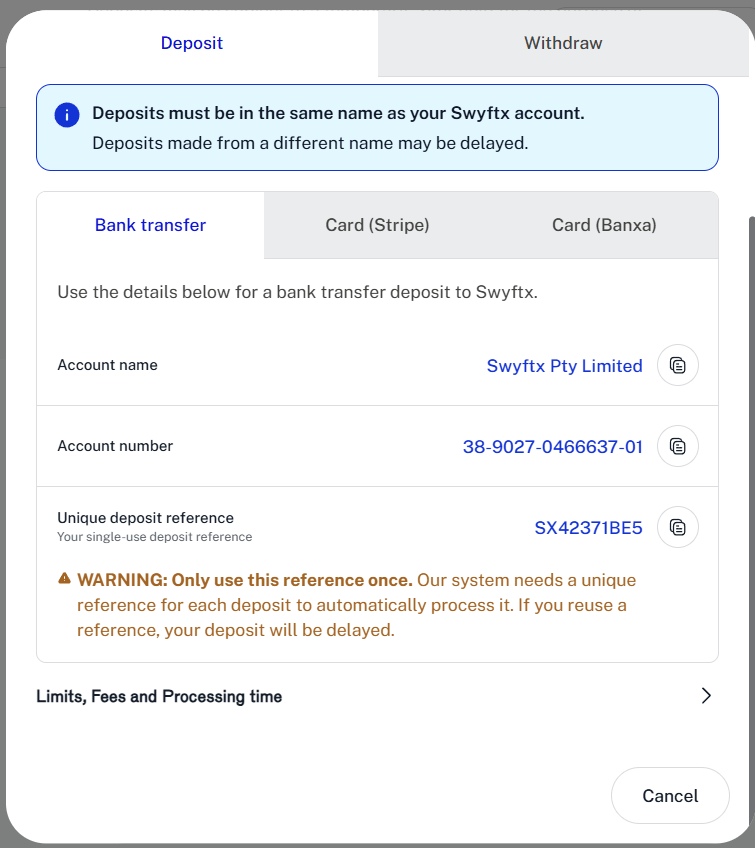
    It will bring a deposit information box like so:

    To get your reference number, click the “generate reference” button, and it will give you a reference to include with your deposit so it gets delivered to your account.

    Then simply make an internet banking payment to the account number given, and you should have your funds ready in an hour or so.

    Step 2: Choose your coins and quantity

    For this example, I’m going to walk you through buying $100 of Bitcoin.

    You should see a “Quick Buy” button on the homepage.

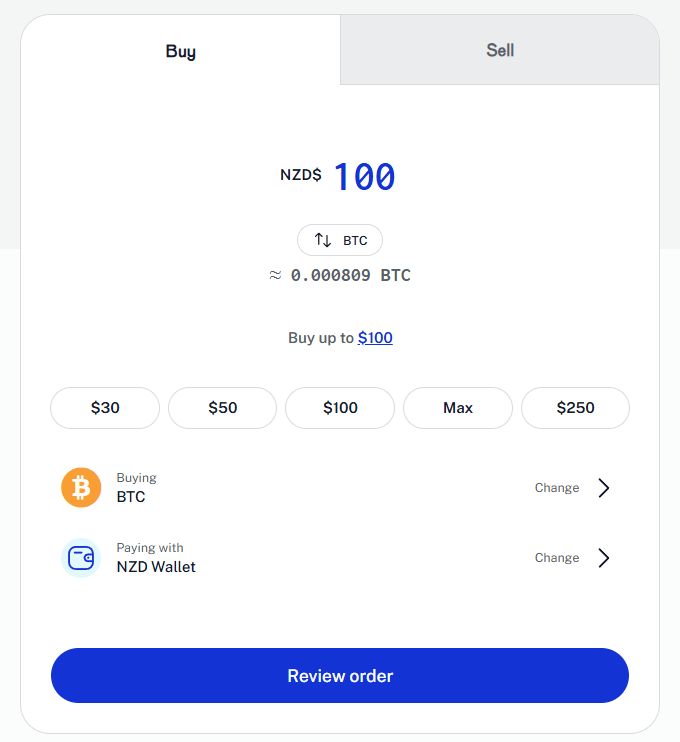
    This should take you to a buy screen, where you can choose your coin and the amount.

    Bitcoin should be the default, so we’ll leave it at that, and in the amount we’ll put $100.

    Of course you can choose to buy more or less, or a different coin, but we’ll stick with Bitcoin for now.

    Then select your source of funding as your “NZD account”.

    Then click buy.

    THAT’S IT.

    You are now the proud owner of Bitcoin!

    This is actually one of the main reasons I recommend Swyftx.

    They do not keep your coins in storage on their own site/servers. They actually help you set up a private wallet and help you keep your own Bitcoin.

    This is the safest option and if you follow the Bitcoinsphere, you may remember Cryptopia, another NZ Bitcoin exchange got hacked in 2019 and lost around $20 million in user funds.

    If people had been storing their coins in their own wallets, this wouldn’t have happened.

    Who should use Swyftx to buy Bitcoin?

    In my opinion, Swyftx is going to be the best option for 95% of first time buyers, and for people who are new to Bitcoin.

    When it comes to Bitcoin, most people are interested in buying $200 or $500 or maybe a few thousand dollars as an investment. Swyftx is absolutely perfect for this and you won’t find a service better suited for it.

    As you get more involved and educated about Bitcoin, you may also become interested in purchasing other cryptocurrencies such as Ethereum or Ripple XRP or Litecoin, and many others. Swyftx allows you to buy all of these as well, and has more than seventy of the most established cryptocurrencies which you can buy directly with NZD.

    They’re also one of the safest options and operate everything legally and above board as a registered provider, so you know you’re protected by NZ law, which is not the case when dealing with overseas brokers and exchanges.

    If you want to get started with Swyftx, you can open a new account by clicking here.

    What’s the best way to store Bitcoin in New Zealand?

    Buying Bitcoin in NZ is the first hump, but what about storage?

    You can leave your coins on Swyftx. This is common practice and exchanges like Swyftx have become much better at security and keeping your assets safe.

    However, there are risks to this. Exchanges get hacked all the time and due to the “crypto” nature of the industry, your coins are almost never recovered.

    There’s the Mt Gox hack of 2014, the Bitfinex hack of 2016, the Binance hack of 2019, and even the Cryptopia hack in our very own New Zealand. It happens and it will happen again.

    Therefore, if you’re serious about your Bitcoin investment, have a significant dollar amount invested, and you plan on holding it for the long term, I would suggest using a Bitcoin wallet.

    Most exchanges and services want to hold your coins for you, so they can keep them in private accounts in case they go under, or lend them out to traders and institutions and earn interest on them. 

    So, what is a Bitcoin wallet, you ask?

    A wallet is a PRIVATE storage system for your Bitcoin, and it’s actually how Bitcoin was originally designed to be used. This is why you might hear the phrase “Be Your Own Bank” in Bitcoin circles.

    A wall operates sorta like an online bank account.

    It contains two keys: one public and one private.

    The public key is what you give to someone so they can send you Bitcoin. If you sold a donkey for Bitcoin, you would give the buyer your public key, and he would pay you by sending Bitcoin to that address. Think of it like your Bitcoin bank account number.

    The private key is something you keep secret. Think of it like your Bitcoin internet banking password. The private key is what allows you to send Bitcoin from your wallet to somebody else. Never share your private key with anyone, ever.

    Now, as for the wallets themselves. There are two main types of wallet. There are hardware wallets and software wallets.

    Software wallets

    Software wallets are free and are generated on your computer or mobile phone.

    Think of a software wallet like the wallet you carry around in your pocket each day. It’s good for storing a little bit of cash, but not for thousands and thousands of dollars.

    It’s the same for Bitcoin.

    If you plan on buying and selling Bitcoin regularly or actually using it to pay for things, a software wallet can be a good choice for keeping a little Bitcoin that’s easy for you to access each day.

    Hardware wallets

    A hardware wallet is more like a safe in your basement.

    It’s a physical device (looks like a USB drive) that you can keep in your house and use to store large amounts of digital currency. Some people even lock their hardware wallets in an actual safe or a bank safety deposit box.

    What’s the difference?

    The usual concern with a software wallet is the private key is generated on a computer or phone and therefore can never really be considered 1,000% safe. Obviously it depends on how clean your computer is, and if you generated it offline etc etc. Remember, if someone has your private key, they have full access to your Bitcoin.

    A hardware wallet is considered much safer because the private key is generated completely offline, inside the device itself, and never even touches the internet. That’s why it’s always recommended to store large amounts of Bitcoin on a hardware wallet.

    In reality, if you only have a few hundred dollars in Bitcoin, a software wallet will probably be fine. If you have thousands and thousands of dollars in Bitcoin, you probably want to invest in a hardware wallet.

    What do I use?

    I do not currently use a software wallet. I store some of my coins on a hardware wallet, and have a small amount of coins stored on Independent Reserve in case I want to sell some.

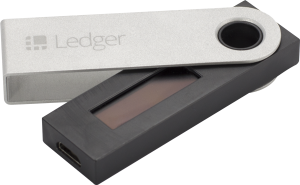
    The hardware wallet I use is the Ledger Nano S.

    buy bitcoin in nz

    It’s one of the most highly recommended in the community and is super easy to use. It also allows you to store Ethereum, Litecoin and about 30 other major cryptocurrencies, along with your Bitcoin. You can grab one here. They ship their Bitcoin wallets worldwide, including to New Zealand.

    As I said I don’t use a software wallet, but if you are interested in one, I would recommend the wallet provided by Exodus. If you want help setting up an Exodus wallet, it’s very simple and secure, I have a free guide you can open by clicking the blue box below.

    How To Set Up A Bitcoin Wallet in 2 Minutes With Exodus (click to open)

    First, download the Exodus app on your phone [Android, iOS].

    Open it up and you should come to this screen:

    Tap the Get Started button and swipe through the introductory messages and you’ll get taken to your portfolio.

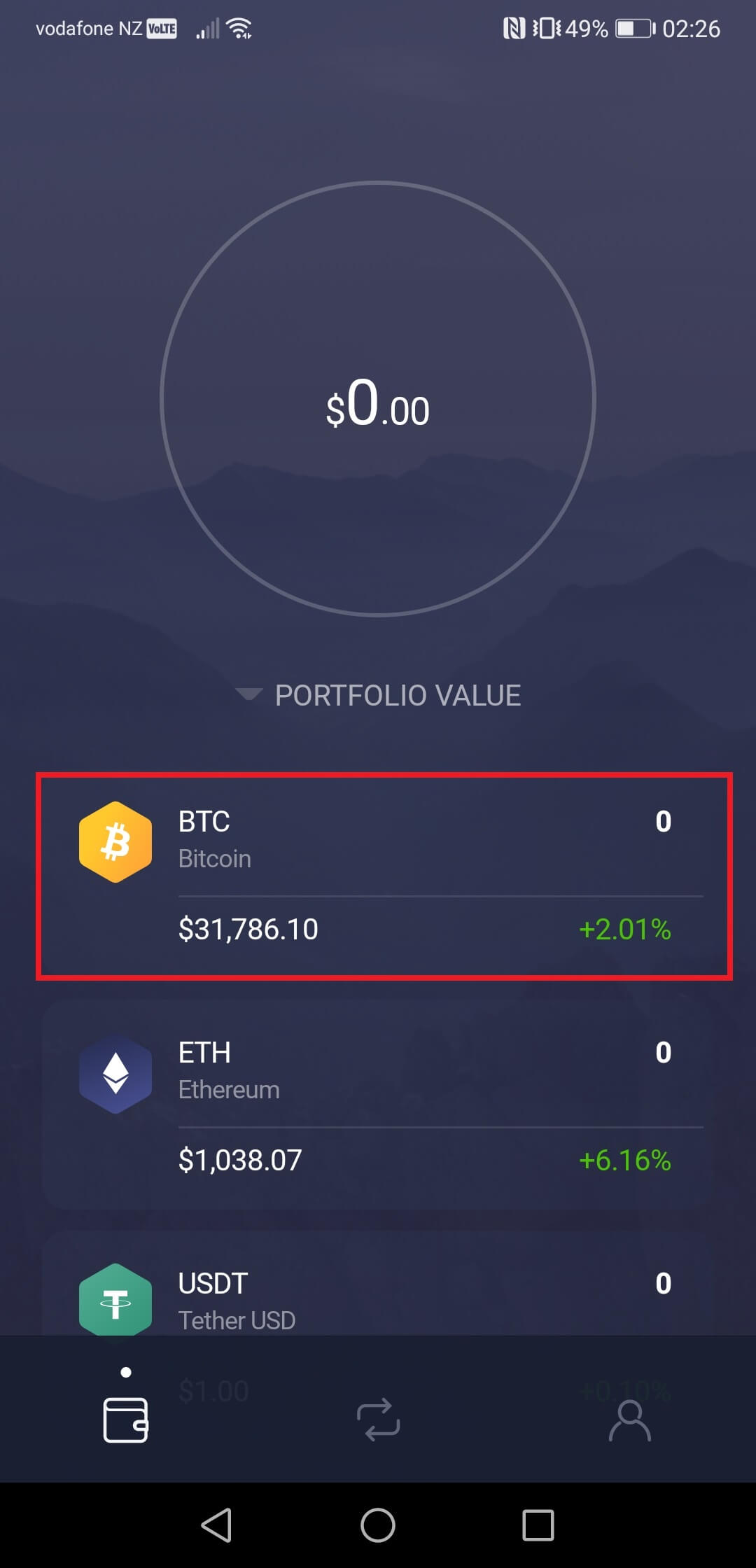
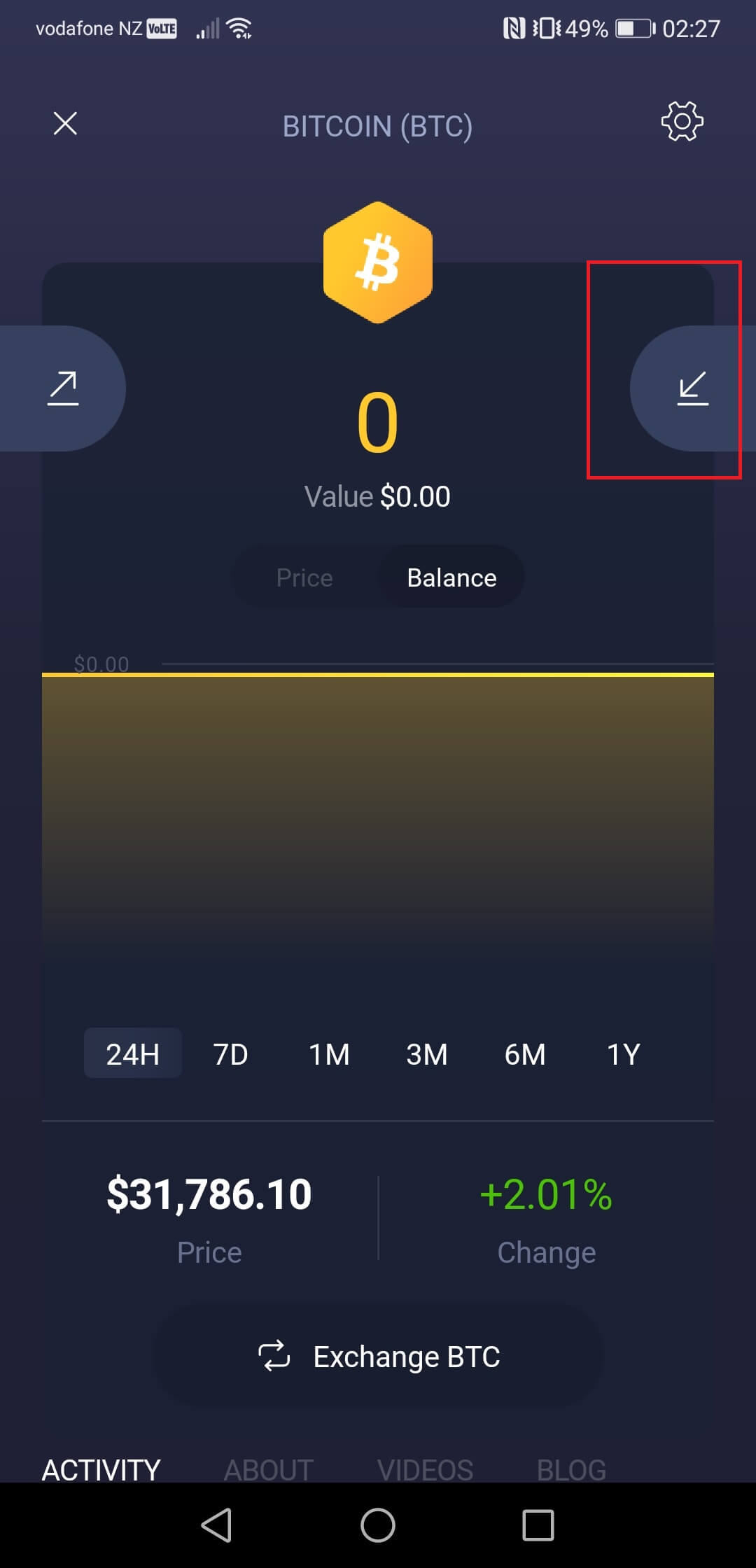
    You’ll see the first line in your portfolio is Bitcoin:


    Tap the Bitcoin logo and you’ll get taken to your Bitcoin holdings:

    Obviously, it will show as zero right now (but we’re going to change that!)

    On the left hand side you’ll see an upward arrow, which is for sending Bitcoin, and on the right hand side you’ll see a downward arrow, which is for receiving.

    Tap the downward arrow:

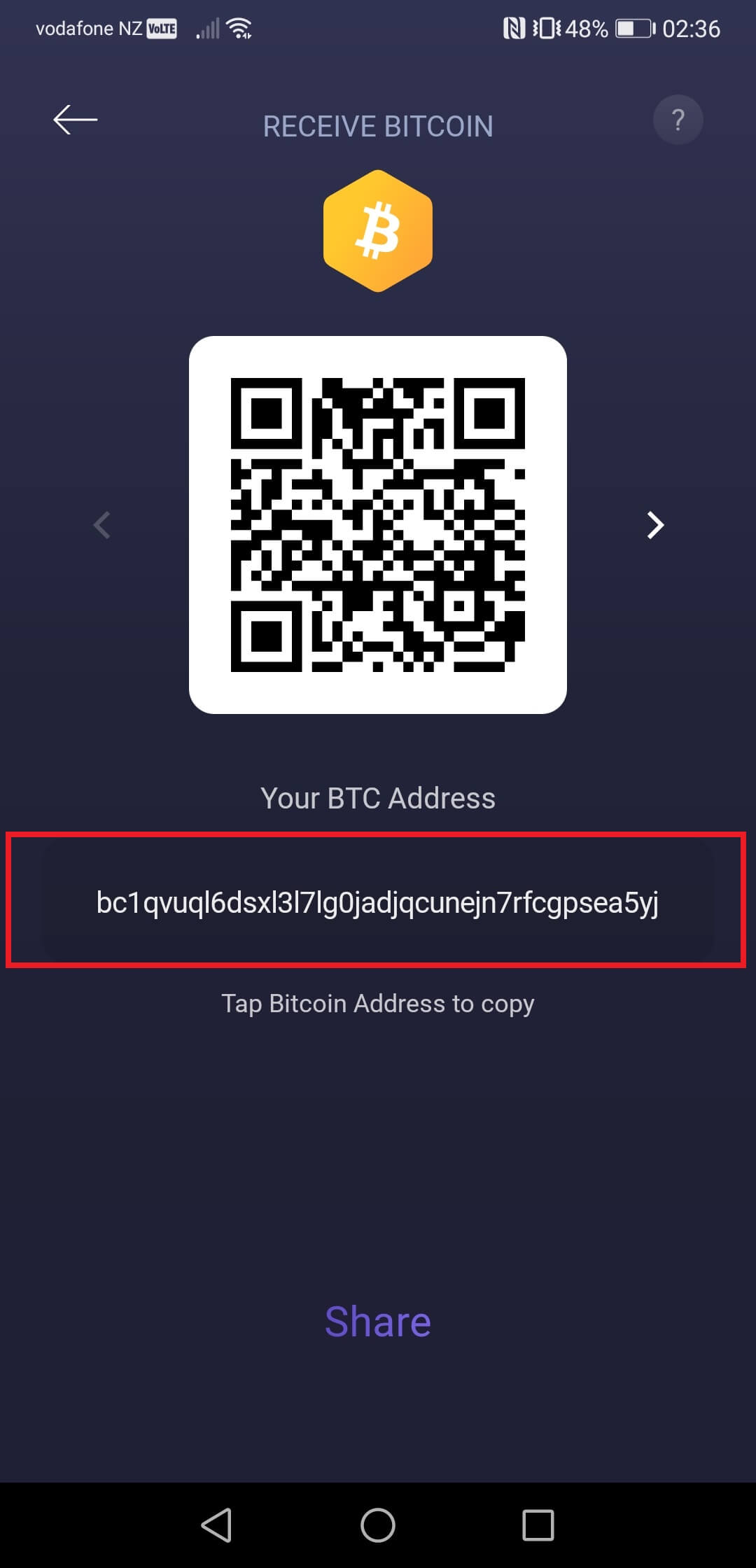
    This will then show you everything you need to receive Bitcoin.

    You’ll see your Bitcoin address at the bottom!

    It should look like a string of letters and numbers starting with bc1qvuq……

    Simply copy this string of characters and paste it into EasyCrypto when they ask for your address. Also, before you place your order, double and triple check that the address is correct! 

    Otherwise someone else might be getting a nice surprise when your Bitcoin gets sent to them instead 😉

    Also, don’t forget to backup your wallet. This is hugely important. Exodus has a simple guide to backing up your wallet here. It will only take 5 minutes. Don’t forget!

    In summary: If you have only have a few hundred dollars in Bitcoin, use a software wallet – I recommend Exodus. If you have thousands of dollars or more in Bitcoin, invest in a hardware wallet. I recommend the Ledger Nano S.

    Other tips for buying in Bitcoin in NZ

    I’m reluctant to give you any actual “tips” for investing in Bitcoin, because that’s not really my intention here. How you invest needs to be an investment decision based on your own risk profile and comfort level.

    If you want to buy some Bitcoin and try and sell it in a few days for a quick profit, that’s great, and if you want to hold it until retirement that’s great too.

    What I will say is to not to rush. If you have, say, $1,000 to invest, don’t throw it all in at once. Dip your toes in and get a feel for how the market behaves.

    Even if you’re used to trading in commodities and financial markets, the cryptocurrency market is quite different. It is open globally, 24 hours a day, 365 days per year, and the market is still very young. There is no other market like it. Big changes are always just around the corner.

    I’d also encourage you to read about what Bitcoin really is and the technology behind it. One book I highly recommend is The Internet Of Money by Andreas A.

    Two other good books I’ve read are Digital Gold and The Bitcoin Standard.

    Information is the key to investing and the more your learn and understand, the better decisions you can make. Other than that, where you go with your Bitcoin journey is up to you.

    Have fun and good luck!

    Questions? Leave em below. I’ll answer them the best I can! A full directory of places to buy Bitcoin in NZ can be found here.

  • Love Cape Town

    Love Cape Town

    At first glance, The Zebra Crossing was just your regular hostel. Fifty beds, small lounge, small kitchen, little courtyard for the smokers. But like all good hostels, it was operated with love. And like all hostels operated with love, it became home.

    It was Doniel who checked me in. The cheeriest of smiles, caramel skin, short shoulder length hair, a pair of warm eyes behind black rimmed glasses. As she showed me the bathrooms, she reminded me Cape Town was in a drought, and not to shower longer than two minutes. Then she showed me the kitchen, and reminded me to wash the dishes with the tap off, and use as little water as possible. And I knew she loved working in hospitality. I knew that, because when she showed me to my room she said, “I really love working in hospitality!”

    That’s how I met Doniel.

    My room had eight beds but was empty, except for one other guest, presumably female, who looked like she’d been there a while. She had those Arabian looking blankets hung around her bunk like curtains, and all her clothes folded neatly on the bed above. It’s an oddity to find someone who actually unpacks in a hostel dorm. When you see it you already know; that person is either very strange, or a first time traveller, or is living here.

    That night I learned the owner of that bed was a black South African woman, tall, skinny, an artist, maybe in her forties, very upbeat, chatty, vibrant, and I was right, she was living here in the hostel, and working here too, and had been for some time. Out in the courtyard late that evening, I sat on one end of the couch, wrestling with the wifi, and she sat on the other, puffing on a cigarette. And in between wifi signals and puffs of smoke, we started talking. An hour, and then two, and maybe three.

    That’s how I met Stephanie.

    A few mornings later, I was, as usual, on my laptop in the lounge. I’d been in Cape Town three or four days now, and spent the mornings sitting against the back wall, at the large wooden dining table, with full view of the room, and anyone in the room with a full view of me. When Doniel arrived for work that day she walked through the lounge to reception, and we exchanged good mornings. Then just after her followed a young woman, strikingly pretty, with pale skin and a sharp nose, dark straight hair that fell to her shoulders. And I wasn’t sure if I should also say good morning to her, so I just smiled, and she smiled, and then she was gone.

    A few minutes later, she was back. And Doniel was teaching her how to fold the big stack of sheets sitting on the couch, and how to make the beds.

    “Are you working, Brendan?” Doniel finally asked, in between folds.

    I nodded, and she smiled, saying, “Whenever people need to work, that’s always the spot they sit in.” Which led to a conversation about what I do, and all the questions that always follow.

    “That’s so interesting. I’d love to learn something like that, I have so much time these days.”

    “I can sit down with you some time, and show you a few things, if you want.”

    “I would love that.”

    And she turned to the pretty girl and said, like a big sister, “See! You should talk to people more often. You never know what you might learn.”

    Not long after that, Doniel left to attend to something else. And the pretty girl suddenly became chatty, asking me all sorts of things.

    “So what’s your name, by the way?”

    “Erin.”

    “Ellen?”

    “No Erin, with an R.”

    So we chatted for the morning, while she folded sheets, and wandered in and out of the rooms, making up beds for the guests who were to arrive that day.

    That’s how I met Erin.

    It was later that same day a gentleman came into the lounge to lay on the couches. I was still on my laptop, sitting in the same spot, against the back wall, at the big wooden dining table. I’d seen him wandering in and out of the hostel in the previous days, but we’d never crossed paths in a way that required me to introduce myself. But now here he was, sitting right in front of me.

    “I’m a driver,” he told me. “I drive people around for the same rates as Uber, so if you ever need to go somewhere, call me.” At first I had no intention of calling him, since using Uber was already so easy, but as we talked I learned more about him, and he explained “I tried to apply for Uber, but they rejected me because my car is too old, only people with new cars can apply. So I started my own thing with the hostels and I find my own customers. Because we need to hustle, right? We can’t let this capitalistic world keep us down.”

    And I thought to myself, this is a man with his mind right, and the right kind of energy to be around. And I decided right then I would surely call him for a ride any time I got the chance.

    That’s how I met Craig.

    It was probably after a week, at the incessant pleading of Doniel, that I finally got off my laptop. I hadn’t been further than the supermarket down the road, and Doniel convinced me to at least do the free walking tour.

    As I was sitting on the couches tying my laces and getting ready to leave, Craig went rushing out the front door, and yelled out “Sharp!” as he ran through the lounge. Then he popped his head back in and said, “You learned that yet, B?”

    “Learned what?”

    “In South Africa, when we say bye, we say sharp sharp! It means like, everything’s cool.

    So I repeated after him, “Sharp sharp” and the cleaning ladies on the couch opposite me cackled with laughter, before Craig also joined in with a giggle.

    “You got it,” he laughed. “Alright, I’ll see you guys later. Sharp.

    Cape Town is an odd kind of city; it feels big, and modern, but is built in patches of nice and not-so-nice. As I walked down to the centre I found myself on streets with cafes and juice bars thinking, “What a nice street”, but would continue onto the street right next to it and think, “Maybe I shouldn’t be here.” Luckily it didn’t take long to get to the centre, where I quickly found the cafe with the big umbrella, the words “Free Walking Tour” plastered across it, and the walking tour manager standing under it with her walking tour clipboard.

    “Is it your first time doing a tour with us?”

    She was maybe 5’1 or 5’2, plump, buxom, big round cheeks and small eyes, a little afro dyed blonde with the cheekiest smile on the street.

    “Okay just sign up here,” she said, handing me the clipboard, “And we’ll be starting in about ten minutes.”

    I overheard her say something in another language while I scribbled my name on the sheet.

    “What language is that?”

    “Xhosa.”

    “It’s cool.”

    “Yeah it is!” she laughed.

    “And your haircut is cool. Like Chris Brown’s, but cooler.”

    And she put the clipboard down and hooted with laughter.

    That’s how I met Florina.

    I did the Apartheid Tour that afternoon; we walked past the court where various Mandela trials took place, the site of apartheid founder Verwoerd’s assassination, the now demolished counter-culture hotspot of District 6. It was my first look at downtown Cape Town, and again, something struck me about its streets I couldn’t quite put my finger on; a fine city, well built, just a little neglected perhaps, like a really nice apartment that hadn’t been cleaned in a while. You’d walk past a street with a really nice hotel, and the whole street was colourful and polished, with fancy coffee shops and park benches and big tall trees, and then you’d turn the corner and it was back to the colour of old concrete.

    When we got back to the cafe, Florina was still standing there with her clipboard. It was as if she were a permanent fixture on that street, like a lamp post or a statue, always in the same spot, under the same umbrella, with the same smile on her face. It was now nearing 4pm, and she told me the Bo Kaap tour was just about to start. I thought, “How proud Doniel will be, that I did not one, but two walking tours today,” and signed up for that tour as well.

    The Bo Kaap is the Muslim quarter of Cape Town, where the Indonesian and Malaysian slaves were housed 300 years ago, the streets still lined today with the world famous colourful buildings, the old mosques, and an endless stream of tourists selfying their lives away. That tour took us right until sundown, and when the day was over and I was back at the dining room table, nursing tired legs and flicking through my photos, I thought, “Doniel was right. What a great idea that was, to finally go out into the city today.”

    The next day I was in the city again, this time to finally start my shopping for AfrikaBurn. This was why I had come to Cape Town; to attend this week-long cultural gathering in the nearby Karoo desert. I still had a few weeks to prepare, but also had an entire shopping list of supplies I hadn’t touched yet. Doniel suggested I head to the Grand Parade, where the second hand market came alive twice a week. We had walked by there during the tour the day before; it was the site of Mandela’s famous speech the day he was released from 27 years in prison.

    I got there and wandered through the square and surrounding streets, surveying the street stalls and prices, the jewellery, jackets, bags, all things I needed in abundance. I didn’t buy anything that day, but the following day I returned, a greater idea of what I was dealing with. One thing I needed was gifts, to give to the many people I would meet in the desert, so just off the Grand Parade I stopped by an old jewellery stand that had given me the cheapest prices the day before.

    I asked again, “How much for these?” and he said “Twenty rand” like he had the previous day. They were bracelets with lettered beads, that spelled out names, hometowns, quotes.

    So I asked, “Can I give you my own words to write?” and he said “Of course, I can make anything.”

    So I said “If I buy twenty, how much?” and he thought about it for a second, and said, “Fifteen rand.”

    And I nodded and said, “What about if I buy fifty. Will you do them for ten?”

    And he looked at me again to make sure I was serious, and then said, “Okay” and told me to come back in four days.

    That’s how I met Adam.

    The next day I was tent shopping in the city, and Adam’s shop wasn’t far from where I was, so I went to see him again. He had already threaded a few bracelets and showed them to me, and as I was about to show him a mistake I overheard him speaking to his friend. It was Swahili, so I asked, “Are you from Kenya?” and he said “No,” with a smile. “We are from Tanzania”. Immediately my heart lit up, Tanzania being a second home of mine, and at once I could suddenly see it in his face and hear it in his accent, and I wondered why I hadn’t noticed it before. So I introduced myself, as an adopted child of Moshi, and an Mbongo, and a Chaaga, and him and his friend laughed, as it must always be a novelty to see someone with my face speak their language.

    And from that point Adam and I were friends, and I would stop by in the afternoons almost every day, he would invite me to sit with him at the back of his stall, teach me how to thread bracelets, ask me about Moshi, and it seemed there were Tanzanians all around this street; they would stop by and say, “Hey, you’re the boy from Moshi?” and I would laugh and say “Ndio!” And they would giggle and say to their friends, “Aisee mchina anaongea Kiswahili” (Man this Chinese guy speaks Swahili!).

    The following week, I finally ventured further out from the centre. There was a local suburb called Wynberg in the city’s south, with a couple of second hand stores I wanted to visit. I hoped they would have the extravagant coats and hats and boots I wanted for AfrikaBurn, the kind the city’s shops weren’t extravagant enough to sell. I went into reception that morning to ask Doniel if there was a bus, and how to catch it, in fact I’d already started shouting my sentence, “Hey, Doniel” before I even walked in the door. But to my surprise it wasn’t Doniel sitting behind the desk, it was Erin.

    She looked up startled, then smiling, stopping my voice in its tracks.

    “Oh. Good morning,” I said.

    “Hey. You’re still here?”

    She had a thick South African accent, the rolling of her R’s extra clean and extra sharp.

    “Well, obviously.”

    “I thought you’d left.”

    And distracted by a pretty face, I ended up sitting there talking to Erin all morning. And I learned she was barely out of school, and didn’t actually have a job at the hostel, but was related to Doniel through a marriage, to a cousin, or something similar, and she had a daughter, and a boyfriend, or fiancé, I don’t quite remember. But what I noticed most was how she had seemed so painfully shy the first time I met her, and now, she literally talked non-stop, with great energy and gusto. And by the end of that morning I had become seemingly good friends with Erin.

    “So can you tell me how to get to Wynberg?” I asked finally.

    “Where?”

    “Wynberg.”

    “I’ve never heard of it, where is it?”

    “Uhh. In Cape Town.”

    “Yeah but….say it again?”

    “Wynberg.”

    She screwed her face up, and started typing something into Google.

    “Erin you can’t be a hostel receptionist if you don’t know where Wynberg is. What if a guest, who’s not as nice as me, asks how to get to Wynberg and you can’t help them. That will be such a bad Tripadvisor review.”

    I leaned over the desk as she pulled up the map, and I took the mouse from her, scrolled east, and then down, until it was bang in the middle of the screen.

    “There.”

    “That’s W-I-N-E-berg!!!!” she screamed. It was loud enough that I pulled away, thinking she might attack me, or at least continue screaming for a few more sentences.

    “But it’s spelt Winberg,” I laughed.

    “Oh my god it’s Wineberg you can’t even read.”

    “Winberg Wineberg. Same thing.”

    And so we sat there arguing about how to say Wynberg for another half hour, before I finally left to the centre to catch the bus.

    Getting around Cape Town isn’t difficult, but can get confusing for a newcomer. There’s a rapid transit system, but it’s confined to the central suburbs so most people use buses. But they use minibuses or vans as their buses, and they call these buses “taxis”. Which means they can’t call actual taxis “taxis”, so they call them “cabs”.

    On the walk down to the city, I passed by the walking tour cafe, and of course Florina was standing there, with her clipboard, under the big walking tour umbrella.

    “Hey Chris Brown.”

    She laughed her big hearty laugh and hugged me.

    “I’m heading to Wynberg,”

    I pronounced it correctly this time, feeling like a proud local.

    “Why the hell are you going to…Wynberg?”

    “To go clothes shopping.”

    “In Wynberg?”

    “Yeah there’s a second hand shop there.”

    She looked at me skeptically, and then finally nodded and said, “Okay, it’s easy, just go to Grand Parade and get a taxi.”

    “But it’ll be way too expensive,”

    “It’s only 20 rand for a taxi,” she frowned.

    But after looking at me again for a split second she figured out what was happening and said, “No baby, not a cab, a taxi.”

    It was only a flashback of a vague memory from Uganda, where I remembered having a similar confusing conversation – as in Uganda they also called their buses taxis – which made me click and I said, “Oh! A taxi is like a bus, right?”

    And Florina laughed and said, “Yes, exactly.”

    Adam’s shop was also on the way to the bus stop, so I stopped there quickly to say hello. He showed me more of my bracelets, which looked good, and as I left I said, “I’m off to catch a taxi to Wynberg” and he nodded, like there was nothing odd about that sentence. So as I left I said “Sharp!” and again he grunted like that was a perfectly normal thing for me to say. And I thought to myself, “Yes, I’m finally sounding like a real Capetonian.”

    That bus/taxi ride was like a mini tour of outer Cape Town; the streets outside the city were much rougher, much emptier, more run down, a little less welcoming on every front. A far cry from the boutique malls and cafes of upper Kloof Street where the hostel was, and what had become home. Wynberg turned out to be rather busy, and didn’t feel dangerous, though didn’t feel completely safe either. Although nobody really looked at me too funny, and I figured it was all in my mind, that I would be just fine, and I was just fine.

    When I got back to the hostel that afternoon with my bag full of steampunk clothes – furs, plaid shirts, vests, boots – Doniel, Stephanie and Erin wasted no time diving into my costume planning. I had merely gone to ask Erin for a pair of scissors, but then Doniel came in and started looking through everything, and then Stephanie joined in, and suddenly all three of them were onto those clothes like it was crack, and they couldn’t stop, and there was now nothing more important to them than dressing me up and making me look fabulous.

    “No, no, you can’t sex that one up. This one, put this one on.”

    “Yeah that one.”

    “You can definitely sex that one up.”

    “Maybe cut the sleeves off.”

    “And wear this around your wrists.”

    Snip snip snip.

    “Open the chest a bit.”

    Snip.

    “Oh yeah, that’s hot.”

    “HOT.”

    “So hot.”

    “Now I want to go to Afrikaburn too!”

    “What if you put that one on top?”

    “And then the vest.”

    “I don’t think he needs the vest.”

    “Okay there. Like that.”

    “Gotta show his arms, definitely.”

    “Of course.”

    “There we go.”

    “I love it.”

    “Hot.”

    And I thought to myself, “This is what it must be like to have sisters. Wouldn’t it have been nice, to have a sister or three.”

    From then on I found myself walking into central Cape Town almost every day. It was a fifteen minute walk from the hostel, and now that it was familiar it always felt safe, the police on each block making it feel doubly so. However, I always made sure to avoid the infamous Long Street, tourists conjugated there, and locals knew it, always roaming that street to ask people for spare change or food. The walk downtown always took me along the same route, where I would stop and have a hot chocolate with Florina, and then stop and chat for an hour with Adam, say hi to some of the other shopkeepers in the market I’d befriended – the sock lady from Cameroon with whom I practiced my French, Banks from Nigeria who sold me my jeans, the Kenyan guy on the far end of Grand Parade – then I’d do some costume hunting through a few stores before finally heading to the supermarket to buy dinner and head back home.

    One night, after cooking dinner, I went to sit in the lounge with a tea and a bag of rusks. The rusk is a South African snack, like a hard, dry, slow baked cookie. It was something I did almost every night, and this night Craig was in the lounge too, chilling with his iPad on the couch. At the time around ten exchange students from America were also staying in the hostel, and one of them was sitting on the opposite couch, chatting with him. It was dark, as we never turned the lights on in the lounge for some reason, and I couldn’t see her well, but she was tall-ish, and slender, and dark skinned, and pretty, with a young face, and sat abnormally upright, and had large bountiful hair tied in a bun atop her head. As we introduced ourselves she asked, “What are those?” and I told her they were rusks, and she should try one. She hesitated for a long time, maybe five, ten minutes, then she came over to look at the bag, but didn’t take one, and then went to sit back down. How odd, I thought to myself.

    That’s how I met Zawadi.

    The next night, while I was cooking dinner in the kitchen, I got to know Zawadi a lot better. It was somewhat serendipitous as I had found myself thinking about her that day. I was cooking steaks and avocado, and while I stood in the kitchen eating she came in and stood with me. It turned out she wasn’t so American after all, but Kenyan Ethiopian, which gave us much to talk about, and after finishing half my plate I realised I was being rude and asked if she wanted some. She smiled and she nodded, so I cut her a piece of steak and handed her my fork, and she ate it happily.

    “More?”

    “Mmm.”

    “Steak?”

    “And parachchi.

    So I cut her another piece of steak, this time with avocado, and I should’ve known as a Kenyan she would love avocado, I handed her my fork, and again she ate it happily. And we talked a lot that night, and I felt my mood lift whenever she entered the room, and sadden when she left. And I found myself thinking that night, “There’s something quite special about that Zawadi.”

    The following day I asked Craig to take me into Observatory. Observatory was an up and coming bohemian neighbourhood in Cape Town, a short drive out of the city centre. The main street was filled with chic bars with semi overpriced cocktails, cafes that served vegan burritos and turmeric lattes, op shops with funny names, but the wider area was filled with lower priced flats and apartments, so a lot of people seemed to live in Observatory too. I was heading over there for none of those things, though. My mission that day was to get a haircut, and Observatory was home to the only Korean hairdresser in town.

    Craig was already at the hostel waiting for me when I woke up. That was the thing about Craig – he took his job seriously. Never forgot an appointment, never showed up late. The other great thing about having Craig as a driver; every ride was a tour of Cape Town.

    “See that hospital, the world’s first heart transplant was done there, right here in Africa.”

    “That restaurant there, they do a huge ostrich burger for 100 rand, with fries and everything!”

    “Look up there, our three mountains, you hiked any of them yet? Lion’s Head, that’s the best one.”

    Craig was a gentle soul. Forty-ish, probably, and skinny, with cleanly cropped hair and a boyish smile. He wore glasses with large lenses, and was always dressed casual – sneakers, chinos – but always clean and crisp. But the most notable thing about him was his zen – always peaceful, always smiling, always polite – he let off such a zenful energy it made you feel zen as well.

    As we pulled up to a traffic light, he took half a chocolate bar sitting under his dashboard and held it out the window.

    “Hey, come, have some sweet,” he shouted.

    A young woman begging on the footpath jumped to her feet and ran over to take it.

    “It’s funny you know, we eat chocolate all the time, but for them it’s like such a special thing.”

    Craig was what old South Africans would describe as “coloured”; someone of mixed white and black ancestries. During the apartheid era, every person had to carry a ‘passbook’, which said which group you belonged to – coloured, white or black – and that determined whether you could enter the white areas of town, whether you could vote, and so on.

    “What about me, would I be coloured too?”

    “For you man, I think they had a separate one, like Chinese or Asian or something. But they would have treated you like a coloured.”

    “But you know what,” he continued. “Sometimes when they ask that question now on forms and stuff, I just scribble out all those boxes and write over the top in big letters, SOUTH AFRICAN.”

    That night, I had plans with Stephanie. A platonic affair, at least I’d guessed so at the time. I had been sitting in the lounge one morning, probably eating rusks and doing nothing, and Stephanie had come in looking for me.

    “Do you want to go to this with me?” she asked.

    She showed me a poster on her phone. It was for a singer named Ernestine, performing at an arts weekend that Friday.

    “She’s a friend of mine. Something South African for you to see. I think you’ll love it.”

    “Sure,” I said.

    But it was Craig that would tell me several weeks later, as he dropped me off at the airport, “You know, Stephanie had her eye on you…talked about you a lot, said she thought you would be the sweetest catch.”

    Some weeks earlier, I had been down in the city chatting with Florina and her clipboard; she was with a friend that day, and the two of us ended up going for sushi while we waited for Florina to finish work. But we ended up staying there drinking tea and eating sushi rolls until after dark, so I had to call Craig to drop her home. The next day Craig said to me when I woke up, “Got your lady friend home safe” and Erin overheard, then tried to give Craig a little grilling.

    “Craig is a proper taxi driver, and taxi drivers always keep secrets,” I said, and we both laughed, and Erin rolled her eyes and gave up. So I didn’t miss the irony, that on my final day there was Craig, the secret keeper, bending the code and divulging a little secret to me before I boarded a plane to leave.

    Of course Craig knew it was all harmless, Stephanie nor I could hardly have cared, and I was glad Stephanie asked me out that night, because it was the kind of night I loved but would never find on my own. Craig dropped us off at the theatre around six. Stephanie was a perfect lady, bought the first drink, was a delight to talk with, and she was right about the music; Ernestine performed a lengthy set with a full band, with many stories, a joy to experience. I was starting to learn this about Cape Town – it was a city rich with experiences, and a true melting pot, it had everything you needed or wanted. It was all just a little hidden. You needed a little help to find it.

    As my departure date to AfrikaBurn approached my packing list still had many things unticked. One afternoon while in the city shopping, again, I swung by the walking tour cafe to visit Florina and her clipboard.

    “Just…nobody has what I’m looking for,” I told her, exhausted.

    “Well what are you looking for?”

    “I need a bag, but like…a cool bag. And a scarf, but a cool scarf. And just, lots of cool stuff.

    She nodded and checked the time.

    “Plus everything gets wrecked in the desert, so needs to be cheap. But still cool. You know?”

    “C’mon, I’ll take you somewhere,” she said, putting down her clipboard.

    “Aren’t you working?”

    “There’s still two hours before the next tour starts. C’mon.”

    We walked downtown, past the Grand Parade and into a busy street I’d never been to before. Into a big mall, then up a pair of escalators that led to what looked like an abandoned second floor. As we strolled through a maze of empty shops – and they looked like they’d been empty a while – we came to an overpass with a few people selling jewellery and trinkets laid out on sheets on the ground. The vibe suddenly went from neutral to uneasy, I could tell we were crossing some kind of invisible territorial line, but I followed Florina across, and talked to her casually, acting like this was nothing new, like I’d been here a hundred times. But I felt so out of place there, had I been alone I would’ve turned around and walked straight back from where I’d came.

    Across the overpass, we turned a corner to what looked like an empty rooftop. It seemed like an abandoned building, but I could hear activity in the distance, and after turning behind a few walls we came to a concrete market. It was weathered but tidy, like rows of little boat sheds or storage units, all turned into market stalls and shops. And though there were many of them, seven or eight rows, maybe even ten, reasonably busy with foot traffic and chatter and laughter, they all sold mostly the same things – sunglasses, bags, denim clothes, jewellery. And hair shops. Lots and lots of hair shops.

    “This is Top Deck,” Florina said as we walked the first alley.

    “Yeah I know, I come here all the time.”

    She laughed heartily and pushed me.

    As we walked the stalls, every other person looked up and stared at me for a moment, not in a hostile way, just curiously, then looked at Florina, then went back to what they were doing.

    “Don’t ever come here without me, okay?”

    “Why?”

    “Just don’t. Well, you can if you want, but don’t cry to me when…”

    She looked at me and made a face, and then smiled.

    “You know.”

    I had been told several times that although apartheid had been abolished in South Africa for years, even though things were relatively peaceful, there were still ‘white’ areas, where black people never went, and ‘black’ areas, where white people never went. It had sounded like something problematic, something they were struggling to solve, but as I watched a group of ladies getting their hair braided, and laughing and gossiping in Xhosa, I thought, “Maybe that’s not a bad thing, or even a problem. People are different, maybe it’s good, to have our own spaces sometimes.”

    We wandered every single alley, and Florina was right, Top Deck was the spot I’d been looking for. In an hour I had the exact scarf I wanted, the exact bag I wanted, the exact sunglasses I wanted, and it had all cost less than a Kloof Street lunch. Plus, she had been exaggerating about it being a shady place, surely. We’d chatted with everyone, and everyone had been lovely.

    That evening back at the hostel, I was on the picnic benches outside the kitchen. I was eating my usual steak and avocado dinner, tinkering on my laptop between bites. It was now late April, and the nights were starting to become cool in Cape Town; though with a few layers on it was pleasant enough to spend the evenings sitting outside. Zawadi joined me and stole some of my steak again, then sat across from me and worked on her paper. In fact, all of the exchange students were working on papers furiously that night, apparently with a big deadline looming the following day.

    “Do you always travel with your laptop and your tablet?” I asked her.

    “Actually, I won this,” she said, waving her iPad.

    “How?”

    “A slam poetry contest.”

    “You do slam poetry?”

    She nodded.

    “I wanna see. Is it on video?”

    She hesitated for a moment, then grabbed her phone and pulled up an obscure video on Youtube. I didn’t recognise her at first, in that outfit, that different hairstyle, but I smiled when I saw her walk out onto the stage. She was modest in real life, gentle, harmless, but as I watched her performance unfold I knew I’d only seen a single side of her; she was fierce in front of the microphone, her words were bold, and intelligent, she drew applause from the crowd, again and again. And again I found myself thinking, “She’s really quite special, this Zawadi.”

    That night, Zawadi texted me after we’d all gone to bed. She had told me earlier in the night she hadn’t seen much of Cape Town, and I’d told her I was heading to the market to see Adam the next day and she could join me. And to my delight she said yes, she would quite like to, and messaged me to say I should let her know before I leave.

    I was awake earlier than usual the next morning. It was only a few days until I left for the desert, and I still had much to do.

    “I’m leaving soon are you awake!”

    Silence. Unfortunately, I had things to do and didn’t have a morning to waste. I headed down to see Adam without her.

    Every time I visited Adam, I learned something new about him. One day, he had a little kid, maybe six or seven, sitting in his seat. He was in school uniform, and making himself a bracelet with Adam’s tools. A while later the mother came and took him away, and they waved at each other like old friends.

    I asked, “Who’s that?” And he said, “Every day that boy was always standing around here waiting for his Mom after school, so I let him wait in here to be safe.”

    Another day, he had to go buy some glue to finish a piece, and he asked me to watch his stall for him. “What if a customer comes?” I asked, and he said, “Just tell them a price.” And I sat there for almost thirty minutes by myself, looking like a Chinese guy with an African jewellery store in one of the busiest streets in Cape Town, secretly loving it, and laughing at how trusting he was, leaving literally his entire livelihood with someone he barely knew.

    On this particular day he was showing me some photos on his phone, and he scrolled past a photo of a flashy music studio. I asked him about it.

    “You should know, me, I am a really good rapper!” he proclaimed. “And I will have a studio like that one day.”

    Immediately he scrolled through his phone to some of his songs, and proudly handed them to me to listen to. It was while I was bobbing my head to his tunes that Zawadi finally texted me.

    “Noo I slept too long. Come backkk.”

    “Hah. Just walk down and meet me.”

    An hour later I walked up to Long Street to meet her, and spent the rest of the day showing Zawadi the Cape Town I had come to love over the previous weeks. I took her down to Grand Parade, introduced her to Adam and a few other stall owners, took her past the walking tour cafe – unfortunately Florina wasn’t there – but we went on to visit the clothes shops I’d frequented on my costume shopping, then to the Bo Kaap, where I recreated for her the walking tour I’d been on several weeks before. On that tour they’d recommended a little cooking school/cafe, so we went and tried their bobotie together – a traditional South African casserole – before walking around trying to find the perfect photo spot amongst the colourful buildings. We had been talking about ice cream all afternoon, so on the way home we went hunting for a scoop. The sun was setting then, the streets a little busier, and as we turned up onto Long Street we walked by a group of people drumming furiously out on the sidewalk.

    Further up we found what might be the poshest ice cream parlour I’ve ever seen, and as we sat outside poking at our tubs, she suddenly pulled out her phone, pressed record and placed it on the table.

    “Shhh,” she gestured to me, holding her finger over her lips. I held her gaze, wondering what she was doing, and when she finally put her phone away I raised my eyebrows at her, waiting for an explanation.

    “The people talking, and the drums in the background, and the music,” she smiled. “I just wanted to remember it.”

    The next day I left for AfrikaBurn. Zawadi was also scheduled to leave two days later, for Johannesburg. I wouldn’t see her again. My bus left at midnight, so Craig picked me up around 11:30 and helped me load my gear into the car.

    “Can you just give me a minute?” I asked, before we left.

    I went back into the hostel, but the lounge was empty. The kitchen was empty. The courtyard was empty. I couldn’t find her.

    “You’re not here,” I messaged her. “I’ve gotta leave now. You’re a lovely soul, I’m glad I met you.” I poked my head in the front door one last time, looked around, perked my ears, before pulling it shut and running down to the car.

    When we got to the bus stop in Greenpoint, I gave Craig a hug goodbye, told him I’ll see him in seven days. We had talked about AfrikaBurn a lot during our car rides.

    “Just have the most amazing time, man.”

    I dragged all my stuff to the only free spot left on the sidewalk, next to a girl with an enormous suitcase sitting on her own.

    “Mind if I chill with you?” I asked.

    “Yeah of course,” she said, as she moved a few of her bags and then huddled herself back in her jacket.

    “I’m Brendan.”

    “Leslie.”

    And as we sat there on the sidewalk shivering with hundreds of other strangers, waiting to be bussed into the desert, my phone beeped.

    “Did you leave already?”

    “Yeah. I’m at the bus now.”

    “Sorry! I didn’t see this til now.”

    “Don’t worry. See you in the next life maybe.”

    “Yeah,” she replied. “Or this life.”

    I reached up and grabbed the necklace she’d given me a few days earlier, twirled the pendant between my fingers.

    “We can hope.”

    It was several weeks later, back at the Zebra Crossing, when I came across Stephanie cooking dinner in the kitchen. I had been back from AfrikaBurn for some days now, decompressing and readjusting to life back in the city. The hostel was emptier now, and it happened quite often that Stephanie and I ended up cooking at the same time, and talking way into the night.

    “So did you fall in love, at AfrikaBurn?” she asked.

    “No. Well…I don’t think so.”

    That was Stephanie’s style, straight into the good stuff.

    “Oh, why not! Love is the best!”

    “Is it really? Some people might say, love is the worst,” I laughed.

    “No no, it’s the best. Love is the best. Do you know the story of the Cape?”

    I shook my head.

    “There used to be nothing here. Nothing! And then some people started introducing different plants, and working the land. But still there was nothing, but they kept coming, and planting, and they literally built the Cape from empty desert into this. It started from nothing, and look at it today, it has more plants than anywhere, and it’s more beautiful than anywhere. Because a few people loved it enough to do that.”

    “That’s love,” she continued, a glow in her eyes. “Cape Town is love.”


    Rusks and tea at the dining room table:


    Adam making bracelets:


    At Ernestine’s concert with Stephanie:


    Roaming the Bo Kaap with Zawadi:


    The poshest ice cream parlour we ever saw:


    If you’re backpacking through Cape Town, I can highly recommend The Zebra Crossing hostel. It’s a lovely spot 🙂

    I also highly recommend Craig as a driver, no matter where you are staying. His business is called Beyond Expectations and you can reach him here. Tell him Brendan sent you. He is a great person to know in Cape Town, I promise!

    Adam’s shop is on the corner of Grand Parade, not in the parade itself but on the street, city side. Go buy some necklaces from him, he has better prices than anyone.

    Florina is still the walking tour manager at the time of writing. Tell her I said hi if you meet her!

    Hope you also love Cape Town. I’m sure you will 🙂

  • The Best Travel Cards And Bank Accounts For Kiwi Travellers

    The Best Travel Cards And Bank Accounts For Kiwi Travellers

    QUICK SUMMARY

    The best travel card for Kiwis right now is the Wise debit card.

    To be frank, it’s in a league of its own right now and there is nothing close to it.

    It allows you to load NZD and exchange it to all other major currencies at a fair rate (better than any NZ bank rate).

    It also allows you to get bank account numbers (!) in other currencies, so you can receive payments in those currencies.

    Finally, it’s all manageable within a very modern and easy-to-use app.

    If you do not wish to sign up for a Wise card and want to just use your NZ bank, the best option right now is ASB. 

    Their fees for ATM withdrawals are the lowest, so you can get yourself cash in practically any country in the world without losing too much in fees.

    This article is a part of my travel tips series for New Zealand travellers. If you’re not from NZ, this post won’t apply to you. You can see the rest of the Kiwi traveller guides by clicking here.

    As a New Zealander, trying to find the best travel cards and banking options has been a frustrating affair. Why? There’s just not that much to choose from.

    Banks in larger countries are faced with higher competition and are forced to give their customers bundles of perks, while in NZ the banks enjoy a nice oligopoly which leaves us at the mercy of a few big players.

    What that means is we never enjoy double and triple frequent flyer point deals, large signup bonuses, zero foreign transaction fees and ATM fee refunds. We don’t have great travel credit cards or reward schemes. Very unlikely that you’ll be getting free lounge passes or New Year bonus points.

    However, there are still a few good options for us Kiwi travellers. And of course, it’s still important that you don’t lose money. With the wrong setup, you can end up paying hundreds in fees for currency conversions, overseas ATMs, interest, monthly and annual fees and more.

    That’s what I’m gonna help you with today.

    In this post I’ll break down the best travel cards, bank accounts, and some other lesser known options, and show you how over ten years of full time travel, I’ve managed to keep my bank fees down, gain several free flights on Airpoints, all while enjoying affordable and easy access to all my money, in various currencies, anywhere in the world.

    Note: This is a long post with a lot of numbers. If you don’t care for the analysis and just want to know what cards/accounts to get, you can skip straight to the bottom.


    Part 1: Getting rid of ATM fees

    The main way I access money while travelling is via ATM.

    Not everyone knows this, but you can use ATM’s overseas exactly the same way you use them in New Zealand. You get cash in the local currency, usually get a very good rate, and it comes straight out of your normal NZ bank account. It’s very safe and easy.

    In many countries, I never use a credit card or travel card at all. I just visit the ATM once or twice during my trip, and use cash for everything.

    However! If you don’t set up your bank accounts right, this can end up costing you a lot in fees.

    Here’s an example of when it doesn’t work out so well for you:

    bankfee

    I wanted to withdraw 10,000 Philippine pesos, which is around $265 NZD. At the time of this withdrawal, the interbank exchange rate (the ‘real’ rate that banks use) was around 38, and I was given 38.34.

    So instead of paying $265, I paid $266.04.

    That’s a pretty good rate. At one of those currency exchanger booths, you’d lose 2-3% off that at least.

    However, let’s look at the fees here:

    Offshore service margins: This is a fee they charge for withdrawing foreign currency, and will usually be between 1-2%. In my case, the fee is 1.1%, or $2.93 (that’s actually low for a NZ bank).

    Overseas ATM Fee: This is a fee charged for using an ATM outside your banking network. It usually ranges between $5-$10. In this case it’s $7.50 (quite high).

    Local ATM Fee: This is a fee the local bank will charge for using their ATM (everyone takes a cut!) As you can see, I wanted 10,000 pesos, but got charged 10,200. That extra 200 is the usage fee (around $5.50).

    So for one $265 withdrawal I’ve been charged $3 in service margins, $7.50 by my NZ bank and $5.50 by the local bank whose ATM I’m using.

    That’s a total of $16 for one withdrawal. If I do that once a week it’s going to add up to around $700 a year – not cool.

    So, how do we avoid this?

    Choose a bank with no foreign ATM fees

    When I first wrote this article a few years ago, the only bank that offered free foreign ATM withdrawals was Westpac, through their membership with the Global ATM Alliance.

    Things have changed since then.

    In early 2018, ANZ announced they were waiving ATM fees both in NZ and overseas, and ASB followed suit later in the year and BNZ not long after that. Meaning most banks in New Zealand now waive all foreign ATM withdrawal fees.

    However, if you really want to see who gives the best deal, we need to add up all the fees involved:

    Overseas ATM fee summary (updated May 2020)

    Bank

    ATM fee

    Offshore service margin

    ASB

    no fee

    1.10%

    Kiwibank

    $6

    2.50%

    ANZ

    no fee

    2.50%

    BNZ

    no fee

    2.25%

    Westpac

    $2

    2.50%

    Westpac (Alliance ATM only)

    no fee

    2.50%

    As you can see, ASB is easily the front runner here. But what we really care about are actual dollar amounts.

    Here’s what your fees will look like when making the following withdrawals at an overseas ATM:

    Bank

    $250

    $500

    $1,000

    $2,000

    ASB

    $3

    $6

    $11

    $22

    Kiwibank

    $12

    $19

    $31

    $56

    ANZ

    $6

    $13

    $25

    $50

    BNZ

    $6

    $11

    $23

    $45

    Westpac

    $8

    $15

    $27

    $52

    Westpac (Alliance ATM only)

    $6

    $13

    $25

    $50

    This picture was a lot more complicated just one or two years ago, but now there’s no contest when it comes to the best bank for NZ travellers: ASB.

    The bank account I use is their Streamline account, which is managed entirely online, has a free EFTPOS card, and no fees.

    How do you use a NZ EFTPOS card at an ATM overseas?

    To use your NZ EFTPOS card at overseas ATMs, it works exactly the same as it does back home.

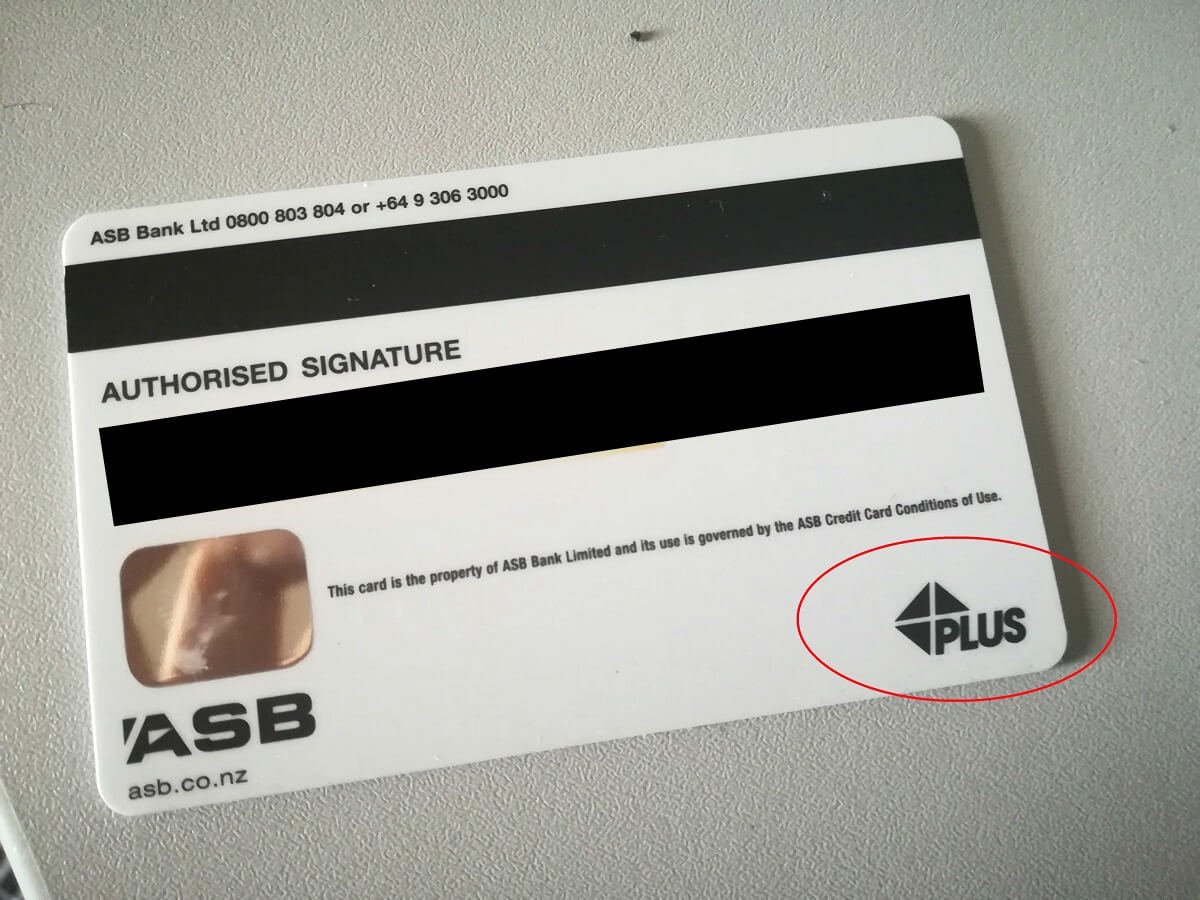
    As long as your Eftpos card has a PLUS, Cirrus or Maestro symbol on the back, you can use it at almost any ATM in the world.

    Check the back of your card and you should see one of those symbols, most NZ cards are either PLUS or Cirrus. 

    For example, here’s the back of my ASB card with the PLUS symbol:

    Then when you visit an ATM, you’ll see a sticker that shows what cards they accept, it will look like this:

    Since those symbols are displayed there, it means your EFTPOS card will work just fine.

    Just put it in, enter your PIN and away you go.

    It’s also really important to remember not to choose “credit” when you make your withdrawal. Choose check or savings or whichever your bank account is connected to.

    If you choose credit, it will not be an EFTPOS withdrawal but a cash advance on your credit card. That incurs interest, a worse fx rate and maybe some other fees as well.


    Part 2: Prepaid debit cards/travel cards

    These types of cards the best travel cards available today when it comes to fees/usability.

    They allow you to pre load different currencies (around 9 different ones) onto a prepaid Visa or Mastercard, meaning you can make purchases/ATM withdrawals in those currencies without paying the foreign exchange fees.

    Some also offer free ATM withdrawals.

    The 3 main ones available to New Zealanders are the Air NZ Onesmart, The Travelex Cash Passport, The Wise Debit Card and the Loaded for Travel card.

    First off, Loaded For Travel has been phased out. You might still see people using them, but they’re no longer being issued as of 2020. So that one is out. 

    Let’s compare the other three. We’ll look at the foreign exchange rate, the fees, and the overall ease of use for each card.

    As a benchmark, right now the NZD/USD rate is 0.6185, so we’ll base our analysis below on this:

    travel money nz

    Onesmart

    The Air NZ Onesmart card is a Mastercard debit card by Air New Zealand. It is managed via your Airpoints account and is pretty easy to use.

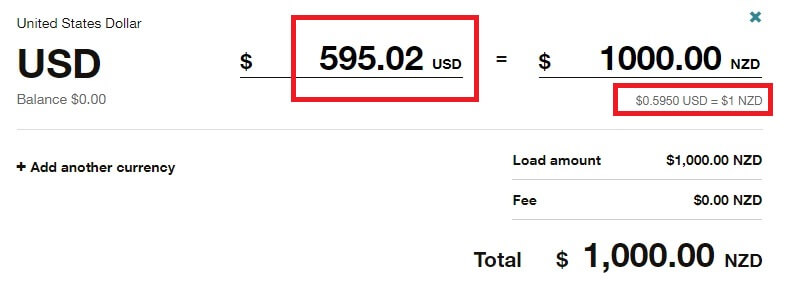
    When looking at the rate, here’s what you’ll get when loading $1,000 NZD into USD.

    best travel cards nz

    $1,000 NZD gives us $595 USD.

    That’s not very good.

    With an interbank rate of 0.6185, that means they’re taking a cut of  3.7% (that’s a lot).

    There is also a load fee of 1.5%, a currency conversion fee when you use the card of 2.5%, and a $1 monthly fee. 

    However the Onesmart does give you other perks, such as earning Air NZ Airpoints on your purchases and 3 free ATM withdrawals a month.

    Getting the card is free.

    Travelex Cash Passport

    The Cash Passport is a travel debit card available from Travelex. You may have seen their currency exchange booths and ATMs in the airports. 

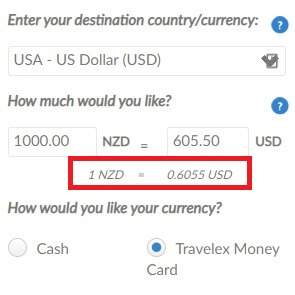
    Here’s their current rate when loading $1,000 NZD to USD:

    best travel cards

    $1,000 NZD gives us $605 USD.

    That’s better than the Onesmart (which gave us $595).

    The rate is 0.6055, compared to the interbank rate of 0.6185, so they’re taking a cut of 2.1%. Not extravagant, but not great either.

    Travelex also has a bunch of other fees:

    •  $10 initial load fee
    •  1% subsequent load fee
    • $4 monthly inactivity fee
    •  $10 closure fee).

    Looking at that you’re already guaranteed $20 in fees to simply open and close an account. ATM withdrawals are free.

    Could still be better than a Onesmart, depending how often you plan on using it.

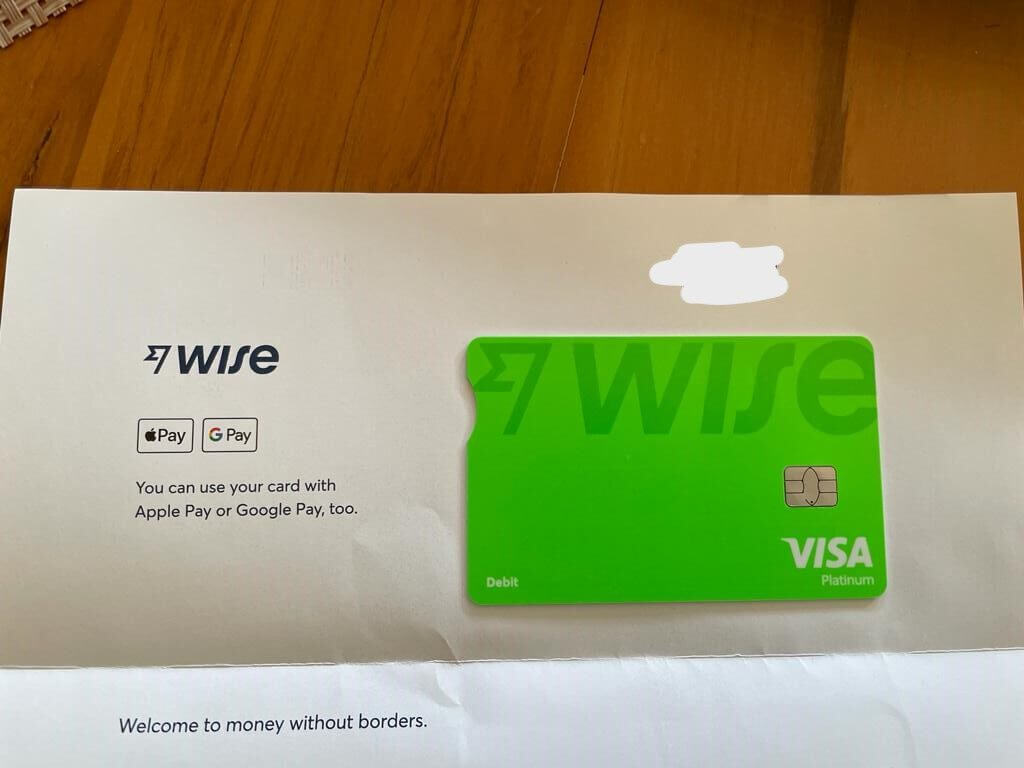
    Wise Debit Card

    Wise is a European money transfer service, but started offering debit cards and “borderless” bank accounts a few years later. 

    Their debit card came out around 2018 for Kiwis.

    I’ve been using it and it’s been pretty great. 

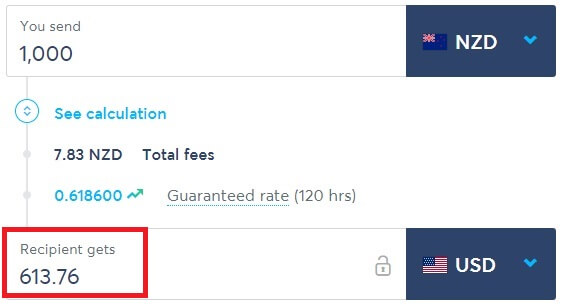
    Here’s what rate you get for loading $1,000 NZD to USD.

    At a rate of 0.6186, that almost exactly matches the interbank rate to four decimal places (actually slightly better).

    So the currency exchange fee they are taking is zero. That’s amazing.

    Of course they also have a fee like the previous cards, which here works out to $7.83, or 0.7%. That’s really low!

    Ordering a card is not free; it costs $14 NZD. 

    After that there are no monthly fees, and you get free ATM withdrawals of $350 per month (2% thereafter).

    There are also many other perks to owning a Wise card – you can open bank accounts in various currencies, get an IBAN number, and receive money in foreign currencies too.

    So which prepaid travel card is the best?

    Let’s put all that info together and see if we can get a winner:

    Onesmart

    Travelex

    Wise

    Exchange rate margin

    3.7%

    2.1%

    0%

    Setup fee

    no fee

    $10

    $14

    Load fee

    1.5%

    1% 

    0.7%

    ATM withdrawal fee

    3 free/month

    no fee

    free up to $350/month

    Closure fee

    no fee

    $10

    no fee

    Inactivity fee

    no fee

    $4/month

    no fee

    Monthly fee

    $1

    no fee

    no fee

    Airpoints

    Yes

    No

    No

    First, the Onesmart exchange rate is so crap that I would disregard it altogether – there is no way you would save money with it when you’re losing 3.7% every time you load money.

    That leaves Travelex and Wise.

    Because the exchange rate is also rather terrible for Travelex (and literally perfect for Wise), that would be enough for me to recommend Wise outright.

    Add in the fact that Wise has no closure fee, no inactivity fee, no monthly fee, and the cheapest load fee by far, and it’s a no brainer.

    The $14 set up fee is the one downside, but it is a one-off, and over the long run is easily worth it. In fact, you will make that back in savings the first time you load money.

    Travelex also ran into financial problems in early 2020, and it seems risky to have money stored on one of their travel cards right now. Them disappearing is not impossible.

    So easy decision here: Best prepaid travel card for Kiwis is the Wise Debit Card.

    You can sign up for yours here.


    Part 3: The best travel credit card for Kiwis

    Let’s move onto travel credit cards.

    The trick with credit cards is to minimise your fees, never pay interest, and try and earn some reward points along the way.

    We’ll start with fees. What are some of the fees you typically pay with credit cards?

    Here’s an example:

    kiwibank

    For this particular transaction, I purchased a $111 USD air ticket on Cambodia Angkor Air.

    On that date the interbank rate was 0.875, and they gave me 0.873. That’s good. 

    But you’ll also see I got charged fees of $3.18; around 2.5%.

    I personally do not want to add 2.5% to everything I buy, just because I’m using plastic.

    Unfortunately there is currently no bank in New Zealand that offers a credit card without foreign transaction fees, so this is unavoidable.

    However, having a credit card is very handy during your travels, so I think it’s a good idea to always have one on you, even if our options aren’t great in NZ.

    Since there are literally hundreds of different cards available in New Zealand, I’m not going to compare them all. What I will do is compare a few “free” credit cards to see which gives us the best deal.

    The following credits cards all have no annual fee and are reasonably easy to get approved for:

    ASB Visa Light

    Kiwibank Mastercard Zero

    Warehouse VISA

    AMEX Airpoints

    Annual fee

    no fee

    no fee

    no fee

    no fee

    Cash advance fee

    no fee

    $6

    $2

    $5

    FX fee

    2.1%

    1.85%

    2%

    2.5%

    Interest rate on purchases

    13.5%

    16.9%

    19.95%

    19.95%

    Interest rate on cash advances

    22.95%

    22.95%

    22.95%

    21.95%

    Airpoints

    No

    No

    No

    Yes

    All are pretty similar across the board.

    The main differentiator is the ASB Visa Light has no cash advance fee, meaning any ATM withdrawals are free. They should be free anyway on your EFTPOS account, but have this as a safety net is great as well.

    The other thing is the AMEX Airpoints card is free and gives you a chance to earn Airpoints, plus you get a $50 signup bonus – that’s also important and I’ll address that more later.

    Let’s take a look out how these fees actually translate into numbers. These are the fees you would pay if you made the corresponding purchases or ATM withdrawals:

    ASB Visa Light

    Kiwibank Mastercard Zero

    Warehouse VISA

    AMEX Airpoints

    $500 from ATM

    $11

    $15

    $12

    $18

    $1,000 from ATM

    $21

    $25

    $22

    $30

    $2,000 from ATM

    $42

    $43

    $42

    $55

    $500 in purchases

    $10.50

    $9.25

    $10

    $12.50

    $1,000 in purchases

    $52.50

    $46.25

    $50

    $62.50

    $2,000 in purchases

    $105

    $92.50

    $100

    $125

    Summary:

    The ASB credit card is best if you’ll need to make ATM withdrawals.

    The Kiwibank card is best if you’ll want to make actual purchases.

    This is under the assumption you pay the bill on time and don’t incur any interest.

    Either way, credit cards should be a backup only, and you should use your ASB EFTPOS for ATM withdrawals and Wise debit card for purchases on the road wherever possible.

    Don’t forget about Airpoints!

    This is more a tip for while you’re in New Zealand, but make sure you’re taking advantage of Airpoints!!

    If the average New Zealander uses an Airpoints credit card in their day-to-day life, they should easily get a free air ticket to Aussie or Bali each year.

    If you’re after a good, cheap, fast-earning Airpoints card to use, the American Express Airpoints card is the easy winner.

    It’s the only zero-fee Airpoints card there is, plus the Airpoints earn rate is even better than some of the more expensive cards from the NZ banks. I’d highly, highly recommend applying for it today while it’s around. Often they also have a $50 signup bonus, which makes it an absolute no brainer. Check here if the bonus is on offer and to get your free card.

    For a more thorough breakdown of Airpoints cards in New Zealand – I’ve got an entire guide which analyses every single Airpoints card available in New Zealand. You can check it out here.

    Another credit card tip: Paying in NZD (if it’s a good deal!)

    Sometimes shops and websites will ask if you want to pay in NZD instead of local currency.

    This can be a good idea sometimes. 

    Whenever the shopkeeper asks if you’d like to pay in NZD, always ask what the amount will be. Then pull out your phone and do a quick conversion (I use the Oanda app) and check if it’s a fair amount.

    Nine times out of ten they will be taking a big commission on the exchange rate. That means even though you’ll avoid FX fees on your credit card, you’ll end up paying more to the shop and it will probably end up costing you more overall.

    There are good opportunities to do this though. Take a look at this example.

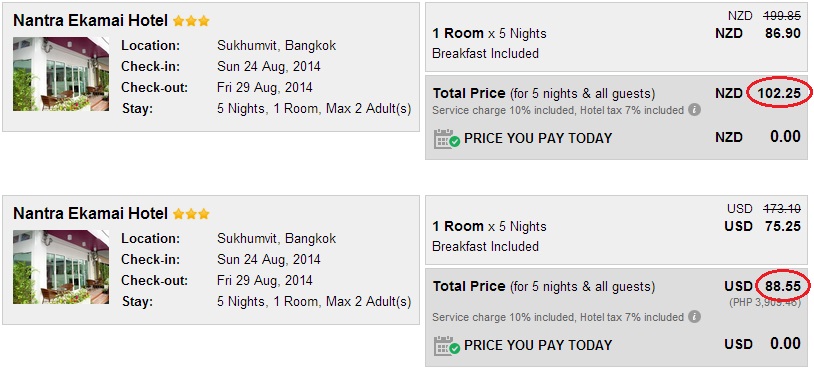
    This is a hotel booking form from one of my favourite booking sites, Agoda. It’s for a hotel in Bangkok:

    agoda

    Their prices are USD listed ($88.55), however they also give me the option to pay in NZD ($102.25).

    If I choose to pay in NZD, I’ll be getting a conversion rate of 0.866, compared to the current interbank rate of 0.867.

    That’s very good, and much better than what AMEX will give me if I pay in USD and let them convert it (it was around 2.5%, remember?)

    Therefore I often make online bookings in NZD (assuming the rate is good), which eliminates foreign transaction fees, and also lets me earn some Airpoints along the way.

    In the case that it’s better to pay with USD, just use your Wise debit card.

    Summary for the best travel credit card:

    There is no ‘good’ travel credit card in NZ (that I know of).

    However, it’s always good to have one anyway. My recommendations are:


    So which travel cards/bank accounts do I use?

    Here’s the summary of what I use currently to keep my fees as low as possible and money as easily accessible on the road.

    The main card I use while travelling is my Wise Card. Nothing else is anywhere near as good. 

    However, as backups:

    • I have an ASB Streamline Account (no fees), which I use to withdraw larger amounts of money from ATMs. I have never visited a country where I could not do this.
    • I have an Airpoints American Express (no annual fee), which also has no fees and earns me Airpoints. I barely use this while travelling, but I use it for pretty much everything I buy while in New Zealand. If you’re not already, I’d highly recommend signing up for one today and start stacking Airpoints! I also recommend you read my guide on travel hacking for Kiwis.
    • Lastly, I carry a small amount of USD in cash for emergencies. 

    Between these options I manage to keep my bank fees almost non existent – in fact you might have noticed every single card has no annual fee.

    I also get to earn a few frequent flyer points along the way. Pretty good, no?

    What should you use?

    If you’re on a shorter trip (say 2 weeks – 1 month), it becomes much less important what card you will use.

    If you’re just going to Australia, you can simply use your NZ Eftpos card to get money from ATMs. You can even use your ANZ and Westpac cards and their equivalent ATM in Australia.

    If you’re going on a longer trip, or travelling around the world, you absolutely need a Wise card. That option can hold you down in almost every country. Keep an ASB Eftpos card handy, and possibly one other bank account too as a backup.

    That’s it!

    Best of luck in your travels and as always, if you have any questions, drop them in the comments below. 

    B

  • Running The Singapore Marathon

    Running The Singapore Marathon

    When deciding to do the Singapore Marathon there was a big question mark over it for a few weeks. I had just finished my first marathon at Auckland, but something told me I still had more to give. With all I’d learned at that race, plus a few more weeks of training, I was confident I’d be able to improve my time.

    After a week of rest I decided to sign up. The biggest lesson from my first marathon was, if you never try, you’ll never know. And my months-long battle with TSW had taught me how important it was to do things while you have the chance. Life can change overnight.

    What’s it like running Singapore Marathon?

    Singapore was very different from my first marathon at Auckland.

    It’s much bigger. 50,000 runners, around 15,000 for the full marathon. By comparison, Auckland had less than 2,000. Secondly, the weather played a big part. Singapore Marathon 2019 was also an evening race rather than a morning race. All these things combined for a very different and challenging experience. I’ll break this all down below, I’m sure you’ll see what I mean!

    Signing up for the race

    Singpapore Marathon is one of the biggest marathons in the world. The sign up is done through the Singapore Marathon website.

    The registration will cost you anywhere from $90 SGD to $155 SGD, depending on whether you’re a local or foreigner, and how early you sign up.

    It’s also worth hunting around for discount codes on various runner websites, as the marathon does give out quite a few. As an Auckland marathon finisher I received a discount code, but unfortunately it had expired by the time I signed up.

    During the registration you will be asked your shirt size for both a running singlet to wear on the day and a finishers t-shirt that you receive at the finish line. They’re both pretty good items that will last a while, so make sure you get the size right!

    You can also pre-order the photo package during registration. It will be more expensive to get it after the race, however, there weren’t actually that many photographers on the Singapore course. There’s a good chance they may only get 1 or 2 photos of you, especially since there are so many runners, and they may not be high quality since the race is at night. It’s bit of a gamble to pre-order them without knowing what you’ll get. You also get one free photo anyway with your entry.

    Training

    My biggest concern had nothing to do with weather or travel or anything external. I was mostly concerned with my body. I only had six weeks between the Auckland Marathon and the Singapore Marathon.

    In Running To The Edge, the author talked about how professional marathoners can only compete twice a year because the toll on their body is so high. This caused me to be more cautious with my training and to actually tone down my training from the first marathon since I hadn’t had a chance to fully recover. Plus I hoped all the endurance I’d built up for Auckland would at least carry over.

    I planned out my six weeks like this:

    Week 1: Rest

    Weeks 2 and 3: Mileage 25 km/week, gym twice a week

    Weeks 4 and 5: Mileage 45 km/week, gym once a week

    Week 6: A few short runs, race on Saturday.

    As it turned out I was quite under-trained for the race, maybe an extra 10 fast kms per week would have helped a lot. But much advice also said it was better to be under-trained than over-trained. It’s hard to hit the perfect spot, especially for someone like me who has no running background and no coach. I’m kind of just guessing and figuring it out as I go along!

    Diet

    I was on the keto diet for all my Auckland training and was even 100% keto during the race. I also did all my workouts fasted except for maybe some ketones/electrolytes in my water. I actually felt great during all my Auckland training on this diet (I describe my keto diet in detail in my Auckland marathon post).

    When training for Singapore I stuck with keto for most meals, but I changed this up a bit and started incorporating post-run carbs into my training. This meant I was eating ~100g of carbs after my workouts, mostly to try and beef up my glycogen stores. Some keto athletes also said post-workout glycogen helped a lot with muscle repair, so I decided to try it and see.

    While it was nice to be able to eat carbs, I didn’t feel as strong. Normally after working out I would eat salmon, avocado, fish, lamb, eggs etc, and would wake up feeling brand new the following morning. Now I was replacing that with sweet potato, rice and fruit, then eating my proteins later at night and was feeling kind of flat. I felt this during the race too, which I’ll go into later.

    So for me, pure keto is still a winner.

    Athlete Check In

    I actually love the Athlete Check-ins. This is where you go to pick up your racing bib, shirt and goodie bag a few days before the race. There’s a runners expo on as well and it’s just cool to have something like this to get you pumped up for the event.

    The Singapore Athlete Check-In was at the Marina Bay Convention Centre. It’s easy enough to reach by MRT (Bayfront Station). It’s run over three days so you have plenty of time to go and check in.

    They have all the usual things, like merchandise for sale, lots of running gear, info on other marathons and Singapore Marathon branded stuff. I actually ended up buying a running belt and some gels for the race. Anything you need for the run, you’ll find it there.

    Race Day

    Singapore Marathon 2019 was the first year they started the race at night. The official start time was 6pm. I had actually anticipated this being a good thing, as I hate waking up early in the morning.

    The opposite turned out to be true and I’d say now I actually prefer to race in the morning. There’s a few reasons. First, when you wake up on race day you’re usually pumped and ready to go. You’ve left the schedule for the whole day empty and all you want to do is get on with the race. But with an evening race you wake up at 8am and have to wait until 6pm to race, that’s ten hours you’re just sitting around waiting to get started. Not only do you lose a lot of energy in that time, you also need to be mindful of everything you eat and do – you can’t eat anything too heavy, you need to stay off your feet and so on. By the time you line up at 6pm you can actually feel quite drained and all your adrenaline from the morning is gone.

    This is somewhat how I was feeling when I got to the race venue. Being there got me a little pumped up, but nowhere near to what it feels like to be out starting a marathon at 5 or 6 in the morning.

    The second reason I’d prefer a morning race is because the evening is super hot! At 3 or 4 in the morning, the air would have cooled a lot from the previous day, but at 6pm the air is still almost at peak temperature, even though the sun has gone down. The heat was actually one of the big killers for most people.

    Singapore Marathon is a huge event so everything was much more controlled. Every checked bag went through security screening and every starting pen was heavily staffed and controlled at the entry point. I actually wanted to be in starting pen C (4 hours to 4:15 hours) but since I registered late the fastest pen I could get a place in was pen E (4:45 to 5 hours). I thought I might be able to sneak into C anyway, but there was no chance.

    Another interesting thing was the half marathoners and the full marathoners started at the same time. I found this to be odd – surely 15,000 marathoners will make the course crowded enough, you really want to add in 15,000 half marathoners too? The pens felt very tight and everyone was already sweating before we even started, not just from the heat but from the crowd. Nights can be cool in Singapore sometimes, but on race night we weren’t so lucky. It was around 30-31 degrees when we got to the start line.

    Because of the rolling start, the elites got the gun at 6:05 pm and my pen got the gun just before 6:30. We were off!

    Kilometres 1-8

    I had a goal to run 4:15 in this race. That meant my pace had to be around 6 minutes/km. Because I started in a slower pen than I had wanted, everyone was running around 7-7.5 minutes/km. That was actually fine as I had planned to start out slow anyway. However after the first aid station at 2km, I wanted to get on pace and I couldn’t. It was far too crowded to pass people or even weave through. The initial streets were narrow so everyone was just boxed in the crowd. I had no choice but to run 7 minute kms for the first 6-8 kms.

    The aid stations were also sucking time. At Auckland, the aid stations literally had 200-300 cups at each table pre-poured, stacked four or five high and ready to go. Volunteers held them out for you and you could just run past and grab them without even stopping.

    The aid stations at Singapore were nowhere near as organised – they had queues probably 5 or 10 deep, and the cups weren’t pre-poured (or they couldn’t pre-pour fast enough). If you wanted water, you had to stop and wait in line, wait for them to pour your cups and then get running again. They were super understaffed. At one station there was only one girl at the table I stopped at. When I got there she was fetching bottles of water from the boxes in the back, then she rushed over to us and dumped them on the table, opened one and started pouring furiously. There were about 7 or 8 of us holding cups out impatiently wanting to get moving again. My best guess is they had a lot of volunteers who didn’t show up for the day. Running an aid station table is at least a 3-4 person job, she was doing it alone! It was going to be a long night, I felt so sorry for her.

    Since I was already running each km 1 to 1.5 minutes slower than I needed, and also losing probably 30 seconds at each aid station, any hope of finishing in 4:15 vanished by the 8km mark. I was already about 10 minutes behind pace and it would’ve required a miracle to catch up. I basically told myself to not worry about the time, just run my best, and have fun.

    Kilometres 9-15

    By now I was already soaked in sweat and the humidity wasn’t letting up. A few guys had already taken their shirts off, so I took mine off also and tied it around my head. This actually made a huge difference, I now had wind against my body to cool me down, and felt lighter too, and any water I poured on me actually hit my skin instead of just making my shirt stick to me even more.

    This part of the race was pretty uneventful and just felt like a normal training run. The course was still crowded so trying to put on any speed would have still required some weaving through people, but nowhere near as bad as the first few kilometres.

    Kilometres 16-21

    This is where things started turning sour. I’d been dealing with some foot niggles all week, but it didn’t feel like anything serious. Then around the 15-16km mark sharp pains started in my foot. At first I thought it was just normal running pain. When you set out to run 42 km, it’s usually a given that your feet (and everything else) is going to get messed up at some point. If you zone in on the task the pain usually just goes away.

    Unfortunately this time it didn’t “just go away”. Things got worse quickly and by 18 km my foot was in serious pain and buckling under weight. At this point I was convinced I had broken something, possibly a stress fracture or at the very least had a really f*cked up foot.

    I actually remember saying out loud to myself “You’re in trouble”. 24km left, and no way out except to run every 24 of them on my own two feet. A horrible feeling came over me that I probably wouldn’t be finishing. On one good foot I knew I could beast-mode through 5km and maybe even 10km, but I knew 24 km was impossible even on my best day. My heart sunk as I thought about needing to pull out of the race.

    It’s easy to talk a lot of shit before the race about how you’re a beast, how you’ll never give up, but when you’re staring it in the face like this, it’s not always the same words running through your head. Sometimes you’re forced to admit you’re not really as tough as you said you were.

    What started going through my mind at that point was a Youtube running video I listen to during training. Near the end is a part that goes, pain is temporary, but quitting is forever. This starts playing through my head and I tell myself, no way you can stop here. If it turns out you can’t do it then you can’t do it, but the only way you’re going to stop before the finish line is if the ambulance comes and carry you off the course. As long as you can still take one more step, giving up now is quitting! I put my head down and went to work.

    At this point, the goal was just to get to half way. In my mind, I saw that as the huge psychological victory I needed to win. After that I could chip away at the second half, and maybe we’ll make a miracle happen.

    Because I couldn’t put much weight on my left foot, I had a new style of running, waddling a bit like a penguin and using my arms to push me through the air. It wasn’t pretty but it worked. Also motivating me was the fact that I was passing a lot of people! By this stage the heat was taking its toll, and half the course was already walking.

    Eventually I saw the signs up ahead that split the course – half marathoners turn off to the left, full marathoners carry on down the right. I watched the half marathoners leave the course and a few minutes later, I hit the 21km marker. Half way! Time to turn on beast-mode and hope for some magic.

    Kilometres 22 – 30

    The name of the game here was mini goals. Every 2km there was an aid station, so I told myself to get to the aid station at 22km, then walk through it as you drink.

    As I hit the aid station, it was pleasantly empty. With the half marathoners gone, the course was now far less crowded, there was no more waiting for water or trying to push through the crowd. I downed two cups of 100 Plus and sucked down an energy gel I had in my race belt. I told myself to get all the sugar I could get.

    I walked through the aid station, gave my feet a rest, then slowly got running again. I used this strategy for all the aid stations up to 30km; run 2km, walk through the aid station. To be honest that whole stretch of the race is a total blur, I don’t really remember it. When I got to 28km, it felt like a miracle. I told myself if you make it to 30km, you can walk to 31.

    I made it to 30.

    Kilometres 31 – 36

    Hitting the 30’s was a huge psychological win, but as I walked to 31km, things started to get a little depressing on the course. The mood was super glum and most people were walking by then. The heat was really f*cking people up in a bad way. It felt like nobody wanted to be there, including me.

    I also noticed all the medical tents were full. There was a tent every ~2km, and it was always busy, at least 10-20 people at each one. I saw a few people on stretchers who looked semi-conscious, most likely heatstroke. And there was always a crowd of people spraying stuff on their legs. I’m not sure what it was, but it smelled like tiger balm and stung my eyes every time I ran past.

    At this stage we’d been running for around 3.5-4 hours.

    Running through the various parks, lots of people were sitting on the park benches. Some had taken off their shoes. I’m not sure if they were just resting and planned on continuing, or if they’d given up. One guy was laying against a railing, half conscious. He looked like he needed help. Then I saw the medic running towards him about 25m down the street.

    A few kilometres on, a woman collapsed just a few metres away from me. She was probably the fourth or fifth collapsed person I’d seen in the last couple of kms. Luckily, the guy behind was close enough to catch her. He sat her up on the sidewalk. I continued running, and a few minutes later saw the medic running with the wheelchair and some ice. I pointed behind me and said, “She’s 30 seconds that way.” He nodded and kept on running.

    Not long after that, a guy ten metres ahead of me suddenly turned off onto the grass and dropped to his knees. A bunch of us turned to see him vomiting loudly in the bushes. I didn’t sound pretty.

    The last incident in this “death period” of the race was along a bridge towards the final loop of the race, around 36km. As I crossed, I saw a medic kneeling over a guy passed out against the railings. It was one of the pacers. As I ran past the medic was yelling into his radio, “I need some ice on the bridge please, right now, ice on the bridge.”

    It was dismal. Nobody wanted to be out there anymore. I was thinking, I’m never doing this again. Just get me to the finish line.

    Kilometres 37-42

    Hitting the 37km mark was a huge victory. It was now 5km to the finish line. How many times have I run 5km in training? Sometimes I’d do that just for a warm up. There was no way I was going to be broken by 5km now, I was certain I’d be finishing this race.

    But just as things started looking up, I got to a hill just before 38km. It wasn’t a small hill. It was a monster! When I think back on it, the hill was probably somewhere between 100m to 200m, but it felt like 2 kilometres at the time.

    Some people say it’s best to walk up hills, because if you run up you use a lot of energy and don’t even move much faster than walking. But for me the hill is a more mental challenge. I like to run it as fast as I can and get it done as soon as possible.

    I did my best to sprint up the hill, probably wasn’t moving very fast, but at least it felt fast. After conquering it I got to the 38km marker. 4km left.

    Then somewhere around 39km, a bit of magic happened. While running into one of the final parks a guy suddenly stopped and hunched over, resting his hands on his knees. Just out of instinct, I gave him a tap on the shoulder and said “No no don’t stop we’re nearly there!”

    Suddenly his head shot up and he started running beside me.

    When we hit the 40km aid station, I stopped and slug two cups of water. As I finished I saw him a few metres away, waiting for me. He motioned me with his head to get moving. He had fire in his eyes and I could tell he was ready to smash these next 2 km with a sledgehammer.

    I nodded and we took off.

    By this stage, 90% of the course was walking. We weaved through the crowd, my splits say we were only running around 7:30/km but we were passing so many people it felt like we were flying. In Running To The Edge, he talks about how running as a group is always more powerful than running alone. Now I started to see what he meant. When someone is pacing you it’s far too hard to give up. When you’re alone, it’s far too easy.

    I was even running normally now. At least, it felt normal. My foot had gone numb a long time ago, I couldn’t even feel it. We pushed and we pushed, but it felt like forever waiting for the 41km marker. At one point I was convinced the marker didn’t exist, that it had gotten blown down by the wind or something. There was no way hadn’t run at least a kilometre yet! But eventually I saw the 41km sign in the distance. 1km left.

    There were a few spectators as we got to the final stretch into the F1 building. They cheered and it gave us a little boost to not give up. My foot buckled a little and I grunted, but he shouted “Cmon!” and we kept on moving. It wasn’t long before we hit 42km.

    “200 metres left,” I said between puffs as we passed the sign. “Let’s do it,” he said back.

    We followed the course through a little U-turn, then in the distance we could finally see the blue carpet and the finish line. It’s an indescribable feeling to see a marathon finish line. It’s an image you’ve been imagining not only for the entire race, but for all the months of training and hours of pounding pavement leading up to race day. When you see it in front of you, it’s a type of joy that could never be explained, it can only be experienced.

    Obviously the first half of the course was empty by now, so all the photographers had gathered here at the finish line. There was nobody in front of us, just me and this guy, running side by side. All we could see was photographers click-click-clicking, it’s flash after flash, it felt like we were running for first and second at the Olympics. We picked our legs up and crossed the finish line side by side.

    After taking a moment to catch our breath, we finally gave each other a hug and a fist bump. A few others finished just after us and we all enjoyed the moment with high fives and smiles and good jobs and well dones. All I can remember thinking is, what a motherfu*cker of a race. And how happy I was it was over.

    Post race

    To be honest, post-race at the Singapore marathon is kind of ridiculous. After you collect your medal, you’re then forced to walk around a kilometre to the finisher’s village. It’s literally the last thing you want to do after running 5 hours in the Singapore heat, but for some reason the organisers designed it this way.

    To make things worse, to collect your finishers tee shirt they make you walk through one of those winding snake airport type queues, and not a short one either. I can vividly remember everyone’s sour faces as hundreds of us hobbled through this line for five minutes to collect our t-shirts.

    One nice touch after the race is you do get a lot of freebies; a packet of Lays, a can of 100 Plus, a cold towel, a banana, a bottle of water, and a can of (zero-alcohol) Heineken.

    The Finisher’s Area was also kind of disappointing. There were a few stalls, but nothing really happening, no food or drink for sale (or not much), it just felt a bit like an empty parking lot with lots of kids waiting to be picked up from school or something. Normally post-marathons should be quite celebratory, but at Singapore it was a bit dull.

    By now it was also just after midnight. As the MRT was closed, getting home was a nightmare. Around 15,000 marathoners ran that night, so for about 1.5 hours we couldn’t get a cab or a Grab anywhere. I ended up wandering around with my parents trying to find a cab until we finally got home at 3am. Definitely not what you want to be doing after running 42 kilometres!

    Final Thoughts on SCSM

    For me, the event was just okay. Lots of the logistical planning was disappointing. In the lead-up they had talked it up as being a world class race but so many simple things they got wrong. For example; running out of energy gels at the aid stations, being understaffed at the aid stations, on-course entertainment consisted mostly of empty stages (didn’t bother me at all, but I did notice it), poor design of the post-race area. They all seem like pretty simple things (like, how do you run out of energy gels?) so I was surprised at many of them.

    It also didn’t work out starting the half marathon and full marathon at the same time. Apparently this is the first time they did this, and it made the course super crowded at the start, we felt like sheep being herded in the paddock. Most races start the half-marathoners around an hour later, which doesn’t matter since the half marathon finishes about 2-3 hours earlier than the marathon anyway. Maybe there was a reason they did it that way, but it seemed odd to me and made the race a lot less enjoyable for both groups I’m sure.

    As for the course itself, it’s not too hilly but still super challenging because of the weather. The humidity increases the difficulty by more levels than you’d expect. Racing at night is also quite special, even though it’s much hotter (at least at the start).

    Overall, it was a good one to add to my running résumé, and I learned a lot. Probably not a course you’ll PR on, but if you’re up for a challenge, it’s a good one for the collection.

    Good luck!

    Heading to Singapore Marathon and…

    Looking for tours and activities at an affordable price? I use GetYourGuide! Always great deals and local perks.

    For travel insurance, I always use World Nomads – get protected for just a few dollars a day!

    Somewhere to stay? Booking.com gives you the biggest selection and the best rates.

    Also be sure to check out my Singapore travel guide here!

  • Running The Auckland Marathon

    Running The Auckland Marathon

    It was late August when I signed up for the race. Nine weeks out.

    Part of me didn’t really believe I could do it.

    But, part of me did.

    That was the only part that mattered.

    There’s a long backstory to why I signed up for this race. I was battling a skin condition called Topical Steroid Withdrawal (TSW). It had destroyed me physically and mentally. I could write a book about the experience, but I’ll leave out the long version for now (you can read more here).

    Because what I learned on race day is everyone has a unique reason for getting to the start line. The marathon isn’t a race for most, it’s a battle against yourself, trying to conquer your own limits and destroy your demons. The thing we all have in common is, we are in a fight.

    On the back of one guy’s shirt, it said “Sudden cardiac arrest in May, but I’m still here.” Another guy’s shirt said something like “My wife said I needed to get in shape.”

    To some it might seem like madness to wake up at 4 a.m and run 42 km with a bunch of strangers, but thousands of people had accepted the challenge. Marathons are particularly special, mythical even; a chance to undertake the impossible journey that Pheidippides ran from Marathon to Athens. You go out there and run the impossible race, and by doing so you take your life back. Because once you finish a marathon, you can do anything.

    What’s it like running Auckland Marathon?

    The marathon experience is quite special, something I didn’t expect or even think much about when I signed up. People come from all over the world to run. It’s a a life changing event for many.

    Below I’d like to take you through the experience, from signing up to everything that happens on race day. If you want to run your first marathon and Auckland is on your radar, I’ll include everything you need to know. And if you have no plans of ever running a marathon, hopefully this gives you an insight to what it’s like, or better yet it might inspire you to try 🙂

    Signing up for the race

    Auckland Marathon is owned by Ironman and administered through Active.com, but you start your registration directly on the Auckland Marathon website.

    It will cost you around $130-$190 to enter, depending on how early you sign up.

    You will also need to pay an Active.com handling fee of 8%, so in total the registration fee will cost you between $140-$205 NZD.

    This fee gets you entry into the race with an official race number and timing bib, a gear bag, medical support on the course, water, Powerade and Coke at aid stations, an Auckland Marathon hat, and a finisher’s medal (if you finish).

    The other thing you might want to buy is your race-day transport. You don’t want to be worrying about things like parking and being late on race morning, so I’d recommend using the transport provided by the event. You can either catch the ferry from Auckland CBD, which will take you directly to the start line, or there are also buses you can take from other areas on the North Shore. The tickets cost around $10-$20.

    There’s a whole bunch of other stuff you can buy during registration like photos, clothing etc. but none of it is essential. If you’re thinking about buying the photos, you can wait until after the race and you’ll get to actually see them before you buy, but it is a bit cheaper to buy them beforehand.

    Training

    For some idea of my background, I’m new to running, I started running 4 months before the race, and started training for the marathon 9 weeks before. I would’ve liked more time, but I made the decision to register late so that was all I was left with.

    Most people would have considered me fit and healthy before I started, but I quickly found out that didn’t matter much. Running fitness is a different beast!

    I remember my first run in June was 2.14 km and I felt like I was going to pass out. If you had told me then I would be running a marathon in October I would have said “Impossible!” or at the very least, “highly highly highly highly unikely”. But the other thing about running fitness is it tends to improve quite quickly; a handful of short runs and you’ll already notice a big difference. So don’t be discouraged if your first runs feel like death!

    As a new runner the first thing I had to do was put together a training plan. All the training plans I Googled you had to pay for, and the free ones were vague. I did find a few helpful-ish articles and used those and mostly guesswork to put a plan together.

    Basically you’re going to need to run a lot (duh), but there are many different kinds of runs; slow runs, fast runs, long runs, short runs, tempo runs, threshold runs, repeats.

    To be honest all that stuff just complicated everything so I just focused on one thing: Mileage.

    This meant I ended up doing only three types of workouts:

    1. Short runs
    2. Long runs
    3. Weights

    My only goal was to finish the race. As long as I met my mileage goal every week I figured I was getting fitter and would finish.

    A typical week would be three short runs (between 6-10 km) and then a long run on Sunday (20+ km). I didn’t worry about how fast I ran or when I ran or how I ran, I just focused on finishing the mileage. Once or twice a week, I would go to the gym after a short run and do some weights (mostly hitting legs, and some circuit stuff).

    “Good” runners typically get their mileage up to 80+ km per week or more, but I knew in 9 weeks I’d never get that far. The goal was to get up to 50 km per week, but I never actually made it there either. Dealing with TSW and also a few sore muscles meant the most I ever ended up logging in a week was 41 km, and the longest run I did was 28 km. Not the ideal build-up to race day, but it was the best I could do with the time I had.

    Diet

    Obviously you need large amounts of fuel to train for and finish a marathon, so nutrition is a big part of the training plan. I know everyone has a different view on what a healthy diet looks like, and to be honest I think you could finish a marathon on any reasonable diet, whether it’s Whole 30, paleo, vegan, carnivore or whatever else. But I will tell you what I did and why I did it.

    I decided to train on the keto diet, which is a low/zero carb diet. I’d have been open to any diet, but I went with keto because it’s familiar and fit best with the TSW treatment I was going through.

    The broad macronutrient breakdown on keto is 75% fats, 20% protein, 5% carbs.

    This is the opposite of almost every recommended diet for marathoners, which recommends ~60% carbs and almost no fats. However I did find many people who had run marathons on keto and that was all I needed to know.

    What’s the idea behind keto?

    Carbs are the default energy source for most people. What happens is you eat carbohydrates, your body turns them into glycogen. The body then sends this glycogen to your muscles to use as energy.

    However if you stop eating carbs, your body has to use something else. It turns to the next energy source which is fats. Your body takes fats (either body fat or dietary fat) and turns it into something called ketones, which gets sent into your bloodstream for energy.

    The reason people choose the fats/ketones route over the carbs/glycogen route is because of capacity. Glycogen delivers energy faster, but your muscles can only store around 2,000-3,000 calories of glycogen at any time. When you run out, your body shuts down and you’ll get light headed and find it difficult to stand or walk (also known as “bonking”) until you eat more carbs. 2,000 calories will only last you around 1.5 hours of a marathon, so if you’re running on glycogen, you will need to eat during the marathon if you want to finish. This is why most people hammer energy gels during marathons, which are packed with sugar (carbs).

    When it comes to fats, your capacity is much higher. Most people already have at least 30,000 calories of stored body fats, which is enough to fuel several marathons without eating anything. However, if you’ve been eating carbs your whole life your body’s ability to create ketones will be weak, since it’s never had to do it before. It takes time for your body to build the ability to generate large amounts of ketones, or to become “keto adapted”. Usually around 6-8 weeks of no carbs, and your ketone-producing ability will continue to improve over time after that.

    If I were an experienced runner and could finish the marathon in ~3 hours, I would have relied on a more glycogen-based diet, but as a newbie with only 9 weeks to train I figured I could be out there for 5 hours or even more. So the bigger gas tank on keto made more sense to me. I’m also a regular faster so I knew my body was already keto-adapted to some extent.

    So what does a keto diet look like? Lots of fish, steak, chicken, cheese, eggs, butter, and low glycemic vegetables. This was good because it also kept my food prep very simple. For all my training, I also worked out fasted, relying only on body fats to fuel my runs. This made my meal prep even simpler as I only ate one (big) meal a day.

    I did learn quite a few interesting things about this diet during my prep, and for any future marathons I would tweak this strategy a bit, but overall it worked as I’d hoped.

    Athlete check-in

    Two days before the marathon there is the check-in, where you go to pick up your race number and your race pack. It was held at The Cloud in the CBD, and there’s a big runners expo there too with all kinds of merch and gear for sale.

    It’s pretty cool to go to these things as a first time runner. You see all the other competitors and what a big event it is. Everyone is on a buzz because you’ve been training for months and now finally the race is here.

    If you’re running at Auckland, one thing I’d recommend is depositing special drinks. The great thing about Auckland marathon is it lets all competitors deposit special drinks, not just the professionals. This means you can prepare your own drinks and deposit them at check-in with your name and the aid station you want it to be sent to, and the staff will make sure that drink is waiting for you out on the course.

    Because I was running on keto I couldn’t drink the sugary drinks they provided, so I mixed up my own drinks with electrolytes, ketones and MCT oil and had them deposited at every aid station. This was a big mental confidence booster for me, because I knew I would have lots of keto-friendly fuel, and would be able to race with the same drinks I’d been using all throughout my training.

    Race morning

    I woke up around 3:30 am on race morning. I had all my kit prepared the night before. During the race I’d be carrying a race belt with my knee guard, a little box of electrolyte pills, some “fat bomb” sachets, and my phone with headphones in case I needed inspiration (I ended up not using the phone, the fat bombs or the knee guard at all, but I did finish all the electrolytes!)

    I arrived at the start line early. This gave me a lot of time to stretch and do some massage ball work, more for peace of mind than anything. In the back of my head I still wasn’t sure if I’d be able to finish this thing. My knee was a little soft and I knew I’d have to be gentle on it. I was just doing my best to focus and get positive.

    As my parents were with me I didn’t need to deposit any gear, but if you’re alone there is a bag check where you can deposit your jackets etc and they’ll transport it to the finish line for you.

    The start line is divided up into zones based on pace, so if you think you’ll run around 3 hours, you go to the 3 hour pace zone, if you think you’ll run 4:30 you go to that zone and so on. It’s a rolling start, and there’s an electronic timer on your racing bib so your official time doesn’t start until you actually cross the start line.

    I started at the back of the 4:45 zone. I figured I could run between 4:30 and 5 hours, but I’m a slow starter and didn’t want to get caught in a whole bunch of people passing me. I decided it was better to start at the back and pass lots of people rather than get overtaken all the time and be reminded of how slow you are.

    There was a lot of buzz on the start line. Thousands of people, all this work and it had all led to this moment. This means lots of nerves, lots of emotion. But as soon as the gun went all that faded away and I got to work.

    Kilometres 1-10

    I felt unusually strong for the first 10km. Normally my body takes a while to loosen up, but on race day I was comfortable from the beginning. Possibly because I started at a slower pace than usual.

    It was still dark at this point, about 30 minutes before sunrise. As a summer chaser it was a little cold for me. Of course I was too caught up in the moment to worry about that. It only took a couple of slow kilometres before I was warmed up and running smoothly.

    The course at Auckland is top-heavy, meaning the difficult parts are in the first half. Most of the early part consists of small hills. In fact the course basically starts on a hill (an easy one). Hills are the bane of a marathoner because not all kilometres are equal. After running for hours, 1 km on a hill can be ten times harder than 1 km on a flat. So getting the hills out of the way early actually turned out to be a good thing.

    The first aid station was at 4 km. This was where I realised how awesome it is to have special drinks. The special drinks table is actually about 20 metres before the actual aid station. So how it happens is everyone is running towards the aid station, but before we get there, there’s a big sign that says “Special Drinks” with a table. And on the table I see my bottle waiting, with the blue and yellow ribbons I tied on it so I could find it easily. There’s only 2 other bottles there. I run by like it’s my own personal refreshment booth, don’t even need to stop, I grab my bottle and start sucking on it as I run right through the aid station. Everyone else is slowing down or stopping in the crowd to get water or Powerade, and I just breeze right past them.

    The second huge advantage was I had a bottle, and everyone else was drinking from cups. It’s almost impossible to run while drinking from a cup without slowing down (I learned this when I grabbed some water a few aid stations down), but it’s easy from a bottle. So I was able to continue running while drinking without breaking my rhythm at all, and everyone else had stopped to walk/drink.

    My pro tip: If you’re running at Auckland, definitely deposit special drinks!

    The first ten kilometres was my strongest part of the race as expected. I also ended up passing a lot of people like I’d planned, including the 4:45 pacer. At least mentally, that set me up nicely for the next leg.

    Kilometres 11-20

    This is the area where you finish the last few roads on the North Shore and then head over the bridge to Victoria Park.

    I still felt strong during this area. However, the bridge was a lot steeper than I expected. Quite a few people struggled on the uphill. It’s a lot steeper than you might guess while driving over it. I grinded out the uphill quite well, but ended up finding the downhill difficult too. It felt uncomfortable running it slowly. I told myself it’s a waste of energy to hold back on a downhill, so I let my legs loose and went down at speed.

    This probably used a lot of energy anyway and hammered my legs, but it did mean I got over the bridge quickly. I also passed the 4:30 pacer group on the way.

    Once you get over the bridge, there’s a few winding roads you run through and some mini hills, but eventually you get out towards Victoria Park. This is the halfway point, so you see the half marathoners going off to the finish. For you though, it’s only halfway!

    I actually remember feeling pumped at this point as I still had spring in my legs, and told myself I was more than ready to fight through the second half. This is what we came to do!

    Kilometres 21-28

    The second part of the course is all flat. It’s also all straight – along the waterfront to St Heliers and then straight back. This makes it ideal for putting your game face on and getting to work.

    My goal was to stay in front of the 4:30 pacer and maybe even push for 4:15 in the later kms. But my legs started to weaken around Kilometre 25, and eventually the 4:30 pacer group caught up to me. I stayed with the group for about 2km, but my legs just couldn’t do it and I had to let them go. That was disappointing, but I didn’t have time or energy to dwell on it. I just told myself to make sure I stay ahead of the 4:45 pacer, and kept on going.

    Along the waterfront there are markers every kilometre. They seemed to come rather quickly at the start, but by Kilometre 25 it felt like decades between them. Around Kilometre 28, the hurt started to set in deeper than I’d ever experienced in training. It was the kind of pain where I would have said to myself “Enough for today” because I would’ve guessed an injury wasn’t far away. For the first time I was doubting whether I’d actually finish without walking. I hadn’t even gotten to Kilometre 30 yet, and that’s supposed to be when the “real” hard part starts.

    Kilometres 29-36

    The worst part of the race x100. My legs were toasted. I told myself whatever you do, don’t walk. But although I may have looked like I was running, I was probably moving at walking pace anyway.

    Interestingly it was only my legs though. My cardio was fine, I wasn’t breathing heavy, and had a ton of energy (those trusty body fats). I could’ve gone straight to the gym and smashed an arm workout. But my legs just weren’t conditioned to run this long. They were being tortured.

    This is also the point I started seeing a lot of people bonking, a few people walking with limps, and pairs of people just walking and talking like they’d given up on trying to run anymore.

    Around Kilometre 31 was where the peak pain period started and even though I didn’t stop I felt like I wasn’t moving at all. Looking ahead was just endless waterfront, and the disadvantage of being an Aucklander was, I knew exactly where I was. Even in a car Victoria Park was miles away! It would have been better if I’d had no idea. Plus my mind was playing tricks on me. “Does that sign say Kilometre 32? I thought I already passed Kilometre 32! FML.”

    Finally I did stop to walk through an aid station at 33km and finished my drink slowly. A little pep talk, and I managed to force myself to get running again.

    Then after managing to “run” to the 36km aid station, I stopped to go toilet and it was hard for me to get moving again. Six more kilometres shouldn’t feel like a lot, but it might as well have been 100 more at that point, the finish line felt so far away. This is where you start zoning out, calling on Jesus to come down and save you. I gave myself a chest bump and told myself just get to the next aid station, drink more ketones and maybe your legs will come to life.

    Kilometres 37-42

    I was running super slowly (my splits say I ran 8’41” for Kilometre 37) but running a few kilometres slowly was probably what I needed. My legs found a little spring and as each kilometre marker went down it was a mental boost that got me moving a little faster each time. I ran Kilometre 38 in 7’47”, and Kilometre 39 in 7’26”.

    When I left the 40 km aid station, my legs came back to life. Now I could visualise the finish line being only 2 km away. There was a police officer there that told me to finish strong and I said to myself…YEAH! Time to finish strong.

    The crowds started growing after this point and suddenly the course was lined with people smiling and cheering. The marathon course is pretty lonely at times, especially in those later kms. You’re out there chugging along, the finish line is still so far and you realise nobody can run these kms except for you; the only way you’re getting out of here is through another hour of pain on these smashed up legs. So to suddenly get all that energy from spectators in the last two kms, it was like a pure shot of adrenaline. If you’re ever on the sidelines of a marathon, or any running race, definitely cheer and clap people on. It might not seem like much but after four hours of running that boost is everything.

    Because your name is on your race bib, people were even saying “C’mon Bren you’re looking strong!” and that would pump me up for at least another 200 metres. I’d say “F*ck yeah, I am looking strong!” and beast mode became activated. Another lady shouted, “Don’t give up, and remember to smile!” and that really reminded me that it was such a blessing to be out here running this race, that I wasn’t even supposed to be here. I thought back to where I’d come from, all the darkest nights I’d been through and how I’d survived far worse pain than this. I needed to be reminded that this race wasn’t just for me but for everyone who’d been through what I’d been through.

    The only thing I regret from the race is I wish I could’ve gone back and thanked all those people who cheered for me. They have no idea how much impact they had with just 4 or 5 words.

    The last kilometre was all engines GO and I started to power through it. By now there was no doubt in my mind I was going to finish, so there was no reason to hold anything back anymore. Even if my ankles broke I could crawl to the finish line. I lifted my legs up and tried to get the best time I could. Looking at my race splits, the last kilometre was actually one of my fastest (6’03”).

    As I came through the business park before Victoria Park, there were crowds of people sitting along the route in the sun, enjoying the race. I couldn’t see the finish line yet but I knew it was just around the corner. A lot of them were cheering, saying “Finish strong!” and “Almost there!” and this is where I started to get a bit emotional and was holding back tears. I actually still think about this moment a lot and I cry every time. A marathon means something different to every person, but it’s always about conquering yourself and achieving the impossible. It’s such a long and hard journey to get there and after months of training and hours of running one step after the other, you can finally smell the finish and all these strangers are clapping and screaming for you, it’s a feeling that can’t be explained.

    When I turned the corner to the finish line, the first thing I saw was the lines of people crowded on the ASB barricades, banging on the sides and screaming. I had visualised this moment so many times during training, so to suddenly experience it was a little overwhelming and I wasn’t able to hold back tears anymore. Nine weeks ago I could barely walk up the stairs, nobody would’ve believed I would ever finish this race. The feeling of crossing the finish line will be impossible to forget. No matter how many marathons I run in my life, even if it’s the Olympics, even if I win the gold medal, even if it’s a world record that lasts forever, this marathon at Auckland will always be the one that means the most.

    Post race

    After the race you walk through the finisher’s tunnel and you get your medal, a banana and a Powerade.

    There are a few places for you to pose for finisher’s photos, and all of Victoria Park is turned into the post-race festival/village with food and merch for sale to enjoy with your family and friends. You can also join the crowd and support the other runners who are just finishing, which includes half and quarter marathoners and the Fun Run.

    However most people tend to just chill out on the grass and relax, which is exactly what you should do. You’ve just become a marathoner!

    Thinking of running Auckland?

    One thing that I noted during the whole build up and after the race was what a great job they do with this event. It’s one of the best organised events I’ve been to. Everything goes like clockwork and everything is made as stress-free as possible for the runners so they can focus on what might be the hardest thing they ever do in their life. It’s also small enough so that your experience isn’t dampened by long lines, crowding, traffic and all that other crap that often ruins large events. If you’re thinking of running a marathon, especially if it’s your first, Auckland is a big thumbs up from me.

    Can I do it?

    Lots of people say, “I could never do a marathon”, but running the marathon is the greatest equaliser of all sports. You don’t need a coach, a gym membership, natural born talent, good genes, height, big muscles, expensive gear, good teammates or anything else to become a marathoner. All you need is a pair of shoes and two working legs (and there were people with no legs and no shoes at Auckland 2019, so technically you don’t even need those!)

    Finishing a marathon only requires two things:

    1. Working hard
    2. Not giving up

    That’s also what makes it scary, but if you can commit to that, you can cross the finish line. Plus, you get bragging rights for life 😉

    See you there!

  • A Day In Honiara

    A Day In Honiara

    I’m skipping the hotel breakfast. I already know what it’s going to be.

    Eggs, bacon, fruit, sausages. And fish of course.

    Not that there’s anything wrong with that. Sounds delightful actually.

    It’s just, we’ve only got one day in Honiara, and I’d prefer to start the day with something…different.

    It’s around 8:30. I head out of the hotel, wave good morning to the ladies at reception.

    The bellman outside gives me a friendly nod.

    “Good morning sir.”

    “Morning, my friend. The market is that way, right?”

    I point in the distance.

    “Yes sir.”

    Luckily, the sun’s not too high in the sky yet. It’s barely gotten off the sidelines, yet the air is already hot. And not just normal hot.

    Island hot.

    Honiara is typical for an island capital. It looks like an island capital, with dusty buildings and crooked palm trees along the streets. It moves like an island capital (slowly). Most of it all, it smells like an island capital. Like humidity and sea salt and brown grass and wet sand. It’s one of those smells your nose doesn’t forget. If you know, you know.

    The first store I pass is a supermarket. Of course, I have to go in.

    Earlier in the week I’d asked our guide Fiona, “What are some of the traditional dishes here?”

    She hesitated, but didn’t really have an answer. So I pointed to the airport workers in front of us.

    “Like what will those guys eat for lunch today?”

    She didn’t even have to think about it.

    “Tuna.”

    “Like fresh tuna?”

    “No from the can.”

    “Just tuna?”

    “And maybe bread.”

    I looked at her oddly for a moment.

    “You guys live on islands surrounded by fresh seafood and your favourite food is canned tuna?”

    She laughed and shrugged her shoulders.

    “It’s easy.”

    And that’s exactly what I see as soon as I walk in. Rows and rows of Solomon Island tuna.

    I have to buy a can. If this is the national dish, I’m trying it.

    There’s not a lot of people around today. It’s Saturday.

    Shops are open, but empty, buses are running, though empty(ish). One block, two blocks, three blocks. Police station, a few supermarkets, people lining up at the ATM. Everything is rather uneventful.

    That is, until I get to the market.

    The entrance is so crowded, I can barely get in. To my right, lines of all types of vegetables, laid out on tarpaulin mats. On my left, watermelons.

    Rows and rows of watermelons.

    As I walk down eyeing them all, the young boys scream out to me, seeing me salivating from my eyes.

    “Sir, melon, here!!”

    “No here, melon here! Sir!”

    “This one this one!”

    Selling watermelons is competitive business.

    The vegetable ladies are less enthusiastic. Most of them are too busy gossiping to even look up at me.

    The market’s huge, and the produce is all beautiful.

    Casavas, pumpkins, taros, eggplants, pawpaws, cucumbers. And bananas.

    Lots and lots of bananas.

    I keep walking, and find more interesting stuff. That’s the great thing about tropical markets. They never end.

    Huge pineapples. Oysters, clams. Coconuts.

    It’s a tropical food paradise.

    Anyway, I don’t have a kitchen, and I’m only here for a day. So I’m not shopping. I’m looking for the cooked stuff.

    When I find the rows of cooked food I realise I’ll need to strategise a little. There’s SO MUCH to try.

    Now, do I be a good blogger and try all the funky stuff, or just eat the stuff I like?

    Easy answer. The stuff I like!

    The first lady is selling sausages. The kind you eat at birthday parties when you’re a kid. Haven’t had one of those in forever. I’ll take one.

    The next lady has “golden rice” and “vegetable pies”.

    “What’s inside that?”

    “Fried rice.”

    “And what about that?”

    “Vegetables.”

    Okay. I’ll take both.

    Next we’ve got chicken, fish, more chicken. Comes with rice, bananas, some type of pancake. Should I get one? I’ll think about it.

    But beside them are some boiled (or steamed?) bananas I’ve never seen before. Yeah, I’ll take one, please.

    On the opposite side, a group of girls are selling packed meals. It’s chicken, rice and vegetables. If I was living in Honiara, I’d probably eat that for lunch every other day. But surely I can find something more interesting.

    Then I come to a smiley grandma, buckets of home cooked food in front of her. I already know this is a winner. Even though there are signs, I ask her what’s in each one. She lifts each lid and lets me peek inside. They all look great.

    I’m feeling a little flush. I’ll get the most expensive one.

    I wasn’t expecting a big serving, but she grabs a takeaway container and packs in enough beef and rice for breakfast, lunch, dinner, and maybe even a few scoops leftover for tomorrow.

    I look at my collection of plastic bags. I think I’ve got enough food for the day. Probably the week.

    I make my way to the exit. But I can’t escape. More things catch my eye.

    Bananas. Not just any bananas. Green bananas, yellow bananas, orange bananas, red bananas. Question: Are you really going to walk past bright red bananas and not buy them?

    I only want one, but they sell them in bunches, and bunches here aren’t small, they’re bunches of fifteen.

    I guess I’ll take fifteen.

    I finally head out of the market, past the gossiping vege ladies, past the watermelon boys. Just as I’m about to exit, a grandma walks past me carrying a box of something delicious-looking.

    “Excuse madam, what are those?”

    She turns, looks at me startled. Who is this strange oriental man inquiring about my food?

    “Those. What are they?”

    “Casava rolls.”

    Question: Are you really going to walk past homemade casava rolls (never heard of them) and not buy one?

    “Can I have one please?”

    I smile. She smiles. Puts the box on the ground. Takes a plastic bag. Scoops one up and pops it inside. Hands it to me.

    I hand her some cash.

    “Keep the change.”

    We’re staying at the Heritage Park Hotel, just on the edge of the town centre. I’m dripping in sweat when I finally make it back.

    Luckily it’s not just any old hotel, it’s a resort that breeds smiles and oohs and ahhs. My room is air conditioned, there’s a Peanut Slab on the pillow, two cold waters waiting for me in the mini bar. I’ve got a nice balcony too, there’s a pool downstairs. Two actually.

    But I’m just thinking about breakfast.

    I start with the golden rice. It’s literally fried rice that’s been wrapped in batter and deep fried. Even though I feel like it’s giving me heart disease it’s a solid 7/10.

    The vegetable pie is next. It’s lots of pie and not many vegetables. 4/10.

    The casava roll is slightly bland but the texture is very unusual and satisfying. Be amazing with ice cream. 6/10. Maybe 6.5.

    Then it’s time for grandma’s beef stew. The box is so full it spills out on the table when I open it. I only plan to eat half, but it’s so darn good I destroy that thing like it’s trying to run away. Paired with the boiled bananas I picked up, it’s one of the best things I’ve eaten all trip.

    10/10.

    I lounge on my balcony, my stomach swollen from too much food. I’ve still got red bananas, and a can of tuna. Tomorrow’s breakfast, I say.

    A few hours later, once the girls have woken up and done a morning wander, I go to meet them at Breakwater Cafe, just around the corner. Sun is at full mast now, the town is baking. I find the girls there halfway through their brunch. It’s a cosy place, lots of goodies on the menu.

    I’m still full from my little market adventure earlier. But, question: Are you really going to walk past such a delicious menu and not try something?

    “I’ll have the coconut smoothie please.”

    “Anything else?”

    I shake my head, then take a quick look in the cabinet.

    “Well, maybe a piece of that strawberry slice.”

    While picking at our food, the four of us chat about what to do with our day. It’s a free day for us, our last day in the country, our only day in Honiara. They’ve already been to the National Museum, which “didn’t take long”, in their words. I’ve done my market haul. To be honest, we’re just kind of exhausted from a week of whizzing around so many islands.

    We make a little pit stop at the crafts market next door but after that, it’s back to the hotel. The girls head for a day of sunbathing at the pool. I head to my room and fall into a food coma.

    That’s our day in Honiara.

    That night the four of us have dinner in the hotel restaurant. We’ve been spoiled with good meals this trip, but it doesn’t stop here. The Heritage Park menu is top notch. I go with one of the traditional dishes – fish cooked in banana leaf.

    Afterwards we sit and talk about the only thing travellers know how to talk about: Where we’re going next. Freya’s going back to Aussie before taking off on another big trip. Sam’s heading off to tour Europe. Sarah’s going to Bali. We swap stories and tips, like telling Sarah how to finesse the taxi system in Bali, and giving Sam advice on surviving Europe’s hostels. And then we talk about dessert. It feels like I spend an hour deciding between the apple pie and the cherry tart. I even consult the girls several times.

    “Seriously, apple pie or cherry tart?”

    I get the apple pie.

    Should’ve got the cherry tart.

    The following morning we get picked up for the airport. As it’s on the opposite end of town, so we get to enjoy one last drive through Honiara’s centre. Our driver’s name is Andrew. Young guy. Hip. Groovy hairstyle.

    “Are we going to pass Chinatown?” I ask him.

    “Yeah, it’s just coming up here.”

    He points up ahead, to the right.

    “I was going to walk there yesterday,” I say. “But it was too far. Is there anything interesting there?”

    “Not really.”

    “But there’s a lot of Chinese here? I noticed people don’t really look at me too funny.”

    “Yeah, lots. For example this hotel here.”

    He points out the window next to me.

    “It was started by this Chinese man. He had lots of kids with different Solomon women. And now all those kids run the hotel together.”

    “This one right here?”

    “Yeah.”

    We both look at it, and then he laughs, and then I laugh, and then we both look at the hotel again. And keep on laughing.

    We pull into the airport and unload our bags. I still have about eight red bananas left. Even after giving two to Sarah, I barely got through half of them. I hand them to Andrew.

    “A gift for you,” I say, grinning.

    We say goodbye, shake hands, give each other a bro hug. Probably be a while before we see each other again.

    Or so we thought.

    A few hours later, we’re back at the airport entrance. Andrew comes to pick us up. Our eyes are tired, faces glum.

    “Flight overbooked.”

    We were the first ones off. No more flights today. Back to the hotel.

    As we load our bags back in the van, I crack a smile.

    “Well. At least I’ll get to try the cherry tart.”

    They all laugh. “And the tiramisu!”

    That night, I find out what I’d known in my heart all along: The cherry tart was so much better than the apple pie.

    Maybe one more night in Honiara isn’t so bad.

    The following afternoon, Andrew picks us up again, ready for round two.

    “What you been doing today?” I ask him.

    “Just in my house, watching movies.”

    “Did you eat the bananas?”

    “Yeah,” he grins.

    “Did you know,” he goes on, “we have an island here that has one hundred different types of bananas! One hundred!”

    “Really? What’s it called?”

    “Makira.”

    “Makira…”

    “Yeah Makira. They even have a banana festival. A festival just for eating bananas!”

    Now that sounds like a party worth going to.

    It’s a Sunday today. The roads are empty. I figure everyone in Honiara is at home, watching movies and eating bananas, like Andrew.

    Then we pass the local soccer pitch.

    I was wrong. The field is packed on all four sides. Nobody is watching movies. Everyone in Honiara is here, watching soccer.

    Another few minutes along, we pass by a few fruit stalls. I remember I still have some spare change jingling in my pocket.

    “Andrew can we stop here. I got some coins to burn.”

    He nods and pulls over.

    “Who wants coconuts?!”

    We pool our spare change, hand it to the lady out the window. She pulls half a dozen coconuts off her stall, drills a hole in each one, drops a straw in, hands them to us one by one.

    One last coconut for the road.

    As we pull into the airport, we all say bye to Andrew, again. We unload our bags from the van, again. Check in, again. Go through customs. Then as we head through security, the guy slaps my bag gently as it comes through the belt.

    “Yours?” he asks.

    I nod.

    “You got tuna?”

    I laugh and pull out the tiny can of tuna I’d forgotten about. What a nice surprise. I’ll have it on the plane.

    He looks at it for a minute, then puts it on the desk behind him.

    “I can’t take tuna?” I ask.

    He shakes his head.

    Fiona was right, they really do love their tuna. Won’t even let it out of the country.

    It’s not long before we’re buckled in, and the flight takes off. We all look at each other and grin, nervously, and then with relief. We’re really leaving. But as we watch the islands pass beneath us in the window, something tells us, we’ll be back.

    Or at least I will be. I’ve got a banana festival to go to.

    Until then, Solomon Islands.

    B


    The cost of my trip was covered by Tourism Solomons. Opinions are always my own. For more information, see my Disclosure Policy.

  • A Day In Gizo

    A Day In Gizo

    Life is good at Fatboys.

    It took us a little while to get out here, in our little boat, zooming across the ocean. But wow, it was worth the trip. This charming resort on an island of its own, surrounded by calm and crystal waters.

    When heading to Fatboys the first question is, why call a place Fatboys? I had a few theories. But it’s answered on the wall as soon as you step off the boat:

    “Fatboys comes from the character Joe in Charles Dickens’ “The Pickwick Papers”. The fatboy’s life revolves around eating, sleeping, and making every attempt to avoid work. Whilst at Fatboys, guests can become “Joe the Fatboy”.

    When we’d arrived yesterday, just as we were docking, some of the boys from the resort were unloading their catch from a fishing trip.

    “Just around here,” they answered, when we asked where they’d been.

    The Spanish mackerel they pulled onto the deck was the size of my leg.

    We ate it a few hours later for lunch.

    Right now, we’re eating the rest of it for breakfast.

    It’s not so bad, becoming Joe the Fatboy.

    We’ve got a fun day planned. A little island hopping, some snorkelling, another lunch on a beach somewhere. But first, we finish breakfast slowly. I have a second cup of tea. Then we head back to the rooms to chill for a bit. There’s no rush. There never is, around here.

    The four of us are staying in a lovable two piece cottage, right on the water. There’s a little balcony, attached to another little balcony, attached to the sand, attached to the ocean. The water’s shallow, barely reaches your knees. Water is clear as glass. Calm. Rooms are simple, soothing. No television. Just good food and the ocean.

    Exactly what I’ve needed.

    As soon as breakfast settles it’s back to the boat. We all climb in, head back out onto the water.

    Fatboys is located in Gizo, in the Western Province of the Solomons, a collection of islands, great for snorkelling, diving, lots of boutique resorts. As we whiz through the waves I realise how funny it is that since we landed here, we go almost everywhere by boat. Hardly any driving, walking, biking, training, flying. It’s pretty much boat, everywhere.

    It’s almost normal to us now. Getting in a car would be kind of weird.

    We spend the morning hopping through a few different islands before reaching our snorkelling spot.

    The girls gear up, jump in, spend an hour exploring the water. For me, the water is off limits again. I hang about on the sand for a few hours. That’s fine. Perfect, actually. There are few things I love more than sitting in the sand on a quiet beach.

    Lea is with us today. Lea is one of the staff from Fatboys, always chipper and wearing a cheeky smile.

    Her and Fiona, our guide, disappear for a moment into the island, then come back.

    “There’s a guy living over there,” Fiona tells me, pointing down the beach, where she’s just come from.

    “Like a village?” I ask.

    “No just a guy.”

    She grabs a Coke from the cooler bin. Lea takes one too. She offers me one. I shake my head.

    “Just one guy?”

    “Yeah, and his kid. It’s his job, to look after the island.”

    “Wow.”

    Must be lonely, I think. Or maybe, paradise. I know a few people who’d fantasise about swapping jobs with him, probably every day.

    When the girls have had enough of the water, it’s time to head to a new island for lunch. We pile back into the boat and zoom out.

    The ocean has a slight attitude today, rocking our boat more than usual. Every few seconds we get a healthy spray across our faces, island after island whizzing past us. I sit with Fiona, up the front.

    “How many islands do you have here?” I ask her.

    “Almost 1,000.”

    “Is there an official number?”

    “992.”

    Nine hundred and ninety two islands. We’ve been to about eleven.

    Nine hundred and eighty one to go.

    “And why are they called The Solomons? Solomon was an explorer, like Cook?”

    “No,” she laughs. “There was another explorer that came here, a Spanish guy. I forgot his name. But when he got here he guessed this was where King Solomon hid his gold. So that’s how he named it.”

    “And did he find the gold?”

    “Nobody knows.”

    We both have a chuckle.

    After a longish boat ride we finally pull into shore. Kennedy Island, they call this one.

    There’s a story to this island too, and it’s not about a king named Kennedy or his hidden gold. In 1943, a man by the name of John Kennedy, who would later become US president, had his ship smashed by the Japanese navy during World War 2. Two of his crew died, but Kennedy and the rest managed to swim here and survive long enough to find rescue (and get an island named after them). No doubt a few Solomon coconuts would have kept them going. Maybe the odd Spanish mackerel too.

    Lunch for us, though it doesn’t need to be, is slightly more lavish than that. When we arrive, a crew is there cooking us an island feast certainly fit for a president or two; grilled crayfish, boiled yams and cassava, fried rice, sweet potatoes, fresh fish, stewed pumpkin and greens, and of course some fine Solomon Islands tropical fruit. SO YUM. I want to be a Fatboy forever.

    After that, it’s back to the resort. We spend the rest of the afternoon recharging in the cottage. Then, just before dinner, we’re into the boat one last time. Where to now? Heading out for a “wine down”, they tell us.

    The “wine down” is a Fatboys treat, for guests to end the day with a sunset and a glass of vino on your own private island. We get taken fifteen minutes out to a tiny island, maybe the size of a tennis court or two. Ocean is warm, calm, sand is soft like flour. Although we’ve almost stopped noticing all that. We’re getting used to these perfect islands.

    We haul the beach chairs off the boat, the cooler bin full of wine and sodas, ready to watch the sunset. The girls open the wine and polish it quickly. We all snap photos. Then, I go sit with Lea in the sand. Open a beer, pour myself two sips, give her the rest.

    “What’s it like, working at Fatboys?”

    “Fun,” she says. “I get to do lots of different jobs.”

    “Like coming out here with us,” I say, tapping the beer can.

    “Yeah,” she laughs.

    “So what do you guys do out here, for fun?”

    “Play snooker. Chew betel nut.”

    “Chew what?”

    “Betel nut.”

    I look at her, make a face.

    “You chew it. Makes you high. You haven’t seen it?”

    I shake my head.

    “You want to try it?”

    “Sure.”

    “I’ll ask the boys for you. Tonight.”

    That night after dinner, Lea tells the guy behind the bar he’s chewing betel nut with me tonight. I pull up a stool, introduce myself. He’s soft spoken, with a boyish face, curly brown hair.

    He fetches the goods from under the bar; half a betel nut, plus a sprig of ‘fruit leaf’, and a bag of coral powder.

    “This first,” he says, rolling half a betel nut between his fingers. He pops it in his mouth and starts chewing. Then he dips the sprig in the lime powder, takes a bite.

    “And now you just chew. And spit.”

    He grins. His teeth are going red already.

    I copy him. Start chewing. It tastes terrible.

    “And where do I spit?”

    “There,” he says, pointing behind me. “In the sea.”

    We both walk out to the jetty and spit into the ocean.

    “You see how it’s red?”

    We stand out there for a while, chewing, making our teeth red. In between spits, we chat. Get to know each other. He has a girlfriend. Not married yet. Chews betel nut every day. Not very good at snooker.

    “You feel anything?” he asks.

    “Not really. What am I supposed to feel?”

    He points to his head.

    “A bit high. Happy.”

    I shrug, shake my head.

    “Maybe you need to chew more.”

    I shake my head again, spit what I have left into the sea. There are lots of delicious things to chew on in the Solomon Islands. Betel nut isn’t one of them. We go back and sit at the bar. I order a ginger ale and a bowl of fruit.

    This is more like it.

    The next morning we’re in for something a little different. We’re heading to the market in Gizo town. It’s a short boat ride. When we arrive, the place is brimming with action. Waterfront lined with boats, bumper to bumper.

    “They’re waiting for passengers,” Fiona tells us, pointing to all the young drivers milling about. “Ladies come here in the morning for the market, then head back to their islands.”

    Just so happens, today is the grand re-opening of the market, in a brand new building. Everybody’s in Gizo town to check it out, people are giving speeches, the streets are blocked off with crowds. Markets are one of my favourite things to wander, always full of delicious treasures. I can’t wait.

    As we duck past the crowds and file inside, the tables are lined with beautiful island produce. There’s no shortage of treats to try.

    The first thing that catches my eye is a round yellow fruit, looks like a big passionfruit.

    “What is that?” I ask the friendly man.

    “Poutera”.

    “A what?”

    He laughs.

    “Poutera.”

    “Is there an English name?”

    He shakes his head.

    I turn to Fiona standing next to me.

    “What’s it taste like?”

    “I’ve never heard of it,” she says.

    The man cuts one open, neatly carves off a slice and hands it to me on the knife. I slurp it down.

    “So good,” I grin, reaching out for another.

    “You want to get one?” Fiona asks.

    “How about three,” I smile.

    With my bag of poutera in hand, we continue wandering the aisles. Cakes, donuts, fruits, soups. I could wander these stalls and eat all day long. But, time is short. We’ve got to get back to Fatboys, pack. We’ve got lunch waiting, and then a flight to catch.

    With the time we have, I try a coconut cake, a pumpkin roti, grab some bananas for later.

    Wishing I could stay all day, I make a mental note – next time you head to a Solomons market, go early, with an empty stomach.

    Not all is lost. Lunch back at Fatboys is my favourite tropical fruit smoothie, followed by seafood noodles (amazing). If you ever make it to Fatboys, you certainly won’t be disappointed with the kitchen. It lives up to its name. Food at Fatboys is always a winner.

    Of course, before we head to the room to pack, I remember I have poutera for dessert. I ask Lea for a knife at the bar and start cutting them up.

    “You know what these are?” I ask her.

    “Poutera.”

    I look at Fiona and laugh. “Lea knows!”

    I cut her a slice. Nobody else wants any. I take care of them myself. They go down like candy.

    It’s sad saying bye to Fatboys. For delicious food, beautiful views, a place to put your feet up and recharge, you couldn’t ask for a better place. A few more days would have been perfect. Piling into the boat, all our bags in tow, we wave bye to the crew one last time.

    It’s not every day you get dropped at the airport by boat, but today is one of them. After a short ride we pull up to a stone jetty, on a small island, feels like the middle of nowhere. That’s because it kind of is.

    We haul our bags off, walk along the jetty. It feels like nothing is here. But we turn the corner and find the cutest, smallest, strangest airport we’ve ever seen. We all look at each other and laugh, wander out onto the airstrip, snap a few photos.

    “The Japanese built this,” Fiona tells us. “The Japanese left a lot of stuff here actually, that we still use today.”

    Eventually the plane arrives – a tiny little thing.

    The crew consists of two; the pilot, and the co-pilot. They jump out, refuel the plane, then wave us on.

    As we take off, we stare out the windows, watch the islands of Gizo slowly disappear below us. What a magical place. But, there are other corners of this country to explore. For now we head to the capital. Next stop – Honiara.

    A stay at Fatboys can be booked easily through Booking.com. For all info on transport, flights and things to do in Gizo, see the Tourism Solomons website.

    The cost of my trip was covered by Tourism Solomons. Opinions are always my own. For more information, see my Disclosure Policy.

  • A Day In Munda

    A Day In Munda

    It’s our first full day in The Solomons. We’re in Munda, having breakfast at the Agnes Gateway Hotel, just around the corner from our guesthouse. Sarah is having eggs, Samantha is having sausages. I’m the only one having fish. Because apparently, that’s the thing to do here. Heavy breakfasts, like fish and rice and potatoes. I love it. It feels like a very island thing to do.

    “So after this head back to the rooms, and a taxi will pick you up for the museum,” Fiona says.

    Fiona is our guide for the week. She’s a young, smiley woman, soft spoken, with a slow walk and a kind face.

    “After that I’ll meet you guys back here, we’ll head out to the islands.”

    Breakfast done, we head back to the rooms to get ready. We’re staying at Qua Roviana, a two storey guesthouse just around the corner from the docks. It’s a small but charming place, obviously built with love. The four of us head straight to the lounge and wrestle with the wifi.

    An old lady walks in.

    “Good morning!” she says in her grandmotherly voice. She’s a friendly soul we met the evening before, grew up around here some 50 years ago.

    “It’s a lovely day, do you have something fun planned?”

    “Yeah we’re off to the museum. Then we’re going snorkelling at the islands.”

    “Oh fantastic. Which island?”

    We all look at each other.

    “I think it starts with H,” Sarah says.

    “H…” she lady trails off. “Must be…Hopei?”

    We all shrug.

    “Probably!”

    An hour later the taxi picks us up for the museum. The driver is a young guy with a funky haircut. His name is Junior. We all jump in and say hello.

    “So the museum right?”

    “Yep. I forgot the name though,” I say. “How many museums are there in Munda?”

    “Just one.”

    “Well then that’s the one we’re going to!”

    The drive out isn’t long, but it’s bumpy. It’s a dirt road, with small shacks and houses every few minutes, potholes, puddles. Junior maneuvres around them slowly, telling us a few bits about Munda.

    Fifteen minutes later we pull up a sand driveway to someone’s house.

    “We’re here.”

    Waiting to greet us is a stocky man with a childish grin. He’s wearing a camo tee shirt and shorts, his shabby hair hidden under an old baseball cap. His name is Barney.

    Barney greets us enthusiastically and welcomes us into an open air garage, two long wooden tables down the middle.

    “So this is my collection. I haven’t put labels on anything, I prefer if you want to know about something, you ask me.”

    I look up and down the room. The two tables are covered with what looks like scraps – old bottles, scrap metal, bottle tops. But looking a little closer, they’re actually parts of guns, medicine bottles, dog tags. I’d been wondering where the entrance to the museum was, but that’s when I realised – this room is the museum.

    During World War 2, the Solomon Islands found itself more involved than it probably wanted. The Japanese and Americans fought over the isles, likely wanting them for resources and strategic bases. Even today there are still buildings and airstrips built by the Japanese. Obviously as history was happening, the Islands were left with their fair share of mementos – army equipment, bullets, guns, blown up airplanes – left buried in the Islands’ sands. For fifty years, anyway. After that, Barney came along to dig it all up. It seems he’s spent most of his adult life beep beep beeping with his metal detector, uncovering every bit of wartime memorabilia he can find. And it seems he’s barely getting started.

    He pulls out a box from under the table. It’s filled with old bullets, keys, bits and pieces.

    “This is my special box. I keep all the really interesting stuff I find in here.”

    He takes out a big keyring of dogtags. There’s at least 200 on there.

    “You can see where they were all from – mostly US soldiers. The first dog tag I ever found was a man named Peter Joseph. So I named my museum after him.”

    “Do you still have it?”

    “Of course! It’s right here.”

    We all snap a photo.

    While the girls continue looking through the box, I wander around the tables.

    “Where do you find all this stuff?” I ask him.

    “Just anywhere down there, at the old sites,” he says, pointing in the distance. “Sometimes kids find stuff and they come running down here asking, Barney will you buy this off me? So I give them five dollars, ten dollars, depending on what it is.”

    At first glance the whole room looks messy, but on closer inspection, you can see everything has been laid out meticulously in distinct collections. Coke bottles sorted by colour, rifle barrels sorted by length. Each time I stop and take a photo of something, Barney starts telling me about it.

    “These ones are all Japanese helmets,” he tells me as I examine a bullet hole.

    “How do you know?”

    “Mushroom,” he says, moulding the shape with his hands. “The Japanese wore mushrooms.”

    As I stop at the guns, he rattles off all the different models, who they were used by. Same with the knives, and the clothing.

    “And what’s this, an engine?”

    It’s a huge clunk of metal, sitting tucked away in the corner of the room.

    “Yep jet engine,” he says, rattling off more fancy names. “All the Japanese planes were given female nicknames by the Americans, like…Betty Bomber, Grace, Louise, Norma. Zeke.”

    I look at him stare at the engine like it’s an old childhood toy. He smiles childishly, obviously fascinated by it all.

    On the table behind us are bottles.

    “Tell me about these.”

    “Oh, they’re all different types of bottles. Soldiers used them for liquor, medicine, drugs. See?” He holds one up so I can read the print. “Oh! And look at this.”

    He pulls out a small box from under the table.

    “Morphine. Still sealed.”

    “What’s the coolest thing you ever found, do you think?”

    He walks back over to his little box of treasures.

    “I don’t know, but when I found this, I thought it was really amazing.”

    He rummages through his box and pulls out a lock and key. It’s inscribed with United States Marine Corps.

    “It still works.” He turns the key back and forth a couple of times before going back to his little box.

    “Oh! And this.”

    He twirls a little bolt in front of me.

    “What is it?”

    “A stamp. Japanese one. Rare”

    “What’s the most recent thing you found?”

    He smiles.

    “Well actually, I found this just the other day.”

    He holds up his hand, like a newly engaged damsel showing off her diamond ring. Then he pulls the silver off his finger and sets it on the table.

    “It’s from a US soldier,” he tells us proudly. “Just look at the design.”

    When you first meet Barney, you kind of half listen. But after a while, he tells you something interesting. Then a few more things. After long enough, you begin to see how passionate he is about everything in this little room. So you start asking questions. You discover how well read and knowledgeable he is. And genuine. Half an hour goes past, and he’s suddenly wildly interesting. Maybe the most interesting guy you’ve met all year.

    I ask him if there’s a good book I could read about the Solomons and the war.

    “Munda Trail is good. Midnight in the Pacific. Here, take a look.”

    He points behind me. I turn around and see a stack of books on the table. Munda Trail. Midnight in the Pacific. Among others. We talk history for a while, a few stories about the Japanese, and that’s when I realise, this is really all this guy does. Looks for artefacts. Reads history books. He’s one of those guys that found something to obsess over, and now he obsesses over it. Not everyone discovers their true love. Barney is one of the lucky ones.

    “So you still go out looking for stuff today?”

    “Oh my gosh, all the time. I’ll go out tomorrow.”

    He points to a metal detector hanging on the wall.

    “I just…I have to. It’s in my blood, you know?”

    He laughs, like it’s ridiculous, but it’s not. It’s pretty darn cool. In fact, I regret that we’re leaving town tomorrow. If we weren’t, I’d ask if I could join him.

    As much fun as Barney is, we can’t stay any longer. The islands await. We snap a photo with the man, share handshakes and pile back into the cab.

    If you’re ever in Munda, do make an hour or two to go visit Barney’s Museum (official name is The Peter Joseph Wartime Memorial Museum). Even if you’re not a war history enthusiast, it’s great to meet Barney and support someone who loves what he does and does what he loves. Entry is 50 Solomon dollars (about $6 USD).

    “So what are you doing after this?” Junior asks as he pulls out of the driveway.

    “We’re going to the islands for snorkelling.”

    “Which one?”

    We’re all silent again.

    “It’s the one that starts with H.”

    “Hopei,” he says. “Is Billy taking you?”

    “I have no idea. Who’s Billy?”

    “He’s the boat driver. I’m sure you’ll be going with him.”

    “Is he cool?”

    “Yeah! He’s a cool guy.”

    “Okay if he’s taking us, I’ll tell him you said he’s a cool guy.”

    We all have a chuckle.

    When we get to the docks Fiona is there waiting for us. She sets the girls up at the dive shop with snorkels and fins. For me, I’ve been dealing with skin issues, so swimming is off limits. I’ll be sitting on the beach, enjoying some sunshine, taking photos.

    At the dock, our driver shepherds us all onto the boat. Junior was right. His name is Billy. He reverses the boat out, then powers us out into the open sea. The water here is a sparkling turquoise, littered with islands. Gorgeous, times one hundred.

    It’s around a twenty minute ride to Hopei. As we pull up on the sand, a staff of four or five is already there, cooking our lunch. Two large fish are resting over hot stones, sizzling away. I go over and chat with them, ask them questions.

    “The traditional way to cook fish,” they tell me.

    Under the shade, a spread of fruits and refreshments have been laid out for us. Two of my favourite things in the world – bananas and coconuts.

    The first coconut goes down like a milkshake.

    “Can I have another one?” I ask Fiona.

    “You can have as many as you like!”

    She shouldn’t have said that. I grab another. Again it goes down in seconds.

    The girls have gone into the water. The water is crystal, the kind where you can walk out to your knees and still see your toes in high definition. Fiona and I sit on the shore, snap a few photos.

    With the girls occupied, Fiona asks if I want to take a walk around the island.

    Sure, I say.

    We call Billy over. I grab another coconut, and the three of us start walking inland.

    Hopei isn’t a small island. It’s not huge either. Just good for a day. Billy walks us over to the opposite end, passing under fruit trees, forest. We walk by a cabin where guests can stay the night, nestled in the green. Imagine sitting out here with a group of friends, I think to myself. Eating grilled fish, sipping on coconuts, listening to Bob Marley. What a dream.

    On the walk back, we stop at another beach, hidden by some trees.

    “This is where the sun sets,” Billy tells me. “The water is shallow – you can walk, all the way out there, watch the sunset.”

    He points out to a water line, way out, at least thirty or forty metres. The water is clear as glass. We relax for a while under the trees, talking, sipping my coconut.

    “Oh by the way. Do you know a guy called Junior?”

    “Yeah.”

    “He says you’re a really cool guy.”

    He laughs and shakes his head.

    Lunch is ready when we return to the group. The girls are just getting out of the water, ready to eat. I salivate as I watch them lay out the food. Watermelon salad, casava and sweet potatoes, yams stewed in coconut milk, and of course, the pair of marvelous grilled fish. All Solomon Islands favourites, all cooked delightfully.

    We don’t use plates, but banana leaves. I stack my banana leaf healthily with everything. It goes down too fast.

    “Eat more,” Fiona says.

    She shouldn’t have said that.

    I have seconds. Thirds. Wash it all down with fresh coconut. Heaven must look like lunchtime on Hopei.

    With my pile of empty coconuts stacking up, I ask Fiona if they have a machete to cut them open. The flesh is inside, waiting for me. It would be criminal to leave it to waste.

    “Just use this,” she says, grabbing a carving knife on the table. She digs it into the shell, prys it open.

    “Do you have a spoon?”

    She takes the knife and slices a little wedge off the coconut shell. “This is how we do it,” she smiles, handing it to me. It’s like a little ice cream scoop.

    I scrape out a spoonful flesh and suck it off the edge of the shell. My tastebuds sing. I’ve eaten a lot of coconuts in my travels. No lie, these are the best in the world. The best.

    The girls lounge around the beach a while, letting lunch digest, while I continue to nibble on tropical goodies at the table. But soon the afternoon rain sets in. After gobbling down six coconuts and every banana on the table, it’s time to head back.

    As we pull out into the sea once again, we say goodbye to Hopei – the island starting with H – and thank it for the memories.

    All inclusive day trips to Hopei (and many other islands), diving, snorkelling, sunset cruises, and various other activities around Munda can be arranged at the Agnes Gateway Hotel. Just show up and ask – it’s centrally located and very easy to find!

    That night we get together for a short sunset cruise before dinner.

    The weather is nippy, the girls look half-hearted. Then Fiona brings the wine out, and suddenly the girls can’t wait. Sunset cruise? Yes please!

    We climb back in the boat, zoom out into the ocean once more, around twenty minutes out, then sit there afloat as we watch the sun set behind some islands in a purple sky. The girls polish off the wine while I polish off the snack platter. It’s a nice way to wind down the evening. Then it’s back to the Agnes Gateway Hotel for dinner.

    On the menu tonight? Crab. Not just any crab. An enormous crab.

    The seafood in the Solomon Islands is legendary. Right out of the sea, onto your plate. Every night of the week.

    With full bellies and well tanned faces, we head back to Qua Roviana for the night. Tomorrow, we set sail west, for new islands and new adventures. Our time in Munda has come to an end, but our adventures in the Solomon Islands are only just beginning.

    B


    The cost of my trip was covered by Tourism Solomons. Opinions are always my own. For more information, see my Disclosure Policy.

  • Surviving AfrikaBurn: A First Timer’s Guide To Tankwa Town

    Surviving AfrikaBurn: A First Timer’s Guide To Tankwa Town

    Think you’re ready for your first AfrikaBurn?

    I had my first AfrikaBurn this year, and can tell you it is magical, inspiring, life-changing, enlightening, and I’m certain you’re going to have a significant experience there (you can read my full diary here).

    However, there is a lot to think about before you go.

    AfrikaBurn might be many great things, but it is also exhausting, dangerous, challenging, dirty, and both physically and emotionally overwhelming. There is a lot you need to prepare for – food, water, gifts, camping, transport, sun, rain, wind, costumes, tickets, lights, safety, budget. Living in the Karoo for a week is no joke! So many people go unprepared, and this ends up dampening their experience significantly. So my first piece of advice is, be prepared.

    That’s what this guide is for, and is my gift to all first timers heading to Tankwa Town. I want to make sure your first Burn is as great, even better, than mine, and this guide will have all the information you need to make that happen.

    Contents

    1. What is AfrikaBurn?
    2. Buying Tickets for AfrikaBurn
    3. Your Camping Options
    4. Transport to AfrikaBurn
    5. What do you do at AfrikaBurn?
    6. Understanding the Burns
    7. Safety and Security
    8. Volunteering
    9. Gifts
    10. MOOP
    11. Packing List
    12. Budgeting For AfrikaBurn

    What is AfrikaBurn?

    To attend AfrikaBurn, you must understand AfrikaBurn.

    AfrikaBurn is not a music festival, a rave, a carnival, a concert, or any other kind of arts event or festival.

    The truth is, there isn’t really a word to describe it. We simply call it, a Burn.

    Each year, 12,000 people venture into South Africa’s Karoo Desert and volunteer their time and resources to build a city. The city is known as Tankwa Town.

    Tankwa Town is a city of Radical Inclusion. Everyone is invited to live in Tankwa Town, however they are asked to live by a few guiding principles.

    First, Tankwa Town is completely Decommodified. Money is useless in Tankwa Town. It’s not allowed there, and doesn’t belong there. There’s nothing to buy, nothing is allowed to be sold, there are no businesses, no branding, no sponsors, no advertisements, no markets, no stores.

    In fact, there’s nothing at all in Tankwa Town, except what you take with you. The entire city is built from the ground up, by you. Whatever you take there, is what you will find there. If you want a restaurant in Tankwa Town, you build it. If you want a concert, build a stadium and create it. Tankwa Town is created entirely by the Community, and limited only by your imagination. If you don’t build it, it won’t be there.

    Because there is nothing in Tankwa Town, you also need to take everything you need to survive for a week; water, food, shelter, clothing, electricity. This is called Radical Self Reliance. Some say, your ability to survive in the desert for a week serves as your Tankwa passport. Those who can’t do it, simply can’t come.

    How does a town survive without money? Tankwa Town survives on an economy of Gifting. Residents are free to provide anything they want, but they can only gift, and expect nothing in return. Those who don’t know what to gift can volunteer as city staff – Rangers, Cleaners, Cooks, Lost & Found, Gate Staff. Everybody is expected to give something to the town. Otherwise, it can’t exist.

    Radical Self Expression is a key component of life in Tankwa Town. There is no dress code, you express yourself freely in whatever way you choose. You can wear outrageous outfits, or wear nothing at all. Often the world tells you there are certain things you can and cannot wear or do. But not in Tankwa Town. In Tankwa Town, you are free.

    In the centre of Tankwa Town is the playa, a large open circle of desert filled with artwork. Throughout the week, the artworks are burned by the artists; the oldest standing tradition of the Burn. The burns teach us Immediacy, and that the city is transient, life is transient. It reminds us that we built this city together, and will destroy it together, that it was only here for a moment, and nobody saw it but us.

    Finally, we live by the principle of Leave No Trace. At the end of the week, everything that hasn’t been burned is dismantled or destroyed and removed from the desert. We leave the desert spotless, as if we were never even there. The city remains only in our memories.

    The 11 Guiding Principles of AfrikaBurn

    These are the unwritten “laws” of Tankwa Town. They are not enforced as laws, but they are encouraged and expected to be respected by all who attend. I’ve mentioned most of them above, but here is the full list:

    1. Radical Self Expression – Express yourself truly and honestly.
    2. Radical Inclusion – All are invited and respected.
    3. Radical Self Reliance – Your survival is solely your responsibility.
    4. Decommodification – No buying, no selling, no advertising, no money.
    5. Communal Effort – We work together.
    6. Civic Responsibility – We value a civil and responsible society.
    7. Participation – We achieve change by personal action and being involved.
    8. Immediacy – We are here right now, all we have is this moment.
    9. Gifting – Give to the community without expecting anything in return.
    10. Leave No Trace – Respect the environment, leave it as if we were never here.
    11. Each One Teach One – A self reliant community depends on freely passing knowledge to one another.

    Buying Tickets For AfrikaBurn

    To enter Tankwa Town, you need a ticket.

    Tickets in 2019 cost 1900 ZAR ($132 USD).

    There is only one place you should buy your ticket, and that is directly from the AfrikaBurn website. You will need to set up a Burner profile, and you can purchase it with any regular debit or credit card.

    Make sure you use your full legal name on your ticket purchase and that it matches your passport/drivers license. You will need to show your ID when you enter the gate and it will need to match.

    I would also highly recommend printing your tickets out, don’t rely on your phone. You never know what can happen out there.

    (If you’re wondering why you need to buy a ticket to a decommodified event: AfrikaBurn is a non-profit, and funds go towards things like admin, legal, materials for DPW volunteers to set up the town infrastructure (toilets, roads etc), not to mention renting a big ass desert for a week, among other things). Full financials are on their website.


    What are the camping options at AfrikaBurn?

    One thing that wasn’t clear in any of the official guides is, how does the camping actually work? Are you allowed to just camp on your own or do you need to join one of the Theme Camps?

    The answer is, you can absolutely camp on your own without joining a camp, and in fact that’s how Burners traditionally attended Burns. Theme Camps were things that popped up later as the events became bigger.

    What’s a Theme Camp?

    Theme Camps are camps that plan to offer some kind of service to the burn, such as an area to serve food or a bar or something similar. Generally these camps need a lot of members to cook, clean, set up the camp and basically keep things running smoothly, so they invite volunteers to stay with them and help out. Lots of people join a Theme Camp for their first Burn, but you definitely don’t need to if you don’t want to.

    If you’re planning on joining a Theme Camp, make sure you get in touch with the camps early. There should be a full listing of Theme Camps on the AfrikaBurn website and their contact details.

    Find the ones that resonate with you and ask if they’re looking for people to join. The advantage of Theme Camps is they’re generally located closer to the centre of town, so it’s a lot less walking for you every day. The other advantage of Theme Camps is they generally provide things like water and food and a big stretch canopy shelter for you to camp under, which can appeal to first time Burners.

    If you’re camping solo, you’ll be located a little bit further away, but if you get to the Burn early (first or second day) you should be able to get a spot not too far away. As a solo camper, you’re going to have a lot of other things to plan for too. We’ll talk about all that in the packing section below.

    Of course, you can also arrange to camp with a group of friends and that is common too.

    Plug and Play Camps

    These are camps that, for a price, offer to set up your camping, transport all your supplies into the desert, and basically offer you a hotel-like service for your week in Tankwa. These camps are strictly prohibited at AfrikaBurn. If you’re offered a plug-and-play experience, do not accept it and report it via the website. Not only does it go directly against the principles of AfrikaBurn, it may be shut down by Burn HQ if/when they find out about it.

    Cost sharing with other campers is fine (you bring the tent, I’ll bring the food, let’s all chip in for gas etc), but AfrikaBurn HQ can request financials if your camp is large to ensure no profit is being made.


    Transport To Tankwa Town

    Getting to Tankwa Town is a mission, it’s about 8 hours by bus, 4-5 hours by car. What makes it even more difficult is the road. It’s a shitty unpaved road and punctures are super common. I caught the bus to Tankwa, and our luggage vehicle had a blow out about halfway through. Check it out:

    As you can see, this road is no joke.

    Here are your options for getting to Tankwa:

    Drive yourself

    Most people drive themselves to Tankwa. It’s about a 4-5 hour drive assuming you don’t have any real problems. I worked as a greeter on the gate and a lot of people were arriving with flat tyres, even in good weather, so be prepared for that. Have a couple of spares and a puncture kit, and make sure you know how to change a flat.

    The directions from all major cities can be found on the AfrikaBurn website.

    If you are planning to drive, and you’re planning to camp solo, I would highly recommend a camper if you can afford it. It will just remove so many of the weather considerations you need to make when camping in a tent. Especially if you’re staying the whole week, the extra comfort will be worth it.

    AfrikaBurn Bus

    The bus is an ideal option for those coming in from overseas and don’t have car. It totally removes the need to worry about driving, changing tyres, keeping spares and tools, vehicle passes and so on.

    In 2019 the Burn Bus was 1095 ZAR return (about $75 USD). It leaves at midnight on the Sunday before opening and returns at 1pm on the Sunday of closing. The bus is pretty comfortable, and can fit all your stuff. My main concern was whether I’d be able to fit all my camping gear and water on the bus, but the ticket says “anything you can fit in the taxi on the way to the bus stop, you can fit on the bus”

    The one major downside of taking the bus is it’s a super long bus ride, around 8 hours each way.

    Tickets are sold on Quicket.

    Carpooling

    There are lots of people heading to the Burn and many of them will have free seats. The best way to find a ride is to post on the Facebook group Tankwa Ride and Share. This is a group specifically for finding and offering rides to Tankwa.

    Again, the main issue is space, because even if people have spare seats, they may not have room for all your stuff. Don’t try and arrange your rides one or two days before the event – arrange them early as open seats become much rarer as the event gets closer!


    What do you actually do at Afrikaburn?

    I got this question a lot. If there are no concerts or performances or famous people to see, what do you actually do at AfrikaBurn?

    It’s a city. You live in it.

    And like any city, there is always stuff going on. When you arrive, you will receive a map and a WTF? Guide, so you know What The F*ck is going on. It will detail all the Theme Camps, Artworks, Mutant Vehicles, Classes, Talks, Events and so on:

    Also, like all cities, it is totally different during the day and night.

    I don’t want to say too much as so much of AfrikaBurn is figuring the city out for yourself and creating your own unique adventure. But here’s a general idea of what goes down:

    AfrikaBurn during the day

    The day is when most of the events are happening. The centre of town is along the Binnekring and Buitekring (translates to “inner ring” and “outer ring”). For reference, you can check out the town map.

    Walking along the Binnekring during the day will present you endless Theme Camps offering food, drinks, playing music and hosting events. Just from memory, 2019 had things like desserts, wine, ribs, burgers, yoga, sauna, movies, massages, pancakes, fresh juice, and lots of dancing. There are also lots of classes, talks and discussions about many subjects – spirituality, sex, life.

    People also enjoy exploring the artworks during the day, so you’ll see many people out on the playa. There will also be Mutant Vehicles out on the playa with DJ’s playing sets for anyone after an afternoon dance.

    What’s a Mutant Vehicle?

    Tankwa Town is a pedestrian and bicycle only zone. All vehicles that come into Tankwa are required to drive straight to their camping spot and park for the duration of the week. The exception is Mutant Vehicles. Mutant Vehicles are pieces of mobile art, usually modified cars or trucks. All need to be inspected and approved as Mutants by the DMV (Department of Mutant Vehicles).

    If you wander around the Buitekring and the camping zones in the day, you’ll find more Theme Camps, generally smaller and lesser known ones. For example, everybody knows Pancake People because it’s on the Binnekring, but nobody knew about Maple Camp because it was a few blocks away on Butterfly Road. So during the day, make sure you take the time to really explore the map, you’ll find a lot of gems out there.

    Personally, I love the day much more than the night. It’s when the real conversations are had and friendships are built. My advice is definitely don’t sleep in! Get out of your camp, start interacting. There’s lots to do and people to meet!

    AfrikaBurn At Night

    After sundown, Tankwa Town turns into one enormous party like you’ve never seen. The bars and clubs all let their speakers blare at full volume, people are dressed in fairy lights and glow sticks, crazy fur coats and costumes, and drugs and alcohol are everywhere. The playa is also filled with Mutant Vehicles pumping tunes and creating mini dancefloors all across the desert. The party goes right until sunrise and even then it doesn’t stop.

    Not everything at night is about partying though. In 2019 we had State Of Bliss which opened a jazz lounge and served tea, there was Sweet Love Cinema which screened movies until the a.m., plus lots of people just chill in their camps and relax.

    Remember, the nights are freezing cold, so make sure you have something warm to go out in at night. Also, some places serve drinks at night, but not many. If you plan on hitting the nightlife hard, make sure you bring your own alcohol.

    In your daypack

    When you venture around the town, you need a backpack to carry all your things with you. The most important things to remember are days are sunny, nights are cold, it’s dusty and you need to hydrate. Sanitiser, lip balm, buff, dust goggles, sunglasses, WATER, plate, cup and cutlery, map, headlamp. Here’s what a typical daypack (and nightpack) might look like:


    The Burns

    Every night there are burns scheduled, usually between 6-8pm. To understand why the artworks are burned, you need to understand the origins of the event.

    In 1986, two friends built a wooden statue of a man and burned it on a beach in San Francisco. It was a ritual attended by about 30 friends. This ritual continued each year, and eventually became known as Burning Man. More artworks started to be built, more people started attending, and it grew so big it got moved into the Black Rock Desert. Today, 80,000 attendees head to Black Rock each year and construct an entire metropolis for Burning Man. This is known as Black Rock City.

    Tankwa Town is South Africa’s version of Black Rock City, and both cities live by the same core principles. The burns are a central tradition of Burning Man, and AfrikaBurn.

    The burns are symbolic because they represent the impermanence of the city, and life in general.

    I would highly recommend attending as many burns as possible. They are the essence of the event and what it stands for, and they mean different things to everybody. The Burn Schedule is up every day at OCC (check the map).


    Safety and Security

    While incidents do happen in Tankwa Town, they are rather rare, especially considering the environment.

    One provider of security are the Tankwa Town Rangers. Rangers are not police officers, they are Burners just like everyone else but volunteer to patrol the city and keep the peace. For example, they give directions to people who are lost, if someone has parked their car blocking the road, a Ranger might ask them to move it, if a parent has lost their child, a Ranger will help them radio it in to HQ. A big part of a Ranger’s job is to ensure people are safe, so if anyone is seen passed out or incapacitated, Rangers will escort them to the Sanctuary tent – a first aid tent where they can get medical treatment or rest.

    There are also police, medics and ambulances present in Tankwa Town, however they are only called in as last resorts, for serious medical emergencies, or if laws have been broken. Often Rangers will radio incidents into Ranger HQ, and HQ will decide if they need to escalate it. Medical evac is also available.

    For the burnings, there are fire marshalls present at every burn, who secure a safety perimeter and then monitor the burn until it’s complete. There have been incidents of people running into burns, so marshalls are large in number and security around burns is taken very seriously. Many burns are cancelled or postponed because of wind concerns.

    There are also Event Guardians, local staff which act as general security for the event. They generally are stationed on the main streets and just observe for any problems, but I didn’t see them often.

    The Self Reliance principle is pushed a lot in this respect. People are generally encouraged to look after themselves and solve problems themselves wherever possible. For example, at Ranger training we were told not to get involved in fights or arguments between people. Radio it in if it gets out of hand, otherwise, let them settle it on their own.


    Volunteering

    Volunteering is encouraged for all burners, and you will see the sign “One burner one shift” posted on the Binnekring by the volunteer booth. Particularly for those not involved in a Theme Camp, volunteering is the ideal way for you to contribute to Tankwa Town and embrace the principle of Communal Effort. I volunteered every day Mon-Fri as a Ranger, Greeter, Fluffer and Ice Slinger and each shift added so much to my experience.

    If you’re a first time Burner, I would highly recommend volunteering as a Ranger. This is the absolute best way to learn how the town works. As a Ranger, you’re forced to learn the map because people will see your orange vest and ask you directions, so you will very quickly learn your way around town. This will add so much to your enjoyment of Tankwa Town; by the end of the week, I met people who still didn’t even know various parts of the town existed. As a Ranger, I’d been forced to walk the town end-to-end over my shifts, I didn’t even need the map by the end of the week.

    To be a Ranger, you will need to attend Ranger training, either before the Burn in Cape Town or during the first two days of the Burn at Ranger HQ.

    To sign up as a volunteer, you can either do so beforehand on the website, or in Tankwa Town at the volunteer booth.


    Gifts

    Gifts are something a lot of people don’t prepare for and end up regretting. You are going to have so many incredible moments and connections with people and having a small gift to exchange can really add a lot to the experience.

    Some people gift things like candy, chocolates, one girl gifted me a mini waffle while I was on Ice Slinger duty and it was the most perfect and delicious thing to receive at that moment. Little gestures like this make up part of Tankwa’s magic so I’d suggest thinking about what kind of gifts you might want to bless the city with.

    I took about 60 of these bracelets and they were all the rage, people loved them! Anytime I saw someone doing something nice I would put one on their wrist, like the guy performing jazz at the State of Bliss lounge or the guys cooking the ribs each day, or even just someone who gave me a compliment or a hug. Often people I’d given them to would stop me a few days later on the street and be like “Hey man thank you so much for this bracelet I love it!” My only regret is I didn’t take more, I should’ve taken 200!

    Tankwa Town is the perfect place to rediscover the joy in giving, so make sure you’re prepared with meaningful gifts you can spread each day 😉


    MOOP

    Before we get to the packing lists let’s talk about MOOP.

    MOOP stands for Matter Out Of Place and refers to anything that doesn’t belong in the desert. Everything from cigarette butts to beer cans are MOOP. In fact, every single thing you bring to Tankwa with you is MOOP. One of our Burn Principles is Leave No Trace, so everything you bring with you, you must take back with you, including your trash. Even biodegradables like orange peels and apple cores are MOOP. Things like that take a long time to biodegrade in the desert, you need to bag it and take it all home. If you’re going to the Burn, do not MOOP!

    If people see you mooping they will call you out for it. You should do the same.


    AfrikaBurn Packing List

    This is the largest and most important section. Remember, there is nothing in Tankwa Town provided for you, except toilets.

    That means you need to take everything needed to survive for a week in the desert – a week of food and water, good shelter, warm clothes, bedding, transportation, medicines, any electricity you need and so on.

    Below is my recommended packing list. There may be other things you need to consider, but this is everything I took and I didn’t run into any major problems out there.

    Camping

    • Tent – My advice for tenting is to spend a little extra and get a larger tent that is wind and waterproof. A tent like this will probably cost you around 1,000 – 1,500 ZAR. A 3-4 person tent is about right for solo camping, as you’re going to have a lot of stuff. You’re also going to be very tired at the end of each day and you want your home to be comfortable. This is the exact tent I used (Oztrail Genesis 4V Dome) and I ordered it straight off Takealot, they delivered within 48 hours and it was perfect. My friend nicknamed it the mansion because it was so nice and spacey compared to tents of most other solo campers 😀
    • Rebar – When the wind decides to show up in Tankwa it is vicious. Normal tent pegs are about as useful as toothpicks. You need rebar. Rebar is that steel reinforcement bar they use on construction sites. We had a dust storm on Day 2 and without rebar my tent would have stood no chance. Afterwards the town was littered with tents lying in bits. If you don’t have rebar during a strong wind storm, kiss your tent goodbye. Don’t believe me, check out the video. I bought my rebar from Outdoor Junkies in Capetown, they sell ready-made rebar pegs for Burners at around 25 ZAR a pop. Worth every penny.
    • Hammer – To get your rebar into the ground, you’re going to need a hammer or mallet. Even with a good mallet, it still wasn’t easy getting my pegs in, the ground in the Karoo is like concrete. To be honest you shouldn’t have any trouble borrowing a mallet of someone in the campgrounds, but just be aware that you need one.
    • Mattress – Again, the Karoo ground is rock hard, it’s not like sleeping on grass. You’ll need a mattress or sleeping mat. Something like this is perfect.
    • Sleeping bag – It is freezing cold at night in the Karoo, sometimes sub-zero. Make sure you bring a warm, thick sleeping bag, something like this.
    • Pillow – I didn’t actually take a pillow, would’ve been nice though!

    Food

    You need a week of food. It’s up to you whether you want to cook or not. I personally decided against cooking, as it meant there would be so many more things to bring, and would use more water too. Instead I survived on wholesome ready-to-eat foods:

    • Rusks – Bring a variety, they don’t take up much space and are nutritious.
    • Dark chocolate
    • Protein bars – Bring a variety (chocolate, peanut, dried fruit, seeds etc)
    • Biltong – Ostrich, beef, kudu – great source of protein.
    • Nuts – Bring a variety.
    • Health snacks – I had a lot of those healthy snack balls and bars, usually made of dates and nuts and seeds.
    • Other snacks and treats – Cookies, sweets, dried fruits etc.

    If you do plan on cooking, you should know they do sell ice in Tankwa Town. It is the only thing allowed to be sold there (as a food safety issue), and is sold by the AfrikaBurn team. Therefore you will be able to keep meat fresh (and drinks cold) as long as you buy ice each day.

    One tip: Don’t get too worried about food. Lots of theme camps serve food and most people take way too much. By Day 4 or 5 people will be happily giving away their food so they don’t need to take it back. I only took about 4-5 days worth and I still had this full box to bring home:

    Of course that doesn’t mean you can go unprepared! Take the minimum amount you think you’ll need for a week, and that will definitely be enough. If you have any left over, you can gift it.

    Water

    The recommended amount is 5 litres per person per day. This includes drinking, washing, brushing your teeth etc.

    I took 30 litres (six 5L bottles) and ended up giving 3 of them away on the last day. However this is because I was working as a Ranger so I was able to fill up my water bottle at Ranger HQ each day, and also there was a Theme Camp offering showers so I did most of my bathing there.

    I still recommend taking 4-5L per day, even though you may not use that much. It’s always better to be overprepared, and you can always gift it if you have any left over.

    Clothing

    • Costumes – Radical Self Expression means you’re encouraged to wear whatever you want! You will see lots of people wearing extravagant things, and also lots of people wearing nothing at all. Dressing up is awesome fun and a big part of the Burn. A good place to get stuff in Cape Town is at the Grand Parade on Wednesday and Saturday mornings, and the vintage stores in Observatory (Bang Bang, Voom Voom, just walk down that street, there are several). Coats For Africa is another great shop.
    • Warm jacket – The nights are very cold in the desert so you need something warm. Big fur coats are popular because they’re warm and they look awesome.
    • Buff – I used my buff every day and it was a life saver (you can get them here). You can wear a buff so many different ways so it serves you in all weathers – wind, sun and rain. This is me wearing it as a full head mask during one of the very windy days:
    • Full brim hat – The sun can be brutal in the day.
    • Walking shoes/boots – Unless you’re taking a bicycle, you will be walking a lot! And I also recommend walking over biking, because it will be so much more natural for you to stop and talk to people, make new connections, and wander down little streets and into little camps. Make sure you have shoes you can walk several kilometres in each day (and be sure to tape up your feet if you’re prone to blisters).
    • Sunglasses – Obviously.
    • Dust goggles – When the dust storms hit, they hit hard and you can barely open your eyes for five seconds without dust getting in. You may be lucky and have no dust storms, which is great, but if they do come you absolutely need goggles. Ski goggles like these ones are super affordable and will do the job perfectly, even swimming goggles, or you can buy some cool steampunk ones from a vintage shop or on Amazon:
    • Thermals – Again, the night is cold. You may not get much sleep if you’re not warm. Handy for wearing under your clothes while walking around the playa at night too. Something like this is perfect.
    • Warm socks – For sleeping!
    • Flip flops – Really handy for doing things around camp and quick trips to the toilet. Also, the ground is reasonably flat and not too hazardous out there, on hot days, lots of people walk around in flip flops. Gives your feet a break from your boots too.
    • Gloves – Hands freeze at night.
    • Everyday clothes – You don’t need to dress up in costume every day, sometimes it’s nice to just walk around in a tank top and shorts. Light long sleeve shirts and pants are ideal to keep the sun off you. Bring a versatile wardrobe, you get all kinds of weather out there.
    • Final day clothes – This was one of the best tips I received. Fold up a full set of clothes and wrap it up tightly in a plastic bag. These will be your clothes for the trip home at the end of the week. Trust me, the last thing you want to do is spend 5 hours in a car sitting in dirty dust covered clothes. Having a fresh set of clothes for that final trip is heaven.

    Toiletries

    • Toothbrush/toothpaste
    • Toilet paper/paper towels – The toilets always have toilet paper, but having your own is handy, also just for cleaning around camp.
    • Lip balm – Essential! The desert destroys lips.
    • Baby wipes/wet wipes – Absolute life savers. You can use them tissues, wiping down cutlery and cups, sanitary wipes, and many other things. “Wet wipe showers” are also common and effective. I took about 12 packs and used almost all of them.
    • Moisturizer – Skin gets battered out there.
    • Nasal spray – For the dust!
    • Hand sanitiser – Essential, used it daily.
    • Sunscreen

    Tools and supplies

    • Power bank – For charging phone and camera (there’s no reception in Tankwa, but phones are still good for taking photos and notes).
    • Headlamp – Essential! Get a good strong headlamp like this one , you will use it alot to get around town after dark.
    • Torch – Not essential if you have a headlamp, but still handy.
    • Spare batteries – Obviously.
    • Duct tape – For fixing shit.
    • Pad and pen – Good for writing down phone numbers, contacts, notes.
    • First aid kit – You don’t need a treasure chest, but at least take some essentials. I had band aids, Dettol, tea tree oil, tape.
    • Locks – Stuff does get stolen at burn, lock your tent. Use a code lock, keys get lost.
    • Cup – Essential! Drinks are gifted everywhere but you need your own cup. Use a carabina to latch it to your waist for easy access, or even string it around your neck.
    • Plate – When gifted food, you can often just use your cup but a plate or small lunchbox helps.
    • Spork/cutlery
    • Fanny pack – I used my fanny pack every day, it was very handy for the small things like lip balm, sanitiser, wipes, notepad etc.
    • Backpack – You’ll need a small daypack to carry things with you during the day – water, sunscreen, scarf or warm clothes, cup, plate, maybe even a camera.
    • Umbrella/raincoat – We only had a tiny bit of rain and I just stayed in my tent. But if rains are heavier, you might really want these.
    • Trash bags – There are no bins in Tankwa. You need to take all your trash home with you!!
    • Lights – You need to light yourself up at night. There are cars and bikes all over the place and if nobody can see you it’s a problem. Many people like to use Christmas lights, but I think glow sticks are ideal -cheaper and you can also gift them. I took a tube of 100 and gave most away, you only need 4 or 5 per night to be fully lit up. Just make sure you take them all home with you! Glow sticks are full of chemicals and are the worst kind of MOOP. You can usually get a tube of 100 for less than $10.

    Other optional supplies

    • Buckets – Buckets come in handy around camp – as a basin to bathe, as a rubbish bin for the corner of your tent. Also note that you cannot just dump grey water (water with soap in it that you’ve used to bathe, brush teeth, wash dishes etc) in the sand. If 12,000 people dumped grey water around the campground it would be a huge muddy swimming pool! You need to collect it and let it evaporate – buckets are perfect for this.
    • Broom/dustpan – Cleaning your tent is nice every few days, as the dust gets everywhere quickly. You can just use a makeshift broom out of some paper, but having a proper dustpan is very handy.
    • Bicycle – Many people bring bicycles – they aren’t necessary but you will be doing a lot of walking without one. You can also rent a bicycle for the week from Pedals For Peace.
    • Camera – You don’t see many cameras in Tankwa Town since the dust ravages them, but if you know what you’re doing and have a dustproof lens, you can get some amazing shots.
    • Table and chairs – If you plan on lounging around your tent, bring foldable chairs and a table. Not so necessary as a solo traveller, but if you’re coming as a group you’ll probably want this to be able to eat and just chill out together.
    • Umbrella/shade – Something that can change your entire camp is having a shaded area outside where you can just sit and relax. I spent most of my time at other people’s camps, but if you plan on spending a lot of time in camp relaxing, you’ll want to arrange something like this. Either some big picnic umbrellas or a tent with a shade attached.
    • Generator – Not necessary in my opinion, but a lot of camps bring them.
    • Gas cooker/stove – If you plan on cooking. Make sure to adjust your water supply accordingly for washing dishes/cooking needs.
    • Fire extinguisher – If you’re cooking, you’re advised to bring one.
    • Musical instruments – Always a winner!
    • Extra set of car keys – If you’re driving, definitely bring two sets of keys. Things get lost easily in the Karoo. Last thing you need is to be stranded out there.

    Budgeting For AfrikaBurn

    How much does AfrikaBurn cost?

    I came to Cape Town around two weeks early to make sure I was properly prepared for AfrikaBurn. As you can see from the packing list, there are a lot of things you need to buy.

    Here’s a very rough breakdown of all the things I bought for Burn:

    • AfrikaBurn ticket: 1,895 ZAR / $132 USD
    • Bus ticket: 1,090 ZAR / $76 USD
    • Tent: 1,299 ZAR / $90 USD
    • Rebar: 141 ZAR / $10 USD
    • Backpack 190 ZAR / $13 USD
    • Fannypack 100 ZAR / $7 USD
    • Satchel 120 ZAR / $8 USD
    • Sunglasses 20 ZAR / $1.50 USD
    • Storage boxes 102 ZAR / $7 USD
    • Headlamp and batteries 239 ZAR / $16 USD
    • Jacket 150 ZAR / $10 USD
    • Scarf 40 ZAR / $3 USD
    • Scarf 50 ZAR $3 USD
    • Boots 560 ZAR / $39 USD
    • Hat 60 ZAR / $4 USD
    • Hoodie 150 ZAR $10 USD
    • Thermals 120 ZAR / $8 USD
    • Socks 130 ZAR / $9 USD
    • Gift bracelets 680 ZAR / $47 USD
    • Costume stuff (vests, hats etc): 990 ZAR / $69 USD
    • Food: 1,600 ZAR / $111 USD
    • Water: 110 ZAR / $8 USD
    • Miscellaneous (sunscreen, first aid, wet wipes etc): ~500 ZAR / $35 USD
    • Things I was able to borrow: Sleeping bag, mattress, cooler bin.

    TOTAL 10,700 ZAR / $716.5 USD

    Obviously there were various things I already owned so didn’t need to buy, like a power bank, buff and so on. Also, since I’m on the road I can’t really carry much with me, so I literally had to buy almost everything. If I were travelling to South Africa solely for the Burn, I would’ve brought a lot of stuff from home.

    Luckily South Africa is relatively inexpensive, so preparing for Burn isn’t as expensive as other European festivals or Burning Man. And if budget is really a problem, you can sell most of your costume stuff at vintage shops when you get back. I gave most of mine away, but I did sell my tent pretty easily when I got back to Cape Town.

    Also, once you get to Tankwa Town you won’t be spending anything, so you only need to budget for preparations beforehand. And, since it was my first Burn I was slightly overprepared; you should be able to do it for much less if you just stick to the essentials.


    Final Tips For AfrikaBurn

    • I know it’s hard after reading a huge guide like this, but go without expectations. Don’t look forward to anything, just let the experience happen.
    • Don’t sleep in. So much great stuff happens in Tankwa Town during the mornings and afternoons.
    • Take people’s contact details. It’s very unique connections you make there.
    • Goggles, wet wipes, cup, gifts, rebar, buff. These small things will make such a big difference! Make sure you have them.
    • Take some photos, but not too many. Try and live in the moments.
    • Get involved in everything. Go to all the events, volunteer as everything, attend the events that are way out of your comfort zone. That’s the secret to self discovery in Tankwa Town.
    • Go on the first day! In my opinion the first 3 days are the best. You experience the town building and coming to life. The final days are quite different, in fact some people come to Tankwa just for the party at the end of the week. So the crowd changes a bit. Definitely experience the early days if you can.
    • Try to appreciate the whole experience of Burn. I met people who literally just slept in the day and partied at the Cobra all night. I talked to them about different places around town and they hadn’t even heard of them. There is so much more to see than just the raves.
    • Express yourself radically, give lots of hugs and gifts, and have HEAPS OF FUN 🙂

    That’s everything I have to say. Writing this guide has been my Each One Teach One, and providing it here to you is my Gift.

    SEE YOU IN THE DUST.

  • The AfrikaBurn Diaries Pt.5: Until We Meet Again

    The AfrikaBurn Diaries Pt.5: Until We Meet Again

    You are reading Part 5. Click here to start at Part 1, or view all parts here.


    I’m not sure which one of us woke up first. Probably Grizzly. It had become tradition for me to lie in bed in the mornings, waiting for the sun to rise high enough to cook my tent until I couldn’t handle it anymore. Then I’d get up and rummage through my cooler bin, deciding what to eat for breakfast. Grizzly couldn’t do that though. She had work.

    Grizzly worked at the Lost & Found booth. I thought it was the perfect job for her. With those big eyes and big hair, she had the kind of face you’d want to see when you wandered up to the booth, hopeful someone had handed in your iPhone.

    “Especially with phones, people are always like, OH MY GOD THANK YOU SO MUCH. And I’m like, bro, I didn’t even do anything. But it’s still a nice feeling.”

    I was still sitting there half asleep, sucking on a Powerade bottle when she laced up and ducked out of the tent. All her stuff, clothes, blankets, food, still lay strewn across the floor.

    “Hey,” I shouted after her. “What’s all this, you moving in or something?”

    She looked back and smiled.

    “My mansion now.”

    It was the last day of AfrikaBurn, and the skies couldn’t have been more beautiful. When I emerged from the mansion and headed for the toilets, still in my underwear, there was nothing but endless royal blue stretched above me in a windless sky. Spots of white cloud sat in the distance, but nothing that would ever reach us before we were gone. The storms and winds were done. Our last day in Tankwa Town would be showered in sunshine.

    I decided I’d simply walk the playa for the day. Even though I’d wandered across it countless times, I felt as though I hadn’t really taken time to stop and see it. Today was the last chance before it was all gone.

    Back at my tent, I dressed quickly. Getting dressed was often a lengthy process, as your imagination ran wild with possibilities – boots or flip flops, fur vest or topless, hat, bandana, wig, goggles…that was half the fun of Tankwa Town. But today was different. I threw on a tank and slippers and headed out.

    With the weather divine, the playa was roaming with happy faces. It wasn’t crowded – perhaps the crowd was still recovering from the Friday night shenanigans – but the vibe was festive for those of us who made it out onto the sands. And sooner or later, we were all drawn to the Spirit Train.

    The Spirit Train not only booms on the playa in the night, it does so in the daytime too. Just, a little more gently. Instead of thumping beats to ecstasy laden minds, it plays classics like the Jackson 5 and Billie Holiday. The crowd was still small when I walked by. I climbed on board one of the carriages – which were all empty for once – to shelter from the sun and watch the people dance in the sunshine. The crowd moved like it had a life of its own; over the next hour, people came and went, it grew, shrunk, swayed side to side, buzzed with energy as the DJ fed it.

    Not far from me, a guy in the crowd set his phone against the train to record himself dancing. He was Australian; the kind of Australian you know is Australian just by looking at him. Behind him, a group of strangers laughed while taking selfies. A French guy lay on the ground snapping photos. At the back of the crowd, a topless girl and her boyfriend spun in circles. The sight was so joyous, so full of spirit, and suddenly it was so clear to me the real reason we were all here. It wasn’t just to have fun, or escape the real world, or even to build this town. It was to teach us one simple lesson; that if 12,000 of us, all of different races, nationalities, genders, ages, colours, classes and religions could pool our resources, and in one week build a city in the desert where everyone had food and shelter, lived in peace and danced in the sun together, there was no reason the whole world couldn’t do it. None of us were particularly wealthy or talented, but even out here in the middle of nowhere there was more than enough for everyone. We made it that way. We made it that way because we loved each other, and we loved each other because we were human. One could only imagine if we really lived like this. Imagine if it wasn’t just 12,000 of us. Imagine if it was 7 billion. What 7 billion people could achieve if we loved and respected each other…

    It wouldn’t have been a day in Tankwa without running into Grizzly. She appeared in the distance, at the edge of the dance floor just before I was about to leave for the toilets. Dark denim skirt, short orange top that sat loosely above her midriff, hair up in a floral headband. I waited for her to spot me. Eventually she did, waved, smiled, walked over.

    “Stranger danger.”

    “How was work?”

    “Fun. I’m going to miss that place.”

    She struck a pose, and I snapped a few photos of her.

    “What’s the plan tonight?”

    “I don’t know. It’s the last night…we should…check out CEXx.”

    “Wanna go together?”

    “Let’s meet there at 11.”

    I spent the rest of the day roaming and snapping photos, but by the time night fell, I had ended up at Potato Heads, relaxing with Lynesha P and friends. And it was with them I would experience one of the most special of AfrikaBurn traditions: The burning of the Clan.

    Back in 1986, two friends named Larry and Jerry held a bonfire on a beach in San Francisco. As a celebration of art, counterculture, rebellion, they burned an 8 foot tall wooden man. It was attended by about 30 people. The following year they did it again, and the year after that. As the tradition grew, so did the community. Soon, many artworks were built and burned, and more people started to attend. The event became known as Burning Man. Eventually it wasn’t just artworks, it was an entire city. The Burn Principles were born: radical self expression, radical inclusion, decommodification, communal effort, gifting economy, radical self reliance. By 2018, Burning Man had grown to 80,000 people, coming together to build an entire metropolis in the Black Rock Desert in Nevada. They called it, Black Rock City. And even today, the week in Black Rock City still culminates with the Burning of the Man.

    When the Burn was brought to Africa, Black Rock City became Tankwa Town, Burning Man became AfrikaBurn, but they lacked a central effigy to represent it all. If the desert in Black Rock was emblematised by a wooden man burned on a beach in San Francisco, what about the desert in the South African Tankwa Karoo?

    The founders tried to create something, using computers and fancy graphic design tools, but soon they realised, the perfect emblem already existed. South Africa is home to some of the most intricate rock art in the world, and one of the founders recalled an old cave painting she’d seen by the San people; South Africa’s First Nation.

    In her words, the image depicted “one body, several heads, and many dancing feet. It didn’t depict any particular gender, and captured the collaboration and community we wanted to inspire. But most importantly, it was an image made by an artist of the First People.”

    With this idea, San elders were approached for permission to use the image as the emblem of AfrikaBurn. Their blessing was given, in the hope it would raise the profile of the San people wherever it was seen. The image became known as the San Clan, the official effigy of Tankwa Town. Each year a nominated artist builds the San Clan to his or her own interpretation, but it is always grand, and always with the ancient San image of the one body, many heads and many feet, built in a towering artwork to watch over the citizens of Tankwa.

    The Clan was scheduled to Burn at 7. We arrived early, as did many others, eager to see the city’s tallest artwork finally fall. We managed to weasel into the second row, but by the time we’d found ourselves a place to sit we’d lost most of the others – it was just myself, Lynesha P and a friendly “guy with the weed”. I handed out glowsticks to everyone as darkness fell, striking up conversation with the English couple next to us. Their young daughter, no older than six, grinned widely as I wrapped a glow stick around her wrist. She was high on excitement, like the rest of us. Imagine coming out here, watching the Clan burn at six years old, I thought. What a way, to start a life of adventure.

    Half of Tankwa Town was gathered on the playa by the time the torches were lit. The Clan crew gathered at the base, held their flames high above their heads. The crowd cheered loudly. One by one they set their torches to the Clan and stepped away. The cheers grew louder, until the fire took on a life of its own. We watched in silence. The flames wrapped the base slowly at first, but then raced up the shaft and encircled the top; within minutes, flames were flicking off the highest point. Us, more than 50 metres away, could still feel the heat press against us. I looked to the left. Thousands of faces were lit with firelight, their eyes spellbound. I guessed their minds had to be filled with the same thoughts as mine: That this week had opened our hearts, brought so much joy, and that the moments had captured us so completely, we had forgotten it was ever going to end. But now the Clan was falling, and we were all realising, it was finally over. Lynesha P rested her head on my shoulder, her eyes still on the blaze. I nodded, as if to say, I know. Everywhere, every day, people tell you about experiences for your bucket list; Skydiving, Songkran, Carnaval. But those rarely leave you more than a nice photo and a story. It’s always the moments nobody warns you about, the ones you stumble upon serendipitously where you say to yourself, I’m here, and I’ll never forget this. The burning of the Clan.

    Once it toppled, the crowd slowly dispersed, only a dedicated few staying until it completely turned to ash. We all drifted back to the Binnekring, as usual, ending up at Atypical Bar. Drinks flowed freely, familiar faces laughed and danced and hugged and celebrated. Eventually I lost Lynesha P and friends in the night, but Atypical Bar was always friendly no matter who was there. One gin and tonic turned into three, one new friend turned into four. But as much as I wanted to stay until dawn, it was almost 11. I had somewhere else to be.

    I didn’t even remember the way to CEXx. I only remembered it was a very mysterious looking tent, somewhere on a corner, somewhere in the backstreets by the Horn. But I walked off the Binnekring and followed the different streets by memory – left on the Buitekring, straight until the fork, left again – until eventually I found it, shrouded in its dim pink lights. I pulled back the flaps, ducked inside, said hello to the imposing man at the door as I shook with relief from the cold outside. In the middle of the tent, Grizzly sat smiling at me, relaxing, as if she hung out there every night.

    “Didn’t even know if you’d be here,” I grinned.

    CEXx was full that night. Each corner had its zone in action – the Bondage Zone, the Petting Zone, the Voyeur Zone and The Dome. Grizzly and I wandered a bit and settled in the bean bags at the Voyeur Zone. A stage bed was set up, empty at the time, free for couples to let out their exhibitionist side, but we just snuggled against each other in the viewers area and talked about the night. By now, the gins had seeped well into my arteries, and I quickly fell asleep in Grizzly’s lap. When I woke an hour later, she laughed and filled me in on what I’d missed – this couple, that couple, good, not good. In The Dome beside us, we couldn’t see inside, but the sounds were enough to let us know how much fun was being had inside. In the Petting Zone, a girl was tied up and being whipped. An old man lay in a mountain of pillows getting his belly rubbed by a younger man. It was sex everywhere, all around us, but in this town, it was hardly odd. This whole week had been about fun, freedom, expression. I suppose, this was the purest of all three.

    Grizzly and I kept to ourselves, in our little corner, on our little bean bag, perhaps a little intimidated to wander around, but comfortable enough to watch, laugh about it, share our own intimate stories. The night passed quickly, and before we knew it, the matron was walking the room telling everyone “ten minutes left”. As he did, I noticed a familiar face walk onto the voyeur bed in front of us. She was a Ranger girl I’d seen every day, bumped into every day, shared a few words with every day. Cocoa skin, big eyes, beautiful smile. On her arm she had a wiry young man with long hair and a skinny frame. A young Emile Hirsch. I watched her rush him to the bed, not worried that another couple were already there in the midst of passion. They both disrobed in seconds, she stroked him for a moment, then bent over and invited him in. It was raw, unglamorous, but they were both so eager, so committed to having it, even if it were only for sixty seconds. Barely a minute had passed when the matron finally announced the den was closing. But they both grinned, looked contented, that they’d done what they’d come to do.

    On the way out, I saw her walking in front of me and rested my hand on her shoulder. She turned, her eyes wide with surprise as she saw me.

    “Ninja! You’re everywhere!”

    We laughed and shared some friendly words. Then, as we exited the tent and turned to walk our separate ways, realised this was probably the last time we’d ever see each other. We hugged and said a half goodbye.

    “Next year,” I smiled.

    I walked over to Grizzly, waiting for me by the entrance.

    “Home?”

    “Home.”

    We walked slowly, along the Buitekring backstreets. It was the a.m. hours now, and you could hear the music thumping on the playa in the distance. Some people were in the midst of their final Tankwa night. For others, the night was just getting started. For us, it was coming to an end. At least, that’s what we’d thought.

    The campground was quiet. We headed towards the mansion, strolling slowly down 9ish Boulevard, plonking feet. It was our last night, but it didn’t phase us. We walked the long way and enjoyed it slowly, taking in the streets that we now called home. But as we were about to turn into Fata Morgana, a voice called behind us.

    “Guys you know the gate, the gate…the gate like the big entrance, is that over that way?” He pointed behind him.

    “It’s actually that way bro,” I laughed, pointing in the opposite direction.

    “Oh my god…”

    He rested his head in his hands. It was only then I sensed the panic in him. He looked like he’d been wandering these streets for hours, cold and alone.

    “Guys I just want to get home, can you help me get home.”

    “Do you know the name of your street?”

    “No but if you show me a map…I can show you on the map.”

    We walked to the nearest intersection. Each of them had maps up on the lamp posts. I shined my torch on it, asked him to show me.

    “Okay so from the main gate, I’m two streets up, and then two streets across.”

    He traced along the roads with his fingers, two streets up, two streets across.

    “There.”

    “Okay so that street is Jerome.”

    “That’s it! Jerome.”

    I turned to Grizzly.

    “Let’s walk him to Jerome?”

    She smiled and grabbed my arm.

    “Yeah.”

    Jerome was about four streets down. I looked our new friend up and down. He looked cold, the type of deep cold you feel after sobering up after a long night, his body slouched in fatigue. If he was staying down on Jerome, it meant he’d probably arrived just a couple of days ago, still getting used to the Tankwa life of no showers and freezing nights.

    “What’s your name, man?”

    “Justin.”

    He was a young guy, tall, twenties, thick South African accent. It was normally the Rangers’ jobs to get lost souls home safely, but no orange vests could be seen in any direction. I guessed this one was mine – one last Ranger good deed, no vest needed.

    It didn’t take us long to get to Jerome. But we didn’t see the spark of relief on Justin’s face that we’d expected.

    “This isn’t it…” he said, looking around.

    “This is Jerome. C’mon, we’ll walk the whole street with you, tell us when it looks familiar.”

    We walked from one end to the other. Still nothing.

    “When you get to my camp, there’s a white VW on one side, and a camper van on the other. I promise I’m not so drunk that I won’t recognise it. I’ll know it as soon as I see it.”

    For the next hour, we tried to solve the riddle of Justin’s camp. Each street of the south block – Illusion, Jerome, Kansas, Larry – we walked end to end, pointing out every VW and campervan, each time Justin shaking his head saying that’s not it. But even between yawns in the freezing cold, Grizzly and I found ways to laugh at each dead end, just as eager to solve the mystery as he was.

    Eventually, walking Kansas for the third time, Justin stopped suddenly.

    “Heyyy hold on a second.”

    He pointed to a Toyota Hilux, parked snugly under an old canvas.

    “Just today I was here with my friend, asking him – how much must you love your Luxy to park it in its own tent?”

    He wandered a few metres along, slowly, his eyes and ears suddenly perked like a woken dog. Each step he took was bigger, faster, until he turned back at us, smiling.

    “Guys, look. There’s the VW. There’s the camper.”

    He rushed into his camp, laughing. Grizzly and I followed him in, just to make sure he was in the right place.

    “I can’t believe you got me home. Thank you, oh my god. Thank you so much.”

    “No worries. I’m Ninja, by the way. This here’s Grizzly.”

    “Ninja and Grizzly. Hah. I love it.”

    It was almost 4 a.m. We headed back toward Fata Morgana, our yawns monstrous, our legs weak, but none of it had dampened our night. The opposite in fact. We’d loved every second of it. We strolled home in the moonlight, slowly, turned down 9ish Avenue, crossed over to Lady Davina Boulevard, all the way to the east blocks until we finally hit Fata Morgana. As we neared home, it dawned on me that just a few days ago, I was as lost as Justin in these streets, even in the day time. But now I walked them mapless in the dark, the names and landmarks rolled off my tongue as if I’d grown up here. As we unzipped the mansion flaps and ducked inside, my heart pinched, knowing that in 12 hours this would all be gone. Not just Fata Morgana, but all these streets. But I also knew, I’d never forget these roads. There’d been too many stories written here, ones that couldn’t be forgotten. I’d remember them forever.

    Tankwa Town had already half disappeared when I emerged from the mansion the following morning. The 4WDs and tents that had surrounded me had almost all packed up and gone, presumably to miss the traffic rush back to Cape Town. Even the Dutchies had already gone. Not naked hippie guy, though. He was still laid out in his “backyard”, no hurry to be anywhere.

    Grizzly rushed back to her camp to pack her things. I looked around the tent, hands on hips, strategising how to put the life in front of me back into four bags and a cooler bin. Even though I’d only been here a week, it felt like this home had a decade of baggage and memories to pack. But piece by piece, I pulled it apart, shaking each piece of clothing free of dust, separating each piece of trash from treasure, pulling the mansion down one pole at a time.

    I still had two hours to spare before the bus left for Cape Town. With nothing left to do, I grabbed my last five litres of water to gift to Ranger HQ and headed across the campground.

    On the way there, I bumped into Paris. He called out to me as I walked past his group, all in the midst of pulling their camp down. I hadn’t known, but he actually lived just one street over from me. We shook hands, hugged, swapped Facebooks, snapped a photo.

    “Stay in touch with you, Ninja.”

    A few minutes later, Miles from Greeting duty rode by on his bike.

    “Spread the love man!” he screamed, holding up his wrist with the bracelet I’d given him.

    Two streets over, I walked into the girl from CExx.

    “Oh my god, Ninja. I knew I’d see you again,” she laughed.

    We hugged, and swapped Facebooks, me finally learning her real name.

    “Visit me in London, some time.”

    By the time I made it to Ranger HQ, it felt like I’d bumped into almost every familiar face I could think of. I found fellow ranger Warpdrive lounging in the back.

    “Got water for you guys,” I smiled, holding up my five litre bottle. “You’re staying on for a few more days, right?”

    “Yeah! Awesome. Just drop it here. We going to see you here next year?”

    I nodded.

    “I can’t imagine missing it.”

    On the way back I decided to walk the long way home, to stop by Potato Heads one last time. As I’d hoped, Lynesha P was there milling about. She wasn’t heading home until tomorrow.

    “What happened to YOU last night!” she said, poking at me.

    “I went to meet a friend, but I looked for you! Where’d you go?”

    She shrugged, as if it were a stupid question.

    We hugged goodbye, as I’d done with everyone else. But this hug was a little longer than the others, a little tighter, a little more special. Lynesha P was someone I was sure I’d see again, somewhere down the line.

    “Come visit me in Johannesburg. It’s a one hour flight.”

    She was serious. I told her, maybe. But for now, I had a bus to catch.

    Somehow, I’d forgotten that even though the bus point was fifteen minutes away, it was more like thirty minutes with bags, and I had to make two trips. I’d been loitering, thinking I had an hour, but I made the bus with barely two minutes to spare. Grizzly was waiting by the cargo hold, with half my bags, anxious to get on.

    “What took you so long!” she laughed, waving me on. “We’re leaving like, now.”

    The bus was near empty. On the way to Burn literally every inch of spare room had been stuffed with bags, tents, water, boxes, and the energy had been electric. But for the return trip each of us collapsed into our seats, weary beyond measure, the bus empty enough for us all to have rows to ourselves. Still, I sat with Grizzly by the window.

    The bus ride was long. Grizzly and I chatted about the little things – the gifts people had given us, the costumes we’d seen, what we were looking forward to when we got home, peppering the conversation with inside jokes. I’d only known her seven days, but it felt like years, like we could talk about anything.

    As dusk fell, the sky turned a bright, orange red, stretched across the desert – the kind of sunset you hear about but never see. Both of us, our bodies now truly broken and exhausted, lay back and admired it in silence.

    “Look, can you see it?” I said, pointing into the distance.

    She stared for a moment, then shrugged.

    “See what?”

    “The Cobra. They’re burning it tonight at 8.”

    She rolled her eyes and punched me. But she understood. Even though the playa was eight hours behind us, even though it no longer existed, we still hadn’t left. Our hearts and minds were still in Tankwa.

    Darkness had fallen when we finally rolled into Cape Town. It was eerie, seeing all the brand names up in lights; Cheverolet, Checkers, Deloitte! We’d only been gone a week, but it felt like a year had passed. As we drove by a row of restaurants, the first thing I saw were the sandwich boards, plastered with Weekend Specials, prices up in neon on the windows. Everybody trying to sell something. Everybody trying to buy something. A normal thing, usually. But it didn’t feel so normal anymore.

    It was around midnight when we finally got dropped at the McDonald’s in Greenpoint. Grizzly was booked at a hotel for the night, I was expected back at my hostel, but after one sniff we both knew we were going in for burgers and fries before we headed home. We brown bagged our orders. Grizzly had a ride coming, and starving as we were, both of us really just wanted a hot shower and a pillow.

    “I’m gonna shoot,” I told her. I opened my arms, and she pulled me in, hugged me tight. It felt sudden, this goodbye, like it had snuck up on us.

    “Love you, Grizzly.”

    I heard her breath pause, her hand still pressed against my back.

    “Love you too.”

    Outside on the sidewalk, I sat waiting for my Uber, surrounded by my dust covered bags. Nobody needed to guess I’d just returned from a week in the desert. But it didn’t feel like just a week. As images of Tankwa still flashed through my mind, it felt like I’d been out there for years, like that place had become a part of me. During the final days of Burn, I had been saying to people, “Can you believe we’ll go back to the real world, and only one week will have passed?” Usually barely anything changes in a week, but out there, a week changed our lives forever. As I wolfed my burger down, my face covered in sauce, I spotted four or five people sitting out in the cold on the opposite side of the street. Street beggars were nothing new in Cape Town, and often we gave them things – chocolate, muesli bars – but I didn’t usually see them out this late. I could see only shadows, but it felt like they were watching me, wishing they could afford the burger I was eating.

    All I could think was; out there in the desert, there’s a place where it isn’t like this. Maybe it only exists for a week. But it exists.

    THE END.


    JUMP TO: Part 1 | Part 2 | Part 3 | Part 4 | Part 5