Blog

  • The AfrikaBurn Diaries Pt. 4: Oh The Days Are Wild, Too

    The AfrikaBurn Diaries Pt. 4: Oh The Days Are Wild, Too

    You are reading Part 4. Click here to start at Part 1, or view all parts here.


    He was sitting with his back to me, so I started with the outlines of his shoulders, then the back of his head, his shabby greying hair, then finally down his torso to his butt. It wasn’t often I had a naked guy sitting in front of me, but here it felt like just another weekday.

    “Forget about hands, and forget about faces,” the teacher said. “You won’t have time, and they’re not important, anyway.”

    It was just past noon, and around a hundred of were sat on the floor in a circle, in the corner of the CEXx tent. A naked stranger laid out like he was sunbathing in the centre. CEXx (pronounced Sex-ex) was a large, mysterious tent, hidden in one of the backstreets of Tankwa Town, and probably one of the most interesting. But not many people even knew it was here. During the day they ran lectures and discussions such as “Sex on Drugs” and “Kink 101”, but once night fell, the tent turned into the Play Zone; a sexual playground for the hedonists. Just across from us I could see the infamous Dome, a large tent where couples were invited to indulge in “anything goes” at night. We were sitting in the Petting Area; what happened on this floor at night I didn’t know exactly, certainly something kinky, but right now it was the day, and the hundred of us had gathered for something slightly more innocent: Nude sketching lessons.

    Lynesha P was sitting beside me, scribbling away. I glanced over at her sheet. Her sketch was scruffy, busy. Mine, more like a stencil piece. But they both resembled the same muscular back and shabby head of hair. How about that. We were both artists now.

    The next volunteer was a young hippie with Jesus hair, after him, a voluptuous blonde with long wavy locks and milky white skin. By then I felt like I was finding my inner Picasso, but Lynesha P had other ideas.

    “Speed dating starts in five minutes. Stay or go?”

    Earlier in the week, she and I had been flicking through the guidebook looking at all the different events we’d been missing – pancakes, pasta, topless parades. But when we’d turned the page onto “Silent Speed Dating”, both of us nodded that was a must-do. Even though neither of us really knew what it was.

    I nodded and flicked my head towards the door. As I folded up my masterpieces and got up to leave, I gave a love bracelet to the girl next to me who’d lent me a pencil, whispered a thank you to the teacher, and the two of us tiptoed back out onto the Binnekring.

    Silent speed dating was at a camp called Vagabonds, right in the centre of town. Run by a bunch of crazy Scandinavian kids, they offered everything from morning dance parties to cacao ceremonies to sweat-outs in a full size sauna they’d hauled into the desert. The day before I’d walked by and was given a massage in their “spa” by a charming Californian gal, noting how tranquil and unassuming the camp was. But today, it was packed full to the brim. Evidently everybody in Tankwa was ready to speed date in silence.

    A young man hopped on the tiny stage in the corner and clapped everyone to attention.

    “You’re going to walk around with your hand up until you find a partner. Then we’re going to play the music for two minutes. There is no talking! Look into your partner, and see what you see.”

    Everyone paired up pretty quickly. Within a few seconds I locked eyes with a petite sandy blonde, like a mini Jennifer Aniston. They hadn’t told us to hold hands, but there came an urge to hold my palms out, and she placed hers in mine.

    “Time starts now!”

    The tent turned silent. Yoga music began flowing out of the speakers. At first, it just felt like a staring contest. Her eyes were small, and dark, frosty blue. Every ten seconds she turned away to giggle, then stared back at me nervously, like we were at a school prom and it was the first time she’d danced with a boy. But thirty seconds passed, and her eyes changed, from smiling eyes to nervous eyes to curious eyes to startled eyes. When’s the last time you stared into a stranger’s eyes? Have you ever? It is an unnerving, naked, electrifying thing. At first it felt like the time couldn’t pass quickly enough, but by the end, it felt like two minutes had passed in a flash. When the music stopped, we embraced each other tightly. Then we looked at each other and hugged again. We had shared something, although we didn’t quite know what it was. But, we couldn’t talk about it. We didn’t even have time to think about it. We were already being told to hurry up and find a new partner.

    My next partner was a tall guy with large green eyes and a kind face. A young Nicholas Cage – the City of Angels version. He had a face with a permanent smile but as our “date” started and the seconds ticked on, I noticed how much sadness his eyes showed. I guessed, that smile was hiding something, pain that hadn’t passed yet. You see people’s eyes all the time, but how often do you actually look inside them, study them, see the colours swirl, try to read the story they tell? Or let others do so to you? You don’t realise how vulnerable your eyes make you, until you have a stranger staring straight into them, reading your life story.

    My next partner was a young Asian guy. Right away I guessed he had a background similar to mine. Asians were scarce at AfrikaBurn; very few things in Tankwa Town were customary to our cultures. But that’s what made it intriguing. For us, just being there was almost a form of rebellion. As the music started and we looked into each other, it was instant brotherhood. I’d seen those eyes a million times. Everything he’d been through in his life, every piece of self doubt, every question he’d asked himself in the middle of the night, I felt like I already knew and understood. As he let on a smile and a knowing nod, I knew he was seeing the same. He was a dreamer like me. He was also from a place where his friends and parents were probably wondering what the hell he was doing at a place like this. But we didn’t care. We were here. The music stopped and we grinned and hugged triumphantly. Like, man, I knew I wasn’t the only one.

    My final partner was a young African woman, with small eyes, big cheeks, and a childish smile. We held hands. As the music started she tilted her head slightly to the side, her eyes curious. As I gazed, somehow, I could tell she had a child. Her eyes reminded me of my mother’s. I searched her eyes, trying to see why. But all it did was make me realise how after all these years, I’d never really looked into my mother’s eyes. After all these years, maybe I still didn’t even really know her. Underneath just being my mother, what were her fears, insecurities? What did she think about at night? What were things she secretly wished for? What made her happy? What did she want to be when she grew up? I’d never taken the time to look, see who she really was. A tear rolled down one side of my face. And this woman standing in front of me, squeezed my hands, gazed, deeper, wanting to know more. Another tear. Her eyes were sad now too, but loving. She squeezed my hands again. I smiled. The music stopped.

    She opened her arms and I smiled with relief as we hugged, wiping the trails from my cheeks.

    “Thank you,” she whispered. “Thank you so much.”

    As we broke, I saw Lynesha P smiling at me adoringly from the corner. I smiled back and shook my head, as if to say, don’t even ask. I’m fine. But as everyone searched for partners for the next round, I took a seat outside and watched from a distance. I couldn’t handle another round. Plus, I’d seen everything I needed to see.

    “That was the most amazing thing…” Lynesha said as we walked out after it was over. Her eyes were as wide as her grin. “You were so emotional! I don’t know if we’ll ever get to do anything like that again.”

    Now walking back in the sunshine amongst the crowd, it did feel like we’d been through something. Something a little bit magical, something nobody else would understand. Even if that were the only memorable thing I did my whole week in Tankwa Town, it would’ve all been worth it.

    My Ranger shift that night finished at 9. I hadn’t made plans with anyone, so I wrapped up in furs and wandered down to State of Bliss. It was quiet, only a handful of people lounging while someone tinkered on the piano. I took a seat on the floor and unwound. My feet were weary from the hours of walking – between the daytime fun and my night shift, I’d covered the entire town at least three times over already, and the night hadn’t even begun.

    As I zoned out to the music, I noticed one of Grizzly’s friends appear at the lounge entrance. Tall, slender, melanated, beautiful, wrapped in a bright orange fur jacket you could see in the night ten miles away. She spotted me and tip toed over.

    “Heyyyy! Mind if I sit with you?” she whispered.

    “Course not, what’s up.”

    “Chilling. Where Leslie at?”

    It was odd; normally I bumped into Grizzly three or four times a day, but I’d been out on the playa since morning and hadn’t seen her once.

    I shrugged.

    “No idea. Maybe we’ll catch her tonight.”

    After three or four songs she started gathering her things.

    “I’m gonna head to Atypical. You wanna come?”

    “Bet.”

    Atypical Bar was the coolest bar in Tankwa Town. At least I thought so. The first time I went there was on Day 2, to warm my hands on the open fires outside, and one of the camp members came around with marshmallows on sticks for us to roast. I ate around six or seven and thought I was on my way to heaven. The next night, I learned their bar had a full menu of cocktails on offer all night every night. No other bar in Tankwa was blessing the crowd with free liquor like Atypical Bar. And tonight, it was hip hop night. The place was booming. Drinks flowed at the bar, marshmallows were flaming outside and the best music in Tankwa Town was blaring from its speakers.

    “This is my shit!” Orange Fur yelled as we waltzed in at the top of a Pharrell classic.

    The mood was jolly that night. The dancefloor shook harder with every song, conversation around the marshmallow fire was full of love, people flooded in off the Binnekring. It felt like all the friends I’d made in town found their way to Atypical Bar. Gin and laughter flowed, but often I’d look around and find myself thinking, Grizzly would love this. Between songs I’d turn to the entrance hoping to see her walk in, but she never did. It was an unforgettable day, unforgettable night. Just one face away from perfect.


    “One bag!”

    “One baaaaaaaaag.”

    Friday had arrived. Most people were in bed nursing hangovers, but myself and four other burly fellows had volunteered for the Friday morning Ice Slinger shift.

    “One bag!”

    “One baaaaaaaaag.”

    Nothing is bought or sold in Tankwa Town, but there is an exception; Ice. Several years ago, a bout of food poisoning swept through the Burn. Toilets were overflowed with vomit and diarrhea, and people were laid up in their tents with food poisoning for days. It was just another reminder that out here in the desert, food goes bad quick. Ice keeps the beer cold, but more importantly keeps the steaks fresh. So, Tankwa gets three truckloads of ice delivered daily, all sold at the Ice tent to keep the town chilled and healthy.

    Of course, the Ice trucks don’t unload themselves. That’s what the Ice Slingers are for. Every morning the ice line stretches into the hundreds, as Ice Slingers muscle the bags off the back of the trucks and into people’s cooler bins.

    Before the shift started, the four of us were handed gloves and briefed by the Ice Master.

    “You two in the truck,” he said, pointing at us. “You two on the ground.”

    He was a portly man, and fun, the kind you’d want as an uncle for your kids.

    “I’ll call out the order and you fetch ’em. But remember to throw the bags! Don’t slide ’em. Ya understand? Don’t slide ’em! And move ’em quick!

    We pulled on our gloves and flexed our biceps, ready for a morning of hard labour.

    “And one more thing. I’ll scream out the order – three bags, five bags, whatever. But if the order is for only one bag, I want you to scream out after me, one bag! Keep ya on ya toes.”

    The line was already out the tent and winding down the Binnekring when we opened for business. People came armed with cooler bins, backpacks, trolleys, ready to cart their hauls of ice back to their camps.

    “Six bags!”

    My comrade was a young French guy, looked like a small Daniel Craig. From the back of the truck we threw them to the boys on the ground, shaky at first, throwing six, dropping four. But we found a rhythm quickly.

    “Nine bags!”

    The line moved quick. Even though we were in the back of an ice truck, we worked up a sweat. It felt glorious, getting blood pumping through the muscles on a Friday morning. I hadn’t had this much fun all week.

    “One bag!”

    “One baaaaaag!”

    Two bags. Five bags. Eleven bags. Three bags. One bag.

    “One baaaaag!”

    The line moved and moved, more people arrived, bought more ice, we changed trucks and kept going. Each truck we’d swap jobs with the other boys, from throwing to catching. Throwing burned your biceps, catching smashed your wrists ’til they bled, but we screamed one bag with all our might and loved every minute.

    After an hour we’d run through the whole queue. We pulled off our gloves and leaned against the trucks, pumped up on endorphins with grins on our faces. The Ice Tent was still open for another hour, and people drip fed in every five minutes, but the hard work was done. We sat on the back of the trucks and chatted about our week, like four blue collar workers getting ready for the weekend. Which is exactly what we were.

    When our Ice Slinger shift ended, the boss man gave us each a 5kg bag as a reward. As I was living on chocolate and biltong, I had no use for a bag of ice. But he insisted I take it. Everyone needs ice, gift it to someone. I knew exactly who.

    In the backstreets of Tankwa Town is a camp called New Beginnings. New Beginnings was relatively unknown, but those who knew about it loved it. Because New Beginnings offered what every single person in Tankwa Town dreamed of. Hot showers.

    The walk to their camp was longer than I expected; I arrived almost breathless.

    “Is this the New Beginnings crew?” I asked, dripping with sweat, a fresh bag of ice in my arms. They turned and looked at me, a few of them nodding with smiles.

    “I’ve come to gift you a bag of ice.”

    Suddenly their eyes turned to glitter as they eyed the bag in my hands. Some of them whimpered with joy. The thank you’s came so fast I couldn’t keep track of them.

    “Least I can do. You’re doing God’s work out here.”

    And it was true, they were. The New Beginnings shower is like any other shower, but out here in the desert it might as well be a suite at the Radisson. It’s a standard showerhead hooked up to a huge metal water tank, heated with flame. There’s a gun that dispenses bio degradable soap. Flick it on, and you’ve got a winning hot shower to wash your sins away. But there’s a catch. It’s outdoor. Not only outdoor, it’s basically on a stage. If you’re going to shower, you do it on display for all of Tankwa Town to see. But after a week in the desert that was the last thing I cared about. I stripped, stood on the little wooden platform, flicked the water on. Piping hot water rained down onto my face and down my naked body. A week of dust and sweat and dirt and grime washed away, each second bringing out longer and louder moans of unashamed ahhhhhh. People in line looked, passers by on the street looked. But there’s something liberating about being naked in front of people. First it feels terrifying, then a little odd, and then, the most normal thing in the world. By the time I stepped off those wooden slats, I didn’t just feel clean. I felt fearless.

    I walked into Atypical Bar that night as if I’d done it every Friday Night for the last ten years. I handed over my cup to the bar, they mixed me a blue tonic with gin. I said hi to the familiar faces standing at the fires out front, on the dancefloor, sitting around on the couches. Five days ago Tankwa Town had been a complete mystery, but now, it was as if we really lived here.

    It was well past midnight when she walked in. I was sitting on a bench by the DJ, sharing a joint with a wacky trio I’d befriended. The guy sitting next to me was dressed like Willy Wonka, and had motioned for me to come sit with his crew as he lit up. As we sat there laughing about nothing, I saw her wander in off the Binnekring. I watched her for a moment. She was alone, looking lost, perhaps searching for a friendly face. I handed the joint back to Willy and went up to greet her.

    “You.”

    I smiled. We stood out by the fires, talking while warming our hands.

    “I thought I’d never see you again.”

    “I know! Nah I did think about you yesterday, and today,” she smiled.

    “Liar.”

    “No really I did! Where have you been anyway. Let me guess. Working.”

    “Yeah, I was on Ice Slinging this morning actually.”

    I showed her the cuts on my wrists.

    “Mister hard worker.”

    “Wanna walk?”

    I went back inside and shook hands with Willy. He gave me a hug, I handed him a love bracelet. He examined it like a raw diamond, then hugged me again.

    “Love your work, by the way,” he grinned, nodding at Grizzly standing outside.

    “It’s nothing like that,” I smiled.

    He nodded and pursed his lips, bro style. We exchanged smiles again, bumped fists and turned to go our ways.

    Grizzly was waiting for me by the fires. I raised my eyebrows at her, saying, where to?

    “Let’s check out the cinema?”

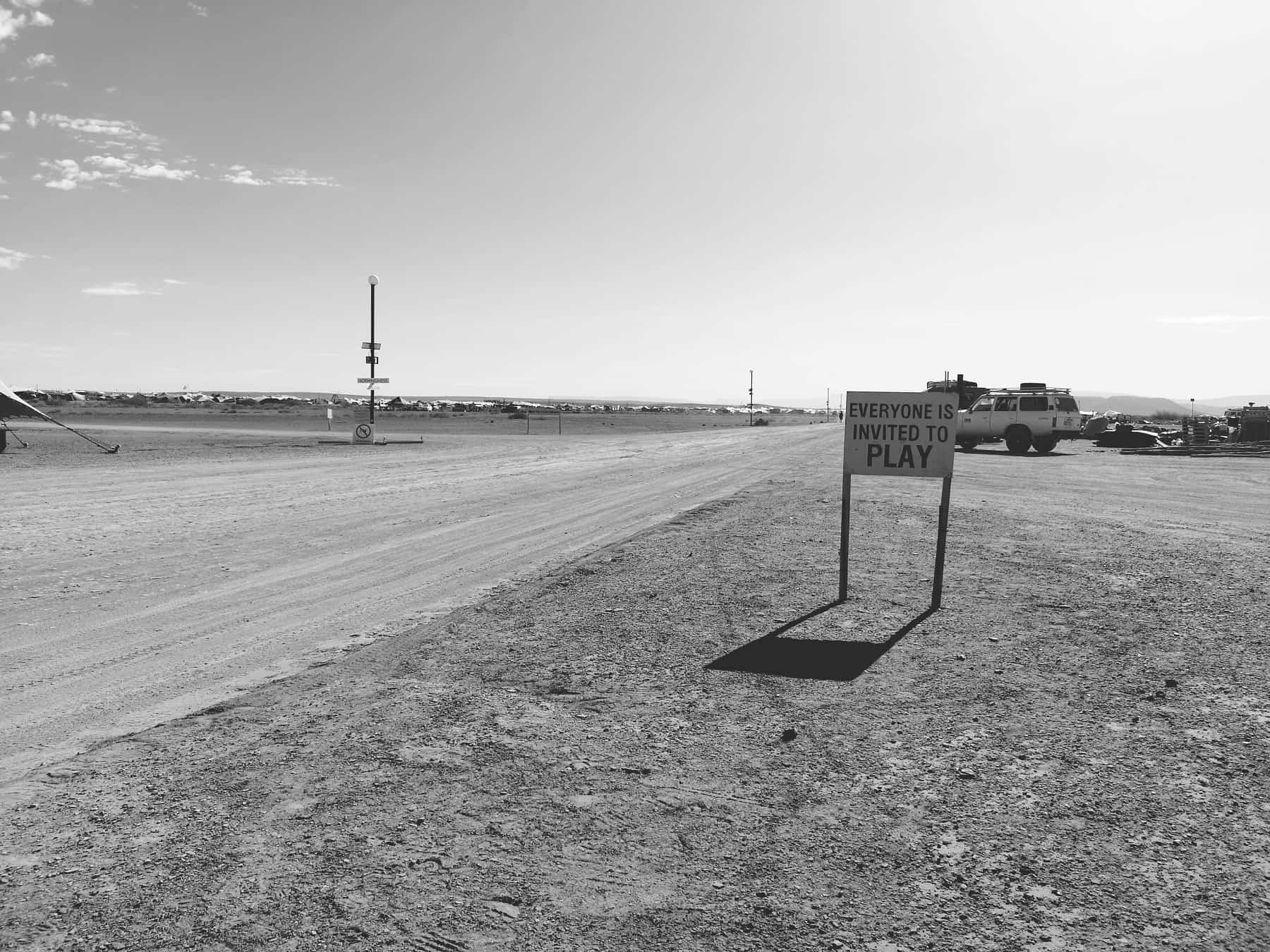
    Sweet Love Cinema was just a few camps down. It was a large tent, open air, a projector up front playing non-stop movies all through the night. Laid out in front were fifty or so bean bags where people came to chill, sleep, smoke, pass the day or night. It was always packed when I’d walked past, but on this night, at this hour, it was barely half full. Grizzly and I slipped into the back row, put our feet up. She snuggled against me as we hid under our scarves, braving the breeze blowing in behind us. It was an old sixties slapstick playing. Grizzly watched as I lay there gazing around the tent. How much work it must have taken to build this, put it all together, just for the people. How many more places like this were hiding around town that I hadn’t discovered yet? I realised how much I was going to miss this, how I wasn’t ready for it to end yet. But tomorrow was the last day. In 24 hours, this would all be over.

    As I snapped out of a doze one more time, I caught Grizzly’s eyes starting to close.

    “C’mon. I’ll walk you home.”

    The Binnekring was particularly cold that night. Grizzly and I loitered along it, slowly. This stretch of desert, blazing with lights, music, crazy costumes, drugs, artwork, would have been a spectacle to anyone on any day of the week, but to us it had just become “that place down the street”. We walked and talked like it was just another quiet seafront boulevard.

    “So you didn’t drink for a whole year? Why?”

    I looked at the ground, thinking.

    “I guess, I like the challenge of it. You know, my Mum told me something my grandma used to say. There are four things that break a man – womanising, drinking, smoking, gambling. So there’s this Asian thing where they say stay away from those things and you’ll be successful.”

    “Is that why you’re successful?”

    I looked up at her, surprised.

    “I’m successful?”

    “Well you’ve like, travelled all over the world and everything….” she trailed off.

    “And you speak Spanish. You got cool points for that.”

    “Oh yeah, cool points?”

    She looked at me and smiled.

    “So many cool points.”

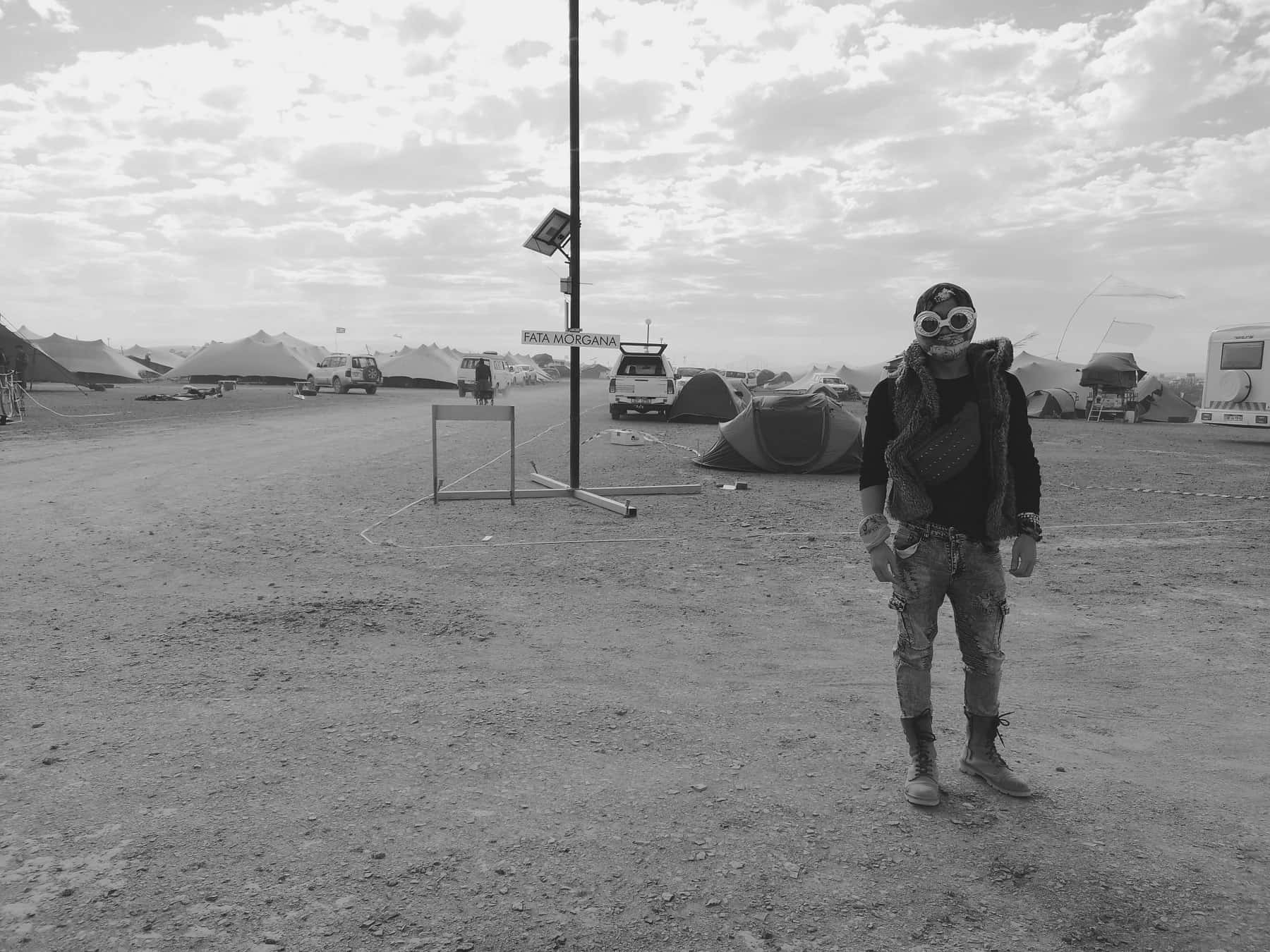
    It was silent in the campground by the time we got to Grizzly’s place. Grizzly lived in a group camp right on the corner of 9ish Boulevard and Atlantis. Atlantis, Butterfly and Cherry Blossom were considered the “nice” streets of Tankwa’s suburbs. Up there, all the camps had big windproof canopies to pitch their tents under, proper kitchens, water tanks, and electricity generators. It was a little different down past Fata Morgana and beyond. There you started to see a lot more beer cans in the dirt, open fires, tents held together with duct tape. I flicked on my torch and we tiptoed through the camp to her tent.

    I laughed when we got there. Her tent was barely the size of a sleeping bag, not tall enough to sit up in, and almost falling over. She pulled back the flaps.

    “And that’s where I sleep.”

    She had a “mattress” made out of her clothes, a sleeping bag on top, the rest of her stuff all stashed on top of each other. On the first day it would’ve looked rather charming and cosy, but after a week in Tankwa, it was barely standing. I shook my head.

    “Grab your sleeping bag. Come stay with me in the hood tonight.”

    Somehow to Grizzly, “grab your sleeping bag” meant “grab as much stuff as possible”. By the time she was done the two of us tiptoed out of there with half her clothes, blankets, pillow, food, all stuffed under our arms as we headed across the campground.

    “Not in Atlantis anymore,” I said as we passed Cherry Blossom. “You’re now entering the ghetto. From here on it’s all drug dealers, Tankwa Town mafia. I mean look at that!”

    I pointed to a pile of trash one camp had left out by the road. “It’s a hard life down this way.”

    When we reached Fata Morgana, we turned off at my intersection towards home. Adrien Brody’s hippie tent was lit with flashing blue Christmas lights, as always, just beside it, the Dutchies van with the lights out, their bicycles resting against their bonnet. My tent was hidden from the roadside by their cars, but as we walked off the road and cut between them, there it was, sitting proudly in the dirt.

    “Welcome to my mansion.”

    I pulled back the flaps and we dumped all her stuff. I was surprisingly tired from the short walk, and collapsed into my pile of clothes.

    “Oh my god, it’s a mansion for real. You can actually stand up in here.”

    Grizzly started unravelling her stuff and fixing somewhere to sleep. As she lay out her pillow and unrolled her blanket, she suddenly stopped and looked up at me.

    “Shit. I forgot my sleeping bag.”

    “Are you serious!”

    “Should I go back and get it?”

    “Yeah, right. This is the hood, remember? You think you can go walking out there alone?”

    Grizzly groaned, nudged me over and claimed half my mattress. I opened up my sleeping bag and whooshed it over us. Exhausted, we lay huddled together, laughing at the tragic bed we’d made. Usually it was hard to stay warm even with a sleeping bag all to myself, but with her laying against me the desert cold all but disappeared.

    “I can’t believe it’s the last day tomorrow,” I whispered. We lay staring at the high roof of the mansion. “It feels like we’ve been here forever, but it also feels like…we just got here.”

    It had crept up on us somehow; weird that we’d say goodbye in just one day. But, as we’d find out, a lot can happen in one day in Tankwa Town.

    …to be continued.
    Click here to go to Part 5.


    JUMP TO: Part 1 | Part 2 | Part 3 | Part 4 | Part 5

  • The AfrikaBurn Diaries Pt. 3: Nights On The Playa

    The AfrikaBurn Diaries Pt. 3: Nights On The Playa

    You are reading Part 3. Click here to start at Part 1, or view all parts here.


    The crowd was already huge when I arrived. I’d thought I was early. Thousands of people sat in a huge ring, surrounding the Temple of Ixam. It was scheduled to burn just after sunset.

    ‘Burning’ was talked about often in Tankwa- on the Binnekring during the day you’d always hear people screaming about it – don’t forget there are two burns tonight! But nobody ever talked about what they meant, or why we did them. It was just something we did. Each evening, people gathered to watch as various artists set fire to their creations and watched them crumble in flames. Some artworks stood several stories tall, and the burns were magnificent – the biggest blazes you’d ever seen – sometimes taking over an hour to fall to ash.

    The artists had requested a silent burn that night. All camps had been ordered to shut off their music, and viewers had been asked to stay silent as they watched. As darkness fell, a group of young men dressed like hunter gatherers, long staffs in their hands, finally set the temple alight.

    The Temple of Ixam was dome shaped, a couple of storeys high, made of straw and wood. Later I’d learn it had been standing for several years, built to honour the indigenous people of the desert. The fire started slowly, but within minutes it was at full blaze. Thousands watched in silence as the flames roared. The loudness of fire is peculiar – something you don’t really notice – but hits you hard when you experience it. What hits you even harder is the beauty. It’s more breathtaking than we realise. If you don’t believe me, take a look at the people’s faces next time you’re around a fire. How they simply stare at it, watching it dance, mesmerised. It captivates people. When the temple finally toppled, the crowd roared with delight, like some kind of triumph. I felt it too.

    But while the flames captivate us quickly, they lose our interest quickly, too. As soon as the temple fell, the crowd began to disperse, looking for wilder things the night had to offer. As I turned and headed back to the Binnekring myself, I saw friendly faces approaching.

    “THERE HE IS!” they shouted as they saw me.

    We laughed and hugged.

    “We’ve been looking for you!”

    Tania and Claire were another two people I’d met on the bus. They’d been sitting in the seat in front of me, our friendship christened with the sharing of a peanut butter bar.

    “Come out with us tonight! Meet at our camp at 8?”

    In the 72 hours I’d been here, hope and trust had suddenly re-emerged as the essential survival tools inside the gates of Tankwa. Cellphone reception didn’t exist. If you were to meet anybody, anywhere, you simply had to give a time and place and hope they would make it, trust they would make it. But that was refreshing too, not living through a screen anymore. We made plans face to face. We had conversations face to face. Nobody ever finished an introduction with “I’ll text you”. It almost felt like we were becoming children again.

    I arrived at their camp late.

    “Oh here he is,” they groaned lovingly, as if they’d given up on me showing.

    One drink, then we headed out.

    “Okay Brendan, the plan tonight is, we have to find the ship,” Claire said as we waltzed out onto the playa.

    “The ship?”

    “Yes! Last year all of my coolest nights were on the ship!”

    “What the hell is the ship??”

    “Haven’t you seen that big sailing ship, that drives around the playa at night?”

    As usual, the playa was pulsing with noise and lights that night, like some kind of drug filled Disneyland. DJ’s sat atop mutant vehicles in the distance, passionately thumping out sets for the little crowds that gathered. People roamed in groups of twos and threes, dressed extravagantly, covered in lights and laughter. It was the hour when all leftover heat from the day had dissipated; the desert air was now cold and numbing, even with the alcohol and long fur coats, your fingertips chilled if you didn’t keep them buried in your pockets.

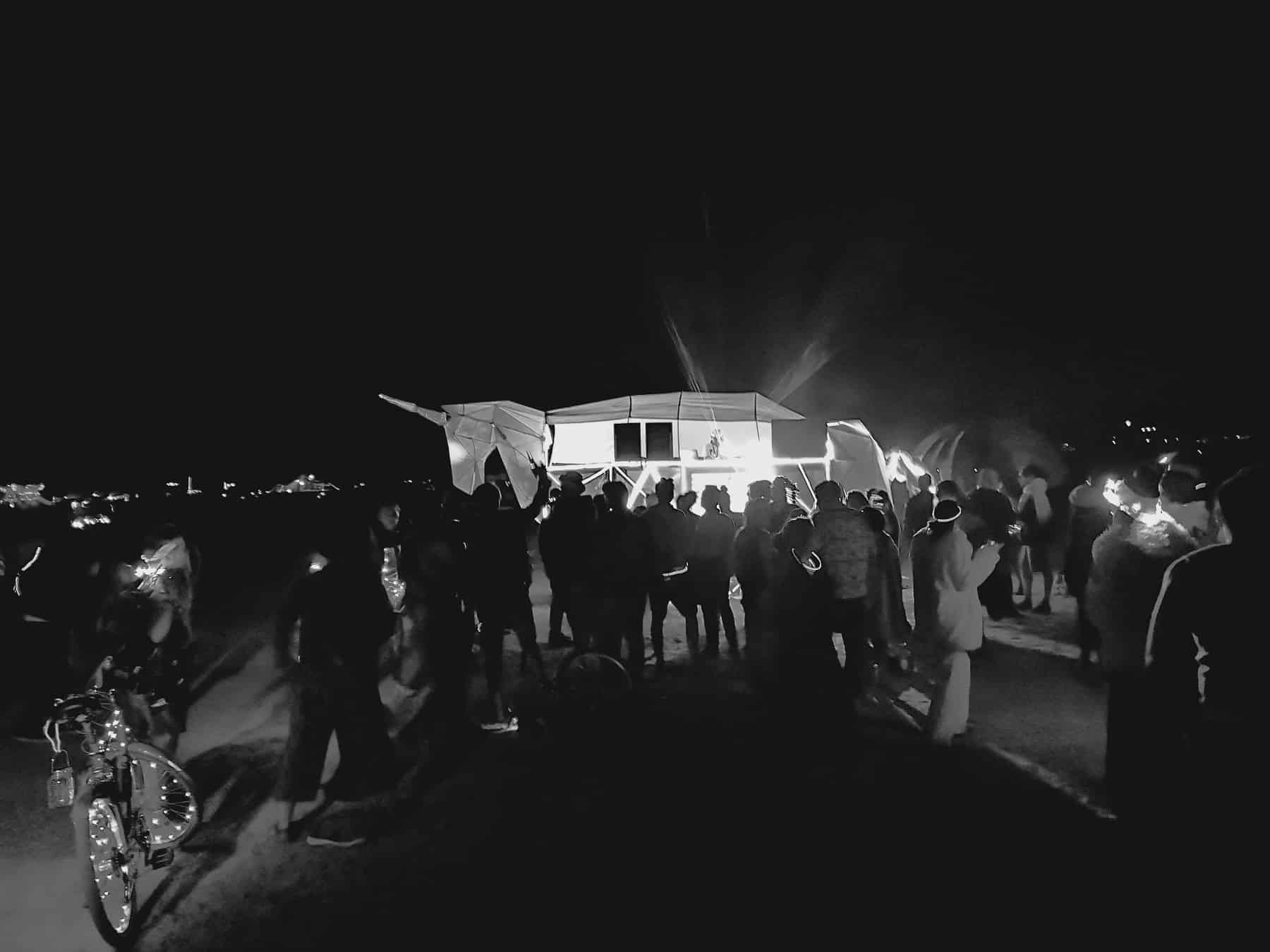
    It didn’t take us long to find the ship, which was actually named The Flying Dutchman. It was a huge trailer modified into a pirate ship on wheels. A DJ booth was set up in the middle, and people sat around it on the deck and chilled, while others danced in the sand under the huge sail built from LED lights.

    “That’s the ship!” Claire screamed. We marched towards it. “Now we just need to wait for space to get on.”

    There was a decent crowd commanded by the DJ when we arrived. Some wandered by on the playa and stayed, others danced for five minutes before drifting on to somewhere else. As we sifted into the crowd, I caught a glimpse of a girl sitting up on the ship deck, alone, by the mast. She was facing away from me, I could only see the back of her head. But I already knew who it was.

    I walked around the front of the ship and caught sight of her face. She looked bored, or high, maybe both, her eyes staring aimlessly into the ground. Perhaps she was having a spiritual moment, or an epiphany, maybe an introspective awakening. All were reasonably common in Tankwa Town. I walked up to her, and she looked up, her face morphing slowly into a smile as she saw me.

    “Hey Grizzly Bear,” I laughed. “Can I come up and join you?”

    “Of course! Get up here.”

    I climbed up and sat beside her on the deck.

    “What are you doing up here all by yourself?”

    “I dunno, I was cold. I don’t even know whose jacket this is.”

    She was wrapped up in a fur coat three sizes too big for her. I shuffled over and offered my arm, and she snuggled up next to me.

    “My friends are over there,” I said, nodding my head backwards. “They’ve been talking about this freakin’ ship all night. I need to find them a space so they can jump on.”

    As we both looked back at them, a friend of Grizzly’s jumped up to sit with us.

    “Oh, this is Anton.”

    I shook his hand and introduced myself. He was tall, with long Jesus hair, looked like a young Edward Norton. I guessed he was part of the ship crew.

    “Ooh. I got an idea. Anton you see those two girls over there? They’re obsessed with this ship. Go over and say you’re the ship’s owner, and you would like to invite them both on deck as VIP guests.”

    He looked over.

    “Those two?”

    “Yeah.”

    He squinted for a second, then grinned and started walking over.

    Grizzly laughed into the sky as he left.

    “That’s so good.”

    We both turned to watch. From a distance we giggled as Anton walked up to them like a Bible salesman, his hands animated as he talked. Claire’s face turned from puzzlement to joy, within a few seconds they were both following him over. As soon as they came around the nose of the ship and saw us, we all burst out laughing. They climbed up and sat beside us.

    “Made it to the ship,” I grinned.

    Claire was right. The ship was pretty cool. We sat up there for hours, chilling in the desert night. Every few songs, the ship would move. We’d watch the ship crew jump into action, do all their safety checks, then as many people as possible would climb on as the driver revved up the engine and drove us fifty metres to a new spot on the playa. You could barely see ten metres ahead, so someone would walk in front with a torch, making sure we didn’t crash into an artwork or a pile of bicycles. Alongside us, the rest of the crowd walked. But the DJ never stopped playing, and the people never stopped dancing.

    I pulled out some of those healthy snack balls from my bag, the kind made from dates and coconuts and other hipster stuff. Grizzly took a bite and nearly spat it out.

    “What the hell is that?”

    “Healthy food.”

    “That’s nasty. You got any like, real food?”

    “What, like a New York pizza slice?”

    She laughed and punched me.

    “What part of New York are you from anyway?”

    “Well, I’m Dominican, so…”

    “Wait…you’re Dominican?”

    “Yeah.”

    I switched to Spanish, and she laughed, and we chatted in her language for a while, asking all the important questions, getting to know each other. It was the first time we’d actually sat down and talked to each other for more than five minutes.

    A pretty blonde girl jumped up on deck and sat on the other side of me. I guessed she was from Sweden, Norway, somewhere up that way, the way her eyes had that piercing blue. Turned out, she was Danish.

    “So how long you two been together?” she asked.

    I looked to her, my eyebrows raised.

    “You’re a couple, right?”

    Just as I was about to shake my head, Grizzly jumped in.

    “Yeah we are.”

    “No we’re not,” I laughed.

    “Babe, stop playing.”

    “Oh really, we’re a couple? Where did we meet?”

    “At school.”

    “Where did we go on our first date?”

    “To a restaurant.”

    “What did we eat?”

    “Spaghetti.”

    We both started laughing and didn’t stop, while the Danish girl stared at us, trying to figure out what kind of drugs we were on.

    When’s the last time you sat around and laughed with strangers? It’s special. It’s not something you can plan, it’s one of those things that only happens when it happens. And it happens on the road, but not as often as you think. Being rare makes it precious. And being precious makes it beautiful. But for it to happen in the middle of the night in the middle of the desert in the middle of the week in a place like this? It was the most rare, precious, beautiful thing in the world.

    Eventually Grizzly jumped down off the deck to go somewhere, and I lost her in the night. But the Danish girl and I sat there talking, about what had brought us here, and what we were looking to find. When it got to 3 am, I told her I’d be heading to bed soon. It was getting late.

    “Are you serious? 3 o’clock is late?”

    “Well, yeah. What’s late to you?”

    “I’d say around 9 or 10. You can’t even see the sun yet!”

    I thought about how different her week in Tankwa was going to be, compared to mine. Some people were here only for the night; they missed pancakes every morning, all the lunchtime events on the Binnekring, the daytime dancing. But who knows what crazy and magical things they saw in the sunrise hours. But that’s what made Tankwa incredible – it really was somewhere for everyone.

    It was well into the morning hours when Claire, Tania and I finally left the ship and headed back towards the Binnekring.

    “I think we’re going to call it, Brendan,” Claire said. “Enough for one night.”

    “You guys go ahead. I’m gonna take a walk.”

    We swapped goodnight hugs and went opposite ways, them back to the tents, myself up along the Binnekring. It was unusually quiet for the early a.m. It seemed all the shenanigans the night before had worn people out some, the energy now a lot more mellow. Still, every camp buzzed in its own way. I stopped in at State of Bliss, which was also quiet. Stephane and I chatted for a minute, before I shook his hand and wished him goodnight.

    It was a long walk home. State of Bliss was on the opposite corner of Tankwa, strolling slowly, home was almost an hour away. I didn’t mind. I had nowhere to be tomorrow, and long walks in Tankwa Town were never dull. I decided to turn off the Binnekring and walk along the Buitekring, a quieter street that ran along the back of town. I was sober now, and wrapped so tightly in furs that the chilled desert air wasn’t discomforting but refreshing. Camps were smaller and private back here, but even at this hour, little groups huddled around fires, played music, continuing to enjoy the night with less extravagance but just as many smiles.

    As I turned onto Lady Davina Boulevard, hitting the final stretch towards my tent, I thought about how much I loved the nights. But I also realised, I loved the days more. That was where the real conversations were had, the connections were made. The night was where you celebrated new friendships, but the day was where you created them. I peeled open my tent, gave myself a quick bath with some baby wipes, then tucked myself into bed. As I lay there waiting to fall asleep, I decided tomorrow I’d wake early. I’d seen the nights. Now it was time to indulge in everything the Tankwa days had to offer.

    …to be continued.

    Click here to go to Part 4.


    JUMP TO: Part 1 | Part 2 | Part 3 | Part 4 | Part 5

  • The AfrikaBurn Diaries Pt. 2: The Desert Is For The Strong

    The AfrikaBurn Diaries Pt. 2: The Desert Is For The Strong

    You are reading Part 2. Click here to start at Part 1, or view all parts here.


    The light woke me up.

    I was wrapped in three layers of clothes, expecting the desert night to be arctic, but I’d slept through the night comfortably. I hid inside my sleeping bag, staring at the peak of my tent. The grey was slightly brighter on the east side, illuminated by the morning sun. I looked at my phone.

    9 o’clock.

    I grabbed my water bottle, sucked furiously on it for a few seconds, then pulled my cooler bin over. It was filled with survival foods; biltong, cookies, protein bars, dark chocolate. Nothing that needed to be cooked, nothing that could spoil. I nibbled on bits of everything, waiting for my mind to wake up, thinking about what today might bring. But it was too early for any imaginations. I lay back down to read.

    Just that week I’d started a new book, The Forest Through the Stars. It was about an eight year old girl in pyjamas who showed up on a young lady’s doorstep one night. The lady believed she was a runaway, but the girl claimed to be an alien from another galaxy who had simply borrowed a dead girl’s body. She had been sent from her planet to learn about earth, and was not allowed to return back until she had witnessed five miracles.

    I lay there burning through pages, hunting impatiently for clues. Was she an alien or not? I knew I’d probably only find out in the last chapter, but it didn’t stop me hoping. I was so engrossed I didn’t even notice the wind at first. But it was the third or fourth gust that made me put the book down. Winds roared across my tent, blowing the peak almost as low as my head.

    Back in Cape Town, I’d made a hasty decision to splurge on a proper storm proof camping tent, rather than a $40 throwaway from one of the budget stores. When I unpacked it, the girls at the hostel had laughed at how huge it was, asking if I was secretly packing for a party of eight. But it didn’t seem so funny anymore. I lay there nervously, watching in suspense as my tent struggled against the wind, waiting for the beams to snap at any moment. Alien girl was searching for five miracles, I was only hoping for one: For this tent to survive the morning.

    Somehow, it held its ground. At noon when I finally left for my shift, I could hardly believe it was still standing.

    The scene outside was exactly as I’d pictured. The fierce winds had turned half of Tankwa Town upside down. Dust, finer than sand, zoomed through the sky like fairy dust. Without goggles, keeping your eyes open for more than three seconds was retinal suicide.

    As I walked the streets, each block had become a graveyard of tents, one after the other, strewn across the dirt in pieces. They had told us the desert sandstorms took no prisoners, but sometimes I’d wondered if it would really be as bad as they’d said. Now I knew the answer.

    But even disregarding the tent wreckages, the campground looked different to me. I was oriented here now. After studying the map the night before, I now had a picture in my mind of how this place worked. It was bigger than I had realised, the size of ten football fields, easily, and laid out neatly in blocks, like Manhattan – three streets across, thirteen streets down. The streets ran alphabetically; Atlantis, Butterfly, Cherry Blossom, Disappear, Evanescent, all the way down to Moment.

    As I passed each intersection I searched for the street sign, making sure to memorise each name. Someone had said the night before, we’d have 12,000 people in here by the end of the week. It really was like a real city.

    On the way to my shift I stopped by Atlantis to give a hello to Byron. He was milling about outside his camp, looking busy. He held up his wrist as I approached, flashing his bracelet, grinning. We shook hands, a chinwag here, there. Then, as I left his camp, I saw Leslie approaching in the distance. I shouted out to her.

    “Leslie!”

    Her hair was big, as usual, her eyes bright, her smile automatic when she saw me.

    “Did you say Grizzly?” she laughed as she walked towards me.

    “No I said your name, weirdo. That could be your playa name though. You know, like a grizzly bear.”

    “Yeah, could be!”

    “So what you doing tonight, Grizzly?”

    “Dunno. I’m sure you’ll find me though. What about you, what you doing right now?”

    “I go on shift at 12.”

    Her eyes rolled.

    “You actually are always working! Mister hard worker.”

    She was right, it did feel like I was always working. But secretly, I loved it. It gave the day routine, but also meaning. Something to make me feel like I earned my place in this town.

    That day, I had signed up for Greeter duty. I arrived a half hour early. I was met by three girls huddled inside the Greeters tent, sipping tequila while taking shelter from the ever-growing dust storm. It was vicious now. Standing outside without goggles was almost impossible.

    “Hi!” they screamed as I walked in, as if I were a long lost friend they’d known since childhood. The Greeters tent was small, with only a single bench, flanked by a small table with some coffee and cookies. They shuffled over and made a space for me.

    “Ninja hey? That’s a cool name. I’m Savannah,” one said, puffing on a joint before passing it onto me.

    They each wore safety orange vests, with heeled boots and fishnet stockings, running all the way to their bums which were hardly hidden.

    “So where you staying, Ninja?”

    “On my lonesome,” I replied, passing the joint along. “On Fata Morgana.”

    “I know that place! Our friends are camped there. We should all go hang out. We’re all at Potato Heads.”

    “Potato Heads?”

    “Yeah it’s a camp where we like cook potatoes for people.”

    “Cool. Is it nice?”

    “Yeah we’re set up real nice. If you ever go camping with Victoria, everything has to be real nice.”

    “Who’s Victoria?”

    “Me!” the other girl beside me said, raising her hand. Her smile was playful, hair dirty blonde, fell freely across her face. They almost looked like sisters.

    “So, anything big planned?”

    “Yeah! It’s my birthday tomorrow,” Savannah said. “I’m turning 21!”

    “Woo. And you’re having a party? Are you doing 21 shots?”

    “Probably more like 21 drugs.”

    The three of them chuckled and proceeded to rattle off 21 different drugs with ease, counting them on their fingers like some kind of pop quiz. I hadn’t heard of half of them.

    When their shift finally ended, they farewelled me with hugs and selfies before going on their way.

    “Come visit us at Potato Heads Ninja! Don’t miss my birthday!”

    “I’ll find you,” I smiled, not knowing if I would or not. Besides, I didn’t have time to think about that. It was time to work.

    Greeters were the gatekeepers of AfrikaBurn. They were responsible for patrolling the gate, welcoming new cars in with big smiles and funny dances, and of course, manning the Virgin Gong. Any time an AfrikaBurn virgin arrived, they were briefed by Greeters on the principles of Tankwa Town – and then invited to ring the Virgin Gong. I fell into the role with ease. The virgins rolled up starry eyed anticipating wonder, and we welcomed them to the promised land of radical possibilities. Unbeknownst to them, just 24 hours earlier I’d stood in that exact spot and rung the gong myself. But as I’d been learning, things change quickly in Tankwa Town.

    The storm continued all through Greeter duty. When our shift finally ended, I anxiously rushed back to my tent and see if anything was left of it. I crossed the open desert from the Gate to the campground, just as I’d done the previous morning off the bus. But of course, everything was different now. For one, I actually knew where I was going.

    I got to Fata Morgana and peered around the Dutchies’ van. My tent was still standing proudly. I unzipped the front flaps and ducked inside to get lunch. Things didn’t look so great on the inside, however. Before I’d left that morning, I’d opened the window flaps so the wind would blow through the tent instead of against it, hoping it would increase chances of survival. And maybe it had, but now everything inside was covered in a one inch blanket of dust. Cleaning it would have been pointless. The winds were still raging, it would be brown again in no time. I made peace with the fact that tonight I’d be sleeping in a bed of desert sand.

    When I stepped back outside, Naked Adrien Brody was standing by his truck, fiddling with some tools.

    “It’s still standing,” I smiled, nodding at my tent.

    “Yeah, don’t worry about it. It’s going to be fine,” he said, matter-of-factly. “The beams on those tents are fibreglass. They’re made for storms like these.”

    I looked back at my tent, flapping hopelessly, like a baby duck, trying to fly in a hurricane.

    “Really?”

    “Yeah. Believe me. It’ll be just fine.”

    Somehow, I knew he knew what he was talking about. I felt good suddenly, anxiety free. Pleased that my investment in a flashy tent had paid off. And I’d finished work. I looked over at the Dutchies’ van. Their bicycles were gone, meaning they’d left to go exploring for the day. I decided to do the same.

    I’d been wandering the playa aimlessly for almost an hour when I bumped into Paris. Paris wasn’t his real name, but it’s what I called him. Names were hard to remember, hometowns weren’t. Paris was a harmless soul, another I’d met while standing in line for the bus back in Cape Town. He was soft spoken with a kind face and kind demeanour, oozed black French style, from his denim clothes to his mini locs to his unmistakeably French accent. It was a welcome surprise to see a familiar face. The wine bar was nearby. We pulled out our cups and went for a drink.

    The wine bar was a central point on the Binnekring. It was huge, for a start, and with boppy tunes and free wine on tap all day, it was always full. We waded through a sea of bodies to get to the bar. Behind the bar stood a shelf lined with huge barrels of sweet South African wine, along with three smiling faces to disperse it to Tankwa’s endless line of thirsty mouths.

    “Red or white my brah?”

    We both asked for red, and handed our cups over. He flicked the little tap on one of the barrels and we watched as the wine trickled out.

    One of the things that had drawn me to AfrikaBurn, probably more than anything else, was the idea that the society existed without money. Tankwa Town boasted a “gifting economy” as one of its core principles. Nothing was allowed to be bought or sold, no advertising, no sponsorships, no business. Money simply did not exist in Tankwa Town. Over the years I’d become disillusioned with a world where literally everything revolved around dollar bills – the only kids who got good educations were the ones with money, kids who got medical care were the ones with money, people went to jobs they hated for money, now even water cost money, people murdered, lied, cheated, scammed people just for money. Was there anywhere on earth where people didn’t just spend their entire lives jerking off over money? I searched, but never found. And then I heard about Tankwa Town.

    Two weeks earlier, I was sitting on a sofa in my hostel courtyard, chatting to a local Capetonian woman sucking on a cigarette. It was cold that night, and the two of us were huddled in our sweatshirts, braving the cold to get a better wifi reception outside by the office. When I told her I was in town for the Burn, she mentioned she’d heard about it over the years, but never learned what it was.

    “So people spend all this time building these artworks and making these events, just because?”

    “Just for the culture, I guess.”

    “C’mon. With an event this big, someone’s making money somewhere. I mean you paid money for a ticket, right?”

    “Yeah.”

    “So?”

    “Well it’s a non profit. We’re contributing to something. Renting a big ass desert for a week, for one.”

    “Look, I’m an artist. If it were me, I’d tell everyone I was making a big artwork, get donations, make something huge…for my portfolio. I just…I know human beings. Nobody does something for nothing.”

    Yet I was a human being, and many a time I’d found joy in doing something for nothing. But now that I was here, her words stayed with me, turned me into a skeptic. I was always observing, looking for the catch. But there wasn’t one. Tankwa Town didn’t just support a gifting economy. Gifting was gospel here. People lived and breathed it. Total strangers walked up to you on the playa and gifted you candy, hugs, crafts, for no reason at all. The Binnekring was an endless line of camps that had brought entire lounges, spas, kitchens, eight hours into the desert, cooking up feasts all day, just in the spirit of giving. No branding, no Coca Cola advertisement on the wall. And even right here in this bar, he handed us our wines and didn’t ask for a thing. Just sent us away with a smile.

    We stood out in the sun and sipped our wines. Talked. It was cool, but after the second cup, the vibe had become crowded and heavy.

    “We need a place to chill,” Paris said. “You know somewhere?”

    I thought about it.

    “You know what. I do, actually.”

    It didn’t take us long to find the Potato Heads camp, nestled somewhere along Cherry Blossom. When Paris and I spotted it, we waltzed in like homeless people off the street. Their camp was big, at least twenty people, with a huge chill-out spot in the front with lawn chairs and bean bags. A small group was lounging in the middle. I found it odd, and refreshing, that none of them questioned who we were or what we were doing there. They just smiled at us, like walking in off the street was the most normal thing in the world. Because in this part of the world, it was.

    “Savannah around?” I asked.

    “I think she’s sleeping,” one of them said.

    “Oh. Mind if we chill here with you?”

    “Of course!”

    They shuffled to make space for us. We introduced ourselves. Paris had already started rolling a joint before we’d even learned their names.

    “So what’s going on here?”

    “Lynesha’s about to do mushrooms, first time,” one girl said, nodding at the girl beside me.

    “I’m thinking about it,” she smiled back.

    Lynesha P was an Indian girl from Johannesburg. She had big eyes, her smile was innocent, her hair platted and tied up like Princess Leia. I watched her twirl the mushroom between her fingers. In the other hand she held a bar of chocolate, presumably as a chaser. I took it and stole a piece.

    “Don’t eat it all!” she cried.

    “They don’t taste that bad!” another girl said. “You’ll only need one piece.”

    I watched her twirl the mushroom between her fingers one more time. Then she popped it in her mouth like a gummy bear, unphased, like she’d done it a million times.

    On the other side of me, Paris took the chocolate and passed me his joint.

    “You put tobacco in it?”

    “Of course man. I’m French.”

    “You guys need to quit that shit, man.”

    I hit it once, softly, and passed it along.

    As evening approached, someone suggested we hit the playa and try catch the sunset. That roused the group. Everyone got up, filled their cups one more time and put on their fur coats and lights as we dripped out of the camp in twos and threes. But, people move slowly in Tankwa Town. By the time everyone was accounted for and we made it to the playa, the sun had long gone, leaving only a trail of leftover pinks and oranges.

    Luckily, sunsets were merely the beginning of nights on the playa. Once darkness fell, the playa really came to life. We turned on our headlamps and started to roam.

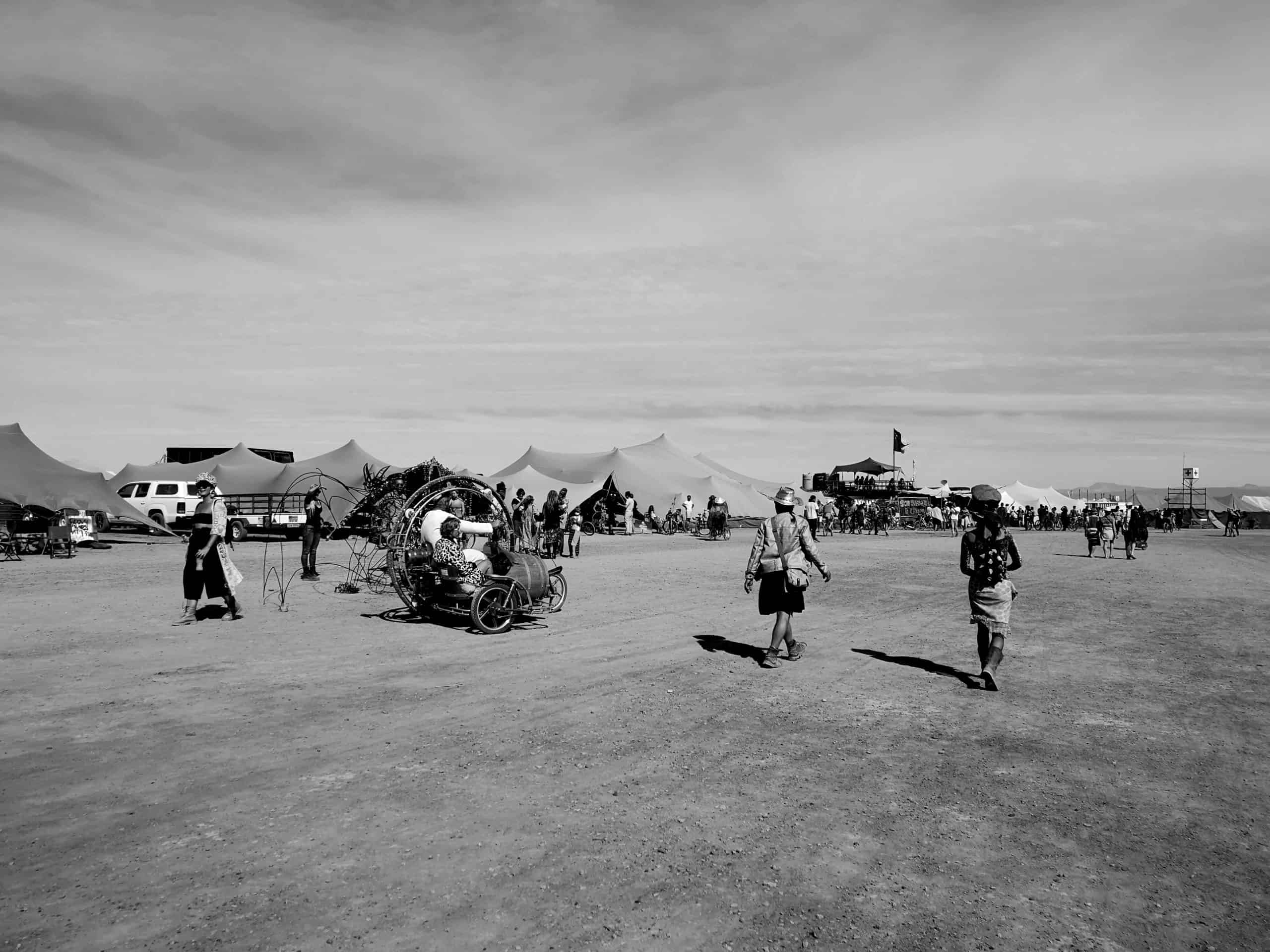
    Tankwa Town at night is a different world. At any one place, you were surrounded by 360 degrees of madness, like a devil’s amusement park, straight from a movie. Mutant vehicles became nightclubs-on-wheels scattered across the desert, covered in neon lights, speakers blaring. The artworks all stood tall and illuminated, people used them as meeting points, selfie spots, landmarks. From a distance, the Binnekring throbbed with music, dancing, cries, laughter, flashing lights, stretching magnificently for what seemed like forever, rivalling the best nightclub streets in the world. Sometimes you’d get to a spot and see it in all its glory, stop, and remind yourself, we really built this place from nothing. It’s all for us. And it’s all for free.

    Lynesha P and I were the last ones standing that night. Some retired to bed, some we lost in the madness, but that was the norm on the playa. As the night wound down, our legs begged for rest.

    “I know where we can go.”

    The day before, halfway through my Ranger shift, Super C and I had walked into a small camp hidden in the far corner of Tankwa Town. It was so unassuming, most people would’ve walked right past it. Had we not been on duty, we probably would have too. But once I stepped inside I knew I’d found a new home. The name was State of Bliss. The open air tent was split into two rooms, tea bar on one side, bean bags surrounding a jazz piano and mic on the other. We had chatted briefly with the “owner” Stephane, who’d invited us in to look around.

    “Come back at 11,” he’d said to us. “The jazz lounge will be open then.”

    When Lynesha P and I wandered in late that night, it was full. I said hi to Stephane at the bar, and we filled our cups with hot milky chai before heading to the lounge. We snuggled close to armour ourselves from the desert cold, leftover winds still blowing from the storm earlier in the day.

    My face was still caked with dust, I hadn’t showered in 48 hours, and my legs ached from two endless days of walking. But it was no match for hot tea and live jazz, in the middle of the desert, brought together for no other reason than to show us what the joy of music and giving looks like.

    As she pressed the keys on the piano, Lynesha P lying against me, I listened to every note, every word. All I could think to myself was, this is it. This is exactly what I came here for.

    ...to be continued.

    Click here to go to Part 3.


    JUMP TO: Part 1 | Part 2 | Part 3 | Part 4 | Part 5

  • The AfrikaBurn Diaries Pt. 1: Welcome To Tankwa Town

    The AfrikaBurn Diaries Pt. 1: Welcome To Tankwa Town

    When the bus dropped us at Welcome Road, none of us were really sure what to do or where to go. There was no booth, no person, not even a sign. Around us was nothing but desert. That was the irony of Welcome Road – it was hardly welcoming.

    I looked around. In one direction was the gate, where we’d just come through. In the other direction; tents, camps, maybe a kilometre away. I guessed that’s where we were going, but how to get there? There were around thirty of us, all staring at our piles of belongings. It seemed we were all thinking the same thing. Surely we’re not carrying all this stuff over there, are we? Why did the bus drop us here?

    A pair of orange vests walked by.

    “Excuse me, I’m looking for free camping. Where is that?”

    “Straight ahead,” said one, pointing towards the tents in the distance.

    “And how can we get there?”

    He shrugged his shoulders.

    “You walk.”

    I looked at my stuff again. Three bags, 30 litres of water, a mattress, a tent, cooler bin. Sixty kilos, probably. I looked up at the campsite in the distance. Between us, nothing but dirt and tumbleweed. It’d be three trips, at least.

    I picked up half my stuff and started walking.

    The sun was heavy. Not suffocating, but just enough to make you suffer. My face dripped within minutes. Moments later, my arms burned, both from both sunshine and work. Sweat beads rolled off my forehead like marbles.

    The campsite had looked huge from a distance, but suddenly small when I got there. Lots of empty space, camps half put up, only a small sprinkling of people walking around. It was the first morning of the first day, after all. I dropped my bags and took a moment. A moment not to just catch my breath, but to survey what was around me. If this was going to be my home for a week, I needed to choose my camping spot strategically, carefully. The right location, a place where magic was easy to manifest. The right neighbours, the kind that would lift your spirits in the morning, have good stories and food and love to share. I wandered and visualised camping in each open spot, like choosing a desk on the first day of class.

    After twenty minutes, I found it. An empty block, just off an intersection. It offered nothing magical at first glance – perhaps that it was on a corner, and near to the toilets – but just looking at it felt right. A couple of hippie gentleman were already camped up there, but no one else.

    “Is this space free?” I asked.

    He was a middle aged guy, South African, looked like an old Adrien Brody. Perhaps not quite as handsome. And he was naked.

    “Yeah it’s all free. We’re just putting up a little fence here, but that’s all yours,” he said, waving his hand alongside him.

    It was perfect.

    I fetched my bags, dropped them. Then I turned behind me, to look at the street sign.

    Fata Morgana.

    Remember that name, I told myself. Fata Morgana was now home.

    When I arrived back at the bus stop to fetch the rest of my stuff, half the people had gone. The rest were loading all their stuff onto a rickety pickup truck. I took a look at the driver, gauging his friendliness. He looked jolly enough.

    “Excuse me, where are you heading?”

    “Atlantis and 9ish!”

    “Could you give me a ride, I can’t carry all that stuff. I’m on Fata Morgana.”

    “You know how to get there?”

    “Yeah,” I lied.

    “Then it should be cool. Jump on!”

    I loaded the water, the mattress, the cooler bin, the tent, as relief flowed through me. As everyone loaded their stuff and jumped on, space became tight. People sat on bags that were on bags, bodies hung off the sides. I jumped onto the footstep on the passenger door, holding onto the window.

    “Everybody on?”

    We drove out into the desert, myself hanging off the side of the truck, face blowing in the desert air. I’d watched garbage collectors do this on the way to school as a kid, wishing I could join them, thinking about how cool it must feel. 30 years later my dream had come true. It felt even cooler than I’d imagined.

    After dropping everyone at Atlantis and unloading, the driver drove me on to Fata Morgana. From a distance I saw my bags cooking in the sun, wondering if half my belongings might be melted by now. As I went to shake the drivers hand, I pulled a bracelet off my wrist.

    They had told us, make sure you take gifts to AfrikaBurn. People will do kind things for you, you’ll want to acknowledge them. Back in Cape Town, I’d befriended a Tanzanian craftsman at the local market who worked with beads, and asked if he could make 50 bracelets for me. They were simple, but beautiful, beaded with the words “Spread Love”.

    “Man, thank you so much. What’s your name?”

    “Byron.”

    “Seriously bro, saved my life.”

    I grabbed his hand and put the bracelet around his wrist. He twisted his hand around, staring at it in awe, trying to read what it said.

    “Oh man, that is so awesome!”

    He opened his arms, offering the hug of all hugs.

    “I won’t take this off man,” he said, admiring it again. “It’s too cool.”

    Byron. I’d remember the name, make sure to pop in to his camp and say hi whenever I walked past. Already I could tell, this week, it would be all about the little things.

    As he drove off, I noticed a couple with a campervan lingering around my spot.

    “Yeah that’s him,” Adrien Broner shouted from his tent, pointing at me.

    I turned back to the couple and smiled, my eyebrows raised.

    “Are you camping here?” they asked.

    I nodded.

    “Uh, we just wanted to know how much space you needed. Do you mind if we camp here beside you?”

    “Yeah! Of course. I’m alone, I just need that little spot. I can even leave you a little backyard,” I laughed, pointing to the area beside them.

    They were Dutch, I forget their names, but the girl was a carbon copy of Minnie Driver, her boyfriend could’ve passed for a young Paul Walker. A little less surfer boy, but just as handsome.

    “You want a beer?” Minnie asked as I unpacked my tent.

    “Sure.”

    Once Paul had parked his camper perfectly parallel to the road, he came over to help me pitch. It only took us a few minutes. Once standing tall, I stood back, sucked on the Corona and admired it.

    Home.

    The three of us spent the next hour sitting outside their camper, sipping beer and snacking on a bag of biltong. It seemed none of us knew exactly what to expect for the week, or really even knew what we were supposed to do. I suppose, that’s why we were here. To experience something new.

    That evening, I was rostered on for Ranger duty. Rangers are like the police of Tankwa Town, but the kindergarten version. We walk around in orange vests, our only weapon is a radio, people ask us for directions, stuff like that. In the weeks leading up to Burn, it’d been said everyone was supposed to volunteer. That’s what makes Tankwa Town a town. Not everyone does, but I had signed up to volunteer for something every day. As my first time there, I wanted to be a part of everything; to live and breathe this town.

    When I reported to the Ranger HQ shed, a little early, I was greeted by a pleasant lady. She called herself Peaches.

    “And what’s your handle?” she asked.

    “Handle? I don’t have one.”

    “Well you need one, it’s like a nickname, a playa name. Should be something a five year old could say.”

    I looked at the board in front of me. Each timeslot was scribbled in with different nicknames – Boogeyman, Northwest, Tigger, Serenity.

    A playa name, I thought. It came to me quickly.

    “My handle will be…Ninja.”

    “Ninja! That’s a cool one. Grab yourself a vest and a radio. We’ll brief your shift in a few minutes.”

    As we neared 5 p.m. the Ranger shed had filled. Everyone was chatting, chirpy, buzzing for their first day of duty. Some I recognised from the training in Cape Town, but most were new. But it was only now I was seeing how Rangering seemed like serious business, people treated this like a real job. I put my serious face on.

    During the brief, I was assigned to The Horn, and partnered with a young man by the name of Super C. Super C was a cheery guy with curly hair, caramel coloured skin and a strangely deep voice that didn’t quite match his face. He laughed often, usually at the end of an unfunny sentence, a boyish smile constantly spread across his face. It made things easy though. He talked a lot, so I didn’t have to.

    The Horn is right in the corner of the map, shaped exactly like it’s named, pointing into a secluded edge of town. It almost looks like nothing would be out there. To get into the Horn though, you need to walk along the Binnekring.

    The Binnekring is like Tankwa Town’s Broadway, or Vegas Strip. All the main theme camps are here, the bars, the clubs, the food camps. As you walk along it, the activity is electric – non stop dancing, laughter, drinks, food, lights. It’s the heart of the town. Not only that, the Binnekring opens out onto the playa, the huge ring of desert filled with artworks, so big you can barely see the other side.

    Super C and I started our walk. The bars on the Binnekring were just opening, sun setting behind them, as more and more people came out ready for the evening. Everyone was giddy, ready for Tankwa Town’s first night, all dressed in their long fur coats, big sunglasses and strings of neon lights. Outside one bar, people were lounging on bean bags, sipping on drinks among some mellow music. In the crowd, I saw a familiar face smile at me. I smiled back.

    “Hey you.”

    “Heyyyy.”

    Her eyes followed me as I walked over. Her hair was big and wild, her mocha skin covered only by a black strapless bra and some baggy pants.

    “Is this your camp?”

    “Nah,” she laughed. “Just chilling here.”

    She had a thick New York latina accent, just like in the movies. It was almost as if she was putting it on.

    “Sorry but…I totally forgot your name.”

    “Leslie,” she laughed.

    “And you’re Brendan, right?”

    “Wow, you remember. Impressive. But actually my name is Ninja now.”

    “Oh okay, Ninja,” she laughed.

    Leslie was the first burner I ever met. When I’d arrived at the bus stop in Cape Town the night before, she was sitting there alone on the curb in the middle of the crowd, surrounded by her big water bottles and oversized suitcase. “Mind if I chill with you?” I’d asked, as she cleared a spot beside her. We sat and talked for a minute, before the bus arrived and everyone got up in a frenzy to load their things. But when we got off the bus the next morning, there she was again, right next to me, and as I walked through the campground later that afternoon, there she was again, walking in the opposite direction. We stopped and chatted, laughed about how we kept bumping into each other. And now here she was again.

    “I’ve gotta go, I’m kinda like…working.”

    “Okay, mister hard worker,” she said rolling her eyes. I rolled mine back.

    “I’ll come catch you later.”

    Sun set quickly in Tankwa Town. By half six the town was dark, the music was loud and the lights were out. The Binnekring overflowed with people, their smiles at full mast, as high on life as they were on drugs. Every now and again someone came up to us asking directions. Super C helped them out. Me – I had no idea where we were most of the time. These streets were all new to me too, I was as lost and excited as everyone else.

    At around half seven HQ called us in for dinner break. Super C and I loitered back, and while he went off to his camp to eat, I stayed at HQ and studied the map. If people asked me questions, I wanted to be able to answer them. I hated the feeling of telling people I didn’t know. As I memorised the streets, I took a moment to flick through the guide booklet, stopping at the back page:

    Rising like a dusty mirage out of the Karoo heat, there’s a city that many call home. It’s a manifestation of our collective imagination and the culmination of our collective efforts. It comes and goes, and ebbs and flows. It’s transient, temporary and transitory. It’s neither here, nor there.

    It is real in its unrealness.

    Sinking into the sands of time, every artwork will be taken down or burned, every camp will be packed away, and every vehicle dismantled. The city we manifested will disappear, remaining only in our minds. What a beautiful, astounding, priceless thing.

    When I’d decided to come here, I’d been unaware of how big it was, how dedicated this community was. But now it was suddenly hitting me, after seeing it all with my own eyes. I was about to be a part of something far more special than I had imagined.

    …to be continued.

    Click here to go to Part 2.


    JUMP TO: Part 1 | Part 2 | Part 3 | Part 4 | Part 5

  • A Taste Of Roots with #Amex

    A Taste Of Roots with #Amex

    This post is a part of my Sponsored Reader series. As a long time user and ambassador of their Airpoints credit cards, American Express kindly invited me to enjoy this Chef Series event for American Express Restaurant Month in Auckland. I sent my reader May and a friend to enjoy 3 hours of eating with one of Auckland’s finest chefs! She details her experience below.


    While on my lunch break, doing the usual scroll through my newsfeed I spot Bren’s post about giving one of his readers the chance to eat ‘fancy food and wine’.

    I keep reading, seeing it’s in Auckland but a bit late notice and would be the following night.

    I had no plans, I thought why not?

    I quickly wrote up an email to Bren to apply, and found out that same night I had been chosen!

    Since I was told to take a friend, it was only natural that I took my cousin, Enna, with me. We’re a couple of foodies, we love to cook at home, co-run a food business and cook together – you may recognise us from New Zealand’s My Kitchen Rules! I excitedly rang her straight after finding out; we couldn’t wait to try food from such acclaimed chefs!

    A Taste of Roots is a simple and rich menu from Lyttleton’s restaurant, Roots, by celebrated three-hatted chef Giulio Sturla. For this special event, he for the first time allowed his diners to see the menu before the food was presented:

    Also on board was executive chef Kira Ghidoni, who also boasts three-hats.

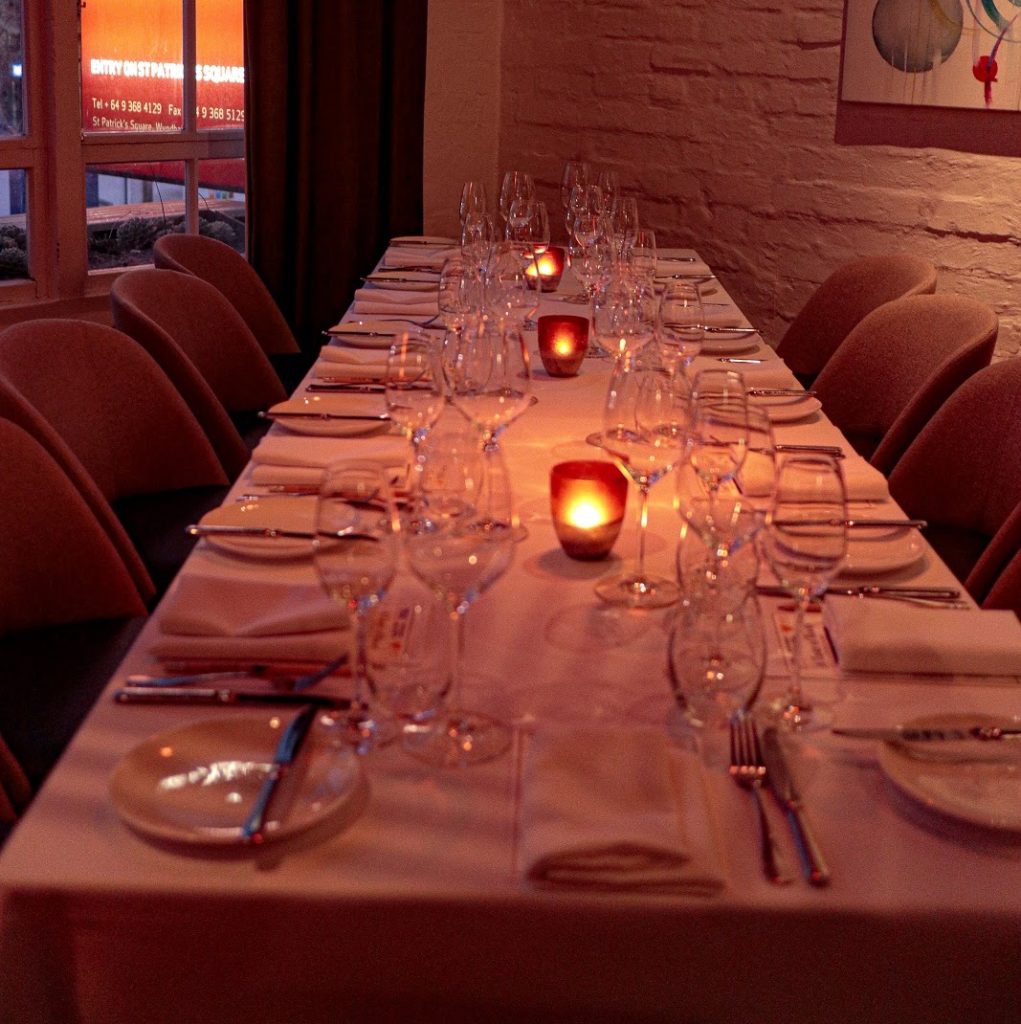
    The event itself was hosted by The Grove restaurant in Auckland CBD.

    This was my first time at The Grove, we were greeted at the door with a beautiful Allan Scott sparkling wine and walked through tables glittering with wine glasses. All the glitz had us anticipating a buzzing night.


    We were seated at the nook on a somewhat separated edge, which really gave us a sense of mystery as we couldn’t peer over at the other tables. We were lucky enough to share the table with a reviewer, a Remix magazine writer and a banker; all of them lovely and enthusiastic foodies! 

    There was also a blank piece of paper and pencil on our table which had us all guessing what we were expected to do with it.

    Once everyone was seated with a glass of wine in hand, we were warmly greeted by Michael Denheath, owner of the Grove which has been around for 15 years.

    The ambience and service here was phenomenal, everyone was attentive and we never had an empty glass. 

    Then came a special welcome from American Express who make Restaurant Month possible. I have been taking advantage of the amazing Restaurant Month events for years. August is easily a favourite month because of this, it’s also an easy way to take the pressure off figuring out where to eat!

    American Express Restaurant Month runs for the entire month of August, and features special menus, classes and events. Check out more of their amazing events here.

    Also note that throughout the month there is a special “Spend $50 get $20 back” offer for all Amex cardholders, available at over 500 Auckland restaurants.

    If you’re not yet a cardholder, Amex is running a special 300 Airpoints dollars signup bonus on its Platinum card to celebrate Restaurant Month. This is the top Airpoints credit card available in New Zealand and the #1 card recommended in my Airpoints and travel hacking guide. Click here to apply!

    Giulio also started our night with a few words.

    He is a passionate person and even reached out to us to help him settle his new roots. The blank piece of paper that everyone was questioning now all made sense. He asked us to write anything we thought of that might “help with ideas for his new beginning”.

    Henry, the editor next to me even remarked how he loved the way the pencil we received was branded with the Roots logo. There were definitely those small details that trailed through the night making it all feel genuinely fancy. 

    I also wrote and sketched a bit after each course, which you can see at the end of this post!

    Onto the food…


    Course: Snacks

    Wine: Valdespino Fino Inocente Sherry, Andalucia, Spain

    The waiter presented us with our snacks which were encouraged to be eaten with our hands. He mentioned fermented cheddar cheese and the rest was sort of caught up with the buzzing around the room as we all tried to figure out what we were eating! 

    Snack 1 of 2:

    The sherry was not too sweet, smooth and reminded me of dried fruits like raisins. I’ve recently come to love wine so being able to try a range was such a privilege!

    The dish was a delicate taco-like casing with beautiful sticks of pickled radish, the taste of a cured tender meat (reminded me of pastrami) torn into light strips and some puffy fresh peas, but what really got us all was this little sticky, chewy cheese ball in a light crisp casing.

    The inside of this cheese ball reminded me so much of mochi; a hot cheesy mochi ball. So damn good! After quickly getting through our first snack, James sitting across from us thought of the idea to put the cheese ball inside the taco, for some reason none of us on the table thought to do that. I can only imagine how good that would have been…

    Snack 2 of 2:

    When I saw the butter placed on our table I was so excited for my favourite food of all time…bread!

    I’ve been making my own sourdough for the last year now and there’s so much love and nurturing that goes into making sure your starter (real yeast) is right. I just recently have been making batches of sourdough that I’ve had to throw away. It’s been heartbreaking.

    Seeing and eating such beautiful little morsels of this bread only encourages me to keep trying.

    The butter…wow. It was a grapefruit confit butter. It had hints of sweetness, it actually reminded me of a lightly salted caramel. I believe it also had fermented garlic in it.


    Course: Wagyu Tartare 

    Wine: Pewsey Vale Vineyard The Contours Riesling 2012, Eden Valley, Australia  

    My favourite dish of the night. Everything was good but this…this was simple and sweet and special. With fermented garlic, crispy garlic chips, chive flowers and that incredible wagyu. There was a beautiful bite to the wagyu, like fresh sashimi.

    The star component was definitely the black garlic. Something that has been trending, along with all things fermented. It becomes a smooth sweet paste that hits you right at the back of your throat, it reminded me of sherry or dried dates.


    Course: Mushroom

    Wine: Vinas del Vero La Miranda White Grenache 2-16, Somontano, Spain 

    What really shone in this course was the crispy seaweed. Giulio had mentioned in the beginning that they cultivate the seaweed themselves, it really makes you think about where you’re getting your food from. Rich in umami and with such a light brittle texture it helped season the mushrooms perfectly. He just needs to sell these as fancy seaweed snacks so I can always get a fix of these!

    It’s also always an absolute treat when fresh black truffle is grated on top. I will say though in this dish, I couldn’t really taste it? Still a treat though!

    We were also served a thick soup similar to a starchy Asian soup, which had flavours of shiitake. We were given a medley of wild mushrooms like oyster and enoki, which I absolutely loved. 


    Course: Paua

    Wine: Dewazakura Dewa Sansan Junmai Ginjo Sake

    Served on a creamy bed of what I can only assume is a mushy paua puree. It had a similar texture to apple purée, that melted in your mouth as you bit into the chewy and hearty paua. The small helping of warm beef stock was so warming and the right flavour for a full bodied mouthful. The crispy kale added another rich layer, luckily this dish was small enough to carry those flavours without it becoming overpowering. 

    The sake would have been better served warm and just a small shot but a quick sip of the sake definitely wiped your palette clean for the next spoonful.


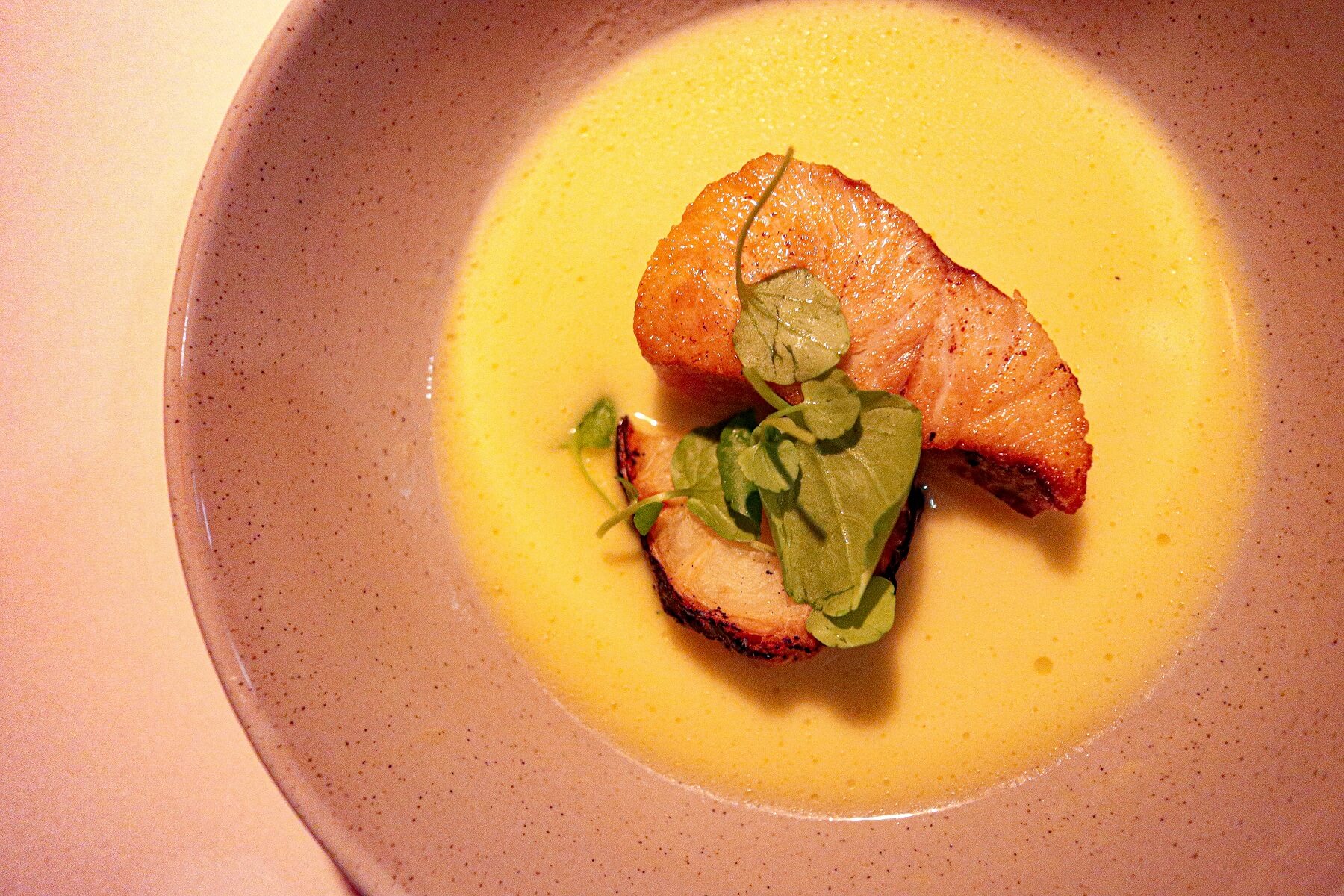
    Course: Fish and Celeriac

    Wine: Duboeuf Saint Amour Beaujolais 2015, France

    A lighter dish but still rich with its buttery sweet thin soup.

    Like a fish stock, which was both sweet and savoury. The celeriac was charred on one side and felt like it was added there for texture rather than flavour. The fish was rich, smooth and tender. We weren’t sure of the type, in my head I kept thinking that the fish was halibut, Enna was thinking hapuka? Delicious either way.


    If you don’t qualify for the Amex Airpoints Platinum, another option is the entry level American Express Airpoints card. The card comes with a $50 Airpoints dollars sign up bonus, and to make it doubly worth it, there is no annual fee! Simply apply and spend $750 on your card within the first 3 months to qualify.

    This is the best free Airpoints card available in New Zealand today as seen in my Airpoints guide. Click here to see if you qualify.

    Course: Venison

    Wine: Alluviale Cabernet Sauvignon Merlot 2015, Hawkes Bay, New Zealand 

    This was my absolute favourite wine of the night, maybe of my life. It was so smooth yet clung to your mouth without being dry.

    For the food, beautifully tender and how venison should be, rare. Leek absolutely melted in the mouth, I imagined it must have been slow cooked on a low heat or maybe even as a confit.

    The sauce looked like chocolate topped with hemp seeds. It was decadent and truly indulgent, rumours around the table were suggesting offal of some sort, like a pate. I thought of boiled blood sauce. It was such an other wordly taste. Salty but not too salty and like a lot of Giulio’s dishes, hitting the back of your tongue without being sticky.


    Palette cleanser!

    These came out to ready us for desert. I’m not normally a fan of feijoa but these cute ice blocks were light and delicious!


    Course: Caramel Cremaux 

    Wine: Antinori Vin Santo del Chianti Classico, Tuscany Italy

    The final course; short and not too sweet.

    A quenelle of coffee latte flavoured ice cream. This was my first time trying a cremaux and it reminded me of a chewy pudding, it wasn’t too sweet but carried a deep caramel flavour.

    The praline was perfect, crunchy and added that sweetness that a dessert needs. If it had a bit of flaky salt over the top, even on that ice cream it would have really done it for me.


    End it with honey

    Before we all left, chef Giulio came out to personally hand us all a taste of his last honey from his beehive down in Christchurch.

    He explained a bit about why he had them – turns out he had horrible hayfever when he moved to New Zealand and it was suggested to have a bee hive to deal with the pollen. So, if you were ever thinking of a solution to your hayfever!

    Every year the harvest is different and Giulio loves what nature can give back, nurture the land and nurture your body. Good ingredients are just as important as good flavours.

    Before we left we thanked Giulio and I handed him my paper! We took a quick pic on the iPhone so apologies for the poor quality. But wow, he was so humble and we cannot wait for what he has in store, he is the founder of the not-for-profit Eat New Zealand so I’m sure there will be more opportunities to try some of his amazing food!

    And this is my picture…

    After each meal I would pick up the pencil and draw what food or comments resonated with me the most. Here’s the end result 🙂

    What a night. Thank you so so much Bren, AMEX, Giulio, Kira and the Grove! 

    American Express Restaurant Month runs for the entire month of August. Check out more of their amazing events here.

    Don’t forget that all month there is a special “Spend $50 get $20 back” offer for all Amex cardholders, available at over 500 Auckland restaurants.

    If you’re not yet a cardholder, Amex is also running a special 300 Airpoints dollars signup bonus on its Platinum card. This is the top Airpoints credit card available in New Zealand and the #1 card recommended in my Airpoints guide.

    Happy eating!

  • Where To Stay In Nairobi? The Best Hotels & Neighbourhoods

    Where To Stay In Nairobi? The Best Hotels & Neighbourhoods

    Nairobi – one of my favourite cities, not just on the continent, but the world!

    In this guide I’ll take you through everything you need to know about Kenya’s capital, including what to expect in each area, where to stay, and a break down of some of the best Nairobi hotels to make your trip as safe and memorable as possible.

    What’s Nairobi like?

    All I can say is, pull your socks up.

    Way up.

    Lace your shoes up tight.

    This city doesn’t mess around.

    Nairobi is one of Africa’s gems, one of the fastest growing cities in the world, and a city that never sleeps. If you want to know Africa, you need to know Nairobi. 

    I’ve been visiting Nairobi for almost ten years now, and have grown to love the city almost like a second home. For most first timers this city easily overwhelms them, especially if it’s also your first time on the continent. However, that’s because most people arrive here unprepared.

    Without knowing where to stay, how to get around, and the best places to stuff your face, Nairobi is going to intimidate most newcomers. That will mostly leave you dining in a few tourist restaurants and leaving thinking Nairobi is “just okay”.

    However, a few insider tips is all you need to get a little deeper under the surface and feel Nairobi’s magic. Do that, and you’ll surely fall in love with it like the rest of us.

    Africa for beginners?

    At least on the eastern coast, Kenya is probably the most suitable city for first timers in Africa.

    Everybody speaks English, it’s safe in most areas, almost all first-world amenities can be found here, and people are very welcoming to foreigners.

    On top of that, Nairobi Airport services airlines from most corners of the world, making it an easy entry point to the continent.

    If you’re looking for a city to host your first Africa experience, Nairobi is one of the best options there is.

    In this guide:

    Where to stay in Nairobi?

    Choosing the right place to stay in Nairobi is essential.

    Nairobi is a huge city, and driving across town can take over two hours at the worst of times. Taxis aren’t exactly dirt cheap either.

    That means you want to stay in a place that minimises your commute time and bases you around the main sights that you’ll want to see.

    Below I’ll break down six of the best areas of Nairobi for tourists. Some are more accessible than others, but all can be good depending on the type of trip you’re looking for.

    I’ll also recommend one or two accommodation options in each place, just to make things extra easy for you. The best hotels in Nairobi are generally clustered in a few areas, but there is accommodation of high quality in all parts of town. As you know my travels are all about value, so all these places are vetted and include some of the best Nairobi hotels when it comes to comfort and affordability. I’ve stayed all around Nairobi, so feel confident that you’ll be well taken care of!

    Map of Nairobi

    As you can see Nairobi is large and spread out, and as the city is still developing each area is quite distinct. Some parts may resemble Europe, others may resemble rural Kenya in many respects.

    Most tourists should be looking to stay around the Westlands/City Centre areas, but other areas are definitely suitable too. It just depends on how comfortable you are getting around on your own, and what you plan to be doing during your visit.

    With Uber now very established, reaching different parts of the city is much less of an issue than it was in the past. However it still helps to stay in the right part of the city, as you never know when your sightseeing plans can turn into a day of sitting in traffic.

    Let’s take a look at each of these areas in detail:

    Westlands

    the Nairobi National Museum

    Westlands is one of the wealthier suburbs in Nairobi and the most popular area for expats.

    It’s quiet, there are lots of supermarkets and shopping malls around, and streets are lined with gated compounds and apartment complexes.

    Many of the top Nairobi hotels are also found here.

    For foreigners moving to the city (of which there are many lately), Westlands is constantly touted as one of the best neighborhoods to stay in Nairobi and the apartment market here is hot. 

    Shopping for marathon gear at Westgate mall, Westlands!

    Its proximity to the city centre makes it an ideal place for those wanting to stay somewhere central but not in the bustle of town itself. It’s also the centre of Nairobi’s nightlife scene.

    In my opinion, this is the best place to stay in Nairobi for first-time visitors.

    Also note that the surrounding suburbs in Westlands are also suitable if you want something a little more quiet. For example, Lavington, Kileleshwa and the nearby areas are all safe and pleasant areas to stay.

    I personally stayed in Kileleshwa on my last visit and as an avid runner, I went running around the neighbourhood daily with no issues, and saw many others doing the same. Since it’s just the next suburb over from Westlands, it was still convenient to do all my shopping, eating out in Westlands as it’s only a few minutes away by Uber!

    A great place to stay in Kileleshwa is the Radisson Arboretum.

    Things to do around Westlands:

    1. Visit the Nairobi National Museum.
    2. Head to Clay Oven for upper end Indian food – delicious and not too pricey.
    3. Urban Eatery is an upscale “food court” and one of the best places to chow in town. 
    4. Get pampered at Devarana – one of the best spas in the city.
    5. Hit Electric Avenue for the most vibrant nightlife in town. Alchemist and Havana are always fun, but avoid Brew Bar – always overcrowded with foreigners, and prices to match.
    6. Go to a spin class at Psycle Kenya!

    Evening spin class at Psycle in Westlands!

    Where to stay in Westlands?

    For the budget traveller:

    Stay at the Mvuli Studio Suites. It’s an exceptionally well run apartment guesthouse in a perfect location. Should only run you $30ish per night which is an absolute bargain for this part of town. Best rates here.

    For something nicer:

    I would stay at the Best Western Premier Westlands. Equipped with a restaurant, bar, gym, excellent breakfast buffet and beautifully furnished rooms, this has a well-deserved five stars and is one of the best hotels in Nairobi. Check out the reviews and you’ll see it holds its own against most upper-end hotels around the world. It’s perfectly located right in the middle of Westlands, and isn’t even that expensive for a place of this calibre. Around $200 should get you a room outside of high season, and since tourism is highly seasonal you’ll get regular specials. You’ll get the best rates here.

    Staying nearby in Kileleshwa, a great spot is the Radisson Blu. It’s right next to the Arboretum, which is a beautiful park with walking paths and greenery where locals and tourists alike go to relax, take strolls or go for runs. It’s especially beautiful in the summer months.

    South B/South C

    South B Nairobi

    South B/South C are adjacent local residential areas full of high-rise apartment complexes and the odd hotel. It’s right by the Nairobi National Park, and there are also a few shopping malls and supermarkets in the area. This is probably not the best place for an Africa first-timer, but if you’re comfortable being one of the only foreigners walking around this is a nice and affordable area to stay. I’d say it’s one of the best places to stay in Nairobi for long-term stayers on a tighter budget.

    Things to see around South B/South C:

    • Go for lunch or afternoon tea at the Ole Sereni Hotel – it overlooks Nairobi National Park, if you’re lucky you’ll see animals.
    • Just walking the streets here is interesting – especially in South B. A good look at local Nairobi life.
    • There’s a nice food court out the back of Nextgen Mall – a good place to get some affordable local food.
    • Go ice skating at the Panari Center, a short drive from South C on Mombasa Road.
    • Carnivore is one of Nairobi’s most famous restaurants where you can sample different game meats. It’s on Langata Road, halfway between South C and Karen.

    Where to stay in South B/South C?

    For the budget traveller:

    You can’t get better value than Juddy’s Place. Juddy runs this small homestay on her own; the rooms are cheap, the service is stellar. It’s a little secluded so Uber is a must if you want to get anywhere, but you won’t find many places that are better value for money. Best rates here.

    For something nicer:

    The Boma Hotel is easily one of the best hotels in Nairobi. It’s located just off the Mombasa Road, far enough that you’re not bothered by the ridiculous traffic, and not too far from the airport. Inside the hotel are two quality restaurants, a cocktail bar, pool, spa, gym, and everything comes with A grade Kenyan hospitality. Most importantly, rooms are big! You’ll find the best rate here.

    People who stay down this way often like to stay at the Ole Sereni, as it overlooks Nairobi National Park and you can sometimes see animals feeding at night. However, in my opinion the Boma is superior as a place to stay, and you can always walk down to Ole Sereni for a meal or cocktail anyway to enjoy the view. 

    Nairobi City Centre

    hotels in nairobi city centre

    Things move fast in Nairobi town! Staying in town can be a shock to the senses at first, but it’s actually one of of my favourite areas of Nairobi. 

    The city centre has changed so much since my first visit back in 2012 – back then all the cafes and restaurants were filled with expat businessmen and tourists. Nowadays, it’s filled with Kenyan students and young professionals, splurging on lattes and enjoying life.

    Walking around the city centre is also totally safe, at least in the day time, and there are endless restaurants to try and friendly locals to talk to. Don’t be afraid to explore here, it’s the heart of Nairobi! There’s also many hotels in Nairobi city centre that are good value, so if you want to stay here there are plenty of options.

    Things to do in Nairobi Town:

    • Walk through Uhuru Park. It’s nothing mind blowing, but you do see some interesting characters there.
    • Catch a show at the Kenya National Theatre (show times here).
    • Buy some souvenirs at the Maasai market. Remember to bargain hard here!
    • Tribeka Lounge on Banda Street goes off on the weekends. This is where to party if you want to mix with the local nightlife scene.
    • Just walking around town is an experience in itself. Lots of coffee shops, local stores and streets to explore. Make a day of it.

    Where to stay in Nairobi city centre?

    For the budget traveller:

    Stay at the After 40 Hotel. It’s in the centre of town and does all the basics right – good rooms, wifi throughout, and a restaurant on site. Usually $50 is enough to get a you a basic room, depending on the season. Best rates here.

    For something nicer:

    There are a few options but I’d go with the Serena Hotel, just because of its location. It’s right beside Uhuru Park in one of the nicer parts of the city centre. It’s not as lavish as some upscale hotels, but it has just enough flash – outdoor pool, poolside bar, good wine selection, gym, spa – to keep you comfortable. Hotels in Nairobi city centre are generally more expensive than elsewhere, so I prefer somewhere like Westlands. Still, it’s not a bad place especially if you’re there on business. Will likely run you at least $250 for a king room. Best rates here.

    Karen

    places to stay in karen nairobi

    Karen lies to the southwest of central Nairobi and is home to a large portion of Nairobi’s European population. Most residents here are upper-middle class, and you’ll notice how much more international it feels than other parts of Nairobi.

    One downside is it’s quite far out of the city centre. However if you’re looking for a quiet getaway far from the Nairobi’s daily bustle, Karen’s your place. 

    Things to do in Karen:

    1. Head to Talisman on Ngong Road. Not cheap, but the food is world class.
    2. Head to Giraffe Manor down in the Langata area – your Instagram will love you for it.
    3. Walk the Oloolua Nature Trail, a 5km walk, complete with caves and waterfalls.
    4. Head to Karen Country Club for a pizza and a game of golf.
    5. Go for a day at the races at Ngong Racecourse. The crowd is more interesting than the horses!
    6. Share some love at the Nairobi Animal Orphanage.
    7. Unwind at the Resurrection Gardens, a green sanctuary perfect for alone time and reflection.

    Where to stay in Karen?

    For the budget traveller:

    Karen Little Paradise might be what you’re looking for. This is a small B&B that grows much of their own food on premises, various fruits and vegetables that you’ll inevitably get to enjoy during your stay. It’s quite secluded and you’ll certainly need a taxi to get anywhere, but if it’s an escape you’re after then look no further. Best rates here.

    For something nicer:

    Book yourself into the famous Drexel House, right on the outskirts of Karen. This one-of-a-kind hotel is housed in a colonial mansion and one of the most delightful accommodations in Nairobi. Very private, and equipped with everything you could want for a five star vacation – outdoor pool, garden, private compound, restaurant, bar, room service. A hugely different experience to a cookie-cutter five star hotel, a stay at Drexel and its wonderful staff will surely be beautiful memory of your time in Kenya. It books out often, so book early. Get the best rate here.

    Kilimani

    places to stay in kilmani nairobi

    Kilimani was historically a British residential neighbourhood in Nairobi, but has since become a fast-developing residential and commercial centre.

    There are several big malls and office buildings here, with more popping up every year, and the scene is very international.

    More recently it’s become popular with the large Chinese population doing business in Kenya.

    I’d say Kilimani is one of the best areas to stay if you’re looking for a more “local” experience, but somewhere that’s still safe and vibrant. 

    Things to do in Kilimani:

    1. Try the nyama choma (grilled meat) at Coco Jambo – a beautiful outdoor restaurant perfect for long lunches.
    2. Experience African fine dining at Le Palanka – not cheap, but an experience not to be missed. 
    3. Go shopping at the Yaya Centre – a small but upscale mall popular with expats.
    4. Start (and maybe finish) your night out at Kiza. It’s a high-end nightlife venue, bottles and everything.

    Where to stay in Kilimani?

    For the budget traveller:

    Eldon Suites is your place. This is a boutique apartment building, conveniently located within walking distance from various restaurants and cafes. It has a restaurant, garden and swimming pool and the rooms are very spacious. $40 should get you a room outside of high season – awesome value for money. Get the best rate here.

    For something nicer:

    Easy choice – stay at the Yaya Towers. Basketball court, tennis court, gym, games room, swimming pool, BBQ area; it’s luxury living at its finest. It’s also right beside the Yaya Centre where you can get everything you need. This is apartment living so you might find you enjoy the privacy a touch more than the usual Nairobi hotels. About $195 should get you an apartment here for a night and if you’re wanting to vacation in style, you won’t be disappointed. Best rates here.

    Airport

    If you’re just overnighting it’s not a bad idea to stay by the airport.

    Nairobi traffic isn’t the friendliest and trying to get to the airport at peak hours is a nightmare, so this can be the best place to stay in Nairobi for 1 night, unless of course, you’re planning on exploring the city. In that case, I’d probably stay in Westlands or the city centre.

    Besides, the airport isn’t in the middle of nowhere, so if you do stay here there are a few things close by to keep you busy.

    For the budget traveller:

    Silent Sky Homestay is the best option down here. It’s tucked away in a side street and not the easiest to find, but the value for money here is excellent. A good night’s sleep is guaranteed, and breakfast is included. 3km from the airport, $25 a pop. Get the best rate here.

    For something nicer:

    Stay at the Four Points. It’s run by the Sheraton and does everything right – spa, gym, pool, buffet breakfast. Out of the Nairobi hotels by the airport, this is the best of the lot – located right beside Jomo Kenyatta, so you can rest easy and avoid the early wake up. Perfect for an overnight stay. 

    More Nairobi tips

    Use Uber. It’s safer than taxis and has better-vetted drivers than Bolt. There are many Uber drivers in Nairobi, so it’s never hard to find a ride. Also, Uber Eats is very good and you can order your groceries or any number of restaurant meals from your phone.

    Order groceries – Traffic in Nairobi can be a nightmare so getting food delivered is often a good option at meal time (especially when it’s raining!) The two major apps are Uber Eats and Glovo. I recommend getting them both because they serve different restaurants and supermarkets, and both have a good selection. On my last trip I was quite busy so ordered food in almost daily. Delivery is super affordable and will only cost you a dollar or two.

    Groceries ordered from Artcaffe using Glovo!

    Airport taxis are expensive but they are safe and convenient. You will need to negotiate with the driver because they will always give you a loaded price. The best tip I can give you is to open Uber and check how much the fare will be. In my experience, if the Uber fare is 1,000 shillings, an airport taxi will probably quote you something like 2,500 shillings. If you just tell them you’re going to call an Uber, they’ll probably agree to something like 1,200 shillings. Or you can simply call an Uber and wait.

    Eat the local food! Kenyan food is not intimidating at all and you should definitely try all the staples while you are there. Ask around for some good places, locals will be more than happy to point you towards their favourite local spots. Some foods you can ask about are ugali, pilau, chapati, smocha, nyama choma, plantains, githeri etc.

    Fish and masala chips!

    Get a sim card. There’s mobile data coverage everywhere in Nairobi and it’s affordable. Safaricom is the best network, make sure you take your passport with you as it’s required for every foreign user.

    Food safety is less of an issue now than it was 10 years ago, but eating in local street places can still give problems to foreign stomachs. I highly recommend you read my guide on preventing traveller’s diarrhea – it will come in very handy on a trip to Nairobi.

    Traffic is heavy. Give yourself plenty of time to get to the airport, especially during peak hours. Weather is also a factor – if it rains get ready for some epic traffic jams.

    Learn the language. English is widely spoken, but it helps to learn some Swahili before your trip. You might want to check out my Learn a Language in 7 Days guide.

    Get travel insurance! Travelling in Africa is unpredictable, insurance is an absolute must. If you’ve never purchased travel insurance before, this blog post should tell you everything you need to know. 

    Hoping you love Nairobi as much as I do. Any questions, leave them below. Enjoy!

    B

    Featured image: ninara @ Flickr

  • All The Things I Ate In Penang

    All The Things I Ate In Penang

    Penang has a reputation for being one of Asia’s foodie capitals, you could even say Penang prides itself on being ground zero for Malaysia’s best food, but how good is it really?

    For the first few weeks in Penang, I set out to try as many of Penang’s signature dishes as possible.

    Now one thing people kept telling me in Penang was that I needed to go to this particular stall on so-and-so street for certain dishes, sometimes they would even say you need to queue up for 45 minutes but it’s worth it! 

    Well, I don’t go to places like that.

    One, because it’s not worth it. I’ll always check out people’s recommendations, but I’m not waiting 45 minutes for a plate of noodles.

    Second, because places like that don’t represent the food of the city. Who’s going to queue up for 45 minutes for lunch every day? If a city is a food city, you should be able to get good food anywhere.

    Cities like Bangkok, Tokyo, Hong Kong, Singapore – there’s great stuff on every corner. If the only good noodles in your city are from this one guy in this one shop that you need to queue up for, well then…yeah. Your city’s noodles probably aren’t that good #sorrynotsorry.

    Instead, I went for my usual approach. I just walked the streets and ate everything. Let’s take a look:

    Pan Mee

    I think I tried three different pan mee in Penang.

    It’s a noodle soup with flat uneven noodles, feels like those classic hand pulled noodles you find sometimes in China. They top it with pork mince, mushrooms and dried anchovies.

    If it weren’t for the anchovies this would’ve been one of my favourite snack dishes – the noodles are thick and chewy and the soup is light – just how I like it. Instead I only ate it a few times, but it’s pretty good.

    I ate it at: Every food court will have it, but I had a pretty good one at this food court.

    Curry Mee

    I don’t really know how to explain this dish, when I got it, it just looked like a curry noodle with everything on it. They give you a few different sauces, some meat, herbs, tofu and blood tofu, plus a whole bunch of garnish.

    I watched the guy next to me mix it all up so I did the same thing. It’s yum, but it’s also heavy, be ready for it.

    I ate it at: Every food court will have it.

    Asam Laksa

    I’d already finished eating when I saw a stall serving this beside me, I had to try it. It’s a bit different to the regular laksa you might be used to – it’s fishy, they used tuna, and the noodle is different too (it’as a thick udon-like noodle). I think the sauce in the spoon is shrimp paste.

    One thing I love about the noodle soups in Penang is the servings are small, so you never feel like you need to over-eat or spend all your stomach capacity on one or two bowls of noodles. I wouldn’t want a huge bowl of this, but a small bowl is perfect.

    I ate it at: A Lan Cafe food court.

    Wan tan mee


    View this post on Instagram


    A post shared by Bren (@brenontheroad) on

    I probably tried seven or eight wan tan mee places in Penang, because for me it’s the perfect noodle dish! I could eat it for any meal of the day.

    The wan tan mee in Penang is legit, but one thing I dislike is their dry version is often dripping in sauce (which kind of means it’s not dry anymore…so uhh?) However it seems locals love it that way. I don’t mind it, but I far prefer it dry dry, or with sauce on the side. However the standard in Penang is to drown it in dark soy.

    Either way it’s still a champ, I don’t think I had a bad wan tan mee anywhere in Penang. 

    I ate it at: All over the place, although there’s a really good one on the corner of Love Lane and Chulia St.

    Prawn mee


    View this post on Instagram


    A post shared by Bren (@brenontheroad) on

    One hungry night, I Googled late night food and this prawn mee spot showed up, so I went searching for it in the early morning hours. It’s like a laksa, but with small shrimps and anchovies, plus your choose of noodles.

    I ate it at: Greenhouse Prawn Mee. 6/10.

    Char Kuey Teow


    View this post on Instagram


    A post shared by Bren (@brenontheroad) on

    I didn’t know Penang was famous for char kuey teow until I’d already tried it. Char kuey teow (and rice noodles in general) used to be one of my favourite dishes growing up so I’ve eaten this many hundreds of times in my life. They make it a little different everywhere, even in Penang.

    The main difference I noticed in Penang was how small the serving was. In other places I’m used to working through huge steaming piles of char kuey teow. I actually preferred the smaller serving, because it’s cheaper, and it meant I could go and eat it any time of day, and it left stomach space to eat other stuff too 😀 The char kuey teow in Penang is on point, definitely try it.

    I ate it at: Lots of places! You’ll find this literally everywhere. All were good.

    Satay

    Penang satay isn’t bad at all. You usually find at least one satay spot in each food court, normally it’s an Indian-run joint and you can smell it and see the smoking grills the moment you enter. I think the lamb is probably the best (and most expensive), but it’s the dipping sauce that makes that dish. This is a good side dish to share when you’re dining with someone, let’s you eat more noodles 😉

    I ate it at: Red Garden Food Paradise. Was good!

    Nasi Kandar


    View this post on Instagram


    A post shared by Bren (@brenontheroad) on

    Nasi Kandar is a really cool dish, I learned about this at the food museum. Basically guys used to carry around rice and curry dishes on a pole (kandar) on their shoulders. Their wives would cook it, and then they’d go walk around the streets and sell it to people. Obviously they have food carts now so the poles are gone, but the name stayed the same.

    Funny thing: I asked the guy to give me all the less-spicy stuff, because I know Indians don’t mess around when it comes to spice. So he piled up a bunch of things and I’d keep asking him “not spicy right?” and he’d be like “yeah not spicy”. And then I still nearly died while eating it because it was so spicy. It would have been a pleasant death though, food was awesome.

    I ate it at: Nasi Kandar Beratur, plus a few others. Ask the guys to explain the dishes to you, they’re used to tourists!

    Tandoori chicken


    View this post on Instagram


    A post shared by Bren (@brenontheroad) on

    After walking past this place Kapitan’s every day and seeing it always full, I finally tried it near the end of my stay. Tandoori chicken isn’t new to most people but the word is they do it well here in Penang and it’s the flagship dish at Kapitan’s. Took a while to arrive so I assume they cooked it fresh, on a delicious naan with two different sauces. I liked it 🙂

    I ate it at: Kapitan’s in George Town

    Lok lok


    View this post on Instagram


    A post shared by Bren (@brenontheroad) on

    I got taken here by my friend Kirsten, a blogger and longtime expat in Penang. She and her husband took me out for lok lok one night, which is basically hot pot with skewers. You sit around a table filled with skewer choices, dunk them in the hot pot for thirty seconds or so and then eat. They have everything, from classic meats, organ meats, dumplings, tofu, vegetables – you just take what you want and eat until you’re full. The novelty of it is pretty cool. Good place for spending a night with friends if you’re travelling as a group!

    I ate it at: Ping Hwa Lok Lok

    Hainan chicken rice


    View this post on Instagram


    A post shared by Bren (@brenontheroad) on

    Hainan chicken rice is a favourite in Malaysia so I wasn’t surprised seeing it here in Penang. This is one of my favourite dishes and I can eat it at any time of the day.

    Chicken rice only has four elements but all four need to be on point – the chicken, the rice, the sauce and the soup. Usually it’s the rice that sets places apart, because it needs to be cooked in a good broth to get the right flavour.

    I’ve tried this in maybe a dozen different countries, I still think Thailand does it best, but Penang does it pretty well too. You’ll find it in almost every food court, give it a try.

    I ate it at: A lot of places (most food courts will have it) but I had a surprisingly awesome one at the Queensbay Mall Food Court.

    Nasi goreng

    Nasi goreng is a Malaysian/Indonesian fried rice dish, really popular in this region. There are usually tons of different nasi goreng on the menu, I can’t remember which one I have in the photo, but whichever one comes with prawns and sweet chili sauce, it’s that one!

    This was another dish that was way freaking spicier than I expected and I needed a few cups of Milo to get through it. Nasi goreng is like a fried rice so there’s no fixed recipe. Mostly they’ll use things like soy sauce, sambal, chili, oyster sauce etc. Will be different everywhere.

    I ate it at: Gurney Drive Hawker Centre. There’s lots of other good stuff there too.

    Claypot chicken rice

    I used to enjoy eating this a lot when I was younger – the crispy rice at the bottom is always a delight, and claypot restaurants usually have some interesting menu options. At popular places, you can often see the long lines of claypots lined up steaming away. It can take a long time for it to cook, so at food courts it’s common for them to pre-cook it a little beforehand. If you want to full experience, go to a traditional place that makes the pot from scratch.

    I ate it at: The Jetty Food Court, 5/10.

    Roti canai

    This was the first thing I ate when I landed in Penang and the last thing I ate before I left, because it’s the most awesome snack ever!

    What you get is a greasy roti (maybe two), and a bowl of curry sauce for dipping (maybe two). Either way it’s simple and super addictive.

    It’s not everywhere but easy enough to find, especially in Indian food areas. Not the healthiest thing in the world but some things are worth it 😉 

    I ate it at: The moment I arrived in Penang I got off the bus in Georgetown and there was a dude selling it right there in front of me. It was the best one I had in Penang. I think it’s somewhere around the corner of Lebuh Carnavon and Lebuh Campbell, there’s a few other guys selling it on the same corner. But most Indian places will do it.

    Chee cheong fun


    View this post on Instagram


    A post shared by Bren (@brenontheroad) on

    This is something everyone should try in Penang, I first tried it when I was walking around buying fruits for breakfast. It’s a simple dish – rice noodle sheets, rolled up and then topped with sesame seeds and some sauces. I believe it’s a sweet sauce, a shrimp sauce and a chili sauce. I didn’t get this as often as I would’ve liked, but if there had been a stall near me I probably would’ve had it every morning! It’s light and tasty and cheap, perfect combo.

    I ate it at: A few places but the best was Yan Foo Chee Cheong Fun.

    Char hor fun

    This is a sauce-heavy rice noodle dish, first the noodles get fried up in the wok and set aside, then a thick gravy is made with prawns, pork, veges, an egg if you want it, which all gets poured on top.

    Very Cantonese flavours and is quite heavy so don’t expect a tiny plate like many other dishes in Penang. I prefer drier noodle dishes but this one is definitely a flavour bomb if that’s what you’re after. Malaysia would also be the place to try it! It’s everywhere in Penang, won’t be hard to find.

    I ate it at: The corner of Love Lane and Chulia Street. Very central and lots of street food around there!

    Ee fu mee

    Ee fu noodles are a popular egg noodle in China/Hong Kong, I saw a guy cooking this after I’d already eaten one night, but I saw it and had to try it. It was a vegetarian spot so it was fried up with tofu and veges.

    It was fine, but with so many other prime time noodles on offer in Penang, not something I needed to eat more than once.

    I ate it at: Gurney Drive Hawker Centre. There’s lots of other good stuff there too.

    Roast duck noodles

    Roast duck dry noodles is easily in my Top 10 favourite dishes ever, it might even be in the Top 3 on a good day, so naturally I eat it wherever I go.

    The duck in Penang seems more gamey than other places, which I don’t mind, and they do noodles well in Penang so this was a winner.

    Cantonese style food is common in Penang as the Chinese population here is big, so go for it when you see it! It’s legit.

    I ate it at: Red Garden Food Paradise. Was good!

    Ikan bakar


    View this post on Instagram


    A post shared by Bren (@brenontheroad) on

    This is a Malay dish which consists of a marinaded whole fish, grilled, and served with dipping sauces (usually curry, sambal or chili…or all three), a plate of rice and salad.

    It’s actually not something you see everywhere but it’s not hard to find if you look for it, try it, it’s worth it!

    I ate it at: A little Malay store opposite the Jetty bus terminal.

    Oyster omelette

    I actually lost my photo of this since Google can’t back up photos properly, but it’s easy enough to explain. The chef makes a starchy omelette, then adds in a handful of fresh oysters and serves it with some chili sauce. It’s good but it’s also double (or triple) the price of every other dish so I can’t imagine you’ll eat it often unless you really like it. It’s popular though, I saw it everywhere. Worth trying at least once.

    I ate it at: Chew Jetty Cafe, but you should find it at most street food centres.

    Nasi Kerabu

    Nasi kerabu is a Malaysian rice dish – blue rice eaten with fried chicken or fish, crackers, pickles and anchovies. I’ve actually forgotten whether the rice tasted different (which means it probably didn’t) but apparently it’s blue because of a flower they cook it with. I didn’t see this often, but I’ve also forgotten where I ate it (yep best blogger ever) so you’ll need to hunt for it. But I’m guessing you’ll find it at most Malay places!

    Thali

    Thali was one of my favourite things to eat in Penang and I tried most of the thali places in Little India. You’ll be served rice, poppadoms and chapati, and then a large selection of different curries and dishes. Usually you also get a little yogurt, and an Indian sweet as a dessert. Apparently the dishes are ordered in levels of spiciness and you’re supposed to eat them in order, but I didn’t see anyone doing that. Always have a massive food coma afterwards, so try do it for dinner rather than lunch!

    I ate it at: Little India in Georgetown, I tried a few, but I think the best is NR Thali Sweets Cafe, just ask for the thali menu 😉

    Vegetarian!

    Vegetarian and vegan food is pretty big in Penang, probably because of all the tourists that come through. Of course it’s always more expensive than local stuff, but they have some nice twists on traditional dishes. Penang street food isn’t the healthiest thing to eat every day so it’s nice to eat something health conscious now and then.

    Get it at: My favourite spot is The Leaf. Pinxin is pretty good too.

    Red wine chicken noodle

    Local friends took me to eat this for lunch one day, it’s super good. Apparently this cafe is famous for it. If you like funky noodle soups then make sure you try this when you’re around the jetty in Georgetown!

    Get it at: Cowboy Street Cafe. Their menu is full of other nice stuff too 🙂

    Let’s get to the fruits! I ate fresh fruits for breakfast every morning in Penang so I definitely did the rounds. Along with the usual apples, oranges, bananas, watermelons, mangoes, I got to try a few other interesting things too.

    Coconuts

    The coconuts in Penang are legit. Lots of flesh and the water is crispppp. Usually 5-6 ringit gets you a coconut, perfect for washing down a bowl of noodles (and some coconut pieces for dessert)

    Rambutan


    View this post on Instagram


    A post shared by Bren (@brenontheroad) on

    Similar to a lychee, just firmer and harder to peel. They’re easy to spot from their spikey skin and dark red colour. I don’t find them as sweet or as enjoyable as lychees but they’re a fun fruit to eat, especially while you’ve got some downtime to Youtube or watch a movie. Rambutan smoothies are pretty good too.

    Papaya


    View this post on Instagram


    A post shared by Bren (@brenontheroad) on

    Papayas are grown locally in Malaysia but they weren’t as soft or sweet as the ones I’ve had in other tropical countries. They also have a more watery flavour to them.

    They’re still great and I ate them almost daily. Try and choose the very overripe ones (i.e. really soft), they generally taste better. 

    Mangosteen

    Mangosteen is legendary and was probably my favourite fruit to eat in Malaysia. It has a very thick, dark purple skin, once you bust that open, you’ll find a small bulb of white wedges. They taste like a crossbreed between strawberries and mangoes. I didn’t find them everywhere but I did buy them whenever I saw them. They’re pretty cheap too. Best fruit ever!

    Yellow dragonfruit


    View this post on Instagram


    A post shared by Bren (@brenontheroad) on

    Dragonfruit is a bit difficult to describe, the flesh is mild and juicy, maybe similar texture to kiwifruit. There are various types, I like the yellow one as it seems to be sweeter. A lot of people I know have never seen or heard of dragonfruit, and are always surprised to see what it looks like on the inside. It’s an easy fruit to eat, definitely try it when you see it.

    Langsat

    This is another lychee-like fruit, maybe the size of a grape (it’s those little round things in the yellow dragonfruit photo above). It’s white fleshed and firm and sweet, the only thing I didn’t like is it leaves a sticky coating on your fingers after you peel it. I spent 10 minutes trying to wash it off with no success. It’s native to Malaysia though, so you need to try it while you’re here.

    Red dragonfruit

    Along with white fleshed dragonfruit there is also a red/pink fleshed variety. I didn’t enjoy this as much, it tastes more bland. It looks great on Instagram but I only tried it once. Actually red-skinned dragonfruits like this are usually white inside, I was surprised when I cut this one open. Still okay, but yellow is better 😉

    Soursop

    The soursops in Malaysia are pretty big, I forgot to take a photo of mine unfortunately, but you’ll see them in the fruit shops around George Town. The Malaysian soursops are great, just on the expensive side so I stuck to my other favourites. If you’re a soursop fan though you’ll have a good time here for sure 😉

    Watermelon

    Did you know they have yellow watermelons in Malaysia. They taste mostly the same as red watermelon, maybe a tiny bit sweeter. But it’s just extra cool because it’s yellow! On a side note, their pink watermelons are really good too 😉

    Verdict on Penang food

    Does Penang live up to the hype?

    Where it shines most is value for money. Most dishes cost around 4-5 ringit (about a dollar), which is amazing. I can’t think of many cities that offer better value than that. For a budget traveller this would be ground zero for good food.

    Also it’s very consistent. I didn’t go to many places where I thought “I definitely need to come here again”, but I never had a bad meal. I enjoyed everything I ate in Penang. But I also didn’t eat anything life-changing here.

    The best thing about Penang is food is everywhere. Sometimes it feels like it’s the only thing in this city, almost every storefront you pass is a restaurant. You only need to walk five minutes before seeing something worth trying, probably not even that. Georgetown is literally food on every corner, and the variation between Malay, Chinese, Indian and Western means you’ll never get bored.

    Best food city in Asia? Don’t think so. I think it’s tough for it to top cities like Bangkok, Shanghai or even Tokyo, unless you have a serious affinity for Malaysian food. I think even Singapore gives it a run for its money. Regardless, every foodie will leave here smiling for sure.

    Been to Penang? How do you rate the food scene? Let me know in the comments 🙂

  • How To Start Your Own Blog (In 10 Simple Steps)

    How To Start Your Own Blog (In 10 Simple Steps)

    So, you’ve seen how wickedly awesome my blog is and you want one of your own (cough). Not a problem.

    Starting your own blog is actually a lot easier than you think. You can be up and running in a couple of hours, depending on how fast you work, and could even have your first post up by the end of the day.

    Everyone blogs differently, but things are mostly the same at the start: You choose a domain, get some hosting space, find a design you like, stuff like that. It’s not difficult, but will cost you a little bit of money and you might want to punch your screen a couple of times.

    I’ve laid everything out step-by-step below, in as simple a way as I could. Hopefully it’s all crystal clear but if not, don’t be afraid to leave your questions in the comments.

    Let’s go!

    Quick note: If you’re blogging as a hobby, a good option is a free blogging platform. My recommendation is WordPress.com, which is 100% free. There will be some limitations when it comes to customisation. For a serious blog that could potentially become a business, you’ll want a self hosted blog which is what I’ll talk about below.

    Why start a blog?

    Why are blogs important? What purpose do they serve?

    There are a million different answers.

    A blog is a platform. It represents your voice. You can use it to share stories, influence people, inspire, educate, debate, entertain. It is a creative outlet. It allows you to express yourself freely in a world where we can’t always do so. It allows you to share your message, and most importantly, it allows people all over the world to find you.

    I’ve had conversations with people from places as remote as Iran and Ecuador about how they can travel more, live simpler lives and follow their passions in life. It is the blog that makes these connections possible.

    When you’re passionate about something, you usually have a desire to share it. You can think of your blog as your own newspaper or magazine, where you control the stories. If you have something valuable to say (and most of us do), a blog can allow you to explore your passions further, and connect with people who share the same passions as you.

    In other words, a blog connects you to the world.

    Step 1: Choosing your blog name and domain

    Choosing the right name is important.

    It’s what identifies your little space on the web. You want a name you’re proud of, a name that is memorable and a name that uniquely identifies you.

    You also want to get it right the first time. Changing your domain name is like going through a re-brand (a lot of work).

    Some tips:

    • Think long term. Choose a name you can expand on. If I had called it www.breninthephilippines.com, I would’ve been stuck with a domain restricted to Philippines related content. What happens when I travel somewhere else?
    • Make sure your blog name is available on all major social networks (Facebook, Twitter, Instagram, Pinterest), and sign up for them immediately.
    • Spend some time reading other blogs in your niche and find out which ones have stood the test of time. What did they name their blog? Use this to help you generate ideas, but also remember you need to be original.
    • Don’t choose something people might misspell easily. For example, www.travellingwithbrendan.com isn’t ideal because in international English it’s spelt “travelling” but in American English it’s “traveling”. Make it as easy as possible for people to find you.
    • Write it out in your email signature. How does it look? Introduce your blog to the mirror. How does it sound? Make sure you like it!

    Once you’ve chosen a name you’ll register the domain with your web host, which we’ll talk about in the next step.

    Step 2: Choosing a web host

    Web hosting is like renting a piece of land for your blog. You pay a hosting company for some space on the internet and they let you build your blog there.

    It sounds daunting, but don’t worry – it’s very straightforward.

    Who should you host with?

    After using around 10 different web hosts over the years, I’ve got a pretty good idea of what you need when hosting.

    After several hosting disasters, and now as the owner of a large portfolio of sites, my #1 recommendation for new blog owners is Dreamhost. Almost all of my sites are hosted with them, except for my biggest site (this blog, which is hosted with Pressidium).

    For hosting a new site, Dreamhost is easily the best I’ve found in terms of affordability and service – it’s just as cheap as the budget hosts, but the support is still great! Here’s what I love about them:

    • WordPress pre-installed for you (saves so much time).
    • Super affordable, $2.49 per month for your first site.
    • Free domain name
    • Free SSL certificates
    • SSD storage
    • Unlimited traffic!
    • Great support

    Simply head to their homepage to get started, or if you’re brand new to site building and need some help getting set up, just click the blue box below for a step-by-step guide.

    Getting started with Dreamhost (click to expand)

    Let’s get your web hosting set up! This should only take us 5 minute (or less).

    First, head to the Dreamhost homepage by clicking here, and click the WordPress hosting button:


    Then you’ll want to select the Starter plan.

    This is the cheapest plan and if you’re starting a brand new blog, will be more than sufficient for you:

    Click the “Sign up now” button and you’ll get taken to domain registration.

    You get a free domain name when you host with Dreamhost, which will save you around $10 per year (nice!)

    Click “Register a new domain.”

    If you know what domain you want, enter it here.

    Otherwise, go back to the previous step in this guide, and have a think about what domain you would like.

    Once you’re ready, enter the domain and click “Add for $0”, and you’ll be taken to payments.

    At the payments page you’ll have the option to pre-install WordPress. Keep this checked! It will save you some time and trouble, and will allow you to get building your site right away.

    The DreamShield and Dreamhost Email add ons are not necessary and will cost you extra, so you can remove them.

    Once you’re ready you can click Pay and you’re done. You card will be charged and you’re now the owner of a brand new WordPress site!

    Step 3: Install WordPress

    WordPress is the most widely used and widely supported blogging platform there is, and I highly recommend you use it. Most hosts have an install wizard for you, and even if they don’t you can install it yourself if you’re not a complete computer newbie.

    If you’re hosting with Dreamhost it’s even better – they pre-install WordPress on your hosting account for you. So if you’ve signed up with Dreamhost, you can skip this step and go on to the next one.

    If for some reason you unchecked the “pre-install WordPress” option during signup, don’t worry. Dreamhost has a one-click WordPress install you can use.

    Just head to the One Click Installs option in your Dreamhost dashboard:

    That should take you to the WordPress Installer. Just choose your domain name from the drop down box and click “Install it for me”. 

    The installer will do its thing and in a few minutes you have WordPress ready to go 😉

    Step 4: Login to your WordPress site

    Once you’ve gone through the steps, Dreamhost will present you with the URL to log in to your WordPress site.

    It should look like: www.yourblog.com/wp-admin (obviously you’ll replace yourblog.com with whatever your domain name is).

    The login page should look something like this:

    wp login

    Simply log in with the username and password you’ve been provided. If you don’t know what it is, contact support and they will resend the credentials to you.

    Step 5: Choose a theme

    You need to decide what your blog is going to look like.

    To do this you are going to need to choose a “theme”. You have 3 options here – free, premium and custom. I’ll explain all three below.

    Note: I want to stress that you don’t need to buy a theme right away. It’s perfectly fine to build your blog on a free theme for a few months, even a year, while you find your footing. If you can’t afford to fork out cash for a theme from the beginning, don’t worry about it. Just start writing!

    Free theme

    In the left hand side of your screen you’ll see your WordPress menu. Go to Appearance > Themes.

    wordpresstheme

    There you’ll be able to search through a library of themes, and many of them will be free. Just try them out and see which one you like! You can also Google “free WordPress themes” and you’ll be spoiled for choice.

    Premium Theme

    The downside to using free themes is they’re often lower quality than ones you pay for (obviously) and sometimes the developer of the theme will stop updating it, leaving you with an out-of-date theme which can lead to security and functionality issues. The alternative is to buy a “Premium” theme which will provide a slicker, more secure design.

    The blog you are reading right now is created with Thrive Theme Builder.

    This is a premium theme that allows you to completely customise your site to look exactly the way you want. It’s all drag-and-drop and very intuitive to use. I also made a video showing you exactly how I created the design you’re looking at right now, step by step. Check it out here:

    Step 6: Set up your pages

    Your blog is going to have several different pages. By default your theme should already have a home page, but you’re also going to want to set up an About page and a Contact page (and any other page you can think of).

    This is easy – just go to Pages > Add New:

    pages

    Then, write your page content and click Publish.

    After that you’ll need to add the page to your menu. To do this, go to Appearance > Menus. Select the menu you want to add it to from the dropdown box at the top. Then select your newly created page from the left hand side and click “Add to Menu”. Easy, right?

    Step 7: Write your first post

    You’ll now be ready to finally write your first post. Just go to Posts > Add new and start writing!

    posts

    By now you might be feeling a little overwhelmed, but relax. Everything in WordPress is pretty easy to figure out and after a couple of weeks of messing around inside the dashboard you’ll know your way around. Don’t be afraid to click things, it won’t break!

    Step 8: Create a logo/brand

    If you want to stand out, you’re going to need some sort of brand or logo that people recognise you by. I noticed most bloggers have modest little logos (which I’ve since learned is a good idea), but I wanted mine to be big and loud. So for my first blog design, I created a big huge fancy logo, which was easier than I thought.

    The problem was, even though I knew exactly what I wanted in my head I had no idea how to create it on a computer. So, I went to Upwork and found someone to do it for me. I sketched my design the best I could on paper, took a photo of it, and then sent it to a cartoonist to actualise it for me.

    Here’s what I sent him originally:

    DSC03749

    I’m no artist, but that doesn’t matter – all you need is an idea. He discussed a few more thoughts with me and after some sketches we turned it into this:

    BREN_ON_THE_ROAD_Sketch4 And then this:

    HEADER_300DPI_COLOR

    And finally this:

    Final header cartoon

    You don’t need to be a computer whiz or even a very good artist to make a logo for yourself. You just need an idea and someone will be able to bring it to life for you.

    What’s it cost to get something like this done? You’d be looking at maybe $100-$200, depending on who you choose. If you’re on a tighter budget, Fiverr is a really good place to get a simpler logo done, and there are decent designers there who will put something together for as little as $5! If you have a bit more money to play with, give 99designs a go. They’re pricey, but they have a money back guarantee and a good crop of active designers.

    Lastly, remember this fancy design part isn’t vital. There are a ton of blogs infinitely more successful than mine that just use simple text titles with no fancy artwork at all. Google’s logo is a good example – a six year old could’ve made it.

    Step 9: Before you go live

    By now you should have a web host, a domain name, some posts and pages, a cool WordPress theme and your own blog logo. However, you’re not ready to go live just yet.

    Here are a few things I’d recommend doing before you start sharing your site with everyone:

    Write around 10 posts

    It seems kind of dumb to take your blog live when you’ve only got one post. My goal was to have 10 posts already written so when people came to my blog for the first time they had a few articles to keep them around for a while.

    As it turned out, when my blog first went live I got friends telling me they’d read all my posts and were waiting for more – something that would never have happened if I only had one or two posts up.

    Set yourself up on social media

    Set up pages on Facebook,
    Twitter and Pinterest so that people who like your stuff can follow along and stay updated.

    In my first month pretty much all my traffic came from Facebook, and quite a few posts went viral from there too.

    You might also consider setting up accounts on Youtube, StumbleUpon and Instagram (many bloggers use their personal Instagram and Twitter accounts, however you definitely will need to start a separate page for Facebook).

    Start an email list

    I love using email to keep in touch with my readers, and have a newsletter and various courses that get sent to my subscribers.

    As a newbie blogger, I highly recommend using Mailerlite. They’re easy to use and they’re free for up to 1,000 subscribers.

    To start building your list, you’ll need to sign up to Mailchimp and then start adding subscribe boxes to your site. All the instructions are there when you sign up and it’s straightforward.

    Install important plugins

    To add functionality to your WordPress blog you will be using add-ons known as “plugins”. Plugins add cool functions to your blog, such as adding “Like” buttons to your posts and securing your site so spammers won’t mess with you. To install a plugin just go to your menu, then go to Plugins > Add New:

    wordpressplugins

    Then, search for the plugin you want in the search box and click “Install”. Once it’s finished installing, click “Activate”. After that it should be plugged in and working!

    Here’s a few I’d recommend starting off with:

    Wordfence Security – Monitors who logs in and out of your account and provides real-time security, anti-virus and firewall.

    Akismet – Spam filter for comments (you will get a lot of spam comments).

    BackWPUp – Allows you to schedule regular backups of your site in case shit happens.

    Jetpack by WordPress.com – Provides a whole bunch of cool features like site stats, subscriber lists and comments sections (and heaps more).

    iThemes Security – All-round security to keep your site safe.

    W3 Total Cache – Improves your site load time.

    WordPress SEO by Yoast – Helps optimise your blog’s content so it can be found easily by search engines.

    Get feedback

    Before I went live I shared my blog with a few close friends and asked them what they thought.

    It’s important you can ask people who aren’t afraid to be honest with you. If your blog looks shit, you want them to be able to say it looks shit without worrying about offending you, because when real visitors come to your blog and it looks shit they’ll leave and never come back.

    Ask your friends to tell you what they don’t like about your site, rather than what they do like – that will be far more useful criticism to help you turn your blog into something people will enjoy reading. By this time you’ll probably have spent many hours staring at your site so don’t underestimate the value of a fresh pair of eyes. They will see things that you don’t.

    Step 10: After you go live

    Promoting your blog

    The first thing with promotion is to make sure your content is actually worth promoting. Nobody shares stuff that’s mediocre, people only share stuff that’s awesome. This is often termed “Wow content”.

    Make sure all your stuff is Wow content before you start asking people to promote it.

    For a small tugboat blog that’s just getting off the ground, social media is going to be one of your best friends. Places like Facebook, Twitter, Stumbleupon and Pinterest can be great traffic generators. Make sure you’re active on these platforms and are sharing your work as it’s published. Sharing your work on your personal accounts is good too – your friends will be some of your most loyal fans!

    Guest posts are also great for exposure. For example, my guest post on Our Awesome Planet brought me several thousand page views. You can also host guest posts or interviews like my interview series on Solo Female Travel. Both are good ways to bring in new readers and make connections.

    Another good strategy is to ask relevant Facebook pages (keyword here is relevant) if they’d be willing to share your work. For example, if you write something about New Zealand, reach out to different Facebook pages about New Zealand and ask if they’ll be willing to share your article. If your content is awesome you’ll get a few yeses!

    Lastly, reach out to other people in your niche and get to know them.

    Get in touch with the bloggers who inspire you and give them props on their work.

    I have a few blogging role models – Migrationology, Legal Nomads and Wandering Earl to name a few, and they all know I think they’re awesome because I’ve reached out to them and told them. I also ask them for advice now and then, and even arranged meetups in person.

    I’m always connecting with new bloggers and it’s been beneficial in many ways. The blogging community is cool and friendly for the most part; I’ve gotten a lot of help and I always pay it forward too when newbie bloggers contact me often asking for advice.

    SEO

    Search Engine Optimisation is the practice of making your website rank highly in search engines so people can find you. It’s a large topic and impossible for me to explain here, plus to be honest I don’t know that much about it.

    If you’re interested in learning, two good (and free) beginner’s guides are The SEO Strategy You Can Build An Empire Around and The Beginner’s Guide to SEO.

    Personally, I don’t do a lot of SEO (I use the Yoast plugin I mentioned above and that’s pretty much it). It’s a constantly changing environment which makes it hard to keep up with.

    For me, I focus my time on writing content that I (and hopefully my readers) love. That’s what’s important to me.

    Monetisation

    Now, you’re probably wondering when the money starts flowing. Sorry to disappoint, but if you ask any travel blogger they’ll tell you the money is better flipping burgers at McDonald’s. Many bloggers will go at least 6-12 months, working hundreds of hours on their sites without even earning a dime. If it’s money you’re after, you’re better off spending your time elsewhere.

    There are various ways to make money from your blog. These are the most common:

    Advertising – Through either direct advertising or ad networks, you can place banners and text ads on your website and get paid either per click or a flat rate. Google Adsense is probably the most popular and easiest to get approved for.

    Selling products and services – You can create your own products to sell, such as my ebook Triple Your Travel, or offer services such as freelance writing, consulting or design.

    Affiliate marketing – You can promote other people’s products and earn a commission when you make a successful referral. This is a great option because you don’t need to develop a product but can still offer something of value.

    As an example, my Resources page contains several affiliate links. If someone makes a purchase through the links there I will earn a commission (at no extra cost to the buyer). It really is a win-win-win. If you would like to find affiliate products to promote, I would recommend using an affiliate network. Here are some I can recommend:

    • Flex Offers – It is a bit of a process to get approved for this network, but they have very good merchants so it is worth the effort.
    • Share A Sale – This is a smaller affiliate network and easier to get approved for, and it still has many good merchants. There is not much here for me to promote but depending on your blog you might find something that fits with your theme.
    • Affiliate Window – Another good affiliate network with a good selection of merchants. There are one or two items for here that I’ve promoted regularly.
    • Commission Junction – Quite a large network that has a large range of advertisers.
    • Amazon – Amazon’s affiliate program is one of the largest on the web. Commissions are very low but since Amazon sells almost everything you will definitely find something that fits.

    Sponsored content/reviews – Companies will pay you to publish a post promoting their product/service, such as a hotel, an app or a gadget. I don’t do this, but many bloggers make an income this way.

    Partnerships/ambassadorships – Longer term relationships where certain brands will pay you to endorse and promote their product/service. Common arrangements in the travel industry are tourism boards paying bloggers to promote a destination or experience or companies asking bloggers to use and endorse their products (such as cameras/apps/travel gear).

    As a portfolio to land freelance work – Whether you’re into photography, video or writing, your blog is the ideal portfolio to showcase your work. I’ve landed various freelance writing gigs from my blog and always include my blog in my pitches.

    There are many other ways to make money from your blog, but the above are what I’ve seen to be the most common. It starts with having an audience. This comes from writing a blog that you’re passionate about. Without a readership the money is unlikely to come, and if you’re in it for the money you’re probably going to be disappointed anyway. Do it because you love what you’re writing about and have a desire to share it with the world. The money will present itself eventually.

    A complete guide to making money from your blog:

    For a more detailed guide to monetisation, check out my post The Practical Guide To Making Money With A Blog. This post is far more in depth and shows you, step-by-step, how to implement the methods mentioned above.

    Bonus Step: Tools to help make your blog awesome

    Here are a few tools and resources I actively use on this blog. Some you need to pay for and some are free, but all of them will help you create a faster, cooler, more successful blog.

    Do note that you probably won’t need to worry about the tools listed below right away, and many of them won’t make sense to you right now. However, after a few weeks or months you’ll understand why they’ll be handy, so make sure you keep these on your “check out later” list.

    Cloudflare – A free CDN service that speeds your website up considerably! No one likes waiting for websites to load, so if you want loyal readers, make sure your site is fast. If you’re hosting with Dreamhost, this tool will already be integrated and you can activate it with just a few clicks in your Dashboard.

    Uptime Robot – A free service that monitors your uptime. Every time my site goes down I get an email, and then another message when it goes back up. Very handy.

    Picmonkey – Photoshop is way too cool for me, so I use Picmonkey to make all my website’s graphics. Sometimes I also use Canva.

    Smugmug – I use Smugmug to host all my photos. It means I can keep my photos at optimal quality, keep my bandwidth down, and have my entire photo collection organised in a easy to navigate portfolio. Flickr is a free service with the same functionality, but Smugmug is just simpler, faster and has better support, which I’m happy to pay for.

    Thrive Leads – I use this plugin for creating all my subscriber sign up forms and it’s been super helpful in building my subscriber base. It’s not free but it’s easily the best email list plugin I’ve used so far.

    Hootsuite – I use Hootsuite to help manage my social media accounts. It allows me to queue my updates so I don’t need to be online 24/7 fiddling with my different channels. Huge time saver and really easy to use.

    Mailerlite – I use Mailerlite for my email list, and I highly recommend it. It’s free for your first 1,000 subscribers, and you get all the features too! Perfect for newbie bloggers.

    Sendowl – I use Sendowl for managing sales and distribution of my ebooks. It is excellent. You probably won’t need this until further on in your blogging career but it’s good to know about!

    For the full list of tools I currently use, check out my Blogging Resources page.

    That’s it!

    So, for those of you who’ve been asking how I built this blog, that’s how!

    I self-taught myself most of this stuff so you might find differing advice out there, but this is what has worked for me. As a blogger you’ll need to spend a lot of time experimenting with your site and finding what works for you. It’s all part of the fun.

    If there’s anything I’ve missed or you have questions, leave a comment below and I’ll answer it the best I can. Otherwise best of luck, and hope to see you in the blogosphere soon!

    -Bren

    Note: Some of the links in this article are affiliate links. All items recommended above are resources I use here on my own blog and are honest recommendations. No items are sponsored and I pay for all my resources in full. For further clarification you can read my Disclosure Policy here.

  • Along Mallorca Roads

    Along Mallorca Roads

    It’s 10 o’clock when I land.

    That’s the problem with booking the cheapest flight. It always lands late.

    “Take bus number 1,” she texts. “Our stop is number 422, in front of El Corte Ingles. You know, that shop you hate.”

    I haven’t seen her for years.

    Well, two years.

    But it feels longer than that.

    I find the bus stop. Get on. Let her know I’m on the way.

    “So do we need to share a bed tonight?”

    “Why? Are you going to shower if we do?”

    “Nah, gonna eat lots of burritos.”

    “Clown. We got bunks.”

    It’s rare for me to travel with a girl. With anyone, really. Especially a girl I’m not, you know. Dating.

    “I’m guessing you’ve taken the bottom?”

    “Most definitely.”

    “How you gonna reach the stars from down there? Be ambitious.”

    I actually asked her on a date once. She said no. Of all the no’s I’ve gotten from girls over the years, hers might be the only one I agree was a good idea.

    “I was waiting for you to go eat. Super hungry now.”

    “We’ll eat late. In true Spanish style.”

    “Nothing will be open!”

    “It’s Spain, everything will be open.”

    I get off the bus at El Corte Ingles. It doesn’t take long to find the apartment. One wrong street, one wrong turn. That’s all. Often it takes a few more than that.

    She buzzes me in from upstairs. I get in the elevator, the size of a shoebox.

    Ding.

    Ding.

    The front door is already open. She appears just as I’m about to step inside, smiles like a mother when she sees me. We hug.

    “Fancy seeing you here.”

    I drop my bags in the room. It’s the cheapest Airbnb in town. Tiny. Two bunks. Both have pillows. Both have sheets. Bargain.

    “Eat?”

    Mallorca is lifeless when we step out onto the streets. Some cars. No lights. No people. Nothing open. It’s not even midnight. We walk through town to the main plaza. You always know when you’re in Spain; wide streets, stone sidewalks, old buildings, not tall, not short, rustic. When we get there it’s dead, everything closed. Except Burger King.

    I don’t have many female friends. I mean real friends, not Facebook friends. The girls I have real phone calls with, multi-hour phone calls, the girls who call, just to see how I’m doing; they’re girls I’ve been romantic with, at one stage or another. A female friend who was always just a friend? I don’t think I have any.

    Well, I have one.

    That’s why I think it was a good idea.

    I sit and watch Fernanda eat her fries. That’s her name. Fernanda. I don’t eat. Then I eat one. Then eleven or twelve. I’ve never seen anyone eat fries like Fernanda. She doesn’t dip them. She holds the fry, gets the ketchup packet, then she squirts ketchup onto the fry itself, right along the fry, from tip to tip, in a perfect line. Then she eats it. Gets another fry, does it again. I watch her do it six or seven times. People always ask about the big things – job, house, degree. But it’s the little things – how they arrange their wardrobe, if they say please, the way they eat their ketchup, that really tell you if you know someone.

    The next day, we get the tourist stuff out of the way early – do the Palma walking tour, look at some castles, try a Mallorcan ensaïmada. When evening arrives, we take a walk along the waterfront, all the way to the end, until there’s no waterfront left. We talk about a girl that’s been on my mind.

    “Really tall. And just, beautiful. Odd thing we’ve had going on.”

    It’s good having a female friend. It’s like you’ve got the other team’s offensive coordinator there, sharing all the team secrets. While a poor girl thinks you’re at the kick off you’ve already seen the next ten plays of the game.

    The next day, Fernanda suggests a day trip to Sóller. Google highly recommends it. It’s a two hour bus ride, through winding mountains, valleys, lots of green. It’s beautiful, but sometimes, when you’ve seen a good amount of the world, bus rides become a sort of limbo, the scenery becomes background noise. You need to actually stop and remind yourself, hey dickhead, this is beautiful, appreciate it.

    When we arrive in Sóller, it’s late. And it’s Sunday. Much of it is closed. Streets mostly empty, apart from the odd wanderer. The main plaza is more lively, with tourists and tapas restaurants and tables with big umbrellas. Fernanda and I walk through, explore some side streets, find ourselves back at the main plaza. Turns out, the main plaza is the only plaza.

    “That’s it?”

    “I guess so.”

    We take a seat at the emptiest restaurant, have a drink, order some vegetarian croquetas.

    “I just don’t get why he disappears, and then he starts replying for a week, and then he disappears again?”

    “Guys do that sometimes.”

    “Yeah. Why?”

    “Well. Sometimes we just don’t want to talk to you.”

    She shakes her head.

    “I mean girls do that too, right?”

    She smiles. I smile. We both nod and eat a croqueta.

    A couple of days later, after trying every vegetarian cafe in Palma, we book a rental car to explore the island. I book the cheapest car, from the cheapest company. Pick up time is 11 a.m.

    I walk down to the waterfront to pick it up, right on time. Fernanda stays at the room and mothers the bags. I almost walk right past the rental office, it’s so tiny. It’s tiny, and it’s packed with people.

    “We don’t have any cars right now,” she tells the guy at the counter. “All these people are also waiting for cars.”

    “But we’ve booked! We booked it for this time!”

    It’s some British guy with angry hair. His world is falling apart, apparently.

    “We’re overbooked sir. You’ll need to wait for two hours, the cars will be here then.”

    When he’s done, I give the lady my booking. Same story. I text Fernanda.

    “Need to wait two hours, they have no cars.”

    “What the fuck!”

    “Let’s go eat.”

    Fernanda meets me on the waterfront. We find an American diner, I have the strawberry pancakes. We’ve spent the last four days binge eating; there’s no stopping us now. The two hours zooms by. When you’ve spent your life sitting in airports, two hours is like a toilet break.

    We walk back to the rental office. It’s a different lady now. The other one is probably in court, getting sued by the British guy. I hand over the booking form.

    “Oh,” she says. “You’re an online booking. There’s no cars, you’ll need to wait an hour or so…”

    She hasn’t even finished speaking when Fernanda turns hostile.

    “He was here at 11 and you said the same thing! We’ve been waiting two hours already!”

    The lady tenses up, looks at me sheepishly.

    “Really?”

    I nod.

    “Sorry, I didn’t know.”

    She looks back down at her computer, clicks a few things.

    “I’ll need to give you a slightly bigger car, is that okay?”

    I nod again.

    “Okay, they’ll bring it right out for you. Do you want to buy insurance? It’s only 50 euros and you’re covered for everything. Otherwise any damage is an excess of €1,200.”

    We don’t buy it.

    Fernanda and I go outside to wait for the car.

    “Why you blowing up at the nice lady for?” I laugh. “She didn’t know.”

    “What, you were just going to say okay and wait for another hour?”

    “Of course not. I was just about to win her over with some charm. Then you brought the fury.”

    We get in the car. It’s been a while since I drove on the right hand side. It’s been a while since I drove, period. We’ve barely been in the car ten minutes before I krrr krrr krrrrrr the side mirror against something.

    “Brendan!”

    “It’s fucking weird! Driving on the other side.”

    We spend that morning driving out to Cala d’Or. It’s a little tourist village, on the west of the island, our new home for the next few days.

    I drive badly while Fernanda describes the map badly. Like Bonnie and Clyde. Well, not really. More like Donkey Kong and Dixie Kong. Except Fernanda is older than Dixie and can’t read a map. There’s a rumour that women aren’t good map readers. Must be true. There’s also a rumour that Asians can’t drive. Definitely not true. Well, maybe just today.

    Cala d’Or is a typical beach holiday town. Lots of hotels, tapas restaurants, supermarkets with those rotating racks of sunscreen on the footpath. Fernanda and I check in, then go in search of dinner.

    Every restaurant in Cala d’Or is the same. Pizza, pasta, tapas, seafood. Fernanda examines every menu like it’s an ancient artifact, decoding the scriptures in her head. Eventually she finds one she likes.

    “Table for two.”

    The guy smiles and walks us in.

    “Sit anywhere you want, you can choose.”

    I point to Fernanda.

    “She can choose.”

    The waiter laughs, leans in to whisper.

    “It’s always the same, huh?” 

    He gives me a giggle, a friendly shoulder pat.

    We order the unhealthiest food on the menu. Pizza, nachos, something else that we probably regretted later. Our waitress is a little blonde girl. I guess German. Wrong. Dutch.

    “Where are you guys from?!”

    We explain we’re both from New Zealand, even though our faces are Brazilian, and Chinese.

    She’s chatty, starts telling us about Cala d’Or, how long she’s lived here, some of the fun things we could do.

    “Oh, we’re not together,” I tell her.

    “Oh?”

    “You thought we were a couple? “

    Well…yeah.”

    “Nah. Fernanda’s going through a mid-life crisis. I just came out here to support her.”

    Fernanda rolls her eyes. I laugh like it’s a joke, even though it’s kind of true. Because it’s always kind of true, for everyone. Life just seems to be made up of a series of mid life crises. One after the other. Eventually you realise that’s just called life.

    The next day we drive out to a beach that will look spectacular on our Instagrams. Fernanda knows where it is, how to get there. She takes the keys, says she’s driving today.

    The roads are quiet. As we pass through the towns, I know these are the same roads we drove yesterday, but for some reason I don’t recognise them. They all look the same. Until eventually I recognise one: The road with the funny intersection, the one where it looks like you can’t turn, but the sign with the blue arrow appears just in time, and then you realise you can.

    But today we go a little further from the towns. We hit the open road, lots of fields, lots of orange and green, lots of houses with too much land, vineyards maybe, farms.

    I read the map to her, left, left, right, left. 

    Eventually we come to a dirt road.

    Left here, I tell her.

    The road is gravelly, uneven. She drives slowly.

    It gets narrower. Hedges and trees on both sides.

    Leaves brush against the car mirror.

    Slowly, I say, watching the branches tickle the side of the car.

    We keep going.

    Surely it must widen up soon.

    Nope.

    Narrower again.

    Branches drag against the car. We hear scratching. Is it really scratching?

    It’s probably alright. Keep going.

    Krrr.

    That sounded bad.

    Too late now. Can’t go back.

    Krr. Krrrrr.

    We look at each other. It might be okay, we say with our eyes. We hope.

    Eventually it clears. We get out to the main road, drive down to the beach.

    As soon as we park I jump out and check the doors.

    I start laughing. Fernanda looks at me, smiles nervously.

    “We’re so fucked,” I tell her.

    She gets out, runs her hands along the panels.

    “Oh my god.”

    Then I take a step sideways, look at it in the sun.

    “Okay, it’s not thaaaaat bad.”

    I crouch, change angles again.

    “Actually it is that bad.”

    I look at her.

    Chuckle.

    Shrug.

    “Worry about it tomorrow.”

    Eventually we find the beach we’re looking for. It’s hidden, down a long flight of stairs. But we follow the small trail of tourists to a lookout, up on a cliff where we can see the lagoon below. Fernanda looks horrified.

    “What the hell?”

    I’m not sure what she’s what the helling about.

    “This isn’t it, is it?”

    I shrug my shoulders. I’ve never seen this place, never heard of it.

    She pulls out her phone, shows me a photo.

    “This is what it’s supposed to look like.”

    I study the photo. I can recognise the boat ramp, the far cliff. But that’s all. The sand in the photo is white and perfect. The sand in real life is brown and covered in rocks. The water in the photo is turquoise and glistening, the water in front of us looks likes sewerage.

    I burst out laughing.

    “That’s hilarious.” Catfished by Instagram.

    After dinner that night, we stop at a small ice cream shop by the hotel. It’s one of those fancy ones, where they have nice tables outside with dim lighting, and overcharge two euros for each scoop.

    “I just. I don’t even think I want to work anymore. I want to be a housewife.”

    I turn my spoon upside down, suck the ice cream off like a lollipop. The same way I’ve eaten it ever since I saw someone do it in a movie when I was ten.

    “But, this is exactly what you were wanting last year.”

    She nods.

    “You wanted that apartment. And that job. And Berlin.”

    She nods again. Smiles as if she’s already had this conversation with herself last week, and the week before. And a few weeks before that.

    I think I’m just lonely.”

    I scrape at my ice cream again, not even eating anymore, just drawing patterns in the half still left.

    “Yeah, well. So am I. Sometimes. It’s not always a bad thing you know, to be lonely.”

    The following day, we try a new target. Fernanda’s found a different beach. Again, it’s supposed to look spectacular on Instagram. Again, she drives.

    Before leaving we stop and load up on snacks at the SPAR, healthy-ish ones. As we arrive back at the car, I run my hands across the side panel, seeing how deep the scratches run. Fernanda smiles anxiously as I do it. I smile back.

    “Worry about it tomorrow.”

    I fire up Google Maps and we head for the coast. I recognise these roads a little more now. I remember the double street, the one that confused me when we first drove into town. And then the big roundabout that comes after it. A few minutes on, there’s the big Santanyí sign. And then of course the funny intersection, the one where it looks like you can’t turn but you can.

    Past that, it’s new territory. It’s a new beach this time, on a different coast, with different roads to roam. On the stereo we listen to a song one of her musician boyfriends wrote for her. The same song we were listening to yesterday. The same guy she keeps talking about at meal time.

    “…what you want, what you want, doo doo doo, what you want…”

    “It’s catchy, right?”

    Yeah, it is actually.

    Like the rest of Mallorca’s beaches, this one seems to be hidden too. We park the car, wander around the little red teardrop on Google Maps. No beach. But again we follow the trickle of tourists, along the rocky cliff, up the hill, through a little wooden gate. Behind the gate the path is well trodden, a hint that it’s here. Five minutes along the path, we find it. It’s down, far, far down, in a little cove under the cliff we’re standing on.

    Fernanda shows me the photo. It kind of looks the same. But in the photo it looks majestic, the kind of place where you’d build a palace up on the cliff after winning the lottery. In real life it just looks like a cove. The kind of cove you look at for five minutes, take a photo, and leave.

    We look at it for five minutes, take a photo and leave.

    That night after dinner, Fernanda and I poke at a piece of mediocre cheesecake.

    “My Mum talked to me. She thinks I’m lost. Said I should write down some goals. Asked me if I’m…drifting.”

    Fernanda looks at me.

    “Well, are you?”

    I think about it.

    “I don’t think so. I don’t know. Maybe.”

    I scrape at the cheesecake again. Turn the spoon upside down and eat it.

    “I think I’m with your Mum a little bit. Your life’s too easy now. Not that you didn’t work for it, but…”

    I nod.

    Drifting.

    Fernanda can see it, now that we’re sitting here talking about it. But Mum can see it better, from halfway across the world. What would we do.

    The following day is our last day in Mallorca. We drive out to Mondragó National Park.

    It’s late afternoon when we finally find the beach there. It’s a medium sized bay, pretty, walled by rocks on either side. It’s empty when we arrive. I take off my flip flops. We walk along the sand.

    “There’s a seat there.”

    She points up on the rocks lining the water.

    “Where.”

    “There.”

    She stops me. Points at the rocks. Makes sure my eyes are following her finger.

    “Oh. There.”

    We climb up onto the cliff, sit on the little seat in the rocks. It’s a bit odd, like a park bench someone has hidden there, disguised. We chat for a while, then just sit in silence. The tide is coming in. I watch the swell crash against the pile of rocks below us. It comes in cycles, a few small waves, then a big one, a few smaller ones, then a bigger one.

    As they crash in and out, my mind drifts, segues, as it usually does by the water.

    Happiness. Loneliness. Mum. Fernanda.

    Each time a wave crashes on the rocks, my mind hits pause for two seconds, just to see if this one will make a splash big enough to reach me. And then straight back to wondering.

    Tanzania. Car crash. Where to go next. Why. Drifting.

    Wave. This one looks big. It’s going to splash me.

    Ooh, nearly.

    Half an hour goes by. An hour. Maybe two. No idea.

    Mallorca. How many people wait the whole year for a week in Mallorca…

    Fernanda says something.

    I flinch, ask her what she said. I’d nearly forgotten she was sitting beside me.

    “Maybe this one,” she repeats, raising her eyebrows towards the water.

    She’d been watching the waves too. This whole time. Waiting for them to splash us. Just like I was.

    The wave collapses onto the rocks, loudly. It plunges deep, then, as if launching off a trampoline, shoots up towards us. It splashes the tips of our toes, barely.

    I look up. The sun is just starting to set.

    “Let’s go?”

    The next morning Fernanda wakes up before me. Packs her stuff before me. Tells me we’ve got five hours until we fly. It’s time to worry about the car.

    “Google it. How to fix car scratches,” I say, stuffing toiletries into my bag.

    I hear the mumble of Youtube videos, her flicking through different ones.

    “Toothpaste?” she says, puzzled.

    She keeps watching. I look up at her, see her eyes fixed on the screen.

    “Oh my god,” she laughs. “Fucking toothpaste.”

    We check out and hurry down to the car. I give her my toothpaste, grab two dirty socks. She wets one, toothpastes it, starts buffing the door.

    After a few seconds she pulls her head back, examines it like an outfit she’s holding in the mirror.

    “Oh my goddd. It works.”

    She buffs harder, starts laughing.

    I take the toothpaste, start polishing the other side.

    A couple walks past, looks at us confusingly, a Latina and a Chinaman furiously polishing their rental car with socks.

    After twenty minutes we’re done. In the right light, it looks brand new. In the wrong light, it looks like we’ve tried to cover our car scratches in toothpaste.

    We laugh at each other, proudly. We did our best. It’s in fate’s hands now.

    I drive today. We barely need the map anymore. I make my way out of town, one last time. Along the confusing double road. Around the the big roundabout. Past the big Santanyí sign. Through the funny intersection, the one where it looks you can’t turn but you can. From there, it’s onto the highway, our final Mallorca road. Ample lanes all the way back to Palma.

    We pull up at the rental office an hour later. It’s the same lady at the desk, the one that got sued by the British guy. She’s gossiping with a workmate.

    I hand her the keys.

    “Any problems?”

    “None at all.”

    She glances at the car out the window for less than a second, tells me to sign a form, hands me the return slip.

    That’s it?”

    That’s it,” she smiles.

    She waits for me to walk out. As I close the door, I see her quickly go back to gossiping. I check my credit card for weeks. They never charge it.

    We share a cab to the airport. Fernanda’s going home to Berlin, me, onward to Amsterdam. She waits for me to check my bag in, we shuffle through security together. Soon we get to the end of our shared walk through the airport, the part where her gate is this way and my gate is that way.

    She drops her bag. We hug. She puts a hand on my neck, pulls my head down towards her. Kisses me on the cheek.

    I smile, wrap my arms around her.

    The last time Fernanda and I said goodbye, it was a goodbye that said maybe we’ll meet again, someday. But this time it wasn’t even a goodbye. It was a call me when you land, remember to read that book, don’t worry about the twenty euros, I’ll send you that recipe, did you give me back my toothpaste? 

    And I knew, from now on, there would be no more goodbyes between us. Only take cares, and see you next times, laughter about this holiday we took when we were kids, the beaches we couldn’t find, the food that cost too much money, all the conversations that came in between, along Mallorca roads.

    But as we broke our hug, turned to walk our own ways, I didn’t say any of that.

    Didn’t need to.

    Like the waves on the rocks at Mondragó, she already knew.

    B

  • Eat Less Food, If You Want To Be A Millionaire

    Eat Less Food, If You Want To Be A Millionaire

    In the 1920’s, there lived a man named Edward Bernays.

    Edward was the nephew of psychologist Sigmund Freud, and became a marketing genius, before corporate marketing was really a thing.

    At the time, Bernays’ PR firm was working for a major pork and bacon manufacturer named Beech Nut Packaging.

    Bacon wasn’t really a thing back then. It was mostly a scrap meat for peasants. Bacon cheeseburgers didn’t exist, neither did BLT sandwiches, certainly not bacon and eggs. In fact, Beech Nut’s dilemma at the time was how to push bacon into the mainstream as an everyday product. Nobody was really eating it.

    Edward Bernays wasn’t new to these dilemmas. This was the same man who convinced the American public that glass cups were unsanitary and people should use paper cups instead. The company that paid him to do that was Dixie Cup, the country’s major paper cup manufacturer.

    So Bernays worked his magic. He asked his company’s internal doctor (who was on his payroll, so no conflict of interest, of course) if he would be willing to state publicly that a big breakfast was better than a small breakfast.

    At the time Americans often didn’t eat anything for breakfast, usually just coffee or orange juice, maybe a bread roll.

    The doctor said of course. Big breakfasts will be great for people.

    Bernays then asked if he would be willing to ask 5,000 of his “doctor friends” if they would co-sign his opinion that big breakfasts were better than small breakfasts.

    Most of them said yes.

    That was all Bernays needed. The advertisements were put together, and a marketing campaign went out in the country’s national newspapers.

    4,500 doctors agree that you should eat a big breakfast every morning!

    Right beside these words was a delicious looking picture of bacon and eggs.

    It was one of the best marketing campaigns of all time. Bacon sales for Beech Nut Packaging soared. Bacon became a household favourite. The classic American breakfast they called it. Suddenly everyone was eating bacon and eggs when they woke up, to be healthy, to get charged for the day.

    One hundred years later, every diner in America still serves bacon and eggs for breakfast.

    What’s the moral of this story?

    I’m sure you’ve figured it out already. But let me tell you another story.

    Last week, I started another fast. I haven’t eaten any food for nine days, and I feel fine.

    Actually, I worked 7-8 hours today, did 150 push ups, 100 squats, some kettlebell work, drank a litre of green juice. I don’t just feel fine, I feel awesome. I could do another nine days, no problem at all.

    Now, if you went and asked people on the street what would happen if they didn’t eat for nine days, they’d probably say they’d be in hospital, they’d have shrivelled up, some might even say they’d be dead.

    Yet, here I am. Definitely not dead. It’s 3:25 a.m. and I’m wide awake. Not hungry at all.

    How is it possible that I haven’t eaten any food for nine days and feel fine?

    Most of us know we need to eat three meals a day. That’s common knowledge. Our brains won’t work otherwise. The world is even designed around that. Lunch menu, dinner menu. Breakfast served until 10. Should be a big breakfast too. Bacon and eggs maybe.

    With us needing to eat so often, surely nobody could go a day without food, right?

    Nine days? Impossible.

    We should do a study.

    Well, I am the study. I’m doing it right now.

    Now we might think, okay fine, we got tricked into eating bacon and eggs. But it goes deeper. Most of us don’t realise how much influence people like Edward Bernays have on our lives. There are Edward Bernayses all around us. And every day they influence our decisions, they influence our bank accounts. Most importantly, they influence our happiness.

    About two years ago, I read a book.

    The title?

    Influence.

    It was a marketing bible by Mister Rob Cialdini. In it, he taught the psychology of selling. How to recognise when you were being sold to, how to recognise when somebody was trying to influence you.

    He explained why somebody could say something and you’d ignore them, but another person could add just three specific words and you would instantly take out your credit card. He talked about the one sentence a salesman could say to double your likelihood of buying a car. He examined how Buddhist monks at the airport were able to collect thousands in donations every day, just by using a flower.

    Most importantly, he explained how to overcome this, how we could turn these persuasion tactics around and make them work for us instead.

    After reading that book, I started to take notice of these things in my everyday life. I started to see that as soon as you step outside your door, you are being sold to, 24 hours a day. Everywhere you go, every interaction you have, somebody is influencing you to spend. Maybe you see a businessman wearing a watch, it sparkles. Suddenly you want one, because you grew up watching ads that made sparkly things look cool. You see a guy wearing sunglasses, he looks confident. A billboard you saw last year pops into your head. Confidence is everything. Suddenly you want those sunglasses too.

    It was eye opening.

    I started to enjoy getting sold to. I enjoyed deciphering it, watching what emotions people could pull out of me.

    One day, I went for a “free eye test”. As soon as I got in the room, I got sold a not-free eye test, twice.

    That machine will let me do a more complete test, she told me.

    So you’re saying this machine will do an incomplete test? I asked.

    Well, no. This test is still good. But that one’s…better…

    On my way out, the lady at the desk asked if I’d like to look at some sunglasses. We’ve got the new model of those ones, she said, pointing to the ones in my hand. Come take a look.

    These ones are still working fine, I said to her.

    Good time for an upgrade! These are actually on sale, they’ve been very popular. Try them on? No obligation of course…

    I started reading more books, like Made to Stick by the Heath brothers, which again taught how advertisements draw emotions out of you, stick to you, I read Blink by Malcolm Gladwell, to try and understand our instincts, why we make sudden decisions to like something or want something.

    Money wasn’t a mystery anymore. I could see why everyone was broke all the time. Because every moment of the day, someone is selling you something useless. Watches. Sunglasses. Bacon. And eventually, you buy it.

    They say every time you do a long fast, you learn something new. About yourself. About other people. That’s expected. We’re used to eating all the time. Don’t eat for five or ten or twelve days, and that’s a big change. Big changes always have lessons in them.

    This year, my mind drifted towards these ideas above. About how we arrive at the habits we follow and the beliefs we have. Last night, I had just finished a workout and was feeling so great. I thought to myself, how is it possible to not eat for nine days and feel so great? Logic would tell you it should be the opposite!

    But I’d mistaken logic for Edward Bernays.

    Three meals a day, every day. Edward had told me that since I was born, said it was healthy, gave you energy.

    Funnily, it’s actually the opposite. Eating too often saps our energy, and most food we eat is bad for us. 90% of the population would be far healthier if they skipped a meal every day. We’re supposed to eat for survival, and myself as a living example, you can see we don’t need to eat every day to survive, or even flourish. Mike Rashid eats once a day and can’t fit his muscles in his shirt. Coupe only eats a few times a week, and he’s stronger than all of us.

    But, Edward Bernays wouldn’t like you to know that. He needs you to eat three meals a day, that’s his job. Well, he needs you to buy three meals a day. He probably doesn’t care if you actually eat them.

    Can you imagine what would happen if the government recommended people fast two days a week? To only eat one big home-cooked meal per day? Do a ten day fast every year?

    Edward Bernays would lose his job. Bacon companies would lay-off half their staff. Restaurants, cafes, farms would lose 2/3 of their revenue overnight. Supermarkets too. The country’s economy would implode.

    Yet, that’s exactly what we should be doing. Obesity is off the charts, everybody’s on cholesterol meds, we all know someone who has diabetes. Maybe we should eat less, Edward?

    No way! Keep buying three meals a day. Please.

    Except nowadays, it’s not even just three meals anymore. It’s five meals, six meals.

    Try this! Perfect for a mid-afternoon snack! Treat yourself to one of these before bedtime!

    We’re sold things to eat while we’re watching television, while we’re in the car, before we go to the gym.

    Want some popcorn? You can’t watch a movie without popcorn!

    Suddenly we’re getting told to eat when we’re bored, when it’s a holiday, when someone gets married, when we’re celebrating, when we have an office meeting.

    In fact, Edward Bernays tells us, eating to survive is silly now. Instead, eat to have fun. Eat to show friends how much they mean to you. Eat because it will make the movie better. Eating this will make you happy.

    They never tell you the real reason:

    Eat because we want to sell you more food.

    So, what can we do about it? Well, the solution is kind of simple: Eat less food.

    But why stop there. Imagine if we didn’t just change our behaviour with food. Imagine if we decoded the influence in every area of our lives.

    Example: It’s Valentine’s Day. Of course, Edward Bernays is telling you to spend a shitload of money on meaningless things buy an expensive dinner for your girlfriend and maybe some flowers and chocolate. If he doesn’t do that, Edward says, he doesn’t love you.

    But what if you just, I don’t know, do things that actually show her you love her. Such as giving her a massage, holding her hand, baking her a cake in your kitchen, picking her a flower from the garden, taking a long walk with her and having a meaningful conversation. That would be crazy, right?

    Well, Edward definitely thinks it’s crazy, because none of those things require a credit card. He’d be having a seizure hearing people suggest that. If everyone did that, both him and the CEO of Hallmark would lose their jobs by the weekend.

    But, this is the world we designed. We need to spend. It’s what keeps this system turning. If every adult in the country buys a BMW, people will celebrate – GDP is going to grow 10%, the government will collect billions of tax, everyone’s going to look rich. The country will be booming.

    But, that also means for GDP to rise again the following year, every adult will need to spend even more. They can’t just buy another BMW, they need to buy a Ferrari. If not, GDP will go down. Suddenly people will be screaming recession, the president will be out of a job, it would be a disaster.

    So…they get Edward Bernays on the phone.

    Morning Edward, job for you. Need you to help us sell a few Ferraris.

    Now when you fast for nine days, and you live out of a backpack, and everything in your life is still fine, it tells you something. It tells you you can live outside that world. It tells you how much less you need to live a good life. It tells you how little food you need, how little money you need. It tells you how much time you can get back, just by rejecting everyone else’s influence. It tells you you can give up the bacon and the sunglasses and the eye test upgrade and the sparkly watch, and nothing will happen. Instead of buying all those things from Edward Bernays, you can keep that money in the bank. Which means instead of retiring after 40 years you can retire after 15. Because I’m sure you’ve realised by now, Edward Bernays is a millionaire. He’s a millionaire because of all the money you keep giving him.

    Now wouldn’t it be nice if you started keeping that money, and became a millionaire yourself?

    The funny thing about that is, it’s so simple to do. All you have to do is, nothing.

    Literally nothing.

    Don’t go to the mall, don’t look at the menu, don’t try on any sunglasses. Just stop doing it. Do nothing. Watch your bank account grow. What road to becoming a millionaire could be easier than that?

    Okay fine, we can’t spend our lives sitting around doing nothing. But you don’t need to give any money to Edward to live your best life. Read a book from the library (it’s free). Work out at the park (it’s free). Go for a run (it’s free). Do some yoga (it’s free). Meditate (it’s free). Have a conversation with a friend (it’s free). Go hiking (it’s free). Take a swim at the beach (it’s free). Write a story (it’s free). Eat less food. Do more exercise. Ride a bike to work. It’s free.

    Here’s the irony: After living this way for a while, you’ll start to notice something. You have way more money. Meaning you can start buying whatever you want. The difference is, you don’t want it anymore. So you just keep on living.

    I can tell you, for sure, it’s a far happier way to live.

    Happy Valentine’s Day, millionaire.

    B