They say a picture paints a thousand words but a gif can paint a million. Here’s 43 of them showing the best (and worst) of backpacker life. (more…)
Category: Travel Tips
-
Ten Easy Tips For Making Flying Less Crappy
Yo, I love flying!
Said no person ever.
Flying sucks. You know it and I know it. Two hours trudging through the airport, waiting in lines, having security nosy through all your bags and then sitting in a cabin with stale air for 12 hours – there’s no fun in there.
Unfortunately, I don’t really have any tips for making it fun, after ten years on the road, I have learned a few tricks to make a long flight more comfortable.
If you’re going to be stuck in the air anytime soon, give these ideas a crack and see if they make a difference:
1. Mark your bags as fragile
On most airlines marking your bags as fragile is free.
You can simply tell them you have a few fragile gifts or electronics and they should tag it for you. This means that your bags will get handled better by airline staff and not get thrown around like a box of old shoes.
It also means your bags will usually come out first at the other end, meaning once you get off your long flight, you shouldn’t be left waiting around for bags any longer than you need to (warning: I’ve also had them come out last, so it can be a gamble!)
2. Request a special meal
If given the option I always request a special meal, usually the gluten free one, but sometimes the low sugar or vegetarian one too, just for something different.
I do this for a couple of reasons. One, it comes out sooner meaning I get to eat before everyone else, and two, it’s usually better quality, probably because greater care is needed to make it and it’s produced in smaller batches.
I actually figured this one out when I was eating fluten free for health reasons. Most good airlines now offer special meals – halal, vegetarian, low calorie etc.
3. Ask for more food
Best way to make a long flight more comfortable? EAT!
Plus, I don’t know about you but I’m always still hungry after those airline meals – a kid’s sized plate of food with salad and bread roll? That’s hardly enough to fill a grown man’s stomach.
What most people don’t realise is you can just ask for another meal once you’re done.
Simply buzz the flight attendant and ask nicely if they have any more meals left (they always do, usually because some passengers don’t eat and flight staff rarely eat their share).
I do this all the time and I’ve never been denied a second meal. Sometimes I’ll even get the special meal, finish it, and then when the standard meals come around ask nicely for one of those as well. You usually have to wait until the rest of the plane has been served, but some hostesses are cool and will give you one straight away!
4. Check in online
I still forget to do this as I’m not good at thinking that far ahead, but checking in online will save you a lot of time and hassle.
Rules vary between airlines but it’s a good idea to do it around 24 hours before your flight. Some good airlines will even email you a reminder which is nice.
Once you get to the airport you can go straight to the online check-in counter (which is almost always empty) and drop off your bags, while everyone else waits in the huge queue at the normal check-in line. I don’t think I’ve ever seen more than 4 or 5 people waiting for the online-check in counter.
Sitting in a cafe enjoying a book and a cup of tea is always more relaxing before a long flight than standing in queues for hours, I’m sure you’ll agree!
5. Request a better seat
When you check-in, the check-in staff usually just assign you whatever seat they want, and sometimes will give you a crappy seat down the back so they can save the good ones for frequent flyers and such.
All you need to do is ask for a better seat. I usually ask for an aisle seat as close to the front of the plane as possible.
It’s very easy for them to do and doesn’t cost anything, and they’ll usually print you a new boarding pass within 20 seconds, complete with new seat number. Remember, you’re going to be sitting in that seat a long time, sometimes more than 12 hours! Get a good one.
6. Load your phone/tablet with entertainment
I don’t know how we ever survived flying without smartphones, because I’m on mine almost the whole time.
Flights are long and boring, and even worse if there’s a shitty movie selection or you don’t have a TV screen at all. Even then, the sound and picture on that TV is sometimes so shitty I don’t bother watching anyway. Instead, my phone is loaded with stuff to keep me entertained – I have my Kindle app loaded with books, a bunch of music, and also a few episodes of my favourite podcasts. I particularly enjoy Pat Flynn’s podcast and The Tim Ferriss Show.
I also have a pen and pad for taking notes while I’m listening. I find it’s a good low stress way to do something productive on the flight.
People are always looking for gadgets to make flying more comfortable, but your phone can do everything!
7. Know the rules when flying budget airlines
Make sure you read all the rules and conditions when flying a budget airlines, especially the likes of Ryanair and Easyjet. Some particularly tough airlines will charge up to $100 for the pettiest reasons, like if you haven’t printed your boarding pass or if your baggage is only 1cm larger than the permitted dimensions.
What’s more, these rules are often hidden in fine print to catch you out and squeeze a few more dollars out of you (Ryanair is particularly bad with things like this).
Standard airlines are usually lenient, budget airlines are not. Make sure you read all the fine print at the bottom of your e-ticket and show up prepared!
8. Tag your luggage
Unless your luggage is custom made, chances are there’s someone out there with the exact same bag as you (I’ve seen identical backpacks to mine on multiple occasions).
It’s a good idea to tie a piece of ribbon or something on it so you can quickly identify it as yours when it pops out on the belt. More importantly, it’ll stop some idiot taking your bag by mistake.
9. Take an empty water bottle
You can’t take water through security but you can take your water bottle.
You can fill this up once you get past the checkpoint at one of the drinking fountains in any good airport.
In some airports you go through another security checkpoint right before you board, in which case you can ask the flight attendant to fill it up for you with bottled water once you’re on the plane. That way you’re always hydrated and not continuously buzzing the hostess for water like me.
(A few premium airlines are actually giving out bottled water on board now, which is nice).
Remember, it’s super important to stay hydrated on long flights. People almost never drink enough. Drink more!
10. Wear pyjamas or take them on board
I don’t get why people dress up for flights.
On a short flight I’m not too fussed about my clothes, but when flying long haul I always wear pyjama pants, a comfortable t-shirt and a hoodie.
I’ll often fly in flip flops too, if I’m feeling particularly lazy.
If you don’t like looking like a hippie while wandering through the airport, you can just stuff your lounging clothes in your carry-on bag and slip into them once you’re on board (just cover up with a blanket and do it!)
Trying to make a long flight more comfortable? Dress for it!!!
Got any other flying tips? Share them in the comments below!
-
Solo Female Travel: Talking Life On The Road With Lauren Juliff
This month in the SFT series I’ve got one of my favourite interviews to date – an awesome story of taking control of your life through travel and rolling with the punches when the road decides to make life interesting.
On the move since 2011, our interviewee has got a heap of travel wisdom to share and a growing collection of funny stories that will surely give you a laugh or two. Now a full time digital nomad and soon-to-be published author, she’s definitely someone to get familiar with if you’re interested in a life on the road.
Say hi to Lauren Juliff from Never Ending Footsteps!
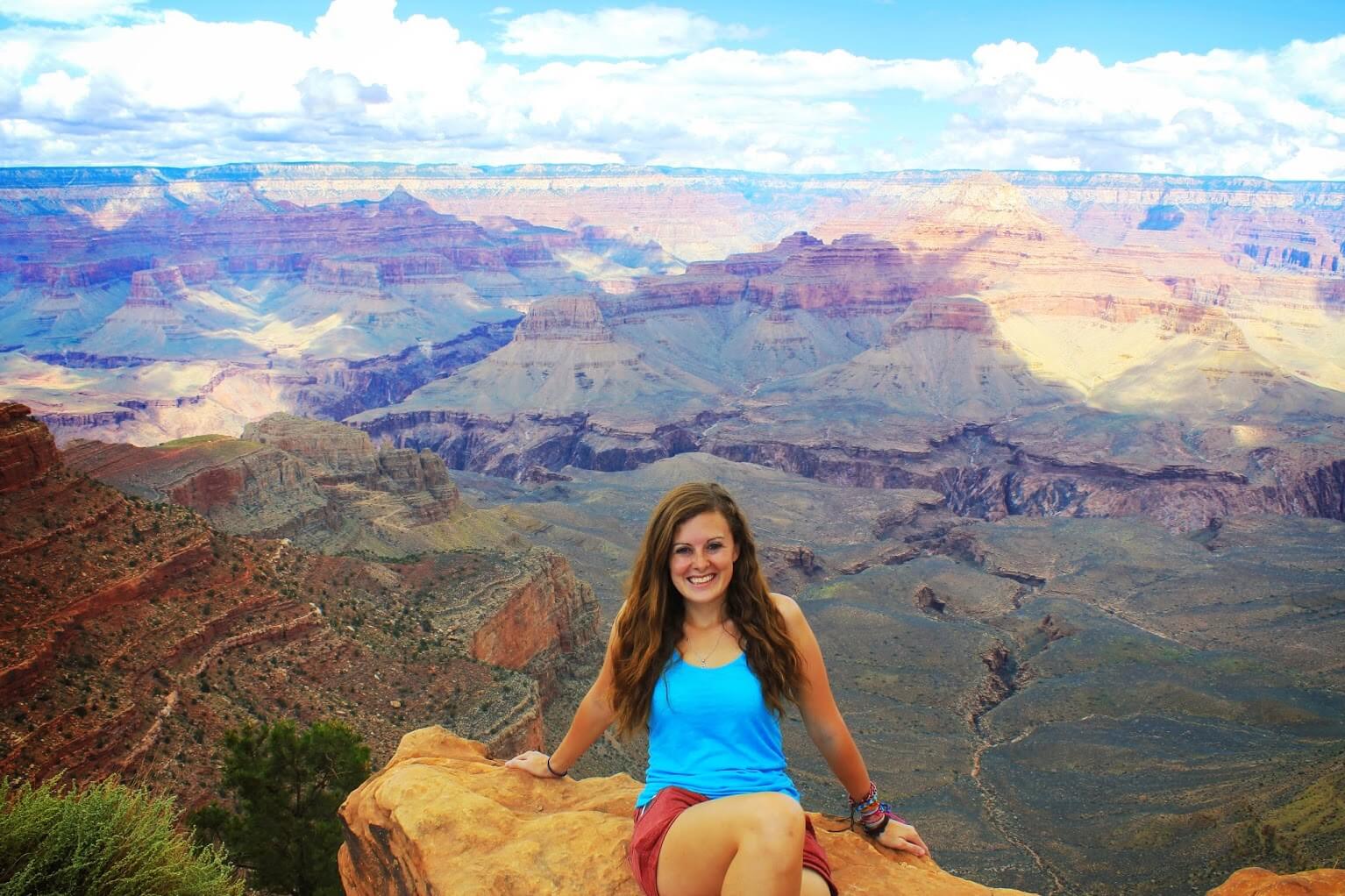
Introduce yourself! Who are you?
I’m Lauren Juliff, and I’m a professional travel blogger, freelance writer, author, and full-time traveller.
Tell us a bit about how you started a life of travel. What was your inspiration, how did you make it happen, and what were the hard things you had to leave behind?
I’ve always wanted to travel, but never believed it was a possibility. When I was a child, I’d head off on a family holiday to the British coast, where it would rain all week and all we did was argue. When it came to leave, though, I spent all day sobbing because I didn’t want to go home. This pattern continued until I finally decided to travel long-term.
I spent five years saving as much money as I could, picking up part-time jobs that I could fit around my studying. I sold close to everything I owned in preparation. I moved back in with my parents to save money. I stopped buying thiings I didn’t need. I made travel my priority, I guess, and every decision I made was weighed up against that.
The only hard thing to leave beind was my family. We’re incredibly close and saying goodbye to them was one of the hardest things I’ve had to do. That’s pretty much it! Quitting my job was a piece of cake because I didn’t care about it, I didn’t have any possessions aside from what could fit in my backpack, and my friends had been unsupportive when I told them of my dreams to travel, so I wasn’t sad about leaving them.
On your blog you put together monthly summaries of your travels, and you often manage to visit several countries while spending under $1,000 per month. What’s your secret?
Visiting cheap countries – I spend a lot more time in Southeast Asia and Eastern Europe over Australia and Western Europe. I eat street food where I can, as these meals rarely cost more than $1. I take buses and trains instead of flights. I stay in hostels and guesthouses over hotels.
Also, moving slowly helps! For example, when travelling across Thailand, you’re paying out for touristy activities, you’re paying for transport, you’re paying higher prices for accommodation because you’re staying for a short amount of time, food gets expensive because you haven’t had a chance to find the cheapest options. When I hole myself up in Chiang Mai for a few months at a time, I end up spending around half as much as I would when travelling. Accommodation can be incredibly cheap if you’re staying for months at a time in Thailand – I pay around $200 a month for a large room, with gym and pool access, and a weekly cleaner. If I was travelling from guesthouse to guesthouse, I’d likely end up paying $400 for the month, and it would be in basic rooms with just a shower and a bed.
Airbnb is great for long-term stays as well. When I’m staying somewhere for a month, I can usually get a 50% discount on the nightly rate.
You’ve got a few stories of getting into sticky situations on the road, but you’re still alive with all your limbs, obviously. With safety being such a huge issue in travel, what advice can you share for staying safe on the road as a female?
While I’ve had lots of mishaps on the road, I’ve never felt like I’ve been in any kind of real danger while travelling. Make sure to behave how you would at home, stay cautious when drinking, keep your stuff locked up when you go outside, stay away from any dodgy neighbourhoods, and don’t wander around alone at night.
What are some places you’ve had to deal with unwanted advances or harassment from men and how do you handle it?
Morocco was the worst I can think of. I love the country but I was harrassed on a daily basis. It wasn’t just vocal, but I had guys grabbing at me, and hissing when I passed. I even had a guy throw a rock at my head at one point! If I feel uncomfortable with male attention, I leave. I walk back to my guesthouse and refuse to interact with them. That’s it, really. I don’t talk, no eye contact, and I leave.
Have there ever been times when you’ve visited male dominated societies and had to be sensitive to “special” rules for women, such as wearing certain clothes or behaving in a certain way? How did you handle it?
The Maldives was probably the most extreme example of this – it’s an extremely strict Muslim country. I didn’t have a problem with it, though, and I’ve never had an issue with it. I just accept that that’s a part of travelling through a country, and respect their culture. In the Maldives, I wore jeans and a long-sleeved top at all times, and I sunbathed and swam in the ocean in a t-shirt and board shorts. No alcohol, no eating pork, keep covered up. It was fine.
Many first time solo travellers are worried about being alone and the difficulty in making friends on the road. What’s your experience and what advice can you give?
I used to be pretty shy and socially anxious before I travelled, and this was a very real concern of mine.
Fortunately, I’ve found it to be incredibly easy to make friends on the road, which is shocking considering how lacking my social skills were at the time! The easiest thing to do is stay in a dorm. It’s impossible not to make friends in one– everyone’s there because they’re looking to meet people, and you already have something in common to talk about: travel!
Share one of the philosophies you live your life by. When, how, and why did it become part of your life?
To leave my comfort zone as much as possible. Before travel, I lived a very sheltered life: I’d never eaten Chinese/Thai/Indian food, and I had never even been on a bus. Everything terrified me because I had no life experience.
Travel took me right out of my pea-sized comfort zone on an hourly basis, and it has been so incredibly transformative for me. I feel like I’m actually able to function in the world without panicking that I’m going to die.
Now, I try to challenge myself as much as possible because I know it’ll help me be a better person. In fact, this year, I’m on a mission to try 52 new things in 52 weeks.
People always think travel is glamorous and full of smiles all the time, but as you know that is far from the truth. Tell me the one (or two or three) things you hate most about the traveller’s life (or miss about a traditional life).
Fortunately, a traveller’s life is full of freedom, so if there was something I hated or missed, I’d stop doing it or go do it. I’d say that my least favourite part of travel is missing my family, but when I miss them, I book a plane ticket home and go see them. So, there isn’t really anything I hate about it. If there was, I’d stop doing it.
One of the first posts of yours I read was a really inspirational piece about your battle with anxiety and how travel helped you regain control of your life (here and here). Could you share some thoughts on why you think travel brought such a positive change to your life? Would you advise others to follow the same path?
It took a long time for me to realise this, my anxiety stemmed from a lack of control. Once I started to have panic attacks, I felt like I had lost control of my life, and I started doing silly things to try and control it: I unintentially developed an eating disorder, for example, and I stopped going outside.
Travel gives me full control over my life. I can go wherever I want whenever I want, do whatever I want (within reason!), and with whoever I want. It’s liberating and it calms my anxiety so much. I used to have maybe 5-10 panic attacks a day at the height of my anxiety, but it’s rare I’ll have one even once a year these days.
I wouldn’t necessarily advise that others just throw everything in to travel because they’re dealing with anxiety. When I was at my lowest point, I couldn’t even bring myself to leave the house or eat more than an apple a day, so leaving to travel would have been the worst thing for me to do. I think if you have mild anxiety (attacks maybe once a week/month) it’s a more realistic option.
Let’s talk about your upcoming book. Tell us a little bit about what’s inside, your inspiration for writing a memoir, and when we can expect it!
My book is a travel memoir titled How Not to Travel the World. I’m one of the unluckiest travellers in the world – I’ve been assaulted, robbed, and scammed, been caught up with a tsunami, had a boat start to sink with me on board, accidentally ate a cockroach, the list goes on… How Not to Travel the World is about how I managed to conquer debilitating anxiety through having these terrible things happen to me. It’s about following your dreams, no matter how many curveballs life throws at you. It’s about learning to get out of your comfort zone, finding the humour in messed up situations, and falling in love with life on the road. I decided to write it because I wanted to show that travel isn’t all rainbows and sunsets and meaningful experiences. I wanted to show that it can be transformative, and I wanted to share some of the stories I haven’t written about on Never Ending Footsteps. It’s due out in July!
People will look at you and see that today you travel the world full time, work for yourself, and have a book deal to your name. Give some practical advice to the girls out there might aspire to quitting their jobs and following in your footsteps.
Find a way to stand out from the crowd. There’s so many travel blogs out there that you’ll never stand out unless you do something different. Be honest, inject personality into your writing, and don’t be a sell out. If you want to work as you travel, start your business at least a year before you leave the country – some of the most time-consuming aspects are right at the start, and you don’t want to spend eighteen hours a day on your laptop when you want to be out exploring. In terms of travel, don’t plan. Have a rough idea of where you want to go, book a one-way ticket, don’t freak out, and just leave. It’s really that simple.
Exploring the temples of Bagan. What an incredible place!
A photo posted by Lauren Juliff (@nefootsteps) on
Ok, some fun questions. Describe yourself in 3 words.
Honest, disaster-prone, determined.
Who’s your celebrity crush?
Keith Richards.
Which country, in your opinion, has the most handsome men?
New Zealand, because the men are rugged and outdoorsy, and have funny accents.
Imagine a Hollywood movie wants to make a movie of your life. Who plays you and why?
Jennifer Lawrence, because she’s also a walking disaster.
When’s the last time you cried?
Last week, when I emailed my editor the final draft of my manuscript. So many emotions!
Imagine travel has become illegal and you now have to choose one city to live in for the rest of your life. Where do you choose?
Ljubljana, Slovenia.
What’s one of the less popular posts on your blog that you’d like more people to read?
And Then the Brakes Failed – one of my favourite incident posts but it never seemed to gain much traction.
If you could invite any 3 people from history to dinner, who would it be?
Richard Feynman, Syd Barrett, Winston Churchill
The world is about to end in 30 minutes and you have time for one final meal from anywhere in the world. What is it?
Honey and cumin glazed yams from Tasy N Sons in Portland, OR.
Ok, let’s get serious again. Are you a nomad for life? Why? Why not?
I don’t know what the future holds, but for the moment, I have no plans to stop travelling. I recently tried an experiment where I moved to Spain for four months to see if I was ready to settle. I’m two months into the stay and I spend most of my time planning trips for when my time is up.
I’d imagine my travels might evolve until I have a base I can return to for a few months each year, but for now, travel makes me happy.
And lastly, for the girls (and guys) out there still on the fence about their first solo trip, what advice can you give them?
Travel is the best thing I’ve ever done, and I’ve never met anyone who’s regretted it. If you’re wondering whether to take the plunge, try it. If you hate it, you’re only a plane ticket away from home, and then you won’t have to spend the rest of your life wondering what might have been.
Got questions for Lauren? Leave them in the comments below! You can also check out more of her story on her blog at Never Ending Footsteps and connect with her on Facebook and Twitter.
Missed the rest of the series? Check out the previous interviews here.
-

Ten Awesome Travel Websites You Probably Didn’t Know About
It seems that every day a new websites pops up that aims to change the way people travel. Flights, accommodation, transport, food, entertainment can all be found online and the options out there only continue to grow – the hardest part is staying up to date!
To help you out this week I’ve created a short list of ten websites every traveller should have in their bookmark list.
Enjoy!
Hipmunk
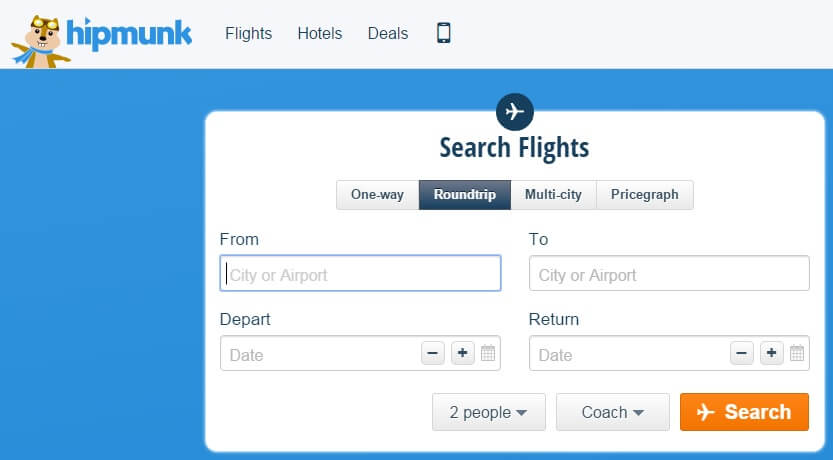
Last year I wrote about a few of my flight search tactics using the website Skyscanner which still remains my favourite to this day. However, there are many others which I like with a recent favourite of mine being Hipmunk. The prices are always competitive and it often digs up fares other search engines haven’t found. I love the interface too. I use a few different sites when hunting for flights, and Hipmunk is now a permanent addition to my rotation.
Similar sites: Skyscanner, Flight Network
Vayable

A few years back Airbnb shook up the hotel industry and Uber soon followed with its own shake-up of the taxi industry. Vayable is now following suit with its own shake-up of the tour-guiding industry. This fast-growing site is a place where aspiring tour-guides can offer “experiences” to tourists, normally at a fraction of the cost you would pay from a traditional tour company. Many experiences are rather niche, meaning you can find something that caters directly to your interests. Whether it’s a food tour, photography tour or your typical tour of city sights, you’ll likely find it here, offered by a local in the know.
Similar sites: Rent-A-Guide, Sidetour
(You can claim $10 free Vayable credit here!)
HelpX
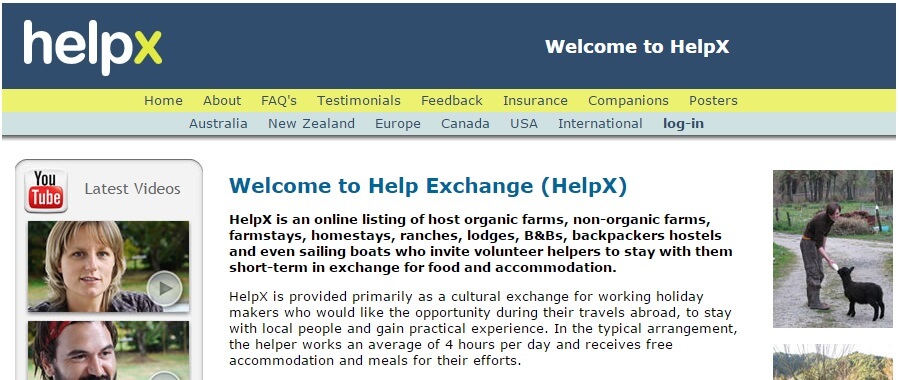
HelpX is a site where you can find work exchange opportunities whenever your money is running low around the world. The usual arrangement is free room and board in exchange for a few hours work a day. Typical opportunities are things like farm-stays, English conversation, hostel work, construction, painting, event help and so on. Paid opportunities can also be found, so it can be a good way to lay low and recharge the body and bank account for a while. Premium membership fee is 20 Euro for two years.
Similar sites: Workaway, Volunteer Latin America
Travelfish
Travelfish is a site that specialises in Southeast Asia backpacking information. It has an active forums and a wealth of articles offering practical advice and tips for your journey through the region. Southeast Asia is probably the most popular backpacking destination in the world and as always the crowds of tourists tend to attract their fair share of petty scams and shady characters. Having a site like Travelfish keeps you informed and will make navigating the region a little bit easier.
Eatwith

Eatwith is a site that allows you to book meals in the home of a chef (professional or otherwise), giving you the opportunity to experience authentic, home-cooked local cuisine during your visit. This can be a great opportunity to get out of the restaurant scene and have a dining experience closer to what a local would typically have on any given day. The quality control is rigorous – Eatwith claims hosts are all interviewed and less than 4% of applicants are approved. Prices aren’t exactly cheap but not extravagant either.
Similar sites: Feastly, Vizeat
Rome2Rio
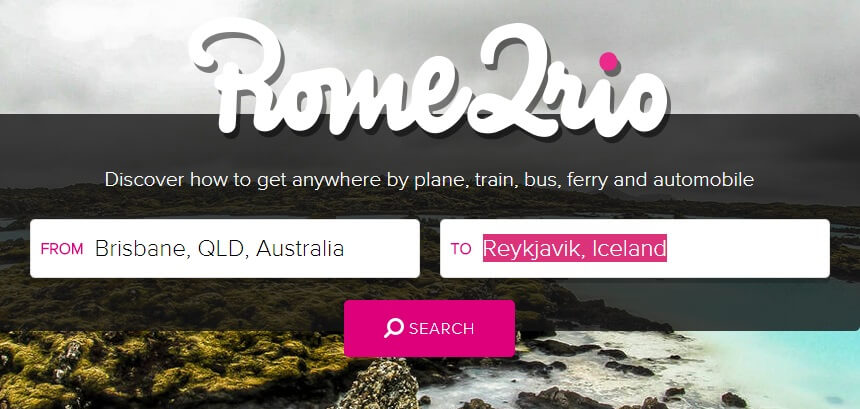
Rome2Rio is a planning website that gives you details of travel options between any two locations. For example, you could enter “Brisbane, Australia to Accra, Ghana” and it will give you all possible options for getting between the two. All options are searched – walking, buses, trains, ferry, driving, taxis, flying and details will be provided for each. I only use it sparingly but it’s a great tool to have in your back pocket.
Blablacar
Blablacar is a car-pooling website that allows you to find drivers who have empty seats and are heading in the same direction as you. If you’re heading from Berlin to Zurich, do a quick search and you might find a number of drivers going the same way. While many international cities are searchable, it seems to be used almost exclusively in Europe. You will need to pay for rides but prices are reasonable and will definitely be cheaper than a last-minute train or bus. Also a good way to make a few new friends!
Nomadlist
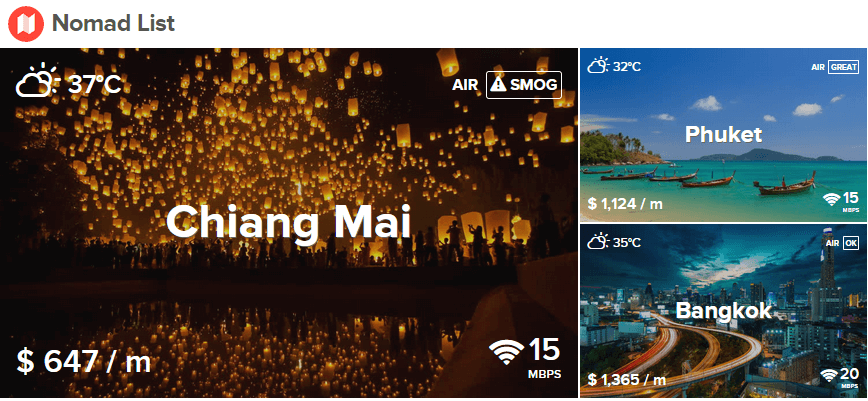
Nomadlist is the 4th startup from @levelsio. It is a resource for digital nomads looking to find a suitable city to sit tight for a while and get some work done. As I’ve learned, this is something that can prove rather time-consuming and sometimes ends up being bit of a coin-flip decision. Nomadlist removes the guesswork and collates information about numerous suitable cities. All the important details are covered – wifi availability, internet speed, co-working space availability, food and accommodation costs, safety, English proficiency and much more. Many cities fall under the $1500/mth mark. It’s a game changer!
Couchsurfing
I’m sure readers of this site are more than familiar with Couchsurfing but I’ll mention it here anyway as it’s still a favourite of mine. I’ve hosted, surfed and made so many friends off this site that I can’t recommend it enough. If you’ve never heard of it here’s a quick intro – locals offer up a couch (or some other sleeping surface) to travellers in their city. Travellers will then reach out to available hosts asking if they can “surf” their couch – if the host is cool with it they’ll exchange info and make the arrangements. Everything is free and no money changes hands. Most Couchsurfing communities also organise regular events and meetups that you can attend around the world. A similar site that has popped up recently is Trampolinn, which aims to encourage people to host by offering credits that can later be used for free stays. Not sure if it’ll take off but we shall see.
You can start creating your Couchsurfing profile by clicking here!
Skift
Skift is a travel news website that keeps you on the cutting edge of the travel industry. Regular topics are new travel startups, airline industry news and travel trends. If you’re a serious travel enthusiast it’s a great place to stay informed and up to date on the industry. I’m a subscriber and read it often!
What sites do you use on your travels? Anything I’ve missed? Share it in the comments below!

-
Solo Female Travel: Musing On Travel with Kristin Addis
We’re back!
This month in the SFT series I’ll be chatting with a traveller who’s certainly covered her fair share of the globe (definitely more than me!). On the road solo since 2012, she’s no stranger to travelling alone and hopefully she’ll have a few stories and advice that you guys will find handy. Interestingly, she had a few answers that were quite different to previous interviewees, so read on to get her take on nomad’ing solo as a female.
Psst – she also writes a great blog – one I always enjoy checking in on from time to time. Do check it out!
Anyway, let’s get to that interview; say hello to Kristin from Be My Travel Muse.
Introduce yourself! Who are you?
A girl from Southern California who likes to pretend she’s deep and complex by writing about traveling. I’ve been on the road solo since September of 2012.
Tell us a bit about how you started a life of travel. What was your inspiration, how did you make it happen, and what were the hard things you had to leave behind?
My inspiration was other travel bloggers who showed me, through their writing and stories, that a lifestyle like this is actually possible without being a trust fund baby. I saved up a chunk of cash, sold everything I had, and took off on a one-way ticket, effectively demolishing any bridges behind me. The things I left behind are still difficult to do without – my best friends and family, all of whom mean the world to me.
What’s the response been like to you going nomadic and breaking the ‘traditional’ mold of job, marriage and kids?
I still have a job. I don’t think traveling means you can’t have a marriage and kids. That’s a big misconception and a lot of people I meet are out there doing it, such as the family volunteering with me on a farm I’m staying on right now in South Africa. There is no ‘normal’ anymore and these days, thinking outside the box is much easier to execute with all of the opportunity online and for native English speakers who want to teach abroad.
How I’ve been getting around #China: hitch hiked over 1000km (621 miles) in the past 2 weeks meeting amazing people and having incredible adventures A photo posted by Kristin Addis (@bemytravelmuse) on
One of the biggest concerns about solo female travel is safety. What’s your experience with this, and what advice can you share for staying safe on the road as a female?
I don’t think traveling alone as a female is THAT different than a male traveling alone. We do have different concerns but so much boils down to common sense and intution. I view it this way: You’ve stayed alive this long, keep doing what you’re doing on the road as well.
Share one of the philosophies you live your life by. When, how, and why did it become part of your life?
Compassion heals and helps us understand. It cultivates patience and removes the “us vs. them” mentality. It improves the mood and when you feel connections to people rather than differences, life becomes easier.
Tell me the one book you’ve read that has inspired the biggest positive change in your life.
It’s called What Makes You Not a Buddhist. The title is a bit misleading because it sounds like it’ll be a religious book but it’s largely not. It’s more about the four truths of Buddhism and how they can help us deal with loss, change, and other difficulties. It changed my entire perspective and it’s the book I always recommend to friends.
People always think travel is glamorous and full of smiles all the time, but as you know that is far from the truth. Tell me the one (or two or three) things you hate most about the traveller’s life.
The lack of stability, friends, and the comfort of understanding a place.
#SCUBA diving in #Belize. Take me back A photo posted by Kristin Addis (@bemytravelmuse) on
We always say that travel changes people. Looking back now, what is the one thing you don’t like about your old self that you managed to change through travel?
I don’t think it changes people. I think it allows them to be who they’ve always been without the judgement and influence of people back home. Family and friends do, inevitably, have a lot of influence over how we act and behave, but without anyone who knows you from before on the road, you can be whoever you want to be in that moment.
Where are some places you’ve had to deal with unwanted advances or harassment from men and how do you handle it?
I got groped in the dark in Nepal by a man who foricibly grabbed me then ran away in the span of a few seconds. It left me feeling shocked and vulnerable, but I stayed for a month regardless and still think highly of the country. There are bad eggs everywhere and I’ll be more careful about walking alone at night moving forward.
How do you afford your travels?
I support myself from brand partnerships and advertising on my blog, freelance writing, and some freelance social media work. It took a while to get here, but now it’s a solid living and I couldn’t be happier.
Right now you’re wandering through Africa, a continent that many would perceive as dangerous for a solo female traveller. Give us your opinion after spending some time on the ground there.
I’ve gone to townships where some locals here won’t go, and been treated with so much kindness that it’s overwhelming. Africa is huge, there are a lot of dangerous places but that’s also true of the US.
Waterfalls in Hogsback #SouthAfrica. Stayed on a perma culture farm there and loved the experience of living completely off the grid. Gorgeous A photo posted by Kristin Addis (@bemytravelmuse) on
Are you a nomad for life? Why? Why not?
A lot of people ask me that and it’s impossible to answer. I don’t even know what I’m doing tomorrow! Most likely traveling will always be a part of my life but at some point a home base would be nice.
And lastly, for the girls out there still on the fence about their first solo trip, what advice can you give them?
This is for the girls and the guys: do it because you will meet people, you won’t be alone that much, and it will be worth it. It’s scary right now and that’s okay because it is for everyone, but most things worth doing are.
Kristin is a former investment banker from California, who left her job to travel the world in 2012. To read more about her story, check out her blog at Be My Travel Muse, or connect with her through her social media channels on Facebook, Twitter and Instagram.
Enjoyed this interview? Check out the rest of the series here!
-
Hostelling 101: A Newbie’s Guide To Hostel Life
If you plan on spending any amount of time on the road you’re going to be introduced to hostel life sooner or later. It’s just a part of being a backpacker.
Now, I know some of your right now are screwing your nose up at sleeping in a backpackers’ dorm room, and if that’s the case, you’ve probably got a little bit of catching up to do.
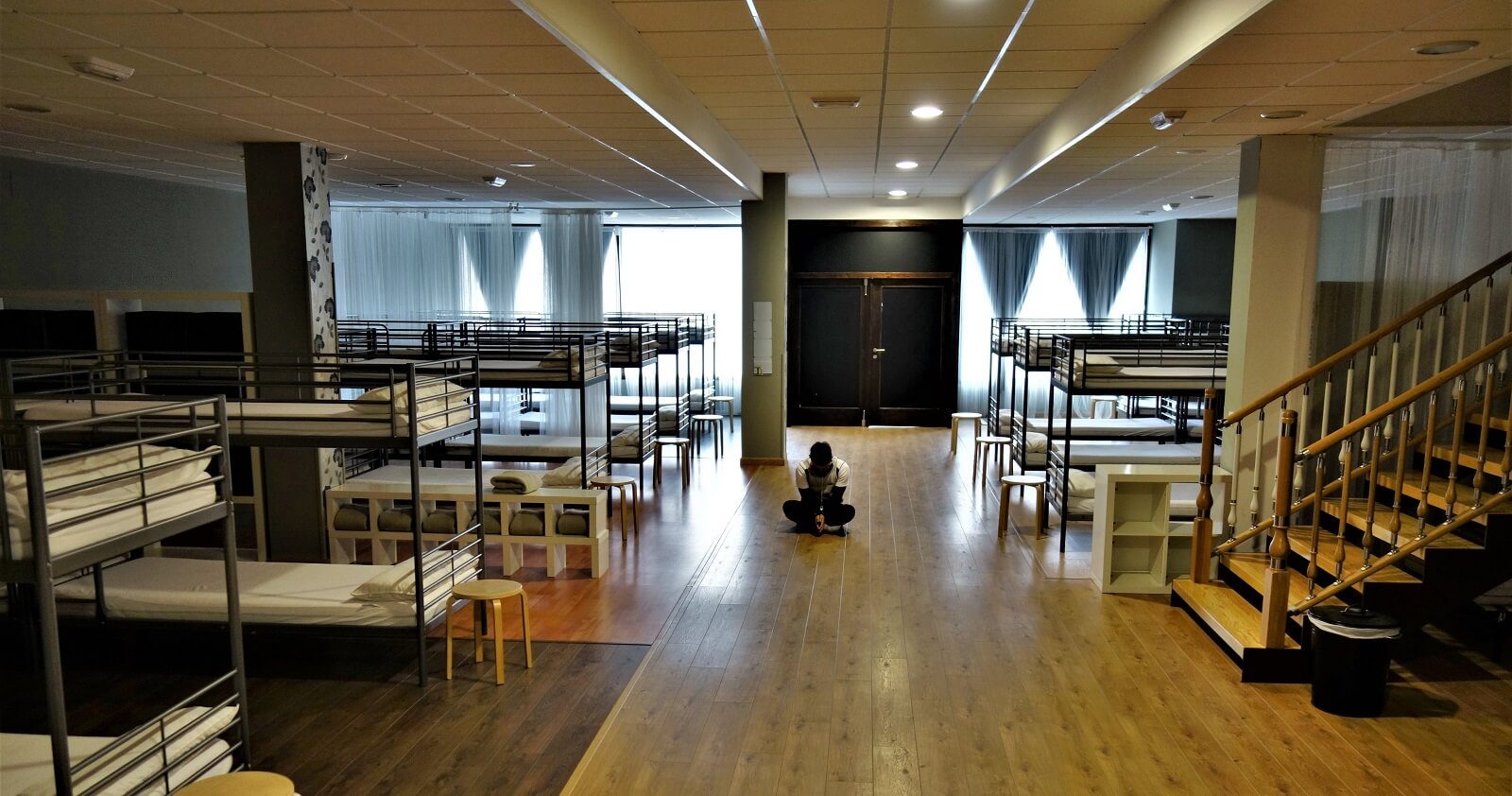
Many hostels today are modern, clean, spacious, and are actually more comfortable and entertaining than a 3 star hotel. I’m talking pool tables, Playstations, big screen TVs, jacuzzis, swimming pools, barbecues, kitchens, tour desks, ping pong tables, bars, computer rooms – everything you could possibly need.
If you’re new to hostel life, you’re in the right place. I’m about to break down everything you need to know for surviving the hostelling world, and give you all the tips you need to make sure your next stay is a good one.
Why hostels?
The main reason for staying in a hostel is price. Many of you know I preach budget travel on this blog, and other than Couchsurfing (read my Couchsurfing 101 guide here) you won’t find a better value form of accommodation on the road. In big backpacking regions like Southeast Asia and South America hostel beds will rarely cost you more than $7 or $8 a night. That’s $2,900 to cover an entire year of accommodation.
Hostels are also a great place to network, meet new travel buddies, seek advice from fellow travellers and immerse yourself in the backpacking community. I can’t even imagine how many friendships, relationships and even marriages were born in hostel lounges and bars.
You might also find that hostels are one of the best places to bring out your inner extrovert and develop your social skills. Let’s face it, most of us aren’t social butterflies. It’s weird for us to go up to a stranger and say hi. In a hostel this is completely normal though and I can honestly say staying in hostels has made me a much more outgoing and socially comfortable person. Just the sheer volume of different people you meet will really open your mind up to the world and make your experience that much richer.
And lastly, travellers understand each other. Not everyone is interested in travelling the world, but when you’re in a hostel everyone is there for the same reason. You won’t need to explain why you’re travelling alone or justify your trip to anyone. We’re all on the same page and we already get it. Just having and being a part of that community is an awesome thing.
Let’s talk about the different types of hostels. Hostels can be broken down into a few general types:
The Party Hostel
View this post on InstagramThese hostels are usually easy to spot. They’ll generally have big dorm rooms available (up to 24-30 people), a bar, lots of events, and lots of reviews on Hostelworld. The rooms and drinks will be cheap and they’ll often have pub crawls throughout the week and a daily happy hour.
The crowd at these hostels will be mostly university students and high school grads, but you’ll get a good number of 20-something travellers on career break and RTW trips too. There will also be the odd creepy old guy (crap, in a few years that’ll be me!).
I stayed in a lot of these hostels on my first trip through South America, and honestly grew out of them pretty quickly. It’s just not my style. I’m bit of an introvert and I like time to myself, and it’s exhausting to be hyper-social all the time. However if I’d started travelling when I was 18 I probably would’ve enjoyed them more. I still stay in them from time to time, but only for a couple of nights before moving on.
The Classy Boutique Hostel
View this post on InstagramThis is the classic ‘try-to-break-all-the-hostel-stereotypes’ type hostel. It’s squeaky clean, got amazing beds, a fully decked out kitchen, a comfy lounge with lots of games and books, tea and coffee on tap, and they probably even serve eggs for breakfast.
Obviously these hostels charge more, sometimes more than double what a typical hostel charges, but you’ll find that there is a huge demand for them now as people grow out of the party hostel scene.
Here you’ll meet a lot more travelling couples, older travellers, digital nomad types and a more laid-back crowd in general.
The No-Frills Hostel
View this post on InstagramWhile the party hostel can charge super low prices because of its sheer number of guests, the no-frills hostel charges low prices because it only offers the bare minimum. There are no bars or computer rooms or ping pong tables, but you should find yourself a clean bed and a working bathroom and wifi – everything a budget traveller needs.
You tend to meet more introverted people at these places, and a lot of really interesting, well travelled people as well. It may also just seem this way because people aren’t drunk or hungover all the time. I’m a big fan of the no-frills hostel and tend to stay in these whenever I can.
Note: “No frills” doesn’t mean “crap”. It means clean and basic. There are many crappy, dirty hostels around the world, but I won’t be bothering to talk about them.
The Quirky Hostel
View this post on Instagram
Every now and then you’ll come across a hostel with something really unique – maybe it’s a big treehouse or on a horse ranch, or built in some big colonial mansion. They tend to be a little more expensive and draw a more social crowd, but not quite as rowdy as the regular party hostels.I find these hostels always have a very family-like atmosphere – people eat dinner around the table together and sit around sharing stories in the lounge or on the patio. You tend to meet slower, more relaxed travellers at these places, and your fair share of hippie types too. Lots of fun and friendships are made here!
How to survive in a hostel
Hostels are a hyper-social environment, which means you’re going to be dealing with a lot of different people. If you’re an introvert like myself, your social skills will be put to the test and you really need to make an effort to break out of your shell.Don’t freak out though. Travellers are a very friendly community of people – the friendliest I’ve ever known in fact. People are often shelled up in life because they have fears or memories of getting face-palmed by a girl they tried to say hi to in a bar, or a little secret society of back-stabbing ladder-climbers at their job, but this sort of behaviour does not exist in the backpacking community (or at least I haven’t seen it).
People who enjoy travelling are naturally open people – we want to meet new people and try new things and hear new stories. While in the real world you might feel the need to have a certain social status to mix with certain people, in the travel community everyone is equal. There is no cool kids’ table. The guy who has travelled to 100 countries and the guy who’s on his first overseas trip will have no problems hanging out and sharing a beer in the hostel lounge. In fact, that’s what makes hostelling so amazing – meeting so many different people at different stages of their lives with different dreams and different stories.
To survive in a hostel, all you need is the courage to say hi. If you see a group of people sitting in the courtyard chilling out, go up to them and introduce yourself. They won’t laugh at you or roll their eyes, I promise. This isn’t a nightclub. In fact, I can guarantee you they’ll welcome you so warmly it’ll be like you’ve known them for weeks. Will you meet a few pretentious people along the way? Yeah, maybe. But they don’t tend to last too long in a hostel anyway, so don’t worry about it.
Remember, we’re all away from home without our friends and family, living in a hostel with a bunch of strangers. Everyone’s in the same boat. Just say hi!
Things you don’t do in a hostel
There’s quite a few things here, so I’m going to run them off real quick, bullet point style.
- Don’t leave your shit all over the floor – put it in a locker or on your bed. I’m not the tidiest guy either but you need to understand dorm rooms are small and it helps to keep them tidy. You don’t get many people anal about cleanliness in hostels anyway but people still like their personal space.
- Don’t steal beds – everyone always wants the bottom bunk but it’s first in first serve. Bed stealing goes on more often than you think!
- Don’t take forever in the bathroom – you’ll piss a lot of people off.
- Don’t eat other people’s food out of the fridge – I know it’s really tempting but man that shit is annoying.
- Don’t leave dirty laundry lying around – especially socks because they smell. Plastic bag them and keep them in your locker.
- Don’t turn the light on when it’s already off – if you come in late after a night out, don’t turn on the lights on and wake everyone up. It’s cool to come in late but use your cellphone to light your way to your bed, and be quiet about it too.
- Don’t wake people up – please don’t be that guy at 5am in the morning screwing around with plastic bags and ruining everyone’s day. If you were crazy enough to book a bus or flight that early that’s cool, but it’s best to take your stuff into the hallway and pack your things out there.
- Don’t leave dirty dishes – Every single hostel I’ve been to has a “do your own dishes” policy but there’s always some prick who thinks he’s above the law. Don’t be him! (or her).
- Don’t hang laundry in the window – It’s cool that you’re trying to save money but this gets to people. I actually don’t mind to be honest, but I’m pretty hard to annoy. Just be mindful.
- Don’t be cheap – When it comes to snacks and drinks and booze and cigarettes people are always more than happy to share, but there’s the odd guy that just leeches everything and he’s pretty easy to spot. Bring something to the table (or just don’t dig in to everyone else’s stuff).
- Don’t hog the computers – Quite a few hostels offer computers with internet so you can check your flights and post your TripAdvisor reviews and all that other good stuff. Just don’t be that guy watching Youtube all day. I once spent a few hours watching the NBA Finals on a hostel computer, so I’m guilty too. This is becoming less of a problem now though since everyone has smartphones.
- Don’t talk during the movie – It’s quite popular for everyone to wind down after a day of sightseeing with a movie in the lounge/TV room. Please don’t be that annoying group of friends talking throughout the movie about their day. Go outside! (you f*****g ****s)
- Don’t speak in languages other people don’t understand – This is a big one. If I’m sitting in a group of ten people and we’re all speaking Spanish and then a couple of people join us who don’t understand, we switch to English. This is just common courtesy, and is quite a frequent scenario in travel circles. Sorry to single you out, but Frenchies – you guys are the worst at this! Some people don’t even realise the rudeness of it, but luckily most people in hostels are aware and mindful. I’ve found the Germans and Dutch to be most polite in this regard – props to them!
At the end of the day most ground rules like this are just common sense. Remember you’re sharing living space with a lot of other people and the basic rules of respect apply. If you can’t handle it, that’s cool, just book a hotel room.
How To Book A Hostel
I always book my hostels using either Booking.com or Hostelworld. Hostelworld is probably slightly easier to navigate, but I prefer Booking.com as Hostelworld always requires a deposit. Either way, both are great.
For me, the most important thing when finding a hostel is location. I want it to be as close as possible to the places I want to visit so I can spend as little time and money as possible on transportation.
To do this, I utilise the “map view” in the search function. Here’s an example of the map function in Hostelworld when searching for hostels in Amsterdam:
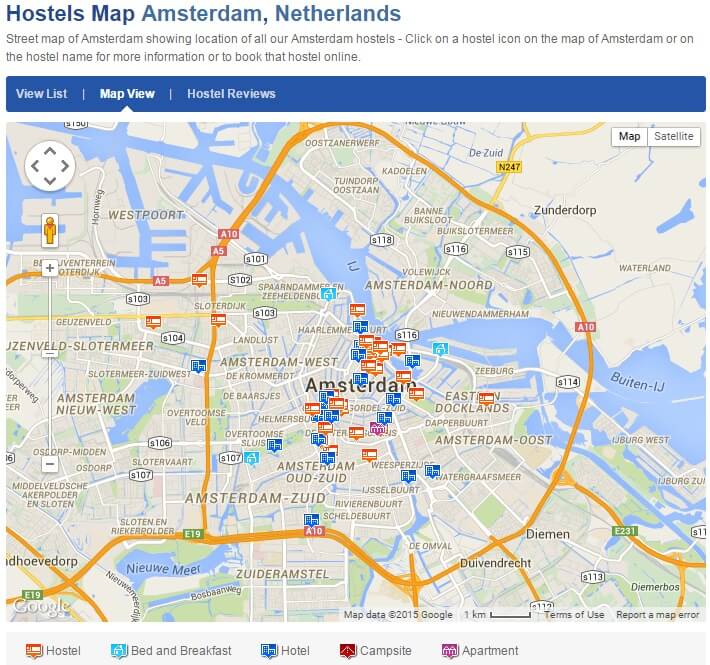
Take a look at the big cluster of accommodations – it’s safe to assume that’s where the centre is or at least it’s an area with good public transport access and the area is safe. Obviously if there’s a certain school or course I’m enrolled in, I’ll find something situated close to that. To single out the hostels from the hotels on Booking.com, simply filter the prices into the lower price ranges, or simply sort the search results by price.
Once I’ve figured out my prime location, I’ll start filtering out the stuff I want. In the following screenshot I’ve set filters to only show hostels that have been rated 80% and above. You can also set filters for anything else you want such as breakfast, wifi etc. using the options on the left.
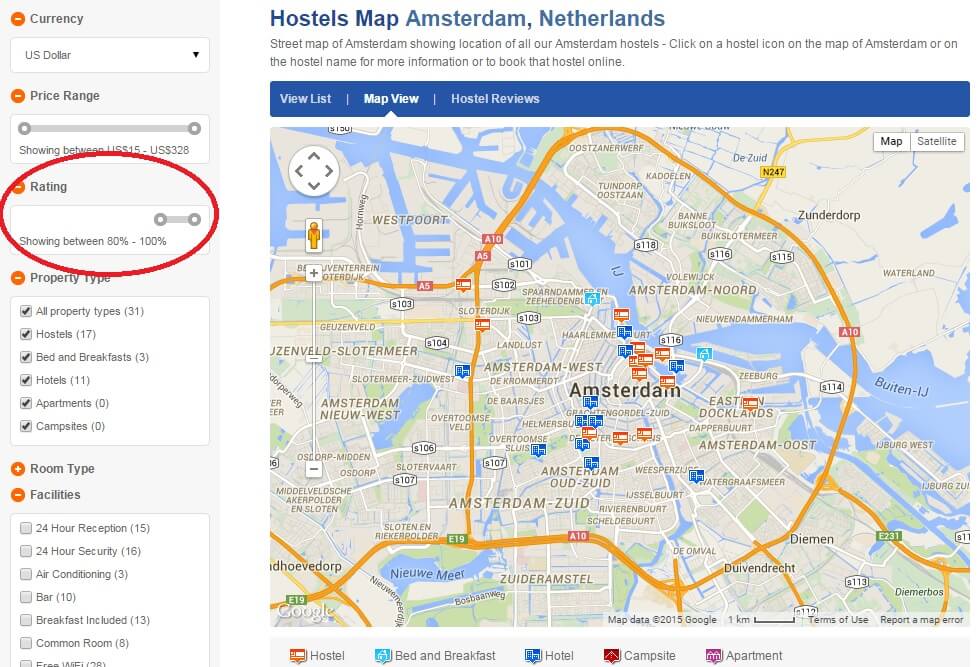
From there I will simply sift through the reviews of each hostel, look at the prices and then make a booking.You can hold your mouse over each icon and it will bring up the hostel information and rating. My criteria differs from time to time but I very rarely base it solely on price – it’s more a combination of comfort, location and price. Just from a quick browse, in this example I’d probably pick between The White Tulip, Central Station Hostel and Hostel Van Gogh. White Tulip and Van Gogh have a party hostel vibe while Central Station is more on the no-frills side. It’ll just depend on how I’m feeling at the time.
Note: I’ve never stayed in any of these hostels, in fact I’ve never even been to Amsterdam. This is just to demonstrate the process I would go through when searching for a hostel.
Alternatively, some people just like to show up without booking at all. This allows them to take a look at the rooms and the beds and make a more informed decision. The only downside with this is you can be left wandering around the city with all your luggage looking for a place to stay if your first few choices don’t pan out. In reality this isn’t a big deal, some people actually enjoy the spontaneity of it all. I personally prefer to pre-book.
Ready to go hostelling?
Well, that’s pretty much all you need to know. If you’ve never stayed in a hostel before don’t rule it out just yet – some of your best travel memories will probably be made in hostels and you might find the experience a lot more pleasant than expected. I’ve found that hostel culture is also evolving all the time and a lot more boutiques are popping up while the raving party hostel culture is dying down a bit. It’s not uncommon these days to see people sitting around the hostel lounge reading at night rather than in the bar getting loose. Whatever your vibe is, use the search tips above and you’ll find a hostel that fits with you.
Good luck!
Got any hostelling tips or stories? Let us hear em in the comments below.
-
Ten Important Things You Will Probably Forget To Pack On Your Next Trip
Ever get overwhelmed by packing?
I’ll be honest – I’ve witnessed some absolute packing meltdowns. People literally crying while trying to rush for a plane. I can’t say that’s ever happened to me, but I’m far from perfect myself. Even though I pack lighter than most and have a very short packing list, there are still things I always seem to forget.
Below is a list of things I’ve forgotten at least once on my trips, and usually that’s gotten me into trouble somewhere along the way. If you’re putting together a packing list for an upcoming trip, make sure you add the following items to it – it’s pretty simple stuff, but for some reason it’s always the simple things we don’t remember!
Read more:
1. Passport Copy

Thankfully I have never lost my passport on the road, but that doesn’t mean it won’t happen. I’ve found most passports are “lost” because bags/purses are stolen or lost, rather than the passport itself. It does happen often, and it is probably one of the worst possible things you can lose while travelling.
To minimise the chances of this happening and to make life easier if it does happen, make sure you do the following before you leave home:
- Take multiple photocopies of your passport, and make sure you have one copy in each item of luggage and one on your person (in your wallet/purse).
- Take a colour scan of your passport photo page (and visa if you got one) and save it in your email so you can access it anywhere.
- Try not to carry your passport with you on the street every day. Instead, carry one of your photocopies. In the years I’ve been travelling I have not once been asked to produce my passport randomly on the street. I generally wouldn’t carry it around unless you’ve expressly been told to.
2. Passport Photos

Make sure you’re always carrying at least a handful of passport photos of yourself. You might think one or two is fine, but I’ve applied for visas (such as the volunteer visa in Tanzania) which required four passport photos for four different forms. If you’re travelling around the world you can never have too many of these.
Also note the different sizes available. In New Zealand a passport photo must be exactly 3.5cm x 4.5cm, however in Vietnam a visa photo must be 4cm x 6cm. I usually carry around 10 different photos of different sizes. I also get them taken professionally at a photo shop, as many countries are extremely strict about what they will accept and what they won’t. A stack of ten shouldn’t cost you more than a few dollars.
3. Pen
Probably the thing I forget most often, which annoys me a lot once I get to the airport and need to fill out those stupid forms. Even more annoying is when the airport doesn’t provide pens. Take a pen! It will make life so much easier.
4. Gifts

You are going to meet a lot of people on the road, and you are going to say goodbye to a lot of people as well. Very often I wish I had something from home to give, like some chocolates or some souvenir, especially to people who have shown me great hospitality, but of course I don’t have room to travel with stuff like that. Instead, what I do is carry a bag of New Zealand one dollar coins, and give these to the good friends/students/hosts I meet around the world. It’s sort of like a souvenir, and also an invitation to come visit me one day so they can spend it. I’ve seen other people carry things like bag patches or bracelets, but it doesn’t really matter what you choose – just make sure you have something.
5. Vaccination Passport

It can be hard to keep track of all the needles you’ve had jabbed in you, especially if you’ve been through Africa or South America. In my travel wallet I keep a “vaccination passport” from the travel health centre which details the shots I’ve had, when I had them, and how long they’re good for. I’ve never had to present it, but if anything ever happens to me and the doc needs to know what cocktail of vaccinations is inside me all I need to do is hand him my little booklet (which is great, because at this stage I have no idea what I do and don’t have).
6. Lock

I’d be willing to bet every backpacker has left home without a lock or found themselves without a lock at least once. It just happens. Plus, it’s only once you’re on the road that you realise how handy they are (hostel lockers, gym lockers, check-in baggage etc).
I’d recommend taking a few locks actually (two or three), because:
- They get lost easily.
- You often need to lock more than one thing (especially if hostel lockers are small and you can’t fit everything in).
Use a code lock rather than a key lock, because having a key just gives you one more thing you could lose. It’s also a good idea these days to use TSA approved locks like this one or the one in my photo above. You can click here to check out some good, affordable locks on Amazon.
7. A second bank card

Bank cards get lost easily on the road – wallets are common targets for pickpockets, ATM machines sometimes swallow them, and they’re small and fall out of bags and pockets pretty easily.
I carry around three bank cards, and I also have my money spread over 3 different bank accounts. That means if one card gets lost, or my bank decides to shut off my access due to “suspicious activity”, I’m not left broke and starving in the middle of the jungle somewhere.
Looking for the best bank in the world for travellers? Click here.
Another good tricks, if you have multiple cards, is to leave one of these cards at home. Save the credit card number in your cellphone or in your email. That way, even if you lose all your cards, you still have an active card at home that you can use to book flights and hotels online with.
Obviously, be discrete here. Don’t save it in your phone as “Credit card number”. Otherwise you might as well save it as “PLEASE STEAL MY PHONE AND USE THIS NUMBER TO BUY A CAR”. Just save it as Sally or John or something.
Check out my guide to the best credit cards for New Zealanders here.
8. Universal Adapter
I always used to head to the local markets or some cheap hole in the wall electronic store to buy an adapter when I landed in a country. It’s only recently that I discovered the joy of owning a universal adapter, which allows you to charge your stuff in any country in the world (these days they have USB slots as well, which is extra handy).
The adapter I am currently using is this GearIt model which has been awesome – super lightweight and you can charge three things at once on it (this usually just means all my dorm mates start charging their crap on it too). You can check it out here on Amazon.
9. VPN
I’ve written about the woes of public wifi security before, but I will mention it here again. If you’re sending/accessing sensitive information online while travelling, especially things like Paypal/Credit Cards/Bank Accounts, make sure your connection is secure. Using a VPN will ensure your connections are encrypted and mitigate the risk of your bank accounts/cards getting skimmed or locked. The VPN I use is Private Internet Access, which is awesome value for money and has always worked well for me.
If you are travelling and plan on using free wifi in hostels and cafes, I highly recommend travelling with one. The VPN I use is only around $3 per month and is worth every penny. You can check out the plans for Private Internet Access by clicking here.
10. New US Dollars

Cash is king. Always make sure you have at least a couple of hundred USD on you, which will come in very handy for visa payments at the airport or staying alive in a town where there are no working ATMs. I usually carry around $200-$300, which should be enough to get you out of trouble if you’re ever in a fix. Also, try to carry newer USD (at least Series 2009 and up). Some countries will not accept your notes if they’re too old – I’ve had 2004 notes rejected once before in Africa.
Travelling soon?
- For affordable accommodation, I highly recommend using Airbnb. In many cities you will be able to find high quality apartments and guest rooms at much cheaper rates than hotels. You can get $25 of Airbnb credit, absolutely free, using this link.
- I highly recommend travelling with travel insurance. Many things can go wrong when you travel, and it’s important to get covered so you’re protected and reimbursed for any missed flights, hospital bills, lost baggage and so on. For a beginner’s guide to travel insurance, why you need it and where to buy it, check out my post Travel Insurance 101: Everything You Need To Know.
- Looking for more packing tips? You can check out some of the things I carry on my trips by checking out my post, What’s In My Backpack. Safe travels!
-
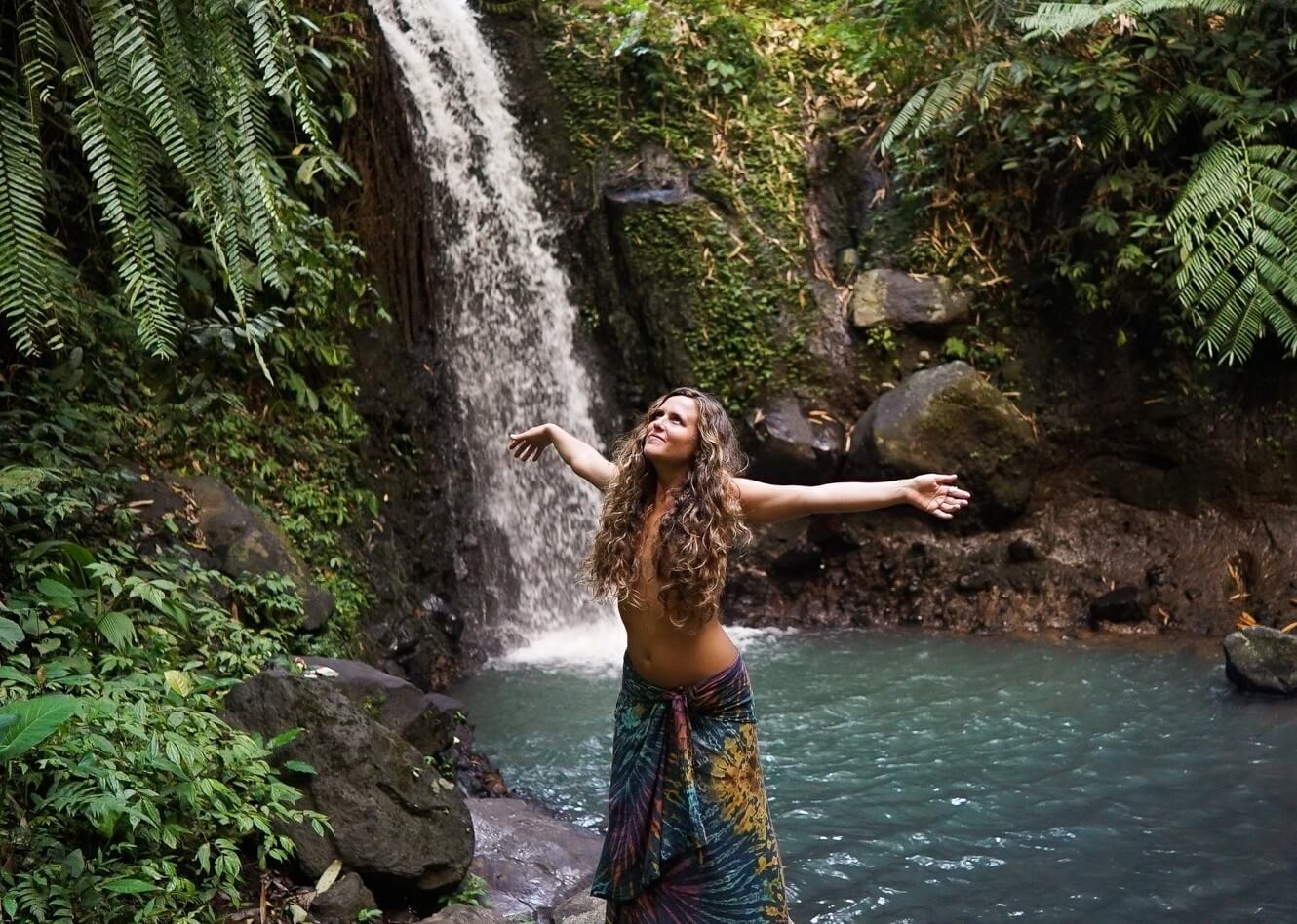
Solo Female Travel: Living La Pura Vida with Camille Willemain
Yes, we are back!
This series was a huge success last year and so I’m excited to let you know I’ll be running it one more time. Seven more female nomads, seven more interviews. I’ve got some amazing interviewees lined up for you this time and I’m sure you guys are going to love it (missed last year’s series? Check it out here).
Today’s interviewee was one of my favourites to date. I admire her for her advocacy for pure and simple living, and the idea of living out your life without listening to all the outside noise and judgement. As many of you know, that’s a lesson I’ve tried to emphasise here in the past as well.
After 3 years out on the road she also has a few lessons in travel to share, but, I’ll let you read those and the rest of what she has to say for yourselves.
Say hi to Camille from This American Girl!
Introduce yourself! Who are you?
Ha, “who am I”, I ask myself that question every day. The answer is ever evolving. The easy answer is, my name is Camille, I’ve been living nomadically traveling the world for 3 years, I’m a full time travel blogger at This American Girl, a certified yoga teacher, a reiki practitioner, a beach bum, and apparently these days I’m also a snow bunny.
Tell us a bit about how you started a life of travel. What was your inspiration, how did you make it happen, and what were the hard things you had to leave behind?
I was kinda thrown into the world of travel. I didn’t exactly plan it, but I believe the best things happen that way. I was laid off from two different jobs back to back (I worked as a project manager in Internet Marketing), and kept going in and out of a relationship that had long met its expiration date. Getting laid off showed me that something clearly was not working and I needed a new direction. I decided to pursue my passion at the time, Interior Design, so my plan was to go back to school and get my Master’s. My friend, blogger from canyoustayfordinner.com, had just gotten a book deal with Random house to write her memoir, and told me she was going to Costa Rica to write the book for a few months. We ended up going together, and the rest is history. I got a taste of the travel life, and despite my mental struggle the first year, I knew there was no going back for me. At this point, my lifestyle isn’t even a choice. It’s a calling.
What’s the response been like to you going nomadic and breaking the ‘traditional’ mold of job, marriage and kids?
I’ve been called anything from ballsy, badass, and inspirational to selfish, spoiled, and entitled. I practice detaching myself from external judgement, be it negative or positive. It’s not easy, but if you put yourself in the spotlight, it’s essential. I feel strongly that this is the right path for me at this point in my life, and that keeps me going. My family is super supportive and proud, which makes life so much easier. When people tell me that I’ve inspired them to follow their dreams, it’s a really thick icing on the cake.
One of the biggest concerns about solo female travel is safety. What’s your experience with this, and what advice can you share for staying safe on the road as a female?
I think the most dangerous place in the world is the USA, haha. But seriously, everywhere has a potential for “danger” and it all depends on where you go and the energy you put out there. Most of the time I feel safe. I have lots of safety tips for women in this post.
Share one of your life philosophies. When, how, and why did you come to believe in it?
The difference between happiness and unhappiness is simple: gratitude. See how wonderful everything you DO have is, and you’ll be instantly happy. So often we fixate on what we wish we had, how things could be better, what’s wrong with our situation. That causes us suffering. A simple change in perspective allows us to be instantly happy. Seeing happy, generous, loving people living in poverty in Cambodia, Laos, and Nicaragua, and witnessing the effects of gratitude in my own life has instilled this belief in me.
Bren: 100% truth right there!
Bathing in the holy water at #tirtaempul #bali #indonesia #nomadlife #travel #wanderlust A photo posted by This American Girl (@thisamericangirl) on
Tell me the one book you’ve read that has inspired you and/or your travels more than any other.
Honestly my fave travel book has got to be The Beach, I love the writing style and he so perfectly depicts the Southeast Asia backpacking culture. However, I wouldn’t say it’s inspired my travels. The book that has inspired me most in life is Ishmael by Daniel Quinn. A disillusioned intellectual meets a gorilla in a warehouse who teaches him about the story (and destructive myth) of human culture through mental telepathy. Sounds out there, but it’s the realest thing I’ve ever read. It proposes a brilliant solution for healing the destruction we’ve caused ourselves and the earth: live and let live. It’s basically my bible and I recommend it to everyone I meet.
How do you address your fears about certain locations or countries? Do you avoid certain places based on being a woman and how do you deal with blatant sexism on the road?
I’ve never avoided anywhere as a woman, but cat calling and sexism is a real problem especially in Latin America. I’ve tried ignoring, responding with anger, responding with sass, responding with sarcasm, and honestly none of it seems to stop them. So, my advice is to hold your head up high, not feel any shame for someone elses’ behavior, and respond in whatever way makes you feel most empowered.
People always think travel is glamorous and full of smiles all the time, but that is far from the truth. Tell me the one (or two or three) things you hate most about the traveller’s life (or miss about a traditional life).
Haha, ok, honestly I love it all in its own way. You’ve GOT to have a sense of humor or you’ll go crazy that’s for sure. The worst by far is food poisoning. It depletes my energy, breaks my spirit, and leaves me crying for my mom. This is why I travel with my own water kefir, and I never get food poisoning anymore. More about that here!
We always say that travel changes people. Looking back now, what is the one thing you don’t like about your old self that you managed to change through travel?
For a long time I rejected who I was before travel. I saw myself as an improved version of my former self. Though my yoga practice is all about accepting the interconnectedness of everything, and embracing myself at every stage of life. I’ve grown tremendously through travel, and I suppose the thing I’m most proud of is the way that I’ve learned to take responsibility for my own happiness. I, and only I, decide that. It doesn’t depend on how nice my boyfriend is, or how available my friends are, or how good my job is. It’s my own choice. A very empowering discovery indeed! 🙂
You seem to have a love affair going on with Costa Rica, and recently wrote a book about the country! Tell us a bit about that and what it is about the country you love so much.
Costa Rica is the best place in the world to simply be. It has such unbelievable nature, a really easy lifestyle, and it’s so active and healthy. You’ll have to read my book, which has an entire chapter entitled “What Makes Costa Rica So Special” to find out more 😉 You can read more about my book here.
Ooommmmmm #pavonesyogacenter #meditation #yoga #yogateachertraining #pavones #costarica A photo posted by This American Girl (@thisamericangirl) on
Ok, some fun questions. Who’s your celebrity crush?
I’m sooooo out of the loop with who celebrities even are these days that it’s tough to answer that. Do bloggers count? hahaha
And which country, in your opinion, has the most handsome men?
Portugal. Easy.
If you could choose one musician to serenade you for an hour, who would it be?
Matt Corby. Ok, maybe he’s my crush.
Imagine a Hollywood studio wants to make a movie of your life. Who plays you and why?
I play myself, because I’m an original 😉 And I’m actually a trained theater actress since age 5. True story.
When’s the last time you cried?
The other day on the bus. The moment I put my headphones in and look out the window, the waterworks come, haha. I love it. It feels really good. They’re usually tears of gratitude and happiness for my life.
You’re allowed to ask the universe one question and it will be answered 100% honestly. What would it be? (Bren: I’d ask who killed 2pac).
I ask the universe questions all of the time, and when I turn off my mind for long enough, sometimes I even get the answers 🙂
But I still don’t know who killed Tupac… assuming he’s actually dead….Complete this sentence: If I was granted three wishes today, I would have lunch with ________, I would spend the day in ___________, and I would go to bed at night with ____________ (just to cuddle, of course).
I would have lunch with my best friend from college who I last saw a year ago in Bali, I would spend the day in the El Nido Palawan, and the last one I’m keeping as my secret 🙂
Ok, let’s get serious again. Are you a nomad for life? Why? Why not?
I never say never, so who knows, maybe one day I’ll settle down. But I do know that I’m a lifelong explorer. Travel has been my outlet for discovering myself, and I don’t see that ever changing. At this point I envision myself having a home in Costa Rica that I can always come back to, leading travel/yoga retreats all over the world, and continuing to travel to and blog about my adventures all over the world.
And lastly, for those still on the fence about their first solo trip, what advice can you give them?
Ask yourself this question: What would you do if fear did not exist? What would you do if you could not fail? What would you do if you knew that the universe was always there to support you?
Then go and do that. Whenever you get scared, ask yourself those questions again, and remember that when you trust, you have nothing to fear.
Want to read more about Camille’s story? Be sure to head over to her blog at This American Girl and connect with her through her social media channels on Facebook, Twitter and Instagram. Also, if you have any more questions for her, leave them in the comments section below!
Enjoyed this interview? Check out the previous interviews in the series here.
-
How Safe Is It To Use Free Wifi While Travelling?
Along with free breakfast and beds with two pillows, there are few things that can make travellers pee their pants with excitement more than this sign:

And most of the time, we’re so excited to check our ex-girlfriend’s Instagram that we don’t even think twice before whipping out our phones and connecting.
But how safe is it?
You may be shocked to know (or maybe you won’t) that public wifi is a playground for internet snoops looking to leech details of unsuspecting users. When you connect to these free wifi networks on your phone or laptop, you share the connection with hundreds of other users, and everything you do on the internet (emails, passwords, files) is unprotected and available for prying eyes to see. It’s not difficult, either. Anyone with the right tools or software can be snooping on your every move.
If you’re lucky, the best they’ll get is a little peek inside your kinky Facebook conversations, but things can get a lot more serious if they manage to pick a few credit card details, your online banking info, or access to your Paypal or business interests.
This is particularly sensitive for people who work on the road, such as travel bloggers like myself, freelancers, and remote workers.
So what do you do?
Luckily for us, there’s a very simple solution.
Using a VPN
A VPN is a “Virtual Private Network”, which acts as your own private and secure connection to the internet. You may be familiar with using one for work; often a requirement when you work remotely so that your connection back to your office is secure. However, your personal details are just as, if not more, important than your work stuff, and so in this age of constant connectivity it is wise to ensure you take measures to protect your personal information too. These days VPN’s are cheap and accessible, so there really is no excuse to not be using one. There are also many benefits to them beyond simple data security. Let’s go through them.
Security
When using a VPN, all the data you send across the web is encrypted and scrambled. That means everything you write in your emails, everything you download, and all your banking passwords are safe from anyone who’s trying to snoop around on your wifi network. If your connection is unsecured, there’s a good chance someone sneaky could be watching your every move. Think about the number of times you’ve logged onto a Starbucks, hostel or airport wifi without even thinking twice. If there was a password, how hard was it for you to get it? Think about it! These connections are not secure – people can see you.
Identity protection
When using a VPN, your real IP address is cloaked and the VPN will give you a “dummy” IP address, which basically means websites and internet services won’t be able to monitor your activity, searches or location. With a VPN, you can stay anonymous on the web, just like you’re supposed to.
Bypass censorship restrictions
When I lived in China, there were countless websites I wasn’t able to get onto because of China’s “Great Firewall” (Facebook, Youtube etc). Even news websites and blogs can get censored for the most petty reasons, and this is not unique to China. In fact, with the madness of political correctness these days, even countries like Australia and USA are starting to dabble in internet censorship. Thankfully, a VPN solves all this. While in China and other countries around the world, I’ve been able to use a VPN to surf the internet freely without any restrictions whatsoever.
Access country-restricted content
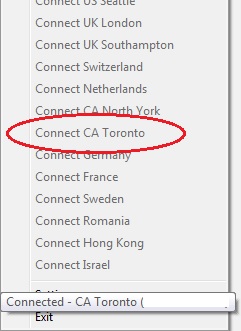
Whenever I need my reality TV fix, the site I normally use to stream it is a Canadian one. Unfortunately, the stream is only available to Canadians. Luckily because I have a VPN, this isn’t an issue. I simply connect my VPN to a Canadian server, and I get my fix of cheese TV without a problem, regardless of where I am in the world:
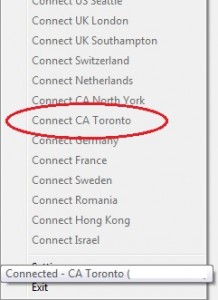
This holds true for all websites that restrict their broadcasts to within their own countries, which can drive travellers mad, especially those in need of their weekly fix of sport or television.
Prevent banking lockouts
Fortunately this hasn’t happened to met yet, but I’ve met one or two people frustratingly trying to Skype their bank to get their account unlocked from some remote country. Banking websites tend to go overboard on security (which is a good thing, really) and if you log in from somewhere strange like Nigeria or Venezuela it might tick off one of their security censors and lock down your account. After that, it’s a matter of getting your bank on the phone and pleading your innocence (Paypal also has it’s share of lockdown stories). By using a VPN, you can connect through servers in “safer” countries and prevent the headache altogether.
Where can you get a VPN?
The VPN I currently use is Private Internet Access. At $40 a year, it is by far the best value among the reputable VPN services out there as far as I know. The speeds are good, and it has a wide range of servers around the world you can connect to. It also allows you to connect to 5 devices simultaneously with no extra charge which is a huge bonus for me as I often am switching between both my phone and laptop while working (almost all VPNs charge a fee for multiple devices). It doesn’t have any fancy frills or sexy interface, but it works perfectly which is all that matters. I’ve used around 3 different VPN services in the past couple of years, but have stuck with Private Internet Access for a while now and am very happy with it. You can click here to read more about Private Internet Access and how it works.
If you’re feeling tight, there are free VPN’s available out there, but none that I’m going to recommend here. All the ones I’ve tried either bombard you with ads, are slow, or simply don’t work at all.
Do you need one?
As I do most of my work on public wifi connections these days, a VPN is a must-have for me, but even if you use public wifi casually I’d still highly recommend getting one, particularly if you use the net to access/send sensitive information like banking/credit card numbers etc. If you only travel sparingly and aren’t a big public wifi user you’ll probably be ok without one, but being so inexpensive, I’d say it’s a small price to pay for the peace of mind while you stay connected around the world.
Safe travels!
Disclosure: I am a Private Internet Access affiliate. This post is not sponsored and I pay for my VPN service in full. You can read my Disclosure Policy here.
-

The Most Dangerous Thing You Will Ever Encounter While Travelling
It’s no secret that the road is filled with countless hazards that can totally derail your perfect holiday.
There’s the guy who hustles you as soon as you come out of arrivals in the airport.
There’s the taxi driver who’s planning to rip you off, or worse, drive you into a dark alley and demand your wallet.
There’s the dirty bunk bed in your hostel dorm that’s waiting to infest your entire suitcase with bed bugs.
There’s the lady at the street stall who didn’t wash her lettuce properly, just waiting to serve you a salad that’s going to give you food poisoning.
There’s the pickpocket loitering around the bus stop waiting for you to put your bag down so he can nick your passport and sell it to some drug smuggling mule for a few thousand dollars.
There’s the scantily clad girl in the bar waiting to slip a roofie into your beer so she can clean your pockets out once you collapse in the bathroom.
There’s the tag team of petty thieves waiting to rob you at knife point outside the subway exit when you come home from the club at night.
But which one is the worst of them all?
Is it the sex crazed murderer loitering the streets? The town pedophile? The team of drug dealers trying to sneak a few kilos of cocaine into your backpack?
Please.
These guys are nothing more than mere inconveniences.
The truth is, the road holds something far more sinister than all these people combined. Something that will murder your entire family in cold blood without even blinking an eye. And most people won’t even see it coming.
That’s right, this little vixen hides in the background, and when you least expect it, sneaks up on you and launches her brutal attack. She’ll stab you in the back, come at you with all her evil friends, she’ll even massacre you in your sleep.
I know, totally ruthless, with no shame at all.
Wanna know who it is?
I’ll tell you.
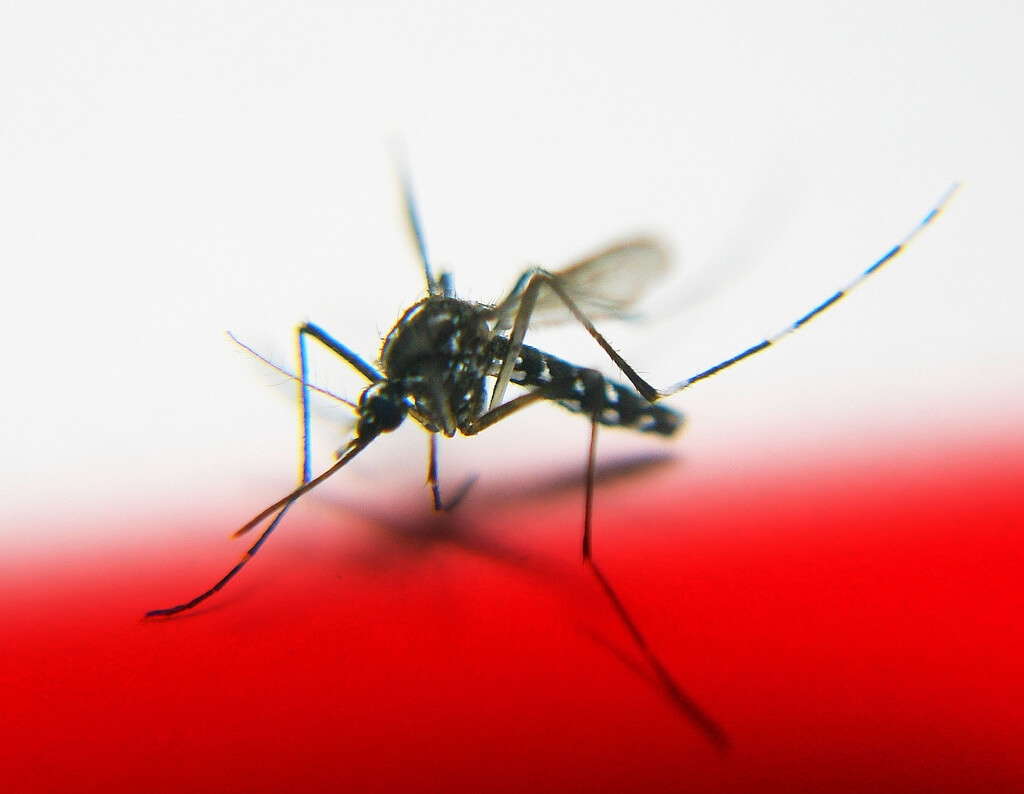
Your biggest enemy on the road, my friends, is this:
That’s right.
Mosquitoes.
These little fuckers are responsible for more deaths than all the wars in history combined.
With a little nip on the thigh, they’ll gladly pass you one of world’s many incurable diseases. They’ll leave you with a few paralysed limbs. They’ll leave you rolling around on the hospital floor, wishing for someone to put you out of your misery. These tiny little creatures cause more human suffering than any nuclear bomb, genocide, terrorist attack, famine or natural disaster could ever hope to inflict.
Don’t believe me?
Here’s just a few of the goodies they have in store for you…
Malaria
What is it?
According to the WHO, around 200 million people are infected with malaria every year and around 600,000 of those infections result in death.
It is caused by the Plasmodium parasite, which is spread to humans by the bite of infected Anopheles mosquitoes.
The WHO estimates that in 2014, one child will die from malaria every minute. Most deaths occur in sub Saharan Africa, but the disease is common in the Americas and Asia as well.
It’s one of the most common diseases people get from mosquito bites while travelling; an estimated 30,000 travellers contract the disease every year. There is no vaccine, but some strains can be treated.
What happens to you?
“Symptoms appear seven days or more (usually 10–15 days) after the infective mosquito bite. The first symptoms – fever, headache, chills and vomiting – may be mild and difficult to recognize as malaria. If not treated within 24 hours, P. falciparum malaria can progress to severe illness often leading to death. Children with severe malaria frequently develop one or more of the following symptoms: severe anaemia, respiratory distress in relation to metabolic acidosis, or cerebral malaria. In adults, multi-organ involvement is also frequent.” – WHO
Let me tell you, I’ve met a good handful of people who’ve had the pleasure of enduring this disease, and trust me, it doesn’t look like fun.
Where can you catch it?
Malaria is prevalent throughout South and Southeast Asia, sub Saharan Africa, the northern half of South America and parts of Central America:
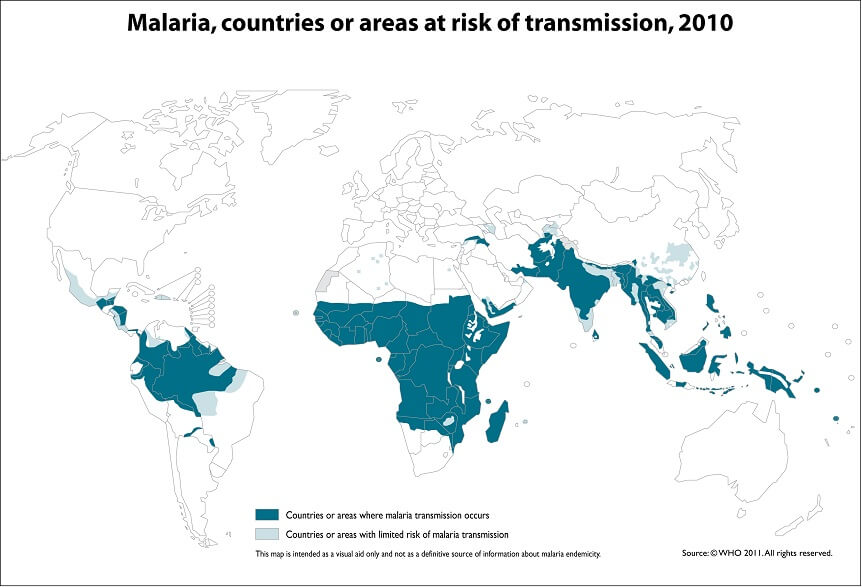
Map source: WHO. You can read the WHO’s fact sheet on malaria here.
Dengue Fever
What is it?
Dengue fever is a tropical disease spread by bites of the Aedes aegypti mosquito.
Until recently, there were four recognised strains, and a fifth one has since been discovered. Contracting one strain does not give you immunity to the other four. The two Asian strains are considered the more serious of the five.
Currently there is no vaccine, and no direct treatment, meaning once you contract it, it is a matter of being monitored in hospital and staying hydrated while you tough it out (ask Wandering Earl, it’s not fun). This is a very common disease people catch from mosquito bites while travelling, most often around the tropics and the equator.
According to WHO, around 100 million people are infected every year, and this is expected to rise.
What happens to you?
Common symptoms of the disease are high fever, severe headache, eye pain, nausea, vomiting, full body rash and muscle and joint pains.
More severe symptoms are vomiting blood, respiratory distress, extreme fatigue, organ impairment, severe abdominal pain, and death.
Due to the very heavy sweating, dengue fever often causes complications from dehydration.
Incubation period is around 4 days, and symptoms last for up to a week.
Where can you catch it?
Dengue is prevalent throughout South and Central America, and various countries in Africa. It is also very common in Southeast Asian countries, such as Singapore, Thailand and the Philippines.
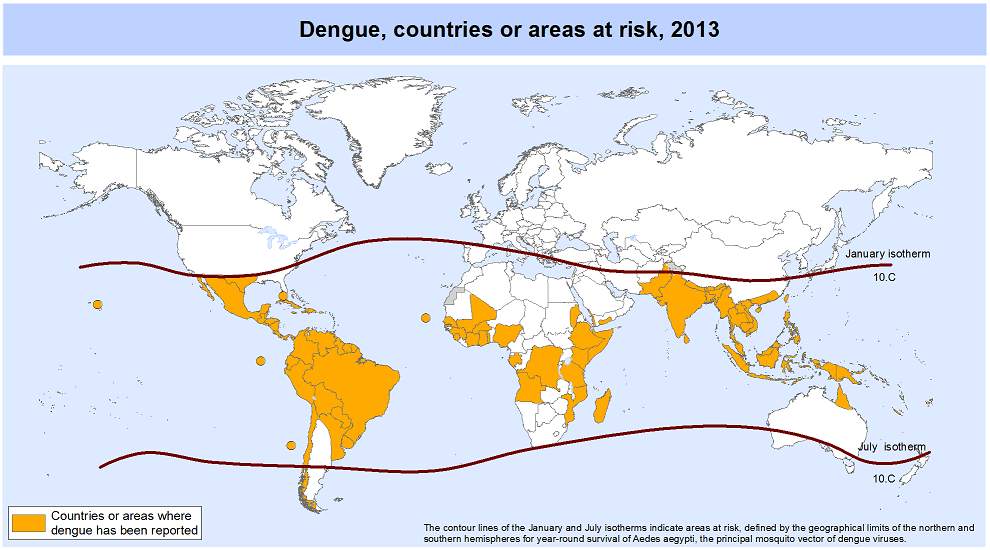
Map source: WHO. You can read WHO’s fact sheet on Dengue here.
Elephantiasis
What is it?
Scientifically known as lymphatic filariasis, this disease occurs when infected mosquitoes transmit a filarial parasite with their bite. It’s one of the lesser known diseases from mosquitoes but still reasonably common.
The parasites compromise the lymphatic system, which leads to disfigurement and abnormal enlargement of body parts which cause both severe pain and permanent disability.
Around 120 million people are currently infected, with 40 million suffering from severe disfigurement and disability. Preventive medicines are now being distributed by WHO on a large scale, but for advanced infections there is no cure.
What happens to you?
“The majority of infections are asymptomatic, showing no external signs of infection. These asymptomatic infections still cause damage to the lymphatic system and the kidneys as well as alter the body’s immune system.
When lymphatic filariasis develops into chronic conditions, it leads to lymphoedema (tissue swelling) or elephantiasis (skin/tissue thickening) of limbs and hydrocele (scrotal swelling). Involvement of breasts and genital organs is common. Such body deformities lead to social stigma, as well as financial hardship from loss of income and increased medical expenses. The socioeconomic burdens of isolation and poverty are immense.” -WHO
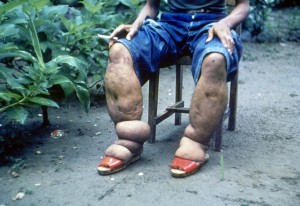
Elephantiasis of the legs. Photo: CDC.Where can you catch it?
Elephantiasis is present in Brazil, most of sub Saharan Africa, and throughout South and Southeast Asia:
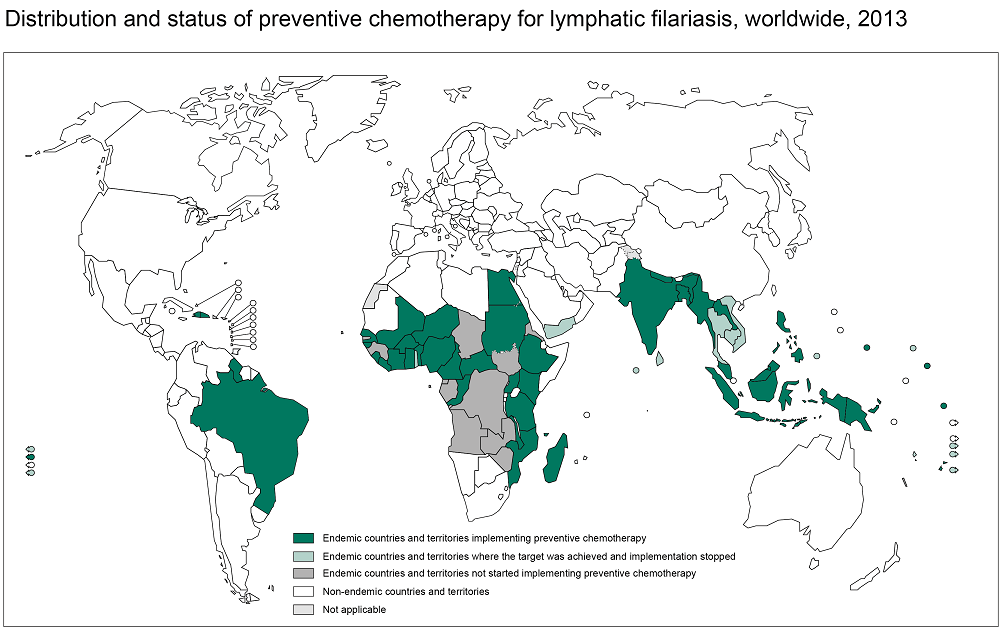
Map source: WHO. You can read the WHO’s fact sheet on Elephantiasis here.
Yellow Fever
What is it?
Yellow fever is a virus spread by the bite of the female in several species of mosquitoes. It’s one of the well known diseases from mosquitoes and many countries have border control checks against it.
Approximately 200,000 infections are recorded every year, of which around 30,000 result in death.
Only supportive treatment is available, meaning the symptoms are treated directly, but not the virus itself. Luckily, there is a vaccine available which all travellers should get, and many countries in Latin America and Africa will request your vaccination certificate before you can enter the country.
Interestingly, despite the availability of a vaccine, yellow fever deaths and infections continue to rise each year.
What happens to you?
“Once contracted, the virus incubates in the body for 3 to 6 days, followed by infection that can occur in one or two phases. The first, “acute”, phase usually causes fever, muscle pain with prominent backache, headache, shivers, loss of appetite, and nausea or vomiting. Most patients improve and their symptoms disappear after 3 to 4 days.
However, 15% of patients enter a second, more toxic phase within 24 hours of the initial remission. High fever returns and several body systems are affected. The patient rapidly develops jaundice and complains of abdominal pain with vomiting. Bleeding can occur from the mouth, nose, eyes or stomach. Once this happens, blood appears in the vomit and faeces. Kidney function deteriorates. Half of the patients who enter the toxic phase die within 10 to 14 days, the rest recover without significant organ damage.” -WHO
Where can you catch it?
Yellow fever risk areas are scattered throughout Africa and South America:
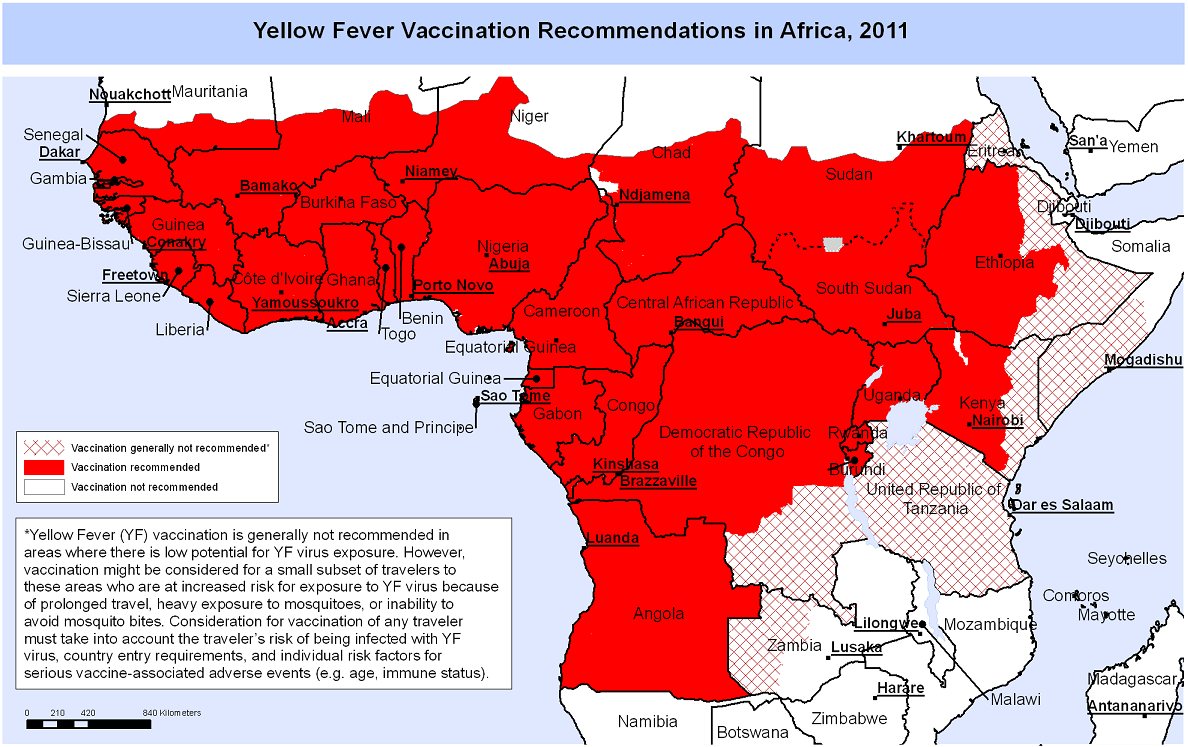
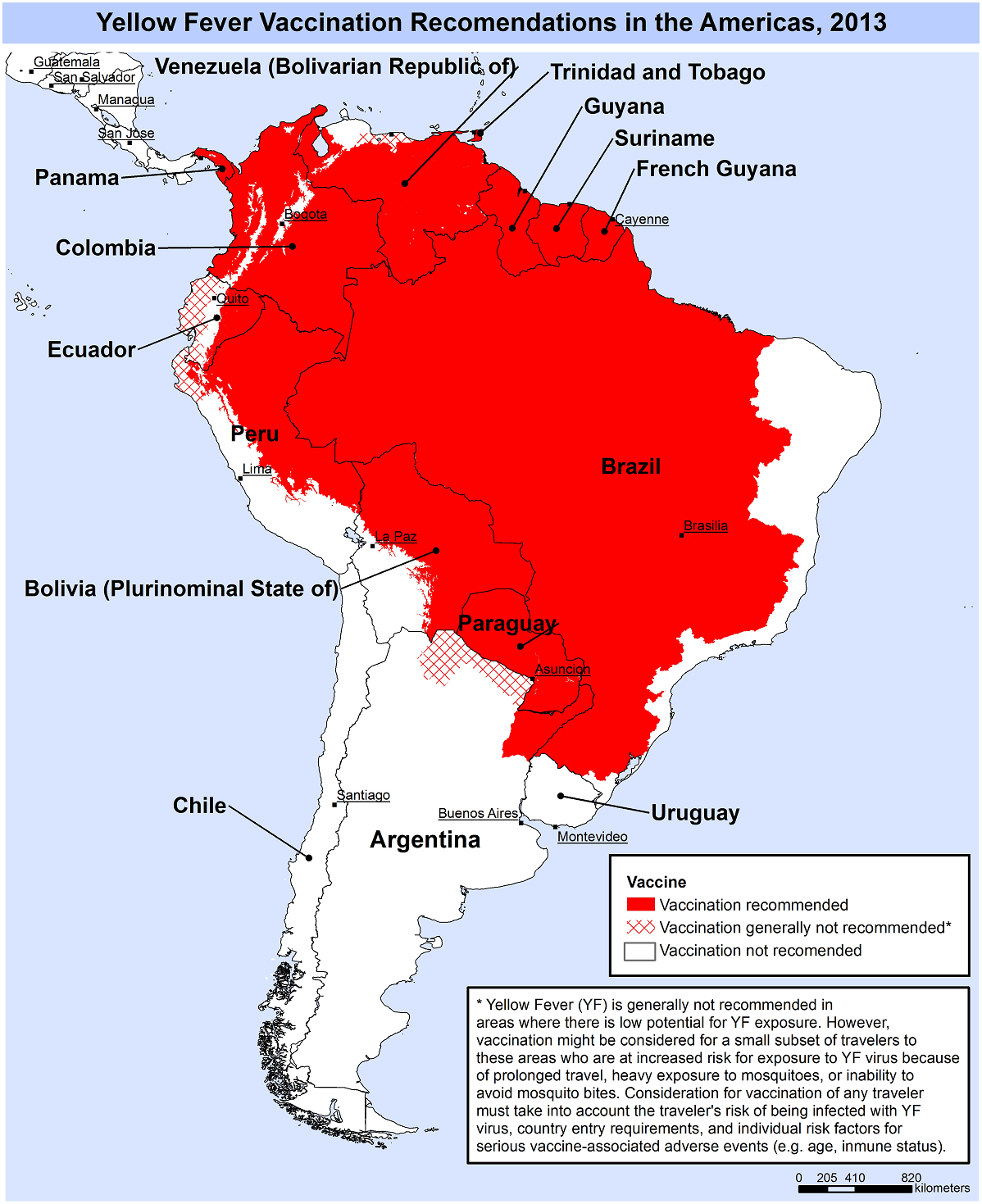
Map source: WHO. You can read the WHO’s fact sheet on yellow fever here.
Chikungunya
What is it?
I first became aware of this disease when I met a guy in the Philippines who’d been living with it for about 8 months. In his own words, “he was a vegetable” for several weeks, unable to even lift his arms to wash his own face.
Even months later, he was still suffering, and every now and then would spasm violently for a couple of seconds, before letting out a long sigh of defeat. This disease, my friends, is no joke.
Chikungunya is spread by the bite of the Aedes aegypti and Aedes albopictus mosquitoes – the same species that transmits Dengue Fever. It also shares similar symptoms with Dengue.
Over 2 million cases have been reported since 2005, and a recent outbreak has been sweeping through the Caribbean (also aiding a spread to the US). There is no vaccine and no cure.
What happens to you?
“Chikungunya is characterized by an abrupt onset of fever frequently accompanied by joint pain. Other common signs and symptoms include muscle pain, headache, nausea, fatigue and rash. The joint pain is often very debilitating, but usually lasts for a few days or may be prolonged to weeks.
Most patients recover fully, but in some cases joint pain may persist for several months, or even years. Occasional cases of eye, neurological and heart complications have been reported, as well as gastrointestinal complaints. Serious complications are not common, but in older people, the disease can contribute to the cause of death. Often symptoms in infected individuals are mild and the infection may go unrecognized, or be misdiagnosed in areas where dengue occurs.” -WHO
Where can you catch it?
Chikungunya risk areas are sub Saharan Africa, South and Southeast Asia, parts of West Asia and the Caribbean:
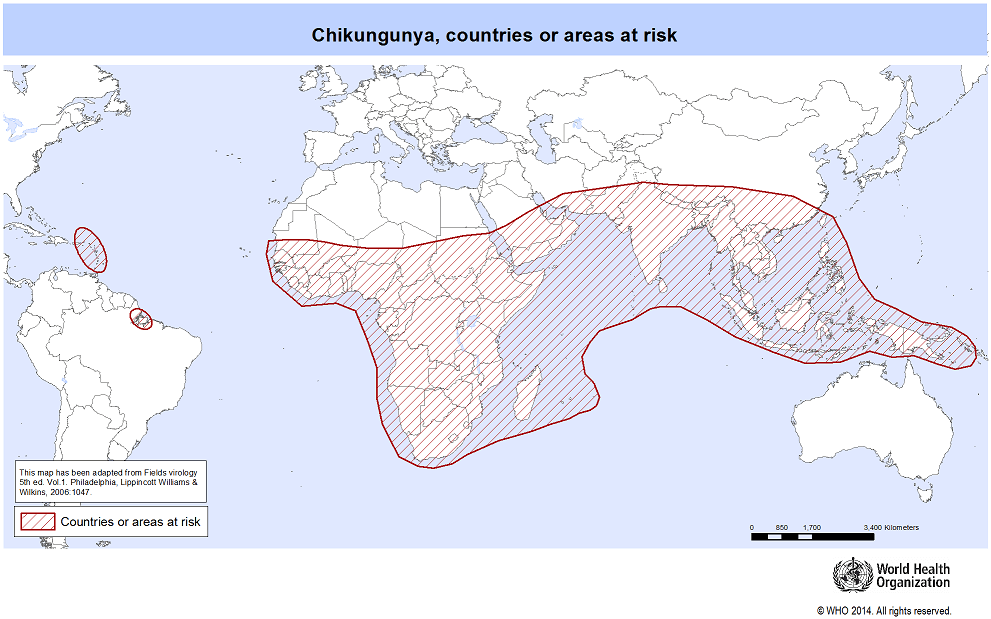
Map source: WHO. You can read the WHO’s fact sheet on Chikungunya here.
West Nile Virus
What is it?
West Nile Virus, which gets its name from the region it was first discovered, is a mosquito-transmitted virus which has had several outbreaks in the last 50 years, the biggest being in Greece, Israel, Romania, Russia and USA.
It has also been commonly reported in West Asia, the Middle East and Australia. It has the ability to cause serious neurological disease and death, and there is no vaccine or cure available.
What happens to you?
“Infection with WNV is either asymptomatic (no symptoms) in around 80% of infected people, or can lead to West Nile fever or severe West Nile disease.
About 20% of people who become infected with WNV will develop West Nile fever. Symptoms include fever, headache, tiredness, and body aches, nausea, vomiting, occasionally with a skin rash (on the trunk of the body) and swollen lymph glands.
The symptoms of severe disease (also called neuroinvasive disease, such as West Nile encephalitis or meningitis or West Nile poliomyelitis) include headache, high fever, neck stiffness, stupor, disorientation, coma, tremors, convulsions, muscle weakness, and paralysis. It is estimated that approximately 1 in 150 persons infected with the West Nile virus will develop a more severe form of disease.” -WHO
Where can you catch it?
WNV is commonly found in Africa, Europe, the Middle East, North America and West Asia. The largest outbreaks have occurred in Greece, Israel, Romania, Russia and USA.
Because birds are the natural hosts, outbreaks tend to occur on major birds migratory routes.
In its original range, WNV was prevalent throughout Africa, parts of Europe, Middle East, West Asia, and Australia. After being introduced to the USA in 1999, the virus has spread and is now widely established from Canada to Venezuela.
Source: WHO. You can read the WHO West Nile Virus fact sheet here.
Japanese Encephalitis
What is it?
Japanese Encephalitis (JE) is a virus from the same family as Dengue, Yellow Fever and West Nile Virus.
It was first discovered in Japan in 1871, and 68,000 infections are reported each year, of which 20,000 result in death.
It is transmitted by the bite of the Culex species of mosquito. Unlike many of the other diseases from mosquitoes, humans do not actually act as a host of JE – rather, it is pigs and water birds that carry the virus and pass this onto mosquitoes which then spread this to humans. For this reason, you are at greater risk when living in conditions where you are in close proximity to these hosts (rural areas/farms).
There is no direct treatment or cure, but several vaccines are available.
What happens to you?
“Most JE virus infections are mild (fever and headache) or without apparent symptoms, but approximately 1 in 250 infections results in severe disease characterized by rapid onset of high fever, headache, neck stiffness, disorientation, coma, seizures, spastic paralysis and death. The case-fatality rate can be as high as 30% among those with disease symptoms.
Of those who survive, 20%–30% suffer permanent intellectual, behavioural or neurological problems such as paralysis, recurrent seizures or the inability to speak.” -WHO
Where can you catch it?
JE is considered a risk almost throughout Asia:
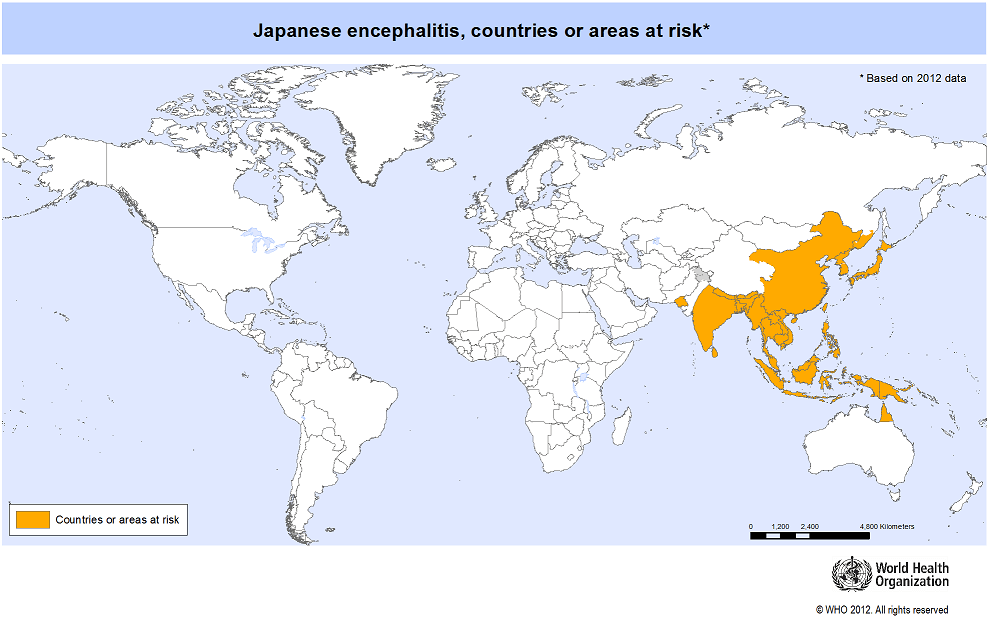
Map source: WHO. You can read the WHO fact sheet on Japanese Encephalitis here.
I wish I could say that’s it, but it’s not. The evil of the mosquito extends far beyond what I’ve outlined above, but I think I’ve covered the main ones.
How to stay disease free and prevent mosquito bites while travelling:
Visit your travel health clinic
Before you go travelling anywhere, talk to either your GP or the travel health clinic in your city. They should be up to date on what’s going on in the world and can advise you best.
Where possible, get the vaccinations that are available (such as yellow fever), and use the preventive medicines available for things like malaria.
Again, your doc will have all the information you need. They’ll also advise you on other non-mosquito related vaccinations, which might be just as important.
Prevention is the best cure!
Your best defense is to simply not get bitten.
That means wearing closed shoes, sleeping in mosquito nets (check for holes!), wearing long sleeves and long pants where possible, and always wearing mosquito repellent when outdoors (especially at night). Also, when you see a mosquito don’t just wave it away, smush that little bastard!
– Because most people will shower every day and wash off the repellent, a good tip is to also rub deet on your hats, shoes, backpacks, jackets etc. That way, even if you forget to put your repellent on one day, you may still have a bit of protection from all your gear. I also quite like mosquito coils and candles – if you plan on sitting outside for the night, light one up.
Be extra vigilant with mosquitoes at sea level
At higher altitudes many of these disease carrying mosquitoes can’t survive, but down at sea level they are rampant, which is where most of these viruses are prevalent.
Sleeping in an air conditioned room also helps – mosquitoes don’t like the cold.
Seek medical care quickly if you have symptoms
If you feel like you may have caught something, make sure you get to a hospital asap.
If you have travel insurance, the cost shouldn’t be an issue. For many of the above listed viruses, getting treatment early will be a big factor in making a full and fast recovery
This is why travel insurance is so essential. If you do contract anything, medical evacuation and a lengthy hospital stay is very possible, which could run you into the tens of thousands of dollars, or more. Travel insurance is absolutely essential if you don’t want to be returning home with huge medical bills. I have a very thorough guide to getting the best travel insurance here.
Remember, if they can’t bite you, they can’t hurt you.
Stay safe and good luck!
Do you have any horror stories you owe to mosquitoes? How close were you to dying? Let me know in the comments below.
Feature image: Lnk.Si @ Flickr