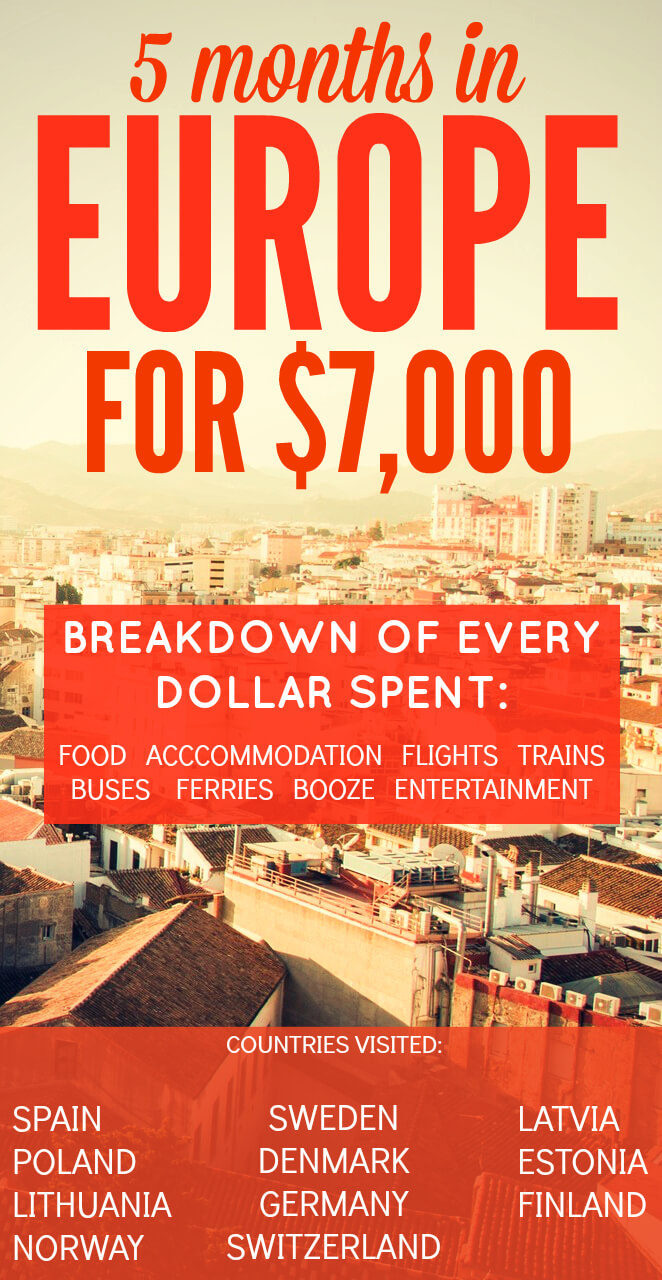
Truthfully, I was a little nervous doing my numbers. I’m a budget traveller at heart, so was just being my thrifty, miserly self for the most part, but there were times when frequent visits to the ATM starting getting me a little anxious.
Thankfully, it wasn’t so bad. After doing my accounts things turned out more or less how I expected.
Here are the numbers:
Accommodation
€1,659
Transport
€873
Other stuff (booze, food, getting around, all that shiz)
€3,896
Travel Insurance
€165
Total (156 days)
€6,593
Just over €42 per day.
Below I’ll be breaking this spending down as much as possible, so you can see where money goes on the road. This isn’t intended to be a guide on how you should or shouldn’t travel, or how much you should or should not spend. It’s only intended as a closer look into the budget travel lifestyle, and hopefully will help you plan and budget your own trips in the future.
Let’s see how it all broke down.
Accommodation
Beds in Europe aren’t always cheap – in northern Europe the cheapest hostel bed will run you at least €30 during summer. That’s already most of your daily budget gone, so I had to be smarter about my accommodation.
I Couchsurfed a lot this year, which is quite an involved process and can be exhausting and time-consuming, but it’s definitely worth it for the money you save and the people you meet.
I also stayed with friends whenever I could. This is less taxing than Couchsurfing, because obviously you know the person already. You can just send a casual text and ask, rather than writing up a whole blurb about yourself and sending it to a ton of Couchsurfing hosts. And if any of you are thinking “Well I don’t have any friends in Europe”, 90% of the friends I stayed with were people I met during the trip! So make sure you stay in touch with people – your travel buddy network will come in handy.
In total I stayed with friends or Couchsurfed for 51 nights – at a guess that saved me at least €1,000 to €1,500.
The rest of the nights were stayed in hostels, which are all listed below, or Airbnb when it was affordable enough.
Flights can be cheap, but they usually charge a small fortune if you have check-in luggage, which I did. So I did almost everything overland.
Of course I always took the cheapest bus or ferry, no matter what time they went, and the fares fluctuate quite a bit. It helps to be flexible – sometimes the Monday morning bus can be double the price of the Wednesday overnight. I was a fan of Flixbus, which was super easy to book with online and always cheaper than the train.
I hitch-hiked through the Baltics which helped keep costs down and I wanted to hitch-hike more through Scandinavia, but the cold weather and rain set in so I decided against it.
I got a little lazy and started catching trains instead of buses in Finland, just because they were so much faster, so that added maybe €40 or €50 to the total.
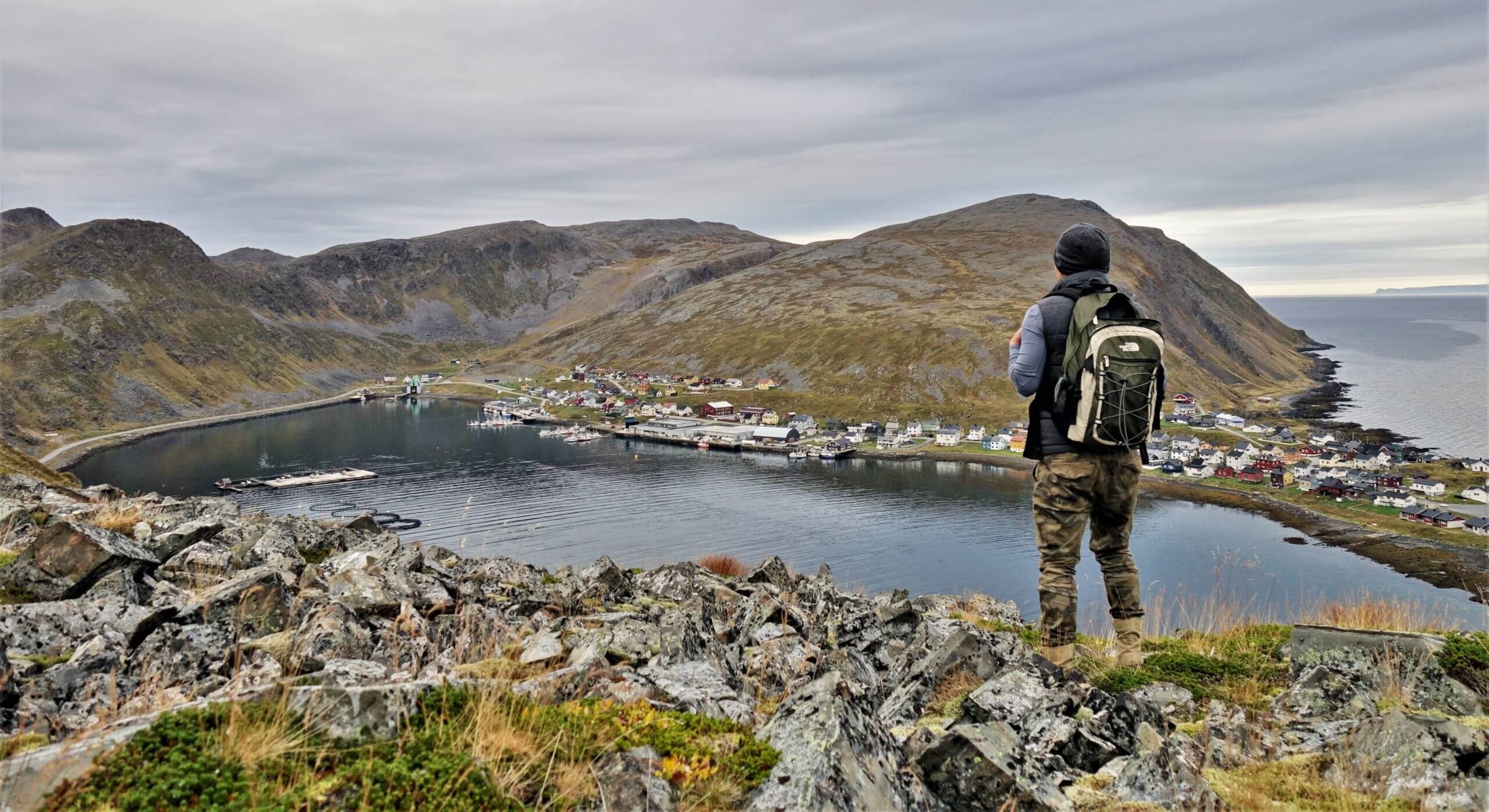
Care hire was probably the biggest cost, but that was really the only way to explore northern Norway. That mini road trip was one of the highlights anyway, so no regrets there. Quite surprisingly, I found the cheapest rates to hire my car were through Expedia.
Note: Not included here are my flights in and out of Europe. I wanted to only include costs that would be constant across all travellers, and flights in and out will be different for everyone. If you’re curious though, my flight from New Zealand to Spain was €790, and my flight out to Bangkok was €295.
Other spending
This is just everyday spending on kebabs, cocktails, haircuts, subway tickets, shampoo and so on. It excludes accommodation.
Here’s the breakdown:
Spain (6 days)
€100
Poland (44 days)
€895
Lithuania (3 days)
€30
Latvia (1 day)
€10
Estonia (8 days)
€350
Finland (42 days)
€1,598
Norway (6 days)
€35
Sweden (6 days)
€80
Denmark (3 days)
€50
Germany (27 days)
€429
Switzerland (10 days)
€319
Total
€3,896
I didn’t really keep tabs on my everyday spending – usually I just take the maximum withdrawal from the ATM and use that cash for everything until it runs out. I have all my bank records so my total spending figure above is definitely correct, but the breakdown between countries is a close estimate. I’m pretty frugal and don’t buy many things anyway, so I can make a good estimate of how this figure broke down:
65% (~€2,532) on Food
15% (~€584) on Booze (Mostly in Finland, those guys drink a lot)
5% (~€195) on Clothes (2 pairs of shoes, jacket, jeans, sweatpants, beanie)
5% (~€195) on Activities (Festival ticket, entrance fees etc)
5% (~€195) on Public Transport/Uber (I’m sure it’s less than 5% but let’s keep this simple)
5% (~€195) on Other stuff (Haircuts, phone credit, toothpaste, that kind of stuff)
A few notes on how these figures shaped up:
Food
To keep food costs down I cooked a lot – almost every day in Finland, Germany and Poland. If you’re savvy you can eat pretty well for around €5-€8 per day. When I was on the road without a kitchen, I would normally eat fruit, vegetables, bread and yoghurt from the budget supermarkets or the vege market. When I had a kitchen it was chicken and vegetables. It’s usually not expensive, but in places like Copenhagen or Zurich you might still spend €15 per day on basic supermarket food. Eating out will be double that. I was only eating out two or three meals per week at most. But to be honest, by the last couple of months I didn’t really care anymore and just ate whatever I wanted.
Booze
I don’t really drink to get drunk, but booze was a problem. I did quite a lot of going out in Poland and Finland because, well, Poles and Finns like to drink. In Poland booze is cheap so it wasn’t a problem. In Finland booze is definitely not cheap, so it was a problem. So that’s definitely something to keep tabs on next time.
Public transport
If you’re not careful you could easily blow this figure out another €100-€200. Public transport isn’t cheap up in Europe’s north. To keep public transport costs down I tried to walk as much as possible, especially in Sweden, Finland and Denmark. I must have spent at least fifty hours walking those cities. In Poland it was a different story, I caught the tram every day but it was barely a dollar, so no worries there. And I have to be honest, I didn’t always pay for the subway during my 3 weeks in Berlin (sorry Berlin).
Uber
I used Uber a lot in Poland. It’s incredible. Nice cars and drivers, and the rides were rarely more than €3! I don’t know how these guys are making any money, sometimes I felt bad for not tipping. But that was the price. Saved my ass in a couple of other countries too.
Activities
I didn’t do many tourist activities. I did a few walking tours, which only require a small donation, and I visited two museums – the Uprising Museum in Warsaw, and the Nobel Museum in Stockholm. Can’t say I particularly enjoyed either one. All the other activities I did were free (open mics, exhibitions, street art, that kind of thing). I do give to buskers quite often, so you can throw some of my budget to that.
Cellphone
I didn’t use roaming. I bought local sim cards in Poland, Lithuania, Estonia and Finland, and even in Finland it was only about €1 a day for unlimited everything, so no worries there. Everywhere else I just relied on free wifi, which is pretty widespread in Europe.
Places of note
Germany and Poland seem to be the outliers – I spent a lot of time in both places and didn’t spend much. In Germany it was so damn cold I just stayed in the hostel and worked, and any tourist stuff I did was always free. There was also a “free food” cupboard at the hostel full of stuff that other people had left behind, and there was a great vege shop down the road that got you a whole bag of produce for €3 or €4. So I didn’t spend much on food either. As for Poland, everything was just cheap in general so no tricks needed there.
The Estonia numbers might look odd, as I spent a lot there and it’s not an expensive country. I was there to attend a 3 day festival and, well, things got a little silly. So that’s why those numbers are high.
Finland was definitely where I blew the budget. I knew I’d spent a lot there, but I didn’t expect it to be that high. As I said, I went out a lot there and it’s just an expensive country in general. Still glad I spent the time there though, awesome place.
Lastly, I kind of went off the rails in Switzerland. €319 over 9 nights (excluding accommodation) was a little reckless, but the Swiss make quality cocktails and I was just letting loose for my last moments in Europe. I was catching up with a few friends there and just wanted to enjoy myself.
Travel Insurance
Yes, I always travel with insurance. I was partially covered by a family policy for the first few months. For the remaining months I purchased a basic policy from World Nomads, which cost €165. These guys are great because you can buy your cover whenever you want, even if you’re already in the middle of your trip. I’ve been using them happily for a few years now.
€42 per day over 156 days. From a budget travel perspective, I think I did okay. I’d give myself a B+.
Unsurprisingly, I got the “Are you rich?” question a lot when I told people how long my trip was. Budget travel is still a myth to most people (except for you awesome readers, of course!)
As you can see, this isn’t an enormous amount of money for a five month trip. Take your Macbook, your iPhone, a couple pairs of shoes and your sunglasses and you’re probably halfway there. To be honest, it wasn’t difficult to travel within this budget – it was pretty comfortable most of the time. I was always well fed, usually well slept, and felt healthy the entire trip.
For context, I think you could do this trip for €5,000 without getting too uncomfortable, although if you’re new to the road it would be quite the challenge (doable though). On the other end of the scale, €9,000 should hold you downvery comfortably.
Of course there is always room for improvement, so here’s a few things I could’ve done to knock this figure down:
Choose different countries. I spent a combined 65 days in Finland, Sweden, Norway, Denmark and Switzerland – some of the most expensive countries in the world. Replace those with places like Italy, Portugal, Greece and Spain and you’ll shave at least €1,000-€2,000 off that total pretty effortlessly. There are lots of guides online to help you pick the right itinerary to choose your budget – this one’s good!
Less booze, especially in the Nordics. It eats through your wallet pretty quick.
Couchsurf more. By the last month of my trip I was just too tired to be finding Couchsurfing hosts. I just paid the €10-€15 for a hostel and did it easy. If you were really strapped for funds though, it’s not too difficult to find hosts in major European cities.
Hitch-hike. I really wanted to hitch more, but as the summer closed out it was a little difficult to predict the weather. I also felt like I was running out of time a little, and didn’t want to waste any more days standing by the roadside. Europe really is a great place for hitch-hiking though.
Try a Workaway. I actually purchased a Workaway subscription this year and sent out twenty or thirty requests, but never got accepted to any of them. In saying that, I was being very fussy (I only wanted a place where I could surf or learn to ride a horse). If you’re open to all kinds of projects, I’m sure you would get placed very easily. This would give you a few months of free food and accommodation, knocking your cost per day down significantly.
Lastly, the obvious answer. Travel somewhere else! Europe is easily the most expensive continent. €42 a day is frugal living in Europe, but I would need to try very hard to spend that much in Southeast Asia, or even Latin America. If you can survive on €42 per day in Northern Europe, you can do it pretty much anywhere.
That’s it! I hope this was a helpful post for planning your next trip. If you have questions, leave them in the comments below.
Travel safe!
Bren
World Nomads provides travel insurance for travelers in over 100 countries. As an affiliate, we receive a fee when you get a quote from World Nomads using this link. We do not represent World Nomads. This is information only and not a recommendation to buy travel insurance.
This article is a part of my travel tips series for New Zealand travellers. If you’re not from NZ, this post won’t apply to you. You can see the rest of the Kiwi traveller guides by clicking here.
If you’ve travelled to Europe, you will be familiar with the 90/180 days Schengen visa rule. Citizens of Annex 2 countries, of which New Zealand is one, can enter and stay in the Schengen Area for 90 days within a 180 day period without a visa. Your 180 day count begins from the first day you enter a Schengen Area country, and you can leave and enter as many times as you wish, as long as your total days in the region do not exceed 90 for that 180 day period. Pretty simple. Currently, the Schengen Area includes the following 26 countries:
Austria
Belgium
Czech Republic
Denmark
Estonia
Finland
France
Germany
Greece
Hungary
Iceland
Italy
Latvia
Lithuania
Luxembourg
Malta
Netherlands
Norway
Poland
Portugal
Slovakia
Slovenia
Spain
Sweden
Switzerland
Liechtenstein
There are no border controls between these countries, and you can move freely between them without a passport.
New Zealand’s bilateral agreements
Important: The information below is exclusively for New Zealand passport holders, who have slightly different Schengen rules to other countries. If you are not a New Zealand passport holder, this post will not apply to you. You can read about the standard Schengen rules here.
For New Zealanders the rules are a bit different. Before the Schengen agreement was inked, New Zealand had signed bilateral visa waivers with many European Schengen countries (as far back as the 1950’s). The visa waivers mean that the 90/180 day rule applies to each country individually, rather than the Schengen Area as a whole. This means you can stay in Spain for 90 days, then France for 90 days, then Germany for 90 days and so on.
(Trust me, this is a big deal. Some backpackers are willing to give a left nut and a pinky for a second 90 days).
The countries with this bilateral visa waiver agreement are as follows:
Austria
Belgium
Denmark
Finland
France
Germany
Greece
Iceland
Italy
Luxembourg
The Netherlands
Norway
Portugal
Spain
Sweden
Switzerland
The New Zealand government confirms the European Commission still honours these visa waivers and that they override the Schengen agreement.
You can read more here. This is an official government website.
In case the site is down, here’s the official statement as at January 2025:
New Zealand travellers can also get visa-free access to some countries in the Schengen area through a Bilateral Visa Waiver Agreement (BVWA). You need to use the Schengen allowance first, and you can only use one BVWA allowance. New Zealand has BVWAs in place with:
Austria
Belgium
Denmark
Finland
France
Germany
Greece
Hungary
Iceland
Italy
Liechtenstein
Luxembourg
The Netherlands
Norway
Portugal
Spain
Sweden
Switzerland.
See how many days you can stay in each BVWA country on the European Union Law website. Remember that your entry and length of stay in a country is subject to the decision of border officials. They may have different interpretations of the Schengen rules or consider other factors that could affect your eligibility to enter the country. If you can, let the border official know you’re using a BVWA to enter the country. You might also want to keep evidence, like receipts and boarding passes in case you need to prove your length of stay in a country or in the Schengen area.
But does it work?
All our government websites caution that immigration officers may be unaware of these agreements. The advice was to contact the relevant embassies and get confirmation that the agreements are still recognised in the countries you plan to visit.
Since I wasn’t quite sure where my Eurotrip would end up, and also for the sake of this blog post, and also because I have no life, I just contacted all of them.
My name is Brendan, I’m a New Zealander travelling in Europe at the moment. I got your details from the Embassy listing on Goabroad.com.
I’ve been told we have a bilateral agreement with [country], that allows me to spend 3 months in [country] visa-free, regardless of any time spent in other Schengen countries. I was advised to email you to confirm whether this bilateral agreement is still valid?
From Safe Travel:
“However, New Zealand has bilateral visa waiver agreements with many of the individual countries in the Schengen area [country included]. These visa waiver agreements allow New Zealanders to spend up to three months in the relevant country, without reference to time spent in other Schengen area countries. The European Commission has confirmed that these agreements continue to be valid. These agreements thus effectively override the Schengen area restriction (which would otherwise be imposed on New Zealand passport holders) of no more than 3 months out of a 6-month period in the Schengen area as a whole.”
YES means they still honour the waivers. NO means they don’t. A question mark means I couldn’t find embassy details, or they didn’t reply after several tries.
Austria
Yes (kinda)
Belgium
Kinda but not really
Denmark
Yes
Finland
Yes
France
Yes
Germany
Yes
Greece
?
Iceland
Yes
Italy
Yes
Luxembourg
?
The Netherlands
Yes
Norway
Yes (kinda)
Portugal
No
Spain
Yes
Sweden
Yes
Switzerland
Yes
The long answer
Here’s the exact email each embassy sent me.
Austria
“The bilateral agreement between Austria and New Zealand is currently still in force. It allows you to stay in Austria for an additional 90 days, if you can prove that you have left the Schengen Area after the first 90 days, and have not had any stopovers in other Schengen countries during the second 90 days. Further please note that it is not a guarantee that the bilateral agreement will be honored by all other Schengen Member States and that you might still be fined for overstay when you leave the Schengen Area.
“Referring to your email below I can inform you that a New Zealand passport holder does not need a visa for a stay of up to 90 days in any 180 days period in the Schengen area.
In addition the Embassy can inform you that, according to the SPF Foreign Affairs of Belgium, the actual bilateral agreement formally confirmed through an exchange of Notes on 1 November 1951 between the two countries, entitles New Zealand citizens to stay for two more months without a visa in Belgium after 90 days spent in any other Schengen country. When entering Belgium you will need to be able to prove you have not stayed in the Schengen area for more than 90 days. At the end of the 2 month period you will need to leave from Belgium and cannot visit another Schengen country.”
-Belgian Embassy
Denmark
“Dear Brendan,
Yes, this is correct and still valid. For more information, please see link below:
“Yes, you can stay in Finland for 3 months [regardless of time spent in other Schengen countries].”
-Finnish Consulate
Germany
“Dear Brendan,
New Zealand citizens can travel visa-free to Germany for visits of up to 90 days per half-year. Times spent in other Schengen member states do not count towards these 90 days. However, as there are no I internal border controls, it is up to you to prove to immigration on departure that you have not spent more than 90 days in any one country.”
-German Embassy
Iceland
“Hi Brendan,
Yes I can confirm this is correct. NZ has an old bi-lateral agreement with Iceland and a few other European countries, that the Schengen Area agreement does NOT override. This was an unintended oversight when the Schengen agreement was signed but it stands.
So you can on a NZ passport spend up to 3 months in Iceland regardless of your other European travel.
In the unlikely event you will have any issues about this in Iceland, you can contact the Icelandic Foreign Affairs as they know all about this and you could also show this email as a proof.
Have a good trip to Iceland.”
-Icelandic Consulate
Italy
While Italy originally told me the waivers are no longer valid, a reader has since emailed me an updated reply that says the waivers are still in fact recognised:
“We confirm that the bilateral agreement between NZ and Italy is in place. This means that you are allowed to a 90 day tourist stay in Italy even if you have already spent 90 days in another country in the Schengen Area.”
The exchange of Notes signed on 25 January 1961 between Italy and New Zealand, entitles New Zealand citizens to stay in Italy without a visa for 90 more days irrespectively from other periods spent in other Schengen Countries.
Netherlands
“Once the 90 days for the Netherlands have been used up you cannot return for 180 days.
If you wish to stay longer pleased contact the IND (www.ind.nl) from within the Netherlands to request an extended tourist/visitors visa.
In principle, New Zealanders benefit from the short-stay visa waiver, as long as they (a) do not intend to work; (b) hold a passport valid for at least 3 months after date of return; and (c) have a return ticket. Border officials in EU countries may ask for other supporting documents such as an invitation letter, proof of lodging, return or round-trip ticket. For the precise requirements contact the local consular services of the EU country in question.
Therefore, New Zealand passport holders can freely travel in this period to countries in the Schengen Area: Austria, Belgium, Czech Republic, Denmark, Estonia, Finland, France, Germany, Greece, Hungary, Iceland, Italy, Latvia, Lithuania, Luxembourg, Malta, Netherlands, Norway, Poland, Portugal, Slovakia, Slovenia, Switzerland, Spain and Sweden.
On top of the overall Schengen visa waiver, New Zealand concluded bilateral visa waiver agreements with many of the individual countries in the Schengen area before the Schengen Agreement came into force. The countries with which New Zealand has bilateral visa waiver agreements are: Austria, Belgium, Denmark, Finland, France, Germany, Greece, Iceland, Italy, Luxembourg, The Netherlands, Norway, Portugal, Spain, Sweden and Switzerland.
Persons of New Zealand nationality are, according to the Bilateral Visa Waiver Agreement, entitled to stay in the Netherlands for 90 days and consecutively go to one of the other countries (length of stay depending on the agreement of New Zealand with that country!). Or the other way around, first visit one of those countries and then the Netherlands afterwards.
As stated before there is no border control between these countries, but there will be when you leave the Schengen area. You might be questioned about the length of your stay if it is more than 90 days. You are strongly advised to gather evidence (e.g. airline tickets, hotel bills, receipts, etc.) that show the duration of your stay in each different Schengen/EU country. That way you have the best option to prove that your stay in the entire Schengen area was legal.”
-Dutch Embassy
Norway
“Dear Brendan
New Zealand citizens travelling on New Zealand passports are exempt from the visa requirement for entering Norway. They can stay in the Schengen area for up to 90 days during a period of 180 days. Their stay can be for 90 consecutive days, or divided into several stays. The six-month period starts on the day of first entry into the Schengen area. A new six-month period starts immediately after the expiry of the previous one, thereby allowing another stay in the Schengen area of up to 90 days. However, although a stay will stretch from one six-month period to the next, they may never stay inside the Schengen area for more than 90 days each time. It is their own responsibility to make sure that they are not in breach of this requirement.
For stays longer than 90 days, a residence permit is required. There is no way to extend the 90 days visa free period. Please note that overstaying the 90 days visa free period may lead to expulsion and a future entry ban to the Schengen area.
However, please be advised that there is currently a separate bilateral agreement between Norway and New Zealand allowing stays for up to 90 days visa free in Norway in addition to any days spent in a non-Nordic Schengen country. As a consequence, New Zealand citizens will not be refused entry to Norway due to time spent in e.g. Spain. Whether or not non-Nordic Schengen countries will disregard time spent in the Nordic countries before entering the non-Nordic country must be confirmed with the appropriate immigration authorities.
For more information regarding the bilateral agreement between Norway and New Zealand, please contact the Norwegian Directorate of Immigration.”
-Norwegian Consulate General
Portugal
“Visa matters are handled by our Consulate General in Sydney. The Consul General has advised that, contrary to the information contained in some official websites, the Portuguese authorities are of the opinion that the Schengen Agreement superseded the earlier bi-lateral agreements.
Tourists are permitted to stay in Portugal, without a visa, for a period not exceeding 90 days, in the aggregate for all Schengen countries. If you require further information, please contact the Consulate General in Sydney.”
-Portugese Consulate
Spain
“Yes, as a NZ citizen you may stay in Spain without visa for up to 3 months regardless of the time you have spent in any other Schengen area countries.”
-Spanish Embassy
Sweden
“To my knowledge and as far as I am aware – nothing has changed concerning the bilateral agreement.”
New Zealand citizens do NOT require a visa to visit Switzerland for a period of up to 90 days within a 180-days period. New Zealand citizens benefit from this short-stay visa waiver, as long as they:
(a) do not intend to work;
(b) hold a passport valid for at least 3 months after date of departure;
(c) have a return ticket.
Border officials in EU countries may ask for other supporting documents such as for example an invitation letter, proof of lodging, return or round-trip ticket.
Moreover a bilateral visa waiver agreement signed between Switzerland and New Zealand allows holders of New Zealand passports to stay in Switzerland up to 90 days irrespectively from other periods spent in other Schengen countries. In this case, New Zealand nationals are advised to carry evidence of the period spent in Switzerland (e.g. passport stamps, accommodation receipts, ATM slips).”
-Swiss Embassy
What about the other Schengen countries?
Remember we do not have bilateral agreements with every Schengen country. That means the 90/180 day rule for the Schengen region as a whole still applies to the following countries:
Czech Republic
Estonia
Hungary
Latvia
Lithuania
Malta
Poland
Slovakia
Slovenia
And also Portugal, and possibly Luxembourg and Greece as we discussed above.
Therefore, my advice for anyone visiting Europe would be to visit the above countries first, use up your 90 days, and then continue your travels into the countries with the New Zealand visa waivers. Again it is up to you to prove you have complied with all the visa restrictions, so keep your bus and train tickets and accommodation receipts. You won’t have passport stamps as there are no border controls within the Eurozone.
It is also worth noting that Macedonia, Croatia, Bosnia and Herzegovina, Montenegro, Albania, Bulgaria, Romania, Serbia, Moldova, Ukraine, Russia, Belarus, Andorra, Monaco, San Marino and Vatican City are countries in Europe that are not a part of the Schengen zone and therefore will have their own visa/immigration rules. You can check those here.
This means you can go to one of these non-Schengen countries for 90 days, reset your 180-day counter, and then re-enter the Schengen zone for a new 180 day clock. This is the “90 days in/90 days out” planning strategy that many long-term travellers use to stay in Europe for extended periods. Of course you only need to do this if you want to visit the Schengen countries that don’t have a bilateral visa waiver with us.
Did it work for me?
Here’s how it all went down:
When it came time to leave Europe, the first task was choosing a country to leave from. I’d been in the Schengen Area for 184 days.
I’d been told Spain and France simply do not care if you have overstayed, probably because their workday is only 20 minutes long so they don’t have time to bother with silly travellers like us. We’re all too broke to pay the stupid fine anyway.
That wasn’t good for me because, as you know, I like to live dangerously. Like, right on the edge. I don’t even watch the safety video or turn off my phone during take off. So I made it a point to leave from the strictest country. I wanted to make sure I got checked, questioned, and see for myself whether our “special rules” checked out. For the sake of a blog post I was willing to miss my flight and risk that nasty overstayer stamp that would banish me from Europe for life. Life! (Actually I think it’s two years but whatever).
So who is the strictest? Word on the street is: Germany and Switzerland. They apparently check everyone, every time. No surprises there.
So I arrange to fly out from Zurich airport. Ideally the customs officer would know the deal and just stamp me through. But I had all the papers from all the websites printed out, ready to bust out on the table like Ally McBeal if things got crazy.
Finally I get to customs. Moment of truth. I take a look at the lineup. There is an art to this, you know. It goes like this:
Young, fun looking guys don’t give a toss when it comes to this stuff. Usually if you overstay 3 or 4 days somewhere they just stamp you through because they only care about going home to play Xbox later. And they hate paperwork. So if I’ve overstayed somewhere, I always try to choose a counter with a young smiley dude in his twenties. Young women are the next easiest. Try and look for the happy ones, hopefully they’re crazy in love with some hunk and not even thinking straight and won’t want to be mean in case it messes with their happiness. However, there’s a flipside. If you choose one that’s moody you’re gonna get it in the ass. There’s a 300% chance she’ll bust your balls and go high and mighty on you. So make sure she looks cheery. Next is the older guys. These guys are hit and miss. Sometimes they’re like your cool uncle and might just smirk at your cheeky overstay and give you a wink before stamping you through. Other times you might get that old school guy that just has to do everything by the book and will ping you. And then older ladies are usually the toughest. If you overstayed and you choose the counter with the older lady, she’s gonna smoke you. But usually she’ll be really nice about it, like a loving grandmother disciplining a toddler. Unless of course someone pissed her off that morning. Then you’re in for a long afternoon.
So I check out the lineup, and remember, I’m trying to get pinged here. But there’s no grumpy looking girls. No meticulous looking grandmothers either. So I go for the grumpiest looking old guy.
I rock up and he hasn’t even looked at my passport for two seconds before he asks, “And how long have you been in Europe, sir?”
Switzerland lives up to the rep. It’s on.
“About six months,” I tell him.
I pull my shoulders back and smile. In these situations you gotta have confident body language and stuff, you know.
“Mmm about six months,” he nods, flicking through my passport.
“Says you came in on June 6, through…Algeciras?”
“Oh yeah I entered in May but I went to Morocco for a couple of weeks and then I came back.”
He nods again slowly, flicks through a couple more pages, and then starts talking to the young mid-twenties guy in the booth next to him. He’s waving my passport at him, and he’s talking Swiss German so I don’t understand anything, but I hear him say New Zealand a couple of times, tapping the front of my passport. He’s talking like a Dad so I figure he’s explaining the intricacies of the special visa rules we have. Of course this young guy looks like he couldn’t give two shits about it.
Then he inks his stamp, still blabbing away, stamps my passport and says, “Have a safe flight!”
Didn’t even take two minutes. I get a little rush of satisfaction. I’m through!
Planning to stay in the Schengen Area for over 90 days?
So it worked out for me, let’s make sure it works out for you too.
In the space of six months, I’ve noticed information change on various of the websites above multiple times. As of writing – November 2016) – the information in this post is current, but if you’re planning to (legally) overstay your 90 days, I would do exactly as I did:
Email the embassies of the countries you want to visit
Print them
Print out the policies on their immigration websites too
Print out the NZ safetravel page on the bilateral waivers
Have them all ready at customs
As you saw in my little story some customs officers know their shit, but I’m sure many others don’t.
If in some strange scenario the embassy has okayed you and customs won’t accept it, at least you can show you did everything you could to comply and you may just get a warning instead of a ban and a hefty fine.
This is annoying since New Zealanders should be able to enjoy this arrangement without all the hassle, but this is what our government recommends.
Also note, the countries you visit isn’t actually too important. It’s the country you leave from that matters. You move freely without border checks in the Schengen Area, so it’s only when you fly out of the area that you’re going to be checked.
If you’re really anxious about it, try and leave from a country that has expressly stated on their immigration website that the waiver is valid (Switzerland, Denmark, France).
Hope this helps, have a safe trip and enjoy Europe!
-Bren
Update April 2018:
As you can see from the comments this post has become quite popular and is now #1 on Google for this topic. While this is great, it might also mean that all the embassies now have hundreds of Kiwis emailing them each day asking to confirm waivers. As you can imagine this is eventually going to piss off the staff and that could even result in some waivers being pulled altogether.
Let’s work together and try and make this more efficient. Here is my suggestion:
I am suggesting you only email for waiver confirmations from the country you actually intend to leave from. That is where you will be checked and questioned, so you really only need confirmation from that particular authority. I also encourage you to please come back here and share any confirmations you get from embassies and your experiences with the waivers at customs. Teamwork makes dreamwork. Thanks!
Update January 2025:
This post is still very popular and while the waivers still exist the rules are ever-changing. I haven’t been to Europe for several years so I’m not familiar with many of the changes. Use the information in this post to your best judgement, and if you can, come back and update us with your recent experiences in the comments (which country you exited from, any problems you had etc). I am still actively monitoring and approving all non-spam comments. Thanks!
Heading To Europe And…
Looking for tours and activities at an affordable price? I use GetYourGuide! Always great deals and local perks.
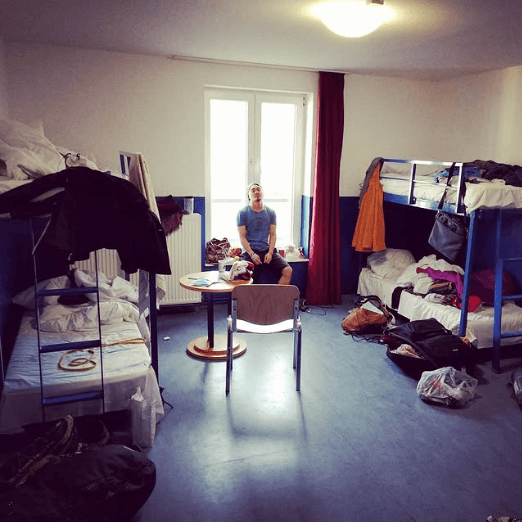
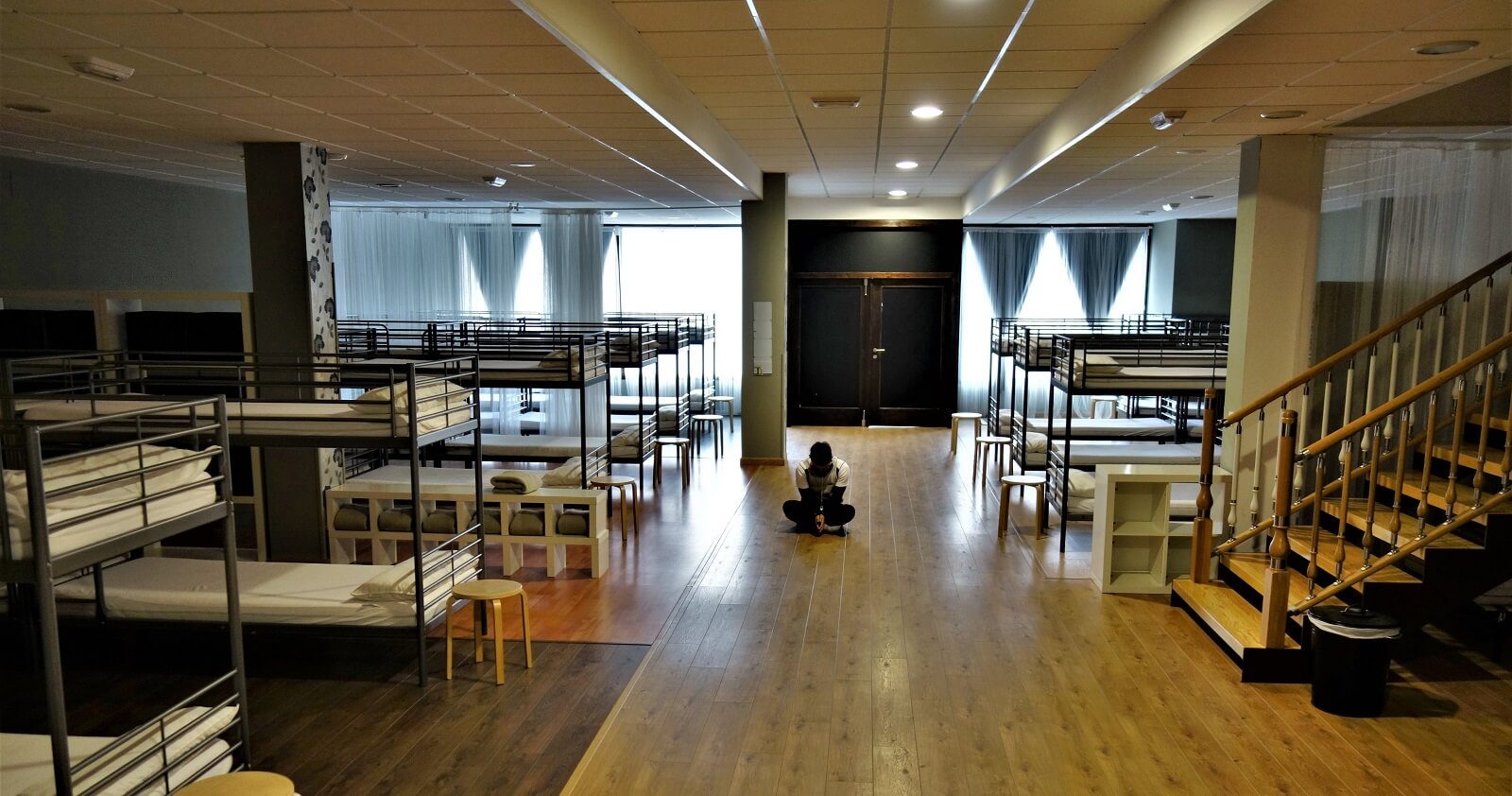
Right now, I’m sitting on my bed in a hostel dorm in Berlin. My crap is all over the floor. The girl sleeping in the bed beside me also has her crap all over the floor. And then there’s a couple of tidy guys, with all their stuff locked and zipped up. Nobody has made their bed (why would you?). It’s 4 p.m.
Today, living like this is perfectly normal for me. But it wasn’t always. It’s been over five years since I left my wildly exhilirating accounting job in New Zealand and set off on my world adventure. I have probably slept in over 200 beds since then, and on countless other couches, floors, trains, cars, planes, tents, beaches.
As this has normalised for me over the years, I tend to forget how odd it might seem to others. When people appear puzzled about this lifestyle, I often shrug it off, like it’s nothing special. But I’ve noticed this can confuse people, intimidate them almost, and make it seem like the backpacking trail is reserved for these odd personalities, who like living in dirty socks and sleeping in rooms that smell like feet.
So today I want to take you all back, to the day I checked into my first hostel. Because back then, living like this was anything but normal, and I was anything but an accomplished traveller.
My backpacking career began in South America. I flew into Buenos Aires, and was scheduled to stay on the continent for 14 weeks.
I showed up that afternoon with nothing but a backpack full of clothes, some toiletries, and the shoes on my feet. I hadn’t packed a laptop, nor a tablet, nor a camera. I didn’t have any warm clothes. Not even a jacket. I had no guidebook. I didn’t even take a cellphone.
I really just thought I wouldn’t need any of it.
Camera? The photos are in my head. Laptop? Internet cafe. Phone? To call who?
Once I was off the plane, I changed my USD at the first airport currency exchange I saw, right at the baggage collection. I’ve since learned this was the equivalent of having the word “ROOKIE” tatted across my forehead, and I remember overhearing an English couple discussing how it “wasn’t a good rate”, but at the time I wasn’t aware of how badly rates were loaded at the airport. I didn’t know of these cool little things called ‘travel blogs‘ back then. I mean, I just needed to get pesos. This is the place to get pesos, no?
Once clearing customs I headed straight to the taxi stand. I saw the same English couple I’d seen at the currency exchange, and asked if they wanted to share a cab to the city. They said, “Sure”, and one of them ran off to a nearby ATM to get some cash out.
I had a hostel booked already, I still remember the name: Milhouse Avenue. Initially I gave the driver the wrong address, so we drove around in circles until I actually got the booking printout from my backpack and double-checked it. When we arrived, the driver asked for a tip. I didn’t know how much to give him, so I gave him a 20 peso bill, which at the time was around $5 USD. He grinned a huge grin and slapped me on the shoulder, and then probably took off to splurge on some empanadas.
I was in an eight bed dorm, mixed with guys and girls. Jet lagged, I slept the rest of the day, only heading out briefly that evening to eat a burger with a couple of my roommates. I thought it was so cool – making new friends like that. There were literally hundreds of people in the hostel, all drinking, watching movies, cooking, playing pool, chatting at the bar. As a lifetime introvert, I remember being a little overwhelmed by it all. I just went upstairs and lay on my bed.
The next morning I woke up and most of my dorm had already started their day. Some were out, a few were around brushing their teeth, that sort of thing. I remember one of the staff coming into the room to take some dirty sheets and open the curtains.
“It’s a beautiful day guys, get out of here!”
My heart jumped a little.
Get out of here?
But…
To where?
I felt all this pressure suddenly, like when you were a kid and you weren’t listening in class and now everyone is working and you have no idea what’s happening. Around the hostel I could hear all these people shuffling maps and talking about buses and different places they were going to visit. But I didn’t get it. How does everyone know what they’re doing? Was there like a presentation I missed in the morning or something?
Of course it only lasted a couple of seconds before it clicked; we were just supposed to look after ourselves. But I had never been in an environment like this before. It was always catch the bus at 7, eat lunch at 12, go home, do your homework, go to soccer practice. Wake up, iron your shirt, file your timesheet. Even my two previous travel experiences were no different: On my volunteering trip in Tanzania, I got told what my job was, which bus to catch, what time to show up, what time to go home. My language course in Spain – get to class at 8, go home at 2, do my homework, go to sleep. For my entire life I had woken up in the morning and had someone else tell me what to do. And now, in this foreign country, it felt odd that people didn’t follow a programme. I mean, don’t we need to have a group meeting so everyone knows what they’re doing?
There was this guy in the bunk above me. He was from Serbia, I remember him only as Z. He came out of the bathroom and I asked him meekly:
“So, what are you going to do today?”
“Oh I’m just going to head to the train station and buy a ticket for next week.”
Just looking at me, he must have known I was a new kid.
“You can…uhh…come with me if you want?”
I nodded. Yes, I really do want.
Because I had no idea what else to do.
We got to the subway and headed to the ticket machine.
“How much is it?” I asked him.
“One twenty.”
“One twenty….” I mumbled.
“Yeah, pretty cheap huh?”
I thought about it. 1.20 would have been…25 cents? No way.
“So like, one hundred and twenty?”
He laughed at me.
“No man that’s crazy. One peso twenty cents.”
Look, guys, I’m really not a dumb guy. Honestly. This was just unknown territory. Out here in deep water my brain had stopped working. I was a lifelong academic. If I didn’t have a textbook to give me the answer, then…where do I find the answer? On paper I was probably one of the most educated guys in that hostel, but book smarts get you nowhere on the road.
I walked around with Z for the rest of the day. It didn’t take long for me to shake off the shock and settle into the whole backpacking thing. He was a seasoned traveller, so just hanging out and talking with him, seeing how relaxed he was, watching how he navigated a foreign city, I finally started to “get it”. There were no teachers out here, no parents, no manager’s office to go ask questions. You simply learned from the guy beside you.
I met some cool guys that evening in the hostel bar. I met another Kiwi in my dorm, some British guy who wasn’t shaving for a whole year, a couple of crazy Brazilians, and of course Z was there too. I did the hostel tango class that night in the bar, and sat around chatting with a few people. There was one Australian guy I remember particularly well. He had shabby blonde hair, seemed to know everyone. I asked him how long he’d been travelling.
“Eight months,” he said without a flinch.
“Eight months??”
He nodded, like it was nothing. Part of me didn’t even believe him. How does somebody travel for eight months?
He then showed off some little caps of cocaine in his pocket, and proceeded to tell us about all the beautiful girls he had sex with in Colombia and Brazil. I thought his stories were great, still unaware of what a common species of backpacker this was. On a safari, he’d be a gazelle, or a zebra. The first one is cool and you take about thirty photos. The next five hundred, you just drive right on past.
By the time I left Buenos Aires a week later, I felt like I’d finally figured it out. Backpacking represented a lot more than just travelling. In fact, much of it wasn’t about travelling at all. It represented freedom, friendship, cultural mixing, self discovery. It was a colourless, classless community, where no one cared who was rich or who was poor, whether you were a doctor or a busboy, where people sat around and did absolutely nothing as much as they explored their destinations. There was nobody to report to, no schedules to follow, no promotions, no start time and end time. You simply woke up each day and followed your own feet. Of course, I still had much to learn. But I was on the way.
Looking back, I never managed to fully embrace the backpacker lifestyle that entire trip. I spent ten of my fourteen weeks in Peru, enrolled in Spanish school, living in my own apartment. Back then I told myself it was because learning the language was the priority, and it was, but I also believe it was a case of being institutionalised in a rigid “Yes sir, no sir” environment, something I still carry remnants of today. As much as I hated the rules, living without them made me uncomfortable. I couldn’t be free without feeling lost at the same time.
And that brings us full circle, five years later, to my hostel dorm here in Berlin. Because this year being a backpacker has been a completely normal, almost tame experience. I’ve grown into it, and in some ways grown out of it too. I am now comfortable without structure, without rules. But it’s taken this long to get here. And whenever I come across yet another 19 year old Australian on their first big adventure with lots of “silly” questions, I don’t dare tell them I’ve been travelling for five years or start lecturing them about life on the road. I shut up and try to be the guy that Z was; humble, encouraging, helpful, and give them the props they deserve for doing something most people never will.
So, the moral of this ramble:
If you’re planning a trip and have no idea what you’re doing, don’t worry. Relax. And when you do hit the road and everyone around you seems like an expert traveller, chill. We all started there, and I was the most clueless of them all. Like everything else, learning to travel takes time, so embrace it, ask the dumb questions, have fun, enjoy the journey. I won’t say it’s easy, but I do know you will figure it out. And honestly, those years of kooking on the road will probably be some of the best of your travel career.
Today I want to introduce you to a travel style that dominates almost all of my trips overseas.
While I’ve always considered myself both a backpacker and budget traveller, I’ve also been a very slow traveller.
In five years of full time travel, I’ve only visited 30+ countries. That might sound like a lot, but I know people that have done more than that in six months. In fact, some tours in Europe take you through 15 countries in 30 days. It’s crazy.
Slow Travel is the opposite. Instead of whizzing through different cities, you just pick one or two. Then you settle down in that city, maybe for a month, maybe for three, maybe for the whole year. You find a place to stay, make friends, find your favourite bars and restaurants, buy a subway card. It’s like you’re an expat, only with a few less strings and a little more freedom.
Why Slow Travel?
Travel can be about a lot more than just sightseeing and taking photos and having a few drinks with some new friends at the hostel. All that stuff is awesome, but what if you want to go deeper?
You need time. Three or four days, a week, that’s not enough. If you want to pull back all the layers of a place, you need time for that connection to grow. Think about your relationship to your own hometown. How long did it take you to find all the coolest restaurants, meet people, build friendships and relationships, find the fastest way to walk home, meet the owner of your favourite bar, join different classes and events, settle into your neighbourhood and become a part of the community? Many months. Probably years. Maybe you’re still doing those things today. A connection to a place simply cannot be built in a matter of days.
Even mundane things like daily commutes, grocery shopping, and going to the gym will teach you so much about a city and its culture. Things you will never experience on a short two or three day trip.
How do you choose where to go?
It’s totally up to you, of course. I generally base my choices around three things:
Weather
I chase the summer. I think it will be a long time before I spend a winter in New Zealand again.
Affordability
I choose a place where the rent is <$500 per month, if possible. And food and transport must be cheap also. I try to aim for a budget of between $1,000-$1,500 per month.
Language
I try to spend time in places where I am an active student of the language. There are various languages I’m studying and finding a country where I can be immersed in one of them is important.
Other considerations
A few other things, like if there is surf, internet speed, if I have friends there, safety etc. are all things I think about, but they are minor considerations. I am generally open to travelling and living in any country, as long as it’s not a war zone or on the verge of a meltdown.
Where do you stay?
I’ve stayed in hostels for up to a month, but I generally try to find myself a small apartment. I’m a pretty simple guy, so I don’t need anything fancy – just a bathroom, kitchen, internet and a bed. Frills like air conditioning, hot water, television and a microwave are nice but not a requirement. It’s usually easy to find something like this for under $500 per month (sometimes a lot less). I use Airbnb a lot and bargain for a monthly rate, and also local rental websites (use Google), Facebook groups, and real estate agents. Also a good idea is to ask a few local friends for good websites to check once you hit the ground. I always forget to take photos, but here are some places I’ve stayed in before:
Cuzco – $180/month:
Krakow – $490/month:
Manila – $550/month:
What you see above are short-term rates (4-8 weeks). No leases were ever signed, no bonds were ever paid, no background checks were done, and most stays were between 1-2 months. All I did was show up with my backpack and hand over a wad of cash, and they gave me the keys. You pay a premium for this convenience.
If you do stay longer term (3-6 months+) you could expect another 20-40% off the rates above. You may get asked to sign papers and pay deposits like a normal tenant, but you should come off better off in the long run.
I have a post with my Airbnb process and also a referral link for a free $20 voucher you can grab here. As I said earlier, it also helps to talk to an agent when you land, and browse some local websites/newspapers or Craigslist.
What do you do for money?
The most obvious thing you can do is use your savings. I talk about this extensively in my free ebook.
The next most obvious option is to find a job! Jobs I see people picking up regularly are teaching English, taking zumba and yoga classes, bartending, or just any odd job you can find. If you have a terrible job at home, why not find a terrible job while you travel instead. It’ll be more fun, I promise. In most cases, your biggest hurdle will be getting a work visa, rather than the job itself.
If you have mobile skills, you can try your hand at freelancing. If you can create income flow before you arrive, you will be set from day one in your new home. I have an extensive guide on getting started in freelancing here.
Becoming even more popular these days is remote work, where you ask your boss if you can ‘work from home’ for a period of time. Whether or not they’re cool with ‘home’ being 3,000 miles away is another story. But this is the future – more and more big companies and making remote work standard practice today. If you’re up for it, try it. Here’s a short intro to the process.
Lastly, if you have a house or a long-term lease back home, trying renting or sub-leasing your apartment out on Airbnb while you travel. I know a lot of people doing this, including hosts I’ve been renting from. It works.
I actually get asked this question a lot. What did you do for three whole months?!
Usually I go to a place with a goal in mind – learn a language or skill, or maybe I just have a shit ton of work to do and need to stay put for a while. Here’s a recap of some of my Slow Travel experiences:
Six months in Manila, Philippines to build my freelance business and blog. Stayed in apartments I found online (2013).
Chinese class, Shanghai, 2012.
Between work, blogging, working out, sightseeing, studying the language as well as whatever other goals you’ve set for your stay, it’s pretty easy to stay busy. Sometimes you’ll find simple things like grocery shopping takes a few hours out of your day, since you can’t read or understand anything.
The key is to go in with a mission – what do you want to learn? When you leave, what new skills or knowledge would you like to take with you? This turns your “travels” into a goal-oriented experience, rather than just a holiday.
How do you make friends?
This is a question I get often, and the answer is pretty simple: You make friends overseas exactly the same way you make friends at home.
It’s actually easier overseas. As a foreigner people have a lot of questions for you and make an effort to make you feel welcome. I’ve had many people come up to me on the street and ask me where I’m from and what I’m doing, which of course, never happens in New Zealand.
As a new kid in town, you’re forced to put yourself out there and present yourself to the community. Like I said, this is no different to when you’re at home – you join the gym, go to classes, go to bars, attend events. Of course it is harder when you know absolutely nobody in town, but that’s a challenge you need to embrace. There was a time when you couldn’t pay me to go out to a bar or an event alone, but now I attend almost everything by myself. Few travellers would disagree that travel tests your social skills to the limit, but this is a blessing – it changes every aspect of your life for the better. As a lifetime introvert, this has been doubly true for me.
Some communities that are “easy-access” and you can join immediately are language exchanges, sports clubs, gyms (including yoga, boxing, crossfit and martial arts), pub crawls, Meetup, Couchsurfing, co-working spaces, any type of classes, expat bars. Of course you’ll meet many people in the natural course of your life too, such as your co-workers, flatmates, neighbours etc.
Do you need to quit your job?
The concept of Slow Travel is similar and in some ways complementary to the Mini Retirement, which I wrote about last month.
The difference is, Slow Travel relates purely to travel, regardless of what is happening in your career or life back home. Even if you don’t plan on leaving your job and only have four weeks to travel, you can still spend that Slow Travelling in a chosen city.
Back when I was an accountant, I took five weeks of extended leave and spent the entirety of it in Málaga, Spain, which turned out to be one of the most powerful experiences of my life. In fact, I credit it almost entirely for setting me on the journey I’m on today, and I didn’t need to quit my job to enjoy it.
Slow Travel is not so much about spending long periods of time in a place, but more about spending whatever time you do have to appreciate the daily, the normal, the routine – this will create the deep connection that so many travellers talk about – the type of experience that opens your mind to everything the city, and the world, has to offer.
Managing your Fomo
One of the biggest challenges with Slow Travel is the constant Fomo (fear of missing out). Instead of spending a month or two in Spain, you might want to try and do it all – partying in Barcelona, wining and dining in Paris, sunbathing in the south of France, eating pizza in Italy and skiing the Swiss Alps. That is a much sexier story, will get a lot more high fives and dropped jaws from your co-workers, and will triple the amount of likes you get on Instagram.
But the important thing to remember here is your ‘why’. Are you going travelling to take lots of great photos and have fun and come home with a sexy globetrotting story (which is fine), or are you going to invest your time and energy into new skills, languages, ideas, communities and a way of life? One is not better than the other, and in fact I encourage you to enjoy both modes of travel during your life, as I have.
But you do need to commit to one, and don’t let all the other what-ifs impede your experience. There are endless places on the planet to visit. You will never see them all, so it is pointless to let your mind constantly wander elsewhere and second-guess your choices. Choose the experience that you want and embrace it.
A word of warning
Slow Travel is tough.
You will suffer periods of loneliness, which is unavoidable. The plus side is you learn to enjoy the company of yourself, which will greatly curb your fear of loneliness for future trips. I’ve come to believe alone time is extremely important, both for periods of reflection, rest, and clarity of mind.
You will doubt yourself a lot. What the hell am I doing here? Almost every time I Slow Travel I second guess myself and get the urge to go home or go somewhere else after a few days. But if you stick it out, and take the time to create a home in your new city, the doubts will evaporate quickly. For me, this adjustment period is two weeks – I know if I can just get over the two weeks of settling in, everything will come right. And it does. There is so much to learn and enjoy in Slow Travel. Good things take time, as always.
Finally, it will be hard to say goodbye. This is a horrible feeling, and one that I don’t think I will ever get used to. When you make new friends, become enamoured with new places, start relationships, invest your time and emotions and life into a place and its people, it will never be easy to say goodbye. For some it gets easier, for some it gets harder, but it it never becomes easy. The only comfort is in knowing you can come back some day. This is one of the paradoxes of travel – such amazing experiences make us want to stay longer in our newfound homes, but they also inspire us to keep travelling. Our hearts are always pulled in both ways.
Travel safe,
Bren
Ready to start travelling? My free e-book is a complete, 71-page guide to creating a life of travel. Click here for your free copy.
Most people associate retirement with walking sticks, nursing homes, grandchildren and wearing funny slippers.
But that’s what your grandparents did.
Times have changed.
‘Waiting until retirement’ was a catchphrase that benefit everyone except the actual retiree. The government got as many tax dollars out of you, with no guarantee that you’d live to get them all back in pension. Corporations got the best hours of your days during the healthiest years of your life to earn as much money off you as possible. And you were forced to wait until the very end before you actually got to do what you wanted with your life.
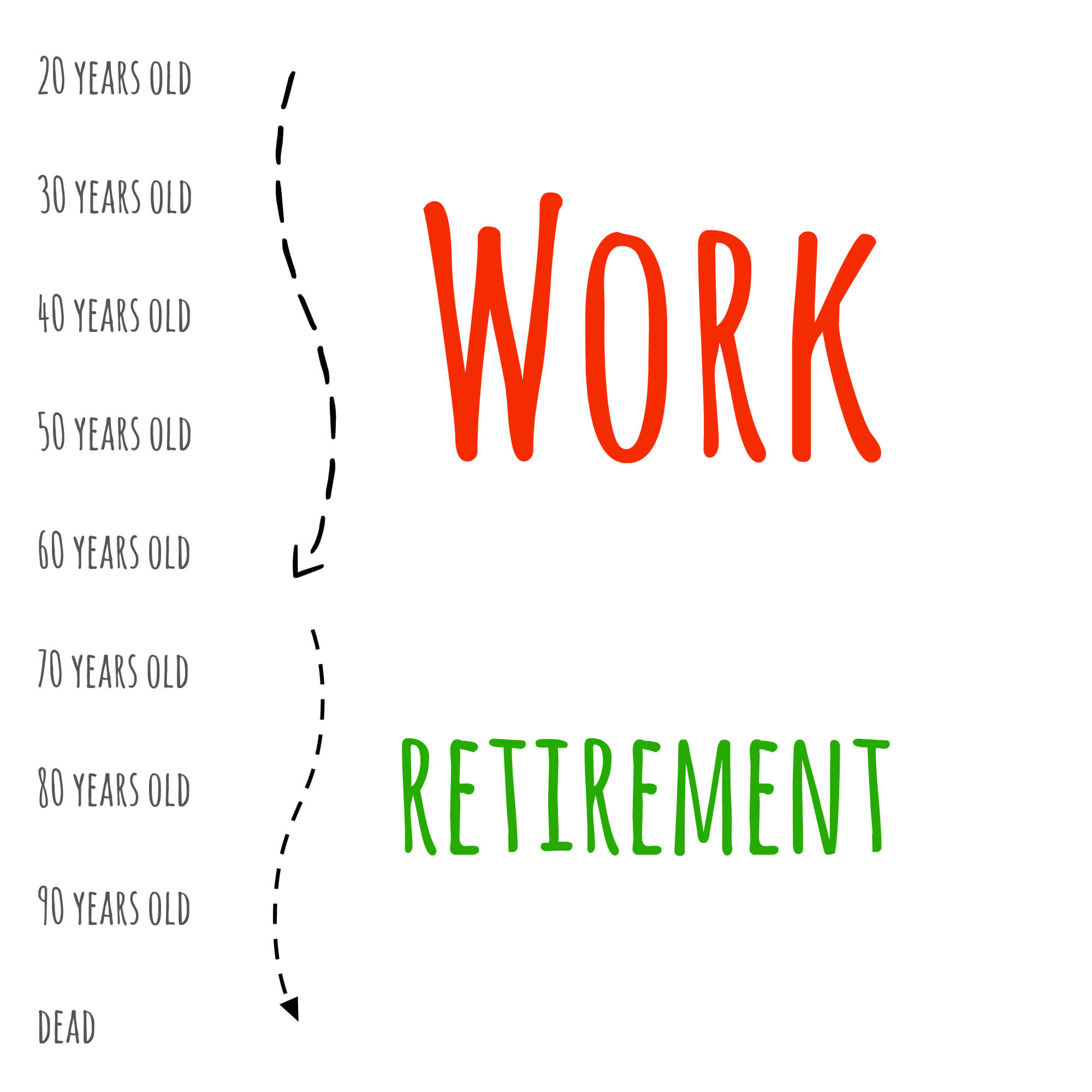
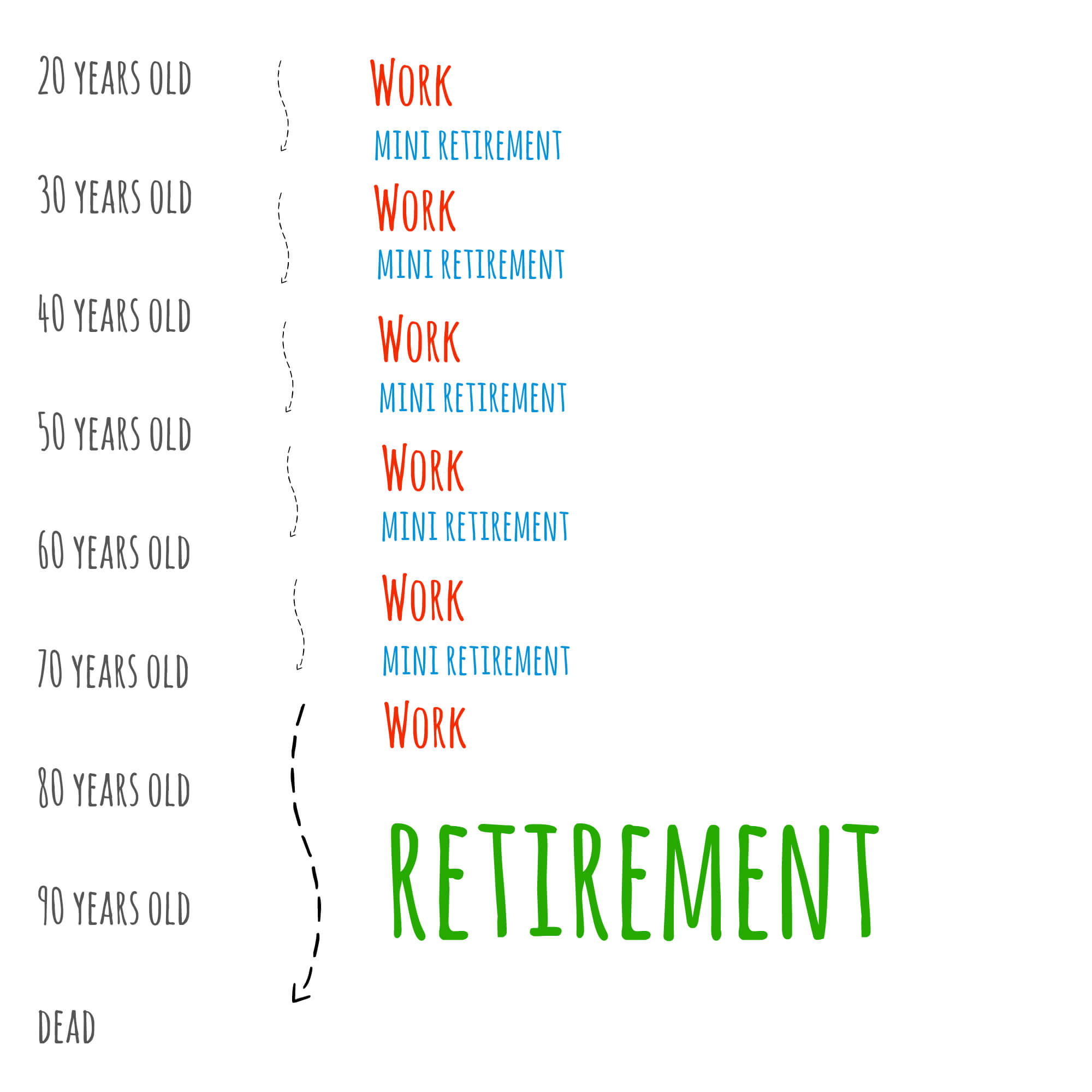
Emerging today is the concept of the mini retirement. Instead of waiting until your sixties to enjoy life, people are taking their retirement in bursts, spacing it out over the course of their careers.
Typically, we think of life like this:
A mini retiree’s life looks more like this:
Perhaps you earn a little less money, perhaps you don’t own an enormous house and perhaps you don’t become the CEO. But what you do get to do is enjoy the freedom of retirement in your twenties, thirties, forties and fifties, you still get to have a career and you get the chance to enjoy the world throughout all periods of life. You will likely be healthier, better travelled, less stressed. You might even enjoy your job for once. How’s that for crazy?
Why mini retirements make sense
I don’t want to trivialise the importance of work. I work. You work. We all need to work. But by adding this element of balance into life we can make our work more purposeful. Instead of just working until we die, we can work towards something real, something we want. Not only does it make our work meaningful but our lives, too.
You can experience the joy of retirement during your youth
There are certain things that you can’t do (or can’t do as well) when you’re 65 and up, especially physical things such as kite-surfing, climbing mountains, enduring 20-hour train rides, cliff jumping – the list goes on.
When you take a mini-retirement at 30, you can still do all these things with your youthful body. Your hips won’t die on you when you sit on a bus for hours, your back won’t buckle when a wave throws you off your surfboard at 20 miles an hour. It’s not only more fun, but it’s safer and healthier.
Your mind is also young. You learn things easier, you remember things better. You get the chance to become a student again while your brain is still fresh and clicking. I’ve met many older folk in my language classes that talk of difficulties in remembering vocabulary and conjugations, and I’ve also experienced this as the years click on.
As the old saying goes, youth is wasted on the young.
You open yourself up to new career paths
When you work continuously for 40 years, you tend to stay on one career path. You study accounting, you become an accountant, you stay an accountant forever. That’s easy, it’s where your career is stable and it’s right in the centre of your comfort zone. Ask your accountant how long they’ve been an accountant. Probably their whole life. Ask your doctor how long they’ve been a doctor. Most people don’t change careers.
When you take a break every few years, your options open up. You might take your first mini-retirement and get a job teaching English. You may love it so much that you decide to go to teacher’s college. You might do a yoga course and decide to get certified as a yoga teacher. You might spend your retirement writing poetry or a screenplay and realise you’re actually really good at it. You might even do something crazy like, I don’t know, start a blog.
Most people don’t change careers because of the risk. You need to take the time to re-educate yourself and find your way in a whole new field. But I have never met a person who changed careers and regretted it. And I’ve met a lot.
The job you hate becomes more bearable
How many of you hate your job? If my old office is an accurate sample size, around 98% of you.
However, I don’t believe it’s the job itself that is that bad. It’s the monotony of it. It’s the thought that you’re going to be doing this every day for the rest of your adult life.
I’ve got to do this for the next 40 years?
If my old 9-5 was just a one or two year gig, it would’ve been fine. There would’ve been light at the end of the tunnel. I just need to guts it out for a couple of months and then I’m free. That’s a bearable thought. It’s actually quite a nice thought – I’m here to earn some money for a bit, then I can go and enjoy it. Work and play.
When you take mini retirements, the end of the tunnel is always visible. Just a few years and then I’m mini retiring. Even if you loathe your job, you’re there for 4-5 years at the most. That’s much easier to digest than 40 or 50. Put your head down, save some cash, hand in your notice and chase some dreams.
You increase your time wealth, which leads to a life of greater balance
Most careers are engineered towards amassing financial wealth. We don’t mind taking on more stressful roles and longer hours to fatten the paycheck and stockpile as many dollars as possible. In the midst of the hustle we tend to forget why we’re working so hard.
By taking mini retirements throughout your career, you allow yourself to appreciate the importance of time wealth as well. As your life goes on, you’re able to see the value in having time to read, take long walks, spend an entire week relaxing with your boyfriend/girlfriend at the beach. Many of us lose sight of the value of time wealth until we’re reminded of it’s beauty, often through unexpected circumstances like a redundancy or other unexpected downtime. Mini retirements are the perfect way to ensure balance in your life – a great career but also hobbies, travel, healthy relationships and a wealth of free time to pursue your passions too.
The Practical Side
What kind of career will you have? What do you do during a mini retirement? How do you pay for it?
Your career
People think a big gap on their resumé looks bad. I have never known this to be true.
Do you know what lands you a job after an interview? It’s not having a great report card. Any dummy can memorise a textbook. It’s not having a really nice tie and good manners. Dummies can do that too.
It’s being interesting. Having ambition, being a risk-taker, having tenacity, thinking on your feet, embracing challenges, standing out from the crowd.
If an employer asks what you were doing during a two year break and you tell him you were playing Xbox, then a gap on your resumé looks bad.
If you tell him you built a motorcycle and drove it across Europe, worked in rainforest conservation in Ecuador, volunteered as a special needs teacher in Uganda and then self published a book of poetry, your resumé looks pretty good. It might go straight to the top of the pile. People want to be around inspiring and interesting people. And they know if you can do such incredible things out in the world, you’ll definitely be able to handle anything they throw at you in the office.
Another common reason people give for not taking big breaks from work is they think it will negatively affect their career progression.
“If I take a year off, everyone will surge ahead of me and I’ll never get that promotion.”
“I want to take a gap year, but I’m scared I won’t find another job when I get back.”
It’s never been true.
When I visited my old office after coming home, I had barely been there five minutes before my old boss offered me my job back. “If I find out you’re working anywhere else in town I’ll be very disappointed!”
This has been true for many of my friends on the road. They travel around the world for a year and walk straight back into their old job. Not only that, they get begged to take back their old job. After having to hire people for my own projects, I understand why this is. Good people are so hard to find. If you’re a star, people don’t want to see you go. They’re ecstatic when you come back.
Lastly, you might think the gap makes you look unreliable. I can’t hire this person, they’re going to quit after two years. Want to know a secret? Everyone quits after two years. Employers know and expect this.
The point I’m trying to make is, you will be okay. If you had a great career before your mini retirement, you’ll find or continue a great career after it. And if you had a shitty career before your mini retirement, then who cares what happens to it?
Your finances
The secret to a mini retirement is to be a diligent saver. Saving for your mini retirement is no different to saving for a house deposit or a new car. In that sense, you are simply transferring your savings from a new car to a mini retirement.
I’m a little biased, but I would guess that a mini retirement will add much more to your life than a new car.
If your mini retirement is going to be two years, maybe you’ll need about $20,000. If you plan to work for five years, you’ll need to save $4,000 a year. That’s $333 a month, or $76 a week.
Too hard? Take a shorter mini retirement, or work another year.
Too easy? Take a longer retirement, or work a couple of years less.
Also, because you won’t be travelling in the tourist sense of the word, most of your expenses during your mini retirement are going to be things like rent, food and hobbies. Normal stuff. Those are the same things you buy at home. Thinking about it like this removes a lot of the mystery.
And here’s your secret weapon. If you already own a car, or a house, you can lease your house and car. That gives you an income during your mini retirement. If you can’t find anyone, offer it to someone you know at way below market (even a little income will go a long way). If you don’t want to fluff around with arranging any of that, you can simply sell the car (yes, you can always buy a new one). Finding someone to rent your house shouldn’t be as difficult, and you could also do a Home Exchange as another option.
If you’d like a blueprint on saving for a mini retirement, I cover the subject extensively in my free ebook.
What to do
A few ideas:
Learning holiday
This is actually my favourite style of travel, and I’ve done it all over the world to learn martial arts, surfing, dancing, languages and more. In fact, my first solo travel experience was a Spanish course in Spain. Obviously, the longer you have the more you will learn which makes this style of travel perfect for mini retirements. I meet many people at language schools that only get to stay for two weeks and are heartbroken when they need to leave so soon. During a mini retirement you can spend a good 3-6 months really exploring and learning your craft, whatever you choose it to be. Paired with the experience of being in another country and these really can become life-changing adventures.
I booked my first learning holiday through STA Travel. Now I just find my opportunities independently, but their learning section is still a great place to find ideas.
Working holiday
Working during retirement?
Bear with me.
There are many working holiday opportunities out there – you can be a skydive instructor, a surf coach, a yoga teacher – pretty much any passion that you have can be turned into a job.
Even though the pay might not be great, you will still be topping up the bank account, putting less stress on your finances and allowing you to live a little larger while you’re out there.
There is an abundance of these opportunities – you’ll just need to ask around. I would suggest not planning your entire mini retirement around something like this, but stay open to it. Perhaps you want to extend your mini retirement from one year to two or three, and a short working holiday might be the kicker you need to make it happen.
Caz and Craig have some good info to get you started. But Google will give you all the info you need.
Travel
Nothing fancy. Just go see the world.
Volunteering
Volunteering is an amazing experience, one that I’ve done various times. There is an element of responsibility and awareness to consider when you decide on a project, especially when working with children, and also on the organisation (if any) you affiliate yourself with. However, when done right volunteering is a magical ride.
Do your homework on your project. If you’re paying money, make sure you know where it’s going (to a needy cause or into a corporation’s pockets?). Ask yourself if you’re doing the project for the right reasons. Would you do it if you couldn’t take your camera? Ironically volunteering can be a somewhat selfish endeavour; we do it because it makes us look good and feel good, and that’s okay. Just make sure there are many good reasons behind your work too.
Shannon has a great grassroots project you can browse here.
Study
Go back to school! Educate yourself on something new, get qualified for a job you always wanted to do, or upskill in your current field without the pressure of a job to go to each day. Many people go through life wanting to try something unconventional like acting or dancing, but never find the time to dedicate to it. I wish I could learn that, but when will I find the time to go back to school and study again? During your mini retirement, bro.
A year after I left my job, I moved to Shanghai and went back to university for a year. I was 25 at the time and it was an incredible experience.
Even if you don’t study towards a certificate in an official university or institution, you can still dedicate time to educating yourself on your own time. Go to the library, take online courses, read books, self study, find something on Udemy. It’s all possible.
It’s not really possible to travel the world for zero dollars. Eventually you’re going to spend a dollar somewhere. Maybe to buy a cocktail for that pretty Balinese girl, or to get your nails done before that Indian wedding you’re about to attend.
But that doesn’t mean everything needs to cost money. Whether it’s flights, accommodation, transport, food or entertainment, there are ways to travel the world for free. You just need to know where to look, and have a willingness to do things a little differently.
For you aspiring nomads on there who are looking to see the world on the cheap, here are a few zero-dollar-ideas to get you started:
House sitting has been taking off recently in backpacker circles, especially with more long term travellers hitting the road and looking for places to base themselves for extended periods.
House sitting is a system where you can live in someone’s home for a few weeks or months while the owner is away. Usually people seek house-sitters because they need someone to feed the pets and water the garden etc. That means as a house-sitter, a little work is involved. You’ll spend a couple hours each day walking dogs and feeding chickens, stuff like that.
Nonetheless, it’s a pretty good gig and you can find some pretty amazing places to stay. Did I mention you stay for free?
Remember that movie “The Holiday”? Yeah, the one with Jack Black and Cameron Diaz and a few others, I don’t really remember. That actually happens in real life. It’s called Home Exchange or House Swap, and it’s been around a little while.
Basically before you go to Australia, you find someone in Australia who wants to come to your city. You exchange emails, make sure they’re not a looney, presumably they do with the same with you, and then you agree to swap house keys. You go to Aussie and stay in their home for free, they come to your city and stay in your home for free. You both get a free house-sitter, and nice home to holiday in, maybe a car to drive, and you save a ton of money. Pretty cool.
I talk about Couchsurfing a lot on here, because it’s awesome.
Couchsurfing involves sleeping on someone’s couch (or if you’re lucky, a mattress or a bed) for free. The focus of the community is on cultural exchange and travellers helping other travellers.
If you want to get the most out of it, don’t just use it for free couches. Really get involved in the community by joining groups, going to events and hosting other travellers in your city.
Get started in Couchsurfing by
Signing up at Couchsurfing.org and completing your profile! (note: as of 2020, Couchsurfing is no longer a free service. Try BeWelcome or Trustroots instead.
You’d be surprised how many people you actually know around the world. When you start travelling, that number will multiply every day.
Don’t be afraid to ask around and see who’s got a couch free. I try to keep my house-crashing to a minimum but if I’m in uber expensive places like France, London or Hong Kong, I always try to find a friend to crash with. As you meet people on the road many will go above and beyond to help you out – don’t be surprised if you get offered to stay with the friend of the brother-in-law of the guy you shared a hostel dorm with in Argentina. It happens!
5. Camping
When I was in Turkey earlier last year I met a guy who had travelled all over the country, total hobo style. He’d been hitch hiking the whole way, and would pitch his tent by the side of the road at night and sleep. It sounded mad, but he said it was fine and trouble free. On that same trip, I had a Greek couple who had spent an entire summer camping on the beach in Greece, for free. Get involved in the camping community and get familiar with the rules, and you can sleep for free in many countries around the world.
Get started by
Reading some guides on wild camping here and here.
6. Travel the world for free with WWOOF
Every second backpacker I meet in New Zealand is WWOOFing. Traditionally WWOOFing refers to farm work but it’s become synonymous with any kind of work exchange these days. Recently I met a girl who is WWOOFing at a hostel down at my local surf beach – she surfs in the morning, cleans the hostel in the afternoon. Others are WWOOFing at farms and hostels across the country. Sounds fun.
Get started in WWOOFing by
Checking out WWOOF.net, but during your travels all you need to do is ask! Hostels, guesthouses and farms are always looking for people.
7. Travel the world for free with HelpX
HelpX is similar to WWOOF – it’s a network where people offer housing and food in exchange for a few hours work each day. Very common requests are for people to help renovate properties, look after children, help run B&Bs and guesthouses, cleaning, painting, sometimes people just want you around to practise English with a few hours each day. HelpX is literally all over the world and there are a ton of interesting projects on there for every type of traveller.
Get started in HelpX by
Checking out the endless opportunities on HelpX.net
8. Workaway
Workaway is another work exchange network where you can trade work for room and board. Opportunities are global and the network is very professionally run.
I’ve met quite a few people who spent time working on cruise ships. The common theme is that it is hard work, but you are literally being paid to travel around the world and that makes it awesome.
There is work for everyone on a cruise – they need cooks, waiters, IT staff, a band to play at night, personal trainers for the gym, dance teachers, cleaners, tour guides, management staff etc. The pay isn’t bad, and because room and board is provided you save around 90% of your salary.
Au pairing is where you work as a live-in assistant in a foreigner’s home. Duties are standard household chores such as laundry and cleaning, as well as dropping off/picking up children from school, helping them with homework etc. Au pair work usually requires 4-5 hours of work a day, and the work is paid. This is very popular in more expensive destinations to travel/live in, such as Europe, Australia and New Zealand.
Get started au pairing by
Reading guides from experienced au pairs: Ashley has one here, and Yara has another here.
Technically you can get free transport to anywhere in town, if you’re willing to use your feet. Well, you might need to swim/climb/crawl a little too, but you get the deal. A lot of us tend to head straight for the subway or a taxi when we’re new in town, but as you get more comfortable on the road you’ll start to love walking. You get to move slowly, look around, smell the air, peek inside the windows. Some of the most interesting things I’ve encountered on the road have been a result of taking walks. These days, if I need to get somewhere and the walk is less than an hour I’ll go by foot. Being free is just a bonus!
Hitch hiking is popular in a lot of countries and perfectly safe if you know what you’re doing. Go to the side of the road. Stick your thumb out. Get in. Get out.
We’re all still alive, because we did our homework.
Staying safe on a hitched ride is more common sense than anything else. Try to hitch hike in pairs. Don’t hitch hike at night. Do it in countries where it’s normal and accepted. If a car stops and you get a bad vibe, don’t get in. Stuff like that.
Get started with hitch hiking by
Checking out this detailed breakdown from Jamie at Great Big Scary World. When the time comes, you can find all the best hitching spots and seasoned advice on Hitchwiki.
There are endless ways to stay entertained for free. Start with your standard parks, plazas and markets where you wander, take photos, watch buskers and get to know a few strangers.
During the week in big cities there are often free shows, concerts, open mics, festivals and cultural events.
Beaches, boulevards and city squares always have interesting things going on. Hiking, regional parks and major landmarks are often free as well.
Many major museums often have free entry days in low season.
Couchsurfing events are free. On Meetup.com there are often casual sports gatherings and pickup games which are free.
This is just a few of many examples – always check out your hostel noticeboards, tourist info offices and online city guides to stay informed. Or as Rolf likes to say, “When in doubt, just walk until your day becomes interesting.”
That’s not a literal term – you don’t actually need to dive inside the dumpster (although that works too).
It is very common for small family owned bakeries and restaurants to throw away leftover food at the end of the day. Fruit and vegetable shops will also have produce left at the end of the day which they can no longer sell. Food that is also one or two days away from expiry usually gets thrown in the bin too. It’s perfectly edible food and there’s no shame in asking for it!
In fact, you’re actually helping reduce food wastage while saving a bunch of cash at the same time. It’s a win win.
Just head to these places before closing time and ask if they have any food they’re going to throw away. If you let them know you’re a bunch of broke hungry backpackers they may be extra nice. I remember a friend telling me about the markets in Italy, where he would get given so much free food he was actually turning it down because he couldn’t carry it all!
Some places may try to sell it for a nominal amount, maybe a couple of dollars, which is fine too. And of course many people still do it the traditional way – looking through the supermarket dumpsters at night – which is how we scored the bounty in the photo above!
This is really common and there are a lot more ways to do this than people realise. It does require you to be pro-active as not all opportunities are advertised on the likes of HelpX or Workaway, but if you have skills, chances are someone else needs them.
Things such as zumba, yoga, surfing/skiing, dancing (all types) and personal training are some of the most in-demand skills and there are resorts, cruises, schools and tour companies always looking for people to jump in and start taking classes for clients. If you’re qualified or experienced in these kinds of things and looking to settle down for a bit, approach the big resorts and tour companies and ask! You’ll be surprised how many opportunities there are.
Travel hacking is the art of playing the frequent flyer and hotel points systems to your advantage.
Frequent flyer points are free. Sign up for a credit card and you get 30,000 of them. Eat at a restaurant, get another 1,000. Put your spending on a credit card, get a few more. Most cards will waive an annual fee for a year, and waive it a second year when you tell them you want to cancel. You can rack up a tidy number of points if you’re willing to figure it out.
Some people have dedicated their lives to this and play these frequent flyer programs full time. It’s like a game to them and they end up jetting all over the world for free. If you’re willing to invest the time, you can too.
Get started in travel hacking by
Great resources on the topic are Million Mile Secrets and the Flyer Talk forums, although if you’re a newbie it can be hard to understand the lingo and what they’re talking about. Good source of free information though.
Inspired? While there’s a lot of info here, this is really just scratching the surface. Whether it’s someone ironing linens on a rich man’s yacht or restoring ruins in rural Italy, I constantly meet people doing interesting things out here to travel the world for free. If you’re low on funds it doesn’t mean you can’t travel. It just means you need to think outside the box and do things a little differently.
Good luck!
Got anything to add? What are some ways you’ve managed to travel for free? Share your stories in the comments section below 🙂
Disclaimer: World Nomads provides travel insurance for travelers in over 100 countries. As an affiliate, we receive a fee when you get a quote from World Nomads using this link. We do not represent World Nomads. This is information only and not a recommendation to buy travel insurance.
There’s endless information out there on helping girls travel the world. How they can stay safe, overcome their fears, dress appropriately, how many bikinis to pack, dealing with foreign men etc. I even put together a whole interview series about it.
But what about the dudes?
Don’t worry, fellas. I haven’t forgotten about you.
I know as well as you do – it’s tough being a man in today’s world. And it can be tough on the road as well.
What follows is my guide to travelling the world as a modern man. What to look out for, what to wear, how to stay safe, dealing with girls, things you should pack and so on. It’s all here.
Ready?
Let’s do it.
Part 1: Safety
It’s generally said that travelling is a lot more dangerous for women than it is for men. In my experience, that’s not true. I’ve seen far more men get mugged, become victims of violent crime, end up in hospital with injuries and get into altercations. I haven’t been able to find numbers, but I would bet good money that male tourist deaths outnumber female tourist deaths, too.
Why is this?
Because we’re boys. You have about twenty times more testosterone bubbling through you than your female travel buddy. Science says you’re likely to be more adventurous, take more risks, visit more dangerous destinations and do more dangerous activities. You’re more likely to try and fight someone who mugs you rather than hand over your wallet. You’re more likely to get into an argument in a bar, and you’re more likely to throw a punch. You’re more likely to walk home alone in the middle of the night, even if you know it’s dangerous. You’re more likely to do the cliff jump. You’re more likely to ride the motorbike without the helmet. You’re more likely to start prodding that weird looking snake with your hiking pole to see what it will do. You’re more likely to thrill-seek, be a daredevil, and follow your male brain into a bad situation. Man hormones are risk-taking hormones. That’s why we always get into trouble.
So how do we stay safe?
Avoid confrontation
I’ve never been mugged. I’ve met a lot of guys who have, and almost all of them fight back. The funniest was the Aussie guy in Colombia who had a couple of kids pull a knife and ask for his wallet. He went into fight stance and said, “Go fuck yourself.” The most recent case was in Ecuador, where my Israeli roommate got lured to a “cool party” by two local guys who jumped him once they were out of the main streets. Of course, he fought them both, ending up in hospital with a couple of nasty wounds but, in his words, at least he “got blood from the other guy too”.
I would like to say if this happens to me I will hand over my wallet and walk away, but I’ll never know until it happens (what were all those fighting classes for?). Either way, that’s the smart thing to do.
Of course, avoiding confrontation is not only something that arises when you’re getting mugged. It also means you should avoid causing scenes and pissing people off, such as in restaurants and markets, at events and festivals and with taxi drivers and so on. Things can escalate fast, especially in less reserved cultures, so while you’re overseas it pays to tone things down and swallow your ego. Sometimes you need to check your pride and take a punking on the chin. Not as easy as you think.
Easy on the drink
If a girl is drunk in a bar and causing mischief, even shouting profanity and throwing drinks on people, it’s unlikely anything particularly terrible will happen to her. How many times have you seen an obnoxious women get knocked out? I can safely say, zero. She might get shouted at, shoved, talked to by a bouncer or thrown out, but that’s about it. If she’s alone there’s always the risk she gets taken advantage of, but as long as she’s got friends around she’ll probably be okay.
As a man, things are different. If you behave like that, you’re getting punched in the face, bottled, or taken outside for a beat down. I’m sure you’ve seen all three. What’s more, in some countries there’s not a lot of trash talk build up before a fight – sometimes the punches come far sooner than you’re used to seeing. I see arguments and fights all the time on the road, and it’s always between drunk men. Like I said, men are more likely to throw a punch and more likely to wear a punch.
Take extra precautions
I know I can’t just tell you to be careful. If there’s some shady jungle walk where you might come across bears or lions and you want to do it, you’re going to do it no matter what I say.
What I can say is take as many precautions as you can. If you’re heading somewhere iffy, make sure you tell your friends and family, and some people on the ground as well, where you’re going and when you’re expected back. Take efforts to make sure you’re contactable at all times. Take a first aid kit. Ask people about the risks and dangers of the area and get educated. You can still do cool shit out there and be safe at the same time.
Likewise, exercise these precautions in everyday situations too. I generally leave my wallet at home and keep cash in my socks if I’m walking around somewhere shady at night. I always ask which streets I should avoid, and even though my curiosity can kill me, I do generally avoid them. If I do want to go there, I find a fixer. When heading out at night, I also wear looser jeans and shoes rather than flip flops, as it would be much easier to run fast (or throw a roundhouse) in those clothes. There’s nothing unmanly about taking an extra moment to think about safety and take easy precautions that can pay off (and maybe even save your life) in the long run.
Body language
Honestly, this is probably one of the best tips I can give you for staying safe. Your body language says so much about you, and people will make a judgement about you in a split second based on your body language. If you walk with your chest out, chin up, looking straight ahead and moving confidently, you’re far less likely to be bothered than if you walk with your head down, walking too fast, glancing left and right and looking uncomfortable. People, and especially bad people, can smell weakness – they can see it from miles away.
Over the years I’ve managed to fine tune this body language, and local friends constantly comment on how comfortable and confident I look. After a night out in the outskirts of Nairobi, I was walking home with a couple of local guys in the early a.m. and they couldn’t believe I’d only been in town a week. In their words, “It looks as if I live here” and “white people are normally shitting themselves”. I’ve had similar comments in many countries and I attribute it to having good body language that doesn’t show I’m uncomfortable or scared, even when I totally am.
Tips for good body language:
Body language is just good acting. Imagine you’re walking down your street in your home town. Imagine as if you’ve been walking down this street every day for your entire life. Nothing here can surprise you. Nothing here is new. You belong here. You live here.
Walk with your chin up, looking straight ahead. Look around casually. Sigh, like you’re bored. Nothing to see here. You walk here every day.
Ooze confidence (not arrogance, there’s a difference). Emit no fear. Make the shadies think twice before approaching you. If you’re generally a fearful guy, consider taking some self defense or martial arts classes to improve your self confidence. There’s a good chance you’ll never need to use those skills, but they can greatly improve your peace of mind in situations like this.
Walk a normal pace. The slower the better. Relax. People walk fast when they’re afraid or nervous, just like they breathe fast and talk fast. Walk slowly. Nothing to be afraid of here. You’re not rushing anywhere. You’re comfortable. You belong here.
If you’re lost, keep walking. Don’t look around all flustered and worried. Discretely pull out your phone and check your map. Hop into a convenience store if you need to or sit down at the bus stop. Don’t be obvious about it. Pretend like you’re just reading a text message. Just a normal day. Nothing to be afraid of.
When you walk with that mindset, and you really go into character with that mindset, you’ll give off a strong, positive vibe. It’ll show confidence and calm, and will get you out of more trouble than you realise.
If you do get approached and they ask if you’re a visitor, always say no. Tell them you’re working here for a short time or your brother lives here. This works well to deter hustlers and scammers. It can also make people think twice about bothering you if they know you have a few connections in town.
Local friends
Local friends are instant social proof. Similar to your body language, they can prevent bad situations from starting in the first place.
During my first trip to Africa I had one afternoon where I’d spent a little too long playing with my students and lost track of time. I found myself walking home after sunset, on a main road that was pitch black and suddenly a lot more spooky than it was in the day time. I could feel people looking at me wondering what a silly Chinese boy was doing out alone at night. I knew I needed to blend in more so I caught up to a lady a few steps in front of me and asked her where she was going and if it was okay if I walked with her. Of course she said yes because I was such a polite young gentleman (i.e. she knew I was shitting myself). I could feel the difference instantly. I only got passing glances, as I now looked like the guest of a local rather than a wandering idiot.
I have countless stories like this. In tourist zones you’re fine, but once you venture outside the Lonely Planet boundaries you’ll feel a lot more welcome if you have a local by your side. This is especially true for local nightlife, and places like slums and rural villages. It’s almost like showing you’ve been invited to the party, rather than just showing up as an obvious outsider. If you don’t have local friends, you can simply ask an independent tour guide, find a Couchsurfing buddy etc.
Final words on safety
Staying safe is usually just a matter of common sense. If it’s a dangerous neighbourhood, don’t go there. If you’re getting a weird vibe, leave. Be extra careful after sundown. The world is safe for the most part. I am not a big guy at all but by using simple methods like the ones above I’ve only had really minor incidents in my five years on the road. Stay aware of your surroundings and trust your instincts and I’m confident you will be fine.
Part 2: Packing
So, we don’t need hair straighteners, tampons or lipstick, so what do we need?
Luckily for guys, we can buy most things we need on the road. While some girls will never use anything other than their latest edition GHD hair straightener from home, guys will generally use any razor, any shaving cream, any shampoo, wear any shoes and so on. This makes packing for us a little less complicated.
I’m not going to write out a whole packing list for you – I’m sure you’re all capable of packing a bag. However, here are a few things to think about:
Pack light!
Other than specific medications, there are very few ‘important’ things you can’t rent or buy on the road. If it’s something you don’t expect to be using daily or at least a few times each week, I’d suggest leaving it at home. This includes things like sports gear, blazers, extra pairs of sunglasses and so on. If there comes a time when you really need it on your trip, you should be able to find it.
Shoes
This is actually my biggest packing problem (although I’m not as bad as Tyson).
I want a pair of shoes for the gym, also a good pair of walking shoes for scouting the city, a pair of flip flops for the beach and the shower, and also a pair of nice shoes or boots for a night on the town. Although that would mean 4 pairs of shoes which is Level 10 Stupid.
On my last trip through Europe and Africa, which lasted around 6 months, I had a tidy pair of sneakers which tripled as gym shoes, walking shoes and going out shoes, plus my trusty flip flops. That’s two items of footwear, and the sneakers were on my feet most of the time, which meant I only ever had to make room for flip flops in my backpack.
I now try to keep to these two pairs all the time, but you could probably stretch to three if you really need to. Remember, you can always buy shoes out there if needed!
Gym clothes
A pair of board shorts doubles as swimming/beach shorts and gym shorts. If you surf or do water sports some good compression gear can double as a rash guard/gym top. My advice here is don’t pack clothes especially for the gym, or at least not anything you wouldn’t mind wearing on a day out sightseeing. Just make do with any t-shirt or tank top for your workouts.
Workout stuff
I always travel with a baseball and some bands to do my Mobility WODs. The bands are practically weightless and a baseball is just, well, a baseball. With a set of bands you can pretty much do a full body workout anywhere, regardless of whether you can find a gym or not. I’ll talk more about working out below, but this is all I pack exercise-wise.
Dress clothes
I’ve met guys who travel with full on blazers, dress pants and dress shoes “just in case”. Most will admit to never wearing them, or maybe using them once or twice on a 3 month trip. I don’t pack these clothes because: they’re valuable so you have to take care of them, they take up too much space, and you hardly ever wear them. Instead, in the few times I’ve needed suits on the road, I’ve borrowed or rented them (they’re usually quite easy to find).
Condoms
How are babies made? Unless you’re keen to find out, pack some rubber.
Guys often think they can just buy quality condoms anywhere. If you’re heading to somewhere like Germany or Canada, sure. If you’re heading to Malawi or Haiti, maybe not?
Condoms are not made to the same standards around the world. Many guys in places like Thailand or China complain that the condoms are much smaller and break often. A good friend of mine in Africa told me she has “living proof that African condoms do not work”. Durex is probably the most reliable brand in the world but there have been places where I didn’t see them, and I’m not even sure their manufacturing standards are the same in every country.
We get condoms for free in New Zealand so I generally take some from home, which is exactly my advice if you’re unfamiliar with where you’re travelling – take them from home. Use ones you’re familiar with and you know are safe. If you consider yourself bit of a stud, take ten boxes. No time for jokes here bros – sex can kill you.
Part 3: Dating
I get it. You land in a new country and see all these exotic women floating around and you don’t know what to do with yourself. Should you talk to her? Can you say hello? What do you do on a first date? Is her mafia boyfriend going to find you and kill you?
Honestly, the cultural differences when it comes to male/female relationships is one of the most fascinating things I’ve noticed in my travels. There are so many small differences that can be any combination of strange, funny, intimidating, pleasant and mind boggling all at the same time. In more progressive countries they insist on splitting the bill. In other countries they insist on paying the entire bill. In more conservative countries they’ll expect you to pay. There will be cultural differences in the way they talk and dress and behave. Some are full of drama and some play no games at all. But an intelligent travelling man like yourself will figure this all out on his own.
I don’t have a lot of advice when it comes to dating. But here a few things to think about:
The only common trait across all countries I’ve been to is the man is expected to initiate. The guy always asks the girl out, never the other way around. Other than that, interactions between men and women can be wildly different all over the world.
If a pretty girl is being unusually forward with you, especially in a bar or club, she’s very likely a working girl preying on an unsuspecting tourist (i.e. you). You might like to think this is just normal of the culture, but it’s not. If it were, every man on earth would have moved there already. One of the most common (and funny) hostel stories is the guy who went home with the hot girl and got asked for money or got his wallet/laptop/phone stolen. I hear it almost every year.
Most fights in bars happen because someone was talking to the wrong girl. Be mindful. Not all places are like the west where you just talk to whoever you want.
When it comes to dating, the best advice I can give is to just be honest with your intentions and respectful to the culture. Don’t judge the differences and don’t assume or expect her to act in a way you’re used to. You’re the guest, so just enjoy the friendship or romance for what it is.
Part 4: Health
When hanging out with other guys on the road we usually end up looking for the same thing:
Somewhere to lift weights, and;
Somewhere to eat a good hearty meal afterwards.
Why?
TO STAY SWOLE OBVIOUSLY.
Sometimes we manage to find both rather easily, but they’re prohibitively expensive. And sometimes we can’t find them at all.
What to do?
Gym
Sometimes you’ll find a gym that will let you in on a day pass. I’m always happy to pay $5-$10 for a day in the gym. Some gyms however charge $20-$30 which is a joke. If they don’t offer day passes, or are too expensive, you can tell them you’ve just moved to town and you’d like a free day trial. This works often.
Playgrounds
Using the nearest playground is always a fun workout, especially if you have partner. What you’ll find varies throughout the world, but at the very least you can find a few soccer goalposts or if you’re lucky you might even find a full-fledged outdoor gym. Regardless, a few horizontal bars is all you need to for a full workout. Here are some ideas for upper body and leg day.
Push ups
My last trip I was away around six months and only step foot in a gym once, yet I came home in better shape than any other trip. The reason was a personal challenge I had set myself for 100 push ups a day, no matter what. I ended up doing them in all sorts of strange places like the airport and hostel corridors, but it worked. I stayed in shape the whole time and was in better health for it. When I think about it now, I’m not surprised – over six months that adds up to 18,000 push ups!
If it gets too easy, you can try some of these variations. If you’re worried about leg day, add on some body squats to round out your workout.
Bands
You’ve probably seen these resistance bands popping up around your gym. They’re awesome for travellers. You can stash a couple in the front of your backpack and they weigh almost nothing. It’s like carrying around a mini gym that you can pop out in any hotel or hostel room. Here’s a good introduction.
You don’t need the fancy ones either. I just have some elastic tubes I got from my physio.
The M100
The M100 has been my go-to cardio workout for years and still knocks me out every time. Can literally do it anywhere. Once I had a room so small that I could only do it in the shower. Still worked.
The best advice I can give for staying in shape is to work out every day, no matter what. Even twenty push ups each morning is better than nothing. Over 3 months that’s 1,800 push ups. Not bad right? It’s much easier to stay in shape than to get in shape, so keep your workouts constant, no matter how short they are, and you should come home without a belly.
Part 5: Diet
I’m bit of a health nut, but I’m not a nutritionist or dietitian, so I don’t want to be giving advice on what you should and shouldn’t eat. Instead, I will tell you how I eat while travelling, and you can use or discard this information as you like.
Nuts and seeds
I almost exclusively snack on raw nuts and seeds. Raw almonds and pumpkin seeds are my favourite, but a bag of mixed nuts will do. Real easy way to get a dose of fats and protein, and won’t plump you up like a tube of Pringles. Perfect for long bus/plane rides and airport layovers.
Fruit and veges
Peelable fruit such as mandarins and bananas are the safest from a cleanliness perspective, and are also easy to carry around and eat on the go. I also eat a lot of carrots and cucumbers while lounging around the hostel. If I ever find a juice bar, I’ll get the biggest vegetable juice on the menu and if possible will drink one every day. As any backpacker knows, your diet goes to shit pretty quickly out there so it pays to get a hit of fruit and vegetables whenever you can.
Yoghurt
Great for your gut and pretty healthy in general. Try to keep it natural and stay away from the sugary ones.
Eggs
Classic source of protein and real easy to cook. All you need is boiling water for a breakfast (or evening snack) of hard boiled eggs.
Tuna
I eat a crapload of tuna while travelling, at all times of day. If I’m scrounging for cash, a few cans of tuna with some carrots, a couple of eggs and some fruit is a standard lunch for me. Why? Because it’s cheap, healthy and available. There’s not a single country in the world I couldn’t find this.
Water
I always stay hydrated with water or unsweetened tea. I don’t even think about touching Coke, orange juice or any of those other sugary drinks. If there are some unique local drinks to try I’ll give them a go, but otherwise it’s H20 all the way.
Supplements
I travel with a multivitamin and a few other supplements. It’s not necessary but it’s nice to have. There have also been times when I’ve had protein powder with me, on trips to Africa where I knew I wouldn’t be eating much meat. However generally I’m pretty light on this stuff.
One of the many joys of travelling is eating, so I don’t suggest you hold back in that department. In fact, I’ll go absolutely nuts on the local food when I travel, regardless of how healthy it is. However, when it comes to snacking I generally stick to the stuff above and stay away from pizza, fast food and other junk. This keeps my health in check and isn’t hard on the wallet either. Backpackers always complain about getting sick and out of shape a lot during their travels, which I attribute almost entirely to diet. All the beer, burgers, fast food and skipping meals doesn’t take long to catch up to you. Stay conscious of your diet and I’m sure you’ll notice a huge difference.
That’s it, bros
Okay men. I hope that readies you for world domination. Interestingly we don’t see a lot of advice on man travel, so I hope this was as interesting for you to read as it was for me to write. If you’ve got any other questions, leave them in the comments below and I’ll get to ’em. Otherwise, see you on the road. Grrr.
No more ironing shirts, or rush hour traffic. No more of that fucking alarm clock.
Man, I used to really hate that alarm clock.
Quitting your job to travel is pretty in these days. The drudge of life after school gets onto you pretty quick, and you’re suddenly dreaming of adventuring in faraway places. All those damn travel blogs out there only fuel the fire.
Here’s the thing though.
This might not be for you. Just because I like it, doesn’t mean you will. Just because I can handle it, doesn’t mean you can. It’s really not for everyone.
In my first year of travelling, I bunked with this American guy for a couple of nights. He was a third grade school teacher. We were chilling in our dorm talking about all the places we wanted to go to, and then he suddenly dropped the bomb.
“But that would mean I’d need to leave my job, and I love my job.”
I was in shock. He loves his job. What kind of weirdo loves their job?
But he did. He was the first person I’d met in my entire life who loved his job – he was out here travelling the world and was actually missing going to work.
I was an accountant. I worked in an office of accountants. None of us loved our job. In fact, all we ever talked about was how much we didn’t love our job. But I still think, possibly, there’s a 9-5 job out there I would enjoy. I just never found it.
Ask yourself, do you really want to quit your job and travel the world, or do you just want to quit your job?
If you hate your 9-5, maybe all you need to do is: Find a new 9-5.
Then I quit my job and vegetated at home for a month.
Then I went to Tanzania for two months, and came home.
Then I went to South America for three months, and came home.
Then I went to China for a year, travelled Southeast Asia for two months and came home. Only then did I know for sure that life on the road was for me.
There are a lot more challenges to long term travel than people realise. It’s tough out here – physically tough, mentally tough, emotionally tough.
It can be sad to see someone sell the house and car, quit the job, start an online business, buy a one way ticket and then see it all fall to pieces. They hate the road. It’s lonely. They’re wearing dirty underwear. They run out of money. Diarrhea, again. No wifi today. Another scammer. Crying. Getting fat. These are the realities of a traveller’s life.
Quitting your job is already a big step. A multi-month trip is another. Maybe you’ll go home early. Maybe you’ll try again a few months later, and maybe you won’t. There is no shame in either.
If it burns inside of you, go for it. There is absolutely nothing wrong with taking the risk. You just need to be prepared for it to not work out.
Are you leaving on good terms?
I left on good terms with everyone. My friends, family, my old boss.
This is important.
I gave my old boss four months notice. Four months. I went into her office on the first day back in January and told her I’ll be gone by May. She appreciated that a lot.
Remember, you’re travelling. You’re not disappearing forever. Over the past few years I’ve visited my old office several times to say hello. The first few times my old boss even offered me my old job back. Had I hated life on the road, I would’ve really appreciated that. In fact, I’ve known many travellers who returned home and walked straight back into their old job after a few years on the road.
This is why it’s important to leave on good terms. Bridges are valuable and can be hard to rebuild.
Are you saving hard enough?
You can never have enough money on the road.
I’ve met people running out of money out there and it’s miserable. They’re eating one meal a day, looking for a work exchange, trying to hitch hike home across the Indian Ocean.
Don’t be that guy.
Save religiously, obsessively even. Stop buying coffee. That’s $3 a day. Don’t go out on Friday – another $50. Don’t cut your hair this month. Take lunch from home. You don’t need a new phone.
I wore the same suit to work every day for three years. My workmates laughed at me. I didn’t care. You shouldn’t either.
Trust me, every dollar counts out here. If you’ve budgeted a $10,000 trip, save $12,000. Save $15,000. And then a bit more. The hard work starts at home.
Why do you want to travel?
People often ask us, what are you running away from?
Other than the rain, and my ex-girlfriend, not much…
The thing is, we all travel to run away. People will tell you that’s not okay, but it is. Go wander. Find yourself out there.
The only caveat is, you need to know what you’re running from, and why. Sometimes (usually) it’s a tough question, but you need to answer it and own it. Travel doesn’t solve all your problems. It doesn’t make everything okay again. It can give you clarity, inspiration and strength. It may spit you out an evolved version of you, strong enough to face the old demons. But whatever you’re running from won’t go away with travel.
You don’t need all the answers right now. It’s okay to drift for a while. If you want to buy the one way ticket and get lost, go for it. But remember, travel isn’t about doing nothing. It’s about doing absolutely everything. Know why you’re out there. Look for it, find it. But don’t get lost forever.
There’s a pretty amazing journey in front of you. It can be hard to look so far ahead, but you’ll be coming home eventually. These five questions should help you leave it the right way.
People like us, we enjoy time on our own – reading, writing, playing video games, working out. We don’t need others cramping our schedules. We don’t need bouts of small talk to make us feel comfortable. We like being alone. It’s easier that way.
So what about travel?
A lot of introverts think travelling the world is not for them. Having a travel buddy with you, 24 hours a day? Ugh.
And travelling alone as an introvert? Out here in all these strange places? Having to make new friends and socialise with new people all the time?
No way.
Count. Me. Out.
Yet over the last five years of traipsing through this world, I’ve come to realise something. Introvert travel works.
In fact, it’s better for us. Introverts are travellers at heart. We were made for this.
I’ve said many times in my writing that travelling solo is the way to go – no fiddling about with travel plans with a group of travel buddies all trying to figure out what the hell to do and disagreeing and arguing about every leg of your trip. Travel is a personal experience. You can do the odd trip with a group of friends now and then, but when you prepare for that massive multi-year journey and the shit gets real?
We go solo.
And that’s good for us. Extroverts always need that interaction, they can’t be alone, they need people around them all the time.
Us? Travelling alone as an introvert works because we’re comfortable being alone. We like it. It’s peaceful. We don’t need to feed off the energy of other people or always be in conversation. We can sit with ourselves, with a book, a pen and pad, even nothing, and we’ll be just fine.
While extroverts tend to travel with others, joining group tours or finding new travel buddies for every excursion, us introverts are able to move on our own time. We even prefer it. As an introvert travelling alone, we can sit on that 12 hour bus alone and it’s the most natural thing in the world. While others are lost in conversation, we stare out the window and actually notice how the goats strategically stand under the banana trees, how the driver waves to every bike that passes by. We’re able to move slowly, at our own pace, no group to worry about, no friend to check up on. We can explore the world without meeting times or dinner dates.
When you travel solo, you naturally spend a lot of time alone. Just so happens we like it that way.
Travel brings us out of our shell
We can’t stay alone forever. Sooner or later we need to interact – we need to find a friend, a buddy, someone. While extroverts do this naturally, we need to force ourselves to do this, and that’s a good thing. You’re expanding your horizons, you’re growing. You’re getting uncomfortable.
These days, I can walk into a party or a function and strike up a conversation rather easily. It never used to be that way. When I’m with friends or colleagues, I can be as loud or goofy as I please, but not with strangers. Trying to interact with communities and groups I didn’t know used to scare the shit out of me. I hated meet and greets and networking events and cocktail parties (I still do, actually).
But after travelling alone for so long, having to meet so many strangers and create new friendships, I’ve turned into a trained extrovert. It’s like a switch – with a little self pep talk, I can switch it on whenever I need to. Before I walk into the hostel lounge for the first time, I flick it on and it’s go time. I meet everyone, make friends, have a few laughs, and then I’ll spend the latter half of the evening in bed, reading a book or writing. When I feel like I need to get out and be social, I can sign up for a pub crawl or a walking tour and flick the switch back on again.
I love meeting new people, hearing other people’s stories, making new friends, but it’s not natural to me. If there’s just one or two of us sitting around the breakfast table, that’s easy, but a huge party with crowds of strangers? That’s not me. I had to learn to flick that switch on. Travelling alone taught me to deal with that one.
We Relish The Time To Think And Reflect
Because you’re not 100% “on” all the time, you spend a lot of time alone in thought. You flick through your photos, not because you’re showing them to someone and telling a story, but just because you want to. You can spend hours alone, thinking about the day, this new country, the new people you meet.
That’s perfect.
Not enough people take the time out to reflect while they’re travelling, but for us it’s natural. We need that time or we go crazy. And travel is nothing if not a reflective time. As an introvert travel has a deeper impact on you because you naturally observe, and see, and think. You take the time to take it all in.
Next time you’re on the train or the bus – look at the people who are talking and laughing the whole time, and look at the ones who are quietly staring out the window, lost in thought.
For one, the long train ride is a time to crack jokes and talk about themselves; for the other, it’s a time to observe and pull apart about the country flashing before them.
This really is one of the best parts about solo travel for introverts. The ability to really sink into your experiences and think about them, write about them, make sense of them. It’s exactly what travel is about.
Introvert Travel Is Easier To Plan
Can’t find anyone to eat dinner with? No one to take that hike with you? You’re the only person who wants to see the waterfalls?
Awesome.
You didn’t want anyone with you anyway.
These days it’s so normal for me to go eat dinner, alone, and then sit there for 3 hours afterwards reading. I can walk around a city for an entire day without talking to a single person. I don’t need anyone with me, and often, I don’t want anyone with me.
While extroverts are always trying to plan new trips with people and make plans with other travel buddies, I just worry about myself. My trip planning is always 100% stress free. I don’t need to worry about who’s coming, who’s not coming, if we have enough people, if we have too many people, if I’m going to like them or hate them.
I buy one ticket. I book one room. I ask for one seat.
No one else matters.
Of course, I’m not always alone. If I feel like meeting someone, I’ll pep talk myself to put my Kindle down, put on some pants, and I’ll check into a busy hostel or go to the local bar. I’ll close my eyes, flick the switch on, and away we go.
But for the rest of the time it’s all solo. No one to worry about, and no one worrying about me.
We Find Deeper Friendships
It feels like we’re loners, sometimes. People think we hate other people. That we’re shy and afraid of socialising.
That’s not true.
We just like a bit of quiet.
It seems more extroverted folk tend to say hi to every single person they see. They introduce themselves, add everyone on Facebook, shake everyone’s hand. They have time to meet everyone in sight.
We don’t have the energy for that. Maybe that makes us come off as snobbish, but whatever. It takes effort for us to let people in. To build a friendship. To get to know someone. And it’s not effort that we can give to every person, every day.
Unfortunately, travelling is filled with superficial friendships. People you’ll bunk with for a day, share a beer, say you’ll keep in touch, and then never see or talk to ever again. You cling to each other because you’re both village idiots disoriented in a foreign place, and it’s awesome, to meet new people this way, but you can hardly call them friends.
Extroverts always seek out someone to share things with, even if it’s just a few hours, but we don’t have the energy for that. It’s exhausting.
However, eventually you do meet someone who’s special. Someone you really click with. Someone who really could be a friend. It’s always magical when you meet these people – someone from halfway across the world who you really bond with. Bromances and romances and friendships that don’t just last fifteen minutes. They last a lifetime. You made the time for them because you had the time for them. You may not have 100 new Facebook friends this month, but you do have one new friend who might just change your life.
Afraid to travel the world because you’re an introvert? Worried about all the new faces? Can’t handle all the hellos and goodbyes?
You’re running in the wrong direction.
Get on a plane. Go somewhere faraway. Watch yourself soak it all in. See how you evolve.
Solo travel was made for you. And if you haven’t experienced it yet, it could be the exact thing you’ve been waiting for.
Are you an introvert who’s travelled solo? How was it? What did you learn? Did you enjoy it? Let me know in the comments below!