Blog

  • The Ultimate Travel Hacking Guide For Kiwis

    The Ultimate Travel Hacking Guide For Kiwis

    This article is a part of my travel tips series for New Zealand travellers series. If you’re not from NZ, this post won’t apply to you. You can see the rest of the Kiwi traveller guides by clicking here.


    Firstly, a disclaimer before any of you get too excited:

    Travel hacking in New Zealand is pretty shit.

    Unlike the States, where you can literally find yourself with more free stuff than you know what to do with, in New Zealand you should be happy with maybe one free flight per year. That’s still great, but don’t expect to be flush with an endless supply of free first class tickets.

    All free travel is good travel anyway, so it’s important you make the most of the opportunities we do have. In this guide I’ll give you an intro to travel hacking and what we can do to make it happen in New Zealand.

    What is travel hacking?

    Travel hacking can mean several things, but mostly it’s just a fancy name for getting lots of frequent flyer points/miles.

    The idea is you will set up systems/bank accounts/credit cards that will allow you to earn lots of frequent flyer points during the year, and at the end of the year you should have enough for a free holiday.

    In New Zealand, your best travel hacking option is to base your strategy around Air New Zealand Airpoints. It’s our national airline and most point-earning opportunities are going to be with them.

    The first thing you need to do is sign up for Airpoints. This is free and you can do this here.

    The next step is earning Airpoints fast. There are four main ways to do this:

    1. Credit card bonuses
    2. Credit card spending
    3. Airpoints partners
    4. Travel

    I’ll go through the best strategies for each below, so you can get your first free flight as soon as possible!


    Credit card sign ups
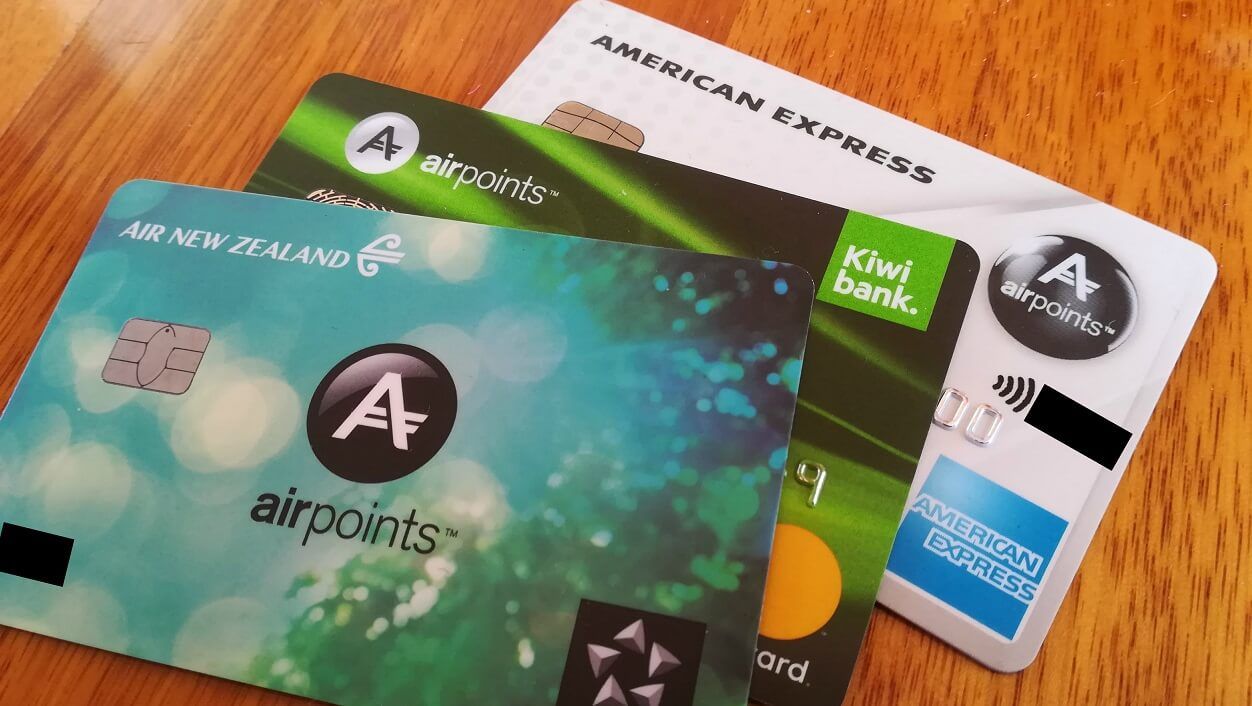
    This is one of the easiest ways to get free Airpoints dollars but also one that you need to micro manage quite closely.

    Banks love it when you sign up for credit cards. Most people in New Zealand are financially illiterate, so a new credit card usually ends up meaning lots of interest, late payment penalties and fees. Obviously banks love this.

    Therefore to encourage people to sign up, most banks offer a signup bonus.

    For example, during the year Kiwibank and Westpac offer up to 300 Airpoints dollars as a sign up bonus on their platinum cards (these bonuses usually come out around January-April, watch out for them!). Just signing up for those two cards is going to give you 600 Airpoints dollars – easily enough for a free return ticket to Aussie.

    Too good to be true? Not really. Just a few things to watch out for here:

    Watch out for the annual fee

    Even though you get a sign up bonus, you still need to pay an annual fee for the card.

    Annual fees range from zero dollars all the way up to almost $400 per year. It’s important to make sure the annual fee doesn’t completely cancel out your bonus.

    As an example, during select months the Westpac World Mastercard offers a 400 Airpoints dollars sign up bonus. However, the annual fee is $395. Therefore you’re only making a $5 “Airpoints profit”. Sometimes the perks can make this card worth it, but from purely a profit point of view it’s a poor choice.

    On the other hand, the American Express Airpoints card offers a 50 Airpoints dollars sign up bonus, and the annual fee is zero. Even though the bonus isn’t huge, that’s an instant Airpoints profit of $50, which is a much better outcome.

    Therefore, it’s important to check the bonus actually covers your annual fee and then some. It it does, you can just sign up for the card, get the bonus and then never use the card, and it will still be worthwhile.

    Cancel after the first year

    The general idea with these bonuses is to get the bonus, then cancel the card within the next year.

    The reason you don’t want to keep the card is because you’ll need to pay the annual fee every year, which usually isn’t that cheap. Most cost around $100-$200 per year.

    Usually what I do is sign up, get the bonus, then keep the card and use it to earn Airpoints for a year (since you’ve already paid for it). Then before the next annual fee becomes due, cancel the card.

    Of course if you like the card, you can always keep it. Some cards like the American Express Airpoints Platinum offer pretty good perks, like lounge access and free travel insurance, so if those are things you use regularly you might want to hang onto it.

    Always go for the biggest bonus

    The thing about Airpoints sign up bonuses is they’re only available for new customers. This is really important to understand.

    For example, you can’t sign up for the standard Westpac Airpoints card, get the bonus, then the following year sign up for the Westpac Airpoints Platinum and get the bonus, and then the following year get the Westpac World and get a bonus again.

    The bonus is usually only available to new customers. That means it makes sense to always go for the biggest bonus, because that’s most likely the only one you’re going to get.

    Some cards operate on an exclusion period, meaning if you close your cards and cease to be a customer, after a certain amount of time you become eligible as a “new” customer again. For example, at Kiwibank the exclusion period is 18 months. So in that case, you could sign up for a Kiwibank card, cancel the card, wait for 18 months, then reapply and get the bonus again. But even if you wanted to try that, it would still make sense to always go for the biggest bonus. If you want to max your Airpoints earning strategy, chasing the biggest bonus is key.

    Don’t sign up for too many cards

    Contrary to what most people think, churning through a lot of credit cards won’t significantly affect your credit rating, unless you’re going through a stupid number each year.

    What affects your credit rating are unpaid bills, loan defaults, bankruptcies – things like that. If you never pay off your credit card and leave money owing on them, then your credit score will take a hit. But if you sign up for one or two new credit cards per year and always pay them off on time, you shouldn’t have anything to worry about.

    My advice here is to just keep things under control. Don’t apply for absolutely everything straight away. I know it can be tempting to just sign up for everything at once, but that can actually compromise your applications. Just sign up for one or two cards, there’s always next year!

    Stay up to date

    Good sign up bonuses only come around once or twice a year. It’s important to keep an eye out – but “booster” season, where the big bonuses come on offer, usually happens in the early months (Feb-April). Keep your eyes peeled during these months.

    The only cards I know that offer bonuses year-round are the American Express cards. Both the American Express Airpoints card and American Express Airpoints Platinum offer a nice bonus and both are great cards as I’ve broken down in my Airpoints credit card guide.

    Update December 2018: The American Express Platinum Airpoints card just lifted its sign up bonus to 300 Airpoints dollars. That’s a very good deal! Check it out here.

    In fact, if the bonuses are on offer and you don’t already have an Airpoints credit card, I’d recommend applying for one of these today.

    If in doubt, go for the free American Express Airpoints card. It has zero fees and you get a $50 Airpoints signup bonus. You’re literally getting offered $50 to fill out some forms and use the card for a month. No brainer! You can apply online here.


    For a thorough breakdown of Airpoints credit cards in New Zealand, I highly recommend checking out my Airpoints Credit Cards Guide. It breaks down all the perks, earn rates, fees and bonuses of every Airpoints card in NZ, and will help you find the perfect card for you!


    Credit card spending

    The next best way to earn Airpoints is by earning points on your everyday spending. Now that you have an Airpoints credit card, everything you purchase on it, even if it’s a pack of gum, will earn you valuable Airpoints.

    This means things like groceries, petrol, clothes, coffee – pretty much everything you spend money on should be purchased with your Airpoints credit card.

    Now, that doesn’t mean you need to spend more money! All you need to do is keep buying the same stuff you buy every day, but use your Airpoints credit card to pay for it.

    How to earn Airpoints on your credit cards fast

    To maximise your Airpoints earnings, there are a lot of little tricks you can do.

    One is to make little adjustments to your shopping habits. For example, there’s a Chinese fruit shop that only lets me pay by credit card if I spend over $20. That means instead of visiting there every couple of days to buy fruit and veges, I just go once or twice a week and do slightly bigger shops. I still spend the same amount of money, but I get to earn Airpoints on all of it.

    Another thing you should do is think about everything you spend money on that you don’t use a credit card for, and if there is some way you can start. I know one guy convinced his landlord to let him pay his rent on his credit card, and another who convinced his employer to use his credit card to pay some company expenses (expenses like Facebook ads and Google ads is good for this. See if you can make something happen!)

    If you run a business, you’re probably already paying for a lot of stuff on credit card, so make sure that’s going on an Airpoints card and you’re earning points for it. I know a guy who runs a pretty successful dropshipping store and pays for all the orders on credit card. He literally flies everywhere for free because of the tens of thousands of dollars running through his card each month.

    People also do things like always paying for group dinners/outings on their cards and getting everyone to pay them back, instead of splitting the bill at the restaurant.

    Get creative, this is what a lot of travel hacking is about – making slight changes to how you do things in everyday life in order to max your points balance. Make it a lifestyle!

    Always pay off your card on time!

    If you find yourself paying interest and late fees on your credit card, it’s going to cancel out all the Airpoints you’ve been earning. Therefore it’s imperative that you pay you card off on time. Be diligent about this! If you don’t get this part right, your whole travel hacking endeavour becomes pointless – you would be better of burning all your credit cards and going back to living off cash.

    The rule is you should never be paying credit card fees or interest, ever, except for your annual fee.

    Achieving this is simple:

    1. Always pay your card off on time.
    2. Always pay your card off in full (not just the minimum amount).

    Just put a reminder in your phone for the end of each month and pay your credit card off that day. You can do it all through internet banking, it takes less than five minutes. Most cards email you when your statement is ready as well.

    If you pay your card off in full, and on time, you should never be paying fees, penalties or interest, ever.


    Airpoints partners
    Double dipping by using Airpoints retailers

    Airpoints has several retail partners around New Zealand where you will earn points just for shopping with them.

    For example, one of these partners is Mitre 10. If you buy something at Mitre 10, they’ll scan your Airpoints membership card and you’ll earn some Airpoints, just for shopping there. That’s your first dip. Then you can also pay for the items with your Airpoints credit card and earn Airpoints again on the same purchase.

    Shopping at these retailers whenever possible is a good way to pad your Airpoints account out with a few extra points, especially if you’re making a big purchase like a dishwasher or fridge (my smart money advice would actually be to buy those things on Trademe rather than a store, but if you prefer to go brand new, definitely try and get some Airpoints ;))

    Some of the more popular Airpoints partners are Z Energy, Mitre 10, New World, Harvey Norman, Liquorland, Tower Insurance, Mercury Energy. Check these out, because a lot of them have pretty good specials. For example Mercury offers double Airpoints dollars every time you pay your electricity bill. There are about 60 partners in total – you can see the full list here.

    This doesn’t mean you can spend more money!

    This is important.

    The premise of a good travel hacking strategy is that you earn your Airpoints for free.

    Do not start paying more for stuff or buying more stuff just so you can earn Airpoints. This defeats the entire purpose of travel hacking.

    For example, you might see that New World is an Airpoints partner so it might be good to go double dip there. But there is no point in grocery shopping at New World to earn $2 in Airpoints if it means you spend $25 more on groceries (New World is expensive). That’s a loss of $23. Obviously it makes more sense to just keep shopping at Pak N Save or the Chinese supermarket and save $25 on groceries.

    It’s the same with filling up your car at Z service stations and earning 1 Airpoints dollar when you can go to G.A.S. or Gull and save way more money.

    This is common sense, but even I catch myself sometimes wanting to fill up at Z just to swipe my Airpoints card. Obviously spending an extra $10 to fill up your car just so you can earn a few cents in Airpoints is stupid. Real dollars are always better than Airpoints dollars.

    You should not find yourself spending more money just to earn Airpoints. If you are, try to rethink your earning strategy because you’re doing something wrong. Your goal should only be to earn Airpoints on money you were already going to spend anyway.

    Take advantage of partner deals

    Quite often, Airpoints partners will offer you special deals that will allow you to earn a quick chunk of airpoints, and just other miscellaneous deals in general. Usually they’re all compiled on the Airpoints website – check them out here.

    The Airpoints Mall

    The Airpoints Mall is a place where you can shop at a variety of retailers online and earn Airpoints bonuses for your purchases.

    There’s actually quite a good selection of shops in here, mostly clothing shops like ASOS, Smith & Caughey, Ezibuy. The only one I ever use personally is Groupon, but there’s a good chance one of the places you shop at is in there.

    Of course, you can double dip here as well! You’ll get Airpoints by shopping in the Airpoints mall, and then you’ll get Airpoints again on the same purchase if you use your Airpoints credit card to pay.

    You can view the full Airpoints Mall listing here.

    Again the same rule applies here. Don’t go shopping just for the sake of earning Airpoints. You should only come here when you were already going to buy something from these stores and want to collect some Airpoints on top. I don’t do a lot of online shopping, but if you are the type that does, definitely bookmark the Airpoints mall and check in there before you buy anything.


    Travel
    The last way to earn Airpoints is by travelling.

    This was the original way for earning frequent flyer miles and is still one of the fastest ways to earn Airpoints today. Basically it works like a loyalty program, so the more you fly the more you earn. Along with your flights, you can also earn points on hotel stays, car rentals and other travel related spending.

    Earning Airpoints on Air NZ flights

    Whenever you fly on an Air New Zealand flight, you should get points credited automatically to your account. The amount differs, but if you fly to Aussie you will probably earn around 15 Airpoints dollars. If you fly to the States, you might earn closer to 30-40 Airpoints dollars. If you fly business class or higher you will earn more (but of course I always recommend flying economy).

    You can use their Airpoints calculator for estimates on how many Airpoints you can earn on each route.

    Earning Airpoints on Star Alliance flights

    You can also earn Airpoints on any of Air New Zealand’s partner airlines. Air NZ is a part of the Star Alliance, which means (almost) any Star Alliance flight is also eligible to earn you Airpoints.

    For a list of all the partner airlines you could earn Airpoints with you can click here.

    You can also use the Airpoints calculator to estimate how many points you could earn on each partner airline route.

    How this works is you will book a flight on a partner airline, say it’s Singapore Airlines, for example. Once the flight is over, make sure you keep your boarding pass. In my experience you will need to claim the Airpoints manually after the flight. I don’t think I have ever had Airpoints from partner airlines automatically credited to my account (and I’ve flown a lot). If you don’t claim your points from partner airline flights manually, you won’t get them.

    There is a short period where you need to give Air NZ a chance to credit your points automatically. Usually it’s around two weeks. After that’s over, jump into your Airpoints account and see if your Singapore Airlines points are there. Most likely they won’t be, so simply select “Claim missing Airpoints” and enter all the details from your boarding pass. Your points should be credited within a few weeks.

    My general rule for flights is I always choose the cheapest flight, and don’t really have any loyalties to any specific airline or alliance. My loyalty is to price and nothing else. However, even with this approach you still need to be mindful of which airlines are Star Alliance/Airpoints partners, so you can remember to claim your points after the flight. Don’t forget! So many people leave Airpoints on the table, make sure you grab yours.

    Earning Airpoints on other travel spending

    You can also earn Airpoints on all your hotels, car and campervan rentals and airport parking.

    To earn Airpoints on hotel stays, you should use the Airpoints booking engine which is partnered with Expedia. Basically you will be using Expedia but through a portal on the Airpoints website. I’ve done a quick check and the pricing looks the same between the two, so it’s definitely better to use the Airpoints version. You can use the Airpoints Expedia booking system here.

    To earn Airpoints on car rentals, you can get rentals from Apex, Budget or Avis. Airpoints has a booking engine for this too which you can find here.

    For campervans, Air NZ is partnered with most major rental companies in New Zealand, which gives you bonus Airpoints. You can see their booking site here.

    For all other deals, such as airport parking, taxis, and a few other things, check out the Airpoints booking deals page, it’s all there.

    And again, double dipping applies here as well. For example, if you take a flight to Sydney on Air New Zealand, you’ll earn Airpoints just for booking the flight. Then if you pay for the ticket using an Airpoints credit card, you’ll earn Airpoints again. The same applies for any hotels, car rentals etc you book through the Airpoints website. You should be able to see how this can stack Airpoints pretty fast!


    How much could you earn?

    Let’s mock up a typical year and see how much Airpoints we could actually earn by doing all this.

    Bonuses

    We’ll sign up for a few credit cards. First, we’ll grab the American Express Airpoints card. That’s my favourite Airpoints card because it’s the only free Airpoints card in the country, and I love free stuff. It also gives you a 50 Airpoints dollars bonus.

    Then let’s say we take advantage of some other sign up bonuses. You can sign up for multiple, but I’ll assume we’ll do just one, maybe the Westpac Airpoints Platinum. During booster season (Jan-April) the Westpac Platinum usually has a sign up bonus of 300 Airpoints dollars, and an annual fee of $145, which equals 155 Airpoints dollars in profit.

    Spending

    Minimum wage in New Zealand is $16.50 per hour, after tax that works out to around $28,000 per year after tax. Let’s assume we save half of it (yeah right) so we have spending of $14,000 per year.

    $14,000 per year on the Westpac Platinum will earn you 187 Airpoints dollars.

    $14,000 per year on the free American Express Airpoints will earn you 140 Airpoints dollars.

    Let’s call it in the middle at 175 Airpoints dollars.

    Bonus points

    Let’s say we earn a further 10 Airpoints dollars on double dips and Airpoints partners (most of you should be able to earn more than that, I earn about that in ~3 months, and don’t leave my house much).

    Travel

    Finally, let’s say we take one flight to Aussie during the year and earn another 15 Airpoints dollars. Maybe you could earn this a different way, through renting a campervan, booking a hotel somewhere, a few domestic flights etc.

    Airpoints earned:

    Credit card bonuses 205
    Credit card spending 175
    Partner rewards 10
    Travel 15
    TOTAL 405 Airpoints dollars

    That’s enough for a couple of domestic flights, maybe a flight to Aussie if you’re lucky.

    If you earn around double what I outlined above (~$56,000 p.a.), you’d be looking at ~810 Airpoints dollars, which is a free flight to Asia, depending on the season, or a one-way flight to Los Angeles or Canada, with a few points left over.

    If you earn around triple what I outlined above (~$84,000 p.a.), you’d be looking at ~1,215 Airpoints dollars, which will easily get you to Paris or Rome, maybe even a return flight on a good deal.

    You could also bump this number up significantly by using one of the faster-earning cards and signing up for more bonuses. If you’re using one of the platinum cards, you’ll probably be enjoying lounge access and free travel insurance too.

    How hardcore your travel hacking gets is totally up to you!

    How to get started:

    Sound good? Here’s what you need to do to get things going:

    1. Sign up for Airpoints. It’s free – just click here.
    2. Get yourself an Airpoints credit card. You can find out which card is best for you in my Airpoints credit card guide here. If you just want the easiest, no frills card, I’d recommend the free American Express Airpoints card, which is what I use. It’s the only free Airpoints card on the market, so you can’t go wrong with that one (you can’t lose money on a free card!)
    3. Bookmark the Airpoints deals page here. Check in each month.
    4. Bookmark the Airpoints Mall. Check in here before you go shopping for anything.
    5. Start using your Airpoints credit card at every opportunity and racking up points. Get creative with it. Don’t forget to pay your card off in time and in full every month.
    6. Watch the points stack up and repeat!

    Best of luck and hope to see you in the air soon 🙂

    Questions? Leave em below.

    Bren
  • How I Broke My Shoulder And Then Fixed It

    How I Broke My Shoulder And Then Fixed It

    We each picked up another rock and stood laughing by the edge of the maize fields. The kids threw first, one after the other. We watched as the rocks sailed into the sky before falling somewhere in the distance among the stalks. Then they looked up at me, waiting for me to throw. I gave my shoulder a little rub, hesitant. It had been so long since I’d thrown something at full effort, scared I’d break something again; the last few rocks we’d thrown I’d just lobbed into the air lazily, like always. But for some reason I felt better today.

    “What the hell,” I thought.

    I gripped it loosely between my first two fingers, like a cricket ball, did a little hop step, and let it rip with everything I had.

    Zoooom.

    We all stood there in a line, eyes in the sky, watching it soar way into the distance, these little kids laughing wildly as they pointed to it, wondering how it was possible to throw something so far. Even I was surprised. As it landed I gave my shoulder another rub, just to check if it was still in one piece. It was fine. After five years, maybe my shoulder was finally back to normal.

    A bad shoulder is born

    It is hard for me to pinpoint the exact time my shoulder starting niggling. I’ve had niggling injuries all my life. Ankle, hamstring, wrist. I vaguely remember my shoulder pinching mildly around 2012, when I start hitting the weight room hard, like every other mid-twenties male. But injuries for me were always minor inconveniences. I would rest and stretch for a week, then it was right back into the action.

    In 2013, I was throwing rocks out in Ethiopia somewhere and felt a sharp jolt in my right bicep. Normally I shrug things like that off, but this one was different. It was a piercing pain that made me really stop and think “ooh”. But even then, I just gave it a rub and thought it would sort itself out in a week or two.

    A few weeks on and it was still uncomfortable for me to do basic things, like push ups or just lifting my arm above my head. Maybe it needed a couple more weeks to heal itself up.

    Of course, that never happened. 

    What followed was three years of doctors visits, physios, scans and X-rays, frustration, fear, despair. None of them managed to fix it. It affected my sports, my workouts, even the way I did simple things, like reaching for the salt across the table. At one point, it almost felt like I was going to be “that guy with the bad shoulder” for the rest of his life.

    Of course, I wasn’t able to let that happen – I’m too obsessive to let things go like that. Eventually, I realised the only person that was going to fix this problem was me. Googling, research, books, emails, experiments. Today, five years later, I’m 95% cured. I fixed my own permanent injury, and hopefully it’s a story that will help many of you out there do the same thing.

    The physio and doctor world tour

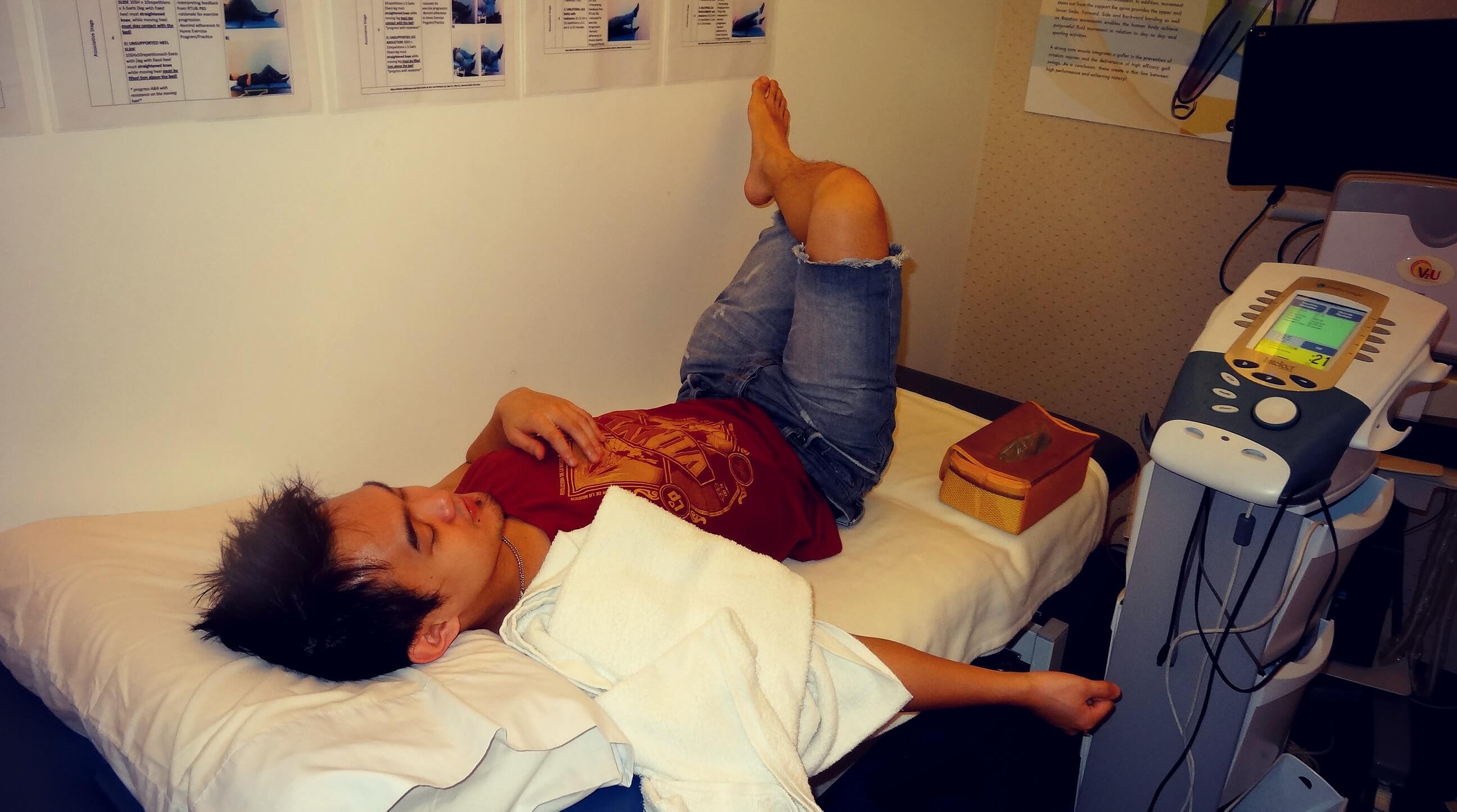
    I saw my first physio about two months after feeling that first jolt in my shoulder. I was living in the Philippines at the time. This was the beginning of my little world tour of shoulder treatment. The physio didn’t give me any real diagnosis – she just did the standard assessment, gave me a few exercises with the stretchy bands, massaged it, hooked me up to some UV machine or something. Over the next few weeks of seeing her, things improved a bit, but only marginally.

    By this stage I wasn’t doing any shoulder work in the gym anymore – I was too weak to lateral raise even a few kilos. I started to wake up with a sore shoulder in the middle of the night or in the morning, meaning I had to start sleeping on my left side only. It was starting to affect my day-to-day life.

    I saw a new physio the following year back in Auckland, maybe six months later. Her diagnosis was a bad subscapularis and some bicep tendonitis. I must have visited her about ten times, and each time was the same thing. She’d do some assessments, I’d tell her it still hurts, and then it was just the same advice as last week. Do more exercises, strengthen it up. Every morning I was doing shoulder rehab exercises, dozens of them. The shoulder improved slightly (maybe, I don’t even know for sure) but nowhere near to 100%. 

    After no real results with the physio, I finally went to see my GP. His diagnosis was chronic inflammation of the bursa, or bursitis. The bursa is a little sack of fluid between your neck and shoulder. Since the problem had been going on for so long (around ten months now) my GP recommended a cortisone (steroid) injection, because he said no amount of physio would fix such heavy inflammation. A few days later I visited a clinic and they did the injection under ultrasound. I saw my big inflamed bursa on the screen.

    “See your bursa, it’s normally as thin as paper,” the doc said.

    Mine was all swollen up like a mushroom. I watched the needle jab right in on the screen and pump in a dose of steroid. It was done in two minutes.

    Things improved a lot after that, maybe to 75%. I went to my physio again two days later and had big improvements on all her standard assessments. I felt like I’d finally found the answer. Steroids for life!

    But gradually things got worse again. A few months on and I started to feel the sharp pinches again, and still couldn’t lift as heavy as before. Things slowly deteriorated. I figured I’d see someone new – give it one more shot. I was in Bangkok at the time, and made an appointment with a shoulder specialist at Bumrungrad, the renowned international hospital.

    That hospital is like a space station. I signed in and registered as a patient, got an ID card, and then was escorted up to the specialist area by my own personal guide. I remember looking down on the hospital, from the window of the ten millionth storey. If they can’t fix my shoulder here, nobody can.

    The doctor was Thai, but spoke perfect English, no doubt from his American education, which was evidenced by his row of degrees on the wall. We had a long conversation about the entire backstory. He said the obvious thing to rule out first was any structural damage. “Have you had an X-ray done?” he asked. I shook my head. “Well, that’s kind of an obvious place to startCome with me.

    We walked down the hall to the X-ray room and did an X-ray on the spot, with some kind of new-age X-ray machine I’ve never seen before. Then we headed back to his office where he showed them to me.

    “It looks normal. Since you’ve seen so many people already, I’d suggest we do an MRI. Rather than just poking it with my fingers and guessing, on an MRI we can see everything clearly. If anything is wrong, we’ll be able to see it right away.”

    That made a lot of sense to me. This guy was making the most sense out of anyone I’d seen thus far. I returned the next morning and did an MRI. If there was once place where I could afford to do it, it was here.

    Later that afternoon I returned to the doc and he gave me the news.

    “Everything’s normal. You have a small, small tear on your labrum, nothing that won’t heal up by itself.”

    He gave me a short lecture on different strengthening and postural exercises, and some pain meds just in case. That was it.

    This was a huge letdown. The MRI had sounded so promising. I thought they were surely going to find something in there, maybe even a wild parasite eating away my shoulder muscles or something. But I was again left with no real answers.

    It was at this time I learned the real meaning of health is wealth. Who cares if you have a billion dollars if you can’t even reach into the top cabinet? I was starting to get depressed about the thought of all the things I may never be able to do again. Was a little shoulder injury really going to stop me from doing so many things in life?

    Luckily, just a few days later, I made a discovery that changed everything.

    The blog post that changed my life

    It was just happenstance that I found a blog post by Clayton at Spartan Traveler called How I Broke My Body And Then Fixed It (his blog is also amazing for anyone into productivity/long term travel/online business – he doesn’t post often but when he does it’s top notch – check it out here.)

    As you can see, this post you’re reading right now is named in honour of Clayton’s. This was the turning point that finally led me in the right direction.

    In that article, Clayton laid out a story almost identical to mine, but it was about his knee. As I read through it I found myself nodding, nodding, hoping there would be a magic answer at the end. And there was, kind of. 

    I also reached out and emailed him, telling him how awesome his post was and how much I had learned from it. Like every real blogger out there, he hit me back!

    Building my own path to recovery

    There is a lot of theory that relates to what I’m going to talk about below. Clayton explains it all in his blog post, I won’t repeat any of it here. If you’re dealing with long-term injuries I would highly recommend reading his post first.

    The first thing I started doing was watching the videos by Mobility WOD (Workout Of The Day) like he recommended. These were short, daily videos by Kelly Starrett – the movement guru, author and doctor – giving you short ten minute exercises to do each day. The goal is to break down soft tissue that has knotted up, fused to bone, and re-open up movements, some of which might have been restricted for years or even decades. Think of it as giving yourself a Thai massage but 10x more painful. Obviously this takes some work, although the concept is reasonably simple.

    I started with all the shoulder ones. I still remember the first one I did. I was in Quito at the time, in a little hotel using a broomstick and a ball from a toy store. The video below was the exercise I did and gave me almost instant relief:

    Now imagine what I’m thinking at this moment. Four doctors in three different countries over three years couldn’t figure it out, painkillers and steroid injections couldn’t fix it, then this random guy on the internet makes magic happen in five minutes on Youtube. Over the following days I moved onto all his other shoulder videos, then moved on to back, neck, bicep, and everything else.

    These MWod videos brought my shoulder to around 80% health in just a few days. I was in Quito learning salsa at the time, and was finally able to get back in the gym in the mornings, lifting weights and slowly building my strength up again. I started every day with MWods and gradually improved even more. It was hard work, but obviously worth every second. Soft tissue work and mobilisation on Youtube was more effective than all the physios I’d seen put together, and in a ridiculously short time. It was as close to a magic bullet as I could have gotten. Not to mention, not a single “professional” had even mentioned this kind of therapy, let alone recommend I actively include it in my daily rehab.

    Getting to the next level

    Of course, this was only the beginning. What I wanted to build was a shoulder that was even stronger than before, too strong to be injured again. That wasn’t the case yet. I was still having to lift easy in the gym, and still had pinches in the front delt and bicep every now and then.

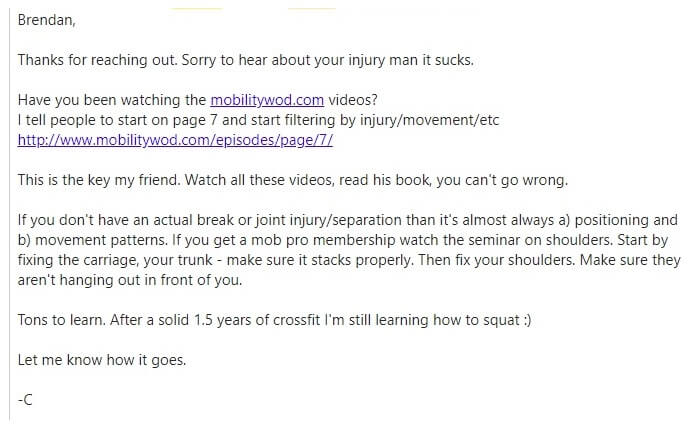
    Clayton had recommended a book called The 4 Hour Body by Tim Ferriss.

    There is so much information in this book. Even now several years later I still pick it up and flick through some chapters and find things I didn’t even notice the first time.

    Maybe that’s why the first time I read it, it was a little bit heavy for me. Too much information and not enough personal context to relate it to. 

    However, about a year later I re-read the book and everything clicked. 

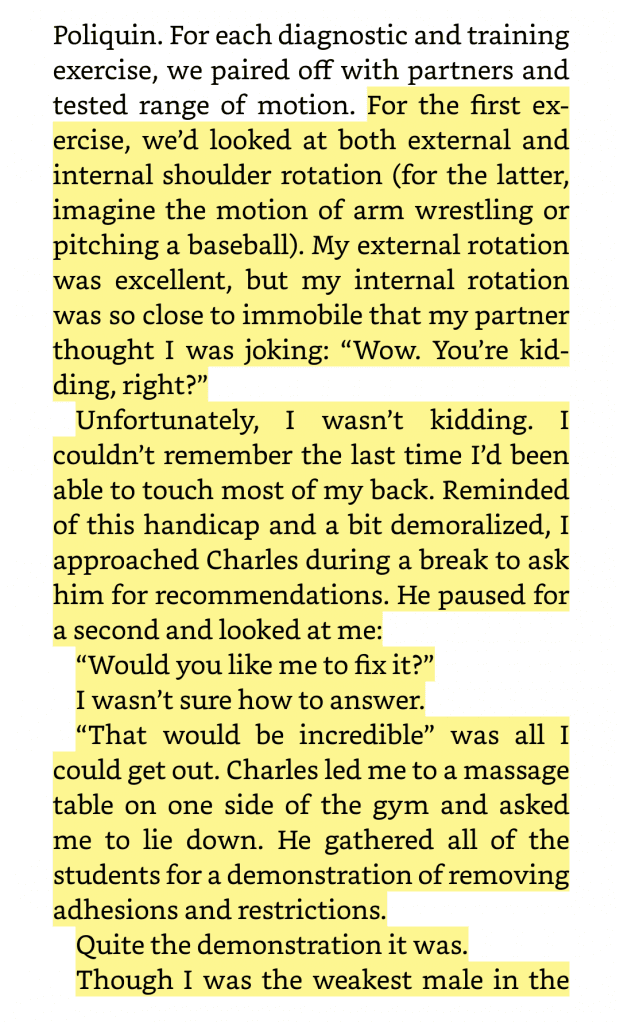
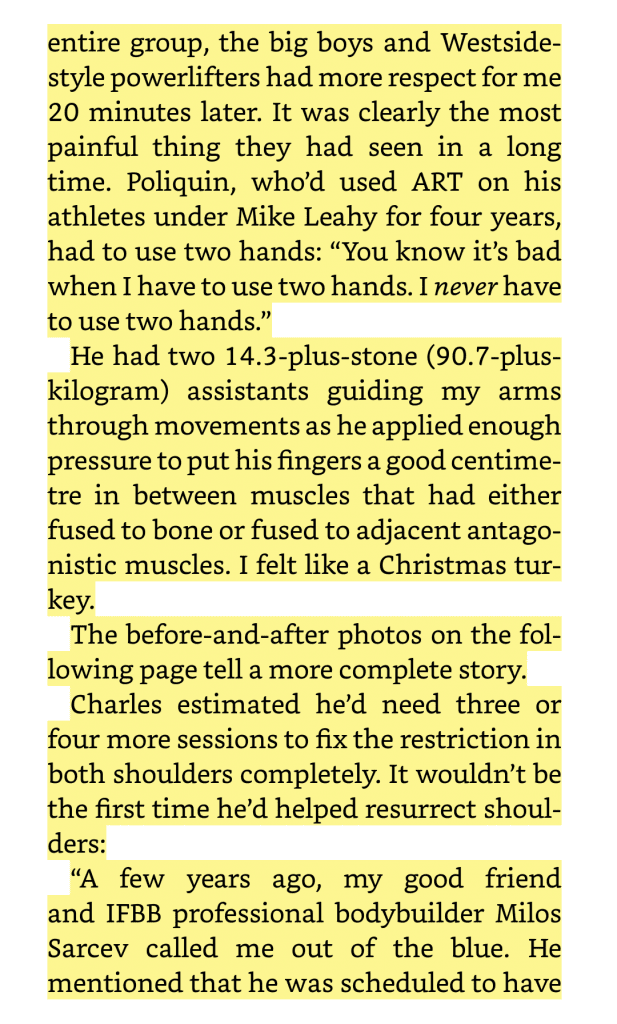
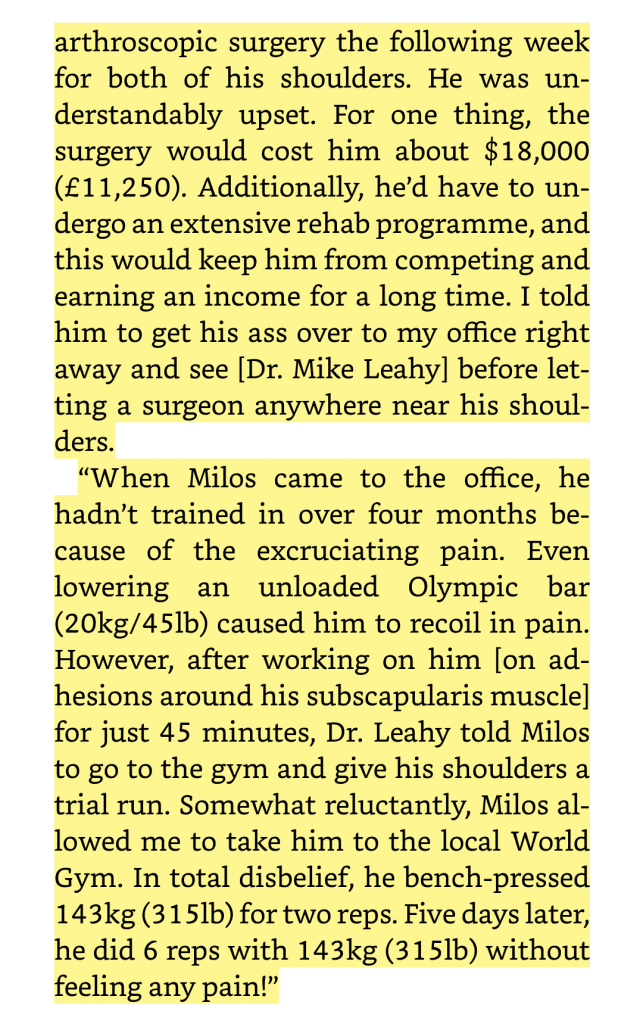
    There are two chapters in the book that are exceptional. The first is called Reversing Permanent Injuries.

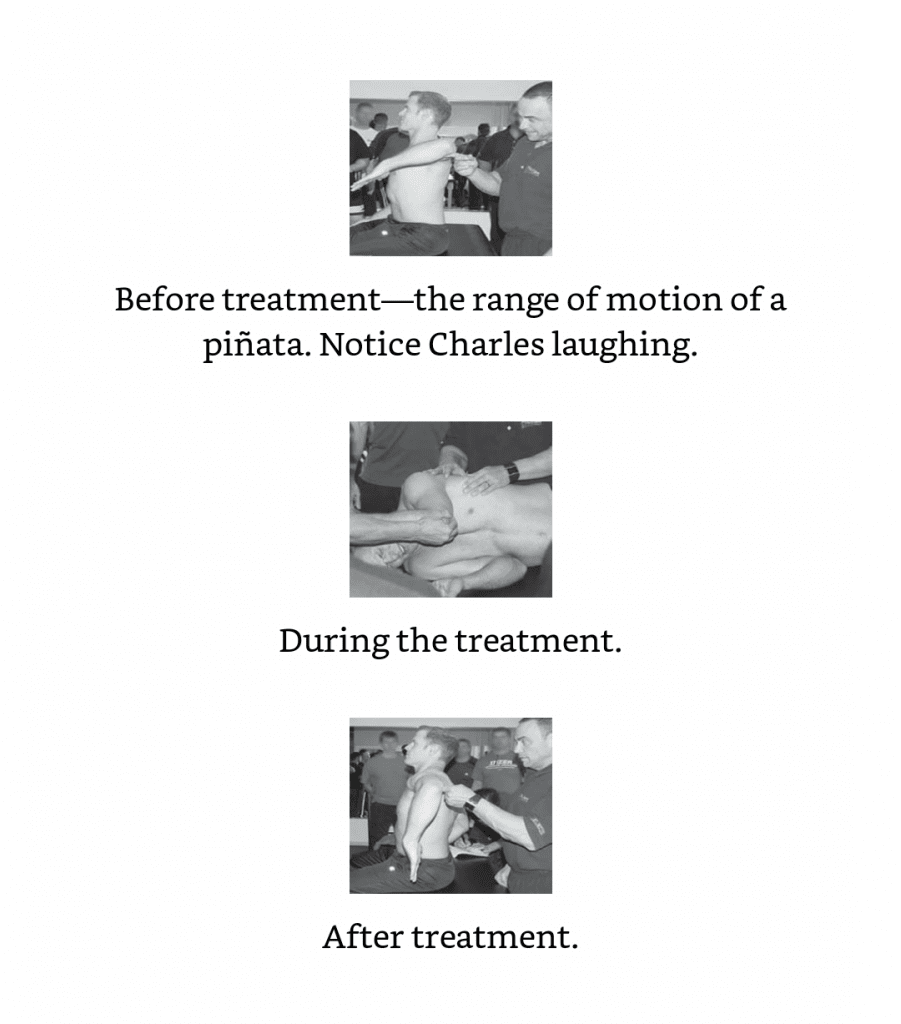
    Here are a few pages from that chapter:

    My internal rotation was about as good as Tim’s in the photo. Maybe slightly worse. So, it was back to Mobility WOD to find exercises for improving internal and external rotation. I also saw an ART doctor in New Zealand for 2-3 sessions, who helped loosen things up nicely, but in the end I figured it was mostly stuff I could do at home.

    Today, my internal rotation is excellent. No physio, no surgery. Just regular mobilisation work from Youtube. Just one example of the many improvements I’ve made from info in this chapter.

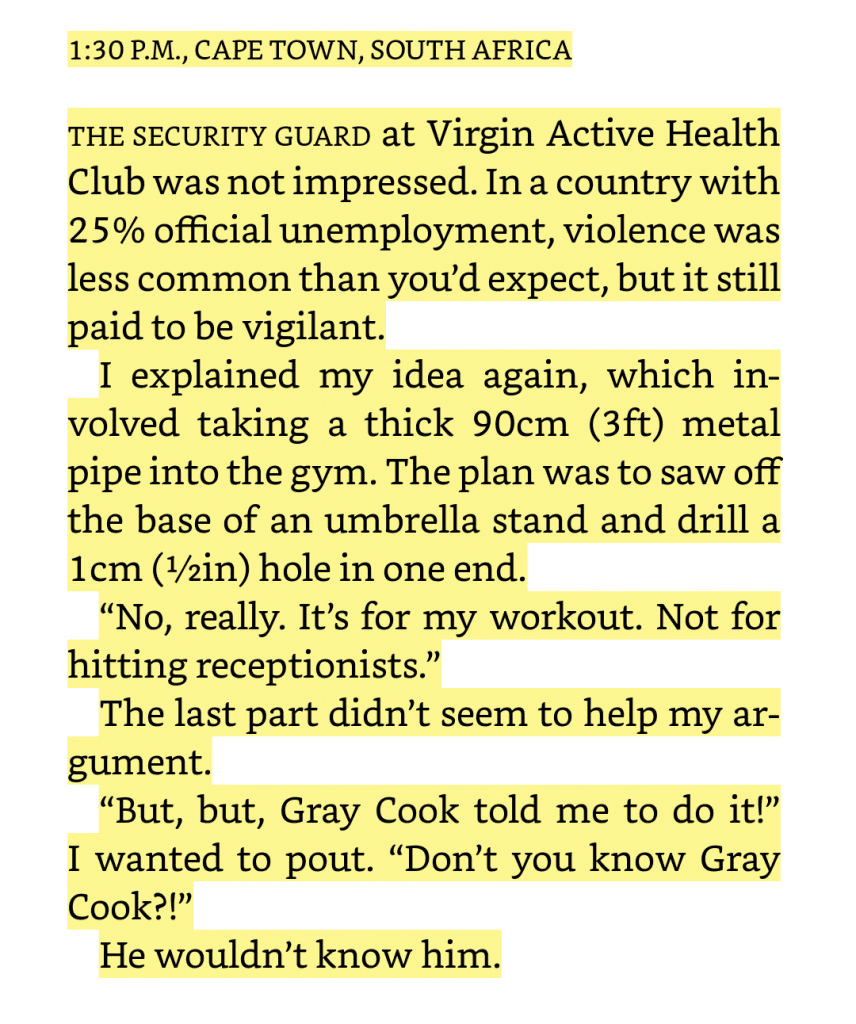
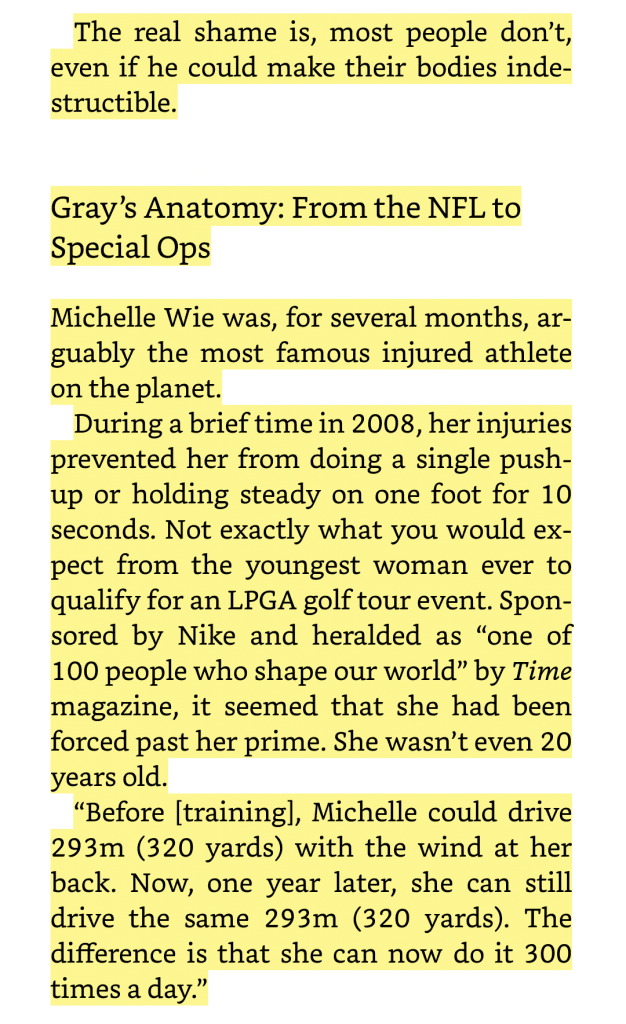
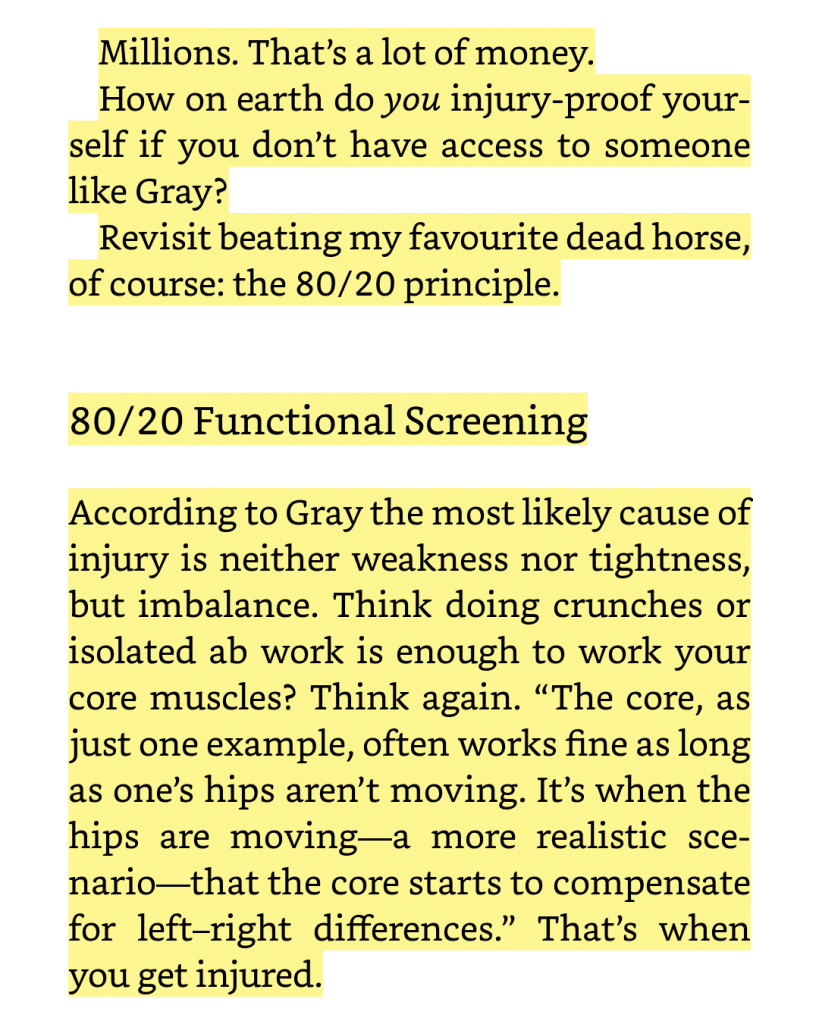
    The second chapter that really changed the game for me was called Prehab. Prehab is about injury proofing the body, and is possibly the most interesting chapter of any book I’ve ever read in my life. If you’ve ever dealt with serious injury, it probably will be for you as well. Here’s the introduction:

    One of the exercises described in the chapter to both test for and fix these imbalances are “the chop” and “the lift”.

    These can be done on any standard pulley machine in the gym, or even with resistance bands. This video offers a good explanation of what they look like:

    After self-testing myself, I found my right side was 4x stronger on the lift. It was a whopping 10x stronger on the chop.

    If imbalance causes injury, I was a multi-muscle injury time bomb waiting to explode. 

    But this shouldn’t have been surprising. I use my right arm 10x more than my left arm, so why wouldn’t my right side by 10x stronger than my left? And over 30 years of life surely that imbalance would lead to some kind of problem. Maybe that’s why people get more injuries as they get older. This is the kind of thing that seems obvious when you think about it, the problem is, you never think about it. 

    Over the next 2-3 months I started my rebalancing program. I did the chop and lift every morning: 2-3 sets on my strong side, 5-7 sets on my weak side. In a pretty short time I made big progress, bringing the imbalance to about 2x, down from 10x and 4x. This is in fact how I do almost all my workouts now. I used to do equal sets on either arm/leg, but now I always do more on my weak side to close the imbalance.

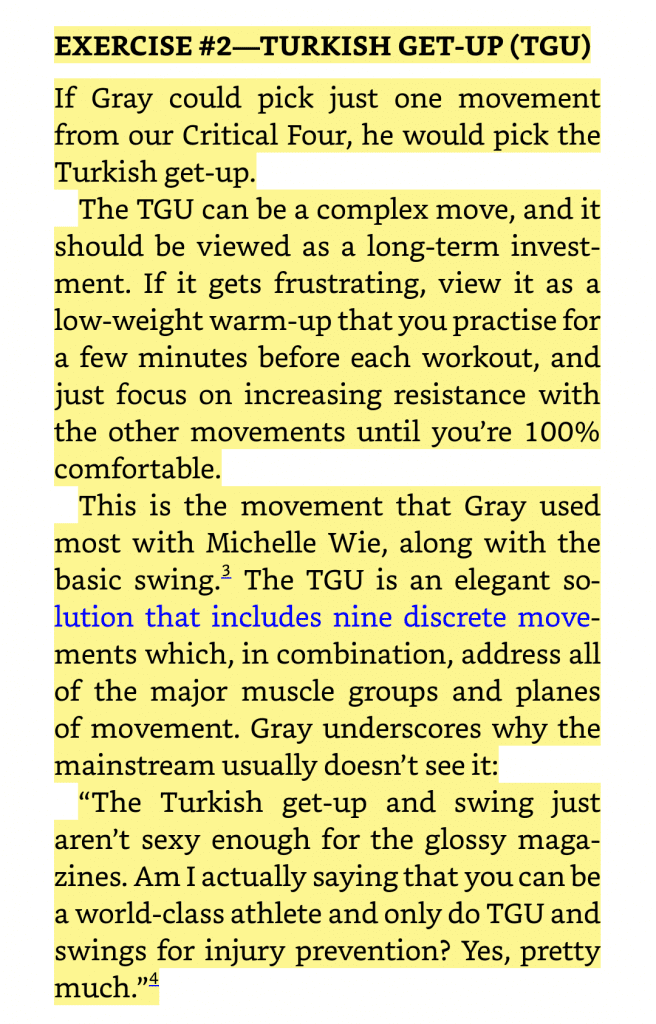
    There is another exercise outlined in the book called “The Turkish Get-up” or the TGU. Here’s an extract:

    The last two sentences sums it up: Jon Torine, head strength coach of the Indianapolis Colts, is also referenced in the chapter: 

    “My job is injury prevention and performance enhancement. I start with the TGU. I finish with the TGU. I check progress with the TGU.” Since Torine joined the Colts, they’ve had the lowest injury rate of any team in the NFL. The TGU works!

    Here’s a good tutorial on it:

    I do the Turkish Get Up as often as I can, every day if possible. It’s a perfect exercise for stabilising, but is also a full body workout too. I do a weak/strong ratio with this too, so I usually do 2 with my right arm, 5 with my left arm. Even today, after doing this for a few years, my right side is much stronger than my left. A lifetime of imbalances takes years to fix.

    All this information was instrumental in returning my shoulder to health. Because I finally had a “diagnosis”, I was able to go full steam into researching and understanding everything there was to know. And usually when that happens I go way into the rabbit hole and when I get to the end I start digging for even more. Steady progress over the next year brought my shoulder back to around 95%. 

    Relapse

    During my Eurotrip of 2016 I started to slack off a bit – I was travelling with bands and a ball but just never really found time to do any body work. I was still doing pushups and other bodyweight exercises every day, but because I wasn’t dealing with any injuries anymore I started to lose interest in the mobility side of things. I was also country-hopping like a mad backpacker through Europe so it was just never on my mind. Unsurpsingly the shoulder pain started to emerge again. It even got so bad I remember hunting for a pharmacy in Copenhagen to buy some pain meds during the latter half of that trip.

    But because I was already armed with the knowledge of how to fix it, I wasn’t too worried. When I finally settled in Berlin, I started getting back on my daily mobilisation work again. It ended up being another few months before I “fixed” my body again. But this time the doubt was never there. I knew what I needed to do, and I did it, and it worked.

    Just by luck I also learned some new stuff during this time. Luckily, one day while lounging in the hostel, I came across this gem on Joe Rogan’s podcast, where a shoulder specialist came on the show and introduced me to brachial hanging also known as “relaxed hanging”. Check it out:

    Can you imagine that? Simple hanging from a monkey bar each day has a higher success rate than shoulder surgery. It is information like this that is not widely available in the medical profession. They’re great at finding the right medications and surgeries, but stuff like this isn’t in their textbooks. You have to hunt for it on the internet. Interestingly the MWod guy posted a similar video recommending this same exercise about a year later.

    As soon as I saw this video I started hanging every day. The results were awesome. Shoulder loosened up instantly and you can literally hear the fibres grinding away. Before I had been struggling to find a place where I could do a lot of my exercises, but hanging was something I could do anywhere. I was in Germany at the time, and started doing my daily hang from the rails of the top bunk bed. In the next hostel I was doing it under the staircase.

    This period of time was a good lesson that nothing is ever truly “cured”. You need to look after your body constantly, or you simply fall into the same cycle that got you injured in the first place. And was also a good reminder that there’s always more to learn, even if you don’t think you need to.

    Maintenance, maintenance, maintenance

    Now that I’ve got a good understanding of shoulder mechanics and how my shoulders became broken, I’m always looking for new ways to keep the shoulder healthy.

    The main lesson I’ve learned is to treat the body holistically (meaning treat the whole body, not just the problem area). If the shoulder is injured, you can’t just treat the shoulder. In fact, it might not even be the shoulder that’s broken. It might be your hip or back or chest that’s busted, and that’s what’s throwing your shoulder out of whack. I’ve read countless blog posts now about people who had a sore knee, but it was actually their ankle that ended up being the cause, or maybe they had a sore back, but it was their knees that needed fixing. 

    Treating your body holistically also means managing your diet, your stress levels, your sleep. An inflammatory diet makes your more prone to injury. High stress levels slow down your recovery. Lack of sleep cuts down on your healing time. If you have a bad shoulder, don’t just try to heal the shoulder, try to heal the whole body.

    Other things that I do are I travel with a hockey ball and resistance bands so I can do all my Mobility WOD exercises on the road. Prehab is always better than rehab; just a few minutes a day and you can do a lot to prevent your body from breaking. The thing about serious injuries is they rarely happen out of the blue. They usually happen by wearing down a muscle for many years, until it finally hits the limit and poof. So doing maintenance work on your body isn’t just something you do when you’re “injured”. This has to become a part of your daily life.

    How To Cure Your Own Permanent Injuries

    If we go back to the beginning of this story, it started with a physio, then another physio, then a GP, then a steroid injection, then a specialist, then an X-ray and MRI, plus a bunch of pain meds and home exercises and every kind of diagnosis. Over three years I was treated for bicep tendonitis, inflamed subscap, chronic bursitis, three different countries, nobody could fix it.

    I’m also near certain had I simply continued with the advice I was given (painkillers, physio, cortisone) I’d be having shoulder surgery in the near future, if not already. I would almost certainly be looking at an entire life with a bad shoulder. 

    That’s not necessarily what surprises me. What surprised me in the end was how simple the cure was – no surgeries, medications or expensive therapy. When I look back on it, here’s all that was required:

    1. Doing shoulder soft tissue/mobility exercises every morning from Youtube (5-10 mins a day, free)
    2. Turkish get ups (5-10 mins a day, need a kettlebell or something heavy)
    3. Chop and lift (20 mins a day, need a basic gym or resistance bands)
    4. Hanging from a bar (2-3 mins a day, free)

    Obviously it took a lot of time to discover and experiment with all these, but those four exercises are what had about 90% of the effect. And all that information I got from a book on Amazon ($10) and the internet (free).

    This is the power of research and reading. All the answers are out there if you’re willing to hunt long enough to find them. With the internet we are all connected and can share our experiences. If anyone you know has a “bad shoulder” or “bad knee” or “bad back”, please send them this post or Clayton’s post and give them an introduction to this. The amount of people I’ve read about who have turned their “injuries” around with such simple methods is astounding. Hopefully this post can help us add a couple more.

    Resources

    Here are a list of resources I highly recommend to anyone dealing with lingering injuries:

    The 4 Hour Body by Tim Ferriss – so much amazing knowledge in here from self-experimentation. Changed my life.

    Mobility WOD Youtube channel – Literally hundreds of videos on restoring movement to every muscle in the body. Spent hours watching these.

    Becoming a Supple Leopard by Kelly Starrett – Book by the Mobility WOD guy on all things movement and mobility. It’s huge like a bible, I have it sitting in my weight room at home. Covers everything!

    Move U on Instagram – This is my favourite Instagram page, and the two guys who run it are really good at explaining things. They cover a new muscle group each day, and give you exercises to do.

    vinnierehab, adam_rehab, drkev_hyrbid – Three guys on Instagram from a rehab company that all post really interesting info and exercises.

    Pretty much everything I’ve written in this article I learned from the above resources. Almost all of them are free.

    And remember, even if what I’ve listed above doesn’t have the answer to your specific problem, I’m sure someone out there does. So much of the advice is universal to a healthy body anyway. Keep searching, asking questions, trying new things. And don’t give up! 

    Bren

  • The Secret To Solving All Your Money Problems

    The Secret To Solving All Your Money Problems

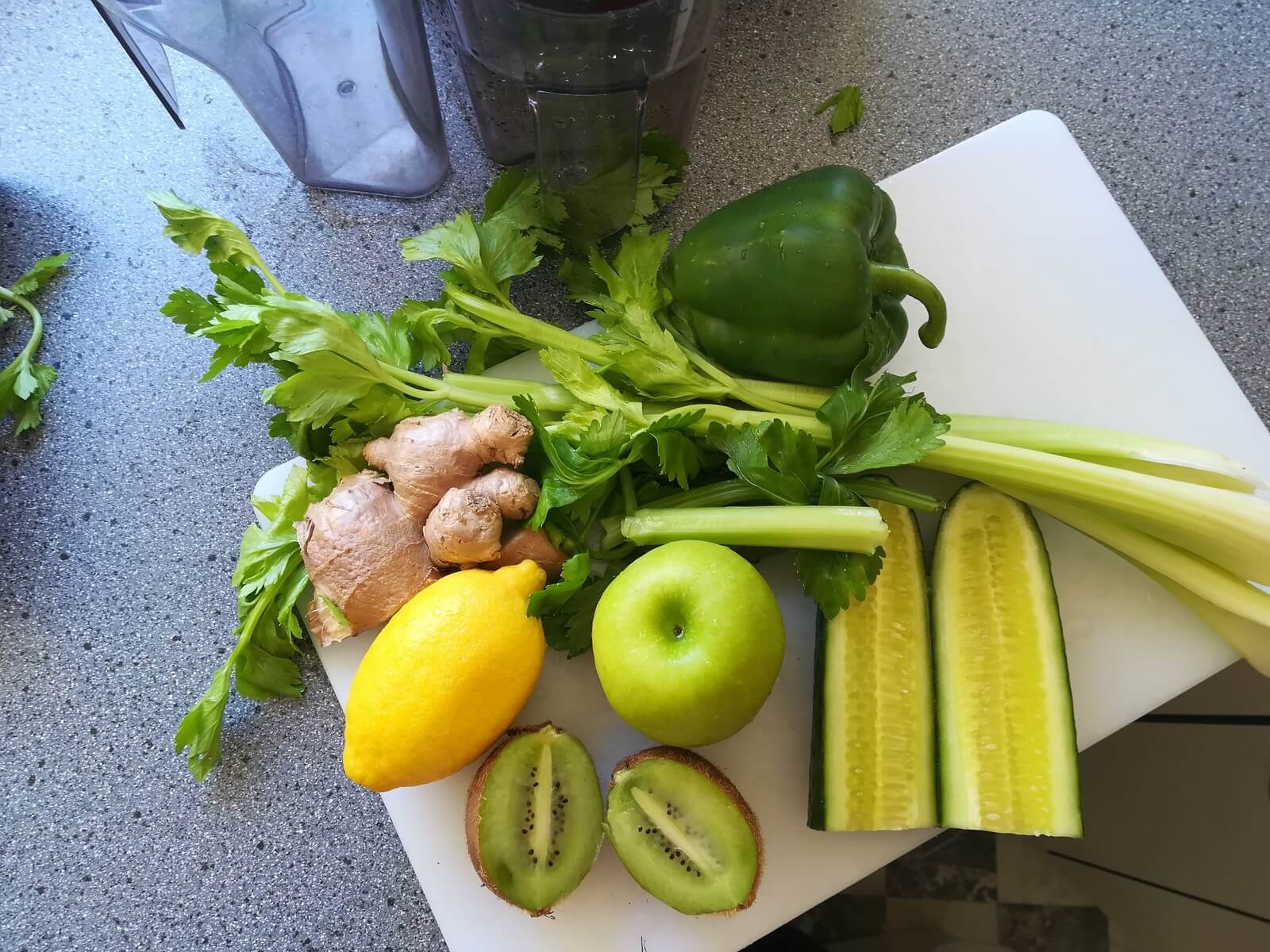
    I bought a new juicer recently. Want to know how much it cost?

    $285.

    I agonised over it for days. My old juicer was working fine, but the new juicer was supposed to give me more juice, which meant more nutrients, and less waste, and hopefully that would make it worth it in the long run.

    But $285? For a juicer?

    When it arrived, I tested it against my old juicer. I weighed the carrots, and put them in the old juicer. Then I put the same amount in the new juicer. I weighed the juice. A 10% difference. So assuming each glass of juice has $4 worth of ingredients in it, and I save 10% each time using the new juicer, that’s 40 cents on each juice, meaning I need to make 712 juices before the juicer pays for itself, and since I’m only in New Zealand for 3 months per year, it would take me around eight years. Worth it? Probably not.

    I still had 28 days on the guarantee. I decided I would return it.

    A few days later I met up with a friend I hadn’t seen for a while. She’s a hard working girl, two young kids, has her own business. I pulled up to her house and saw a new car in the driveway. Audi. I grinned, and shook my head. I already knew what we would be talking about.

    She came out and got in the car. I hadn’t seen her in about a year. She looked…older.

    “Nice car,” I smiled.

    She smiled back knowingly.

    “Is it brand new?”

    “Yeah.”

    “How much was it?”

    “I’m not telling.”

    “C’mon tell me.”

    “$75,000.”

    I laughed, and then she laughed, and then I laughed some more, and then she punched me.

    Seventy five thousand dollars!!!! For a car.

    I decided right there and then – I was allowed to keep my $285 juicer.

    As we sat there chatting that afternoon, I was suddenly plunged back into the stress of everyday life in Auckland. We talked about her money problems, all the things she wanted, how she was struggling to stay on top of everything. It was a sudden dose of culture shock for me. Doubly so, because the culture I was being shocked into was a culture I was once a part of. One thing I take for granted is, the community on the road is mostly free of this talk. We never talk about mortgages, or car payments, because none of us have houses, or cars. We never talk about retirement funds, or renovations, or office politics. We mostly talk about how to find cheap flights, and good street stalls to eat at, the Airbnbs we’re staying in, which coffee shops have the best internet, the Australian girl in the hostel we try to avoid at breakfast, how the avocados at Ali’s Fruit Shop are fifty cents cheaper than the ones at Lidl. The energy in our conversations is usually calm and peaceful.

    This conversation was not calm or peaceful. She was stressed about her car payment. She was stressed about her business. She was stressed about her relationship. She was stressed about everything. She showed me a house she had wanted to buy on her phone. “Look at it, it’s perfect. I’m in love with it.”

    “How much is it?” I asked.

    “They asked for bids in the low 900’s, so I offered 920k. But then someone offered 960k! Do you think I should counter-offer? Look at the deck, oh my gosh. It’s so perfect.”

    As if she wasn’t juggling enough already, she was thinking of adding a million dollar house to her problems.

    Later in the car before I dropped her home, she showed me a voucher on Groupon. It was $240, for a fancy lunch buffet somewhere. I lost it.

    “There is never a time where it’s okay for anyone to pay $240 for lunch. Put that shit away right now!”

    “That’s cheap! It’s for four people. It’s usually $100 per person!”

    My friend is not poor. She has a business, works hard, makes a good living. As you can see, she drives a nice car and lives in a nice house. She’s the kind of person I would expect to be living a good, stable life. But she isn’t.

    Even though I was surprised at the situation, I shouldn’t have been. When I was an accountant, I saw this sort of thing all the time. It was my job to look through the client’s bank statements and sort through all the things they were buying. I had a front row seat to people’s financial disasters.

    One particular client I remember well. He earned over a million dollars a year and couldn’t pay his final $50,000 tax bill. All he (and his wife) had to do was keep their spending to $950,000 that year and they would’ve been okay. But no, they had to spend the full million. Where did it all go? Houses, holidays, expensive cars. The kind of cars that cost $75k. The kind of houses that cost a million dollars.

    I see this problem every day. Many of us struggle with money. We don’t have enough, we don’t earn enough, we can’t pay for the things we want. But if people earning a million dollars per year can’t even make ends meet, what does that tell you? It’s this:

    Your money problems will not be solved by earning more money.

    If you want to solve your money problems, the secret is a lot simpler:

    Change your relationship with money.

    You probably just rolled your eyes. You didn’t want to hear that. Because that’s not a convenient answer, is it? You wanted me to tell you some easy ways to get rich so you can go out and buy all those things you want.

    But even if I could tell you that, it would lead you nowhere anyway.

    You can see this all around you. Pro athletes going bankrupt. Multi-millionaire celebrities suffering from depression and anxiety.

    Even more telling, consider this: Every week someone in your city wins the lottery. Apparently if you win that, you’re living the dream. But statistics show that 70% of lottery millionaires will lose the entire fortune within a few years. Even more telling, 30% of big lottery winners will end up filing for bankruptcy. Big lottery winners are also more likely to become estranged from family and friends, and have higher incidences of suicide, depression and divorce than the average citizen. As the saying goes in the finance world – if you really, really hate someone, give them a winning lotto ticket.

    Everybody is adamant this will never happen to them.

    “Man, those people must be really dumb or something.”

    Ask those same people what they would do if they won $5 million tomorrow, and the answers will mostly be the same. They’d quit their job. Strike one. Then they’d buy a new house and a new car. Strike two. Then they’d go on holiday. Strike three. You lost your source of income, you bought expensive assets that create no income (and a lot of expenses), and now you’re spending your time on holiday splurging and doing nothing. You’ll be broke in five years. The perfect example of a toxic relationship with money.

    A healthier answer? Don’t quit your job. Don’t buy a new house. Put all the money in the bank. Go back to work tomorrow, and just keep living your life. You’ll never need to worry about money ever again.

    Not a sexy answer. That’s why nobody does it. It’s also why they all went bankrupt. What makes you think you will be any different?

    Here’s an inconvenient truth. You and I are average people. Your IQ isn’t 200, your dad isn’t a billionaire, and you’re not inventing the next Google. Neither am I. If we were, you wouldn’t be reading this blog and I wouldn’t be writing it. That means if we want to be at financial peace, we need to do it the ordinary way. But earning more money will do nothing. Winning lotto will do nothing.

    You will not solve your money problems until you change your relationship with money.

    Think back to when you were a kid. Your mother gave you $5 pocket money each week, and you’d buy a couple of chocolate bars, or a pack of basketball cards, maybe you’d save up for a few weeks and then buy a video game. Then one day you got a job at the corner store, and the owner started paying you $50 per week. $50 per week! You didn’t even know how you were going to spend $50 per week.

    And now think about today. Maybe you earn $50 per hour. It’s still not enough. When you break six figures, still not enough. Then you get your first million. Still not enough.

    Where do you stop? 

    This is the culture we live in. If your salary is not growing, you’re failing. If you haven’t upgraded your car in five years, you’re failing. If your company’s profits are not growing, it’s failing. If your country’s GDP isn’t rising, it’s failing. Nobody wants to be failing.

    This is the culture of more. We can’t complain, we created it. But the thing about a culture of more is, there is no finish line. You’ll be chasing it forever. Since none of us live forever, it’s a game that can’t be won. So why are we still playing?

    About four years ago, I wrote an article called The One Simple Lifestyle Change That Will Transform Your Life. It was an article that explored the idea of living simply, based on my experiences on the road. Silly me thought I was onto something new; showing people the cool mini sub-culture of my backpacking family, at the time completely unaware that “minimalism” was already a thing. After publishing it, I started getting hundreds of readers a day searching for “simple lifestyle” on Google, and soon discovered the already thriving minimalist movement that was tearing through Instagram, plus many others, including the very cool nomadic spinoff, #vanlife

    I started reading the stories of many people around the world who had left high-stress high-income careers to live freer, simpler lives. Small houses. No car. Tee shirts. Jeans. Picking fresh fruits and veges. Travel. Long lunches. Music. Reading. I thought to myself, is it actually happening? Is being rich actually going out of fashion? Sure enough, a movement was growing, the culture was changing. I realised I was actually a part of something – a worldwide community of people trying to live simpler, more purposeful lives. But more importantly this told me this wasn’t just a philosophy for the crazies. This was for everyone.

    There’s an old saying, which I’m certain you’ve never heard before, it goes something like, “Money Can’t Buy You Happiness”. The thing about cliches is, they’re usually right. That’s why they become cliches. A bunch of people spend their whole life trying to get rich, they get rich, they’re not happy. They tell their kids, “Money can’t buy you happiness.” The kids don’t believe them. They too spend their whole life getting rich. They’re not happy. They tell their kids, “Your granddaddy told me this, and he was right, money can’t buy you happiness.” Those grandkids don’t believe them, so they spend go and their whole life getting rich too, until it’s a story so well known that 200 years later people are blogging about it on the internet.

    But that is understandable. Because the thing about the simple life is, like most journeys, this can’t just be forced on you through a blog post, it can’t be preached. It can simply be shared, and either it resonates with you or it doesn’t. That’s because the “declutter” movement, as it is sometimes called, isn’t just about trying to “buy less stuff” or “save more money”. In fact, that’s only a very small part of the puzzle. 

    What it is actually about, I’ve learned, is teaching yourself to find joy outside of money.

    A Ferrari might bring you joy for a few months, and will cost you $300,000. A short backpacking trip where you meet some new interesting people might also bring you joy for a few months and cost you $800. One requires you to work at McDonald’s for a week, the other requires you to work in a high stress corporate job for 5 years. When you look at it like that, it’s easy to see where the merits are. But how would you ever know this unless you’ve been on the trip and you’ve had the Ferrari?

    That might be why many never wrap their heads around it. In fact, a lot of people I’ve talked to on this journey tell me it happened completely by accident. 

    I just went on this trip and suddenly everything changed.

    That’s how it was for me too.

    This is why we preach the merits of travel so much. So much of it has nothing to do with counting countries or seeing famous sights or lounging on beaches. The real epiphanies come from detaching from the life you’ve always been living, to see things with different eyes, to meet people who don’t have a fancy job or fancy house and are smiling and laughing every day, far more than you have in the last ten years. To be able to feel completely happy just reading a book or listening to some music or taking a walk. Things like that open your eyes. And of course experiences like this aren’t exclusive to travel, but it does seem to be a common place for them to happen. These experiences have the power to jolt you into change quicker than you thought. But you can’t experience them through a blog post. You need to feel them for yourself.

    So what is the secret to changing your relationship with money? Saving an extra $50 a week helps. Learning to cook helps. Downsizing your car and house helps. And you should absolutely start doing those things. But these are all mini moves; they won’t break the unwinnable cycle you’ve been in your whole life, of earning more and spending more and wanting more.

    What will do that is pushing yourself into new experiences. Opening your mind to new people and places. Finding joy in things that don’t cost an entire paycheck, and realising they brought you more joy than any new car or pair of shoes ever did. And if you are able to experience joy in the smaller, simple things, you won’t need to buy $75,000 cars or million dollar houses to fill those gaps. Your life will surely be plentiful already.

    How you take the first step on that journey, is up to you.

    Bren


    How did your journey into minimalism and simpler living start? Was it a book you read, a person you met, an experience you had? Share it below, I’d love to hear!

  • Mini Movie: Hostel Life In Swakopmund, Namibia

    Mini Movie: Hostel Life In Swakopmund, Namibia

    The backstory to this video:

    I went to Swakopmund in late 2017 to do some surfing on the African west coast. This is supposed to be one of the best places in the world to surf, and has one of the most famous waves in the world that breaks along Skeleton Bay. I’m not good enough to surf Skeleton Bay, but there are lots of other little breaks in the region perfect for a novice surfer like me. Surfing and Africa? Two of my favourite things! What better way to end the year.

    Of course when visiting interesting off-beat places like this, I’m always conscious there might be a cool story to write about at the end of it. Normally I just try to let the experience happen. Usually I don’t even keep a journal. I have a funny kind of memory where people and events just sort of get recorded in some archive in my head somewhere, and I let them percolate there for a few months. After that, I’m able to look back on the experience after everything has settled. Then I sit down to write and see what comes out. That’s how all my stories have been written.

    Swakopmund was a little different. While I was there we didn’t surf every day, because the conditions weren’t always good. That’s one of the things about surfing – everything depends on what mother nature is doing on any given day. It’s possible you can head somewhere to surf for a week and not get any waves the entire time! So over the two weeks I was there I ended up having a lot of downtime. This was mostly just sitting around the hostel chatting with the other guys, cooking food, going grocery shopping – normal stuff. 

    But even though we weren’t really doing anything each day, by the last few days of my stay I could sense there was still an experience here worth sharing. But, it’s difficult to write a story about just sitting around a hostel; an experience like this might be memorable in its own way, but it doesn’t really pop when put into written word. That’s when I had the idea of maybe making a video instead.

    I dusted off my point-and-shoot camera and started recording a few things from everyday life – cooking, sitting around the lounge – that kind of stuff.  Everything in the video is shot on either my point-and-shoot or my phone. You also might notice that pretty much all the footage is just from me sitting around in the hostel. There’s really nothing about Swakopmund itself (even though it’s a really cool little place) because we rarely ventured further than the supermarket on non-surf days. But that was exactly the kind of thing I wanted to show; what do long term travellers actually do every day? 

    A couple of months later, I finally found time to sit down and sift through the footage and put something together. I was hit with a steep learning curve. Editing video takes forever! Or not so much editing itself, but trying to piece your clips together into a storyline that makes sense – I could sit there for hours just fiddling with ideas. And then learning how to actually edit the video to how it appears in your head is just as laborious. I’m talking hours and hours and then even more hours in front of the laptop, Googling different things and watching guides on Youtube, man…

    The thing is when you spend that much time on something, it’s pretty cool to see what pops out the other end. So even though I had a lot of frustrating nights putting this together, I learned a lot and enjoyed it. And now that it’s done, it’s cool that I’ve got this little souvenir of Swakopmund to keep forever. 

    So, enjoy. And let me know what you thought in the comments, I’d love to hear!

    Bren

    Did you enjoy the vid? Want more? If I get enough interest I’ll start making more in the future. Let me know you’re interested by subscribing to my Youtube page. Just hit the button below 🙂

     
  • A Day In Harare

    A Day In Harare

    I’m staying with a girl called Lyn. Couchsurfer. I’m sitting on her couch, relaxing with a cup of tea.

    Getting here though, was bit of an adventure.

    It was middle of the afternoon when I landed in Harare. Small flight. Lyn had already given me all the instructions the day before.

    “To get to my house you can take a combi from the airport, it’s 50 cents. Then when you get to town, take another combi to Westgate Red Roofs, it’s also 50 cents. Get off at Mopani road, the next street is mine! Or you can just take a taxi, it’ll be $30.”

    $30. Who am I, Bill Gates?

    I get to baggage collection. There’s a friendly airport guy standing around, not doing much. Looks like a security guard.

    “Excuse me, do you know where I can catch a combi?”

    He looks at me.

    “Where are you going?”

    “To Westgate Red Roofs.”

    “Ahh. Okay. You need to go to town first. Come, come.”

    He walks me out of the building.

    “Just walk out of the airport, to the big billboard there.”

    I follow his hand, pointing into the distance.

    “You can catch it right outside the gate. You need to change to another combi in town – just ask somebody where to go. Everybody is friendly!”

    His English is crisp, with the classic African accent.

    “Can I take this big bag on with me?” I ask, pointing to my backpack.

    “Of course! It’s no problem. Come I will walk you a little.”

    He walks me across the carpark, halfway to the airport gates.

    “So you see the big billboard over there. Just wait there. The combi will come.”

    I say thanks and keep walking. I realise I’ve never actually walked out of an airport before.

    I get to the main road. It’s quiet here, like empty suburban streets. The sidewalks are wide and dusty, the air is warm. I look at the different street corners, wondering where I’m supposed to wait. A man walks past.

    “Excuse me sir, is this where I wait for a combi?”

    “Yes you can wait just here. It will come. Where are you going?”

    “I’m going to town.”

    “Okay no problem, they will all go to town.”

    “And…uh…what exactly does a combi look like?”

    “A combi?!”

    He scrunches his face up.

    “It’s…like a bus!”

    “A small bus or a big bus?”

    “Just like, a small bus. When you see it, you will know!” he laughs, waving his finger. That’s a very African thing, I’ve learned – waving the finger when they say something funny.

    “So where are you coming from now?”

    “New Zealand.”

    “Ahh New Zealand! And how is New Zealand right now?”

    “It’s cold now. Not like Zimbabwe.”

    I’m actually sweating already. The sun is beating.

    “Yes, Zimbabwe is always okay!” he laughs, and I laugh with him.

    “Ok my friend, goodbye.” He shakes my hand and walks off.

    About ten minutes later the combi tumbles down the street. It’s a van, maybe a 20 seater, well loved and rusted, painted all sorts of colours. I see the doorman’s head hanging out the window. He sees me and bounces his eyebrows, as if to say, “you getting on?”

    I flick my eyebrows back at him, and the combi slows down and skids to a stop. He slides the door open. It’s packed full.

    I pat my backpack a couple of times and look at him. He grabs it without even thinking and magically finds space for it somewhere, then waves for me to get in the back. It’s times like these I’m grateful God made me a small guy. If I was one of those 6’4 Dutch guys, squeezing into a vehicle like this, it would be the most ridiculous, embarrassing moment of my life.

    I sit huddled in the back seat and watch Harare go by. CNN would make you believe this city is half burned to the ground with bodies lying the street, but it looks not too different to most other African cities I’ve been to. Gas stations, restaurants, people walking around, talking on cellphones, kids riding bikes, ladies at vegetable stands. You know, life.

    I feel a nudge in my side. The kid next to me is nudging me. Why is he nudging me? I look at him and he points to the front. The guy at the front is asking for money. I pass him the US dollar bill scrunched up in my hand. 

    About twenty minutes pass. We come to a stop and everyone starts to get off. I guess we’re in town. I do a thirty second “perimeter check”. It’s not as busy as I thought it would be. There’s traffic, but not a crazy amount. There’s people, but not a crazy amount. The roads are well worn and patchy. I’m at a big intersection. Weathered single storey buildings line every block, plastered with shop signs and advertisements. Street sellers crowd the footpaths, their little mats and stalls laid out with their trinkets. They’re offering everything from tupperware to cellphone cases to sneakers. Some African cities rumble with noise, but not this one. This one has more of a mild hum. Welcome to Harare.

    Before the combi takes off again I ask the doorman how to get to Westgate Red Roofs.

    He thinks for a second, then points somewhere in the distance.

    “Copacabana.”

    I look over to where he’s pointing and point with him.

    “That way?”

    “Yes, Copacabana.”

    He jumps back on the combi and takes off.

    I cross the road and head towards the Copacabana bus, I think.

    I feel eyes on me as I walk the streets. Asian guy in a snapback wheeling a backpack in the middle of Harare. I guess they don’t see that often around here. I look around. No white people. No Asian people. Just Africans. 

    I see a guy manning a little street stand who looks cool, and ask him for directions.

    “Excuse me…”

    He looks up.

    I smile. “How are you?”

    This is something I’ve learned in this part of the world. You always greet people before you ask them for something. Even if it’s just a question.

    “I’m fine my brother how are you.”

    “I’m cool. Can you show me where to get the combi for Copacabana?”

    “You’re going to Copacabana?”

    I nod.

    “You don’t need a combi my friend, you are already here!”

    I look at him, puzzled.

    He jumps up and points down the street.

    “You see the big red sign there?”

    I see it and nod.

    “Just walk there, and turn left on that street, you will be in Copacabana!”

    I get it now. Copacabana is the place of the bus stop. Not the name of the bus route.

    I say thanks and keep walking. He grins and goes back to his phone.

    The streets are a bit more crowded down this side of town. Some stare as I walk past. Some smile. Most just look for one or two seconds, then carry on with their day. As expected, things are slow here. People walk slowly. Talk slowly. Laugh slowly. I like it this way.

    I get to the red sign and turn left. A big crowd of combis is at the next block. I head over and ask one of the drivers.

    “Westgate Red Roofs?”

    He grabs my arm and shuffles a little so we can see around the corner.

    “There. Copacabana,” he points.

    I squint into the distance and see another crowd of people. I say thanks, he nods expressionlessly, not even a hint of a smile, and goes back to his day. He’s too busy to be dealing with silly tourists like me.

    I get to the corner, there’s another big crowd of combis here. I ask one of the guys, “Westgate Red Roofs?”

    He smiles a huge smile.

    “Copacabana! There!” He points even more blocks down.

    I smile and say thanks. He smiles back. Then he suddenly takes a karate stance and starts doing karate chops. 

    “Can you teach me?” he says, giggling. Karate chop. Another karate chop.

    “Next time,” I smile. We shake hands and I take off.

    I follow his directions, and pass through a little market, packed with people. Mats are laid out in grids, like mini streets, each one piled up with pyramids of clothes or shoes or toiletries. There’s lots of shouting and laughing. A few people smile at me, and I smile back.

    As I come out the other end, I see combis, and a guy shouting for customers. He’s built like a weightlifter, huge arms, in a green polo shirt and green shoes. He’s eating a popsicle, that’s green too. A+ for style. I ask him if he’s going to Westgate Red Roofs.

    “Westgate! Wait here,” he points beside him. “Just here. The bus is coming.”

    I sigh with relief. It’s been over an hour since I left the airport. I lean on my backpack, squashed in a crowd of combis. It’s chaos in here, there must be at least thirty of these vans all crammed in this little street, all fighting for customers, honking, shouting, laughing, sweating. I stand there like a village idiot, in the middle, boxed between them all.

    A guy walks past and shouts “Konnichiwa ni hao!” I turn and give him a smile. My face is getting sore from smiling and thanking.

    The guy standing beside me laughs, and asks where I’m going. I tell him I’m going to Westgate. 

    “Oh you going to that side, okay. You came from the airport?”

    I nod.

    “Yeah I saw you, I was on that same combi!”

    We stand there and chat for a while. 

    I feel a nudge on my thigh. I turn and see a combi ready to run me over. I guess they don’t beep horns here if they want you to move. They just hit you with their bonnet.

    I move away quickly.

    Finally the combi rolls up for Westgate. Green muscle man slides the door open and I jump in. The metal inside is worn and rusted, the seats all covered in colourful fabrics, also worn and holey. I sit there and wait for twenty minutes as it fills up. One by one all kinds of people get on. Students, ladies from the market, businessmen. When it’s finally full, we go.

    We roll out of town and into the suburbs. Everything looks…normal. Big houses with brick fences, traffic lights, bus stops, parks. Every now and then we stop and someone gets off, or someone gets on, or both. 

    One thing I always examine is people’s clothes. The ladies all wear colourful dresses, hair freshly braided. The boys usually dress a little more western – Nikes and hoodies. The men – shirts and pants, always.

    After a half hour we get to Westgate Red Roofs, so I know my stop is close. I tell the doorman I want Mopani Road. He nods at me, in that carefree African way.

    Then just a few stops later, he clicks his fingers at me.

    “Sssst. Mopani.”

    I jump out. The doorman plonks my backpack on the ground and points me to the street I’m looking for. Before I can even double check which one, the combi is gone. I get lost pretty quickly. It’s quiet. I look around, getting my bearings. There’s a few people wandering around, a little vege stand on the corner, kids playing. The roads are wide, paved and dusty. It looks like any regular neighbourhood. No street signs. I look around clueless for a few seconds, trying to make my best guess.

    Just a little lost. Relax. Done this a million times before.

    I ask a guy walking in front of me, in a fedora hat. We walk together for a few metres while he points me in the right direction. He’s friendly and has a really white smile. He sends me down a different road and continues walking on.

    I walk, walk some more, keep walking. My backpack wheels make a relentless duk-a-duk-a-duk on the pavement, drawing more attention than I want. It’s like the gringo signal, that sound. Whenever people hear it, they know some clueless foreigner is in their midst.

    I come across two kids, maybe ten years old, just loitering. 

    “Mopani Road?” I ask him.

    “Mopani?!” he shouts back. 

    Then he points at the road behind me. 

    I turn and give it a quick look, then turn back and give him a thumbs up. He bounces his eyebrows at me and walks away.

    I’m sweating hard now. Zimbabwe sun is hot and merciless.

    Finally, right down the end of the street I find her house number. I fiddle with the gate, looking for a bell, a latch, anything. But Lyn’s mother sees me and comes running out. 

    “Hello!” she smiles. As soon as the gate opens I extend a hand but she reaches her arms out for a hug. We go inside. Then we sit down for tea.

    Lyn pulls into the driveway an hour later. We meet and shake hands and hug for the first time. And then we sit and talk over tea as well. Over the next few hours I tell her a few travel stories, she tells me some funny Couchsurfer stories. It’s a lazy afternoon – my energy is low after my overnight flight and combi adventure. As the sun comes down, we start talking about dinner.

    I learn that Lyn’s mother loves KFC. Say no more! We jump in the car and head to the mall.

    Zimbabwe KFC is different. They have stuff I’ve never seen before, like sadza nuggets, and lime and chili zinger wings. I get them both. “Dinner’s on me!” I insist.

    Lyn’s mama is so joyous she takes a bunch of selfies of us all eating chicken. 

    After we’re full and smiling, we go across the road to the supermarket. I buy some yogurt and water, and then we wander through the whole supermarket, looking for KFC ingredients (we were watching Youtube videos about how to make it ourselves). It’s like a little welcome tour for me. Zimbabwean Supermarkets 101. But really, they’re no different to the supermarkets anywhere else in the world.

    After that, it’s back to the house for bed. I knock out as soon as my head hits the pillow.


    The next morning, Lyn takes me out to see the Harare Botanical Gardens. It’s $2 to get in. Nobody is there. It’s enormous, and semi-well maintained, large open fields with big trees scattered throughout. And silent. We wander around and chat. Then we sit under a tree and chat. We talk about our families. What we’re doing with our lives. Where we’re going. She tells me a lot about Harare, the Mugabe regime, the Zimbabwean people. It is always revealing to hear about this life from someone who actually lives and breathes it, rather than from some American lady in a newsroom. Those two stories, I’ve learned, are always very different.

    Lunch next. We’re both so hungry – we stop at the first Chicken Inn we see and get busy on some fried chicken and pizza. Lyn pays for it by text message, I don’t even get how it works. After that feast, I decide to wash it down with a bottle of Zimbabwe’s traditional maheu. It’s a fermented drink, from maize – I’ve been seeing it everywhere. I rip open the bottle and sip it once. Sip it twice. Sip it three times. No thank you.

    Earlier in the morning, Lyn asked if I could teach her how to swim. Sure, I said. So after lunch, we head to her local swimming pool. The sun is out, but I just know the water will be freezing, because the night was cold. I tell her, but she doesn’t believe me. We ask the guy at the desk if we can just go in and dip our hands in quickly. Lyn touches it once and walks right out.

    “I told you!”

    “Let’s just go get some snacks and chill.”

    We drive through the suburbs, talking and listening to some beats on my phone. She manoeuvres around potholes every now and then, like it’s second nature. Luckily the traffic is light out here. 

    Suddenly she pulls over by the side of the road.

    “What we doing?” I ask, looking around.

    “Getting snacks.”

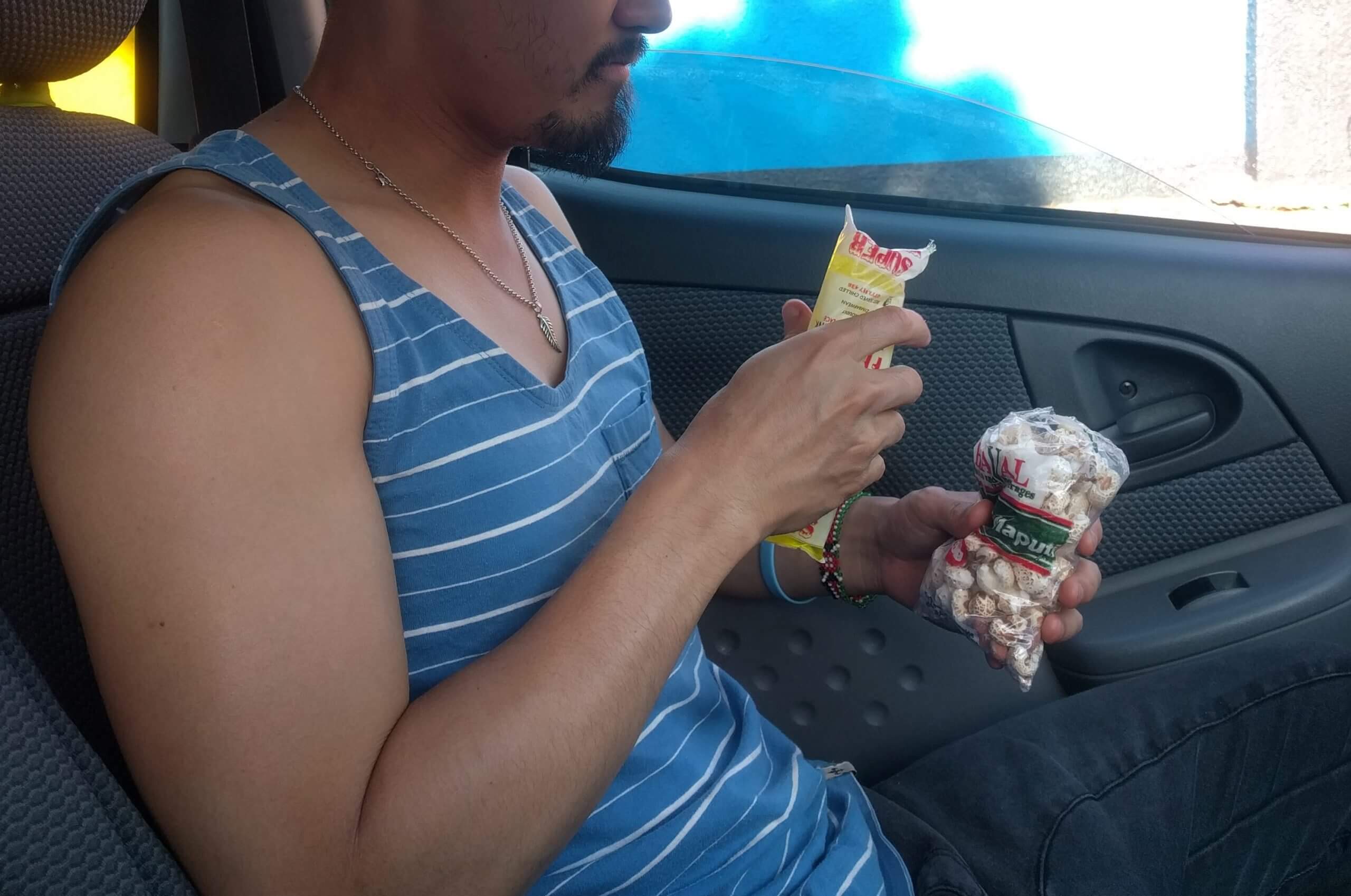
    I jump out of the car and follow her to the corner. There’s an ice box and a bag of snacks just sitting on the roadside. 

    “What do you want?”

    Across the road there’s a crowd of women sitting under a tree, chatting. One of them gets up and leisurely walks over to greet us.

    Lyn grabs a bag of peanuts and Zimbabwean popcorn. 

    “Here, try this,” she says, handing it to me. I look at the packet. Peanuts and maputi.

    “You should try a Freeze-it too.”

    She opens the ice box. It’s full of little popsicles. They’re more like frozen bags of juice.

    “What flavour do you want?”

    Yellow of course! I reach in and grab one. 

    “How much is it?” she asks the lady.

    “10 and 10.”

    I hand her 20 cents and we walk off. I almost feel bad for paying so little.

    Lyn and I cruise around for the next hour, checking out street stalls for snacks while I suck on my Freeze-it. It reminds me of the ice blocks I used to eat at school. As I slouch in the passenger seat, people from the roadside get a glimpse of me and often stop and stare. Lyn and I already know what they’re thinking.

    Hey look, sister found herself a Chinese boyfriend.

    It was the same thing in the supermarket the night before. We laugh about it.

    We get home in the late afternoon. I’m flying tonight. 

    Lyn’s mama is cooking dinner. We’re eating sadza (like cornmeal/mashed potatoes), beef stew, some greens, and bugs. Yeah, bugs. They’re called mopani worms, I think. High in protein. It’s the wholesome home cooked meal I need to prep me for my flight.

    A few hours later, Lyn drives me to the airport. It’s a long drive, and we sit mostly in silence, listening to the radio. It’s two politicians arguing about Zimbabwe’s problems. Lyn keeps giggling during their talk.

    “This guy is seriously talking so much crap.”

    Lyn’s mama nods. I laugh with them. Politicians in New Zealand, politicans in America, politicians in Zimbabwe; all good at the same thing.

    We finally get to the airport. It’s dark outside, almost midnight. I haul my backpack out of the trunk and let out a smiling sigh. Farewell time.

    I give them both a long hug and thank them for everything. 

    “Keep in touch!”

    “Of course.”

    I wave at them as I walk in to the terminal.

    It used to be sad, doing this. Another hello. Another goodbye. But eventually you learn to see a little beauty in it.

    Just part of the Harare chapter in that backpacker life.

    Bren

  • All My Superheroes Are White

    All My Superheroes Are White

    I know what it’s like, to grow up wanting to be white.

    I grew up in the early nineties in New Zealand. This was a time when it was normal for me to be the only Asian kid in my class, the only Asian kid on my soccer team, the only Asian kid in a school photo. My friends always looked at me curiously when I brought fried rice and dried seaweed for lunch. I was never bullied for it. In fact, my friends loved tasting the “funny” lunches I took to school. But I knew from the youngest age that I was different.

    As you grow up, that can mess with you more than you realise. When all your friends are white, and all the cool people on TV are white, and all the billboards have white faces, and all your teachers are white, and the leader of the country is white, it just makes sense to want to be white. No five year old enjoys being an outsider. Even the first girl I had a crush on was white. That’s because I didn’t have much of a choice; every girl in the school was white. I still remember, watching the Bruce Lee biopic when I was eight, and feeling a wave of relief when I saw he married a white woman. I thought, phew. If Bruce Lee had a crush on a white girl, I guess I’m allowed to as well.

    Luckily, I had a very smart mother. She could see the future. So she made sure to teach me self-love. She raised me just Chinese enough to know where I came from, but just Kiwi enough so that I wouldn’t feel like an outcast. I played Asian sports, like badminton, but also European sports, like cricket. She cooked us Chinese food like noodles and wontons, but also white food, like spaghetti and mashed potatoes. I was always connected to a Chinese element and community, so at least I knew there were other people in New Zealand that looked like me.

    I think the first movie that taught me Asian people could be cool was Rumble in the Bronx, with Jackie Chan. Before that, the only Asian people I ever saw on TV were token characters, like that kid in The Goonies. So when I saw Jackie Chan whooping ass in that movie, I was like wow, Asians can actually do cool stuff too.

    That’s what we do when we’re kids. We’re still learning about the world, so we look to the world around us. If the rich and powerful people are white, we grow up with thinking that’s how it should be. If all the teachers are white, we notice that too. If all the criminals in the movies are black, it’s the same thing. I have no trouble admitting that if I’m at a gas station late at night and two black people walk up to me, I would feel somewhat alarmed, but if two white people walk up to me I’d barely think about it. That’s because I learned to be that way from television, movies, the news. The funny thing is, I’ve never had a black person do a single bad thing to me, ever. In fact, they’ve probably given me the deepest and most selfless hospitality I’ve known. I’ve only been stolen from once on my travels, and it was a Thai housekeeper. I’ve only been attacked once, and it was a white European. If I based my feelings on actual experiences, I should feel the safest in the company of black faces. But I don’t.

    This is the power our televisions and books and movies have. They shape our perception, regardless of our reality.

    Which brings me to my next story. This isn’t something I talk about much, but I have a student that I sponsor in Tanzania. I visit her every year, and obviously after seven years we’ve grown a close friendship. She’s the little sister I never had. I’m always conscious of her privacy, so I’m just going to refer to her as Sis. When I visit Sis and her family during the school holidays, I spend every day with her and her baby brothers. I try and encourage them to be studious, like my mother always did with me. When we first met in 2011, none of them could speak English. Now, the four of us can sit and talk for the entire afternoon, while they ask me about all the things that kids like to ask about.


    A post shared by Bren (@brenontheroad) on
    During our time together I like to teach them through a variety of mediums: Music, film, writing, even photography and drawing. But improving their English is always paramount, and I find film – to hear and see words being spoken in normal conversation by other people – is one of the best ways to learn.

    The problem is, I’ve never been able to find a film to watch with them. I don’t want them to watch movies where every superhero looks like a white foreigner and every criminal is a black person that looks just like them. It doesn’t take a genius to understand why that’s a bad idea. I know – because that’s the world I grew up in. I loved watching movies as a kid, but I grew up in a world where all my heroes were white. Superman was white, Batman was white, Spiderman was white, Mitchell Goosen was white, Charlie Conway was white, Terminator was white. It was also a time in movies where all black people were thugs, and Chinese people didn’t exist. So that’s the world that built itself around me: White people were good, black people were bad, Chinese people stayed quiet in the background. This isn’t a coincidence. We learn from our environments.

    The superheroes I grew up with

    Every year I’ve been to Tanzania, I’ve felt eager to give these kids the joy of watching movies. But what movie could we watch? Where was the movie where the heroes had dark skin like them? Where was the movie where the stars had hairstyles like them and clothes like them? Which movie had an African-looking person that was saving the world, doing something good, being loved? Where was the movie where a black person was being great without the help of a white savior?

    The only movie I could think of, from my entire childhood, was Space Jam.

    So, I never introduced them to film. Over the last seven years, I’ve just refused to show them movies. 

    Last year during my visit to Tanzania, I suddenly thought of one. I was flicking through Youtube and was reminded of a movie – The Karate Kid. Not the original, the latest one, with Jaden Smith and Jackie Chan. I thought about it. The “star” was black. The “bad guy” was Chinese. The girl was Chinese. It wasn’t perfect, but it could work. I took my laptop up to the village the next day, and we watched it together.

    There is a scene in this movie, where Jaden meets the girl for the first time. His hair is braided, and she asks, “Can I touch your hair?” before feeling it and then giggling.

    I saw Sis smiling during this scene, and if you’re black, or spent time in Africa, you’ll know why. Hair is a big deal over here. African hair is thick and rough, so it’s often braided for hygienic and cosmetic reasons. You will find most young girls actually grow up with shaved heads because of this. Moreover, African women are often taught their hair isn’t attractive. I know several women who work for international companies and they are required to wear “European style hair” wigs every day. Just imagine – if white people were told to cover their natural hair and wear afro wigs to work, because it looked more professional. It would be preposterous, the white world would halt to a stop. But that is what black women go through every day. The scene in the movie was subtle, but important. Yes, this is a movie about people just like you.

    Unsurprisingly, they all loved that movie. They talk about it all the time. It was because they related to it. Because the main character looked like them.

    There is another scene in this movie, where Jaden’s character visits a Chinese temple and learns how to do the “Art of the Snake”, a particular style of kung fu. Sis spent hours the next day watching “Art of the Snake” videos on Youtube on my phone. When I told her there were other styles, like “Art of the Tiger” and “Art of the Monkey”, it opened the Pandora’s box of kung fu videos until she used up my entire data package. Later when I asked her what sports she wanted to play this year, she said “I want to learn kung fu, the art of the snake.” When I asked her what instrument she wanted to learn she said, “Art of the Snake!” 

    This is the power things like film, books and music can have on children. It’s how they learn about the outside world, and that determines how they see themselves. Just a single film or book can make them believe they’re a superhero or a criminal. Our media shapes the ideas and beliefs and dreams of entire generations.

    When I first saw the Black Panther poster, I already knew it was going to be huge. But I didn’t know it was going to be “global phenomenon” huge. It is a shift I have seen happening in culture around the world since I started travelling, and have been excited about it, although I didn’t think the world was quite ready for it yet. But apparently, we’re getting close. Tipping points take time to reach, but you’ll get there eventually, if you push long enough.


    This is much more than just a movie with a black superhero. We’ve already had those before (cough, Catwoman). Those don’t count. It is easy to take a white movie and put a black face on the front. Black Panther doesn’t just show a black face, it celebrates black love, black pride, black culture, something one of my heroes, Muhammad Ali, tried to do for so many years in his lectures, despite being silenced and vilified.

    No European hair wigs over here…

    Look at this photo. The women warriors of Wakanda have shaved heads. The princess of Wakanda has a shortly cropped fro. I’ll tell you why this is important: For centuries the universal standard of beauty has been long, straight, flowing hair. These standards infiltrate all cultures, which is why even black celebrities like Beyonce, and Tyra Banks, and even Michelle Obama straighten out their afros or wear wigs (yes, they wear wigs). But what does that tell the young girls of Africa who grow up with shaved heads? It tells them the world doesn’t think they’re beautiful. That their natural hair isn’t good enough. That it should be hidden. But this movie tells them different. Think of the girls who have Black Panther as the first movie they ever see. That is going to be a different generation. A powerful generation.

    This movie has been built from African roots. The kings and queens in the movie have proudly African hairstyles and African accents. The heroes are wearing clothes and jewellery from African designers, inspired by African tribal styles and colours. The good guys are black. The bad guys are black. Wakanda is built and ruled by blacks, and is not the armpit of the world, but the most advanced nation on earth. Think about what that tells young black kids about their future. It’s a movie I can finally show them where they are celebrated, where they will feel included, where they can see that people who look and sound just like them can be superheroes too, and save the world. 

    Self love needs to be taught. I know this well. If you learn to love everything about yourself, everything is possible. But it is not taught expressly. It’s taught in the things we see and hear, the subtle messages in the world around us. Things like songs. Movies.

    This next generation of Africans need to be shown that dark skin is beautiful, afro hair is beautiful, their features are beautiful, that black faces deserve to be on cereal boxes and billboards. They need to grow up knowing there are superheroes with eyes and lips and noses just like theirs, that red carpets can be filled with entire casts of movie stars that look just like them, that everything about their homes and their lives and their culture is magical and something to be proud of. This isn’t just true for blacks or Africans, but for children of all minorities. If you haven’t understood the buzz around this movie, this is the place it’s coming from. Because I have been waiting literally years for just one movie like this that I can show these kids. And seven years and maybe 2,000 Hollywood films later, it’s here. This isn’t even about me – I’m a Chinese kid from New Zealand. But even I know how much we need it. For the people that this movie actually represents, one can only imagine how long the wait has been.

    This is only the beginning. My goal is not, and never will be, to have kids grow up with only black role models or only white role models. If we’re going to show our kids movies, give me every colour, give me a rainbow of superheroes so I can teach them love for all. Black Panther is the beginning, but how far can we go? Will I have an Asian Spiderman to show my kids one day?

    Let’s hope so.

    Until then, let’s all be a part of this, and teach the young (and old) that excellence comes in all the colours of the world.

    Love you all, and enjoy the film!

    Bren

  • This is Why Bitcoin is Going to Win

    This is Why Bitcoin is Going to Win

    This isn’t an article about Bitcoin. 

    I’ll forgive you for thinking so, because of the title. But it’s not. It’s an article about travel, people, life, and the amazing world around us.

    Let me tell you a story.

    When I visited Tanzania for the first time, the security guard at my hostel was a Masai. The Masai are a tribe in East Africa that still maintain much of their traditional lifestyle. They live in faraway villages, herding cows, sleeping in huts made of mud and dung. Usually there is no electricity or running water. 

    The guard and I became friends, and after several weeks, he invited some of us out to his village for a night. We must have walked at least thirty minutes from an open road in the middle of the countryside to get to this village.

    It was exactly as I imagined.

    His mother cooked dinner for us that night in a tiny hut on an open fire. We slept in another tiny hut; three of us shared a bed – a Masai warrior, a white boy from America and a little Chinese guy, all spooning like dominos – because that’s the only space they had. We drank milk straight from the cow. We brushed our teeth using sticks from a special tree, with sap that tasted like cinnamon.

    But here’s the strangest thing I remember:

    That night, while we were all sitting around the fire, eating corn and drinking beers, one of these Masai guys pulled out his Nokia phone and added us on Facebook. This was in 2011. I was still using a flip phone back then. I didn’t get an internet phone until 2012.

    How does a guy living without water, without electricity, in a remote village in Tanzania, get internet on his phone before me – a Chartered Accountant earning thousands of dollars per week in New Zealand?

    What I’ve described here is a technological phenomenon that swept through Africa during the early 2000’s. In many African cities, there are no landlines. They went straight from sending letters in the post to sending text messages on a Nokia. That clunky phone on the kitchen bench with that curly fries looking wire? They don’t even know those existed. For many of them, a Nokia cellphone is the first phone they have ever used.

    The term for this is “leapfrog technology”. Kids are probably studying it in economics now. It occurs when a community is so far behind, they end up skipping an entire generation of technology and going straight to its successor. It has happened numerous times in recent history, and with it, goes the disappearance of another industry. Go and check how many fax machines have been sold in Africa. They have probably never heard of the fax machine.

    That’s the problem with infrastructure; it’s permanent. Once you lay down a railroad, that’s what you’ve got. You can’t change it every year, like a website. That means it’s great, until it isn’t. You put down phone lines, and twenty years later you need to spend millions of dollars digging them all out again. While you’re spending all your time and money on that, the guy who couldn’t afford those lines in the first place is starting to build cellphone towers. It happens all the time. It’s just that most of us do not realise this, because we don’t live long enough to see the full cycle. The only way to see the full cycle, is to have a time machine.

    Plot twist: We do have time machines. They’re called airplanes. If you fly to Ethiopia, Uganda, Cambodia, Bangladesh, Nicaragua – it’s a trip back to the 1940’s. People are still killing chickens in their backyard and fetching water from the river. There are people who have never used a microwave, or even an oven, or even a stove top. They’re still cooking every meal over an open fire. I’ve met people who have never heard of McDonald’s. They don’t even know what a fast food chain is. They don’t have bank accounts – in fact, they have never even seen a bank. 

    Yet they have Facebook. They know how to Google.

    Look at this photo:

    This picture is from a few years ago. The girl playing with my iPhone is 8 years old. Her house doesn’t even have basic plumbing. No taps. Their toilet is still a hole in the ground. No electricity. No water. Never seen a landline phone in her life.

    But all the adults in her family have cellphones. She knows how to reach me on Whatsapp. 

    This is what leapfrog technology looks like. 

    It sounds bizarre, but on the road, you see this kind of thing all the time. There have been many leapfrog technologies, and there are going to be many more. Here’s another example of one I see happening already:

    In many countries, especially in Africa, the public transport is abysmal. If you go to Nairobi right now, they use recycled vans as public transport. They’re using old, imported, twelve seater vans, on the verge of falling apart, and they cram 14 or 15 people in. They charge them about 50 cents each and they sit in Nairobi traffic, crawling slower than a tricycle. It takes hours to get anywhere. That’s public transport in Nairobi right now. I’ve used this exact system in many countries across the continent – Uganda, Zimbabwe, Tanzania, Ethiopia.

    But many of these countries will never dig up their roads and lay down a subway system. They’ll go straight to the next thing, maybe Elon Musk’s crazy hyper-speed tunnel or, self driving Uber buses. Nobody knows. But they’re going to leapfrog the subway, just like they did with the landline. 

    This is what leapfrog technology does. It’s why the Chinas overtake the Japans, and the Indias overtake the Britains. It’s why Shanghai’s metro system makes the New York subway look like a toy train set.

    And it’s also the reason Bitcoin is going to win.

    Let me build on this with a second story.

    I send money to Tanzania every year, usually two or three times, to pay school fees. It’s a couple of thousand dollars maybe. The first time, I tried to send a SWIFT payment directly to the school bank account. You might have heard of SWIFT. It’s an interbank technology from the seventies.

    My payment got bounced twice.

    Each time, the bank returned the money, minus $100. That’s the best technology banks have right now. They need a week and $100 to tell me “Sorry, we couldn’t send your money.”

    I will soon explain how this is going to turn banks into the next fax machine, although the reasons are probably pretty clear to you already.

    Then I started using Western Union for a few years.

    Western Union is fast, but it’s expensive. It’s disgustingly expensive. When you work out the loaded exchange rate, plus the fee, Western Union ends up taking a cut of around 8%-12% each time. This is why Western Union is also going to be the next fax machine. When you shave 12% off the remittances of the poorest people in the world for two decades, people are going to turn you into a fax machine pretty quickly.

    Last year there was another small improvement. My people in Tanzania finally have a bank account, so I sent money to their account via Xendpay. Here’s how that works – I send money to Xendpay on my credit card. Xendpay takes a cut. Then they change the money to USD and send it to the Tanzanian bank. The Tanzanian bank takes a cut. Then they change the USD to Tanzanian shillings. They take another cut. Then they deposit it into my friend’s bank account. When she makes the transfer to the school, the bank takes another cut. The whole process takes about five days. The total cut by middlemen is about $60. 

    Five days. Sixty dollars. Cheaper than a bank. Cheaper than Western Union. Still pretty shitty.

    This probably seems normal to you, because that’s how banking is. You’re probably thinking, what is this guy complaining about? If you send money to another country, it’s going to take a few days. Just plan ahead, what’s the problem? You gotta pay a fee? That’s life. What’s the problem? Deal with it.

    Here’s what that sounds like to me:

    When you do a school project, you just Google the topic and find out whatever you need to know in five seconds, right?

    Well, here’s what I used to do: I’d wait until the next day before doing anything. Even if the project was due soon and I hadn’t started, I’d wait until the next day. Why?

    Because the library was closed.

    I’d go to school early the next day, go to the library and get the books I needed. Then I’d pay 10 cents per page to photocopy it all. It would cost me two or three dollars probably, to photocopy everything I wanted. If you’re in school right now, you probably don’t even know what a photocopier is. It’s a machine that does exactly the same thing as your phone camera, but it’s the size of a dishwasher and can only do black and white. Then I took my pile of photocopies and took them home to work on my project.

    That’s how we did school research in the nineties. 

    Why am I telling you this?

    Because waiting two days to go to the library and paying $3 to photocopy all the information you need is the exact same problem as waiting five days for a bank transfer to clear. It’s a problem. A big problem. You just don’t know it yet, because when it comes to banking, you’re still using a fax machine. You’re using the fax machine because Whatsapp hasn’t been invented yet. But the banking equivalent of Whatsapp is coming soon. In fact, it’s already here.

    Bitcoin is the banking equivalent of Whatsapp. That’s why Bitcoin is going to win.

    When I talk about Bitcoin, I’m talking in general terms. I’m talking about cryptocurrency. I’m talking about the blockchain. A lot of the things I do are digital – I run all my businesses on the internet – so I have already been involved in this new way of banking. I have paid for things in Bitcoin. I have paid for things in Litecoin. I have paid for things in Ether. When I talk about Bitcoin, I’m talking about all of those. And I’ve seen them work. I’ve seen people using a Bitcoin debit card. It works exactly like a normal debit card. It’s connected to your Bitcoin wallet, and you can go swipe it at 7-Eleven and buy a donut with your Bitcoin. For those that are saying it’s not real money, it is real money. You can buy donuts with it right now in 2018. It works.

    Here’s where it gets exciting.

    When you send Bitcoin to someone, it can be anyone. It can be anyone, anywhere in the world. They do not need to put on their shoes and go down to the bank with two forms of ID, a statement of their water bill and $100 in cash to set up a bank account, then wait two days for all that information to clear, then return to the bank two days later to add a pin to their debit card so they can finally withdraw the money.

    You think that’s an exaggeration?

    Ask anyone who’s moved to London lately and tried to set up their bank accounts. It’s not an exaggeration.

    But all that doesn’t matter anymore. You can now download an app on your phone, and I can send Bitcoin or any other cryptocurrency to you, anywhere in the world. Depending on the currency, it will take less than a few minutes. It might even be instant. It will cost around ten cents, probably.

    “But Bren, why do I need that? I have a bank account already, I can withdraw money instantly from any ATM in the world, I can pay for everything in five seconds with my VISA debit, I can log on to my internet banking and open a new account whenever I want. Why do I need Bitcoin?”

    The answer is: You don’t. And if you live in Australia, New Zealand, America, Europe, probably your friends don’t either. But you’re completely missing the point.

    Here’s something to think about. Next time you travel through Thailand, go down to the fruit cart on the corner and try buying your breakfast with a VISA debit.

    I can tell you now, you’re not having breakfast that day. 

    If four million people in New Zealand don’t need Bitcoin, that’s fine. They can keep using their bank. If 300 million people in America don’t need Bitcoin, that’s fine too. But there are two billion other people in the world who don’t have a bank account. If you’ve time travelled, you would have met them. About a billion more have nothing but a basic checking account which they never use.

    This is almost half the world.

    I meet these people all the time. These people have remained unbanked, completely excluded from economic opportunities of the last fifty years, because banks have no interest in banking them.

    Banks are not interested in opening an account for the peanut guy so he can deposit $1.50 into his savings account each day. There is no money to be made from the 100 people who sell corn to each other living in a village 200km out of the city.

    But what those people have is a $100 Chinese smartphone. Just like my Masai friend in Tanzania. They have a data connection. And they have a little solar panel, about the size of a cereal box, to charge their phone every two days. I have gifted several of these to people in Tanzania, they cost about $11 and look like this:

    Now, let’s say these people want a bank account. You tell these people they have two choices.

    Choice A: They can download an app on their phone and within the hour they can send and receive money to anyone, anywhere in the world.

    Or, Choice B: They can walk to the main road, sit on a bus for two hours, go to the citizen’s office and apply for a passport so they have a form of ID, wait three days, then get on the bus again and go pick up the passport, then go and wait in line at the bank for an hour (because in an African bank you will be waiting for at least an hour), ask to open up an account, and then every week take the same two hour bus ride into town to deposit money into their savings, while also paying $5 per month for the rest of their life to keep that account open.

    Which one do you think they’re going to choose?

    This is why banks are going to get leapfrogged. This is why Bitcoin is going to win. 

    Here’s another reason why Bitcoin is going to win: We already know it works. In Africa, they already have a Bitcoin clone. It’s called M-Pesa. If you’ve never heard of M-Pesa, it’s a digital money that originated in Kenya in 2007. It went like this:

    The Kenyan cellphone provider, Safaricom, had a function on their sim cards, where you could send credit or ‘minutes’ to people. The interesting thing was, since everybody had a cellphone the value of a “minute” was universal, just like money. So, people started using it like money.

    Maybe you get a taxi, you forget your wallet, and you say to the driver “How about I just send you some minutes instead?”

    This became so common that Safaricom built an official system for it, now known as M-Pesa (pesa is the Swahili word for money). Today with M-Pesa, anyone with a sim card, even on the crappiest $10 cellphone, has an instant bank account. They can pay and receive money from anyone instantly via a simple text message. This was only launched ten years ago. Today, M-Pesa accounts for 48% of Kenya’s GDPEverybody uses it This is why many people in Kenya don’t even have a bank account. They don’t need one. They leapfrogged banking.

    But there’s a catch. Kenyan M-Pesa only works in Kenya. I can’t send money from New Zealand to an M-Pesa account. I’ve tried. There’s also a transaction limit, of around $500. But here’s the second catch: Bitcoin is just like M-Pesa. Only Bitcoin transactions are limitless. And they’re global.

    Bitcoin is like M-Pesa for the whole world.

    Right now, this means nothing to most people. Most of you have zero need or desire to send money instantly to Kenya. That’s fine.

    But I want you to think bigger. I want you to think about how much your life can change when you can be paid by anyone in the world, instantly. If you can receive money from anywhere in the world, instantly. I earn money in about five different currencies. I’m waiting for money to clear all the time. This will be amazing for me. But even if it doesn’t excite you, you don’t need to care right now. Just like you don’t need to use Google to research something. You can still go down to the library and photocopy a textbook if you want. But that is not where the world is going. 

    Let me show you something. I travel everywhere with a travel wallet. In that wallet I have my passports, my visas, bank statements, credit cards, and I also have cash. Here’s what that cash stash looks like right now:

    Do you know what this is?

    This is the equivalent of a photocopied textbook. This is the equivalent of sending my emails by fax machine. I can guarantee you kids in ten years will look at this photo and have no idea what they are looking at. I’m not collecting these currencies. This is just leftovers I’ve unintentionally accumulated over my travels. Why have I accumulated them? Because I can’t spend them. That’s because each of these pieces of paper can only be used in one very specific corner of the world. If you think about it, that’s ridiculous.

    Currency is one of the last areas of our lives to be globalized by the internet, and it’s the one that most needs to be.

    This is why Bitcoin is going to win.

    Let me give you a more real-life example.

    If you go to the border of Kenya and Tanzania, you’re going to see a lot of cash changing hands. It will be people such as little souvenir sellers on the streets selling bracelets to tourists from around the world. What you’ll notice is they are not using one currency. They aren’t even using two currencies. You ask any of those people – souvenir store owners, waitresses, drivers, to pull out the cash in their pocket, and it’s going to be a mix of Kenyan shillings, Tanzanian shillings, US dollars, Euros, maybe even some South African Rand and British pounds. Ask any of them what the exchange rate is, and they’ll be able to tell you, because they change money every single day just so they can buy dinner. I have even tipped a guy in Africa, around $50, all mixed in three different currencies. He didn’t even blink. You do that in New Zealand and the guy will laugh at you, thinking you’re joking. You do that in Kenya, it’s just normal business.

    This is a broken system. It is ridiculous that if I’m in Poland, I must buy my apples with Polish zloty, but travel a few hours over to Germany and I have to use Euros. They’re the exact same apples. The money is worth the exact same amount. But they’ll look at the zloty and say, sorry, if you walk two hours that way, you can buy an apple with the purple piece of paper, but here, you need to use the pink piece of paper.

    Isn’t that ridiculous?

    Perhaps, it doesn’t sound that ridiculous to you, because that’s how it’s always been. Except that it hasn’t.

    We’ve had global currency before, just not in your lifetime.

    Imagine a hundred years ago if the store owner said, “Sorry, your gold is in the shape of a circle. I only accept gold in the shape of a triangle.”

    That’s moronic, but that’s exactly how it is today with currency. This is because when today’s money was invented, they didn’t plan for this. They didn’t plan for people in Denmark to fly down to Italy for a shopping weekend with a pocket full of Danish Krones. They didn’t plan to have bloggers that earned money in ten different currencies. They didn’t expect to have companies like Facebook that do business in literally every country in the world, and now during tax season they have to ask their accountant to convert all of that money, literally hundreds of currencies, back into USD. There was no internet. There were no computers. That’s why our money infrastructure is a fax machine. The USD is a fax. The Euro is a photocopied textbook.

    These are the kind of infrastructures that get leapfrogged.

    But again, this probably doesn’t affect you. Maybe you live in Canada, or Australia, you go travelling once a year. Why should you care what money they’re using on the border of Kenya and Tanzania?

    I’ll answer that question with a question.

    Where do you think the global growth is going to come from in the next two decades? You think it’s coming from Australia? It’s not. Take a guess what the fastest growing economy is forecast to be in 2018. 

    It’s Ghana.

    Second fastest? Ethiopia.

    Then India. Then Ivory Coast. Then Djibouti (source). Most people don’t even know Djibouti exists. But they will soon. You can follow this trend all throughout history. Massive economic booms have always been spurred by large, young, underdeveloped populations. It’s why every empire dies and a new one emerges. 

    That is happening right now. I have seen it with my two eyes. While you’re sitting there thinking Africa is just made up of corn farmers, there are young Kenyans, South Africans and Nigerians huddled in co-working spaces, brewing some of the fastest tech-startup scenes in the world. While you’re sitting there thinking, “Oh yeah, nothing wrong with libraries, nothing wrong with fax machines, nothing wrong with waiting two days to open a bank account” they are sitting there sending M-Pesa, receiving Bitcoin, and writing code that is going to leapfrog them into the next internet.

    Africa has the youngest population in the world. They have the fastest growing population in the world. And that is only Africa.

    You also have the Americas, Eastern Europe, Southeast Asia, the Middle East – all young, fast-growing populations that now have the opportunity to be a part of something. They are no longer shut off to the world thanks to the internet. And now, in the very near future, they will no longer be shut off from banking thanks to the blockchain. When these people start getting access to banking, funding, international trade, credit, things are going to move. And I guarantee they will move faster than anyone imagined.

    This is why you should care. Because these people are now all potential partners. They are also potential customers. But most importantly, they are potential competitors. Bitcoin has allowed that to happen.

    That is why Bitcoin is going to win.

    If you’ve made it this far, you might still have one burning question. A really important one. What the hell is Bitcoin?

    The answer is: It doesn’t matter.

    I want you to take 60 seconds right now to watch this video:

    You show that to an 18 year old, their eyes will pop out of their head. They’ll probably think this video is from the 1920’s. But it’s from 1994. That’s what the internet was just 25 years ago. It was something so revolutionary, so unlike anything we’ve ever seen before, that nobody was able to wrap their head around it. 

    The point: It doesn’t matter if you know how Bitcoin works. You don’t know how the internet works either. Try and explain to me in two sentences how the internet works. You can’t. Nobody can. But we use it every day. People send billions of dollars over it every day. You don’t need to know how it works. You just need to know that it does, and that it’s better than the thing we had before it.

    Here’s a third and final story.

    One of the funniest things I do when I meet a teenager at a hostel is I tell them about the cassette player. We’ll be listening to music in the lounge, and I’ll tell them what it was like to have a Walkman cassette player back in the day.

    “If you wanted to hear a song, you just had to turn on the radio and wait. I used to sit in front of the radio for hours, waiting for a song to come on. And I had a cassette in the deck, ready to record. You could fit maybe 15 songs on a cassette. I’d spend an entire Sunday sitting in front of the radio waiting for songs to come on so I could record them. And then I would spend all night listening to them on my cassette player. The funniest thing was, on a cassette, you can’t just skip through songs by clicking a button like you can on iTunes. If you wanted to listen to a specific song, you had to click the rewind button, and the cassette player would go zrrrrrrrrrrr, and then you had to guess when to stop it. You had to guess, to the exact second, where your song was going to be.”

    They always look at me when I tell them that story and think I’m joking. It doesn’t matter what country they’re from. It’s the same reaction. I have to go on Youtube and show them what a cassette player is.

    And then while we’re on Youtube, I tell them about MTV. 

    “You know when we wanted to see a music video, we had to wake up early on Sunday morning and turn on MTV. It was on for about two hours. But you couldn’t just choose a song. You just had to sit there for two hours and actually wait until…”

    That has been one of the greatest things about the conversations I’ve had on the road. It gives you perspective. It reminds you of how quickly things change. It keeps you up to date on how eighteen year olds think, how thirty year olds think, how sixty year olds think, because you meet all of them. Someone once told me, travel is powerful because it removes you from the bubble of your age group.

    I think this is why I see things kinda funny. Because I’m seeing it from everywhere. It’s why I got excited about Bitcoin. I’ve met the people that need it. I’ve met the people that would use it. More importantly, if I was in their shoes, I would most certainly be using it already.

    This is why Bitcoin is going to win.

    Just for fun, here are a few more bold predictions born out of that perspective:

    We are going to have people in my lifetime that won’t know what grocery shopping is. Instead of going grocery shopping, they will just say a few commands into their cellphone, and the groceries will get dropped off by a self-driving car in an hour. I don’t think this is something that will happen in 100 years or anything. I think it’ll be in the next decade. 

    You’ll tell those kids, “You know, we used to go into this big building, called a supermarket, we’d have to go every week, and you used to walk around pushing this cart thing, it was like a little car, and you would pick everything off the shelves that you wanted, and then the lady at the front would scan every single thing on a machine, and then you’d carry all your bags out to the car and drive home.”

    And the kids will say, “But didn’t that take like two hours and the building will be so crowded with everyone trying to get food?” And you’ll say “Yeah, that’s just the way it was.”

    There are also kids alive today that will never drive a car. They will never get a driver’s license. Self driving Ubers will take us everywhere. Getting a driving license will be a hobby, like a gun license. You’ll tell your kids, “You know, we used to all drive our own cars. We used to sit in traffic for two hours every day, and you’d have to actually remember all the roads and where to go, and to control the speed you had to push this pedal jussssst enough so you got the right speed, and then keep it there the whole time.”

    And they’ll say, “But weren’t there lots of bad drivers that would crash into other people and cause accidents and people died all the time?” And we’ll just shrug and say, “Yeah, that’s just how it was.”

    There are kids alive today that will never have a job. They will use a blockchain platform like Refereum or Flixxo, and will earn their entire income from just playing video games or watching movies. There is even a platform launching soon called Vice where people will earn money to watch porn. These will be full time “jobs”. Kids are going to get paid five or ten cents every time they watch an ad. Think about that: We used to get force-fed ads on TV. A few years later we were able to pay a monthly fee to avoid ads on Netflix. But the next generation of kids? They will never watch an advertisement for free, ever. If you thought millenials today were entitled, wait until the next batch comes along. They will complain about not being paid enough to watch their TV shows. 

    And what will we say?

    “You know, everyone used to have to work at jobs to earn money. You know that store where you buy lunch? People used to actually put on a uniform and stand behind a counter there for 8 hours, every day. They would make the food and count the money for you, and they got paid $8 an hour.”

    And they’ll say, “But, wasn’t that like really boring and lots of people got depression and weren’t happy and hated going there every day?” And we’ll say, “Yeah, that’s just how it was.”

    Finally, Bitcoin. Bitcoin will mean there are kids alive today that will never set foot inside a bank. You’ll tell them, “You know, we used to use banks to pay for everything. I could never give money straight to you. I had to keep all my money in a bank. Then if I wanted to pay you, I’d tell my bank to send the money to your bank. Then your bank would receive the money, keep a little bit of it, and give the rest to you. It would take one whole day. If you were in a different country, it would take 3-4 days. I’ll pay you on Monday, you get the money on Thursday.”

    And they’ll say, “But wasn’t that really slow and annoying and made it impossible for you to do business with anyone?” And we’ll say, “That’s just the way it was.”

    The ideas above all have one thing in common. They’re made possible by the blockchain. This is why Bitcoin is going to win. Everything above is already being invented. It’s happening, now. We’re at the stage of those Today Show hosts, wondering what the hell the internet was in that video I showed you 3,000 words ago. Nobody understands this, nobody knows how big it’s going to be, but it’s happening.

    What does this mean for you? 

    It’s up to you.

    We’re going to have Bitcoin in the future. We’re going to have thousands of digital currencies in the future. But I have no idea how much any of them will be worth, and I don’t care.

    Like I said, when I talk about Bitcoin, I’m talking generally. I’m talking about the blockchain. I’m talking about cryptocurrency. I’m talking about giving more opportunities to the people who desperately need them. I’m talking about finally including the people that have been excluded for so long. I’m talking about how this is going to change so many people’s lives for the better, including yours and mine.

    It’s going to be huge.

    It’s going to completely change the world.

    I don’t think any of us realise how big it’s really going to be.

    Here’s one last ramble I’m going to put on, because it’s a question I get asked a lot. What happens when the US government makes BitUSD? What happens when Germany comes out with BitEuros? Why would anyone use Bitcoin then?

    Well, those governments probably will make BitUSD and BitEuros. In fact, they’re probably sitting around a table trying to figure out how to do it right now.

    It doesn’t matter. Here’s why Bitcoin is still going to win.

    If you’ve spent a bit of time in this space, I won’t even need to explain this to you, but a BitUSD will have the exact same problems as today’s USD. The banks are going to want to control it all – you’re still going to have to take two forms of ID and wait two days to open your BitUSD account, you’re still going to need to change your BitUSD to BitEuro to buy apples in Germany. It will most likely be issued by the government, it will be limited by geography, by regulation and the network will be closed and centralised and secret, just like everything else the government does.

    In other words, the complete opposite of Bitcoin.

    There’s a reason the internet succeeded and took over the world. Because it was free and open and not owned by anyone. It’s the same reason Bitcoin is going to win: Because it’s free, it’s open and it’s not owned by anyone. The USD isn’t global. It isn’t decentralised. It’s nothing like Bitcoin. If you wanted to, you could definitely put it on the blockchain, and it would work fine. But there’s no reason to put it there. It would be like drawing an emoji on a piece of paper and faxing it to someone. It makes no sense.

    Bitcoin won’t compete with national currencies, because it won’t need to, just like Whatsapp doesn’t need to compete with fax machines.

    We see this all the time with leapfrog technology. The incumbent tries to pivot, but it never works, because it’s not designed for the new environment. It’s like a horse and carriage on a highway.

    Let me put it this way. Did you know, Britannica is on the internet?

    If you don’t know what Britannica is, it’s basically Wikipedia before the internet. It was an attempt to cram all of human knowledge into 25 books. If you went into someone’s house and saw two metres of oversized books stacked on a shelf, that was Britannica.

    It looked something like this:

    Of course, nobody uses it anymore, but they’re on the internet. They have a website. But nobody uses it. How do I know nobody uses it? Because if you ask an 18 year old today about Britannica, they have no idea what you’re talking about. 

    That’s what banking is. That’s what currency is. It’s the Britannica of money. If you give someone a choice, what are they going to choose?

    Are they going to choose a currency they can only use in one country which they need to keep in a bank account that costs $5 per month to keep open and takes two business days to receive anything?

    Or would they choose a borderless, global currency they can use instantly just by downloading an app, for free?

    This is why Bitcoin is going to win. It’s not the currency of our generation. It will be the currency of the generation to come. In twenty years, parents will be explaining paper money to their kids, the same way I explain cassette players to teenagers on the road.

    And when I say it is going to win, I don’t mean everything else is going to die.

    People still use libraries today, even though we have the internet.

    People still send postcards, even though we have email.

    People will still use USD, even though we have Bitcoin.

    And people will still use banks, even though we have the blockchain.

    When I say it is going to win, what I mean is, it is going to change the world. I mean it is going to be the catalyst for a huge transfer of wealth, just like the internet was. Twenty years ago, you wouldn’t have been able to even attempt to explain what Google, Facebook or Amazon was. But twenty years later, the founders of those companies have gone from nerds in a dorm room to the richest men in the world.

    That is what is happening right now.

    That is why Bitcoin is going to win.

    Thanks for reading.

    Bren

  • Will I Ever Stop Travelling?

    Will I Ever Stop Travelling?

    I’ve been getting this question a lot recently.

    Well maybe not a lot, but more than usual.

    I suppose I’m at that stage where it’s getting kind of weird to be on the road all the time.

    One or two years; that’s normal. You have some adventures, see the world, then go home and get married.

    Three or four years; not so normal, but it’s interesting. People have a lot of questions, they want to know where you’ve been and how you do it and and all your craziest stories.

    But five years? Six years? This is odd. I mean, is he okay? What’s he running from? People don’t travel for that long, unless something isn’t right with them. Right?

    I doubt I’ll explain things very well here, but I’m going to try.

    The short answer is no. 

    And the simple reason is, I haven’t finished what I started yet.

    A few years ago, I Couchsurfed for the first time in Nairobi. And my host didn’t live in the nice part of Nairobi, with Uber and KFC and vegan cafes. She lived in the gritty part, where the roads weren’t paved and the electricity cut out all the time. Shortly after I arrived, I went to the kitchen to wash my hands and a few drops of water dribbled out. I just figured the tap was broken.

    Later my host explained they hadn’t had water for a few weeks. Instead, a guy came by every other day, bringing water from who-knows-where, and filled up all the buckets in the house. We paid him a dollar or two per bucket, something like that. And we used that water to bathe, cook, brush our teeth, even to flush the toilet.

    I’d never lived in a place without running water before, so it was new to me. But I quickly learned the tricks of the bucket water life. In the morning, you’d go and fill up a small bucket. Then you’d brush your teeth. Then, you’d sit on the toilet, do your business. Then, you’d get the shampoo out, stand over the bucket and give yourself a bucket bath. Since you were recycling the same bucket, you’d start with your face first, while the water was clean, and then your body and arms and legs, and you left your less glamourous parts for last, obviously. And once you’d finished, you’d take that bucket of bath water and use it to flush the toilet. You only had a few litres of water to use, and it was ice cold, but you learned how to make it work. Wash your face, brush your teeth, flush the toilet, take a shower. Five or six litres. And guess what? It wasn’t even that hard.

    Of everything I saw in Nairobi during that trip, that’s the thing I remember most. Trying to save water in the morning. I learned how to be more mindful of such things, I learned to be more efficient, I became aware of how much water I wasted at home and how I took it for granted, I learned empathy for those who lived that life every day, but most of all I realised how much I don’t know about other people. I learned the importance of not judging someone without stepping into their lives first. Sometimes I would stand beside someone on a bus who smelled a little, and I would think “Is it really that hard to take a shower every day?”

    Now I know the answer: Yes, sometimes it is.

    So what’s the moral of that story? Well, like most things in life, travel transcends itself into something much bigger. The things I learned in Nairobi really had nothing to with Nairobi. It might be the novelty that draws people to travel in the first place – you saw the Grand Canyon, smoked some weed in Amsterdam – awesome stuff. But once you’ve done all that, the reason you keep travelling isn’t about sights and photos anymore. It’s about using your craft, whether it’s travel, or the guitar, or dancing, to become a better person. To give your best self to the world.

    Michael Jordan dedicated his life to a sport that made him one of the richest people ever. His entire life, from when he first dribbled a ball to the 54 year old legend he is now, has been about basketball.

    But if you ask Michael Jordan today, what were the most important things he learned during his career, I’m quite sure his answers would have nothing to do with basketball. He wouldn’t say, “Well, I learned the perfect angle to release my fadeaway jumpshot…and I learned how to beat a double team…”

    He would probably say, “I learned how to stay calm under pressure. I learned how to trust others. I learned how to believe in myself. I learned how to accept criticism. I learned how to build a team. I learned the importance of working harder than everyone else. I learned how to be fierce. I learned how to be humble. I learned how to be a leader.”

    He mastered basketball but the real gift was, it turned him into a better person. And I know those things aren’t unique to basketball. I know this because travel has taught me all those things, too.

    Obviously, it doesn’t start off that way. A few weeks ago, Travel Republic asked me about my inspirations for travel, which got me thinking back to why I started in the first place. Was it a movie, a song, a story somebody told me? And more importantly, why haven’t I stopped yet?

    The thing is, travel is a very personal journey – our travel lives are not displayed on a television or movie screen for everyone to see. Therefore it can be hard for people to understand why we love it and need it. I think for most, it starts off being something superficial, about all the beautiful places we want to see. But eventually it changes to something inward – a way for us to learn about who we are, and how we fit into this world. Perhaps we learn a new language, become part of a new community, fall in love. That helps us understand people, gives us perspective, teaches us compassion.

    Travel helps us become better people.

    Are you ever going to stop travelling?

    I used to find it weird, to get asked this question. It’s not like anyone ever asked Jordan, “Are you still playing basketball? Don’t you need to like, get a real job or something?” I doubt people ever meet Tom Hanks and say, “So this acting thing, you’re still doing it? Aren’t you bored of it yet? When are you going to go back to real life?”

    I suppose it’s the private nature of travel that leads people to ask this question. Nobody really gets to see what happens to us out there, so they don’t really understand why we keep doing it.

    But if you love something, you do it, and if it gives back to you, you keep doing it. You continue doing it, until you can’t anymore. It’s not something you get sick of, like a video game. It’s a lifelong journey. Something you can always take more from. Something you can always get better at. Maybe the travel photos and the travel parties and the travel sights lose their twinkle eventually. But like I said, travel isn’t really about travel.

    We use it to challenge ourselves. To learn about ourselves. To learn about other people. To love each other. 

    Travel is the tool we use to become better human beings.

    Like any craft that you love, there is no finish line. It’s an endless journey. There is always more to learn, if you dig deep enough.

    As long as you love it, why would you ever stop?


    What about you? Did you ever stop travelling? Why? Let me know in the comments 🙂

  • How To Do A 10 Day Juice Fast: A Monster Guide

    How To Do A 10 Day Juice Fast: A Monster Guide

    When I posted about my juice fast on Instagram this week, your questions came pouring in. You all wanted to know how I did it, what juices I drank, whether I was at a retreat, etc etc. I’ve written up this huge post for you all, which will detail everything you want to know, and more.

    I’ve actually done a juice fast before.

    It was when I first bought my juicer, a few years ago. I did a three day juice cleanse, and did a few more over the years, but never managed to get past 3-4 days.

    This time I decided I’d finally push it harder.

    My travels for the year finished around December 22, and I wanted to start immediately, but I decided to wait until after Christmas dinner with my family. Then I figured I’d help finish the leftovers on Boxing Day too. Then part of me wanted to wait until after New Years Eve, but I realised I was just being bitchy. Never leave to tomorrow what can be started today!

    So December 27th I started my ten day juice fast. Before I tell you how it went, let me talk about what a juice fast is, and why you might want to do it.


    Why Do A Juice Fast?

    1. It “reboots” your digestive system

    Did you know up to 30%-50% of your daily energy can be spent digesting food? That’s why your body shuts down after you eat a huge meal. It’s using all its energy to break everything down and send things to the right places. Your stomach, intestines, kidneys, liver, brain –  it all needs to start working. If you’re constantly eating (and therefore, digesting) food, that leaves little energy for anything else, including healing, recovery, cleansing, brain function etc.

    Stopping food intake allows your digestive system to switch off for an extended period of time, meaning your body can distribute it’s energy elsewhere. Most people report large increases in energy after the initial “torture” days of the fast, and even healing of old injuries.

    2. It still gives you all your nutrients

    When you juice vegetables, you extract the nutrients from the vegetable fibre. That means your body needs to digest almost nothing, but you still get (most) of the nutrients of the vegetable. On average days I juiced about 20 servings of fruits and vegetables – far more than what a regular human eats. Even if juicing only gives you half or a quarter of that, it’s still better than the diet of 90% of the people I know. Contrary to what most people think, juice fasting isn’t starving and does not leave you malnourished.

    There are even people who go on permanent or long term juice diets (generally for weight loss reasons), up to six months, and are still fine and healthy. The juice diet is actually considered one of the best ways to elevate nutrition levels while cutting calories to lose weight.

    3. It flushes your system

    If you go on Youtube and see what a dirty colon looks like, it will make you wonder exactly what’s inside yours, too. The modern diet contains a lot of things we shouldn’t be eating/drinking. This results in mucus/faeces/plaque forming in our digestive organs. Some studies estimate you can have up to 2-3kg of old faeces stuck in your digestive tract, which can be from years ago. Fasting can help you flush this old matter out, either naturally or with the help of enemas/colonic irrigation. This is why a juice fast is often referred to as a juice cleanse, as one of the main benefits is the cleansing of your digestive tract.

    4. It’s healthy!

    I don’t need to tell you that a large intake of fruits and vegetables is healthy. A break from eating will also help you rethink how much food you need to eat, how often you eat it, and exactly what you should and shouldn’t be eating. One thing I’ve learned from travel is you only need very small experiences to fuel large changes in perspective – this fast was certainly another example of that.

    5. It’s a challenge!

    Let’s face it – life is easy. 99% of us have never been to war, never lived through a plague, never had to walk into a coal mine and drill into the darkness, waiting for a cave to collapse on top of us just to support our families. We’re already 99% wimp, so sometimes we need small challenges just to make sure we don’t turn 130% wimp. Most people who attempt a juice fast give up, even though on paper it’s not actually that difficult. Challenges are good for us.


    The Rules Of A Juice Fast

    So, what are the rules? It’s pretty simple:

    Only freshly made juice is allowed – no store bought or long-life juices. You need to make them yourself with fresh produce and a juicer, or buy it from somewhere that does. Remember you want juice, not smoothies. Smoothies are just blended up solids, which aren’t allowed.

    Avoid fruit juices due to the high sugar content. General rule is 80% vegetables to 20% juice.

    No food (obviously), but if you are seriously about to die you can eat one or two grapes or berries.

    Herbal tea is allowed (no milk, sugar, honey, or any additives).

    Vegetable broth is allowed (not vegetable soup, big difference)

    Go for at least 7 days. In this particular juice fast I actually aimed for 10 days and ended up going for 11, or just under 2 weeks. Some people try and aim for 2 weeks; I would suggest waiting until you’re more experienced at fasting before going that long.

    Side note: Do you need to go organic? Of course an organic juice cleanse is better than a non-organic one, but it’s not essential. Non-organic produce is still nutritious – just make sure you wash it thoroughly, and you can peel you produce too if you wish.


    My 10 Day Juice Fast Diary

    To give you an idea of what it’s like, here’s a brief diary of my ten day fast:

    Day 1

    I’ve bought two litres of fresh juice from a juice bar (I’m still travelling). One is a red juice (carrots, beets, lime, ginger) and one is a green juice (kale, spinach, celery, apple). I finish both within a few hours, then just drink water. I’m hungry at night so I cheat and eat a small slice of papaya. Maybe better to ease myself in, I tell myself. So I’ve already cheated before the end of Day One. #fail

    Day 2

    I buy a litre of juice at the airport (kale, spinach, celery, apple). It’s from the same shop I bought from yesterday (Top Juice, in Australia). I have a four hour flight today so should be interesting. Day 2 is typically a difficult day; I feel very tired, also because I’m still a bit jetlagged. I fall asleep on the plane, when I wake up there’s a snack box in front of me with cake, yogurt and a sandwich. Get it away from me! The girl next to me looks backpackerish, so I ask her if she wants it. She’s so happy (all backpackers love free food). Finally, I get off the plane – in New Zealand now! I make around a litre of my standard green juice with my juicer at home (celery, cucumber, lemon, ginger, capsicum, apple).

    No bowel movement today.

    Day 3

    HUNGRY. Drink three litres of juice today, two green, one red. Massive headache. I spend most of the day in bed. Still no bowel movement.

    Day 4

    Headache isn’t as bad as yesterday, but still quite light headed. I get out of bed and trip over my backpack, and I’m so dizzy that I stumble around like I’m drunk for a few seconds and collapse into my shelf. Am I dying? I make a red juice and my stomach sings when it hits. Yum. I drink some activated charcoal in the morning too, to try and encourage a bowel movement.

    I also start making some vegetable broth (onions, celery, carrots, garlic, then pressure cook for a few hours). Of course you need to strain it and discard all the vegetables, you can only drink the broth, no solids allowed. The taste is mild, but after adding some sea salt it does wonders to satisfy the cravings for hot, cooked food. I freeze a few cups of it for the rest of the fast.

    By the end of the day I finally have a bowel movement, thank god. It’s mostly solid.

    I do 20 pushups just to make sure the body still works.

    Day 5

    Slept terribly. Weighed in at 56kg! (probably started around 61kg).

    Have 2-3 liquid bowel movements over the day. Charcoal seems to be doing the trick. Most people say their bowel movements reek due to the heavy detox, but mine seem pretty healthy. Energy feeling a little higher now. Took a long afternoon nap.

    I “eat” a mandarin after waking up. By that I mean I put the pieces in my mouth, chew them and get the juice, then spit out the solid. It’s a good trick to satisfy you mentally, and technically isn’t cheating.

    It’s New Year’s Eve today, so I go to a barbecue with a litre of juice with me. I go late to avoid all the food. I do eat two blueberries though late at night (second cheat!).

    However, I’m going home on New Years Eve healthy, not drunk, and mid-fast. What a good feeling.

    Day 6

    New Years Day. Weighed in at 55kg.

    Almost no hunger pangs. I only get them two or three times during the day, where my stomach rumbles for one or two minutes. Other than that I don’t feel hungry at all. Body seems to be embracing the fast now. Had a solid bowel movement, no different to a regular one (haven’t eaten anything in 6 days and still passing solids? Where’s it coming from?)

    Do 20 pushups and a few kettlebell swings just to keep the muscles working.

    Drank about three litres of juice today – two green, one red.

    Brain felt good, worked the whole day. Had a cup of vegetable broth at night.

    Day 7

    Today was the best day so far.

    Woke up feeling good, not hungry at all. The last couple of mornings have been like this – haven’t felt the need to make any juice until at least 4-5 hours after waking. I just get out of bed and start working. Water keeps me happy until the late afternoon. Of course whenever I see food I want to eat, but it’s easy enough to just walk away.

    By mid afternoon I still hadn’t had a juice, and felt enough energy to workout. I did a little yoga, planked, and did fifty pushups.

    Then I took a salt bath to continue my sweat and get some toxins out. Filled the tub with Himalayan pink salt and tea tree oil and soaked for forty minutes – total sweat fest and felt amazing after. The idea of this is to open up your pores and absorb the minerals from the salt directly into the skin while sweating out the bad stuff. Bit of bro-science, but feels good.

    As I’m typing this, it’s 11pm at night and I still haven’t had anything today except water and coconut water. Not hungry at all (I actually feel kind of full, stomach must be shrinking). Amazing.

    Day 8

    Woke up this morning feeling great, tons of energy, not even hungry! Again, didn’t feel the need to drink a juice at all.

    I finally drank one late afternoon, since I thought two days without juice might be unhealthy. I actually started to feel a small headache after. However, by the late evening I was feeling nice and fresh again. Brain was super clear, did lots of work and reading.

    Also knocked out 50 pushups again just to keep things moving…

    Things are getting easier and easier now. Days are flying by!

    Day 9

    Things were feeling a little backed up, hadn’t passed a bowel movement in a couple of days, so I decided to finally bite the bullet and do a colonic treatment.

    If you don’t know what this is, it’s when you flush water through your colon to clear out any faecal matter in your digestive passage. Here’s how it goes:

    First, the guy sticks a nozzle a few inches up your bum (yes, it’s uncomfortable). It’s attached to a colonic machine, where one tube sends water in and another tube sucks it out. He turns on the flow to send water in – you tell him when your guts feel full, then he reverses the flow and sucks all the water out. Then he slowly increases the pressure and alternates between hot and cold water. For the first ten minutes the expelled water was clear, only a few small bits of debris. I figured because I was on a fast and I’m young and healthy, my colon was probably nice and clean. Woop!

    Then after about 10 minutes I started feeling very light headed. I told the guy my stomach is cramping and I’m getting dizzy. He stopped the flow for a moment and told me to relax. Then I told him I’m really dizzy I think we should stop. Then a few seconds later, the expelling pipe filled with dark brown gritty water. “You see that, that’s a lot of toxins leaving your body. Your adrenaline is pumping, that’s why you’re dizzy.” He turned the flow back on and a large amount of dark toxic stuff came streaming out for about 30 seconds, then the water turned clear again. My head cleared and I came out of a huge cold sweat, feeling rejuvenated. It was pretty cool! That happened another two times during the session. Throughout there were also periods where I was flushing out lighter brown water and I could see all the mucus and old fecal matter getting flushed out. I guess this is the cleansing part of the juice cleanse!

    After the session, you need to go sit on the toilet, because there is still quite a lot of water in you. As soon as my bum touched the seat it was a waterfall. Lots of solids came out. Imagine that – no food for 9 days and still had solids pouring out. They were different to normal bowel movements too – heavy, like little rocks.

    Finally I headed downstairs for some water and a little debrief – he said I had a really good result and flushed a lot on my first session, not everyone does.

    On the drive home I felt really light and free, and couldn’t stop laughing. Must have been a big endorphin release.

    Rest of the day was business as usual – juice and rest. However I was expecting more bowel movements after doing the colonic, which didn’t happen. Maybe I’m totally emptied out? Hopefully.

    Day 10

    I woke up feeling a little light headed. Weighed in at 53.5kg.

    Didn’t feel hungry or the urge to make a juice so just drank some water until the evening. Finally made a big green juice – kiwifruit, celery, apple, lemon, ginger, capsicum, cucumber.

    I also made another vegetable broth, this time with lots of tomatoes and drank a large cup of that.

    Still no bowel movement today!

    Day 11

    Woke up super early for my second colonic. I decided to do a another one as I was starting to feel heavy in the guts again.

    This colonic was a lot less intense than the first one. We had a blockage halfway through, so we stopped and I went to the toilet and passed quite a lot of solids. Then I came back and we managed to clear quite a lot of green water and mucus, and by the end I was feeling really emptied out.

    After we were done, I thought about whether to push the fast to 14 days. However because the colonic was mostly clean, I felt like the fast had run its course, and there wasn’t much more to gain from fasting any longer. My system was definitely empty, and it wasn’t even a challenge anymore to not eat – I wasn’t hungry during the days, and my energy was high.

    So I called the fast on the 11th day. Time to eat!

    This is me at 53kg, about 7-8kg lighter than I was on Day One:

    Now, you’re supposed to ease yourself back into eating, so the plan was to be vegetarian/vegan for a few days, as fresh vegetables are the easiest thing for your body to digest.

    First things I ate were some sauerkraut and coconut yogurt to introduce some probiotics. Then I had a big bowl of salad (courgettes, mushrooms, cucumber, tomatoes, garlic, parsley, olive oil) and a coconut. Later at night I ate some cooked veges and some fancy bread, also snuck a few bites of chicken (cheat #3!).

    Here’s the interesting thing: I felt terrible after eating! After the yogurt and kraut I was fine, but after eating my salad I started to get sore guts and felt really tired. I had to go take a nap, and knocked out for about three hours. After that I felt a little better but still sluggish. Over the rest of the evening I came right, but it was the opposite of what I was expecting (I’ll explain why this happened in more detail below).

    As I write this it’s now 2 a.m., my energy levels are okay, guts still a little sore, but I think I should be firing tomorrow.

    Day 12

    Today is my second day of eating. I fasted for the morning and started eating around 4pm. It’s past midnight now and I’ve had a juice with basically everything in it (green and red ingredients combined). I also had some coconut yogurt and paleo cereal, a coconut, some silverbeet, eggplant stew, lentil pasta, a piece of corn, plus some stir fried beans and carrots. Also I had a smoothie with blueberries, cacao, maca, pea protein and almond milk.

    Tomorrow I think my stomach will have readjusted back to normal and I’ll start eating big calories. The goal now is to put my weight back on, with only the healthiest food.

    Overall I’m feeling good, back to normal!


    How To Do Your Own Juice Fast

    So, now for the details. How do you actually do a juice fast? Below I’ve written up the protocol I followed, which I really just made up myself. It will be good to tailor it to your own lifestyle, everyone is different! As long as you follow the basic rules from the beginning, you should be fine.

    A disclaimer – I am not a doctor or nutritionist or any kind of medical professional. Everything I know about juices and fasting is based on my own personal research from books, blogs, documentaries etc. I’ve been juicing regularly for around 4 years; all my evidence is anecdotal and from personal experimentation. Do your own research, please!


    What Is The Best Juicer?

    I highly recommend making your own juice. Juices oxidise quickly, and pre-packaged juices will be nowhere near as nutritious or pure as juice made in your own kitchen.

    Obviously to do this you will need to buy a juicer.

    Juicers are not expensive. In fact they are very affordable.

    You might have seen some with hefty price tags, but the good news is you don’t need the best masticating juicer in the world and in fact, you don’t need a masticating juicer at all. If you’re on a budget, a cheaper centrifugal model is just as good and in fact exactly what I used for several years.

    Where Can You Buy A Good Juicer?

    Juicing is pretty popular now so you can find good juicers at most standard home and department stores, and can easily order one online at Amazon.

    To simplify it for you below I’ve listed two juicers I can recommend you begin with. You can get them easily on Amazon or find a similar model at your local store.

    However there are many to choose from so to simplify it for you I’ve listed two good options that I can recommend below:

    Best Centrifugal Juicer: The Breville Fountain

    breville fountain juice fast

    This is actually the first juicer I ever owned.

    I still have it and it works great. It doesn’t work very well with leafy vegetables, but it works really well with fibrous ones like carrots, celery, beets, apples etc.

    This is a centrifugal juicer and waste is slightly higher with these types, but they’re still really good. When it comes to the best centrifugal juicers, I think Breville is definitely the best brand. They’re reliable and have been making them for years.

    If you’re buying your first juicer, this is the model I’d recommend. Awesome value too at under $100. You can click here to grab one on Amazon.


    Best Masticating Juicer: Aicok Masticating Juicer

    I’ve now upgraded to a masticating juicer because they put out less waste and you can juice more things with them.

    However, they are usually more expensive. If you plan on making juicing a daily habit in your life, the improved efficiency will likely make it worth it.

    What’s the best masticating juicer? Look for one of the quality slow masticating juicers that really take the time to squeeze as much juice as possible.

    These models are great because you can just flick it on and pop vegetables in one by one and they’ll slowly grind away as you wash and chop more in the background. It’s the favourite part of my morning routine!

    I’d say the best slow masticating juicer for newbies would be the Aicok. It’s reliable and sturdy, but without the $400 price tag that comes with the flashier models. You can grab one here on Amazon.


    Best Juice Recipes For A Juice Fast?

    Lots of you asked about this, so I’ll share my top secret juice recipes with you.

    Keep in mind these recipes have been carefully formulated over a number of years using ancient kung fu principles. Please respect their power.

    The Red Juice

    I usually stick to two juice recipes – one red and one green.

    I suppose since I invented these juices I had better name them.

    I will call this juice The Red Dragon, named after that dodgy Vegas casino in Rush Hour 2.

    The red juice recipe:

    • 4 carrots
    • 1 large beet
    • 1 red apple
    • 1 lemon
    • 1 thumb of ginger

    What the red juice is good for:

    Carrots are the base of this juice and really nutrient rich (vitamin A, vitamin C, vitamin K and vitamin B8, potassium, copper, iron and manganese). They also contain beta-carotene, a strong antioxidant.

    Beets contain betanin, a powerful antioxidant. They are also packed with minerals and are full of nitrates, which improve blood flow throughout the body. Weightlifters often drink beet juice for the nitric oxide, which opens up the blood vessels and gives them a greater pump. This is one of nature’s steroids!

    Apples are one of the most nutrition-dense fruits we have. Rich in vitamins and polyphenols and packed with antioxidants. Red apples have slightly more sugar than green ones, but both are good. I use red apples for red juice and green apples for green juice, just to keep it simple.

    Lemons are packed with vitamin C, beta carotene, vitamin A, folate, calcium, magnesium, phosphorus and potassium, not to mention one of the most alkalizing fruits we know of. I use a lemon in every juice I make, including the skin.

    Ginger is another ingredient in all my juices. All around the world you will find people treating ailments with fresh ginger, whether it’s digestion, blood pressure, inflammation, nausea, or just common colds and flus. There is too much good stuff for me to write about it here, but it’s one of the most super superfoods we have. There’s no problem juicing ginger with the skin on, just make sure you wash it first.

    Tips: Go easy on the ginger at the start; it’s strong if you’re not used to it. Use apples to control the sweetness – use less apple if it’s too sweet, add another apple if not sweet enough. Unpeeled lemons are best, but peeling them is fine if you can’t handle the flavour.

    The Green Juice

    What shall we call this juice? I think I’ll call it The Ninja Turtle, named after the best cartoon series in history.

    This juice should be your main juice. As a general rule I like to stick to one red juice per day, and everything else I drink is green juice. Getting your greens is super important on the fast, so drink as much of this juice as you can.

    The green juice recipe:

    • 3 sticks of celery
    • 1 small cucumber (or half a big one)
    • 1 green bell pepper
    • 1 green apple
    • 1 lemon
    • 1 kiwifruit
    • 1 thumb of ginger
    • Any leafy greens you want

    What the green juice is good for:

    Celery is amazing. It’s packed with high amounts of vitamin K, vitamin A, vitamin C, folate, and potassium, plus many other micronutrients. Make sure you juice the leaves as well!

    Cucumber is a favourite for skin fanatics, packed with vitamin A and C, plus a good supply of B vitamins and is highly alkalizing. Also has a high water content so is a great base for juicing. The great thing about cucumber is the mild flavour; it mixes well with anything – you can even add it to your red juice.

    Green bell peppers are high in vitamin A, C and E and a large range of B vitamins. Also one of the best sources of carotenoids you can find (phytonutrients that prevent cancer and other diseases). One of the most nutrient-dense vegetables you can get.

    Green apples have a slightly richer micronutrient profile than red apples and contain less sugar.

    Kiwifruit contains more vitamin C than almost any other fruit, plus is a good source of vitamin K, vitamin E, potassium, folate and manganese. Juice it with the skin on!

    Leafy greens are possibly the healthiest food on the planet. You can include any leafy greens you want, although try use cheaper ones, as you don’t get that much juice out of them. Save the expensive ones for when you can start eating again after your fast. Leafy greens should be a big part of your diet when you start eating solid food again.

    Remember, these recipes are just guidelines and you can add all sorts of other things to your juice. Some good things to experiment with are grapefruits, oranges, rhubarb, chard, wheatgrass, limes, tomatoes, even pineapple and pears. Just stick to that 80/20 vegetable/fruit ratio to keep the sugar level down.

    The vegetable broth

    During the fast, you’re probably going to get some cravings for savoury, cooked food.

    To satisfy this craving I started making vegetable broth as a “cheat drink” during my juice fast.

    This was a lifesaver for me around Day 4-5 when I was dying to drink something other than juice.

    The recipe:

    • 1 onion
    • 4 garlic cloves
    • 1 celery stalk
    • 1 carrot
    • 1 tablespoon apple cider vinegar
    • sea salt and pepper to taste

    Cover and boil for 1-2 hours, use a pressure cooker if you have one. Then strain the broth and drink! Remember – don’t eat the vegetables. This is nothing more than drinking vegetable flavoured water, it should be clear and light. It’s the perfect thing to drink before you go to sleep.


    What To Expect On Your 10 Day Juice Fast

    Day 1-2

    You’re probably going to feel really hungry by the end of Day 1. This is normal since your body is used to eating 3-4 meals per day. Load up on juice and rest. Your body will adjust soon.

    Day 3-4

    This is the torture period and your body is going to start feeling as shitty as possible to try and get you to eat. During this period it’s common to experience a “die-off” or “Herxheimer reaction”. This is when a lot of toxins and yeast in the body start to die rapidly. Sounds good, right? Not really – when they die, they release all the noxious substances they contain, and if they die rapidly they usually release toxins in your body faster than your liver can expel them. That leads to you feeling really sick; headaches, nausea, brain fog, fatigue. Drink a lot of water and green juice and get a lot of sleep.

    The majority of people quit during this time, but prematurely ending the fast during this deep cleanse is very bad for the body. Once you’re in the torture zone, do your best to power through and allow your body to finish cleansing. If you’re really struggling, don’t break the fast completely; try and ease your way through by eating some fresh fibrous fruits that digest easily, like mango, papaya and banana, or maybe even some lightly steamed vegetables. Remember this isn’t about ego! If a healthy “cheat” like this will allow you to continue your cleanse, it’s a good idea.

    If you do this over a couple of days and still feel really ill, you might need to consider breaking your fast. Prolonged die-off is bad for you. Start eating three small, healthy meals a day of fruits and vegetables, like the things I suggested above. Let your body recover, and you can try starting your fast again in a few days. A good summary of die-off and why it happens can be found here.

    Day 5-7

    Your body will start to embrace the fast, your digestive system will switch off and your stomach will start to shrink. You should start feeling more and more energy each day. Hopefully you’ll have some healthy bowel movements around this time too. If you have diarrhea, don’t worry, your body is flushing out toxins. If it smells terrible, that’s also a good thing. Remember that stuff has been sitting in your body! And now it’s gone. Just stay hydrated and get a lot of rest. Make sure you’re getting 2-3 litres of fresh juice per day. By Day 6-7 you should start feeling pretty fresh.

    Day 8-10

    Your body should be well adjusted and you shouldn’t feel hungry at all. Hopefully your energy levels are high and your juices are keeping your nutrient intake intact. You can even get back in the gym and start returning to full workouts. You can decide whether to push your fast for a long period or break it here. Your body will tell you when it’s ready. Either way, it should be reasonably smooth sailing from this point. Congrats, you made it!


    How To Break Your Juice Fast Properly

    Whether you push your fast to 14 days, 21 days or even a month, eventually you’ll need to break the fast.

    This was actually the big mistake I made. How you break your fast is as important as the fast itself! The first thing I tried to eat was that enormous bowl of salad in the photo above, which gave me a a lot of stomach pain and made me really nauseous.

    Now I’ve learned that the correct way to break a fast is to start slow. Drip feed very easily digestible foods into the body.

    The perfect thing to start with is very small servings of fruit. Maybe eat a small slice of watermelon, then an hour later have a few grapes, then an hour later eat a mango and so on.

    Slowly build yourself up to small salads and finally cooked food.

    Remember your digestive system is dormant after the fast. If you start eating steak and burgers and pasta straight away, your body won’t be digest it properly and it will clog up your system.

    You’ve spent so much effort fasting and resetting your body, make sure you restart it in the right way when it’s finally time to start feeding again.

    IMPORTANT: Take probiotics!

    Another thing to remember – your system is empty so it is essential to rebuild the gut! Make sure you eat a lot of probiotic foods like kefir, sauerkraut, sugar-free yogurt (with live cultures), kombucha. This a super important step so let me take you through it piece by piece.

    Probiotic supplements

    The BEST thing you can do at this stage is take a probiotic supplement. This will flood your gut with beneficial bacteria after your fast has killed all the candida, harmful bacterias and parasites in your digestive system. Here’s a good article about the importance of a healthy gut, and how effective your gut flora can be at boosting your immune system and solving many serious health problems

    For a probiotic supplement, my recommendation is the Renew Life 150 Billion. This has a much higher colony count than most off the shelf probiotics, which only give a measly 2 or 3 billion units.

    After a fast, I’d recommend minimum 50 billion units per day, but ideally more.

    Renew Life is my go-to because it’s not too expensive, and you get them easily on Amazon. Click here to grab some!

    It’s almost impossible to overdose on probiotics, so load them up, I’d recommend taking a probiotic supplement 2-3 times a day or even more while you re-introduce food back into your body.

    Fermented vegetables

    Fermented vegetables are perfect because they have been broken down to the point that they’re basically pre-digested. This is the ideal food for after a fast!

    Kimchi is one of my favourites. After a fast I eat a spoonful of kimchi alongside every meal. It’s perfect alongside a salad or soup, or even on the side of some scrambled eggs! A locally batch-made kimchi is what you want, and if made right it should be loaded with good probiotics. Something like this organic kimchi from Small Town Cultures is a great choice.

    Sauerkraut is also great, which is fermented in the same way as kimchi but contains only simple cabbages, rather than a range of vegetables and spices. This organic sauerkraut from Whole Foods is exactly the kind of thing you’re looking for!

    Kombucha

    Kombucha is a fermented soda and is a good replacement for all your drinks post-fast. Instead of coffee in the morning, have a kombucha. Instead of Coke at lunch, kombucha! No wine during dinner, drink kombucha! It’s delicious and it’s good for you and is loaded with probiotics.

    For a great sugar-free kombucha, I highly recommend Remedy Kombucha. All their flavours are great and it’s not expensive at all. You can grab a box here!

    Yogurt

    The last thing I like to eat is yogurt, usually for breakfast or in my smoothies or just for a snack on its own. I prefer to use coconut yogurt as I generally avoid dairy for a few weeks after my fast. Coconut yogurt gives you all the probiotic benefits of regular yogurt and is easy on the stomach too. It’s also vegan friendly if you’re strictly plant based. You can usually find these in your local supermarkets, but if you want to get some delivered a good example is this Whole Foods yogurt by Cocoyo.

    As for food, get lots of leafy green vegetables and fresh fruits in, at least for the first few days.

    Try and stay away from foods that make your digestive system work hard, such as gluten and lactose.

    It’s also been shown that vegetables move through the colon much easier than animal products, so it’s good to stay vegan/vegetarian for a few days as you get the digestive system working smoothly again.

    Let this be an opportunity to make some permanent healthy lifestyle changes too; more fruits, more vegetables, more sleep, less junk food. Your body should be strong and healthy post-fast; keep it that way!

    What you need to get started on your first juice fast

    A juicer!

    Got your juicer yet? There are literally hundreds on Amazon. If you’re a newbie juicer or on a budget, go with the Breville Fountain. If you want to spend a bit more and go masticating, go for the Aicok.

    Glass bottles

    Glass is far preferable to plastic to store your juice and drink from. Even BPA-free plastic isn’t good for you.

    I always drink straight from a glass and juice every glass fresh, but if you’re going to make a day’s juice in the morning and store it, I recommend using a set of glass bottles like these. Don’t store it longer than a day.

    Cleared schedule for 3-4 days

    The initial days of your fast are going to be taxing on your body. Try and set aside 4ish days where you don’t have any big commitments and can stay home and relax. Once you get through the initial few days, you should return to life as normal (you might even feel better than normal!)

    Probiotics

    Really important for when you end the fast. The best thing to take is a probiotic supplement at least twice daily to restore your microbiome. I use the Renew Life 150 billion.

    As foods, I recommend eating fermented vegetables. I like to eat organic sauerkraut such as this one, and/or an organic kimchi such as this one.

    Kombucha is also a great addition. I love this sugar-free kombucha by Remedy Kombucha.


    That’s it! That’s everything I can tell you. I really hope this was helpful and you all take some time to rebuild your health, whether by fasting or diet changes or anything else.

    Remember, the above is all based on my own personal experience – your experience may be different so listen to your body and do what’s best for you. If you have any questions, just leave them in the comments, I’ll be here.

    Good luck!

    Bren

  • 2017 In Review: A Strange But Fulfilling Year

    2017 In Review: A Strange But Fulfilling Year

    2017 has come to an end, and it’s been a funny one.

    Following on from my 2014, 2015 and 2016 reviews, I’m going to take a moment to reflect on 2017 and my thoughts on the year.

    As I always say, you should do the same 🙂

    Blogging


    A post shared by Bren (@brenontheroad) on

    I did do quite a lot of writing in the first half of the year. When In Berlin, A Tammisaari Story, and Things Are Nice In Switzerland were some stories I added to my collection. I actually love all three of them, and I read them every now and again. Some musings I put together were also popular – We Should All Be So CuriousThe Real Reason You’re Afraid To Chase Your Dreams and What Do You Do When Your Dreams Come True?

    Then later in the year, and my email subscribers already know this; I took a hiatus from blogging. I became quite disillusioned with blogging in general, and decided I needed a “holiday”. I know it can sound funny for a travel blogger to need a holiday, but we need them too, like everybody else. I decided I would let my blogging schedule go – no promotion, no writing, or any other blogging duties for the rest of the year.

    So what did I do?

    Funnily enough, I couldn’t stay away too long and just kept working. But taking the pressure off myself to write regularly was a huge change. In that time I wrote a short (and free) course on building niche sites, I wrote a few accommodation guides just to keep the site active, and I did some niche site building of my own. Working only when I wanted, rather than forcing myself to work, was a refreshing change I needed.

    Other than that, there really isn’t much to tell you about the blog. There were no big redesigns, no big product launches – it just kind of chugged along. I’m not sure exactly where it goes in 2018, but I’ll be writing, that’s for sure.

    Want to start your own blog? Check out my guide by clicking here.

    Finances

    Everything is going fine. As you’ve probably heard, Bitcoin went through the sky this year which has made me a handsome sum, as has the stockmarket which I also have skin in. The blog income continues to trickle in, although I’m still reluctant to monetise it heavily which has put a ceiling on how much it can make. 

    As I touched on earlier, I started investing time in building niche sites this year which has been a lot of fun – something to get me away from the blog but still do something productive. The problem is I have too many ideas and I keep trying to start more projects, which isn’t good, I need to focus on a small few! So that will be something to focus on next year.

    Other than that, nothing eye opening to share here. I’m just ticking along.

    Hobbies and learning

    I was in New Zealand until June, and was training at Auckland MMA five times a week. I love the complexity of martial arts and how you can never finish learning – there is always more to challenge yourself with and always someone better than you. Plus getting punched in the face helps you learn stuff pretty quickly. I also did some self training while on the road and spent a few weeks tuning up at a gym in Namibia – I’ll talk more about that in the travel section below.


    A post shared by Bren (@brenontheroad) on

    I also spent some time surfing during those early months, but not as much as I wanted to. It started with another surf camp with the guys at Rapu, which is always awesome. I’m at that annoying point with my surfing where I’m stuck between “not a beginner” but “still kinda shit”. I’m good enough for small waves, but still getting smoked on medium waves. And I’ve graduated from a longboard but still not good enough for a shortboard. I’ve noticed this happens with pretty much every new thing you learn, and if you just grind it out you’ll pass the plateau. Hopefully I’ll get my wave count up next year and start shredding some real ocean.


    A post shared by Bren (@brenontheroad) on

    I also started writing music this year. It’s been a lot of fun. Poetry, songs. I can’t make beats so I steal them off Youtube, but it was a regular outlet for me early in the year. On the road it’s a bit harder to write, but I still did a little writing out there. Nothing to pursue professionally but a lot of fun.

    As for next year – I still want to learn an instrument. I’ve come to terms with the fact the guitar doesn’t like me, though. I’m moving on to something new.

    Also, I read 15 books this year! New record.

    Friends & Family

    I’ve become a total travel SNOB. I became really choosey this year about who I spent my time with. I passed on a lot of social events, because I already knew what was going to happen – people were going to get drunk, spend lots of money, take selfies and get a hangover. Of course there’s nothing wrong with that, but I was super selective about who I would do that with.


    A post shared by Bren (@brenontheroad) on

    In hostels I used to always head to the lounge and chill with people, this year I avoided that almost entirely to read or work. I couldn’t sit there and listen to how another person was finding themselves and how travel was teaching them so much (told you – total travel snob). But the people I did take the time to know were awesome – smile.

    I also got the chance to connect with a lot of old friends this year. I’ll touch on that in the travel section, but it was nice to see lots of familiar faces around the world. As your travel network grows the world becomes a lot smaller and friendlier.

    As for family I was home in Auckland for almost half the year, plus I travelled with my parents for a few weeks, and saw all my extended family in Australia for the grandfather’s 100th birthday. All good stuff.


    A post shared by Bren (@brenontheroad) on

    Health

    It’s tough staying in shape on the road, but I did a pretty good job this year. I’m actually in the middle of a juice cleanse as we speak, which I do once a year or so, but I’m starting off in better shape than usual. At the end of the year I often have a tendency to let myself go, but I stayed in control this time – lots of fruits, veges, and minimal alcohol.


    A post shared by Bren (@brenontheroad) on

    Overall, the first year of my thirties was almost perfect healthwise. A few ailments to be expected here and there, but nothing that affected my day-to-day life.

    I’ve also had no serious injuries this year. The shoulder has been perfect and everything else has stayed together pretty well. I did a lot of maintenance and mobilisation work while I was in New Zealand, and I’ve been learning about that stuff for a few years, so it seems to be paying off now. I also follow a lot of mobility channels on Instagram which always give me fun and easy exercises to do on the road. @moveu_official is one of my favourites.

    The one thing I do want to work on next year is my paddling fitness. People always assume I’m the fittest guy in the squad until I get into the surf. Five minutes of paddling and I’m stuffed! I think it’s because my arms are so short. That’s the next obstacle to getting my surf game on point.

    Travel

    When I looked back on the year my first thought was “I didn’t travel that much”, and compared to last year that may be true, but I did actually do a lot!

    I left New Zealand for Tanzania in June. I spent the about five weeks there, tutoring some of my students. I visit this part of Tanzania almost every year, so it’s always nice to come back and see how things have changed. My Swahili also improved a lot, which I was really happy with.


    A post shared by Bren (@brenontheroad) on

    After all my kids went back to school I had a month to spare, so I caught the bus up to Kenya and spent about five weeks in Nairobi. One of my old classmates from France lives up there, so we connected and she showed me what today’s Nairobi is all about.


    A post shared by Bren (@brenontheroad) on

    It has changed so much since I first visited there in 2012. Before all the coffee shops were filled with white expats and businessmen. Today, they are all filled with young Kenyans. The younger generation are all coming out of university talking about social issues and building startups and NGOs and are out socialising and having fun on weekends. It’s going to be a great city when it matures.

    After Nairobi I had to fly back down south to Australia. I had a family reunion in Coolangatta – my grandfather turned 100 and we all gathered to celebrate. What an awesome thing to be a part of. 


    A post shared by Bren (@brenontheroad) on

    From there, I joined my parents on a trip back to the motherland. My parents have gotten over the Africa phobia most people have and have now seen Morocco, South Africa, Namibia, Zimbabwe, Ethiopia, Uganda, Kenya, Botswana and Tanzania. More countries than me!

    We spent about two weeks in Namibia, visiting the famous sand dunes and Etosha National Park. Namibia wasn’t a country I knew much about, but I was intrigued after seeing it for the first time. It’s unique, unlike any other country I’ve been to. As it turned out, I would return soon.


    A post shared by Bren (@brenontheroad) on

    From Namibia, we ventured up to Zimbabwe to visit the Victoria Falls. The falls were, in a word, overrated. But Victoria Falls itself was a cool little town, not the hopeless Zimbabwe that CNN makes you believe it is. 


    A post shared by Bren (@brenontheroad) on

    After Victoria Falls, I had to return to Tanzania. On the journey over I spent one night in Zimbabwe’s capital – Harare – where I Couchsurfed with a girl and her mother. She showed me around Harare which turned out to be quite different than I expected. It’s a slow city, obviously not without problems, but not hopeless either. I think it has great things ahead of it with the right leadership.

    That second stint in Tanzania was about a month, to see one of my students graduate. This was a special moment for us and I was so grateful to be there to share it with her. Other than that, Tanzania is much like home now. Travelling there isn’t so much a holiday but returning to a familiar place and routine. Travellers have a tendency to build homes in different places around the world. Tanzania is one of mine.


    A post shared by Bren (@brenontheroad) on

    Next – Germany! One of my biggest inspirations – J.Cole – was touring his new album this year, and I bought tickets to his Berlin show back in March. This was only because his New Zealand show sold out in about ten seconds, so I bought a ticket for his Berlin concert instead. I really had no intention of actually going to it, I just wanted to buy a ticket to support him.

    As it turned out, my schedule cleared just in time and I realised I could actually go! I booked a flight to Berlin and the show was incredible – the highlight of the year.


    A post shared by Bren (@brenontheroad) on

    I was only supposed to be in Germany for about a week, but as we know it never works out that way. My dear friend Fernanda had an empty apartment in Berlin (long story) where I was able to sleep for free, so I stayed on for a while. I got to meet up with all my old friends from last year’s Berlin chapter, and it was just like old times. Berlin’s a funny city – not very pretty, but always a good time.

    Part of the reason I was in Germany so long was, I couldn’t decide what to do! I thought I could travel Europe a little, or head back to Africa, or even just go home. But something about Namibia was calling me back. I had driven past the surf there on my earlier visit, and it looked special. Surfing Africa. I checked flights and, like a sign, Germany to Namibia turned out to be insanely cheap (Namibia is an old German colony). 

    The flight was from Cologne, so I caught the overnight bus to Cologne, explored that city a little, and then jumped on the plane a few days later.


    A post shared by Bren (@brenontheroad) on

    Namibia was a good finale to the year. I actually got stuck in Windhoek – the capital – for longer than expected. I didn’t want to head to the surf right away, plus I was a little tired, and wanted to see what Windhoek had to offer. I got an Airbnb for a month, joined the kickboxing gym down the road and tried to see what the city was about.


    A post shared by Bren (@brenontheroad) on

    Windhoek is sleepy for a capital, but it can be a lot of fun too. It’s quite unique – both the racial mix and the culture. I’ll probably be able to write a whole post about it. Also, my buddy Janika, who I met during last year’s Eurotrip, was in town on a volunteer post. I got to see some of the local scene and mix it up with her crew for a few weeks.


    A post shared by Bren (@brenontheroad) on

    Finally in December I headed out to the coast. I stayed at a surf hostel in Swakopmund called the Salty Jackal; the passion project of Olli – a young German Namibian guy.


    A post shared by Bren (@brenontheroad) on

    I spent about two weeks here, and lots of good times were had in this hostel, from early morning surfs to sandboarding to barbecues and just all-round good fun. I even made a movie about it. I was sad to leave, but soon it was time to head home for Christmas, as always.

    The route home for Xmas had one last little adventure. I flew through Doha, and I’ve had some pretty long layovers in that airport. However this particular one was 20+ hours, so I decided to venture out and get a hotel for the night. That meant I finally got to walk around Doha and see what it was like. Cool way to cap off the year.


    A post shared by Bren (@brenontheroad) on

    Overall I knocked over three new countries (Qatar, Namibia and Zimbabwe), and visited four oldies (Germany, Tanzania, Kenya, Australia). Not the wildest of years but still a lot of hours on the road!

    Plans for 2018

    Absolutely nothing!

    As for travel, most likely I will be Africa bound again but I’m not sure. Re the blog, I plan to go back to old school writing, and move away from the more monetised posts. I wrote some slightly more commercial stuff in 2017 mostly as an experiment, and it didn’t seem worth it or bring the results I was hoping. Rather than keep the blog as a central part of my life, I feel it needs to be more as a side hobby, a labour of love, where I can write freely when I feel like it. I suspect it will move that way for most of 2018.

    That of course doesn’t mean I won’t be busy. I always have something to work on, and my laptop will continue to come with me everywhere I go. 

    Again, thank you all for being here! Even though I’ve been absent for some months, it’s been amazing to have you tag along as always. This blog continues to bring so many great people into my life, I couldn’t be more grateful. Hopefully will meet many more of you in the coming year.

    Keep on living,

    Bren