Blog

  • Solving The Quarter-Life Crisis

    Solving The Quarter-Life Crisis

    “Stay in school,” they said.

    “Just get good grades,” they said.

    “You need to get an education,” they said.

    “Work hard,” they said.

    “It’ll all pay off when you graduate,” they said.

    “You can be anything you want to be,” they said.

    They meant well. And technically they weren’t lying, because they probably all believed it too.

    But technicalities never made anyone feel any better.

    You played the game, just like me. You did those all nighters trying to memorise graphs and buzzwords. Is chapter 6 in the exam? Do we need to study chapter 6?

    You thought you were going places. You thought there was light at the end of that exam tunnel. Oh, those dreams. Such big dreams.

    Then you got to 25 and the dust settled. Holy shit, you said to yourself. There’s no pot of gold here. They were just buttering you up to be mortgage-paying, tie-wearing, tax-paying oompa loompas.

    Say hello to the quarter-life crisis.

    You know why every 25 year old is fucking depressed these days? Because we never got what we were promised. No one jumps through more hoops than a 15 year old. First you learn how to find the angles of a triangle. Then you learn how to translate Hamlet’s gibberish into a 1,500 word essay. Then you learn how to turn x and y into numbers and then back into letters again. And we did it all, just like they told us to. Why? Because good shit was supposed to happen after that.

    “You’ll have everything you ever wanted.”

    “The world will be your oyster after this.”

    “You’ll have the whole world in your hands.”

    The whole world? Really? All I ended up with in my hands was a calculator and a one hour lunch break.

    We were never going to be rockstars. None of us were meant to be rich or famous.

    There’s a sense of entitlement among my generation, but it’s not really their fault. We were raised that way. Parents and teachers and movies and governments said to us every day, “work hard in school and you can become anything you want to be.”

    Why the hell do they say that? It’s a lie. It fucks up our expectations. They teach us not to lie about stealing candy yet it’s okay for them to lie about life.

    Instead, they should be saying “work hard in school and statistically you are most likely to graduate with a bunch of student debt, get a job you don’t like, earn around $39,000 a year, spend 25 years paying off a mortgage for a house that wasn’t your dream home, drive a second hand Corolla and probably have a couple of kids before getting your first divorce.”

    It’s not the best sales pitch. But does it need to be? 100 years ago parents just told their kids “study hard and you’ll get a good job.” What happened to that one? At least it’s the truth.

    Jack Nicholson was just joking you know. We can handle the truth.

    Instead, we all grow up to be bitter and pissed off because we passed all those maths exams and didn’t end up a movie star.

    So here you are. 25 years old, give or take. At the quarter way point, and realising life in the real world isn’t quite what you thought it would be. It’s like a bad practical joke, 25 years in the making. You’re showing all the quarter life crisis signs, neck deep in quarter life crisis depression, Googling for quarter life crisis books to save you. Bad news. Nobody’s coming to save you.

    But here’s the good news.

    You made it. You survived. You got all those pieces of paper and you made it out alive. And you probably learned a few things along the way, like how to find the area of a triangle. By now you’ve probably figured out finding the area of a triangle isn’t essential to happiness, or even getting a job. But it might serve you well at a pub quiz one day.

    But here’s the real good news: You can break out of this. You’re young, you’re able, you’re fit and intelligent. With the right mindset, the quarter life crisis doesn’t stand a chance. Because me and you – we’re going to conquer this quarter life crisis together. Here’s the gameplan.

    How to deal with a quarter life crisis

    1. Start Over

    25 is not the quarter point of your life. It’s the beginning. Conquering your quarter life crisis isn’t about going extreme or living in self pity. It’s about starting over.

    Unlearn.

    Forget everything you were taught about the world.

    A degree? Just an option. Not a necessity.

    Marriage? There’s no such thing as too late. Only too early.

    Buying a house? Only once you’ve travelled the world and decided on a place to call home.

    The first step to solving the quarter life crisis is understanding you have been conditioned to believe what they want you to believe. You’ve been buttered up to be just another noddy. Now, instead of living in this Truman Show, you need to create your own. Understand that reality is whatever you want it to be.

    Unlearn everything. Try and see the world with fresh eyes. Learn to make your own decisions and generate your own ideas. Life begins today.

    2. Go Back To School

    They were right about one thing. You need an education.

    You need to learn, and you know nothing right now. Life has just begun, remember? So ask yourself, what do you want to learn? I know for damn sure it’s not trigonometry or algebra, so what is it?

    Maybe it’s the guitar, or painting, or dance, or sailing. Maybe it’s cooking or boxing. Only you know. School isn’t going to suck this time around. You’re going to be chasing a passion, you’re going to be hungry to learn.

    Nobody can force you to study periodic tables while dangling a carrot of fame and riches in front of you now.

    “Young man, you better learn that K is potassium or you’re never going to the job of your dreams!”

    Bitch please.

    Ain’t no periodic tables in my dreams.

    You decide when to show up. You choose the subjects. You’ll like school this time.

    Decide What You Want

    What do you want to be when you grow up?

    The best question you’ve ever been asked. Too bad it gets asked when you’re four years old, and all you want to do is eat ice cream and play with ninja turtles.

    Do you know the best time to ask yourself that question? Right now. When you actually know what it means. When you actually have the chance to do something about it. When you actually know what it takes to get there.

    Do you wanna be famous? A rock star? An A-list actor?

    Go for it. At least you know what it takes now. No more empty promises. You know the struggle, the unlikelihood, and the long journey it’ll require. But this is how to deal with a quarter life crisis. Seeing reality, and venturing out to create your dream anyway.

    Maybe your dream might be one that’s a little easier to attain – maybe a yoga teacher or a world traveller.

    Whatever it is, you know the deal now. You don’t need to pass chemistry to make it happen. Decide what you want and go for it with everything you’ve got.

    Understand there is no normal

    You know what the best part about the status quo is?

    Stomping the shit out of it.

    Think about all the people you look up to, your role models, the people you admire. What do they all have in common?

    I don’t know who your idols are, but I’m going to guess they’re all outliers. Exceptions. There’s nothing normal about them. They stand for something, and they don’t care what others think.

    There’s a handful of people I admire – Mike Tyson, Eddie Huang, Curtis Stone, Anthony Bourdain, Kobe, J Cole, Pharrell, to name a few.

    None of them are normal. That’s why they’re inspirations. None of them sit behind a desk in shirt and tie. None of them wait for their annual leave before they go get their shit done. They all believe in something and they live by those beliefs.

    What about you? Where do you want to go in this life? What do you believe in?

    People tell you normal is having a job you don’t like and mortgage you can’t afford. Blink twice and you’ll see there’s nothing to gain in striving to be normal. Normal is there to serve CEOs, governments, banks and corporates, but not you.

    So what do you want to be? A professional treasure hunter? A ballerina? Awesome.

    Are you afraid that’s not normal?

    Even better.

    The only thing that should be normal in this life is people being exactly who and what they want to be.

    Invest in yourself

    When people talk about investing, they always talk about the stock market or getting yourself a rental property. That’s all good stuff, but there’s an investment vehicle that’s far more important than any other – you.

    You can never, ever go wrong by investing in yourself.

    You will always be you. You will always have this mind and this body. Invest in it. Make it amazing. Upgrade yourself to the top model and then upgrade yourself some more.

    What does that mean?

    It means instead of spending your money on shoes and iPads and your time in front of the television, start spending as much of it as you can on yourself. Take classes every day – dancing, yoga, writing, martial arts. Read books. Eat healthy food. Learn a second (and third and fourth) language. Buy a gym membership. Travel. Take time each day to relax and meditate. Don’t spend your hard-earned cash on superficial junk and don’t spend your time building someone else’s dream. Invest your time and money on building the best possible version of you.

    Fuck everybody else

    I know how it feels. You feel like you’ve been living your life for everybody but yourself. You worry if your friends and family will approve of who you’re dating. You worry what everyone else will think of the outfit you wear to work. You worry what society thinks of your job.

    Worrying what everybody else thinks does nothing but make you miserable. You know why? Because you can’t please everybody in this world.

    Some smart famous guy once said, “I can’t give you a sure-fire formula for success, but I can give you a formula for failure: try to please everybody all the time.”

    If other people are unhappy, that’s their shit to worry about – not yours. So ask yourself, what do you care about? What would make you happy? Learn to put yourself first. You can worry about everyone else’s feelings later.

    Getting started

    The quarter-life crisis is inward. It’s a personal crisis. Feeling unfulfilled, following a dream that’s not yours, always desiring something or somewhere else – that all begins from the inside. You can only be happy if you do the things that make you happy; you can only do the things that make you happy if you choose to do them. What do you want to be good at? Who do you want to be? What do you want? These are the questions that change your life. Answer them.

    Where to begin? A few places:

    • If you want to travel, my free book and budget travel course is available here.
    • If you’re ready to go back to school, Udemy is a fantastic place to start – like a mini online university, with expert courses on pretty much everything. I’m enrolled in several (aff link).
    • For a toe-dip into self improvement, check out the 4 small things I do each day to try and be more awesome.
    • If you’re stuck in a 9-5, I’d suggest reading this relevant post on how to get the most out of it.
    • Start reading. Some of the best books for a quarter life crisis are on my reading list. Check it out here.
    • If you have any other questions, tweet or email me! I’d love to help.

    Here’s to your second quarter being fu*king amazing.

    Bren


    how to deal with a quarter life crisis
  • 2015 In Review: Europe At Last, Africa Again & Learning Every Day

    2015 In Review: Europe At Last, Africa Again & Learning Every Day

    Wow, what a year.

    Now it’s time to look back and reflect.

    Like I said last year, posts like this are very personal, a chance for me to collate thoughts on the year – where I’ve succeeded, where I’ve failed and where to focus moving forward. I encourage you to look back on your own year and put your reflections into words as well, not only about the year gone past but also the year ahead. I share my review here for anyone who’s interested in reading, but obviously as a private exercise it’s just as helpful.

    Below are personal reflections on the various areas of my life that are important to me right now – blogging, writing, finances, health, education, friends and family, travel, and future goals. It was a mixed year but definitely a memorable one as well.


    Blogging

    In the #office.

    A photo posted by Bren (@brenontheroad) on


    In January 2016 my second blogging anniversary comes up. I’m almost two years into this blogging thing but I feel like I’ve barely gotten started! Still so much I don’t know, still so much to learn and still so much work to do.

    As for stats, my traffic was actually lower than last year, and my social media following has grown slower than last year, however my email subscribers have more than doubled and the blog definitely made more money than last year. Overall, things have been on the up.

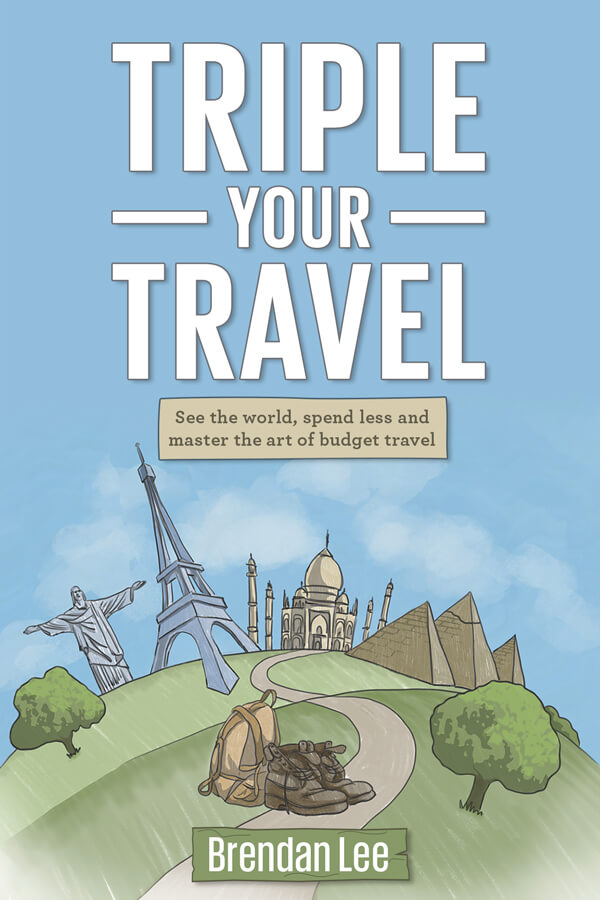
    The big milestone was the release of my travel guide Triple Your Travel – I spent most of the year writing and producing it, which meant I didn’t have as much time to write blog posts, but it was a very rewarding endeavour and I definitely learned a lot. I’ve been told over and over that I needed a flagship product, and that was the hole Triple Your Travel was intended to fill. I’m happy with how it turned out and really believe it’s an awesome resource for the would-be traveller. A big thank you to everyone who’s picked up a copy!

    The blog also continues to connect me with more and more amazing people around the world – other bloggers, travellers, total strangers. It’s definitely my favourite part about having this platform. It serves to enrich my travel experience wherever I go, and that alone has made it such a rewarding project.

    Writing

    Obviously, writing is largely a part of blogging, but it deserves it’s only little section here. This year I’ve come to think of myself as a writer first and a blogger second. Last year was all about travel tips and hacks, this year has been more about personal stories that make travel special to me. It’s tough, because the former are much more popular with readers, but the latter are what I really love to write. Stories such as Melancholic in Montpellier, Five Days In London, I Found New Zealand In Ahipara and A Bowl Of Potato Soup In Rotorua are the stories I love to write – stories I hope to look back on in a few years and remember why I travelled. They take a really long time to write and edit (days, not hours) and don’t generate much traffic, but I will continue to edit and publish them, although perhaps a little more sparingly.

    Secondly, I’ve been flirting with the idea of writing my first book – not an e-guide or ebook, but a book book – one you can put on the bookshelf. I’m not sure if it will be a travel memoir in the style of A Bowl Of Potato Soup In Rotorua or a more philosophical book in the style of The One Simple Lifestyle Change That Will Transform Your Life. Maybe a mixture of both. What do you think? Let me know in the comments!

    Overall, my writing has matured (I think). It’s still evolving obviously, and I’ve never had writing training so the words just come out however I hear them in my head, but I’m coming to enjoy it more and more, experimenting with different styles and words. I simply love telling stories. Expect a lot of blogging in 2016!


    Finances

    At the start of this year I budgeted all the things I wanted to do, looked at my bank balance, and decided if I travelled smart I wouldn’t have to take on much work. In the end I spent about $12,000 this year on 7 months of travel – slightly over budget but still did pretty well. I spent around $2,800 on my month in France which was a killer (a good chunk was tuition), and about $2,800 on flights (the two big ones were going and coming home: Sydney-Istanbul and Johannesburg-Sydney). Budget airlines in Europe and Africa were big life-savers. The rest of my trip I was able to get by with simple budget travel strategies!

    I continue to write for select clients, I still have money trickling in from investments and the blog continues to bring in funds. My inbox is still being flooded with income opportunities for the blog which would easily add up to thousands of dollars per month but it’s all about advertising and sponsoring stuff I have no interest in putting in front of you guys. Sometimes it’s hard to let that money go but luckily I’m in a position where I can do so. There are a few companies I would love to partner with – if the opportunity arises I’ll see if we can make that happen in 2016.

    Overall I haven’t made a whole lot of money this year, but didn’t spend much either, which is exactly what I preach. Now I’m back in New Zealand holed up in my parents’ house, figuring out my next move. All should be well!


    New Projects

    I’m always experimenting. Last year I spent a lot of time fiddling around with new projects and websites, and while I learned a lot most of them were miserable failures (things like Amazon stores, niche sites, Facebook marketing). It wasn’t that they were bad ideas per se, but just that I wasn’t able to give them the attention they needed. Between writing Triple Your Travel, blogging, freelance writing and actually travelling – I didn’t have much time for anything else. These things may get a revival sometime down the track, but probably not in 2016 – any new project next year will probably centre around a new book or Youtube series (I’ll talk about this later), but we’ll see.


    Education

    First #swahili class. Let’s get it on.

    A photo posted by Bren (@brenontheroad) on

    I talk about learning all the time. On here, in my emails, on social media. Almost every newsletter I send out I ask people what new things they’re learning, how and why, encouraging people to learn something new. When I wrote about the joy of learning something new last year, I wanted to inspire someone to start a new class or find a new passion, because the excitement of learning something new is what has inspired me to keep travelling all these years.

    This year was awesome. I wrote recently about the Four Things I’m Doing Each Day To Become More Awesome, but there’s been a lot more to it than that. I finally finished the Spanish course on Duolingo, and now I’ve moved onto French. I also spent a month in French school during May which is something I’ve wanted to do for a few years now (and yes, I’ll be going back!). I started meditating which has added a lot of clarity to my life. During my time in Africa I self-studied Swahili each day and improved a lot, which totally transformed my trip to Tanzania this year. I took Kizomba lessons during my month in Uganda. When I returned home in October, I finally took up yoga like I’ve been talking about forever and do three classes a week. I can play one song on the guitar and am up to level 6 on Yousician! I completed a surf camp and am much less terrible than I was before. And I’m finally a member of a martial arts gym again, following on from my training in the Philippines nearly two years ago.

    In a way, I feel like I’ve almost taken on too much, so 2016 will probably be about getting better at all these things I’ve already started. I do want to learn Tai Chi though. And maybe some Portugese 🙂


    Friends And Family


    The hardest part of travel – being away from your loved ones. You learn so much because you’re away from them, you meet so many new people because you’re away from them, but you also miss them a lot because you’re away from them. It’s a rough, double-edged sword.

    It’s about finding the balance. I had a family reunion in January where I saw a lot of my extended family. I was at home in New Zealand with my parents until April. I travelled alone until October, and then flew to Australia to see my cousin get married before heading home to New Zealand for the summer. Took a small road trip to see a friend get married in November, and I’ll spend Christmas and New Year with friends and family. Seven months away, five months at home. It’s been perfect this year.


    Health

    Start the day with a green juice and you’ll punch like Mike Tyson

    A photo posted by Bren (@brenontheroad) on

    I turn 30 next year! The golden years are over.

    Interestingly, I feel like I’m in the best shape I’ve ever been in – ever since my shoulder injury I’ve been obsessed with staying healthy. When you can’t even lift your backpack up the stairs, you can’t even raise your arm to twirl your dance partner around, it puts things in perspective. Nothing matters if you don’t have your health.

    During my travels this year I made a really concerted effort to eat a lot of fruits and vegetables and stay away from shitty food. That was kind of hard in Turkey and Bulgaria, where delicious kebabs are everywhere, but in the rest of Europe and Africa it was pretty easy (Africa has the best fruit and veg ever!). Unlike most trips, I didn’t allow myself to get out of shape at all on the road.

    Now that I’m back in New Zealand, it’s detox time. If you see my kitchen at home, it’s like a mad scientist’s lab of nutrition. Every day I drink bone broth, matcha green tea, fresh vegetable juice, and a smoothie of all the most potent nuts and fruits and spices. I feel like I’m on steroids.

    Between yoga, fighting and surfing, plus my daily Mobility WOD, the body gets a workout every day and has been feeling really good. For the first time in a long time, I’m working out every day and completely injury free. I’m getting older, but healthier too. I’ll be aiming to make my thirties stronger and healthier than my twenties.


    Travel

    What a year. The world taught me so much. The travel bug still bites. I want to see more.

    I started the year by calling in the new year in Tokyo. This was a trip I’d planned with friends for a while, so it was cool to finally travel with them. After Tokyo I ventured out to Japan’s Okinawa Islands, which was a slower, simpler version of Japan that was really interesting to see. You can learn a lot in these off the grid places!

    #fatty #salmon #sushi

    A photo posted by Bren (@brenontheroad) on

    After that I headed to Fiji for a family reunion (a lot of my family lives in Fiji), and almost missed my flight because Sydney Airport was just so amazing as always (not). I spent a lot of my childhood in Fiji as my parents are from there, but haven’t been back for many years so this was a reunion that was long overdue.

    Then in April I finally got to Europe. I didn’t move around a whole lot (four countries in total) but that was more than enough to make it worthwhile.

    I started out with a flight to Istanbul (I would’ve flown to anywhere in Europe – Istanbul was the cheapest flight I found). I actually knew nothing about Turkey and booked the ticket around four days before I flew, so I went in completely blind. Overall, I didn’t like Turkey. The people, the vibe, it wasn’t my kind of place. I left after a week. I did, however, get to see Gallipoli, a place I have heard about my entire life, which was a rewarding and eye-opening experience. I got to see Troy as well, which I’ve always been fascinated with after learning about it in high school.

    After Turkey it was onto Bulgaria. I had a horrible bus ride over the border, but three weeks in Bulgaria blew my mind. I had two weeks in Plovdiv and a few days in the capital Sofia. Super friendly people, affordable, awesome food, the women are beautiful, not touristy at all, safe, lots to do. One of my new favourite countries – I would live there!

    #Sunday afternoon in #Plovdiv. Miss this place.

    A photo posted by Bren (@brenontheroad) on

    From Sofia I flew to Paris. I walked around, spent a day at the Eiffel Tower, looked at the Louvre from the outside but didn’t go in, then was up until 6am the following night watching Mayweather vs Pacquiao. After that it was an early morning, last-minute train to Montpellier, where I spent a month in an intensive French course. I’ve been meaning to visit France for years, so this was trip was extra sweet. I loved Montpellier – small and trendy, safe, beautiful – a highlight of the year.

    A Thursday night chill session on the streets of #Montpellier. Miss that place.

    A photo posted by Bren (@brenontheroad) on

    Next, I flew up to London to visit some friends. I couchsurfed with an old friend from my 9-5 days which saved me a tidy bundle of cash, but the highlight was seeing my old friends from home and knowing they’re all doing well and earning stacks of money. It’s funny how life changes so much, but over a beer everything is still the same. I didn’t get a lot of time in London, but the city grew on me during those few days. I can see why people love it so much.

    Enter Africa. I flew from London to Moshi, Tanzania – a city I know very well now. I have some continuing non-profit work I do in Moshi since my first visit in 2011. It’s a personal story I haven’t shared here yet, maybe I will at some stage, but nonetheless it’s a city I love and will continue to visit! It’s always nice to visit my old friends at Hostel Hoff too, where I stay each time I return. Unlike my other visits to Moshi, I finally got time this year to see a bit more of Tanzania. I spent 3 weeks exploring the bustling and crazy Dar Es Salaam, and another week or so on the idyllic island of Zanzibar. I’ve visited Tanzania now more times now than any other country in the world – I just love it that much.

    When my Tanzanian visa ran out, I headed to Uganda’s capital, Kampala, for a month stay. I haven’t written about Kampala yet, mostly because I was holed up in an apartment finishing off writing Triple Your Travel. However, I did get out and explore, eat, and make a lot of new friends out there. It’s an incredible city, with possibly the friendliest people I’ve ever met (yes, maybe even more than the Filipinos!). I would love to return.

    Causing mischief wit da boys in #kampala Thursday night! Love this city to pieces.

    A photo posted by Bren (@brenontheroad) on

    My last stop was South Africa. I needed to fly through Johannesburg to catch my flight home, so decided to stop in for a few days and see what this city was all about. It wasn’t at all what I expected. Joburg is a booming metropolis comparable to most first world cities I’ve been to – sparkling clean water, big winding highways, flash European cars everywhere and lots of amazing bars and restaurants, quite bohemian too in many parts. It can be tough to get around but with Uber, everything was painless. Joburg is vibrant and happening – maybe not the Africa you expect, but still amazing.

    Some dope artwork in #johannesburg. Couple thousand bucks to get one of yourself. #whenimrichandfamous

    A photo posted by Bren (@brenontheroad) on

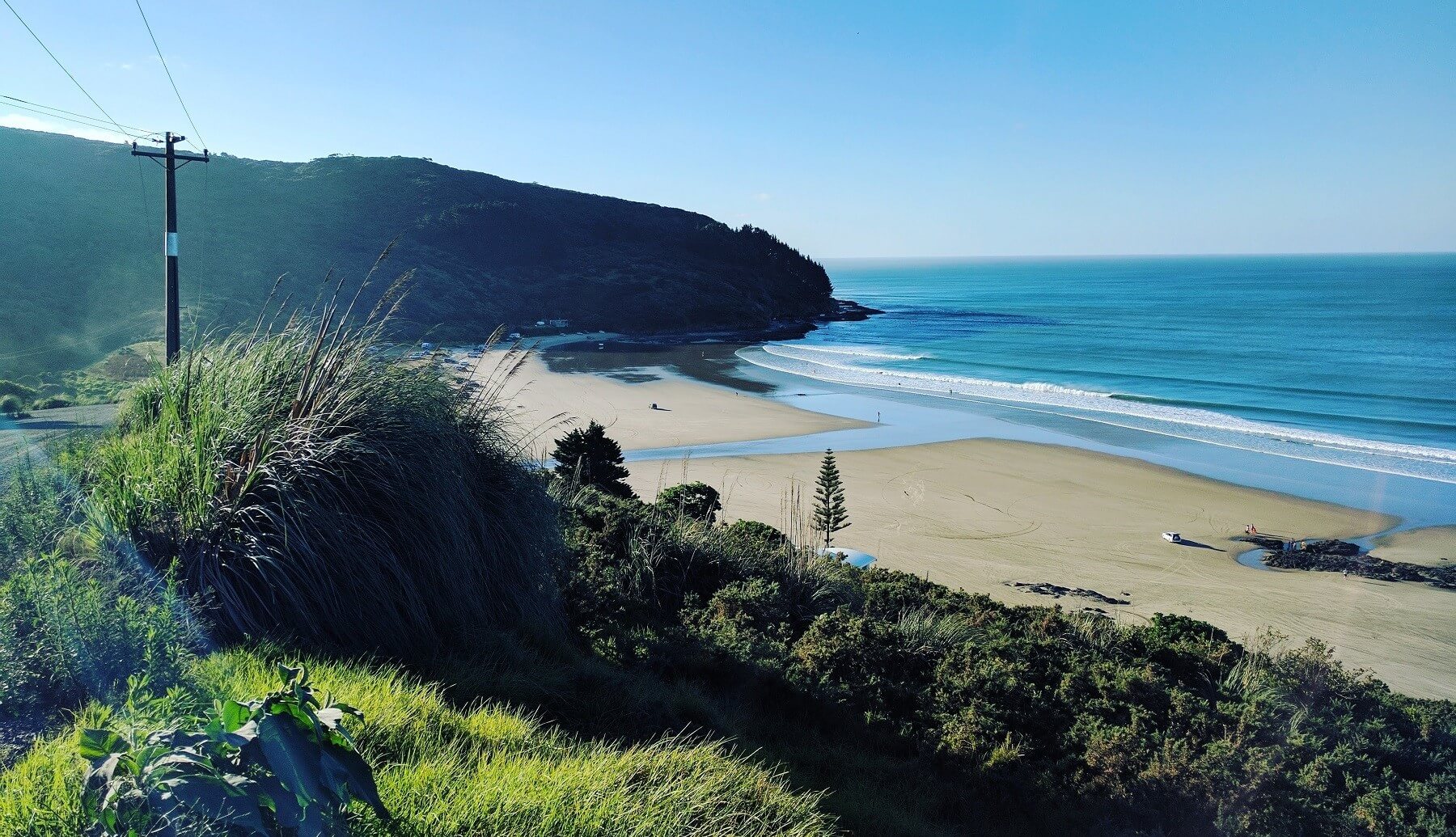
    From Joburg I flew to Sydney to see my cousin get married, then it was home to New Zealand. As much as I suck at surfing, I missed it a lot so I almost immediately signed up for surf camp – something else I’ve always wanted to do. I learned a lot about my own country up there, which made it a far richer experience than I had expected. Another highlight of the year.

    Learning to surf in #Ahipara

    A photo posted by Bren (@brenontheroad) on

    The last bit of travel for 2015 was a short road trip down to Wellington to see my old buddy Jordan get married. 9 hours each way, I decided to break it up with a stop in Taupo on the way down and a stop in Rotorua on the way up. Despite being only a week long trip it felt like I’d been away a month. A reminder that even short travel experiences can be amazing ones.

    A photo posted by Bren (@brenontheroad) on

    All in all a handful of new countries, lots of new friends, lots of new memories. Couldn’t have asked for more.


    Plans for 2016

    As for travel, I don’t know. All I know is I’ll be walking the Camino in May to celebrate my Mum’s birthday. The rest is up in the air, but I do have some ideas.

    Taiwan is one of them – I need to head back to that part of the world and work on my Chinese, which is terrible and I’m embarrassed to tell people I spent a whole year in China studying it. Staying in Europe is the other possibility, maybe with a dip down to Africa. Depends on my money situation. Right now, I’m just focusing on enjoying my summer at home in New Zealand. When the tickets do get booked, you’ll be the first to know.

    As for the blog, I’ve got a few things in mind. I’ve been brainstorming a Youtube series which probably won’t be ready in 2016, but it’s something I’ll be gathering ideas for. I also have the aforementioned book, which I’ve started writing some thoughts on. I’m redesigning the site as we speak which is exciting, and I have a lot of posts drafted which I think you guys are going to love. In the end, I’ll just be striving to keep getting better at what I do – writing stories, and sharing information that helps you travel more.


    Thank you!

    Again, I owe so much to you. To everyone who shared an article, tweeted, pinned, read my emails, purchased my book, even if you just read an article and said “Hey that was pretty good,” thanks so much. To know that my writing has an influence is what makes all the work worth it. Many of you write in to me and share your own stories, or how an article of mine has helped you to make a positive change in your life, and that’s really the best feeling the world, so please continue to write. At the end of the day, we write not to make money or get shares on Facebook, but to share a story that will make an impact. Many of you leave comments to say that something I’ve written has inspired you, but remember that seeing you out there doing awesome things really inspires me as well. It’s been amazing connecting with you all this year, and hopefully I’ll see a few of you out on the road in 2016!

    Final words

    2015 has actually zoomed by, and I can’t believe we’re here already, but this year has helped me grow in many ways. In a sense, I feel like I’m actually starting to grow up. My travels have become slower, I’m observing a lot more, being more selective about who I spend my time with and building the things I care about. My minimalist lifestyle continues, which allows me to spend more time on myself, strengthening body and mind rather than building a bank account. I’m in a very different place than I foresaw ten years ago.

    Many new people came into my life this year, some of whom I introduced to you in my writing and some I did not. But I’ve learned from all of these people and always feel blessed that travel brings so many great friendships into my life – it really is the best part of doing what I do.

    For now, it’s a summer at home, but I’m sure 2016 has some great adventures in store for me. Time will tell.

    See you in the new year,

    Bren


    What did 2015 mean to you? What were your successes, failures? What are your aiming for in 2016? Let me know in the comments below!

  • The Books I Read In 2015

    The Books I Read In 2015

    One of my goals this year was to try and read more.

    I never read. Before this year I’d read maybe five books since high school. I read a couple last year, but this year the challenge was to make reading a habit.

    Why?

    Because it’s the advice that keeps coming up again and again. As it’s usually described – when you read, you get to transfer knowledge from the brain of a very successful person into yours for a few dollars. In total I got through 11 books, almost one a month. By most people’s standards I still probably didn’t read much at all, but I’ve read more books this year than any other year of my life. And I agree with the big dogs – you learn a lot.

    For those of you who want to know exactly what I’m reading, I’ve listed every book I read this year below, with a few notes. I’d also love for you to share your reads of 2015 in the comments, I’m looking to fill up my list for 2016!


    The Art Of Learning by Josh Waitzkin

    “I think a life of ambition is like existing on a balance beam. As a child, there is no fear, no sense for the danger of falling. The beam feels wide and stable, and natural playfulness allows for creative leaps and fast learning. You can run around doing somersaults and flips, always testing yourself with a love for discovery and new challenges. If you happen to fall off – no problem, you just get back on. But then, as you get older, you become more aware of the risk of injury. You might crack your head or twist your knee. The beam is narrow and you have to stay up there. Plunging off would be humiliating. While a child can make the beam a playground, high-stress performers often transform the beam into a tightrope. Suddenly you have everything to lose, the rope is swaying above a crater of fire, increasingly dramatic acrobatics are expected of you but the air feels thick with projectiles aimed to dislodge your balance. What was once light and inspiring can easily mutate into a nightmare.”

    Most people will have never heard of Josh Waitzkin, but the man is anything but ordinary. As a six year old, he found a fascination with chess after seeing men playing in the parks in New York. After beating many of the hot-shots there, he was discovered by a famous chess teacher who took him under his wing. He was quickly recognised as a prodigy and was the subject of the film “Searching for Bobby Fischer”.

    Being the subject of a movie was a big distraction and he claims he was unable to properly concentrate after his newfound fame. Despite dominating the US chess scene, winning every tournament possible and advancing to International Master by age 16, he retired from chess in his early twenties and took up Tai Chi as a way to clear his mind. He describes how he was able to transfer the same learning methods and principles from chess to martial arts, recounting his rise as a competitor in “Push Hands”, the competitive combat form of Tai Chi, eventually leading to a world championship. He has since also expanded his learning to a black belt in Brazilian jiu-jitsu under BJJ legend Marcelo Garcia.

    The Art Of Learning is part “how-to” and part memoir, where Josh shares his unique learning theories that have allowed him to rapidly excel in whatever discipline he chose. An example – when he started learning chess, instead of learning opening sequences and playing full matches, him and his coach would simply play games of king and pawn versus king -he learned the game backwards. This allowed him to better understand the power of the king and pawn, and how to control space. In his own words: “what I am best at is not Tai Chi, and it is not chess – what I am best at is the art of the learning.”

    I feel it’s not the most practical book, perhaps it’s a bit high level for me, but the story and theories themselves are truly fascinating. Would highly recommend, especially for anyone in martial arts or competitive sport.


    Kitchen Confidential by Anthony Bourdain

    “I got, finally, the hands I always wanted. Hands just like the ones Tyrone taunted me with all those years ago. At the base of my right forefinger is an inch-and-a-half diagonal callus, yellowish-brown in color, where the heels of all the knives I’ve ever owned have rested, the skin softened by constant immersions in water. I’m proud of this one. It distinguishes me immediately as a cook, as someone who’s been on the job for a long time. You can feel it when you shake my hand, just as I feel it on others of my profession. It’s a secret sign, sort of a Masonic handshake without the silliness, a way that we in the life recognize one another, the thickness and roughness of that piece of flesh, a résumé of sorts, telling others how long and how hard it’s been.”

    Who doesn’t love Anthony Bourdain? I’ve been a fan ever since I saw him have a foodgasm over a bowl of pho in Vietnam.

    Kitchen Confidential is his no holds barred memoir of his early life as an upcoming chef in New York City. After his graduation from CIA (Culinary Institute of America), Bourdain floated around numerous restaurants in New York, some famous, some not so much.

    There are lots of great stories, sure, lots of drugs and sex and everything else you’d expect in a famous dude’s memoir, but the real treasure of the book was seeing the scars behind the famous guy we see on TV. You see Anthony Bourdain on his travel show being a clown and eating all this delicious stuff around the world and you just think, this guy’s got it made. But he also did long hours at a shitty job peeling potatoes, he also slept in a mouldy apartment unemployed and almost broke, addicted to drugs, hating life. He went through his misery too. So when we see those people on TV living the dream, it helps to know sometimes they crawled through the mud to get there too, just like the rest of us.

    For me, it was less of a chef’s memoir, and more a story of what a man can achieve when he loves what he does and follows his dream, because the ups and downs will test you, but if you push hard enough you’ll come out the other end smiling. Will always be a fan of Anthony Bourdain.


    Eat Pray Love by Elizabeth Gilbert

    “I keep remembering one of my Guru’s teachings about happiness. She says that people universally tend to think that happiness is a stroke of luck, something that will maybe descend upon you like fine weather if you’re fortunate enough. But that’s not how happiness works. Happiness is the consequence of personal effort. You fight for it, strive for it, insist upon it, and sometimes even travel around the world looking for it.”

    Elizabeth Gilbert’s wildly famous memoir tells the story of a successful, married writer in New York City who supposedly has it all, yet is on the verge of a complete mid-life meltdown. Once her divorce is finalised, she drops it all and embarks on a one year journey of self discovery.

    A gastronomic chapter in Italy, a spiritual awakening in India and falling in love in Bali – she documents it all in shameless honesty. For her it’s an endless emotional roller-coaster, full of insecurities, loneliness and self reflection.

    Elizabeth Gilbert can write. You will know her very well by the end of the book. Some people will see themselves in her and others will find her insufferable, but everything she writes is real and she leaves herself open on the page. Even if she drives you mad, you can’t help but respect the realness.

    It’s not a book that I particularly enjoyed (it took me several months to finish it), and I think it’s quite clear I wasn’t the target audience. But as a traveller, it raised many questions to reflect on. What is it about travel that makes it so healing and therapeutic? What are we running from, and toward, when we travel? Is it the people or the places that really make travel so transformational? That’s what made it worth reading for me.

    (If you’d like to know more, I wrote a full review here).


    Fresh Off The Boat by Eddie Huang

    “Dave had no shoes. This was something I noticed was very common with white people down south. They went everywhere with no shoes. Their parents would drive barefoot, then throw a pair of sandals on the asphalt as they walked out of the car and into Publix. I didn’t get it. The bottoms of their feet were all red, there were little pieces of gravel between their toes, and somehow they didn’t care. I mean, Dominicans hate socks and love Aventura, but at least they still got Jordan 7s on. Then Dave invited himself and his stank-ass feet into our house. I liked the guy, but I knew that as soon as my mom saw him walking around on the carpet with his dirty-ass bare feet, she would bug. Everyone knows to take their shoes off in an Asian home, but the fuck you supposed to tell Huckleberry Finn when he rolls in barefoot? There’s no answer for that. It’s unprecedented behavior on our continent, unless you’re a wounded samurai that got his wooden chancletas stolen.”

    When you’re Chinese blooded, but you were born in America, are you Chinese, or American? The same question can be asked of Australian Vietnamese, Canadian Indians and British Africans. It’s a question many people growing up as a minority will be familiar with.

    Eddie Huang is the host of Vice’s Huang’s World, owner of Baohaus in NYC and the personality behind the TV sitcom Fresh Off The Boat. But what he is just as famous for are his views of race, identity, stereotypes and racial issues. Naturally I relate to Eddie’s story of growing up as an overseas Chinese in a western country, and I’m a huge fan, so I jumped on his memoir.

    When you grow up looking different to everyone else, it becomes a part of who you are. It’s something that affects every single minute of your day. Do you belong, or don’t you? It shapes your life, your journey. Eddie writes candidly about his life before 30, and the continuing challenge of finding acceptance as his own person in a society of racial profiles. Mixed in are lots of family hard love, drug dealing, laughs, nuggets of wisdom, many victories, constant hustle and a lot of anger – his story is thrown at you full force in the voice his fans know as uniquely his.

    If you don’t relate, much of it may come off as bitter and over-dramatic. But if you’ve experienced a similar upbringing, you will be nodding, laughing, and rooting for him all the way. Thumbs up from me.


    The Fastest Billion by Charles Robertson

    “Imagine a continent torn by multiple wars, beset by ethnic and religious warfare, malnutrition, disease and illiteracy –all of it complicated by poorly drawn borders, a still potent post-colonial stigma and the incessant meddling of outside powers. With a single exception, per capita income hovers at $400, primary school education reaches only a fraction of the region’s vast population, and its authoritarian rulers ensure any revenue generated by the region’s rich natural resources is spent on personal, rather than national priorities. Too many readers will by now have concluded that the continent referred to above is my own, Africa. In fact, while Sub-Saharan Africa has suffered the same problems in recent decades, the region described above is Developing Asia in the mid-1970s: an area of the world that had endured 200 years of decline, imperial domination and economic stagnation before beginning on the path that would transform it into the most economically vibrant zone on Earth. Just as SSA has suffered through its despots and destitution, so the seedlings of transformation have pushed through the African soil. As an increasing number of economists, investors and financial policymakers have realised, Sub Saharan Africa has emerged from its own malaise, into a dawn that promises growth to rival, if not surpass, that recorded by Asia’s ’Tigers’ over the past two decades.”

    We often hear about the hopeless side of Africa, but this book aims to tell the other side – the side of limitless potential, booming economies, a surging population and a continent on the brink of a revolution.

    I’ve visited Africa almost every year since 2011, and the change is constant and neverending. One family I met in 2011 was living in a small mud house, without water or electricity. In 2012, they had running water. In 2013, they had electricity. This year they had a flat screen TV, a DVD player and smartphones with Whatsapp. Africa is changing quick.

    Every day in Africa medicine is advancing, democracies are emerging and incomes are rising. There are skyscrapers going up in almost every capital. Education is expanding, fast. More people are voting and campaigning in elections. A middle class is starting to emerge. Banking and internet is sometimes more advanced than many first world countries. It is at the forefront of a new age.

    The Fastest Billion explores this emergence, through research, hard data, historic comparisons and basic economic principles. It’s a fascinating look behind the scenes of Africa’s development (for those who are interested), and gives estimates of when, and why, certain milestones will be achieved (literacy rates, democracy, GDP levels). It can be repetitive and even overzealous in its enthusiasm (it is without a doubt the most bullish things I’ve ever read on Africa), but having spent much time on Africa it is understandable why. Things are changing there more rapidly than ever before. If you have an interest in Africa, or are planning to visit for the first time, this book will help you make sense of what you’re looking at – a continent on the brink of change.


    The Undisputed Truth by Mike Tyson

    “A year before I was scheduled to be released, there was talk that I would be granted an early release. A lot of national press people were questioning my conviction. My lawyers were talking to the court and to the Washingtons. Apparently, they had reached an agreement. I would pay the Washingtons $1.5 million and I would apologize to Desiree and I would get out of jail immediately. I didn’t even have to admit to raping her, just apologize for it. Some of my friends like Jeff Wald were pushing for the apology. “Mike, I’d admit to raping Mother Teresa to get the fuck out of jail,” he told me. “If I apologize, the prison in my head would be worse than the prison I’m in now,” I told him. So they brought me to Judge Gifford’s courtroom in June of 1994 for a sentence reduction hearing. I was dressed in denim pants, a light blue work shirt, and work boots. The new prosecutor asked me if I had anything to say. “I’ve committed no crime. I’m going to stick with that to my grave. I never violated anyone’s chastity.” That wasn’t what anyone wanted to hear. They sent me right back to jail.”

    As a fight fan, I love Mike Tyson. I’ve watched almost all his fights, watched all his interviews. He’s a warrior. But after reading his story, I can truly say I admire him. Mike Tyson’s story is a hard one. After reading his memoir I can’t even understand how he’s still alive, let alone how he became one of the greatest fighters of all time.

    The book starts with vivid recollections of his troubled childhood, until he’s taken in by legendary boxing trainer Cus D’Amato. He then documents his rise to becoming youngest heavyweight champion of all time, his up and down boxing career, his debilitating battle with sex, drugs and alcohol, his rape conviction, recounts of his time in prison, how he hits rock bottom after his team, and the world, turn on him, and his eventual journey to finding happiness as a father and husband.

    It’s a story of the highest highs and the lowest lows, from a man largely misunderstood. The media, as always, tells you what they want you to know. The memoir fills in the gaps behind the headlines. He is truly a man who has survived it all, and I’d love to shake his hand one day. Best book I read all year.


    Models by Mark Manson

    “Men don’t seem to understand that if a woman rejects him because he’s short, or because she doesn’t like his hair, or because she finds him boring, then he wasn’t going to enjoy being around her anyway.”

    Mark Manson is a blogger I’ve followed for a while now (he should be familiar to many of you too, I share a lot of his articles!). His first book, Models, is a book about women, or more specifically, what men should do to improve their relationships with women. It feeds from his experience as a self-help writer and a dating coach.

    I found it a case of somewhat over-complicating things (he himself concedes this in the book) but there’s a lot of wisdom in here. He breaks down situations a lot of guys will be familiar with, and analyses them in a way that will make you go “I never thought of it that way.”

    Mark shows, although not explicitly, how your success with women is a greater reflection of what is really going on behind the scenes in your life. Using your relationships with women as a vehicle, he asks you the tough questions you need to answer in order to be the man you want to be. Of course, positive change in your dating life inevitably will feed into all other areas of your life. I feel like that is the greater purpose here.

    For me, it wasn’t so much a dating book. It was a book about how to be a man in today’s world – about finding your truth, finding confidence, being self-aware and answering to yourself honestly. Who are you? What do you want? And do you have the confidence to be that person and chase those things? From what I’ve seen, male self esteem seems to be at an all time low in my generation. In the book, Mark touches on the idea of a “new masculinity” – an idea of what it means to be a strong, confident man today, and staying true to your masculine instincts in our changing society.

    A good read for guys in their twenties finding their way in the world.


    Open by Andre Agassi

    “I play a kid I recognize from juniors, Pete Something. Sampras, I think. Greek kid from California. When I played him in juniors, I beat him handily. I was ten, he was nine. The next time I saw him was some months ago, at a tournament. I can’t recall which one. I was sitting on a beautiful grassy hill beside my hotel, just after winning my match. Philly and Nick were sitting alongside me. We were stretched out, enjoying the fresh air, and watching Pete, who’d just taken a beating in his match. He was on the hotel court for a post-match practice, and nearly every ball he hit looked bad. He missed three of every four swings. His backhand was awkward, and one-handed, which was new. Someone had tinkered with his backhand, and it was clearly going to cost him a career. ‘This guy will never make it on the tour,’ Philly said. ‘He’ll be lucky to qualify into tournaments,’ I said.”

    I grew up watching Andre Agassi play tennis. My Mum was a big tennis fan and I spent many nights watching Andre Agassi and Pete Sampras duke it out on TV with my brothers.

    As an old fan, learning the story behind this guy was fascinating. We learn he hated tennis from a young age, and if it weren’t for his obsessive father who built a court in their backyard so he could train non-stop, he wouldn’t have been a tennis player. We learn he was so embarrassed about going bald he wore a wig during the French Open final, and was so paranoid about it falling off that it lost him the tournament. As a tennis player, he was wildly talented and a total outlier. As a human, he was just like the rest of us.

    The storyline is all tennis – his childhood as a prodigy, his rivalry with Pete Sampras, his hate for Wimbledon and the French Open, but the message is about loyalty, family, and what it really takes to be the best in the world. If you’re an old Agassi fan, you will absolutely love it.


    On The Road by Jack Kerouac

    “The announcer called the LA bus. I picked up my bag and got on, and who should be sitting there alone but the Mexican girl. I dropped right opposite her and began scheming right off. I was so lonely, so sad, so tired, so quivering, so broken, so beat, that I got up my courage, the courage necessary to approach a strange girl, and acted. Even then I spent five minutes beating my thighs in the dark as the bus rolled down the road. You gotta, you gotta or you’ll die! Damn fool, talk to her! What’s wrong with you? Aren’t you tired enough of yourself by now? And before I knew what I was doing I leaned across the aisle to her (she was trying to sleep on the seat) and said, ‘Miss, would you like to use my raincoat for a pillow?’”

    There are a few names in the travel community that everyone knows – people who are considered the OG’s of the road. Jack Kerouac is one of them.

    His adventures hitch-hiking across America are now cemented in legend and his books appear on pretty much every “Top Travel Books” list there is. Even Bob Dylan wrote “I read On The Road in 1959 and it changed my life like it changed everyone elses.” How can you not read it after that?

    On The Road is a memoir of Kerouac’s documenting his journeys across America during the 40’s with friend Dean Moriarty. While Kerouac’s character is kind of reserved, Moriarty could be described in today’s terms as that boozy Australian backpacker who’s been travelling forever doesn’t give a shit about anything. It’s a potent mix.

    In the end it’s not the wildest story, but I don’t think it’s meant to be. Instead, it represents an idea and a lifestyle, one of freedom, exploration and blazing your own trail. While some will question what kind of life he’s trying to chase, others will understand him completely.

    To be honest, I struggled through it. I almost gave up around 50 pages in, not because it was boring but just because of the old style of prose it was written in. In the end, I got through it. It had some great moments but it wasn’t for me. I feel like you need to be an American (or at least have travelled America) to really enjoy it. He would write to the tune of, “And we were back in Virginia, so you know what that means.” Well actually no, Jack, I’m from New Zealand, so I have no idea what that means. Still, I’m glad I finally read it.


    What I Learned Losing A Million Dollars by Jim Paul

    “I made $248,000. In one day, a quarter of a million dollars. The high was unbelievable. It’s literally like you expect God to call up any minute and ask if it’s okay to let the sun come up tomorrow morning.”

    This book came highly recommended from quite a few people. It documents Jim Paul’s incredible run of success as a trader of lumber and bean oil, amassing over a million dollars in profits over a few years, to finally losing it all on one bad trade.

    The first half of the book is a memoir. It tells his early beginnings as a hustler at the golf club he used to caddy at when he was a kid, to his rapid rise as a floor trader in New York, and how a love of money and shiny things had consumed him from a very young age. His love for money takes him into an upward and downward spiral of risky trading, somehow coming out on top on every trade, making over a million dollars in a few years and having absolutely everything. Then it all comes tumbling down.

    The second half of the book is reminiscent of a university textbook. He talks about different trading strategies, with the focus on being how to not lose money, rather than how to make it. He justifies this approach with the fact that while all successful investors have rules that contradict each other (some diversify, some don’t, some trade long term, some short term), they all have one rule in common which is: don’t lose money. He then explores the psychological side of trading, under the broad idea that to be rich you should focus on not losing money, rather than making money. To be honest you need a background in finance or accounting to really understand the second half. If you’re not familiar with terms like margin call, short selling and futures, it will be mostly gibberish to you.

    Still, a fun read for those who are interested (and if you’re in the markets you should definitely read it!)


    Making Mavericks by Frosty Hesson

    “To say that Mavericks isn’t for kids is doing it an injustice. It’s hardly for people. I’d been surfing it for seven years when Jay had his life-altering moment. I had seen world-renowned big wave riders paddle out, take one look at the building-sized, dark green wall of ocean rushing at them with such incredible force that the water actually gets sucked backward up the face of the wave, and then just turn around and go home. These were people who’d conquered breaks all over the globe, but they simply wanted nothing to do with Mavs. Jay, though, he wanted to slay dragons.”

    When Jay Moriarty wiped out on the famous building-sized waves at Mavericks, he became a household name, at least in the surf community. Taking on the granddaddy of big wave surfing at age 16, no one could be believe he survived the wipe out, let alone paddled back out to catch another wave a few minutes later. Some people were just made to be legends.

    Making Mavericks is the memoir of big-wave surfer Frosty Hesson, a Mavericks regular and Jay Moriarty’s mentor/coach. There are a lot of ingredients to this story – first, it tells the colourful story of Frosty, who has been a surfer at heart ever since he touched the ocean. Second is the story of Jay, one of those rare people who manages to capture the hearts of an entire community. And lastly, the stories of Mavericks, the mythical waves that only few dared to surf.

    Most people outside the surf community will have never heard the names Frosty Hesson or Jay Moriarty, and in my mind that’s what makes the story so compelling. They were regular guys like the rest of us, with jobs and families and bills – it’s what they stood for that made them special. Making Mavericks is a charming tale of friendship, community, finding your peace and chasing dreams, even when life isn’t always perfect. I loved it.


    What did you read this year? What should I add to my reading list for 2016? Let me know in the comments below!

  • A Bowl Of Potato Soup In Rotorua

    A Bowl Of Potato Soup In Rotorua

    “What are you cooking?”

    “It’s like a potato soup thing.”

    “Is that like, a German thing?”

    “Yeah.”

    She had a pretty smile. Really straight teeth, too. I always liked girls with straight teeth.

    I turned back to my chicken, steaming slowly in my pan. Hostel kitchens are always interesting. Everyone’s trying to cook something healthy, but with the cheapest and lowest quality ingredients. There’s a sparse selection of kitchen tools. And there’s the whole international thing, too; the Asians are always boiling stuff, the Aussies are eating like four packs of instant noodles, the Brits usually go for a quick and dirty pasta, and of course there’s that one gourmet chef trying to make gnocchi or falafels or something. It’s the most diverse kitchen in the world, only the food quality is about as good as an upside-down prison.

    I peeked into her pot as I passed by to collect some cutlery. I cracked a smile. It looked like glue. Hot, steamy, bubbly glue.

    “Are you going to let me try it?”

    “Sure, when it’s ready,” she smiled.

    She was a petite little thing, dressed in simple shorts and a tank top, with a pair of dark-rimmed glasses. The typical travelling girl’s outfit.

    When my chicken was done I scooped it onto my salad and took it out to the dining area. Five minutes later, she walked around the corner and plonked her soup on my table, along with a plate of salad, salt and pepper, a glass of water, a fork and spoon, and an apple cut into quarters, all arranged nicely in front of me. I smiled inside. Germans.

    “It’s not the best soup I’ve ever made.”

    I looked it over, grinning.

    “Alright, here we go. Do you mind if I use your spoon?”

    “No not at all.”

    I took a small scoop, blew on it lightly and slurped it down. I didn’t know what to think. It just tasted like potatoes. Soupy potatoes.

    “Yeah. It’s not bad.”

    She laughed.

    “You can be honest.”

    “I’m always honest,” I said, smiling. “If it was shit, I would’ve just said, yo, this soup is shit.”

    We chatted away like old friends as we ate our lunches. I’d known her maybe fifteen minutes, but there’s something about meeting people in hostels. It’s like you already kinda know each other – I know this girl ain’t a princess because she sleeps in a bunk bed, I know she ain’t a rich kid because she’s not at the Radisson and I know she’s cool because she’s out here travelling the world by herself. It’s easy to talk to someone after that. You already have so much in common without even knowing each other.

    I scooped the last bit of salad out of my bowl.

    “So, what are you up to today?”

    “I don’t know, I’ll just go sit in the sun probably and do nothing. Then I have to go to work.”

    “Cool. Can I join you?”

    “Yeah, of course.”

    We spent the next fifteen minutes talking about where to go. I had just spent the weekend at a friend’s wedding down south, and had stopped in Rotorua for a couple of days to break up the long drive home. I didn’t know this city at all. She, on the other hand, had supposedly been living here for a few weeks now. I bugged her to think of somewhere cool. She was the local here, at least out of the two of us.

    When we finally made it out the front door she was still clueless.

    “Okay, so how about we drive,” I suggested. “You tell me where to go.”

    We jumped in my car and headed off. She directed me left and right through the town centre, along Lake Rotorua and then off on some road out of town.

    “Where the hell are we going?” I asked.

    “I dunno. Somewhere,” she laughed.

    As we chatted away, it struck me how absurd this would’ve been to me five years ago. Going off with a complete stranger, driving to nowhere, talking as if you’d known each other since graduation. People aren’t so open in the real world. You can’t just say hello to a stranger without them thinking you’ve got Asperger’s. I guess that’s why you can’t be away from the road for too long. You miss the openness, the traveller’s spirit, the ability to just say hi for the sake of saying hi.

    “So tell me, why do all Kiwis drive in bare feet?”

    I looked down at my feet. Indeed, I was driving in bare feet. I’d tucked my flip flops under the seat before we took off. I guessed it was one of those quirks she had noticed, the same way I’d been noticing them about her. I didn’t have an answer – sometimes there aren’t reasons for these things. They just are.

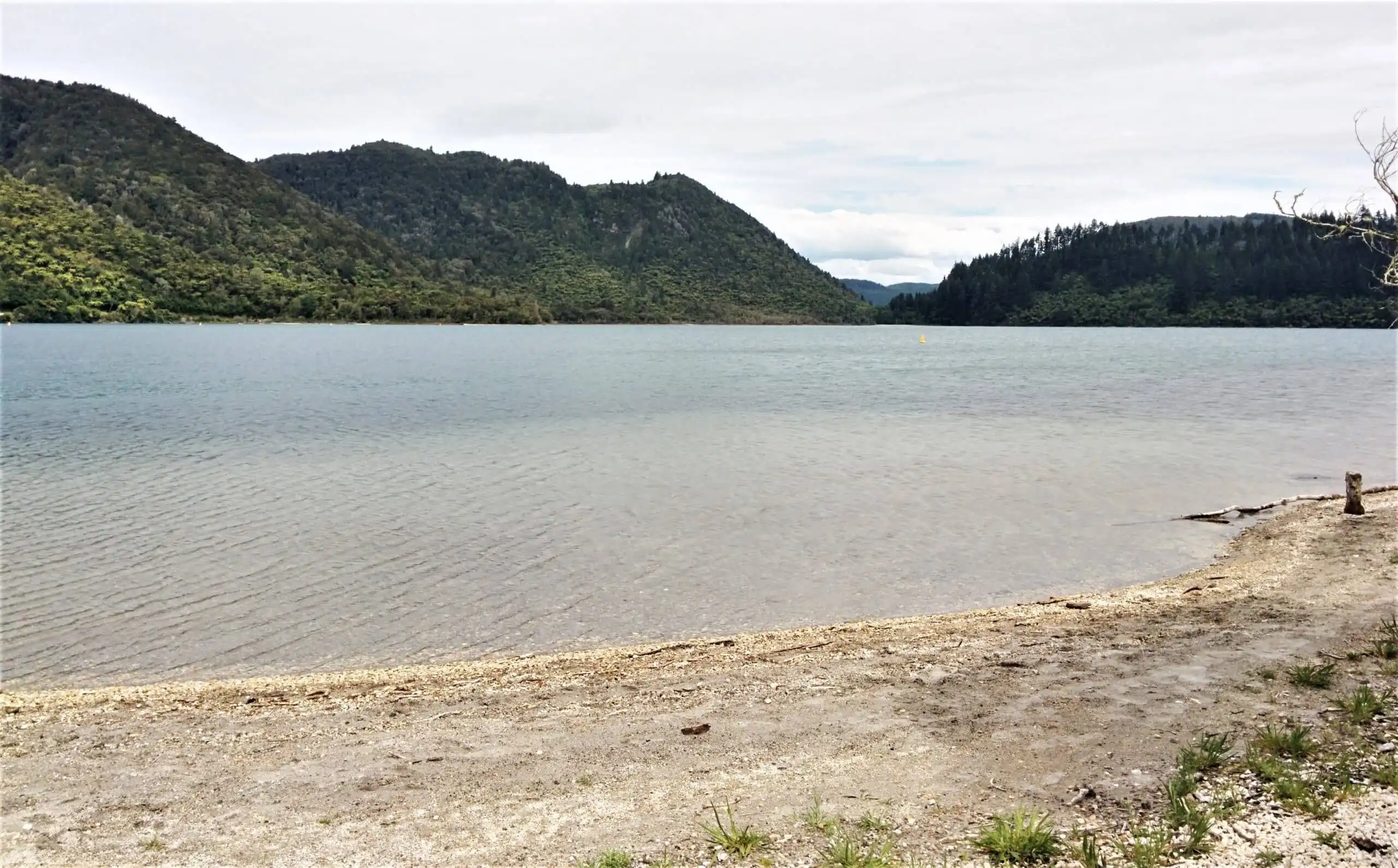
    Eventually, after leading me down some winding roads we found ourselves lakeside at a place called Blue Lake. There were a few people around, but it was mostly empty. I’d never heard of this place before. I guess she was like a local after all.

    “C’mon, let’s walk down there,” I said, pointing to a small enclave by the water’s edge.

    We sat out there and talked, on the rocks, throwing pebbles into the water like little kids at the beach.

    “So, I don’t even know your name,”  I laughed.

    “Don’t tell me though. I’ll guess.”

    She looked at me, grinning.

    “Okay.”

    “But you have to tell me the first letter, at least.”

    ” J.”

    “J..is it a German name?”

    “Yeah, it’s really German.”

    I didn’t even think.

    “Julia.”

    “What the hell!”

    She looked to the sky, laughing.

    “Is that really it?”

    She nodded, still laughing. I sent my own laugh to the sky. I didn’t even know Julia was a German name.

    We sat there for over an hour, talking about nothing, looking out over the glassy lake. It was easy to talk to her; she was youthful, bubbly and free spirited, not jaded by a cubicle or dead-end job. When you meet people out on the road, there’s a certain twinkle in their eye; not a metaphorical one but a real one. You can see it. In the office, it’s nowhere to be found. Eyes are glazed, uninspired. But on the road, the eyes shine. You can’t miss it. It’s a difference as clear as night and day.

    We spent the rest of the afternoon sitting out there, talking about life. It was playful, relaxed – a reminder of the simple joy of doing nothing in the company of another human being. In the morning we’d been strangers. Now, friends. I flirted hopelessly. She laughed at my cheesy jokes.

    I didn’t see her again until the following evening. She walked into the kitchen while a few of us were sitting on the benches chatting, and gave me a smile as she came to flick on the kettle beside me.

    “Hey you. Do you want tea?”

    She was wearing all black after her shift at her waitressing job. Her dirty blonde hair was up in a small ponytail, glasses on, not a speck of makeup on her. She looked nice.

    “Sure.”

    She pulled two cups off the shelf and popped in the tea bags.

    As she passed me my cup, I noticed how short her nails were and smiled. Over the last few years I’ve developed a theory – the longer a girl’s nails, the crazier she is. I hadn’t sensed any crazy in her the day before. I guess the nails were just an affirmation.

    We stayed in the kitchen that night, tucked in the corner, chatting away until one in the morning. I have no idea what we talked about – travel, Germany, school, work, life – probably a bit of everything. I told her I’d take her on a date if she came to Auckland. She said she’d take me on a date if I went to Germany. It was fun to talk about, but we both knew neither was likely to happen. I was heading back to Auckland the next day and the sad reality was, we’d probably never see each other ever again.

    The next morning, as I handed my keys into reception and lugged my bag down into the car, I sent her a message.

    “I’m off. Come say goodbye?”

    I watched the ellipses flashing on the screen before it dinged.

    “Ok one sec.”

    She came out in her pyjamas two minutes later, still half asleep. Hair in a mess, sleepy eyes. I could only laugh.

    We sat in reception and chatted for five minutes. There wasn’t much to say. I liked her, sure, maybe she liked me too, but all we could really do was hug and say “It was nice to meet you.” As we walked our separate ways, I sent her a smile and wave. She sent one back. Then it was over.

    Five years ago, goodbye wouldn’t have been that easy. I might have dwelled on it, wondering what could have happened, where things might have gone. That’s the true challenge of life on the road. The long flights and the lost sleep and the rickety bus rides – you get over that stuff in a day. It’s the goodbyes that leave the marks. They come too soon and too often, each one chipping away at you, little by little. The road leaves you more what-ifs than you care to remember. But sooner or later, you accept this is just the way it is.

    When you travel, you don’t get to explore every story. The time between hello and goodbye will always be short, and that’s just a part of the life you chose. You can have the most epic boys’ night, and then suddenly everyone’s gone the next day. A second date with a pretty girl that never gets to happen, no matter how amazing it could be. But that’s also the reason we love it so much, because you never know what’s waiting for you at the end of the next bus ride. Perhaps a fleeting romance, a new best friend, maybe even a special someone who might just change your life. When you travel, there are stories waiting behind every bowl of potato soup. A simple hello is all you need to find them.

    To your next adventure,

    Bren


    Which hellos and goodbyes do you remember most from your travels? What short stories have made your trips memorable? Share them in the comments below!

    rotorua

  • How I made over $4,000 in my first month on Elance (Upwork)

    How I made over $4,000 in my first month on Elance (Upwork)

    Update: Elance has now merged with Odesk to form Upwork. The platform is more or less the same, and operates in the same manner. The advice below is still applicable. Good luck!


    Surprisingly, the world of freelancing had eluded me until recently. It was by complete accident that I stumbled across a website called Elance – a kind of eBay for freelancers. Fuelled by enthusiasm and a rapidly declining bank account I dove in headfirst and was astonished at the earning potential of the online freelance market.

    Below I’ll detail how I went from an empty Elance profile to making over $4,000 in my first month working as a writer online, all without an ounce of freelance writing experience.

    What is freelancing?

    Freelancing is similar to contract work. It’s basically marketing yourself as an individual, offering your skills to businesses to do a task. You have no boss, no office hours and no public holidays. You work for yourself and it’s up to you to find work and pitch yourself to clients.

    Elance is an online marketplace for freelancers. It’s a place where both freelancers can find work and businesses can find freelancers to work for them.

    As a traveller freelancing is an ideal income source. If you have any desire to travel long term and get out of the office you need to start building a freelance income. You can work anywhere, anytime with just a laptop and wifi. This is where sustainable long term travel starts!

    How I started

    As soon as I surfed on into Elance I signed up and created a profile. I used to be an accountant, so naturally I starting browsing the jobs in the Finance section. Most were bookkeeping jobs and the type of crap I hated that caused me to quit my job in the first place. Not only that, every job seemed to have hundreds of bids from Indian freelancers offering to do the job for $2 an hour. $2 an hour! I wouldn’t even sit through Gossip Girl episodes for $2 an hour! (I wonder if Blair Waldorf has received my fanmail yet…)

    So there I was, so easily uninspired and seconds away from clicking the big red X in the top right hand corner when I caught sight of the “Writing and Translation” category. I vaguely remembered someone telling me about people making a decent wage working as a writer online and decided to check the listings out.

    I had no idea what I was doing, but a lot of the jobs seemed interesting and I knew I could do a decent job. I turned to my best friend (his name is Google) for a bit of advice. Pretty much all my searches about becoming a freelance writer on Elance came back with the same message:

    “Indians and Filipinos are highly skilled, more dedicated, and spend 18 hours a day on this site bidding for literally every single job that comes up. What’s more, they offer to do this work for $1 an hour. You simply cannot compete. Forget about it.”

    One thing about me is I’m super stubborn. When someone tells me I can’t do something it really annoys me, and no matter how stupid it is I’ll generally do everything I can to prove you wrong. What!? You said I can’t eat a whole bag of french fries through my nose?! That’s it. McDonalds, now. You’re driving.

    Bidding for jobs

    So with my stubbornness in hand I started bidding. Unfortunately for me what Google had told me was true. Every single job was being swamped with lowball bids from India and the Philippines. Truth is, I did want to give up at that moment, willing to accept the fact that they were all probably smarter, more hard working and more experienced than I was, not to mention they were much, much cheaper than me too. Nonetheless, I soldiered on, bidding for about 15 jobs and getting awarded exactly zero of them.

    After thinking about this for a while, I realised that the most likely reason people weren’t interested in hiring me was because I had no feedback. I also looked like a hamster in my profile photo. But without at least one feedback, there was no way that they could tell whether I was a rockstar writer or a complete illiterate idiot. On every job that I bid for, the writer who ultimately won the job had at least a couple of jobs completed and at least 4/5 star feedback.

    So I asked myself, what do businesses do when they’re trying to build up customers? They give stuff away for free!

    The next 3 jobs I bid for, I decided not to write my usual “I have an accounting degree and I’m a very hard worker and I love a challenge and I won’t let you down and please hold on while I think of something even more boring to tell you”. Instead, I decided to do part of the job for free as my proposal.

    My first job

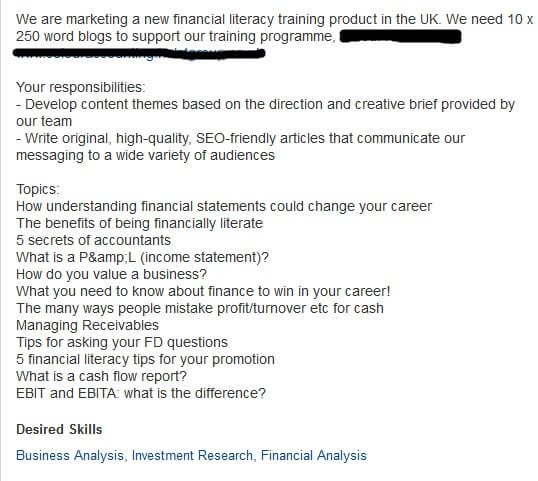
    The job posting looked like this:

    Accounting blog

    I had no idea what a ‘creative brief’ or ‘SEO’ was. I still don’t.

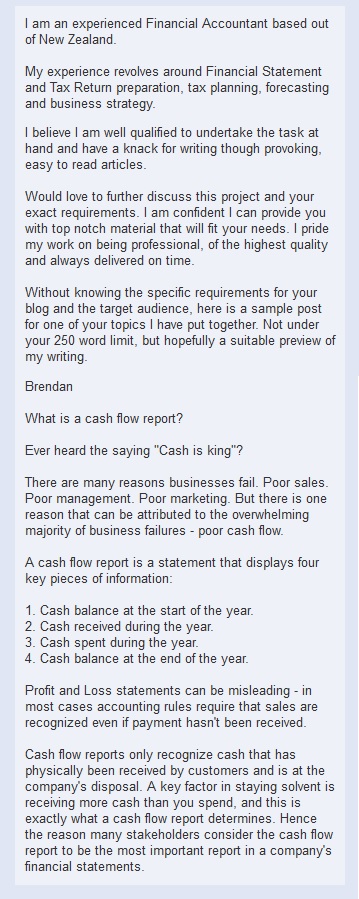
    But that didn’t matter to me because since accounting is my expertise, I knew I could kill this job. However, if I just wrote my typical “I work really hard” proposal I would just look like another amateur writer with no experience, probably even a homeless one bidding from a stolen laptop. Therefore I decided to actually write a blog post for one of the requested topics as my proposal instead. That way he would know that I could write a blog post in good English and also would not be left wondering whether I really knew anything about accounting. Here’s what my proposal looked like:

    Accounting blog proposal

    I also bid quite a high price. I bid $250, which amounts to $25 for a 250 word blog post. For a new freelance writer that’s a very high rate. Most writers when starting out work for around $3-$5 for a 500 word article. Why did I do this? Simple – to stand out. Buying psychology 101 – high prices give a perception of high quality. Also, I’m from New Zealand where the minimum wage is $13.75 an hour. If I’m supposedly a qualified accountant willing to write for $3 an hour in a country where any other job would earn me 5x that, then the client will probably conclude that something is off, i.e. that I’m a moron.

    To my surprise, the whole thing worked perfectly. Within a couple of days I was awarded the job and it’s embarrassing how proud I was. I really couldn’t wait to get started. I was now officially a freelance writer, and had a client to prove it!

    celebration dance

    Lesson: Bidding high helps you stand out, and tells the client you’re not some desperate wannabe (even though you are). On this job I could see that the majority of the bidders were only bidding $3-$5 per post, and many were from India and Pakistan meaning they probably weren’t native English speakers. The highest bid on the job was around $300, so I bid just under that, making me stand out but not making me look extravagantly expensive.

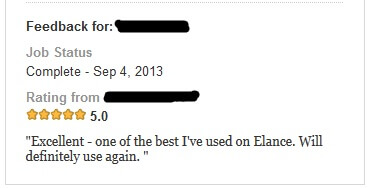
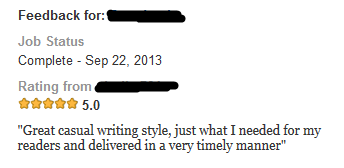
    After 10 days I had completed the job, been paid $250 and received my first feedback:

    feedback accounting blog

    I also need to stress that you must get a 5 star feedback. A 3 star feedback is probably worse than having no feedback at all. So how do you do this?

    Firstly, strive to be the best freelancer your client has ever worked with. Submit work before the deadline. Write 700 words when you only needed 500. Make it clear that you will rewrite and edit your piece until they are 100% satisfied. Put effort into your writing and make your articles the best your client has ever read. In other words, exceed every expectation.

    Then, make it clear you need a 5 star feedback.

    “Hey Joe,

    I’m glad you liked the final article. If, for any reason, there’s still a part of it you’re not quite 100% happy with, please let me know and I’ll rewrite it until it’s exactly what you’re after.

    If there’s no further work to be done, I’d really appreciate it if you could leave a 5 star feedback for me on Elance. This would be so helpful in me securing further work and continuing to write. If you feel any aspect of my work wasn’t to 5 star standard, please don’t hesitate to let me know and I’ll do everything I can to fix that.”

    Remember, finding good writers on Elance is a complete headache for most editors. Well established freelance writers earn up to $500 an article, so for $20+ they don’t tend to expect too much. If you’ve been blowing their socks off with your professionalism and commitment to quality throughout the project, they really should have no problem leaving you the 5 star feedback you’ve asked for.
    [thrive_leads id=’10652′]

    The ball starts rolling

    After that everything became exponentially easier. With my first 5 start feedback behind my name I landed my next job a couple of days later. Here’s what the job posting looked like:

    Indian job

    My proposal:

    Proposal indian job

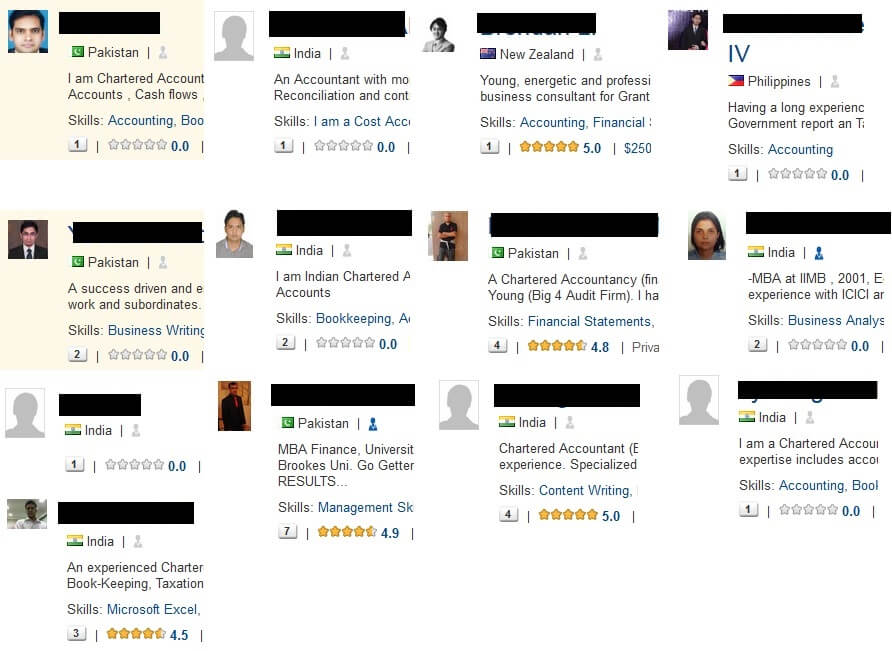
    While I can’t see the other proposals, I can see who the other bidders are. There were 13 bidders for the job, which I have listed below:

    bidders

    As you can see, of the 13 bidders 4 are from Pakistan, 7 are from India, 1 is from the Philippines, and 1 is from New Zealand (me). Assuming the job poster was looking for a native English speaker, he can choose either me or…me.

    Lesson: Don’t get disheartened by a large number of people low bidding on jobs. While many of them may be great workers, Elance is renowned for having a large number of English second language speakers submitting poor quality writing that can’t be used. For this reason many job postings explicitly ask for native English speakers only. In this case I was the only native English speaker that bid, and eventually I was awarded the job. Funnily enough, almost every other bidder was also a Chartered Accountant and some had CFA’s/MBA’s, making them far more qualified than I was (probably way smarter, too). They also were cheaper than me – my bid of $550 was far higher than the average bid of $180, which reinforces my earlier point of bidding high and not selling yourself short.

    Trying a different niche

    After completing this job and getting another 5 stars, I decided to see if I could land a job outside of accounting and finance. I did this for fun more than anything else, and to get some experience in a different niche. Pretty much all my proposals went along the lines of:

    “My background is in financial writing but I can apply my skills to a variety of topics….I work hard blah blah…I’ll be happy to write the first article at no charge as a trial to see if it suits your audience.

    After submitting around 10 bids for travel articles, food articles, fitness articles, sports articles and pretty much any job that got listed, the one I got a hit on was a collection of articles for a mens lifestyle blog (hooray). 10 articles at $11 each. Granted, a significant paycut from my previous gigs, but was a job nonetheless and I actually had a lot of fun doing it.

    Because the article was outside my niche I had to put a bit more effort in to ensure a 5 star feedback. I read through the clients blog and a lot of similar blogs to get a feel for the right writing style, I made sure the writing was delivered way before the deadline, and of course I offered to rewrite it as many times as he needed. Out of the 10 articles, only 1 needed to be rewritten, and he seemed very impressed with the work:

    Elance7

    Lesson – You can land jobs outside your niche – you’ll probably get paid less and need to offer a freebie for the first few, but it’s worth it for the extra experience and feedback. Research well and strive to submit the highest quality work that your client has ever seen. Soon you’ll have a good amount of experience in different niches and be able to command higher prices.

    My first “big” client

    The next job I landed ended up paying me quite a bit more than the others. It was for writing Chartered Accountancy teaching notes, which is:

    1. A crap job that nobody wants to do
    2. Requires a very specific skillset

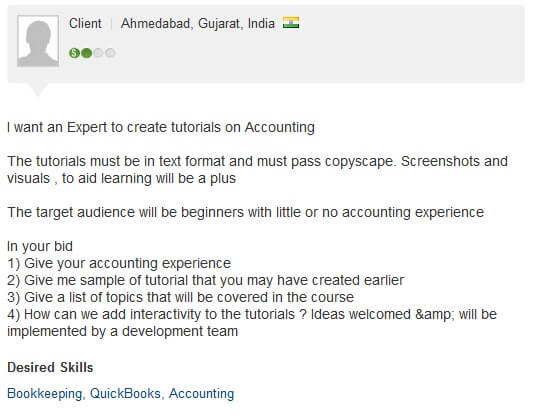
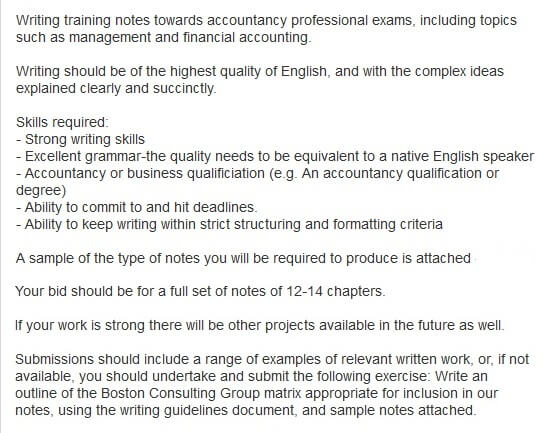
    Those are two ingredients for a high paying gig. Here’s what the posting looked like:

    accounting notes

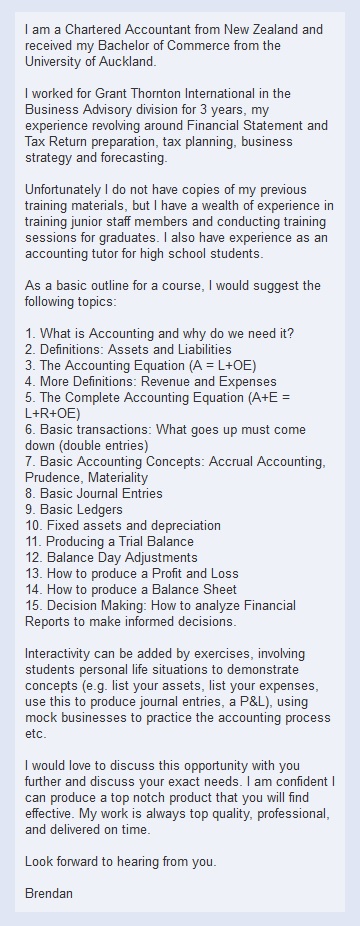
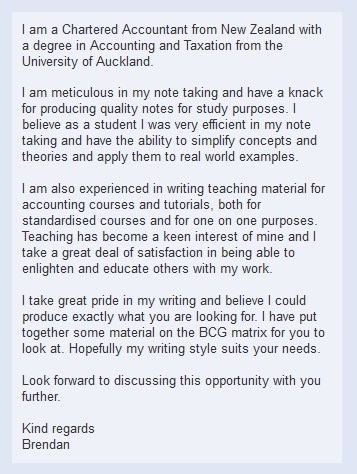
    My proposal:

    Elance99

    In my proposal you’ll see that I made sure to address every requirement listed in his posting. What you can’t see in the screenshot is that the job budget was up to $5,000, so I knew he was willing to pay good coin for the right candidate.

    I spent most of the evening researching and putting together the sample notes requested in the posting, as I knew that would most likely be the deciding factor. I wanted to submit something exceptional. The client emailed the next day saying how my proposal and sample notes had really stood out from the rest, and awarded me the job. The first job was a trial, which involved writing a single chapter of notes for $230. I did everything I could to make it the first set of interesting accounting notes in the history of mankind (I failed, it’s not possible), and he later offered me a full 10 chapters, for which I negotiated a price of $2,900.

    Lesson – Don’t be afraid to spend time on your proposals – it’s like preparing for a job interview. I’ve found that the clients who ask for specific samples in their listings are generally the ones that require writers with a very specific expertise, and if you can deliver on this the payday can be pretty good.

    Earnings for the first month:

    Job 1: $250

    Job 2: $550

    Job 3: $110

    Job 4: $230

    Job 5: $2,900

    Total : $4,040 USD worth of work awarded in just over a month.

    Disclaimer: While I managed to “win” all these jobs within a month, it actually took around 2 months for me to complete everything. This is because those were the deadlines I negotiated. I did this because:

    1. I was travelling at the time
    2. I’m lazy

    I was probably working around 10-15 hours a week. Had I been working on them full time this could have been easily completed in around a month.

    I was earning around $25-$30 an hour on average, which is not far from what I was earning when working full time as an accountant. The interesting thing is, this is considered peanuts for a writer! Many established writers earn closer to $100 an hour, some substantially more. While I’m a long way from those rates, the potential itself is exciting.

    Things to remember when starting out on Elance:

    Bid for jobs within your expertise (particularly for writing). This will be your best shot for producing quality writing and building up your feedback. If you’re a personal trainer bid on fitness articles; if you’re a banker bid on financial articles; if you’re a nurse bid on health articles etc. You don’t necessarily need to be a professional – you could bid on parenting articles, travel articles; I’ve even seen several jobs for gamers to write articles and reviews on Playstation games, so there really is something for everyone.

    Take whatever jobs you can get at the start. You get 40 bids on Elance when you start out – you should use all of them. With my first 40 bids I got awarded 3 jobs, and then I paid the $10 fee for another set of 40. If you’re serious about building an income, you’ll need to put a decent amount of effort into marketing yourself and bidding for work. Once you get some decent feedback you will be able to be more selective with the work you accept.

    Don’t limit yourself to writing – Writing can get boring, so it’s nice to have something else to work on to give yourself a break. For web developers, programmers and IT nerds in general, the freelance world is a goldmine for you. I’ve flirted with the idea of finding accounting work but I can’t bring myself to do it just yet. Still gives me nightmares. Another great moneymaker is translation – if you speak multiple languages there are people that will pay big money for accurate translation work.

    Write for free – I’m a big advocate of writing articles for free and including them in your proposal, at least when you’re starting out. If anything, it’s a great way to practice your writing and if you don’t get the job you can still add the piece to your portfolio. For example, if the poster requires 10 articles on the benefits of green tea, research and write an article on the topic. Even if you don’t win the job, convert the file to pdf and add it to your portfolio as “Green tea article written for established health magazine”. Win win!

    Look at other successful writers. See how their profiles are laid out and what they include in their portfolio. Look through their resume, their photo and the profile layout in general. Use this as a model for your own profile.

    So anyway, that’s how I started out in freelancing and I was pretty satisfied with my results. What’s been great about it is that I’ve developed a new stream of income that I can earn while travelling, which is always the goal for me. I’m sure there are many different strategies that people use to freelance and if you’re willing to share I’d love to hear them! Also, I’d be keen to hear how the above strategies of mine work out for you if you decide to use them. I’ll probably write another post on the topic in a few months, hopefully with a new and improved approach to share with you all. Hopefully this post has showed you that it really is possible to make money on Elance; maybe not millions, but enough to make it worth giving a try.

    My challenge to you:

    Set up a free account at Elance (Upwork) and spend some time creating your profile. Then, start bidding like crazy on any writing jobs you think you can do a decent job of. It might be writing about parenting, about working out, about dieting, about insurance, about cars, about computers; anything! At the very least you should use all of the 40 bidding credits that you start out with. With some effort and a little bit of luck, you should be able to land at least one job.

    Then, do an unbelievable job. Exceed every one of your client’s expectations. Let them know that you’re committed to quality and will produce exactly what they need in order to get a 5 star feedback.

    Finish the job, get paid, request a 5 star feedback and blow the payment on something to reward yourself.

    Congrats! You’ve just built yourself another income stream 😉

    Happy freelancing.

    Ready to start your freelance career? This in-depth guide shows you real proposals to real clients that have landed real jobs, complete with the tools and resources you need to get started.
  • Why Travel Is Awesome For Introverts

    Why Travel Is Awesome For Introverts

    So, you’re an introvert?

    Yeah, me too (ISTP, in case you were wondering).

    People like us, we enjoy time on our own – reading, writing, playing video games, working out. We don’t need others cramping our schedules. We don’t need bouts of small talk to make us feel comfortable. We like being alone. It’s easier that way.

    So what about travel?

    A lot of introverts think travelling the world is not for them. Having a travel buddy with you, 24 hours a day? Ugh.

    And travelling alone as an introvert? Out here in all these strange places? Having to make new friends and socialise with new people all the time?

    No way.

    Count. Me. Out.

    Yet over the last five years of traipsing through this world, I’ve come to realise something. Introvert travel works.

    In fact, it’s better for us. Introverts are travellers at heart. We were made for this.

    We’re more comfortable travelling alone

    I’ve said many times in my writing that travelling solo is the way to go – no fiddling about with travel plans with a group of travel buddies all trying to figure out what the hell to do and disagreeing and arguing about every leg of your trip. Travel is a personal experience. You can do the odd trip with a group of friends now and then, but when you prepare for that massive multi-year journey and the shit gets real?

    We go solo.

    And that’s good for us. Extroverts always need that interaction, they can’t be alone, they need people around them all the time.

    Us? Travelling alone as an introvert works because we’re comfortable being alone. We like it. It’s peaceful. We don’t need to feed off the energy of other people or always be in conversation. We can sit with ourselves, with a book, a pen and pad, even nothing, and we’ll be just fine.

    While extroverts tend to travel with others, joining group tours or finding new travel buddies for every excursion, us introverts are able to move on our own time. We even prefer it. As an introvert travelling alone, we can sit on that 12 hour bus alone and it’s the most natural thing in the world. While others are lost in conversation, we stare out the window and actually notice how the goats strategically stand under the banana trees, how the driver waves to every bike that passes by. We’re able to move slowly, at our own pace, no group to worry about, no friend to check up on. We can explore the world without meeting times or dinner dates.

    When you travel solo, you naturally spend a lot of time alone. Just so happens we like it that way.

    Travel brings us out of our shell

    We can’t stay alone forever. Sooner or later we need to interact – we need to find a friend, a buddy, someone. While extroverts do this naturally, we need to force ourselves to do this, and that’s a good thing. You’re expanding your horizons, you’re growing. You’re getting uncomfortable.

    These days, I can walk into a party or a function and strike up a conversation rather easily. It never used to be that way. When I’m with friends or colleagues, I can be as loud or goofy as I please, but not with strangers. Trying to interact with communities and groups I didn’t know used to scare the shit out of me. I hated meet and greets and networking events and cocktail parties (I still do, actually).

    But after travelling alone for so long, having to meet so many strangers and create new friendships, I’ve turned into a trained extrovert. It’s like a switch – with a little self pep talk, I can switch it on whenever I need to. Before I walk into the hostel lounge for the first time, I flick it on and it’s go time. I meet everyone, make friends, have a few laughs, and then I’ll spend the latter half of the evening in bed, reading a book or writing. When I feel like I need to get out and be social, I can sign up for a pub crawl or a walking tour and flick the switch back on again.

    I love meeting new people, hearing other people’s stories, making new friends, but it’s not natural to me. If there’s just one or two of us sitting around the breakfast table, that’s easy, but a huge party with crowds of strangers? That’s not me. I had to learn to flick that switch on. Travelling alone taught me to deal with that one.

    We Relish The Time To Think And Reflect

    Because you’re not 100% “on” all the time, you spend a lot of time alone in thought. You flick through your photos, not because you’re showing them to someone and telling a story, but just because you want to. You can spend hours alone, thinking about the day, this new country, the new people you meet.

    That’s perfect.

    Not enough people take the time out to reflect while they’re travelling, but for us it’s natural. We need that time or we go crazy. And travel is nothing if not a reflective time. As an introvert travel has a deeper impact on you because you naturally observe, and see, and think. You take the time to take it all in.

    Next time you’re on the train or the bus – look at the people who are talking and laughing the whole time, and look at the ones who are quietly staring out the window, lost in thought.

    For one, the long train ride is a time to crack jokes and talk about themselves; for the other, it’s a time to observe and pull apart about the country flashing before them.

    This really is one of the best parts about solo travel for introverts. The ability to really sink into your experiences and think about them, write about them, make sense of them. It’s exactly what travel is about.

    Introvert Travel Is Easier To Plan

    Can’t find anyone to eat dinner with? No one to take that hike with you? You’re the only person who wants to see the waterfalls?

    Awesome.

    You didn’t want anyone with you anyway.

    These days it’s so normal for me to go eat dinner, alone, and then sit there for 3 hours afterwards reading. I can walk around a city for an entire day without talking to a single person. I don’t need anyone with me, and often, I don’t want anyone with me.

    While extroverts are always trying to plan new trips with people and make plans with other travel buddies, I just worry about myself. My trip planning is always 100% stress free. I don’t need to worry about who’s coming, who’s not coming, if we have enough people, if we have too many people, if I’m going to like them or hate them.

    I buy one ticket. I book one room. I ask for one seat.

    No one else matters.

    Of course, I’m not always alone. If I feel like meeting someone, I’ll pep talk myself to put my Kindle down, put on some pants, and I’ll check into a busy hostel or go to the local bar. I’ll close my eyes, flick the switch on, and away we go.

    But for the rest of the time it’s all solo. No one to worry about, and no one worrying about me.

    We Find Deeper Friendships

    It feels like we’re loners, sometimes. People think we hate other people. That we’re shy and afraid of socialising.

    That’s not true.

    We just like a bit of quiet.

    It seems more extroverted folk tend to say hi to every single person they see. They introduce themselves, add everyone on Facebook, shake everyone’s hand. They have time to meet everyone in sight.

    We don’t have the energy for that. Maybe that makes us come off as snobbish, but whatever. It takes effort for us to let people in. To build a friendship. To get to know someone. And it’s not effort that we can give to every person, every day.

    Unfortunately, travelling is filled with superficial friendships. People you’ll bunk with for a day, share a beer, say you’ll keep in touch, and then never see or talk to ever again. You cling to each other because you’re both village idiots disoriented in a foreign place, and it’s awesome, to meet new people this way, but you can hardly call them friends.

    Extroverts always seek out someone to share things with, even if it’s just a few hours, but we don’t have the energy for that. It’s exhausting.

    However, eventually you do meet someone who’s special. Someone you really click with. Someone who really could be a friend. It’s always magical when you meet these people – someone from halfway across the world who you really bond with. Bromances and romances and friendships that don’t just last fifteen minutes. They last a lifetime. You made the time for them because you had the time for them. You may not have 100 new Facebook friends this month, but you do have one new friend who might just change your life.

    Afraid to travel the world because you’re an introvert? Worried about all the new faces? Can’t handle all the hellos and goodbyes?

    You’re running in the wrong direction.

    Get on a plane. Go somewhere faraway. Watch yourself soak it all in. See how you evolve.

    Solo travel was made for you. And if you haven’t experienced it yet, it could be the exact thing you’ve been waiting for.

    Are you an introvert who’s travelled solo? How was it? What did you learn? Did you enjoy it? Let me know in the comments below!

    Thinks introverts can't travel? No way! This piece is so true and shows you why travel is amazing for all people, especially the introverted. The road is made for us!
  • I Found New Zealand In Ahipara

    I Found New Zealand In Ahipara

    I still remember my first surf class.

    I wriggled into a wetsuit, lathered my face up with super thick sunscreen and walked down to the beach feeling like Aquaman in my spongy suit with a rocket ship tied to my leg. They say Kiwis love to surf, but at 28 I’d never touched a surfboard in my life. That’s the Chinese side of me, I guess. Chinese people don’t surf. When’s the last time you saw a Chinese surfer?

    My first wave was tiny, the smallest splash of water. When the teacher pointed at it and lined me up, I almost thought he was joking. Yet it picked my board up and sent me flying. That’s all it took; one wave. I knew I had to learn more. I signed up for a full week of surf camp a few months later.


    Brett didn’t really look like a surfer. He was a Maori dude, maybe late 30’s or early 40’s, and he could’ve been anything really – a plumber, a lawyer, a taxi driver, but not a surfer. He didn’t have the beach blonde locks or the California slow talk, which is what you’d expect from someone who surfs for a living. But I guess stereotypes are only true until they’re broken.

    The drive up to our camp from Auckland was a long one, so we had a lot of time to talk. I noticed the Maori in his humour, the surfer in his opinions but also the wisdom from his years in the water. It was clear he lived for the ocean; he had studied the way the wind and the weather patterns affected the swell, why the waves formed in the shapes that they did, how the climate halfway around the world affected the waves that we experienced in New Zealand. He noticed small details, like when the wind changed from a north westerly to a westerly, or when it softened earlier or later than expected. Surfing, it seemed, was about a lot more than just a board and a wetsuit.

    As we made the drive north he rattled jokes off constantly about anything that came to mind – landmarks, bad drivers, the towns we passed through – like a twelve year old kid. But every now and then we’d pass the ocean and his tone would change; he’d explain the shape of the beach, the difference between a spring tide and a neap tide, and why the waves were coming in the way they were. As soon as the subject moved to surfing, it was all business.

    We arrived five hours later to our home for the week. It was a small town, and quaint, littered with weathered corner stores and clean but empty sidewalks. Every house had a small front yard, the lawns unkept and a mossed over dinghy or kayak leaning against the fence. This was Ahipara.

    “There’s the hospital,” Brett pointed out as we drove past. “Just make sure you don’t get sick after 4:30, cos ain’t nobody gonna be there,” he laughed. I wasn’t sure if he was being serious or not.

    As we pulled up to our quarters – a beautiful chic beach house right on the shore of 90 Mile Beach – I unloaded my stuff and went to look out over the ocean. Many Kiwi families own a ‘bach’ – a small beach house where they come and enjoy their weekends during the summer – but not my family. I didn’t grow up with the sand on my doorstep. I’ve lived in New Zealand almost my entire life, but my school holidays were mostly filled with video games or sports tournaments. The whole sailing, surfing, collecting shellfish thing – that was all “white people stuff” to us when I was a kid. I didn’t grow up with the ocean like a lot of other Kiwis.


    The next day we headed to Shipwreck Bay – one of Ahipara’s gems. Brett parked up on the cliff, overlooking the beach, and tried to explain how awesome these waves were, coming in one after the other in almost perfect sequence. I didn’t get it. They just looked like waves to me.

    “If you wipe out, cover your head. Then grab your board and paddle out to the side and out the back. If someone’s surfing at you and you think you’re gonna get hit, let your shit go and dive under the water. The fins are only a few inches long, so you’ll be safe down there.”

    Brett talked a lot. He kind of needed to, but a lot of it went over my head. I heard the important bits, though.

    It was standard surf class to start off with; we caught some smaller waves and whitewash, practising all the things he was teaching us. We stayed pretty close to the shore that morning, but after a couple of hours in the water I was ready for the big time. He’d shown me how to paddle in and pop up, how to watch and read the wave and stay on the board all the way into the beach. I still wiped out on pretty much every ride, but he told me it was just a matter of practise now. He sent me out the back, to where the real surfers were.

    There was a bunch of us out there, bobbing in the ocean in the afternoon sun – a loud American guy, a couple of local kids, myself, Brett also grabbed a board and got in eventually. As the waves came in everyone would turn their boards around and paddle, riding the waves into shore before paddling back out for another ride, but not me. I sat there on my board, floating in the water; watching, observing. I didn’t feel ready yet. There’s a rulebook in surfing – an unwritten one, and I was trying to decode it all. Are these guys in a queue, or just sitting wherever they want? Is there a rule of who goes and who doesn’t? Is there some sort of system, like smaller board, first wave, bigger board, second wave? I had no idea. The rules of surfing aren’t clear to the newbie like myself. You need to learn them through the grapevine.

    Between sets, everyone sat out there waiting for waves, chatting. I watched intently. It was like a secret community, detached from the world, just men and their boards, playing out in the ocean.

    “Check out all the birds around that boat,” I overheard Evan say to Brett, as we all sat around during a short lull. Evan was a local guy, a friend of Brett’s who seemed to surf a lot. I turned and looked behind me. A small boat sat bobbing in the distance, maybe 200 metres away, a flurry of birds circling overhead. “Maybe I should’ve gone fishing instead of surfing.”

    I looked over at him, laughing. Fishing instead of surfing? On Tuesday? In my house it was either study or do your homework. Maybe it would’ve been nice, to grow up in Ahipara.


    That evening Brett cooked up a feast for dinner. He seasoned a couple of chickens, stuffed them, and roasted them in the oven with a bunch of veges. Then he grabbed the rice and pulled out the rice cooker.

    “You know how these rice cooker things work, bro?”

    I turned to see if he was being serious. In a Chinese home the rice cooker is the equivalent of a toaster, so it was a question you’d expect a six year old to ask.

    “You just put in two cups of rice and then fill the water to the line marked 2,” I told him, laughing.

    He examined the inside of the pot looking for the markings, then filled it with water, fiddled with it for a while and finally turned it on.

    “That might be a bit too much rice for us,” he mumbled, as he peeked through the top of the pot.

    I shrugged.

    “Don’t worry bro, that just means fried rice for breakfast.”

    He looked at me.

    “You know how to make fried rice?”

    Err, do you know how to make toast?


    Day 3. His eyes were sharp.

    “Stop fuckin’ around. When you’re in the water it’s time to put your fuckin’ game face on.”

    He was getting angry, obviously.

    It was early morning and Brett had taken me out behind the rocks, beyond the learner waves. He figured maybe I was ready for something a little more thrilling. I still felt like a schmuck in the water, but I was up for anything if he was willing to show me.

    Things weren’t quite clicking though. Perhaps it was the early start, or my busted shoulder, but I was paddling like a nine year old girl. Eventually I made it out the back behind the breaking waves, and sat up on my board next to him waiting for the swell to come in.

    “Dude, you’ve got to get your shit together. We don’t have long out here. Plus it’s absolutely unheard of to get these waves all to ourselves. Unheard of.

    I didn’t get what he was so angry about. We’re surfing, bro. Chill out.

    After a couple more waves we paddled back into the bay. I caught a wave, got rolled completely and sat there for a moment, giving my aching shoulder a rub and catching my breath. Brett got in my ear again.

    “Dude. Seriously, you can’t fuck around when you’re in the middle of a set. If you wipe out, get your shit and paddle away. No time to fuck around.”

    I nodded.

    Chill the fu*k out, bro.

    The following wave was no better. I caught it badly, rode it for a few seconds and then got tumbled like a sock. As I plunged into the water the wave rolled over me and I came up, gasping for air.

    Mother****!” I screamed, irritated.

    I took a moment to catch my breath and figure out what I did wrong. Was I not leaning forward? Did I not get the right angle? Who knew. I gave my shoulder a little rub, looked around for my board and pulled the leash towards me. Then I saw Evan, on the wave after mine, coming towards me quickly. He was still a good 20 metres away, so I tried to gauge whether he was going to hit me or not.

    Yep, going to hit me, ooh no no, gonna go past me for sure, ooh shit maybe he might hit me, oh nah, definitely gonna go past me.

    Until he was right in front of me, and he was going to hit me.

    I let all my shit go and dived as deep under the water as I could. After two or three seconds, I felt the wave give a solid tug on the board, pulling me a metre backwards, and as the water calmed I came up to breathe. The first thing I heard was Evan swearing his face off. I looked around and found him bobbing in the water, ten metres away, clutching his leg. The wave had taken my board and flicked it out the face, smacking him on the leg as it flung out. Earlier in the day I’d dropped my board on my finger and winced, so I knew getting one thrown at your leg would’ve hurt like a mother*****r.

    I floated there, not sure what to do. Evan was still cursing and Brett didn’t look happy either. I paddled over and apologised profusely. He took it as well as he could. I knew he was dying to let loose on me, and he should’ve. Had he not been Brett’s mate, things might’ve been a little different.

    As I turned to paddle back out, Brett’s words rang through my head. “No time to fuck around! Grab your board and paddle away!” It made sense now. I’d been in my own little world out there, but it wasn’t my own little world. We couldn’t just chill out. What was I even trying to do out here? I couldn’t surf. I wasn’t a surfer. I belonged by the sand, on the baby waves.

    I spent the rest of the afternoon bobbing out the back, watching. I was done for the day. This wasn’t my ocean. I didn’t feel welcome here anymore.


    I was pretty weathered when we got back to the beach. I wriggled out of my wetsuit and massaged my shoulder. Brett was over at Evan’s car, chatting away. I knew what they were talking about.

    “You left a few marks mate,” he said as he walked back.

    I nodded, upset with myself.

    “We better get him a box of beers,” he suggested. I nodded again.

    I pulled on a shirt and Brett and I hoisted the surfboards up onto the roof. He threw me the straps.

    “Strap those bad boys on tight mate,” he said, fiddling with the rest of the gear.

    He had explained on the first day how to strap the boards on the roof, but I’d been busy eating a banana or something. I looked at the straps.

    So this clip will probably go around this bar, and then that one will go over there and then….

    Who was I kidding. I had no idea.

    Brett saw I was clueless and came over to help. He stood on the other side of the roof and threw me one end of the strap.

    “Thread that one through the front mate.”

    I threaded it through the front.

    “No, through the front.”

    I looked at him.

    “It’s through the front.”

    He laughed out loud and shook his head.

    “Man, you must be tired.”

    I still didn’t know what was wrong with the strapping, but eventually we got it all strapped down in a way he was happy with. Once we’d pulled the straps tight, he came over and asked if I could tie it down.

    “You know how to tie a bowline?” 

    I shook my head. He laughed and took the straps off me.

    Whatever bro. You don’t even know how to cook rice.


    On the way home we bought a box of beers and Brett took it around to Evan’s place that evening as a peace offering. I wanted to pay for it, but Brett insisted on splitting the bill. Even though I’d done the damage, he was the one responsible for me out there, he said.

    He got back around 11pm with a few beers under his belt. I was in the lounge reading at the time, still feeling shitty about what had happened. Brett grabbed another beer from the fridge and sat beside me on the couch.

    “There were a few people over at his place. A few opinions came out eh.”

    I smiled and nodded. I could imagine.

    “A few of them saw the whole thing and were pretty horrified, to be honest,” he laughed.

    “But I explained it to them like this, you know: you’re a 29 year old retired accountant. And they were like what? Really? And I was like yeah, he’s not an idiot. This is just a totally new world to him. They were literally laughing out loud when I told them about you strapping the boards to the roof. A lot of them were on your side after that, they kinda started to understand.

    But in the end Evan was just like, thank you so much, for the beers. He actually thought you were some foreigner dude. When he heard you say sorry in your Kiwi accent, he was all good about it.”

    That night Brett and I sat there and talked it out until 2 or 3 in the morning. I thought it was cool, how he’d stood up for me. He certainly didn’t need to. As we talked about the week, he told me he’d been disappointed watching me paddle half-heartedly that day, as those morning waves had been my chance to really surf some bombs. He said that had been my moment, to really show him what I could do; that those might be the most perfect learner waves I’ll ever see in my life. When the surf is that good, you gotta go for gold. You gotta surf until your arms fall off.

    “I knew it straight away, the very first day, when I saw you do those burpees out here on the lawn. My expectations for you have been up here, this high. That’s why I’ve been so hard on you. Your popup is effortless, you got awesome technique, awesome athleticism. For someone your age that’s crazy. People your age usually have trouble picking this up, but you don’t have that problem. You could be really, really good man, seriously. All you need to do is go out there and put your game face on, but I haven’t seen you do that.”

    I was disappointed in myself too. I hadn’t thought of surfing that way. I’d thought of it as a hobby, like playing frisbee. Not something you bring your game face to. All day he’d been saying it – get your shit together, put your game face on. But I hadn’t been hearing him.

    It wasn’t too late. I still had one day left.


    The next day before our surf we headed up the coast to collect some shellfish for dinner. Brett had asked around town for which spots were hot, so we jumped in the van and made the journey north.

    Eventually we pulled off the main road and took a side road onto the famous 90 Mile Beach. Brett parked the van up on the bank and we headed down to the water to try our luck.

    I watched him dig his toes into the sand, hunting for treasure. I copied him. I found one straight away and quickly pulled it out of the sand.

    “That’s a tuatua, right?”

    “Yeaaah bro!” he screamed.

    But that was the last one. After digging for three or four minutes, we found nothing. He looked out into the ocean and screwed his face up.

    “The tide’s too high man. We need to be down there,” he said, pointing a few metres out into the water.

    Neither of us had our swim gear, so we called it quits and headed back to the van.

    With his foot flat on the pedal, he floored it up 90 Mile Beach, 100km an hour. Every now and then he’d turn and look at the water, looking for something, and then after ten minutes or so he pulled over and parked the car.

    “This looks better. We’ll probably find some here.”

    I looked down the beach, confused. I could see at least a few hundred metres in either direction and it all looked identical to me. The tide was at the same spot, maybe even higher, the beach looked the same, so did the water. What did he see that I didn’t?

    We walked down to the water’s edge and dug our toes in again. I watched Brett wriggle his feet in and after a few seconds he smiled, bent down and dug his hands deep into the sand.

    “Look at that!” he laughed. His hands were overflowing with tuatua, literally. He couldn’t even hold them all.

    I bent down and did the same, digging my hands in the sand and rummaging around. I could feel the little suckers wriggling between my fingertips. I pulled my hands up and looked at my palms, filled with five, six, maybe seven tuatua, wriggling themselves back into their shells.

    “Go get the bucket from the car, bro!” he yelled, laughing.

    I couldn’t believe it. It was like finding hidden treasure. Maybe this guy can’t cook rice, but he can smell the shellfish in the sand 90 miles away.


    When we arrived back that afternoon Brett sent us out to surf on the beach just outside our bach, 100 metres from our backdoor. I sunscreened, suited up and headed for the water. The ocean looked different to me now. I didn’t see a playground anymore. It was more like a boxing ring, a place for battle. Me against the water.

    I spent about two hours in there getting tumble dried by the waves – paddling out, trying to catch something, getting smoked, paddling out again. I didn’t care. All I needed was a good one. Just one good wave.

    Before long the sun had started to set and my arms were about to fall off, but I was still out there fighting. I got battered by another set, but I couldn’t go in just yet. I got back on the board and paddled out again.

    I was half dead when I finally made it out the back again. My feet were freezing, I couldn’t feel my shoulder. When the set came in, I hesitated for a moment, wanting to catch my breath. The first one didn’t actually look like a good wave, but once I saw it standing up behind me I knew I had to either paddle for it or get smoked. Brett’s words rang in my head. Four strong paddles – one two three four! I paddled for my life and felt the water pick my board up, sending me flying. I jumped to my feet. I didn’t fall off.

    I looked left. The wave was breaking there. I looked right. It was breaking there too. I’d never surfed a wave that broke both ways. I had to go left. I only knew how to go left. I grabbed the rail and leaned left. The board sped up and I put a knee down and held the rail tight, my mouth wide open. I looked left again, right again, the rumble of the water roaring behind me. All of Brett’s words ran through my head; “Watch the wave, move with it, keep the board on trim, stay low, chin knee toe, always chin knee toe!” I shuffled my foot under me, trying to get a better stance. I was moving fast now. I leaned forward, and sped up even more. I took a split second to glance behind me, watching the wave crashing violently against the back of my board. But I was there. I was on it. I could see the beach, and I still hadn’t fallen off. I was surfing.

    Brett was standing outside on the porch smiling when I got back to the house. His eyes were beaming and he held his thumbs up, nodding with a grin from cheek to cheek.

    “Mate you were looking behind you, looking to the side, nice and low, leaning left and right!” he beamed, re-enacting it all on his imaginary surfboard in front of me. He’d been watching from the kitchen window.

    “Shit mate. That was real surfing right there. I was up here saying to myself, ‘Welcome to the club buddy.’”


    That night, we devoured our pot of tuatua. We must have had over 100 but we demolished it all in about ten minutes. I usually buy my tuatua in bags of ten from the supermarket – getting them fresh from the beach is like an impossible dream, at least in my neighbourhood.

    As we sat at the dinner table that night, chatting away like old friends, I thought back over the week. I’d seen a different New Zealand up here, one that I’d never seen during my years growing up in my own community. Up here, everyone knew how to strap boards to the roof. Everyone knew where to find shellfish in the sand. Everyone knew how to tie a bowline. And, everyone knew how to surf. The New Zealand I knew was different. My friends can all cook the shit out of some fried rice by their 7th birthday, but ain’t none of them ever owned a surfboard.

    New Zealand’s a funny place, really. Lots of skin colours, lots of cultures, but we’re not really thrown in a mixing bowl; we’re still stored separately in little tupperware containers in different parts of the country. Things like the All Blacks and fish and chips can bring us together sometimes, but we tend to keep to our own a lot, too. That’s New Zealand, and it’s not necessarily the New Zealand that I like or want. We pride ourselves on being multicultural and diverse, but there’s still a lot left to learn from each other. Being multicultural requires a lot more than just ‘same country, different neighbourhoods’. Being open is easy when you’re travelling the world – everything’s new and exciting – it’s easy to embrace it all. It takes a bit more effort at home. You have to go look for it. You have to want to find it. You can spend your whole life adventuring in faraway places, but sometimes the greatest travel lessons are waiting for you in your own backyard. I learned that in Ahipara.

    That was our final day. The next morning we were heading back to Auckland, but not before one final surf.

    “If you want to surf tomorrow, you’ll need to get up at around 6. You’ll have around an hour in the water. We need to be out of here by 9.”


    My alarm went off at 6am sharp. My whole body hurt and my shoulder was practically in pieces, but I wanted to shake hands with the ocean one more time, if only to say goodbye. I didn’t know if I’d ever be here again.

    It wasn’t a warm morning. The sun wasn’t out yet, and there was a classic morning chill that reminded me of the early winter mornings from my 9-5 days. Half asleep and shivering, I squirmed as I pulled on my wetsuit, still damp from the day before. I had to be quick. I only had an hour.

    As I grabbed my board and headed towards the sand, Brett came out in his underwear and gave me a few pointers.

    “Look at the waves. See how much softer they are today. You’ll have to catch them on much less of an angle. Keep that board much straighter when you paddle today.”

    I nodded and headed towards the sea.

    As I walked across the sand, I scanned the beach on either side of me. The sun was only just starting to rise, and there wasn’t a person in sight. I had the entire beach, the entire ocean, to myself.

    When I finally got to the water’s edge, I set the board on the sand and kneeled down to tie the leash around my ankle. I felt my toes sink and stopped for a moment, watching the sand swallow my foot while the ocean washed over it. It was icy cold, sending a sharp chill through my body. I welcomed it. It was refreshing, in a way.

    Wrapping my leash, I pulled it as tight as I could. As Brett said on the first day, “it’s impossible to tie your leash too tight,” so I tried two or three times, getting it a little tighter each time. When I finally stood up to head into the water, I looked back at the house one last time. The sun had half risen now and our blue roof and walls shouted against the reddish tinge in the sky. In between me and the house lay fifty metres of golden sand, empty and spotless, other than my footsteps running down the middle.

    I looked left. Nobody.

    Right. Nobody.

    I smiled. For thirty seconds, I just stood there, taking a moment to soak it all in. Peaceful. Happy. Beautiful. Doing what you love. These were the kinds of moments we live for. It was the ultimate postcard shot and I didn’t have my phone or my camera with me, but I didn’t care. I just took a deep breath, smiled, and told myself to be grateful for how fucking awesome life is.

    Then I grabbed my board, turned, and ran into the water.
  • Four Things I’m Doing Each Day To Become More Awesome

    Four Things I’m Doing Each Day To Become More Awesome

    “We get a little better or a we get a little worse every day. Let’s get a little better today.”
    – Jason Street


    I push self-improvement a lot on this site, and travel is often a vehicle to reach those goals, rather than the goal itself. Last year I wrote about the joy of learning something new, and I’ve tried to give you ideas to find your own ‘something new’ by sharing my own pursuits, whether it’s learning Spanish, French, Chinese, martial arts, dancing, cooking or whatever else I manage to come across while I’m out there.

    Sometimes these things can look a little grand, so today I wanted to bring it back down to ground level. Learning new things doesn’t have to be a big elaborate affair you need to travel around the world to do. Over the past couple of years I’ve been adding new things to my daily routine, most of which don’t take up much time or money at all (in fact, they’re all free).

    This is my “Daily Four”, and no matter how busy I am I make a special effort to do them all each day.


    Yousician

    yousician

    Yousician is like that video game Guitar Hero, only you use a real guitar, and you learn actual guitar skills. Before each level there is a short video tutorial teaching you some new chords, or new strumming or picking pattern, and then you go onto the game where you’ll practice those new skills and try to pass the level. It’s fun, challenging, and you’ll definitely learn something.

    I have a paid account, but you certainly don’t need one. You can use it free for up to one lesson daily, and even after that you can have unlimited practice time on the lessons you’ve already passed. This is the newest addition to my daily exercises, and probably the funnest, too.

    Cost: Free, with paid options available.
    Time needed: Around 10-15 minutes a day.
    Get it at: www.yousician.com
    Add me: Feel free to add me to your friends list! My username is brenontheroad.


    Headspace

    headspace

    Meditation has always been a ‘hocus pocus’ lala land thing to me, until I learned that Arnold Schwarzenegger claimed daily meditation “changed his life” during his early years of fame. Since Arnie is one of the baddest dudes ever invented, I got interested. For the last year or so, I’ve been practicing meditation using the app Headspace.
    As I’ve adopted a more minimalist lifestyle over the last four years I’ve noticed how beneficial it is to live an uncluttered life, but I never realised the mind could be cluttered in the same way. As I learn to meditate, I’m starting to learn to focus the mind and stay relaxed and stress free. Any time I’m working on something that’s starting to piss me off, I’ll do a Headspace lesson and always end up feeling clear and ready to go afterwards. It’s like sending your brain to the gym.

    The first module is free, and I actually was doing it over and over again before I finally decided to upgrade. Even if you just do the free lessons I’m sure you’ll find it awesome, so I definitely recommend it!

    Cost: Free, with paid upgrade available.
    Time needed: 10 minutes a day.
    Get it at: www.headspace.com


    Mobility WOD

    mwod

    Kelly Starrett is a mobility guru and has a Youtube channel called Mobility WOD, dedicated to helping you prevent injuries and gain increased mobility, flexibility and strength. These videos literally changed my life.

    I suffered a bad shoulder injury two years ago that left me unable to do any type of exercise without serious pain in my right arm – even push ups were painful. As someone who loves the gym and playing sport, this was almost unbearable so I just trained through the pain which obviously made things worse. Even lifting my arm in salsa class to spin my partner around started to hurt.

    Over those years I visited 3 different physios, had an ultrasound, a steroid injection, an x-ray, an MRI, saw my GP multiple times, a shoulder specialist yet still nobody could fix it. The pain became a normal part of my life. I was ready to become that old guy who can’t do shit because he “has bad shoulders”. When I learned Clayton from Spartan Traveler had overcome similar issues with his knee, I emailed him and he introduced me to Mobility WOD. He explained to me that if the MRI showed nothing, it probably wasn’t an injury – it was just battered tissue that was twisted and tight and positioned badly, probably from years of bad posture or movement. He explained since nobody has perfect posture or movement, this basically happens to everyone as they get older. That’s where Mobility WOD came in – a collection of exercises designed to unglue tight and ropey soft tissue, loosen the muscles and correct bad postures and movements so you could move freely again, like you did when you were a kid.

    After years of dead ends that was the first logical explanation I had heard, so I excitedly searched all the shoulder Mobility WODs and did every single one of them. They were pretty weird, but I felt them work almost immediately. Within a few days my shoulder had improved ten-fold, maybe to 80% health. Within a week I was back in the gym lifting weight. I couldn’t believe it. The solution was so simple yet thousands of dollars in medical advice from various “experts” in various countries wasn’t able to give it to me. I tweeted Kelly Starrett and told him his videos were freaking life changing.

    Mobility WOD or Mobility Workout Of The Day is designed as a daily exercise. It’s now the first thing I do in the morning. Every day it’s a different muscle group so it keeps it interesting, and often I’ll redo old ones if I found them particularly effective, especially on my shoulders. It’s completely changed the way I exercise, not to mention giving me my shoulders back which is something I can’t even describe.

    I would recommend this to absolutely everyone, regardless of age, gender or fitness level.

    Cost: Free.
    Time needed: Around ten minutes a day.
    Get it at: Mobility WOD on Youtube

    Also: Vinnie Rehab on Instagram is also really good!


    Duolingo

    duolingo

    You know how much I love to learn languages. It enriches your travel experiences and is always a valuable endeavour regardless of whether you enjoy travelling or not.

    Duolingo is a language game, where you finish lessons and earn points, gems and gain new levels. The Duolingo team claims it’s been proven that 34 hours of playing is the equivalent of one university semester of language tuition – whether or not that’s true I don’t know or care. I do know it’s pretty fun and your language skills will definitely improve.

    I usually play in the morning while lying in bed, and get through around two or three lessons per day. I’m currently using it for Spanish and French only, but as an English speaker you’ll have 14 different languages to choose from. Way more fun than memorising verb tables.

    Cost: Free.
    Time needed: Around ten minutes a day.
    Get it at: www.duolingo.com
    Add me: Feel free to add me to your friends list! My username is brenontheroad.


    What you may have noticed is that none of these things require more than ten minutes a day, and all of them are free. Just a small investment of time each day and you can be learning an instrument, speaking a second language, building a strong, injury-free body and a creating a more focused and happy mind. This is my Daily Four, and you’re more than welcome to steal it and adopt it as your own.

    Enjoy!

    Bren

    Note: I pay for all my memberships in full (where applicable) and this post is not sponsored in any way. You can read my Disclosure Policy here.

  • The Life Of A Backpacker In Gifs

    The Life Of A Backpacker In Gifs

    They say a picture paints a thousand words but a gif can paint a million. Here’s 43 of them showing the best (and worst) of backpacker life. (more…)

  • My New Book Is Out!

    My New Book Is Out!

    So I’ve got some cool news.

    Can you guess what it is?

    Well yeah, duh. Of course you can, it’s in the title. Up there. ^^^

    But instead of doing one of those press release style announcement posts, I thought I’d release this by giving you a little look behind the scenes. Because obviously my book is finally out and obviously I’m super psyched, but why did I write it? What’s it about? Who helped me? How did I write it? How long did it take? Is it organic? Are batteries included?

    Let’s go back to the start.

    When I wrote my first ebook, “So You Wanna Be A Traveller?” last year, I was pretty blown away by the feedback. Back then, I’d just started my blog and was a new kid on the block, so I decided to give it away for free (you can grab your copy here if you haven’t already). Thousands of you signed up to read it and a few of you even insisted on paying for it, which was really awesome and unexpected. I can’t say I would’ve done the same!

    When I decided to write a second ebook, I wasn’t quite sure what to write about, so I asked you. I sent an email survey out and you told me you wanted to learn how to travel on the cheap. You wanted to know how myself and all these other travellers were seeing the world without trust funds, without sponsored trips, without big salaries, without spending thousands and thousands of dollars every month. So I set out to write the ultimate resource on budget travel. The most comprehensive, practical, up-to-date resource available. A book that would stomp the sh*t out of the expensive travel myth. A book that you could read through in a matter of days, see the big picture and tell yourself, “Shit, I can really do this. I’m going to see the world.”

    Writing a book is pretty different from writing a blog post. Because there’s so much more information, you need to figure out how all the pieces will fit together. One writing lesson I always remember is that people learn best through stories. So I remember sitting down to write the first chapter, over a year ago, and I knew I had to start with a story. I recalled one morning in Peru, where I had walked to the corner store to buy some breakfast.

    I watch in amusement as she stacks the eggs, one on top of the other in a tube-like plastic bag. It’s almost like she’s playing Jenga. To my surprise, she manages to fit all six eggs in, and then, as if she’s been doing it for 45 years, whirls the bag around her finger, somehow knots it, and places it on the counter in front of me. It looked so neat you could be forgiven for thinking it was packaged on a factory machine line.

    “Algo más?” she asks.

    I take a quick look around her tiny hole in the wall and grab a bottle of yoghurt, some mineral water, and a small bag of bread.

    “Cinco soles,” she smiles, slowly packaging my breakfast into a small, black plastic bag.

    I reach into my back pocket, pull out a pile of coins and sprinkle 5 soles out on the counter.

    Cost in dollars?

    $1.25.”

    At the time I was just writing the first thing that came to mind, but I ended up keeping those words as the opening paragraph, and the stories in that chapter really set the tone for the whole book. Sometimes one tiny piece of advice can really set you along the right path.

    Over the following months I continued writing each day, basically just spewing out everything I knew about how to travel the world. Pages after pages, just stories and tips and strategies one after the other, all unorganised in one big crap pile of text.

    However, after I’d written around 30,000 words I stopped for a few months. Why? Because I thought the book was a stupid idea. I don’t know where the self doubt came from, but I just kept thinking that the book wasn’t worth finishing. I’ve got tons of info on my blog already about saving money while travelling, and there’s literally thousands of other blogs out there who write about it too. So I decided it was a waste of time. “This isn’t of value to anyone. Nobody will pay for this shit.” I stashed the document and went back to blogging and freelance writing.

    The book sat as a Word document on my computer for around 3 or 4 months until I started flirting with the idea of writing it again. A couple of people actually emailed me and asked if I had another book or where they could read more of my writing, and that gave the idea new life again. I decided I needed to finish it. While people could probably figure out how to see the world while flipping through other blogs, maybe some of them wanted to hear it through my voice. Maybe they wanted to learn the art of travel through my lessons and my story.

    Almost a year after I wrote that first paragraph, I finished the book. It came in at around 60,000 words, which was a little long for a book of it’s kind. I wanted it to be thorough and detailed, but also quick and easy to read, without any fluffy stuff that didn’t relate to the central goal of traveling the world on a budget. In the end I trimmed it down to around 50,000 words, to get a truly concise but comprehensive guide to life on the road as a budget traveller. When I read through it the final time I was stoked. It was exactly the book I would’ve wanted to read before I’d started this journey five years ago.

    After that it was time for the pretty stuff. First, I needed a title. I decided on Triple Your Travel, as I liked the idea of people using budget travel as a way to multiply their adventures. See three times more of the world. Visit three times as many places. That’s what budget travel can do for you.

    Then I needed a cover. I wanted a cover that said, “Yo, this book looks dope!” but also a cover that reflected my style of writing and, more importantly, my style of travel. I decided to give 99designs a go. They came back with some okay stuff, but nothing that really reflected my style and the book itself:

    99designs samples

    As soon as I saw these I knew I’d be designing the cover myself. I actually really like designing my own stuff but I can’t draw to save a life, so I doodled out the ideas I had in my head and sent them to my artist (the same guy who did that cool banner at the top of my page):

    triple your travel cover Can you figure out the landmarks? You probably think you’re looking at a donut, a rocket ship, some corn chips and a slice of fish, but it’s actually Angkor Wat, the Colosseum, Leaning Tower of Pisa, Taj Mahal, the Pyramids, the Great Wall of China, the Eiffel Tower and Christ The Redeemer.

    After some back and forth with my graphic artist, who can actually draw, we turned it into this:

    Brendan_eBookCover_03
    I actually wanted to add more landmarks but that was going to cost more money and I was being cheap. So I just told him to add some colour, and he came up with this:

    ebook cover old
    And I hated that. I told him this looked straight out of Oregon Trail, and we needed to make it more ‘Bren On The Road’ style, so he came back with this:

    cover colour
    And she was the one. I actually want to turn this into a patch and stick it on my backpack!

    Now I just needed to turn it into a cover. My brother is a designer so I worked on some concepts with him. We came up with a few things and went back and forth trying a bunch of different designs, taglines and layouts:

    covers
    After a few weeks of messing around with it we finally came up with our winner:

    tripleyourtravel

    Sorting that cover out actually took 10x longer than it should have. I still hadn’t edited the book! I decided as far as writing went I was out of good ideas, so there’d be minimal editing. I just needed to proof read it, clean out the mistakes and publish it. I remember my English teacher always told me never to proof read on the computer, so I printed the thing out and started going through it. Check that monster out!

    triple your travel proof reading
    Lastly, I had to design the book itself, such as the page layouts, font style, font size, colours etc. Again, my designer brother was up for it so we worked on a few concepts and he did a pretty awesome job putting it together. If you’ve read my first book, which I designed myself, you’ll definitely see the difference! He was able to pick out a lot of design flaws that were way beyond me, I’d never have spotted that stuff in a zillion years. The result is a really polished ebook which should be super easy on the eye and is hopefully a pleasure to read. It’s kinda hard for me to showcase that here, but you’ll see it if/when you read it!

    So, that entire story was really just a roundabout way of saying: my new book is out! If you do end up buying it, thanks so much – seriously, you’re awesome. And if you don’t because you’re broke and have no money, well, you’re still awesome and I sincerely hope you’ll stick around and keep reading my blog.

    You can read more about what’s inside and grab yourself a copy here.

    And honestly, thanks so much guys. All of you who have liked a post, commented, tweeted, shared, even just mentioned this site to your friends over these past 18 months, you’ve been a part of getting this site to where it is today. This thing has already grown bigger than I ever thought it could, so thanks so much for all the support, you weirdos. It’s been awesome and as long as you’re reading I’ll keep writing.

    Cheers, and safe travels!

    Bren