Blog

  • Seeing The Pyramids Of Giza In Egypt!

    Seeing The Pyramids Of Giza In Egypt!

    I was blessed to visit Cairo last month as I was competing in the Egypt International.

    Unfortunately, I didn’t play well and was knocked out easily in the first round.

    However … that meant I also had a lot of free time to wander around Cairo and see a few things.

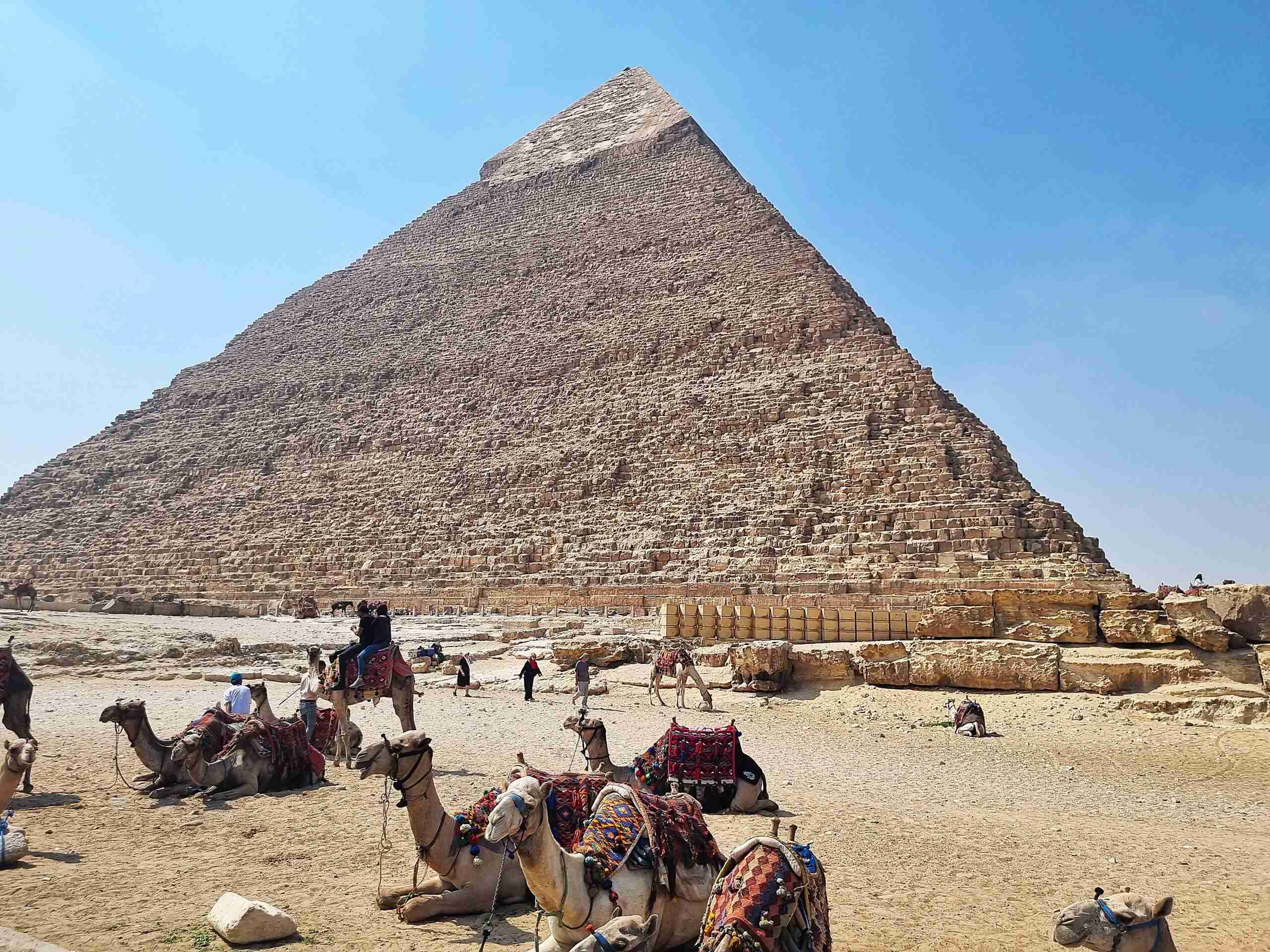
    Of course, top of the list was to see the Pyramids of Giza, possibly the most talked about landmark in the world? The only two I can think of that might take the title are the Eiffel Tower and the Great Wall Of China. I’ve been lucky to see both of those in my travels, so was time to see how the pyramids stacked up (get it?!)

    In my old age, I suppose I have gotten lazy and was lacking the energy to do things backpacker style. Ten years ago I would have jumped on a public bus to Giza, waited in line to buy the cheapest ticket possible, and bought water and snacks from the supermarket.

    This time, I was happy to pay someone to arrange everything for me.

    I booked this tour on Get Your Guide at just over 100 Euro, which included:

    • Pick up
    • Drop off (both by private car)
    • Entry to the pyramids and Sphinx.
    • Entry inside the great pyramid
    • Local lunch

    This was supposed to be a shared tour, but when I was picked up from my guesthouse the driver told me I’d be getting a private tour as there were no other bookings. Cool!

    We drove down to Giza which took around 45 minutes.

    It was early am so I was snoozing most of the way, but the driver pointed into the distance and said, “Look over there.”

    Indeed, there in the skyline were the peaks of the Great Pyramids.

    Once we arrived I was introduced to my guide. His name was Mohamed, like half of the other men I had met in Egypt by then. Mohamed was a short, chunky guy – he told me he was the top weightlifter in Egypt some years ago, which wasn’t hard to believe.

    As we walked up to the entrance we chatted – he was an easy, chilled-out guy (most tour guides are). He told me he’d been taking pyramids tours for twenty years, so I was definitely with the right guy.

    The best part about going with an experienced guide became apparent in the first two minutes. There was a long line waiting to buy tickets and go through security, but Mohamed walked us right to the front, shook hands with the security guard and walked us through. It does say on the tour listing that you’ll get to “skip the queues”, so I’m guessing this is an arrangement all the guides have with the complex.

    It was the same thing entering the pyramid. There was a short queue but we headed straight to the front and I went right in.

    What do I mean by “entering the pyramid?”

    This is an extra add-on, which lets you walk into the passage built inside the pyramid (obviously heavily refurbished).

    It’s a short but semi-difficult climb and a very narrow passage so you’ll be constantly squeezing past people. Many people were taking breaks and sweating like dogs, mostly because it’s not only tiring but hot inside. Once you get to the top, there’s a small room where there isn’t anything to see (as far as I could tell) other than an empty room with a stone box. A casket? Treasure chest? Dunno. Then you turn around and climb back down, the same way you came.

    Is it worth it? I guess if you’ve travelled all the way to Cairo, you might as well do it. It’s a pretty cool thing to say you’ve done.

    Once I’d come back out, Mohamed took me for a little walk around the five pyramids.

    There are three big ones – built for three generations of kings, and then some smaller ones built for wives and mothers.

    If you don’t want to look dumb like me, don’t ask which pyramid was for King Tut, since he wasn’t buried here! (he’s in Luxor). The pyramids are for King Khufu, his son Khafre, and his grandson Menkaure.

    Mohamed obviously knew all the best photo spots and angles, so we walked around and snapped photos at all of them. Another bonus of having a guide – he can be your photographer too!

    As I was there in October, it wasn’t the busiest. There were a few school groups around, and then your regular tourists from America, Europe etc (I know the accents).

    As we’re walking around, I asked, “When you were in school did you also come here for a trip?”

    He says “Of course, but not really to see the pyramids. Just to ride a camel and have fun with friends.”

    Yep – sounds exactly like my school trips to the Auckland Museum as a kid!

    Once we’d wandered around and taken all the classic photos, he gave me some free time to wander and look at things myself.

    By then I’d already seen everything, but I took ten minutes to stroll around a second time (the place isn’t that big).

    Other than being offered many scarves and camel rides and ice creams, there wasn’t much else to see.

    After that, we headed to the Sphinx. Unfortunately, we didn’t spend much time at the Sphinx, we just drove past and took a photo and that was it.

    I saw people walking around the statue and touching it, so if you want to do that there’s a way to, but it wasn’t offered and I didn’t ask.

    In hindsight, I probably should have, since after that we left the complex and the tour was pretty much over.

    On the way to lunch, we stopped at a Papyrus gallery.

    I thought it was going to be the usual souvenir-selling spiel, but it was quite interesting.

    The Egyptian papyrus is a type of paper that “lasts forever” made out of the papyrus plant.

    I was introduced to a guy who showed me the process from start to finish, peeling away layers of a papyrus stem, wetting it and then stamping it into paper. Then he demonstrated how it’s nearly impossible to rip it and you can dunk it in water and it never damages.

    I was left to roam the gallery and asked if I wanted to buy anything – there were hundreds of papyrus painted with everything from Egyptian legends to family trees to celebrity portraits. So in the end it was indeed a souvenir-selling spiel, but at least an interesting one.

    I noticed an ATM machine inside the gallery right next to the cashier, and interestingly, many tourists lined up to take out cash.

    The desk was also super busy processing purchases, so I asked the guy how many they sell in a day and he smiled and said “A lot!”

    He also told me many tourists come to Egypt specifically to buy papyrus since it’s the best quality in the world and it lasts forever. True or false? No idea.

    Finally, it was off to lunch.

    The lunch was a classic mixed grill with some chicken, meatballs, bread, rice, salad, and a million different dips and condiments, like every other meal in Egypt!

    I was hoping “local Egyptian lunch” might be a bit more interesting, but it was a standard (good) meal, nothing spectacular.

    Evidently, the Cairo heat was starting to wear on me as I forgot to take photos of the papyrus gallery or the lunch…maybe I’m just getting old, hah!

    Should you take an organized tour or go solo to the Pyramids?

    I think it’s easy enough to go solo, since they have Uber in Cairo and it works pretty well.

    Including Ubers to and from Cairo to Giza, and your entry ticket, you’ll probably pay half as much, but things will just require a bit more time and energy to figure out and you’ll spend some time waiting in lines.

    If you want to pay an extra $40 or $50 to make things easier, an organized tour is the way to go. For me personally, it was definitely worth the extra! I booked mine through Get Your Guide, but you can also ask your hotel/guesthouse if they can arrange something for a better price, or even just ask at the various tour agencies around Cairo.

    Final verdict on the pyramids?

    Certainly a cool thing to see, and if you’re in Egypt or the region in general, definitely go! But… also kind of underwhelming.

    Maybe the best way to put it is this – if I was still working as an accountant, and I had my two weeks of vacation time, and I’m wondering “Where should I go to spend my two weeks off this year?? Maybe I’ll go to Egypt to see the pyramids!”

    Then I fly 25 hours to Egypt, just to see the pyramids, get really excited about it … and I finally see them.

    I think I’d be disappointed.

    However, if I was on a trip around the region, maybe visiting Jordan, the Emirates, Abu Dhabi, maybe even Morocco, then decided to add on Egypt for a couple of days to visit the pyramids – I would definitely think it was worth it.

    In other words, they’re cool, but I don’t think they’re not soooo cool that you’ll rave about them to your friends and stare at the photos for weeks afterwards. Probably like most famous sights, to be honest.

    Still – part of the coolness isn’t just whether they look cool, but how they’re such a big part of history, and so much mystery still surrounds them, and they’re a symbol of the ancient Egyptian Empire that still fascinates scholars to this day. In that sense, I hope everyone gets the chance to see them at least once in their lives!

  • Training At Ban Thong Yod Badminton School in Bangkok!

    Training At Ban Thong Yod Badminton School in Bangkok!

    Life recently brought me to Bangkok for a few months and I was lucky to spend one of those months training at Ban Thong Yod.

    Ban Thong Yod is a world-famous badminton school, known for producing both a male and female world champion over the years (Ratchanok Inthanon in 2013 and Kunlavut Vitidsarn in 2023).

    The school sits around an hour from the city centre, in the Bang Khae area.

    Arranging it was easy. I sent a message to the Whatsapp number and someone was available to answer all my questions and organize everything. They have a dedicated staff member who speaks English to take care of this stuff, so that was helpful.

    I hadn’t pre-planned anything, so while chatting I asked her when I could come and she said “you can come today if you want”, so I did!

    I showed up that afternoon with my bags and moved into the BTY House, just in time for the afternoon training session.

    What’s A Typical Day Look Like?

    When I arrived, I was introduced to the head coach who watched me hit around for a few minutes to see which group I would be in.

    There seem to be around 4 different groups, but I’m unsure exactly how the system works.

    Anyway, I was put in one of the middle groups where I was training with mostly young teenagers.

    There is five hours of training per day.

    The first session is the 7-9 am session, which is a conditioning session.

    After that, you go back to bed if you hate early mornings like me, or maybe go to the restaurant and eat some breakfast.

    Then you relax until the 1-4pm session, which is an on-court session.

    After that, you’re free! Go eat some dinner at the restaurant.

    A lot of players also order food on Grab (the Uber Eats of Thailand) if they get sick of the school food.

    What’s The Training Like?

    If you’ve trained for badminton competitively, there will likely be nothing new. Pretty standard drills like multi-feeds, footwork, sequence drills, sparring and so on.

    There does seem to be more focus on fitness/consistency, compared to Smash Travel where we spent lots of time on technical things.

    I think in the whole month of there we only did one or two drills focusing on learning/honing new techniques, the rest was more on footwork and repetition.

    However, the school has produced two world champions, so obviously they have a good idea of what to teach you and when!

    The morning session is things like footwork, skipping, weights, calisthenics – no rackets or hitting. I actually missed this session quite often because I couldn’t wake up that early. But the few times I did go it was pretty good and not too hard. For the older players, you generally get put in the gym with the weight training session. For younger players, they do more footwork-type conditioning on court.

    At 1 pm you are back on court and it’s drills for the first two hours. The third hour you usually do some sparring to finish out the session. The drills are nothing revolutionary, but they have 6 or 7 coaches to feed, so you get quite a lot of time on court.

    Saturday and Sunday the schedule is quite different – the afternoon session is 3pm-6pm, and consists of only sparring and games.

    This sounds fun but they turned out to be the days I enjoyed the least. The class is bigger than usual, and there’s no real structure to it. The coach just points to a few of you randomly and says “go play doubles, go play singles”, then when you’re done he points to some others for their turn. So half the time, you’re just sitting around waiting for your turn to be told to play. I had my skipping rope and spent a lot of time skipping while I was waiting. Quite a few times I actually considered just leaving the class and going to the gym instead. But also for a lot of players, it’s good to get an easier day, especially those who train 3x a day during the week.

    Is the training hard?

    I was coming off a 5-6 week break, having not been on court since the Mauritius International.

    The training at my first court session was not that intense, but somehow I was almost dead before we reached halfway. Badminton is funny like that. Even 1-2 weeks off and you feel like you haven’t played in years.

    However, the next day the body had adjusted and things were much better.

    It’s kinda hard but nothing crazy. Some days are harder than others.

    Overall if you play badminton regularly you will probably be fine. If you’ve never “trained” like some of the people there, will probably be a shock to your system. But still fun! And since you’re training every day, you should adjust quickly.

    Who Else Trains There?

    The group I was in had about 25 students.

    When I arrived, the class was mostly Thais, but there were a lot of foreigners too. We had players from Canada, France, USA, England, and also a big group from Taiwan. Over the month I was there, the turnover was quite big as most people stay 2-4 weeks, but we also had players from Philippines, Malaysia, Poland, Korea, Japan and maybe a few others I’m forgetting.

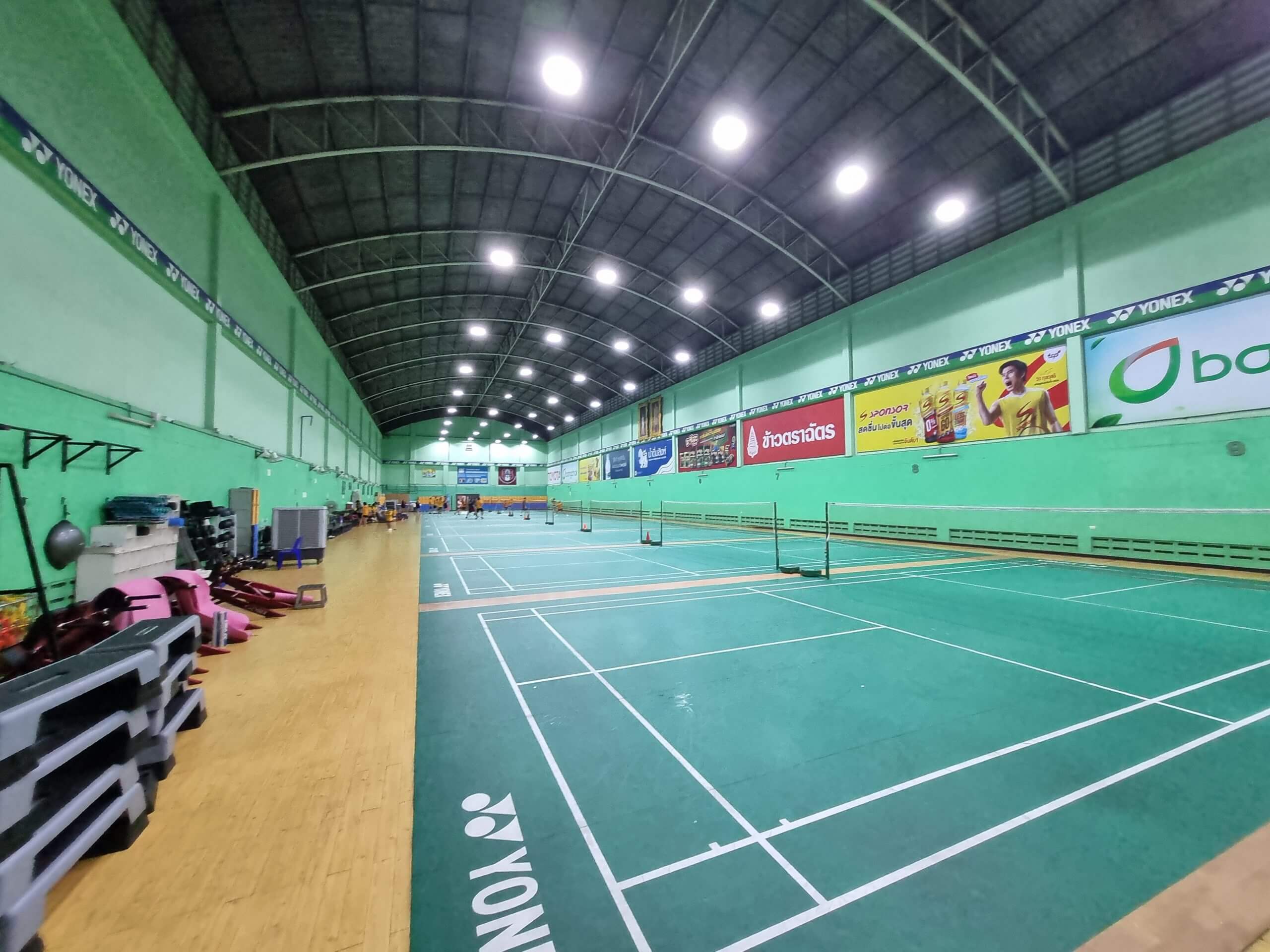
    What is unique about BTY is anyone can train there – they have 18 courts and run training all day for everyone from beginner to elite (world champion level, literally).

    This is why many people come here to train – because although Japan, Korea, Malaysia etc might have good schools, they’re not open to everyone. They’re usually exclusive and you need to be selected.

    At BTY, you can train even if you’re still a newbie, as long as you don’t mind being put in the class with 5-year-olds! (and of course, if you can afford it 😉

    There are lots of local Thais training here, I would guess over a hundred, from kids to adults.

    It’s called a badminton school but most people don’t realise it’s literally a school, as in school-age kids live there and this is their education.

    I figured this out when I noticed my 1pm session was filled with 14 year olds. From what I can gather from chatting with them (their English isn’t perfect) they do some online schooling, but the priority is badminton.

    They all train 3x daily and I guess they probably do some online maths lessons during their rest time or something, but they don’t seem to worried about it. Also, I’m just guessing here, maybe it’s different.

    What Are The Facilities Like?

    It’s a big facility which is like a mini badminton campus. It has:

    • Dorms where most players live (local and foreigners)
    • BTY House which is a more expensive option for foreigners
    • Very well-equipped gym
    • 18 courts
    • Restaurant
    • Small Yonex shop to buy gear (shoes, rackets, grips etc)
    • 7-Eleven right outside

    Staying in the dorms is free, or rather it’s included in the training price.

    However I chose to stay in the BTY House, because I’m working and also skin issues, so I need my accommodation set up in a certain way. You pay extra to stay in BTY, it gets you a private room with an ensuite and a fridge and desk. There’s also a little lounge in the house with a big TV that nobody really uses, and a small yard to hang your laundry and sit around if you want. If you can afford it, it’s worth it!

    Unfortunately I forgot to take a photo of my room, but it’s a pretty standard small hotel-style room.

    The gym is available to you whenever you want (except while the squads are using it for training) and has everything you would need in a gym – treadmills, spin bikes, machines, free weights, kettles etc.

    The restaurant is pretty good and the prices are regular Thailand prices.

    You can pay maybe $2 for a meal. Not bad.

    What Can You Do On Your Off Days?

    On Mondays, school is closed!

    People usually use this time to go visit some things around Bangkok or just relax at the mall.

    I’m familiar with Bangkok so I didn’t do much on Mondays other than eat and maybe get a massage. However, for many, it’s their first time in Thailand so the trip doubles as both a training trip and a vacation!

    Unfortunately there’s no beach in Bangkok, but there are many cool things to do like watch some muay Thai fights, go shopping, visit the markets, eat some street food, temples, floating markets, and plenty of amazing restaurants, cocktail bars, cafes and so on to spend some time at. My Bangkok guide can give you a few ideas!

    How Would I Rate My Experience?

    Me and head coach!

    I think the school is probably too expensive for most, but it’s a well-established school and as far as badminton training goes I think it’s great.

    Why is it expensive?

    The facilities are all top of the line – Yonex courts, Yonex shuttles, an excellent gym, lots of coaches, and unlimited good players to spar with. You also play with new Yonex shuttles daily (they must go through hundreds of tubes a day!) so it’s easy to see why the cost is high compared to other camps.

    It’s probably too much for casual players, but if you’re competing at national/international level (or aspiring to) then it’s a good place to get some intensive training and lift your game. Some players who are serious about doing well on the BWF circuit come and train here for months or years at a time. For context – I think it was perfect level for me, and I compete internationally and my world ranking was around 520 at the time.

    Overall – had a lot of fun, and met some cool people. Some say my game improved a lot in a month, I don’t know about “a lot” but I definitely did learn some new skills and started winning more by the end of my stay. So overall, great experience and can happily recommend going! I would love to go back!

    To train at BTY, you can contact them at the details on their website.

    Heading to Banthongyod and…

    Looking for tours and activities at an affordable price? I use GetYourGuide! Always great deals and local perks.

    For travel insurance, I always use World Nomads – get protected for just a few dollars a day!

    Somewhere to stay? Booking.com gives you the biggest selection and the best rates.

    Any questions, leave them below!

  • How I Spent Two Weeks In Mauritius!

    How I Spent Two Weeks In Mauritius!

    I was recently lucky enough to visit Mauritius and had a blast.

    Mauritius is an island country off the coast of East Africa, about four hours from Nairobi.

    The island is small and you can drive the circumference in around six hours.

    I was here for a badminton tournament so I spent most evenings at the stadium training, but otherwise, I was able to spend most mornings enjoying the beach and exploring.

    When I landed I was met at the airport and delivered my rental car. And this will be my first travel tip for Mauritius – rent a car!

    I hired my car using DiscoverCars and there are many good vendors to choose from. I chose the cheapest one and it all worked out great.

    I had been hesitant because I’ve travelled much of Africa and (for me at least) driving on this continent is a big NO, but Mauritius was totally fine and felt more like driving in small-town Europe. As my trip progressed it became clear I’d made the right choice, as the car allowed me freedom to explore more of the island versus relying on the metro/buses. The roads are good quality and if you’re a comfortable driver back home you shouldn’t have any issues:

    The drive from the airport to my accommodation was about an hour – longer than I expected. I chose to stay at the beach in Flic en Flac, and again, it was a great choice and I highly recommend it.

    I visited three or four beaches during my trip and Flic en Flac was the best in terms of convenience, restaurants, safety and the beach itself. Several locals I met from the tournament also lived in Flic en Flac.

    If you want a recommendation on where to stay in Flic en Flac, I stayed here. It’s a short 3-4 mins walk from the beach and very reasonably priced!

    The first few days I spent lounging around the beach and checking out the area. The beach at Flic en Flac is large and stretches for at least half a kilometre and probably more.

    There are street food shops all along the beachfront and you can get anything from noodles to ice cream to fresh coconuts for a few dollars.

    One of the funny things about Mauritius is when they say “kebab” they actually mean a baguette/sub.

    They call their kebabs “wraps” which I guess is normal, but beware that if you order a kebab you’ll actually be getting a sandwich.

    Shout out to my friend Lauren at Never Ending Footsteps who posted about this semi-hidden roti stall called Farota aka Vinoda which sells classic Indian rotis for less than a dollar each!

    I tried the fish, the chicken and the veg, all were delicious!

    I also pumped out a solid amount of kilometres on the roads around Flic en Flac.

    If you’re a runner, Flic en Flac is amazing. The streets are straight, flat and empty. You can run either beachfront or around the residential back roads. Both are great.

    On my first fully free day, my mission was to knock off some tourist spots.

    One popular one is the Chamarel Park which is toward the south of the island. There were a few beaches down that way I wanted to visit too.

    It was a long drive from Flic en Flac, so I broke up the trip with a short detour to one of the waterfalls.

    The Tamarind Falls are in the centre of the island and looked like a good target. I’m guessing there are a few other viewpoints for these particular falls, but the one I stopped at was underwhelming. If there’s a way to get closer though, they would be quite impressive.

    Onto the famous Chamarel Geopark.

    It’s quite a drive through long winding hilly roads, but not too hard to find.

    It will cost you $12 USD to get in and within the park there’s a waterfall, some turtles, and the well-known Chamarel “7 Coloured Earth” Hills.

    The waterfall is the first stop.

    It’s a nice enough waterfall. You can’t swim in it, but you snap a photo at a few different viewing decks.

    Then you drive down to the coloured sand dunes.

    Let me be honest – when I saw the dunesI just thought they looked like piles of dirt on a construction site.

    Okay, they’re all different colours but vaguely. Otherwise, you’re literally looking at piles of sand.

    It’s supposed to be a showcase of different coloured volcanic sands, and if it was something you saw on the roadside it would be pretty cool, but to build a whole tourist park around it seems kind of OTT.

    That’s nothing new in tourist attractions I guess, but it’s my job to be honest so there you go.

    I didn’t spend much longer in the park, there’s a few things you can pay extra to see but I had a feeling they weren’t going to be my kind of thing.

    Instead, the afternoon was still young so I took a cruise down to two nearby beaches in the south – Le Morne and La Gaulette.

    Le Morne is a flashier beach with nice resorts and aimed at higher-end tourists. The beach itself is quite nice (at least the one I saw) but Flic en Flac is definitely better. Le Morne feels kind of far away from everything though, so I wouldn’t like staying down here if your goal is to explore the island.

    La Gaulette is a short drive away and is aimed more at backpackers/budget travellers, but I saw some nice-looking restaurants around there too.

    I ended up stopping into one for a quick curry and calamari to fuel up.

    Is Mauritius cheap? I wouldn’t say cheap, but not expensive either. The above cost me 700 MUR, which is about $14 USD.

    I would say that’s average for a budget restaurant. Obviously street food will be cheaper, and nicer restaurants more expensive.

    The beach at La Gaulette is not as nice as Le Morne, in fact I wasn’t able to find an actual beach on Google maps.

    I did manage to find the water and took this photo from a boat ramp.

    Beautiful sunset, but definitely not a place for a day of sunbathing!

    After the drive home it was time for a short walk at the beach and some dinner – I got myself a grilled fish on the Flic en Flac waterfront:

    Overall, pretty fun day. Again – rent a car! Makes a huge difference in where you can go and what you can see.

    My next free afternoon I had just finished training in the middle of the island and wanted something traditional and local.

    Google led me to this traditional creole restaurant which was a mission to find (it’s up some winding residential back roads) but once I was inside it was beautiful!

    It’s set in a big backyard garden and they serve a set menu of creole dishes.

    The first course was fried plantain chips, fried eggplants, chili coconut dip and what seemed to be a bhuja/nut mix.

    Next came the main course which was rice, lentils, radish (I think), potato curry, salted fish and cabbage, sausage stew, octopus stew, deer stew, and eggplant dip and chili dip on the side. As you can see – a pretty serious spread!

    I’m sure you agree this looks epic, but how did it taste?

    A few things were a little too salty, but overall it was great. The waitress explained that there was a specific order to eat things in (I’ve forgotten now) which I followed and I finished everything easily.

    Finally, dessert.

    It was a papaya jelly, a coconut tart and a cake (almond, I think?), and a shot of local flavoured rum.

    Believe me when I say all three desserts were freaking delicious and I could have gone another round easily.

    I tasted the rum but didn’t drink it, it was mild and sweet. I’m sure anyone who drinks alcohol would love it.

    If you would like to visit this place, it’s called Escale Creole Restaurant. Bill was 1400 MUR ($28 USD) for one.

    During my second week in the country, I was finally due to compete in the Mauritius International.

    As you can tell I hadn’t been taking my preparation too seriously and had been more preoccupied with my holiday, but when in Mauritius, can you really blame a travel junkie for enjoying himself?

    The tournament was at the Cote D’Or Stadium, which is the biggest sports complex on the island.

    I lost (badly) in the first round. Not that I expected to go very far, but would have been nice to score more points!

    Anyway, had an awesome time training with the Mauritian squad and meeting some athletes from around the world.

    Now that I was truly on vacation, I had time to spend a day exploring the town centre!

    Port Louis is in the centre northwest of the island, and looks like what you’d expect from a classic island city. Driving into Port Louis is a bit more busy than other parts of the island, obviously, but traffic is well behaved and not too stressful to navigate.

    Walking around my first impressions were, in a word – dated.

    Everything works, everything is clean and functioning, but there’s a lot of wooden architecture and it has an old, weathered look.

    This is the central market, not far from downtown:

    Another interesting thing you might not know about Mauritius is the population is more than 50% Indian. This comes through in a lot of the things you see in town. A lot of Indian style shops, Indian restaurants, Indian-inspired food etc.

    One of the places I really wanted to see is Chinatown so I headed that way and spent a good hour walking around.

    The Chinese population is not that big in Mauritius, so Chinatown is not huge either.

    To be honest, there is not much to see there, but it’s cool to wander around and see what an African Chinatown is like.

    Of course I needed to eat something, so I stopped into this noodle joint which smelled good and it delivered!

    Another interesting observation – in every country I’ve been to where there are Chinese and Indian communities, they still speak to each other in their native languages. So Chinese people in New Zealand or Australia or South Africa speak to each other in Mandarin or Cantonese (not all the time, obviously, but it’s common). In Fiji you’ll always hear the Indian population speaking to each other in Hindi, same as the Indians in Kenya, Canada and so on.

    However, in Mauritius, they all speak to each other in French!

    The first few days was a surprise seeing Indian and Chinese families conversing with each other in fluent French. Then I met about five or six Chinese Mauritians at the tournament and learned none of them can speak Chinese, they all speak French at home.

    I found that really interesting and it’s not something I’ve seen before.

    I’m telling you that story because in this particular noodle restaurant, I noticed the owners talking to each other in Mandarin! So I knew the noodles would be on point and authentically Chinese Chinese (and they were)! I could’ve been on the streets of Shanghai and not known the difference. The place is called Soup Queen.

    On my final day in the country, I went out for an easy lunch – an octopus salad, Mauritian-style fried rice, and then relaxed in the sand.

    This kind of day sums up Mauritius nicely. There’s really not much to do except for eat and sit in the sun. But is that so bad?

    I’d say it’s the best thing about the place 🙂

    That brought my trip to a close and I was back at the airport the next day to fly out.

    Overall, I loved my time in Mauritius and would love to go back. It’s safe, easy to get around, affordable, sunny, developed, and you can even practice your French!

    Verdict from me: Rotten Tomatoes 10/10 highly recommended.

    Heading to Mauritius and…

    Looking for tours and activities at an affordable price? I use GetYourGuide! Always great deals and local perks.

    For travel insurance, I always use World Nomads – get protected for just a few dollars a day!

    Somewhere to stay? Booking.com gives you the biggest selection and the best rates.

  • Training At Smash Travel In Bali – A Review

    Training At Smash Travel In Bali – A Review

    While preparing for the Oceania Champs earlier this year, I was fortunate to get a week of training at Smash Travel in Bali!

    I had been in Bali over the New Year period doing my annual fast, and after a short training camp in Jakarta with some friends of mine, I found myself back in Bali before heading back to Australia for the tournament.

    My friends actually knew the head coach at Smash Travel (Ajay) and told me he’s great to train with.

    So – I fired off a Whatsapp message and asked if they could take me in for a week.

    Toni is a player from Sweden who lives in Bali and runs everything. Everything was super smooth and easy to book and after a few minutes of chatting I was ready to get training!

    Arriving in Bali

    I arrived in Bali a few days later and was picked up from the airport (included in the camp) and taken to the accommodation (also included in the camp).

    The accommodation is a local guesthouse about three minutes walk from the badminton hall – it’s run by a local family who are wonderfully friendly and I was settled in quickly.

    The guesthouse has spacious rooms with a balcony on each, air conditioning, a fridge and kettle, and also a semi-indoor pool for guests. For me, it was more than comfortable.

    The only thing you should know is there’s no kitchen access, so it’s not possible to cook your own meals.

    This meant I was ordering my meals from GrabFood, but that was totally fine for me.

    Especially since it’s Bali, so you have many delicious things to choose from and it’s easy to stay healthy!

    The training

    It’s an intense schedule but nothing more than you would expect at other camps.

    • Monday – 8am to 11am
      Tuesday – 8am to 11am, 3pm to 5pm
    • Wednesday – 8am to 11am
    • Thursday – 8am to 11am, 3pm to 5pm
    • Friday – 9am – 11am
    • Saturday – 1pm to 4pm
    • Sunday – OFF

    So basically you train twice a day on Tuesdays and Thursdays, every other day is one 2-3 hour session except for Sunday.

    There’s also the chance to add in some private sessions with Ajay, which I did do ($50USD/hr) and thought it was valuable.

    Of course, the camp will be slightly different for everyone, depending on how many players are there at the time and the levels. During my week there was only one other (foreign) player at training, but some local players join in the training too, including Ajay’s son who is still a young kid but can seriously play!

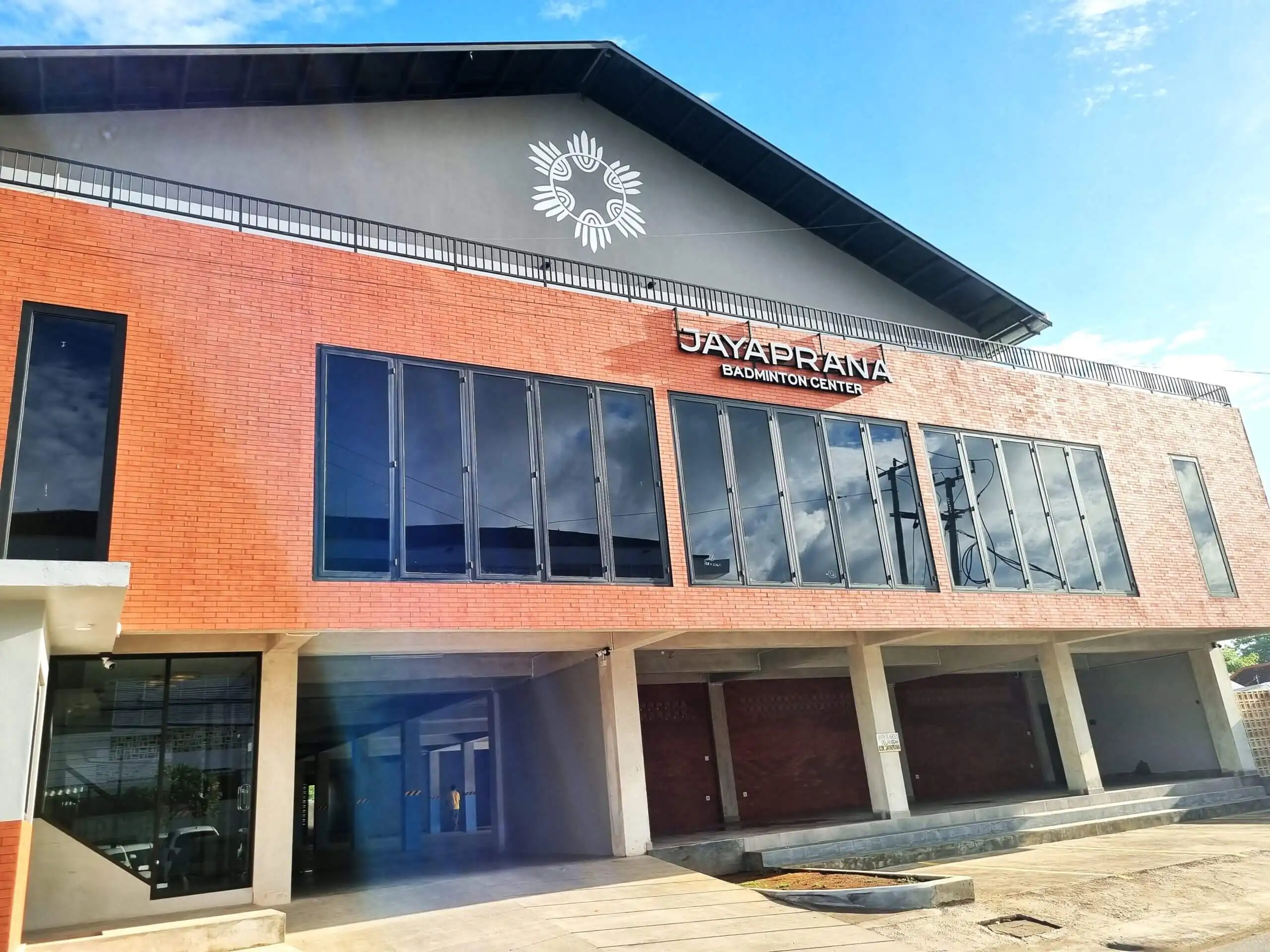
    The training is held at a newly built badminton complex called Jayaprana, just around the corner from the guesthouse.

    As for what we did while I was there, it was mostly the same format every day.

    • Sparring with Toni and the local Bali players
    • Drills with Ajay – sometimes he will drill a new shot with you, sometimes focus on footwork, sometimes he works on technical things. Some specific things him and I worked on were – backhand technique, improving smash power, deception at the net, reverse slicing, and various tweaks to my footwork.
    • Fitness and conditioning drills

    Ajay’s coaching style is very relaxed and there is no real structure to it – by that I mean it’s not like there’s a daily schedule where you do 20 minutes of warmups, 30 minutes of footwork, 30 minutes of drills, 30 minutes of sparring etc etc.

    He kind of just watches you play and picks out different things for you to work on. Some days you spar a lot, some days not much. Some days you will do lots of conditioning work, some days you won’t do any.

    Warm ups, warm downs and stretching you mostly do on your own – so it helps to get there a little early and stay a bit later so you don’t waste your court time on that.

    I know some people prefer really structured training, but I personally don’t mind either/or. I think it kind of suits the Balinese vibe anyway that things are a bit more freestyle and keeps it interesting!

    What are the facilities like?

    Jayaprana has five courts and it’s built for badminton, so the ceilings are high and there is no wind.

    The courts are mats but I don’t think they’re Yonex or Victor mats but some local brand. This means they’re not tournament quality, but still pretty good, and certainly better than wooden courts.

    As for shuttles, they use a local brand of shuttles, again not the same quality as Yonex/Victor/Yangyang shuttles but still fine to train with and I had no complaints about the quality.

    Inside the courts they also have a little drinks shop where you can buy smoothies/juices and also regular stuff like water and Pocari Sweat or Nescafe.

    There are showers too if you want to rinse after training.

    Overall it’s a small but good quality facility.

    As for stringing, luckily you’re in Indonesia, which is a badminton crazy country! So finding badminton shops to string isn’t an issue. Unfortunately, they don’t do it at the hall, but some local stores can do it and they’re not too far away.

    It’s also cool that since you’re in Indonesia you can find lots of cool badminton gear you might not always find at home.

    I bought tons of gear that I can’t find easily at home, including playing kit, a bag, wristbands etc.

    All my teammates are jealous of my new shoes!

    What does a typical day look like?

    First, you wake up at 7:30 am, get all your crap together and run to the hall.

    Then when you arrive ten minutes late, you realise you can relax because it’s Bali and nobody is going to yell at you.

    Train for three hours.

    Walk back to the room and order some food on Grab.

    Eat.

    Go to sleep.

    Wake up again at 1:30pm for afternoon training.

    Train for two hours.

    Get back to the room at 5:30pm.

    Do some laundry and think about what to eat for dinner.

    If you’re tired, just order Grab. If you have energy, you can head out to Seminyak beach and eat at one of the nice restaurants, or eat at one of the local places around.

    Go to sleep.

    Wake up and do it again!

    Would I recommend it?

    The short answer is yes. I had a great time and would recommend it.

    Now for the fine print:

    It’s a small camp. Like I said, the hall has five courts and there is one coach.

    If you’re an elite-elite player (as in, you are aiming to compete with world-ranked #500+ players, national level players in your country, advance far into Future Series/International Series tournaments), then it might be a bit small for you. You are not going to find a big squad of elite sparring partners from around the world like you would in the big camps in Dubai and Thailand. For context – I compete internationally and my world ranking at the time was around 600.

    Ajay is a high-level coach so of course, working with him will still be great, and I’m sure they’ll bring in whatever top players they can to spar with you. For example, Toni knew I was prepping for the Oceania Champs so he arranged one of Bali’s top players to come in and give me some games (he was waaay better than me). But also remember Smash-travel accepts beginners, which is fantastic, but it means it’s also not catered specifically to top-level players.

    UPDATE 2024: Ajay is no longer the coach there, I can’t vouch for the new coaches but Indo coaches are generally high level.

    Still, if you’re not preparing for elite-level international competition (which is 99% of us) and you simply want to get better at badminton, I think Smash Travel is a great camp and tons of fun. For anyone B grade and under it would definitely be beneficial.

    I paid for the all-inclusive package for one week. The price is reasonable and personally I thought it was very fair value for money.

    Booking is easy, just hit them through their website smash-travel.com.

    I also have a Bali accommodation guide if you’re looking for other options!

    Heading To Bali And…

    Looking for tours and activities at an affordable price? I use GetYourGuide! Always great deals and local perks.

    For travel insurance, I always use World Nomads – get protected for just a few dollars a day!

    Somewhere to stay? Booking.com gives you the biggest selection and the best rates.

  • Racing The Karen Open Triathlon In Nairobi!

    Racing The Karen Open Triathlon In Nairobi!

    I was first through the gate.

    It was 7 a.m. and the air was dewey.

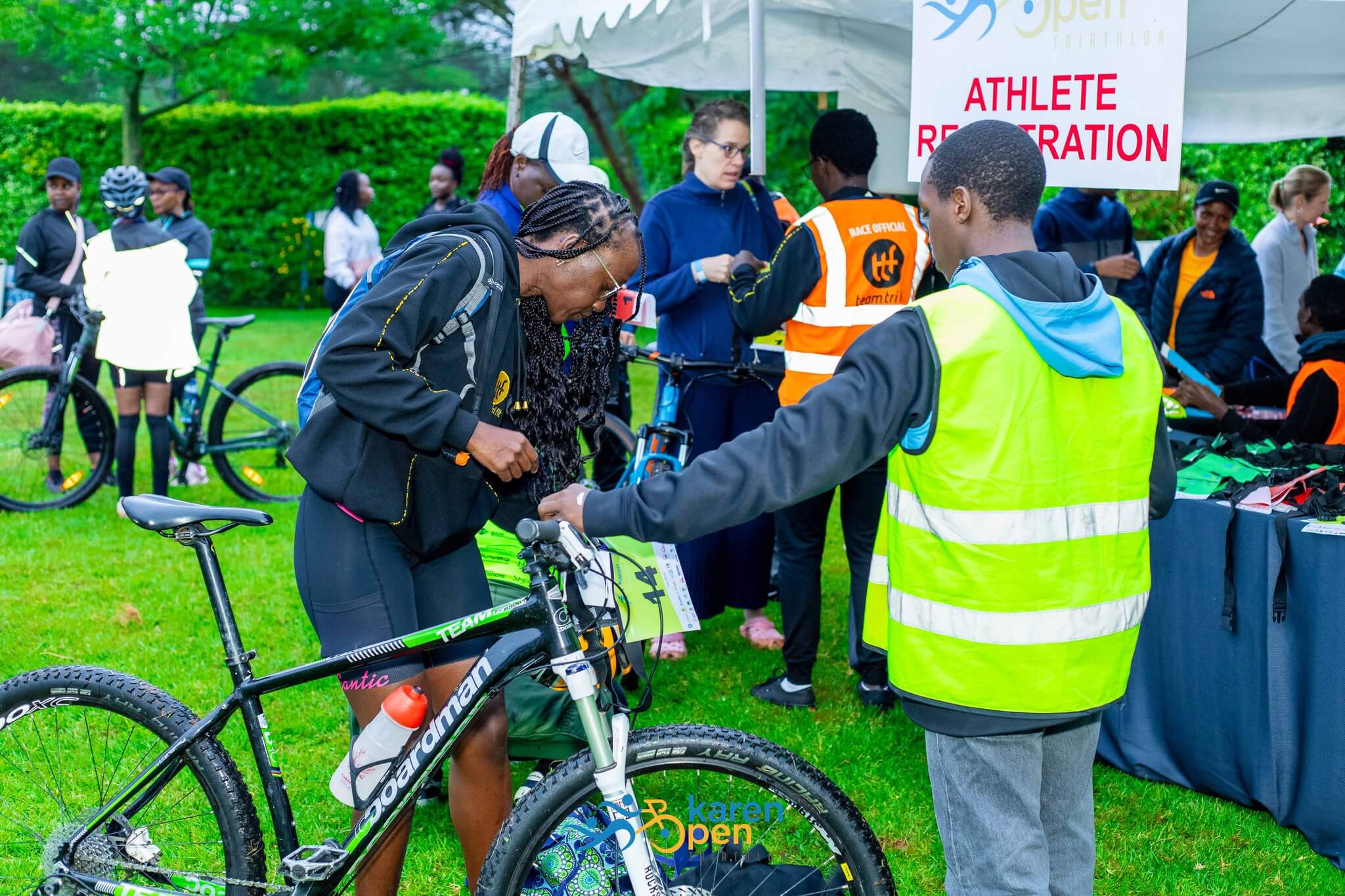
    I headed for the registration desk – the first athlete of the day.

    They handed me my race bib, wrote my race number on my calves and arms.

    As I wheeled my bike into transition, I couldn’t help but smile. Race day always gives you that feeling. My first triathlon since 2021. It was good to be back.

    I first heard of this race last year when I was in Kenya last year, and had kept it in the back of my mind. By pure stroke of luck it matched up with my travel schedule this year, and I registered with about four weeks until race day.

    I was in Bali at the time, and without a bike or even a good place to run, training had consisted of daily sessions on the treadmill and spin bike at a scrappy gym by my apartment.

    However, I felt reasonably well prepared considering the time frame. I knew my swim would be rusty, but I felt I had enough kilometres in the bank for a decent time on the run.

    After arriving in Nairobi about a week before race day, the rain had been tumbling down. I had gotten in one ride and a few swims. Race day would be interesting.

    Thankfully, on this day it hadn’t rained overnight. The sky was blue. Sun was already showing. It was a perfect day for racing.

    After hanging my bike, I went to arrange my transition basket.

    Race top. Sunglasses. Helmet. Socks. Shoes. Gloves.

    I visualized the transition in my head, three, four times, ensuring I had the order right.

    I did. I think.

    Nothing left to do but sit and wait.

    The first curveball of the race was the start time.

    Even though the scheduled start was 8 a.m., when the clock hit 8 we were still finishing registrations.

    Once that was done, a group warm up took place.

    Then we had a bunch of speeches, race rules had to be explained, sponsors had to be thanked.

    By the time we finally headed down to the pool, it was well past 9.

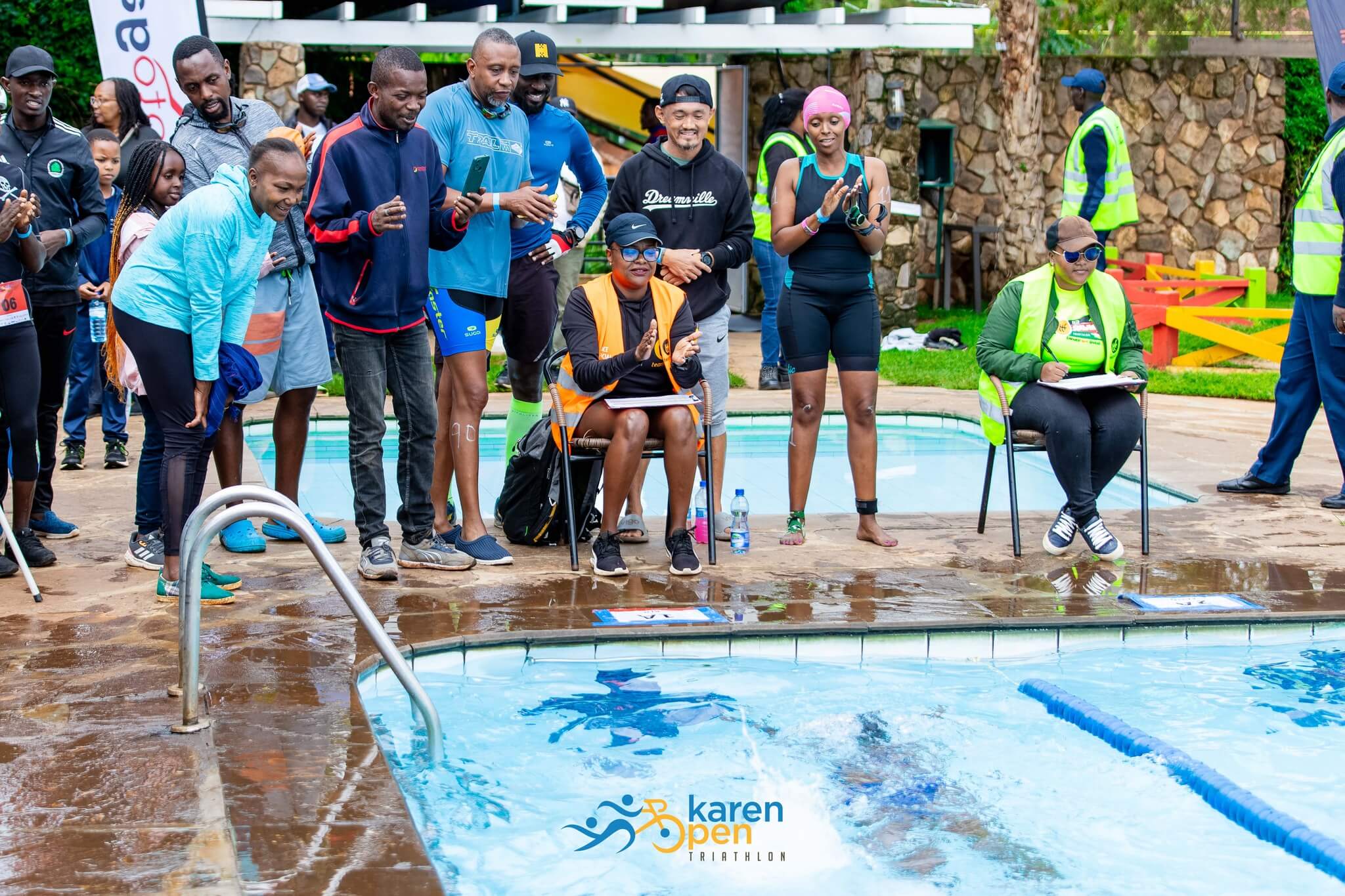
    We were grouped in our expected swim times, and the start list ran from slowest to fastest.

    The ladies went first, and the first wave alone took around 40 minutes.

    Instead of starting at 8, it was likely my race would start around 11.

    Unfortunately I had drunk a whole bunch of caffeine at 7:30 a.m. in anticipation of an 8 a.m. start. By the time 11 came around, I was starting to feel like an afternoon nap.

    But, that’s all part of racing. The rest of us simply enjoyed the sunshine while we waited, cheered on the girls in the pool, and chatted with our fellow athletes.

    I had another dose of caffeine just before my group was called to the swim.

    The swim was 38 laps of a 21m pool.

    I hadn’t had much time for swim training, but I had done three swims since arriving in Kenya two weeks earlier, and was clocking around 16 minutes for the distance.

    I started well enough and didn’t feel like I was going too fast, but around 12 laps in I was breathing heavy for some reason.

    I tried to push through but my lungs weren’t having it. Very strange. I couldn’t help but stop at 20 laps and give myself a ten second break and a few deep doses of oxygen.

    The second half felt much better, and I managed to get through in my expected 16 minutes.

    From there it was a sprint from the pools to the transition field around 200m away.

    Since I was out of breath, transition took longer than expected. I tried to relax while getting my shoes on, knowing I was moving too slowly but also not really caring. I was exhausted! There was a guy next to me getting his kit on at the same time.

    “Bro that so hard, what the heck!”

    “I know!”

    Well, at least it wasn’t just me.

    After about three minutes, I was running my bike down the chute and onto the road.

    It’s not a secret that I hate the bike. I hate how long it is, how dangerous it is, how many things can go wrong. And also I suck at it, that’s probably the main reason.

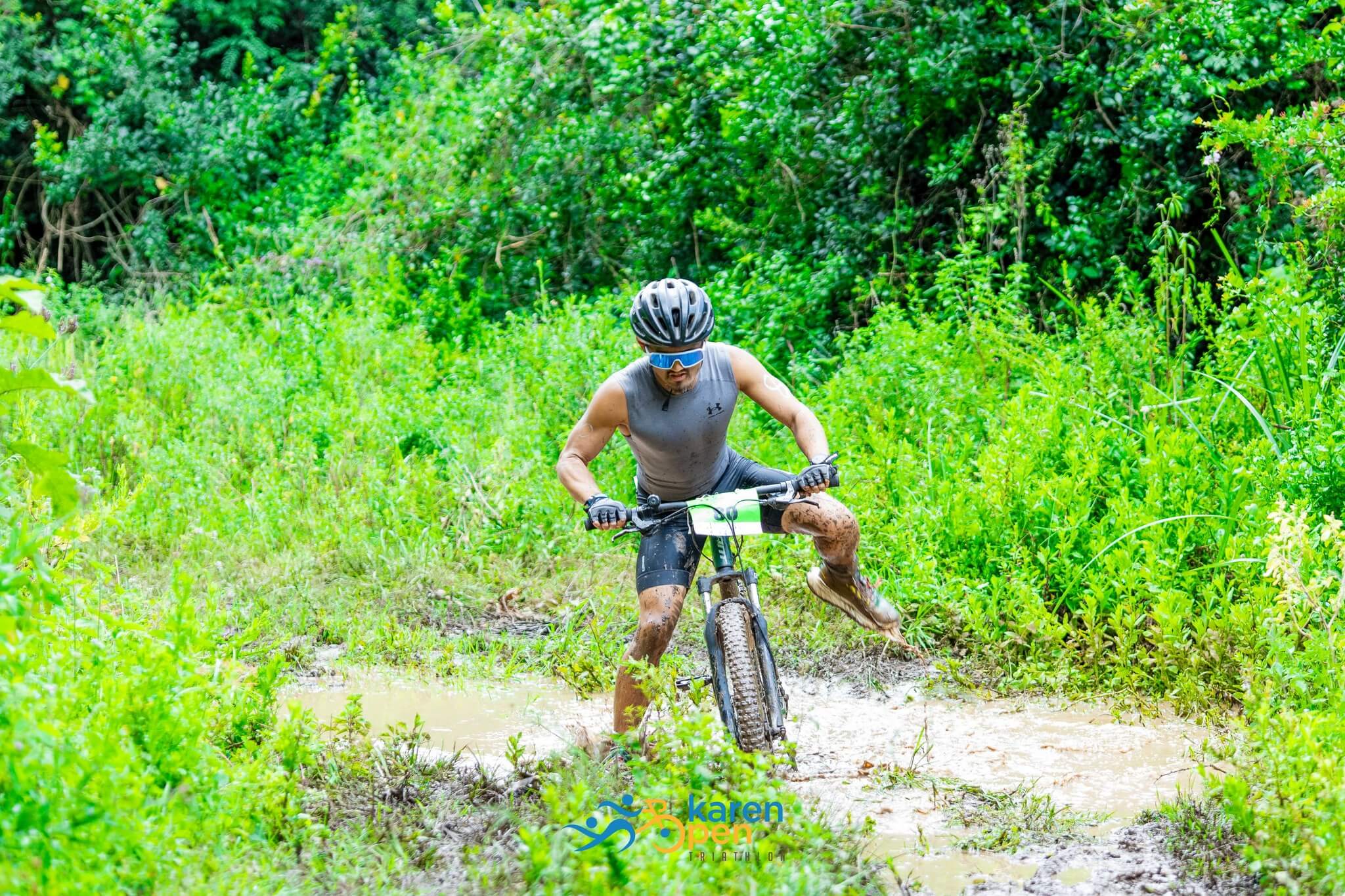
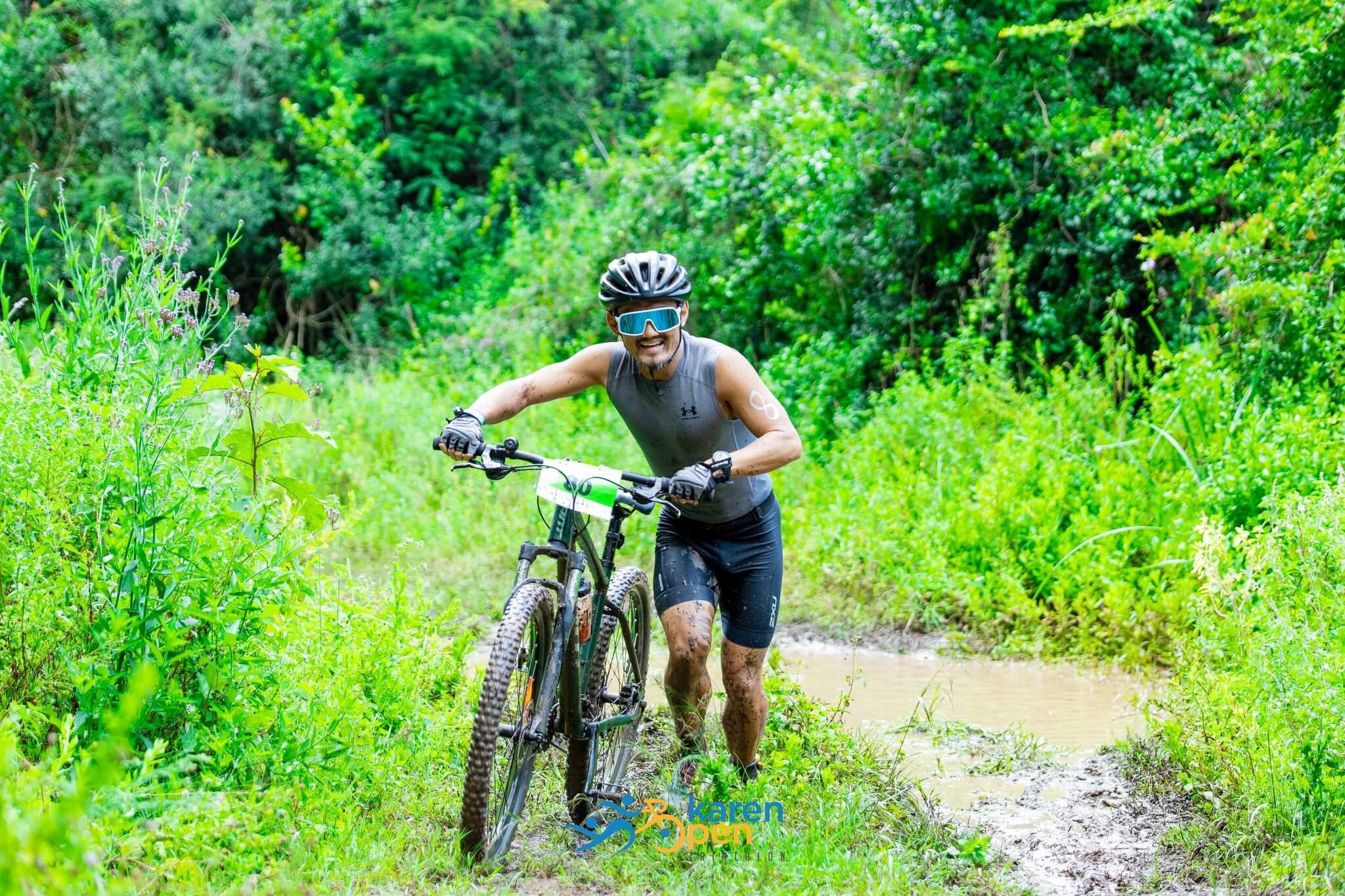
    To make matters more challenging, this course was a mountain bike route, something I’ve never raced or barely even ridden before.

    Even though the idea of a race to go fast, I knew I couldn’t go fast. All that would lead to is me crashing into a pile of rocks and walking home. The course wasn’t too rugged, but definitely tough enough that I had to pump the brakes almost the whole time and cruise through at a comfortable speed.

    That didn’t stop me from falling off a couple of times.

    Thankfully there were 3 or 4 kilometres on-road, which was a welcome respite for my arms (mountain biking kills your arms!) and allowed me to pump out watts the best I could without worrying about dying.

    The end of the bike was an on-road climb that seemed to be giving people problems. It wasn’t too steep, but was long and after riding through the mud for an hour was tougher than it should have been. I did my best to finish strong and make up some time.

    Coming into transition for the second time, the atmosphere was a bit more festive as many earlier starters had already finished.

    I had designed this transition to be lightning quick – all I needed to do was hang my bike, take off my helmet, then grab my hat and go.

    I was in and out within 30 seconds.

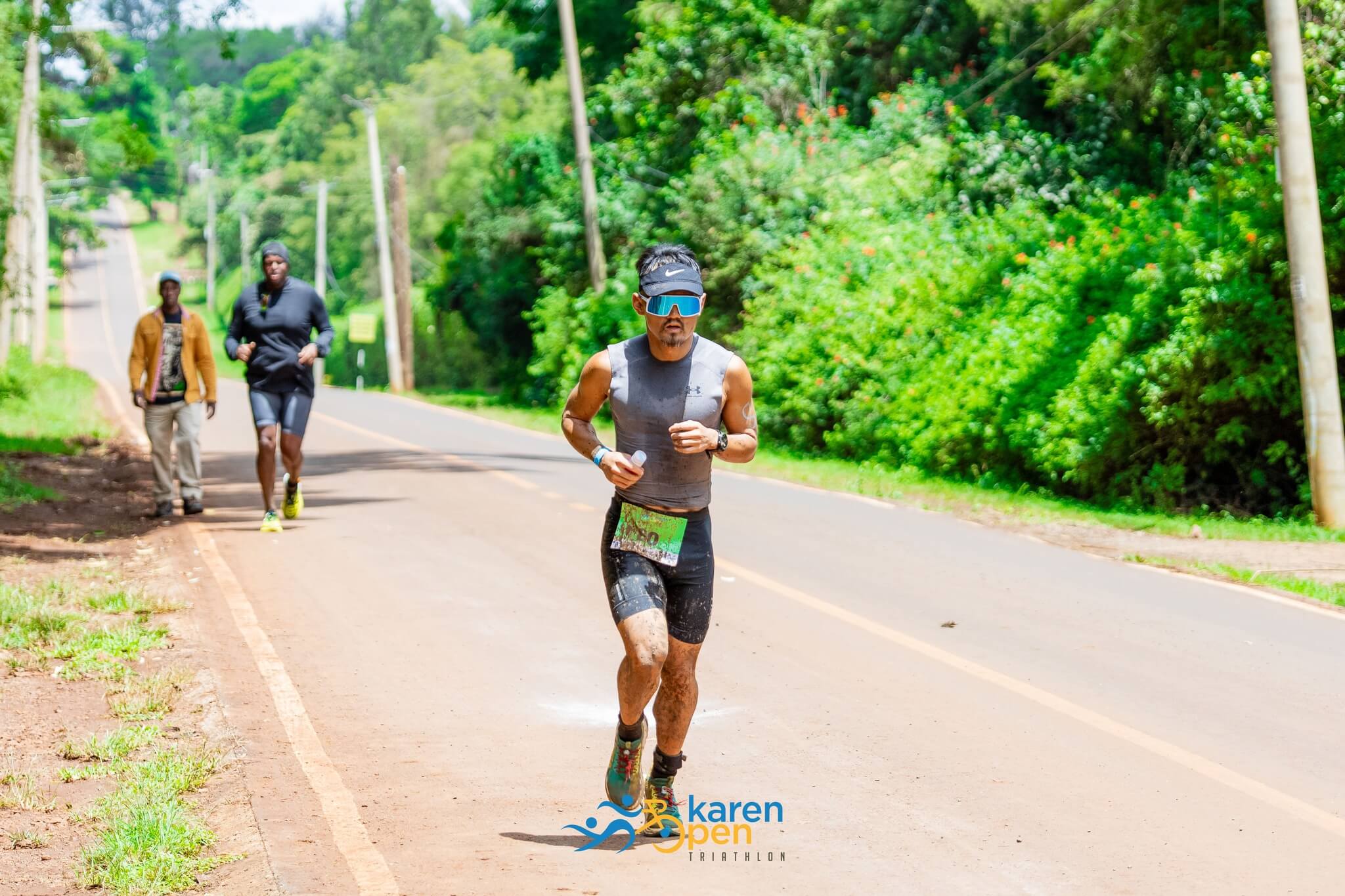
    I’m not the fastest runner, but I’ve gotten better over the years.

    In the first couple of kilometres I managed to pass around 4 or 5 people who had blitzed past me on the bike. For whatever reason, the run seemed to be giving a lot of people problems, and many were shuffling or dawdling along and looking worse for wear.

    My legs were pretty heavy but it was only a 5.5km run – as a marathoner that distance feels like a gift.

    While I wasn’t able to hit anything close to PB pace, I cruised through the run, trying to push in the last 2km.

    I passed another handful of people during that final stretch, and crossed the finish line as strong as possible.

    After a shower and a freshen-up back at the pool of the Karen Country Club, it was back to the finish line to relax on the lawn and watch the rest of the racers finish.

    The relay event had started last, so many were still on their bikes or just starting their runs.

    It was a good time to chat with the other triathletes about the race and just about life in Kenya, the triathlon scene and make a few new friends.

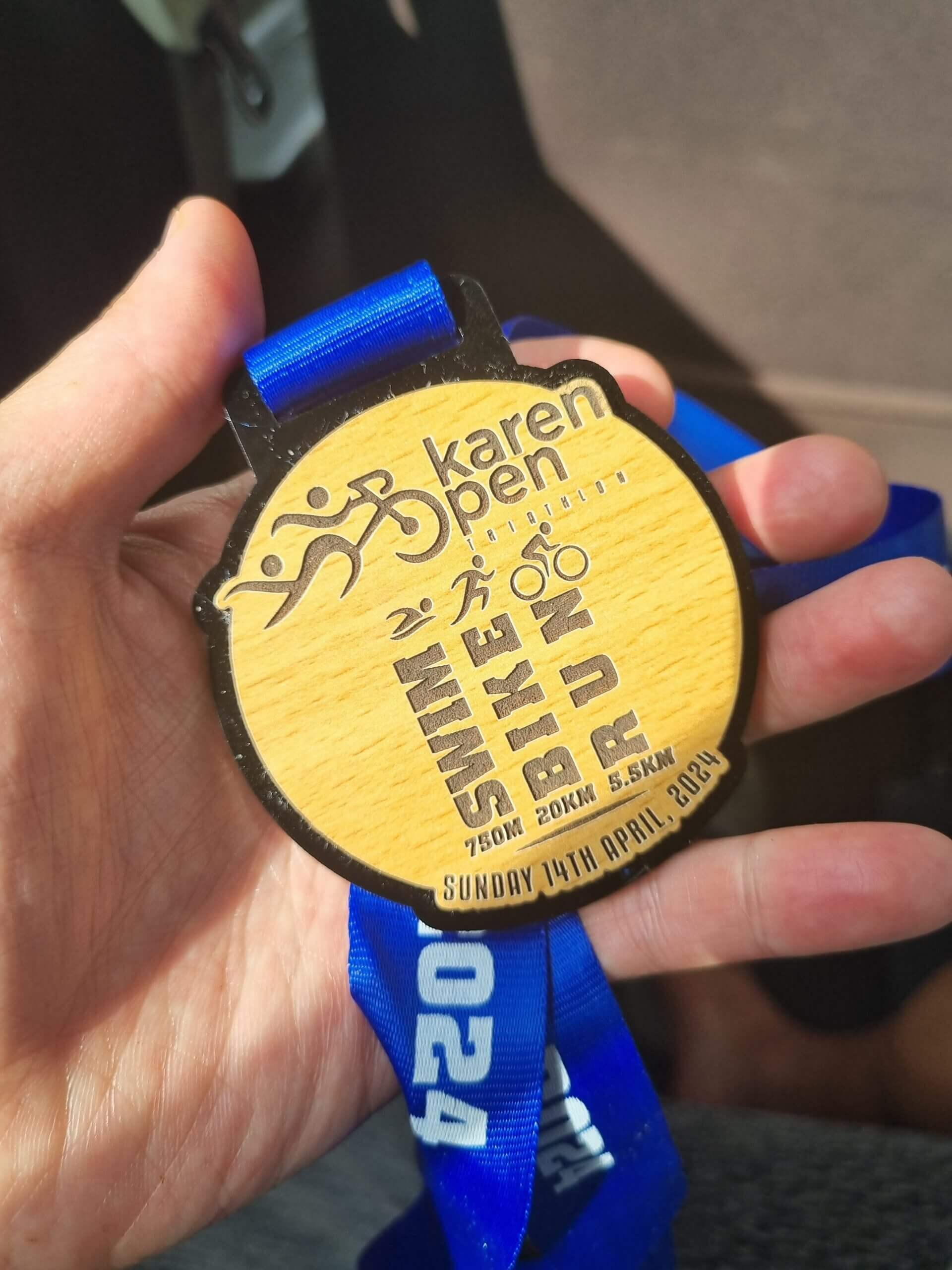
    Result? 10/67 in the men’s. 11/96 overall.

    A decent swim, biked like a snail, and run maybe a few minutes slower than I should’ve. Since I only had 4 weeks of training, couldn’t have expected much more.

    Still every race and every finish line is a blessing, another achievement, another building block to staying strong and healthy, and another step to doing better next time.

    Overall, I thought the race was superbly organised, and other than the late start, everything ran like clockwork.

    Will I race it again? Maybe!

    We’ll see what 2025 holds.

    Also! Shout out to the teams at Joy Riders and Team Tri Fit for organising the race, and allowing me to train with them for a couple of sessions before the race. Wonderful group of people – if you’re into the race scene and ever in Nairobi, definitely hit them up!

    Heading to Nairobi? Check out my accommodation guide here!

  • How To Get A Visa Extension In Bangkok

    How To Get A Visa Extension In Bangkok

    Are you in Bangkok and want to extend your stay past the allowed 60 days?

    If you entered Thailand on a visa exemption on arrival, you would have received 60 days to enjoy the kingdom, but you have the option to extend this for a further 30 days, and it’s very easy to do!

    In this guide I’ll show you step-by-step how to get your 30-day extension.

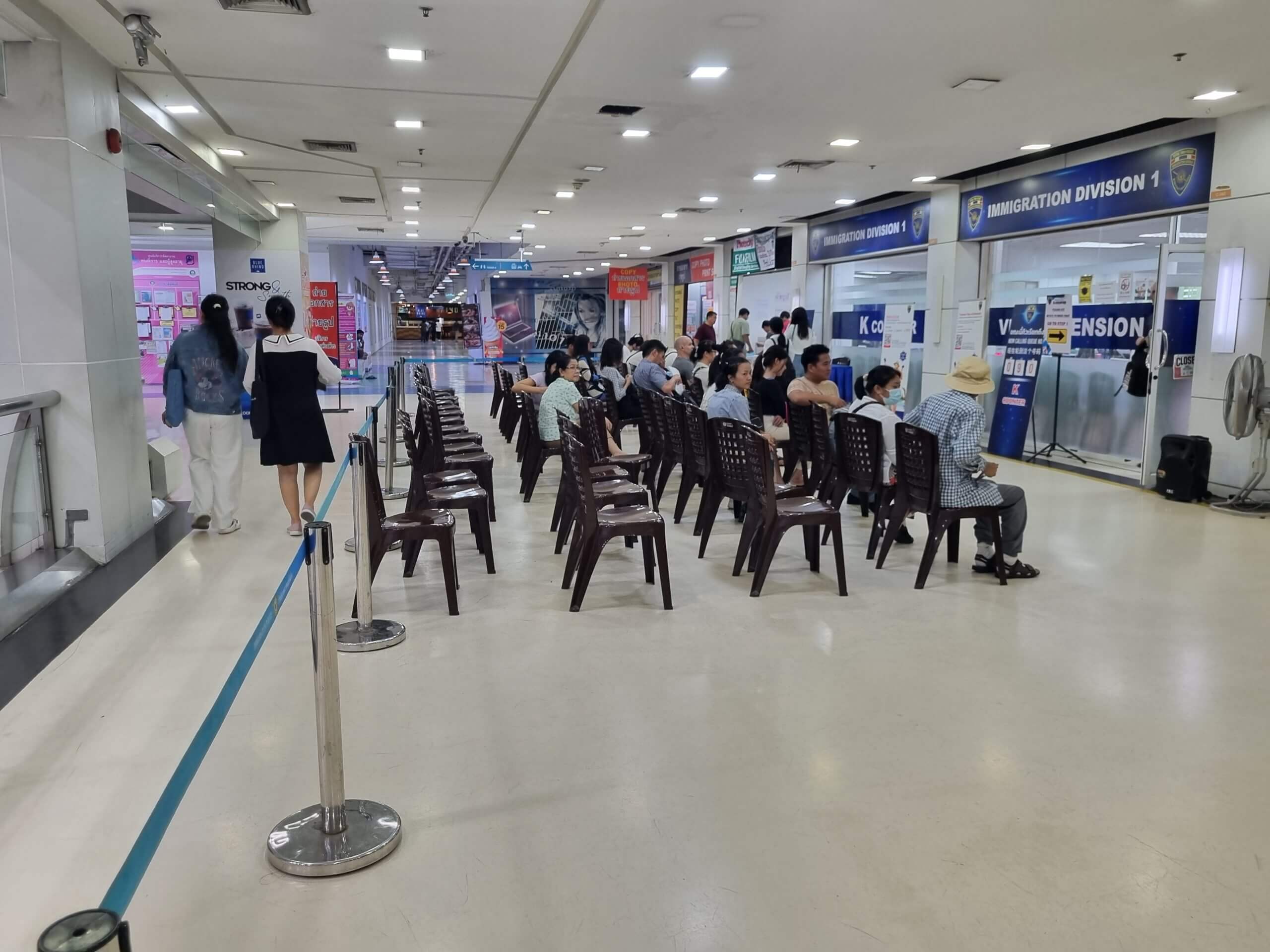
    The first thing you need to do is get yourself to the immigration office at IT Square in Lak Si (third floor). The Google Map address is here.

    It is not hard to find, in fact, it is literally right outside the Lak Si subway station (red line).

    Here’s what you will need to take with you:

    • Your passport
    • 1,900 baht for the extension
    • 104 baht for some printing
    • A pen (very important!)

    The office is open Mon-Fri from 8:30 am to 3:30pm (they close at 12-1 for lunch).

    My suggestion is to get there at 8:30 a.m. because the crowd will be far less and the staff will also be less grumpy before they start dealing with clueless tourists all day.

    As soon as you reach the third floor and find the office you’ll walk past these photocopy shops:

    Give them your passport and they’ll make a photocopy of your bio page and your visa stamp page. You shouldn’t need to tell them what you need, they do this thousands of times per week.

    Then they’ll ask if you need photos. If you don’t have a passport photo handy (a physical copy, not on your phone) then say yes! They’ll quickly take your photo and print some for you.
    All this should cost you 104 baht or thereabouts.

    Once you’ve got your documents, head to step one (everything is signposted).

    At Step 1, there will be three forms you need to fill out.

    You don’t need to print them beforehand, they are all provided:

    The forms are all straightforward, it’s the usual things like your name and address and favourite ice cream flavour (just kidding).

    For those of us who are a bit slow they even have written examples posted on the wall for you to copy:

    Make sure you fill everything out properly because if you don’t, the ladies will just send you back to fix it and you’ll need to rejoin the queue again.

    When I was last there, I saw three people get sent back to correct their forms. Don’t think you can just get to the desk and they’ll let you fill in all your gaps there. They won’t! You’ll get banished back to the form-filling station, so do it right the first time.

    As i said the forms are straightforward, but you will need to put a full address for your accommodation so make sure you have this handy. You can’t just write “Sheraton Hotel” you actually need to write the street name, district, country, city, postcode etc.

    Once you finish your forms, you’ll join the queue at this station where someone will check you completed all the paperwork correctly.

    This is also where you will hand over your passport photo and your photocopies of your passport.

    If everything is peachy, you’ll get your forms stamped and be sent to the processing room which looks like this:

    Wait for your number to be called, the staff here will collect your 1,900 baht extension fee and take a photo of you for their biometrics.

    I believe they only take cash (and they give change).

    Once that’s all done, you’re done! Just head back to the waiting area and take a seat.

    If they’re busy you might wait a while, but usually your passport comes back within 15-30 minutes. A staff member will come out of the room with a pile of passports and call your number.

    If the crowds are not too big, this whole process from start to finish can usually be done in less than an hour.

    If the queues are long and you need to wait over the lunch break, you might take 3-4 hours.

    This is why it’s advisable to arrive early, but in most cases, you should be in and out within one day.

    Also, this extension service is only for people who entered Thailand on a visa exemption.

    If you have a different type of visa that you acquired as an e-visa or from a Thai embassy, you will need to extend it at the immigration department in Chaengwattana (Building B).

    Do I need a TM30 form?

    You might have read around the interwebs that you need a TM30 form.

    The TM30 form is used for your accommodation provider to register you online with the immigration department.

    I asked if my accommodation had registered me before I went, and they said they had.

    I am actually not sure if they checked this on their systems while I was doing my extension, it’s possible they did. However, they definitely did not ask me for a physical copy of the TM30 form, nor did I see it mentioned anywhere at any of the stations.

    If you want to be safe, you can ask your accommodation provider if they’ve registered you with a TM30 before you go (I think they’re all supposed to do it regardless of whether you’re extending or not).

    Do I need a return ticket?

    No, this was never asked for, nor is it mentioned anywhere in the requirements.

    They did not even ask for a leaving date.

    When given my passport back they just told me the date I had to leave by.

    Can I book an appointment online?

    Yes, this is possible, however I have not looked into it nor do I know anyone that’s actually used the service.

    If you go early, the process is easy enough that you can be in and out within an hour, so I don’t see any need to try book appointments online and complicate the process more than it needs to be.

    However, you can try it. If you do – come back and let me know how it goes!
  • 5 Days Fasting In Canggu, Bali

    5 Days Fasting In Canggu, Bali

    It’s that time of year again!
    After a hectic year and feeling absolutely drained, it was time to clean up the body, mind and spirit with a fast.

    Last year I did my annual fast at Atsumi in Phuket. It was a resort specifically designed for fasting. Everything was prepared for you and available within the resort – which during a fast is like a dream (since you sometimes barely have the energy to think). It was simply wake up – drink tea – go to yoga – get a colonic/enema – get a massage – sit in the sauna – meditation – sleep. They also take care of all your water needs and preparation for breaking your fast.

    While I felt it was worth every cent, it was rather expensive (about $2,500 USD for 14 days).

    This year I wanted to see if I could do it slightly cheaper, DIY style.

    I scouted many locations, including other areas in Thailand, the rest of Asia, Costa Rica, Europe, but Bali came up as the best candidate. Firstly, because it’s closer to home (five hours closer than Thailand!), secondly, because there’s a beach and it’s warm (very important!), and thirdly, because it’s inexpensive.

    The first task was to find a place where I could do my daily enema/colonic.

    There are actually many places you can do this in Bali, mostly around Kuta and Ubud.

    However, the only place that used the colonic system (closed system) that I prefer was based in Canggu.

    That was perfect, as I’ve always wanted to check out Canggu since it popped up on the backpacker map some years ago.

    Next step was to find a place to stay that was both nearby so I could walk to my daily colonics, and also inexpensive.

    Since I’m a bit of a Bali newbie, I didn’t realise Christmas time was absolute peak season so the pickings were thin. However, I did find a great no-frills place at EVA Guest House, about a ten-minute walk from Aqua Spa.

    There were also many health food spots in the area, perfect for when it came time to break fast and rebuild.

    With everything booked, it was time to get down to business!

    Day 1

    This year I started my fast on the day of travel.

    Normally I wait until I arrive, since not eating on the plane is kind of hard (since it’s so boring and there’s nothing else to do). However, I decided this time it would be efficient to start fasting the morning of my travel day, so that I was already 24 hours in when I arrived.

    I landed in the evening at 9 p.m., so when I arrived at the guesthouse I was already 21 hours fasted.

    While it was upsetting to give up all my free food on the plane, it was a huge mental boost knowing that I’d already gotten through Day 1 on my first night in Bali.

    Day 2

    I woke early, around 6 a.m. and headed straight for the beach.

    I was surprised to see even that early, the beach was packed and there were hundreds of surfers in the water and walkers on the sand.

    Canggu happens to be a hot surf destination, so there were lots of people getting surf lessons early in the morning and people renting out boards.

    I spent about thirty minutes there doing some light walking and stretching, then headed back to the room to do some housekeeping – I needed to buy water and some other supplies.

    One thing I was doing during my fast in Phuket was taking psyllium husk and charcoal each morning, which helps push things through your system so you can expel it during your colonic. I managed to find these things at Active Whole Foods, which was just a $1 moto-taxi away.

    Then it was time to head for my first colonic session.

    It was easy enough to book – it’s all done online and the clinic is easy to find on the main street.

    When I arrived I was greeted by three nurses who talked me through the treatment – since I’ve done it many times before it didn’t take long and then it was away to the races.

    The clinic is great and the system looks new, however, the one thing I wasn’t a fan of is there’s no shower in the room to wash off after your treatment. Otherwise, I was really happy with the staff and equipment.

    At around $45 per session, it’s pretty good value.

    If you don’t know what a colonic is, it’s a treatment where you insert a small hose up your bum and it flushes your system with water for about 45 minutes, kind of like doing an enema over and over. The amount of junk that comes out of your colon even after not eating for several days will amaze you.

    My first colonic was surprisingly pretty clean.

    After passing some old matter in the first five minutes, it was mostly clean for the rest of the session. Who knows if it will stay clean for the week, or there’s a lot of trash hiding up there that will take a few more sessions to clear.

    After that, it was time to simply head back and lay low for the rest of the day. While it’s tempting to try and work, I’ve learned the first days of a fast work best when you clear body and mind.

    Day 3

    I went for my daily colonic again around lunchtime, and passed quite a lot of waste.

    It’s always suprising to see how much still comes out even after not eating for days!

    Overall, I still was feeling strong without too many symptoms.

    This is kind of a good thing and a bad thing, because when your body starts to detox, you really start to feel bad.

    This means things like fatigue, light-headedness and just feeling kind of shitty in general.

    This is known as the herx reaction, or die-off.

    So this could have meant two things – either my body is so clean and has not many toxins to clear, or the worst is yet to come.

    However, one thing I did notice is my sweat started to smell.

    We know our body purges things through the three P’s – poop, pee and perspiration.

    With my sweat starting to smell, this seemed to be a good sign that my body was finding and expelling toxins.

    The perfect thing to do at this stage is a deep heat sauna, so I headed to Power + Revive – a gym about 10 minutes walk from my guesthouse – and signed up for their 5 day pass.

    This gave me access to the gym and their workout classes, but more importantly, to their recovery area!

    This includes a dry sauna and a cold plunge, which were both excellent.

    I spent about 20 minutes in their sauna sweating out demons, and then spent a few 30 second dips in the cold plunge, which was so much colder than I expected!

    I am not new to ice baths, but for some reason, this cold plunge pool felt much colder than I’m used to, even though it wasn’t at ice temperature. Maybe not having eaten for 3 days had something to do with it.

    By night time, I was finally starting to feel some hunger pangs.

    72 hours down! 48 more to go.

    Day 4

    Day 4 was definitely the toughest day.

    After my colonic I sat in the waiting room and zoned out for about two hours. I didn’t feel sick, but I felt so fatigued and definitely didn’t have the energy to walk home.

    When I finally got home, I collapsed on the bed and stared at the ceiling for hours.

    I was also supposed to hit the sauna, but didn’t have the power to walk up to the gym, and also take a walk on the beach to do some grounding and get some sun, but didn’t have the legs for that either.

    I just lay in bed and watched shows on my laptop, trying to let my body rest and do its thing.

    Day 5

    Last day!

    On this day I did manage to get my butt out of bed and head down to the beach in the morning.

    I took a half-hour walk and did some stretching.

    I had my colonic booked for later in the day, and knowing it was the last one I tried to get the most out of it. When doing colonics, it’s not just a matter of lying there and passing the time. You are constantly working, trying to let as much water into the colon and then expelling it, and the process can be exhausting. However, the more you’re willing to work, the better the results will be. Even after five days, I still passed quite a lot of gunky green matter. It’s such a good feeling knowing it’s out rather than in!

    After a slow walk home, the rest of the day was pent in bed reading and scouring the internet for what I was going to eat the next day.

    However, at this stage I had fasted around 115 hours, and was feeling strong again. In previous fasts, the “sick and tired” stage of the fast usually lasted around 2-3 days, but it seems on this one, I only had one shitty day (Day 4).

    Now it was just a matter of chilling out and waiting until re-feed time.

    Day 6

    I went to bed early the night before, but didn’t sleep well. Not sure why.

    Just kept waking up and going to the toilet.

    Eventually, I got out of bed at 7 a.m. and spent an hour or so just relaxing and drinking water.

    Then it was time for my first meal.

    When I say “meal” I mean my first calories, and for me I like to break my fasts with bone broth.

    I had ordered some organic bone broth from Bali Broths and felt myself coming back to life just watching them heating up on the stove.

    Then I sipped down about 400 ml slowly by the spoonful and felt amazing.

    After a short break, it was time to break with some fruits.

    Fruits are always great to break a fast with, since they’re about 90% to 95% water.

    My go-to is always watermelon!

    One of my favourite parts about Asia is you can always find fresh fruits, usually cut and packed for you fresh daily, and Bali is no exception. For about $3 you can get a big box of fruits like so:

    Finally, the last part of my fast was to get in some fats with some raw milk.

    Raw dairy is not easy to find in most places around the world, but Milkup in Bali runs a beautiful dairy and whole foods operation here which sells both raw goat and cow milk.

    Some people say dairy is not great to break a fast with, but I think raw dairy is great and full of nutrients! It’s always food in liquid form so doesn’t stress your digestive system too much. I took down a few glasses of raw milk, and then a cup of goat kefir. Delicious.

    After that, it was back to eating as normal.

    Later that day, I started with a few small meals from some cafes on my street.

    First was some salmon and veggies, and a gluten free wrap.

    It’s hard for me to say how “refreshed” I feel after a fast, I seem to return to baseline quickly now that I’ve done it so many times, and also since I don’t drink, smoke, or eat much junk food, my body never really feels that “dirty” to begin with. But, I can say I’ve seen definite benefits from making it a regular part of my life, and I’m sure I will continue to do so!

    The Rebuild

    The following week was a full on week of just exercising and eating.

    It is one of my favourite things in the world to experience your body rebuilding after a fast.

    I spent my afternoons at Body Factory Bali, which is a fantastic gym, probably one of the best I’ve ever been to.

    After working out, I would spend the rest of the day eating and reading at the various cafes around Canggu.

    There are so many good healthy-food cafes in the area, I was spoiled for choice:

    How Much Did It Cost?

    How much is it to do a water fast in Bali?

    Here’s what I spent:

    Colonics, 4 sessions: 2.2m IDR/ $145

    Guest House, 6 nights: 3.8m IDR/$250

    Gym/Sauna 5 day pass at Power + Revive: 55k IDR/$35

    Bottled water 10 litres: 50k IDR/$5

    For breaking fast:

    Fresh fruits delivered: 100k IDR/$6

    Milkup (raw milk/kefir): 155k IDR/$10

    Supplements – Charcoal, Bentonite, Psyllium, Diatomaceous Earth, electrolytes (I brought these from home): ~$50 USD

    Total: $501 USD, or about $83.50 per day.

    This compares to around $200 per day I spent doing my fast at the fasting center in Phuket.

    So, definitely cheaper overall, and still a really good quality and worthwhile experience with good facilities.

    However, be aware I am an experienced faster and it’s not a problem for me to do a 5 day fast unsupervised. However, if it’s your first time doing a fast of this length, it would be important for you to have someone guiding you, which fasting centers and resorts are ideal for.

    As for the rebuild, here’s what I spent:

    Body Factory Bali Silver membership (7 days): 1.3m IDR, or $85.

    Eating: Around $30-$40 per day for 3 meals.

    Would I do it again?

    Definitely!

    I’m already planning to do my annual fast again next year in Bali, and while I’m open to other options such as Ubud, I think Canggu is the easiest and cheapest option. Looking forward to it!

    Heading to Bali? Check out my beginners guide here!

  • Where To Stay In Bali? The Ultimate Guide

    Where To Stay In Bali? The Ultimate Guide

    When trotting around Canggu, you might see a piece of wall art on the side of a restaurant that reads “Bali is never a bad idea.”

    Bali is full of wonders and treasures and it’s no wonder it’s been a favourite holiday destination for decades.

    Here’s one thing you may not know about Bali, though.

    The island is huge.

    For example, are you trying to decide between Ubud and Kuta?

    Choose well, because I can promise you will not be spending a lot of time in both. Driving between the two is over an hour, and since traffic in Bali can be horrendous, it will be even longer during rush hour.

    How do you know where’s the best place to stay for you?

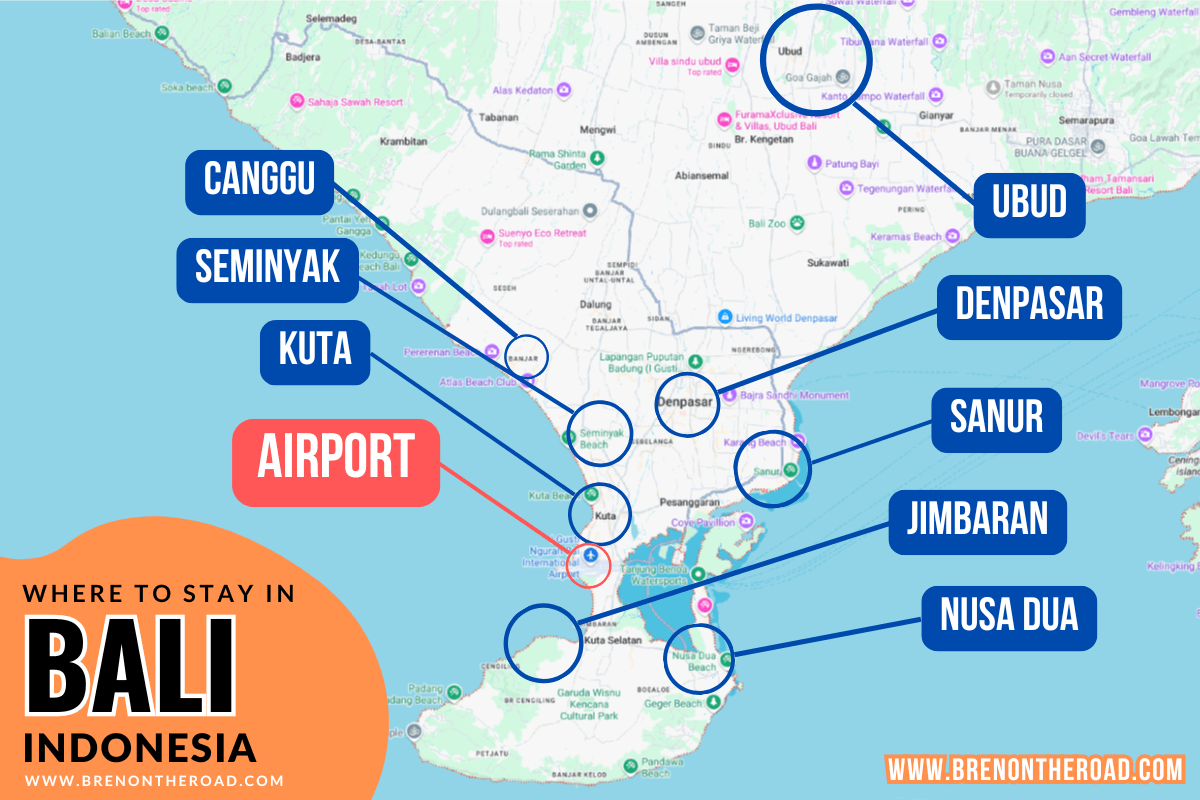
    This guide! Below I’ve mapped out the main areas of the island, and not only are they quite distant from each other they’re all very different as well.

    By the end of this guide you should have a much better idea of what Bali has to offer, and which part of the island is going to give you the Bali experience you’re looking for .Of course, if you have any questions, you can leave them in the comments below. I’ll be here!

    How to get to your destination

    Your first challenge is getting to your accommodation in the first place.

    Most likely you’ll arrive via Denpasar Airport.

    Luckily, buying a tourist sim at the airport is extremely easy (they’ll all be hounding you as soon as you exit baggage collection). Once you have data on your phone you can simply use the Grab app (similar to Uber) to order a ride.

    You can also pre-book your ride with Klook, but in my experience that’s not really necessary.

    Expect to pay between $20-$40 to get from the airport out to the beaches, depending on which one you’re going to.

    In this guide:

    • Map of Bali
    • Kuta – Tourist party area, good for younger people/backpackers
    • Seminyak – A quieter version of Kuta, good for couples
    • Canggu – Up-and-coming backpacker area, gyms, healthy food, good for young people
    • Ubud – More secluded – lots of yoga, vegan food, healthy restaurants, nature, hikes and activities
    • Jimbaran – More up-market and several popular surf beaches
    • Nusa Dua – Bali’s luxury corner
    • Sanur – Smaller beach area – quiet but not much happening, a few nice restaurants/hotels though.
    • Denpasar – Central area with less tourists, more local living

    Map of Bali

    This is a map of the most popular areas to stay in Bali.

    As you can see, all the areas people typically stay are in the south of the island (where the airport is).

    Of course, the north of the island can be visited too, but as a tourist you’re probably coming to Bali for nice restaurants, some shopping, live music on the beach, a comfy hotel, maybe a massage and a few fun activities, and the north isn’t really the place to find all that (it can make a great day trip, though!)

    Click on each coloured tear drop to see the name of a place and a screenshot.

    We’ll go through more details of each of them in the guide below.

    Where To Stay In Bali

    Kuta

    Kuta is probably the most common area for tourists in Bali.

    Bali frequenters tend to hate the place, but I think it’s not a bad spot for first-timers or people who aren’t accustomed to travelling in Asia.

    Things might be a little more expensive here but it’s basically an entire beach town set up for tourists, so everything is accessible and you will never have trouble finding a place to stay or something to eat.

    Do be aware that it’s a favourite for backpackers and younger travellers and a lot of partying goes on here – that means drinking during the daytime and noisy nightclubs after dark.

    However, it’s easy enough to stay away from those areas if you want – though if you’re trying to avoid that kind of thing my recommendation would be to simply stay in another area (discussed below!)

    Points of interest around Kuta:

    • Waterbom Bali – A huge waterpark, great for kids
    • Discovery Mall – Huge mall with all your favourite brands
    • Kuta Beach – most popular beach in Kuta (maybe all of Bali?!)
    • Bombing Memorial – The Ground Zero Memorial in remembrance of the Bali bombings
    • Beachwalk Mall – Big, sprawling mall in Kuta

    You should stay in Kuta if you are:

    • A backpacker looking for hostels/budget accom and trying to save money.
    • Looking for crowds, partying and nightlife.
    • Want to be in the centre of the action.
    • Want to be close to Kuta beach.
    • Shopping!

    Where to stay in Kuta:

    For the backpacker:

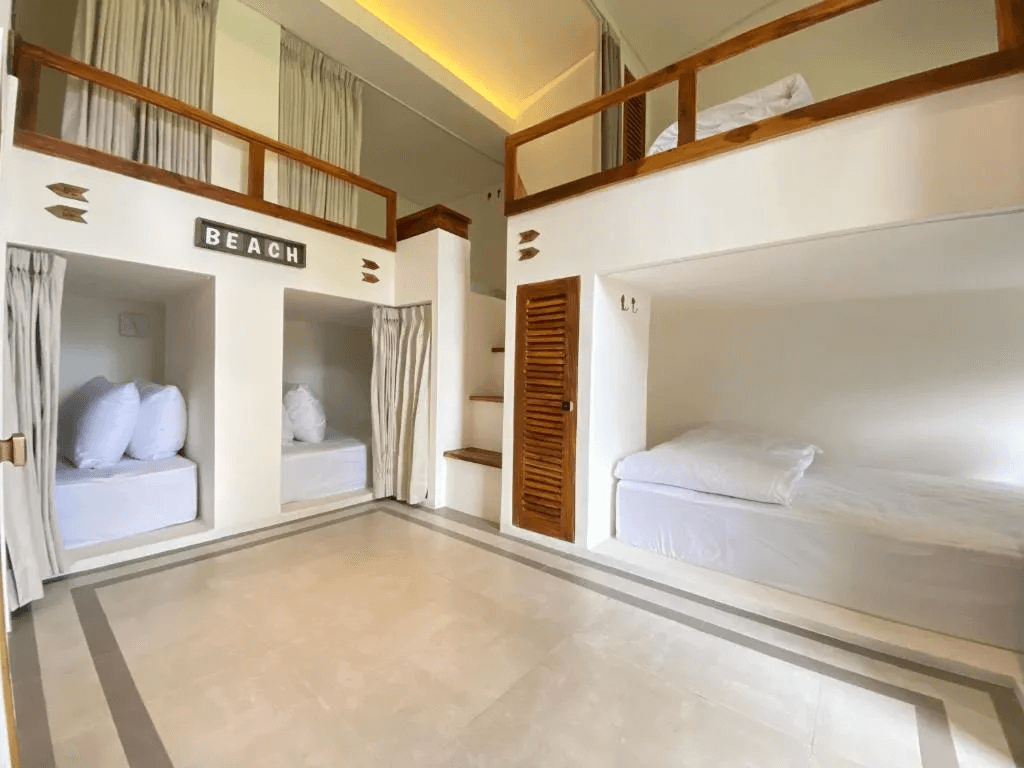
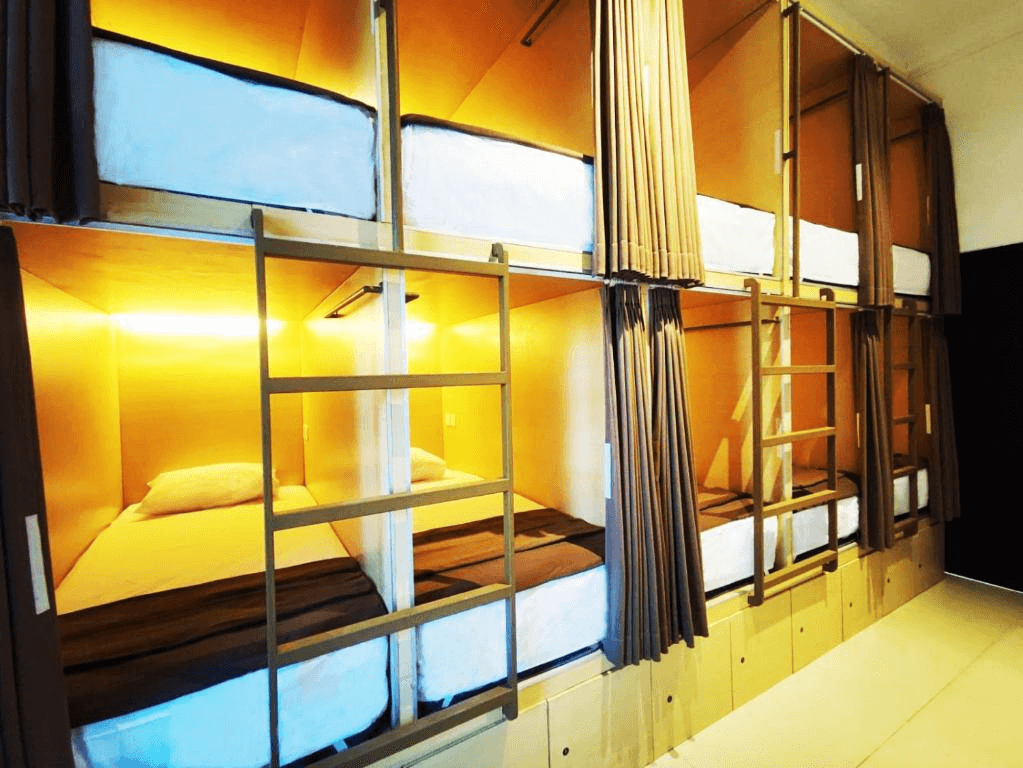
    Stay at the Fora Capsule Hostel.

    It’s about a 10 minute walk from the beach, and the facilities are super modern and clean. Capsule beds means you get to enjoy your privacy while still being able to socialise with other backpackers.

    At ten bucks a night you can’t go wrong. Best rates here.

    For the budget traveller:

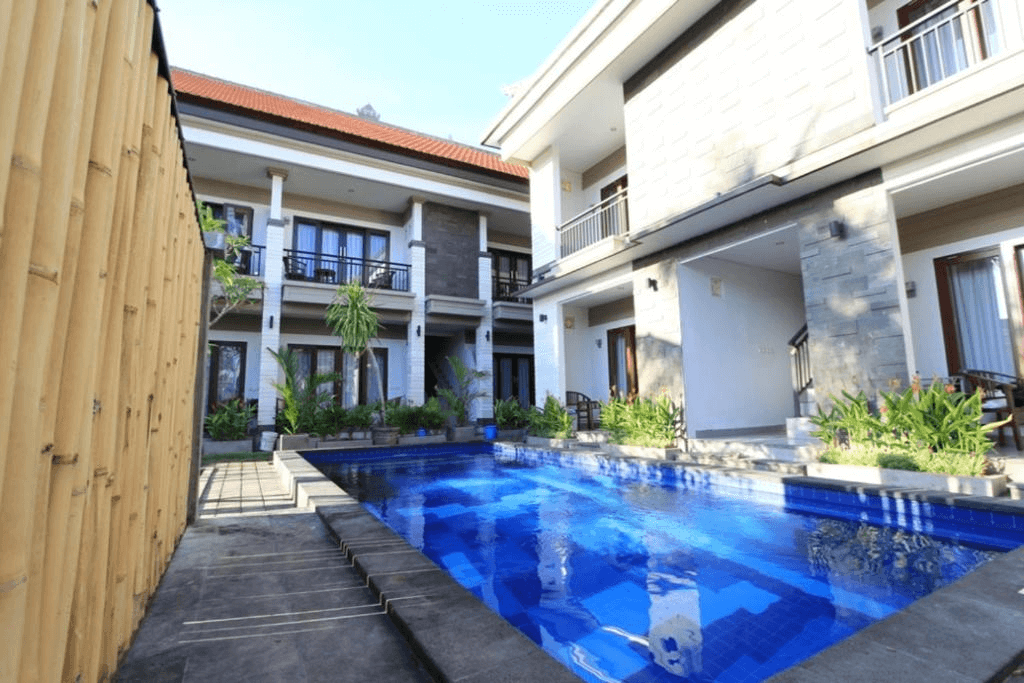
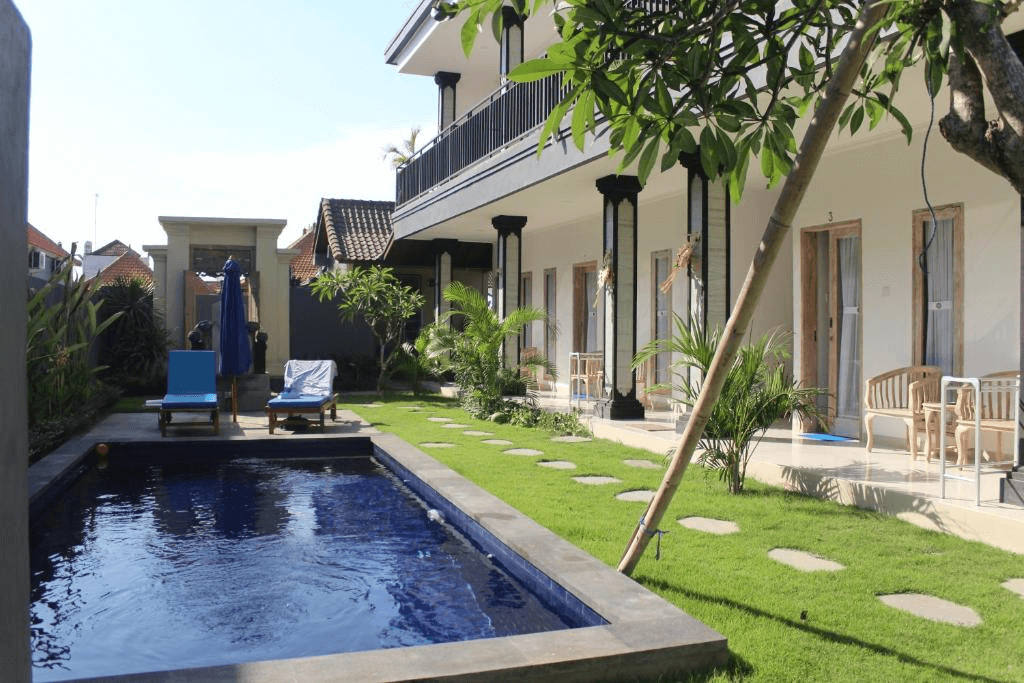
    Stay at De Dukuh Guest House. Private rooms, swimming pool, 7 minute walk to the ocean.

    Enjoy your privacy while still being in the centre of Kuta. Private room shouldn’t run you much more than twenty bucks a night.

    Best rates here.

    For the luxurious type:

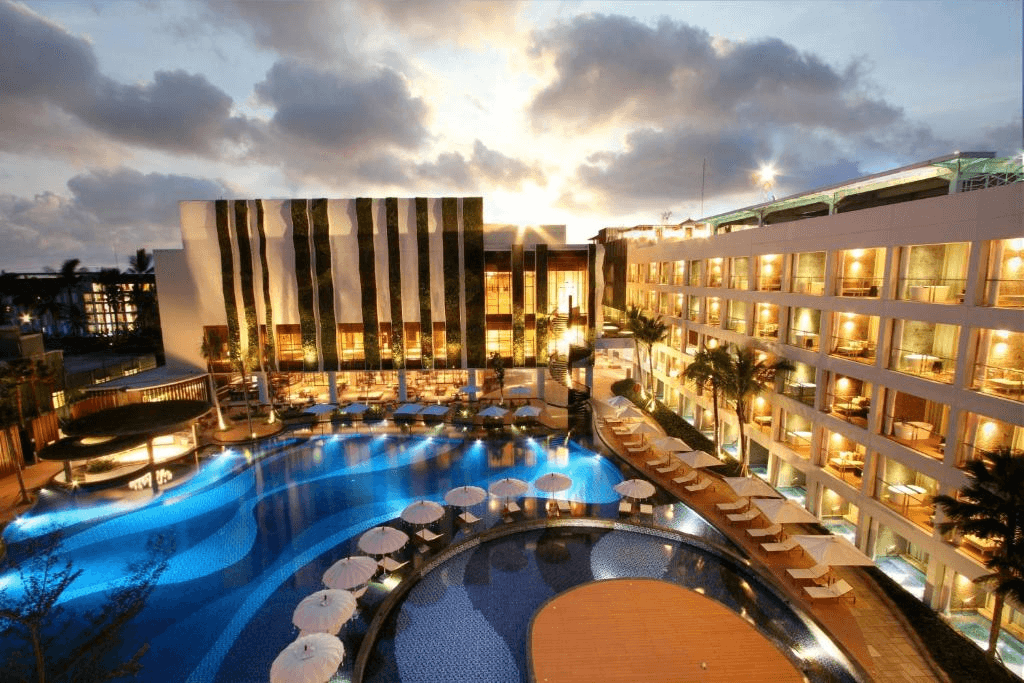
    Stay at The Stones Resort.

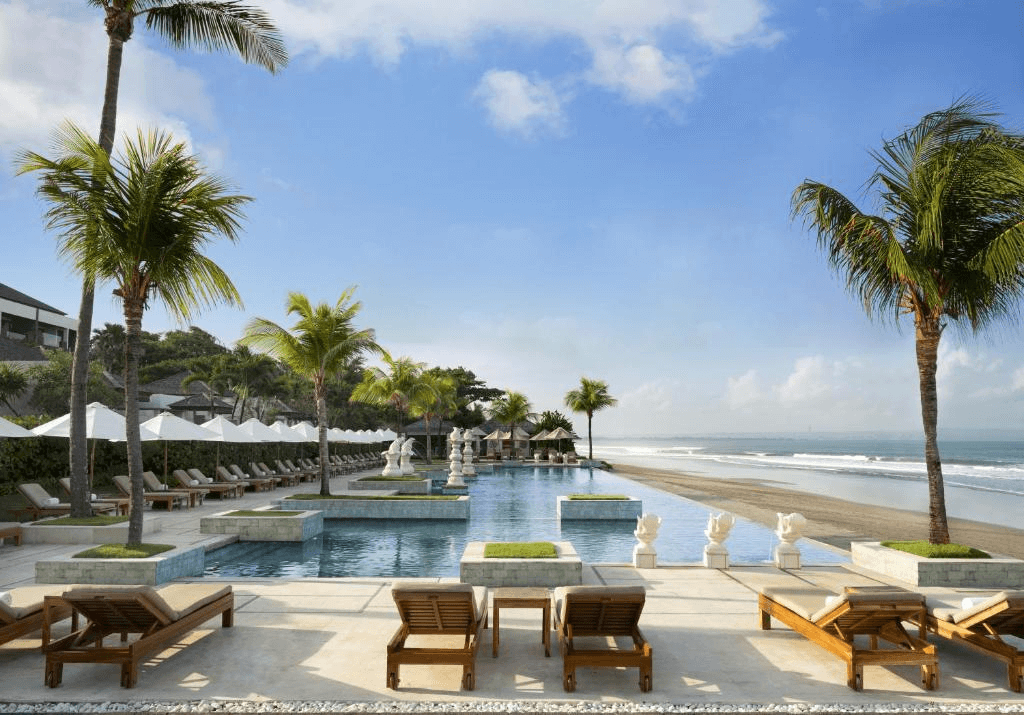
    Beachfront on the wonderful Legian Beach, the resort is fully equipped with an amazing pool, spa, gym, plus a kid’s club for you to leave the little ones while you go for a cocktail.

    Three fantastic restaurants serving everything from local fare to steaks and seafood means you never have to leave!

    Hands down one the best hotels in Kuta.

    Best rates here.


    Seminyak

    I’m a fan of Seminyak.

    You can think of Seminyak as the calmer baby brother of Kuta.

    You can still find clubs, parties and cocktails on the beach here, but the vibe is much more mellow. Think beanbags on the sand, listening to live acoustic music, rather than raving and tequila shots.

    It’s also very tourist-oriented so very suitable for first-timers and inexperienced travellers. A lot of the area around Seminyak is walkable, so it’s quite nice in the evenings to just walk around, maybe buy a few souvenirs and look for somewhere to eat.

    If you love a more laid back beach where you can chill with a drink and some lunch, this is also the spot for you. Seminyak is home to a yuuuuuge stretch of beaches consisting of Petitenget Beach, Kayu Aya Beach, Seminyak Beach, Double Six Beach and Legian Beach. This stretch of white/golden sand beaches is lined with restaurants and beach clubs and is perfect for taking long walks, or having a drink and laying out on the sand for an evening. Yes, good for swimming too!

    There’s also a diverse mix of accommodation so whether you want a 5-star hotel or a hostel dorm, you’ll find it here no problem.

    Points of interest in Seminyak: 

    • Eat Street – Long street with lots of great restaurants! (mostly international food)
    • Seminyak Beach and others – a beautiful stretch of beaches with beautiful sunsets!
    • Shopping – many boutique stores for clothes/souvenirs
    • Nia Cooking School – Popular cooking classes in Bali
    • Seminyak Flea Market
    • Nyaman Gallery – Well-known local art gallery

    You should stay in Seminyak if:

    • You want a beautiful beach!
    • You want a good selection of places to eat and drink, without the big crowds.
    • You want to be near Kuta, but not in the centre of the action.

    Where to stay in Seminyak:

    For the backpacker:

    Stay at White Penny Hostel.

    Modern hostel with both female and mixed dorms, shared kitchen and an on-site restaurant. Fantastic location makes it a 5-minute walk to the beach and surrounded by many great bars and restaurants to choose from.

    Not the cheapest hostel, but great value for money for what you get.

    Best rates here.

    For the budget traveller:

    Stay at De Puspa Residence.

    A local guesthouse offering basic accommodation but they do all the basics right.

    Private rooms with private bathroom, a beautiful garden setting, and well managed. Upgrading to a room with kitchen is possible. Five minutes walk to the beach makes it a perfect choice.

    Best rates here.

    For the luxury seeker:

    Stay at the legendary Seminyak Beach Resort.

    Hands down the best hotel in Seminyak, it features a beautiful infinity pool that opens right onto the sand. The rooms are equipped with huge TVs and beautiful bathrooms with rainshowers, and if you feel like splurging, you can upgrade to a villa with your own hot tub over ocean views.

    A fully equipped spa and fitness centre, not to mention two fantastic restaurants to cater to your holiday cravings.

    Best rates here.


    Canggu

    It’s hard to pinpoint exactly who the target market is for Canggu – people say it’s for backpackers, but I don’t think that’s accurate.

    Here’s what Canggu has to offer:

    • The best gyms on the island
    • Many health-focused restaurants – on menus you’ll find things like “tropical smoothie bowls”, “pumpkin protein brownies” and “liver and marrow patties”
    • A few vegan restaurants
    • A pretty good surf beach
    • Lots of coffee
    • Many shirtless gym bros and girls working out in bikinis

    I love the area, but I think it’s quite pricey and is aimed at a slightly higher budget than what a backpacker can afford. I usually spend about $100 a day in Canggu on food and accom, and that’s when staying in a budget guest house. Not to mention, I joined the most expensive gym of my life while I was there (about $110 USD per week).

    Points of interest in Canggu:

    • Canggu Beach – Great for surfing lessons
    • La Brisa Farmers Market – Every Sunday!
    • The Lawn – Popular beach club in Canggu with huge parties every Friday
    • FINNS – Infamous party spot in Canggu – 11 bars/4 pools, nowhere else like it!
    • Pura Tanah Lot – Famous sea temple in the ocean
    • Bali Body Factory – Amazing gym for those looking to stay fit! Day passes available.
    • LOTS of great restaurants

    You should stay in Canggu if you:

    • Want to party! (but – peace and quiet can also be enjoyed in Canggu)
    • Want surf lessons.
    • Looking to get healthy (many healthy restaurants and gyms)
    • Want a younger crowd.

    Where to stay in Canggu:

    For the backpacker:

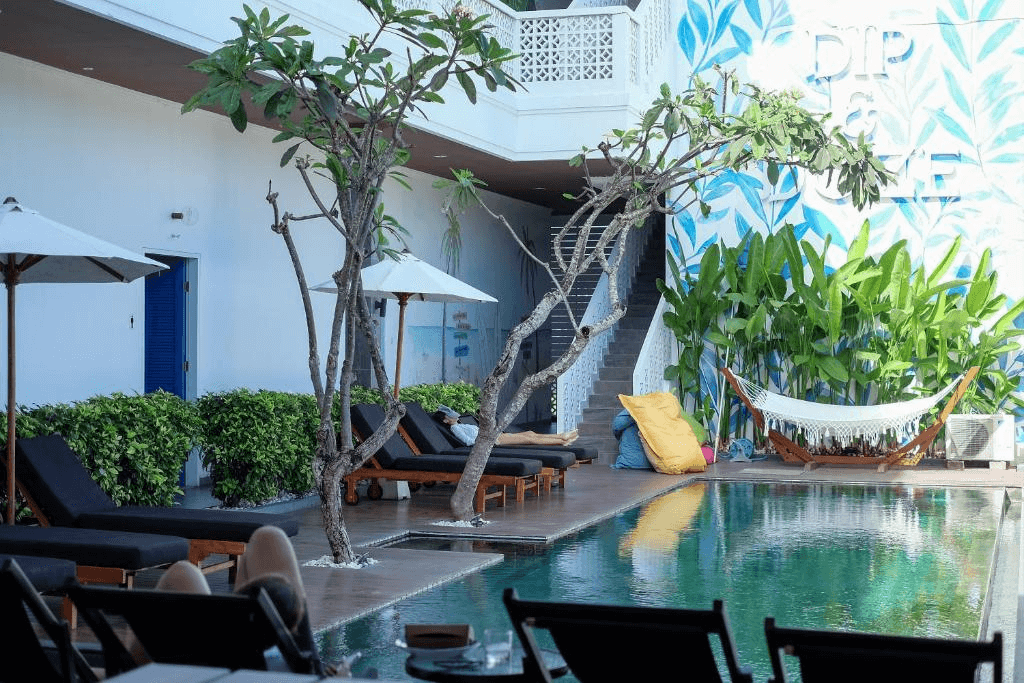
    Stay at Dip & Doze.

    This small hostel does everything right – clean rooms, nightly social activities, many areas to mingle including the pool and lounge, and a short walk to the beach.

    Best rates here.

    For the budget traveller:

    Stay at Eva Guest House!

    This is where I stayed on my first trip to Canggu. It’s a very basic guesthouse but has an excellent location, right across from Bali Body Factory gym and surrounded by great restaurants.

    It’s about a ten minute walk to the beach, and the management is wonderful.

    Nothing flashy but if you’re on a budget, it’s everything you need!

    Best rates here.

    For the luxury seeker:

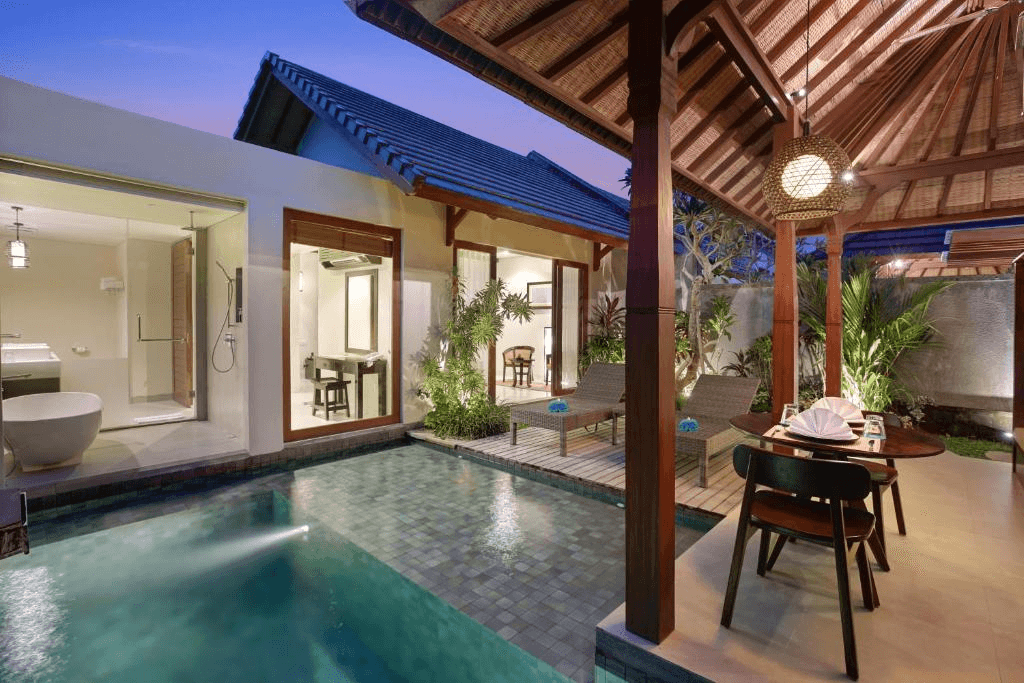
    Easy choice – stay at Theanna Villa and Spa.

    This heartbreakingly beautiful set of villas has everything you could ever need.

    The top-end villas have everything from a private pool to a barbecue area and open seating areas where you can enjoy the Bali heat in luxury.

    An on-site spa means you can be pampered daily, after exploring Canggu on one of their bicycles.

    If you’re not in the mood to pedal, their free shuttle will escort you around the surrounding areas.

    Nobody in Canggu does luxury better.

    Best rates here.


    Ubud

    Ubud is famous for being Bali’s “hipster/yogi/vegan/spiritual” retreat where you can get away from the clubs and the parties and instead meditate yourself into a new you.

    Up in the north of the island, where quiet roads among rice paddies is the norm, here you will find many vegan/whole foods/healthy restaurants, meditation and breathing classes, yoga schools, fasting and cleansing retreats and the like.

    It is quite a distance from the beaches, but don’t worry – you will definitely be enveloped in enough greenery and nature to keep you happy!

    Even if you don’t want to stay here, it’s a fantastic place to head for a day trip and enjoy a bike ride in the paddies or a stroll through Ubud town.

    You should stay in Ubud if you are:

    • Wanting peace and quiet
    • Wanting to get healthy
    • Looking a spiritual/relaxing experience
    • Want to enjoy the “Eat Pray Love” type of Bali trip.

    Points of interest in Ubud:

    • Sacred Monkey Sanctuary – Famous monkey conservation sanctuary
    • Campuhan Ridge Walk – The most popular walk in Ubud
    • Tegenungan Waterfall – Beautiful falls where you can swim a short drive from Ubud
    • Ubud Art Market – One of the best markets in Bali!
    • Tegalalang Rice Terraces – The most famous paddies in Ubud
    • Ubud Water Palace – Hindu water temple in the centre of Ubud
    • Mount Batur – Yes, you can climb it!

    Where to stay in Ubud

    For the backpacker

    Stay at Alam Pracetha Hostel.

    This boutique hostel is stylishly designed and sits within a a local Balinese housing compound. A few activities are put on during the week and free wifi is available throughout.

    If you like small tasteful hostels, this is a great choice for your stay in Ubud.

    Breakfast included!

    Best rates here.

    For the budget traveller:

    Stay at Uma Taman House!

    This is a small guesthouse that is perfectly located within walking distance (about 10 minutes) to Ubud Centre.

    Each room has a private bathroom and a balcony for you to relax outside in the Bali sunshine.

    Should cost you around $15 per night (maybe slightly higher in peak season). For what you get, it’s a bargain.

    Best rates here.

    For the luxury traveller:

    Stay at the The Ridge!

    If you’d like to indulge in daily fresh pastries, sweets, champagne, while relaxing in your own private pool in your private villa overlooking Ubud, this is the spot you’re looking for.

    There is also an on-site spa a wellness centre where you can get a massage or take a yoga class to ensure you stay vibrant and healthy during your stay.

    Whatever you need, the staff will attend to your every need.

    Ubud luxury at its finest.

    Best rates here.


    Jimbaran

    I have not spent much time in Jimbaran personally, but it’s a spot that is popular with surfers due to the many unique surf breaks, and has some beautiful beaches.

    It’s also a popular honeymoon spot, as the area is more targeted towards luxury vacationers rather than backpackers and young people.

    You will find many luxury resorts here, and some of the best beaches on the island.

    It’s not far from Kuta but is significantly less touristy and crowded.

    Points of interest in Jimbaran:

    • Kedonganan Fish Market
    • Jimbaran Beach – One of Bali’s best!
    • Dreamland Beach – Very popular!
    • Padang Padang Beach – Famous surf beach
    • Balangan Beach – Another famous surf beach
    • Pura Ulun Siwi – Black stone temple

    You should stay in Jimbaran if:

    • You’re on a honeymoon and want a bit of liveliness, but nothing too crazy.
    • You love good beach.
    • You looking for upper-end accommodation.

    Where to stay in Jimbaran:

    For the backpacker:

    Personally I don’t think Jimbaran is the greatest spot for a backpacker, but if you’d like to stay around here I’d go with the Bali Bobo Hostel.

    It’s a little far from the beach, but as far as hostels go it does all the basic things well and is decent value for money.

    Best rates here.

    For the budget traveller:

    Stay at Flower Bud!

    This offers great value for money and is a short 5-minute walk to the beach.

    Set in a tropical garden, the rooms are chic and private, plus an outdoor restaurant and pool are available for you to enjoy.

    All for $30 a night – what’s not to love?

    Best rates here.

    For the luxury seeker:

    You can never go wrong with the Four Seasons.

    Set right on the sand of Jimbaran Bay, this beachfront resort has everything you could desire.

    Your own Balinese villa set in a tropical garden, three on-site restaurants to cater to all your cravings, a gym to get your morning workout in, a spa to relax and rejuvenate in the afternoon, and a stroll on the beach outside to close out your evening.

    Bali in luxury never looked better!

    Best rates here.


    Nusa Dua

    Nusa Dua is Bali’s luxury corner, and widely considered the most flashy place on the island.

    Home to countless luxury resorts and villas, and the island’s best golf course, this is the part of Bali designed for people who have money to spend.

    A 7km beach walk that runs along the coastline which is beautiful to stroll along in the evenings.

    The nightlife is very subdued, and most evenings you will simply see couples and families (of all ages) enjoying meals in up-market restaurants and strolling in the sand.

    It is significantly more flash than Jimbaran and if you’re on a honeymoon, this would be my choice.

    You should stay in Nusa Dua if you are:

    • Money is no issue.
    • You want a luxury vacation.
    • You want to be away from parties, noise, and nightclubs.
    • You’re on honeymoon and want to impress.

    Where to stay in Nusa Dua:

    For the budget traveller:

    Nusa Dua isn’t really the place you want to be staying on a budget (try Seminyak, Kuta or Canggu instead).

    However, if you need to stay around here for whatever reason, a good choice is Amaris Hotel.

    It’s a no-frills hotel quite close to the beach that goes for around $25 a night.

    Best rates here.

    A great choice is the Surin Park Apartments. They’re fully serviced, beautiful, a short walk from the beach and very affordable. Check the latest rates here.

    For the luxury seeker:

    Stay at the Royal Santrian.

    Where do I start with this beautiful property!? Located on your own private beach in Nusa Dua, the villas at The Royal Santrian will feel like a home you never want to leave.

    Private pool, outdoor seating area, separate dining and sleeping/living areas, indoor and outdoor showers, bath tub, and once you step inside I’m sure you’ll agree – immaculately furnished and designed.

    An on-site restaurant serves both western and local dishes, and a classy bar to ensure your champagne or cocktail glass is always full.

    In my opinion, the best beachfront offering in Nusa Dua, perfect for a honeymoon or a romantic getaway.

    Best rates here.


    Sanur

    Sanur Beach is around 15 minutes from the centre of Denpasar by taxi and is a much quieter and smaller version of Kuta or Seminyak.

    The crowd here is usually couples or families and you won’t find many nightclubs or bars, but rather lots of good restaurants, bakeries and boutique stores.

    Sanur is not very popular, but personally I enjoy hanging out here and do so quite often when I’m in Bali. There are a few good restaurants on the beach where you can spend the evening enjoying good food and drink, reading a book and digging your feet into the sand. Luxury!

    Points of interest around Sanur:

    • Blanjong Pillar – the oldest historical site in Bali
    • Sanur Beach – has a great promenade running along the coast perfect for walks
    • Sindu Night Market – street food!
    • Massimo Gelato – the line is always huge, but worth it

    You should stay in Sanur if:

    • You want all the tourist comforts without the bustle.
    • You’re a couple wanting a quieter beach.

    Where to stay in Sanur:

    For the backpacker:

    Stay at Suwardika Homestay.

    A basic hostel that has everything you’d expect in a decent backpackers. 10 minute walk from the beach and one of the cheapest in the area. Great value for money.

    Best rates here.

    For the budget traveller:

    Stay at Sekar Waru.

    A very typical Balinese guesthouse with basic rooms with big beds and a small outdoor seating area (you see this a lot in Bali).

    Close to the beach (about ten minutes) and all rooms come with a TV and private bathroom. Free wifi and bike rentals also available.

    Best rates here.

    For the luxury seeker:

    Stay at Andaz Bali!

    Andaz Bali is a luxury concept hotel by Hyatt situated in Sanur.

    Situated on the beachfront, you’ll also have access to a fantastic swimming pool, spa and fitness centre, international restaurant and bike hire.

    Both suites and private villas are available, with garden, pool or ocean views.

    Hands down the best place to stay in Sanur!

    Best rates here.


    Denpasar

    If it’s your first time in Bali – I probably wouldn’t bother with Denpasar.

    It’s a very local area and the things people come to Bali for – beaches, shopping, food and fun – is not really abundant around Denpasar.

    Last time I stayed in Denpasar, I found myself catching a Grab almost every night to Sanur Beach to eat and hang at the beach.

    If you want to be near the airport – choose one of the places in Kuta. It’s only a short drive away.


    There it is! Your ultimate Bali accommodation guide. Hopefully, this has given you all the info you need for your perfect Bali adventure. Any questions, feel free to leave them in the comments below. Otherwise, have fun and travel safely 🙂

    Bren

  • Running The Nairobi City Marathon: A Review

    Running The Nairobi City Marathon: A Review

    When I landed in Nairobi, I had been tentatively training for Ironman 70.3 in Vietnam.

    However, since I’m indecisive and bad at planning, and also was going through some personal shit, I took my sweet time getting organised and missed the deadline to register.

    That opened up my calendar to head to Nairobi, where I was due to catch up with some friends anyway.

    Arriving in Nairobi was like returning to a second home, but had changed a little since I left it five years ago.

    Traffic still bad, air still smoggy, but they did have a brand new highway, and the city seemed “younger” than it was since I last visited.

    Java coffee shops were now full of young Kenyan students, when it once had been mostly Kenyan businessmen.

    The malls and restaurants were full of students with iPhones, when they once had been mostly moms and foreigners.

    Clearly, Nairobi was growing up.

    When I found out the Nairobi City Marathon was in May, it lined up perfectly to be my first race of the season.

    I wasn’t in the best running shape, but the plan was to only run the half-marathon. Running a full marathon is a beast, but I was confident to do the half on short notice.

    However, when I started training, I quickly learned the first problem I would have in Nairobi – the city is not very runnable.

    In contrast to some of the cities in, say, Australia or even Thailand, sidewalks in Nairobi are generally crowded with pedestrians and street stalls, not in great condition, and it’s hard to find a smooth running route that’s not interrupted by traffic jams.

    Not to mention, not all areas of the city are safe.

    Strategically, I booked myself into an apartment right near the Arboretum – a small natural park near the Westlands area.

    The Arboretum turned out to be my nemesis. It is not flat at all – it’s a 1.2km loop that goes up and down rather steeply, and if you want to go running off the main path and into the trails among the trees, the route grows to about 2.4km with even more ups and downs.

    However, since there was nowhere else for me to run that became my training spot.

    Very quickly the boys at the ticketing office got to know me as the “guy who runs forever” and greeted me warmly each day.

    As I landed in Nairobi on 25 April, and race day was 21 May, I didn’t have long to train. It was all systems go.

    I knew I had to knock out some solid 10km runs and at least one 20km run before race day.

    My first run was 10.3km, in the pouring rain, and while I didn’t push the pace, I felt strong.

    With some luck, maybe I could even PB this half marathon.

    Then things changed.

    The book I was reading at the time was “Never Finished” – the second memoir by David Goggins.

    If you know anything about David Goggins, you know he has the ability to make you look in the mirror with brutal honesty.

    I was sitting in a cafe, eating tacos and a mocktail, waiting for a friend, as I read this passage:

    It hit me in the face like a baseball bat.

    Had I gotten I soft? Did I only challenge myself when it fit into my schedule now? A “part time savage”?

    I knew deep down I was running the half-marathon, not because I couldn’t run the full marathon, but because it would hurt too much, and I would need to train more.

    Marathons require you to suffer, and suffering is never fun.

    So why bother?

    The soft life is the good life.

    But I read that passage three times over, and I knew he was speaking directly to me.

    And then:

    I wasn’t eating bacon and eggs though.

    I was eating tacos and mojitos – even worse!

    I remember putting the book down and smiling.

    And then saying … “Gat freaking dangit gaaaaah!”

    The Nairobi City Marathon is a full marathon event – so why was I signing up for the half?

    Be honest.

    Right then I was forced to admit it – I’d gone soft.

    How can I be the Iron Skin guy – the always push yourself to your limits guy – the get yourself out of your comfort zone guy – and then run the half marathon?

    So it was decided. I pulled out my phone and updated my registration to the full.

    Then I went home to train.

    I felt the mindset shift immediately.

    As soon as I got back to my apartment I was full of energy (anxiety) and drew up a training plan.

    It had been three years since I’d run a marathon.

    The full marathon is a different beast – while most runners can probably show up to a half marathon without training and still finish, the full marathon (at least for me) is straight murder if you’re not prepared for it.

    At this point, we were about four weeks out, and the final two weeks is mostly rest and tapering.

    So in the next two weeks I would need some serious mileage. At least one 20km run. At least one 25km run. And a bunch of fast 10km runs. Probably cross-training with some long bike rides in between.

    Thanks, Goggins. For ruining the next four weeks of my vacation!

    About 14 days out, I did my final “long run”.

    It was a 24km killer through the Arboretum, on a Saturday.

    People watched me going round and round – families, church groups, elderly couples on their afternoon stroll, young couples promenading – all staring at this strange Chinese boy running around in circles for three hours looking like he was about to die.

    Every time I passed the ticketing office, the boys grinned and waved at me, shaking their heads.

    Even I wasn’t sure if I’d make it.

    It had been years since I’d run that distance, but knowing that I still had it in me, and my legs weren’t too beat up by the end of it, filled me with confidence.

    Maybe I will survive this one after all, I thought.

    And even if you don’t – who cares? You tried. That’s the whole point.

    And then, a week out from the race, another twist.

    The friend I had been eating tacos with, the one who I started complaining to about all the training I would suddenly need to start doing, texted me one evening.

    It was an article in the Kenyan news.

    Nairobi City Marathon postponed until 10 July.

    Of course, I knew it had to be a prank, or a mistake.

    I checked my email – no news.

    I checked my phone – no news.

    Surely, the race isn’t being postponed one week from race day!

    And even if it were, it would be due to some emergency and surely they would be alerting us in all ways possible … but nothing.

    Then I finally checked their Instagram page, and it was true. They were postponing the race.

    The comments were hilarious. Athletes from all over the world had arranged visas, booked accommodation, many had already landed in the country and were prepping for race day, and with no notice they were cancelling the race, one week out.

    I just wanted to tell them all, I’m sorry you’re surprised but, cancelling such a big event and ruining all your plans with no explanation, no refund, not even an email – this is the most Kenyan thing ever that it’s almost funny.

    So yes, as someone who has spent a bit of time in Kenya, I was surprised, but I wasn’t really surprised.

    I was just happy my friend had texted me, otherwise I wouldn’t have even known, and probably still would have shown up on May 10 (they never did end up sending out any email or phone notification, we were just expected to see it on the news apparently, LOL. I love Kenya).

    So now – what to do?

    I had already done my long training runs, had started tapering, and was mentally in the zone to race.

    Now that the new race date was eight weeks away, I almost could do a full training camp.

    But the thing about the marathon is – it’s a mental exercise as much as a physical one.

    My mind had been primed to race on May 10, I’d already begun the battle in my head.

    Now that I was being forced to slowly build up my training again, try and peak again two weeks before the race, then taper down all over again – I didn’t have it in me. Even Goggins couldn’t change my mind this time.

    I decided I would do this:

    I would stay in shape, and I would still race the full marathon, but I wasn’t going to make it my life for the next eight weeks.

    Instead, I was going to enjoy my Nairobi holiday!

    So for the next eight weeks I logged about 150km on the road, spent several hours down at Psycle Kenya doing spin classes (cool place!), but spent even more time catching up with friends, trying new cafes, playing badminton, reading, eating more tacos, and simply enjoying the soft life I’d sworn off just a few weeks earlier.

    When race day arrived, I wasn’t expecting much from myself, other than to finish and to give it my best.

    To give them some credit, even though pre-race they were easily the worst organisers of any race I’ve ever been in, they had things pretty dialled in on race-day and things went smoothly.

    I showed up at the starting point at Nyayo Stadium about thirty minutes before the gun time, and had no choice but to trust my valuables with the bag-check. If they can’t even run a race properly, can they do they do a bag-check properly? Thankfully – everything was fine there.

    I hadn’t thought too much about my race-day nutrition, but I had a belt full of gels and salts, and hoped it would get me through.

    Somehow, I was late to the start line after waiting for the toilets, and managed to start the race just before they closed the line off.

    The course starts on one of the highway off-ramps, and for almost the entire course you are running on the Expressway.

    This means wide and nicely paved (closed) roads, and every kilometre is clearly marked.

    I knocked out the first 10km comfortably, and the weather wasn’t too hot or windy.

    Since I was one of the last to start, I spent most of the first 10km passing the tail-enders, which is always a confidence boost.

    The aid stations were great and had fresh bottles of water (always easier to drink from than cups) with many volunteers.

    Every aid station I knocked down salt pills with my water, hoping it would keep any cramps at bay.

    From 10km to 20km I probably did my best running of the race.

    At least I thought I was running well, until the half marathon leaders boosted past us and OH MY GOODNESS THESE ARE KENYANS FAST. Like a pack of gazelles galloping past you, leaping with perfect form and long legs with impossibly lean calf muscles and bodies with zero fat on them.

    I hit the 21km mark at exactly two hours, which was at or maybe slightly better than I expected on the training I had done.

    I also felt my legs still had a good amount of gas left in them. My marathon PB is 4:08, and I wasn’t expecting to beat that, but I guessed I might not be far off.

    The good thing about the Nairobi City Marathon is the course is mostly flat. There’s some elevation, but nothing for any extended distance or that will make the race miserable. If you’re looking for a course to PB, this isn’t a bad choice.

    Then at almost 32km exactly, things got heavy.

    I cramped badly in my groin and even after downing every bit of salt and gel I had in my pocket, it didn’t get better.

    My pace dropped instantly from about 5:30/km to 7:30/km and I started death marching.

    Many people I had passed earlier in the race caught up to me and floated past.

    That didn’t matter to me, at least not in the moment.

    All I cared about was getting the f*ck off the course so I could sit down and weep in silence.

    Running with a cramp is doable for 3km, maybe even 5km, but 10km?

    Never been there before. So I guessed we were about to find out.

    Answer: Yes it’s possible, but holy crap is it miserable and you will hate your life.

    For the last two kilometres, we merged with the “fun run” crowd, which I think was the 5km event. Most people weren’t even running, it was just a huge march of people singing, dancing, listening to music, selfies and groups of friends generally having a good time.

    Since I was pretty much at a walking pace, I blended in and got to suffer in disguise while I hobbled to the finish line.

    I finished my final kilometre at a pace of 7:35.

    The finish line is also in Nyayo Stadium, where we began, and it’s a big party.

    I hobbled across, collected my medal and basked in the pain and glory.

    While I sat in the stands afterwards, trying to come back to planet Earth, watching the crowds of people singing and dancing in front of the stage, holding my medal, it took me a moment to realise it, but I was damn proud of myself.

    I thought back to why I started running – that period of my life where I wasn’t sure if I’d make it out alive, where I was forced to be strong, where I found running, and running was all I had.

    Back then a marathon was a distant impossibility, and now I’d just completed my fifth one, far from home, with no coach, no team, no training plan.

    Just my spirit and me, taking on the impossible.

    Even if the race wasn’t perfect, I realised it was never supposed to be.

    Like Goggins said, things like this just remind you who you are, where you came from, and what you’re capable of.

    I was grateful to Goggins for reminding me what got me here, and pushing me to keep striving to be better.

    They say on the marathon course, you will always find a new part of yourself you never knew existed.

    And it was true again. After 42km, I was blessed with a new piece of me I discovered in Nairobi.

    Heading to Nairobi and need a place to stay? Check out my city guide.

  • Two Weeks At Atsumi Healing In Phuket

    Two Weeks At Atsumi Healing In Phuket

    It’s dark when I arrive.

    They’ve sent me a taxi.

    I come out of arrivals and search for my name on a placard.

    Mr Lee. Atsumi Healing.

    That’s the one.

    The drive from the airport isn’t long, but feels long.

    Because I’m exhausted.

    Exhausted.

    The schedule has been non-stop, I’ve never experienced burnout before, but I’m sure this is it.

    And then, like magic, my calendar opened up. No commitments for months.

    So I’m here.

    As we drive through the Phuket night, I gaze out the window, half-dazed.

    It’s been about ten years since I was here, but things look mostly the same.

    Soon enough, after we’ve crossed the island, the taxi slows down, heads through a winding alley, deep in the suburbs of Phuket, until we finally enter the gardens of Atsumi.

    A young woman is there to greet me.

    She has a bright smile. Like most Thais. She shows me to my room.

    It’s a small cottage. Cozy, tidy. Big bathroom. Minimalist.

    Exactly my style.

    She wishes me goodnight, and says we’ll talk more tomorrow.

    There’s a welcome letter.

    They tell me to eat the salad in the fridge – it’s the last meal I’ll be having for a while.

    All I want to do is sleep, but I start picking at the salad, and quickly start wolfing it down.

    Enjoy it, I tell myself.

    Last meal for 14 days.

    Then, I collapse on the bed.

    Welcome to Thailand.

    I wake up the next morning and head to my meeting with my supervisor, Yoki.

    Yoki is a smiley young man with a calm aura. Not tall, not short, just lean, and vibrant.

    He serves me a tray of kombucha and ginger tea.

    I pass, politely.

    I tell him – I’d like to strictly water fast, 14 days.

    He looks surprised, but nods and says okay.

    Then he talks me through the day’s schedule.

    Yoga at 8 a.m.

    Then enema/colonic.

    Beach walk.

    Rest/nap.

    Massage.

    Sauna.

    Meditation.

    Bedtime.

    A typical daily Atsumi schedule:

    Why does this sound so tiring, I laugh.

    But I’m excited, too.

    Long fasts are not new to me.

    I intermittent fast daily, and do extended fasts once or twice a year.

    But 14 days is new.

    The longest fast I’ve done is eleven.

    I figure if I’m going longer, I might need some help.

    That’s why I’m here.

    And in my beaten-up state, now seems like the perfect time.

    I’ve done this enough times to know what to expect – the first two days are easy. Day 3 can be tough, sometimes. Then things really start to get hard around Day 4 or 5. After that, the body goes into super fasting mode, and it’s smooth sailing.

    After my meeting with Yoki, I go to yoga.

    The teacher is a pretty, motherly, young French woman named Ann.

    As Phuket is still quiet from Covid restrictions, Atsumi is empty.

    I’m the only client, and have all the classes, and the entire resort, to myself.

    What a dream.

    The yoga class is done in the sala, a big open-air pagoda looking out over the lake.

    We work up a big sweat and start the day invigorated.

    Will probably be seeing you a lot, I tell her as we finish.

    From yoga, I head straight to the colema room.

    A “colema” is a type of colonic irrigation, like an enema.

    You stick a small tube up your bum and it fills your colon with water, flushing out all the old waste that’s been sitting in there.

    During a fast, it’s particularly effective as you’re not introducing any new food into your system, so you know everything that comes out has been up there a while.

    The lady running the colema room is a darling grandmother who doesn’t speak much English, but over the next two weeks will welcome me with a warm smile each morning like I’m her own grandson.

    Yoki introduces me to the colema system and gives me the play-by-play of how to use it.

    Then I go to work.

    It’s a solid sixty minutes of water in, water out, until I feel completely rinsed.

    It’s not comfortable, but the feeling of rejuvenation afterwards is like a high.

    Once I’ve had a chance to lie down and recover, Yoki drives me down to the beach.

    Nai Harn Beach is a nearby small, busy beach on the southern end of Phuket.

    It’s packed with Russian tourists and expats.

    But, still great for a walk and some alone time.

    I spend forty minutes walking up and down, feet in the water, taking in the sunshine.

    Once we get back, I collapse on the bed and take a few hours for myself.

    Who knew relaxing could be such hard work?

    3 p.m. rolls around. Massage time!

    The masseuse’s name is Daeng. She speaks almost no English, but that’s not necessary.

    I lounge in one of the small open-air huts around the lake, while she gives me a foot massage and does some reflexology.

    It’s the best part of my day.

    As the sun starts to set, Yoki prepares the sauna.

    It’s filled with herbs like lemongrass and ginger, and is like a blast of steam and aromas when I step inside.

    I do fifteen minutes, then come out and drink some lemongrass water, then go in for another round.

    Saunas are one of my favourite things during a fast, feeling the body cleansing through the pores. Therapeutic, and magical.

    Night falls, but the day is not over.

    We have one more yoga session to end the day.

    Tonight’s teacher is Kate, a young Russian woman, warm and chatty. I like her.

    She takes me through a tough session with many holds and long, drawn-out stretches.

    It’s tough work after a day without food, but I know it will definitely make me sleep well once I finally hit the pillow.

    As the week goes on, the days slowly blur together, as they usually do during a fast.

    The yoga sessions get easier. Sometimes, we do meditation sessions instead, or sound therapy.

    The colema sessions get more intense.

    I start passing worms, many of them (I have pics, but they’re too gross to post).

    I show them to Yoki, and he nods expectedly.

    Very normal, he says. Tapeworm. Everybody has.

    Each day I think I’ve passed all the worms I can, but each day another one comes out, bigger than the last.

    Every morning I start to look forward to it, seeing what else I can evict from my body and build back stronger.

    Day 4 and 5 are tough.

    I find myself daydreaming of food, torturing myself by Googling all the best restaurants in Phuket that I’ll be able to try after this is over.

    A battle wages in my mind every hour. I want pizza. I want fries. I want chicken.

    I tell Yoki, and he laughs.

    But on Day 6 things start to calm down.

    I feel calmer. I take comfort in knowing I’ve been here before, and knowing it gets easier from here.

    My system is completely empty. No food for 6 days, and my body has been flushed daily, until the water coming out is almost clear.

    I start working again. My mind is clear, and for a few hours per day I can get on the laptop and be productive, instead of daydreaming in bed.

    I tell Yoki to organise a Thai boxing class for me, instead of yoga.

    It feels good, to hit the pads, release some endorphins, pump some blood through the muscles.

    Day 8 arrives. I’m at peace. Day 9. Peace. I know I can keep going, as long as I need.

    Finally, on Day 11, Yoki sits down with me and says, maybe I should break fast today.

    I’ve lost almost six kilos, and 11 days of colemas means there is probably not much more benefit to keep going.

    My daily weigh in:

    I had been aiming for 14 days, but I agree with him.

    Time to start rebuilding.

    He says the girls will bring some fruit to my room for my first meal.

    When I get back, it’s already sitting on my doorstep.

    I can’t help but smile and feel like a kid of Christmas morning.

    I stand in the sunshine and savour every bite.

    A few hours later, they bring me a salad and a coconut.

    I know I’m supposed to eat it slowly, but I wolf it down.

    From Day 11 to 14, I start rebuilding my body, from a clean foundation, and a renewed spirit.

    Atsumi also operates a raw food cafe in Phuket, so the meals are delivered fresh daily.

    Raw lasagne.

    Raw burger.

    Every day they arrange something different and interesting.

    I feel like I am floating in heaven.

    When my two weeks is finally up, I say my goodbyes to all the staff – the colema lady, the massage lady, all the assistants, Yoki.

    In a short time, they have become like a small family to me.

    I tell them one day I will return again, when my body asks me to.

    I walk out the gates rejuvenated, reset and refreshed, ready to take on the world again.

    And … eat my way through every restaurant in Phuket!

    Note: This post is not sponsored and I paid for my stay in full. You can learn more about Atsumi at their website.

    Looking for a place to stay in Phuket? Check out my comprehensive guide to the island here!