Tag: sahara tour reviews

  • A Glimpse At Morocco

    A Glimpse At Morocco

    I’d never visited the north of Africa. Turkey’s maybe the closest I’ve come to a country like Morocco, and I didn’t have much fun there.

    But of course, things are different on the mother continent.

    After a quick two week whiz around Morocco, I don’t really have too much to tell you – it was two days here, three days there, and before I knew it I was back on a boat to Spain. But I can tell you – I like it! Here’s a few scattered thoughts from my short time in the country.

    Food


    A photo posted by Bren (@brenontheroad) on

    Every major city in the world has a Moroccan restaurant (or fifty). Gotta be a reason for it.

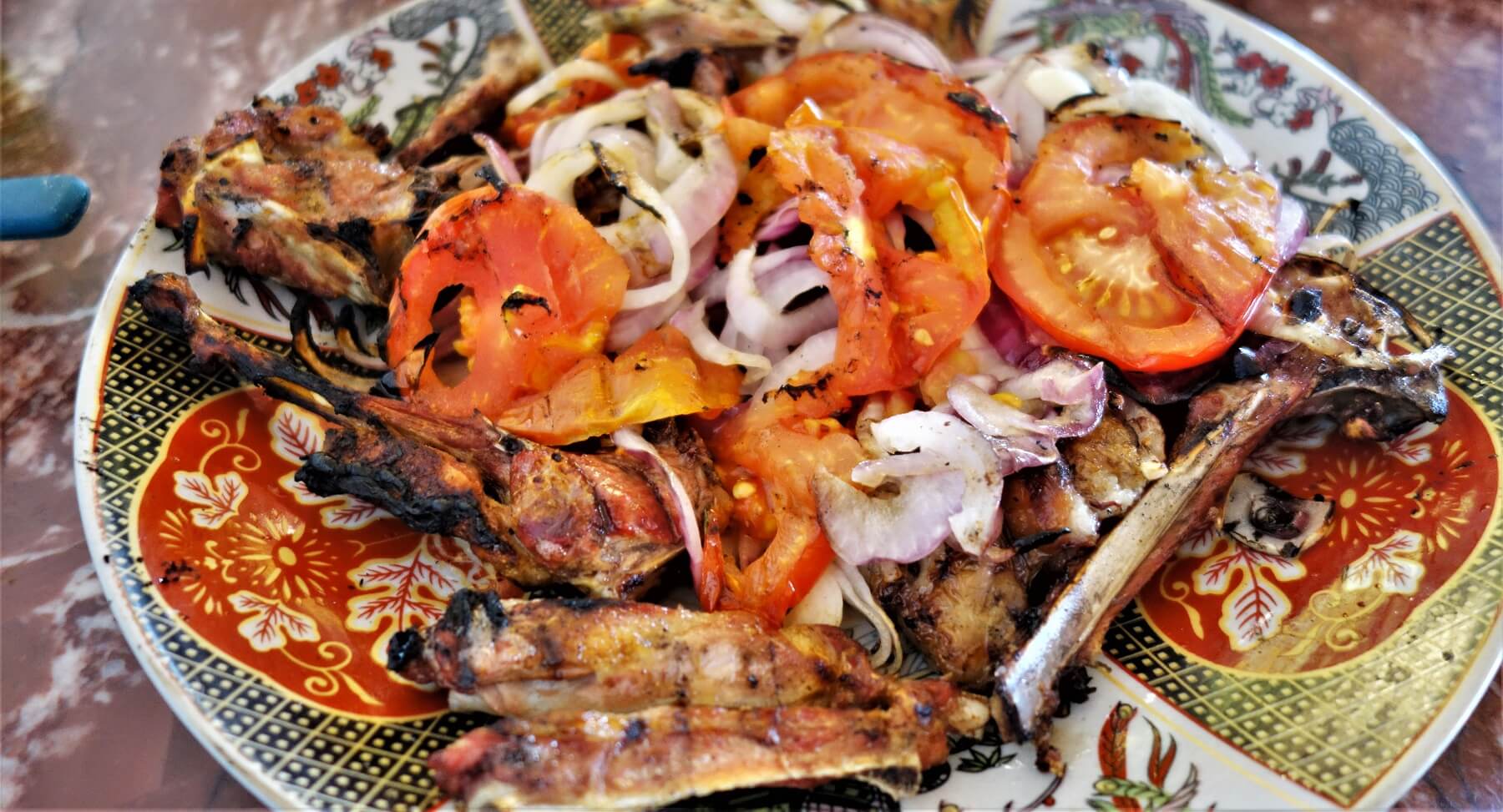
    The food in Morocco is hearty. Slow cooked meat, stews, soup, couscous, bread. I like my food cheap, filling and simple – no turning my carrots into flowers nonsense. The tanjia above is just meat (all kinds) slow cooked with spices in a big clay pot. It’s perfect.


    A photo posted by Bren (@brenontheroad) on

    The tagine is similar, but cooked in a shallower dish and usually with vegetables. You can get them with chicken, beef, lamb, maybe even fish? You’ll find them for just a few dollars in most local eateries, and they’re healthy and filling which is the perfect combo for us budget travellers.


    You want the good shit you gotta go to the source. #couscous #Morocco

    A photo posted by Bren (@brenontheroad) on

    They have a hearty harira soup, the famed couscous, shish kebabs, there’s even camel on the menu. Out near the coast, I ate one of the best fresh lobsters I’ve had in my life and it didn’t cost a fortune. The food isn’t Southeast Asia cheap, but it’s affordable and delicious. I ate well in Morocco.

    Tip: Stay out of the tourist restaurants. The price difference is ridiculous and the food is more or less the same (or worse!). You will just be paying for decor and nice tablecloths. Look for places where locals are eating and drinking. A tagine will only cost you 35-45 dirham there, versus 100+ in the more swanky joints. You can also buy a lot of fresh fruit and veges in the markets for just a few dollars. You can eat very well on a budget here!

    Diverse


    A photo posted by Bren (@brenontheroad) on

    The tourist strongholds of Marrakesh and the Sahara are great, but there’s a lot more to Morocco than that. You can head up into the mountains, out to the beaches, Casablanca, Fez, the blue city of Chefchaouen, the movie city of Ouarzazate, all the medinas and kasbahs and desert towns – it’s a pretty diverse country. In the space of a day I went from freezing my nipples off on top of the mountains to sweating like mad in the bustling city. I didn’t expect there would be so much to see there, and that the cities would be as developed as they are. It’ll surprise you!

    Tip: It’s a good idea to take tours here (I mean day tours, not big tour bus tours) – they aren’t that expensive, and you shouldn’t need to pre-book online. I’m certain you’ll get a better price on the ground. I doubt you’ll need to worry about things booking out – if you’re willing to pay for a tour, someone will be willing to take you. Get a recommendation from your riad (guesthouse), or if you’re game you can bargain with the many operators around the city.

    If you’re after a good rundown of things to do in the country, fellow blogger Andrew put together a great list during his Morocco road trip.

    A lot of history


    A photo posted by Bren (@brenontheroad) on

    Like most other dummies who visit Morocco, I thought it was populated by Arabs. Several people in Morocco were quick to point out they were not Arab, and that Morocco is not an Arab country. Our tour guide told us the Arabs came to introduce Islam (successfully), and introduced the Arabic language in the process (I don’t know the whole story, sorry). But the indigenous people of Morocco and North Africa are actually the Berbers. I suppose the Berbers had a kinder fate than most indigenous peoples, as the majority of the population is still Berber today. As you venture out of the cities, you’ll find many purely Berber small towns and cities where Berber is spoken rather than Arabic.

    I noticed many of them are also very outspoken about their history books. In school they are only taught history that dates after the French arrived, despite there being a long Berber history to learn about, and a colourful Moroccan past as a bridge between Europe and Africa. I instantly related to this, because in New Zealand it is exactly the same; we are only taught history from the date the English arrived; and any Maori history before that is never talked about. At school I was never taught about the Maori kings, but I was taught a lot about the English ones and how many wives they had. Parallels like this always fascinate me, because it shows how deeply history, no matter how long ago, still affects us today all over the world. If I do get back to Morocco, exploring more of this history would be the main reason that gets me there.

    Tip: Make an effort to get out of the cities and into these smaller Berber towns. I didn’t get much time to explore them but I’m sure there are many great stories to be found there. Just from a quick walk-around I could tell they felt very different. You’ll pass through a lot of them anyway if you’re heading towards the Sahara.

    Safe!

    I was trying to tip toe on rocks over a river, and of course I slipped, and my shoes got soaked. Then we stopped for lunch, and I asked our driver if I could leave my shoes on top of the car to dry. Since the car was parked by the road, I had to ask:

    “Will anyone take them?”

    And he looked at me like I was birdbrained.

    “Of course no one will take them.”

    So we went and had lunch. And no one took them.

    In Fez, we were warned to be a little more cautious at night, but the daytime was as safe as any city I’ve been to.

    Marrakesh was even safer. In fact, we were told the king had made it a priority to keep visitors safe, and any crime towards tourists results in a few years in prison. Even at 2 in the morning, you could walk freely through the city and police were everywhere. I’d be very surprised if any traveller with elementary-level common sense has problems in Marrakesh – it’s probably one of the safest major cities I’ve ever been to.

    Throughout the country (especially more touristy places) you’ll run into a number of petty scammers and street hustlers, but honestly it’s pretty tame by Africa standards.

    Fellow blogger Kate even road tripped herself all the way from Marrakesh to Fez! 

    The desert


    A photo posted by Bren (@brenontheroad) on


    Even though the Sahara is swamped every year with tourists doing the obligatory camel tour into the desert, it’s still pretty cool.

    It’s also cool to do a tour of more of the desert – people actually live there, there are villages and hotels and families out there. As you drive through you’ll see their intricate water systems, people riding quad bikes, maybe a little village built around an oasis. It’s pretty interesting.

    The only thing about the desert is it’s difficult to indie travel it – the towns and villages would be possible, but heading out any deeper would not. You’ll need to take a tour. The good news is that won’t be hard to find – most people come to Morocco for the Sahara, so whatever kind of tour you want should be available somewhere.

    Tip: Luckily I was there in early June, which is before the tourism onslaught. Our camel whisperers told us that come August, there’s around forty people doing the camp each night (we only had seven). Keep that in mind if you plan on going.

    Hot!


    Children of the desert. They must be tough.

    A photo posted by Bren (@brenontheroad) on

    It’s warm in the desert. And in the cities. It’s quite a dry heat, so more bearable than the likes of Southeast Asia or the tropics, but still pretty heavy. November to February should be a lot cooler; otherwise prepare to get your sweat on.

    Tip: It’s getting more liberal, especially in Marrakesh, but even in the blistering heat there will be women walking around fully wrapped from head to toe. I would suggest being respectful as possible and covering up when you can, especially the ladies. I did wear singlets a couple of times in Marrakesh, but other than that I tried to at least wear a t-shirt.

    You’ll get sold a lot of stuff


    A photo posted by Bren (@brenontheroad) on


    You’re going to get sold the same stuff throughout the country. First, the leather. In Fez, they tell you the best leather in the world is from Fez. Then in Marrakesh, they’ll say the best leather in the world is from Marrakesh. I didn’t go to Casablanca, but I’m pretty sure they have the best leather in the world too.

    Then you’ll get sold the Argan oil. The Argan tree is endemic to the south of Morocco, and you’ll hear the same story about this tree many times (they tried to plant it in Spain, it didn’t grow, they tried to plant it in the lab, it wouldn’t grow, in the north of Morocco, it didn’t grow. It only grows in a special place in Morocco). Then you’ll go into the store and see all the ladies sitting there breaking open the Argan fruit and grinding the nuts into oil. Then they’ll tell you Argan oil cures everything and get offered a few bottles for sale.

    Then you’ll get sold some hand-woven silk stuff, maybe some dates, a Moroccan rug, some spices, a photo with a snake around your neck. There is a lot of stuff that is uniquely Moroccan, so naturally there’s a big money grab selling this stuff to tourists. Take your time if you want to buy it. There’s no rush. You’re going to see it again the next day, I promise.

    Tip: Like anywhere in Africa, you have to haggle! Our riad owner told us we shouldn’t pay more than 60-100 dirham (5-9 Euro) for a good leather belt. But in the shops we were getting quoted 20-40 Euro. I don’t really buy things when I travel so I didn’t get in on it, but I would suggest haggling super hard, China/India style.


    A photo posted by Bren (@brenontheroad) on

    Affordable

    It’s actually a great place for budget travellers. Even in the cities, you can get a decent tagine for 35-45 dirham ($3.50-4.50), a taxi for 15 dirham ($1.50) and a dorm bed for about 70 dirham ($7USD). The country gets a lot of visitors so the tourist infrastructure is good, especially in Marrakesh. Even in the smaller cities, there are a lot of independent riads (guesthouses) that give you good accommodation options. This actually makes it cheaper than a lot of sub-Saharan Africa, even though it’s more developed. If you’re backpacking, 200-250 dirham ($20-$25) per day should be more than doable, excluding any tours you want to take.

    If you’ve never been to Africa, it might be a good place to get your first taste of the continent!
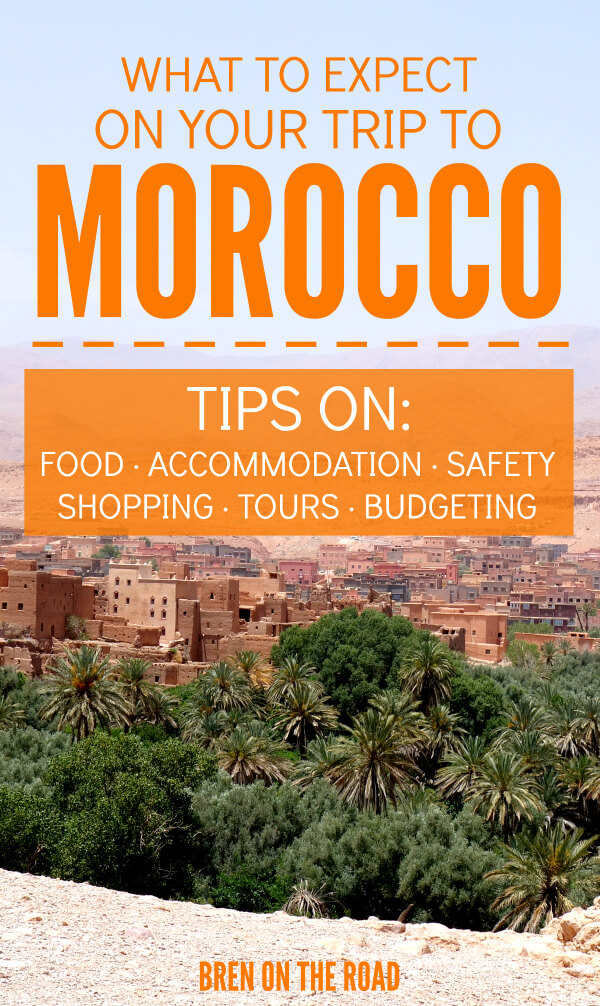
    Traveling to Morocco? Get expert tips on food, shopping, accommodation, budgeting, safety, and other things to expect. The north of Africa is amazing. Enjoy your trip!

  • Under Stars In The Sahara

    Under Stars In The Sahara

    This camel has big mouth.

    Seriously, you could fit a basketball inside.

    I jam my camera in his face and snap a photo. I’m sure he doesn’t mind. Or maybe he does, but after a million stupid gringos doing the same thing, he’s probably over it.

    Our Berber guides tell us, one by one, to jump on our camel’s backs. They’re kneeling in the sand, makeshift blanket saddles strewn across their backs. Like kids on a school trip, we climb on, a little too excited.

    As I steady myself, the guide gives the camel a little nudge and a pssst, and it climbs up onto its feet. It feels higher than I expected.

    We start to ride. I notice the number tag punched into my camel’s ear. It’s been bolted in, with a nail the size of a cigarette. I feel sorry for him. I feel doubly sorry that he has to cart me out here on such a nice afternoon when he could be relaxing with his bros taking sand baths and comparing the calluses on their knees. Then I see the reigns wrapped around his neck. I trace them with my eyes, up around his head and through his nose. The rope is actually threaded through his nostril, so that he has no choice but to follow the chain. And the rope is then tied to ass of the camel in front. I feel triply sorry for him. Not only is he forced to stare at that camel ass in front his entire life; he’s chained to it. Even if he wants to look away when it poops, he can’t. And they poop a lot. If that’s not bad enough, his honourable death will be getting served as a camel burger in a tourist cafe as soon as his legs give out.

    Next time, I think I’ll come out by quad bike.

    The ride out is about an hour. Riding uphill is easy, but riding downhill gives the core a bit of a workout. I see one girl up front struggling, holding on for dear life. I feel bad for laughing. She just looks so funny though.

    The guide up front leads the camel train on foot. He walks in bare feet, standing on camel pee and poop with every third step. He doesn’t care. He embraces it. He’s a man of the desert.

    Of course, there are no roads out here. It’s just orange sand in every direction. But these guys know the way somehow.

    A photo posted by Bren (@brenontheroad) on

    The sun is almost setting when we get to the camp. It’s a small site, the size of half a tennis court. The rooms are tented with heavy woollen blankets to withstand the wind, but they also keep the heat in. I go into my tent for thirty seconds, then come straight back out.

    Hot.

    Way too hot.

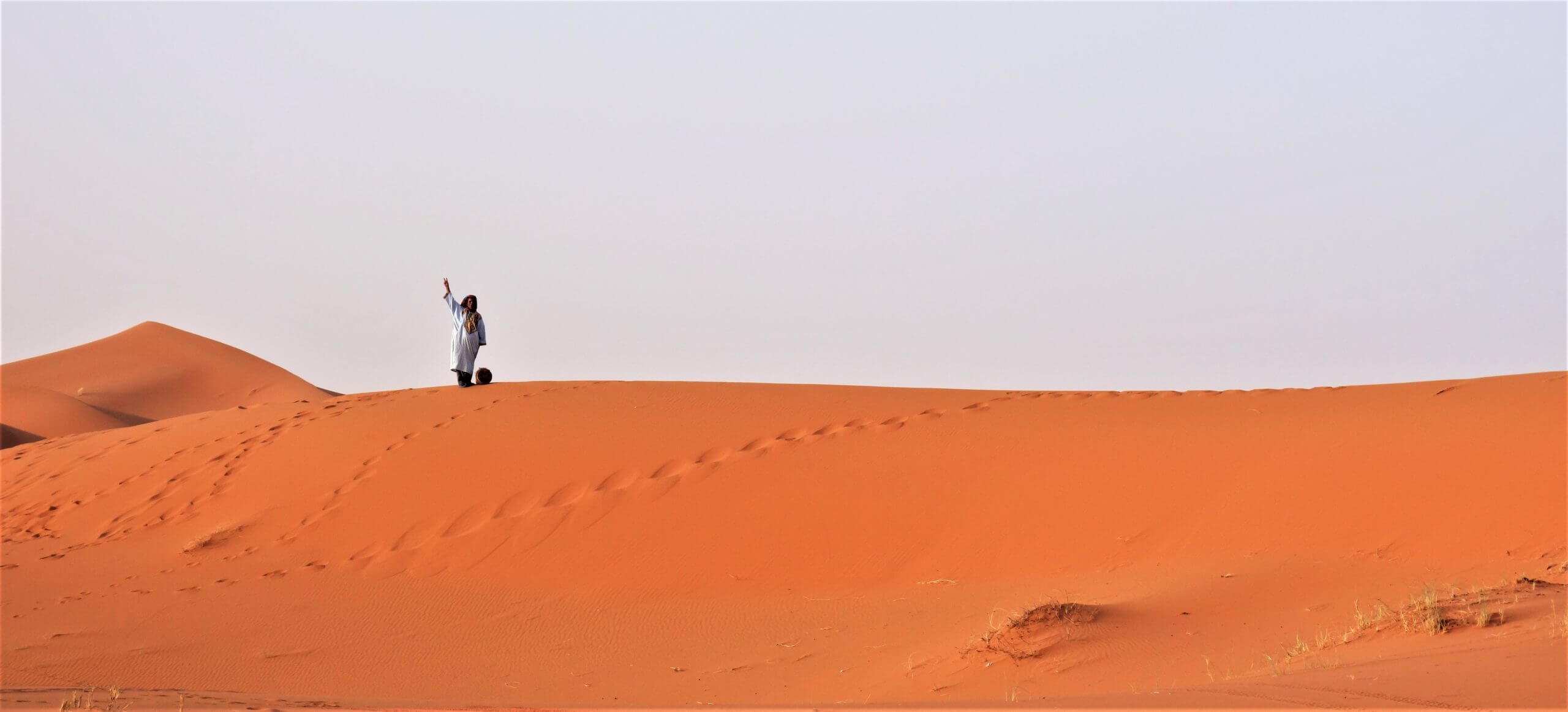
    While the guides cook dinner we go wandering. It’s vast, and barren. The desert is big and empty – who knew? We climb to the top of the closest dune to catch the sunset and take selfies. Out here, all you can see is orange. A big sea of hilly, wavy, endless orange. I just sit and stare at it, I don’t even know what to think. What is this place? Why is it here? Mind boggling, and scary too. We’ve only come an hour from civilisation, but if everyone disappeared now I’d have no idea how to get back. I’d be dead in three days.

    A photo posted by Bren (@brenontheroad) on

    We climb back down to camp as it gets dark. The camp is set up like a courtyard, with tents in a square and a communal eating and sitting area in the middle. I lay on one of the mats and stare at the sky. Stars are slowly coming out, but I can barely see them among the camp lights.

    Dinner is soup and tagine. It’s like a stew, with meat and vegetables, and we eat by candle light. It’s all very nice. But I want to go and feed my camel.

    One by one, people drop off. A couple go to bed. A couple more. Before long, I’m the only one left and they turn out the lights.

    It’s completely dark. The weather has cooled, and the wind is starting to pinch. But it’s okay. I lie on the mat, staring up at the sky. It’s so dark, and there are so many stars.

    So many stars.

    I put in my earphones and put my phone on shuffle. Now it’s like a soundtrack. If this were a movie, this would be the scene where the main character has his moment. Staring at the open sky in the middle of nowhere and it all becomes clear. He knows what he’s supposed to do.

    Is that what’s going to happen? Maybe. I feel energy. In fact, I have a lot of moments like this. Always when I’m alone, silent, somewhere special. It makes me think about things.

    I feel a sudden surge of appreciation. Gratitude completely engulfs me. I thank the universe for letting me be here. I thank it for keeping my family safe and healthy and happy. I thank it for the journey and this crazy moment happening right now. Stars. The middle of the Sahara desert. Silence. I take a deep breath, or two or three. I don’t know what I did to be so blessed. Nothing, probably. Just one of the lucky ones. Thank you for giving me a good life.

    I get lost in the stars. You can’t count them, it’s impossible. They’re never ending. They’re so bright, brighter than I’m used to in New Zealand. Counting Stars by One Republic comes on. Poetic, almost. My body is filled with fire. I don’t know why.

    After ten minutes, whooosh. Shooting star. Can’t even remember what that means. Make a wish? Buy a lotto ticket? I don’t do anything. I just say thank you for the shooting star.

    Everyone loves looking at stars. Why? They don’t do anything cool, they don’t even move. They just twinkle. But we love it. Maybe it’s what they represent – the unknown. We’ll never touch or smell or feel them. They just tell us how insignificant we are. Look at all these galaxies. Aliens? Are there aliens? There must be. Maybe they’re on that star over there. Or that one. I wonder if they’ll arrive soon and kill us all. What are these stars? Are they planets? Asteroids, maybe? Is one of these meteors going to come blow us up soon? Probably. And none of the aliens will care. Probably a meteor killed a whole bunch of aliens already today, and we didn’t care. Damn I’m getting kinda cold.

    Whooosh. Another one.

    I don’t know how long has gone by. Maybe an hour. Maybe two. I grab my phone to check, then quickly change my mind and put it down. Because what’s the point? The time would tell me nothing. Time is irrelevant right now.

    I think about the journey that brought me here. All the small conversations, and the big ones. All the small friendships, and the big ones. It’s all led to here. But why? Where does it end? What’s it all for? One day you’ll be gone, and it’ll be like it never happened. You gotta pay it forward – leave something behind, make it count for something. It was so clear for a moment. You gotta write your book, Brendan. Write the damn book.

    Whoooosh. That’s three.

    The stars do it to you. They’re an incubator for this type of melodramatic navel gazing. It’s these solitary moments that send us to look deep inside ourselves. We become conscious of things we secretly knew all along. Even if just for a moment.

    The cold wakes me up. I look at my phone – 3am. Not yet morning. I get up to pee. As soon as I walk outside the camp, I get the spooks. There is a port-a-loo like toilet about 25 metres away, but I just walk halfway and pee in the sand, like the camels. I don’t want to get lost. This is the middle of the Sahara in the middle of the night. The sand looks grey now, and you can hear it shuffle with the wind. It’s lit by moonlight, but cold and ashen, as far as the eye sees. I’ve never seen a place like this before. It looks so mysterious. It even feels mysterious. Like I could see ghosts and shadow warriors and I wouldn’t even be surprised. I’d just think, yep, I thought I might see some shit like that out here. I hurry back to camp.

    I tell myself I’ll stargaze just a bit longer. Just until the next shooting star. I lie back down on the mat. My mind is empty now. I just stare blankly, watching the whole sky twinkle before me, waiting for it. I wonder if it’ll ever come. But it doesn’t take long. After just a few minutes, whoooosh.

    I go to bed happy.

    I’m the last to wake up. Everyone’s already taken their photos of the sunrise and is now chilling on the dunes or packing up to leave. I get dressed and go visit my camel.

    A photo posted by Bren (@brenontheroad) on

    Hey bro, hope you slept well. Sorry but you gotta take me back, I don’t know the way.

    I stroke his head and he flinches.

    Sorry.

    I wouldn’t want to be touched on the head by me either.

    The ride back to civilisation is a sobering wake-up. It’s not every day you ride a camel in the desert before breakfast. The girl in front is still on the brink of falling off, and I still find it funny. But she makes it all the way.

    The ride feels shorter today. As we arrive back, the guide gives my camel a nudge and a pssst, and he drops to his knees in a clunky one-two. I hop off and pat him on the back, and promise to never eat a camel burger ever again. I take one last photo, thank him, and say goodbye.

    Often, we go to a place and don’t learn the things we expect to learn, or feel the things we expect to feel. But the road is fickle. There is no rule book out here. You take whatever it gives you, and embrace the journey as it happens. One day you’ll look back and think, yeah, I remember that conversation, or I remember thinking of that idea, maybe in the ocean, some town by the lake, or under stars in the Sahara. Those moments change us, whether we want them to or not. So collect them, and remember them. Because that collection of moments is called life. Happening right before your eyes.

    To the many moments and memories,

    Bren


    Magical story by Bren On The Road about star gazing in the Sahara.