Tag: how to travel the world

  • Five Questions Before You Quit Your Job To Travel

    Five Questions Before You Quit Your Job To Travel

    It sounds like the ultimate dream.

    No more ironing shirts, or rush hour traffic. No more of that fucking alarm clock.

    Man, I used to really hate that alarm clock.

    Quitting your job to travel is pretty in these days. The drudge of life after school gets onto you pretty quick, and you’re suddenly dreaming of adventuring in faraway places. All those damn travel blogs out there only fuel the fire.

    Here’s the thing though.

    This might not be for you. Just because I like it, doesn’t mean you will. Just because I can handle it, doesn’t mean you can. It’s really not for everyone.

    I try to give you the truth about living on the road. I told you why I do it. I tell you the good stuff. I tell you the bad stuff. In the end it’s a personal decision. Travel, yes. Leave your 9-5 and travel the world full time? Maybe.

    Do you really hate the 9-5?

    In my first year of travelling, I bunked with this American guy for a couple of nights. He was a third grade school teacher. We were chilling in our dorm talking about all the places we wanted to go to, and then he suddenly dropped the bomb.

    “But that would mean I’d need to leave my job, and I love my job.”

    I was in shock. He loves his job. What kind of weirdo loves their job?

    But he did. He was the first person I’d met in my entire life who loved his job – he was out here travelling the world and was actually missing going to work.

    I was an accountant. I worked in an office of accountants. None of us loved our job. In fact, all we ever talked about was how much we didn’t love our job. But I still think, possibly, there’s a 9-5 job out there I would enjoy. I just never found it.

    Ask yourself, do you really want to quit your job and travel the world, or do you just want to quit your job?

    If you hate your 9-5, maybe all you need to do is: Find a new 9-5.

    Are you really ready to jump all in?

    I started small. I suggest you do too.

    I took unpaid leave and went to Spain for five weeks. Then I went back to work.

    Then I quit my job and vegetated at home for a month.

    Then I went to Tanzania for two months, and came home.

    Then I went to South America for three months, and came home.

    Then I went to China for a year, travelled Southeast Asia for two months and came home. Only then did I know for sure that life on the road was for me.

    There are a lot more challenges to long term travel than people realise. It’s tough out here – physically tough, mentally tough, emotionally tough.

    It can be sad to see someone sell the house and car, quit the job, start an online business, buy a one way ticket and then see it all fall to pieces. They hate the road. It’s lonely. They’re wearing dirty underwear. They run out of money. Diarrhea, again. No wifi today. Another scammer. Crying. Getting fat. These are the realities of a traveller’s life.

    Quitting your job is already a big step. A multi-month trip is another. Maybe you’ll go home early. Maybe you’ll try again a few months later, and maybe you won’t. There is no shame in either.

    If it burns inside of you, go for it. There is absolutely nothing wrong with taking the risk. You just need to be prepared for it to not work out.

    Are you leaving on good terms?

    I left on good terms with everyone. My friends, family, my old boss.

    This is important.

    I gave my old boss four months notice. Four months. I went into her office on the first day back in January and told her I’ll be gone by May. She appreciated that a lot.

    Remember, you’re travelling. You’re not disappearing forever. Over the past few years I’ve visited my old office several times to say hello. The first few times my old boss even offered me my old job back. Had I hated life on the road, I would’ve really appreciated that. In fact, I’ve known many travellers who returned home and walked straight back into their old job after a few years on the road.

    This is why it’s important to leave on good terms. Bridges are valuable and can be hard to rebuild.

    Are you saving hard enough?

    You can never have enough money on the road.

    I’ve met people running out of money out there and it’s miserable. They’re eating one meal a day, looking for a work exchange, trying to hitch hike home across the Indian Ocean.

    Don’t be that guy.

    Save religiously, obsessively even. Stop buying coffee. That’s $3 a day. Don’t go out on Friday – another $50. Don’t cut your hair this month. Take lunch from home. You don’t need a new phone.

    I wore the same suit to work every day for three years. My workmates laughed at me. I didn’t care. You shouldn’t either.

    Trust me, every dollar counts out here. If you’ve budgeted a $10,000 trip, save $12,000. Save $15,000. And then a bit more. The hard work starts at home.

    Why do you want to travel?

    People often ask us, what are you running away from?

    Other than the rain, and my ex-girlfriend, not much…

    The thing is, we all travel to run away. People will tell you that’s not okay, but it is. Go wander. Find yourself out there.

    The only caveat is, you need to know what you’re running from, and why. Sometimes (usually) it’s a tough question, but you need to answer it and own it. Travel doesn’t solve all your problems. It doesn’t make everything okay again. It can give you clarity, inspiration and strength. It may spit you out an evolved version of you, strong enough to face the old demons. But whatever you’re running from won’t go away with travel.

    Travel is not an antidote. It’s a catalyst.

    I didn’t like who I used to be. I put on a shirt and tie, did tax returns for fat millionaires. I didn’t want to be an accountant. I looked in the mirror and asked, who the hell is that guy? I wanted to be someone else. So I didn’t just travel. I spent long nights studying the languages of the world, learned to fight, learned to dance, learned to surf, read books, volunteered with the poor. Travel didn’t solve my problems. It helped me solve them on my own. I used travel to become the person I wanted to be. Maybe I’m still working on it, but I’m no longer running away.

    You don’t need all the answers right now. It’s okay to drift for a while. If you want to buy the one way ticket and get lost, go for it. But remember, travel isn’t about doing nothing. It’s about doing absolutely everything. Know why you’re out there. Look for it, find it. But don’t get lost forever.

    There’s a pretty amazing journey in front of you. It can be hard to look so far ahead, but you’ll be coming home eventually. These five questions should help you leave it the right way.

    Good luck!

    Bren

    Sounds like a dream: Quit your job, travel the world. But sometimes it's not everything you thought it would be. And let's be honest - you're not really that sure about it, are you? These are the five questions you're missing.

  • Travellers And Tourists Are All The Same, And Anyone Who Tells You Differently Is Just A Silly Gringo

    Travellers And Tourists Are All The Same, And Anyone Who Tells You Differently Is Just A Silly Gringo

    “Yeah, but those kinds of people aren’t travelling, they’re on holiday.”

    “Oh right,” I nodded, as I quietly took a sip of my beer, pretending to know what he was talking about.

    What the hell was the difference?

    For the rest of the night, the topic popped in and out of conversation, and eventually, I kinda got the gist of what he was talking about. It was my first year of travelling and, little did I know I would meet many, often smug and obnoxious characters, with this mindset throughout my next few years on the road.

    “Don’t go to Phuket! It’s just full of typical tourists on package holidays. It’s not the real Thailand. It’s a place for tourists, not travellers.”

    Spend one month on the backpacking circuit and you’re bound to meet someone like this; people who have, with apparent Robinson Crusoe-like fearlessness, slept in a beach hut or visited a city without a Sheraton, and thereby elevated themselves from just another silly tourist to a gritty, hardened and courageous “traveller” – someone who, through their immense nomadic struggle of taking one 40-hour bus ride, is now so brave and bulletproof that they no longer need the precious comforts of air-conditioning and pizza to survive life out on the unkind road.

    These self-proclaimed “travellers-not-tourists” are often obsessed with shunning the tourist centres for more “local” and “off the beaten path” travel experiences. And if there’s one thing they always pride themselves on, it’s having experienced “local” life – eating like a local, sleeping like a local, living like a local, taking shits like a local.

    But here’s the kicker: you will never know what it’s like to be a local, because you’re not a local, and you never will be a local. So, my suggestion? Stop trying to pretend you’re one, because you sound like an idiot.

    After I returned from the visit to my project in Ethiopia last year, my friends and family all commented on how “off the beaten track” and “authentic” the experience seemed.

    “It must have been so fascinating, to experience life in the village like that!”

    “Wow, you really got to see what the locals live like! That’s amazing!”

    And it was amazing. But I do not pretend to know what it is like to live their life. Sure, I slept in the village for a night. I met the community, ate their food, fetched their water, learned their customs. I observed, first-hand, a 48 hour snapshot of village life. But do you know what I did the next day? I got in a 4WD, drove to my 3-star hotel, had a Coke and a pizza, a hot shower, and went to sleep in a bed with clean white sheets and a fat pillow. I did not, and do not, live their life. I have no idea what it is like to wake up every single morning at 6am and carry a 20L jerry can of water on my back for 40 minutes. I don’t know what it’s like to eat injera and that pungent orange powder every night for dinner off the dirt floor of a mud hut. What I can do is attempt to appreciate their culture and their hardship. I can acknowledge the contrast their life has to mine. But, in reality, I have no idea what their life is like.

    To all those who claim to be “real travellers” because they have experienced “the local life”, please, stop. You may well have seen how locals live, seen what they do in their daily life, you may have even eaten some of their food and slept in their houses, but despite all that, you’re not a local. You’re a tourist. You’ll always be a tourist.

    “Why do these people even bother coming to Thailand? They spend their whole vacation in their air-conditioned resorts, eating cheeseburgers in the tourist restaurants. They might as well just stay home.”

    Typical words from a “traveller-not-tourist” that you will hear on many an occasion. For some reason, they hate resorts. They hate tourist restaurants. They hate people who go on holiday to do things they can do at home.

    The irony is, these oh-so-knowledgeable travellers will probably sleep in a hostel dorm, eat Thai noodles in small Thai restaurants, and drink beer with Thai people on the beach at night.

    Guess what, Indiana Jones? You can do all that at home too.

    And even if you couldn’t, what is so wrong with staying in an air-conditioned room and eating cheeseburgers? What is so “unauthentic” about it? Why is that not a “real” and “local” experience? Are you suggesting that all Thai people live without air-conditioning and never eat cheeseburgers? Walk into any Burger King in Bangkok, and I assure you it will be packed with Thais eating Whoppers. It will probably be air-conditioned, too. Perhaps these super-experienced know-it-all travellers need to pull their head out of you-know-where and start observing the “local life” they are so apparently informed about a little bit closer.

    The reality is, a traveller is a tourist. And a tourist is a traveller. You are nothing more than a visitor in a foreign land. Just because you slept in a hut and shit in a hole, does not make you any more ‘travelled’ than the guy who slept in the Radisson and shit in a flush toilet. I mean, you can sleep in a hut and shit in a hole at home. Why did you bother coming all the way out here to do that?

    It seems, people are searching so hard for something extreme, something extravagant, that they refuse to accept the “real” culture for what it actually is. Once you land in the country, there is no ‘real’ and ‘fake’. Everything you see is real. Yes, maybe it’s Americanised, maybe it’s changing, maybe it’s becoming frustratingly similar to what you see at home. But it’s real. Embrace it. Learn from it. This is the world, whether you like it or not.

    I’m not quite sure when travelling became a competition. Perhaps in the 13th century, when Columbus sailed West trying to find chicken tikka masala before anyone else. Or was it more recently, thanks to TV shows like An Idiot Abroad and The Amazing Race?

    Whenever it started, nothing paints the picture more perfectly than listening to two bickering 19-years olds in a hostel lounge trying to one-up one another while pretending to be best friends.

    “Oh, but do you know what it’s like to actually live like a Cambodian? I do, because I got invited into a Cambodian family’s house, and actually ate real home-cooked Cambodian food!”

    “Oh yeah, but did you actually help cook the Cambodian food? No? Oh that’s a shame, because I got invited to a Cambodian dinner too, but I actually helped cook the amok and I stayed the night there too!”

    “Oh yeah, I stayed the night too of course. And then in the morning I realised they had no toilet. I had to shit in a bucket!”

    “Oh I’ve had to crap in a bucket many times, it’s like, so normal to me now. Actually, when I was in Africa, I spent a whole week in a Maasai village and had to shit out in the cornfield!”

    And it goes on and on, this passive aggressive “I’m a better traveller than you” game, until they’ve made up as many stories as their imagination will allow.

    Sorry to crash the party kids, but here’s the inconvenient truth:

    Both of you are just a couple of silly gringos.

    Just like me.

    Just like the rest of us.

    We are all village idiots; outsiders, people who do not belong but have been welcomed in anyway. That is exactly what makes travel beautiful. We get to see a glimpse of different lives. We get to see new faces, experience new smells and flavours. We get to do, see and eat whatever and wherever we want, even if it is a cheeseburger in the resort café. Everything about travel is a personal experience – not a competition. People will explore the world and themselves in different ways. There is no wrong or right or better or worse. So instead of spending all your energy trying to be the most un-touristy traveller out there, how about just enjoying travel for what it is; a chance to escape the rut of daily life, learn about yourself, see the world, and have a good time.

    You silly tourist, you.

    Photo credit: garryknight@Flickr

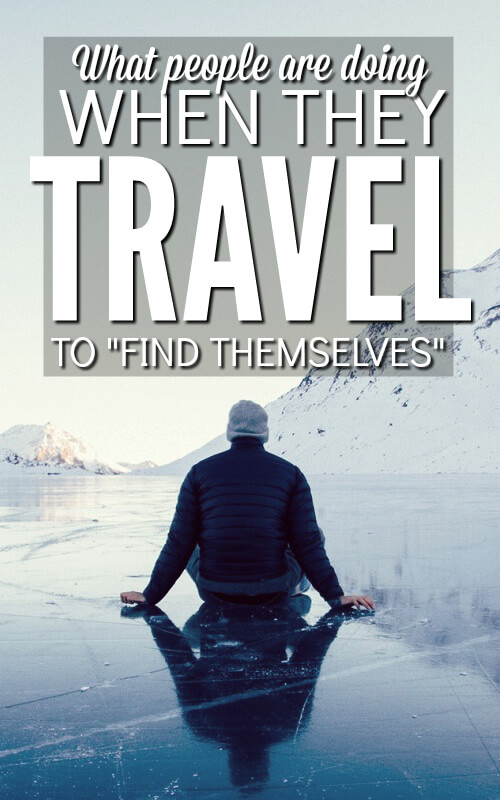
  • What People Are Doing When They Travel To “Find Themselves”

    What People Are Doing When They Travel To “Find Themselves”

    You’ve seen it before, right?

    Someone you used to know, suddenly transformed after venturing around the world. All their old dreams vanished and they come home all worldly with their stories and new-found carefree attitudes. Kind of annoying, really.

    Life is different now, they say.

    They’ve changed.

    They’ve finally found themselves.

    Honestly, I hate that phrase. “Finding yourself” is so cliche and fluffy that it doesn’t even mean anything anymore. Films like Eat Pray Love and Walter Mitty have only glammed it up even more. But the truth is, travel does change things. The person that leaves is rarely the same as the one that returns.

    But why? What the hell happens out there?

    Here’s my take.

    Removing outside influences

    For most of us, our life is full of outside influences. We have parents telling us to work hard and find good jobs. We have teachers telling us to study hard and get good grades. We have bosses directing our careers. We have girlfriends (or boyfriends) swaying our decisions. We have social pressure from colleagues and friends to fit in and be normal. We have governments saying we need jobs to be responsible. We have television, billboards and advertising, telling us what is trendy and acceptable. We have society creating a mould and constantly pressuring us to fit into it.

    And every time we want something somewhat different to the pack we get ‘concerned’ friends looking at us funny saying, “Really?”

    With all these voices in our head, our decisions are so heavily influenced that it’s impossible to figure out what we truly want.

    Instead of “going travelling to find yourself”, a more appropriate phrase might be “going travelling to decide what you want from life because it’s the only place where people will shut the fuck up long enough for you to think”.

    Seeing the world changed a lot of my opinions and perspectives on life; almost complete U-turns in some cases, but in reality it wasn’t so much the travel that did it.

    It was the quiet.

    It was the solarity.

    One of the biggest fantasies you will hear from people in 9-5 jobs is that they want to just “retire on the beach and drink cocktails all day”. In fact, while sitting in my cubicle I can admit that I fantasised about the exact same thing probably every Monday (and Tuesday, and Wednesday, and Thursday…).

    And then, only a few years later, I found myself in South East Asia doing exactly that. Each morning I would wake up, eat breakfast, and then sit on the beach and drink cocktails all day.

    Was it fun?

    You bet.

    I had the best time of my life…for two days. Then I got bored.

    It only took 48 hours to realise that wasn’t my dream at all. It was just a fantasy that had been dreamed up out of hate for my old life; early morning commutes, wearing a tie, a shitty job and a 40-hour work week.

    During those years, I would wake up every morning and think, “If this is really going to be my life for the next 40 years, you can kill me now.”

    But as I sat on the beach with drink in hand, the prospect of that lifestyle didn’t impress me much either. I mean, honestly, ask yourself; do you really want to sit on the beach and drink every day for the rest of your life? Never learning anything new, never challenging yourself, never growing or achieving anything? Is that really what you want from life? Is that really what you want to spend your precious time on this earth doing?

    Sure, it still sounds better than a cubicle. But I’d be surprised if anyone would be happy spending 40 years drowning in alcohol on the beach.

    That wasn’t my dream. It was an “anywhere but here” fantasy, dreamed up out of my unhappiness and desperation. I soon realised, I need to be challenged. I need to be learning new things. Sitting on the beach drinking cocktails is fun, but sitting on the beach reading books would surely satisfy me more.

    But that’s not enough either. I like challenges and building things. I like writing and creating things. So perhaps, sitting on the beach reading books and building a business would be my dream.

    But even that’s not enough. I like to have friends. I like companionship. I want to be around my family. So perhaps, sitting on the beach reading books, building a business, near my family with a great girlfriend and great circle of friends would be my dream. Maybe? Who knows.

    But that’s a part of finding yourself. If I were still in my cubicle, with only 3 hours of free time a day and my friends, family, colleagues and girlfriend all telling me what I should do, I would still be fantasising about cocktails on the beach.


    “The best day of your life is the one on which you decide your life is your own. No apologies or excuses. No one to lean on, rely on, or blame. The gift is yours – it is an amazing journey – and you alone are responsible for the quality of it. This is the day your life really begins.”
    Bob Moawad


    Realising your paradise does exist

    We all think our lives are normal. We all think that the way we live, the things we eat and the society that we have is the right version of life, and everything else is different.

    But every traveller eventually has that eureka moment; maybe while sitting on a beach or wandering through some small town. They see and experience something so different and so contrasting with their own life that it suddenly hits them: their life isn’t normal. Normal doesn’t exist.

    You think an alarm clock is normal? No, it’s not. Not everyone wakes up at 7am and does a 40 hour work week. Just the mere thought of doing that is a complete joke to many people.

    It goes for everything in life – shoes, monogamy, internet, religion, taxes, locking your doors, tampons, divorce – all these things we blindingly accept as normal are considered absolutely ridiculous somewhere else in the world.

    And then suddenly, it’s like, poof, you no longer need to live by the rules back home. There are many different places out there, with different rules, and if you look hard enough, you’ll find a place with rules you agree with.

    That life you hated so much back home, you don’t need to go back to it.

    Back there, the life you want to live is considered ‘stupid’ and ‘unrealistic’. You’re bombarded by naysayers and cynics, and people who feel threatened by your desire to venture out.

    But not on the road.

    Somewhere in the world, you’ll be able to find a place where the life you always dreamed of living; your beliefs and values and lifestyle, isn’t stupid. It’s normal. And by finding this place, you no longer feel like an outsider. You don’t need to feel like what you’re looking for is stupid and unrealistic. You’re finally able to accept who you are and what you want. In the process of discovering the world, you were able to rediscover yourself. And that’s a part of finding yourself.


    “If you end up with a boring miserable life because you listened to your mom, your dad, your teacher, your priest, or some guy on television telling you how to do your shit, then you deserve it.”
    -Frank Zappa


    Finding perspective

    You’ve probably heard the saying “it’s a small world.”

    Well, whoever came up with that is an idiot.

    It’s an enormous world, overflowing with amazing people and places that even with twenty lifetimes you would not come close to seeing it all.

    But it’s not until you really start exploring that you realise how big the world is. It’s only when you meet that one interesting person in that one faraway town in that obscure, impossible to find tea house, that you begin to wonder; how many more amazing people are waiting to be met? How many incredible stories are waiting to be told? How many more places are there to be found, all with their own myths and scandals and legends and stories?

    But more importantly, you realise that you cannot meet all these people, or see all these places. The world is too big. And in a world so big, you’re insignificant. You yourself are also just another one of these faraway people, waiting to be met. So even though back home you probably consider yourself the most important person in the universe, in reality, you’re nobody.

    There are 7 billion people on this planet. If you disappeared tomorrow without a trace, how many people do you think would actually care?

    100?

    200?

    500?

    That’s not even 1 percent of 1 percent of 1 percent.

    Perspective.

    You’re nothing more than a speck of sand on a shoreline that never ends.

    Is that cynical? No. It’s liberating.

    Because since you’re so insignificant, you are free. And because you are free, you can do whatever you want.

    Nobody cares.

    Perspective.

    One thing that’s very noticeable among well travelled people is how laid back they are. They don’t get hung up on stupid shit.

    Girls I used to eat lunch with at work would freak out when their plate had a tiny bit of dirt on the edge. They would berate the waiter with a tone that said “how dare you serve me a plate that isn’t sparkling clean!”

    However girls I eat lunch with on the road happily sit down in the dirtiest, smelliest street stalls and devour their meals with huge smiles on their faces.

    Why?

    Because the road humbles you. You learn how insignificant you are. And then you don’t care anymore. If someone is angry at us, we don’t care. If our order is late, we don’t care. No job? We don’t care. If the bus ride is 40 hours and there’s no air conditioning and we’re all sweating and someone vomits and the whole bus starts to smell like mouldy fish…we don’t care. Because after seeing how big the world is and all the crap that goes on it, we realise this stuff doesn’t really matter.

    Perspective.

    When we stop caring about dumb shit like this, we allow ourselves to properly care about the things that really do matter – friends, family, our loves and our passions. With our new found perspective, we learn how to choose our battles and focus on what matters. We rediscover what really is important to us, and that’s a part of finding yourself.


    “It took me a long time and much painful boomeranging of my expectations to achieve a realization everyone else appears to have been born with: That I am nobody but myself. But first I had to discover that I am an invisible man.”
    -Ralph Ellison


    Realising that it’s ok to do what you love

    We live in a wonderful world, where from the youngest of ages we are conditioned into being model citizens. Our lives are paved out for us before we even hit puberty.

    I didn’t really want to go to university. I didn’t want a 9-5 work day. I didn’t want to apply for a job after graduation. I did it because I thought I had to.

    You’ll probably do the same.

    But then, you travel. And you do the things you love. And you find new things to love. And you decide you don’t want to be a banking officer anymore – you want to ride horses, or scuba dive, or do yoga, or play the harp.

    And more importantly, you actually meet people who are spending their lives riding horses, and diving, and teaching yoga, and playing the harp.

    Those moments stick with you. It’s like, “Shit! Look at all these people living the exact life I never thought was possible!”

    And you no longer need an alarm clock to get you out of bed. You don’t need any more inspirational quotes on Facebook. You’ve finally realised that if you just take the tiny step outside the lines, it’s possible to spend your life just doing what you love and life is suddenly exciting again. That’s a part of finding yourself.


    “We can’t be afraid of change. You may feel very secure in the pond that you are in, but if you never venture out of it, you will never know that there is such a thing as an ocean, a sea. Holding onto something that is good for you now, may be the very reason why you don’t have something better.”
     -C. Joybell C.


    Do you need to travel to find yourself? Probably not. But amongst all the noise of your daily life, it is hard to really give yourself the space to do so. 

    When we travel, we get lost.

    We have days where life has no meaning at all – we just lie in bed and stare at the slats in the bunk above us.

    And then we have days where life has all the meaning in the world, when we meet a special person who teaches us a lesson so powerful that our life changes completely.

    Time on the road is time to reflect, to think, see what is on the outside. It’s time away from the masses; time to be whoever you want to be. We see all the different flavours of the world, absorb it all, and decide which path draws us in the most. We get lost, and we search, and then we find ourselves.

    Whatever the hell that means.


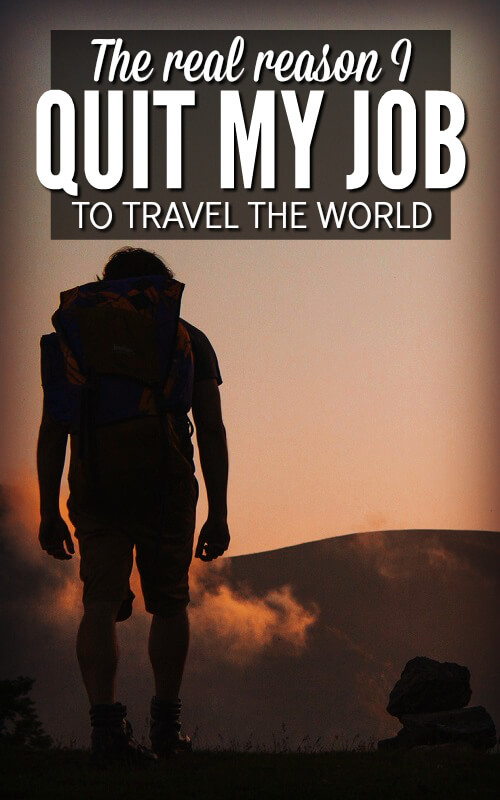
  • The Real Reason I Quit My Job To Travel The World

    The Real Reason I Quit My Job To Travel The World

    Back when I was a young teenager, I remember sitting in the car one morning with my Mum on the way to school. The night before I had just watched an episode of South Park, where the guys were sent a starving child from Ethiopia and then took him to a buffet, but kept stealing his food as he was about to eat it. While obviously just bad comedy, I remember being extremely angry at it, and thinking how incredible it would be to really take one of those starving children to a buffet and let them live in our shoes for a day.

    And so I blurted out to Mum, “One day, I’m going to get really rich and then go and build a village in Africa.”

    I don’t remember exactly what she said in reply, but it was probably along the lines of, “If you study really hard and come first in class, you can build as many villages as you want.”

    You might say, even at that young age, I was already dreaming of adventuring in faraway places.

    Of course those intentions were a little starry-eyed, and today I’d probably say building a village in Africa would just be a wasteful and ego-driven way to blow a bunch of money. But the point of the story has nothing to do with Africa, or villages; it’s simply to say that from my earliest years, I had never once dreamed or aspired to become an accountant.

    Nonetheless, around ten years later there I was, fresh out of university and sitting at a desk in an accounting firm. I had never planned it that way, and still to this day can’t really figure out how it happened; I just ended up taking accounting in high school, studying it at university, applying for a few jobs, and then, like clockwork, I was locked into a three year accounting contract. Funny how life can flash before your eyes like that, even when you’re not dying.

    And so I continued to drift along, following the crowd like I’d always done. Everyone signed that form, so I signed it too. Everyone joined that institute, so I joined it too. I straightened up my tie and cleaned my shoes. I paid my fees. I played the game.

    It was long, painful. Every morning I would wake up and curse relentlessly, starting every day as bitter as they come. But as much as I wanted to, I didn’t give up. My fellow comrades and I trucked along, just like we were supposed to.

    “Just one more year,” they said.

    “It’s all going to pay off,” they said.

    Three years passed slowly but I’d played all my cards right. I studied hard. I passed all the exams. My grades came back and they were “great”. It was seven years of study and tens of thousands of dollars in fees, but my efforts had finally culminated in two words – Chartered Accountant.

    Yet as I watched everyone else celebrate with such glee, I didn’t see many reasons to be happy. I hadn’t really enjoyed my time as an accountant, so I didn’t find a whole lifetime of it as something to be very excited about. I’d been told for years that accounting was an interesting and important career, yet nothing about it seemed very important or interesting to me.

    Before long, many of my colleagues had moved to London or Sydney, where they picked up six-figure salaries with relative ease. The ones that stayed in New Zealand landed jobs as managers and advisors in some of the country’s biggest companies. It wasn’t uncommon for them to be earning over $3,000 a week, and usually for doing a lot less work than we were used to. Here was the payday we had all been working towards, and finally it was sitting there in front of us, waiting to be taken.

    For several months I pondered the idea. London? New York? A fat paycheck and a sexy looking business card? It was extremely tempting.

    But it was different this time. Money didn’t entice me anymore like it did when I was 21. I was at a point where I hated my life and I hated myself, and no amount of money was going to fix that.

    People often ask me, how did you do it? Why did you do it? How did you spend all those years and all that money working for something, just to throw it away in the end?

    People assumed I just hated working, but that wasn’t necessarily true. Others thought I was just lazy. Others thought I was simply proving a point. But it was none of that.

    Instead, it was a deep-seated unhappiness, a result of spending my whole life working so hard for things I had never wanted in the first place. People used to ask me what I did, and when I had to answer “I’m an accountant”, I felt ashamed of myself. And not because there is any shame in being an accountant, or because accountants are to be looked down upon; in fact, it is considered one of the more prestigious careers in my country. It was merely because an accountant was never what I wanted to be, and that was never the life I had envisioned for myself. Each day I would stare out the window and dream of living a different life; studying Spanish in Spain, exploring my ancestry in China, volunteering in rural Africa, backpacking through South America and Southeast Asia. To say I was an accountant only upset me, because it told me that I did not have the resolve, and was too afraid, to chase after the life that I truly wanted. I was a dreamer; someone who talks big and walks small. I was that guy. And I knew if that was always how I saw myself, there was no chance of me ever being happy.

    So, after 1,165 days working as an accountant, I quit.

    It was a strange feeling at first. I felt so…free. I thought back to when I first started working, in particular to a distinct memory I had of buying some gear online for my computer. At that time, I was barely two weeks into the job, and I had wanted to go pick my stuff up from the shop warehouse. However, I couldn’t go during the week because of work, as the shop closed at 6pm, nor could I go on the weekend because the shop was only open on Saturday morning and I had sport. The sudden feeling of paralysis hit me like a brick. I felt so suffocated; shocked at the realisation that someone now had so much control over my time that I couldn’t even pick up my own shopping.

    And now, I had too much time. Where should I go? What should I do? Options were literally endless, and all that seemed to do was spurn hundreds of ideas that collided with each other. Overwhelmed, I spent a month vegetating at home, but eventually managed to pull my plans together and set out on the journey I had been dreaming of.

    First stop: Kilimanjaro.

    Fast forward three years and all those Monday morning dreams I had have come true: I’ve studied Spanish in Spain, lived for a year in China, taught for six months in Africa, backpacked South America and Southeast Asia and so much more. All the things I had so longingly lusted for in that office cubicle, each of which had seemed like highly improbable fantasies at the time, became realities, and each of them were just as fascinating and fulfilling as I had imagined them to be. It seems that dreams, no matter how extravagant, do come true, and sometimes they are much, much closer than you think.

    These days, my old life is a distant memory. Sometimes I actually look back and find it hard to believe those years ever really happened at all. They just replay in my mind like a movie I once watched, or a dream from years before. Three years in the office is just one big blur, but three years on the road has blessed me with enough memories to fill several lifetimes. I can finally say with honesty: if I died today, I would have very few regrets at all.

    People ask me all the time about my future plans, and to be honest, I don’t have too many. In terms of money, I don’t need a lot; between life as a blogger, some side projects, my freelance gigs, my savings, and the investments I made during my working years, I make enough to live quite comfortably in many different countries. I live a much simpler life than I did before, and spend far less than I used to; at my old job I used to pay $13 a day just to park my car. That amount alone is enough to get by each day in many of my favourite cities around the world.

    And then, people often ask me if I ever regret my decision. Do I miss the office life, the routine, the putting on my suit and tie each morning? And the answer is, shockling, yes. Sometimes I do. Travel is not always the glamorous lifestyle it appears to be, and sometimes, you miss the familiarity of a routine and a community. But not once have I regretted setting out to fulfill my travel dreams. Exploring the world has been a truly priceless experience, completely my own, and totally irreplaceable.

    Try to remember that life is to be enjoyed, and we usually make a habit of taking it a little too seriously. As long as you have food to eat, clothes on your back, and a roof over your head, the only thing missing from your happiness is fulfillment. Forget the shiny life you are sold on television. What do you enjoy? What makes you happy? Start chasing that today, because waiting is a fool’s game. Sooner or later, the day will come where you don’t wake up, and none of us know when that might happen. It may be today, or 50 years from now, but either way your tomorrows are numbered.

    How are you going to spend them?


  • The One Simple Lifestyle Change That Will Transform Your Life

    The One Simple Lifestyle Change That Will Transform Your Life

    Everybody wants more. Everybody wants to have the bigger house, the faster car, the nicer suit. When the new phone comes out, we want it. We need it. When we get to six figures, we want seven, and if we’re lucky enough to get to seven, we want eight. Everybody always wants more.

    But what would happen if everybody wanted less? What if you offered somebody a mansion and they simply said, “No thanks, my studio apartment is just fine.” What if you offered someone an Armani suit and they said, “That’s alright, I’ve already got all the clothes I need.” Because interestingly, that seems to bring people a lot closer to happiness than you’d think.

    When I was a kid, I didn’t know what I wanted to be when I grew up. My friends wanted to be firemen, or soldiers or race car drivers. But not me. None of that stuff really jumped out at me. The only thing I knew for sure was that I wanted to be rich.

    This dream carried through my teenage years and into adulthood. When I started work as an accountant, I would fawn over my clients’ bank statements, mad with envy.

    “Bro, come look at this one!” I’d say to my colleague, and we’d huddle around it, staring at the endless zeroes, in awe of these guys who were ordering European cars like Domino’s and living in million dollar houses. I would run through their entire statement, looking at the $2,000 dinners they would buy and the weekend shopping splurges they’d have on clothes and holidays.

    “That’ll be me one day,” I would smile to myself.

    I was going to upgrade from this shitty job, work at some big bank in London, get a gig on Wall Street. I was going to be that guy who drove around the corner in the $400,000 car and everyone would stop to watch me drive past. I’d be the guy that finally bought that $3,000 bottle of wine on the menu. I had a nice life, but I wanted more. I always wanted more.

    My first trip to Africa started to change that. I worked with many vulnerable children and families during my time there, and interestingly, began to admire them a lot more than I’d admired those millionaires in my client folder. It forced me to question the value of my dream and where it was taking me, and I began to wonder why I had been chasing a life of excess when in reality, I already had everything I could possibly need.

    I spent the next 3 years travelling the world, and with these thoughts in the back of my mind I started to embrace the simple life. I stopped buying new things, simply because I didn’t have any room to carry them. And as I stopped buying new things, I stopped wanting new things. And as I stopped wanting new things, I noticed that new things didn’t have any effect on my happiness at all.

    With only five t-shirts, my body felt the same as when I had twenty t-shirts.

    With one pair of shoes, my feet felt the same as when I had five pairs.

    Somehow, my shoulders didn’t seem to complain that I wore the same jacket each day.

    Instead of wanting more, I wanted less. And slowly, I realised I’d been chasing the wrong things all along. All those years I’d been working 40 hour weeks to buy more and have more, and now suddenly, there was nothing I wanted to buy. So what good was a job after that? What was I supposed to be working for?

    Nothing.

    I didn’t need to work for anything. I was free.

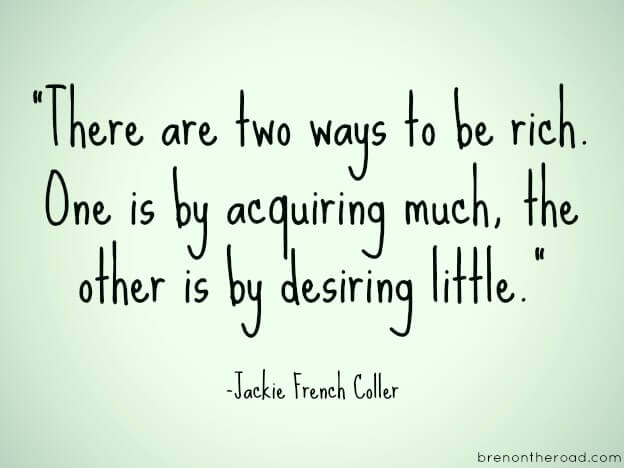
    And just like that my dream had come true. I was rich.

    rich

    Over the past year, I can count on one hand the physical things I’ve bought that cost more than $100.

    Two.

    A cellphone, and a juicer.

    I’ve largely managed to remove “stuff” from my life. And despite not earning a lot of money and not buying a lot of things, the year gone by has been one of the richest years of my life. Without the burden of a job, mortgage, car and house full of stuff, I’ve managed to spend my entire days on more fulfilling activities such as writing, reading, learning, meditating, exploring, exercising, cooking, relaxing, and interestingly, almost all of these things are free. Some would say I’m living like a retired millionaire, and maybe I am, but I don’t have much money at all.

    I’ve learned that when you stop buying things, you stop needing a lot of money, and when you stop needing money, you no longer need a regular job, and when you no longer have a regular job, you have time, and when you have time, you can literally do whatever you want. And isn’t that the meaning of happiness? To do whatever you want?

    In the west especially, we place a lot of value on material things. We often define people by what they have, rather than who they are. Just the other day I remember asking my friend about someone in her family.

    “What’s he like?” I asked, to which she responded, “He has a helicopter”. It puzzled me. A helicopter? Is that who he is? I guess a few years back, that would’ve impressed me, but the reality is things are just things. And they have nothing to do with who you are.

    Ask yourself, who are you as a person? Who do you want to be? What do you want to learn, to be good at, to experience, to see?

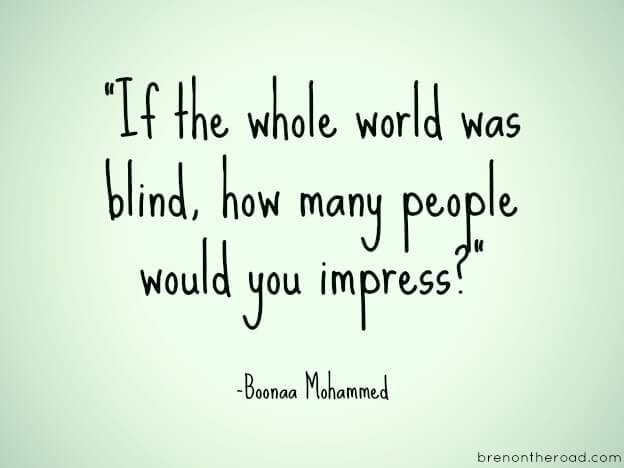
    Because what makes you rich and unique is not what you have, but how you have lived. It’s in the stories you’ve collected, the lives you have touched. It’s in the memories you have to take with you.

    blind

    Since I’ve been travelling, I’ve had a lot of plane rides and bus trips to sit and reflect, and the one thing I always tend to think about is happiness.

    What does it mean? And where does it come from?

    Many of you, like I did, might consider that getting your dream apartment, a European car, a walk in wardrobe with all your favourite clothes, and a million dollar lottery win will probably get you there. But imagine you had all that tomorrow. Picture yourself with all of that. What would you do next? I’d assume you would say you’re going to spend the rest of your life doing things you love, like travelling, or relaxing on the beach and surfing, or writing music, or spending time with your kids. But if you think about it, you can already do all these things. You do not need the house, or the car, or the million dollars for that fulfillment. And that should tell you that in reality, your happiness has nothing to do with those material things at all.

    becker

    If you find yourself unhappy, not having the time or money to live the life you desire, start asking yourself, why? What are you missing in your life? Chances are you’re spending too much time working, and not enough time on the things you love. But what are you working so hard for? What do you need to buy that you don’t already have?

    There is a Swedish proverb that goes something like, “He who buys what he does not need, steals from himself.” Take a moment to think about how much you’ve stolen from yourself. What did you spend your paychecks on last year? Were they essential to your survival? Will you remember those things ten years from now?

    You can buy a car for $10,000, or you can travel the world for a year. You can buy a $1,000 iPad, or you can buy 10 flights around Asia. You can buy an $800,000 penthouse apartment, or you can spend the rest of your life relaxing in beachfront huts for $20 a day.

    Think about the stuff you’re buying. Is it bringing your dream closer? Or pushing it further away?

    In The 4 Hour Work Week, the author talks a lot about lifestyle costing and design. The basic premise is, what is your ideal lifestyle, and how much does it cost to live it? I love Asia, so for me, I’d probably live there, at least for now. A decent bed is $12 a night, great food is $5 a day, a massage is $5 and other miscellaneous costs might run me $5 more. That works out to $27 a day to live a comfortable life at the beach (or in the city). So ideally, that is what I’d aim to earn, and the rest of my time would be spent living, i.e. doing what I love.

    What about you? How much money do you really need?

    The beauty of this equation is that it highlights the value of minimalism and living a simple life with less. If your lifestyle is too expensive, want less. Make do with less. Everyone has a choice between living with more and working more, or living with less and working less.

    Which will you choose?

    jackma

    People often ask me, what’s my secret? How do I do it? How do you spend the entire year travelling the world?

    I suppose there is a secret, and to live this lifestyle it’s mostly been about one thing – spending less money.

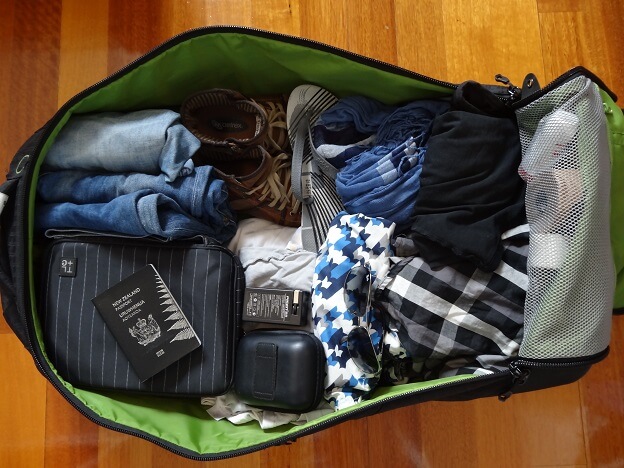
    Everything of importance to me I can fit into my 70 litre backpack. There’s a couple of pairs of shoes in there, my laptop, my camera, some clothes, some toiletries, and that’s it. I live with the contents of this bag year round, and need nothing more and nothing less. It almost feels like I own nothing. But I have more than I could possibly need.

    backpacking life
    My life squashed into one bag

    I can’t remember the last time I went “shopping”. I don’t remember the last time I bought a new shirt. I do not spend my day dreaming of things to buy, but rather reading about things I want to learn, writing about things that are on my mind, and seeing places that I’ve always wanted. I take photos, I sleep in, I walk, I exercise, I read and write, I explore and I relax. That is my day.

    In this age of hyper-consumerism and extravagant spending, I’ve been liberated by simply living a life of minimalism. I am no longer enticed by shiny things. I no longer believe in the lie that success consists of earning more and buying more. I buy only what I need, and I simply live.

    The one simple lifestyle change that will transform your life

    In the movie Fight Club, Tyler Durden famously said, “The things you own, end up owning you.” You buy a house, and it owns you. You cannot stop working because of it. You cannot travel because of it. You cannot spend more time with your family because of it. You cannot quit your job because of it. Your entire day, your entire life, becomes about earning more money to pay for your house.

    Ask yourself; do you own the house, or does the house own you?

    When you buy a car, you need to finance it. You need to service and clean it. You need to pay for petrol, insurance, warrants, parking. You worry about where to leave it, whether someone will dent it, whether it will be stolen, whether it’s been registered. The car you wanted so badly is now always on your mind, sucking in all your time, money and energy.

    Ask yourself, do you own the car, or does the car own you?

    When the weekend finally comes you have two precious days free, but you need to spend it cleaning the house, the car, the boat, the second house, the clothes, the garage, the garden.

    Let me ask you, what if you had nothing? How much simpler would life be? Instead of 5 rooms to clean, what if you only had three? Two? One?! How much more time would you have to read, surf, run, play the piano, go out for dinner, travel, stargaze, dance?

    Instead of wanting more, maybe it’s time we started thinking about less. Instead of filling up your shelves, empty them. Instead of buying something every weekend, sell something. Instead of wanting everything, want nothing at all.

    You might just find your dreams are a lot easier to get to, when there’s less stuff in the way.


  • Why Every Person Needs To Travel The World

    Why Every Person Needs To Travel The World

    After talking to some of my friends back home I’ve realised how much my view of the world has changed since I left New Zealand 3 years ago. As I continue to experience different cultures the way I see the world continues to evolve, for better or worse, and each encounter seems to add different perspectives that my previous self would have never even tried to appreciate. But, what’s most interesting is that when I look back, it’s the moments that were seemingly insignificant at the time that have ended up influencing me the most. There’s been many, but here’s 3 of my favourites.

    The self proclaimed ‘parking warden’ in Colombia

    While travelling through the small Colombian city of Pereira, I got in touch with a Couchsurfing contact named Carlos to help show me around town. After we agreed to meet he picked me up in his flash 4WD and we headed off to a small cafe for a drink and something to eat. He was cool, and we chatted like old friends as we drove out to the city. Then, something weird happened. As we arrived and he started parking the car, an old, raggedy looking man got up off the curb and stood in front of us. I thought he was going to cause trouble, but I quickly learned he was just trying to help us park the car. Slightly puzzled, I watched as he slowly walked back, holding his arms out and guiding us in, giving us the ‘slowly, slowly’ signal and then finally telling us to stop. All I could think in my head was “gee thanks, old man, for helping us park a car in a completely empty parking lot.”

    I didn’t give him too much thought after that, but when it came time to leave we walked out to the car and he was still sitting there. He stood up, went to the back of the car and started ushering us out, again not really doing anything helpful, but trying to look like he was. Once we’d backed out and were ready to drive off, Carlos wound down the window, gave him a few coins and said “Gracias”, before heading off down the road.

    “Why did you pay him?” I asked.

    “Oh, that’s his spot. They all have their own spots. If you park there, they make sure no one touches your car and you just give them some money to say thanks.”

    “But is anyone going to touch your car anyway?”

    “No, probably not.”

    “So what happens if you don’t pay him?”

    “Nothing.”

    I remember looking at him like he was an idiot. It all seemed so bizarre to me.

    “Well why do you need to pay him when you don’t even want his help?” I asked.

    He smiled.

    “We are like that in Colombia. It’s our culture, we just try to help each other. He needs to get money somewhere, so we give it to him. Otherwise he’ll be annoying people, stealing from them, it’s not good. We all give him a few pesos, and it’s not a problem.”

    After thinking about it for most of the day, I actually started to admire that old man. He was trying to make a way to earn money for himself, without hurting anybody or bothering anyone; just giving himself the dignity of “working”, albeit nothing important, and in a weird kind of way, making an honest living. But more than that, Carlos’ attitude was one that I had never seen in my own country. It was as if giving was so normal for him, that he didn’t even think twice about it. When did the culture in my own country become so selfish? Carlos doesn’t know it, but I learned an incredible lesson from him that day, and my opinion of Colombia and it’s people changed completely. I really think the world would be a much better place if we all started being a little more Colombian.


    “Blessed are those who can give without remembering and take without forgetting.” -Elizabeth Bibesco


    The fried rice lady in Shanghai

    While I was living in Shanghai I would get dinner from a bunch of street food stalls outside my dorms. I had a few favourites, but there was this one lady who sold fried rice that I’d buy from nearly every night. Eventually she started to recognise me, and in her head she’d probably labelled me as the guy who always wanted 2 eggs and no chili.

    One Friday, after a hard night out, I’d fallen asleep in the back of the taxi. As we pulled up to my dorms I paid the driver, stumbled out of the car and started walking towards the gate. It was almost 4 a.m. but in the distance, I saw 3 old ladies and their food stands, sitting half-asleep on their stools in the blistering cold. I squinted and in my drunken haze, I noticed my fried rice lady was one of them, leaning against a pillar in her usual spot. As she saw me from afar she laughed, jumped up and turned on her wok. How could I possibly not buy a box of rice from her now?

    For those of you who’ve been to Shanghai, you’ll know the winter night there is brutal. It’s a sharp, piercing cold, usually sub zero, and when you add in the air pollution it’s just insanely uncomfortable. But here was this old lady, probably pushing 60, sitting out in the cold at 4 a.m. at the slight chance of earning a few extra dollars.

    What I vividly remember though, as I stood in front of her, warming my hands against her stove and watching her cook my rice, was looking at her face and thinking to myself “Why have I never worked this hard?”

    They say that struggle breeds success, and if I’m honest with myself I’m not sure that I’ve ever really struggled a day in my life. I mean, yeah, I had those sleepless nights during exams, which were unbelievably traumatic, and there were those near-death experiences where I had to work through the day without a lunch break. Gosh, with a life so cruel, how am I even still alive?

    All sarcasm aside, what are we meant to work towards when we’ve been handed a fairytale life? What do we do when we’re already born with full stomachs and beds with clean sheets? We be grateful, of course, but does that also mean our work is done? Or does it just mean we’re expected to do so much more? I’m starting to believe it’s the latter.


    “Never throughout history has a man who lived a life of ease lived a life worth remembering.” -Theodore Roosevelt


    The Tanzanian Jimmy Carter

    I’ve been to Tanzania a few times now, and in the small town of Moshi I’ve gotten to know various locals over the years. One of them is a street seller who introduces himself as Jimmy Carter (yes, like the old American president). Why? I have absolutely no idea.

    The first time I met him he ran up to me on the street and tried selling me bracelets. He was relentless. He followed me all around town, even when I ignored him for about 15 minutes, and no matter how many times I said no he just wouldn’t let up.

    “2,000 shillings! OK, 1,500. OK 1,000. OK 500! Please brother 500. OK 200.”

    I had to admire his persistence. In the end I gave him 500 shillings (about 50 cents) and let him keep his bracelets to annoy someone else with.

    Over time I got to know Jimmy well. Whenever he saw me he’d chase me down, and while he initially would try to sell me stuff, we eventually just became friends. I had considered him a nuisance to begin with, but once I started taking the time to actually listen to him his stories began to surprise me. I was actually amazed at how adept and insightful his street selling had made him.

    “Find the girl who walks slowly. She’s the one who buys. The one who walks fast, she’s too busy, she won’t buy.” 

    “The paintings, I always see girls buy paintings from the store. So now I carry small paintings, and the girls buy it. I never carry the big ones though, no one buys the big ones. Maybe its hard to carry.”

    The more time he spent on the street the more his business savvy improved, and through experience he’d learned business lessons that most of us don’t even learn in school.

    “I show them this bracelet first, the cheap one. Then I show them the nice one. When they see the cheap one first, they always buy the nice one after.”

    “I need to talk to people like you, to practice the English. When I learn more words, I can learn more negotiate. When I learn English my selling really increase.”

    “I have to dress nice, you know. When I wear this shirt, people like me more, I sell more. So I always wear this shirt.”

    It was fascinating. He was changing up his stock, staying presentable, learning to look for high probability customers and learning how to price things. He even understood the concepts of price fixing and supply and demand, and although he didn’t use those ‘academic’ terms, he understood the concepts perfectly. It was stuff I’d spent entire semesters learning in marketing and economics class, and here was some African kid who’d learned it on the street and at times would make more sense than my university professors. Is it any wonder China’s richest man started out selling candy on the street for less than $1 a day? It was a humbling lesson that we should never underestimate the guys at the bottom, because the truth is they’re probably smarter than us, work harder than we’ve ever worked and will probably end up making more than we’ve ever made. I really hope that one day I’ll return and I’ll meet Jimmy not on the street, but standing in his own store.


    “Many who are self-taught far excel the doctors, masters, and bachelors of the most renowned universities.” -Ludwig von Mises


    I look back at my former self and it terrifies me. Just the closed-mindedness I had, that anyone who was poor was poor because they were lazy, and that anyone who didn’t go to university didn’t go because they were stupid. I’ve learned that there’s no ‘right path’ in life and everyone will find their own way if you let them. I used to think because I passed some fancy exams and wore a suit that I was better than the guy on the street, when in reality it’s the guy on the street who will probably change the world and I’m the one who’s more likely to flitter away into mediocrity. Travelling has definitely forced me to check my privelege and concede that while my life has been pleasant, it’s mostly been lived in a precious bubble that’s stopped me from seeing what’s really on the outside.


    “Travel is fatal to prejudice, bigotry, and narrow-mindedness, and many of our people need it sorely on these accounts. Broad, wholesome, charitable views of men and things cannot be acquired by vegetating in one little corner of the earth all one’s lifetime.”

    – Mark Twain


    So travel. It’s an education greater than any university degree and one you will never find in any classroom. Quite simply, it will change your life.

    Photo credit (modified): Andrea_44@Flickr