Tag: how to take a mini retirement

  • An Introduction To Slow Travel

    An Introduction To Slow Travel

    Today I want to introduce you to a travel style that dominates almost all of my trips overseas.

    While I’ve always considered myself both a backpacker and budget traveller, I’ve also been a very slow traveller.

    In five years of full time travel, I’ve only visited 30+ countries. That might sound like a lot, but I know people that have done more than that in six months. In fact, some tours in Europe take you through 15 countries in 30 days. It’s crazy.

    Slow Travel is the opposite. Instead of whizzing through different cities, you just pick one or two. Then you settle down in that city, maybe for a month, maybe for three, maybe for the whole year. You find a place to stay, make friends, find your favourite bars and restaurants, buy a subway card. It’s like you’re an expat, only with a few less strings and a little more freedom.

    Why Slow Travel?

    Travel can be about a lot more than just sightseeing and taking photos and having a few drinks with some new friends at the hostel. All that stuff is awesome, but what if you want to go deeper?

    You need time. Three or four days, a week, that’s not enough. If you want to pull back all the layers of a place, you need time for that connection to grow. Think about your relationship to your own hometown. How long did it take you to find all the coolest restaurants, meet people, build friendships and relationships, find the fastest way to walk home, meet the owner of your favourite bar, join different classes and events, settle into your neighbourhood and become a part of the community? Many months. Probably years. Maybe you’re still doing those things today. A connection to a place simply cannot be built in a matter of days.

    Even mundane things like daily commutes, grocery shopping, and going to the gym will teach you so much about a city and its culture. Things you will never experience on a short two or three day trip.

    How do you choose where to go?

    It’s totally up to you, of course. I generally base my choices around three things:

    Weather

    I chase the summer. I think it will be a long time before I spend a winter in New Zealand again.

    Affordability

    I choose a place where the rent is <$500 per month, if possible. And food and transport must be cheap also. I try to aim for a budget of between $1,000-$1,500 per month.

    Language

    I try to spend time in places where I am an active student of the language. There are various languages I’m studying and finding a country where I can be immersed in one of them is important.

    Other considerations

    A few other things, like if there is surf, internet speed, if I have friends there, safety etc. are all things I think about, but they are minor considerations. I am generally open to travelling and living in any country, as long as it’s not a war zone or on the verge of a meltdown.

    Where do you stay?

    I’ve stayed in hostels for up to a month, but I generally try to find myself a small apartment. I’m a pretty simple guy, so I don’t need anything fancy – just a bathroom, kitchen, internet and a bed. Frills like air conditioning, hot water, television and a microwave are nice but not a requirement. It’s usually easy to find something like this for under $500 per month (sometimes a lot less). I use Airbnb a lot and bargain for a monthly rate, and also local rental websites (use Google), Facebook groups, and real estate agents. Also a good idea is to ask a few local friends for good websites to check once you hit the ground. I always forget to take photos, but here are some places I’ve stayed in before:

    Cuzco – $180/month:

    Krakow – $490/month:

    Manila – $550/month:

    What you see above are short-term rates (4-8 weeks). No leases were ever signed, no bonds were ever paid, no background checks were done, and most stays were between 1-2 months. All I did was show up with my backpack and hand over a wad of cash, and they gave me the keys. You pay a premium for this convenience.

    If you do stay longer term (3-6 months+) you could expect another 20-40% off the rates above. You may get asked to sign papers and pay deposits like a normal tenant, but you should come off better off in the long run.

    I have a post with my Airbnb process and also a referral link for a free $20 voucher you can grab here. As I said earlier, it also helps to talk to an agent when you land, and browse some local websites/newspapers or Craigslist.

    What do you do for money?

    The most obvious thing you can do is use your savings. I talk about this extensively in my free ebook.

    The next most obvious option is to find a job! Jobs I see people picking up regularly are teaching English, taking zumba and yoga classes, bartending, or just any odd job you can find. If you have a terrible job at home, why not find a terrible job while you travel instead. It’ll be more fun, I promise. In most cases, your biggest hurdle will be getting a work visa, rather than the job itself.

    If you have mobile skills, you can try your hand at freelancing. If you can create income flow before you arrive, you will be set from day one in your new home. I have an extensive guide on getting started in freelancing here.

    Becoming even more popular these days is remote work, where you ask your boss if you can ‘work from home’ for a period of time. Whether or not they’re cool with ‘home’ being 3,000 miles away is another story. But this is the future – more and more big companies and making remote work standard practice today. If you’re up for it, try it. Here’s a short intro to the process.

    Lastly, if you have a house or a long-term lease back home, trying renting or sub-leasing your apartment out on Airbnb while you travel. I know a lot of people doing this, including hosts I’ve been renting from. It works.

    Lastly, I discuss many of these options and more, complete with resources, in my post The Practical Guide To Making Money While Travelling. Check it out.

    What do you do all day?

    I actually get asked this question a lot. What did you do for three whole months?!

    Usually I go to a place with a goal in mind – learn a language or skill, or maybe I just have a shit ton of work to do and need to stay put for a while. Here’s a recap of some of my Slow Travel experiences:

    1-2 months:

    Five weeks in Malaga, Spain to study Spanish. Stayed in the school dorms (2010).

    Eight weeks in Moshi, Tanzania as a volunteer teacher. Stayed in a volunteer’s hostel (2011).

    One month in Boracay, Philippines to learn martial arts. Stayed in a small hotel, negotiated long term rate (2013).

    One month in Montpellier, France to learn French. Stayed in an Airbnb. (2015).

    Six weeks in Dar Es Salaam, Tanzania to self-study Swahili and work on my ebook. Stayed in a hotel, negotiated long term rate (2015).

    One month in Kampala, Uganda to work on my ebook. Stayed in an Airbnb (2015).

    Class photo, Tanzania, 2011.

    Boxing class, Philippines, 2013.

    3-6 months:

    Three months in Cuzco, Peru to study Spanish. Stayed in an apartment I found in the newspaper (2011).

    Three months in Quito, Ecudaor to study salsa. Stayed in an Airbnb (2014).

    Salsa class, Ecuador, 2014.

    6+ months:

    Ten months in Shanghai, China to study Chinese. Stayed in student accommodation on scholarship (2012).

    Six months in Manila, Philippines to build my freelance business and blog. Stayed in apartments I found online (2013).

    Chinese class, Shanghai, 2012.

    Between work, blogging, working out, sightseeing, studying the language as well as whatever other goals you’ve set for your stay, it’s pretty easy to stay busy. Sometimes you’ll find simple things like grocery shopping takes a few hours out of your day, since you can’t read or understand anything.

    The key is to go in with a mission – what do you want to learn? When you leave, what new skills or knowledge would you like to take with you? This turns your “travels” into a goal-oriented experience, rather than just a holiday.

    How do you make friends?

    This is a question I get often, and the answer is pretty simple: You make friends overseas exactly the same way you make friends at home.

    It’s actually easier overseas. As a foreigner people have a lot of questions for you and make an effort to make you feel welcome. I’ve had many people come up to me on the street and ask me where I’m from and what I’m doing, which of course, never happens in New Zealand.

    As a new kid in town, you’re forced to put yourself out there and present yourself to the community. Like I said, this is no different to when you’re at home – you join the gym, go to classes, go to bars, attend events. Of course it is harder when you know absolutely nobody in town, but that’s a challenge you need to embrace. There was a time when you couldn’t pay me to go out to a bar or an event alone, but now I attend almost everything by myself. Few travellers would disagree that travel tests your social skills to the limit, but this is a blessing – it changes every aspect of your life for the better. As a lifetime introvert, this has been doubly true for me.

    Some communities that are “easy-access” and you can join immediately are language exchanges, sports clubs, gyms (including yoga, boxing, crossfit and martial arts), pub crawls, Meetup, Couchsurfing, co-working spaces, any type of classes, expat bars. Of course you’ll meet many people in the natural course of your life too, such as your co-workers, flatmates, neighbours etc.

    Do you need to quit your job?

    The concept of Slow Travel is similar and in some ways complementary to the Mini Retirement, which I wrote about last month.

    The difference is, Slow Travel relates purely to travel, regardless of what is happening in your career or life back home. Even if you don’t plan on leaving your job and only have four weeks to travel, you can still spend that Slow Travelling in a chosen city.

    Back when I was an accountant, I took five weeks of extended leave and spent the entirety of it in Málaga, Spain, which turned out to be one of the most powerful experiences of my life. In fact, I credit it almost entirely for setting me on the journey I’m on today, and I didn’t need to quit my job to enjoy it.

    Slow Travel is not so much about spending long periods of time in a place, but more about spending whatever time you do have to appreciate the daily, the normal, the routine – this will create the deep connection that so many travellers talk about – the type of experience that opens your mind to everything the city, and the world, has to offer.

    Managing your Fomo

    One of the biggest challenges with Slow Travel is the constant Fomo (fear of missing out). Instead of spending a month or two in Spain, you might want to try and do it all – partying in Barcelona, wining and dining in Paris, sunbathing in the south of France, eating pizza in Italy and skiing the Swiss Alps. That is a much sexier story, will get a lot more high fives and dropped jaws from your co-workers, and will triple the amount of likes you get on Instagram.

    But the important thing to remember here is your ‘why’. Are you going travelling to take lots of great photos and have fun and come home with a sexy globetrotting story (which is fine), or are you going to invest your time and energy into new skills, languages, ideas, communities and a way of life? One is not better than the other, and in fact I encourage you to enjoy both modes of travel during your life, as I have.

    But you do need to commit to one, and don’t let all the other what-ifs impede your experience. There are endless places on the planet to visit. You will never see them all, so it is pointless to let your mind constantly wander elsewhere and second-guess your choices. Choose the experience that you want and embrace it.

    A word of warning

    Slow Travel is tough.

    You will suffer periods of loneliness, which is unavoidable. The plus side is you learn to enjoy the company of yourself, which will greatly curb your fear of loneliness for future trips. I’ve come to believe alone time is extremely important, both for periods of reflection, rest, and clarity of mind.

    You will doubt yourself a lot. What the hell am I doing here? Almost every time I Slow Travel I second guess myself and get the urge to go home or go somewhere else after a few days. But if you stick it out, and take the time to create a home in your new city, the doubts will evaporate quickly. For me, this adjustment period is two weeks – I know if I can just get over the two weeks of settling in, everything will come right. And it does. There is so much to learn and enjoy in Slow Travel. Good things take time, as always.

    Finally, it will be hard to say goodbye. This is a horrible feeling, and one that I don’t think I will ever get used to. When you make new friends, become enamoured with new places, start relationships, invest your time and emotions and life into a place and its people, it will never be easy to say goodbye. For some it gets easier, for some it gets harder, but it it never becomes easy. The only comfort is in knowing you can come back some day. This is one of the paradoxes of travel – such amazing experiences make us want to stay longer in our newfound homes, but they also inspire us to keep travelling. Our hearts are always pulled in both ways.

    Travel safe,

    Bren

    Ready to start travelling? My free e-book is a complete, 71-page guide to creating a life of travel. Click here for your free copy.
    Learn how to create richer relationships, learn new skills and hobbies, and create second homes all around the world. Slow Travel is here to stay.

  • How To Take Your First Mini Retirement

    How To Take Your First Mini Retirement

    Most people associate retirement with walking sticks, nursing homes, grandchildren and wearing funny slippers.

    But that’s what your grandparents did.

    Times have changed.

    ‘Waiting until retirement’ was a catchphrase that benefit everyone except the actual retiree. The government got as many tax dollars out of you, with no guarantee that you’d live to get them all back in pension. Corporations got the best hours of your days during the healthiest years of your life to earn as much money off you as possible. And you were forced to wait until the very end before you actually got to do what you wanted with your life.

    Emerging today is the concept of the mini retirement. Instead of waiting until your sixties to enjoy life, people are taking their retirement in bursts, spacing it out over the course of their careers.

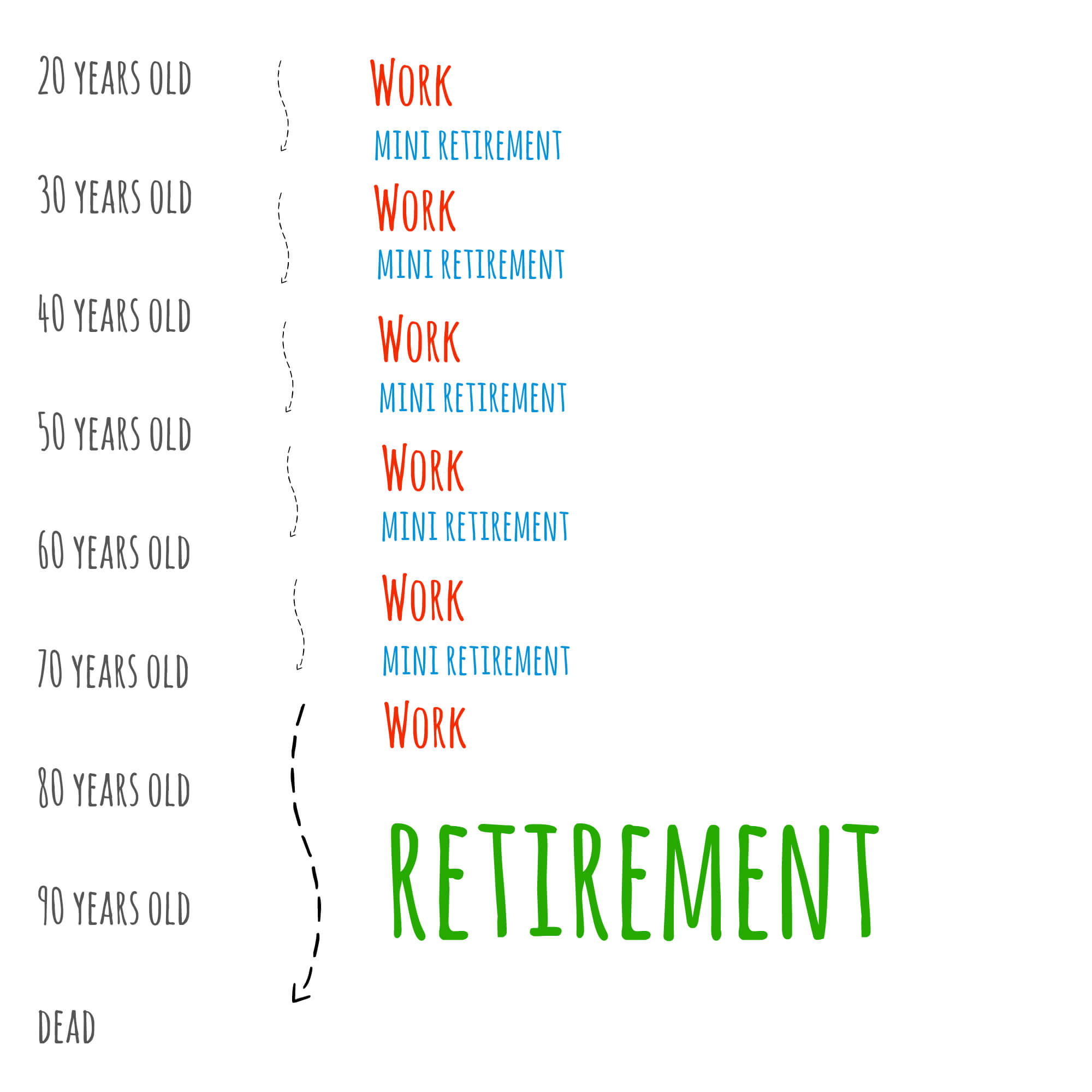
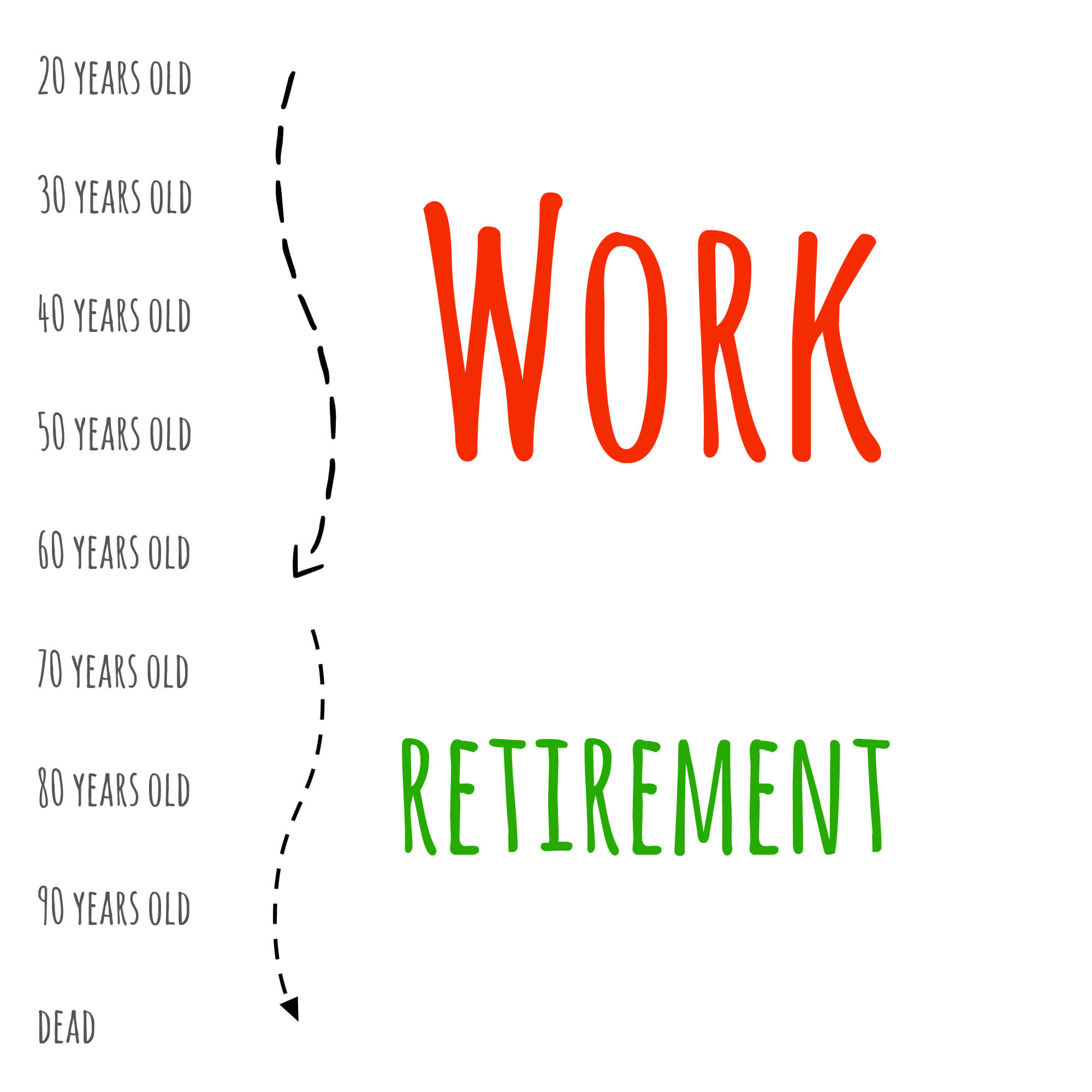
    Typically, we think of life like this:

    retirement
    miniretirements

    A mini retiree’s life looks more like this:

    Perhaps you earn a little less money, perhaps you don’t own an enormous house and perhaps you don’t become the CEO. But what you do get to do is enjoy the freedom of retirement in your twenties, thirties, forties and fifties, you still get to have a career and you get the chance to enjoy the world throughout all periods of life. You will likely be healthier, better travelled, less stressed. You might even enjoy your job for once. How’s that for crazy?


    Why mini retirements make sense

    I don’t want to trivialise the importance of work. I work. You work. We all need to work. But by adding this element of balance into life we can make our work more purposeful. Instead of just working until we die, we can work towards something real, something we want. Not only does it make our work meaningful but our lives, too.

    You can experience the joy of retirement during your youth

    There are certain things that you can’t do (or can’t do as well) when you’re 65 and up, especially physical things such as kite-surfing, climbing mountains, enduring 20-hour train rides, cliff jumping – the list goes on.

    When you take a mini-retirement at 30, you can still do all these things with your youthful body. Your hips won’t die on you when you sit on a bus for hours, your back won’t buckle when a wave throws you off your surfboard at 20 miles an hour. It’s not only more fun, but it’s safer and healthier.

    Your mind is also young. You learn things easier, you remember things better. You get the chance to become a student again while your brain is still fresh and clicking. I’ve met many older folk in my language classes that talk of difficulties in remembering vocabulary and conjugations, and I’ve also experienced this as the years click on.

    As the old saying goes, youth is wasted on the young.

    You open yourself up to new career paths

    When you work continuously for 40 years, you tend to stay on one career path. You study accounting, you become an accountant, you stay an accountant forever. That’s easy, it’s where your career is stable and it’s right in the centre of your comfort zone. Ask your accountant how long they’ve been an accountant. Probably their whole life. Ask your doctor how long they’ve been a doctor. Most people don’t change careers.

    When you take a break every few years, your options open up. You might take your first mini-retirement and get a job teaching English. You may love it so much that you decide to go to teacher’s college. You might do a yoga course and decide to get certified as a yoga teacher. You might spend your retirement writing poetry or a screenplay and realise you’re actually really good at it. You might even do something crazy like, I don’t know, start a blog.

    Most people don’t change careers because of the risk. You need to take the time to re-educate yourself and find your way in a whole new field. But I have never met a person who changed careers and regretted it. And I’ve met a lot.

    The job you hate becomes more bearable

    How many of you hate your job? If my old office is an accurate sample size, around 98% of you.

    However, I don’t believe it’s the job itself that is that bad. It’s the monotony of it. It’s the thought that you’re going to be doing this every day for the rest of your adult life.

    I’ve got to do this for the next 40 years?

    If my old 9-5 was just a one or two year gig, it would’ve been fine. There would’ve been light at the end of the tunnel. I just need to guts it out for a couple of months and then I’m free. That’s a bearable thought. It’s actually quite a nice thought – I’m here to earn some money for a bit, then I can go and enjoy it. Work and play.

    When you take mini retirements, the end of the tunnel is always visible. Just a few years and then I’m mini retiring. Even if you loathe your job, you’re there for 4-5 years at the most. That’s much easier to digest than 40 or 50. Put your head down, save some cash, hand in your notice and chase some dreams.

    You increase your time wealth, which leads to a life of greater balance

    Most careers are engineered towards amassing financial wealth. We don’t mind taking on more stressful roles and longer hours to fatten the paycheck and stockpile as many dollars as possible. In the midst of the hustle we tend to forget why we’re working so hard.

    By taking mini retirements throughout your career, you allow yourself to appreciate the importance of time wealth as well. As your life goes on, you’re able to see the value in having time to read, take long walks, spend an entire week relaxing with your boyfriend/girlfriend at the beach. Many of us lose sight of the value of time wealth until we’re reminded of it’s beauty, often through unexpected circumstances like a redundancy or other unexpected downtime. Mini retirements are the perfect way to ensure balance in your life – a great career but also hobbies, travel, healthy relationships and a wealth of free time to pursue your passions too.


    The Practical Side

    What kind of career will you have? What do you do during a mini retirement? How do you pay for it?

    Your career

    People think a big gap on their resumé looks bad. I have never known this to be true.

    Do you know what lands you a job after an interview? It’s not having a great report card. Any dummy can memorise a textbook. It’s not having a really nice tie and good manners. Dummies can do that too.

    It’s being interesting. Having ambition, being a risk-taker, having tenacity, thinking on your feet, embracing challenges, standing out from the crowd.

    If an employer asks what you were doing during a two year break and you tell him you were playing Xbox, then a gap on your resumé looks bad.

    If you tell him you built a motorcycle and drove it across Europe, worked in rainforest conservation in Ecuador, volunteered as a special needs teacher in Uganda and then self published a book of poetry, your resumé looks pretty good. It might go straight to the top of the pile. People want to be around inspiring and interesting people. And they know if you can do such incredible things out in the world, you’ll definitely be able to handle anything they throw at you in the office.

    Another common reason people give for not taking big breaks from work is they think it will negatively affect their career progression.

    “If I take a year off, everyone will surge ahead of me and I’ll never get that promotion.”

    “I want to take a gap year, but I’m scared I won’t find another job when I get back.”

    It’s never been true.

    When I visited my old office after coming home, I had barely been there five minutes before my old boss offered me my job back. “If I find out you’re working anywhere else in town I’ll be very disappointed!”

    This has been true for many of my friends on the road. They travel around the world for a year and walk straight back into their old job. Not only that, they get begged to take back their old job. After having to hire people for my own projects, I understand why this is. Good people are so hard to find. If you’re a star, people don’t want to see you go. They’re ecstatic when you come back.

    Lastly, you might think the gap makes you look unreliable. I can’t hire this person, they’re going to quit after two years. Want to know a secret? Everyone quits after two years. Employers know and expect this.

    The point I’m trying to make is, you will be okay. If you had a great career before your mini retirement, you’ll find or continue a great career after it. And if you had a shitty career before your mini retirement, then who cares what happens to it?

    Your finances

    The secret to a mini retirement is to be a diligent saver. Saving for your mini retirement is no different to saving for a house deposit or a new car. In that sense, you are simply transferring your savings from a new car to a mini retirement.

    I’m a little biased, but I would guess that a mini retirement will add much more to your life than a new car.

    If your mini retirement is going to be two years, maybe you’ll need about $20,000. If you plan to work for five years, you’ll need to save $4,000 a year. That’s $333 a month, or $76 a week.

    Too hard? Take a shorter mini retirement, or work another year.

    Too easy? Take a longer retirement, or work a couple of years less.

    Also, because you won’t be travelling in the tourist sense of the word, most of your expenses during your mini retirement are going to be things like rent, food and hobbies. Normal stuff. Those are the same things you buy at home.
    Thinking about it like this removes a lot of the mystery.

    And here’s your secret weapon. If you already own a car, or a house, you can lease your house and car. That gives you an income during your mini retirement. If you can’t find anyone, offer it to someone you know at way below market (even a little income will go a long way). If you don’t want to fluff around with arranging any of that, you can simply sell the car (yes, you can always buy a new one). Finding someone to rent your house shouldn’t be as difficult, and you could also do a Home Exchange as another option.

    If you’d like a blueprint on saving for a mini retirement, I cover the subject extensively in my free ebook.

    What to do

    A few ideas:

    Learning holiday

    This is actually my favourite style of travel, and I’ve done it all over the world to learn martial arts, surfing, dancing, languages and more. In fact, my first solo travel experience was a Spanish course in Spain. Obviously, the longer you have the more you will learn which makes this style of travel perfect for mini retirements. I meet many people at language schools that only get to stay for two weeks and are heartbroken when they need to leave so soon. During a mini retirement you can spend a good 3-6 months really exploring and learning your craft, whatever you choose it to be. Paired with the experience of being in another country and these really can become life-changing adventures.

    I booked my first learning holiday through STA Travel. Now I just find my opportunities independently, but their learning section is still a great place to find ideas.

    Working holiday

    Working during retirement?

    Bear with me.

    There are many working holiday opportunities out there – you can be a skydive instructor, a surf coach, a yoga teacher – pretty much any passion that you have can be turned into a job.

    Even though the pay might not be great, you will still be topping up the bank account, putting less stress on your finances and allowing you to live a little larger while you’re out there.

    There is an abundance of these opportunities – you’ll just need to ask around. I would suggest not planning your entire mini retirement around something like this, but stay open to it. Perhaps you want to extend your mini retirement from one year to two or three, and a short working holiday might be the kicker you need to make it happen.

    Caz and Craig have some good info to get you started. But Google will give you all the info you need.

    Travel

    Nothing fancy. Just go see the world.

    Volunteering

    Volunteering is an amazing experience, one that I’ve done various times. There is an element of responsibility and awareness to consider when you decide on a project, especially when working with children, and also on the organisation (if any) you affiliate yourself with. However, when done right volunteering is a magical ride.

    Do your homework on your project. If you’re paying money, make sure you know where it’s going (to a needy cause or into a corporation’s pockets?). Ask yourself if you’re doing the project for the right reasons. Would you do it if you couldn’t take your camera? Ironically volunteering can be a somewhat selfish endeavour; we do it because it makes us look good and feel good, and that’s okay. Just make sure there are many good reasons behind your work too.

    Shannon has a great grassroots project you can browse here.

    Study

    Go back to school! Educate yourself on something new, get qualified for a job you always wanted to do, or upskill in your current field without the pressure of a job to go to each day. Many people go through life wanting to try something unconventional like acting or dancing, but never find the time to dedicate to it. I wish I could learn that, but when will I find the time to go back to school and study again? During your mini retirement, bro.

    A year after I left my job, I moved to Shanghai and went back to university for a year. I was 25 at the time and it was an incredible experience.

    Even if you don’t study towards a certificate in an official university or institution, you can still dedicate time to educating yourself on your own time. Go to the library, take online courses, read books, self study, find something on Udemy. It’s all possible.

    Enjoy your retirement,

    Bren


    Ready for retirement? You don't need to wait until your sixties. Enjoy retirement in your twenties, thirties and forties with the rise of the Mini Retirement. It's here to stay! Click the pic above to learn more.