Category: Stories

  • Wonderful Nights Atop Mt Sinai

    Wonderful Nights Atop Mt Sinai

    Rawan has the most incredible eyes.

    At first they’re green. You get a second look, they’re yellow.

    When she’s finally looking at you and you’re gazing back into them, they’re hazel.

    Then the sun hits her face, the light fills them from a distance and you realise – they’re gold.

    It’s been a long night.

    It’s 11 a.m., I still haven’t slept.

    We’ve hiked a mountain, watched the sunrise, stood where Moses stood, driven out to the wilderness and back, now I’m finally back in my bed, ready to sleep.

    And what I remember most from it all are – Rawan’s golden eyes.

    13 hours earlier…

    “The guy said 10:30.”

    “No no no, ten sharp!” he screams at me through the phone.

    “Okay I’m coming!”

    It’s 9:55.

    I grab my stuff and scramble out the door. The meeting point is at the supermarket, just two or three minutes away. There are no streetlights in the alleys running off the beach, but it’s a full moon. I can see.

    In the distance I see the van arriving.

    Is that the guy?

    He sees me power walking and nods at me.

    That’s the guy.

    “St Catherine’s?”

    I nod. “Do we have a couple of minutes? I need to buy some things.”

    “Of course, take your time.”

    Take my time? You were rushing me out the door five minutes ago.

    I buy a bottle of water, a can of Sprite, and six bars of chocolate. Then I jump in the van, out of breath, and wait.

    10:05.

    10:10.

    10:15.

    What happened to ten sharp?

    Finally at 10:20, another couple shows up. We do the hello-introduction thingie. Brazilian. Friendly.

    We head off. Two blocks down the road we stop to pick up another guy. Also Brazilian. Naturally, he and the couple start chatting. I don’t speak Portuguese, but I can guess what they’re saying. Oh wow you’re from Brazil too, what are you doing in Egypt, oh you’re from Sao Paulo cool, me too.

    After ten minutes we stop. The driver is yammering away on the phone. He’s speaking Arabic, but again I can guess what he’s saying. This hotel beside the pizza place, right? Yes, we’re here, where are you?!

    After fifteen minutes, three young ladies jump inside. The rest of us are semi-sleeping, but these three are loud. They ask if they can put on their music. Driver says sure. They blast it. And talk. And laugh. A million decibels. I’m guessing they took a power nap to prepare for the night ahead. Now they’re wired.

    We pick up one last guy, from Israel, then start the drive to the mountain.

    We are climbing Mt Sinai tonight.

    Mt Sinai is famous for a few things. First, at the foot is St Catherine’s Monastery. It’s the longest active monastery in the world. The summit has an Orthodox church built in 1934, and a mosque still used by Muslims today. And finally, according to both the Bible and Quran, it’s where Moses received the Ten Commandments from the Tablets of Stone, a zillion years ago.

    We arrive around 1:30 a.m. I am barely awake. We get off the bus. Now I’m barely awake and freezing cold. We get taken into a small shop selling hot drinks and snacks. Now I’m barely awake, freezing cold and hungry.

    As we sit and wait, we finally get a chance to chat with one another. The Brazilian guy is Daniel. He’s studying in Lebanon on exchange, now he’s in Egypt, fleeing the war. The Brazilian couple is on a trip around the world. They’ve just been to China. They find out I’m from New Zealand, and excitedly tell me they’re going there next. Cool. The Israeli guy is talking to the Egyptian girls in Arabic. I ask him, how do you know Arabic? He says, because I’m Arabic (he’s Palestinian). Oh. Stupid question. The Egyptian girls are a classic travelling trio, on a one week getaway. In backpacker speak, we call them Charlie’s Angels.

    Charlies Angels
    Noun

    1. A group of three female friends travelling together, who move everywhere as a group of three and never separate. Usually young and rowdy. Avoid if possible.

    We head to the starting checkpoint. There are passport checks, security checks, ticket checks.

    We stand in line and wait.

    The guide keeps saying, “Yella, yella, yella.”

    One of the Egyptian girls is next to me.

    I ask her, “What’s yella?”

    She looks at me. “What’s yellow?”

    No, “yella.”

    “Oh! It’s like, let’s go.”

    Ahh.

    Once they confirm that we all bought tickets, have visas, and none of us are fugitives, we get moving.

    It’s 2 a.m.. The air is crisp. The path is rocky and difficult to walk freely, there are no lights, but the full moon shines and guides the way.

    I walk with the Brazilian guy. Beirut is an awesome city, he tells me. I tell him I almost visited Lebanon, after meeting a Lebanese surfer in the Ivory Coast, who said the surf in Lebanon was great.

    “You’re Brazilian, you surf?”

    “Yeah!”

    “So how’s the surf in Lebanon?”

    He shakes his head, confused.

    “It’s shitty.”

    We both laugh.

    The hike is supposed to be six kilometres, with a final climb of 720 steps to the top. The idea is to be at the peak for sunrise.

    I calculate that by starting at 1 a.m., we will reach the peak around 4 a.m..

    I ask the guide – “What time is sunrise?”

    “6:50.”

    Either I’m awful at math, or we’re going to have three hours of standing around staring at our shoes.

    The path up the mountain is well-trodden. It winds like a never-ending “S”, there are men with camels every ten minutes, waiting for people to get too tired to climb any further.

    I don’t know our guide’s name. But as the rest of the group tires, I find myself at the front, walking with him. He’s chatty. He tells me in high season, he climbs this mountain every day. In low season, it can be as seldom as once a month.

    As he falls back to check on the rest of them, he tells me to go ahead.

    “When you get to the coffee shop, stop and wait for us,” he says.

    “Oh, there’s a Starbucks up here?” I ask.

    He looks at me confused and shakes his head.

    “No.”

    Just a joke, bro.

    I get to the coffee shop. It’s a little hole-in-the-mountain selling Coke, chocolate, and potato chips.

    There are also small benches for us to sit on. I plonk myself down and wait for the others.

    The Brazilian couple are right behind me. The lone Brazilian is next. Then the Israeli. Then the Charlies Angels. I can hear the three of them laughing and hooting long before they arrive.

    As we get ready to start moving again, the Israeli guy cracks. He points at the camel and says, “Might need one of those.”

    Two minutes later, he rides past us on camelback, grinning.

    As this group of camels walk by, one passes two inches from my face. I stare, realising what wondrous creatures they are. They’re enormous. You think they’d be just like horses, but they’re bigger and clunkier, yet somehow still graceful. Secondly, their thighs are ridiculous. Massive slabs of pure muscle. “Wow,” I whisper to myself as they clobber past.

    As we hike to the next stop, I’ve now figured out how this hike goes.

    There is a coffee shop, or “Starbucks” every kilometre or so. The hike is six kilometres, so there’s going to be five or six Starbucks’, and we simply hike from Starbucks to Starbucks taking a rest at each one.

    This gives people a chance to catch their breath, buy a chocolate bar, the group regroups for a head count, then we head on to the next.

    By the time we reach the third Starbucks, I’m falling asleep.

    It’s freezing cold, and five hours past my bedtime.

    As I set there dozing on one of the benches, the Charlies Angels come and sit beside me.

    “Hi!”

    “Hi.”

    Whenever you meet a group of Charlies Angels you rarely learn their names. You just know them as the blonde one, the tall one, the curly-haired one etc.

    This group, I piece them together as the quiet one, the loud one, the mysterious one.

    “So…you guys are from Cairo?”

    The loud one nods. And then shakes her head.

    She tells me she’s from some other city, which I don’t remember. And the other two are Cairenes (someone from Cairo).

    “You have too much energy,” I joke with them.

    “We slept already!” they scream, laughing.

    As we sit there chatting, waiting for the guide to move us along, freezing our toes off, I lie down on the bench and close my eyes. Sometimes during moments like these, I smile at what a faraway place I’ve found myself in. I’m in Egypt. On the Red Sea Coast. Climbing Mt Sinai. Lying under the stars in the middle of the night. Isn’t that wild?

    Another hour passes. Another kilometre. Another Starbucks.

    Finally, we reach the last one.

    The guide tells us we’re at the end. Just wait here until almost-sunrise, and we’ll climb the 720 stairs to the peak.

    At this particular Starbucks, they have blankets to hire for a few dollars which is a godsend. The air is biting with a fierce cold that sends frost deep into your bones. I am freezing. I wrap myself in one and sit with the Charlies Angels. They are all wearing the same baggy jeans.

    “Is this the fashion in Egypt or something?”

    “Yeah!”

    They laugh as I tell them it was the fashion in New Zealand about twenty years ago.

    The loud one pulls out a pizza box. I stare at her confused.

    “You guys brought pizza?”

    “It was our dinner…”

    She opens it up to show five or six slices.

    “Oh my goodness can I have one?”

    “Of course!”

    I grab a slice and savour it. “I’ve been craving pizza for the last five hours!”

    As we sit there shivering in the cold, eating the final pizza scraps, I start wondering where everyone’s gone. There’s nobody around but us. I go look around the Starbucks and notice everyone cramped into a small room, napping. I follow them inside. It’s warm. There are benches to lie on. I find myself a spot and tuck under my blanket. It feels so good I fall asleep immediately.

    “Let’s go!”

    How long have I been asleep? I don’t know. The Charlies Angels are shaking my blanket and rushing me outside. Time to climb to the peak.

    It’s still dark, but sunrise is in an hour. We get the group together, the Brazilians are fast asleep and slow to get up, but eventually we hit the stairs and start ascending.

    The stairs are not really stairs in many places – just rocks conveniently placed, and it’s hard to climb in the dark. We go slowly, taking frequent breaks.

    By halfway, the Charlies Angels are exhausted, heaving oxygen. I see why – it’s tough. We do another twenty stairs and stop again. And again. It’s warming me up, so I love it. They hate it.

    We reach the top. It’s like a small castle. We see the little room where Moses was. We see the cathedral. The small mosque. But mostly, we just want to rest. We go sit against the wall, wrap ourselves in our blankets, and wait for sunrise.

    Like most sunrises, it comes slowly, and we don’t even realise it’s happening until it’s already in the middle of happening.

    As everything comes to light we take photos, hundreds of photos, climbing up on the mountains, on the walls, any shot we can find.

    Once we’ve exhausted every photo angle and possibility, we sit and talk. I finally learn the Charlies Angels names. The loud one is Shahd. The quiet one is Mariam. The mysterious one is Rawan.

    Finally, once the sun is well and truly up, it’s time to descend.

    We climb down the 720 stairs, say goodbye to the last Starbucks guy, give him back his blankets, and head on our way.

    I walk with Rawan. In the sunlight, her eyes mesmerize me. They are yellow, but also brown, and also green. All together – golden. And they glimmer, like gold, every time her face turns and glances against the sun.

    It’s about a two hour trek back to civilisation. I walk with Rawan. We talk about TV shows, and travelling, and work, and food.

    She lights up a cigarette.

    “Isn’t that haram?”

    She rolls her eyes.

    The sun on the Egyptian coast is tough. It starts to beat down. Our walk turns into a dawdle. I don’t mind. She tells me her favourite food is Koshari. Her dream country to visit is Greece. She doesn’t want to go back to Cairo.

    As we arrive back at base, we thank our guide for walking with us all night, tip him, and tumble back onto the bus. We fall asleep immediately.

    Moments later I’m woken by the noise of Dahab, the heat on my face through the window. It’s almost lunchtime. I haven’t slept in over 24 hours. We’re pulling up to the girls’ hotel.

    Everyone says their goodbyes.

    Rawan smiles at me with warm, tired eyes.

    I smile back.

    “Bye.”

    “Bye.”

    I’m the last one on the bus.

    As we arrive at my stop, I thank and tip the driver.

    I’m sleepy, but calm, and grateful.

    Walking back to my guesthouse, I take off my shoes and wander barefoot, along the sand road.

    Once I arrive, I sit for a while outside, looking over the Red Sea.

    What a beautiful sight, and what a beautiful night, atop Mt Sinai.

    For my Mt Sinai climb, I booked my tour through GetYourGuide. It was great! Highly recommended.

  • A Raro Life Pt. 3: Sharing Souls With Strangers

    A Raro Life Pt. 3: Sharing Souls With Strangers

    A Raro Life is a chronological recollection of stories from the six months I spent living in Rarotonga during the 2021 Covid lockdown.

    We’re at Mai’i.

    “My favourite restaurant on the island,” Amandine says.

    But she also said that about Mooring Fish Cafe.

    And Nautilus.

    And OTB.

    We’ve just been to yoga with Michelle. I’m eating fish and chips. Roberta’s eating kumara fries. Amandine’s got the sashimi platter.

    Roberta isn’t doing much eating, though. She’s talking. Entertaining us with stories of her teens – when she backpacked through Brazil in the seventies or eighties, did all the crazy backpacker things. She talks and talks, and I can see Amandine zoning out, then I zone out, and it’s Roberta talking to herself, then after a few minutes, we zone back in. She’s still talking.

    So the island is like home, now? She finally asks me.

    I nod. Every day there is something.

    Tuesday and Thursday is yoga, Amandine says.

    Friday and Sunday is music at Waterline, I say.

    Saturday is the rock band.

    Just Wednesday is free …

    Wednesday you can go to Lucille’s house! Roberta says.

    Amandine perks up.

    Yes! The magazine thing!

    They start laughing.

    You want to go tomorrow? Roberta asks.

    Amandine nods. Yeah!

    She turns to me and starts explaining.

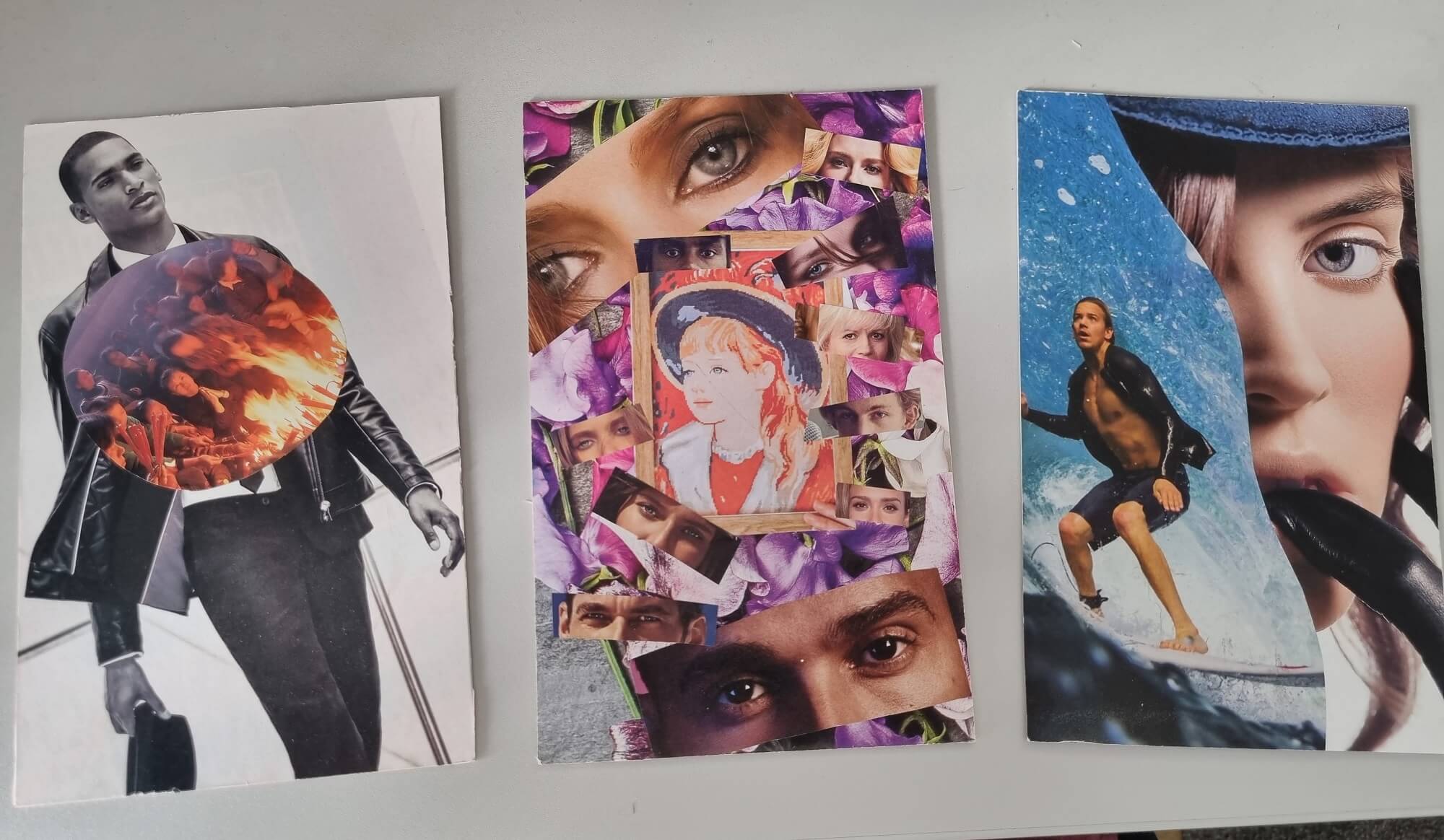
    So it’s this thing – you take all these pictures from magazines, but you don’t even think about it, you really don’t think anything about it, you just take it and then make this picture, and then when you finish you will have a card with all these pictures, then you can make like four or five cards or however many cards you want, and at the end all the pictures will tell a story about your life …

    Uhuh …

    It’s really fun!

    Uhuh …

    Even Kamil went once.

    Just once?

    Yes, he hated it.

    Why?

    Because he’s Kamil, that’s why. But we should go!

    I know I’m not even allowed to say no.

    We will goooo, Roberta says. We can leave at foouuur.


    I wake early the next day. Go to the beach. Read.

    Just before lunch, I lace up for my run.

    As I leave the house, I spot Carlo in the garden, shirtless, doing garden stuff. He grins at me.

    You run everywhere!

    Yep, I smile to myself. Seems to be all I know now.

    Carlo is so jolly. He has a permanent smile, like it’s painted on. When he talks, he lifts his eyebrows, high as he can, like he’s putting in eyedrops. His Italian accent is so thick you almost need subtitles. You can’t not love him.

    I walk down the driveway, around to the front of their house. I don’t know if he’s a carpenter, but I guess he built this house himself. It’s soulful, tropical, built in a nest of trees, straight out of an island movie. The guesthouses – where Amandine and myself stay – are on the bottom floor. Carlo and Roberta live up top, in their breezy idyllic treehouse. I’m jealous. It’s beautiful.

    I start my run, down their long gravel driveway, same as always.

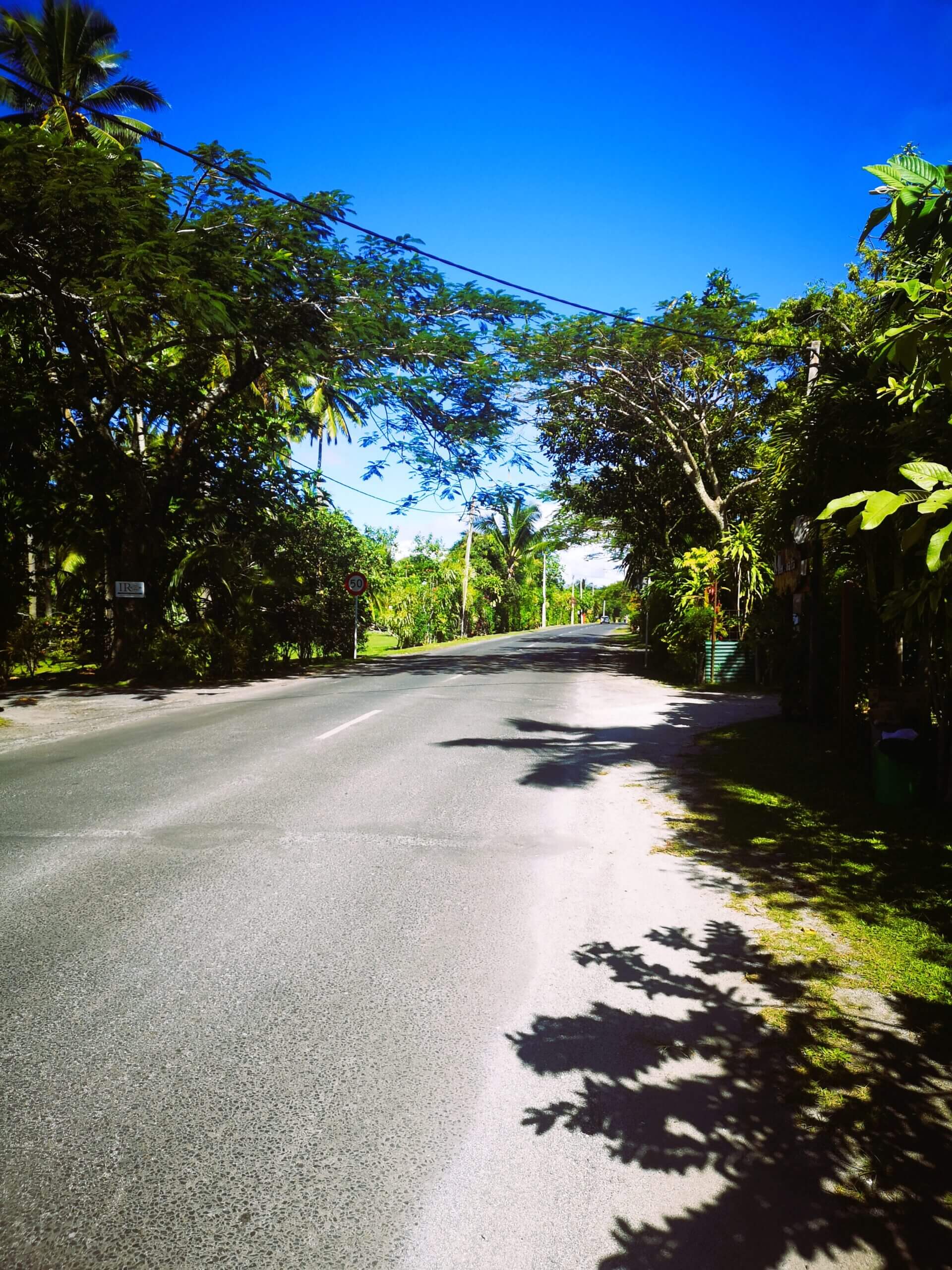
    The funny thing about Rarotonga – it’s nearly impossible to get lost, because there’s only one main road, that circles the whole island. I don’t even know if it has a name – people just call it Main Road. It makes it the most beautiful place to run. Normally, in a foreign country, you need to keep a damn GPS in your head when you run, remembering every turn, every landmark so you don’t get lost. But here, you can just run and run, and when you get tired, just turn and run back. You can’t get lost when there’s only one road.

    I hit the main road and hang left.

    I run past the Edgewater Resort, where I had gone for lunch on my first week.

    Were you running this morning? The waitress had asked.

    Yes I was.

    The next day, I went back for a swim.

    The guy on duty grinned at me.

    Saw you running this morning bro. Chyeah!

    Go for a run, everyone on this island knows. No secrets here.

    I run past Alberto’s Steak House. Pretty good food, Carlo had told me on the first day, on the ride from the airport.

    Next, I pass the bakery that Amandine likes, with the one-dollar Spanish rolls.

    A few minutes down, there are roadworks.

    I run by the orange cones. The guy standing there does a little hop step.

    Wanna race, bro? He grins.

    I grin back.

    I run by Black Rock. Oceanside now. I follow the road all the way to the wall that runs along the sea. They call it the Sea Wall.

    Even though cars are zipping past, it’s soothing, running the Sea Wall. Hearing the ocean crash, tasting the fresh salt in the air.

    I look at my watch. Three kilometres.

    I turn around, start to head home.

    Along the Sea Wall again, past Black Rock again, past Alberto’s again, back to Carlo’s driveway. But I get to Carlo’s driveway and I don’t want to stop. This weather is too beautiful, this sun is too warm, the humidity is too nourishing.

    I keep going.

    I run past the Crown Resort. Then OTB. Then Beluga. Then Waterline. This stretch of resorts and restaurants, I’ve run it many times now. This part of the island is Arorangi. I know it by heart. Without even realising it, it’s become home.

    As I run this stretch of road, there is a moment when all cars have cleared the road, I see no buildings. All I see in front of me are bright green trees hanging still, piles of coconuts gathered by the roadside, and a spotless turquoise sky glowing in the sun. It sits there like it’s in a photo frame, and all I can think is how I regret not having my camera, but I know I’d never be able to capture the perfection anyway. The beauty stuns me, like a beautiful woman, or a beautiful sunset – my eyes try to take it all in, and it’s almost overwhelming, to the point I just want to stare into this blue and run forever.

    How did I not know this island existed until now?

    It’s four.

    Just as I’m locking up, I can hear Roberta and Amandine outside, walking towards my door.

    Do you think he still wants to come? I hear Amandine say.

    They pop their head around the corner and see me.

    Oh yeah, he’s here!

    It feels like a short drive to Lucille’s house. I have no idea where we are, but we pull up a long driveway which eventually opens out to a beautiful, sprawling lawn. A large house sits in the middle, immaculately kept, straight out of a Home & Garden magazine. Around the house is an L-shaped deck, lined with statues and carvings. My first thought – I’d love to live in a house like this.

    We pull up to the doorstep. There are no other cars in the driveway. Just us.

    Lucille is waiting to greet us on the deck. She’s a retired French lady with a soft voice who reminds me of a fortune teller. It’s everything – her wavy blue clothes, her shallow eyes, her pillowy voice.

    Behind her on the deck is a long table filled with stationery – glue, glitter, coloured pens, candy.

    We sit.

    She offers us tea – not normal tea, of course, but tea with turmeric or lavender or masala or some combination of these.

    Can I steal an M&M? I ask.

    She gazes at me strangely, then looks over at the bowl of M&M’s on the table. Smiles.

    “Oh, of course. They’re all for you.”

    As I chew on M&M’s, she introduces herself. She hands me a piece of paper. Across the top are the words Soul Collage. She asks me some questions. Where I’m from, what I do.

    Then she finally tells the ladies to go ahead and get started, before sitting down beside me.

    “So, Brendan, what I would like you to do is to go to that table, spend some time looking through all the pictures, and your task is to choose one, only one. I want you to choose the one that jumps out at you. You won’t need to think about it too much. You should know as soon as you see it. We’re looking for that one picture that, when you see it, you feel that ahhhhhh inside of you, you just know it’s speaking to you. Do you know what I mean?”

    I know I’m supposed to say yes.

    “Yes.”

    “Wonderful.”

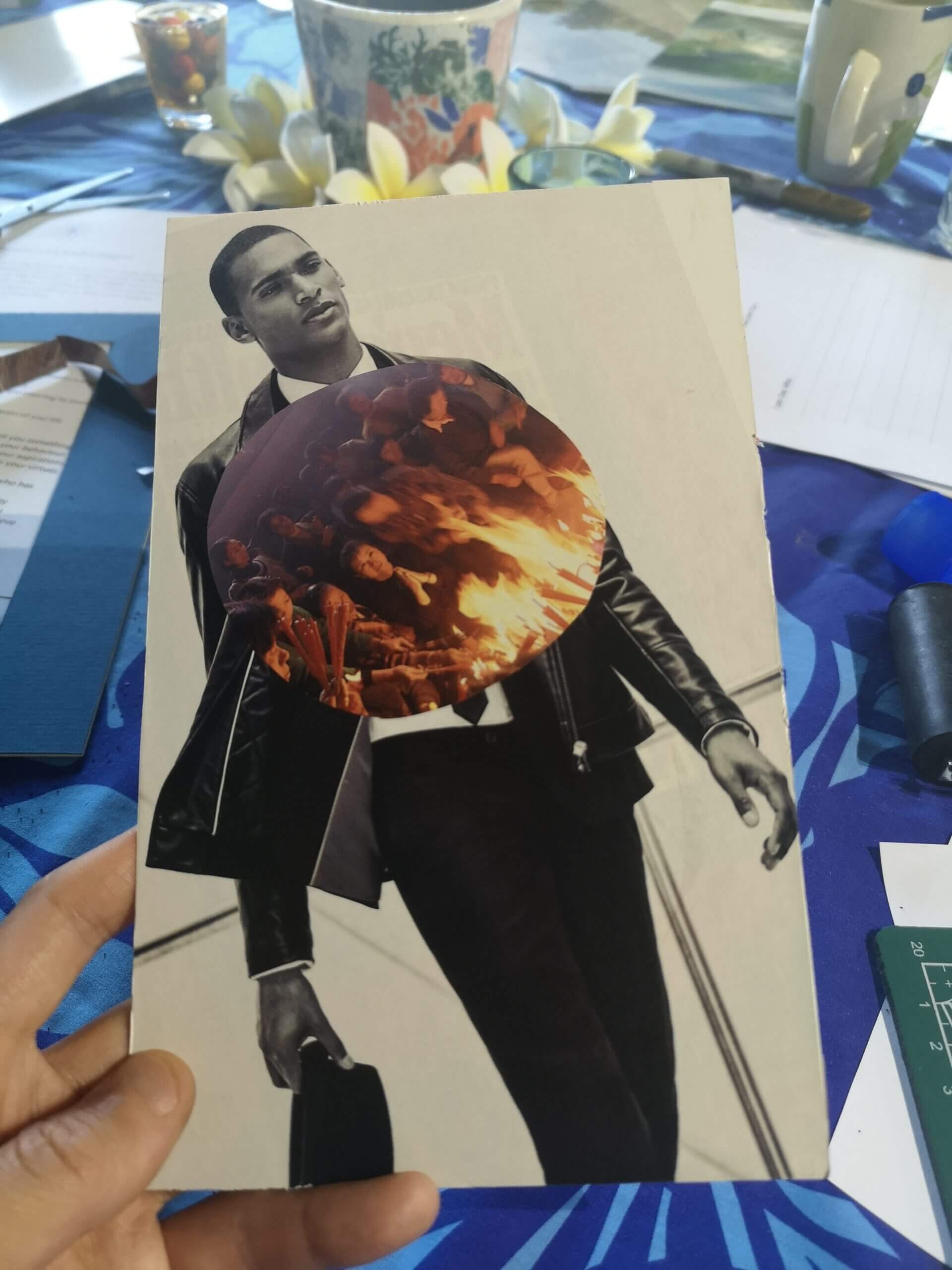
    I go to the table. There are hundreds of loose pages torn out of magazines and brochures, with pictures of everything – beaches, cars, people, plants, animals. I flick through them all quickly, and eventually I pick up a page with a small photo of a bonfire, and I stop.

    I stare at it for two, three seconds.

    It brings back memories of Afrikaburn. A happier time in my life. Right before everything changed.

    I guess this is what she was talking about.

    I take it and go and sit back down with Lucille. She looks at it.

    “Very good. This is the centrepiece of your collage. Remember, it can be anything in this photo that speaks to you – it could be the fire, it could be the people sitting around it, it could just be the colour. It’s all about what you see. Now I want you to return to the table and pick one more picture. This second picture will be your background.”

    I go back to the table. I don’t know what I’m looking for, but I find a picture of a guy. He has a leather jacket and he looks confident and focused and most importantly, at peace.

    I take it back to Lucille.

    She puts a pair of scissors and a glue stick in front of me.

    “Time to be a kid again,” she tells me.

    She’s right, it is like being a kid again. I cut around each picture meticulously, like I used to in primary school, agonising over the angle I should paste it on, over the straightness of the edges, over getting just the right amount of glue.

    I look up at Roberta and Amandine.

    Silence. Intense concentration.

    We are all kids again.

    Lucille comes over and looks at my finished piece. She smiles.

    “Fantastic.”

    She holds it up and shows the girls.

    “Che belloooo,” says Roberta.

    “It’s beautiful,” says Amandine.

    “Isn’t it?” Says Lucille.

    I try not to laugh. Am I supposed to say thank you?

    She hands it back.

    So now, I want you to do it again – look for the pieces that speak to you. But don’t limit yourself this time. Use as many pictures as you like. And remember – don’t think, just listen.

    We spend the next thirty minutes glueing pictures from magazines onto cardboard. None of us talk. None of us take a break. Somehow, it is so simple and meaningless, but so engrossing at the same time. It feels almost … sacred.

    After we’re finished, and still sitting in silence, Lucille comes out of the house. We’ve been cutting and gluing for hours.

    “Shall we share?”

    The day is dimming now. The sun has started to set. She takes us over to some couches on the edge of her deck.

    We sit in a circle, around a small coffee table. She asks Amandine to go first.

    Amandine talks a lot about loneliness. About being on this island for so long. Being away from her people. I hear her, but I’m not really listening. I’m looking at my own cards, wondering what they mean. But the truth is I know exactly what they mean. I’m just wondering if I’m courageous enough to say it out loud.

    Amandine finishes. She hasn’t looked up the whole time. How much of her soul has she bared, I don’t know. But she finally looks up at us and smiles, and suddenly it hits me how bizarre this is, how we barely know each other, yet sharing things so intimate.

    “Brendan, would you like to go next?”

    I have three cards.

    I pull out the first one.

    I stare at it, and it takes me a while to start talking.

    “When I saw this guy, I saw … confidence.”

    “I know he is living freely. He’s not afraid of anything.”

    My voice starts to quiver.

    “I miss him. Because I used to be him.”

    I pause. I didn’t expect to be this emotional, but the words catch in my throat. Tears want to collect in my eyes.

    I don’t let them.

    “I chose the fire because … I remember when I had a fire that burned bright like that …”

    “My fire is gone now. I feel like it was taken away from me.”

    “All I want is to heal, so I can have that back. I want to be this guy again.”

    I don’t look up. I’m afraid a tear might fall if I do. I don’t want to see if they’re looking at me, if they’re listening, if they even care.

    I just move on to the next card.

    But somehow, saying this out loud, looking at this card in front of me, it has moved me. I’m reminded the fire is mine, nobody can take it away. You nurture it, fight for it. It can only die if you let it.

    Suddenly, I am so grateful I am sitting here. Maybe there’s a reason I met these people. There’s a reason I ended up on this island. Around this table. I needed to do this. Maybe this is what healing looks like.


    Heading to Rarotonga? Check out my accommodation guide here!

  • A Raro Life Pt. 2: A Pizza At Midnight

    A Raro Life Pt. 2: A Pizza At Midnight

    A Raro Life is a chronological recollection of stories from the six months I spent living in Rarotonga during the 2021 Covid lockdown.

    I’m on the beach, reading.

    This is tradition now.

    Every morning.

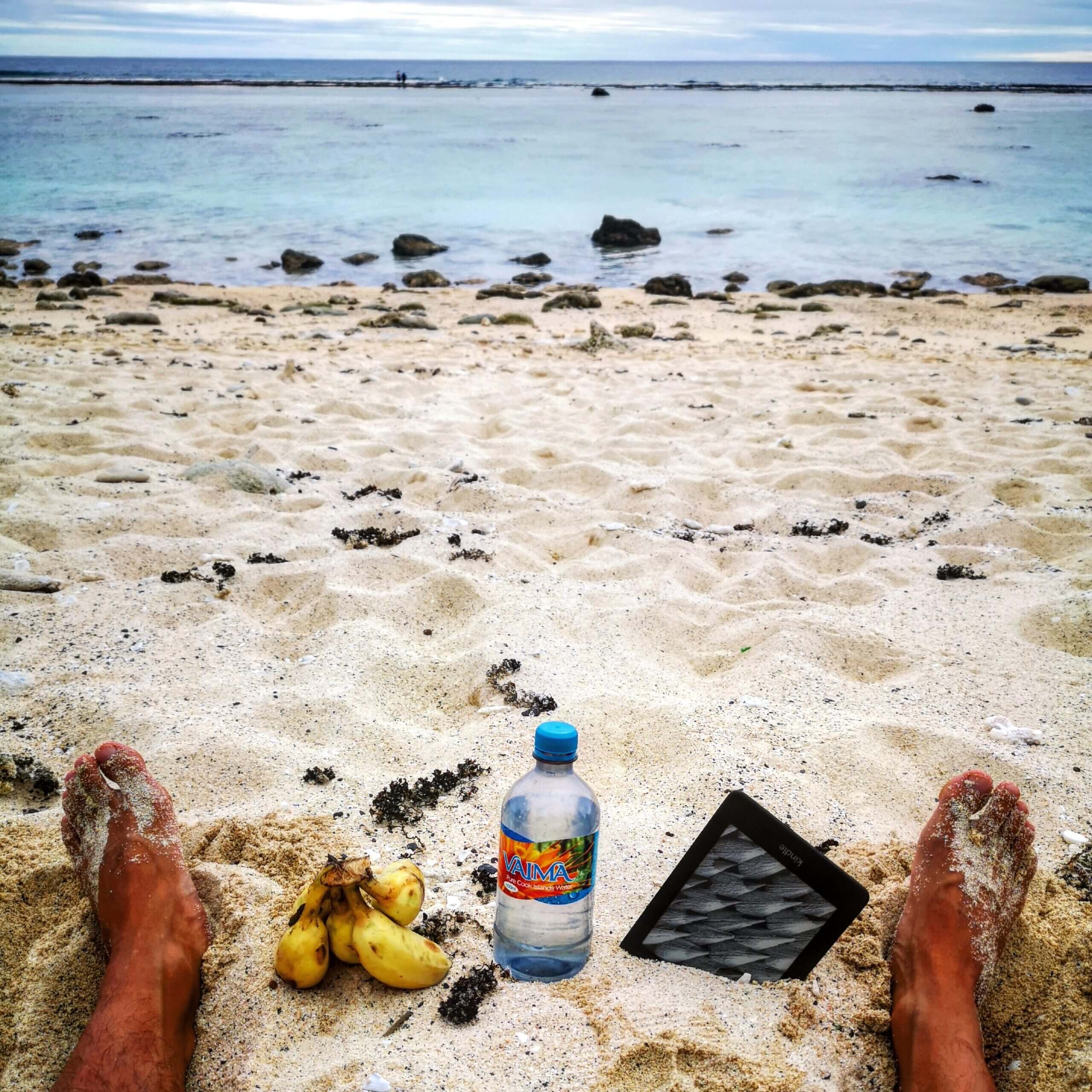
    Bottle of water, Kindle, the sun.

    It’s not the prettiest beach, but it’s my beach. Three minutes walk. And always empty. I have the same spot each morning. Under the first coconut tree.

    Engrossed in my book, I hear a voice.

    “Hii!!!”

    I look up. A girl is waving. Sarong. Big sunglasses.

    “Oh. Hey. What’s up.”

    The Swiss girl from my kitchen.

    She walks over.

    “I’m gooood, how are you?”

    Frenchest of French accents.

    “Just…reading. What’s goin’ on?”

    “I’m going to take a little swim!”

    She stands a few metres away, looking down at me through her sunglasses. Asks what I’ve been up to. How I like the island.

    I tell her I’ve been doing … nothing. And the island’s great.

    Then, finally, as if we’re friends now, she sits down beside me.

    Her name is Amandine.

    “Like Amanda,” she tells me, “but French.”

    As we start talking, I realise she has so much to tell me. All her friends have left. Her boyfriend is in Australia, and their borders are locked. Nobody is allowed in, nobody’s allowed out. And I guess, being here for this long on this small locked down island, you don’t meet so many people. I’m the only new ears she’s had in a while.

    “Do you have plans for later?” she asks. “If you like, there is a sunset party. At Vaiana’s. Just down there. I think most people on the island will be there! So we could go there, meet some people, have a little drink, listen to some music? What do you think?”

    A party. I hate parties. Two weeks ago, you couldn’t have paid me to go to a party. But now, my skin looks half-normal. I feel okay. And I know this now – on the road, alone, you have to say yes. You have to see things, do things. Give yourself a chance to fall in love with a place.

    “Sounds fun. What time?”

    “It starts maybe two. But we can go at four! Do you have a bike?”

    “No.”

    “That’s okay! We can walk! If it’s okay for you …?”

    “Yes, sure.”

    “It will take maybe forty minutes. It’s not too far for you?”

    I laugh. She has a lot to learn about me.

    “I think it should be okay,” I smile.

    She smiles back.

    “So I’ll see you later!”

    She gets up, walks off. Into the ocean.

    Four o’clock comes.

    I go to knock on her door, but she emerges right as I get to the doorstep.

    Long, red dress. Interesting choice, for a beach party.

    “Looking lovely,” I tell her.

    The walk is pleasant. She plays tour guide the whole time.

    “Nice place to watch the sunset,” she says, as we pass the Edgewater Resort.

    We walk past the bakery. “They sell Spanish rolls for a dollar,” she smiles. “Really good!”

    We pass a little path onto the beach. She stops.

    “Have you been to Black Rock?”

    I shake my head.

    “Oh, I have to show you! Let’s go down here, we can walk along the beach.”

    After fifteen minutes of shelly beach, we get there. For some reason, I’m surprised that Black Rock is … just a big black rock.

    “People come here to watch the sunset,” she tells me. “Sometimes, you see whales. Down there, it’s a good place for a little swim!”

    That seems to be her favourite word. A little swim. A little drink. A little walk. Everything is little, just like in French, everything is petit.

    We walk another fifteen. Arrive at Vaiana’s.

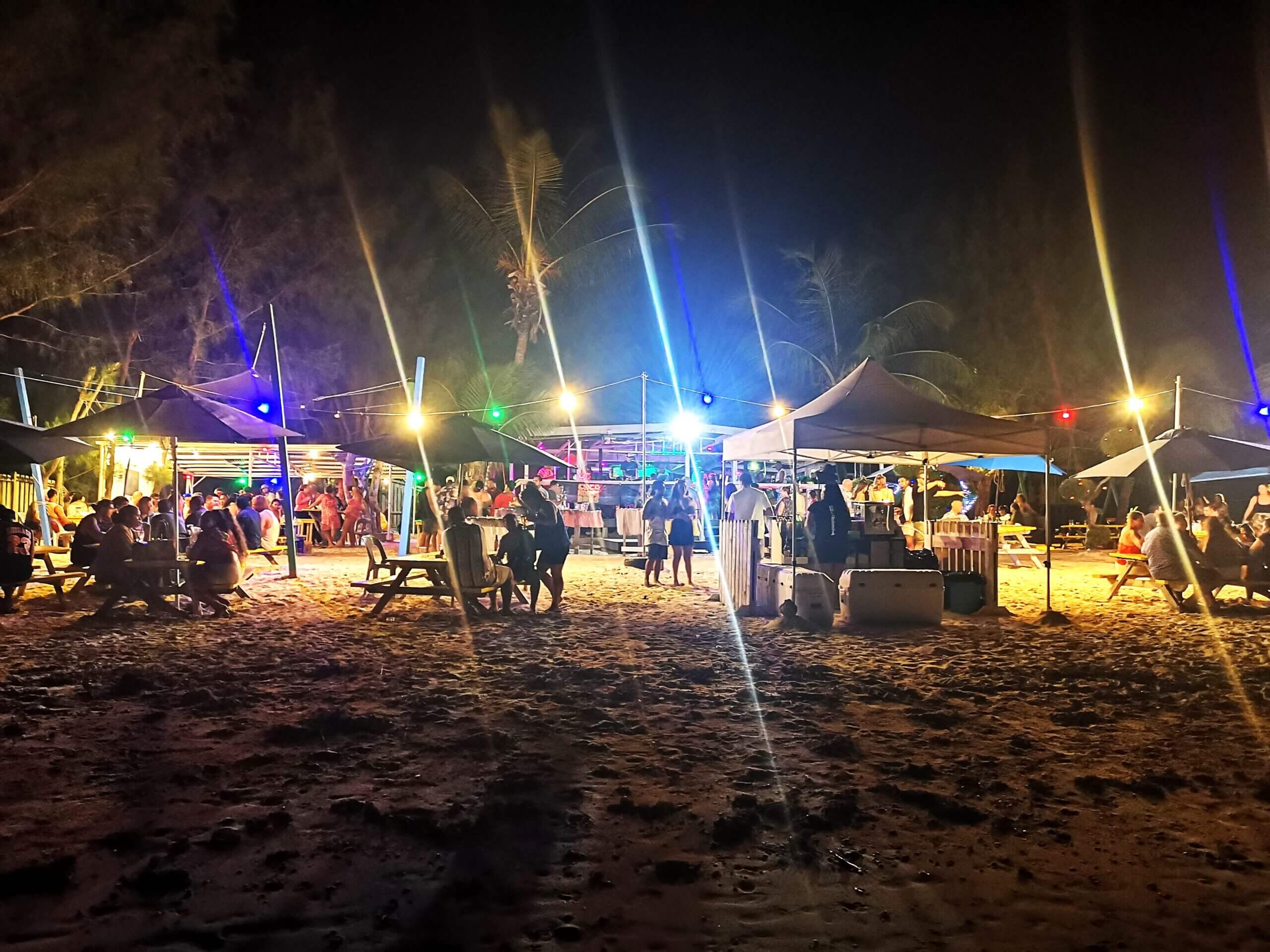
    It’s a gorgeous beach bar with tables scattered on the sand. There’s a DJ in the booth slamming tunes, so loud I can barely hear myself speak. The ocean is like glass, the sand powdery white. Postcard quality. Amandine spots a friend. He’s a thin Indian guy, dressed sharp with slicked-back hair and a friendly grin.

    We go to his table. Handshake.

    “Shanks.”

    “Brendan.”

    Shanks is an interesting guy. He’s the finance big dog at one of the resorts. Standing with him at the table, shouting at him over the music, and my island mocktail, I learn a lot about the island. Who owns what. Where the money comes from. Where it goes.

    Standing there talking about the rich people on Rarotonga, we manage to pass hours. The sun sets. Beautiful. The beach gets drunker and drunker. It’s dark. There are kids running around, among people dancing on whatever drugs, among families eating fish and chips, among people drop dead inebriated.

    Magical.

    “My friend is coming,” Amandine says to me, tinkering on her phone.

    “Yeah, who?”

    “Oh, he’s so great! You will love him.”

    An hour later, she points.

    “Here he is!”

    He’s maybe fifty, in a worn tee, long wavy hair, like Jesus. Asian Jesus. Spectacles. He doesn’t really walk, he shuffles. Small steps, like he’s making sure he doesn’t stand on anything.

    Amandine introduces us.

    “Brendan, Kamil.”

    Kamil is soft-eyed, soft-spoken. But the first thing I notice about Kamil, he’s inquisitive. Asks lots of questions. But not stupid questions. Wise questions. Well-thought-out questions. He doesn’t ask what I do, he asks why I do it. He doesn’t ask where I’ve been, he asks where I would like to return to. I also learn, he and I are not so different. Just from different eras. A man who spent his life travelling all over the world, and then again, and then again.

    I also quickly learn, he and Amandine are tight. Inside jokes. Finishing each other’s sentences. Total BFFs.

    “I want to eat,” Kamil says.

    “Here?” Amandine asks.

    “Nah.”

    “Traders?”

    “Yeah.”

    They turn to me.

    “Have you been to Trader Jack’s?”

    Trader Jack’s is a popular restaurant bar in the centre of town, right on the water. Apparently, one of the Rarotonga’s flagship spots, but with closed borders and no tourists on the island, it’s quiet. We walk in. Every table is empty. Kamil and Amandine march right to the corner table on the balcony. They know all the staff. The staff know them.

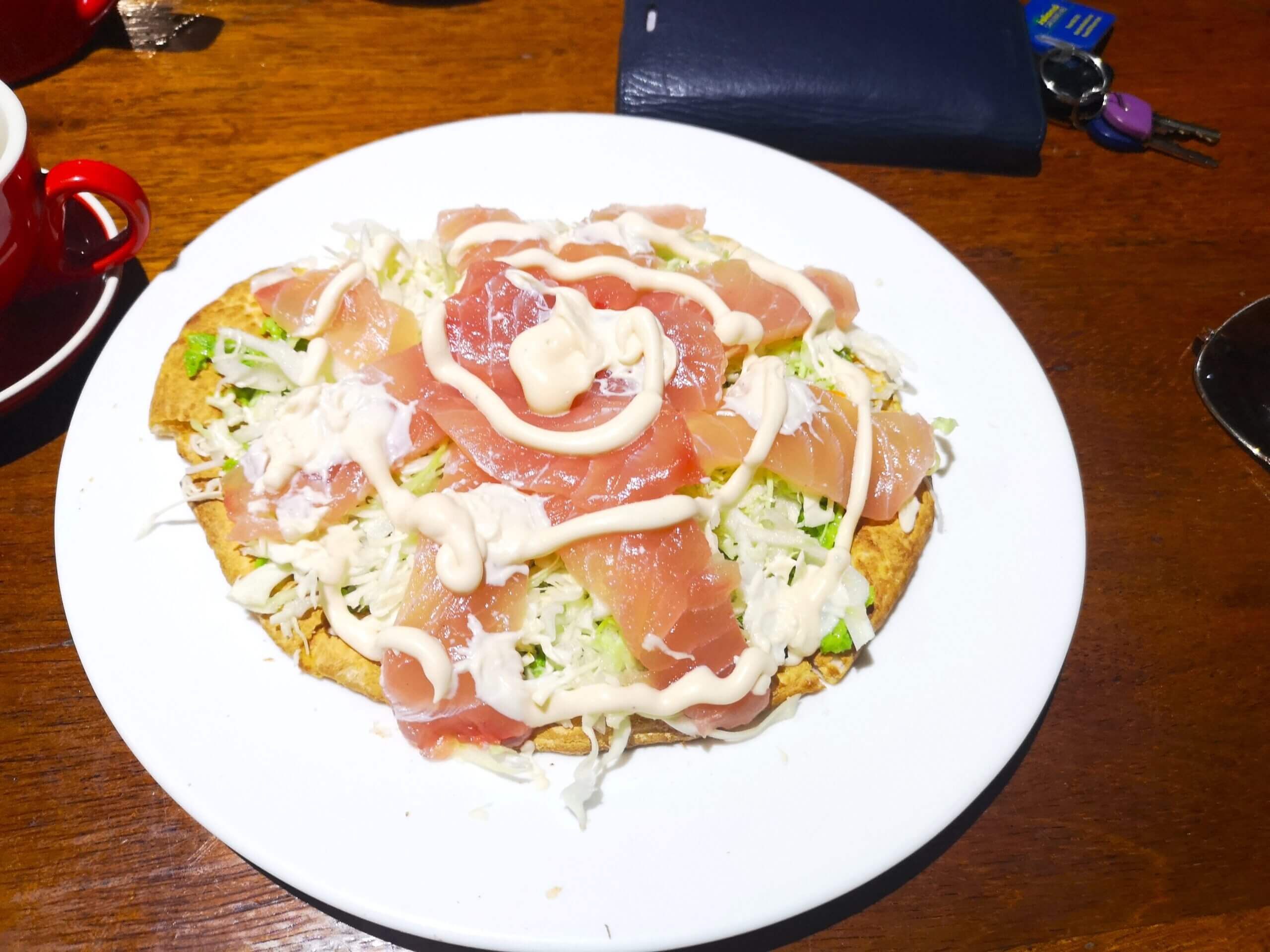
    “Try the sashimi pizza,” Amandine says.

    “Yes, it’s good,” says Kamil.

    “But it’s small,” says Amandine.

    “It’s not that small,” says Kamil.

    “Sashimi pizza?”

    “Yes,” Amandine says. “I know it sounds a little strange, but it is very good! I’m sure you will love it.”

    Because she says it in a French accent, it sounds convincing.

    The waitress comes.

    “I’ll have the sashimi pizza …”

    She nods.

    Amandine gets a drink.

    Kamil orders the nasi goreng, but then asks if he can talk to the chef.

    The waitress goes and gets the chef. The chef comes out.

    Kamil says something about more spicy, less oil, not so oily. The chef nods. Then walks off.

    I raise an eyebrow.

    Mister VIP over here.

    Finally glad to be out of the deafening party, I relax into my chair, the ocean breeze. Amandine and I both sip drinks, while Kamil talks.

    Kamil likes talking. Thankfully, after having travelled so many years, to so many places, he actually has interesting things to say. He talks about Iran, and Indian billionaires, and Malaysian banking. And then, after the nasi goreng is gone, and the sashimi pizza (delicious as promised), and an hour of Kamil’s stories, we finally get up to leave.

    Kamil covers the bill.

    “Thanks, mate.”

    It’s one a.m.

    We get into Kamil’s car.

    “Have you been to Muri, Brendan?”

    “No.”

    “Oh, we have to show you.”

    “Now?” Amandine says.

    “He’s never been!”

    “It’s dark Kamil. He won’t see anything.”

    “Okay, fine.”

    He starts heading toward home.

    On the way, we see two shadows by the side of the road. They have their thumbs out.

    “Hitchhikers,” Kamil says. “Shall we get them?”

    “Of course,” Amandine says, as we drive past.

    “Too late,” Kamil laughs.

    “No, you have to!!”

    Kamil pulls over.

    I turn and see them running towards the car.

    They lean in the window.

    “We’re heading to the backpackers. Next to Beluga.”

    They’re two young guys from Europe.

    “Yes of course,” Amandine says, as if it’s her car, and the two of them cram in beside her.

    As the five of us chat away, I find myself feeling at home once again. Five strangers from different countries, driving along in the middle of the night in a faraway place. I thought I’d never live this life again, but here I am.

    Right back where I used to be.


    Heading to Rarotonga? Check out my accommodation guide here!

  • A Raro Life Pt. 1: Coconuts & Sunshine

    A Raro Life Pt. 1: Coconuts & Sunshine

    A Raro Life is a chronological recollection of stories from the six months I spent living in Rarotonga during the 2021 Covid lockdown.

    It is exhausting to live with this skin condition. It’s exhausting to wake up and deal with it, it’s exhausting to talk about it, to have my life revolve around it, every single day. But here we are.

    It’s been one week since I came to this island.

    I’m staying in a small Airbnb, just off the beach. Since my face has been flared up and mangled, I haven’t ventured too far. I don’t want to see anybody. That’s the whole reason I’ve come here. So I don’t need to see anybody.

    The island is empty anyway. Its border has just opened with New Zealand, whose border is also closed to the world – a “Covid bubble” they’re calling it, so nobody is here. I was on one of the first flights. But I still keep to myself. I wake up, run, then go to the empty beach and read. To eat, I walk across the street to the corner store. The only foods of substance they have are eggs, bread, butter and ice cream. Sometimes papayas.

    So that’s what I’ve been eating for the last week. Egg sandwiches and ice cream. Sometimes papayas.

    But today, I look in the mirror and my face looks kinda … better. My face isn’t red. It’s brown. Just one week. Is my skin really getting better? It’s not near perfect, of course, but I look at the patches on my neck, down my arms, and my skin looks … relieved. Maybe my skin likes this place. Maybe I can show my face to the world today. Maybe I can even go for my first swim.

    Roberta and Carlo – my landlords – are the only two people I’ve talked to. They’re an old Italian couple. Very sweet. Roberta told me she’s coming by to clean my room today. I told her, not in the morning. She said it has to be before five, because she has somewhere to be. I said two o’clock. So I have the perfect day planned. I’m going to spend the morning reading by the water. Then at lunchtime, instead of walking along the beach, I’m going to swim along it. I’m going to swim to the nearest resort, have lunch, then swim back, read until sundown and go to sleep.

    I sit on the beach all morning with my best friend. His name is Kindle. Then just before two, I head for the water. The water is warm, tropical warm. I wade out until it’s shoulder height, set my watch and go. The water feels shallow, but deep enough for me to swim freely. It’s crystal clear. Fish everywhere. Sea cucumbers, blue starfish. Everywhere. As I glide through the water, I mouth a word. Paradise. This ocean is my personal fish tank, there’s nobody but me, and while submerged I can forgot about my red flaking skin, and I just swim and swim and swim.

    Six or seven minutes go past before I pass the first resort. I pull up my goggles and scope it out. It doesn’t look right. The tables are all empty. There’s nobody in sight. It looks tired.

    I keep swimming. Pass another. Not this one either.

    That’s okay. I’ll swim all day, until I find one I like.

    After about twenty minutes, I see one. Laid out on the beach, stylish, clean.

    I swim to shore, walk up to the restaurant dripping, barefoot, topless.

    A friendly lady strolls out.

    “You guys serving lunch?”

    She winces.

    “Our lunch just closed.”

    “It’s alright. I’ll try you tomorrow. What’s this place called?”

    “O-tee-bee.”

    “Oh tee what?”

    OTB. On The Beach.”

    “Oh, OTB. Cool. See you tomorrow.”

    I walk back home, along the beach. A week ago I was shivering through painful winter nights, skin flaring across my face, now, I’m drowning in Pacific island sun. TSW is a complex beast, but I’ve learned a few things – during a flare, my skin loves sunshine, loves humidity, and hates New Zealand. Especially New Zealand winter. So I bask in the sun, breathe the humidity deep into my lungs. It cooks me until sweat starts to drip from my brow and armpits. I rub the scars on my arms, my chest, see the flashbacks of the pain this skin has been through. The sun healed me back then. It will heal me again now.

    I get back to the house. From the driveway, I can already see someone scrubbing my bathroom window inside.

    It’s Roberta. Or Carlo. Adorable.

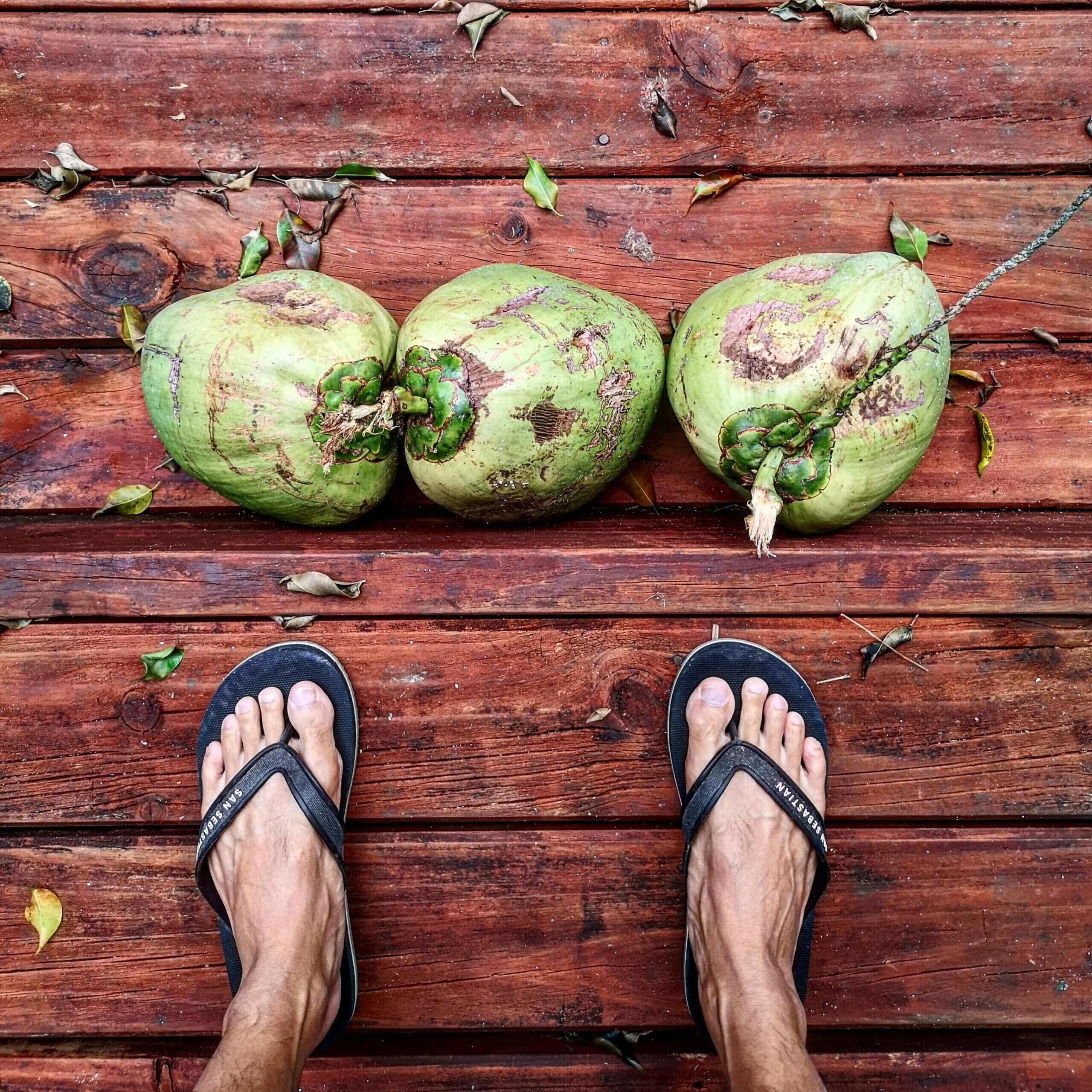
    I don’t want to get in their way, so I go sit on the lawn and work on my coconuts. I collected them yesterday. I’m terrible at husking coconuts. I wish I could blame it on Carlo’s blunt machete, but I think I’m just useless. The village idiot who hasn’t learned to husk a coconut yet. But practise makes perfect, so I line them up, four, five of them, and chop chop chop.

    Finally, I get one open, and go inside to get a spoon. Roberta is in there, scrubbing the floor, and Carlo is in the bedroom doing something. And there’s a young girl in there. Chatting away. She sees me and smiles warmly.

    “Hi!!!!”

    “Hey. Hi.”

    She’s pretty.

    I turn to Roberta.

    “This your daughter?”

    She laughs.

    “No. Well…yes.”

    I turn to the girl.

    “You’re her daughter?”

    “Their adopted daughter,” she laughs.

    Her eyes are brown. Her hair is brown. Her skin is brown. But not chocolate brown. More like a Mediterranean olive brown. She has a button nose, and a slight overbite with nice straight teeth. While standing in my kitchen, scrubbing my bench, she tells me her real story. She’s Swiss. French Swiss. French accent. Very French. Geneva, probably.

    “I was only supposed to be here for two weeks, she tells me. Then we had the pandemic. So I’ve been stuck here since then. Fifteen months.”

    “Fifteen months?”

    She smiles.

    I figure she’s told this story a million times already, so I don’t ask.

    “How do you know Carlo and Roberta?”

    She shrugs.

    “It’s a small island. And I go with her to yoga sometimes. There’s yoga tonight actually. Tuesday. You should go!”

    “You do yoga, Roberta?”

    Roberta pops her head up from under the kitchen counter.

    “Yessss! Toniiiiiight. You waaant to goooo? Fiiiive o’clock.”

    “And it’s Michelle tonight,” the Swiss girl says. “She is the best, oh! She is amazing. Amazing! You will love her. Seriously.”

    I think about it quickly. I want to stay home. Read a book. Like every other night.

    C’mon, I convince myself. Do something. It’ll be good for you.

    “Yeah, okay. I’ll go.”

    Five p.m. rolls around. I go sit outside Roberta’s door. I’m excited. Maybe anxious. My first Raro activity.

    Roberta comes down very yogi-looking, yoga pants on, yoga mats tucked under her arm.

    “Reaaady?”

    The car ride with Roberta is – how do I say – entertaining. Italian people know how to talk. Like a non-stop stream of consciousness pouring out, with an Italian drawl. Naturally, I learn a lot about Roberta and Carlo on this car ride. I learn that Carlo makes a fantastic pizza. They used to own an Italian restaurant on the island. People were sad when it closed. They met in their thirties. But only got married ten or so years ago. She can’t even remember the year, and laughs about it. And I can tell, she loves Carlo. Carlo is really good at this, he’s really good at that. This little bald Italian man with a pot belly, but with the million dollar smile, he has this lady swooning. I see it. Carlo is indeed a pretty cool dude.

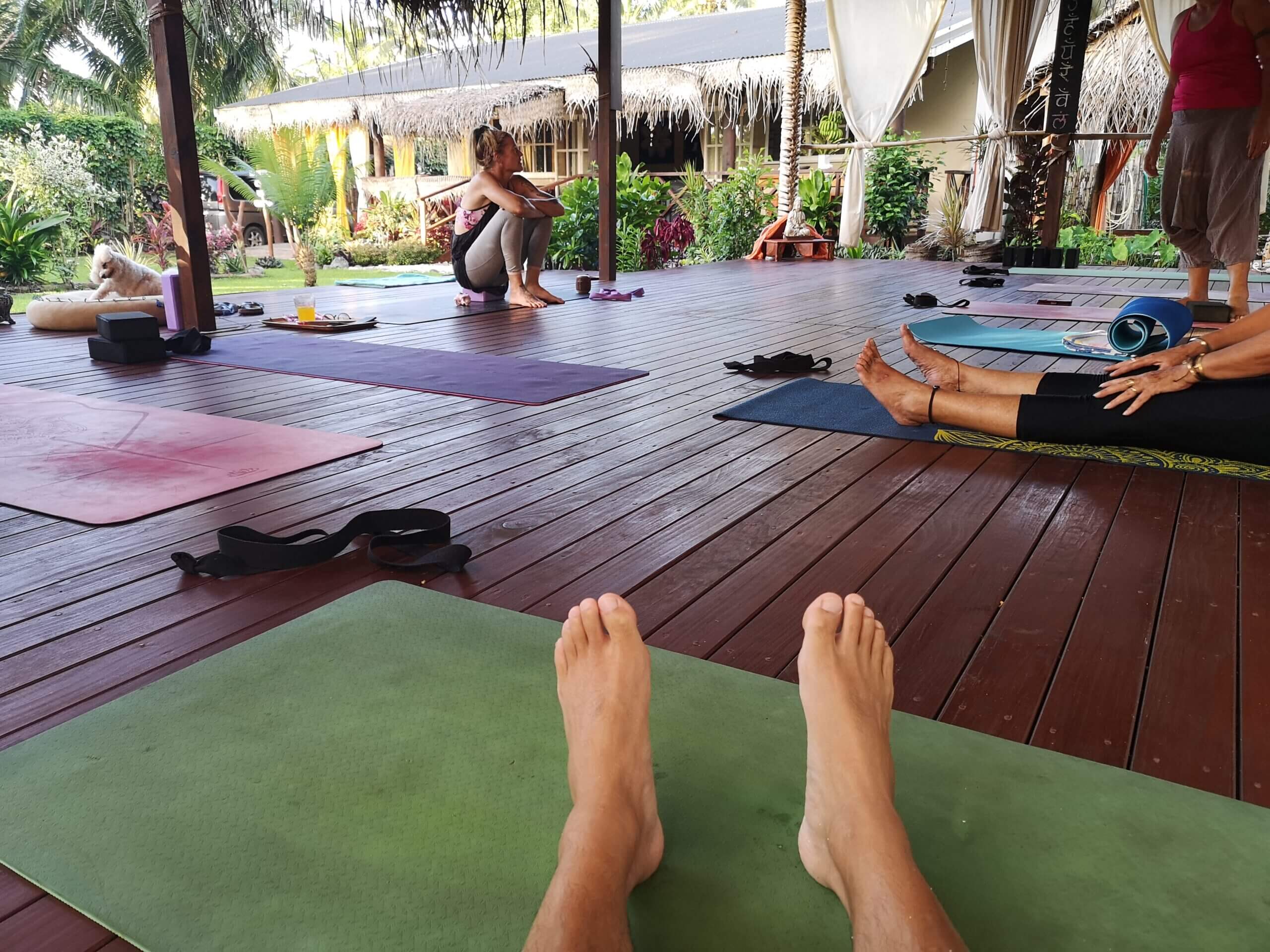
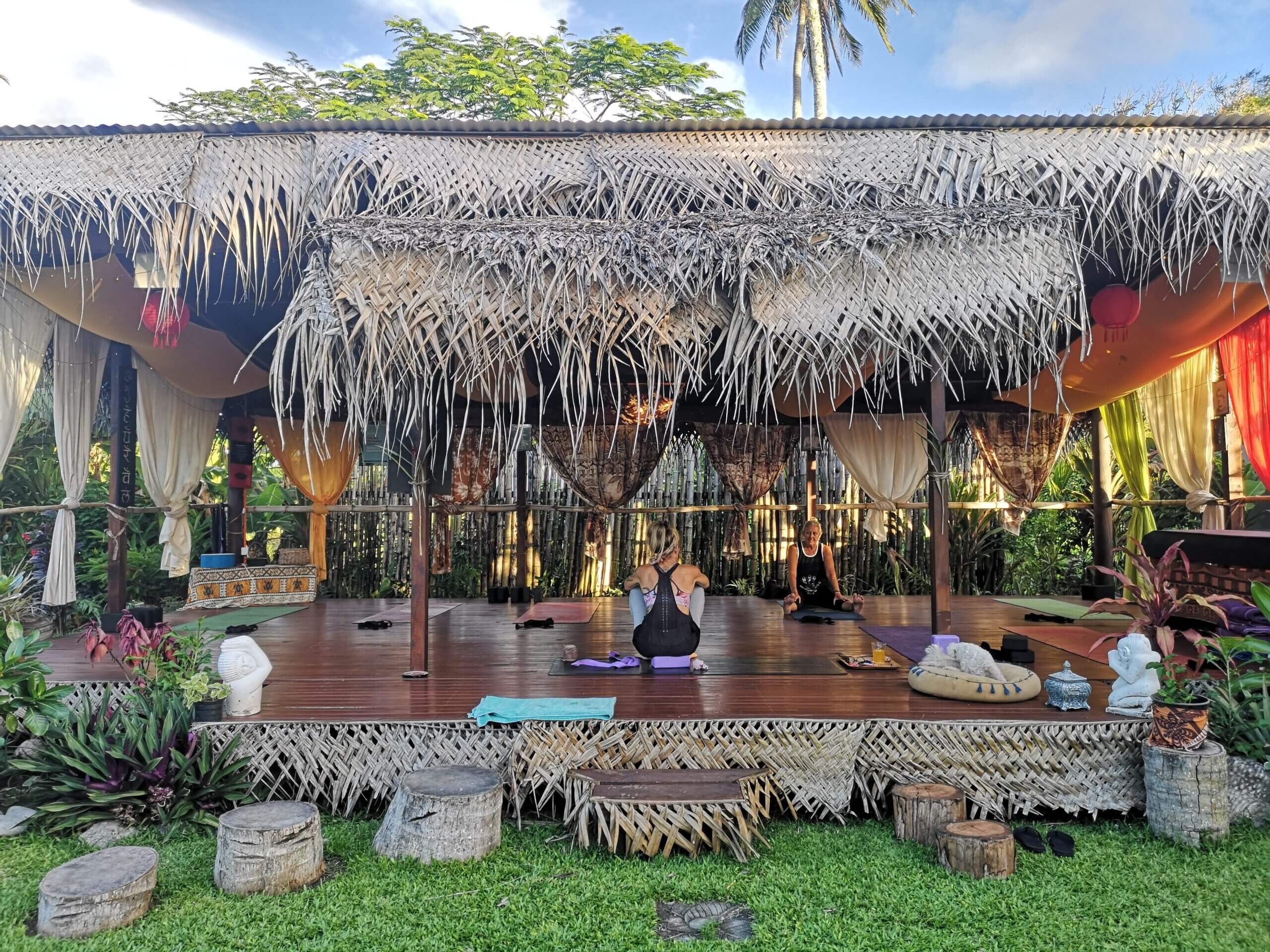
    We get to the yoga place. I have no idea where we are, which side of the island, north, south, inside, outside. But we wander down the long driveway, pass under the little arch, and emerge into a little sanctuary. There’s nice curtains and flowers and lots of green open space with fruit trees and aloe vera plants and stepping stones. We walk across the immaculate lawn to a beautiful covered deck with Christmas lights.

    “This is Brendan,” Roberta says.

    “Oh hi!!! Hi!!! I’m Michelle.”

    Michelle’s name shouldn’t be Michelle. It should be Sunshine. That’s what she is. Absolute sunshine. She’s in her forties, fifties, I don’t know, but has the body of a nineteen-year-old gymnast, long, messy blonde hair, tattoos from her feet to her shoulders, and from the moment we meet, I can feel her warm smile and soothing voice and kind eyes, her loving spirit oozing with tenderness. All I can think to myself is, she is sunshine. At a time in my life when I am desperate for sunshine, I have now met sunshine herself.

    The yoga class is small. Four of us. As the sun sets on the island, we spend an hour listening to Michelle telling us to breathe and twist and stretch and finally, once we’re all dripping with sweat, to lay down and relax. Shavasana. I lay there and make peace with the mosquitoes, and the mosquitoes make peace with me. The others swat their arms, but for some reason, I stay unbitten. Somehow, all my pain is gone. For the first time in months, I have no pain. No pain. My skin feels normal. I am at peace here. I don’t want to leave. I want to stay. Not just on this deck. On this island. I want to stay here forever.

    … to be continued.


    Heading to Rarotonga? Check out my accommodation guide here!

  • Love Cape Town

    Love Cape Town

    At first glance, The Zebra Crossing was just your regular hostel. Fifty beds, small lounge, small kitchen, little courtyard for the smokers. But like all good hostels, it was operated with love. And like all hostels operated with love, it became home.

    It was Doniel who checked me in. The cheeriest of smiles, caramel skin, short shoulder length hair, a pair of warm eyes behind black rimmed glasses. As she showed me the bathrooms, she reminded me Cape Town was in a drought, and not to shower longer than two minutes. Then she showed me the kitchen, and reminded me to wash the dishes with the tap off, and use as little water as possible. And I knew she loved working in hospitality. I knew that, because when she showed me to my room she said, “I really love working in hospitality!”

    That’s how I met Doniel.

    My room had eight beds but was empty, except for one other guest, presumably female, who looked like she’d been there a while. She had those Arabian looking blankets hung around her bunk like curtains, and all her clothes folded neatly on the bed above. It’s an oddity to find someone who actually unpacks in a hostel dorm. When you see it you already know; that person is either very strange, or a first time traveller, or is living here.

    That night I learned the owner of that bed was a black South African woman, tall, skinny, an artist, maybe in her forties, very upbeat, chatty, vibrant, and I was right, she was living here in the hostel, and working here too, and had been for some time. Out in the courtyard late that evening, I sat on one end of the couch, wrestling with the wifi, and she sat on the other, puffing on a cigarette. And in between wifi signals and puffs of smoke, we started talking. An hour, and then two, and maybe three.

    That’s how I met Stephanie.

    A few mornings later, I was, as usual, on my laptop in the lounge. I’d been in Cape Town three or four days now, and spent the mornings sitting against the back wall, at the large wooden dining table, with full view of the room, and anyone in the room with a full view of me. When Doniel arrived for work that day she walked through the lounge to reception, and we exchanged good mornings. Then just after her followed a young woman, strikingly pretty, with pale skin and a sharp nose, dark straight hair that fell to her shoulders. And I wasn’t sure if I should also say good morning to her, so I just smiled, and she smiled, and then she was gone.

    A few minutes later, she was back. And Doniel was teaching her how to fold the big stack of sheets sitting on the couch, and how to make the beds.

    “Are you working, Brendan?” Doniel finally asked, in between folds.

    I nodded, and she smiled, saying, “Whenever people need to work, that’s always the spot they sit in.” Which led to a conversation about what I do, and all the questions that always follow.

    “That’s so interesting. I’d love to learn something like that, I have so much time these days.”

    “I can sit down with you some time, and show you a few things, if you want.”

    “I would love that.”

    And she turned to the pretty girl and said, like a big sister, “See! You should talk to people more often. You never know what you might learn.”

    Not long after that, Doniel left to attend to something else. And the pretty girl suddenly became chatty, asking me all sorts of things.

    “So what’s your name, by the way?”

    “Erin.”

    “Ellen?”

    “No Erin, with an R.”

    So we chatted for the morning, while she folded sheets, and wandered in and out of the rooms, making up beds for the guests who were to arrive that day.

    That’s how I met Erin.

    It was later that same day a gentleman came into the lounge to lay on the couches. I was still on my laptop, sitting in the same spot, against the back wall, at the big wooden dining table. I’d seen him wandering in and out of the hostel in the previous days, but we’d never crossed paths in a way that required me to introduce myself. But now here he was, sitting right in front of me.

    “I’m a driver,” he told me. “I drive people around for the same rates as Uber, so if you ever need to go somewhere, call me.” At first I had no intention of calling him, since using Uber was already so easy, but as we talked I learned more about him, and he explained “I tried to apply for Uber, but they rejected me because my car is too old, only people with new cars can apply. So I started my own thing with the hostels and I find my own customers. Because we need to hustle, right? We can’t let this capitalistic world keep us down.”

    And I thought to myself, this is a man with his mind right, and the right kind of energy to be around. And I decided right then I would surely call him for a ride any time I got the chance.

    That’s how I met Craig.

    It was probably after a week, at the incessant pleading of Doniel, that I finally got off my laptop. I hadn’t been further than the supermarket down the road, and Doniel convinced me to at least do the free walking tour.

    As I was sitting on the couches tying my laces and getting ready to leave, Craig went rushing out the front door, and yelled out “Sharp!” as he ran through the lounge. Then he popped his head back in and said, “You learned that yet, B?”

    “Learned what?”

    “In South Africa, when we say bye, we say sharp sharp! It means like, everything’s cool.

    So I repeated after him, “Sharp sharp” and the cleaning ladies on the couch opposite me cackled with laughter, before Craig also joined in with a giggle.

    “You got it,” he laughed. “Alright, I’ll see you guys later. Sharp.

    Cape Town is an odd kind of city; it feels big, and modern, but is built in patches of nice and not-so-nice. As I walked down to the centre I found myself on streets with cafes and juice bars thinking, “What a nice street”, but would continue onto the street right next to it and think, “Maybe I shouldn’t be here.” Luckily it didn’t take long to get to the centre, where I quickly found the cafe with the big umbrella, the words “Free Walking Tour” plastered across it, and the walking tour manager standing under it with her walking tour clipboard.

    “Is it your first time doing a tour with us?”

    She was maybe 5’1 or 5’2, plump, buxom, big round cheeks and small eyes, a little afro dyed blonde with the cheekiest smile on the street.

    “Okay just sign up here,” she said, handing me the clipboard, “And we’ll be starting in about ten minutes.”

    I overheard her say something in another language while I scribbled my name on the sheet.

    “What language is that?”

    “Xhosa.”

    “It’s cool.”

    “Yeah it is!” she laughed.

    “And your haircut is cool. Like Chris Brown’s, but cooler.”

    And she put the clipboard down and hooted with laughter.

    That’s how I met Florina.

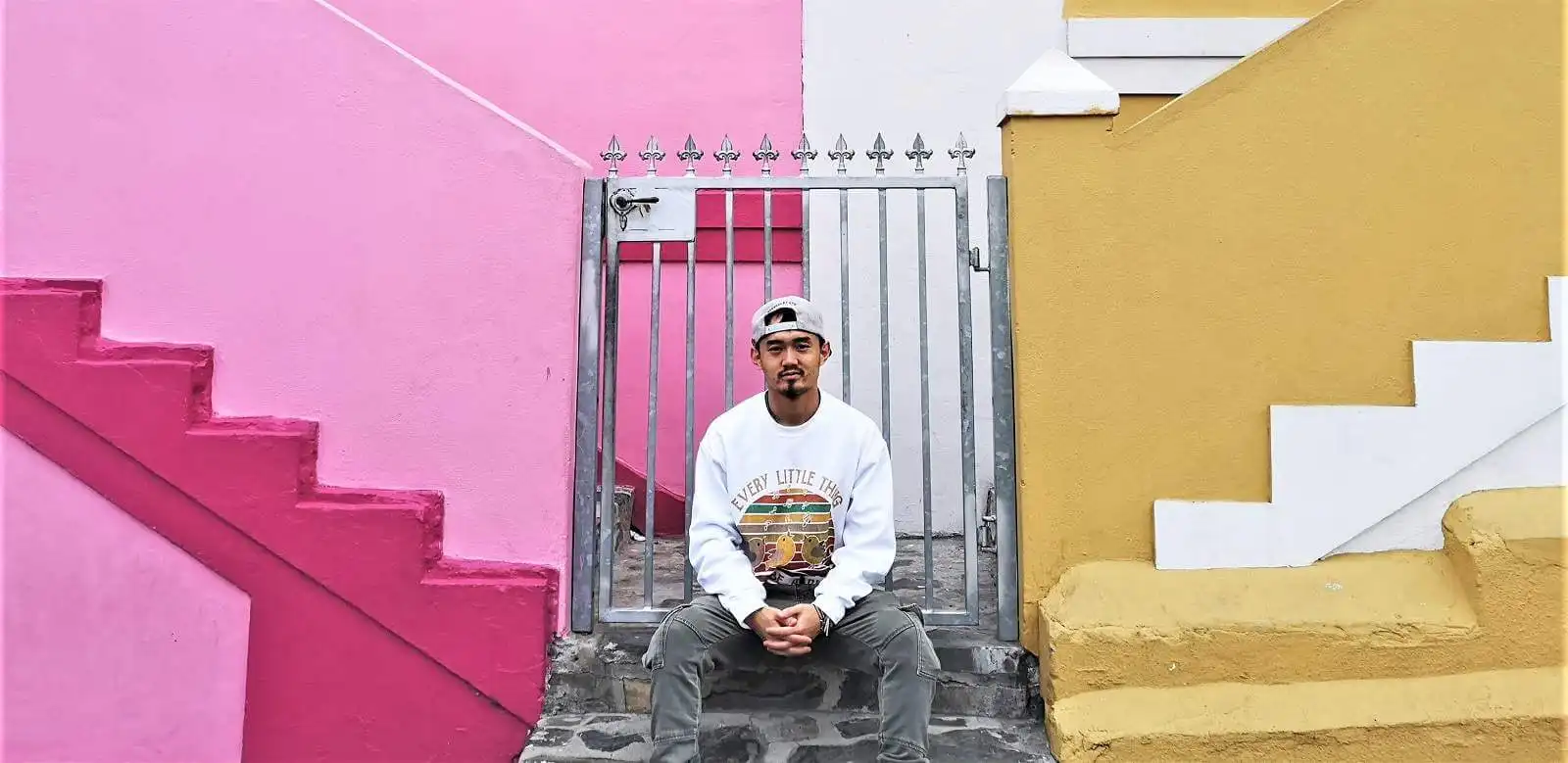
    I did the Apartheid Tour that afternoon; we walked past the court where various Mandela trials took place, the site of apartheid founder Verwoerd’s assassination, the now demolished counter-culture hotspot of District 6. It was my first look at downtown Cape Town, and again, something struck me about its streets I couldn’t quite put my finger on; a fine city, well built, just a little neglected perhaps, like a really nice apartment that hadn’t been cleaned in a while. You’d walk past a street with a really nice hotel, and the whole street was colourful and polished, with fancy coffee shops and park benches and big tall trees, and then you’d turn the corner and it was back to the colour of old concrete.

    When we got back to the cafe, Florina was still standing there with her clipboard. It was as if she were a permanent fixture on that street, like a lamp post or a statue, always in the same spot, under the same umbrella, with the same smile on her face. It was now nearing 4pm, and she told me the Bo Kaap tour was just about to start. I thought, “How proud Doniel will be, that I did not one, but two walking tours today,” and signed up for that tour as well.

    The Bo Kaap is the Muslim quarter of Cape Town, where the Indonesian and Malaysian slaves were housed 300 years ago, the streets still lined today with the world famous colourful buildings, the old mosques, and an endless stream of tourists selfying their lives away. That tour took us right until sundown, and when the day was over and I was back at the dining room table, nursing tired legs and flicking through my photos, I thought, “Doniel was right. What a great idea that was, to finally go out into the city today.”

    The next day I was in the city again, this time to finally start my shopping for AfrikaBurn. This was why I had come to Cape Town; to attend this week-long cultural gathering in the nearby Karoo desert. I still had a few weeks to prepare, but also had an entire shopping list of supplies I hadn’t touched yet. Doniel suggested I head to the Grand Parade, where the second hand market came alive twice a week. We had walked by there during the tour the day before; it was the site of Mandela’s famous speech the day he was released from 27 years in prison.

    I got there and wandered through the square and surrounding streets, surveying the street stalls and prices, the jewellery, jackets, bags, all things I needed in abundance. I didn’t buy anything that day, but the following day I returned, a greater idea of what I was dealing with. One thing I needed was gifts, to give to the many people I would meet in the desert, so just off the Grand Parade I stopped by an old jewellery stand that had given me the cheapest prices the day before.

    I asked again, “How much for these?” and he said “Twenty rand” like he had the previous day. They were bracelets with lettered beads, that spelled out names, hometowns, quotes.

    So I asked, “Can I give you my own words to write?” and he said “Of course, I can make anything.”

    So I said “If I buy twenty, how much?” and he thought about it for a second, and said, “Fifteen rand.”

    And I nodded and said, “What about if I buy fifty. Will you do them for ten?”

    And he looked at me again to make sure I was serious, and then said, “Okay” and told me to come back in four days.

    That’s how I met Adam.

    The next day I was tent shopping in the city, and Adam’s shop wasn’t far from where I was, so I went to see him again. He had already threaded a few bracelets and showed them to me, and as I was about to show him a mistake I overheard him speaking to his friend. It was Swahili, so I asked, “Are you from Kenya?” and he said “No,” with a smile. “We are from Tanzania”. Immediately my heart lit up, Tanzania being a second home of mine, and at once I could suddenly see it in his face and hear it in his accent, and I wondered why I hadn’t noticed it before. So I introduced myself, as an adopted child of Moshi, and an Mbongo, and a Chaaga, and him and his friend laughed, as it must always be a novelty to see someone with my face speak their language.

    And from that point Adam and I were friends, and I would stop by in the afternoons almost every day, he would invite me to sit with him at the back of his stall, teach me how to thread bracelets, ask me about Moshi, and it seemed there were Tanzanians all around this street; they would stop by and say, “Hey, you’re the boy from Moshi?” and I would laugh and say “Ndio!” And they would giggle and say to their friends, “Aisee mchina anaongea Kiswahili” (Man this Chinese guy speaks Swahili!).

    The following week, I finally ventured further out from the centre. There was a local suburb called Wynberg in the city’s south, with a couple of second hand stores I wanted to visit. I hoped they would have the extravagant coats and hats and boots I wanted for AfrikaBurn, the kind the city’s shops weren’t extravagant enough to sell. I went into reception that morning to ask Doniel if there was a bus, and how to catch it, in fact I’d already started shouting my sentence, “Hey, Doniel” before I even walked in the door. But to my surprise it wasn’t Doniel sitting behind the desk, it was Erin.

    She looked up startled, then smiling, stopping my voice in its tracks.

    “Oh. Good morning,” I said.

    “Hey. You’re still here?”

    She had a thick South African accent, the rolling of her R’s extra clean and extra sharp.

    “Well, obviously.”

    “I thought you’d left.”

    And distracted by a pretty face, I ended up sitting there talking to Erin all morning. And I learned she was barely out of school, and didn’t actually have a job at the hostel, but was related to Doniel through a marriage, to a cousin, or something similar, and she had a daughter, and a boyfriend, or fiancé, I don’t quite remember. But what I noticed most was how she had seemed so painfully shy the first time I met her, and now, she literally talked non-stop, with great energy and gusto. And by the end of that morning I had become seemingly good friends with Erin.

    “So can you tell me how to get to Wynberg?” I asked finally.

    “Where?”

    “Wynberg.”

    “I’ve never heard of it, where is it?”

    “Uhh. In Cape Town.”

    “Yeah but….say it again?”

    “Wynberg.”

    She screwed her face up, and started typing something into Google.

    “Erin you can’t be a hostel receptionist if you don’t know where Wynberg is. What if a guest, who’s not as nice as me, asks how to get to Wynberg and you can’t help them. That will be such a bad Tripadvisor review.”

    I leaned over the desk as she pulled up the map, and I took the mouse from her, scrolled east, and then down, until it was bang in the middle of the screen.

    “There.”

    “That’s W-I-N-E-berg!!!!” she screamed. It was loud enough that I pulled away, thinking she might attack me, or at least continue screaming for a few more sentences.

    “But it’s spelt Winberg,” I laughed.

    “Oh my god it’s Wineberg you can’t even read.”

    “Winberg Wineberg. Same thing.”

    And so we sat there arguing about how to say Wynberg for another half hour, before I finally left to the centre to catch the bus.

    Getting around Cape Town isn’t difficult, but can get confusing for a newcomer. There’s a rapid transit system, but it’s confined to the central suburbs so most people use buses. But they use minibuses or vans as their buses, and they call these buses “taxis”. Which means they can’t call actual taxis “taxis”, so they call them “cabs”.

    On the walk down to the city, I passed by the walking tour cafe, and of course Florina was standing there, with her clipboard, under the big walking tour umbrella.

    “Hey Chris Brown.”

    She laughed her big hearty laugh and hugged me.

    “I’m heading to Wynberg,”

    I pronounced it correctly this time, feeling like a proud local.

    “Why the hell are you going to…Wynberg?”

    “To go clothes shopping.”

    “In Wynberg?”

    “Yeah there’s a second hand shop there.”

    She looked at me skeptically, and then finally nodded and said, “Okay, it’s easy, just go to Grand Parade and get a taxi.”

    “But it’ll be way too expensive,”

    “It’s only 20 rand for a taxi,” she frowned.

    But after looking at me again for a split second she figured out what was happening and said, “No baby, not a cab, a taxi.”

    It was only a flashback of a vague memory from Uganda, where I remembered having a similar confusing conversation – as in Uganda they also called their buses taxis – which made me click and I said, “Oh! A taxi is like a bus, right?”

    And Florina laughed and said, “Yes, exactly.”

    Adam’s shop was also on the way to the bus stop, so I stopped there quickly to say hello. He showed me more of my bracelets, which looked good, and as I left I said, “I’m off to catch a taxi to Wynberg” and he nodded, like there was nothing odd about that sentence. So as I left I said “Sharp!” and again he grunted like that was a perfectly normal thing for me to say. And I thought to myself, “Yes, I’m finally sounding like a real Capetonian.”

    That bus/taxi ride was like a mini tour of outer Cape Town; the streets outside the city were much rougher, much emptier, more run down, a little less welcoming on every front. A far cry from the boutique malls and cafes of upper Kloof Street where the hostel was, and what had become home. Wynberg turned out to be rather busy, and didn’t feel dangerous, though didn’t feel completely safe either. Although nobody really looked at me too funny, and I figured it was all in my mind, that I would be just fine, and I was just fine.

    When I got back to the hostel that afternoon with my bag full of steampunk clothes – furs, plaid shirts, vests, boots – Doniel, Stephanie and Erin wasted no time diving into my costume planning. I had merely gone to ask Erin for a pair of scissors, but then Doniel came in and started looking through everything, and then Stephanie joined in, and suddenly all three of them were onto those clothes like it was crack, and they couldn’t stop, and there was now nothing more important to them than dressing me up and making me look fabulous.

    “No, no, you can’t sex that one up. This one, put this one on.”

    “Yeah that one.”

    “You can definitely sex that one up.”

    “Maybe cut the sleeves off.”

    “And wear this around your wrists.”

    Snip snip snip.

    “Open the chest a bit.”

    Snip.

    “Oh yeah, that’s hot.”

    “HOT.”

    “So hot.”

    “Now I want to go to Afrikaburn too!”

    “What if you put that one on top?”

    “And then the vest.”

    “I don’t think he needs the vest.”

    “Okay there. Like that.”

    “Gotta show his arms, definitely.”

    “Of course.”

    “There we go.”

    “I love it.”

    “Hot.”

    And I thought to myself, “This is what it must be like to have sisters. Wouldn’t it have been nice, to have a sister or three.”

    From then on I found myself walking into central Cape Town almost every day. It was a fifteen minute walk from the hostel, and now that it was familiar it always felt safe, the police on each block making it feel doubly so. However, I always made sure to avoid the infamous Long Street, tourists conjugated there, and locals knew it, always roaming that street to ask people for spare change or food. The walk downtown always took me along the same route, where I would stop and have a hot chocolate with Florina, and then stop and chat for an hour with Adam, say hi to some of the other shopkeepers in the market I’d befriended – the sock lady from Cameroon with whom I practiced my French, Banks from Nigeria who sold me my jeans, the Kenyan guy on the far end of Grand Parade – then I’d do some costume hunting through a few stores before finally heading to the supermarket to buy dinner and head back home.

    One night, after cooking dinner, I went to sit in the lounge with a tea and a bag of rusks. The rusk is a South African snack, like a hard, dry, slow baked cookie. It was something I did almost every night, and this night Craig was in the lounge too, chilling with his iPad on the couch. At the time around ten exchange students from America were also staying in the hostel, and one of them was sitting on the opposite couch, chatting with him. It was dark, as we never turned the lights on in the lounge for some reason, and I couldn’t see her well, but she was tall-ish, and slender, and dark skinned, and pretty, with a young face, and sat abnormally upright, and had large bountiful hair tied in a bun atop her head. As we introduced ourselves she asked, “What are those?” and I told her they were rusks, and she should try one. She hesitated for a long time, maybe five, ten minutes, then she came over to look at the bag, but didn’t take one, and then went to sit back down. How odd, I thought to myself.

    That’s how I met Zawadi.

    The next night, while I was cooking dinner in the kitchen, I got to know Zawadi a lot better. It was somewhat serendipitous as I had found myself thinking about her that day. I was cooking steaks and avocado, and while I stood in the kitchen eating she came in and stood with me. It turned out she wasn’t so American after all, but Kenyan Ethiopian, which gave us much to talk about, and after finishing half my plate I realised I was being rude and asked if she wanted some. She smiled and she nodded, so I cut her a piece of steak and handed her my fork, and she ate it happily.

    “More?”

    “Mmm.”

    “Steak?”

    “And parachchi.

    So I cut her another piece of steak, this time with avocado, and I should’ve known as a Kenyan she would love avocado, I handed her my fork, and again she ate it happily. And we talked a lot that night, and I felt my mood lift whenever she entered the room, and sadden when she left. And I found myself thinking that night, “There’s something quite special about that Zawadi.”

    The following day I asked Craig to take me into Observatory. Observatory was an up and coming bohemian neighbourhood in Cape Town, a short drive out of the city centre. The main street was filled with chic bars with semi overpriced cocktails, cafes that served vegan burritos and turmeric lattes, op shops with funny names, but the wider area was filled with lower priced flats and apartments, so a lot of people seemed to live in Observatory too. I was heading over there for none of those things, though. My mission that day was to get a haircut, and Observatory was home to the only Korean hairdresser in town.

    Craig was already at the hostel waiting for me when I woke up. That was the thing about Craig – he took his job seriously. Never forgot an appointment, never showed up late. The other great thing about having Craig as a driver; every ride was a tour of Cape Town.

    “See that hospital, the world’s first heart transplant was done there, right here in Africa.”

    “That restaurant there, they do a huge ostrich burger for 100 rand, with fries and everything!”

    “Look up there, our three mountains, you hiked any of them yet? Lion’s Head, that’s the best one.”

    Craig was a gentle soul. Forty-ish, probably, and skinny, with cleanly cropped hair and a boyish smile. He wore glasses with large lenses, and was always dressed casual – sneakers, chinos – but always clean and crisp. But the most notable thing about him was his zen – always peaceful, always smiling, always polite – he let off such a zenful energy it made you feel zen as well.

    As we pulled up to a traffic light, he took half a chocolate bar sitting under his dashboard and held it out the window.

    “Hey, come, have some sweet,” he shouted.

    A young woman begging on the footpath jumped to her feet and ran over to take it.

    “It’s funny you know, we eat chocolate all the time, but for them it’s like such a special thing.”

    Craig was what old South Africans would describe as “coloured”; someone of mixed white and black ancestries. During the apartheid era, every person had to carry a ‘passbook’, which said which group you belonged to – coloured, white or black – and that determined whether you could enter the white areas of town, whether you could vote, and so on.

    “What about me, would I be coloured too?”

    “For you man, I think they had a separate one, like Chinese or Asian or something. But they would have treated you like a coloured.”

    “But you know what,” he continued. “Sometimes when they ask that question now on forms and stuff, I just scribble out all those boxes and write over the top in big letters, SOUTH AFRICAN.”

    That night, I had plans with Stephanie. A platonic affair, at least I’d guessed so at the time. I had been sitting in the lounge one morning, probably eating rusks and doing nothing, and Stephanie had come in looking for me.

    “Do you want to go to this with me?” she asked.

    She showed me a poster on her phone. It was for a singer named Ernestine, performing at an arts weekend that Friday.

    “She’s a friend of mine. Something South African for you to see. I think you’ll love it.”

    “Sure,” I said.

    But it was Craig that would tell me several weeks later, as he dropped me off at the airport, “You know, Stephanie had her eye on you…talked about you a lot, said she thought you would be the sweetest catch.”

    Some weeks earlier, I had been down in the city chatting with Florina and her clipboard; she was with a friend that day, and the two of us ended up going for sushi while we waited for Florina to finish work. But we ended up staying there drinking tea and eating sushi rolls until after dark, so I had to call Craig to drop her home. The next day Craig said to me when I woke up, “Got your lady friend home safe” and Erin overheard, then tried to give Craig a little grilling.

    “Craig is a proper taxi driver, and taxi drivers always keep secrets,” I said, and we both laughed, and Erin rolled her eyes and gave up. So I didn’t miss the irony, that on my final day there was Craig, the secret keeper, bending the code and divulging a little secret to me before I boarded a plane to leave.

    Of course Craig knew it was all harmless, Stephanie nor I could hardly have cared, and I was glad Stephanie asked me out that night, because it was the kind of night I loved but would never find on my own. Craig dropped us off at the theatre around six. Stephanie was a perfect lady, bought the first drink, was a delight to talk with, and she was right about the music; Ernestine performed a lengthy set with a full band, with many stories, a joy to experience. I was starting to learn this about Cape Town – it was a city rich with experiences, and a true melting pot, it had everything you needed or wanted. It was all just a little hidden. You needed a little help to find it.

    As my departure date to AfrikaBurn approached my packing list still had many things unticked. One afternoon while in the city shopping, again, I swung by the walking tour cafe to visit Florina and her clipboard.

    “Just…nobody has what I’m looking for,” I told her, exhausted.

    “Well what are you looking for?”

    “I need a bag, but like…a cool bag. And a scarf, but a cool scarf. And just, lots of cool stuff.

    She nodded and checked the time.

    “Plus everything gets wrecked in the desert, so needs to be cheap. But still cool. You know?”

    “C’mon, I’ll take you somewhere,” she said, putting down her clipboard.

    “Aren’t you working?”

    “There’s still two hours before the next tour starts. C’mon.”

    We walked downtown, past the Grand Parade and into a busy street I’d never been to before. Into a big mall, then up a pair of escalators that led to what looked like an abandoned second floor. As we strolled through a maze of empty shops – and they looked like they’d been empty a while – we came to an overpass with a few people selling jewellery and trinkets laid out on sheets on the ground. The vibe suddenly went from neutral to uneasy, I could tell we were crossing some kind of invisible territorial line, but I followed Florina across, and talked to her casually, acting like this was nothing new, like I’d been here a hundred times. But I felt so out of place there, had I been alone I would’ve turned around and walked straight back from where I’d came.

    Across the overpass, we turned a corner to what looked like an empty rooftop. It seemed like an abandoned building, but I could hear activity in the distance, and after turning behind a few walls we came to a concrete market. It was weathered but tidy, like rows of little boat sheds or storage units, all turned into market stalls and shops. And though there were many of them, seven or eight rows, maybe even ten, reasonably busy with foot traffic and chatter and laughter, they all sold mostly the same things – sunglasses, bags, denim clothes, jewellery. And hair shops. Lots and lots of hair shops.

    “This is Top Deck,” Florina said as we walked the first alley.

    “Yeah I know, I come here all the time.”

    She laughed heartily and pushed me.

    As we walked the stalls, every other person looked up and stared at me for a moment, not in a hostile way, just curiously, then looked at Florina, then went back to what they were doing.

    “Don’t ever come here without me, okay?”

    “Why?”

    “Just don’t. Well, you can if you want, but don’t cry to me when…”

    She looked at me and made a face, and then smiled.

    “You know.”

    I had been told several times that although apartheid had been abolished in South Africa for years, even though things were relatively peaceful, there were still ‘white’ areas, where black people never went, and ‘black’ areas, where white people never went. It had sounded like something problematic, something they were struggling to solve, but as I watched a group of ladies getting their hair braided, and laughing and gossiping in Xhosa, I thought, “Maybe that’s not a bad thing, or even a problem. People are different, maybe it’s good, to have our own spaces sometimes.”

    We wandered every single alley, and Florina was right, Top Deck was the spot I’d been looking for. In an hour I had the exact scarf I wanted, the exact bag I wanted, the exact sunglasses I wanted, and it had all cost less than a Kloof Street lunch. Plus, she had been exaggerating about it being a shady place, surely. We’d chatted with everyone, and everyone had been lovely.

    That evening back at the hostel, I was on the picnic benches outside the kitchen. I was eating my usual steak and avocado dinner, tinkering on my laptop between bites. It was now late April, and the nights were starting to become cool in Cape Town; though with a few layers on it was pleasant enough to spend the evenings sitting outside. Zawadi joined me and stole some of my steak again, then sat across from me and worked on her paper. In fact, all of the exchange students were working on papers furiously that night, apparently with a big deadline looming the following day.

    “Do you always travel with your laptop and your tablet?” I asked her.

    “Actually, I won this,” she said, waving her iPad.

    “How?”

    “A slam poetry contest.”

    “You do slam poetry?”

    She nodded.

    “I wanna see. Is it on video?”

    She hesitated for a moment, then grabbed her phone and pulled up an obscure video on Youtube. I didn’t recognise her at first, in that outfit, that different hairstyle, but I smiled when I saw her walk out onto the stage. She was modest in real life, gentle, harmless, but as I watched her performance unfold I knew I’d only seen a single side of her; she was fierce in front of the microphone, her words were bold, and intelligent, she drew applause from the crowd, again and again. And again I found myself thinking, “She’s really quite special, this Zawadi.”

    That night, Zawadi texted me after we’d all gone to bed. She had told me earlier in the night she hadn’t seen much of Cape Town, and I’d told her I was heading to the market to see Adam the next day and she could join me. And to my delight she said yes, she would quite like to, and messaged me to say I should let her know before I leave.

    I was awake earlier than usual the next morning. It was only a few days until I left for the desert, and I still had much to do.

    “I’m leaving soon are you awake!”

    Silence. Unfortunately, I had things to do and didn’t have a morning to waste. I headed down to see Adam without her.

    Every time I visited Adam, I learned something new about him. One day, he had a little kid, maybe six or seven, sitting in his seat. He was in school uniform, and making himself a bracelet with Adam’s tools. A while later the mother came and took him away, and they waved at each other like old friends.

    I asked, “Who’s that?” And he said, “Every day that boy was always standing around here waiting for his Mom after school, so I let him wait in here to be safe.”

    Another day, he had to go buy some glue to finish a piece, and he asked me to watch his stall for him. “What if a customer comes?” I asked, and he said, “Just tell them a price.” And I sat there for almost thirty minutes by myself, looking like a Chinese guy with an African jewellery store in one of the busiest streets in Cape Town, secretly loving it, and laughing at how trusting he was, leaving literally his entire livelihood with someone he barely knew.

    On this particular day he was showing me some photos on his phone, and he scrolled past a photo of a flashy music studio. I asked him about it.

    “You should know, me, I am a really good rapper!” he proclaimed. “And I will have a studio like that one day.”

    Immediately he scrolled through his phone to some of his songs, and proudly handed them to me to listen to. It was while I was bobbing my head to his tunes that Zawadi finally texted me.

    “Noo I slept too long. Come backkk.”

    “Hah. Just walk down and meet me.”

    An hour later I walked up to Long Street to meet her, and spent the rest of the day showing Zawadi the Cape Town I had come to love over the previous weeks. I took her down to Grand Parade, introduced her to Adam and a few other stall owners, took her past the walking tour cafe – unfortunately Florina wasn’t there – but we went on to visit the clothes shops I’d frequented on my costume shopping, then to the Bo Kaap, where I recreated for her the walking tour I’d been on several weeks before. On that tour they’d recommended a little cooking school/cafe, so we went and tried their bobotie together – a traditional South African casserole – before walking around trying to find the perfect photo spot amongst the colourful buildings. We had been talking about ice cream all afternoon, so on the way home we went hunting for a scoop. The sun was setting then, the streets a little busier, and as we turned up onto Long Street we walked by a group of people drumming furiously out on the sidewalk.

    Further up we found what might be the poshest ice cream parlour I’ve ever seen, and as we sat outside poking at our tubs, she suddenly pulled out her phone, pressed record and placed it on the table.

    “Shhh,” she gestured to me, holding her finger over her lips. I held her gaze, wondering what she was doing, and when she finally put her phone away I raised my eyebrows at her, waiting for an explanation.

    “The people talking, and the drums in the background, and the music,” she smiled. “I just wanted to remember it.”

    The next day I left for AfrikaBurn. Zawadi was also scheduled to leave two days later, for Johannesburg. I wouldn’t see her again. My bus left at midnight, so Craig picked me up around 11:30 and helped me load my gear into the car.

    “Can you just give me a minute?” I asked, before we left.

    I went back into the hostel, but the lounge was empty. The kitchen was empty. The courtyard was empty. I couldn’t find her.

    “You’re not here,” I messaged her. “I’ve gotta leave now. You’re a lovely soul, I’m glad I met you.” I poked my head in the front door one last time, looked around, perked my ears, before pulling it shut and running down to the car.

    When we got to the bus stop in Greenpoint, I gave Craig a hug goodbye, told him I’ll see him in seven days. We had talked about AfrikaBurn a lot during our car rides.

    “Just have the most amazing time, man.”

    I dragged all my stuff to the only free spot left on the sidewalk, next to a girl with an enormous suitcase sitting on her own.

    “Mind if I chill with you?” I asked.

    “Yeah of course,” she said, as she moved a few of her bags and then huddled herself back in her jacket.

    “I’m Brendan.”

    “Leslie.”

    And as we sat there on the sidewalk shivering with hundreds of other strangers, waiting to be bussed into the desert, my phone beeped.

    “Did you leave already?”

    “Yeah. I’m at the bus now.”

    “Sorry! I didn’t see this til now.”

    “Don’t worry. See you in the next life maybe.”

    “Yeah,” she replied. “Or this life.”

    I reached up and grabbed the necklace she’d given me a few days earlier, twirled the pendant between my fingers.

    “We can hope.”

    It was several weeks later, back at the Zebra Crossing, when I came across Stephanie cooking dinner in the kitchen. I had been back from AfrikaBurn for some days now, decompressing and readjusting to life back in the city. The hostel was emptier now, and it happened quite often that Stephanie and I ended up cooking at the same time, and talking way into the night.

    “So did you fall in love, at AfrikaBurn?” she asked.

    “No. Well…I don’t think so.”

    That was Stephanie’s style, straight into the good stuff.

    “Oh, why not! Love is the best!”

    “Is it really? Some people might say, love is the worst,” I laughed.

    “No no, it’s the best. Love is the best. Do you know the story of the Cape?”

    I shook my head.

    “There used to be nothing here. Nothing! And then some people started introducing different plants, and working the land. But still there was nothing, but they kept coming, and planting, and they literally built the Cape from empty desert into this. It started from nothing, and look at it today, it has more plants than anywhere, and it’s more beautiful than anywhere. Because a few people loved it enough to do that.”

    “That’s love,” she continued, a glow in her eyes. “Cape Town is love.”


    Rusks and tea at the dining room table:

    Adam making bracelets:

    At Ernestine’s concert with Stephanie:

    Roaming the Bo Kaap with Zawadi:

    The poshest ice cream parlour we ever saw:

    If you’re backpacking through Cape Town, I can highly recommend The Zebra Crossing hostel. It’s a lovely spot 🙂

    I also highly recommend Craig as a driver, no matter where you are staying. His business is called Beyond Expectations and you can reach him here. Tell him Brendan sent you. He is a great person to know in Cape Town, I promise!

    Adam’s shop is on the corner of Grand Parade, not in the parade itself but on the street, city side. Go buy some necklaces from him, he has better prices than anyone.

    Florina is still the walking tour manager at the time of writing. Tell her I said hi if you meet her!

    Hope you also love Cape Town. I’m sure you will 🙂
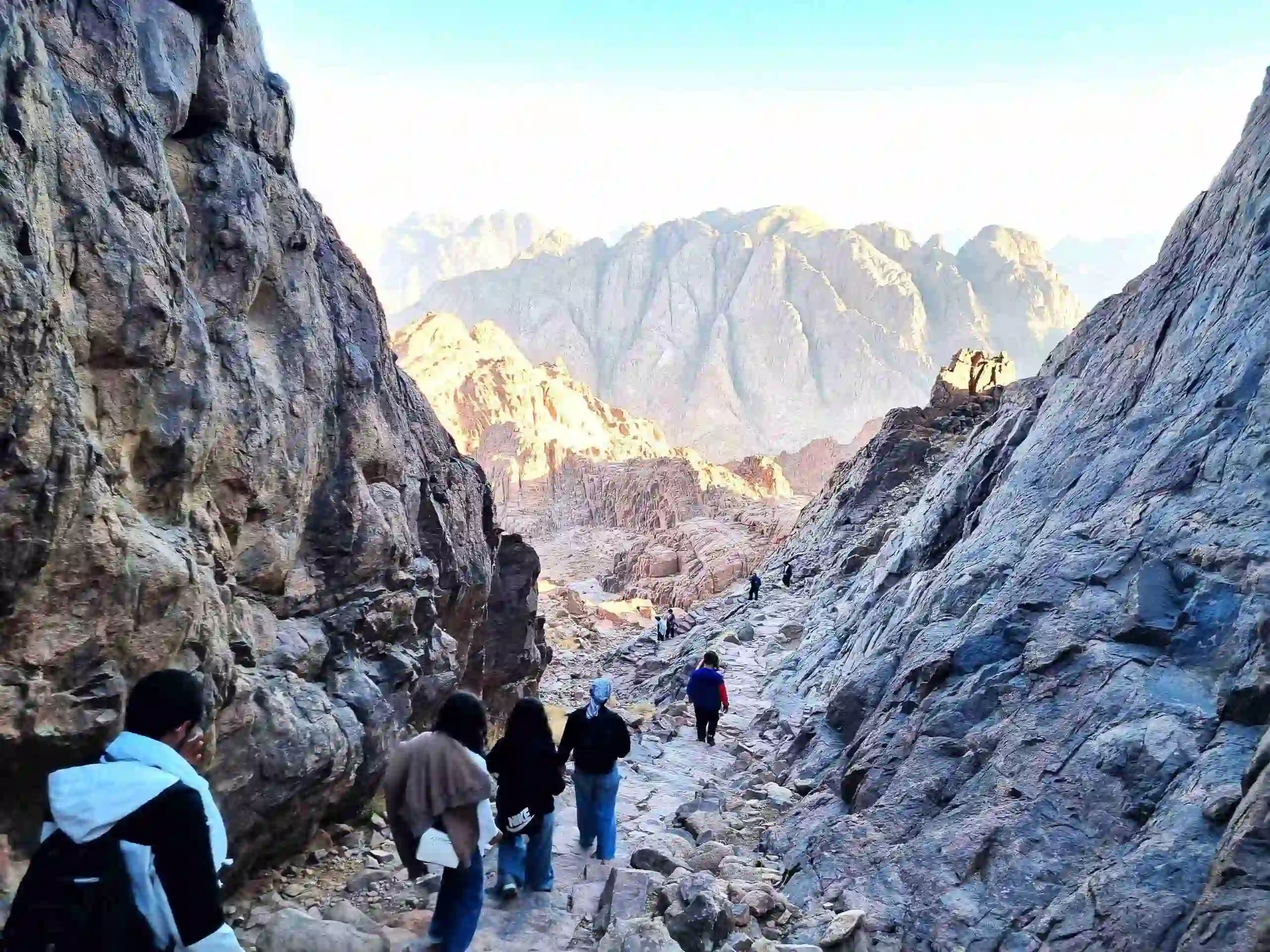
  • The AfrikaBurn Diaries Pt.5: Until We Meet Again

    The AfrikaBurn Diaries Pt.5: Until We Meet Again

    You are reading Part 5. Click here to start at Part 1, or view all parts here.


    I’m not sure which one of us woke up first. Probably Grizzly. It had become tradition for me to lie in bed in the mornings, waiting for the sun to rise high enough to cook my tent until I couldn’t handle it anymore. Then I’d get up and rummage through my cooler bin, deciding what to eat for breakfast. Grizzly couldn’t do that though. She had work.

    Grizzly worked at the Lost & Found booth. I thought it was the perfect job for her. With those big eyes and big hair, she had the kind of face you’d want to see when you wandered up to the booth, hopeful someone had handed in your iPhone.

    “Especially with phones, people are always like, OH MY GOD THANK YOU SO MUCH. And I’m like, bro, I didn’t even do anything. But it’s still a nice feeling.”

    I was still sitting there half asleep, sucking on a Powerade bottle when she laced up and ducked out of the tent. All her stuff, clothes, blankets, food, still lay strewn across the floor.

    “Hey,” I shouted after her. “What’s all this, you moving in or something?”

    She looked back and smiled.

    “My mansion now.”

    It was the last day of AfrikaBurn, and the skies couldn’t have been more beautiful. When I emerged from the mansion and headed for the toilets, still in my underwear, there was nothing but endless royal blue stretched above me in a windless sky. Spots of white cloud sat in the distance, but nothing that would ever reach us before we were gone. The storms and winds were done. Our last day in Tankwa Town would be showered in sunshine.

    I decided I’d simply walk the playa for the day. Even though I’d wandered across it countless times, I felt as though I hadn’t really taken time to stop and see it. Today was the last chance before it was all gone.

    Back at my tent, I dressed quickly. Getting dressed was often a lengthy process, as your imagination ran wild with possibilities – boots or flip flops, fur vest or topless, hat, bandana, wig, goggles…that was half the fun of Tankwa Town. But today was different. I threw on a tank and slippers and headed out.

    With the weather divine, the playa was roaming with happy faces. It wasn’t crowded – perhaps the crowd was still recovering from the Friday night shenanigans – but the vibe was festive for those of us who made it out onto the sands. And sooner or later, we were all drawn to the Spirit Train.

    The Spirit Train not only booms on the playa in the night, it does so in the daytime too. Just, a little more gently. Instead of thumping beats to ecstasy laden minds, it plays classics like the Jackson 5 and Billie Holiday. The crowd was still small when I walked by. I climbed on board one of the carriages – which were all empty for once – to shelter from the sun and watch the people dance in the sunshine. The crowd moved like it had a life of its own; over the next hour, people came and went, it grew, shrunk, swayed side to side, buzzed with energy as the DJ fed it.

    Not far from me, a guy in the crowd set his phone against the train to record himself dancing. He was Australian; the kind of Australian you know is Australian just by looking at him. Behind him, a group of strangers laughed while taking selfies. A French guy lay on the ground snapping photos. At the back of the crowd, a topless girl and her boyfriend spun in circles. The sight was so joyous, so full of spirit, and suddenly it was so clear to me the real reason we were all here. It wasn’t just to have fun, or escape the real world, or even to build this town. It was to teach us one simple lesson; that if 12,000 of us, all of different races, nationalities, genders, ages, colours, classes and religions could pool our resources, and in one week build a city in the desert where everyone had food and shelter, lived in peace and danced in the sun together, there was no reason the whole world couldn’t do it. None of us were particularly wealthy or talented, but even out here in the middle of nowhere there was more than enough for everyone. We made it that way. We made it that way because we loved each other, and we loved each other because we were human. One could only imagine if we really lived like this. Imagine if it wasn’t just 12,000 of us. Imagine if it was 7 billion. What 7 billion people could achieve if we loved and respected each other…

    It wouldn’t have been a day in Tankwa without running into Grizzly. She appeared in the distance, at the edge of the dance floor just before I was about to leave for the toilets. Dark denim skirt, short orange top that sat loosely above her midriff, hair up in a floral headband. I waited for her to spot me. Eventually she did, waved, smiled, walked over.

    “Stranger danger.”

    “How was work?”

    “Fun. I’m going to miss that place.”

    She struck a pose, and I snapped a few photos of her.

    “What’s the plan tonight?”

    “I don’t know. It’s the last night…we should…check out CEXx.”

    “Wanna go together?”

    “Let’s meet there at 11.”

    I spent the rest of the day roaming and snapping photos, but by the time night fell, I had ended up at Potato Heads, relaxing with Lynesha P and friends. And it was with them I would experience one of the most special of AfrikaBurn traditions: The burning of the Clan.

    Back in 1986, two friends named Larry and Jerry held a bonfire on a beach in San Francisco. As a celebration of art, counterculture, rebellion, they burned an 8 foot tall wooden man. It was attended by about 30 people. The following year they did it again, and the year after that. As the tradition grew, so did the community. Soon, many artworks were built and burned, and more people started to attend. The event became known as Burning Man. Eventually it wasn’t just artworks, it was an entire city. The Burn Principles were born: radical self expression, radical inclusion, decommodification, communal effort, gifting economy, radical self reliance. By 2018, Burning Man had grown to 80,000 people, coming together to build an entire metropolis in the Black Rock Desert in Nevada. They called it, Black Rock City. And even today, the week in Black Rock City still culminates with the Burning of the Man.

    When the Burn was brought to Africa, Black Rock City became Tankwa Town, Burning Man became AfrikaBurn, but they lacked a central effigy to represent it all. If the desert in Black Rock was emblematised by a wooden man burned on a beach in San Francisco, what about the desert in the South African Tankwa Karoo?

    The founders tried to create something, using computers and fancy graphic design tools, but soon they realised, the perfect emblem already existed. South Africa is home to some of the most intricate rock art in the world, and one of the founders recalled an old cave painting she’d seen by the San people; South Africa’s First Nation.

    In her words, the image depicted “one body, several heads, and many dancing feet. It didn’t depict any particular gender, and captured the collaboration and community we wanted to inspire. But most importantly, it was an image made by an artist of the First People.”

    With this idea, San elders were approached for permission to use the image as the emblem of AfrikaBurn. Their blessing was given, in the hope it would raise the profile of the San people wherever it was seen. The image became known as the San Clan, the official effigy of Tankwa Town. Each year a nominated artist builds the San Clan to his or her own interpretation, but it is always grand, and always with the ancient San image of the one body, many heads and many feet, built in a towering artwork to watch over the citizens of Tankwa.

    The Clan was scheduled to Burn at 7. We arrived early, as did many others, eager to see the city’s tallest artwork finally fall. We managed to weasel into the second row, but by the time we’d found ourselves a place to sit we’d lost most of the others – it was just myself, Lynesha P and a friendly “guy with the weed”. I handed out glowsticks to everyone as darkness fell, striking up conversation with the English couple next to us. Their young daughter, no older than six, grinned widely as I wrapped a glow stick around her wrist. She was high on excitement, like the rest of us. Imagine coming out here, watching the Clan burn at six years old, I thought. What a way, to start a life of adventure.

    Half of Tankwa Town was gathered on the playa by the time the torches were lit. The Clan crew gathered at the base, held their flames high above their heads. The crowd cheered loudly. One by one they set their torches to the Clan and stepped away. The cheers grew louder, until the fire took on a life of its own. We watched in silence. The flames wrapped the base slowly at first, but then raced up the shaft and encircled the top; within minutes, flames were flicking off the highest point. Us, more than 50 metres away, could still feel the heat press against us. I looked to the left. Thousands of faces were lit with firelight, their eyes spellbound. I guessed their minds had to be filled with the same thoughts as mine: That this week had opened our hearts, brought so much joy, and that the moments had captured us so completely, we had forgotten it was ever going to end. But now the Clan was falling, and we were all realising, it was finally over. Lynesha P rested her head on my shoulder, her eyes still on the blaze. I nodded, as if to say, I know. Everywhere, every day, people tell you about experiences for your bucket list; Skydiving, Songkran, Carnaval. But those rarely leave you more than a nice photo and a story. It’s always the moments nobody warns you about, the ones you stumble upon serendipitously where you say to yourself, I’m here, and I’ll never forget this. The burning of the Clan.

    Once it toppled, the crowd slowly dispersed, only a dedicated few staying until it completely turned to ash. We all drifted back to the Binnekring, as usual, ending up at Atypical Bar. Drinks flowed freely, familiar faces laughed and danced and hugged and celebrated. Eventually I lost Lynesha P and friends in the night, but Atypical Bar was always friendly no matter who was there. One gin and tonic turned into three, one new friend turned into four. But as much as I wanted to stay until dawn, it was almost 11. I had somewhere else to be.

    I didn’t even remember the way to CEXx. I only remembered it was a very mysterious looking tent, somewhere on a corner, somewhere in the backstreets by the Horn. But I walked off the Binnekring and followed the different streets by memory – left on the Buitekring, straight until the fork, left again – until eventually I found it, shrouded in its dim pink lights. I pulled back the flaps, ducked inside, said hello to the imposing man at the door as I shook with relief from the cold outside. In the middle of the tent, Grizzly sat smiling at me, relaxing, as if she hung out there every night.

    “Didn’t even know if you’d be here,” I grinned.

    CEXx was full that night. Each corner had its zone in action – the Bondage Zone, the Petting Zone, the Voyeur Zone and The Dome. Grizzly and I wandered a bit and settled in the bean bags at the Voyeur Zone. A stage bed was set up, empty at the time, free for couples to let out their exhibitionist side, but we just snuggled against each other in the viewers area and talked about the night. By now, the gins had seeped well into my arteries, and I quickly fell asleep in Grizzly’s lap. When I woke an hour later, she laughed and filled me in on what I’d missed – this couple, that couple, good, not good. In The Dome beside us, we couldn’t see inside, but the sounds were enough to let us know how much fun was being had inside. In the Petting Zone, a girl was tied up and being whipped. An old man lay in a mountain of pillows getting his belly rubbed by a younger man. It was sex everywhere, all around us, but in this town, it was hardly odd. This whole week had been about fun, freedom, expression. I suppose, this was the purest of all three.

    Grizzly and I kept to ourselves, in our little corner, on our little bean bag, perhaps a little intimidated to wander around, but comfortable enough to watch, laugh about it, share our own intimate stories. The night passed quickly, and before we knew it, the matron was walking the room telling everyone “ten minutes left”. As he did, I noticed a familiar face walk onto the voyeur bed in front of us. She was a Ranger girl I’d seen every day, bumped into every day, shared a few words with every day. Cocoa skin, big eyes, beautiful smile. On her arm she had a wiry young man with long hair and a skinny frame. A young Emile Hirsch. I watched her rush him to the bed, not worried that another couple were already there in the midst of passion. They both disrobed in seconds, she stroked him for a moment, then bent over and invited him in. It was raw, unglamorous, but they were both so eager, so committed to having it, even if it were only for sixty seconds. Barely a minute had passed when the matron finally announced the den was closing. But they both grinned, looked contented, that they’d done what they’d come to do.

    On the way out, I saw her walking in front of me and rested my hand on her shoulder. She turned, her eyes wide with surprise as she saw me.

    “Ninja! You’re everywhere!”

    We laughed and shared some friendly words. Then, as we exited the tent and turned to walk our separate ways, realised this was probably the last time we’d ever see each other. We hugged and said a half goodbye.

    “Next year,” I smiled.

    I walked over to Grizzly, waiting for me by the entrance.

    “Home?”

    “Home.”

    We walked slowly, along the Buitekring backstreets. It was the a.m. hours now, and you could hear the music thumping on the playa in the distance. Some people were in the midst of their final Tankwa night. For others, the night was just getting started. For us, it was coming to an end. At least, that’s what we’d thought.

    The campground was quiet. We headed towards the mansion, strolling slowly down 9ish Boulevard, plonking feet. It was our last night, but it didn’t phase us. We walked the long way and enjoyed it slowly, taking in the streets that we now called home. But as we were about to turn into Fata Morgana, a voice called behind us.

    “Guys you know the gate, the gate…the gate like the big entrance, is that over that way?” He pointed behind him.

    “It’s actually that way bro,” I laughed, pointing in the opposite direction.

    “Oh my god…”

    He rested his head in his hands. It was only then I sensed the panic in him. He looked like he’d been wandering these streets for hours, cold and alone.

    “Guys I just want to get home, can you help me get home.”

    “Do you know the name of your street?”

    “No but if you show me a map…I can show you on the map.”

    We walked to the nearest intersection. Each of them had maps up on the lamp posts. I shined my torch on it, asked him to show me.

    “Okay so from the main gate, I’m two streets up, and then two streets across.”

    He traced along the roads with his fingers, two streets up, two streets across.

    “There.”

    “Okay so that street is Jerome.”

    “That’s it! Jerome.”

    I turned to Grizzly.

    “Let’s walk him to Jerome?”

    She smiled and grabbed my arm.

    “Yeah.”

    Jerome was about four streets down. I looked our new friend up and down. He looked cold, the type of deep cold you feel after sobering up after a long night, his body slouched in fatigue. If he was staying down on Jerome, it meant he’d probably arrived just a couple of days ago, still getting used to the Tankwa life of no showers and freezing nights.

    “What’s your name, man?”

    “Justin.”

    He was a young guy, tall, twenties, thick South African accent. It was normally the Rangers’ jobs to get lost souls home safely, but no orange vests could be seen in any direction. I guessed this one was mine – one last Ranger good deed, no vest needed.

    It didn’t take us long to get to Jerome. But we didn’t see the spark of relief on Justin’s face that we’d expected.

    “This isn’t it…” he said, looking around.

    “This is Jerome. C’mon, we’ll walk the whole street with you, tell us when it looks familiar.”

    We walked from one end to the other. Still nothing.

    “When you get to my camp, there’s a white VW on one side, and a camper van on the other. I promise I’m not so drunk that I won’t recognise it. I’ll know it as soon as I see it.”

    For the next hour, we tried to solve the riddle of Justin’s camp. Each street of the south block – Illusion, Jerome, Kansas, Larry – we walked end to end, pointing out every VW and campervan, each time Justin shaking his head saying that’s not it. But even between yawns in the freezing cold, Grizzly and I found ways to laugh at each dead end, just as eager to solve the mystery as he was.

    Eventually, walking Kansas for the third time, Justin stopped suddenly.

    “Heyyy hold on a second.”

    He pointed to a Toyota Hilux, parked snugly under an old canvas.

    “Just today I was here with my friend, asking him – how much must you love your Luxy to park it in its own tent?”

    He wandered a few metres along, slowly, his eyes and ears suddenly perked like a woken dog. Each step he took was bigger, faster, until he turned back at us, smiling.

    “Guys, look. There’s the VW. There’s the camper.”

    He rushed into his camp, laughing. Grizzly and I followed him in, just to make sure he was in the right place.

    “I can’t believe you got me home. Thank you, oh my god. Thank you so much.”

    “No worries. I’m Ninja, by the way. This here’s Grizzly.”

    “Ninja and Grizzly. Hah. I love it.”

    It was almost 4 a.m. We headed back toward Fata Morgana, our yawns monstrous, our legs weak, but none of it had dampened our night. The opposite in fact. We’d loved every second of it. We strolled home in the moonlight, slowly, turned down 9ish Avenue, crossed over to Lady Davina Boulevard, all the way to the east blocks until we finally hit Fata Morgana. As we neared home, it dawned on me that just a few days ago, I was as lost as Justin in these streets, even in the day time. But now I walked them mapless in the dark, the names and landmarks rolled off my tongue as if I’d grown up here. As we unzipped the mansion flaps and ducked inside, my heart pinched, knowing that in 12 hours this would all be gone. Not just Fata Morgana, but all these streets. But I also knew, I’d never forget these roads. There’d been too many stories written here, ones that couldn’t be forgotten. I’d remember them forever.

    Tankwa Town had already half disappeared when I emerged from the mansion the following morning. The 4WDs and tents that had surrounded me had almost all packed up and gone, presumably to miss the traffic rush back to Cape Town. Even the Dutchies had already gone. Not naked hippie guy, though. He was still laid out in his “backyard”, no hurry to be anywhere.

    Grizzly rushed back to her camp to pack her things. I looked around the tent, hands on hips, strategising how to put the life in front of me back into four bags and a cooler bin. Even though I’d only been here a week, it felt like this home had a decade of baggage and memories to pack. But piece by piece, I pulled it apart, shaking each piece of clothing free of dust, separating each piece of trash from treasure, pulling the mansion down one pole at a time.

    I still had two hours to spare before the bus left for Cape Town. With nothing left to do, I grabbed my last five litres of water to gift to Ranger HQ and headed across the campground.

    On the way there, I bumped into Paris. He called out to me as I walked past his group, all in the midst of pulling their camp down. I hadn’t known, but he actually lived just one street over from me. We shook hands, hugged, swapped Facebooks, snapped a photo.

    “Stay in touch with you, Ninja.”

    A few minutes later, Miles from Greeting duty rode by on his bike.

    “Spread the love man!” he screamed, holding up his wrist with the bracelet I’d given him.

    Two streets over, I walked into the girl from CExx.

    “Oh my god, Ninja. I knew I’d see you again,” she laughed.

    We hugged, and swapped Facebooks, me finally learning her real name.

    “Visit me in London, some time.”

    By the time I made it to Ranger HQ, it felt like I’d bumped into almost every familiar face I could think of. I found fellow ranger Warpdrive lounging in the back.

    “Got water for you guys,” I smiled, holding up my five litre bottle. “You’re staying on for a few more days, right?”

    “Yeah! Awesome. Just drop it here. We going to see you here next year?”

    I nodded.

    “I can’t imagine missing it.”

    On the way back I decided to walk the long way home, to stop by Potato Heads one last time. As I’d hoped, Lynesha P was there milling about. She wasn’t heading home until tomorrow.

    “What happened to YOU last night!” she said, poking at me.

    “I went to meet a friend, but I looked for you! Where’d you go?”

    She shrugged, as if it were a stupid question.

    We hugged goodbye, as I’d done with everyone else. But this hug was a little longer than the others, a little tighter, a little more special. Lynesha P was someone I was sure I’d see again, somewhere down the line.

    “Come visit me in Johannesburg. It’s a one hour flight.”

    She was serious. I told her, maybe. But for now, I had a bus to catch.

    Somehow, I’d forgotten that even though the bus point was fifteen minutes away, it was more like thirty minutes with bags, and I had to make two trips. I’d been loitering, thinking I had an hour, but I made the bus with barely two minutes to spare. Grizzly was waiting by the cargo hold, with half my bags, anxious to get on.

    “What took you so long!” she laughed, waving me on. “We’re leaving like, now.”

    The bus was near empty. On the way to Burn literally every inch of spare room had been stuffed with bags, tents, water, boxes, and the energy had been electric. But for the return trip each of us collapsed into our seats, weary beyond measure, the bus empty enough for us all to have rows to ourselves. Still, I sat with Grizzly by the window.

    The bus ride was long. Grizzly and I chatted about the little things – the gifts people had given us, the costumes we’d seen, what we were looking forward to when we got home, peppering the conversation with inside jokes. I’d only known her seven days, but it felt like years, like we could talk about anything.

    As dusk fell, the sky turned a bright, orange red, stretched across the desert – the kind of sunset you hear about but never see. Both of us, our bodies now truly broken and exhausted, lay back and admired it in silence.

    “Look, can you see it?” I said, pointing into the distance.

    She stared for a moment, then shrugged.

    “See what?”

    “The Cobra. They’re burning it tonight at 8.”

    She rolled her eyes and punched me. But she understood. Even though the playa was eight hours behind us, even though it no longer existed, we still hadn’t left. Our hearts and minds were still in Tankwa.

    Darkness had fallen when we finally rolled into Cape Town. It was eerie, seeing all the brand names up in lights; Cheverolet, Checkers, Deloitte! We’d only been gone a week, but it felt like a year had passed. As we drove by a row of restaurants, the first thing I saw were the sandwich boards, plastered with Weekend Specials, prices up in neon on the windows. Everybody trying to sell something. Everybody trying to buy something. A normal thing, usually. But it didn’t feel so normal anymore.

    It was around midnight when we finally got dropped at the McDonald’s in Greenpoint. Grizzly was booked at a hotel for the night, I was expected back at my hostel, but after one sniff we both knew we were going in for burgers and fries before we headed home. We brown bagged our orders. Grizzly had a ride coming, and starving as we were, both of us really just wanted a hot shower and a pillow.

    “I’m gonna shoot,” I told her. I opened my arms, and she pulled me in, hugged me tight. It felt sudden, this goodbye, like it had snuck up on us.

    “Love you, Grizzly.”

    I heard her breath pause, her hand still pressed against my back.

    “Love you too.”

    Outside on the sidewalk, I sat waiting for my Uber, surrounded by my dust covered bags. Nobody needed to guess I’d just returned from a week in the desert. But it didn’t feel like just a week. As images of Tankwa still flashed through my mind, it felt like I’d been out there for years, like that place had become a part of me. During the final days of Burn, I had been saying to people, “Can you believe we’ll go back to the real world, and only one week will have passed?” Usually barely anything changes in a week, but out there, a week changed our lives forever. As I wolfed my burger down, my face covered in sauce, I spotted four or five people sitting out in the cold on the opposite side of the street. Street beggars were nothing new in Cape Town, and often we gave them things – chocolate, muesli bars – but I didn’t usually see them out this late. I could see only shadows, but it felt like they were watching me, wishing they could afford the burger I was eating.

    All I could think was; out there in the desert, there’s a place where it isn’t like this. Maybe it only exists for a week. But it exists.

    THE END.


    JUMP TO: Part 1 | Part 2 | Part 3 | Part 4 | Part 5

  • The AfrikaBurn Diaries Pt. 4: Oh The Days Are Wild, Too

    The AfrikaBurn Diaries Pt. 4: Oh The Days Are Wild, Too

    You are reading Part 4. Click here to start at Part 1, or view all parts here.


    He was sitting with his back to me, so I started with the outlines of his shoulders, then the back of his head, his shabby greying hair, then finally down his torso to his butt. It wasn’t often I had a naked guy sitting in front of me, but here it felt like just another weekday.

    “Forget about hands, and forget about faces,” the teacher said. “You won’t have time, and they’re not important, anyway.”

    It was just past noon, and around a hundred of were sat on the floor in a circle, in the corner of the CEXx tent. A naked stranger laid out like he was sunbathing in the centre. CEXx (pronounced Sex-ex) was a large, mysterious tent, hidden in one of the backstreets of Tankwa Town, and probably one of the most interesting. But not many people even knew it was here. During the day they ran lectures and discussions such as “Sex on Drugs” and “Kink 101”, but once night fell, the tent turned into the Play Zone; a sexual playground for the hedonists. Just across from us I could see the infamous Dome, a large tent where couples were invited to indulge in “anything goes” at night. We were sitting in the Petting Area; what happened on this floor at night I didn’t know exactly, certainly something kinky, but right now it was the day, and the hundred of us had gathered for something slightly more innocent: Nude sketching lessons.

    Lynesha P was sitting beside me, scribbling away. I glanced over at her sheet. Her sketch was scruffy, busy. Mine, more like a stencil piece. But they both resembled the same muscular back and shabby head of hair. How about that. We were both artists now.

    The next volunteer was a young hippie with Jesus hair, after him, a voluptuous blonde with long wavy locks and milky white skin. By then I felt like I was finding my inner Picasso, but Lynesha P had other ideas.

    “Speed dating starts in five minutes. Stay or go?”

    Earlier in the week, she and I had been flicking through the guidebook looking at all the different events we’d been missing – pancakes, pasta, topless parades. But when we’d turned the page onto “Silent Speed Dating”, both of us nodded that was a must-do. Even though neither of us really knew what it was.

    I nodded and flicked my head towards the door. As I folded up my masterpieces and got up to leave, I gave a love bracelet to the girl next to me who’d lent me a pencil, whispered a thank you to the teacher, and the two of us tiptoed back out onto the Binnekring.

    Silent speed dating was at a camp called Vagabonds, right in the centre of town. Run by a bunch of crazy Scandinavian kids, they offered everything from morning dance parties to cacao ceremonies to sweat-outs in a full size sauna they’d hauled into the desert. The day before I’d walked by and was given a massage in their “spa” by a charming Californian gal, noting how tranquil and unassuming the camp was. But today, it was packed full to the brim. Evidently everybody in Tankwa was ready to speed date in silence.

    A young man hopped on the tiny stage in the corner and clapped everyone to attention.

    “You’re going to walk around with your hand up until you find a partner. Then we’re going to play the music for two minutes. There is no talking! Look into your partner, and see what you see.”

    Everyone paired up pretty quickly. Within a few seconds I locked eyes with a petite sandy blonde, like a mini Jennifer Aniston. They hadn’t told us to hold hands, but there came an urge to hold my palms out, and she placed hers in mine.

    “Time starts now!”

    The tent turned silent. Yoga music began flowing out of the speakers. At first, it just felt like a staring contest. Her eyes were small, and dark, frosty blue. Every ten seconds she turned away to giggle, then stared back at me nervously, like we were at a school prom and it was the first time she’d danced with a boy. But thirty seconds passed, and her eyes changed, from smiling eyes to nervous eyes to curious eyes to startled eyes. When’s the last time you stared into a stranger’s eyes? Have you ever? It is an unnerving, naked, electrifying thing. At first it felt like the time couldn’t pass quickly enough, but by the end, it felt like two minutes had passed in a flash. When the music stopped, we embraced each other tightly. Then we looked at each other and hugged again. We had shared something, although we didn’t quite know what it was. But, we couldn’t talk about it. We didn’t even have time to think about it. We were already being told to hurry up and find a new partner.

    My next partner was a tall guy with large green eyes and a kind face. A young Nicholas Cage – the City of Angels version. He had a face with a permanent smile but as our “date” started and the seconds ticked on, I noticed how much sadness his eyes showed. I guessed, that smile was hiding something, pain that hadn’t passed yet. You see people’s eyes all the time, but how often do you actually look inside them, study them, see the colours swirl, try to read the story they tell? Or let others do so to you? You don’t realise how vulnerable your eyes make you, until you have a stranger staring straight into them, reading your life story.

    My next partner was a young Asian guy. Right away I guessed he had a background similar to mine. Asians were scarce at AfrikaBurn; very few things in Tankwa Town were customary to our cultures. But that’s what made it intriguing. For us, just being there was almost a form of rebellion. As the music started and we looked into each other, it was instant brotherhood. I’d seen those eyes a million times. Everything he’d been through in his life, every piece of self doubt, every question he’d asked himself in the middle of the night, I felt like I already knew and understood. As he let on a smile and a knowing nod, I knew he was seeing the same. He was a dreamer like me. He was also from a place where his friends and parents were probably wondering what the hell he was doing at a place like this. But we didn’t care. We were here. The music stopped and we grinned and hugged triumphantly. Like, man, I knew I wasn’t the only one.

    My final partner was a young African woman, with small eyes, big cheeks, and a childish smile. We held hands. As the music started she tilted her head slightly to the side, her eyes curious. As I gazed, somehow, I could tell she had a child. Her eyes reminded me of my mother’s. I searched her eyes, trying to see why. But all it did was make me realise how after all these years, I’d never really looked into my mother’s eyes. After all these years, maybe I still didn’t even really know her. Underneath just being my mother, what were her fears, insecurities? What did she think about at night? What were things she secretly wished for? What made her happy? What did she want to be when she grew up? I’d never taken the time to look, see who she really was. A tear rolled down one side of my face. And this woman standing in front of me, squeezed my hands, gazed, deeper, wanting to know more. Another tear. Her eyes were sad now too, but loving. She squeezed my hands again. I smiled. The music stopped.

    She opened her arms and I smiled with relief as we hugged, wiping the trails from my cheeks.

    “Thank you,” she whispered. “Thank you so much.”

    As we broke, I saw Lynesha P smiling at me adoringly from the corner. I smiled back and shook my head, as if to say, don’t even ask. I’m fine. But as everyone searched for partners for the next round, I took a seat outside and watched from a distance. I couldn’t handle another round. Plus, I’d seen everything I needed to see.

    “That was the most amazing thing…” Lynesha said as we walked out after it was over. Her eyes were as wide as her grin. “You were so emotional! I don’t know if we’ll ever get to do anything like that again.”

    Now walking back in the sunshine amongst the crowd, it did feel like we’d been through something. Something a little bit magical, something nobody else would understand. Even if that were the only memorable thing I did my whole week in Tankwa Town, it would’ve all been worth it.

    My Ranger shift that night finished at 9. I hadn’t made plans with anyone, so I wrapped up in furs and wandered down to State of Bliss. It was quiet, only a handful of people lounging while someone tinkered on the piano. I took a seat on the floor and unwound. My feet were weary from the hours of walking – between the daytime fun and my night shift, I’d covered the entire town at least three times over already, and the night hadn’t even begun.

    As I zoned out to the music, I noticed one of Grizzly’s friends appear at the lounge entrance. Tall, slender, melanated, beautiful, wrapped in a bright orange fur jacket you could see in the night ten miles away. She spotted me and tip toed over.

    “Heyyyy! Mind if I sit with you?” she whispered.

    “Course not, what’s up.”

    “Chilling. Where Leslie at?”

    It was odd; normally I bumped into Grizzly three or four times a day, but I’d been out on the playa since morning and hadn’t seen her once.

    I shrugged.

    “No idea. Maybe we’ll catch her tonight.”

    After three or four songs she started gathering her things.

    “I’m gonna head to Atypical. You wanna come?”

    “Bet.”

    Atypical Bar was the coolest bar in Tankwa Town. At least I thought so. The first time I went there was on Day 2, to warm my hands on the open fires outside, and one of the camp members came around with marshmallows on sticks for us to roast. I ate around six or seven and thought I was on my way to heaven. The next night, I learned their bar had a full menu of cocktails on offer all night every night. No other bar in Tankwa was blessing the crowd with free liquor like Atypical Bar. And tonight, it was hip hop night. The place was booming. Drinks flowed at the bar, marshmallows were flaming outside and the best music in Tankwa Town was blaring from its speakers.

    “This is my shit!” Orange Fur yelled as we waltzed in at the top of a Pharrell classic.

    The mood was jolly that night. The dancefloor shook harder with every song, conversation around the marshmallow fire was full of love, people flooded in off the Binnekring. It felt like all the friends I’d made in town found their way to Atypical Bar. Gin and laughter flowed, but often I’d look around and find myself thinking, Grizzly would love this. Between songs I’d turn to the entrance hoping to see her walk in, but she never did. It was an unforgettable day, unforgettable night. Just one face away from perfect.


    “One bag!”

    “One baaaaaaaaag.”

    Friday had arrived. Most people were in bed nursing hangovers, but myself and four other burly fellows had volunteered for the Friday morning Ice Slinger shift.

    “One bag!”

    “One baaaaaaaaag.”

    Nothing is bought or sold in Tankwa Town, but there is an exception; Ice. Several years ago, a bout of food poisoning swept through the Burn. Toilets were overflowed with vomit and diarrhea, and people were laid up in their tents with food poisoning for days. It was just another reminder that out here in the desert, food goes bad quick. Ice keeps the beer cold, but more importantly keeps the steaks fresh. So, Tankwa gets three truckloads of ice delivered daily, all sold at the Ice tent to keep the town chilled and healthy.

    Of course, the Ice trucks don’t unload themselves. That’s what the Ice Slingers are for. Every morning the ice line stretches into the hundreds, as Ice Slingers muscle the bags off the back of the trucks and into people’s cooler bins.

    Before the shift started, the four of us were handed gloves and briefed by the Ice Master.

    “You two in the truck,” he said, pointing at us. “You two on the ground.”

    He was a portly man, and fun, the kind you’d want as an uncle for your kids.

    “I’ll call out the order and you fetch ’em. But remember to throw the bags! Don’t slide ’em. Ya understand? Don’t slide ’em! And move ’em quick!

    We pulled on our gloves and flexed our biceps, ready for a morning of hard labour.

    “And one more thing. I’ll scream out the order – three bags, five bags, whatever. But if the order is for only one bag, I want you to scream out after me, one bag! Keep ya on ya toes.”

    The line was already out the tent and winding down the Binnekring when we opened for business. People came armed with cooler bins, backpacks, trolleys, ready to cart their hauls of ice back to their camps.

    “Six bags!”

    My comrade was a young French guy, looked like a small Daniel Craig. From the back of the truck we threw them to the boys on the ground, shaky at first, throwing six, dropping four. But we found a rhythm quickly.

    “Nine bags!”

    The line moved quick. Even though we were in the back of an ice truck, we worked up a sweat. It felt glorious, getting blood pumping through the muscles on a Friday morning. I hadn’t had this much fun all week.

    “One bag!”

    “One baaaaaag!”

    Two bags. Five bags. Eleven bags. Three bags. One bag.

    “One baaaaag!”

    The line moved and moved, more people arrived, bought more ice, we changed trucks and kept going. Each truck we’d swap jobs with the other boys, from throwing to catching. Throwing burned your biceps, catching smashed your wrists ’til they bled, but we screamed one bag with all our might and loved every minute.

    After an hour we’d run through the whole queue. We pulled off our gloves and leaned against the trucks, pumped up on endorphins with grins on our faces. The Ice Tent was still open for another hour, and people drip fed in every five minutes, but the hard work was done. We sat on the back of the trucks and chatted about our week, like four blue collar workers getting ready for the weekend. Which is exactly what we were.

    When our Ice Slinger shift ended, the boss man gave us each a 5kg bag as a reward. As I was living on chocolate and biltong, I had no use for a bag of ice. But he insisted I take it. Everyone needs ice, gift it to someone. I knew exactly who.

    In the backstreets of Tankwa Town is a camp called New Beginnings. New Beginnings was relatively unknown, but those who knew about it loved it. Because New Beginnings offered what every single person in Tankwa Town dreamed of. Hot showers.

    The walk to their camp was longer than I expected; I arrived almost breathless.

    “Is this the New Beginnings crew?” I asked, dripping with sweat, a fresh bag of ice in my arms. They turned and looked at me, a few of them nodding with smiles.

    “I’ve come to gift you a bag of ice.”

    Suddenly their eyes turned to glitter as they eyed the bag in my hands. Some of them whimpered with joy. The thank you’s came so fast I couldn’t keep track of them.

    “Least I can do. You’re doing God’s work out here.”

    And it was true, they were. The New Beginnings shower is like any other shower, but out here in the desert it might as well be a suite at the Radisson. It’s a standard showerhead hooked up to a huge metal water tank, heated with flame. There’s a gun that dispenses bio degradable soap. Flick it on, and you’ve got a winning hot shower to wash your sins away. But there’s a catch. It’s outdoor. Not only outdoor, it’s basically on a stage. If you’re going to shower, you do it on display for all of Tankwa Town to see. But after a week in the desert that was the last thing I cared about. I stripped, stood on the little wooden platform, flicked the water on. Piping hot water rained down onto my face and down my naked body. A week of dust and sweat and dirt and grime washed away, each second bringing out longer and louder moans of unashamed ahhhhhh. People in line looked, passers by on the street looked. But there’s something liberating about being naked in front of people. First it feels terrifying, then a little odd, and then, the most normal thing in the world. By the time I stepped off those wooden slats, I didn’t just feel clean. I felt fearless.

    I walked into Atypical Bar that night as if I’d done it every Friday Night for the last ten years. I handed over my cup to the bar, they mixed me a blue tonic with gin. I said hi to the familiar faces standing at the fires out front, on the dancefloor, sitting around on the couches. Five days ago Tankwa Town had been a complete mystery, but now, it was as if we really lived here.

    It was well past midnight when she walked in. I was sitting on a bench by the DJ, sharing a joint with a wacky trio I’d befriended. The guy sitting next to me was dressed like Willy Wonka, and had motioned for me to come sit with his crew as he lit up. As we sat there laughing about nothing, I saw her wander in off the Binnekring. I watched her for a moment. She was alone, looking lost, perhaps searching for a friendly face. I handed the joint back to Willy and went up to greet her.

    “You.”

    I smiled. We stood out by the fires, talking while warming our hands.

    “I thought I’d never see you again.”

    “I know! Nah I did think about you yesterday, and today,” she smiled.

    “Liar.”

    “No really I did! Where have you been anyway. Let me guess. Working.”

    “Yeah, I was on Ice Slinging this morning actually.”

    I showed her the cuts on my wrists.

    “Mister hard worker.”

    “Wanna walk?”

    I went back inside and shook hands with Willy. He gave me a hug, I handed him a love bracelet. He examined it like a raw diamond, then hugged me again.

    “Love your work, by the way,” he grinned, nodding at Grizzly standing outside.

    “It’s nothing like that,” I smiled.

    He nodded and pursed his lips, bro style. We exchanged smiles again, bumped fists and turned to go our ways.

    Grizzly was waiting for me by the fires. I raised my eyebrows at her, saying, where to?

    “Let’s check out the cinema?”

    Sweet Love Cinema was just a few camps down. It was a large tent, open air, a projector up front playing non-stop movies all through the night. Laid out in front were fifty or so bean bags where people came to chill, sleep, smoke, pass the day or night. It was always packed when I’d walked past, but on this night, at this hour, it was barely half full. Grizzly and I slipped into the back row, put our feet up. She snuggled against me as we hid under our scarves, braving the breeze blowing in behind us. It was an old sixties slapstick playing. Grizzly watched as I lay there gazing around the tent. How much work it must have taken to build this, put it all together, just for the people. How many more places like this were hiding around town that I hadn’t discovered yet? I realised how much I was going to miss this, how I wasn’t ready for it to end yet. But tomorrow was the last day. In 24 hours, this would all be over.

    As I snapped out of a doze one more time, I caught Grizzly’s eyes starting to close.

    “C’mon. I’ll walk you home.”

    The Binnekring was particularly cold that night. Grizzly and I loitered along it, slowly. This stretch of desert, blazing with lights, music, crazy costumes, drugs, artwork, would have been a spectacle to anyone on any day of the week, but to us it had just become “that place down the street”. We walked and talked like it was just another quiet seafront boulevard.

    “So you didn’t drink for a whole year? Why?”

    I looked at the ground, thinking.

    “I guess, I like the challenge of it. You know, my Mum told me something my grandma used to say. There are four things that break a man – womanising, drinking, smoking, gambling. So there’s this Asian thing where they say stay away from those things and you’ll be successful.”

    “Is that why you’re successful?”

    I looked up at her, surprised.

    “I’m successful?”

    “Well you’ve like, travelled all over the world and everything….” she trailed off.

    “And you speak Spanish. You got cool points for that.”

    “Oh yeah, cool points?”

    She looked at me and smiled.

    “So many cool points.”

    It was silent in the campground by the time we got to Grizzly’s place. Grizzly lived in a group camp right on the corner of 9ish Boulevard and Atlantis. Atlantis, Butterfly and Cherry Blossom were considered the “nice” streets of Tankwa’s suburbs. Up there, all the camps had big windproof canopies to pitch their tents under, proper kitchens, water tanks, and electricity generators. It was a little different down past Fata Morgana and beyond. There you started to see a lot more beer cans in the dirt, open fires, tents held together with duct tape. I flicked on my torch and we tiptoed through the camp to her tent.

    I laughed when we got there. Her tent was barely the size of a sleeping bag, not tall enough to sit up in, and almost falling over. She pulled back the flaps.

    “And that’s where I sleep.”

    She had a “mattress” made out of her clothes, a sleeping bag on top, the rest of her stuff all stashed on top of each other. On the first day it would’ve looked rather charming and cosy, but after a week in Tankwa, it was barely standing. I shook my head.

    “Grab your sleeping bag. Come stay with me in the hood tonight.”

    Somehow to Grizzly, “grab your sleeping bag” meant “grab as much stuff as possible”. By the time she was done the two of us tiptoed out of there with half her clothes, blankets, pillow, food, all stuffed under our arms as we headed across the campground.

    “Not in Atlantis anymore,” I said as we passed Cherry Blossom. “You’re now entering the ghetto. From here on it’s all drug dealers, Tankwa Town mafia. I mean look at that!”

    I pointed to a pile of trash one camp had left out by the road. “It’s a hard life down this way.”

    When we reached Fata Morgana, we turned off at my intersection towards home. Adrien Brody’s hippie tent was lit with flashing blue Christmas lights, as always, just beside it, the Dutchies van with the lights out, their bicycles resting against their bonnet. My tent was hidden from the roadside by their cars, but as we walked off the road and cut between them, there it was, sitting proudly in the dirt.

    “Welcome to my mansion.”

    I pulled back the flaps and we dumped all her stuff. I was surprisingly tired from the short walk, and collapsed into my pile of clothes.

    “Oh my god, it’s a mansion for real. You can actually stand up in here.”

    Grizzly started unravelling her stuff and fixing somewhere to sleep. As she lay out her pillow and unrolled her blanket, she suddenly stopped and looked up at me.

    “Shit. I forgot my sleeping bag.”

    “Are you serious!”

    “Should I go back and get it?”

    “Yeah, right. This is the hood, remember? You think you can go walking out there alone?”

    Grizzly groaned, nudged me over and claimed half my mattress. I opened up my sleeping bag and whooshed it over us. Exhausted, we lay huddled together, laughing at the tragic bed we’d made. Usually it was hard to stay warm even with a sleeping bag all to myself, but with her laying against me the desert cold all but disappeared.

    “I can’t believe it’s the last day tomorrow,” I whispered. We lay staring at the high roof of the mansion. “It feels like we’ve been here forever, but it also feels like…we just got here.”

    It had crept up on us somehow; weird that we’d say goodbye in just one day. But, as we’d find out, a lot can happen in one day in Tankwa Town.

    …to be continued.

    Click here to go to Part 5.


    JUMP TO: Part 1 | Part 2 | Part 3 | Part 4 | Part 5

  • The AfrikaBurn Diaries Pt. 3: Nights On The Playa

    The AfrikaBurn Diaries Pt. 3: Nights On The Playa

    You are reading Part 3. Click here to start at Part 1, or view all parts here.


    The crowd was already huge when I arrived. I’d thought I was early. Thousands of people sat in a huge ring, surrounding the Temple of Ixam. It was scheduled to burn just after sunset.

    ‘Burning’ was talked about often in Tankwa- on the Binnekring during the day you’d always hear people screaming about it – don’t forget there are two burns tonight! But nobody ever talked about what they meant, or why we did them. It was just something we did. Each evening, people gathered to watch as various artists set fire to their creations and watched them crumble in flames. Some artworks stood several stories tall, and the burns were magnificent – the biggest blazes you’d ever seen – sometimes taking over an hour to fall to ash.

    The artists had requested a silent burn that night. All camps had been ordered to shut off their music, and viewers had been asked to stay silent as they watched. As darkness fell, a group of young men dressed like hunter gatherers, long staffs in their hands, finally set the temple alight.

    The Temple of Ixam was dome shaped, a couple of storeys high, made of straw and wood. Later I’d learn it had been standing for several years, built to honour the indigenous people of the desert. The fire started slowly, but within minutes it was at full blaze. Thousands watched in silence as the flames roared. The loudness of fire is peculiar – something you don’t really notice – but hits you hard when you experience it. What hits you even harder is the beauty. It’s more breathtaking than we realise. If you don’t believe me, take a look at the people’s faces next time you’re around a fire. How they simply stare at it, watching it dance, mesmerised. It captivates people. When the temple finally toppled, the crowd roared with delight, like some kind of triumph. I felt it too.

    But while the flames captivate us quickly, they lose our interest quickly, too. As soon as the temple fell, the crowd began to disperse, looking for wilder things the night had to offer. As I turned and headed back to the Binnekring myself, I saw friendly faces approaching.

    “THERE HE IS!” they shouted as they saw me.

    We laughed and hugged.

    “We’ve been looking for you!”

    Tania and Claire were another two people I’d met on the bus. They’d been sitting in the seat in front of me, our friendship christened with the sharing of a peanut butter bar.

    “Come out with us tonight! Meet at our camp at 8?”

    In the 72 hours I’d been here, hope and trust had suddenly re-emerged as the essential survival tools inside the gates of Tankwa. Cellphone reception didn’t exist. If you were to meet anybody, anywhere, you simply had to give a time and place and hope they would make it, trust they would make it. But that was refreshing too, not living through a screen anymore. We made plans face to face. We had conversations face to face. Nobody ever finished an introduction with “I’ll text you”. It almost felt like we were becoming children again.

    I arrived at their camp late.

    “Oh here he is,” they groaned lovingly, as if they’d given up on me showing.

    One drink, then we headed out.

    “Okay Brendan, the plan tonight is, we have to find the ship,” Claire said as we waltzed out onto the playa.

    “The ship?”

    “Yes! Last year all of my coolest nights were on the ship!”

    “What the hell is the ship??”

    “Haven’t you seen that big sailing ship, that drives around the playa at night?”

    As usual, the playa was pulsing with noise and lights that night, like some kind of drug filled Disneyland. DJ’s sat atop mutant vehicles in the distance, passionately thumping out sets for the little crowds that gathered. People roamed in groups of twos and threes, dressed extravagantly, covered in lights and laughter. It was the hour when all leftover heat from the day had dissipated; the desert air was now cold and numbing, even with the alcohol and long fur coats, your fingertips chilled if you didn’t keep them buried in your pockets.

    It didn’t take us long to find the ship, which was actually named The Flying Dutchman. It was a huge trailer modified into a pirate ship on wheels. A DJ booth was set up in the middle, and people sat around it on the deck and chilled, while others danced in the sand under the huge sail built from LED lights.

    “That’s the ship!” Claire screamed. We marched towards it. “Now we just need to wait for space to get on.”

    There was a decent crowd commanded by the DJ when we arrived. Some wandered by on the playa and stayed, others danced for five minutes before drifting on to somewhere else. As we sifted into the crowd, I caught a glimpse of a girl sitting up on the ship deck, alone, by the mast. She was facing away from me, I could only see the back of her head. But I already knew who it was.

    I walked around the front of the ship and caught sight of her face. She looked bored, or high, maybe both, her eyes staring aimlessly into the ground. Perhaps she was having a spiritual moment, or an epiphany, maybe an introspective awakening. All were reasonably common in Tankwa Town. I walked up to her, and she looked up, her face morphing slowly into a smile as she saw me.

    “Hey Grizzly Bear,” I laughed. “Can I come up and join you?”

    “Of course! Get up here.”

    I climbed up and sat beside her on the deck.

    “What are you doing up here all by yourself?”

    “I dunno, I was cold. I don’t even know whose jacket this is.”

    She was wrapped up in a fur coat three sizes too big for her. I shuffled over and offered my arm, and she snuggled up next to me.

    “My friends are over there,” I said, nodding my head backwards. “They’ve been talking about this freakin’ ship all night. I need to find them a space so they can jump on.”

    As we both looked back at them, a friend of Grizzly’s jumped up to sit with us.

    “Oh, this is Anton.”

    I shook his hand and introduced myself. He was tall, with long Jesus hair, looked like a young Edward Norton. I guessed he was part of the ship crew.

    “Ooh. I got an idea. Anton you see those two girls over there? They’re obsessed with this ship. Go over and say you’re the ship’s owner, and you would like to invite them both on deck as VIP guests.”

    He looked over.

    “Those two?”

    “Yeah.”

    He squinted for a second, then grinned and started walking over.

    Grizzly laughed into the sky as he left.

    “That’s so good.”

    We both turned to watch. From a distance we giggled as Anton walked up to them like a Bible salesman, his hands animated as he talked. Claire’s face turned from puzzlement to joy, within a few seconds they were both following him over. As soon as they came around the nose of the ship and saw us, we all burst out laughing. They climbed up and sat beside us.

    “Made it to the ship,” I grinned.

    Claire was right. The ship was pretty cool. We sat up there for hours, chilling in the desert night. Every few songs, the ship would move. We’d watch the ship crew jump into action, do all their safety checks, then as many people as possible would climb on as the driver revved up the engine and drove us fifty metres to a new spot on the playa. You could barely see ten metres ahead, so someone would walk in front with a torch, making sure we didn’t crash into an artwork or a pile of bicycles. Alongside us, the rest of the crowd walked. But the DJ never stopped playing, and the people never stopped dancing.

    I pulled out some of those healthy snack balls from my bag, the kind made from dates and coconuts and other hipster stuff. Grizzly took a bite and nearly spat it out.

    “What the hell is that?”

    “Healthy food.”

    “That’s nasty. You got any like, real food?”

    “What, like a New York pizza slice?”

    She laughed and punched me.

    “What part of New York are you from anyway?”

    “Well, I’m Dominican, so…”

    “Wait…you’re Dominican?”

    “Yeah.”

    I switched to Spanish, and she laughed, and we chatted in her language for a while, asking all the important questions, getting to know each other. It was the first time we’d actually sat down and talked to each other for more than five minutes.

    A pretty blonde girl jumped up on deck and sat on the other side of me. I guessed she was from Sweden, Norway, somewhere up that way, the way her eyes had that piercing blue. Turned out, she was Danish.

    “So how long you two been together?” she asked.

    I looked to her, my eyebrows raised.

    “You’re a couple, right?”

    Just as I was about to shake my head, Grizzly jumped in.

    “Yeah we are.”

    “No we’re not,” I laughed.

    “Babe, stop playing.”

    “Oh really, we’re a couple? Where did we meet?”

    “At school.”

    “Where did we go on our first date?”

    “To a restaurant.”

    “What did we eat?”

    “Spaghetti.”

    We both started laughing and didn’t stop, while the Danish girl stared at us, trying to figure out what kind of drugs we were on.

    When’s the last time you sat around and laughed with strangers? It’s special. It’s not something you can plan, it’s one of those things that only happens when it happens. And it happens on the road, but not as often as you think. Being rare makes it precious. And being precious makes it beautiful. But for it to happen in the middle of the night in the middle of the desert in the middle of the week in a place like this? It was the most rare, precious, beautiful thing in the world.

    Eventually Grizzly jumped down off the deck to go somewhere, and I lost her in the night. But the Danish girl and I sat there talking, about what had brought us here, and what we were looking to find. When it got to 3 am, I told her I’d be heading to bed soon. It was getting late.

    “Are you serious? 3 o’clock is late?”

    “Well, yeah. What’s late to you?”

    “I’d say around 9 or 10. You can’t even see the sun yet!”

    I thought about how different her week in Tankwa was going to be, compared to mine. Some people were here only for the night; they missed pancakes every morning, all the lunchtime events on the Binnekring, the daytime dancing. But who knows what crazy and magical things they saw in the sunrise hours. But that’s what made Tankwa incredible – it really was somewhere for everyone.

    It was well into the morning hours when Claire, Tania and I finally left the ship and headed back towards the Binnekring.

    “I think we’re going to call it, Brendan,” Claire said. “Enough for one night.”

    “You guys go ahead. I’m gonna take a walk.”

    We swapped goodnight hugs and went opposite ways, them back to the tents, myself up along the Binnekring. It was unusually quiet for the early a.m. It seemed all the shenanigans the night before had worn people out some, the energy now a lot more mellow. Still, every camp buzzed in its own way. I stopped in at State of Bliss, which was also quiet. Stephane and I chatted for a minute, before I shook his hand and wished him goodnight.

    It was a long walk home. State of Bliss was on the opposite corner of Tankwa, strolling slowly, home was almost an hour away. I didn’t mind. I had nowhere to be tomorrow, and long walks in Tankwa Town were never dull. I decided to turn off the Binnekring and walk along the Buitekring, a quieter street that ran along the back of town. I was sober now, and wrapped so tightly in furs that the chilled desert air wasn’t discomforting but refreshing. Camps were smaller and private back here, but even at this hour, little groups huddled around fires, played music, continuing to enjoy the night with less extravagance but just as many smiles.

    As I turned onto Lady Davina Boulevard, hitting the final stretch towards my tent, I thought about how much I loved the nights. But I also realised, I loved the days more. That was where the real conversations were had, the connections were made. The night was where you celebrated new friendships, but the day was where you created them. I peeled open my tent, gave myself a quick bath with some baby wipes, then tucked myself into bed. As I lay there waiting to fall asleep, I decided tomorrow I’d wake early. I’d seen the nights. Now it was time to indulge in everything the Tankwa days had to offer.

    …to be continued.

    Click here to go to Part 4.


    JUMP TO: Part 1 | Part 2 | Part 3 | Part 4 | Part 5

  • The AfrikaBurn Diaries Pt. 2: The Desert Is For The Strong

    The AfrikaBurn Diaries Pt. 2: The Desert Is For The Strong

    You are reading Part 2. Click here to start at Part 1, or view all parts here.


    The light woke me up.

    I was wrapped in three layers of clothes, expecting the desert night to be arctic, but I’d slept through the night comfortably. I hid inside my sleeping bag, staring at the peak of my tent. The grey was slightly brighter on the east side, illuminated by the morning sun. I looked at my phone.

    9 o’clock.

    I grabbed my water bottle, sucked furiously on it for a few seconds, then pulled my cooler bin over. It was filled with survival foods; biltong, cookies, protein bars, dark chocolate. Nothing that needed to be cooked, nothing that could spoil. I nibbled on bits of everything, waiting for my mind to wake up, thinking about what today might bring. But it was too early for any imaginations. I lay back down to read.

    Just that week I’d started a new book, The Forest Through the Stars. It was about an eight year old girl in pyjamas who showed up on a young lady’s doorstep one night. The lady believed she was a runaway, but the girl claimed to be an alien from another galaxy who had simply borrowed a dead girl’s body. She had been sent from her planet to learn about earth, and was not allowed to return back until she had witnessed five miracles.

    I lay there burning through pages, hunting impatiently for clues. Was she an alien or not? I knew I’d probably only find out in the last chapter, but it didn’t stop me hoping. I was so engrossed I didn’t even notice the wind at first. But it was the third or fourth gust that made me put the book down. Winds roared across my tent, blowing the peak almost as low as my head.

    Back in Cape Town, I’d made a hasty decision to splurge on a proper storm proof camping tent, rather than a $40 throwaway from one of the budget stores. When I unpacked it, the girls at the hostel had laughed at how huge it was, asking if I was secretly packing for a party of eight. But it didn’t seem so funny anymore. I lay there nervously, watching in suspense as my tent struggled against the wind, waiting for the beams to snap at any moment. Alien girl was searching for five miracles, I was only hoping for one: For this tent to survive the morning.

    Somehow, it held its ground. At noon when I finally left for my shift, I could hardly believe it was still standing.

    The scene outside was exactly as I’d pictured. The fierce winds had turned half of Tankwa Town upside down. Dust, finer than sand, zoomed through the sky like fairy dust. Without goggles, keeping your eyes open for more than three seconds was retinal suicide.

    As I walked the streets, each block had become a graveyard of tents, one after the other, strewn across the dirt in pieces. They had told us the desert sandstorms took no prisoners, but sometimes I’d wondered if it would really be as bad as they’d said. Now I knew the answer.

    But even disregarding the tent wreckages, the campground looked different to me. I was oriented here now. After studying the map the night before, I now had a picture in my mind of how this place worked. It was bigger than I had realised, the size of ten football fields, easily, and laid out neatly in blocks, like Manhattan – three streets across, thirteen streets down. The streets ran alphabetically; Atlantis, Butterfly, Cherry Blossom, Disappear, Evanescent, all the way down to Moment.

    As I passed each intersection I searched for the street sign, making sure to memorise each name. Someone had said the night before, we’d have 12,000 people in here by the end of the week. It really was like a real city.

    On the way to my shift I stopped by Atlantis to give a hello to Byron. He was milling about outside his camp, looking busy. He held up his wrist as I approached, flashing his bracelet, grinning. We shook hands, a chinwag here, there. Then, as I left his camp, I saw Leslie approaching in the distance. I shouted out to her.

    “Leslie!”

    Her hair was big, as usual, her eyes bright, her smile automatic when she saw me.

    “Did you say Grizzly?” she laughed as she walked towards me.

    “No I said your name, weirdo. That could be your playa name though. You know, like a grizzly bear.”

    “Yeah, could be!”

    “So what you doing tonight, Grizzly?”

    “Dunno. I’m sure you’ll find me though. What about you, what you doing right now?”

    “I go on shift at 12.”

    Her eyes rolled.

    “You actually are always working! Mister hard worker.”

    She was right, it did feel like I was always working. But secretly, I loved it. It gave the day routine, but also meaning. Something to make me feel like I earned my place in this town.

    That day, I had signed up for Greeter duty. I arrived a half hour early. I was met by three girls huddled inside the Greeters tent, sipping tequila while taking shelter from the ever-growing dust storm. It was vicious now. Standing outside without goggles was almost impossible.

    “Hi!” they screamed as I walked in, as if I were a long lost friend they’d known since childhood. The Greeters tent was small, with only a single bench, flanked by a small table with some coffee and cookies. They shuffled over and made a space for me.

    “Ninja hey? That’s a cool name. I’m Savannah,” one said, puffing on a joint before passing it onto me.

    They each wore safety orange vests, with heeled boots and fishnet stockings, running all the way to their bums which were hardly hidden.

    “So where you staying, Ninja?”

    “On my lonesome,” I replied, passing the joint along. “On Fata Morgana.”

    “I know that place! Our friends are camped there. We should all go hang out. We’re all at Potato Heads.”

    “Potato Heads?”

    “Yeah it’s a camp where we like cook potatoes for people.”

    “Cool. Is it nice?”

    “Yeah we’re set up real nice. If you ever go camping with Victoria, everything has to be real nice.”

    “Who’s Victoria?”

    “Me!” the other girl beside me said, raising her hand. Her smile was playful, hair dirty blonde, fell freely across her face. They almost looked like sisters.

    “So, anything big planned?”

    “Yeah! It’s my birthday tomorrow,” Savannah said. “I’m turning 21!”

    “Woo. And you’re having a party? Are you doing 21 shots?”

    “Probably more like 21 drugs.”

    The three of them chuckled and proceeded to rattle off 21 different drugs with ease, counting them on their fingers like some kind of pop quiz. I hadn’t heard of half of them.

    When their shift finally ended, they farewelled me with hugs and selfies before going on their way.

    “Come visit us at Potato Heads Ninja! Don’t miss my birthday!”

    “I’ll find you,” I smiled, not knowing if I would or not. Besides, I didn’t have time to think about that. It was time to work.

    Greeters were the gatekeepers of AfrikaBurn. They were responsible for patrolling the gate, welcoming new cars in with big smiles and funny dances, and of course, manning the Virgin Gong. Any time an AfrikaBurn virgin arrived, they were briefed by Greeters on the principles of Tankwa Town – and then invited to ring the Virgin Gong. I fell into the role with ease. The virgins rolled up starry eyed anticipating wonder, and we welcomed them to the promised land of radical possibilities. Unbeknownst to them, just 24 hours earlier I’d stood in that exact spot and rung the gong myself. But as I’d been learning, things change quickly in Tankwa Town.

    The storm continued all through Greeter duty. When our shift finally ended, I anxiously rushed back to my tent and see if anything was left of it. I crossed the open desert from the Gate to the campground, just as I’d done the previous morning off the bus. But of course, everything was different now. For one, I actually knew where I was going.

    I got to Fata Morgana and peered around the Dutchies’ van. My tent was still standing proudly. I unzipped the front flaps and ducked inside to get lunch. Things didn’t look so great on the inside, however. Before I’d left that morning, I’d opened the window flaps so the wind would blow through the tent instead of against it, hoping it would increase chances of survival. And maybe it had, but now everything inside was covered in a one inch blanket of dust. Cleaning it would have been pointless. The winds were still raging, it would be brown again in no time. I made peace with the fact that tonight I’d be sleeping in a bed of desert sand.

    When I stepped back outside, Naked Adrien Brody was standing by his truck, fiddling with some tools.

    “It’s still standing,” I smiled, nodding at my tent.

    “Yeah, don’t worry about it. It’s going to be fine,” he said, matter-of-factly. “The beams on those tents are fibreglass. They’re made for storms like these.”

    I looked back at my tent, flapping hopelessly, like a baby duck, trying to fly in a hurricane.

    “Really?”

    “Yeah. Believe me. It’ll be just fine.”

    Somehow, I knew he knew what he was talking about. I felt good suddenly, anxiety free. Pleased that my investment in a flashy tent had paid off. And I’d finished work. I looked over at the Dutchies’ van. Their bicycles were gone, meaning they’d left to go exploring for the day. I decided to do the same.

    I’d been wandering the playa aimlessly for almost an hour when I bumped into Paris. Paris wasn’t his real name, but it’s what I called him. Names were hard to remember, hometowns weren’t. Paris was a harmless soul, another I’d met while standing in line for the bus back in Cape Town. He was soft spoken with a kind face and kind demeanour, oozed black French style, from his denim clothes to his mini locs to his unmistakeably French accent. It was a welcome surprise to see a familiar face. The wine bar was nearby. We pulled out our cups and went for a drink.

    The wine bar was a central point on the Binnekring. It was huge, for a start, and with boppy tunes and free wine on tap all day, it was always full. We waded through a sea of bodies to get to the bar. Behind the bar stood a shelf lined with huge barrels of sweet South African wine, along with three smiling faces to disperse it to Tankwa’s endless line of thirsty mouths.

    “Red or white my brah?”

    We both asked for red, and handed our cups over. He flicked the little tap on one of the barrels and we watched as the wine trickled out.

    One of the things that had drawn me to AfrikaBurn, probably more than anything else, was the idea that the society existed without money. Tankwa Town boasted a “gifting economy” as one of its core principles. Nothing was allowed to be bought or sold, no advertising, no sponsorships, no business. Money simply did not exist in Tankwa Town. Over the years I’d become disillusioned with a world where literally everything revolved around dollar bills – the only kids who got good educations were the ones with money, kids who got medical care were the ones with money, people went to jobs they hated for money, now even water cost money, people murdered, lied, cheated, scammed people just for money. Was there anywhere on earth where people didn’t just spend their entire lives jerking off over money? I searched, but never found. And then I heard about Tankwa Town.

    Two weeks earlier, I was sitting on a sofa in my hostel courtyard, chatting to a local Capetonian woman sucking on a cigarette. It was cold that night, and the two of us were huddled in our sweatshirts, braving the cold to get a better wifi reception outside by the office. When I told her I was in town for the Burn, she mentioned she’d heard about it over the years, but never learned what it was.

    “So people spend all this time building these artworks and making these events, just because?”

    “Just for the culture, I guess.”

    “C’mon. With an event this big, someone’s making money somewhere. I mean you paid money for a ticket, right?”

    “Yeah.”

    “So?”

    “Well it’s a non profit. We’re contributing to something. Renting a big ass desert for a week, for one.”

    “Look, I’m an artist. If it were me, I’d tell everyone I was making a big artwork, get donations, make something huge…for my portfolio. I just…I know human beings. Nobody does something for nothing.”

    Yet I was a human being, and many a time I’d found joy in doing something for nothing. But now that I was here, her words stayed with me, turned me into a skeptic. I was always observing, looking for the catch. But there wasn’t one. Tankwa Town didn’t just support a gifting economy. Gifting was gospel here. People lived and breathed it. Total strangers walked up to you on the playa and gifted you candy, hugs, crafts, for no reason at all. The Binnekring was an endless line of camps that had brought entire lounges, spas, kitchens, eight hours into the desert, cooking up feasts all day, just in the spirit of giving. No branding, no Coca Cola advertisement on the wall. And even right here in this bar, he handed us our wines and didn’t ask for a thing. Just sent us away with a smile.

    We stood out in the sun and sipped our wines. Talked. It was cool, but after the second cup, the vibe had become crowded and heavy.

    “We need a place to chill,” Paris said. “You know somewhere?”

    I thought about it.

    “You know what. I do, actually.”

    It didn’t take us long to find the Potato Heads camp, nestled somewhere along Cherry Blossom. When Paris and I spotted it, we waltzed in like homeless people off the street. Their camp was big, at least twenty people, with a huge chill-out spot in the front with lawn chairs and bean bags. A small group was lounging in the middle. I found it odd, and refreshing, that none of them questioned who we were or what we were doing there. They just smiled at us, like walking in off the street was the most normal thing in the world. Because in this part of the world, it was.

    “Savannah around?” I asked.

    “I think she’s sleeping,” one of them said.

    “Oh. Mind if we chill here with you?”

    “Of course!”

    They shuffled to make space for us. We introduced ourselves. Paris had already started rolling a joint before we’d even learned their names.

    “So what’s going on here?”

    “Lynesha’s about to do mushrooms, first time,” one girl said, nodding at the girl beside me.

    “I’m thinking about it,” she smiled back.

    Lynesha P was an Indian girl from Johannesburg. She had big eyes, her smile was innocent, her hair platted and tied up like Princess Leia. I watched her twirl the mushroom between her fingers. In the other hand she held a bar of chocolate, presumably as a chaser. I took it and stole a piece.

    “Don’t eat it all!” she cried.

    “They don’t taste that bad!” another girl said. “You’ll only need one piece.”

    I watched her twirl the mushroom between her fingers one more time. Then she popped it in her mouth like a gummy bear, unphased, like she’d done it a million times.

    On the other side of me, Paris took the chocolate and passed me his joint.

    “You put tobacco in it?”

    “Of course man. I’m French.”

    “You guys need to quit that shit, man.”

    I hit it once, softly, and passed it along.

    As evening approached, someone suggested we hit the playa and try catch the sunset. That roused the group. Everyone got up, filled their cups one more time and put on their fur coats and lights as we dripped out of the camp in twos and threes. But, people move slowly in Tankwa Town. By the time everyone was accounted for and we made it to the playa, the sun had long gone, leaving only a trail of leftover pinks and oranges.

    Luckily, sunsets were merely the beginning of nights on the playa. Once darkness fell, the playa really came to life. We turned on our headlamps and started to roam.

    Tankwa Town at night is a different world. At any one place, you were surrounded by 360 degrees of madness, like a devil’s amusement park, straight from a movie. Mutant vehicles became nightclubs-on-wheels scattered across the desert, covered in neon lights, speakers blaring. The artworks all stood tall and illuminated, people used them as meeting points, selfie spots, landmarks. From a distance, the Binnekring throbbed with music, dancing, cries, laughter, flashing lights, stretching magnificently for what seemed like forever, rivalling the best nightclub streets in the world. Sometimes you’d get to a spot and see it in all its glory, stop, and remind yourself, we really built this place from nothing. It’s all for us. And it’s all for free.

    Lynesha P and I were the last ones standing that night. Some retired to bed, some we lost in the madness, but that was the norm on the playa. As the night wound down, our legs begged for rest.

    “I know where we can go.”

    The day before, halfway through my Ranger shift, Super C and I had walked into a small camp hidden in the far corner of Tankwa Town. It was so unassuming, most people would’ve walked right past it. Had we not been on duty, we probably would have too. But once I stepped inside I knew I’d found a new home. The name was State of Bliss. The open air tent was split into two rooms, tea bar on one side, bean bags surrounding a jazz piano and mic on the other. We had chatted briefly with the “owner” Stephane, who’d invited us in to look around.

    “Come back at 11,” he’d said to us. “The jazz lounge will be open then.”

    When Lynesha P and I wandered in late that night, it was full. I said hi to Stephane at the bar, and we filled our cups with hot milky chai before heading to the lounge. We snuggled close to armour ourselves from the desert cold, leftover winds still blowing from the storm earlier in the day.

    My face was still caked with dust, I hadn’t showered in 48 hours, and my legs ached from two endless days of walking. But it was no match for hot tea and live jazz, in the middle of the desert, brought together for no other reason than to show us what the joy of music and giving looks like.

    As she pressed the keys on the piano, Lynesha P lying against me, I listened to every note, every word. All I could think to myself was, this is it. This is exactly what I came here for.

    ...to be continued.

    Click here to go to Part 3.


    JUMP TO: Part 1 | Part 2 | Part 3 | Part 4 | Part 5

  • The AfrikaBurn Diaries Pt. 1: Welcome To Tankwa Town

    The AfrikaBurn Diaries Pt. 1: Welcome To Tankwa Town

    When the bus dropped us at Welcome Road, none of us were really sure what to do or where to go. There was no booth, no person, not even a sign. Around us was nothing but desert. That was the irony of Welcome Road – it was hardly welcoming.

    I looked around. In one direction was the gate, where we’d just come through. In the other direction; tents, camps, maybe a kilometre away. I guessed that’s where we were going, but how to get there? There were around thirty of us, all staring at our piles of belongings. It seemed we were all thinking the same thing. Surely we’re not carrying all this stuff over there, are we? Why did the bus drop us here?

    A pair of orange vests walked by.

    “Excuse me, I’m looking for free camping. Where is that?”

    “Straight ahead,” said one, pointing towards the tents in the distance.

    “And how can we get there?”

    He shrugged his shoulders.

    “You walk.”

    I looked at my stuff again. Three bags, 30 litres of water, a mattress, a tent, cooler bin. Sixty kilos, probably. I looked up at the campsite in the distance. Between us, nothing but dirt and tumbleweed. It’d be three trips, at least.

    I picked up half my stuff and started walking.

    The sun was heavy. Not suffocating, but just enough to make you suffer. My face dripped within minutes. Moments later, my arms burned, both from both sunshine and work. Sweat beads rolled off my forehead like marbles.

    The campsite had looked huge from a distance, but suddenly small when I got there. Lots of empty space, camps half put up, only a small sprinkling of people walking around. It was the first morning of the first day, after all. I dropped my bags and took a moment. A moment not to just catch my breath, but to survey what was around me. If this was going to be my home for a week, I needed to choose my camping spot strategically, carefully. The right location, a place where magic was easy to manifest. The right neighbours, the kind that would lift your spirits in the morning, have good stories and food and love to share. I wandered and visualised camping in each open spot, like choosing a desk on the first day of class.

    After twenty minutes, I found it. An empty block, just off an intersection. It offered nothing magical at first glance – perhaps that it was on a corner, and near to the toilets – but just looking at it felt right. A couple of hippie gentleman were already camped up there, but no one else.

    “Is this space free?” I asked.

    He was a middle aged guy, South African, looked like an old Adrien Brody. Perhaps not quite as handsome. And he was naked.

    “Yeah it’s all free. We’re just putting up a little fence here, but that’s all yours,” he said, waving his hand alongside him.

    It was perfect.

    I fetched my bags, dropped them. Then I turned behind me, to look at the street sign.

    Fata Morgana.

    Remember that name, I told myself. Fata Morgana was now home.

    When I arrived back at the bus stop to fetch the rest of my stuff, half the people had gone. The rest were loading all their stuff onto a rickety pickup truck. I took a look at the driver, gauging his friendliness. He looked jolly enough.

    “Excuse me, where are you heading?”

    “Atlantis and 9ish!”

    “Could you give me a ride, I can’t carry all that stuff. I’m on Fata Morgana.”

    “You know how to get there?”

    “Yeah,” I lied.

    “Then it should be cool. Jump on!”

    I loaded the water, the mattress, the cooler bin, the tent, as relief flowed through me. As everyone loaded their stuff and jumped on, space became tight. People sat on bags that were on bags, bodies hung off the sides. I jumped onto the footstep on the passenger door, holding onto the window.

    “Everybody on?”

    We drove out into the desert, myself hanging off the side of the truck, face blowing in the desert air. I’d watched garbage collectors do this on the way to school as a kid, wishing I could join them, thinking about how cool it must feel. 30 years later my dream had come true. It felt even cooler than I’d imagined.

    After dropping everyone at Atlantis and unloading, the driver drove me on to Fata Morgana. From a distance I saw my bags cooking in the sun, wondering if half my belongings might be melted by now. As I went to shake the drivers hand, I pulled a bracelet off my wrist.

    They had told us, make sure you take gifts to AfrikaBurn. People will do kind things for you, you’ll want to acknowledge them. Back in Cape Town, I’d befriended a Tanzanian craftsman at the local market who worked with beads, and asked if he could make 50 bracelets for me. They were simple, but beautiful, beaded with the words “Spread Love”.

    “Man, thank you so much. What’s your name?”

    “Byron.”

    “Seriously bro, saved my life.”

    I grabbed his hand and put the bracelet around his wrist. He twisted his hand around, staring at it in awe, trying to read what it said.

    “Oh man, that is so awesome!”

    He opened his arms, offering the hug of all hugs.

    “I won’t take this off man,” he said, admiring it again. “It’s too cool.”

    Byron. I’d remember the name, make sure to pop in to his camp and say hi whenever I walked past. Already I could tell, this week, it would be all about the little things.

    As he drove off, I noticed a couple with a campervan lingering around my spot.

    “Yeah that’s him,” Adrien Broner shouted from his tent, pointing at me.

    I turned back to the couple and smiled, my eyebrows raised.

    “Are you camping here?” they asked.

    I nodded.

    “Uh, we just wanted to know how much space you needed. Do you mind if we camp here beside you?”

    “Yeah! Of course. I’m alone, I just need that little spot. I can even leave you a little backyard,” I laughed, pointing to the area beside them.

    They were Dutch, I forget their names, but the girl was a carbon copy of Minnie Driver, her boyfriend could’ve passed for a young Paul Walker. A little less surfer boy, but just as handsome.

    “You want a beer?” Minnie asked as I unpacked my tent.

    “Sure.”

    Once Paul had parked his camper perfectly parallel to the road, he came over to help me pitch. It only took us a few minutes. Once standing tall, I stood back, sucked on the Corona and admired it.

    Home.

    The three of us spent the next hour sitting outside their camper, sipping beer and snacking on a bag of biltong. It seemed none of us knew exactly what to expect for the week, or really even knew what we were supposed to do. I suppose, that’s why we were here. To experience something new.

    That evening, I was rostered on for Ranger duty. Rangers are like the police of Tankwa Town, but the kindergarten version. We walk around in orange vests, our only weapon is a radio, people ask us for directions, stuff like that. In the weeks leading up to Burn, it’d been said everyone was supposed to volunteer. That’s what makes Tankwa Town a town. Not everyone does, but I had signed up to volunteer for something every day. As my first time there, I wanted to be a part of everything; to live and breathe this town.

    When I reported to the Ranger HQ shed, a little early, I was greeted by a pleasant lady. She called herself Peaches.

    “And what’s your handle?” she asked.

    “Handle? I don’t have one.”

    “Well you need one, it’s like a nickname, a playa name. Should be something a five year old could say.”

    I looked at the board in front of me. Each timeslot was scribbled in with different nicknames – Boogeyman, Northwest, Tigger, Serenity.

    A playa name, I thought. It came to me quickly.

    “My handle will be…Ninja.”

    “Ninja! That’s a cool one. Grab yourself a vest and a radio. We’ll brief your shift in a few minutes.”

    As we neared 5 p.m. the Ranger shed had filled. Everyone was chatting, chirpy, buzzing for their first day of duty. Some I recognised from the training in Cape Town, but most were new. But it was only now I was seeing how Rangering seemed like serious business, people treated this like a real job. I put my serious face on.

    During the brief, I was assigned to The Horn, and partnered with a young man by the name of Super C. Super C was a cheery guy with curly hair, caramel coloured skin and a strangely deep voice that didn’t quite match his face. He laughed often, usually at the end of an unfunny sentence, a boyish smile constantly spread across his face. It made things easy though. He talked a lot, so I didn’t have to.

    The Horn is right in the corner of the map, shaped exactly like it’s named, pointing into a secluded edge of town. It almost looks like nothing would be out there. To get into the Horn though, you need to walk along the Binnekring.

    The Binnekring is like Tankwa Town’s Broadway, or Vegas Strip. All the main theme camps are here, the bars, the clubs, the food camps. As you walk along it, the activity is electric – non stop dancing, laughter, drinks, food, lights. It’s the heart of the town. Not only that, the Binnekring opens out onto the playa, the huge ring of desert filled with artworks, so big you can barely see the other side.

    Super C and I started our walk. The bars on the Binnekring were just opening, sun setting behind them, as more and more people came out ready for the evening. Everyone was giddy, ready for Tankwa Town’s first night, all dressed in their long fur coats, big sunglasses and strings of neon lights. Outside one bar, people were lounging on bean bags, sipping on drinks among some mellow music. In the crowd, I saw a familiar face smile at me. I smiled back.

    “Hey you.”

    “Heyyyy.”

    Her eyes followed me as I walked over. Her hair was big and wild, her mocha skin covered only by a black strapless bra and some baggy pants.

    “Is this your camp?”

    “Nah,” she laughed. “Just chilling here.”

    She had a thick New York latina accent, just like in the movies. It was almost as if she was putting it on.

    “Sorry but…I totally forgot your name.”

    “Leslie,” she laughed.

    “And you’re Brendan, right?”

    “Wow, you remember. Impressive. But actually my name is Ninja now.”

    “Oh okay, Ninja,” she laughed.

    Leslie was the first burner I ever met. When I’d arrived at the bus stop in Cape Town the night before, she was sitting there alone on the curb in the middle of the crowd, surrounded by her big water bottles and oversized suitcase. “Mind if I chill with you?” I’d asked, as she cleared a spot beside her. We sat and talked for a minute, before the bus arrived and everyone got up in a frenzy to load their things. But when we got off the bus the next morning, there she was again, right next to me, and as I walked through the campground later that afternoon, there she was again, walking in the opposite direction. We stopped and chatted, laughed about how we kept bumping into each other. And now here she was again.

    “I’ve gotta go, I’m kinda like…working.”

    “Okay, mister hard worker,” she said rolling her eyes. I rolled mine back.

    “I’ll come catch you later.”

    Sun set quickly in Tankwa Town. By half six the town was dark, the music was loud and the lights were out. The Binnekring overflowed with people, their smiles at full mast, as high on life as they were on drugs. Every now and again someone came up to us asking directions. Super C helped them out. Me – I had no idea where we were most of the time. These streets were all new to me too, I was as lost and excited as everyone else.

    At around half seven HQ called us in for dinner break. Super C and I loitered back, and while he went off to his camp to eat, I stayed at HQ and studied the map. If people asked me questions, I wanted to be able to answer them. I hated the feeling of telling people I didn’t know. As I memorised the streets, I took a moment to flick through the guide booklet, stopping at the back page:

    Rising like a dusty mirage out of the Karoo heat, there’s a city that many call home. It’s a manifestation of our collective imagination and the culmination of our collective efforts. It comes and goes, and ebbs and flows. It’s transient, temporary and transitory. It’s neither here, nor there.

    It is real in its unrealness.

    Sinking into the sands of time, every artwork will be taken down or burned, every camp will be packed away, and every vehicle dismantled. The city we manifested will disappear, remaining only in our minds. What a beautiful, astounding, priceless thing.

    When I’d decided to come here, I’d been unaware of how big it was, how dedicated this community was. But now it was suddenly hitting me, after seeing it all with my own eyes. I was about to be a part of something far more special than I had imagined.

    …to be continued.

    Click here to go to Part 2.


    JUMP TO: Part 1 | Part 2 | Part 3 | Part 4 | Part 5