Category: Languages

  • What’s The Fastest Way To Learn A Language? 7 Day Plan

    What’s The Fastest Way To Learn A Language? 7 Day Plan

    Hey. 你好. Qué pasa? Nzuri? Bon.

    Over the past few years I’ve seen the dividends of all my language study from my twenties. Often on the road I get the chance to chatter in a foreign language, which often leads to people asking me, “Bren you speak Spanish too? How many languages do you speak?”

    The truth is I speak far fewer than I would like, and nowhere near as well as I would like. But even my scruffy résumé has served me really well on my travels. Just a few words in another language has opened doors to some incredible experiences.

    Language has fascinated me ever since I started travelling – that we all say the same things in such different ways. This led to me spending much time and money during my travels to learn language and reduce my dependency on English. Funnily I always thought language was fun for everyone – like video games and eating ice cream. It didn’t occur to me that many people actually don’t like learning language. Which explains why so many never do.

    What’s the fastest way to learn a language? It’s not complicated. Their a certain things that are better to learn before others, certain words you should learn and certain ones you shouldn’t bother learning at all. If you focus on the right areas, you can find yourself speaking rather quickly.

    Language doesn’t need to be a mammoth task, and it doesn’t require months and months of studying to be able to say a few basic things. In this guide I’ll take you through a few tips and hacks that will have you holding your own in just a few days. Once you experience that and have your first conversation in another language, however broken it might be, I promise, travelling will never be the same again.

    Why learn the local language

    For me it’s mostly about respect. The world is a big place and England is only one country in the top left corner. Not everyone in the world speaks English or even cares to try. Yet every day I see travellers confused and frustrated that locals in other countries don’t understand English.

    Would it not be weird if someone walked into your coffee shop and said “一杯咖啡和一碗沙拉“, and then got angry when you couldn’t understand them? Yet we English speakers seem to do that all the time.

    It goes both ways. If you respect the locals by trying to communicate in their own language, they will respect you back for the gesture. You will make more friends, have more interesting conversations, be welcomed into more communities, and be given more opportunities to experience local life.

    Even if you only learn to say “nice to meet you” and “thank you”, you will be surprised how far that will take you.

    What’s the fastest way to learn a language?

    Here is my basic breakdown, divided into difficulty:

    Level 1:

    • Greetings
    • Numbers (1-100)
    • Basic nouns
    • Basic verbs

    Level 2:

    • Numbers (100+)
    • Basic adjectives
    • Basic adverbs
    • Verbs in the present tense
    • Basic sentence structure (Noun + verb. e.g. “eat apples”)

    Level 3:

    • Verbs in past and future
    • Fuller sentence structure (.e.g. “John likes to eat red apples”)

    Level 4:

    • Everything else

    If you are trying to learn the bare minimum before a trip, I recommend sticking with Level 1.

    This will give you the best chance of communicating without learning anything complex, and sticking to those subjects is definitely the fastest way to learn a language if you just need very basic communication.

    Level 1 only requires memory and no real understanding of the language structure, but will still give you the tools to say many everyday things. That’s perfect! And you can do it in a couple of days.

    Level 2 will take you longer but is not difficult. Level 3 and above is where a little more “study time” is required.

    A 7 day plan:

    Let’s say it’s a week before your trip. Obviously I’m not going to teach you to become fluent in a new language in 7 days. That’s impossible. There are people who’ve spoken English their entire life and are still horrible at it.

    But if we learn smart we can definitely learn to say a lot in a new language in that short time.

    Here are a few interesting things to consider:

    • Even if you speak a new language broken, almost everyone will still understand you. For example, in a restaurant, you don’t need to say “May I please have a bowl of fruit?” You could just say, “Please, bowl, fruit” with a big smile, and you’ll get exactly what you want. I’m not saying you should aspire to speak broken, I’m saying you don’t need to be perfect to start.
    • If you like chicken, you’ll probably say that word quite often. And if you don’t like shrimp, you probably won’t say that word at all. So you need to personalise your learning, rather than just learning generic lists. This cuts your learning time exponentially.
    • Most words you learn in a typical language course are useless. For example you might learn the word “elephant”. How often do you say the word elephant? Maybe once or twice a month. Whereas you say the words “eat” and “toilet” probably every day, and the words “why” and “because” every second sentence. So in reality you only need to learn a few words, much less than you would expect. Just 100 words will get you much farther than you would imagine!

    What I’m getting at is learning a language should be highly personalised, like going to the gym. A grandfather who is 100kg overweight and a 14 year old girl will have totally different training plans. It is the same with language. You can improve your progress exponentially this way.

    Consider this as an example; my Swahili is slightly better than my Chinese. Why is this strange? Because I spent an entire year studying Chinese full time at a university in Shanghai, with professional teachers, exams, textbooks, countless hours of study, homework, class every day. With Swahili, I’ve only done around 50 hours of self-study while in Tanzania. How does 50 hours of self-study get better results than an entire year in a top university?

    The answer; learn smarter. In my Chinese course we had to learn long lists of completely useless words, like mainframe and parliament. Not only that, I had to learn to write and read them in Chinese characters. That led to hundreds, maybe thousands, of hours spent learning words I might use once or twice a year. Imagine how silly it was that I could write the Chinese character for embassy, yet couldn’t order a simple cocktail at the bar.

    When I started learning Swahili I wanted to be smarter. Because I didn’t have exams or teachers, I got to decide all my own material. I used my experience of studying Spanish and Chinese to help me strip the language down to the bare essentials, and create the most efficient language course, designed specifically for me. Not only did I learn faster and better, it was a lot more fun as well. Once I was able to converse about basic things, my vocabulary and understanding rocketed quickly just from everyday conversation.

    The plan below will introduce you to this approach; how to get to a basic conversational level in a new language in just 7 days. I’m going to go through the steps using two languages; first, Spanish, as it’s a language familiar to many. But I’m also going to do this demonstration in Italian.

    Why Italian? Because I’ve never learned a word of Italian in my life, I have no Italian friends and I’ve never even been to Italy. By laying out the steps to learn Italian in 7 days, this will be a perfect simulation of starting a language from absolute zero.

    Note: This also that means some of my Italian below might (definitely) be wrong, so any Italians reading please chill. You can feel free to correct me in the comments too 🙂


    Day 1: Numbers

    Numbers are important because you use them for almost every activity (room numbers, bus fare, shopping, table for four, etc). Also it’s a nice, easy thing to start with when learning a new language.

    We learn 1-10 to begin with. Anybody can do that in any language.

    For most languages, 1-10 takes you a long way. For example, in Chinese if you can count to ten you can count to 99. And if you learn three more words (“hundred”, “thousand”, and “ten thousand”) you can count to a million.

    If you’re learning French however, counting to 100 is like an epic academic quest for enlightenment.

    So it all depends on the language. But we’re just worried about 1-10 for now.

    So the first thing you will learn is:

    English Spanish Italian
    One Uno Uno
    Two Dos Due
    Three Tres Tre
    Four Cuatro Quattro
    Five Cinco Cinque
    Six Seis Sei
    Seven Siete Sette
    Eight Ocho Otto
    Nine Nueve Nove
    Ten Diez Dieci

    If you don’t know how to pronounce a word, Google Translate has an audio option, too:
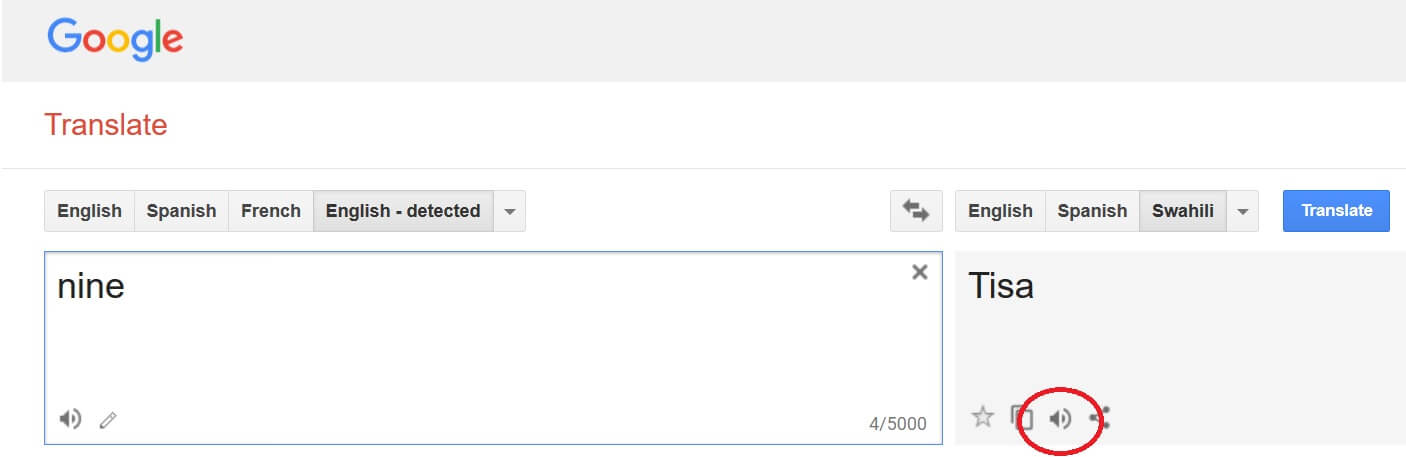
    Counting to ten is a cool first thing to learn because you can kind of sing it to yourself over and over, in the shower, in the car, wherever you want. It’s like your new ABC’s. It sticks with you too – I can do it in maybe ten to fifteen different languages now, just from memory.

    In reality you should be able to learn to count to ten in any language within 15-20 minutes. A nice surprise for me here was that Italian numbers are so similar to Spanish, which I did not know before! That made it an easy start.

    Leave it there for Day 1.


    Day 2: Greetings and basic words

    Greetings are probably the thing you will use the most so it’s good to learn the most common ones.

    Whenever you walk into a restaurant, greeting your waiters at breakfast, the receptionist, even taxi drivers and strangers on the street. Also for Day 2 it’s a good idea to throw in some basic words that you will use all the time (please, thank you etc).

    Here is a list of starting suggestions. I’d also encourage you to add your own!

    English Spanish Italian
    Hello Hola Ciao
    How are you? Como estas? Come va?
    I’m fine Bien Bene
    Good morning Buenos dias Buon giorno
    Good night Buenas noches Buonanotte
         
    Please Por favor Per Favore
    Thank you Gracias Grazie
         
    Yes Si
    No No No
    Excuse me Disculpe Scusami
    Sorry Lo siento Scusa
    Why? Por que? Perché
    What? Que? Che cosa?
    Who? Quien? Chi?
    Which? Cual? Quale?
    Where? Donde? Dove?

    You may also be wondering where and how you find out all the translations for these lists. I’m just using Google Translate, but Google will give you all kinds of free online dictionaries etc. The resources online are endless – it shouldn’t be difficult.

    I made a similar wordlist for Swahili recently and just asked a Tanzanian friend to sit down with me and translate everything – took maybe half an hour, so that’s another way to do it.


    Day 3: Basic verbs

    To populate this list, think of the verbs that you do every day. Don’t include verbs like “paint” and “sail” because you probably don’t do those things every day (unless you’re a painter or sailor).

    Remember, we’re trying to narrow things down to the most usable words. Limit your list to 20. Here’s a good starting list:

    English Spanish Italian
    To eat comer mangiare
    To drink beber bere
    To sleep dormir dormire
    To wake despertarse svegliarsi
    To walk caminar camminare
    To run correr correre
    To wait esperar aspettare
    To cook cocinar cucinare
    To buy comprar comprare
    To go ir andare
    To come venir venire
    To see ver vedere
    To want querer volere

    Bonus points: After you learn this list of verbs, you would get a lot more mileage out of them by learning how to conjugate. That just means instead of learning the verb in infinitive form (to eat) you could also learn how to say “I eat”, “You eat” etc.

    For example in Spanish, the verb to eat is like so:

    to eat comer
    I eat como
    you eat comes

    And a quick Google tells me that in Italian it is:

    to eat mangiare
    I eat mangio
    you eat mangi

    I just Googled this blog post to figure that out.

    If this all sounds like gibberish to you then don’t worry, just learn the verbs as they are and speak broken to begin with. People will understand you. Also many of you would have studied conjugated languages in high school and already know how this works, so go ahead and spend a bit of time learning the basic forms (I, you, they). Of course this doesn’t apply to all languages.


    Day 4: Basic nouns

    Now it’s time to learn the objects we use every day. Food we eat, items we use, that kind of stuff. Here’s a good list to start:

    English Spanish Italian
    Food la comida il cibo
    Drink la bebida la bevanda
    Room la habitación la stanza
    Car el coche l’auto
    Restaurant el restaurante il ristorante
    Bus el autobús il bus
    Coffee el café il caffè
    Tea el il tè
    Juice el jugo il succo
    Beer la cerveza la birra
    Supermarket el supermercado il supermercato
    Brother el hermano il fratello
    Sister la hermana la sorella
    Taxi el taxi il taxi

    This list is the most open to customising. It’s important to learn things common in your life that may come up in conversation. For example if your favourite sports are boxing and surfing, add those words in. Learn how to say the name of your home country. If your favourite food is chicken and chips, add those too. If you’re a lawyer or engineer, add those, and so on.

    Likewise you need to account for where you’re travelling to. If you’re going somewhere to surf, learn the words for ocean, beach, surfboard. If you’re going hiking, learn the words for boots, mountain etc.

    This is what effective language learning is about. Instead of memorising any old word list, create your own. If you’re not a pilot and none of your family or friends are pilots, don’t learn the word for pilot! Minimise your workload.

    For this list I’d set a word limit of about 25-30 words. At this point would be a good time to go back and start revising all your words from Day 1-3. You can forget them quite quickly.


    Day 5: Common words

    This list is all about words that come up in general day-to-day conversation. Did you know just 100 words in the English language make up 50% of all written material? There are maybe 250,000 words in the dictionary, but a small collection of 100 words make up 50% of your average book.

    Unfortunately that doesn’t help us with our cause much; most of them are words like “be” and “the” and “that”, and obviously going around saying “be that the” in another language won’t do much for us. But the concept is a good one to follow. What are the keywords we most commonly use in general conversation?

    English Spanish Italian
    Up arriba su
    Down abajo g
    Left izquierda sinistra
    Right derecha destra
    Near junto vicino
    Far lejos lontano
    Man hombre uomo
    Woman mujer donna
    Fast rápido veloce
    Slow despacio lento
    Here aquí qui
    There ahí
    This esto questo
    That eso quella
    Some alguno alcuni
    All todo tutti
    None ninguno nessuna
    Inside dentro dentro
    Outside fuera fuori
    Hungry hambre affamato
    Thirsty sed assetato
    Sometimes a veces a volte
    Always siempre sempre

    This list is super important because many of these words will come up in day to day interactions. Asking for directions, asking questions, explaining things to people, pointing to things on a menu. You’ll be surprised how often you use the word “sometimes” or “there”. No matter which level of language you get to these words will always be useful – learn this list well!


    Day 6: Basic phrases and replies

    The interesting thing about languages is they are routine in many ways. For example, if someone asks “How are you?”, 90% of the time the reply will be “I’m good” or “I’m fine” (except in Australia, where they’ll say Yeeah yeah bloody good mate just watching the footy yew!)

    Likewise in Swahili if you say “Mambo” to 100 people, 99 of them will reply “Poa”.

    One thing new language speakers do is learn a bunch of words and phrases like “What’s the time?” and “How much is it?” but never prepare themselves for the answer! If you are anticipating an answer you will have a much higher chance of understanding it, even if they say it fast or mumble it. You will also be able to put together an answer if the same phrase is said to you.

    Here are a few good examples to start with:

    English Spanish Italian
    How much is it? Cuanto cuesta? Quanto costa?
    It’s twenty pesos/shillings Veinte pesos Venti euro
    What is your name? Cual es tu nombre? Come ti chiami?
    My name is Batman Mi nombre es Batman Mi chiamo Batman
    How old are you? Cuantos anos tienes? Quanti anni hai?
    I am 20 years old Tengo veinte anos Ho vent’anni
    Where are you going? A dónde vas? Dove vai?
    I’m going to… Estoy llendo a…. Andrò a…
    What are you doing? Q haces? Cosa fai?
    I am…(eating) Estoy (comiendo) Sto (mangiando)
    Where is…(the dog)? Dónde esta…(el perro?) Dov’è… (il cane)?
    It is…(inside the house) Esta… (en casa) È (in casa)
    Do you like it? Te gusta? Ti piace?
    Yes, I like it Si, me gusta Sì, mi piace
    How is it? Cómo es? Come è?
    Good Bueno Buono
    What’s the time? Qué hora es? Che ora è?
    It’s 2 o clock Son las dos Sono le due
    Who is he/she? Quien es el? Chi è lui?
    She is (my sister) Ella es (mi hermana) Lei è (mia sorella)
    I would like… Quisiera…(por favor) Vorrei…(per favore)

    Day 7: Practice!

    And that’s it.

    If you learn everything above, you would have actually learned a few hundred words, will be able to say many basic day-to-day words and phrases, and will probably understand quite a few things said to you.

    Take notes, write down the parts that you struggle with, revise revise revise.

    Remember language is largely a practice and usage skill, meaning the more you use it the better you will get. Your knowledge also compounds, so while it may seem highly difficult at the start it will get much easier as you learn more words and phrases.

    We’re also skimming the fat on a lot of work that goes into language. Most language schools try to educate you on all four skills (reading, writing, listening, speaking), and we’re instead focusing 90% on speaking. That’s going to decrease your learning time a lot without much downside at all (unless you plan on reading the newspaper every day or writing an essay).

    Also remember, the above lists are just examples. Remove or add words/phrases to make the lists most usable for you, so they represent the things you most use/say in your everyday life. These lists are not complete – they are there for you to build on.

    How much time will you need? The above shouldn’t take you more than 1-2 hours per day. I translated all the lists above into Italian in less than 30 minutes. It helped that it was so similar to Spanish and French (I didn’t expect that) but most romanised languages you should be able to do in similar time. Non-romanised languages like Thai or Chinese will take longer but not painfully so.

    After that it’s just about putting in time. Keep it in a doc on your phone or if you’re old school like me write it on a notepad. Everything above will fit on one page. You can read it on the train or while you’re lying in bed at night. Remember there’s no super IQ needed here – it’s mostly just memorisation so anybody can do it.

    The last and most important tip of all is: Speak! As soon you touch down in the country, use it every opportunity you can. Learning everything is useless if you never use it. Don’t be afraid to make mistakes (nobody is expecting you to be perfect), make it fun and use a few more of your words each day. I’ll admit it’s intimidating at the start, but after a few days you won’t be able to shut up.

    Just a handful of hours and I promise you, your next trip will be a completely different experience.

    Good luck!

    Bren

  • A Beginner’s Guide To Studying Chinese In China

    A Beginner’s Guide To Studying Chinese In China

    Learning Mandarin seems to be the global craze these days. People from every corner of the world are flocking to China and many universities have entire campuses dedicated solely to the teaching of Chinese to foreigners. International students are spending thousands of dollars to live and study Mandarin in China’s top institutions, some even coming straight from high school and forgoing traditional degrees in their home countries altogether.

    But what are the real benefits of learning Chinese and what might you expect should you choose to dedicate a few years of your life to the language?

    As a foreign born Chinese, I felt compelled to return to my homeland to learn more about the people, the culture and the language of my ancestors. My reasons for moving to China were more cultural than anything else, so my experience might be coloured differently to yours. However, speaking as a student alone I believe my experiences could be very valuable to you should you find yourself thinking about an extended journey into China.

    How long will I need?

    I’ve studied a handful of languages in my time and Chinese was the most difficult by a long shot.

    If you go in as a complete beginner, most university courses will require just over 2 years for you to reach a “fluent” level, assuming you are doing a full time course (around 20 hours per week).

    The university I studied at had 9 levels, (A to I, with “A” being complete beginner and “I” being fluent) and in a semester you would complete two levels. Therefore to complete A to I would require 5 semesters. That works out to just over 2 years, assuming you pass every exam.

    Technically you can also do summer school each year which might reduce your time to 18 months, although this means you’ll be in the classroom studying Chinese full time for 18 months with no holidays which won’t be much fun.

    Here are some exceptions I’m aware of:

    1. You’re Japanese – Because Japanese people can already read and write a crapload of Chinese characters, they don’t need 2+ years. They may only need one. Probably 70% of Chinese study time relates to reading and writing, and Japanese Kanji in many cases is identical to its Chinese counterpart. The Japanese people in my beginner level class were able to read an entire Chinese menu before we’d even learned our first character.
    2. You speak Cantonese – I don’t speak Cantonese, but just from all the years listening to Cantonese chatter among my friends and family I was able to recognise the Mandarin words for quite a lot of things. I had a couple of Cantonese speakers in my beginner class and they were able to understand taxi drivers and waitresses before we’d even learned how to count to 5.

    If you fall into one of these groups, you’re lucky – you’ll learn Mandarin a lot faster than the average student. To give you an idea of what I’m talking about, it’s a bit like native English speakers learning Spanish.

    Imagine it’s the first day of Spanish class, and you see the words teléfono, restaurante, refrigerador, elefante, and television written on the board. You can’t speak one lick of Spanish but just by looking at the words you already know what they mean (if you’re a little dense, it’s telephone, restaurant, refrigerator, elephant and television).

    However a Japanese person who has no knowledge of English would not have a clue what the words mean. To him they’re just going to look like a bunch of scribbles, or perhaps a wavy, elongated piece of art.

    When you’re studying Chinese, the tables turn. You’re the one seeing scribbles, and the Japanese/Cantonese guy is the one who already knows everything.

    Read more: How To Speak A New Language In Seven Days.

    How difficult is it?

    Mandarin is a language that is both tonal and character based. This makes it unique from any other foreign language that I know of, which are often one or the other but not both. It’s for these reasons Chinese is considered one of the more difficult languages to learn for native English speakers.

    Tones

    Tonal languages are notoriously difficult and learning how to speak in tones is mostly a foreign concept to native English speakers. We use tones to convey feeling and emotion – it doesn’t matter whether we say the word hungry in an upward tone or a downward tone the end result is we’re still hungry.

    Not true in Chinese. For example, the words shúi, shuǐ and shuì mean who, water and sleep. The words are spelt exactly the same, however they are differentiated by the tone you say it in (represented by those dashes above the word). Therefore, you might be dying of thirst and telling your Chinese friend you need water, but if you say the word water in the wrong tone he might go upstairs and make up a bed for you thinking you need a nap. Or you might ask the waitress how much a water costs and she’ll end up slapping you thinking you’re asking how much it costs to sleep with her. These scenarios are not uncommon.

    The tones come easier to some people than they do to others. It’s common to find students who can recognise and reproduce each tone after a few days and some who still can’t tell the difference after several years. Whether it will prove difficult for you depends on your own ear and whether it comes naturally to you or not.

    Characters

    When learning English we need to learn to write 52 characters – 26 letters, upper and lower case. Remember how hard it was learning to write them all exactly how the teacher wanted?  However, armed with our 52 letters, we can now read and write every single word in the English language, even if we might not know the meaning.

    Chinese on the other hand has no alphabet. It’s a character based language which means it has a unique character for every single word that exists. Therefore you’ll need to learn how to read and write around 4,000 unique characters before you can read a newspaper, maybe 6,000 to read a typical university textbook and upwards of 20,000 if you want to study medicine.

    This is not difficult per se, as in you don’t need to be particularly intelligent to do it. It’s rather just very time consuming and requires a lot of dedication and study time. This can be a good or bad thing, depending on the individual learner.

    While I was studying Chinese I found that 70% of class time was dedicated to reading and writing characters. When preparing for exams, my entire study time was sitting in a café writing out pages of characters trying to memorise them. If you can’t read the characters, you can’t read the exam questions and if you can’t read the exam questions, you can’t answer the exam, and if you can’t answer the exam you can’t pass and if you can’t pass you can’t advance to the next level – do not pass Go, do not collect $200. So with no other choice I memorised them, and I didn’t enjoy it very much.

    I was told by my teacher that when primary school students learn a new character they are asked to write it out 100+ times every day. It kind of makes you understand why Chinese people have a reputation for studying so hard. They’ve been spending hours memorising these damn little pictures since the first day of school!

    Now, in my opinion studying language should be fun, and this part of studying Chinese is rarely fun. I believe a valid alternative is to forget about the writing aspect altogether. Learning to read is manageable but learning to write is where the bulk of your time will go to. I believe you can cut your learning time in half if you forgo the writing component and just concentrate on speaking, listening and reading, in that order. This approach is becoming popular, and there are now schools in China offering courses where only speaking and listening are taught and character learning is forgotten. Because I studied at a university, I had no choice. My exams needed to be passed or I would’ve lost my scholarship, and therefore I spent the hours needed to memorise all the pictureboxes so I could pass my reading and writing exams. However, I really advise that new students consider whether it’s important to them to read and write Chinese. If you think speaking and understanding Chinese is sufficient for your needs, you may find the investment required for reading and writing simply not worth it. And remember – just my opinion.

    Choosing a city

    As with every language, immersion is the key to effective learning. If you’re serious about learning Chinese you absolutely must be considering spending some time studying or at least living in China. I spent hours scouring forums and blogs trying to decide which city might be the best for me. In the end I chose Shanghai, so that is the only city I can speak about from experience, but let me say that after spending time in the country I now believe the city you choose will not matter a whole lot. Here’s why:

    While researching cities there were many common criticisms that were repeated over and over again – weather in Shanghai is shit. It’s too hot. It’s too cold. They don’t even speak Mandarin, they speak Shanghainese. You’ll end up learning Shanghainese instead of Mandarin. There aren’t even any Chinese people there, only foreigners. You’ll just speak English the whole time. It’s so expensive. Way more expensive than the rest of China. There’s no culture there. Just commerce. It’s not even the capital. Shanghai doesn’t even exist. It’s a magical world like Atlantis. You’re going to die. People are going to eat you.

    So, naturally I chose Shanghai. Yet as developed as it is, Shanghai is still very Chinese. There are certainly a few foreign dominated areas where you’ll only see white faces but the majority of the city is still yellow faced. It’s expensive if you eat at Italian restaurants, but the noodle shack on the side street will still feed you for $2. Every local speaks Mandarin unless he’s mute or over 100. You can’t speak English the whole time because 99% of locals in Shanghai don’t speak any. The point is, Shanghai is China’s most international city and it’s still a great place for immersion learning, so I’m confident every major city in China will serve you well in this regard.

    Therefore, the city you choose should depend on your other preferences – big city, small city, hot weather, cold weather etc. For this you’ll need to do your own research. But certainly don’t be put off by people saying you can only learn Chinese in Beijing because Shanghai people have shit accents and Guangzhou people can’t even speak Mandarin. It’s bad advice from silly people.

    Choosing a school

    Once you’ve chosen a city you need to choose a school. You may have already decided that you want to study at the famous Beijing Language and Culture University because everyone talks about it, or at Peking University because it’s the top ranked school in the country.

    At first I was basing my decision on which school had the best teachers and the most effective course. After having studied there for a year, I’m of the belief that it doesn’t really matter which course you’re in as the language is so systematic and cannot really be taught in too many different ways. How well you learn will mostly depend on how much time you spend practising and revising, which is obviously irrelevant to who your teacher is and which textbook you have. It’s not going to matter whether you’re writing out characters in a Beijing classroom or a Chengdu classroom. Of course not every course will be identical, but most universities model their courses around the HSK program (kind of a like a Chinese version of IELTS), which means they will all take a somewhat similar direction anyway.

    Rather than basing your decision on course quality or teaching quality, try choosing your school based on cost, facilities and location. What’s important to you? I studied at Fudan University, which had an amazing campus complete with gym, massive cafeterias, and a decent quality international students dormitory. It also had good classrooms, free wifi, fast internet in the dorms, and a large foreign student community. However, it’s obviously more expensive than some boutique schools and smaller universities.

    Fudan University Dorm Room
    Foreign student’s dorm room at Fudan

    Fudan classroomTypical Fudan University classroom

    If you want to live closer to the city centre in Shanghai, you might choose Jiaotong University, or a cheaper option might be Donghua University. For a smaller and probably cheaper school you might choose East China Normal University (ECNU) or SISU (Shanghai Intl Studies University), which both have good reputations and are a little less “cliché”.

    Scholarships

    I was lucky enough to be awarded a scholarship for my one year of study. This included:

    • All tuition fees paid
    • All accommodation paid
    • A monthly allowance of around $300 for food, transport etc.
    • A small allowance for textbooks
    • Health insurance
    • Your choice of (almost) any university in the country

    I chose to study at Fudan University in Shanghai, and all up I estimate the scholarship was worth around $10,000.

    Needless to say, my advice is to apply for this scholarship! My particular scholarship was the New Zealand – China scholarship from the Confucius Institute of the University of Auckland (link here)

    For more information, you can check out my post on how to get a Study in China scholarship here.

    What to expect

    If you’re in a university or school environment, expect to meet a lot of people from everywhere. It’s not like language schools in Spain where people are mostly from Western Europe, or down in South America where people are mostly American. China draws people from every corner of the world. My first class had one Korean, one Japanese, three French, one American, two Mexicans, one Spanish, two Brazilians, one Hungarian, one Australian, one girl from Hong Kong and one girl from the Bahamas. In comparison, my first Spanish class in Spain had ten students, and every single one of them was from Europe except for a lone Japanese guy (and me, of course).

    In class Fudan Morning class at Fudan

    As for living, China is a unique place. I won’t go into the details of living in China, but just know you won’t starve and you won’t go broke and it’s very safe. You’ll get used to it.

    In terms of class time, you’ll be mostly learning tones and basic phrases for the first couple of weeks. The speed is manageable and there is bound to be someone in your class who is having a harder time than you…hopefully. The first two weeks will start with pinyin which means using English letters to write Chinese words. For example, the word for water, can be written in pinyin as shuǐ , or in Chinese as 水. Obviously pinyin is easier, which is why you start with it, but characters will probably start being introduced within a couple of weeks.

    There is not a lot of grammar in Chinese, at least in comparison to English, so you’ll find a lot of your study will revolve around learning new vocabulary and phrases with the odd grammar point here and there. Typically you can expect to learn around 30 new characters a week on average.

    After half a semester you’ll be expected to be able to get around on your own, for example, asking which train to catch or where the bus stop is, as well as being able to read and write those phrases in Chinese. A typical writing exam question at the end of your first semester might be “write about what you did on the weekend”. You’d be expected to write (in Chinese characters) something like I woke up at 8 o clock, I had breakfast at a cafe with my friend, I did homework, I ate at a restaurant with my classmate, we ate whatever, I rode my bike to wherever, I went to sleep at 10pm etc etc. This might seem simple for a few months work but remember, it might only take you a few days to learn to say all that but it will take you a lot longer to learn (and remember) how to write it.

    You can expect to have learned the majority of basic grammar after a full semester, being able to say most basic things you would need to say (perhaps not perfectly but you’ll get your message across). After that it’s just a matter of expanding your vocab and learning the odd advanced grammar point to make your Chinese sound more ‘natural’.

    Expect to be able to complete HSK3 after a semester, HSK4 during your second semester and HSK5 after a year if you’re a good student. I only know one guy from my class who even bothered to attempt HSK5 at the 1 year mark, and he passed (he was Japanese). The rest of us sort of knew we wouldn’t pass it so we didn’t try.

    For those who don’t know, HSK5 is the level required to enter university in China as an undergraduate, i.e. to start doing a proper degree at a Chinese university.

    Visa

    China is pretty anal about visas so the visa process is basically a hoop jumping festival that lasts several months (for me anyway).

    You’ll need a medical exam completed by your doctor for the entry visa application, the university application and then the residence visa application in country. Photocopies aren’t accepted, so make sure you get three, handwritten copies of your medical exam for each application, otherwise you’ll end up paying for three seperate medical exams like I did. There’s a bunch of other crap too but it’s all explained to you once you get into the country.

    Internet

    One other thing to note is that many sites are blocked in China, such as Facebook. If you want to access those, you’ll need a VPN. I recommend using Private Internet Access.

    One Final Tip: Study To Improve Your Chinese, Not To Pass Exams

    Most students structure their study around trying to pass the HSK exams. The problem with this is it requires you to learn how to read and write a lot of words that you will never use and probably don’t even use in English. Therefore, I’d advise against this approach unless there is a real reason that you need to acquire HSK, i.e. to gain university entrance, job requirements etc. If I could do my scholarship all over again I would spend far less time writing out characters in coffee shops and instead spent it listening to audios and practising my speaking. My grades would’ve definitely slipped but in hindsight that is not important at all. You’ll find yourself in situations every day where you wish you knew how to say something, but there was not a single real life situation during my year in China that required me to write Chinese. Remember that you’re learning Chinese so you can communicate with people; not to pass an exam.

    Just do it

    I spent countless hours researching studying Chinese in China before I finally decided to do it. Some things turned out exactly as planned and some things didn’t. I can say though it was an incredible experience and one I recommend to everyone. As we all know, China is booming and it’s an incredible place in the world to be right now. If you’ve been thinking about doing something like this – just get on the plane and go.

    Questions? Feel free to get in touch or leave a comment below, I’ll be more than happy to help in any way I can!

  • A Beginner’s Guide To Studying Spanish Abroad

    A Beginner’s Guide To Studying Spanish Abroad

    For me, learning the language has always been one of the most fulfilling aspects of travelling to a new country. In fact, my first ever solo trip was a full time language course in Spain, and it’s still one of my fondest travel memories.

    Since then I’ve always made an effort to learn some of the local language wherever I am, and it never fails to add a fun and rewarding dimension to my trips. If I’m based somewhere long term I will usually take classes, however for shorter stays I still try to learn as much as possible through self teaching.

    Spanish is one language that I’ve spent a considerable amount of time studying overseas, and I’ve since learned that there are many different variables to consider when deciding to do this.

    In this post I’ll run through each of them, and hopefully by the end of it you’ll be on the verge of heading overseas to make Spanish your official second (or third or fourth) language 🙂

    Spain or Latin America?

    Every prospective Spanish student wonders the same thing – “Should I study in Spain or South America?”

    I’ve actually done both – studying Spanish for 5 weeks in a language school in southern Spain and then again for 9 weeks at a language school in Peru and also Ecuador. There’s obviously pros and cons to each, which I’ll lay out below.

    Studying Spanish in Spain

    Purists would argue that you should study in Spain because you’ll be learning the “official” Spanish (or Castilian, as it’s sometimes called). In a way that kind of makes sense – the language did originate there after all. You’ll also be situated in Europe, with France, Italy, Switzerland and Portugal just a train ride away, but keep in mind that Western Europe is one of the world’s most expensive regions.

    As for the language itself, the Spanish in Spain is slightly more complicated, the one notable difference being the extra verb form “vosotros” (basically that means you’ll have an extra form to learn for each verb – annoying, but no biggie).

    There are also small pronounciation differences, for example, the Spanish have the lisp when they pronounce their C’s and Z’s (i.e. gra-thi-as) while the Latin Americans pronounce it as an S. The letter V also varies – the Latin Americans pronounce it as a V while the Spanish pronounce it as a B. Again, not a big deal but worth noting.

    One thing you’ll definitely notice is people in Spain speak significantly faster than the Latin Americans, and I found this made them a little harder to understand. For advanced speakers it won’t matter so much, but it can make quite a difference for beginners.

    Lastly, it’s important to consider where in Spain you want to study – every region speaks a different dialect and this will impact your learning. For example, I studied in Andalusia where I was often spoken to in the Andaluz dialect. I was a beginner at the time so this wasn’t ideal for me (of course, this problem is easily avoided by studying in Madrid).

    The good

    • Situated in Europe with many travel opportunities
    • “Official” Spanish (although with many different variants and accents)
    • Beautiful weather, food, excellent tourist infrastructure

    The bad

    • More expensive
    • Many different dialects in the country
    • Spanish is slightly more complicated

    Studying Spanish in Latin America

    People argue that you should study in Latin America because their version of Spanish is more widely spoken, however this isn’t entirely true. Every country in Latin America has their own unique style of Spanish with very different accents, words, phrases and slang. For example, I studied in Peru for two months and when I visited Colombia I suddenly found it extremely difficult to understand anyone. Then when I visited Argentina it was the same thing all over again. The takeaway here is, regardless of whether you study in Spain or Latin America, the Spanish you’ll learn is going to be a little bit different to everyone else’s.

    In my opinion, the true benefit of studying here is you can travel around the continent and everyone will still be speaking Spanish, even if it is a little different. Therefore if you’re looking to study for an extended amount of time, say, 6 months or more, Latin America would definitely be the better choice. You could experience 3 or 4 countries, all the while continuing your studies and familiarising yourself with several accents and phrases.

    Also Latin America is still mostly comprised of developing countries meaning everything, including your tuition fees, will be far cheaper than in Spain. I remember my classes in Peru only cost me around $60 a week, whereas in Spain it was at least 3x that.

    As for the language – it’s simpler and easier here. They speak slower and the grammar is slightly more basic as I discussed earlier. I did come across a lot more slang here, although I’m not sure whether it’s because my Spanish improved and I just noticed it more or if that’s actually representative of the language itself. Either way – I found the people in LatAm much easier to understand.

    One last thing to note is that travel around South America isn’t exactly cheap or easy. Flights between countries are actually very expensive, and taking buses is generally long and arduous. It definitely won’t be like Spain where you can jump on a train and be across the border within a few hours. Keep this in mind if you plan on country hopping.

    The good

    • Cheaper cost of living and tuition
    • Large variety of countries to choose from
    • The Spanish is simpler and easier to learn

    The bad

    • General travel issues with developing countries (hygiene/safety/transport/tummy issues)
    • Each country speaks a slightly different Spanish, none of which are Castilian (if that matters to you).

    My opinion on studying Spanish abroad

    As you know I’m all about stretching dollars so Latin America is generally my first choice. The many different countries to experience and the the lower cost of living is just such a big plus for me. Also, much of Latin America is still developing and the continent(s) is changing quite quickly. While Spain probably won’t evolve too much over the next 10 years Latin America certainly will, and that urges me to see the continent now before it enters first world territory. Of course, that’s just me, and your priorities are bound to be very different!

    Which should you choose?

    Obviously there’s no right answer here – it largely depends on your preferences and your reasons for learning the language. I think the only real question you need to ask yourself is, where do you intend to use it?

    If you forsee yourself spending more of your life in Spain, learn it in Spain. If you intend to spend a lot of time in Latin America, learn it in Latin America. Pretty obvious, right? Of course, if funds allow it I’d definitely advocate trying to experience both – they’re each incredibly fulfilling in their own ways.

    Different options for studying Spanish

    You’ll also need to decide “how” you want to learn the language.

    Some people just show up, find a bunch of language partners on Couchsurfing and then teach themselves with a Pimsleur or Rosetta Stone course.

    Others enrol in an intense 30 hour per week course and are conversational within a month (I’m a big fan of this). So what are your options?

    Language school

    This is not affordable for everyone, particularly in Spain. Good language schools cost money, but in my opinion a good school is definitely worth every cent.

    If you’re a complete beginner, I would say a month in a language course is the best possible way to get started. This ensures you create an excellent foundation and have a good understanding of the basics. Remember – habits are easy to make and hard to break.

    To find my school in South America I used the site languagecourse.net. You can compare a large collection of schools there and also read reviews from other students, which is always helpful.

    To find my school in Spain I used STA Travel. Their programmes are a little pricier (I was working at the time so had a much bigger budget), but the school I ended up at was incredible, and I would highly recommend them.

    Things to look for in a language school

    • Location – Ensure the school is located in a central location and close to public transport. If the school is located out in the suburbs your transportation costs will skyrocket, and you’ll also be far away from the action which is never fun. Also, consider the cost of living in the city you’ve chosen – living in Madrid will obviously be more expensive than living in Cadiz.
    • Price – Price varies a lot between language schools; make sure you shop around!
    • Facilities – Some schools will come fully equipped with a gym, pool, restaurant, shuttle service, perhaps even dance and cooking classes. However, this usually results in higher fees too, so make sure you’re going to use the facilities if you’re paying for them! At the very least, make sure the school offers the essentials, such as wifi and course materials.
    • Reviews – Check sites like languagecourse.net and read through the reviews of previous students – these will give you the best idea of whether the teaching and facilities are of a decent quality.

    Private tutor

    While studying in Spain I had 1 on 1 conversation classes, and this sped up my progress exponentially. If your budget allows, I’d highly recommend some sort of private tuition.

    However, it can be quite difficult to find a “good” and affordable private tutor. I think the best way is through word-of-mouth, so ask other students, check out the notice boards in cafes etc and look on sites like Craigslist (or put up an ad of your own). It’s also common that your language school will offer this service, and while it may be more expensive you can usually be confident the teaching quality will be high.

    Self teaching

    If you’re an English speaker, Spanish is actually quite an easy language to grasp and you can get quite far with self teaching.

    I recommend the website Duolingo, which has an incredible free course that covers near everything there is to know about Spanish grammar, all broken down into small, easy to follow lessons.

    As mentioned earlier, you can also use a programme like Rosetta Stone or Pimsleur (these cost money however).

    For online dictionaries, grammar explanations and translations, SpanishDict is my go-to site.

    Language partners

    Whichever method you choose, you’ll need a language partner to practise with. I actually think the best place to find one is Couchsurfing – most countries will have a language group and you can simply post your request for a language partner there.

    You could also try a site like Interpals – another free language networking site. Of course, most language schools will also have a language partner programme to help you out with this.

    Other options

    Of course, organised study isn’t the only option. Many volunteer programmes throughout Latin America offer daily Spanish classes to assist you with your role, and the environment you’ll be in is perfect for Spanish learning (often lower socioeconomic communities where English is hardly spoken).

    Au pairing is also possible in Spain and Latin America, which will allow you to live with a local family and practise your Spanish constantly with native speakers.

    The great thing about these options is that your room and board will usually be covered, allowing you to stay in the country for a lot longer than you normally would be able to.

    How long do I need?

    People often wonder, is it worthwhile to just do a one week or two week course? My opinion is this – it depends.

    If you’re from New Zealand (like me) heading to Spain for a two week course seems like a bit much. Just getting to Spain and back is already around 3 days of travel, and you’ll probably need another week or so to beat the jet lag. In that case, I’d recommend at least a month to get your money’s worth.

    On the other hand, if you’re from the Europe then a two week trip down to Spain would work perfectly.

    As for actual learning time, you could expect to learn a lot in 2 weeks. Spanish is quite easy to grasp for native English speakers, and many of the intense courses (25-30 hours per week) are designed to have people fluent in 6 months. If you attend your classes, you can expect to move quite quickly.

    For those who are planning a big backpacking trip of Latin America, my advice would be to spend the first two weeks in an intensive Spanish course – it will change the dimension of your trip entirely!

    Good luck!

    As you can see, there’s quite a bit to think about when deciding to head overseas and study a language. To some people it can seem odd (why would you go on holiday to study?) but to others it is incredibly rewarding. In the end, just go with your gut and enjoy it. It’s a beautiful language and whichever avenue you choose I’m sure you’ll have a blast.

    Buena suerte!

  • Study Chinese in China for a year…for free!

    Study Chinese in China for a year…for free!

    These days studying Chinese in China is like the new Macarena – everyone is doing it.

    Students from literally every corner of the world, many of them fresh out of high school are laying down around $6,000 – $10,000 a year for housing and language tuition at Chinese universities.

    But what if I told you there was a way to get all this for free?

    Actually no, what if I told you there was a way to get paid to do this?

    Well, there is. And thousands of students are doing it every year. I was one of them! Here’s how:

    Every year the Chinese government offers scholarships to foreign nationals. The idea is that you are given a year’s free study in China, after which you will hopefully decide to stay and become a valuable member of their society (you know, get a job there and marry a Chinese girl and eat heaps of wontons. Mmmm). Even if you don’t, you’ll have spent a year learning Chinese which is good for the country anyway in the sense that the language and culture spreads around the world.

    Typically the scholarship covers all university fees, all accommodation fees, health insurance, learning materials, around $250 to cover your initial visa/setup costs and then they pay you $275 a month for the whole year. All up, the entire gig was worth around $11,000 USD.

    Now before you close this page and say “Brooo. C’mon! I never learned Chinese. I’m dumb. No one’s gonna give me no dang scholarship!” just hold the phone a second. When I applied, I could say about 10 words in Chinese. My career was not China-related (I was a NZ tax accountant). I didn’t get great grades in university. I was not a Chinese language student and I hadn’t met a single person on the scholarship council. I still applied and I still got accepted. 

    There was one other NZ recipient studying at my university and she was also a beginner (we were in the same class). I’ve also already referred one friend who ended up landing a 2013 scholarship – also a beginner.

    Don’t let the word ‘scholarship’ fool you. This isn’t an exclusive deal for smart people. The Chinese government set this whole thing up because it wants to give this money away. It wants people to learn Chinese and it wants foreigners to live in and discover their great country. Getting the scholarship is about presenting yourself as a worthy suitor, that’s it.

    What I found most fascinating was the amount of students in China that just had no idea this opportunity existed. In my opinion, this is the best public study abroad opportunity I know of in the world today. It is not like other free opportunities where you get a “free” flight and “free” apartment, but with a little side deal that you have to teach English in some affiliated school for 6 hours a day. This is completely obligation free – no obligations before, no obligations after, no obligations during (other than attending class).

    OK, so, the deets. Where and how do you apply?

    Being the nice guy that I am, I went and harassed nicely asked 12 scholarship students from around the world about their scholarships and how they managed to get them. Hopefully the information here will point you in the right direction and allow you to study Chinese in China in the not too distant future!

    Enjoy!

    If you’re not interested in studying Chinese but still want to live and work in China, check out this report from my friend J, who spent a semester doing teaching English in the TTC (Teach and Travel China) program.

    Brendan, New Zealand

    Chinese level at the time of application?
    Complete newbie.

    Organisation applied through?
    Confucius Institute at the University of Auckland

    Studied at which university?
    Fudan University.

    What did the scholarship application process involve?
    Had to write a letter stating the reasons I deserved the scholarship. Also needed references from two people, one needed to be a university professor.

    Why do you think you got accepted?
    I had been very involved in the Chinese community in New Zealand, and my references reflected that. I’m also Chinese, and made it very clear I was interested in learning more about my heritage.

    What did the scholarship include?
    A private room in the university dorms, all university fees, monthly allowance of 1,700RMB (~$275USD), free books, free health insurance, some free tours to other cities.

    What were your obligations after the scholarship?
    A one page report after the scholarship detailing my experiences.

    What tips would you give to people applying for the scholarship to improve their chance of being accepted?
    1. I think all the application requirements are there to just weed out freeloaders. I think what it really comes down to is, do you want to learn Chinese? If so, can you prove it? Do you take language classes? Have you read any books on China? Do you have a Chinese language partner? If not, why are you even bothering to apply?

    2. You will still need to ensure you meet all the requirements. For my particular scholarship you needed to be a NZ citizen, and I wasn’t. Therefore I needed to fast track a citizenship application before the scholarship deadline. You also needed to have been a university student within the last 5 years. If it’s been more than 5 years since you graduated, you may need to enrol in some university language courses and get your student ID back!

    3. The make or break part of the application is your letter. You obviously want to learn Chinese, otherwise you wouldn’t be applying. So show that genuine interest and fascination with the country and the language. Most applicants are Chinese language students, so they sell themselves that way. That’s obviously not a good angle for me since I’m a Chinese illiterate. Instead, I made it clear that I couldn’t speak Chinese but I was very eager to live in the country and learn about my heritage (I’m Chinese blooded). I assured them I would take it very seriously and pass every exam (and I did!). I was very keen to learn the language and had been for a long time, so my references were able to vouch for that. Instead of focusing on my crappy Chinese I focused on my other achievements, i.e. my career, travels, community work etc. After they read your letter they need to be thinking “Yes! This is the type of guy we want to give this to.”

    Best thing about living in China?
    The crazy nightlife! And also the melting pot of cultures. Shanghai really feels like the centre of the world these days.

    Worst thing about living in China?
    The air pollution and the very oily food.


    Katie F, New Zealand

    Chinese level at the time of application?
    Minimal – simple sentences – had done a round of night classes at Wellington High.

    Organisation applied through?
    Confucius Institute at the University of Auckland

    Studied at which university?
    Fudan University

    What did the scholarship application process involve?
    Had to write a letter stating why I wanted the scholarship, needed references from two people.

    Why do you think you got accepted?
    Had a slightly different profile – working in the media as opposed to the majority of people who apply who are fresh grads, also I’d already had an internship from a related organisation in Shanghai.

    What did the scholarship include?
    Free private room in university dorms and tuition for a year, 1,700RMB (~$275USD) monthly stipend, free books, free health insurance.

    What were your obligations after the scholarship?
    Short monthly reports during the scholarship, one-page report post scholarship

    What tips would you give to people applying for the scholarship to improve their chance of being accepted?
    Make sure you have good references to vouch for you. In my opinion the most important aspect of the application letter is showing how valuable you will be in the future with this experience under your belt.

    Best thing about living in China?
    Really feeling like you live at the centre of the universe. Everything is happening there.

    Worst thing about living in China?
    Pollution, environmental degradation, poverty can be difficult to deal with.


    Fredrika W, Sweden

    Chinese level at the time of application?
    Some conversational skills, quite poor reading and writing.

    Organisation applied through?
    The Nordic Confucius Institute in Stockholm, Sweden

    Studied at which university?
    Fudan University

    What did the scholarship application process involve?
    I needed to participate in a national competition with performances in Chinese. Based on pronunciation and language skills in the competition you could win one-years language scholarship to any University in China as long as you got accepted to the University. The University application required 2 recommendation letters and a personal letter from me (in Mandarin).

    Why do you think you got accepted?
    Fudan has in the past accepted a lot of the students who won this competition in Sweden. The recommendation letters were well-written, my personal letter was translated into proper flawless Mandarin and was very complimentary towards both the university and the country.

    What did the scholarship include?
    Tuition fees, dormitory fees for the 4-bedroom rooms and a monthly allowance of 1700 Yuan (~$275) and free books at the beginning of the term.

    What were your obligations after the scholarship?
    No following obligations.

    What tips would you give to people applying for the scholarship to improve their chance of being accepted?
    Show that you’re very open-minded towards the culture, enthusiastic about the language and show your passion about your studies.

    Best thing about living in China?
    I can only comment that living in Shanghai was fantastic. Great, vibrant city with great restaurants and an exciting night-life with a lot of opportunities to meet people. Also the low living cost and good opportunities to travel in Asia.

    Worst thing about living in China?
    The pollution, the immense culture shock, the difficulty of sorting anything out in the beginning if you don’t speak Mandarin and have no one to help you.


    Elena M, Spain

    Chinese level at the time of application?
    HSK 2 (I was placed in class C and the top level is J).

    Organisation applied through?
    Confucius Institute, Madrid

    Studied at which university?
    Fudan University.

    What did the scholarship application process involve?
    I had to write a one page essay about why I wanted to obtain the scholarship, send two recommendation letters, and pass all medical exams to fill in the medical report.

    Why do you think you got accepted?
    First of all I think my chances increased for being a student of the Confucius Institute in Madrid and having studied there for two years. Also I had passed the HSK 2 with a very high mark and participated in the Chinese Bridge competition. Moreover, I had spent two summers in China studying Chinese and my final degree dissertation was about translation from Chinese to Spanish. All of this accredited my interest in China and Chinese culture, which I think is what they value the most, your background and past experiences.

    What did the scholarship include?
    Tuition for a year, private room in university dorms, month allowance of 1700 RMB (~$275 USD) plus 500RMB on the first months of the semester to cover books and school material, free health insurance, a night tour on a boat in the Huangpu river.

    What were your obligations after the scholarship?
    None. All I had to do was write a few lines every month just to confirm that everything was going OK.

    What tips would you give to people applying for the scholarship to improve their chance of being accepted?
    The most important thing is show your interest, but being interested is not enough: you need to prove it! Taking Chinese classes? Joined activities related to Chinese culture? Anything is okay but it’s always better if you have some title, especially from the Confucius Institute.

    Best thing about living in China?
    Being able to talk Chinese in your daily life and getting to know people from all over the world.

    Worst thing about living in China?
    Pollution.


    Chia L, Canada

    Chinese level at the time of application?
    Intermediate.

    Organisation applied through?
    China scholarship program through the Canadian Government

    Studied at which university?
    Fudan University.

    What did the scholarship application process involve?
    Letter on why I wanted the scholarship, references, copy of academic records and application form.

    Why do you think you got accepted?
    Had experience with China and wanted to improve my Chinese.

    What did the scholarship include?
    Tuition fees, housing and monthly stipend.

    What were your obligations after the scholarship?
    None.

    What tips would you give to people applying for the scholarship to improve their chance of being accepted?
    Follow application instructions and have a good letter.

    Best thing about living in China?
    Scooters.

    Worst thing about living in China?
    Pollution.


    Liyo G, Belgium

    Chinese level at the time of application?
    Good (HSK level 5).

    Organisation applied through?
    Confucius Institute in Brussels

    Studied at which university?
    Fudan University.

    What did the scholarship application process involve?
    A letter in Chinese, my academic records, and a reference from a Chinese teacher.

    Why do you think you got accepted?
    Because my Chinese was already at a good level and there weren’t many other applicants.

    What did the scholarship include?
    School fees, a room at the dorms, a monthly income of around 1,700RMB (~$275 USD).

    What were your obligations after the scholarship?
    There was nothing afterwards, but we had to fill forms every month during the scholarship, and of course attend classes.

    What tips would you give to people applying for the scholarship to improve their chance of being accepted?
    Maybe try and pass an HSK exam, even if it’s just the first level.

    Best thing about living in China?
    Chinese people.

    Worst thing about living in China?
    Chinese people.


    Liang C, New Zealand

    Chinese level at the time of application?
    Low. Could say hello, goodbye, eat and sleep.

    Organisation applied through?
    Confucius Institute at the University of Auckland

    Studied at which university?
    Sun Yat Sen University, Guangzhou.

    What did the scholarship application process involve?
    An application letter along with two references. One academic, one someone you know.

    Why do you think you got accepted?
    Had been involved with a conference related to Chinese New Zealanders. Had a high academic record.

    What did the scholarship include?
    Free shared twin room, monthly living allowance or 1700RMB (~$275 USD) and tuition fees. Free health insurance. Had to pay for books and transportation.

    What were your obligations after the scholarship?
    A one page report detailing my experiences.

    What tips would you give to people applying for the scholarship to improve their chance of being accepted?
    Get involved in Chinese community events and have great academic references.

    Best thing about living in China?
    The hub of all things created. You can buy anything that you are looking for.

    Worst thing about living in China?
    A lot of fake products. Bad manners of many people.


    Stephanie Z, Australia

    Chinese level at the time of application?
    Somewhere between beginner and intermediate, I had taken 3 subjects at uni.

    Organisation applied through?
    China Scholarship Council via the University of Sydney.

    Studied at which university?
    Fudan University.

    What was the process for your application?
    Two references, statement of purpose, transcript, CV.

    Why do you think you got accepted?
    Showed a demonstrated interest in Chinese studies and furthering my language skills.

    What did the scholarship include?
    Free private room in university dorms, free tuition for 6 months (1 semester), around monthly 1700RMB (~$275USD) stipend, free health insurance.

    What were your obligations after the scholarship?
    Nothing.

    What tips would you give to people applying for the scholarship to improve their chance of being accepted?
    Be authentic and thorough in your application, and try to learn some Chinese before you apply!

    Best thing about living in China?
    It’s dynamic, fast paced and always challenging.

    Worst thing about living in China?
    Pollution, traffic.


    Ambra A, Italy

    Chinese level at the time of application?
    Intermediate.

    Organisation applied through?
    Chinese Government Scholarship Council – EU window

    Studied at which university?
    Fudan University

    What was the process for your application?
    3 reference letters, online applications, health exams, statement of purpose.

    Why do you think you got accepted?
    A good statement of purpose and high grades.

    What did the scholarship include?
    School fees, a room at the dorms and a monthly stipend of 1,700 RMB (~$275 USD)

    What were your obligations after the scholarship?
    During the year I had to write a report every month.

    What tips would you give to people applying for the scholarship to improve their chance of being accepted?
    Carefully follow the application requirements and checklist.

    Best thing about living in China?
    Cheap cost of living, good food, Shanghai is a fun city to live abroad in.

    Worst thing about living in China?
    Quality of life, including the pollution.


    Daniel E, New Zealand

    Chinese level at the time of application?
    Could comfortably converse in Mandarin on a range of topics, send and receive instant messages and texts and handwrite to a basic level.

    Organisation applied through?
    Confucius Institute at the University of Auckland

    Studied at which university?
    Beijing Language and Culture University

    What was the process for your application?
    I had to write a letter outlining both my experience and interests in China and Chinese as well as my future goals and aspirations to do with China.

    Why do you think you got accepted?
    I believe it was because I could demonstrate both strong results in language learning via awards, speech competitions and a Daoming Scholarship. Also in my deliberate and driven involvement in the local Chinese language community. These in concert with a demonstrated desire to further my language ability and be involved in China in the future.

    What did the scholarship include?
    Tuition fees at one of the approved institutes for one year of language studies, course materials were provided for, accommodation (student dormitories, in most instances shared and fairly basic but can upgrade if you are happy to top up with your own money), health services/insurance and a monthly stipend of 1700 RMB (~$275 USD).

    What were your obligations after the scholarship?
    Write a mid-term and full-term report outlining our experience in China, how we found the application and administration of the scholarship and such-like.

    What tips would you give to people applying for the scholarship to improve their chance of being accepted?
    You need to do everything you can to demonstrate your dedication to China, Chinese language and culture and the people of China.

    They’ll also be looking keenly for indications of your future plans and how they involve China, obviously the stronger and more strategic the better.

    Finally, what I did and I believe it helped with my application was to write the letter in Mandarin (I of course got a friend to check grammar etc). I believe this helped leave a positive impression of my intentions and commitment.

    Best thing about living in China?
    The people, the language, the mysterious charm in the Chinese way of doing things.

    Worst thing about living in China?
    Food safety, when you don’t quite “get it” (language or cultural norms), the public toilets (always have some tissues or paper and hand sanitiser on you).


    Lydia E, Germany

    Chinese level at the time of application?
    Advanced (HSK Level 5).

    Organisation applied through?
    Confucius Institute at the Goethe University in Frankfurt

    Studied at which university?
    Fudan university

    What was the process for your application?
    I had to write a motivation letter, fill in application forms and get two references.

    Why do you think you got accepted?
    I think I got accepted because I’d participated in Hanyuqiao before and also already taken the HSK exam (I had also visited some classes in the Confucius Institute itself).

    What did the scholarship include?
    Free tuition, free room in the students dorm, 1400 RMB (~$230 USD) monthly stipend, discount for books and health insurance.

    What were your obligations after the scholarship?
    The Confucius Institute wanted me to write a report about my experiences in Shanghai and also to prepare a presentation (which was held in the Institute).

    What tips would you give to people applying for the scholarship to improve their chance of being accepted?
    Personally, I think it is important to show interest in Chinese language and culture. It would be advantageous to visit classes in the Confucius Institute in advance and if you have already studied Chinese for a certain period of time, maybe also try to take an HSK exam, even if it’s just the first level.

    Best thing about living in China?
    This was already my second time of living in China- I have lived in Beijing before. I think it was great to experience another city. (I realized that I liked both, maybe because they are so different.) And also, it was amazing to get to know so many people from different countries. Another positive point is that most of the things you can do in your spare time are so cheap and you could live rather low-budget.

    Worst thing about living in China?
    I think the worst thing about living there (and which is also the reason why I wouldn’t want to spend more time there than a year) is that you have to worry about what you eat because you could really get problems with impure food (visiting doctors there is not fun – Western doctors are quite expensive and Chinese health facilities are anything but recommendable). Also, the quality of tap water and air is really bad (whereas I have the impression that all this is better in Taiwan).


    Lisi H, Switzerland

    Chinese level at the time of scholarship application?
    Good listening comprehension (maybe HSK 4). Slow speaking due to limited vocab as I hadn’t spoken for a long time. No reading or writing skills.

    Organisation applied through?
    Swiss Chinese embassy

    Studied at which university?
    Fudan University

    What was the process for your application?
    Letters of recommendation, health examination, proof of English level, university diploma.

    Why do you think you got accepted?
    Due to my Chinese heritage (I am half Chinese), recommendation letters, maybe my personal working goals.

    What did the scholarship include?
    Free tuition fees, books, health insurance and accommodation for one year. Monthly stipend.

    What were your obligations after the scholarship?
    None?

    What tips would you give to someone applying for the scholarship to improve their chance of being accepted?
    Stress your relation to China and explain in which way you could help bring more cultural understanding/exchange between the West and China. This is why they provide scholarships.

    Best thing about living in China?
    Meeting people from around the world, experiencing Chinese traditions meeting Western modernity.

    Affordable lifestyle including taxis, food from around the world, crazy clubs, spas & massages.

    Freedom of choice about what kind of life you want to live with the difference in living costs between Chinese and Western life. In Shanghai there is something for everyone.

    Worst thing about living in China?
    Everything and everyone is extremely loud, bad traffic, food quality differs very much, very bad air quality.


    Chris H, England

    Chinese level at the time of application?
    Could have a basic conversation but not about anything complex and specific.

    Organisation applied through?
    Confucius Institute at the University of Nottingham

    Studied at which university?
    Fudan University

    What was the process for your application?
    Had to write a letter stating why I wanted the scholarship, needed references from two people.

    Why do you think you got accepted?
    I was a little surprised actually as I had originally been told they were only looking for people who’d passed at least HSK 3. I think I was chosen partly as I was in my final year of university so they knew I was more likely to accept the offer rather than reject it and continue university.

    What did the scholarship include?
    Free private room in university dorms and tuition for a year, 1,700RMB monthly stipend, free books, free health insurance.

    What were your obligations after the scholarship?
    May have been asked to submit a report but was never asked for it or told where to submit it.

    What tips would you give to someone applying for the scholarship to improve their chance of being accepted?
    Try to show why you are interested in learning the language, e.g. what you plan to do after the course in China, to show you are committed. Also, when studying in China, what you put in is what you get out, put effort into studying but also getting out and using Chinese in everyday life. Don’t hang around with people who speak English for most of the time.

    Best thing about living in China?
    The huge and interesting difference in culture and life style, also the chance to travel all over the country and elsewhere in Asia.

    Worst thing about living in China?
    The apparent difference in logic and manners but you get used to it.


    And one final tip: If your country wasn’t listed above, just Google search for a Confucius Institute in your country/city. They can probably tell you everything you need to know.

    祝你好运!