Category: Book reviews

  • The Books I Read In 2016

    The Books I Read In 2016

    Books! This has been a big part of my life the last couple of years, especially because I suck at reading and used to take so much pride in never reading the book in school and still passing the exam. But this is no longer school, this is life, and reading is starting to feel kind of important now.

    I have decided, however, that I’m not going to be intimidated by all these supernerds around me reading like 100 books a year and taking over the world. I’m eager to read more, but now I’m only competing with myself and my only goal is that I read more than I did the previous year. In 2015 I read 11 books, in 2016 I read 12.5! So I’m pretty much a genius now.

    If you’re interested, here’s what I was reading this year:

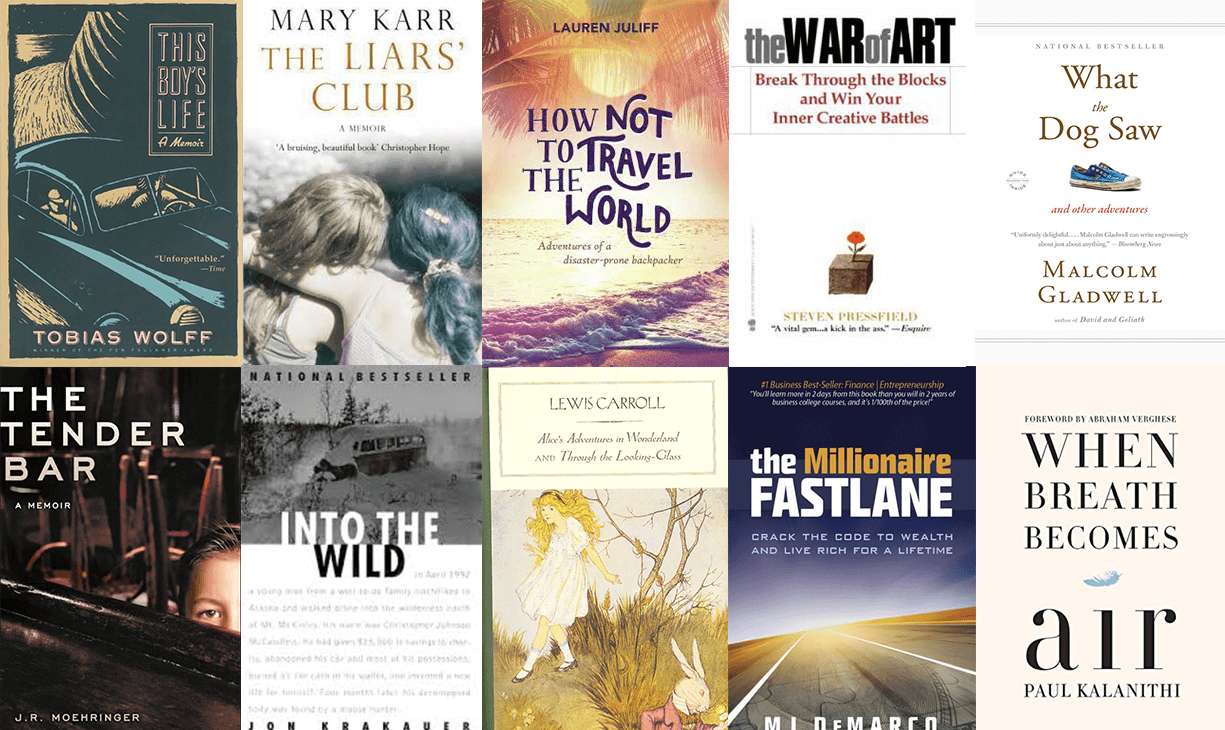
    What The Dog Saw | Malcolm Gladwell

    “They were there looking for people who had the talent to think outside the box. It never occurred to them that, if everyone had to think outside the box, maybe it was the box that needed fixing.”

    Malcolm Gladwell is one of my favourite authors and storytellers, and I generally have to be in a certain headspace to read his books as they’re so thought-provoking and involved. What The Dog Saw is a collection of short essays where he investigates questions such as “Why are there hundreds of mustards but ketchup has never changed?” or “Why do Japanese women have breast cancer rates six times lower than American women?” By looking at these questions from unique angles, or perhaps, just closer than anyone else has, he tends to uncover ideas about us and the world that you don’t see on the surface. It is definitely not his best book, not for me anyway, but if you enjoy innovative, Freakonomics-esque ways of looking at the world, you will love this one.

    Click here to check out What The Dog Saw on Amazon


    The War Of Art | Steven Pressfield

    “The artist cannot look to others to validate his efforts or his calling. If you don’t believe me, ask Van Gogh, who produced masterpiece after masterpiece and never found a buyer in his whole life.”

    What does it mean to be an artist? How, and why, do we create art? Why is it so difficult? And how do we overcome it? Steven Pressfield writes of the debilitating difficulty of simply sitting down to write, or paint, or compose, and how the evils of procrastiation and “Resistance” prevent us from creating great things and reaching our potential. It is war, he tells us. A war against ourselves. A war that any creative will understand intimately. And then he arms us with the mindset to win this war. If you are a creator in any discipline – painting, drawing, writing, singing – it may become one of your bibles. One of the most important books I’ve ever read.

    Click here to check out The War Of Art on Amazon


    This Boy’s Life | Tobias Wolff

    “I was subject to fits of feeling myself unworthy, somehow deeply at fault. It didn’t take much to bring this sensation to life, along with the certainty that everybody but my mother saw through me and did not like what they saw. There was no reason for me to have this feeling. I thought I’d left it back in Florida, together with my fear of fighting and my shyness with girls, but here it was, come to meet me.”

    My Kindle continued to recommend this book to me at every turn, so I gave it a go. You may remember the film adaptation, many years ago, which starred Leo DiCaprio as the author. It’s a memoir of a boy growing up with a darling mother and a wack stepfather. It’s set in small town America, between various places, and is mostly about a young boy getting up to mischief while trying to survive boyhood.

    I read it back in January/February some time and honestly don’t remember much else from it, other than I read it quite quickly and enjoyed it. Not a fiery endorsement I know, but it’s really well written and if you enjoy memoirs you’ll probably like it. A classic, supposedly.

    Click here to check out This Boy’s Life on Amazon


    The Liar’s Club | Mary Karr

    “Now, Miss Karr, this looks like a bullet hole.”

    Lecia didn’t miss a beat, saying, “Mother, isn’t that where you shot at daddy?”

    And Mother squinted up, slid her glasses down her patrician-looking nose and said, very blasé, “No that’s where I shot at Larry.” She wheeled to point at another wall, adding “Over there’s where I shot at your daddy.”

    This was tipped as the memoir to rule all memoirs, winning prize after prize, so being a sucker for true stories of course I had to read it.

    It’s a very candid story of a looney father, a mother who can’t stop getting married, sexual assault, family secrets, child abuse, guns, booze, and all sorts of other crazy shit set in small town Texas. I found it a little underwhelming. Mary Karr can write, no doubt, but she has a neurotic way of writing things that kind of loses me at times. But nonetheless a fascinating story, and not a bad pick if you’re a fan of memoir. Kind of dark, but funny. I feel like the ladies out there will vibe with it a lot more than I did.

    Click here to check out The Liar’s Club on Amazon


    How Not To Travel The World | Lauren Juliff

    “I’d read over and over about how one of the most important things a solo female traveller could do is listen to their instincts. How could I, though, when mine always told me I was going to die? Intuition was a thing for me to ignore. If I paid attention to it, I’d never leave the house.”

    This is a memoir by my friend Lauren who blogs over at Never Ending Footsteps (I interviewed her a while ago here). It is a classic backpacking tale, through Europe and Southeast Asia, and Lauren talks openly about overcoming her anxiety through travel, finding love on the road with a Kiwi rascal, and dealing with all the shit that the road throws at her along the way. It started slow for me, but once the story picked up I zoomed through the book in a couple of days. Ultimately it’s about finding the courage to follow your dreams, and a real, honest look into the backpacking culture and what a single female traveller can expect when they go to the road.

    On a semi-related note, I have spoken before about how there is too much “10 things to do” and not nearly enough storytelling in travel blogging today; most bloggers can’t even knock out 1,500 words of personal narrative, let alone a whole book. So to get this real, honest story from Lauren was super refreshing. Did us all proud with this one.

    Click here to check out How Not To Travel The World on Amazon


    Alice’s Adventures In Wonderland | Lewis Carroll

    ‘Would you tell me, please, which way I ought to go from here?’
    ‘That depends a good deal on where you want to get to,’ said the Cat.
    ‘I don’t much care where -‘ said Alice.
    ‘Then it doesn’t matter which way you go,’ said the Cat.
    ‘- so long as I get SOMEWHERE,’ Alice added as an explanation.
    ‘Oh, you’re sure to do that,’ said the Cat, ‘if you only walk long enough.’

    I have been meaning to read this one for a while. It was as great as I expected it to be. Of course the book needs no introduction but if you’re looking the wackiest, weirdest, most cryptic and imaginative story ever, open this one up.  Everyone seems to have a favourite chapter – mine was Chapter 7: The Mad Tea Party.

    Click here to read more about Alice’s Adventures In Wonderland


    Think And Grow Rich | Napoleon Hill

    “Charles Dickens began by pasting labels on blacking pots. The tragedy of his first love penetrated the depths of his soul, and converted him into one of the world’s truly great authors. That tragedy produced, first, David Copperfield, then a succession of other works that made this a richer and better world for all who read his books. Disappointment over love affairs, generally has the effect of driving men to drink, and women to ruin; and this, because most people never learn the art of transmuting their strongest emotions into dreams of a constructive nature.”

    The premise of the book is this: Napoleon Hill spent decades studying the most successful people in history. The book was written in 1937, so his subjects were people like Henry Ford and Thomas Edison. His goal was to find out what the true drivers of success were. He found that it started in the mind. Everything that exists in the world started in the form of a thought. Someone thought it, then they did it. Not the other way around. So if you control your thoughts, you control your world. Hence the title, “Think and Grow Rich”. The other big theme is of energy. Where does our energy come from? And how do we use it? How do we harness it? Very interesting.

    The content is heavy. I feel like you will need to read it three or four times before you can really understand it as a whole, but more importantly you need to be ready for it. If you’re looking for something in the motivational/self-help space, this isn’t a book I would start with. Had I read this when I was 21 I don’t think I would have got past the first 50 pages. But if you consider yourself open-minded and ready to create something meaningful for the world, it might be for you.

    Note: Since the book is so old it’s been revised a few times and it is hard to find the original, uncut version. The one I’ve linked to is the one I bought which was supposedly the original but I still don’t really know. Try hunt for the paperback original if you want to be super sure.

    Click here for Think & Grow Rich on Amazon


    Influence | Rob Cialdini

    “A well-known principle of human behavior says that when we ask someone to do us a favor we will be more successful if we provide a reason. People simply like to have reasons for what they do. Langer demonstrated this unsurprising fact by asking a small favor of people waiting in line to use a library copying machine: ‘Excuse me, I have five pages. May I use the Xerox machine because I’m in a rush?’ The effectiveness of this request-plus-reason was nearly total: Ninety-four percent of those asked let her skip ahead of them in line.

    Compare this success rate to the results when she made the request only: ‘Excuse me, I have five pages. May I use the Xerox machine?’ Under those circumstances, only 60 percent of those asked complied.

    At first glance, it appears that the crucial difference between the two requests was the additional information provided by the words “because I’m in a rush.” But a third type of request tried by Langer showed that this was not the case. It seems that it was not the whole series of words, but the first one, “because,” that made the difference. Instead of including a real reason for compliance, Langer’s third type of request used the word “because” and then, adding nothing new, merely restated the obvious: Excuse me, I have five pages. May I use the Xerox machine because I have to make some copies? The result was that once again nearly all (93 percent) agreed, even though no real reason, no new information, was added to justify their compliance.”

    Funnily enough, while I was reading this book I experienced this exact scenario. I owed a guy 67 euros, and he asked, “Can we just make it 70, because it’s just easier if we round it up?” If he had asked, “Can we just make it 70?” I would’ve said no straight away, but with a (stupid) reason, I was a split second from just saying yes without even thinking. Then I remembered this chapter from the book and caught myself just in time. Interesting.

    In this book Rob Cialdini breaks down persuasion into a science, giving real-life examples of when you get persuaded to buy or do things, and why it works on you. For example, when a used car salesman offers you a very low price, what is he actually doing? How does he end up convincing you to pay the higher price in the end anyway? How did a group of monks multiply the donations received simply by giving people cheap flowers on the street? These are all examples you or others will experience in their own lives, and this book explains how and why they work.

    The second part of each chapter explains how to recognise these techniques being used on you, and how to resist or even flip the script on the “influencer”. It’s all very interesting. Perfect if you’re in the business of selling, or if you’re one of those hopeless people who can never resist buying stuff.

    Click here to check out Influence on Amazon


    Into The Wild | Jon Krakauer

    “So many people live within unhappy circumstances and yet will not take the initiative to change their situation because they are conditioned to a life of security, conformity, and conservatism, all of which may appear to give one peace of mind, but in reality nothing is more dangerous to the adventurous spirit within a man than a secure future. The very basic core of a man’s living spirit is his passion for adventure. The joy of life comes from our encounters with new experiences, and hence there is no greater joy than to have an endlessly changing horizon, for each day to have a new and different sun.”

    I watched this movie for the first time six years ago, just after my quitting my job. I thought it was just kind of “cool”. This year I watched it again, after six years on the road, and I felt and lived and breathed every minute of it.

    The story of Chris McCandless is a polarising one. A boy, wickedly smart, accepted into Harvard, suddenly drops off the grid one day. He donates his $20,000 savings (or thereabouts, I don’t remember) to Oxfam, burns all the cash in his pocket, adopts a new name, ditches his car by the side of the road, and walks out into the wilderness. His two year journey takes him up and down America, into Mexico, and later up to Alaska, where he planned to live off the land for an entire summer. He was found dead, of sickness and starvation, in the Alaskan wilderness in 1992. He was 24.

    After his death, McCandless became somewhat of a hero amongst backpackers, nomads, hippies and other counterculture movements. After watching the movie again this year, I became semi-obsessed with the story and had to know everything about it. I whizzed through the book in about two days. What I found most interesting, and satisfying also, was how so many didn’t understand him and thought he was stupid. He was vilified in popular media after his death. Why would you not take a map? Why would you abandon such a nice life? Why didn’t he take a phone? Idiot! When it comes to life on the road you either get it or you don’t. To most it will probably just be an interesting story at best, but if you’re a traveller at heart I’m sure you will fall in love with it.

    P.S. The movie is as good as the book.

    Click here to read more about Into The Wild


    The Millionaire Fastlane | MJ DeMarco

    “In a few short years, JK Rowling, author and owner of the Harry Potter brand, went from being a 32 year old divorced English teacher to a media mogul worth over $400 million. The single mom has sold over 30 million copies of her books in 35 different languages. I guess she didn’t hear the excuse, “I’m a single mom and I don’t have time.” Ms. Rowling recalls the happiest point of her life – not the acquisition of millions, but the point at which she could write full time. Similarly, Dan Brown has sold over 80 million copies of the DaVinci Code in 51 languages. Let me be perfectly clear: If you sell 80 million of ANYTHING, you will be a very rich human being.”

    Back when I was a teenager and obsessed with being rich I read quite a few books like this. The premise was always the same – create businesses, not jobs, create passive income, not active income, invest money, don’t spend money, and work really, really hard. So the first half of Millionaire Fastlane was like revision for me, and I actually skimmed most of it. I also studied and worked in finance, so most of the concepts around money and investment were already known to me.

    The second half of the book is where he talks about the “Fastlane”; a process that supposedly anybody can use to become a millionaire within 5 years. Again the concepts are nothing new but he does manage to explain them in an easy-to-follow process that a layman can understand. He talks a lot about mindset and lifestyle changes, such as becoming a saver not a spender, a producer not a consumer, and building scaleable businesses through the “Law of Effection”, which states to earn millions of dollars you need to affect millions of people. A coffee shop or a bar does not have the potential to affect millions of people, therefore they are “Slowlane” businesses. To be in the Fastlane you would want to own the business supplying the coffee or beer, which will give you the potential to supply hundreds of other similar businesses as well. He also talks a lot about the potential of the internet, which essentially has given everybody in the world the potential to affect millions and join the Fastlane.

    If you can handle his “I’m so much smarter than everyone” tone, it’s a pretty good read.

    Click here to read more about The Millionaire Fastlane


    When Breath Becomes Air | Paul Kalanithi

    “Will having a newborn distract from the time we have together?” she asked. “Don’t you think saying goodbye to your child will make your death more painful?”

    “Wouldn’t it be great if it did?” I said.

    Lucy and I both felt that life wasn’t about avoiding suffering. Years ago, it had occurred to me that Darwin and Nietzsche agreed on one thing: the defining characteristic of the organism is striving. Describing life otherwise was like painting a tiger without stripes. After so many years of living with death, I’d come to understand that the easiest death wasn’t necessarily the best. We talked it over. Our families gave their blessing. We decided to have a child. We would carry on living, instead of dying.”

    When Paul Kalanithi, a standout neurosurgeon from Stanford, is diagnosed with lung cancer, his world is turned upside down. After years as the doctor, who wrangled patients from the grip of death daily, he was now the patient, fighting the same fight himself. Paul eventually lost his battle with cancer, but not before becoming a father, making peace with his fate, and penning this poetic and heart wrenching memoir in the months before he died. He had dreamed of becoming writer after his surgical career, therefore in a way, this book was not only about his story, but also fulfilling a final milestone before passing to the other side.

    The book will mean many different things to different people. There are so many life lessons tangled within each chapter, but ultimately it’s a reminder that we must all face death at some point, and therefore death is not the real challenge. The real challenge is, can we face it with integrity and acceptance? Can we meet death without bitterness and defeat? Can we die with gratitude for a life well lived, no matter how long or short we are given? It’s a difficult yet beautiful story, one we should all read.

    Click here for When Breath Becomes Air on Amazon


    The Tender Bar | J.R. Moehringer

    “People just don’t understand how many men it takes to build one good man. Next time you’re in Manhattan and you see one of those mighty skyscrapers going up, pay attention to how many men are engaged in the enterprise. It takes just as many men to build a sturdy man, son, as it does to build a tower.”

    Saving the best ’til last.

    At the end of Andre Agassi’s book Open, he talked about reading a memoir, falling love with it, and later asking the author to help write his own autobiography. The memoir he was talking about was this one, The Tender Bar by J.R. Moehringer. I added the book to my wishlist and didn’t read it until a few months later. But it didn’t take long before I fell in love with it too.

    This is a painfully beautiful story, beautifully written, beautifully honest, with beautiful characters you will come to adore. It is not a crazy story at all, in fact, it’s probably quite an ordinary American story, but the author paints such a vivid picture of his life that you can’t help but feel a part it, like it’s happening before your eyes. He takes you through his childhood growing up with an absentee father, his dream of going to Yale, his love for his trying mother, his rocky adolescence, his first love, and everything else that sent him into manhood. The backdrop of all this, though, is the local bar where his uncle tended each night, and where the characters he met on the stools as a toddler eventually became his father figures who guided him from boy to man. It is an impossibly charming story and easily an all time fave of mine.

    Click here to check out The Tender Bar on Amazon


    What about you? What did you read this year? What were your favourites? Let me know in the comments!
  • The Books I Read In 2015

    The Books I Read In 2015

    One of my goals this year was to try and read more.

    I never read. Before this year I’d read maybe five books since high school. I read a couple last year, but this year the challenge was to make reading a habit.

    Why?

    Because it’s the advice that keeps coming up again and again. As it’s usually described – when you read, you get to transfer knowledge from the brain of a very successful person into yours for a few dollars. In total I got through 11 books, almost one a month. By most people’s standards I still probably didn’t read much at all, but I’ve read more books this year than any other year of my life. And I agree with the big dogs – you learn a lot.

    For those of you who want to know exactly what I’m reading, I’ve listed every book I read this year below, with a few notes. I’d also love for you to share your reads of 2015 in the comments, I’m looking to fill up my list for 2016!


    The Art Of Learning by Josh Waitzkin

    “I think a life of ambition is like existing on a balance beam. As a child, there is no fear, no sense for the danger of falling. The beam feels wide and stable, and natural playfulness allows for creative leaps and fast learning. You can run around doing somersaults and flips, always testing yourself with a love for discovery and new challenges. If you happen to fall off – no problem, you just get back on. But then, as you get older, you become more aware of the risk of injury. You might crack your head or twist your knee. The beam is narrow and you have to stay up there. Plunging off would be humiliating. While a child can make the beam a playground, high-stress performers often transform the beam into a tightrope. Suddenly you have everything to lose, the rope is swaying above a crater of fire, increasingly dramatic acrobatics are expected of you but the air feels thick with projectiles aimed to dislodge your balance. What was once light and inspiring can easily mutate into a nightmare.”

    Most people will have never heard of Josh Waitzkin, but the man is anything but ordinary. As a six year old, he found a fascination with chess after seeing men playing in the parks in New York. After beating many of the hot-shots there, he was discovered by a famous chess teacher who took him under his wing. He was quickly recognised as a prodigy and was the subject of the film “Searching for Bobby Fischer”.

    Being the subject of a movie was a big distraction and he claims he was unable to properly concentrate after his newfound fame. Despite dominating the US chess scene, winning every tournament possible and advancing to International Master by age 16, he retired from chess in his early twenties and took up Tai Chi as a way to clear his mind. He describes how he was able to transfer the same learning methods and principles from chess to martial arts, recounting his rise as a competitor in “Push Hands”, the competitive combat form of Tai Chi, eventually leading to a world championship. He has since also expanded his learning to a black belt in Brazilian jiu-jitsu under BJJ legend Marcelo Garcia.

    The Art Of Learning is part “how-to” and part memoir, where Josh shares his unique learning theories that have allowed him to rapidly excel in whatever discipline he chose. An example – when he started learning chess, instead of learning opening sequences and playing full matches, him and his coach would simply play games of king and pawn versus king -he learned the game backwards. This allowed him to better understand the power of the king and pawn, and how to control space. In his own words: “what I am best at is not Tai Chi, and it is not chess – what I am best at is the art of the learning.”

    I feel it’s not the most practical book, perhaps it’s a bit high level for me, but the story and theories themselves are truly fascinating. Would highly recommend, especially for anyone in martial arts or competitive sport.


    Kitchen Confidential by Anthony Bourdain

    “I got, finally, the hands I always wanted. Hands just like the ones Tyrone taunted me with all those years ago. At the base of my right forefinger is an inch-and-a-half diagonal callus, yellowish-brown in color, where the heels of all the knives I’ve ever owned have rested, the skin softened by constant immersions in water. I’m proud of this one. It distinguishes me immediately as a cook, as someone who’s been on the job for a long time. You can feel it when you shake my hand, just as I feel it on others of my profession. It’s a secret sign, sort of a Masonic handshake without the silliness, a way that we in the life recognize one another, the thickness and roughness of that piece of flesh, a résumé of sorts, telling others how long and how hard it’s been.”

    Who doesn’t love Anthony Bourdain? I’ve been a fan ever since I saw him have a foodgasm over a bowl of pho in Vietnam.

    Kitchen Confidential is his no holds barred memoir of his early life as an upcoming chef in New York City. After his graduation from CIA (Culinary Institute of America), Bourdain floated around numerous restaurants in New York, some famous, some not so much.

    There are lots of great stories, sure, lots of drugs and sex and everything else you’d expect in a famous dude’s memoir, but the real treasure of the book was seeing the scars behind the famous guy we see on TV. You see Anthony Bourdain on his travel show being a clown and eating all this delicious stuff around the world and you just think, this guy’s got it made. But he also did long hours at a shitty job peeling potatoes, he also slept in a mouldy apartment unemployed and almost broke, addicted to drugs, hating life. He went through his misery too. So when we see those people on TV living the dream, it helps to know sometimes they crawled through the mud to get there too, just like the rest of us.

    For me, it was less of a chef’s memoir, and more a story of what a man can achieve when he loves what he does and follows his dream, because the ups and downs will test you, but if you push hard enough you’ll come out the other end smiling. Will always be a fan of Anthony Bourdain.


    Eat Pray Love by Elizabeth Gilbert

    “I keep remembering one of my Guru’s teachings about happiness. She says that people universally tend to think that happiness is a stroke of luck, something that will maybe descend upon you like fine weather if you’re fortunate enough. But that’s not how happiness works. Happiness is the consequence of personal effort. You fight for it, strive for it, insist upon it, and sometimes even travel around the world looking for it.”

    Elizabeth Gilbert’s wildly famous memoir tells the story of a successful, married writer in New York City who supposedly has it all, yet is on the verge of a complete mid-life meltdown. Once her divorce is finalised, she drops it all and embarks on a one year journey of self discovery.

    A gastronomic chapter in Italy, a spiritual awakening in India and falling in love in Bali – she documents it all in shameless honesty. For her it’s an endless emotional roller-coaster, full of insecurities, loneliness and self reflection.

    Elizabeth Gilbert can write. You will know her very well by the end of the book. Some people will see themselves in her and others will find her insufferable, but everything she writes is real and she leaves herself open on the page. Even if she drives you mad, you can’t help but respect the realness.

    It’s not a book that I particularly enjoyed (it took me several months to finish it), and I think it’s quite clear I wasn’t the target audience. But as a traveller, it raised many questions to reflect on. What is it about travel that makes it so healing and therapeutic? What are we running from, and toward, when we travel? Is it the people or the places that really make travel so transformational? That’s what made it worth reading for me.

    (If you’d like to know more, I wrote a full review here).


    Fresh Off The Boat by Eddie Huang

    “Dave had no shoes. This was something I noticed was very common with white people down south. They went everywhere with no shoes. Their parents would drive barefoot, then throw a pair of sandals on the asphalt as they walked out of the car and into Publix. I didn’t get it. The bottoms of their feet were all red, there were little pieces of gravel between their toes, and somehow they didn’t care. I mean, Dominicans hate socks and love Aventura, but at least they still got Jordan 7s on. Then Dave invited himself and his stank-ass feet into our house. I liked the guy, but I knew that as soon as my mom saw him walking around on the carpet with his dirty-ass bare feet, she would bug. Everyone knows to take their shoes off in an Asian home, but the fuck you supposed to tell Huckleberry Finn when he rolls in barefoot? There’s no answer for that. It’s unprecedented behavior on our continent, unless you’re a wounded samurai that got his wooden chancletas stolen.”

    When you’re Chinese blooded, but you were born in America, are you Chinese, or American? The same question can be asked of Australian Vietnamese, Canadian Indians and British Africans. It’s a question many people growing up as a minority will be familiar with.

    Eddie Huang is the host of Vice’s Huang’s World, owner of Baohaus in NYC and the personality behind the TV sitcom Fresh Off The Boat. But what he is just as famous for are his views of race, identity, stereotypes and racial issues. Naturally I relate to Eddie’s story of growing up as an overseas Chinese in a western country, and I’m a huge fan, so I jumped on his memoir.

    When you grow up looking different to everyone else, it becomes a part of who you are. It’s something that affects every single minute of your day. Do you belong, or don’t you? It shapes your life, your journey. Eddie writes candidly about his life before 30, and the continuing challenge of finding acceptance as his own person in a society of racial profiles. Mixed in are lots of family hard love, drug dealing, laughs, nuggets of wisdom, many victories, constant hustle and a lot of anger – his story is thrown at you full force in the voice his fans know as uniquely his.

    If you don’t relate, much of it may come off as bitter and over-dramatic. But if you’ve experienced a similar upbringing, you will be nodding, laughing, and rooting for him all the way. Thumbs up from me.


    The Fastest Billion by Charles Robertson

    “Imagine a continent torn by multiple wars, beset by ethnic and religious warfare, malnutrition, disease and illiteracy –all of it complicated by poorly drawn borders, a still potent post-colonial stigma and the incessant meddling of outside powers. With a single exception, per capita income hovers at $400, primary school education reaches only a fraction of the region’s vast population, and its authoritarian rulers ensure any revenue generated by the region’s rich natural resources is spent on personal, rather than national priorities. Too many readers will by now have concluded that the continent referred to above is my own, Africa. In fact, while Sub-Saharan Africa has suffered the same problems in recent decades, the region described above is Developing Asia in the mid-1970s: an area of the world that had endured 200 years of decline, imperial domination and economic stagnation before beginning on the path that would transform it into the most economically vibrant zone on Earth. Just as SSA has suffered through its despots and destitution, so the seedlings of transformation have pushed through the African soil. As an increasing number of economists, investors and financial policymakers have realised, Sub Saharan Africa has emerged from its own malaise, into a dawn that promises growth to rival, if not surpass, that recorded by Asia’s ’Tigers’ over the past two decades.”

    We often hear about the hopeless side of Africa, but this book aims to tell the other side – the side of limitless potential, booming economies, a surging population and a continent on the brink of a revolution.

    I’ve visited Africa almost every year since 2011, and the change is constant and neverending. One family I met in 2011 was living in a small mud house, without water or electricity. In 2012, they had running water. In 2013, they had electricity. This year they had a flat screen TV, a DVD player and smartphones with Whatsapp. Africa is changing quick.

    Every day in Africa medicine is advancing, democracies are emerging and incomes are rising. There are skyscrapers going up in almost every capital. Education is expanding, fast. More people are voting and campaigning in elections. A middle class is starting to emerge. Banking and internet is sometimes more advanced than many first world countries. It is at the forefront of a new age.

    The Fastest Billion explores this emergence, through research, hard data, historic comparisons and basic economic principles. It’s a fascinating look behind the scenes of Africa’s development (for those who are interested), and gives estimates of when, and why, certain milestones will be achieved (literacy rates, democracy, GDP levels). It can be repetitive and even overzealous in its enthusiasm (it is without a doubt the most bullish things I’ve ever read on Africa), but having spent much time on Africa it is understandable why. Things are changing there more rapidly than ever before. If you have an interest in Africa, or are planning to visit for the first time, this book will help you make sense of what you’re looking at – a continent on the brink of change.


    The Undisputed Truth by Mike Tyson

    “A year before I was scheduled to be released, there was talk that I would be granted an early release. A lot of national press people were questioning my conviction. My lawyers were talking to the court and to the Washingtons. Apparently, they had reached an agreement. I would pay the Washingtons $1.5 million and I would apologize to Desiree and I would get out of jail immediately. I didn’t even have to admit to raping her, just apologize for it. Some of my friends like Jeff Wald were pushing for the apology. “Mike, I’d admit to raping Mother Teresa to get the fuck out of jail,” he told me. “If I apologize, the prison in my head would be worse than the prison I’m in now,” I told him. So they brought me to Judge Gifford’s courtroom in June of 1994 for a sentence reduction hearing. I was dressed in denim pants, a light blue work shirt, and work boots. The new prosecutor asked me if I had anything to say. “I’ve committed no crime. I’m going to stick with that to my grave. I never violated anyone’s chastity.” That wasn’t what anyone wanted to hear. They sent me right back to jail.”

    As a fight fan, I love Mike Tyson. I’ve watched almost all his fights, watched all his interviews. He’s a warrior. But after reading his story, I can truly say I admire him. Mike Tyson’s story is a hard one. After reading his memoir I can’t even understand how he’s still alive, let alone how he became one of the greatest fighters of all time.

    The book starts with vivid recollections of his troubled childhood, until he’s taken in by legendary boxing trainer Cus D’Amato. He then documents his rise to becoming youngest heavyweight champion of all time, his up and down boxing career, his debilitating battle with sex, drugs and alcohol, his rape conviction, recounts of his time in prison, how he hits rock bottom after his team, and the world, turn on him, and his eventual journey to finding happiness as a father and husband.

    It’s a story of the highest highs and the lowest lows, from a man largely misunderstood. The media, as always, tells you what they want you to know. The memoir fills in the gaps behind the headlines. He is truly a man who has survived it all, and I’d love to shake his hand one day. Best book I read all year.


    Models by Mark Manson

    “Men don’t seem to understand that if a woman rejects him because he’s short, or because she doesn’t like his hair, or because she finds him boring, then he wasn’t going to enjoy being around her anyway.”

    Mark Manson is a blogger I’ve followed for a while now (he should be familiar to many of you too, I share a lot of his articles!). His first book, Models, is a book about women, or more specifically, what men should do to improve their relationships with women. It feeds from his experience as a self-help writer and a dating coach.

    I found it a case of somewhat over-complicating things (he himself concedes this in the book) but there’s a lot of wisdom in here. He breaks down situations a lot of guys will be familiar with, and analyses them in a way that will make you go “I never thought of it that way.”

    Mark shows, although not explicitly, how your success with women is a greater reflection of what is really going on behind the scenes in your life. Using your relationships with women as a vehicle, he asks you the tough questions you need to answer in order to be the man you want to be. Of course, positive change in your dating life inevitably will feed into all other areas of your life. I feel like that is the greater purpose here.

    For me, it wasn’t so much a dating book. It was a book about how to be a man in today’s world – about finding your truth, finding confidence, being self-aware and answering to yourself honestly. Who are you? What do you want? And do you have the confidence to be that person and chase those things? From what I’ve seen, male self esteem seems to be at an all time low in my generation. In the book, Mark touches on the idea of a “new masculinity” – an idea of what it means to be a strong, confident man today, and staying true to your masculine instincts in our changing society.

    A good read for guys in their twenties finding their way in the world.


    Open by Andre Agassi

    “I play a kid I recognize from juniors, Pete Something. Sampras, I think. Greek kid from California. When I played him in juniors, I beat him handily. I was ten, he was nine. The next time I saw him was some months ago, at a tournament. I can’t recall which one. I was sitting on a beautiful grassy hill beside my hotel, just after winning my match. Philly and Nick were sitting alongside me. We were stretched out, enjoying the fresh air, and watching Pete, who’d just taken a beating in his match. He was on the hotel court for a post-match practice, and nearly every ball he hit looked bad. He missed three of every four swings. His backhand was awkward, and one-handed, which was new. Someone had tinkered with his backhand, and it was clearly going to cost him a career. ‘This guy will never make it on the tour,’ Philly said. ‘He’ll be lucky to qualify into tournaments,’ I said.”

    I grew up watching Andre Agassi play tennis. My Mum was a big tennis fan and I spent many nights watching Andre Agassi and Pete Sampras duke it out on TV with my brothers.

    As an old fan, learning the story behind this guy was fascinating. We learn he hated tennis from a young age, and if it weren’t for his obsessive father who built a court in their backyard so he could train non-stop, he wouldn’t have been a tennis player. We learn he was so embarrassed about going bald he wore a wig during the French Open final, and was so paranoid about it falling off that it lost him the tournament. As a tennis player, he was wildly talented and a total outlier. As a human, he was just like the rest of us.

    The storyline is all tennis – his childhood as a prodigy, his rivalry with Pete Sampras, his hate for Wimbledon and the French Open, but the message is about loyalty, family, and what it really takes to be the best in the world. If you’re an old Agassi fan, you will absolutely love it.


    On The Road by Jack Kerouac

    “The announcer called the LA bus. I picked up my bag and got on, and who should be sitting there alone but the Mexican girl. I dropped right opposite her and began scheming right off. I was so lonely, so sad, so tired, so quivering, so broken, so beat, that I got up my courage, the courage necessary to approach a strange girl, and acted. Even then I spent five minutes beating my thighs in the dark as the bus rolled down the road. You gotta, you gotta or you’ll die! Damn fool, talk to her! What’s wrong with you? Aren’t you tired enough of yourself by now? And before I knew what I was doing I leaned across the aisle to her (she was trying to sleep on the seat) and said, ‘Miss, would you like to use my raincoat for a pillow?’”

    There are a few names in the travel community that everyone knows – people who are considered the OG’s of the road. Jack Kerouac is one of them.

    His adventures hitch-hiking across America are now cemented in legend and his books appear on pretty much every “Top Travel Books” list there is. Even Bob Dylan wrote “I read On The Road in 1959 and it changed my life like it changed everyone elses.” How can you not read it after that?

    On The Road is a memoir of Kerouac’s documenting his journeys across America during the 40’s with friend Dean Moriarty. While Kerouac’s character is kind of reserved, Moriarty could be described in today’s terms as that boozy Australian backpacker who’s been travelling forever doesn’t give a shit about anything. It’s a potent mix.

    In the end it’s not the wildest story, but I don’t think it’s meant to be. Instead, it represents an idea and a lifestyle, one of freedom, exploration and blazing your own trail. While some will question what kind of life he’s trying to chase, others will understand him completely.

    To be honest, I struggled through it. I almost gave up around 50 pages in, not because it was boring but just because of the old style of prose it was written in. In the end, I got through it. It had some great moments but it wasn’t for me. I feel like you need to be an American (or at least have travelled America) to really enjoy it. He would write to the tune of, “And we were back in Virginia, so you know what that means.” Well actually no, Jack, I’m from New Zealand, so I have no idea what that means. Still, I’m glad I finally read it.


    What I Learned Losing A Million Dollars by Jim Paul

    “I made $248,000. In one day, a quarter of a million dollars. The high was unbelievable. It’s literally like you expect God to call up any minute and ask if it’s okay to let the sun come up tomorrow morning.”

    This book came highly recommended from quite a few people. It documents Jim Paul’s incredible run of success as a trader of lumber and bean oil, amassing over a million dollars in profits over a few years, to finally losing it all on one bad trade.

    The first half of the book is a memoir. It tells his early beginnings as a hustler at the golf club he used to caddy at when he was a kid, to his rapid rise as a floor trader in New York, and how a love of money and shiny things had consumed him from a very young age. His love for money takes him into an upward and downward spiral of risky trading, somehow coming out on top on every trade, making over a million dollars in a few years and having absolutely everything. Then it all comes tumbling down.

    The second half of the book is reminiscent of a university textbook. He talks about different trading strategies, with the focus on being how to not lose money, rather than how to make it. He justifies this approach with the fact that while all successful investors have rules that contradict each other (some diversify, some don’t, some trade long term, some short term), they all have one rule in common which is: don’t lose money. He then explores the psychological side of trading, under the broad idea that to be rich you should focus on not losing money, rather than making money. To be honest you need a background in finance or accounting to really understand the second half. If you’re not familiar with terms like margin call, short selling and futures, it will be mostly gibberish to you.

    Still, a fun read for those who are interested (and if you’re in the markets you should definitely read it!)


    Making Mavericks by Frosty Hesson

    “To say that Mavericks isn’t for kids is doing it an injustice. It’s hardly for people. I’d been surfing it for seven years when Jay had his life-altering moment. I had seen world-renowned big wave riders paddle out, take one look at the building-sized, dark green wall of ocean rushing at them with such incredible force that the water actually gets sucked backward up the face of the wave, and then just turn around and go home. These were people who’d conquered breaks all over the globe, but they simply wanted nothing to do with Mavs. Jay, though, he wanted to slay dragons.”

    When Jay Moriarty wiped out on the famous building-sized waves at Mavericks, he became a household name, at least in the surf community. Taking on the granddaddy of big wave surfing at age 16, no one could be believe he survived the wipe out, let alone paddled back out to catch another wave a few minutes later. Some people were just made to be legends.

    Making Mavericks is the memoir of big-wave surfer Frosty Hesson, a Mavericks regular and Jay Moriarty’s mentor/coach. There are a lot of ingredients to this story – first, it tells the colourful story of Frosty, who has been a surfer at heart ever since he touched the ocean. Second is the story of Jay, one of those rare people who manages to capture the hearts of an entire community. And lastly, the stories of Mavericks, the mythical waves that only few dared to surf.

    Most people outside the surf community will have never heard the names Frosty Hesson or Jay Moriarty, and in my mind that’s what makes the story so compelling. They were regular guys like the rest of us, with jobs and families and bills – it’s what they stood for that made them special. Making Mavericks is a charming tale of friendship, community, finding your peace and chasing dreams, even when life isn’t always perfect. I loved it.


    What did you read this year? What should I add to my reading list for 2016? Let me know in the comments below!

  • Book Review: Eat, Pray, Love (Yes, I Read It)

    Book Review: Eat, Pray, Love (Yes, I Read It)

    I hear about this book ALL THE EFFING TIME. Even today, nine years after its release, girls on the road are still talking about it. And of course, whenever I’m in the conversation, I tend to join the hater’s camp, even though I’ve neither read the book nor seen the movie.

    I decided earlier this year I should change that. If this many people are talking about a damn book about Bali, it can’t be half bad, right?

    So, I read it. I even purchased it on Kindle for seven dollars or whatever, instead of just stealing it from a book exchange. You’re welcome, Miss Gilbert (or is it Mrs now? I have no idea).

    Now, what I noticed early on in the book was, I was actually wrong about it being about a Bali trip. It’s actually about a one year trip to Italy, then India, and then Bali – hence the name Eat, Pray, Love. Ding.

    For myself, and I assume for any regular red-blooded male, the book doesn’t begin well. Here’s the very first paragraph:

    I wish Giovanni would kiss me. Oh, but there are so many reasons why this would be a terrible idea. To begin with, Giovanni is ten years younger than I am, and— like most Italian guys in their twenties— he still lives with his mother. These facts alone make him an unlikely romantic partner for me, given that I am a professional American woman in my mid-thirties, who has just come through a failed marriage and a devastating, interminable divorce, followed immediately by a passionate love affair that ended in sickening heartbreak. This loss upon loss has left me feeling sad and brittle and about seven thousand years old. Purely as a matter of principle I wouldn’t inflict my sorry, busted-up old self on the lovely, unsullied Giovanni. Not to mention that I have finally arrived at that age where a woman starts to question whether the wisest way to get over the loss of one beautiful brown-eyed young man is indeed to promptly invite another one into her bed. This is why I have been alone for many months now. This is why, in fact, I have decided to spend this entire year in celibacy.

    Still awake? Cool.

    The next few chapters she seems to to and fro between relaying strange thoughts, talking to herself, and rationalising her divorce. It’s pretty clear, at least to me, that this woman has more than a few crossed wires up there, but it’s quite an insight for us guys into the female brain. Consider this passage which comes shortly after the above, referring to David, the boytoy/fling she’s entertaining while waiting for her divorce to iron out:

    David and I continued to have our bouts of fun and compatibility during the days, but at night, in his bed, I became the only survivor of a nuclear winter as he visibly retreated from me, more every day, as though I were infectious. I came to fear nighttime like it was a torturer’s cellar. I would lie there beside David’s beautiful, inaccessible sleeping body and I would spin into a panic of loneliness and meticulously detailed suicidal thoughts. Every part of my body pained me. I felt like I was some kind of primitive spring-loaded machine, placed under far more tension than it had ever been built to sustain, about to blast apart at great danger to anyone standing nearby. I imagined my body parts flying off my torso in order to escape the volcanic core of unhappiness that had become: me.

    If that’s not a drama queen, I don’t know what is. Is that what’s going through a girl’s mind while we roll over and go to sleep? That’s what you’re thinking when we don’t cuddle? I think I understand now.

    The next nine chapters are Miss Gilbert talking about herself, or more specifically, her divorce, or more specifically, her divorce that hasn’t yet happened but is going to happen soon. After 30 pages, it’s pretty clear that Elizabeth Gilbert has a debilitating case of rich white girl problems which is turning into quite the American telenovela. She owns an expensive house in New York; she has a husband who loves her and wants to raise a family together; she’s a successful published writer; she has a job that allows her to travel the world. Yet she’s absurdly miserable, or, in her own words, has “spent the last forty-seven consecutive nights sobbing on the bathroom floor.”

    Anyway.

    The first nine chapters (yes, nine) could be summed up as “I’m bored of being married. I filed for divorce and now we’re fighting over who gets our fancy New York house, apartment and all our money. It’s like, literally, like, ruining my life. I’m willing to give him everything (but not really) so I can just go and travel. I can’t decide whether to go to Italy, India or Indonesia so I’m going to all of them. And my boyfriend hates me.”

    Ok fine, to be fair to Miss Gilbert, I’m paraphrasing. Quite heavily. But that’s essentially the first nine chapters of the book.

    One thing I do notice at this point, however, is she’s a brilliant writer. She even gives me a few LOL’s, which are usually pretty hard to get out of me without using wildly immature toilet humour. I guess that’s why she gets book deals. But on the other hand, she just comes across as the most whiny, overly dramatic woman I think I’ve ever come across. Reading the first few chapters is like being stuck in an elevator with an ex-girlfriend you cannot stand, who is still in love with you, while she’s on her period.

    Yet, something compels me to keep reading. When she finally gets to Italy to study Italian, I start to relate to her a little more. I’ve done the study a foreign language in a new city all alone before, and many of her observations resonate with me. I can’t say it’s riveting stuff, but most travellers will probably relate. We’re not quite on the same page, but we’re getting there.

    However, halfway through her Italy spell I really struggle to read on. She is constantly harping on about her emotions and indecisiveness – “I like him, I don’t like him, but I do like him, but I don’t like him. I love eating, but I hate eating, oh but I love eating, but I hate eating.” I already lose my mind listening to that in real life, so I really, really struggle to voluntarily read an entire book about it. I find myself rolling my eyes constantly with an “ugh” and throwing the book aside to go on Youtube or watch the NBA highlights. I’ve heard this woman talk about her feelings so much I feel like I’m in a relationship with her.

    We need a break.

    I file the book away on my digital bookshelf and start reading Tim Ferriss’ 4 Hour Body instead. I’m reclaiming my manliness. It’s all about muscles and working out and superfoods. Grrr.

    After two weeks, I decide to stop playing hard to get and open the book again. I miss you, Elizabeth. Tell me what you’ve been up to.

    Italy ends without much action and she moves onto India. She goes to live in an ashram and makes friends with a bunch of other foreigners, living in this holy place of silence, prayer and meditation. I secretly hope this will help her filter her thoughts and clear her mind, and it sort of does, in a way. She’s a little less whiny.

    But only a little.

    The book does start to fall flat at this point. I mean, I’m sure it was interesting for her, but it’s not for the reader. She wakes up, meditates, eats, goes to sleep. That’s essentially her time in India.

    At this stage, while reading through her words, my mind wanders and I’m not really digesting any of what she’s saying. Instead, while I mindlessly turn pages, I start to reflect a little on myself. Everything about her screams “princess” to me, but her and I have a few things in common. I also had a nice cushy job and left it for no other reason than I hated it. I travelled aimlessly around the world, too. She went to Italy to learn Italian “just because she felt like it”, and I went to Spain to do exactly the same thing. In the end, are we really so different, her and I? Maybe not. Ouch.

    After India, I feel like Elizabeth and I need another time out. Our relationship’s not a cheery one. I’m finding it hard to listen to her emotional complexities, and she’s finding it hard to hold my attention for more than ten pages at a time.

    We go on another break.

    Almost a month later, when my Kindle is all out of books, I finally decide to finish this damn thing.

    She’s in Bali. Woop. She manages to start some kind of odd friendship with a fortune teller, slash medicine man, slash spiritual healer, and she also befriends a traditional medicine lady who cures her UTI with a herbal potion, among other things. And of course, she meets a man. Welcome to the Love section of Eat, Pray, Love, gentlemen. And wow, she really is in love. She’s no longer whiny, wimpy and insane, she’s now all rainbows and raspberries and happy feelings.

    “I have never been loved and adored like this before by anyone, never with such pleasure and single-minded concentration. Never have I been so unpeeled, revealed, unfurled and hurled through the event of love making…I’m losing days here, disappearing under his sheets, under his hands. I like the feeling of not knowing what the date is. My nice organized schedule has been blown away by the breeze.”

    It’s a romantic comedy now – a chick flick, or at least the final twenty minutes of one. But I’ll be honest – despite the lovey dovey drivel, around this stage of the book she actually starts to win me over. The complaining ends, and she starts to embrace her adventure for what it is – an adventure. She’s no longer running away from her fancy New York life; she’s simply in Bali and enjoying being in Bali. Meeting new people, making friends, and making the most of a simpler, happier life. She’s embracing life on the road. Of course, the navel-gazing doesn’t end completely, but it becomes more positive and insightful. We start to find a few things in common. It seems travel has all but cured the mid-life crisis, or in her case, the mid-life raging apocalypse. Good for you, Liz.

    And that’s really it. She falls in love and lives happily ever after. The end.

    So I ripped on her a lot in this post, and I guess it’s because I didn’t really “get” half the book. At least half a dozen times I literally said out loud to my Kindle, “what the fuck are you saying?”
    Whatever. I’m not apologising.

    But to be completely fair, I needed to really sit back and ask myself honestly, what did I think of it?

    I didn’t hate it. Not exactly, anyway. I did get to the end, after all. The incessant whining about nothing can be hard to get through, and I will admit I needed to skip a few pages here and there, but in the end I don’t begrudge her for leaving an unfulfilling domestic life to travel the world. Travel is an escape for many of us, after all. I did, however, find it selfish how she left her very loving husband because simply, in her own words, “I don’t want to be married anymore” but hey, I’m selfish too. We all are.

    There are also great moments of wisdom in there, but interestingly, they don’t come from Gilbert herself but rather the people she meets along the way. For example, in India, she meets a guy called Richard, probably my favourite character in the story, who seems like an all around cool guy who’d be great to share a beer with. He drops this on her during one of her mental breakdowns about one of her boyfriends:

    “People think a soul mate is your perfect fit, and that’s what everyone wants. But a true soul mate is a mirror, the person who shows you everything that’s holding you back, the person who brings you to your own attention so you can change your life. A true soul mate is probably the most important person you’ll ever meet, because they tear down your walls and smack you awake. But to live with a soul mate forever? Nah. Too painful. Soul mates, they come into your life just to reveal another layer of yourself to you, and then they leave.”

    Interesting.

    Then there’s Ketut, the palm reader/spiritual guru who I’m sure is a guazillionaire now:

    “You have been to hell, Ketut?” He smiled. Of course he’s been.
    “What’s it like in hell?”
    “Same like heaven,” he said.
    He saw my confusion and tried to explain. “Universe is a circle, Liss.”
    I still wasn’t sure I understood.
    He said, “To up, to down — all same, at end.”
    I remembered an old Christian mystic notion: As above, so below. I asked. “Then how can you tell the difference between heaven and hell?”
    “Because of how you go. Heaven, you go up, through seven happy places. Hell, you go down, through seven sad places. This is why it better for you to go up, Liss.” He laughed.
    I asked , “You mean, you might as well spend your life going upward, through the happy places, since heaven and hell— the destinations—are the same thing anyway?”
    “Same-same,” he said.

    Little gems like this are definitely one of the book’s redeeming qualities, and they pop up semi-often throughout the latter half of the story.

    Lastly, she does write extremely well – she’s candid, honest, and seems like a nice enough girl. Okay, so she’s a little crazy, but crazy is infinitely better than boring. If crazy gets her on an adventure around the world, so be it. And the book obviously appeals because, hey, she lives the ultimate fantasy – leaves a ‘miserable’ domestic life to adventure around the world and fall in love with a rich Latino businessman. What girl doesn’t fantasise about that?

    It’s obviously a book aimed at women – I bet Oprah freakin’ loved it – so men, read at your own risk. I, personally, didn’t take any big inspiration from it, and there’s no way in hell I’d ever read it again. But, even for me, there were parts I enjoyed. It is a travel memoir after all, and in between the melodramatic rants there are actually some heart-warming travel moments in there, along with the aforementioned bobs of wisdom. Is it worth mowing through the fat to find them? I’ll let you decide for yourself.

    As with my other book reviews, I need to give it a score out of 10, so I’ll go ahead and give it a generous 5.

    Anyway, the best part now is, I can finally join in the discussion.

    What, you guys are talking about Eat Pray Love? Oh yeah? Let me in here. I’ve read that shit.

  • Book review: Frequent Flyer Master by Chris Guillebeau

    Book review: Frequent Flyer Master by Chris Guillebeau

    When you can travel for nearly free, you have a lot more freedom than when you’re stuck at home. Even if there’s just one place in the world that you’d like to visit, travel hacking with Frequent Flyer miles can get you there within a year. (more…)

  • Book Review: The Alchemist by Paulo Coelho

    Book Review: The Alchemist by Paulo Coelho

    “My heart is afraid that it will have to suffer,” the boy told the alchemist one night as they looked up at the moonless sky.

    “Tell your heart that the fear of suffering is worse than the suffering itself. And that no heart has ever suffered when it goes in search of its dreams.” (more…)

  • Book Review: The $100 Startup by Chris Guillebeau

    Book Review: The $100 Startup by Chris Guillebeau

    “Imagine handing a letter to your boss that reads, “Dear Boss, I’m writing to let you know that your services are no longer required. Thanks for everything, but I’ll be doing things my own way now.” 

    Imagine that today is your final day of working for anyone other than yourself. What if—very soon, not in some distant, undefined future—you prepare for work by firing up a laptop (more…)